
It’s Saturday!
Posted: October 22, 2011 Filed under: #Occupy and We are the 99 percent!, Barack Obama, Congress, Democratic Politics, morning reads, Republican politics, Social Security, U.S. Economy, U.S. Politics, unemployment | Tags: Bain Capital, Barack Obama, Black Swan, DNC, Eric Cantor, Human Rights, interest on student loans, Mitt Romney, Muammar Gaddafi, Paul Ryan, Paul Volker, Pell Grants, Regulations, student loans, Volker rule, Wall Street donors, war crimes, Wharton School, World Bank 33 Comments
Happy Saturday Sky Dancers!! It’s a beautiful fall day here in Indiana, but I’m looking forward to getting back to Boston. I’ll be taking off in a couple of days and I hope to be home by Tuesday or Wednesday. My mom is going along for the ride so she can hang out with her youngest grandsons for awhile. It will be fun, because she’ll be there over Halloween. But enough about my boring life–let’s get to the news.
This story is a couple of days old, but still worth reading. Via BDBlue at Corrente, Which GOP candidate do you think has raised the most money from Wall Street?
Despite frosty relations with the titans of Wall Street, President Obama has still managed to raise far more money this year from the financial and banking sector than Mitt Romney or any other Republican presidential candidate, according to new fundraising data.
Obama’s key advantage over the GOP field is the ability to collect bigger checks because he raises money for both his own campaign committee and for the Democratic National Committee, which will aid in his reelection effort.
As a result, Obama has brought in more money from employees of banks, hedge funds and other financial service companies than all of the GOP candidates combined, according to a Washington Post analysis of contribution data. The numbers show that Obama retains a persistent reservoir of support among Democratic financiers who have backed him since he was an underdog presidential candidate four years ago.
And get this–Obama has raised nearly twice as much as Romney from the Mittster’s old firm, Bain Capital! So don’t believe all those stories in the media about the Wall Street titans switching to Mitt.
Here’s another “breaking news” story from Forbes: US Businesses Not Being Strangled By Regulation And Taxation, World Bank Says. Gee, no kidding? But the Republicans say that’s the main cause of our economic problems, don’t they?
The World Bank uses indicators such as time spent to set up a business to getting credit, among other things, in benchmarking the 183 countries it ranks in “Doing Business”. The report measures and tracks changes in the regulations applied to domestic companies in 11 areas in their life cycle–such as investors rights, taxation, cross border transactions, legality and enforcement of contracts and bankruptcy law. A fundamental premise of doing business is that economic activity requires good rules that are transparent and accessible to all, not just big business. Such regulations should be efficient, the World Bank states, striking a balance between safeguarding some important aspects of the business environment and avoiding distortions that impose unreasonable costs on businesses. “Where business regulation is burdensome and competition limited, success depends more on whom you know than on what you can do. But where regulations are relatively easy to comply with and accessible to all who need to use them, anyone with talent and a good idea should be able to start and grow a business (legally),” the World Bank said.
Where does the supposed regulation and taxation crippled U.S. stand in the rankings? It is number four, trailing behind New Zealand (3), Hong Kong (2) and Singapore (1).
What it looks like from the research desks at one of the most powerful and elite multilateral institutions on the planet is a U.S. that does not have the government in its way, but a U.S. whose government is more out of the way than it is in every other major economy on earth, including mainland China.
Wow, I wonder if Congressman Paul Ryan reads Forbes? Naaaah… probably too far left for him. And speaking of Ryan, he appeared at a town hall meeting in Muskego, WI yesterday and made a complete ass of himself as usual. From Think Progress:

During a town hall today, House Budget Committee Chairman Paul Ryan (R-WI) was asked by Matthew Lowe, a student, why the GOP wants to cut Pell Grants. Ryan responded by saying that the program is “unsustainable,” before telling Lowe that he should be working three jobs and taking out student loans to pay for college, instead of using Pell Grants:
LOWE: I come from a very middle-class family and under President Obama, I get $5,500 per year to pay for school, which doesn’t come close to covering all of the funding, but it helps ease the burden. Under your plan, you cut it by 15 percent. I was just curious why you would cut a grant that goes directly to the middle- and lower-class people that need it the most.
RYAN: ‘Cause Pell Grants have become unsustainable. It’s all borrowed money…Look, I worked three jobs to pay off my student loans after college. I didn’t get grants, I got loans, and we need to have a system of viable student loans to be able to do this.
That’s funny. I read that Ryan used his father’s Social Security survivor benefits to put himself through college. I’d like to see some documentation on those three jobs he claims he worked while attending classes, writing papers, and studying for exams. Besides, I’ll bet the unemployment rate for college-age kids wasn’t at depression levels back then.
And speaking of paying for college, here’s an interesting piece at Truthout by Ellen Brown: Can the Fed Prevent the Next Crisis by Eliminating Interest on Student Loan Debt?
Among the demands of the Wall Street protesters is student debt forgiveness – a debt “jubilee.” Occupy Philly has a “Student Loan Jubilee Working Group,” and other groups are studying the issue. Commentators say debt forgiveness is impossible. Who would foot the bill? But there is one deep pocket that could pull it off – the Federal Reserve. In its first quantitative easing program (QE1), the Fed removed $1.3 trillion in toxic assets from the books of Wall Street banks. For QE4, it could remove $1 trillion in toxic debt from the backs of millions of students.
The economy would only be the better for it, as was shown by the GI Bill, which provided virtually free higher education for returning veterans, along with low-interest loans for housing and business. The GI Bill had a sevenfold return. It was one of the best investments Congress ever made.
There are arguments against a complete student debt write-off, including that it would reward private universities that are already charging too much and it would unfairly exclude other forms of debt from relief. But the point here is that it could be done and it (or some similar form of consumer “jubilee”) would represent a significant stimulus to the economy.
According to Brown, student loan debt is “the next Black Swan.”
Here’s another stupid Republican story for you. Eric Cantor was scheduled to give a speech yesterday at the elite Wharton School of Business at the University of Pennsylvania. Cantor was to speak on what Republicans plan to do about income inequality. The school was so excited that they opened the talk to the public. In addition, there was to be a protest by several groups, including Occupy Philly.
Guess what Cantor did? He wimped out and cancelled. ROFLOL! From the LA Times:
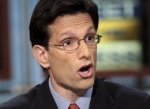
Cantor was scheduled to speak on income inequity at a lecture hosted by the Wharton business school. The Virginia Republican’s office said he called off the speech after learning that protesters planned to rally outside and attendance would not be limited to students and others affiliated with the school.
Ron Ozio, director of media relations at University of Pennsylvania, said the business school “deeply regrets” that the event was canceled.
“The university community was looking forward to hearing Majority Leader Cantor’s comments on important public issues, and we hope there will be another opportunity for him to speak on campus,” Ozio said in a statement. “The Wharton speaker series is typically open to the general public, and that is how the event with Majority Leader Cantor was billed. We very much regret if there was any misunderstanding with the Majority Leader’s office on the staging of his presentation.”
This is pretty disgusting: Libyans line up to see Gaddafi’s body on display; groups call for probe into death
International human rights groups called Friday for an investigation into the death of former Libyan leader Moammar Gaddafi as gory new videos showed him being spat at and punched by revolutionaries and as skepticism mounted about official claims that he was shot in crossfire after being captured.
The new cellphone videos cast a shadow over the revolutionaries even as they were celebrating the end of their eight-month struggle to wrest control of the country. NATO had backed the rebels in the name of shielding pro-democracy civilians from Gaddafi’s brutality.
“The government version certainly does not fit with the reality we have seen on the ground,” said Peter Bouckaert of Human Rights Watch, who has been investigating the capture of Gaddafi in his home town of Sirte. Amnesty International warned that the killing could be a war crime.
Why do I suspect the U.S. Government gave the go-ahead for Gaddafi to be executed, just like Osama bin Laden? You might want to read Joseph Cannon’s take on this one.
Finally, late last night the Volker Rule was number 1 in Google’s top stories. From the NYT:
When Paul Volcker called for new rules in 2009 to curb risk-taking by banks, and thus avoid making taxpayers liable in the future for the kind of reckless speculation that caused the financial crisis and resulting bailout, he outlined his proposal in a three-page letter to the president.
Last year, when the Dodd-Frank Wall Street Reform and Consumer Protection Act went to Congress, the Volcker Rule that it contained took up 10 pages.
Last week, when the proposed regulations for the Volcker Rule finally emerged for public comment, the text had swelled to 298 pages and was accompanied by more than 1,300 questions about 400 topics.
Wall Street firms have spent countless millions of dollars trying to water down the original Volcker proposal and have succeeded in inserting numerous exemptions. Now they’re claiming it’s too complex to understand and too costly to adopt.
Gee, what a surprise. I wonder how many of those millions were taxpayer dollars?
So…what are you reading and blogging about today?
Student Loans: Bubble, Bubble, Toil & Trouble
Posted: October 19, 2011 Filed under: education, unemployment | Tags: Sallie Mae, student loan bubble, student loans 15 Comments I laughed pretty loudly when I opened an email from the university to my faculty account explaining how wonderful the increased retention numbers were looking! Our new funding formula from extortionist governor Bobby Jindal depends on graduating and retaining students. I guess they don’t have economists in that section of administration. Just look at the unemployment rate for the typical student population (16-24 year olds) and the decreasing labor force participation rate from August, 2011. You’ll see exactly what’s going on. Got no job? Where do you go to find money and hopefully place yourself higher up on the meat market ladder if businesses ever go back to hiring?
The number of unemployed youth in July 2011 was 4.1 million, down from 4.4 million a year ago. The youth unemployment rate declined by 1.0 percentage point over the year to 18.1 percent in July 2011, after hitting a record high for July in 2010. Among major demographic groups, unemployment rates were lower than a year earlier for young men (18.3 percent) and Asians (15.3 percent), while jobless rates were little changed for young women (17.8 percent), whites (15.9 percent), blacks (31.0 percent), and Hispanics (20.1 percent).
So, we’ve got the biggest numbers of young people since the baby boom with parents whose employment situation is not great and whose assets and real incomes have taken a major hit over the last ten years. We’ve got kids that can’t even find the usual kid jobs. What are they going to do but go for those student loans and hang at university as long as possible? This brings me to the next big bubble phenomenon–Student Loans–plus the next GSE that’s going to be seeing default rates sky rocket. That would be Sallie Mae.
The $1 trillion of outstanding loans means that Americans now owe more on student loans than on their credit cards. While students have been racking up educational loans, American consumers have been paying down credit cards and home loans.
The average full-time undergraduate student borrowed $4,963 in 2010, up 63 percent from a decade earlier, even after adjusting for inflation, the report says.
Meanwhile, with a greater loan burden, the percentage of borrowers that defaulted on their student debts also rose – from 6.7 percent in 2007 to 8.8 percent in 2009.
That gives a lot of credence to the argument that the next big bubble will be in student loans. Here’s an investor’s view point from seeking alpha from back in July. Should we all start hedge funds and short student loans? Well, for one thing. You can short sell for profit university’s stocks who thrive on churning loans and assume Sallie Mae will be a goner just like its buddies Fannie and Freddie. Dump their bonds and short them!
With the current state of the job market, many if not most of these unfortunate borrowers will not be able to pay off their debt with a lower than expected income. This trend is showing itself through increasing default rates of student loans. Three-year default rates have risen from 11.8% for loans issued in 2007 to 13.8% issued in 2008 (most recent data available). Meanwhile, the fundamental factors driving these defaults have not changed since.
Historically, investors have not worried about the default of these securities because of their explicit government guarantees through FFELP. In addition to this, student loans are the only debt that cannot be forgiven through bankruptcy. Student loan collectors have gone to the extent of garnishing wages and racking up penalties that can double the borrower’s debt in the name of “forgiveness” to maintain a return for bondholders.
This story sounds similar to housing: If the borrowers fail to pay, lenders seize the asset (house for a mortgage, garnished wages for student loans). The story will end the same way, as students lack the income to maintain their living expenses plus the debt or even just the interest payments if they are unemployed. The other option that students will begin to take more is moving abroad to avoid collectors. Financial distress will make it practical to exile oneself to avoid a lifetime of debt slavery. The combination of lower incomes for college grads and expatriation will increase the default rate to even high levels than current record rates.
So how do investors go about shorting the bubble in higher education? Ideally, the best way would be to buy credit default swaps on student loan asset-backed securities, which have a similar construction to the mortgage-backed securities that caused the last financial crisis. However, this strategy is not available to most readers. Average investors are better off short-selling the leading providers of student loans or for-profit universities, which have some of the highest default rates of student loans for any academic institution.
The leading student loan provider in the United States in the Sallie Mae corporation (SLM). It was launched as a government-sponsored enterprise (since privatized) similar to Freddie Mac and Fannie Mae; it currently services and manages $180.4 billion of government-backed student loan debt. It’s also begun to issue private student loans as well. With a debt to equity ratio of 36, Sallie Mae is already on the edge of insolvency. A small drop in collections can amount to significantly levered losses to the company. If the student loan default rate increases to 20%, Sallie Mae will most likely not be able to survive. The continuing upward trend of student loan defaults will lead to either insolvency of Sallie Mae or a government takeover — which will both wipe out shareholders.
Above the Law even asked if there was any one out there left that even believed that this wasn’t a disaster waiting to happen. How’s this for harsh?
The problem is that our colleges and universities are charging a $100,000 to pump out the next generation of dog walkers. Sure, part of the fault lies with the people themselves; parents who let their 18-year-old children borrow a ton of money to go to an expensive private university to major in art history are no better than strung out crack mothers.
But the dean who sits there and says, “come study comparative literary criticism for the low, low price of $40,000 per year,” is the price-gouging drug dealer. These deans are pushing a product at a price point that they know is dangerous for most of their consumers.
This is what worries me. This is also from Above the Law and it mentions just how married you and yours going to be to that student loan. Not only that, but graduate students will have a much bigger balances to pay in the future thanks to an Obama sell-out on the deficit. Talk about setting people up for loan failure. Why not just pump the least able to pay for more money?
In the total debt ceiling cave-in that will mark Barack Obama as the most successful Republican president since Ronald Reagan, there was one cut that really illustrates how little the president cares for his young, college-educated constituents. To save about $26.3 billion dollars, the debt ceiling deal eliminates the graduate student loan subsidy. That means that law students (and other grad students) will continue accruing interest on their non-dischargeable educational loans throughout their graduate studies.
I can see why they call education the “silver bullet,” because education certainly seems like a surefire way to kill one’s economic future….
The graduate loan cut wasn’t the most ridiculous so-called compromise Obama made while John Boehner was pumping him like Richie Aprile did to Janice Soprano. But it is illustrative of the extent to which Obama has abandoned the young people who helped elect him so that he can court… well, I don’t know exactly what universe he lives in where he thinks a black Republican running as a pro-war Democrat wins a general election
Meanwhile back on the Planet of anecdotal evidence, we get these examples. Ask me about Doctor Daughter’s student loan debt or mine, for that matter. I got two degrees in the late 70’s and early 80s by working and that was it. I just couldn’t swing it this time. I now have student loan debt that would’ve bought me a Mercedes and I’m jobless and on the jobfree labor market. Sallie Mae’s like a loan shark too. They’re worse to deal with than the bookies in my neighborhood.
“I have ~$75k in student loans. I will default soon. My cosigner, my father, will be forced to take my loans. He will default as well. I’ve ruined my family because I tried to rise above my class,” writes one testimonial on the 99 percent website on Wednesday.
The 99 percent website is one of the places where the Occupy Wall Street movement first got its inspiration from.
“I am a young medical professional who BARELY makes it paycheck-to-paycheck because I have OVER $200,000.00 in student loan debt,” says another testimonial on the website Tuesday. “I pay almost $1,000 a month just in student loan repayment. I will have to do so for the next 30-years. How will I ever afford to buy a house, have children, or save for the future?”
Monday Morning Reads
Posted: October 10, 2011 Filed under: Global Financial Crisis, Marriage Equality, morning reads, Surreality, U.S. Military, U.S. Politics, unemployment, Women's Rights | Tags: Anita Hill, Crackerbox Palace, DOMA, George Harrison, Indigenous People's Day, National Coming Out Day, Native American Day, Occupy, Paul Krugman, plutocracy, Subprime mortgage crisis and the CRA, Taxes and poor people, technology, the Great Depression 25 Comments Good Morning!
and Happy Native Americans’ Day!
The second Monday of October annually marks Columbus Day in many parts the United States but not all states or region follow this observance. Instead, they celebrate other events on the day. For example, South Dakota’s official holiday on this date is Native Americans’ Day (also known as Native American Day), while people in Berkeley, California, celebrate Indigenous People’s Day.
 I think it’s a great idea to switch the current federal holiday out to a celebration of indigenous cultures or maybe find a better thing to celebrate!
BTW, National Coming Out Day is Tomorrow. That’s something to remember as you read that Speaker Boehner is threatening to withold funds from the Justice Department if that don’t vigorously enforce DOMA. There he goes again!!! The Republican Jobs Agenda is just always topmost on the priority list.
“We’re going to take the money away from the Justice Department, who’s supposed to enforce it, and we’ll use it to enforce the law,” Boehner told the conservative Value Voters Summit.
Boehner is engaged in an ongoing dispute with Attorney General Eric Holder over his refusal to defend in court the Defense of Marriage Act. President Obama has taken the stance that the law is unconstitutional. While the Justice Department usually defends laws passed by Congress against legal challenges, the Obama administration has stopped defending DOMA while Democrats work to repeal the law.
In March, Boehner announced that if Obama wouldn’t defend DOMA, he would, hiring a private law firm to defend it on behalf of the House.
“As the Speaker of the House, I have a constitutional responsibility. I’ve raised my hand to uphold and defend the Constitution of the United States and the laws of our country,” Boehner said Friday.
You know, he’s all about saving those taxpayer dollars too. True Story.
Here’s a movement I want to join if this California Republican Nutter would only give me the location where they’re taking on volunteers. And yes, it’s a REAL tweet.
@RepJackKimble After Value Voters I am more convinced than ever about the radical atheist agenda to secularize Columbus Day
Okay, I’d like to use the next bit of space to clear up a few right wing memes with actual research. I know, you’re shocked, it’s so unlike me to do so. First, while Fannie and Freddie exacerbated the meltdown and behaved as irresponsibly as any Wall Streeter, there is absolutely no connection between the meltdown and the Community Reinvestment Act. I have never been able to figure out how folks jumped the shark to make this connection, but it happened. I’ll give you the bottom line from the abstract but if you want to chase after the econometrics, feel free to follow the link.
In this paper we examine more directly whether these programs were associated with worse outcomes in the mortgage market, including delinquency rates and measures of loan quality.
We rely on two empirical approaches. In the first approach, which focuses on the CRA, we conjecture that historical legacies create significant variations in the lenders that serve otherwise comparable neighborhoods. Because not all lenders are subject to the CRA, this creates a quasi-natural experiment of the CRA’s effect. We test this conjecture by examining whether neighborhoods that have been disproportionally served by CRA-covered institutions historically experienced worse outcomes. The second approach takes advantage of the fact that both the CRA and GSE goals rely on clearly defined geographic areas to determine which loans are favored by the regulations. Using a regression discontinuity approach, our tests compare the marginal areas just above and below the thresholds that define eligibility, where any effect of the CRA or GSE goals should be clearest.
We find little evidence that either the CRA or the GSE goals played a significant role in the subprime crisis. Our lender tests indicate that areas disproportionately served by lenders covered by the CRA experienced lower delinquency rates and less risky lending. Similarly, the threshold tests show no evidence that either program had a significantly negative effect on outcomes.
Okay, one more meme to shoot down. You know how all those Republican presidential wannabes are trotting around saying about half of Americans don’t pay taxes and the rich are still burdened? I’ve shot down some of that argument before, but here’s some further details. I’m quoting from the executive summary and not the study itself. Again, you can go into the methodology if you want here.
A recent finding by Congress’ Joint Committee on Taxation that 51 percent of households owed no federal income tax in 2009 [1] is being used to advance the argument that low- and moderate-income families do not pay sufficient taxes. Apart from the fact that most of those who make this argument also call for maintaining or increasing all of the tax cuts of recent years for people at the top of the income scale, the 51 percent figure, its significance, and its policy implications are widely misunderstood.
- The 51 percent figure is an anomaly that reflects the unique circumstances of 2009, when the recession greatly swelled the number of Americans with low incomes and when temporary tax cuts created by the 2009 Recovery Act — including the “Making Work Pay” tax credit and an exclusion from tax of the first $2,400 in unemployment benefits — were in effect. Together, these developments removed millions of Americans from the federal income tax rolls. Both of these temporary tax measures have since expired.
In a more typical year, 35 percent to 40 percent of households owe no federal income tax. In 2007, the figure was 37.9 percent. [2]- The 51 percent figure covers only the federal income tax and ignores the substantial amounts of other federal taxes — especially the payroll tax — that many of these households pay . As a result, it greatly overstates the share of households that do not pay any federal taxes. Data from the Urban Institute-Brookings Tax Policy Center show only about 14 percent of households paid neither federal income tax nor payroll tax in 2009, despite the high unemployment and temporary tax cuts that marked that year.[3]
- This percentage would be even lower if federal excise taxes on gasoline and other items were taken into account.
- Most of the people who pay neither federal income tax nor payroll taxes are low-income people who are elderly, unable to work due to a serious disability, or students, most of whom subsequently become taxpayers. (In a year like 2009, this group also includes a significant number of people who have been unemployed the entire year and cannot find work.)
- Moreover, low-income households as a whole do, in fact, pay federal taxes. Congressional Budget Office data show that the poorest fifth of households as a group paid an average of 4 percent of their incomes in federal taxes in 2007 (the latest year for which these data are available), not an insignificant amount given how modest these households’ incomes are — the poorest fifth of households had average income of $18,400 in 2007. [4] The next-to-the bottom fifth — those with incomes between $20,500 and $34,300 in 2007 — paid an average of 10 percent of their incomes in federal taxes.
- Even these figures understate low-income households’ total tax burden, because these households also pay substantial state and local taxes. Data from the Institute on Taxation and Economic Policy show that the poorest fifth of households paid a stunning 12.3 percent of their incomes in state and local taxes in 2010.[5]
- When all federal, state, and local taxes are taken into account,the bottom fifth of households paid 16.3 percent of their incomes in taxes, on average, in 2010. The second-poorest fifth paid 20.7 percent. [6]
I know it’s statistics heavy, but some times that’s the best way to see what is actually going on. Right wing memes seem to thrive on taking things completely out of context and this one about tax dodging poor people is a doozy. See exactly how many taxes that get paid that weren’t counted in that famous figure which is an anomaly as it is.
Here’s an interesting article at NYT by David Leonhardt on how today’s economy makes the Great Depression look like the halcyon days.
Still, the reasons for concern today are serious. Even before the financial crisis began, the American economy was not healthy. Job growth was so weak during the economic expansion from 2001 to 2007 that employment failed to keep pace with the growing population, and the share of working adults declined. For the average person with a job, income growth barely exceeded inflation.
The closest thing to a unified explanation for these problems is a mirror image of what made the 1930s so important. Then, the United States was vastly increasing its productive capacity, as Mr. Field argued in his recent book, “A Great Leap Forward.” Partly because the Depression was eliminating inefficiencies but mostly because of the emergence of new technologies, the economy was adding muscle and shedding fat. Those changes, combined with the vast industrialization for World War II, made possible the postwar boom.
In recent years, on the other hand, the economy has not done an especially good job of building its productive capacity. Yes, innovations like the iPad and Twitter have altered daily life. And, yes, companies have figured out how to produce just as many goods and services with fewer workers. But the country has not developed any major new industries that employ large and growing numbers of workers.
There is no contemporary version of the 1870s railroads, the 1920s auto industry or even the 1990s Internet sector. Total economic output over the last decade, as measured by the gross domestic product, has grown more slowly than in any 10-year period during the 1950s, ’60s, ’70s, ’80s or ’90s.
Perhaps the most important reason, beyond the financial crisis, is the overall skill level of the work force. The United States is the only rich country in the world that has not substantially increased the share of young adults with the equivalent of a bachelor’s degree over the past three decades. Some less technical measures of human capital, like the percentage of children living with two parents, have deteriorated. The country has also chosen not to welcome many scientists and entrepreneurs who would like to move here.
I’m still of the opinion that we should hand out citizenship to any of our highly skill foreign students and do everything we can to keep them here. I have a feeling I’m in the minority on that opinion, however.
If you want to do some time tripping to a really upsetting period of history for women, here’s The Nation on The Legacy of Anita Hill. We’re now stuck with this total jerk on SCOTUS because of people like Joe Biden. I’ll never forget one of those senators that let Clarence Thomas get away with it. They hid the women that could verify her stories and put her squarely in the worst position possible. She handled it with dignity and we all lost.
Anita Hill remains an icon to whom subsequent generations are rightfully indebted. At the same time, she has not remained trapped by her own symbolism or frozen in time. It is sometimes forgotten that she is a respected scholar of contract jurisprudence, commercial law and education policy. She is a prolific author, publishing numerous law review articles, essays, editorials and books. Today, Hill is a professor of social policy, law and women’s studies at Brandeis University. Much of her most recent research has been on the housing market, and her most recent book, published this month, is Reimagining Equality: Stories of Gender, Race, and Finding Home.
It is ironic that the full substance of Hill’s remarkable intellectual presence remains so overshadowed by those fleeting, if powerful, moments of her Senate testimony. If the larger accomplishments of her life aren’t quite as iconic as that confrontation with Clarence Thomas, they nonetheless merit attention by feminists and scholars alike. To begin with, Hill is a remarkably elegant and accessible writer. For those who wish to apprehend the gravitas of her intelligence and dignity, Reimagining Equality would be a good place to start.
Krugman gets the Occupy protestors and has some delightful comments up on the Panic of the Plutocrats. He eloquently lays out the hype coming from the Cantors and the Bloombergs as well as CNBC and Fox that paints every one upset with their behavior as Leninist. The descriptions are a hoot but here’s the meat.
The way to understand all of this is to realize that it’s part of a broader syndrome, in which wealthy Americans who benefit hugely from a system rigged in their favor react with hysteria to anyone who points out just how rigged the system is.
Last year, you may recall, a number of financial-industry barons went wild over very mild criticism from President Obama. They denounced Mr. Obama as being almost a socialist for endorsing the so-called Volcker rule, which would simply prohibit banks backed by federal guarantees from engaging in risky speculation. And as for their reaction to proposals to close a loophole that lets some of them pay remarkably low taxes — well, Stephen Schwarzman, chairman of the Blackstone Group, compared it to Hitler’s invasion of Poland.
And then there’s the campaign of character assassination against Elizabeth Warren, the financial reformer now running for the Senate in Massachusetts. Not long ago a YouTube video of Ms. Warren making an eloquent, down-to-earth case for taxes on the rich went viral. Nothing about what she said was radical — it was no more than a modern riff on Oliver Wendell Holmes’s famous dictum that “Taxes are what we pay for civilized society.”
I have one more offering that is just for pure delight. It’s a short bit from the daughter of George Harrison’s Business Manager on what it was like to run the halls of crackerbox palace as a child.
Harrison’s wife, Olivia, always took good care of us and, like her husband, had a gentle, calming disposition. I loved going up the great gothic staircase in the living room to the recording studio on the first floor. I was fascinated by the recording console and the selection of instruments. Sometimes, Harrison would play new music for us and ask for our feedback.
Adjacent to the recording studio was a room with gold records and awards and an Oscar statuette. I remember the exhilarating sensation I got picking up the Oscar earned for “Let It Be” and feeling it weigh down my hand.
When it got late, and Dad was still in meetings, we would go to bed in one of the guest rooms down the hall from the studio with sounds of Harrison’s sitar lulling us to sleep.
You can see I’m full throttle academic today. What’s on your reading and blogging list today?
Reid Goes Nuclear
Posted: October 6, 2011 Filed under: Democratic Politics, jobs, unemployment | Tags: Harry Reid, Senate Nuclear option 8 Comments After endless Republican maneuvers to block any legislative progress in Congress, Harry Reid triggered the so-called “nuclear option” to stop a Republican attempt at symbolic vote on the President’s job bill that was bound to embarrass Reid. This move is a rarely used procedural option. The goal is to block republican amendments that are proposed after the senate has moved to vote on final passage of the bill.
Reid’s coup passed by a vote of 51-48, leaving Senate Republican Leader Mitch McConnell (R-Ky.) fuming.
The surprise move stunned Republicans, who did not expect Reid to bring heavy artillery to what had been a humdrum knife fight over amendments to China currency legislation.
The Democratic leader had become fed up with Republican demands for votes on motions to suspend the rules after the Senate had voted to limit debate earlier in the day.
McConnell had threatened such a motion to force a vote on the original version of President Obama’s jobs package, which many Democrats don’t like because it would limit tax deductions for families earning over $250,000. The jobs package would have been considered as an amendment.
McConnell wanted to embarrass the president by demonstrating how few Democrats are willing to support his jobs plan as first drafted. (Senate Democrats have since rewritten the jobs package to pay for its stimulus provisions with a 5.6 surtax on income over $1 million.)
Reid’s move strips the minority of the power of forcing politically-charged procedural votes after the Senate has voted to cut off a potential filibuster and move to a final vote, which the Senate did on the China measure Tuesday morning, 62-38.
Reid said motions to suspend the rules after the Senate votes to end debate — motions which do not need unanimous consent — are tantamount to a renewed filibuster after a cloture vote.
“The Republican Senators have filed nine motions to suspend the rules to consider further amendments but the same logic that allows for nine such motions could lead to the consideration of 99 such amendments,” Reid argued before springing his move.
Reid said Republicans could force an “endless vote-a-rama” after the Senate has voted to move to final passage.
This move came as a result of Reid trying to usher through a vote on the China currency bill. McConnell wanted to force the vote on the Obama jobs bill to demonstrate the split in the Democratic caucus on the measure. As outlined below, McConnell tried to attach the jobs bill to the Currency bill. Reid outmaneuvered them.
Tonight, McConnell made what’s called a “motion to suspend the rules,” to allow a vote on the amendments. Such motions are almost always defeated, because they require a two-thirds majority to pass. But they’re another way for the minority party to force uncomfortable votes. Even though the minority party doesn’t get a direct vote on the amendment, how somebody votes on the motion becomes a sort of proxy for such a vote. In this case, for instance, if Democrats had voted down a motion for a vote on Obama’s jobs bill, it would have put them in an awkward spot.
Though it’s been the standing practice of the Senate to allow such motions by the minority, tonight Reid broke with precedent and ruled McConnell’s motion out of order, and was ultimately backed up by Democrats.
So, the end result is that by a simple majority vote, Reid was able to effectively rewrite Senate rules making it even harder than it already is for the minority party to force votes on any amendments. Should Republicans retake the Senate next year, it’s something that could come back to haunt Democrats in a major way.
And just to clear up some confusion, what happened tonight was different than the so-called “nuclear option” to end filibusters. While triggering the “nuclear option” requires a Majority Leader to use the same sort of strategic maneuvers as Reid just did, tonight’s move had to do with the amendment process, not filibusters.
As I mentioned the other day, there are a lot of really nervous DINOs who are balking at the measures proposed by Obama to pay from the jobs act.
Democrats in the Senate were divided over the president’s original offsets to pay for his plan, most notably his call to cap deductions for families that earn more than $250,000 annually. But to unite their party, they scrapped his proposed offsets and instead added a 5.6 percent surtax on those who earn more than $1 million annually as the main way to pay for the $447 billion in spending on infrastructure and incentives for companies hiring new workers.
Before those changes were made and sensing Democratic divisions on the original plan, McConnnell went to the floor earlier this week and demanded that the president’s bill be voted on immediately — given the president’s repeated demands to pass his bill “now.”
But Reid blocked that effort, and Democrats are now moving forward with plans to bring the latest version to the floor early next week. Reid and his Democratic leadership team plan to meet at the White House on Thursday evening to talk about their strategy for the plan.
Republicans are opposed to the tax increases and spending levels in the plan and are well-positioned to block it next week since 60 votes are needed to break a filibuster. And there isn’t unanimity even among the 53-member Senate Democratic Caucus.
Nebraska Sen. Ben Nelson, a conservative Democrat who faces a tough reelection next year, said he’ll vote against efforts to bring the bill forward for debate.
If you want more background on the Democratic infighting, you can check out my post from a few days ago here. My guess is that the current polling situation has begun to make it clear to the Democratic party officials that they’re in a heap of trouble. Obama’s polling worse each day. Reid undoubtedly doesn’t want to lose his position in the Senate leadership. I keep wondering why they haven’t pulled the rug out from Mitch McConnell much earlier but I’m assuming they’ve taken their cues from the White House. Maybe this is the start of a bit more gumption.
Live Blog: Unions Join #OccupyWallStreet for March in NYC Today!
Posted: October 5, 2011 Filed under: #Occupy and We are the 99 percent!, The Great Recession, U.S. Economy, U.S. Politics, unemployment | Tags: economy, greed, jobs, occupy Wall Street, protests. MSNBC, unemployment, unions 31 Comments
I have to admit, I’m getting really excited by the way the #OccupyWallStreet movement is taking off. I just got home and turned on MSNBC to find that they are covering the Wall Street protests live this afternoon. They have a number of network personnel on the ground, including Dylan Ratigan. And get this: even Beltway Bob is there! That has to be sign that the mainstream Villagers are taking note.
Right now Harrison Schultz, a spokesman for the protesters is on, and he just said, “I call this a revolution. No one is organizing it. It’s just happening.” He says the media is obsolete. The media thinks they are driving people to the protest, but that’s not true. If he would in charge of a major media outlet, he would be nervous now, because this would be happening whether the mainstream media paid attention or not. He says no one knows what is going to happen or where this will go.
The union march will take place at 4:30 this afternoon, according to MSNBC, but ABC says 3PM. If you have access to MSNBC right now, please watch with us and let us know if anything is happening in your area. Awhile ago, they put up a map to show where all the protests are now, and they were in so many states! I’ll see if I can find the map and post it. Meanwhile, here is a little about what we can expect this afternoon.
The cavalry has arrived in Lower Manhattan. Representatives from no fewer than 15 of the country’s largest labor unions will join the Occupy Wall Street protesters for a mass rally and march today in New York City.
The AFL-CIO, United Auto Workers, and Transit Workers’ Union are among the groups expected to stand in solidarity with the hundreds of mostly young men and women who have spent the better part of three weeks sleeping, eating, and organizing from Zuccotti Square.
Their arrival is being touted as a watershed moment for the “Occupy” movement, which has now seen copycat protests spring up across the country. And while the specific demands of the “occupiers” remain wide-ranging, the presence of the unions – implicitly inclined to making more direct demands – may sharpen their focus.
Today’s action is scheduled to begin at 3 p.m. ET, when the protesters in Zuccotti Square march approximately one mile north to Foley Square, where they will be met by community and labor leaders. Then, at 4:30 p.m., they plan to match together back down toward Wall Street. They do not yet have a city-issued permit for the gathering, but are now pursuing one.
ABC is anticipating more arrests today, but on MSNBC, a spokesman said the unions got a permit for today’s march. Furthermore, if NYC chooses to try to break up the protests today, it will only help the growth of this movement.
Here’s a report from Democracy Now today:
UPDATE: MSNBC has moved on to other things for now. But the Guardian has a live blog. It figures we have to go to a British newspaper to find out what’s happening in our own country.

 peej
peej Carissa
 bostonboomer
 dakinikat
 ecocatwoman
 mablue2
 Mama Lopez
 peggysue22
 quixote
 skydancingguestblogger
 Mona (aka Wonk the Vote)



 Sky Dancing
Recent Comments