
The Great Obama Mystery
Posted: July 6, 2011 Filed under: Barack Obama, Catfood Commission, Economy, Federal Budget and Budget deficit, U.S. Economy, U.S. Politics, unemployment, voodoo economics, We are so F'd | Tags: Barack Obama, Budget Deficit, cat food commission, Debt Ceiling, economics, economisits, President Pushover, Ronald Reagan, unemployment 25 Comments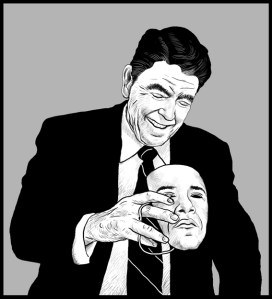
As Dakinikat has explained again and again and again and again, the problem our economy faces is that millions of Americans don’t have any money to spend because they don’t have jobs. Our economy runs on consumer spending. When people don’t have jobs, they don’t have money to spend on consumer items. That hurts our economy. It’s pretty simple, really.
But President Obama doesn’t understand simple basic economics. He’s already decided that high levels of unemployment are “structural.” He thinks our problem is that the government is spending too much money. Yesterday Obama gave another big ol’ nothingburger of a speech on how he’s giving away the store to negotiating with the Republicans in Congress.
Now, I’ve heard reports that there may be some in Congress who want to do just enough to make sure that America avoids defaulting on our debt in the short term, but then wants to kick the can down the road when it comes to solving the larger problem of our deficit. I don’t share that view. I don’t think the American people sent us here to avoid tough problems. That’s, in fact, what drives them nuts about Washington, when both parties simply take the path of least resistance. And I don’t want to do that here.
No, Mr. President, what is driving Americans “nuts” about Washington is that you and your Republican pals seem to be determined to crash the economy. Another thing that drives American’s “nuts” is that you haven’t lifted a finger to do anything about jobs since you took office. All you’ve done is take care of your superrich pals so they’ll donate to your next campaign.
I’ll bet you don’t even know that the latest PPP Poll shows that most Americans want to raise taxes on higher income people.
Poll data by the Democratic-aligned Public Policy Polling released Wednesday said voters in Ohio, Missouri, Montana and Minnesota back hiking taxes on the wealthy — even for people with incomes as low as $150,000.
The respondents were asked: “In order to reduce the national debt, would you support or oppose raising taxes on those with incomes over $1,000,000 a year?”
Nearly 80 percent of voters in the four states backed the idea.
And, BTW, Senator Reid, I’m pretty sure these voters want real tax increases, not phoney “sense of the Senate” resolutions. Back to Obama’s mealy-mouthed speech:
I believe that right now we’ve got a unique opportunity to do something big — to tackle our deficit in a way that forces our government to live within its means, that puts our economy on a stronger footing for the future, and still allows us to invest in that future.
Most of us already agree that to truly solve our deficit problem, we need to find trillions in savings over the next decade, and significantly more in the decades that follow. That’s what the bipartisan fiscal commission said, that’s the amount that I put forward in the framework I announced a few months ago, and that’s around the same amount that Republicans have put forward in their own plans. And that’s the kind of substantial progress that we should be aiming for here.
And on and on, bla bla bla…
I don’t know who you mean by “most of us” Mr. O, but I’m pretty sure most of us citizens don’t support the findings of your right wing cat food commission bipartisan fiscal commission.
President Obama just doesn’t get it. He might be able to learn a little bit about economics if he would just hire a few actual economists to advise him. But the big O thinks he already learned all he needs to know by listening to Ronald Reagan back in the ’80s. All of his economics advisers have left the sinking ship resigned, because Mr. O thought he knew better than they did. Remember this quote?
In his biography of Obama, “The Bridge,” David Remnick, editor of The New Yorker, quotes White House senior adviser and longtime Obama friend Valerie Jarrett: “I think Barack knew that he had God-given talents that were extraordinary. He knows exactly how smart he is. … He knows how perceptive he is. He knows what a good reader of people he is. And he knows that he has the ability — the extraordinary, uncanny ability — to take a thousand different perspectives, digest them and make sense out of them, and I think that he has never really been challenged intellectually. … So what I sensed in him was not just a restless spirit but somebody with such extraordinary talents that had to be really taxed in order for him to be happy. … He’s been bored to death his whole life. He’s just too talented to do what ordinary people do.”
You need to snap out of it, Mr. President; because our country is in big big trouble right now, and you’re really not as smart as you think you are.
Paul Krugman is an actual economist, and his hair is on fire. He can’t figure out what the President has against Keynesian economics.
I’m not alone in marveling at the extent to which Obama has thrown his rhetorical weight behind anti-Keynesian economics; Ryan Avent is equally amazed, as are many others. And now he’s endorsing the structural unemployment story too.
To those defending Obama on the grounds that he’s saying what he has to politically, I have two answers. First, words matter — as people who rallied around Obama in the first place because of his eloquence should know. Yes, he has to make compromises on policy grounds — but that doesn’t mean he has to adopt the right’s rhetoric and arguments. The effect of his intellectual capitulation is that we now have only one side in the national argument.
Second, since Obama keeps talking nonsense about economics, at what point do we stop giving him credit for actually knowing better? Maybe at some point we have to accept that he believes what he’s saying.
Why is Obama doing this, Krugman wants to know. It can’t be because he’s just stupid, can it? (That’s me, not Krugman)
Anyway, now Obama is handling the decisions about the economy all by himself. He’s even decided to “take the lead” in the budget talks with the Republicans–probably because he didn’t think VP Biden was caving quickly enough to Republican demands. Today,
CBS News reported that Obama wants to give the Republicans twice as much as they were originally asking for.
Two Democratic officials familiar with the negotiations over a deal to raise the debt limit said Wednesday that President Obama wants the final deal to be bigger than the $2 trillion deal that has been the focus of negotiations so far.
In fact, they said, Mr. Obama wants the deal to save the government as close to $4 trillion as possible.
Mr. Obama said Tuesday that lawmakers have “a unique opportunity to do something big,” and a deal to save the federal government $4 trillion would certainly qualify. The officials said the president believes “these moments come around at most once a decade” and that “you can’t run away from an opportunity like this.”
According to the officials, Mr. Obama believes that a larger deal would actually be easier to get through Congress. His thinking, they indicated, is this: Any major deal, whether it’s for $2 trillion in cuts or $4 trillion in cuts, will cause significant pain for both parties. But a larger deal allows backers to argue that despite their misgivings, they’ve taken a major step toward dealing with the deficit and debt problem.
Doesn’t Obama understand that cutting that much government spending is going to create even more unemployment? Is this man insane? No, he’s just a right wing Republican. Actually, maybe that does mean he’s insane.
Media Making Same Mistake with Bachmann They Made With Palin
Posted: June 27, 2011 Filed under: 2012 presidential campaign, Democratic Politics, Republican politics, Republican presidential politics, Team Obama, The Media SUCKS, U.S. Economy, U.S. Politics, unemployment, We are so F'd | Tags: 2012 presidential election, Barack Obama, Federal debt limit, Iowa, Michele Bachmann, Republicans, Sarah Palin 12 Comments
Michele Bachmann announcing her presidential run in Waterloo, IA
Michele Bachmann officially announced her candidacy for the GOP presidential nomination today in her birthplace of Waterloo, Iowa. In her speech, she talked about growing up in Waterloo and how as a young girl she didn’t want to move away to Minnesota.
I often say that everything I needed to know I learned in Iowa. It was at Hawthorne and Valley Park Elementary Schools and my home, both a short distance from here, where those Iowan roots were firmly planted. It’s those roots and my faith in God that guide me today. I’m a descendent of generations Iowans. I know what it means to be from Iowa—what we value and what’s important. Those are the values that helped make Iowa the breadbasket of the world and those are the values, the best of all of us that we must recapture to secure the promise of the future.
[….]
I’m also here because Waterloo laid the foundation for my own roots in politics. I never thought that I would end up in public life. I grew up here in Iowa. My grandparents are buried here. I remember how sad I was leaving Iowa to go to Minnesota in the sixth grade, because this part of Iowa was all I knew—I remember telling my parents that we couldn’t move to Minnesota because I hadn’t even been to Des Moines to see the state capitol.
I’m guessing Bachmann’s recollections of Iowa probably made a good impression on her audience, but multiple media outlets are focusing on a gaffe Bachmann made in talking to a reporter. She claimed that John Wayne was from Waterloo, but the only John Wayne born there was serial killer John Wayne Gacy.
Sure, that’s funny–and it’s one of many embarrassing gaffes made by Bachmann during her brief political career. But what is the point of ridiculing her about it while ignoring the scary policies she proposed in her speech? George W. Bush made lots of silly gaffes too, remember? But he was [I won’t say elected] President for two terms.
Furthermore, at conservative blog Hot Air, I learned the following.
It turns out there is a Waterloo connection for John Wayne:
Bachmann’s campaign pointed out to ABC News today that actor John Wayne’s parents did live in Waterloo, although the actor himself did not.
And a little internet research proves that point correct.
According to the book “Duke: We’re Glad We Knew You” by Herb Fagen, Clyde and Molly Morrison – actor John Wayne’s parents – lived in Waterloo early in their marriage – but they moved to Winterset before the birth of son Marion Mitchell Morrison (he changed his name to John Wayne professionally).Says Dave Weigel, “I’m not from a small town, but I’m from a pretty anonymous place (Wilmington, Delaware), and I know that when you’ve got a tenuous local connection to a celebrity, you flaunt it.” Someone probably once told her that John Wayne’s parents met in Waterloo and either she wrongly assumed he’d been born there or else she’s fumbling a talking point about John Wayne’s family being from Waterloo. But this is simply too stupid a story to devote any further thought to, so let’s move on.
I agree with Weigel. I’d rather focus on making sure Bachmann doesn’t manage to soften her extremist image enough to get the nomination and have a shot at beating Obama.
The most important part of the speech, according to Jonathan Chait is this:
“We can win in 2012 and we will,” said Bachmann in launching her campaign. “Our voice has been growing louder and stronger. And it is made up of Americans from all walks of life like a three-legged stool. It’s the peace through strength Republicans, and I’m one of them, it’s fiscal conservatives, and I’m one of them, and it’s social conservatives, and I’m one of them. It’s the Tea Party movement and I’m one of them.”
Here’s Chait’s argument:
Bachmann is trying to break out of the box of the social conservative movement candidate and define herself as a mainstream Republican. First, she declares she can win. Then she pledges her fealty to all three issue families of conservatism, leaving social conservatism for last.
One reason commentators have so grossly underestimated her chances is that they have an antiquated model of the Republican Party in their minds. In that model, religious conservatives are a faction set off from the rest of the party. Pat Robertson could finish a strong second in the 1988 Iowa Caucus, but his appeal was completely limited to right-wing Christians brought into politics by social issues. But the religious right has changed — its power to bend the party to its will has decreased, and its focus has largely merged with that of the GOP as a whole, so that the religious right is almost as concerned with economics and foreign policy as with social issues.
Bachmann represents that transformation. She came into politics through Christianity, but has broadened that style of apocalyptic thinking to economics and foreign policy. There is hardly any difference in the way Bachmann warns that Obama’s policies will destroy the traditional family and the way she warns his economic policies will destroy the economy, or that his foreign policy will lead to the triumph of our enemies. And there’s hardly any difference in the way she discusses these issues and the way most other Republicans do. They are all speaking the same apocalyptic language now.
Unfortunately, Chait is right. The Republican party has moved so far to the right that the nutty fringe is now becoming mainstream. If Bachmann runs for President the whole public conversation is going to move even further right. Just look where Obama is now. He’s more conservative than Nixon–hell he’s more conservative economically than Reagan! Reagan worried about unemployment and social security. Obama couldn’t care less if we have 10% unemployment and old people dying in the streets.
But what’s the “progressive” response to all this? Juli Weiner ridicules Bachman’s “favorite metaphor,” the three-legged stool.
Not to be obtuse, but we counted four (4) legs on the metaphoric stool: “peace-through-strength Republicans,” “fiscal conservatives,” “social conservatives,” and “the Tea Party movement.” Is the Tea Party movement the stool itself, and not one of its legs? We’re English majors with no background in carpentry, but we feel confident in our interpretation.
Who knows? Who cares? Not the Republicans in Iowa, and apparently not in Florida either. Do progressives really think Mitt Romney will win primaries in Indiana, Ohio, and Pennsylvania over Michele Bachmann? I don’t. Can Romney beat Bachmann in the south? Give me a break! We need to see the serious threat her candidacy poses.
Is the ridicule just because she’s a woman? Because it sure looks like Bachmann is going to get the same treatment that Palin got in 2008. That is a big mistake, in my opinion. And how is the Obama administration responding to Bachmann’s speech? I found this statement from spokesman Ben LaBolt at MSNBC.
Congresswoman Bachmann talks about reclaiming the American Dream but her policies would erode the path to prosperity for middle class families. She voted for a budget plan that would extend tax cuts for the richest Americans on the backs of seniors and the middle class while ending Medicare as we know it. Congresswoman Bachmann introduced legislation to repeal Wall Street oversight – risking a repeat of the financial crisis — and while she voted to preserve subsidies for oil and gas companies she opposes making the investments necessary to enhance America’s competitiveness and create the jobs of the future.
What is Obama doing about those issues? A great big nothing, as far as I can tell. I’m expecting him to give away the store to the Republicans during his “negotiations” on raising the debt limit. If Obama doesn’t offer something besides “I’m less horrible,” we could very well end up with our first woman President–and not the woman we all wanted back in 2008.
Bachmann should not be underestimated.
Thursday Reads: Greece, Golf, and the Stanley Cup
Posted: June 16, 2011 Filed under: 2012 presidential campaign, Economy, Republican presidential politics, The Bonus Class, U.S. Economy, U.S. Politics, unemployment, Violence against women | Tags: austerity, Barack Obama, Boston Bruins, golf, Greece, hockey, John Boehner, protesters, rape, Rick Perry, violence against women, Wall Street 12 Comments
Good Morning!!
Thousands of demonstrators have taken to the streets in Greece to protest austerity measures being forced on them by the government, the European Union and the International Monetary Fund (IMF). Government leaders are so nervous that
Prime Minister George Papandreou of Greece said on Wednesday that he would reshuffle his cabinet and request a vote of confidence in Parliament after talks with the opposition about a unity government foundered.
Earlier in the day….Mr. Papandreou offered to step aside so that his Socialist party could form a coalition government with the center-right opposition, but only if the opposition would support a new bailout plan for the debt-ridden country.
Mr. Papandreou’s support has been plummeting, even within his party, and the Socialists appear to be lagging behind the center-right opposition for the first time since the current government was elected in 2009. With a five-seat majority in Parliament, Mr. Papandreou has been struggling to get his government fully behind the measures and to contain growing rifts within his party.
Antonis Samaras, the leader of the center-right New Democracy party, has opposed spending cuts. He has called instead for tax breaks and a renegotiation of the terms of Greece’s agreement with its foreign creditors.
The markets reacted negatively to the situation in Greece.
Greece’s financial and political crisis, compounded by new fears about the pace of the United States economic recovery, sent financial markets reeling on Wednesday….
Anxious investors feared the situation could spin out of control, igniting a series of crises in other heavily indebted euro zone countries, like Portugal, Ireland and Spain. That, in turn, could threaten Europe’s banks and even reach into the United States financial system.
“We are pretty much giving back everything we got yesterday and more,” said Lawrence R. Creatura, a portfolio manager at Federated Investors, noting the rise in the main American indexes of more than 1 percent Tuesday. “Today the market just can’t escape the undertow of deteriorating economic data and political events.”
Awwww…poor little rich men…just let me break out my tiny violin.
In just a few days, President Obama will be playing golf and schmoozing with John Boehner, supposedly to try to come to a “compromise” on the raising the debt ceiling. But according to The New York Times, voters don’t relish seeing privileged politicians playing and watching golf with the economy being so bad for the majority of Americans.
…with two wars, a tight economy and a high national unemployment rate, the prevailing belief is that constituents do not want to see their representatives having fun at the golf course.
“Right now, some constituents think that members of Congress playing golf is a big deal and they don’t like it,” Tate Sr., who lobbies for the PGA Tour, said. “There is so much less talk about politicians going fishing or hunting, because that supposedly makes those members of Congress seem more normal. How ambushing and slaughtering another living creature makes you more normal, I have no idea. But it’s all about perception.”
Do Obama and Boehner care? Apparently not.
Here’s some good news for a change. Yesterday a bankruptcy judge in California followed the example of Massachusetts and declared the Defense of Marriage Act unconstitutional.
The decision issued by U.S. Bankruptcy Judge Thomas Donovan was prompted by a joint bankruptcy filing by a Los Angeles gay couple legally married in 2008. The U.S. trustee assigned to vet the filing by Gene Balas and Carlos Morales had asked Donovan to dismiss the Chapter 13 petition because the 15-year-old law, known as DOMA, restricts federal benefits like joint filings to marriages between a man and a woman. Donovan ruled that the law violated the Constitution’s equal protection guarantee.
Legal analysts said the ruling could have broad implications for gay spouses seeking equal treatment from federal agencies because it adds weight to two other federal court rulings in Massachusetts last year making their way through the appeals process.
The rulings last July by U.S. District Judge Joseph Tauro dealt only with the law as it affects Massachusetts residents, and Monday’s ruling by the Los Angeles bankruptcy court was likewise specific to the local case. But the rulings are seen as bellwethers for the possible extension of federal benefits to gay spouses in states where such marriages are legal, including the estimated 18,000 gay couples who wed in California in 2008.
Potential presidential candidate Rick Perry considers himself a “prophet.”
In his first national TV interview since presidential rumors surfaced, Perry answered Fox News’ Neil Cavuto question about why he’s so unpopular in his home state by suggesting he’s a “prophet”:
CAVUTO: You have kind of like the Chris Christie phenomenon: very popular outside your state, still popular but not nearly as popular within your state. There are even Tea Party groups within your state who like you but don’t love you. […] What do you say?
PERRY: I say that a prophet is generally not loved in their hometown. That’s both Biblical and practical.
You can watch the video at Think Progress.
An interesting trial will begin on Monday in New Hampshire. A woman who was raped by a member of her church and impregnated when she was only 15 years old may finally get a chance for justice.
Jury selection starts Monday at Merrimack Superior Court in New Hampshire in the case against Ernest Willis, who prosecutors charge raped Tina Anderson twice in her home in 1997, leaving her pregnant, the New Hampshire Union Leader reported.
The then-teenager was then compelled by leaders of the Trinity Baptist Church to apologize for becoming pregnant with a married man’s child, the Concord Monitor reported.
Willis, now 52, has admitted to the sex, but claims it was consensual.
Anderson, now 29, who asked media outlets to publicly identify her to draw attention to the case, told police the church’s pastor, Charles Phelps, spirited her away to another church member in Colorado in an effort to muddle a police investigation back in 1997.
Finally, a little provincialism once again…The Boston Bruins are the Stanley Cup Champions!!!!

America’s Housing Problem
Posted: June 15, 2011 Filed under: The DNC, unemployment | Tags: Foreclosures, home prices, US housing market, US jobs market 11 CommentsThe global financial crisis that resulted from a housing bubble may be over for U.S. banks and financial institutions but the 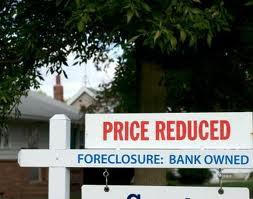 crisis is worsening for U.S. homeowners. Many mortgage holders still have underwater loans. Many home owners have absolutely no chance of selling their homes for any reasonable amount of money in a market that is now worse than the similar conditions present during The Great Depression. For many, the dream of home ownership has turned into a nightmare.
Prices have fallen some 33 percent since the market began its collapse, greater than the 31 percent fall that began in the late 1920s and culminated in the early 1930s, according to Case-Shiller data.
The news comes as the Federal Reserve considers whether the economy has regained enough strength to stand on its own and as unemployment remains at a still-elevated 9.1 percent, throwing into question whether the recovery is real.
“The sharp fall in house prices in the first quarter provided further confirmation that this housing crash has been larger and faster than the one during the Great Depression,” Paul Dales, senior economist at Capital Economics in Toronto, wrote in research for clients.
According to Case-Shiller, which provides the most closely followed housing industry data, prices dropped 1.9 percent in the first quarter, a move that the firm interpreted as a clear double dip in prices.
Moreover, Dales said prices likely have not completed their downturn.
“The only comfort is that the latest monthly data show that towards the end of the first quarter prices started to fall at a more modest rate,” he said. “Nonetheless, prices are likely to fall by a further 3 percent this year, resulting in a 5 percent drop over the year as a whole.”
Home equity has traditionally been a source of wealth and retirement savings for generations of Americans. Falling house prices not only have a negative impact on American wealth, they may be impacting the ability of American households to move where the jobs may be. The ability to move–called labor mobility by economists–is important in a recovery because it leads to stronger job markets.
Economists Colleen Donovan and Calvin Schnure have written an interesting new paper examining whether the fall in house prices since 2007 in the US — which has left many home-owners owing more on their house than it is worth — created a lock-in effect that depressed labor mobility.
This question has significance far beyond either the real estate market or the labor market, because there has been a persistent line of argument from some that the US’s current unemployment problem is not the result of insufficient demand, but is instead a “structural” problem resulting from the inability of the US economy to properly match people with available jobs. A frequent explanation for why it suddenly became difficult to match people with jobs in 2008 is that underwater mortgages have locked people in to their houses, reducing labor mobility and making job-matching more difficult.
The evidence presented in this paper indicates that the fall in house prices has indeed caused a “lock-in” effect, but has not significantly impacted labor market efficiency.
This may be an important factor in explaining persistent unemployment. There has been an argument out there that unemployment is due to ‘structural’ problems which would imply that government programs may not be effective as possible in solving job market issues. This study implies–along with recent data on falling household consumption–that the U.S. continues to have a demand problem. This means that traditional fiscal stimulus and programs could be an effective way to stop both the freefall in home prices and improve the employment outlook. Housing affordability is not an issue in this market. Home prices and mortgage interest rates are have made affordability metrics reach near-historic levels. Other factors are constraining the market.
More than four in every five mortgages now require a down payment of 20 percent, and credit history standards have tightened. At the same time, foreclosures continue at a brisk pace, pushing more supply onto the market and pressuring prices downward.
Then there is the issue of underwater homeowners—those who owe more than their house is worth—representing another 23 percent of homeowners who cannot leave or are in danger of mortgage default.
Indeed, the foreclosure problem is unlikely to get any better with 4.5 million households either three payments late or in foreclosure proceedings. The historical average is 1 million, according to Dales’ research.
We’re basically a situation where the Freddie and Fannie situation is unresolved. The historically low interest rates and high availability of cheap money means that huge institutions are making money from arbitrage and investing rather then lending and investing in non-financial projects. Small-to-medium sized businesses do not have the same funds availability of large corporations. Neither do consumers. Clearly, the Fed is going to start increasing interest rates as signs of price inflation appear on the horizon. This may wring the arbitration profit-seeking behavior of larger firms, but it will further squeeze consumers and small-to-medium businesses that have been hanging on waiting for increased demand.
This is a clear signal that the economy is experiencing demand-side problems which require fiscal policy solutions that stimulate demand. Meanwhile, Washington DC policy makers are focused on the long-term issue of fiscal sustainability. Republicans are still discussing debt default to the point that Fed Chairman Ben Bernanke made a point of mentioning the detrimental impact of that move in a recent speech. The strategy of playing chicken with the federal debt for personal political gain is a form of unpatriotic gamemanship.
Failing to raise the debt ceiling in a timely way would be self-defeating if the objective is to chart a course toward a better fiscal situation for our nation. The current level of the debt and near-term borrowing needs reflect spending and revenue choices that have already been approved by the current and previous Congresses and Administrations of both political parties. Failing to raise the debt limit would require the federal government to delay or renege on payments for obligations already entered into. In particular, even a short suspension of payments on principal or interest on the Treasury’s debt obligations could cause severe disruptions in financial markets and the payments system, induce ratings downgrades of U.S. government debt, create fundamental doubts about the creditworthiness of the United States, and damage the special role of the dollar and Treasury securities in global markets in the longer term. Interest rates would likely rise, slowing the recovery and, perversely, worsening the deficit problem by increasing required interest payments on the debt for what might well be a protracted period.
The focus of fiscal policy discussions should be to relieve downward price pressure in the housing market and provide job creation. Again, there are many ways to do this. The federal government can provide funds to states to keep up levels of public employment. They can fund law enforcement, public health, and education positions for states and municipalities to weather the prolong, slow recovery. These types of initiatives reduce the need for unemployment, medicaid, and other public services. They also maintain people in jobs that pay taxes and will feel safe enough to sustain household spending. This, in turn, creates customers for those small and medium-sized local businesses. It is clear that funding large corporations does not create local jobs. Funding small and medium-sized business through targeted loan programs in either community banks or the SBA could be used to direct monies to businesses that do hire locally rather than use their funds to expand global business.
Additionally, something must be done to help home owners in difficult positions. There appears to be no end to falling real estate prices. The government could help bottom out the market by providing more direct refinancing to under-water homeowners and those home owners who face foreclosure due to prolonged unemployment.
Clearly, the problem is political will. Nearly every administration–Republican or Democrat–facing similar poor economic conditions in the past has realized the gravity of these kinds of situation and have tailored fiscal programs to meet the challenges. This even includes the Reagan administration in the early to mid 1980s. No where in the beltway is there a discussion of policies that have been successfully used to solve these problems in the past. This isn’t even a case of dithering. This is a clear case of willful and deliberate ignorance.
Here’s a good example of the problem.
The dismal housing market news was compounded Wednesday by the National Association of Home Builders’ release of its monthly Housing Market Index. The index, which measures builder sentiment on the market, fell to a level of 13 on its 100-point scale. That’s three points below the previous month and the lowest level since September 2010. Any reading below 50 indicates negative sentiment about the market.
With fewer homes being built, fewer jobs are available and less revenue is generated for local, state and federal governments. Each new home built creates an average of three jobs for a year and generates about $90,000 in taxes, according to the group.
On the bright side, the NAHB noted that a poll it took of 2,000 2012 voters found that housing is still considered by the largest plurality of homeowners as their biggest investment.
Amid the troubling developments in housing, labor and elsewhere, the Obama administration has tried to push several new economic proposals, ranging from new training programs to tax relief.
President Obama is pleading for patience on the economy while at the same time urging the public to stay positive.
“The sky is not falling,” the president said during a stop in North Carolina two days ago.
Is Obama Preparing to Cede the Presidency to the Republicans?
Posted: June 14, 2011 Filed under: 2012 presidential campaign, Barack Obama, jobs, U.S. Economy, U.S. Politics, unemployment | Tags: 2012 presidential election, Barack Obama, lack of empathy, politics, sociopaths 21 Comments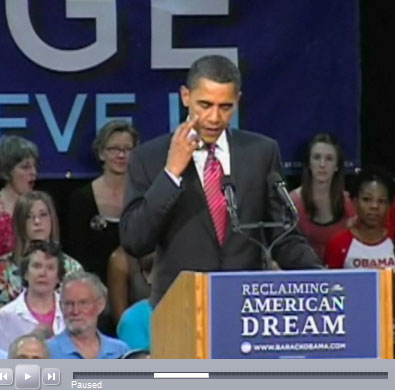
It's all been downhill since I beat Hillary
This morning President Obama gave an interview to Ann Curry of NBC’s The Today Show. It was a pretty strange interview for someone planning to run for a second term as President. Obama told Curry that it doesn’t make much difference to him whether he wins the 2012 election or not.
Though the president himself, his staff, and his supporters around the country are busy devoting everything they’ve got to his 2012 re-election campaign, Obama revealed Monday that his family isn’t necessarily as “invested.”
[….]
And the president revealed that even he sometimes feels like giving up.
“I’m sure there are days where I say that one term is enough,” the president said, but he added that what keeps him going is the unfinished work regarding energy, education, and other issues.
Then why should all the bots go out and support him this time? Can we get a candidate who actually cares about the country?
…if the first lady thought it was time for him to go, he’d listen.
“I think Michelle – if she didn’t think that what we were doing was worthwhile in moving the country forward, I think she’d be the first to say, ‘Why don’t you do something else that’s a little less stressful?’”
Obama also discussed the public perception that he’s a cold fish who never gets worked up about anything. First he claims that “ordinary folks” don’t really think that.
“Ordinary folks understand I spend all my time thinking about this stuff because I’m talking to these folks every single day,” he said….”When I see them at meetings, and they start crying, the notion, somehow, that I’m calm about that, is nonsense. But what is true is that as president, my job is to make sure that I am finding every good idea that we can to move the country forward.”
Well then what does he do when he sees “them” and “they start crying?” Frankly, he’s a sociopath with almost no ability to empathize with other people. He doesn’t even understand what these people are feeling because he doesn’t experience strong emotions other than narcissistic rage and envy. JMHO.
Obama also pretended talked about jobs without really saying much of anything.
Obama says the real challenge is to develop new industries to spur job growth.
“The challenge, though, is it only takes 100 workers to make what it used to take 1,000 workers to make in terms of the amount of steel,” he said. “So that’s why we’re going to have to look at new industries and encourage entrepreneurs to invest in these new industries and make sure that our workers have the skills to train them.
“For us to employ the same numbers of workers as we need to, to get the unemployment rate down, we’ve got to look at new sectors, new markets. We’ve got to do more exporting. So one of my big areas of focus has been on increasing exports.”
Whatever….he doesn’t really care about jobs or “ordinary folks,” and it shows.
Why did Obama give this interview? What’s the point? Was it a shoutout to Republicans that he’s ready to turn the government over to them?

 peej
peej Carissa
 bostonboomer
 dakinikat
 ecocatwoman
 mablue2
 Mama Lopez
 peggysue22
 quixote
 skydancingguestblogger
 Mona (aka Wonk the Vote)



 Sky Dancing
Recent Comments