
Thursday Reads
Posted: April 25, 2019 Filed under: Afternoon Reads, U.S. Politics | Tags: Bernie Sanders, counterintelligence investigation of Russia/Trump, Donald Trump, Hillary Clinton, Joe Biden, Mueller report, She The People Forum 34 Comments
Spring Tree, Georgia O’Keeffe
Good Morning!!
Another old white man joined the race for the Democratic presidential nomination today. Yes, Joe Biden is running, unfortunately. I won’t be turning my TV on today; I don’t want to listen to “savvy” pundits talk about how the Democrats’ savior is another old white man in his dotage. I’m already sick and tired of the 2020 campaign and the primaries are still 8 months away.
Some antidotes to the Biden media frenzy:
Truthdig: Joe Biden Is a Fraud, Plain and Simple.
Harper’s: No Joe! Joe Biden’s disastrous legislative legacy.
Payday Report: Union-Busting Lawyer to Host Biden’s 1st Fundraiser Thursday.
And this from Twitter is laugh out loud material:
https://twitter.com/DavidRutz/status/1121420712307253248
I watched Biden’s announcement video so you don’t have to. He talked about Charlottesville and Trump’s response the white supremacist march and the murder of “a brave young woman” Heather Heyer (he didn’t say her name). You’d think Biden would be worried that this will inspire reporters to bring up his questionable past on race issues. I was surprised that he never mentioned the threat Russia still poses to our elections and our democracy. You’d think that would be stronger issue for him since he was an insider when the Russian attacks took place in 2015-16.
I’m glad to see that even older white man Bernie Sanders is finally getting vetted by the mainstream media. The latest examples:
CNN Politics: Bernie Sanders in 1970s Senate race called millionaire senators ‘immoral.’
Bernie Sanders harshly criticized the wealth of US senators during his first campaign for office in 1971, calling it “immoral” that half the members of the Senate were millionaires.
Sanders’ decades-old comments, which were picked up in December 1971 by the Bennington Banner, a local Vermont newspaper, are resurfacing as the US senator from Vermont has acknowledged that he is now a millionaire in large part due to his 2016 best-selling book, “Our Revolution.” [….]
A Walk in the Meadows at Argenteil, Claude Monet
Sanders made the comments when he was running for US Senate at the time under the banner of the Liberty Union Party, a self-described “radical political party” that advocated nationalization of industries and redistribution of wealth to tackle inequality.
The senators serving at the time, Sanders said, advocated “the interests of corporations and big business —- their fellow millionaires.”In the same article, Sanders proposed eliminating the annual salary of members of Congress (which was $42,500 in 1971) and instead replacing their pay with whatever the average income was in their home state. At the time, Sanders said it would amount to $7,600 for representatives from Vermont.

CNBC took a look at Sanders’ tax returns: Bernie Sanders draws mayoral pension while running for president — his campaign co-chair Rep. Ro Khanna once blasted such ‘double-dipping.’
Sen. Bernie Sanders, the Vermont independent who is seeking the Democratic presidential nomination, for years has drawn a pension for his eight-year stint in the 1980s as mayor of Burlington even has he received a salary as a member of Congress.
Sanders, who earns $174,000 as a senator, received $5,241 from Burlington’s pension system in 2018, according to his federal income tax return.
His total income with his wife, Jane O’Meara Sanders, that year was $561,293, which was down from the more than $1 million they earned in the prior two years, largely as a result of his book about running for president in 2016.
Public financial disclosure records show that Sanders, who began serving in the U.S. House of Representatives in 1991 and in the Senate in 2007, has received nearly $62,000 in Burlington pension payouts since 2005.

Olive Trees at Collioure, Henri Matisse
And, in case you missed it, Bernie didn’t do very well at yesterday’s She The People Presidential Forum.
Bloomberg: Bernie Sanders Faces Skeptical Audience at Forum for Minority Women.
Vermont Senator Bernie Sanders faced a skeptical audience of minority women in Texas Wednesday, a group that will be critical in deciding the Democratic presidential nominee from a racially diverse field of candidates and a record number of women.
Pressed by multiple questioners to address why women of color should support him, Sanders leaned heavily on his economic message, drawing audible expressions of frustration from some of the more than 1,500 people attending the She the People forum in Houston.
“Black women will be an integral part of what our campaign and our administration is about,” he said after being prompted by a moderator of the event, which brought together eight Democratic presidential candidates for separate discussions about issues affecting minority women.
That comment came at the end of his response to a question about how he would appeal to the black women who predominantly backed Hillary Clinton in the 2016 Democratic primaries, to which Sanders offered a long answer about supporting whomever ends up being the party’s nominee.
As usual, Bernie didn’t answer the question.
The Daily Beast: Bernie Sanders Met With Boos After Name-Dropping Martin Luther King at She the People Summit.
Sen. Bernie Sanders (I-VT) was met with audible groans from the audience Wednesday night at the She the People Presidential Forum in Houston for his response to a question on the rise of white nationalism. Sanders, one of eight Democratic contenders for 2020 featured at the summit, which described itself as “the first-ever presidential candidate forum focused on women of color,” prompted boos from the crowd after defaulting to his usual talking points about immigration reform and mentioning his attendance at the March on Washington with Dr. Martin Luther King when asked how he’d handle the issue of white-supremacist violence and what specifically he’d do for women of color. The questioner, former NYC Commissioner of Immigrant Affairs Sayu Bhojwani, later tweeted that Sanders “had a rough time” with the question but “came around.” Others were less forgiving. “Bernie was asked important questions and he answered none of them,” tweeted disability-rights advocate Stephanie Olarte. “It is so sad that the moderators ask the questions in different forms to get an answer Y NADA.”
Click the link to read more reactions.

Pink Peach Trees, Vincent Van Gogh
You probably read it already but The Washington Post published an op-ed by Hillary Clinton yesterday:
Hillary Clinton: Mueller documented a serious crime against all Americans. Here’s how to respond.
First, like in any time our nation is threatened, we have to remember that this is bigger than politics. What our country needs now is clear-eyed patriotism, not reflexive partisanship. Whether they like it or not, Republicans in Congress share the constitutional responsibility to protect the country. Mueller’s report leaves many unanswered questions — in part because of Attorney General William P. Barr’s redactions and obfuscations. But it is a road map. It’s up to members of both parties to see where that road map leads — to the eventual filing of articles of impeachment, or not. Either way, the nation’s interests will be best served by putting party and political considerations aside and being deliberate, fair and fearless.
Second, Congress should hold substantive hearings that build on the Mueller report and fill in its gaps, not jump straight to an up-or-down vote on impeachment. In 1998, the Republican-led House rushed to judgment. That was a mistake then and would be a mistake now.
Clinton argues that we should follow the example of Watergate, in which public hearings led to “a formal impeachment inquiry.”
Third, Congress can’t forget that the issue today is not just the president’s possible obstruction of justice — it’s also our national security. After 9/11, Congress established an independent, bipartisan commission to recommend steps that would help guard against future attacks. We need a similar commission today to help protect our elections. This is necessary because the president of the United States has proved himself unwilling to defend our nation from a clear and present danger….
Fourth, while House Democrats pursue these efforts, they also should stay focused on the sensible agenda that voters demanded in the midterms, from protecting health care to investing in infrastructure. During Watergate, Congress passed major legislation such as the War Powers Act, the Endangered Species Act and the Federal-Aid Highway Act of 1973. For today’s Democrats, it’s not only possible to move forward on multiple fronts at the same time, it’s essential.
Now that’s leadership. If only she were president!
Some Mueller/Russia stories:
NBC News: Mueller report shows Trump campaign left itself wide open to Russians, officials say.
Alfred Sisley, The Small Meadows in Spring, 1880-1
The Mueller report’s narrative of secret meetings between members of Donald Trump’s orbit and Russian operatives — contacts that occurred both before and after the 2016 election — portrays a political campaign that left itself open to a covert Russian influence operation, former intelligence officials and other experts say….
“The Russians came up against a group of people who were not intelligence savvy and who were predisposed not to listen to the intelligence and counterintelligence community,” said Luis Rueda, who spent 27 years as a CIA operations officer. “The Russians made a very bold and aggressive attempt to take advantage of that — to try to compromise people, to try to leverage their access.”
The FBI, as part of its counterintelligence mission, is continuing to investigate Russian attempts to influence the Trump administration and assess the national security damage from Russia’s 2016 effort, current and former U.S. officials tell NBC News….
John Sipher, who served in Moscow and once helped run CIA spying operations against Russia, said, “It’s clear that the Russians had a pretty extensive full court press on this administration.” The full extent of how successful it was may never be known, he said.
“Being able to lock it down and prove in court? That only comes when you catch somebody red-handed, or when you have a source on the inside of your adversary who hands you documents.”

Good to know that the counterintelligence investigation is continuing.
The New York Times: Mueller Report Reveals Trump’s Fixation on Targeting Hillary Clinton.
Spring, Pablo Picasso, 1956
Attorney General Jeff Sessions had a tenuous hold on his job when President Trump called him at home in the middle of 2017. The president had already blamed him for recusing himself from investigations related to the 2016 election, sought his resignation and belittled him in private and on Twitter.
Now, Mr. Trump had another demand: He wanted Mr. Sessions to reverse his recusal and order the prosecution of Hillary Clinton.
“The ‘gist’ of the conversation,” according to the report by the special counsel, Robert S. Mueller III, quoting Mr. Sessions, “was that the president wanted Sessions to unrecuse from ‘all of it.’”
Mr. Mueller’s report released last week brimmed with examples of Mr. Trump seeking to protect himself from the investigation. But his request of Mr. Sessions — and two similar ones detailed in the report — stands apart because it shows Mr. Trump trying to wield the power of law enforcement to target a political rival, a step that no president since Richard M. Nixon is known to have taken.

Read the rest at the NYT.
The New York Times: Trump Vows Stonewall of ‘All’ House Subpoenas, Setting Up Fight Over Powers.
The Trump administration escalated its defiance of Congress on Wednesday, as the Justice Department refused to let an official testify on Capitol Hill and President Trump vowed to fight what he called a “ridiculous” subpoena ordering a former top aide to appear before lawmakers.
“We’re fighting all the subpoenas,” Mr. Trump told reporters outside the White House. “These aren’t, like, impartial people. The Democrats are trying to win 2020.” [….]
Mr. Trump’s flurry of moves this week to block multiple congressional investigations signaled a new phase of constitutional friction that could redefine long-murky boundaries of Congress’s power to conduct oversight of the executive branch — and the power of presidents to keep government affairs secret from lawmakers.
Are we in a Constitutional crisis yet?
So . . . what else is happening? What stories have you been following?
Tuesday Reads: The Continuing Fallout From The Mueller Report
Posted: April 23, 2019 Filed under: morning reads, U.S. Politics 32 Comments
Painting by Edmund Tarbell, American impressionist.
Good Morning!!
On cable news and on Twitter, the main argument over the past few days is about whether Democrats will or should open impeachment hearings. Quite a few Democrats have attacked Nancy Pelosi, claiming she is refusing to allow impeachment of the fake “president” to go forward. Actually, that’s not true. She has argued for public oversight hearing that may well lead to impeachment. That is essentially what happened in the Watergate scandal.
The Watergate investigative hearings began in May, 1973, but articles of impeachment hearings did not begin until February, 1974, when Congress voted to empower the House Judiciary Committee to “investigate whether sufficient grounds existed to impeach Richard Nixon.” One year after Congressional investigation began, articles of impeachment were approved.
The only differences are that the Watergate investigation began with a select committee, before the appointment of a Special Counsel. Now we have the (redacted) Muller report, which lays out a clear road map for Congressional action. We also know that there is a counterintelligence investigation which was not included in the Mueller report. So I think it makes sense for the House Intelligence Committee to focus on counterintelligence issues while the Judiciary Committee examines the case for removing the “president.”

1898 Jean Édouard Vuillard (French artist, 1868-1940)
USA Today: Pelosi to Democrats: If facts support impeaching Trump, ‘that’s the place we have to go.’
House Speaker Nancy Pelosi left open the possibility Monday of impeachment of Donald Trump during a conference call with Democrats, saying “if that’s the place the facts take us, that’s the place we have to go.”
“We have to save our democracy. This isn’t about Democrats or Republicans. It’s about saving our democracy,” Pelosi said in a call with her colleagues, according to a source on the call. But Pelosi also urged Democrats to first focus on following the facts.
“Whether it’s articles of impeachment or investigations, it’s the same obtaining of facts. We don’t have to go to articles of impeachment to obtain the facts, the presentation of facts,” she said.
The nearly hour-and-a-half call was the first time Democrats had all spoken following the release of special counsel Robert Mueller’s report on the investigation into Russian election interference.
“There’s real consensus that we need to take this responsibility seriously and people are very sober about the implications about the work that lies ahead and committed to making sure that we hold the president accountable,” said Rep. David Cicilline, a member of the Judiciary Committee and the chair of the Democratic Policy and Communications Committee, which helps the party with messaging. [….]
“The speaker has been very clear that Congress will not shirk on its responsibility to hold the president accountable, but that we must proceed in a judicious responsible manner,” he said.
I think that makes sense. Pelosi has been very effective in dealing with Trump since she took over as House Speaker, but the press and many Democrats continue to attack her just because she doesn’t want to rush headlong into an official impeachment process. I have said many times that public hearings are needed in order to education Americans who haven’t followed the investigation minute by minute. I think that’s what Pelosi is hoping to do. If she didn’t want hearings, they wouldn’t happen; and they are going to happen.

1927 Jane Rogers Interior Scene
In the meantime, the media and Democrats should be focusing on why Republicans don’t care if our democracy dies.
Paul Krugman at The New York Times: The Great Republican Abdication. A party that no longer believes in American values.
So all the “fake news” was true. A hostile foreign power intervened in the presidential election, hoping to install Donald Trump in the White House. The Trump campaign was aware of this intervention and welcomed it. And once in power, Trump tried to block any inquiry into what happened.
Never mind attempts to spin this story as somehow not meeting some definitions of collusion or obstruction of justice. The fact is that the occupant of the White House betrayed his country. And the question everyone is asking is, what will Democrats do about it?
But notice that the question is only about Democrats. Everyone (correctly) takes it as a given that Republicans will do nothing. Why?
Because the modern G.O.P. is perfectly willing to sell out America if that’s what it takes to get tax cuts for the wealthy. Republicans may not think of it in those terms, but that’s what their behavior amounts to.
The truth is that the G.O.P. faced its decisive test in 2016, when almost everyone in the Republican establishment lined up behind a man fully known to be a would-be authoritarian who was unfit morally, temperamentally and intellectually for high office.
Click on the link to read the rest.

Abby Rubinstein Man Reading A Newspaper 2010
The White House continues to obstruct Congress’s investigation. CNN on the latest attempt: White House tells official not to comply with Democratic subpoena over security clearances.
The White House has instructed a former official who was in charge of the security clearance process to not comply with a House subpoena demanding his appearance for an interview, the latest move by the Trump administration to thwart Democratic-led investigations into all aspects of the presidency.
After a day of tense negotiations, the White House late Monday told the former official, Carl Kline, who now works at the Defense Department, to not appear at Tuesday’s deposition, contending that Democrats were seeking access to confidential information that should be off limits.
The move raises the prospect that the House Oversight Committee could seek to hold Kline in contempt, a step that Chairman Elijah Cummings warned Monday he would take. And it’s the latest White House effort to stonewall Democratic investigations, coming the same day the Trump Organization filed a lawsuit to prevent an accounting firm from complying with Cummings’ subpoena for President Donald Trump’s past financial records.
Michael Purpura, deputy counsel to Trump, argued that Cummings’ subpoena of Kline “unconstitutionally encroaches on fundamental executive branch interests,” according to a letter obtained by CNN.
Kline’s attorney, Robert Driscoll, said his client would listen to his employer.
Lock him up!

1936 Herbert Badham (Australian artist, 1899-1961) Breakfast Piece
We were repeatedly told that the White House had prepared a response to the Mueller report, but Rudy Giuliani now says it won’t be released. Bloomberg: Giuliani Puts Off Formal Rebuttal to Mueller as He Defends Trump.
Donald Trump’s legal team has decided to shelve a plan to issue a formal rebuttal to Robert Mueller’s report, said Rudy Giuliani, even as the president unleashes his own attempts on Twitter to discredit the special counsel and his findings.
The president’s lawyers will focus instead on knocking down specific accounts in Mueller’s report as they surface in news media, Giuliani, Trump’s personal attorney, said Monday in an interview.
Giuliani said Mueller misrepresented the facts multiple times in his 448-page report. He declined to cite specifics, other than to say former White House Counsel Don McGahn — who gave a damaging account of Trump’s efforts to influence the investigation into Russian election interference — was “confused.” [….]
“There are numerous areas that were mischaracterized and some where it is flat-out false,” Giuliani said of Mueller’s report. “But I can only take one or two at a time. It is hard to digest all at once. You have to wait for certain ones to come up and then show if they are false or inaccurate.”
Trump’s legal team had spent months putting together a lengthy counter-report that they planned to release challenging Mueller’s findings, which they assumed would be unfavorable to Trump. But lawyer Jay Sekulow said on Friday that nothing more would be coming.

André Deymonaz, 1946
I’ll end with two articles by close followers of the Russia investigation, who have been poring over the report pulling out interesting nuggets that others may have missed. Here are their latest revelations:
Darren Samuelson, Kyle Cheney, and Natasha Bertrand at Politico: What you missed in the Mueller report. An excerpt:
Who didn’t get prosecuted
The special counsel made some of his biggest headlines when he brought charges against the likes of Michael Flynn, Paul Manafort and Roger Stone. But Mueller’s report also showcases his under-the-radar decisions on potential indictments that were never brought.
Then-Attorney General Jeff Sessions avoided a perjury prosecution over his Senate confirmation testimony when he memorably told lawmakers that he had no communications with the Russian government during the 2016 campaign. It later came out that he had met with the Russian ambassador to the United States on multiple occasions during the campaign.
Mueller’s team looked at that January 2017 exchange and a pair of follow-up written responses before determining that the election-year meetings that Sessions did have weren’t “sufficient to prove” he gave knowingly false answers to lawmakers. Most notably, Mueller informed Sessions’ lawyers in March 2018 that he was in the clear — eight months before Trump pushed Sessions out of his job.
Donald Trump Jr., Jared Kushner and Paul Manafort all escaped prosecution for their role in the June 2016 Trump Tower meeting with a Russian lawyer promising dirt about Hillary Clinton. Mueller’s report said the office looked into whether the senior campaign leaders should face charges for violating laws banning foreign campaign contributions. But ultimately they opted against pushing for indictments out of concern a conviction wasn’t a sure thing. The special counsel acknowledged lacking evidence to prove any of the three men acted with general knowledge of the crime they’d be committing and said that the promised opposition research wouldn’t necessarily qualify as an illegal donation since it was unclear the information was “a thing of value.”
Amelin Albin (Swedish artist, 1902 – 1975) Two Women by the Window
On the hacking front, Mueller’s team also considered charging Russians with trafficking in stolen property, a reveal buried in a footnote. Prosecutors were contemplating bringing the additional charges — they did indict the Russians on conspiracy and identity theft charges — under the Depression-era National Stolen Property Act. Ultimately, however, the special counsel’s office found that hacked emails in electronic form wouldn’t qualify under the law’s almost century-old definition of “goods, wares or merchandise.”

Read the rest at Politico.
Garrett M. Graff at Wired: 14 Mueller Report Takeaways You Might Have Missed.
Robert Mueller’s final 448-page report on Russian interference in the 2016 election—and Donald Trump’s apparent attempts to obstruct justice along the way—takes some time to read fully. On close examination, it turns out to be a deeply compelling document, full of tantalizing revelations and details.
Washington Post book critic Carlos Lozada called the Mueller Report “the best book by far on the workings of the Trump presidency.” New York Times columnist Ross Douthat said the report is “a more rigorous, capacious version” of Michael Wolff’s bestseller Fire and Fury. Its two volumes paint a picture of Donald Trump as deeply narcissistic and incompetent, alternately conned and ignored by everyone around him.
Nearly every page of the report contains fresh insights, even to those who have closely followed the ins and outs of this complex, multifaceted investigation. But assuming you didn’t spend your Easter and Passover holiday weekend plowing through it, here are some key tidbits that recent headlines have overlooked.

Michael Ancher (Danish painter, 1849-1927)
Two of Graff’s takeaways:
1. This was as much a counterintelligence investigation as a criminal one. One of the new details in the report is that the FBI “embedded” approximately 40 personnel in the Special Counsel’s Office. Their role was not to contribute to the criminal probe, but instead to pore over the collected materials and pass written summaries of key counterintelligence findings to FBI headquarters and other agencies across the country.
3. Anyone demanding the unredacted version of the report is stalling. Democrats have spent the last four days hemming and hawing about impeachment, saying they need to read the unredacted report before they make a decision. That’s baloney. For the most part, the redactions aren’t that material to the underlying narrative. Mueller establishes all the damning evidence he needs to point to a pattern of obstruction in unredacted portions of Volume II of the report. (The clear exception where redactions could shed substantial new light: the six-page Appendix D, where Mueller lists the 12 still-secret ongoing cases referred to other prosecutors.) Throughout the remainder of the document, many redactions clearly deal with either Roger Stone or Jerome Corsi. The bulk of the rest appear to focus on operational details of the GRU and the Internet Research Agency.
Two of the most intriguing redactions come on page 12, where the report outlines five (or maybe six) individuals Mueller was specifically authorized to investigate. Two (or maybe three) of those are redacted. Because of the alphabetical list and way the lines fall—there’s a tiny two-letter redaction that spills over to the next line—the final redacted name is almost certainly “Donald Trump Jr.” The other is still unknown, falling somewhere in the alphabet between “Gates” and “Stone.”
Read more at Wired.
What stories are you following today?
Lazy Caturday Reads: Counterintelligence and Cats in High Places
Posted: April 20, 2019 Filed under: Afternoon Reads, U.S. Politics 19 Comments
Good Afternoon!!
Cover-Up General Barr’s redacted version of the Mueller Report is out; and despite Barr’s attempts to soften the blow it make Trump look really bad. Interestingly, there is nothing in the report about the counterintelligence investigation that was begun after Trump fired FBI Director James Comey. It appears that investigation is ongoing.
Ken Dilanian of NBC News reports this morning: The counterintelligence investigation of the Trump team and Russia hasn’t stopped.
Special counsel Robert Mueller’s criminal investigation may be over, but the FBI’s efforts to assess and counter Russian efforts to influence the U.S. political system — including the Trump administration — is continuing, current and former U.S. officials say.
The FBI and other intelligence agencies are pursuing a counterintelligence effort to thwart Russian influence operations in the U.S. and stymie an anticipated Russian effort to interfere in the 2020 election, the officials tell NBC News.
 The FBI and other intelligence agencies are pursuing a counterintelligence effort to thwart Russian influence operations in the U.S. and stymie an anticipated Russian effort to interfere in the 2020 election, the officials tell NBC News.
As part of that mission, analysts will continue to drill down on exactly how the Russians interfered in the 2016 election, whether any Americans helped them unwittingly, and whether any American continues to be compromised by Russia, experts say.
These are different questions than whether crimes were committed, which is what Mueller explored in his 448-page report. Mueller’s report is silent on some of the key counterintelligence issues raised in his probe. It doesn’t mention, for example, the counterintelligence investigation the FBI opened into the president — an inquiry former acting director Andrew McCabe said was designed to examine whether he was compromised by Russia. Nor does the report cite the counterintelligence briefing the Trump campaign is said to have received from the FBI, warning that Russia and other adversaries would seek to infiltrate the campaign.
“The fact that it’s not present in the report tells me the ball is now and remains in the court of the FBI and the intelligence community,” said Frank Figliuzzi, an NBC News contributor and former head of counterintelligence at the FBI.
It’s unclear whether the counterintelligence investigation into Trump remains open. An FBI spokeswoman declined to comment.
Read the rest at the link. It’s long and interesting. I’d be willing to bet that they are still looking at whether Trump is compromised. I hope the House Intelligence Committee will request a briefing on this matter ASAP. They have apparently offered to brief the Gang of Eight at least.
 Yesterday The New York Times published an important op-ed about this by Joshua Geltzer and Ryan Goodman: Mueller Hints at a National-Security Nightmare.
The Mueller report isn’t actually close to a full account of the investigation by the special counsel, Robert Mueller. That’s not just because of the redactions. When he was hired, Mr. Mueller inherited supervision of an F.B.I. counterintelligence investigation. That is the missing piece of the Mueller report.
President Trump may claim “exoneration” on a narrowly defined criminal coordination charge. But a counterintelligence investigation can yield something even more important: an intelligence assessment of how likely it is that someone — in this case, the president — is acting, wittingly or unwittingly, under the influence of or in collaboration with a foreign power. Was Donald Trump a knowing or unknowing Russian asset, used in some capacity to undermine our democracy and national security?
The public Mueller report alone provides enough evidence to worry that America’s own national security interests may not be guiding American foreign policy.
The counterintelligence investigation is not necessarily complete, but from the glimpses we see in the Mueller report, it should set off very serious national security alarm bells.
What would this counterintelligence investigation look like?
An intelligence assessment makes two determinations: a conclusion about the type of influence a foreign power may have over an individual and the degree of confidence in that conclusion. For example, when Mr. Trump boasted to the Russian foreign minister and ambassador in the Oval Office that he had fired the F.B.I. director, it raised only the possibility — a “circumstantial inference,” as it’s called in counterintelligence — that the president was wittingly working on behalf of the Russians.
This apparent desire to please these officials indicates a high level of Russian influence and, in the context of other actions that pleased Mr. Putin, like his sudden decision to withdraw American troops from Syria — could support a modest to high level of confidence in that conclusion.
 The authors explain that we don’t have a “smoking gun” that would indicate “high confidence,” because that “would require something we don’t have and would not expect to have, like an email from Vladimir Putin ordering Mr. Trump to fire the F.B.I. director James Comey.” But we do have many indications that Trump and his associates are working against U.S. national interests. Examples from the article:
— The former Trump adviser Roger Stone directly communicates with the Russia-linked actor Guccifer 2.0 and coordinates with WikiLeaks to get Mr. Trump elected — and he is likely aware that one is a Russian front organization and the other is working with the Russians.
== A Trump campaign national security adviser is informed by a Russian intelligence operative that the Kremlin has stolen Hillary Clinton-related emails and could assist the Trump campaign through “anonymous release” of derogatory information; the campaign then works on setting up backdoor meetings with senior Russian government officials (though the meetings do not materialize).
— Members of the Trump transition team conduct secretive, back channel meetings with Putin operatives.
— Mr. Trump and Mr. Putin speak alone in Helsinki, then Mr. Trump accepts Mr. Putin’s claim that he didn’t meddle in the 2016 election and repudiates the intelligence community’s assessments to the contrary.
Those incidents raise the possibility that Mr. Trump has wittingly sought to advance Russian interests, but the evidence is merely circumstantial and consequently suggests low to moderate confidence in that assessment….
But unwitting assets pose their own dangers. They have significant vulnerabilities that can be exploited with minimal actual coordination. In other words, they look and act more like puppets.
 I’ve quoted a great deal from the article, because it’s so significant. I hope you’ll read the rest at the NYT.
Read more by Geltzer and Goodman on the counterintelligence investigation at Just Security: The Missing Piece of the Mueller Investigation.
Another New York Times op-ed by former FBI counterintelligance agent Asha Rangappa: How Barr and Trump Use a Russian Disinformation Tactic.
On Nov. 9, 2016, according to the Mueller report, some redacted figure wrote to a Russian regime crony, “Putin has won.” Based on the assessment of the intelligence community and the findings of Robert Mueller, President Vladimir Putin of Russia did indeed succeed in his efforts to influence the 2016 presidential election on behalf of Donald Trump.
But Mr. Putin’s ultimate victory may have come on Thursday morning, during Attorney General Bill Barr’s news conference. By seamlessly conflating the terms “collusion” and “conspiracy,” and absolving President Trump of both, Mr. Barr revealed that the Russian information warfare technique of “reflexive control” has officially entered American public discourse — and threatens, with his recent allegations of campaign “spying,” to stay there for a while.
Reflexive control is a “uniquely Russian” technique of psychological manipulation through disinformation. The idea is to feed your adversary a set of assumptions that will produce a predictable response: That response, in turn, furthers a goal that advances your interests. By luring your opponent into agreeing with your initial assumptions, you can control the narrative, and ultimate outcome, in your favor. Best of all, the outcome is one in which your adversary has voluntarily acceded. This is exactly what has happened with much of the American public in the course of Mueller’s investigation.
The assumptions that culminated in Mr. Barr’s conclusions began almost two years ago, when the White House, Trump supporters and the media characterized the focus of the special counsel’s investigation as “collusion.” The word “collusion” does not appear anywhere in Mr. Mueller’s appointment letter: His mandate was to investigate any “links and/or coordination” between the Trump campaign and Russia. There is a good reason for this: “Collusion” is the legal equivalent of Jell-O. Outside of specific factual contexts — such as price fixing in antitrust law — the word “collusion” has no legal meaning or significance. In fact, in his report, Mr. Mueller explicitly stated that his conclusions were not about collusion, “which is not a specific offense or theory of liability found in the United States code.”
Read more at the link. It’s fascinating.
Here’s an interesting take on the Mueller Report from The Washington Post’s book critic: The Mueller report isn’t just a legal document. It’s also the best book on the Trump White House so far.
The Mueller report is that rare Washington tell-all that surpasses its pre-publication hype.
Sure, it is a little longer than necessary. Too many footnotes and distracting redactions. The writing is often flat, and the first half of the book drags, covering plenty of terrain that has been described elsewhere. The story shifts abruptly between riveting insider tales and dense legalisms. Its protagonist doesn’t really come alive until halfway through, once Volume I (on Russian interference) gives way to Volume II (on obstruction of justice). The title — far too prosaic, really — feels like a missed opportunity. And it hardly helps that the book’s earliest reviewer, Attorney General William Barr, seems to have willfully misunderstood the point of it; he probably should not have been assigned to review it at all.
Yet as an authoritative account, the Mueller report is the best book by far on the workings of the Trump presidency. It was delivered to the attorney general but is also written for history. The book reveals the president in all his impulsiveness, insecurity and growing disregard for rules and norms; White House aides alternating between deference to the man and defiance of his “crazy s—” requests; and a campaign team too inept to realize, or too reckless to care, when they might have been bending the law. And special counsel Robert Mueller has it all under oath, on the record, along with interviews and contemporaneous notes backing it up. No need for a “Note on Use of Anonymous Sources” disclaimer. Mueller doesn’t just have receipts — he seems to know what almost everyone wanted to buy.
Read the rest at the WaPo.
What else is happening? What stories have you been following?
Thursday Reads: Russia Investigation Cover Up Live Blog/Open Thread
Posted: April 18, 2019 Filed under: morning reads, U.S. Politics | Tags: Barr Cover-Up Report, Donald Trump, live blog, open thread, Robert Mueller muzzled, Russia investigation, William Barr 54 Comments
Cover-up bunny
Good Morning!!
The Barr cover-up report reportedly will go public sometime today. The schedule is vague. At 9:30, Cover-Up General Barr plans to give a “press conference” about a report that no one except unknown DOJ officials and White House lawyers have read.
Yes, according the NYT, the White House has been briefed and very likely has had the full report for some time. In addition, DOJ attorneys have been helping the White House prepare their counter-report!
The New York Times: White House and Justice Dept. Officials Discussed Mueller Report Before Release.
Not all of Robert S. Mueller III’s findings will be news to President Trump when they are released Thursday.
Justice Department officials have had numerous conversations with White House lawyers about the conclusions made by Mr. Mueller, the special counsel, in recent days, according to people with knowledge of the discussions. The talks have aided the president’s legal team as it prepares a rebuttal to the report and strategizes for the coming public war over its findings.
Cover-up pup
A sense of paranoia was taking hold among some of Mr. Trump’s aides, some of whom fear his backlash more than the findings themselves, the people said. The report might make clear which of Mr. Trump’s current and former advisers spoke to the special counsel, how much they said and how much damage they did to the president — providing a kind of road map for retaliation.

Reporters should use the “press conference” to ask Barr about his past cover-ups, his connections to Russia, his conflicts of interest, and his general corruption. They won’t, of course. They also should not refer to whatever redacted mess the Cover-Up General releases as the Mueller Report, but of course they will do just that.
We have to keep reminding ourselves that it’s not the Mueller report; it’s the Barr report. If Robert Mueller wanted to endorse Barr’s cover-up, he would be appearing at the “press conference.” But his isn’t going to be there. Mueller has been muzzled.
Tom Scocca at Hmm Daily: It’s the Barr Report, Not the Mueller Report.
What could inspire more hope and despair than a whole bunch of people who messed something up being granted a do-over? Tomorrow, all the reporters and publications who gave Donald Trump his “MUELLER FINDS NO COLLUSION” headlines, based on a few sentence fragments in a letter from attorney general William Barr, are supposed to get another document to analyze and quickly write headlines about.
Cover-up kitty
Already, journalists are calling this document “the Mueller report.” It is not the Mueller report; that is, it will not be the report prepared by the special counsel investigating Russian election interference and the Trump campaign. It will be some other document. Its text, like the quotes used in the Barr letter, will be based on the text of the Mueller report, but it will have been edited down for release by William Barr, whose implicit and explicit theory of his job duties is that he is there to protect the president.
This isn’t speculation. It’s a description of what’s publicly known about the process, informed by Barr’s prior work with the Mueller report, his written record of his own thoughts on presidential immunity, and his history as a middleman in previous scandal coverage. Barr is a partisan, not a broker of facts, and it is a basic reporting error to treat material that’s passed through his control as definitive—a basic reporting error that major media outlets eagerly made, last time around.

The Daily Beast: Mueller Report Rollout Won’t Have Mueller.
The Justice Department will hold a press conference Thursday morning about the release of Special Counsel Robert Mueller’s report—but Mueller won’t be there and the document may not be released until after Attorney General William Barr speaks about the nearly 400 pages he went through to redact.
The House Judiciary Committee has been told it will not get the Mueller report from DOJ until 11 a.m. or noon—after Barr’s press conference scheduled for 9:30 a.m.
“They are making Al Capone look straight,” one committee member told The Daily Beast.
House Judiciary Chairman Jerry Nadler ripped Barr’s plan to speak about the report before lawmakers, the media and public have a chance to review it.
“Rather than letting the facts of the report speak for themselves, the attorney general has taken unprecedented steps to spin Mueller’s nearly two-year investigation,” Nadler said at a press conference on Wednesday night.
“The Attorney General appears to be waging a media campaign on behalf of President Trump, the very subject of the investigation at the heart of the Mueller report,” he added.
If the report is heavily redacted, Nadler said, “we will most certainly issue the subpoenas in very short order.” He said they “will probably find it useful” to ask Mueller and members of his team to testify.
Just send out the subpoenas as soon as you get the report. No more fooling around.
Axios insists on calling the Barr Report “the Mueller Report.”
Mueller report: What witnesses expect ahead of its release
Mueller witnesses and their lawyers say that they expect the special counsel’s report to include a mass of detailed scenes in which President Trump lashed out about Mueller, Jeff Sessions, Rod Rosenstein and the FBI.
The big picture: They believe that if Mueller’s report presents the material in the same relentlessly detailed way as his prosecutors asked the questions, the accumulation could lead a casual observer to think that the president tried to obstruct justice.
Show less




Tuesday Reads: Impeachment Is Our Only Hope
Posted: April 16, 2019 Filed under: Afternoon Reads, U.S. Politics 38 Comments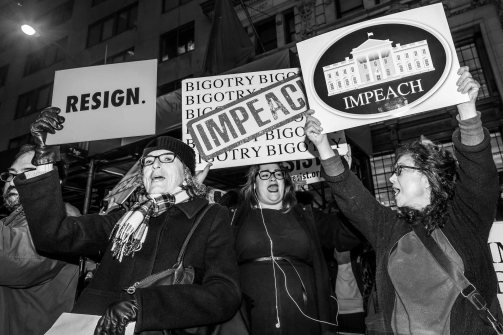
Good Afternoon!!
I’m feeling despairing today. I’m already so sick of the 2020 election that I just want to throw out my TV and hide in my apartment reading escapist novels for the rest of 2019. Bernie Sanders is determined to destroy all of the actual Democrats who are running in order to reelect Trump, and much of the mainstream media is rooting for him to succeed.
I’m convinced that our only hope to save this country from autocracy is impeachment, because the media has learned nothing from their horrendous mistakes in 2016. They will continue to hammer Democrats and support Bernie Sanders’ effort to divide the party because they would rather gain click from publishing gossip than use their considerable power to help save our democracy.
I can’t understand why The New York Times especially is supporting Bernie’s efforts to destroy the Democratic Party. Do they really believe Trump won’t find a way to control the press if he wins a second term? This morning the Times published a stunningly unethical hit piece on Bernie’s latest target, Center for American Progress president Neera Tanden. I’m including the headline because it demonstrates the Times’ deliberate venom against Democrats and, of course, Hillary Clinton. The authors are Elizabeth Williamson and Ken Vogel.
The Rematch: Bernie Sanders vs. a Clinton Loyalist
The bad blood started early.
In 2008, Neera Tanden, then a top aide on Hillary Clinton’s first presidential campaign, accompanied Mrs. Clinton to what was expected to be an easy interview at the Center for American Progress, the influential group founded by top Clinton aides. But Faiz Shakir, the chief editor of the think tank’s ThinkProgress website, asked Mrs. Clinton a question about the Iraq war, an issue dogging her candidacy because she had supported it.
NYT gossip Elizabeth Williamson
Ms. Tanden responded by circling back to Mr. Shakir after the interview and, according to a person in the room, punching him in the chest.
“I didn’t slug him, I pushed him,” a still angry Ms. Tanden corrected in a recent interview.
Ms. Tanden now leads the Center for American Progress, Mr. Shakir runs Bernie Sanders’s presidential campaign and the enmity between the two camps burst into the open last weekend. Mr. Sanders, angry about a video produced by ThinkProgress that ridicules his new status as one of the millionaires he has vilified on the campaign trail, sent a scorching letter to the center’s board, accusing Ms. Tanden of “maligning my staff and supporters and belittling progressive ideas.”
The blowup is another reflection of the ideological divisions among Democrats, this time between a legacy Clinton organization and a liberal wing trying to move the party to the left to harness the energy of millennials. Mr. Sanders’s team remains convinced that the Democratic establishment worked behind the scenes to deprive him of the party’s nomination in 2016; his campaign has cast the group as beholden to corporate interests set on thwarting him in 2020.

I wish NYT would explain how the “Democratic establishment” could have “rigged” the primary for Bernie. Primary voters choose the nominee, and even without the superdelegates that Bernie railed against in 2016, Hillary would have beaten him handily. Bernie had little chance to win after Super Tuesday in 2016. He made no effort to win black votes, and no Democrat can win without them, especially in the South. Bernie also publicly disparaged the South in 2016.
NYT gossip Ken Vogel
But back to the disgraceful NYT story. The authors, Elizabeth Williamson and Ken Vogel took advantage of Tanden’s mother to attack her as an “aggressive” woman (horrors!)
Ms. Tanden’s mother, Maya Tanden, says that her daughter “can be very aggressive.”
“She’s not going to let anyone rule over her,” she said, “and she has loyalty to Hillary because Hillary is the one who made her.”
“Those Bernie brothers are attacking her all the time, but she lets them have it, too,” Maya Tanden said. “She says Sanders got a pass” in 2016, “but he’s not getting a pass this time.” [….]
Ms. Tanden, whose salary was $397,000 in 2018, was an unpaid adviser to Mrs. Clinton’s 2016 campaign while running the think tank, and was considered a candidate for a top White House job had Mrs. Clinton won the presidency. Ms. Tanden says she has founded six new policy-intensive groups as the center’s president and increased its annual budget by 25 percent.
“That’s what she does — she shows up at rich people’s places because she needs funds from them,” Ms. Tanden’s mother said. “That place runs on Neera Tanden.”
Neera’s mom is rightfully proud of her. She’s not involved in politics, and she believed the reporter was writing a nice story about her daughter. She had no idea she was being used to promote Bernie Sanders in his childish feud against CAP and Think Progress. When she realized what was happening, she called back and the reporter who had called her, Elizabeth Williamson, explain that the quotes had been “on the record.” Tanden’s mother Maya didn’t know what that meant.
That’s a joke of course. The NYT fired their ombudsman and eliminated the job.
Williamson send out a nasty tweet about her story, but then deleted it after the overwhelmingly negative response on Twitter.
We’ve learned quite a bit about Cover-Up General Bill Barr’s history in the past couple of weeks, but I didn’t know he had connections to Russia.
Cristina Maza at Newsweek: Should William Barr Recuse Himself From Mueller Report? Legal Experts Say Attorney General’s Ties to Russia Are Troubling.
…some experts argue that Barr’s previous work in the private sector could conflict with his continuing supervision of the investigation into Russian tampering in the 2016 election campaign.
Why? A few of Barr’s previous employers are connected to key subjects in the probe. And some argue that, even if Barr didn’t break any rules, his financial ties to companies linked to aspects of the Russia investigation raise questions about whether he should—like his predecessor, Jeff Sessions—recuse himself.
“The legal standard is really clear about these issues. It’s not about actual conflict, it’s about the appearance of a conflict, about the appearance of bias,” Jed Shugerman, a professor at Fordham University’s School of Law and an expert on judicial and government ethics, tells Newsweek . “The problem is that we have so many flagrant conflicts that are so obvious, we get distracted from what the legal standard is.”
This much is known: On Barr’s public financial disclosure report, he admits to working for a law firm that represented Russia’s Alfa Bank and for a company whose co-founders allegedly have long-standing business ties to Russia. What’s more, he received dividends from Vector Group, a holding company with deep financial ties to Russia.
“All of this raises the need for further inquiry from an independent review, not a Department of Justice investigation,” Michael Frisch, ethics counsel for Georgetown University’s law school and an expert in professional ethics, tells Newsweek . Scott Amey, general counsel at the Project for Government Oversight, says that Barr is probably playing within the rules. But that doesn’t mean he shouldn’t recuse himself.
“He’s not doing anything illegal. [But] is it good practice, given that he might have been involved with these entities in private practice? Probably not,” Amey added.
Read many more details at Newsweek.
If we can’t count on the media to to it’s “fourth estate” job, who can we turn to? Right now, our only hope is the House Democrats.
Brad Miller at The Daily Beast: Here’s How the House Can Finally Nail Trump.
President Trump may complain on Twitter or Fox News that congressional investigations are a “partisan witch hunt,” “presidential harassment,” and a “disgrace,” but few judges will want to hear it.
Of course House Democrats have the legal power to obtain President Trump’s tax returns. And the full, un-redacted Mueller report. And records of Trump’s financial relations with Deutsche Bank and other lenders. And much more.
House Democrats need not ask meekly for information about Trump’s finances and the Mueller report and accept whatever Trump voluntarily provides. The power of the House and of the Senate to compel the disclosure of documents and testimony to inform the exercise of their constitutional powers is very, very well-established. “The power of the Congress to conduct investigations is inherent in the legislative process. That power is broad,” the Supreme Court said in Barenblatt v. United States. “It encompasses inquiries concerning the administration of existing laws as well as proposed or possibly needed statutes.”
“The power of inquiry has been employed by Congress throughout our history, over the whole range of the national interests concerning which Congress might legislate or decide upon due investigation not to legislate; it has similarly been utilized in determining what to appropriate from the national purse, or whether to appropriate,” the Supreme Court said in Watkins v. United States. “The scope of the power of inquiry, in short, is as penetrating and far-reaching as the potential power to enact and appropriate under the Constitution.”
Citizens are required to comply with congressional subpoenas “to testify fully with respect to matters within the province of proper investigation” just as they are required to comply with judicial subpoenas.
Read the rest at the link.
I’ll end this post with some powerful remarks from the woman who really should be our president.
What stories are you following today?

 peej
peej Carissa
 bostonboomer
 dakinikat
 ecocatwoman
 jjlo
jjlo mablue2
 Mama Lopez
 peggysue22
 quixote
 skydancingguestblogger
 Mona (aka Wonk the Vote)





Recent Comments