
Thursday Reads: Women’s Bodies, Women’s Lives
Posted: May 16, 2019 Filed under: morning reads, U.S. Politics | Tags: abortion rights, Alabama, anti-abortion laws, Brett Kavanaugh, incest, Indiana, John Roberts, Louisiana, Missouri, Ohio, rape, U.S. Supreme Court, women's bodily autonomy 16 Comments
Peonies, by Claude Monet
Good Morning!!
Even as we worry about Trump and Bolton starting a war with Iran and about the Democrats refusing to follow the Impeachment road map provided by Robert Mueller, American women must face the fact that our very personhood is being attacked.
Personally, I have decided that I will not vote for any man for president. The right of women to make decisions about our own bodies is too important.
Here’s the latest on the War on Women:
NBC News: Missouri Senate passes bill to outlaw abortion at 8 weeks.
Missouri’s Senate has passed what its authors call one of the nation’s most stringent anti-abortion bills, which would outlaw nearly all abortions at eight weeks of pregnancy.
The Republican-led Senate passed the bill, dubbed Missouri Stands With The Unborn, by a margin of 24 to 10 early Thursday morning….
Missouri’s move comes hours after Alabama Gov. Kay Ivey signed a bill that would introduce a near-total abortion ban in that state. Kentucky, Mississippi, Ohio and Georgia have approved bans on abortion once a fetal heartbeat is detected, which can occur in about the sixth week of pregnancy.
Louisiana is following suit with its own “heartbeat” abortion ban, which was approved unopposed by the Louisiana House Health and Welfare Committee on Wednesday.
Abortion right activists are mobilizing in Alabama. The Washington Post: Governor signs Alabama abortion ban, which has galvanized support on both sides, setting up a lengthy fight.
MONTGOMERY, Ala. — As a crop duster with a banner saying “Abortion is okay” hummed above the capitol, circling back and forth around the governor’s mansion, a group of women below let out a cheer.
Amaryllis by Piet Mondrian (1910)
“Just another day in Alabama,” said Mia Raven, director of People Organizing for Women’s Empowerment and Rights (POWER) House. “We knew this would pass and we got ready.”
Amanda Reyes, who works with an abortion fund, was wearing an “I’m on the pill” T-shirt, complete with instructions printed on the back detailing how to get a medical abortion. She also looked skyward: “Here it comes again! That’s just the coolest thing.”
Hours after the Alabama Senate voted late Tuesday to ban abortions in almost all circumstances — including in cases of rape and incest — women’s rights activists and abortion rights advocates said the decision to approve the nation’s strictest abortion measure has energized them. Knowing that the bill was designed to challenge Roe v. Wade, they are gearing up for the fight.

The Washington Post: Louisiana ‘heartbeat’ abortion ban nearing final passage.
BATON ROUGE, La. — A proposal to ban abortions in Louisiana as early as the sixth week of pregnancy continued to speed through the state legislature Wednesday, the same day Alabama’s governor signed the nation’s most restrictive law against the procedure.
Without objection, the Louisiana House Health and Welfare Committee backed legislation to prohibit abortions when a fetal heartbeat is detected, similar to laws passed in several conservative states that are aimed at challenging the U.S. Supreme Court’s 1973 decision that legalized abortion. Louisiana’s ban, however, only would take effect if a federal appeals court upholds a similar law in Mississippi.
Louisiana’s so-called fetal “heartbeat bill” is sponsored by state Sen. John Milkovich, one of several measures that lawmakers are advancing to add new restrictions on abortion. Senators already have supported the bill, which will next receive full House consideration, one step from final passage. Democratic Gov. John Bel Edwards has indicated he will sign the measure if it reaches his desk.
The New York Times sums up the current abortion landscape: ‘The Time Is Now’: States Are Rushing to Restrict Abortion, or to Protect It.
Alex Katz, Tulips 4, 2013
States across the country are passing some of the most restrictive abortion legislation in decades, deepening the growing divide between liberal and conservative states and setting up momentous court battles that could profoundly reshape abortion access in America….
The national race to pass new legislation began last fall, after President Trump chose Brett M. Kavanaugh to replace Justice Anthony M. Kennedy on the Supreme Court, adding what some predicted would be a fifth vote to uphold new limits on abortion. Red states rushed to pass more restrictions and blue states to pass protections.
Now, as state legislative sessions draw to a close in many places, experts count about 30 abortion laws that have passed so far.
That is not necessarily more than in past years, said Elizabeth Nash, a legal expert at the Guttmacher Institute, which supports abortion rights.
What’s different is the laws themselves, which have gone further than ever to frontally challenge Roe v. Wade, the Supreme Court’s 1973 ruling that established federal protections for abortion.

Read the rest at the NYT.
Interestingly, these extreme laws could be interfering with right wing plans to overturn Roe v. Wade.

Flowers in a Glass Vase by John Constable (c. 1814)
Even Pat Robertson thinks the Alabama law is too “extreme.” The Washington Post: Televangelist Pat Robertson: Alabama’s abortion ban is ‘extreme’ and has ‘gone too far.’
Longtime televangelist Pat Robertson decried Alabama’s new abortion ban as “extreme,” saying on his show on Wednesday that the state legislature has “gone too far.”
Alabama’s law, which has been passed by the legislature and signed by the governor, includes a penalty of up to 99 years in prison for doctors who perform abortions and has no exceptions for rape or incest, Robertson noted on his show.
“They want to challenge Roe vs. Wade, but my humble view is I don’t think that’s the case I’d want to bring to the Supreme Court because I think this one will lose,” Robertson told viewers of CBN’s “The 700 Club” on Wednesday.
David G. Savage at The Los Angeles Times: Supreme Court is not eager to overturn Roe vs. Wade — at least not soon.
The Supreme Court justices will meet behind closed doors Thursday morning and are expected to debate and discuss — for the 14th time — Indiana’s appeal of court rulings that have blocked a law to prohibit certain abortions.
The high court’s action — or so far, nonaction — in Indiana’s case gives one clue as to how the court’s conservative majority will decide the fate of abortion bans recently passed by lawmakers in Alabama and Georgia. Republican Gov. Kay Ivey of Alabama signed her state’s ban into law on Wednesday.
Pot of Geraniums, Henri Matisse
Lawmakers in those states have said they approved the bans in an effort to force the high court to reconsider Roe vs. Wade, the 1973 decision that legalized abortion nationwide.
The justices have many ways to avoid such a sweeping ruling, however. And Chief Justice John G. Roberts Jr., in his 14 years on the high court, has typically resisted moving quickly to decide major controversies or to announce abrupt, far-reaching changes in the law.
Roberts’ history, along with the court’s handling of abortion cases in recent years, suggests he will not move to overturn the right to abortion soon, or all at once, and is particularly unlikely to do so in the next year or two with a presidential election pending.

At Slate, Dahlia Lithwick makes a similar argument: Alabama’s Extremist Abortion Bill Ruins John Roberts’ Roe Plan.
One could feel sorry for Chief Justice John Roberts. He is, after all, caught in an unsightly squeeze play between anti-abortion zealots in Alabama, and slightly less wild-eyed anti-abortion zealots in Georgia, Ohio, Tennessee, and Indiana (the court seems unable to make a decision on whether to grant the Indiana petition it has been sitting on for months now). There’s finally a five-justice majority within striking distance of a decades-long dream to overturn Roe v. Wade, and the anti-choice activists are getting ahead of themselves like slurring drunks at a frat party and making everything more transparently nasty than it need be.
Hibiscus by Hiroshige (c. 1845)
There are easy and near invisible ways for the high court to end Roe. That has always been, and remains, the logical trajectory. As Mark Joseph Stern has shown, when Brett Kavanaugh came onto the court, with his dog whistles and signaling around reproductive rights, it became clear that he would guide the court to simply allow states to erect more and more barriers to abortion access (dolphin-skin window coverings on every clinic!). The five justices in the majority would do it all while finding ways to say that such regulations were not an “undue burden” on a woman’s right to choose. The courts and state legislatures could continue their lilting love songs to the need for the states to protect maternal health and to help confused mommies make good choices, and nobody need dirty their hands by acknowledging that the real goal of three decades’ worth of cumbersome clinic regulations and admitting privileges laws were just pretexts for closing clinics and ending abortion altogether.

Read the rest at Slate.
(Mostly) male legislators are ignoring the realities of actual women’s lives.
When Senator Clyde Chambliss, a Republican, for example, was asked if the law would allow for incest victims to obtain abortions, he responded: “Yes, until she knows she’s pregnant.”
He did not elaborate on how someone would have an abortion before she knows she’s pregnant, outside of claiming, “It takes time for all the chromosomes to come together.”
Flower Garden by Gustav Klimt, 1905
Women’s bodies, lives, and futures are quite literally in the hands of men who seemingly couldn’t pass a high school health class. That’s part of what’s so hard about watching these debates: It’s not just that women’s rights and autonomy are being legislated away, but that it’s being done by complete morons.
This lack of remedial understanding of women’s bodies is not limited to Alabama. Representative John Becker of Ohio, a Republican, for example, sponsored a bill to limit insurance coverage for abortions, but claimed that it would have an exception for ectopic pregnancies, when the fertilized egg implants outside the uterus. “That treatment would be removing the embryo from the fallopian tube and reinserting it in the uterus,” he said, explaining a procedure that doesn’t exist and isn’t medically possible.
There is also Texas state Representative Dan Flynn, a Republican, who believes abortion requires cutting into a woman’s uterus, or Vito Barbieri, the Idaho state Representative, a Republican, who thought you could give a woman a remote gynecological exam by having her swallow a tiny camera.

Shannon Dingle at USA Today: I was 12 years old and pregnant. Alabama’s abortion ban bill would punish girls like me.
Roses and Lillies by Henri Fantin-Latour (1888)
I was that 11-year-old pregnant by rape in Ohio, except I had just turned 12 and lived in Florida….She is 11. She has experienced and is experiencing violating trauma. Maybe someday she will tell her story, but today is not that day.
I can tell my story, though. I was newly 12. I lived in a suburb of Tampa. I had gotten my period a couple years before, and it came regularly once it started. I knew to expect it every 32 days.
It was July, the summer between sixth and seventh grade, when days 33, 34, 35 and more passed with no period. I had read in one of my sister’s Seventeen magazines that periods aren’t always regular, so I figured this was my first one of those.
It wasn’t….I never chose to have sex at such a young age, but abusers in my family chose to rape me. I had lost count of the number of times by then. With a dad high ranking in the county sheriff’s office, I didn’t trust going to the police. I had tried to tell teachers and church volunteers, but that never went anywhere, either.

Please go read the rest if you haven’t already.
Women and girls in the U.S. are in real danger. For me this is the number one issue for women in the upcoming presidential election.
As always, this is an open thread.
Tuesday Reads: Odds and Ends
Posted: May 14, 2019 Filed under: morning reads, U.S. Politics 21 Comments
Women Reading, Manuel Cusi y Ferret
Good Morning!!
There’s plenty of news today and none of it is good as far as I can see. Here are some stories that caught my eye this morning.
Following up on Dakinikat’s post yesterday, a couple of useful articles on Trump’s insane tarriffs:
Trump biographer Timothy O’Brien at Bloomberg: Don’t Go Searching for Strategy in Trump’s Tariffs.
As China and the U.S. dig in for what may become a protracted and possibly very painful trade war, a lot of time is being wasted trying to divine whether President Donald Trump has a strategy.
If we’re defining “strategy” as a cohesive, premeditated plan designed with clear goals in mind – goals that go beyond “gotcha!” – then no, the president doesn’t. “I’m going to teach China a lesson” isn’t a strategy. Slapping rounds of tariffs on Chinese imports is punitive, of course, and may ultimately convince the country’s leaders to open their markets and stop stealing intellectual property from the U.S. It’s unlikely to convince them to significantly reshape what has thus far proven to be a wildly successful, government-brokered industrial policy that has turned China into an economic powerhouse.
By Igor Samsonov
Meanwhile, Trump has been tweeting a series of bonkers and factually-challenged insights recently about what he thinks the impact of his tariffs will be and how U.S. consumers will respond to the likelihood of tariff-induced higher prices. None of this is knitted into a broader geopolitical argument about how best to deal with China on the world stage and challenge it militarily on the high seas and elsewhere.
Don’t expect most of that to change in a meaningful way. The president doesn’t have a sophisticated trade strategy any more than he has a thoughtful immigration strategy or a wily political strategy. What he has are resentments – resentments that are so deeply felt that much of Trump’s fuming can come across at times as the words and bile of someone who has been personally affronted. Trump’s fear and resentment of “the other” is profound and ubiquitous and speaks to sentiments he’s been harboring for much of his life.

From the article, an example of Trump’s strategic thinking:
“I’ve read hundreds of books about China over the decades,” Trump said in “The Art of the Deal,” his nonfiction work of fiction. “I know the Chinese. I’ve made a lot of money with the Chinese. I understand the Chinese mind.”
He’s not really sure about that though, and sometimes his insecurity is transparent. “China has total respect for Donald Trump and for Donald Trump’s very, very large brain,” Trump said last fall.
This moron is president of the U.S.!
Politico: Trump’s China grudge match may be spinning out of control.
The Dow Jones industrial average on Monday plunged 618 points, or roughly 2.7 percent, after a flurry of belligerent tweets from President Trump — and quick retaliation from China in the form of new tariffs — threw gut punches at hopes for a deal between the two nations.
Girl with a Book. Philip Maliavin. Philip Maliavin (1869-1940).
The sell-off framed a central conflict inside the White House — and seemingly within the president’s own mind. Trump loves a booming stock market, which he tracks obsessively, and views it as an indicator of success on par with his approval rating. At the same time, he loves his power to unilaterally impose tariffs, and sees winning tough concessions from China as key to his 2020 reelection bid.
But those two political imperatives are once again at odds. And Wall Street traders and economists say that if Trump doesn’t make a deal, and moves forward with a threat to slap 25 percent tariffs on everything China exports to the U.S., he could further rattle markets, tip the economy toward recession and lose his best ticket to re-election.

Click the link to read the rest.
Also following up on Dakinikat’s Monday post, Irin Carmon at The Cut on the GOP war on women and Justice Breyer’s dire warning: We Have No Idea How Scary Our Abortion Future Will Get.
No one used to take Janet Porter seriously. The Ohio activist who pioneered so-called “heartbeat” six-week abortion bans was mostly known for the gags — a YouTube video with a tinny voice singing “Have a heart, don’t let them kill / Help us pass the heartbeat bill” sung to the tune of “99 Red Balloons,” or having two fetuses “testify” via ultrasound at a committee hearing. Radical as her goals were, she didn’t seem in danger of having them come true, since mainstream anti-abortion activists and elected officials long believed in going slowly to forestall political and legal backlash.
As Ohio Right to Life president Mike Gonidakis, who convinced John Kasich to veto Ohio’s heartbeat bill in 2016, put it to me then, “When you overreach, you lose. The courts can be very vicious to you.” Establishment anti-choicers also worry about waking up voters who think of abortion rights as basically secure, and prefer chipping away at Roe v. Wade, using tendentious and inaccurate phrases like “taxpayer-funded abortion” and “fetal pain,” and falsely comparing later abortions to “infanticide.” The anti-choice split is about speed, not goals. “If the court was 7-2 pro-life I would say, let’s do a ban at conception,” Gonidakis said. “I know everyone is swept up in Trump mania, but we have to be realistic.”
By Nancy Chaoun
But just because that’s been abortion’s past doesn’t mean Porter is wrong about its future. Kasich is gone, and so is Justice Anthony Kennedy. Heartbeat bans are suddenly in place, if not in effect, in Ohio, Georgia, Mississippi, and Kentucky. On Monday, the normally plodding and passionless Justice Stephen Breyer issued a Cassandra-like warning in a dissent joined by the other liberal justices, calling the majority’s overruling of a states’ rights precedent “dangerous” and adding ominously, “Today’s decision can only cause one to wonder which cases the Court will overrule next.” If that wasn’t clear enough, he twice mentioned the court’s major abortion precedent when he didn’t have to. Only running down the court steps shrieking would have been less subtle.

The Handmaid’s Tale could become reality for American women.
In other news:
Cover-Up General Bill Barr is following Trump’s orders to investigate the investigators.
The New York Times: Barr Assigns U.S. Attorney in Connecticut to Review Origins of Russia Inquiry.
Attorney General William P. Barr has assigned the top federal prosecutor in Connecticut to examine the origins of the Russia investigation, according to two people familiar with the matter, a move that President Trump has long called for but that could anger law enforcement officials who insist that scrutiny of the Trump campaign was lawful.
John H. Durham, the United States attorney in Connecticut, has a history of serving as a special prosecutor investigating potential wrongdoing among national security officials, including the F.B.I.’s ties to a crime boss in Boston and accusations of C.I.A. abuses of detainees.
Por amor al arte, Carl Vilhelm Holsøe (1882-1935)
His inquiry is the third known investigation focused on the opening of an F.B.I. counterintelligence investigation during the 2016 presidential campaign into possible ties between Russia’s election interference and Trump associates….
Mr. Durham, who was nominated by Mr. Trump in 2017 and has been a Justice Department lawyer since 1982, has conducted special investigations under administrations of both parties. Attorney General Janet Reno asked Mr. Durham in 1999 to investigate the F.B.I.’s handling of a notorious informant: the organized crime leader James (Whitey) Bulger.
In 2008, Attorney General Michael B. Mukasey assigned Mr. Durham to investigate the C.I.A.’s destruction of videotapes in 2005 showing the torture of terrorism suspects. A year later, Attorney General Eric H. Holder Jr. expanded Mr. Durham’s mandate to also examine whether the agency broke any laws in its abuses of detainees in its custody.

According to Fox News, Durham has already been conducting this investigation “for weeks.”
The Guardian is reporting an incident that didn’t make it into the Mueller Report: Steve Bannon sought alliance with FBI in 2017 White House meeting.
Steve Bannon urged two senior FBI officials to put their differences with the White House “behind them” at a meeting in 2017, on the day after Donald Trump asked James Comey, the then head of the FBI, to pledge his loyalty to the president.
The exchange, which occurred on 28 January 2017 and has never been publicly disclosed, offers new insights into the ways in which senior White House officials, including Bannon, Trump’s closest adviser at the time, sought to ensure the FBI saw itself as an ally of the White House.
By Vladimir Volegov
It also raises questions about why the incident was not included in the report by special counsel Robert Mueller into Russian influence during the 2016 election, which contained detailed allegations of the ways in which Trump sought to obstruct the FBI’s investigation into the president and his campaign.
Bannon made the remarks to Andrew McCabe, who was then serving as deputy director of the FBI, and Bill Priestap, who was serving as the FBI’s assistant director of counter-intelligence. They were written up in a memo by McCabe and later raised when Bannon was questioned by US special counsel Robert Mueller’s team, according to people familiar with the matter.

Read more at The Guardian.
From Politico, Judge set to rule on Trump’s subpoena challenge.
President Donald Trump’s strategy of outright resistance to House subpoenas will face its first test in federal court on Tuesday, setting up a ruling that could boost Democrats’ efforts to investigate the president’s business dealings.
U.S. District Court Judge Amit Mehta is set to rule on the Democrat-led House Oversight and Reform Committee’s subpoena to accounting firm Mazars USA for eight years of Trump’s financial records. The committee’s demand is part of its investigation into alleged financial crimes committed by Trump.
Trump filed suit seeking to invalidate the subpoena three weeks ago — the first of two lawsuits aimed at hobbling House Democrats’ investigations targeting his administration, presidential campaign and business empire.
Mehta’s ruling will represent a flashpoint in the myriad disputes between the White House and Congress — marking the first time the judiciary weighs in on Trump’s blanket strategy of refusing to comply with congressional subpoenas and oversight requests from House Democrats.
That should be interesting.

Portrait of Countess Maria Hilarionovna Worontsov-Dachkova by Nikolai Bekker
As you probably know, Trump met with Hungary’s wannabe dictator and anti-Semite Victor Orban at the White House yesterday and praised him profusely. The Washington Post’s conservative columnist Anne Applebaum asks: It’s clear why Trump likes autocrats. But why are American conservatives following him?
…it isn’t necessary to be a left-wing Chavista to misunderstand a foreign country and celebrate its ugly ideas. Intellectuals of the right are just as susceptible to the lure of exotic ideologies, and equally prone to admire foreign authoritarians who seem to achieve things that democracies, with their boring coalition politics and their tedious rule of law, cannot.
On Monday, President Trump hosted one of these exotic foreign ideologues at the White House. Viktor Orban, prime minister of a country with just under 10 million inhabitants — less than the population of North Carolina — has set out to persuade British and American intellectuals to join his war against liberal democracy. At embassy dinners in London and at Washington events sponsored by Hungarian government foundations, elegantly dressed Hungarian officials expound the values of their corrupt, authoritarian state — and now some U.S. conservatives, perhaps frustrated because they can’t vanquish their own opponents so easily, have come to believe them. Mike Gonzalez of the Heritage Foundation imagines that other Europeans dislike Orban because Hungarians are “constantly reminding their neighbors not to be embarrassed by Europe’s history.” Christopher Caldwell, writing recently in the Claremont Review of Books, admires Orban’s attack on “neutral social structures and a level playing field,” presuming that the Hungarian leader derives these policies from some mystical need for organic community.
In fact, European anger at Orban has nothing do with being reminded of history, and everything to do with Orban’s all-out assault on his country’s legal and judicial institutions, on independent media, on academia and on culture. And the purpose of this assault has nothing to do with mystical organic communities: The reason the ruling party has undermined judicial independence and expelled the country’s leading university is because it wants to maintain its monopoly on power and continue accumulating wealth. No large business can operate in Hungary without ruling-party approval; many in Orban’s inner circle have mysteriously managed to make fortunes; independent businesspeople who do not toe the line are quietly threatened until they leave the country.
Read the rest at the WaPo.
That’s all I have for you today. What stories have you been following?
Lazy Caturday Reads: Banana Republic
Posted: May 11, 2019 Filed under: just because, morning reads, U.S. Politics 23 Comments
Good Morning!!
It’s getting more and more difficult for me to see a way out the mess we’re in with Trump. Perhaps the House will eventually impeach, but Republicans seem happy to accept election help from Russia and other foreign sources. Will any of them ever stand up to Trump?
And can we hope to win the election in 2020 with creepy old white guy Joe Biden when we’ve done nothing to protect the integrity of our elections from Russia’s interference? In 2020, will Trump have help from other countries like China, Israel, and Saudi Arabia?
Here are today’s disturbing reads:
Jeffrey Toobin at The New Yorker: The Constitutional System Is Not Built to Resist Trump’s Defiance of Congress.
Our constitutional system never contemplated a President like Donald Trump. The Framers anticipated friction among the three branches of government, which has been a constant throughout our history, but the Trump White House has now established a complete blockade against the legislative branch, thwarting any meaningful oversight. The system, it appears, may simply be incapable of responding to this kind of challenge.
The President has been candid about his plans for responding to investigations from the House of Representatives, which has been controlled by the Democrats since January. “We’re fighting all the subpoenas,” Trump said, last month, and the pace of his defiant actions has since quickened. The President and his Administration have defied congressional inquiries about security clearances, access to the full Mueller report, the President’s bank records, his tax returns, and the continuing investigation of his campaign’s ties to Russia. (This week, it was revealed that the Republican-led Senate Intelligence Committee has subpoenaed the President’s oldest son, Donald Trump, Jr., to testify before it again.) No White House documents have been produced to Congress; after the Attorney General, William Barr, made a contentious appearance before the Senate Judiciary Committee, last week, no other Administration officials have agreed to testify.
 The fight between Trump and Congress will end up in the courts, but Toobin says the courts’ tendency to deal with these issues on “a case-by-case basis” instead of examining the overall problem of Trump’s blanket stonewalling may all Trump to keep stalling indefinitely.
But this approach by the courts—adjudicating one Administration claim of defiance at a time—will miss the point in the current era. There has never been a President who directed an open campaign of total defiance against another branch of government. It is simply misleading to consider these claims in isolation from one another, because the President has acknowledged that they are part of a coördinated campaign. The law has no clear mechanism for adjudicating these claims together—but they belong together. Trump is leading a political campaign, and it calls for a political, not just judicial, response.
Toobin thinks this could even interfere with the process of impeachment. I guess we are going to find out eventually.
The New York Times: White House Asked McGahn to Declare Trump Never Obstructed Justice.
White House officials asked at least twice in the past month for the key witness against President Trump in the Mueller report, Donald F. McGahn II, to say publicly that he never believed the president obstructed justice, according to two people briefed on the requests.
Mr. Trump asked White House officials to make the request to Mr. McGahn, who was the president’s first White House counsel, one of the people said. Mr. McGahn declined. His reluctance angered the president, who believed that Mr. McGahn showed disloyalty by telling investigators for the special counsel, Robert S. Mueller III, about Mr. Trump’s attempts to maintain control over the Russia investigation.
The White House made one of the requests to Mr. McGahn’s lawyer, William A. Burck, before the Mueller report was released publicly but after the Justice Department gave a copy to Mr. Trump’s lawyers in the preceding days. Reading the report, the president’s lawyers saw that Mr. Mueller left out that Mr. McGahn had told investigators that he believed the president never obstructed justice. Mr. Burck had told them months earlier about his client’s belief on the matter and that he had shared it with investigators.
Mr. McGahn initially entertained the White House request. “We did not perceive it as any kind of threat or something sinister,” Mr. Burck said in a statement. “It was a request, professionally and cordially made.” A White House spokeswoman did not respond to a message seeking comment.
But after the report was released, detailing the range of actions Mr. Trump took to try to impede the inquiry, Mr. McGahn decided to pass on putting out a statement supportive of the president. The report also revealed that Mr. Trump told aides he believed Mr. McGahn had leaked to the news media to make himself look good.
Politico: Trump: Discussing a Biden probe with Barr would be ‘appropriate.’
President Donald Trump told POLITICO on Friday that it would be “appropriate” for him to speak to Attorney General Bill Barr about launching an investigation into his potential 2020 rival, Joe Biden, or his son, Hunter.
The question of whether Trump could pressure Barr to probe Biden is coming under scrutiny after Rudy Giuliani, the president’s personal attorney, said he would be traveling to Ukraine to urge the incoming government there to look at Hunter Biden’s involvement with a Ukrainian energy company that has reportedly been in prosecutors’ crosshairs. The efforts appear to be part of a broader campaign by Trump’s allies to damage the former Democratic vice president’s White House campaign and have raised questions about whether Trump’s team is trying to enlist a foreign government to aid the president’s re-election bid.
“Certainly it would be an appropriate thing to speak to him about, but I have not done that as of yet. … It could be a very big situation,” Trump said in a 15-minute telephone interview on Friday afternoon, which stemmed from POLITICO’s inquiries for a separate story.
That should be mind-boggling, but statements like that from the “president” no longer surprise anyone. Trump acts like the dictator of a banana republic, and no one is shocked anymore.
Here’s more evidence from Trump’s belief that he’s a tin-pot dictator. The Washington Post: Trump takes over Fourth of July celebration, changing its location and inserting himself into the program.
President Trump has effectively taken charge of the nation’s premier Fourth of July celebration in Washington, moving the gargantuan fireworks display from its usual spot on the Mall to be closer to the Potomac River and making tentative plans to address the nation from the steps of the Lincoln Memorial, according to top administration officials.
The president’s starring role has the potential to turn what has long been a nonpartisan celebration of the nation’s founding into another version of a Trump campaign rally. Officials said it is unclear how much the changes may cost, but the plans have already raised alarms among city officials and some lawmakers about the potential impact of such major alterations to a time-honored and well-organized summer tradition.
Fireworks on the Mall, which the National Park Service has orchestrated for more than half a century, draw hundreds of thousands of Americans annually and mark one of the highlights of the city’s tourist season. The event has been broadcast live on television since 1947 and since 1981 has been accompanied by a free concert on the West Lawn of the U.S. Capitol featuring high-profile musicians and a performance by the National Symphony Orchestra….
The revised Independence Day celebration is the culmination of two years of attempts by Trump to create a major patriotic event centered on him and his supporters, including failed efforts to mount a military parade modeled on the Bastille Day celebration in France. The new event has become a top priority for new Interior Secretary David Bernhardt, whom Trump tasked with the job three months ago, officials said.
The president has received regular briefings on the effort in the Oval Office and has gotten involved in the minutiae of the planning — even discussing whether the fireworks should be launched from a barge in the Potomac River, administration aides said. The president has shown interest in the event that he often does not exhibit for other administration priorities, the aides added.
Because Trump is so incompetent that he mostly focuses on minutia–and that’s also what he apparently did in his business career, according to Trump ghostwriter Charles Leerhsen, in an essay for Yahoo News: Exclusive: Trump, the billion-dollar loser — I was his ghostwriter and saw it happen.
On Tuesday, the New York Times scooped the world on the news that from 1985 to 1994, Donald Trump incurred the biggest business losses of any single taxpayer in American history. What was it like for him to lose more than $1 billion in a decade? Was he perpetually ashen-faced with fear? Or smirking at the thought of outwitting the IRS “for sport,” as he said in a Wednesday morning tweet?
By Galina Kim
I happen to know, because from late 1988 to 1990, I was his ghostwriter, working on a book that would be called “Surviving at the Top.” Right in the middle of this period, I can tell you that the answer is that he was neither. Except for an occasional passing look of queasiness, or anger, when someone came into his Trump Tower office and whispered the daily win/loss numbers at his Atlantic City casinos, he seemed to be bored out of his mind.

According to Leerhsen Trump spent most of his time looking at fabric swatches.
Trump’s portfolio did not jibe with what I saw each day — which to a surprisingly large extent was him looking at fabric swatches. Indeed, flipping through fabric swatches seemed at times to be his main occupation. Some days he would do it for hours, then take me in what he always called his “French military helicopter” to Atlantic City — where he looked at more fabric swatches or sometimes small samples of wood paneling. It was true that the carpets and drapes at his properties needed to be refreshed frequently, and the seats on the renamed Trump Shuttle required occasional reupholstering. But the main thing about fabric swatches was that they were within his comfort zone — whereas, for example, the management of hotels and airlines clearly wasn’t. One of his aides once told me that every room at the Plaza could be filled at the “rack rate” (list price) every night, and the revenue still wouldn’t cover the monthly payment of the loan he’d taken out to buy the place. In other words, he’d made a ridiculous deal. Neither he nor the banks had done the math beforehand. Or perhaps Trump knew it because someone had told him, but didn’t want to think about it. The one thing he is above-average at is compartmentalization.
On days when there were no broadlooms or chenilles to ponder, we would sit around his office and shoot the breeze while (as we now know) out there someplace in the real world, his businesses were hemorrhaging cash. He’d talk about the Yankees, show me pictures of Marla Maples (whom he was then romancing while still married to Ivana) and tell me obviously made-up stories, such as how he had just the other day seen a beautiful, completely naked woman on the street. “Put that in the book!” he’d say, and I’d pretend to write it down.
Please go read the whole thing. It’s hilarious until you realize that Trump is probably doing the same thing in the Oval Office when he isn’t trying to start investigations into his political enemies.
I’ll end there. I know there is lots of other news for us to discuss. Please share your own thoughts and links in the comment thread below.
Thursday Reads: Constitutional Crisis
Posted: May 9, 2019 Filed under: Afternoon Reads, U.S. Politics 22 Comments
Mice Factory from The Brambly Hedge, by Jill Barklem.
Good Afternoon!!
Wednesday was one of those huge news days that would have been shocking if any other president had been in charge. But with Trump in the White House, it was just another incredible day among hundreds of other incredible days since November 8, 2016.
Wednesday’s Breaking News Events
The biggest news of the day: The House Judiciary Committee voted to find Cover-Up General William Barr in contempt of Congress.
The New York Times: House Panel Approves Contempt for Barr After Trump Claims Privilege Over Full Mueller Report.
The House Judiciary Committee voted Wednesday to recommend that the House hold Attorney General William P. Barr in contempt of Congress for failing to turn over Robert S. Mueller III’s unredacted report, hours after President Trump asserted executive privilege to shield the full report and underlying evidence from Congress.
The committee’s 24-to-16 contempt vote, taken after hours of debate over the future of American democracy, was the first official House action to punish a government official in the standoff over the Mueller report. The Justice Department denounced the move as unnecessary and intended to stoke a fight.
After the vote, the Judiciary Committee chairman, Representative Jerrold Nadler of New York, swatted away questions about possible impeachment, but added, “We are now in a constitutional crisis.”
The contempt vote raised the stakes in the battle over evidence and witnesses as Democrats investigate Mr. Trump over behavior detailed by Mr. Mueller, the special counsel, in his report into Russian election interference and possible obstruction of justice. By the day’s end, it seemed all but inevitable that the competing claims would have to be settled in the nation’s courts rather than on Capitol Hill.
CNN posted House Judiciary Chairman Jerry Nadler’s grave remarks following the contempt vote.
In addition, House Intelligence Committee Chairman Adam Schiff subpoenaed Barr and the DOJ. Politico: Schiff subpoenas DOJ for unredacted Mueller report and counterintel info.
House Intelligence Committee Chairman Adam Schiff issued a subpoena to the Justice Department on Wednesday for the unredacted version of special counsel Robert Mueller’s report, in addition to all of the foreign intelligence and counterintelligence information collected during the 22-month investigation.
The subpoena comes after Schiff (D-Calif.) and his Republican counterpart, Rep. Devin Nunes of California, made a rare joint request for the documents. Schiff said the Justice Department had yet to respond to the committee’s request, prompting him to issue a subpoena.
Brambly Hedge illustration, by Jill Marklem
“The department has repeatedly failed to respond, refused to schedule any testimony, and provided no documents responsive to our legitimate and duly authorized oversight activities,” Schiff said in a statement.
“The department repeatedly pays lip service to the importance of a meaningful accommodation process, but it has only responded to our efforts with silence or outright defiance,” Schiff added. “Today, we have no choice but to issue a subpoena to compel their compliance.

Somewhat surprisingly, it was revealed (leaked by Don Jr.?) that The Senate Intelligence Committee has subpoenaed Donald Trump Jr. to testify about contradictions in his previous testimony. There have been suggestions that Republican Chairman Richard Burr may just want to give Junior an opportunity to clean up his previous lies to the committee.
CNN: Senate Intelligence Committee subpoenas Donald Trump Jr.
The Senate Intelligence Committee has subpoenaed Donald Trump Jr. for him to return and testify again, and the committee is now at a standoff with President Donald Trump’s eldest son, according to sources familiar with the matter.
One option Trump Jr. is considering in response to the subpoena is to invoke his Fifth Amendment rights, and another is just to not appear at all, according to one source. The subpoena from the Republican-led Senate Intelligence panel is believed to be the first issued to one of Trump’s family members.
Jill Barklem illustration
Discussions for Trump Jr.’s testimony began several weeks ago before special counsel Robert Mueller’s report was released, the sources say. Trump Jr.’s team resisted giving testimony, in part, because the findings of the Mueller report were still not known.
During the negotiations, the idea to use written questions and answers was floated, and at another time it was proposed that Trump Jr. sit for an untranscribed interview, according to one source.
The subpoena was issued more than two weeks ago, according to a source familiar with the matter, and it compelled Trump Jr. to testify before the committee, the source said.

The White House is escalating its war on the press. The Washington Post: White House imposes new rules on reporters’ credentials, raising concerns about access.
The White House has implemented new rules that it says will cut down on the number of journalists that hold “hard” passes, the credentials that allow reporters and technicians to enter the grounds without seeking daily permission.
The new policy has been met with some confusion and even worry among journalists, some of whom suspect that the ultimate aim is to keep critics in the press away from the White House and President Trump.
White House press secretary Sarah Sanders explicitly denied that, saying the changes were prompted by security concerns, not to punish journalists. “No one’s access is being limited,” she said Wednesday night.
Fact Check: Sanders is a notorious liar. Dana Millbank’s press pass has been permanently revoked.
And yes, yesterday there was another school shooting in Highlands Ranch, Colorado, not far from Columbine HS. And last night, Trump held another hate rally in the Florida Panhandle, at which he joked and laughed when an audience member said immigrants should be shot.
Reactions to the Constitutional Crisis
The Guardian: #ConstitutionalCrisis? Trump’s battle with Congress comes to a head, by David Smith.
From Autumn Story, by Jill Barklem
Police this week arrested an alleged arsonist who started a fire outside the National Archives building in Washington, claiming that voices told him to “burn buildings down”. The archives display a four-page handwritten document to countless tourists and schoolchildren: the US constitution.
While the physical object remains fragile but secure, the political framework it represents is facing one of the severest threats in its 232-year history. The arsonist is Donald Trump and he is getting ever closer with his tiki torch.
On Wednesday, the House judiciary committee voted to hold Trump’s attorney general, William Barr, in contempt of Congress. It was a seminal moment in Democrats’ legal battle with the White House over access to the special counsel Robert Mueller’s report on how Russia helped Trump win the 2016 election….
“We are now in a constitutional crisis,” Nadler told reporters after the hearing. “Now is the time of testing whether we can keep our republic, or whether this republic is destined to change into a different, more tyrannical form of government. We must resist this.”

Hyperbole? I don’t think so. A bit more from The Guardian:
Alarm bells not heard before are ringing. Not because Trump has got worse – he doesn’t – but because events have forced the matter to a head. Democrats won a majority in the House of Representatives in last November’s midterm elections, obliging them to wheel out a “subpoena cannon” and end the Trump honeymoon in Washington. Then Mueller produced his long-awaited report, chronicling 10 incidents in which the president may have attempted to obstruct justice but stopping short of indictment, an unsatisfactory conclusion that made all-out political war inevitable.
Dismayingly, Barr has behaved like a political stooge, the sort of apologist one would expect in a slow-moving coup. Now Trump’s assertion of executive privilege – a move normally designed to protect the confidentiality of the Oval Office decision-making process – to hide part of the report and its underlying evidence seems baseless, intended only to trigger a long court battle and run down the clock to election day in November 2020.
By Jill Barklem
Laurence Tribe, a constitutional law professor at Harvard Law School, says: “This is more than minor fireworks. It’s a fundamental challenge to the structure of checks and balances. In particular, the president’s wholesale, blunderbuss assertion of executive privilege over the entirety of the Mueller report is legally groundless to the point of being preposterous.

The Los Angeles Times Editorial Board: Trump’s contempt for Congress is dangerous and self-serving.
After special counsel Robert S. Mueller III filed his report on his investigation into possible ties between Donald Trump’s campaign and Russia, the president hailed the report as a “total exoneration.” His attorney general has since released a redacted version of the document, which elicited a similar reaction from Trump. But now that Democrats in Congress are seeking to gain a fuller understanding of Mueller’s reasoning — including why the special counsel reached no decision about whether Trump obstructed justice — the White House is stonewalling.
On Wednesday, hours before the House Judiciary Committee voted to hold Atty. Gen. William Barr in contempt of Congress for defying a subpoena for an unredacted version of Mueller’s report, Trump, following Barr’s advice, asserted “protective” executive privilege in connection with the report and its underlying evidence. The administration already had moved to prevent former White House counsel Don McGahn from fully cooperating with the committee. And earlier, Trump tweeted that “Bob Mueller should not testify” before Congress.
The invocation of executive privilege, even on a preliminary basis, is hard to justify. By allowing McGahn to talk to Mueller’s investigators, Trump in effect waived any privilege. Congress should be free not only to question McGahn about what he told Mueller (including his sensational assertion that Trump directed him to have Mueller removed), but also to seek documents from him.
Read the rest at the LA Times.
NBC News: Suzanne Garment AG Barr’s contempt charge won’t force Trump to give House Democrats what they want. Here’s what might. A brief excerpt:
The Palace of the Old Oak, by Jill Barklem
The most straightforward procedural suggestion for addressing executive branch noncooperation is to subpoena documents and testimony and, if they aren’t produced, hold the responsible individuals in contempt of Congress. This, it turns out, is not such a great idea.
For one thing, a congressional contempt citation like the one the House Judiciary Committee issued for Barr on Wednesday is evanescent. The process is almost comically inefficient, and requires the contempt citation to be eventually approved by the full House. The citation also expires at the end of the Congress that issued it. When a new Congress is seated, it can start again. In contrast, the executive branch marches on as an enterprise, legally speaking, from one presidency to the next. In a power struggle between president and Congress, this is a big advantage for the executive.
Then, there’s the enforcement dilemma. Criminal enforcement of a congressional contempt citation falls to the Justice Department. If you’re asking the current Department of Justice to move against executive branch officials, good luck to you. (This goes double for Barr himself, who of course leads the Justice Department.)

Read suggested solutions at the link above.
Vox: “The Republican Congress created Trump”: Harry Reid’s thoughts on a fallen Senate.
Former Senate Majority Leader Harry Reid thinks Republicans have been seduced by President Donald Trump and forgotten the whole point of the US Senate.
Sitting at his desk in his old Senate chair with his name engraved on the back, Reid complained that the Republican-led upper chamber has become too subservient to the president under current Majority Leader Mitch McConnell.
“I can’t imagine how the Republicans are being so compliant on everything [Trump] wants,” Reid told me during a recent interview in his Las Vegas office. “What’s the Senate all about?”
It’s not because Trump is an aberration, he cautions: “Trump did not create the Republican Congress; the Republican Congress created Trump.”
Read the whole thing at Vox.
What else is happening? What stories have you been following?
Tuesday Reads: Fear of Fascism; Time to Impeach?
Posted: May 7, 2019 Filed under: morning reads, U.S. Politics 39 Comments
Good Morning!!
A few days ago, the Los Angeles Times published an article about the boom in books about fascism: Fascism is on the minds of book buyers — and publishers are taking notice, by Scott Timberg. Timberg interviewed fascism expert Elizabeth Drummond, “who spent the 1990s studying at Georgetown University.”
“There was a lot of optimism,” Drummond remembered. The topic of her studies — European Fascism of the 1920s and 1930s — seemed distant in both time and place.
But a quarter-century later, things look a bit different. Around the world, democracy appears to be losing ground to authoritarian populism in places like Hungary, Poland and the Philippines. Neo-Fascist, anti-immigrant movements brew in much of Europe and the United States. American politics is polarized in a way it’s not been in a century. And whatever’s going on in Venezuela, Turkey, Russia and North Korea, it’s hard to describe them as democracies.Today, the subject of Drummond’s research no longer feels like a black-and-white film from decades ago.
Drummond is not alone in seeing these connections. College students, book buyers and newspaper columnists are taking a renewed interest in the bad old days of interwar authoritarianism, as well as books about threats to the present. Several scholars have even started a crowd-sourced website called The New Fascism Syllabus.
The last few years have not been great for democracy around the world. But they have been, for people who write about or teach the subject, good for business. As a book review from the Washington Post put it, “Fascism is back in fashion.”
Read the rest at the LA Times.
 Yes, fear of fascism is real for those of us who have closely watched Donald Trump in action. There’s no doubt anymore that his goal is to be another Vladimir Putin or Kim Jong Un or at least President-for-life Xi Jinping of China.
I still believe that Congressional hearings will lead inevitably to impeachment, but perhaps even I’m too complacent? Brian Klaas, the author of several books on authoritarianism, thinks we need impeachment now. The Washington Post: It’s time to start impeachment hearings. Today.
If Donald Trump weren’t president, he’d probably be in jail.
That’s the view of a bipartisan group of hundreds of former federal prosecutors, who have signed an open letter stating that Trump’s conduct would warrant criminal obstruction of justice charges if he lived anywhere except in the White House.
And yet, somehow, the accepted wisdom is that beginning impeachment hearings is not worth the risk. That argument is based on three assumptions. First, that impeachment will make Trump more popular. Second, that impeachment is worthwhile only if it actually ends with removing a president from office. And third, that Trump will lose in 2020, so voters, rather than Congress, can deliver the consequences that he deserves.
All three of those assumptions are shaky. Few Americans have actually read the Mueller report, and walking the country through all the damning material in high-profile public hearings has the potential to hurt Trump far more than the Democrats in Congress. Moreover, impeachment isn’t just a tool to remove a president — it’s also a way to mark a presidency with historic disapproval, thereby deterring similar conduct for future presidents. And finally, though Trump’s poll numbers are abysmal now, it’s entirely possible that he could get reelected in 2020.
If he wins reelection without even enduring so much as an impeachment hearing, then that will encourage future presidents to commit corrupt or criminal acts. After all, Trump will have gotten away with it “Scott Free.”
Impeachment hearings should therefore begin immediately to preserve the rule of law and protect democracy.
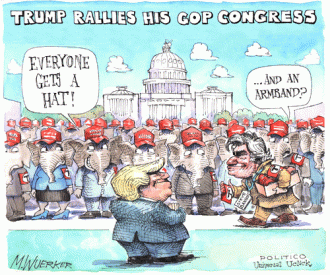 At HuffPost, Igor Bobic and Matt Fuller argue that Congress is Failing.
As House Democrats dither over moving forward with impeachment in a divided government and Senate Republicans are satisfied confirming judges rather than passing legislation, a pressing question is emerging: What the hell is Congress good for, anyway?
The House and Senate have been divided many times. Congress and the presidency are rarely controlled by one party. But the extent to which this Congress is already proving itself worthless as a legislative body and as a check against the president is historic.
“This is the worst I’ve seen it,” congressional historian and American Enterprise Institute scholar Norman Ornstein told HuffPost this week. “With Nixon, we had people like Howard Baker, Hugh Scott, Barry Goldwater, Bill Cohen and John Rhodes. There is no equivalent today. And we have far worse corruption and lying.”
Ornstein added that Trump and his Cabinet are taking “defiance of Congress to a level we have not seen before.”
For the past century, the legislative branch has steadily handed its authority to the executive on various issues like trade, regulations and war-making powers. Lawmakers continued that tradition earlier this year, allowing Trump to circumvent the appropriations process with his emergency declaration and let him build portions of a wall along the U.S.-Mexico border.
The unprecedented move ― which a majority of Republicans supported ― opened the door for future presidents to similarly fund their priorities without the explicit approval of Congress.
Read the rest at HuffPo.
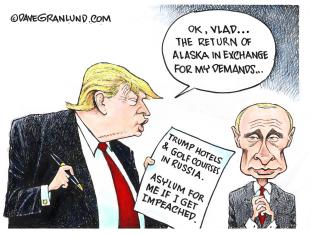 Meanwhile, Trump and Cover-Up General Bill Barr–along with Treasury Secretary Steven Mnuchin–seem to be inviting impeachment. Trump has announced that he won’t comply with any Congressional subpoenas and Barr and Mnuchin are carrying out Trump’s orders.
Grant Stern at Washington Press blog: Barr just wrote a stunning Mueller Report letter that dares Dems to start impeachment.
House Judiciary Chairman Jerrold Nadler (D-NY) subpoenaed the unredacted Mueller Report the day after Trump’s AG led the country through a series of misleading efforts to spin its contents.
Instead of providing the report, the Attorney General sent a reply to Nadler and the House Judiciary Committee that practically dares them to initiate impeachment proceedings with a formal resolution of inquiry.
Shockingly, Barr revealed that there are greater than two dozen ongoing criminal cases and investigations stemming from the Mueller Report. [Stern quotes from the Barr letter in which Barr argues that Nadler has not articulated any legal arguments that would justify releasing grand jury testimony about ongoing criminal cases]
“The Trump Administration is trying to box the Democrats in, to get them to make a decision about the formal process of impeachment,” says former federal prosecutor and Pace University School of Law professor Mimi Rocah.
“They know that it could cause dissension because some people in the party want impeachment,” says Rocah, “and others do not want to start the formal process.”
She’s one of more than 400 [now more than 500] former federal prosecutors from around the country who signed an open letter to the Department of Justice saying that President Trump would’ve been charged with criminal obstruction of justice based on the Mueller Report, were he not in the office.
If Democrats initiated impeachment hearings, they would be justified in demanding such information.
The Guardian: Democrats to fight for Trump’s tax returns after Mnuchin says no.
House Democrats are expected to file a lawsuit or a subpoena with the federal tax authorities for Donald Trump’s returns now that the treasury secretary, Steven Mnuchin, has refused to hand them over – in the latest twist of an escalating war between Congress and the executive branch of the US government.
The Treasury department on Monday afternoon denied a request by Congress for copies of Trump’s tax returns, saying that Congress had overstepped its bounds in requesting them.
The moves came as the president’s bitter confrontation with his political opponents continues to intensify. Democrats will meet with officials from the Department of Justice on Tuesday, having set up a vote in the House on Wednesday to hold Trump’s attorney general, William Barr, in contempt of Congress.
Jerry Nadler, the Democratic chair of the House judiciary committee, proposes to hold Barr in contempt after the justice department refused to provide the panel with an unredacted version of special counsel Robert Mueller’s report of the Trump-Russia investigation. The committee had given Barr until 9am on Monday to comply, after a redacted version of the report was issued last month.
House Democrats will get some support from the New York AG. The Daily Beast: New York Attorney General Sues Trump Treasury Department, IRS.
New York Attorney General Letitia James announced Monday that her office has filed a lawsuit against the Trump Treasury Department and its subsidiary, the Internal Revenue Service, for failing to respond to legally mandated records requests. The suit targets a reporting standard released in July 2018, which eliminates donor disclosure requirements for non-501(c)(3) tax-exempt groups for donors who give more than $5,000. The statement alleges that after James’ office sent a FOIA seeking more information about the decision to implement the standard, the IRS did not adequately respond within the mandated time limit. It also claims that the revised standards impede the AG’s ability to regulate those organizations.
“My office depends on these critical donor disclosure forms to be able to adequately oversee non-profit organizations in New York,” James said in the statement. “Not only was this policy change made without notice, the Treasury and the IRS are now refusing to comply with the law to release information about the rationale for these changes. No one is above the law—not even the federal government—and we will use every tool to ensure they comply with these regulations to provide transparency and accountability.”
Politico: Nadler and Barr steam toward clash over contempt.
The House Judiciary Committee will proceed with a vote to hold Attorney General William Barr in contempt of Congress on Wednesday, Chairman Jerry Nadler (D-N.Y.) confirmed late Monday, as the Justice Department attempts to fend off the effort ahead of a negotiating session with the Democratic-led committee on Tuesday.
Nadler’s firm stance comes as he seeks punitive actions against the attorney general for defying a subpoena for special counsel Robert Mueller’s unredacted report on the Russia investigation and its underlying evidence. It also comes hours after the Justice Department put forward a last-ditch plea to negotiate with the panel, offering a Wednesday meeting but later agreeing to Nadler’s demand for a Tuesday sit-down.
“At the moment, our plans to consider holding Attorney General Barr accountable for his failure to comply with our subpoena still stand,” Nadler said in a statement. “My hope is that we make concrete progress at tomorrow’s meeting towards resolving this dispute. The committee remains committed to finding a reasonable accommodation.”
In a letter to Nadler earlier Monday, Assistant Attorney General Stephen Boyd invited the chairman to a negotiation session on Wednesday to discuss an “acceptable accommodation” that would potentially give more lawmakers access to a less-redacted version of the report, in addition to “possible disclosure of certain materials” cited in Mueller’s report.
Boyd’s letter came hours after the committee took its first formal step toward holding Barr in contempt of Congress for defying the panel’s subpoena for Mueller’s unredacted report on Russian interference in the 2016 election, when Nadler announced that it planned to consider a contempt citation against Barr on Wednesday morning.
It certainly feels as if we are headed inevitably toward impeachment. I still think House Democrats need to exhaust all other means of getting the information they need; but it appears that Trump is almost asking to be impeached. So that’s where we are today; I’m sure there will be more dramatic news coming as the week goes on.
What stories are you following today?

 peej
peej Carissa
 bostonboomer
 dakinikat
 ecocatwoman
 mablue2
 Mama Lopez
 peggysue22
 quixote
 skydancingguestblogger
 Mona (aka Wonk the Vote)



 Sky Dancing
Recent Comments