
Mitch McConnell, Barack Obama, and Fake “Hostage Negotiations”
Posted: June 3, 2011 Filed under: 2012 presidential campaign, Barack Obama, financial institutions, Psychopaths in charge, Republican politics, Social Security, The Bonus Class, The Great Recession, U.S. Economy, U.S. Politics, We are so F'd | Tags: Barack Obama, Debt Ceiling, Federal Deficit, lying liars, medicare, Mitch McConnell, Paul Ryan, Social Security 17 Comments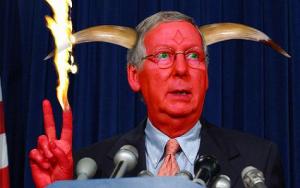
Demon Mitch
I am really angry right now, but I’m going to try to write this as calmly as I can. As we all know, Mitch McConnell, who somehow got himself elected to the Senate from the State of Kentucky is holding the entire economy hostage, insisting that the only way Republicans will allow an increase in the debt ceiling is if the Democrats agree to drastic cuts in Medicare.
As Dakinikat wrote yesterday, what McConnell and other Republicans are doing is “playing chicken with financial markets.” We are in serious danger of another Great Depression. These freaks are suggesting that they will tank the economy in their efforts to win points for their party. Michael Tomasky writes:
McConnell has made it abundantly clear that his goal is not to help the economy or anything else; his overriding concern is making Barack Obama a one-term president. When he said Sunday that there will be no deal on raising the debt ceiling without substantial Medicare cuts, he made his motives clear again.
Tomasky is saddened because
…there was a period in the history of this republic, and of the world’s so-called greatest deliberative body, when senators really did, at some crucial point in deliberations, put their partisan differences aside and work out solutions to the country’s pressing problems.
[….]
McConnell benefits from the lingering good feeling that still permeates the institution in which he serves—because people insist on presuming that the leader of the minority party speaks in good faith. But there’s no good faith here.
The only question is whether the Democrats will accede to the hostage-taker’s demands. They’re in a tough position, especially after yesterday’s vote in the House, where nearly half of the Democrats joined all Republicans in refusing to raise the debt limit without deep and permanent cuts. Raising the ceiling is extremely unpopular in polls (of course it always has been, but that fact that didn’t prevent a certain M. McConnell from voting to raise it seven times during George W. Bush’s presidency).
Dakinikat isn’t alone in her warning about the insanity of what McConnell and his Republican pals are doing to us. Even the Wall Street Journal is questioning McConnell’s motivation. Author Stan Collender concludes that McConnell is willing to sacrifice his party’s chance at the White House in an effort to set himself up to be the next Majority Leader in the Senate.
…McConnell has decided that the GOP winning the White House in 2012 isn’t as important to him as the GOP getting the majority in the Senate and that requires continually energizing the base rather than trying to win over independents and Democrats.
If Obama wins and the GOP takes over the Senate, (Roger Ailes aside) McConnell will be the most important and powerful Republican in the United States. That won’t be true if there’s a Republican president, of course. But if all of the best known GOP candidates lose the Republican nomination in 2012 and the 2012 nominee then loses in the general election, the next tranche of potential Republican presidential candidates will be at least two years away. In the meantime, McConnell will be the one negotiating with the White House and stopping its initiatives.
The McConnell statement makes a great deal of sense in this context. Openly attacking Medicare as he did strengthens his credentials with the base even if it weakens them with everyone else. But that’s okay because it’s the base that’s needed to elect Republicans to the Senate next year and that would strengthen McConnell even if it makes life harder…or impossible…for the GOP presidential candidate.
At Market Watch, Rex Nutting writes of Republican threats to cause the U.S. to default on its debts:
This is an insane idea cooked up by political consultants who can count votes but not dollars. Assuming they are willing to go through with their threat, it’s simply terrorism — a sort of tea-party suicide bomb.
Both parties have played games with the debt ceiling, but never has anyone suggested out loud that default is really an option. Until now.
Default would make our problems immeasurably worse. Our borrowing costs would soar, and no one has quite explained how that would make our debts more affordable. Moody’s said Thursday that it might downgrade our debt (making it more expensive for us to borrow) if there were just a chance of default. Imagine the costs if we actually reneged on our promises. Read our full story about Moody’s warning on U.S. debt.
Taking all this into consideration, any reasonable person would be able to see that the Republicans are simply playing games and that in the end they are going to raise the debt ceiling. They aren’t going to go against the wishes of their Wall Street masters. Even McConnell’s hometown paper agrees:
Sen. Mitch McConnell, R-KY, won a prominent place in the weekend news cycle when he made pointed statements last Friday about Medicare, taxes, and what it would take for him to support an increase in the debt ceiling.
He chose his words carefully. Amid blustery talking points, McConnell painstakingly did not say that Republicans would refuse to increase the debt limit. Ultimately, the only threat he issued was about his own individual vote — not about what Republicans will do in general.
[….]
Because the threat is not credible, the only value it has is the value Democrats choose to give it. If they agree with the Republican proposals and want their own political cover, they will treat the threat as credible. They will “save America” from the dastardly Republicans. If they have more responsible strategies they will call the bluff. They hold all the cards.
Therefore, the Democrats and President Obama should simply sit back and let them throw as many tantrums as they want while pointing out how idiotic they are and laughing uproariously.
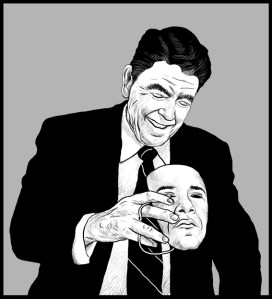
So what does our President do? He calls Republican and Democratic legislators to the White House for bogus deficit talks that are nothing but an obvious charade to enable these elite criminals to continue stealing American taxpayers blind. He even plans to hold a “golf summit” with Speaker of the House John Boehner.
There can be no other explanation for President Reagan’s Obama’s behavior than that he agrees with McConnell that Paul Ryan’s plan to eliminate Medicare is the way to go. He apparently also thinks it’s worth it to trade our collective economic futures for another four years in the White House. Next up, Democrats and Republicans “compromise” on Social Security “reform.”
Elite Conspiracy Theories and the Arrest of Dominique Strauss-Kahn
Posted: May 25, 2011 Filed under: collective bargaining, Economic Develpment, financial institutions, Foreign Affairs, France, Libya, Media, Pakistan, poverty, racism, Regulation, The Bonus Class, The Great Recession, U.S. Economy, U.S. Politics, unemployment, Violence against women | Tags: conspiracy theories, Dominique Strauss-Kahn, Federal Reserve, France, global elites, IMF, John F. Kennedy, Naomi Wolf, Nicholas Sarkozy, rape 29 Comments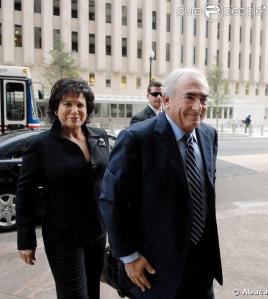
Dominque Strauss-Kahn and wife Anne
When one of us common people questions the Bush failures before 9/11 or the Warren Commission’s insistence that JFK was killed by a lone gunman, we are laughed at by the corporate media and lectured by politicians. But when one of the Global Elite gets in trouble, conspiracy theories are suddenly in vogue. Now that a global banker and possible candidate for the French presidency is accused of a sexual attack on a lowly hotel maid, elite conspiracy theories are running rampant in the U.S. and international media. I’ll give you a few examples.
At the Pakistan Observer, Ali Ashraf Kahn argues that Strauss-Kahn had to brought down, first because he would very likely have beaten the “American poodle Sarakozi” in a race for the presidency of France, and second because he (Strauss-Kahn) had offended the international banksters and corporations by proposing more liberal policies at the IMF which would have been a threat to the dollar. According to Ali Ashraf Kahn, getting rid of Strauss-Kahn would–along with U.S. military actions in Libya and Pakistan–would help to “save American predominance in the world.”
This incident goes to prove the hidden agenda of an international vested interest group trying to build and secure an American Empire for their master, which has not spared even Strauss-Kahn, who has been fixed in a rape attempt with a 32 year old hotel maid in a country where teen aged unwed mothers are a normal accepted feature. The former French Foreign Minister Strauss-Kahn, once if he was elected as president of France would have worked to strengthen the Euro to bring down dollar, which was of serious concern for the Federal Reserve Board in the already ongoing currency war with China. John F. Kennedy, US president was murdered for his only sin of canceling Federal Reserve Act of 1913 in 1963, when for the first time dollar currency was issued with the seal of US government, soon after his assassination President Lyndon B. Johnson revived this Act to continue their financial exploitation.
The author of this article appears to have a problem understanding the distinction between rape and consensual sex that results in pregnancies, but I’ll let that go for the moment. Kahn explains that Strauss-Kahn was trying to make radical changes at the IMF–so much so that Strauss Kahn won high praise from Joseph Stiglitz, which was apparently the final “kiss of death.”
Strauss-Kahn was trying to move the bank in a more positive direction, a direction that didn’t require that countries leave their economies open to the ravages of foreign capital that moves in swiftly-pushing up prices and creating bubbles, and departs just as fast, leaving behind the scourge of high unemployment, plunging demand, hobbled industries, and deep recession. Strauss-Kahn had set out on a “kinder and gentler” path, one that would not force foreign leaders to privatize their state-owned industries or crush their labour unions. Naturally, his actions were not warmly received by the banker’s mafia and multi national corporations who look to the IMF to provide legitimacy to their ongoing plunder of the rest of the world. These are the people who think that the current policies are “just fine” because they produce the desired results they’re looking for, which is bigger profits for themselves and deeper poverty for everyone else.
I have to admit, I’m in sympathy with those goals. There’s a lot more, so read the whole thing if you want more detail.
The next conspiracy theory is from Uganda. The author, Dr. Kihura Nkuba, also argues that Strauss-Kahn’s attack on the U.S. dollar is what led to his downfall. Nkuba says that police in the racist U.S. would never take the word of a poor black woman against that of a powerful white man unless motivated by a political conspiracy.
A woman from West Africa, assaulted by a famous white male, a future president of France, to be listened to by the New York Police, is amazing. But is it? [….]
New York police has [sic] been rummaging through DSK’s diaries, hotel registries, phone records, yearbooks and have made sure that the “great seducer” always appears handcuffed and dressed in a “pervie” raincoat with three-days stubble before they parade him in front of the media. He gets this treatment even though he has no criminal record and nothing, but the sketchy accusations of a room service cleaner.
What is his real crime? Strauss-Kahn was mounting an attack against the dollar and had called for a new world reserve currency that would challenge the dominance of the dollar and protect against future financial instability. He suggested adding emerging market countries’ currencies, such as the Yuan, to a basket of currencies that the IMF will administer to add stability to the global system….Strauss-Kahn saw a greater role for the IMF’s Special Drawing Rights, (SDRs) which is currently composed of the dollar, sterling, euro and yen, over time but said it will take a great deal of international cooperation to make that work.”
I love the way these male authors toss aside the charges against Strauss-Kahn–in Nkuba’s case, while complaining about racial prejudice. I guess he goes by the “bros before hos” rule: racism bad, sexism invisible.
Naomi Wolf also has a conspiracy theory about the Strauss-Kahn arrest that goes along with her defense of Julian Assange against sexual abuse charges in Sweden. She begins by comparing the NYC police response to the Strauss-Kahn case with the case of two of New York’s “finest,” Kenneth Moreno and Franklin Mata, who are on trial for raping a woman in Manhattan.
According to Wolf,
Moreno and Mata have not been asked to strip naked for “evidence” photos, were not initially denied bail, and were not held in solitary confinement, and are not being strip-searched daily. Their entire case has followed the usual timetable of many months, as evidence was gathered, testimony compiled and arguments made.
On the other hand, Wolf writes,
After a chambermaid reportedly told her supervisor at the elegant Sofitel hotel that she had been sexually assaulted, the suspect was immediately tracked down, escorted off a plane just before its departure, and arrested. High-ranking detectives, not lowly officers, were dispatched to the crime scene. The DNA evidence was sequenced within hours, not the normal eight or nine days. By the end of the day’s news cycle, New York City police spokespeople had made uncharacteristic and shockingly premature statements supporting the credibility of the victim’s narrative — before an investigation was complete.
The accused was handcuffed and escorted before television cameras — a New York tradition known as a “perp walk.” The suspect was photographed naked, which is also unusual, initially denied bail and held in solitary confinement. The Police Commissioner has boasted to the press that Strauss-Kahn is strip-searched now multiple times a day — also unheard-of.
I didn’t know that Strauss-Kahn was being subjected to daily strip-searches, but it seems to be true, according to the New York Post.
Prison brass and the NYPD have an airtight plan to safeguard the jet-setting French moneyman by having him isolated, chained, shackled — and repeatedly strip-searched — before and after court appearances, including a bail hearing newly scheduled for today.
“He will be strip-searched when he leaves Rikers Island. He will be strip-searched when he arrives in court. He’s strip-searched when he leaves court, and he’s strip-searched when he gets back to Rikers,” said Norman Seabrook, head of the correction officers union.
“When he arrives to the courthouse, he’s going to be put in an isolated cell away from other inmates,” said Seabrook. “This is for fear that another inmate would try to kill him to make a name for himself.”
Yet, as Wolf points out, hotel maids are routinely subject to sexual attacks during their work. Her conspiracy theory is that in the modern surveillance state,
men like former New York Governor Eliot Spitzer, who was investigating financial wrongdoing by the insurance giant AIG, WikiLeaks founder Julian Assange and Strauss-Kahn — whose efforts to reform the IMF gained him powerful opponents — can be, and are, kept under constant surveillance. Indeed, Strauss-Kahn, who had been the odds-on favorite to defeat Nicolas Sarkozy in next year’s French presidential election, probably interested more than one intelligence service.
This does not mean that Strauss-Kahn is innocent or that he is guilty. It means that policy outcomes can be advanced nowadays, in a surveillance society, by exploiting or manipulating sex-crime charges, whether real or inflated.
She has a pretty good point there. But the maid who reported Strauss-Kahn’s attack was a member of a union, as Dean Baker pointed out. Could that be why her employer made sure she was treated well by the police?
The reason that this is an important part of the story is that it is likely that Strauss-Kahn’s alleged victim might not have felt confident enough to pursue the issue with either her supervisors or law enforcement agencies, if she had not been protected by a union contract. The vast majority of hotel workers in the United States, like most workers in the private sector, do not enjoy this protection.
Dean Baker was also disappointed in Strauss-Kahn’s arrest, because whether or not he is guilty, his resignation spells the end of reform at the IMF.
Reading all these arguments for a conspiracy against Dominque Strauss-Kahn has given me pause. It certainly makes sense that the U.S. government would want to end his tenure at the IMF and prevent him from becoming President of France. But how could they know he would attack a hotel maid? Does the conspiracy require her involvement? That’s the serious hangup I have in buying into these authors’ claims–much as I do always enjoy a good conspiracy theory.
Patrica J. Williams touches all the bases in an article about the case at NPR. On the conspiracy issue, she argues for a skeptical approach to conspiracy theories, while keeping an open mind.
Politics is a complicated, dirty business, as the impeachment hearings of President Clinton ought to have instructed us. (Who guessed back then that Newt Gingrich, while skewering Clinton’s morals, was cheating on his then-wife with his present wife?) For Americans, who by and large have never heard of DSK, the possibility of his arrest being a set-up is inconceivable. But in the immediate aftermath of his detention, a majority of French citizens believe he has been purposely brought down. Why? Dominique Strauss-Kahn was well on track not just to become France’s president but its first Jewish president. As head of the IMF, he led that institution in a distinctly progressive manner. He sharply critiqued corrupt American bankers and banking practices and, early on, predicted the collapse of the mortgage market. As a center-left Socialist party member, he was close to negotiating a European Union bailout for Greece. And his elimination from the election empowers the candidacy of Marine LePen, head of the anti-immigrant, anti-Muslim and anti-Semitic National Front party, whose popularity, alarmingly enough, currently polls higher than that of Nicolas Sarkozy.
I’m certainly going to keep all this in mind as I follow the developments in the Strauss-Kahn case. I’d love to know what you all think about it too, so please chime in!
Monday Reads
Posted: May 16, 2011 Filed under: 2012 presidential campaign, Economy, Federal Budget and Budget deficit, fundamentalist Christians, Global Financial Crisis, income inequality, Medicare, religion, religious extremists, Republican politics, Republican presidential politics, Team Obama, The Bonus Class, The Great Recession, U.S. Economy, U.S. Politics | Tags: Debt Ceiling, End Times, evangelical Christians, Harold Campaign, Mark Thoma, Newt Gingrich, Rapture, the plutocracy, Timothy Giethner 52 Comments Good Morning!
Are you reading for the end of the world next Saturday? Nope, it’s not 2012 yet and we’re not talking about the Mayan Prophecy. Harold Campaign has convinced a group of evangelicals that the date is May 21, 2011. I wonder if any of them would like me to take care of their left behind pets for all their money? You can read more about the man and his end of days wishes at Salon.
The self-appointed harbingers are not tied to any particular church — they claim organized religion has been corrupted by the devil — but rather to Internet- and radio-based ministries. And their lone mission is to tell anyone and everyone that the end of days is May 21. That’s when, they insist, God’s true believers will be lifted into heaven and saved, during a biblical event widely referred to as the Rapture.
The finer points of Christian eschatology have long been the subject of dispute (not to mention the inspiration for movies and books, like the blockbuster “Left Behind” series). Though mainstream churches reject the the notion that doomsday can be predicted by any man, fringe scholars continue to work feverishly pinpointing the moment of the final, divine revelation. And one such man — 89-year-old radio host Harold Camping — has been at the game for decades.
In the early ’90s, Camping published a book titled “1994?,” which claimed judgment day would arrive in September of that year. When confronted with such a staggering anticlimax — the world, after all, kept on spinning — Camping chose not to be discouraged, but to learn from his mistakes. (He hadn’t considered the Book of Jeremiah, he says.) A civil engineer by trade, Camping went back to the drawing board and continued to crunch the numbers, before arriving at the adamant determination that Rapture would come on May 21, 2011. He began to spread the word through his broadcasting network, Family Radio, in 2009, and quickly built up a fervid following.
I guess it takes all kinds. That’s what my mother used to tell me when she was alive, anyway. Speaking of that, MoJo has a great list of Newtisms that will take you a trip back in time with Gingrich’s greatest tongue trips. Here’s some of his earliest hits.
1978 In an address to College Republicans before he was elected to the House, Gingrich says: “I think one of the great problems we have in the Republican party is that we don’t encourage you to be nasty. We encourage you to be neat, obedient, and loyal and faithful and all those Boy Scout words.” He added, “Richard Nixon…Gerald Ford…They have done a terrible job, a pathetic job. In my lifetime, in my lifetime—I was born in 1943—we have not had a competent national Republican leader. Not ever.”
1980 On the House floor, Gingrich states, “The reality is that this country is in greater danger than at any time since 1939.”
1980 Gingrich says: “We need a military four times the size of our present defense system.” (See 1984.)
1983 A major milestone: Gingrich cites former British Prime Minister Neville Chamberlain on the House floor: “If in fact we are to follow the Chamberlain liberal Democratic line of withdrawal from the planet,” he explains, “we would truly have tyranny everywhere, and we in America could experience the joys of Soviet-style brutality and murdering of women and children.”
What is it that Republicans put in their formula that turns out people like this? Newt was on Meet the Press yesterday where he mouthed off on a number of subject’s including Paul Ryan’s Medicare pogrome. This is the National Review’s take so read with caution.
Newt Gingrich’s appearance on “Meet the Press” today could leave some wondering which party’s nomination he is running for. The former speaker had some harsh words for Paul Ryan’s (and by extension, nearly every House Republican’s) plan to reform Medicare, calling it “radical.”
“I don’t think right-wing social engineering is any more desirable than left-wing social engineering,” he said when asked about Ryan’s plan to transition to a “premium support” model for Medicare. “I don’t think imposing radical change from the right or the left is a very good way for a free society to operate.”
As far as an alternative, Gingrich trotted out the same appeal employed by Obama/Reid/Pelosi — for a “national conversation” on how to “improve” Medicare, and promised to eliminate ‘waste, fraud and abuse,’ etc.
“I think what you want to have is a system where people voluntarily migrate to better outcomes, better solutions, better options,” Gingrich said. Ryan’s plan was simply “too big a jump.”
He even went so far as to compare it the Obama health-care plan.”I’m against Obamacare, which is imposing radical change, and I would be against a conservative imposing radical change.”
I have to say that having Trump, Gingrich, Santorum and Paul all debating each other on one stage would probably be highly entertaining. They could have a contest for who would make the craziest old uncle.
The White House is out on the road trying to head off problems with the national debt ceiling. Timothy Geithner says that the economy will double-dip if the Republicans don’t raise the ceiling.
In a heavily-anticipated response to Sen. Michael Bennet, D-Colo., who asked Geithner to document the economic and fiscal impacts of failing to lift the statutory debt limit, the Treasury secretary detailed a chain reaction that would cripple the economy, costing jobs and income.
“A default would inflict catastrophic far-reaching damage on our nation’s economy, significantly reducing growth and increasing unemployment,” said Geithner in the letter to Bennet which was dated May 13. “Even a short-term default could cause irrevocable damage to the economy.”
Geithner has imposed an August deadline for Congress to lift the $14.3 trillion debt ceiling, but lawmakers are still negotiating over Republican demands to tie the move to spending cuts. And a portion of the GOP still remains skeptical about the need to act by the deadline at all, arguing that the consequences have been overstates.
Economist Mark Thoma has a better explanation of how the refusal to increase the debt ceiling would impact the economy on CBS Money Watch. This explanation is much more precise.
If politicians fail to reach a deal to increase the debt ceiling, there would be a large fall in federal spending. The decline in federal purchases of private sector goods and services would reduce aggregate demand, and this could slow or even reverse the recovery (it could also threaten the delivery of critical services that some people depend upon). In addition, the failure to pay wages to federal workers would disrupt household finances and cause a further decline in demand, as would the failure of the government to pay its bills for the goods and services it has already purchased from the private sector (and it could even threaten some households and businesses with bankruptcy should the problem persist). There may be some room for the Treasury to use accounting tricks to avoid the worst problems, at least for a time, but it is not at all clear how well this would work to insulate the economy from problems and eventually this strategy will come to an end.
That’s potentially bad enough, but it’s far from the end of the problems that could occur. Failure to raise the debt ceiling could also undermine faith in the safety of US Treasury bills. If we default on bond payments, or appear willing to do so even if it doesn’t actually occur and investors lose faith in US Treasury Bills, they will begin demanding higher interest rates to cover the increased perception of risk. This could be very costly. We depend upon the rest of the world to finance our debt at extremely low interest rates. If the willingness of other countries to do this diminishes, then the cost of financing our debt would rise substantially. And that’s not all. In addition to increased debt servicing costs, an increase in interest rates would also choke off business investment potentially lowering economic growth, and the consumption of durable goods by households would fall as well. Rising interest rates would also be bad for the housing recovery (such as it is). Thus, failure to reach an agreement could be very costly.
The Economist‘s Blog on American Politics: Democracy in America has an interesting post right now on ‘The Road to 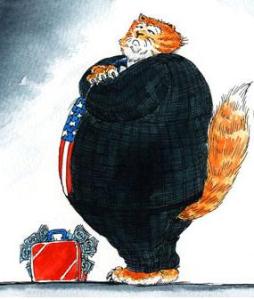 Plutocracy’. It’s an interesting read with a lot of quotes from other pundits.
THE word “plutocracy” is in the air these days. Some say the era of the de facto rule of the mighty top 10%, or top 1%, or whatever insidious sliver of the income distribution is thought to constitute the moneyed power elite, is upon us, or nearly so. I’m not so sure. I am sold on the proposition that there’s something deeply whacked about the American financial system, and that whatever that’s whacked about it is significantly responsible for the top 1% pulling so far away from the rest of the income distribution. This needs to be fixed, whatever its other consequences. It’s not clear to me, however, what exactly is whacked. I don’t know whether to sign up for Tyler Cowen’s “going short on volatility” story, Daron Acemoglu’s “financial-sector lobbying and campaign contributions ‘bought’ an enriching (and destabilising) regulatory structure” story, or some other story. No doubt the truth is in some subtle combination of stories. In any case, accounts such as Mr Acemoglu’s, according to which big players in certain sectors over time manage to rig the regulatory climate to their advantage, are quite compelling for reasons both theoretical and empirical
Newsweek has an interesting article up on why the megarich manage to have such a sweet tax deal. Even if we raise their income taxes, it really doesn’t hit them where it counts. Here’s why.
It drives economist Bruce Bartlett crazy every time he hears another bazillionaire announce he’s in favor of paying higher taxes. Most recently it was Mark Zuckerberg who got Bartlett’s blood boiling when the Facebook founder declared himself “cool” with paying more in federal taxes, joining such tycoons as Bill Gates, Warren Buffett, Ted Turner, and even a stray hedge-fund manager or two.
Bartlett, a former member of the Reagan White House, isn’t against the wealthy paying higher taxes. He’s that rare conservative who thinks higher taxes need to be part of the deficit debate. His beef? It’s a hollow gesture to say the federal government should raise the tax rate on the country’s top wage earners when the likes of Zuckerberg have most of their wealth tied up in stock. Many of the super-rich see virtually all their income as capital gains, and capital gains are taxed at a much lower rate—15 percent—than ordinary income. When Warren Buffett talks about paying a lower tax rate than his secretary, that’s because she sees most of her pay through a paycheck, while the bulk of his compensation comes in the form of capital gains and dividends. In 2006, for instance, Buffett paid 17.7 percent in taxes on the $46 million he booked that year, while his secretary lost 30 percent of her $60,000 salary to the government.
“It’s easy to say ‘Raise taxes’ when you know you’re not going to have to pay those taxes,” Bartlett says. “What I don’t hear is ‘Let’s raise the capital-gains tax.’” Instead the focus has been on the federal tax rate paid by those with an annual income of $250,000 or more—the top 3 percent of earners. Bartlett argues that while raising taxes on the country’s richest individuals would go a long way in easing the debt crisis, it makes no sense to treat the professional making a few hundred thousand dollars a year the same as the Richie Rich set. Maybe it’s hard to muster sympathy for an executive pulling down $1 million a year. But ours is a tax system where a person in the top tax bracket (those earning more than $374,000 in 2010) pays a tax rate of 35 percent on the upper portions of his or her income (37.9 percent if you include Medicare), whereas a hedge-fund manager or mogul earning 10 or 100 times that amount pays less than half that tax rate.
Well, now I’m thinking we’re all just so f’ked that I might as well stop while I’m ahead. What’s on your reading and blogging list today?
Still no answers for the Jobs Crisis
Posted: May 5, 2011 Filed under: Domestic Policy, Economy, Equity Markets, Federal Budget, Federal Budget and Budget deficit, jobs, The Great Recession, U.S. Economy, unemployment | Tags: joblessness, unemployment 27 Comments It’s difficult for me to watch the job market continue to dither knowing full well that nothing is being done about it. Just in case you’ve missed the other headlines today, U.S. jobless claims “unexpectedly” jumped. It wasn’t unexpected on my part.
Applications for jobless benefits jumped by 43,000 to 474,000 in the week ended April 30, the most since August, Labor Department figures showed today. A spring break holiday in New York, a new emergency benefits program in Oregon and auto shutdowns caused by the disaster in Japan were the main reasons for the surge, a Labor Department spokesman said as the data was released to the press.
Even before last week, claims had drifted up, raising concern the improvement in the labor market has stalled. Employers added 185,000 workers to payrolls in April, fewer than in the prior month, and the unemployment rate held at 8.8 percent, economists project a Labor Department report to show tomorrow.
“We’re seeing so many distortions in the claims numbers week to week that it’s hard to say, but I’m willing to be patient and wait and see,” said Stephen Stanley, chief economist at Pierpont Securities LLC in Stamford, Connecticut. “Other reports show an improvement in the labor market. It’s going to take a while to dig out of the hole we have in relation to the jobs the economy lost during the recession.”
Yes, it is a hole, and there’s very little being done to fill it. There are quite a few factors that contribute to the current appalling job market. The Fifth Fed District’s Macroblog looks at the contribution of offshoring. Offshoring basically means that part of a production process is moved to an overseas location. That can mean anything from a call center to manufacturing of a good. You can see that the impacted industries include both service and manufacturing sectors. The nifty table up there in the left hand corner will give you an idea of the impact of offshoring by industry. The numbers are tabulated from data during the years of 1999 – 2008. The changes and content of the ‘other’ category is further elucidated in the macroblog piece. It includes another table that you may review too.
Sixty-nine percent of the foreign employment growth by U.S. multinationals from 1999 to 2008 was in the “other industries” category, and 87 percent of that growth was in three types of industries: retail trade; administration, support, and waste management; and accommodation of food services. Some fraction of these jobs, no doubt, reflect “offshoring” in the usual sense. But it is also true that these are types of industries that are more likely than many others to represent production for local (or domestic) demand as opposed to production for export to the United States.
This is a bit interesting. There are two main types of Foreign Direct Investment that involve ‘offshoring’. One is called vertical and the other is horizontal. Horizontal FDI means that one segment of the process is moved to another country but the final good or service still goes to the consumer in the company’s home country. The last analysis from macroblog implies that a substantial part of that offshoring is actually Vertical FDI. This means that the company is moving itself over to the country to take advantage of end consumers in the other country.
This finding isn’t surprising if you consider the number of countries that are experiencing booms in the number of middle class citizens. There are more middle class Chinese than there are US citizens, as an example. There is also the fact that the middle class in the US has been losing income and purchasing power for nearly 30 years. It only figures that these companies would look for greener pastures elsewhere. Why expand here when your customer base is unlikely to be expanding and unable to afford your products in any meaningful way?
Macroblog points out that this is unlikely to explain all the doldrums in the US job market, but it does provide one factor and and interesting one at that. I would say that this analysis basically says that US businesses are much more bullish on foreign markets than they are on their own. (Capital flows for investment suggest this too.) This should give all of us pause.
Interestingly enough, another FED President also suggested that the economy and the US job markets weren’t as stable as they could be and suggested more stimulus. Three Fed Presidents rotate in and out of the Open Market Committee–that’s the monetary policy decision body–and each district is a world unto itself in many ways. Fed Boston is not in the current rotation.
Federal Reserve Bank of Boston President Eric Rosengren yesterday said record stimulus is necessary to spur the “anemic” economy and that raising interest rates to combat increasing food and fuel prices would impede growth.
“With significant slack in labor markets, stable inflation expectations, and core inflation well below our longer run target, there is currently no reason to slow the economy down with tighter monetary policy,” Rosengren said during a speech in Boston.
Not surprisingly, equity markets seemed to be caught a bit off guard with this news. Right now, I think the market seems to be in one of those periods where it’s not paying much attention to fundamentals. Bloomberg.com notes that Futures Fell on the news. Some times Wall Street thinks as long as their churning out fees and capital gains, all is right with the world. This is definitely not the case. It does explain why their economists tend to get caught off guard though. Hello? Real World anyone?
Stock-index futures dropped after the report. The contract on the Standard & Poor’s 500 Index maturing in June fell 0.6 percent to 1,334.8 at 8:58 a.m. in New York. Treasury securities rose, sending the yield on the benchmark 10-year note down to 3.18 percent from 3.22 percent late yesterday.
Dean Baker from CEPR is pretty pessimistic about the entire thing.
Weekly unemployment claims jumped to 474,000 last week, an increase of 43,000 from the level reported the previous week. This is seriously bad news about the state of the labor market. It seems that the numbers were inflated by unusual factors, most importantly the addition of 25,000 spring break related layoffs in New York to the rolls due to a changing vacation pattern, however even after adjusting for such factors, claims would still be above 400,000 for the fourth consecutive week.
This puts weekly claims well above the 380,000 level that we had been seeing in February and March. This suggests that job growth is slowing from an already weak level. This is news that should be reported prominently.
Unfortunately, the lackadaisical job market is off the front pages. Much of the political focus on the economy remains honed in on the federal debt. Again, this is the silly because one of the best ways of increasing tax revenues and closing the debt is for people to be employed. It’s an uphill battle to expect the deficit to close with this unacceptable level of unemployment. I still can’t figure out where they’ve placed their heads back their in Washington, D.C. Oh, well, look over there … it’s a dead Osama Bin Laden and we’ve not got any pictures yet!

 peej
peej Carissa
 bostonboomer
 dakinikat
 ecocatwoman
 mablue2
 Mama Lopez
 peggysue22
 quixote
 skydancingguestblogger
 Mona (aka Wonk the Vote)



 Sky Dancing
Recent Comments