
Tuesday Reads
Posted: August 9, 2011 Filed under: 2012 presidential campaign, Global Financial Crisis, Hillary Clinton, Medicaid, Medicare, morning reads, psychology, religious extremists, Republican presidential politics, Social Security, The Great Recession, the villagers, U.S. Economy, U.S. Politics, voodoo economics, WE TOLD THEM SO | Tags: antisocial personality disorder, Barack Obama, bipolar disorder, creativity, Dean Baker, Depression, economic illiterates, empathy, Farm Subsidies, FDR, hyperthymic personality, JFK, Kenneth Moreno, mania, Michele Bachmann, narcissistic personality disorder, Nassir Ghaemi, psychiatry, rape cops, Rick Perry, trauma, Tufts University, Verizon strike 43 Comments
Good Morning!! I’m switching to strong coffee this morning, because I’ve had the sleepies for the past few days. It’s been really damp and humid here, so maybe that’s the reason. All I know is I keep dozing off, and I don’t like it! Anyway, let’s get to the news before I nod out again.
A few days ago, commenter madaha turned me on to an article about a fascinating new book that just came out last week. The book is called A First Rate Madness. The author is Nassir Ghaemi, a professor of psychiatry at Tufts University. From Salon:
Nassir Ghaemi, an author and professor of psychiatry at Tufts University School of Medicine, argues that many of history’s most famous and admired figures, from Churchill to FDR to Gandhi, showed signs of mental illness — and became better leaders because of it. Ghaemi bases his argument on historical records and some of the latest experimental studies on depression and mania, arguing that mild symptoms can actually enhance qualities like creativity or empathy.
After reading the piece in Salon, I immediately ordered the book and I’ve been dipping into it over the past couple of days.
So far, I’ve read the chapter on FDR, and I’m going to read about JFK next. According to Ghaemi, both of these men had hyperthymic personalities: basically, they were upbeat, enthusiastic, energetic, and creative, because they tended to be somewhat hypomanic (a milder, less disabling form of the mania experienced by those with bipolar disorder). In addition, both FDR and JFK suffered from serious physical illnesses–FDR from polio and JFK from Addison’s disease. These illnesses and other adversities these two men faced enabled them to develop empathy for the suffering of ordinary people–even though they were both from privileged backgrounds. Ghaemi argues that people with slightly abnormal personalities are better leaders–particularly in times of crisis when great creativity, empathy, and resilience are needed. According to Ghaemi:
Many people who experience traumas [like terrorism or war] don’t develop PTSD or other illnesses. So the question is, what keeps those people from getting sick? What creates resilience? The psychological research suggests that personality is a major factor. Resilience seems to be associated with mild manic symptoms, but you can’t develop resilience unless you’ve already experienced trauma. Many of these leaders faced adversity in their childhood and adulthood, and that seemed to make them better able to handle crises. It’s like a vaccine. You get exposed to a little bit of a bacteria then you can handle major infections and I think trauma and resilience and hyperthymic personality seem to follow a similar path.
Ghaemi does not discuss Obama’s personality in the book, but Salon interviewer Thomas Rogers asked the author whether Obama may be too “sane” to be a successful President in our current time of crisis.
Obama’s persona is that of a very sane, rational person who is good at compromise — which is definitely how he sold himself during the debt ceiling crisis. Do you think Obama’s sanity is hurting his abilities as a leader?
I didn’t discuss Obama and other current leaders in the book, because there are documentation and confidentiality issues, and a lot of speculation would have to happen. That said, Obama has said himself that he thinks he’s very normal. This no-drama-Obama persona is meant to reassure people about his normality, but I think that when you look at his memoir there’s a sense of a much more complex and profound person who may have experienced a great deal of anxiety and maybe some depression growing up, being half-white half-African-American. The [sane] parts of his psychology may hinder his leadership in terms of not being creative, and that may not be as useful in a crisis. But to whatever extent he’s not fully completely average, he’ll have some psychological reservoir to draw on to think more creatively and realistically about the current situation.
I wish I could agree that Obama might learn to deal with the nation’s difficulties, but so far he doesn’t seem to learn anything from experience. Most of the leaders that Ghaemi discusses suffered from mood disorders–depression or bipolar disorder. Obama, on the other hand, appears to have a different kind of disorder–either Narcissistic Personality Disorder or Antisocial Personality Disorder, or both.
Dakinikat alerted me to an interview with Ghaemi on NPR. I haven’t listened to it yet, but here’s the link.
Getting back to current news, this coming Saturday, Rick Perry plans to announce that he’s running for the Republican presidential nomination.
Rick Perry intends to use a speech in South Carolina on Saturday to make clear that he’s running for president, POLITICO has learned.
According to two sources familiar with the plan, the Texas governor will remove any doubt about his White House intentions during his appearance at a RedState conference in Charleston.
It’s uncertain whether Saturday will mark a formal declaration, but Perry’s decision to disclose his intentions the same day as the Ames straw poll — and then hours later make his first trip to New Hampshire — will send shock waves through the race and upend whatever results come out of the straw poll.
Immediately following his speech in South Carolina, Perry will make his New Hampshire debut at a house party at the Portsmouth-area home of a state representative, Pamela Tucker, the Union Leader reported Monday. Tucker was among the Granite Staters who went to Texas last week to encourage Perry to run.
What can I say? This is ghastly news. Think Progress is reporting that besides being a fundamentalist religious fanatic, Perry shares a similar problem to that of fellow wingnut Michele Bachmann–he has taken lots of Federal money in farm subsidies–$80,000, to be exact.
Verizon workers have gone out on strike–45,000 of them.
More than 45,000 workers from New England to Virginia went on strike just after midnight today at Verizon Communications. Since bargaining began July 22, Verizon has refused to move from a long list of concession demands. As the contract expired, Verizon, a $100 billion company, still was looking for $1 billion in concessions from 45,000 workers and families. That’s about $20,000 in givebacks for every family, nearly 100 concessionary proposals remained on the table.
This despite Verizon’s 2011 annualized revenues of $108 billion and net profits of $6 billion. At the same time, Verizon Wireless just paid its parent company, Vodaphone, a $10 billion dividend. Meanwhile, Verizon’s five top executives received $258 million over the past four years.
The workers, members of the Communications Workers of America (CWA) and the Electrical Workers (IBEW), say they are striking until Verizon “stops its Wisconsin-style tactics and starts bargaining seriously.”
According to Reuters, both sides are accusing each other of bad acts:
The second day of a strike by Verizon workers turned ugly after union representatives accused managers of injuring three workers while driving past picket lines, and the phone giant complained of a spike in network sabotage cases.
[….]
Verizon complained of network sabotage cases in the same statement where it said some picketing workers were unlawfully blocking Verizon managers’ access to work centers.
A spokeswoman for the Communications Workers of America, representing 35,000 of the strikers, said the union “does not condone illegal action of any kind.” The International Brotherhood of Electrical Workers, representing 10,000 strikers, also said members “are expected to obey the law.”
However, the CWA said some picketing workers were hurt by Verizon managers’ cars and that one worker was knocked unconscious when he was clipped by the mirror of a manager’s car that was speeding past a picket line.
Dean Baker had a great piece at Truthout yesterday: The Economic Illiterates Step Up the Attack on Social Security and Medicare
The nonsense with the S&P downgrade is yet another distraction – after four months of haggling over the debt ceiling idiocy – from the real problem facing the country: a downturn that has left 25 million people unemployed, underemployed or out of the labor force altogether. Tens of millions of people are seeing their career hopes and family lives wrecked by the prospect of long-term unemployment.
The incredible part of this story is that the people who are responsible are all doing just fine, and most of them are still making policy. Furthermore, they are using their own incompetence as a weapon to argue that we have to take even more money from the poor and middle class, this time in the form of Social Security, Medicare and Medicaid benefits.
The basic story is that the economy needs demand. The housing bubble generated more than $1.4 trillion in annual demand through the construction and consumption that it spurred. Now that this demand is gone, there is nothing to replace it. President Obama’s stimulus was replaced by some of the lost demand, but it was nowhere near large enough. We tried to fill a $1.4 trillion hole in annual demand with around $300 billion in annual stimulus in 2009 and 2010. In 2011, most of this boost has been exhausted and the economy is coming to a near standstill.
If we had serious people in Washington, they would be talking about jobs programs, about rebuilding the infrastructure, about work sharing, and any other measure that could get people back to work quickly. However, instead of talking about ways to re-employ people, the fixation in Washington is reducing the deficit.
We’ve heard these arguments again and again (especially from our own Dakinikat), but they bear repeating until the ignorant Villagers get the message.
Remember the “rape cops” in New York–the ones who were found not guilty recently? Well, one of them finally got a tiny bit of justice. A judge sentenced Kenneth Moreno to one year in prison for official misconduct. But then another judge freed him.
Disgraced ex-cop Kenneth Moreno didn’t stay in jail for long.
A couple hours after an angry Manhattan judge flat-out called Moreno a liar Monday and dispatched him to Rikers Island to being a year-long prison sentence, an appeals court judge sprung him.
Moreno, acquitted in May of raping a bombed fashion executive while his partner served as lookout, was released on $125,000 bail by Appeals Court Judge Nelson Roman so he can appeal his conviction on official misconduct charges.
It was a startling turnabout for the 43-year-old Moreno, who Supreme Court Justice Gregory Carro ordered remanded.
I sure hope he ends up serving at least some jail time.
Dakinikat sent me this article on a report (PDF) called How to Liberate American from Wall Street Rule. Here are the report’s basic recommendations:
How to Liberate America from Wall Street Rule spells out details of a six-part policy agenda to rebuild a sensible system of community-based and accountable financial services institutions.
1. Break up the mega-banks and implement tax and regulatory policies that favor community financial institutions, with a preference for those organized as cooperatives or as for-profits owned by nonprofit foundations.
2. Establish state-owned partnership banks in each of the 50 states, patterned after the Bank of North Dakota. These would serve as depositories for state financial assets to use in partnership with community financial institutions to fund local farms and businesses.
3. Restructure the Federal Reserve to function under strict standards of transparency and public scrutiny, with General Accounting Office audits and Congressional oversight.
4. Direct all new money created by the Federal Reserve to a Federal Recovery and Reconstruction Bank rather than the current practice of directing it as a subsidy to Wall Street banks. The FRRB would have a mandate to fund essential green infrastructure projects as designated by Congress.
5. Rewrite international trade and investment rules to support national ownership, economic self-reliance, and economic self-determination.
6. Implement appropriate regulatory and fiscal measures to secure the integrity of financial markets and the money/banking system.
Finally, in case you missed it, I want to call your attention to this article that commenter The Rock linked to last night: Hillary Told You So
At a New York political event last week, Republican and Democratic office-holders were all bemoaning President Obama’s handling of the debt-ceiling crisis when someone said, “Hillary would have been a better president.”
“Every single person nodded, including the Republicans,” reported one observer.
At a luncheon in the members’ dining room at the Metropolitan Museum of Art on Saturday, a 64-year-old African-American from the Bronx was complaining about Obama’s ineffectiveness in dealing with the implacable hostility of congressional Republicans when an 80-year-old lawyer chimed in about the president’s unwillingness to stand up to his opponents. “I want to see blood on the floor,” she said grimly.
A 61-year-old white woman at the table nodded. “He never understood about the ‘vast right-wing conspiracy,’” she said.
Looking as if she were about to cry, an 83-year-old Obama supporter shook her head. “I’m so disappointed in him,” she said. “It’s true: Hillary is tougher.”
Go read the whole thing. That’s all I’ve got for today. What are you reading and blogging about? Please share.
Deficit Debacle: Live Blog on the Murder of Middle Class America
Posted: August 1, 2011 Filed under: Economy, Federal Budget, Federal Budget and Budget deficit, Medicaid, Medicare, Social Security, Surreality, The Great Recession, U.S. Economy, U.S. Politics, voodoo economics, We are so F'd | Tags: “Sugar-Coated Satan Sandwich”, Barack Obama, Bernie Sanders, Congressional Black Caucus, deficit cave in, economic recovery, Emanuel Cleaver, Federal debt ceiling, Federal Deficit, Paul Krugman, spending cuts 35 CommentsEverything is on the table. Except taxes. WTF?
 I’m watching Bernie Sanders trying defend our precious safety nets right now. The debate over this horrible capitulation to right wing extremists is carried on CSPAN . Sanders is reminding the president that all the polls call for shared sacrifice. He’s saying the proposal is bad and unfair. He’s just announced on the floor he will not vote for the package. What were getting is sacrificed on the alter of greed. At least some one recognizes this.
They’re taking a senate quorum call right now.
Here’s some headlines for you to think about.
From former Biden economic adviser Jared Bernstein: Lousy Negotiation skills are not the problem.
What did we just go through and what does it mean for our national politics, our fiscal and economic policy?
–First, a small but influential group of extreme conservatives are so intent on shrinking the federal government that they would credibly threaten national default;
–Second, Democrats, including the president, do not have a strategy to counteract such extremism, so they accepted a plan far less balanced than they would have liked—the final deal could well turn out to be $3 trillion in spending cuts over ten years, with no revenue increases to offset the cuts.
–Third, and perhaps most importantly, like every debate about the size of government, it’s impossible for normal people, if not the “experts,” to figure out what anyone is really talking about and therefore to judge the deal.
What does it mean to cut $3 trillion in government spending? How will it affect retirement security? Education? Jobs in the short run and investment over the long run? Does it put us on a sustainable fiscal path.
We’re about to agree to cut $1 trillion from something called discretionary spending. That probably sounds great to some folks and bad to others. But what does it mean?
The President bragged on this very point last night, telling America that discretionary spending as a share of the economy will come down to its lowest level since Eisenhower. As if we’ve all been walking around thinking, “if only we could get this budget category down to Ike levels, everything would fall into place.”
In fact, these cuts will hurt our ability to pursue what I view as most positive aspects of the President’s economic agenda—investment in infrastructure, clean energy, research, education. They will pinch programs that are already budget constrained…programs that help low income people with child care, housing, and community services. (One piece to watch for here—defense spending is also in this category, and is supposed to account for about one-third of the cuts…that helps, of course, take pressure of these other parts.)
Then, in part two of the deal, we unleash the gang-of-twelve who are assigned to come up with $1.5 trillion more in deficit savings.
They’ll be hitting the entitlements—Social Security, Mcare, Mcaid—and more defense, but if they deadlock—a non-trivial probability—automatic cuts ensue.
My thought is that the political game has become all important in this negotiation and no one is really thinking about the outcome. The Teabots are insane so they can be discounted, but all of this fall-in by senators and representatives that know what’s going on has got to be the most painful thing I’ve ever watched. Can’t some of them use their brains and consciences for a change instead of checking their labels and owner dog tags?
Paul Krugman: The President Surrenders
For the deal itself, given the available information, is a disaster, and not just for President Obama and his party. It will damage an already depressed economy; it will probably make America’s long-run deficit problem worse, not better; and most important, by demonstrating that raw extortion works and carries no political cost, it will take America a long way down the road to banana-republic status.
Start with the economics. We currently have a deeply depressed economy. We will almost certainly continue to have a depressed economy all through next year. And we will probably have a depressed economy through 2013 as well, if not beyond.
The worst thing you can do in these circumstances is slash government spending, since that will depress the economy even further. Pay no attention to those who invoke the confidence fairy, claiming that tough action on the budget will reassure businesses and consumers, leading them to spend more. It doesn’t work that way, a fact confirmed by many studies of the historical record.
Indeed, slashing spending while the economy is depressed won’t even help the budget situation much, and might well make it worse. On one side, interest rates on federal borrowing are currently very low, so spending cuts now will do little to reduce future interest costs. On the other side, making the economy weaker now will also hurt its long-run prospects, which will in turn reduce future revenue. So those demanding spending cuts now are like medieval doctors who treated the sick by bleeding them, and thereby made them even sicker.
And then there are the reported terms of the deal, which amount to an abject surrender on the part of the president. First, there will be big spending cuts, with no increase in revenue. Then a panel will make recommendations for further deficit reduction — and if these recommendations aren’t accepted, there will be more spending cuts.
They are killing any hope we have of a decent recovery. We don’t have one now. The US Manufacturing Index just fell to a two year low. This is one of the first leading indicators to show a looming recession. One of the most telling signs this morning about this is that the stock market is going down and now there is a flight to safety. Oddly enough, the flight to safety is to US Treasury bonds.
“We’ve turned from budget crisis to economic crisis,” said Paul Horrmann, a broker in New York at Tradition Asiel Securities Inc., an interdealer broker. “We’ve gone from worrying about a budget and default to the economy long term. Higher prices are bringing in buyers, not sellers.”
Still, what about the JOB crisis?
Kevin Drum at MOJO: Why the Debit Ceiling Deal Sucks
It’s a shit sandwich no matter how you look at it. And it’s a shit sandwich in at least two very specific ways: (1) It means we’ll continue to live in a fantasyland that says we don’t need any tax increases even though our population is aging and we’re plainly going to need higher revenues to support this demographic reality; and (2) we’ll continue to live in a fantasyland that says our problems are primarily caused by discretionary spending. This is, of course, exactly the opposite of reality, which means we’re going to screw the poor and do nothing serious about the long-term deficit. Nice work, adults.
Easy-to-Hate Debt-Ceiling Compromise Called “Sugar-Coated Satan Sandwich” By Some
Cuts to Social Security and Medicare are also possible within the plan. Representative Emanuel Cleaver (D-MO), the chairman of the Congressional Black Caucus, called the deal a “sugar-coated Satan sandwich,” which itself deserves $1.2 trillion.
We’re seriously f’d on this one folks.
Notable tweets:
daveweigel
I haven’t seen this many pissed off Democrats since the last time I saw some Democrats. #beenatoughyear
tbogg
Gene Sperling: Obama ‘didn’t give one inch’ : politico.com/news/stories/0… So Obama’s people say he owns this shit sandwich. Jesus. #Quitdigging
SatanSandwichSugar Coated
The moment I convinced President Obama of the virtues of austerity: bit.ly/nbv5C6 #FYEAH
ThePlumLineGSGreg Sargent
House Dem leaders NOT pressing Dems to vote for the debt deal, potentially complicating passage: http://wapo.st/o3wyDP
nytimes The New York Times
How the Debt Plan Would Work
Read this CBO letter to Congressional Leaders. They’re putting discretionary funding caps on Social Security, Medicare, SCHIP, Medicaid, et. Iraq and Afghanistan are exempt from spending caps. This is AWFUL!!! Worse than I thought … Please read this analysis from the CBO to congress!!!
House DEBATE and vote on package: running here at CSPAN. They are voting on the debate rules right now at 3:30 pm cst. Progressive Caucus leaders talking right now saying they will not support the deal because it’s incredibly wrong and worse than the Reid Compromise. Lynn Woolsey and Barbara Lee announcing they will vote no.
Please report on who you know is voting for or against below so we can keep track of who needs to face a real democrat in a primary,
Breaking … WSJ Discovers Lack of Demand is behind Weak U.S. Economy
Posted: July 18, 2011 Filed under: Barack Obama, Domestic Policy, Economy, Surreality, The Great Recession, U.S. Economy, U.S. Politics, unemployment, voodoo economics | Tags: consumer demand, economics, Economists, economy, Federal spending cuts, government stimulus, jobs, Keynes, unemployment, Wall Street Journal 16 Comments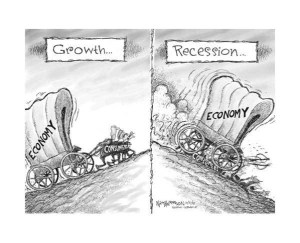
Via Andrew Leonard at Salon, the Wall Street Journal today reported the results of a survey they conducted with 53 economists:
In the survey, conducted July 8-13 and released Monday, 53 economists—not all of whom answer every question—were asked the main reason employers aren’t hiring more readily. Of the 51 who responded to the question, 31 cited lack of demand (65%) and 14 (27%) cited uncertainty about government policy. The others said hiring overseas was more appealing.
Only the conservative WSJ, the President, and Congresss could be surprised by these results. I’m not sure who these 53 economists were, but I think they must have been rather conservative, because the survey found that most did not think the government should do anything more to stimulate the economy.
Despite their forecasts for slow growth and an elevated unemployment rate, the economists aren’t in favor of further action either by the Fed or the federal government. Forty-one economists in the WSJ survey said the central bank shouldn’t pursue another round of bond-buying aimed at reducing interest rates, and thirty-eight said another round of fiscal stimulus shouldn’t be a part of any deficit-reduction package.
Economists added that they hope that as conditions begin to improve, albeit slowly, consumers will become more optimistic. “For whatever reasons, in addition to discrete headwinds, I think we’ve taken a hit to animal spirits and as those headwinds fade sentiment will revive,” said Stephen Stanley of Pierpont Securities. “Optimism can be self-sustaining, but pessimism can also provide a persistent drag.”
If any of the economists the WSJ talked to mentioned the possibility that the government itself could create jobs and thus stimulate demand–as FDR did the last time things were this bad, the WSJ did not report it.
Andrew Leonard crows:
what could be more obvious, even in the absence of rigorous training in economics? In the absence of demand, businesses will refrain from ramping up production and adding staff — no matter what employers think about the future regulatory climate. To prime this pump, to rev up this engine, to get the “delicate machine” working properly, the first focus for economic policymakers should be figuring out ways to boost demand.
Wouldn’t the best way to do that be to create jobs? Even Andrew Leonard doesn’t mention that. It seems ass-backwards to me to talk about getting consumers to spend more in order to get companies to start hiring. How can consumers spend more when many of them are unemployed? Maybe Dakinikat can explain this to me.
Anyway, it’s pretty amazing that the WSJ is admitting we have a demand problem. Now if only they could convince President Obama…
President Hornswoggle and the Debted Hallows
Posted: July 7, 2011 Filed under: Barack Obama, Catfood Commission, Democratic Politics, Economy, Federal Budget, Federal Budget and Budget deficit, Global Financial Crisis, John Birch Society in Charge, legislation, Psychopaths in charge, Surreality, The Great Recession, U.S. Economy, voodoo economics | Tags: 14th amendment, austerity, Chuck Schumer, Debt ceiling negotiations, Federal Deficit, Medicaid, medicare, Social Security, voodoo economics 39 Comments So, you know me. I’m out looking for exactly how bad this debt ‘deal’ is going to austere our economy in to the Great Recession Redux. BostonBoomer has been writing about President Hornswoggle putting Medicare, Medicaid, and Social Security–not even part of the federal budget–on the table. I’ve searched and searched and can’t find the details on the great American Give Away other than a few articles showing a beaming Boehner saying we’re at a 50-50 chance of reaching a deal now. If Boehner is beaming, all but the richest among us should be holding on to our personal liberties and wallets.
We know that the President has caved on a bunch of things during both the HRC negotiations and the extension of the Dubya Tax Breaks for Billionaires pogrom. However, the Democratic leadership was aware of this, grumbled some, and backed his usurpation of responsibility for our future. Imagine my surprise when I watched Chuck Schumer on Andrea Mitchell say that he had no idea about the details of the current deal so he couldn’t really comment on it. The most noticeable detail was his face that said “I’ve got a sick tummy, mommy”. Senator Schumer is on the Senate Committee on Finance that handles all of these things and is supposedly a key person on the budget deal. You would think he would know. But, he doesn’t and neither does any other Democratic Senator or Congressman. It appears the press told them what Obama was handing over to the Republicans.
Senate Democrats reacted angrily Thursday to a report that President Obama has proposed significant cuts to Medicare and Social Security in closed-door talks with GOP leaders.
Democratic lawmakers said they were dismayed to read about Obama’s offer in the press rather than hearing it from the president himself. Their frustration is exacerbated by Obama’s snub of their invitation to speak to the Senate Democratic caucus Wednesday.
Instead, Obama is meeting with Democratic and Republican leaders from both chambers Thursday morning.
“We would have preferred to hear it from the president instead of from the press,” said Sen. Barbara Mikulski (Md.), a senior member of the Senate Democratic conference. “We first have to go after tax earmarks.”
Mikulski said cuts to Medicare and Social Security should be a solution of last resort. She said closing tax loopholes and pulling back from Libya should be considered before entitlement cuts.
She said Obama should not assume Democratic support for a deficit reduction plan that cuts entitlements.
I now fully expect President Cave-in to hand the keys to the nation over to a bunch of punch-drunk Republicans. What I don’t get is why the Democratic members of Congress continue to let him get away with it. They are the very face of “sound and fury signifying nothing”. Let me ask you if you’d want to be a congress member from some solid Democratic district facing re-election by having to defend a Democratic President that’s happy to cut Medicare and Social Security? Social Security doesn’t even need to be on the table. He’s just offered it up for some reason that I can’t fathom. How on earth could you face your electorate and back such a deal?
Let me remind you, all of the economic data gathered in the last 80 years tells us that this austerity agenda is just going to tank the economy. We continue t0 enact the very same crap that put us in the worst economic position we’ve seen since the Great Depression. Why oh why are they doing this to us? Here’s a taste of Noble Prize winning Joseph Stiglitz for some perspective.
A decade ago, in the midst of an economic boom, the United States faced a surplus so large that it threatened to eliminate the national debt. Unaffordable tax cuts and wars, a major recession, and soaring health care costs—fueled in part by the commitment of George W. Bush’s administration to giving drug companies free rein in setting prices, even with government money at stake—quickly transformed a huge surplus into record peacetime deficits.
The remedies to the U.S. deficit follow immediately from this diagnosis: Put America back to work by stimulating the economy; end the mindless wars; rein in military and drug costs; and raise taxes, at least on the very rich. But the right will have none of this, and instead is pushing for even more tax cuts for corporations and the wealthy, together with expenditure cuts in investments and social protection that put the future of the U.S. economy in peril and that shred what remains of the social contract. Meanwhile, the U.S. financial sector has been lobbying hard to free itself of regulations, so that it can return to its previous, disastrously carefree, ways.
Here’s a thorough, peer-reviewed, strong methodology-based IMF study–cited by Paul Krugman–that provides evidence that austerity programs are recessionary and bring on worse budget problems.
The paper corrects this by using the historical record to identify true examples of deliberate austerity — and it turns out that they are contractionary. The multiplier is less than one, but that may reflect the fact that these austerity programs did not take place in the face of a zero lower bound, so they were partly offset by monetary expansion.
The paper also provides a tentative answer to the apparent tendency of spending cuts to be less contractionary than tax increases: it looks as if central banks take more aggressive action to offset spending cuts than tax hikes, reflecting some combination of inflation concerns, belief that spending cuts are more durable, and (the paper doesn’t say this) bankerly ideology.
If we were discussing a politically neutral subject, the evidence here would long since have been considered definitive: expansionary austerity is a doctrine that failed. But since we’re in the political realm, of course, such a convenient doctrine can’t be abandoned. On the contrary, it now seems to be the official doctrine of both the GOP and the White House.
Also, let me remind you that Medicare, Medicaid, and Social Security are very successful programs. They have successfully stopped the elderly from being the poorest segment of society. Just as an example, the majority of single, elderly women would be in poverty without Social Security.
Elderly unmarried women — including widows — get 51 percent of their total income from Social Security. Unmarried elderly men get 39 percent, while elderly married couples get 36 percent of their income from Social Security. For 25 percent of unmarried women, Social Security is their only source of income, compared to 9 percent of married couples and 20 percent of unmarried men. Without Social Security benefits, the elderly poverty rate among women would have been 52.2 percent and among widows would have been 60.6 percent.
When poor people are given medical insurance, they not only find regular doctors and see doctors more often but they also feel better, are less depressed and are better able to maintain financial stability, according to a new, large-scale study that provides the first rigorously controlled assessment of the impact of Medicaid.
While the findings may seem obvious, health economists and policy makers have long questioned whether it would make any difference to provide health insurance to poor people.
It has become part of the debate on Medicaid, at a time when states are cutting back on this insurance program for the poor. In fact, the only reason the study could be done was that Oregon was running out of money and had to choose some people to get insurance and exclude others, providing groups for comparison.
I continually feel as though we’ve all been drug down the rabbit hole. It is like the President is purposefully enabling joblessness, poverty, and public health problems. No amount of research, historical data, and polls appear to be able to penetrate the Washington, D.C. group think these day. The biggest issue is that the President himself believes in the confidence fairy, the bipartisan elves, and the high priests of voodoo economics. He’s not just part of the problem, he is THE problem. Can just one or two members of the Democratic caucus please stand up to this man and his notion that bipartisanship that surrenders the country to right wing reality-deniers is better than any form of principled leadership? Can at least one of the please be brave and start talking some sense and representing the will of the people for a change?
Invoke the 14th Amendment and end the damned sell outs now!
Forget giving away the store — Obama is handing the store to Republicans and inviting them to burn it down.
Posted: July 5, 2011 Filed under: income inequality, Medicare, Psychopaths in charge, Republican politics, Surreality, Team Obama, The Great Recession, The Media SUCKS, the villagers, U.S. Economy, U.S. Politics, voodoo economics, We are so F'd | Tags: Barack Obama, crashing the economy, draconian spending cuts, economy, Great Depression, Health care, Medicaid, medicare, Republicans 22 Comments
Please read this shocking story at The New York Times — there’s no way for me to excerpt all the important parts.
Obama administration officials are offering to cut tens of billions of dollars from Medicare and Medicaid in negotiations to reduce the federal budget deficit, but the depth of the cuts depends on whether Republicans are willing to accept any increases in tax revenues.
Administration officials and Republican negotiators say the money can be taken from health care providers like hospitals and nursing homes without directly imposing new costs on needy beneficiaries or radically restructuring either program.
What this really means is that more doctors and hospitals will refuse to accept Medicare and Medicaid patients, and nursing homes will turn away frail elderly patients who can’t pay out of pocket–because Medicaid will no longer be able to assist those who are poor or have already spent their life savings on health care.
“Congress smells blood,” said William L. Minnix Jr., the chief lobbyist for nonprofit nursing homes.
Mr. Minnix, the president of a trade group known as LeadingAge, is urging nursing homes to “bombard your senators with the message that Medicaid cannot be cut by $100 billion” over 10 years, as President Obama and many Republican lawmakers have suggested.
A coalition of hospital lobbyists, worried about the direction of the budget talks, has begun a national advertising campaign to block further cuts in the two health care programs, which account for about 55 percent of hospital revenues. The hospitals have made a commitment to spend up to $1 million a week through August on television, print and online advertising.
Now check this out: Chuck Schumer, supposedly a Democrat, is quoted in the article as saying, “We are very willing to entertain savings in Medicare. Medicare gives very good health care very inefficiently.”
Really? Medicare has almost no overhead, and it pays way below the going rate for health care services. That’s why so few private doctors accept Medicare patients right now.
Now think about what Dakinikat has told us about the dangers of cutting federal spending and read this:
Medicare and Medicaid insure more than 100 million people, account for 23 percent of all federal spending and are likely to be an important part of any budget deal. Military spending, which accounts for about 20 percent of federal expenditures, is likely to be included as well.
President Obama and his Republican pals are on a mission to bring down the American economy and bring on a repeat of the Great Depression. Can anything or anyone stop them? We need riots in the streets, but can elderly people do it alone?

 peej
peej Carissa
 bostonboomer
 dakinikat
 ecocatwoman
 mablue2
 Mama Lopez
 peggysue22
 quixote
 skydancingguestblogger
 Mona (aka Wonk the Vote)



 Sky Dancing
Recent Comments