
Thursday Reads: Holder Witchhunt, SCOTUS and Health Care, Colorado Wildfires, and Mocking Mitt
Posted: June 28, 2012 Filed under: 2012 elections, 2012 presidential campaign, immigration, Mitt Romney, morning reads, Rush Limbaugh, Scott Brown, SCOTUS, U.S. Military, U.S. Politics, War on Women, Women's Healthcare | Tags: Air Force Academy, alien invasion, Antonin Scalia, Barack Obama, Colorado wildfires, Darrell Issa, Eric Cantor, Eric Holder, FEMA, witchhunt 33 CommentsUPDATE: Supreme Court upholds Affordable Care Act, Including Individual Mandate!

Good Morning!!
Since today is going to be a mostly serious news day, I’ll begin with a silly story. A new survey by the National Geographic Channel found that 65% of Americans think President Obama is more qualified to handle an invasion from outer space than Mitt Romney.
And lest you are tempted to dismiss this poll as pure silliness, the study also found that 36 percent of Americans think UFOs exist, while another 48 percent aren’t sure. Which means that at least some of the respondents judging the presidential candidates’ alien-fighting abilities may see it as a plausible scenario. (According to the poll, 79 percent also say the federal government has been hiding information about UFOs from the public – which may actually say more about the public’s overall distrust of government than its views on aliens.)
UFO = Unidentified Flying Object. Of course UFOs exist. Haven’t we all seen things in the sky that we didn’t recognize? Whether these objects are of extraterrestrial origin would have been a better question. Now the ones who want to “befriend” a visiting alien–those people have got to be looney tunes. But this story isn’t as silly as I originally thought, since it’s obviously just an ad for the National Geographic Channel.
And now the real news. Today will be a big day for politics junkies. Will the House go through their idiotic plan to find Attorney General Eric Holder in contempt of Congress? Will Chief Justice John Roberts and Justice Anthony Kennedy decide to vote to keep the current Supreme Court from going down in history as a laughingstock?
Eric Holder Witchhunt
On the Holder issue, I think the House probably will call the vote, especially since some Democrats are planning to vote for the contempt resolution because they’re scared of the NRA.
Cognitively challenged Massachusetts Senator Scott Brown today called on Holder to resign.
“He can’t effectively serve the president,” Brown said last night on “NightSide” with Dan Rea — in a one-man debate after Democratic challenger Elizabeth Warren chose to sit the event out.
Going at Holder on the eve of an expected contempt of Congress vote tomorrow, Brown said, “For the best interest of the country, I think he should step down and resign. He’s lost the confidence of the American people. Certainly he’s lost the confidence of Congress. He misled Congress. They have a right to know.”
That quote is from the ultra-conservative Boston Herald, so I’ll interpret for you. The “debate” referred to in the article was an appearance on a conservative radio talk show that Brown proposed as an alternative to the public debate that would have been sponsored by U. Mass. Boston and the Edward M. Kennedy Institute.
The announcement came shortly after representatives of Vicki Kennedy said she would not agree to Brown’s demand that she remain neutral in the race, in exchange for the senator’s participation in a late September debate she had proposed be hosted by the University of Massachusetts Boston and Edward M. Kennedy Institute for the United States Senate.
Barnett had said Monday that Brown would participate only if Kennedy, president of the board at the Kennedy Institute, not endorse in the race and that MSNBC not be the broadcast sponsor of the debate.
Instead of “debating” with Scott Brown on a rinky-dink local conservative radio talk show, Elizabeth Warren appeared on Rachel Maddow’s national cable show last night.
Scott Brown and Darrell Issa are both complete idiots, IMNSHO.
The SCOTUS Decision on Health Care
I’m going to go out on a limb and predict that the Roberts and Kennedy will both vote to uphold the Affordable Care Act. I think, based on what they did with Arizona’s immigration law, that Roberts and Kennedy will also vote to uphold “Obamacare.”
When this happens, Antonin Scalia may freak out completely and embarrass himself even more than he did after the Arizona decision. And then perhaps his friends and colleagues will sit him down and suggest that he retire and get his own radio talk show.
At Slate, Judge Richard Posner harshly criticized Scalia’s behavior as political.
The nation is in the midst of a hard-fought presidential election campaign; the outcome is in doubt. Illegal immigration is a campaign issue. It wouldn’t surprise me if Justice Scalia’s opinion were quoted in campaign ads.
Would Chief Justice Roberts be proud of his Court if that happened?
House progressives say they will introduce a single-payer plan if the law is struck down.
The last thing House progressives want is for the Supreme Court to strike down President Barack Obama’s health care law. But if the high court rules Thursday that some or all of the law is unconstitutional, progressives are ready to renew their push for the model of health care they wanted all along: the single-payer option.
“It’s easy to see it’s a good idea,” Rep. Keith Ellison (D-Minn.), co-chairman of the Congressional Progressive Caucus, told The Huffington Post. “It’s the cheapest way to cover everybody.”
Ellison said all 75 members of the caucus have already signed onto a bill by Rep. John Conyers (D-Mich.) to create a single-payer, publicly financed, privately delivered universal health care program. The proposal would essentially build on and expand Medicare, under which all Americans would be guaranteed access to health care regardless of an ability to pay or pre-existing health conditions.
Now, now. We don’t want to give Scalia a conniption fit, do we? He would be more likely to agree with libertarian economics blogger Tyler Cowan who thinks the wealthy naturally will have better health care and poor people should just die if they can’t afford health insurance.
A rejection of health care egalitarianism, namely a recognition that the wealthy will purchase more and better health care than the poor. Trying to equalize health care consumption hurts the poor, since most feasible policies to do this take away cash from the poor, either directly or through the operation of tax incidence. We need to accept the principle that sometimes poor people will die just because they are poor. Some of you don’t like the sound of that, but we already let the wealthy enjoy all sorts of other goods — most importantly status — which lengthen their lives and which the poor enjoy to a much lesser degree. We shouldn’t screw up our health care institutions by being determined to fight inegalitarian principles for one very select set of factors which determine health care outcomes.
The health care decision should come out around 10AM, and I’ll update this post when the news breaks.
Mitt Romney Report
I know everyone is just dying to know what Mitt Romney is up to. Well yesterday he had quite a hissy fit about the Washington Post article on how he pioneered outsourcing when he was at Bain Capital. He actually sent some of his representatives to the Post to demand a retraction! As you might imagine, the Post wasn’t intimidated.
Good grief! They even gave a Power Point presentation! What a bunch of crybabies. And on Hardball today, Howard Fineman reported that Romney campaign staffers complained to him that Obama has been running lots of negative ads against Romney. Hey Mitt, politics ain’t beanbag.
From today’s Washington Post: Mitt Romney shifts focus from Post article on Bain to health-care law.
On the eve of the Supreme Court decision on President Obama’s health-care law, Republican presidential candidate Mitt Romney predicted Wednesday that “they’re not sleeping real well at the White House tonight.”
He said that the court’s decision is a constitutional one, but that “one thing we already know, however, we already know it’s bad policy and it’s gotta go.”
Romney’s comments marked a shift in focus after several days in which his campaign sought to deflect attacks from the Obama campaign over the role that Bain Capital, his former firm, played in the overseas outsourcing trend that accelerated in the 1990s.
Obama, Vice President Biden and top campaign operatives have seized on a Washington Post article published Friday that said Bain Capital invested in companies that specialized in moving work overseas. The Obama team released tough ads in the swing states of Iowa, Ohio and Virginia on the subject.
Romney tried to “work the refs,” but he forgot that you catch more flies with honey than vinegar. Now he’s irritated the Washington Post. Not real smart, Mitt. Yesterday, even Rush Limbaugh dissed the Republican candidate.
Colorado Wildfires (and More Mitt)
The wildfires in Colorado are really getting out of control.
Firefighters struggled on Wednesday to beat back a fiercely aggressive wildfire raging at the edge of Colorado Springs that has forced at least 35,000 people from their homes and was nipping at the edges of the U.S. Air Force Academy.
The so-called Waldo Canyon Fire, fanned by gusting winds, has gutted an unknown number of homes on the wooded fringes of Colorado’s second-most populous city and prompted more evacuations as flames roared out of control for a fifth day.
President Barack Obama plans to pay a visit to the area on Friday to view the damage, the White House said.
The blaze flared Tuesday night with sudden ferocity and quickly overran fire containment lines, invading the northwestern corner of the city. But officials have declined to characterize the extent of property damage there….
The blaze left an orange hue over Colorado Springs, and a smoky haze hung in the air, so thick in places that the giant, roiling pall of smoke that continued to billow into the sky over the city was obscured from the ground.
Local TV station channel 9 news provides a summary of fires in many different locations. It’s really shocking how widespread they are. Yesterday the fires threatened the Air Force Academy, and many residents there were evacuated.
Voters who live in Colorado and other states where there are disasters like fires, mudslides, hurricanes, tornadoes, and floods, should be aware that Republican presidential candidate Mitt Romney opposes federal disaster relief and would probably eliminate FEMA if he were elected. He thinks natural disasters should be handled by individual states. From one of the debates last year:
Here’s a transcript:
KING: Governor Romney? You’ve been a chief executive of a state. I was just in Joplin, Missouri. I’ve been in Mississippi and Louisiana and Tennessee and other communities dealing with whether it’s the tornadoes, the flooding, and worse. FEMA is about to run out of money, and there are some people who say do it on a case-by-case basis and some people who say, you know, maybe we’re learning a lesson here that the states should take on more of this role. How do you deal with something like that?
ROMNEY: Absolutely. Every time you have an occasion to take something from the federal government and send it back to the states, that’s the right direction. And if you can go even further and send it back to the private sector, that’s even better. Instead of thinking in the federal budget, what we should cut — we should ask ourselves the opposite question. What should we keep? We should take all of what we’re doing at the federal level and say, what are the things we’re doing that we don’t have to do? And those things we’ve got to stop doing, because we’re borrowing $1.6 trillion more this year than we’re taking in. We cannot…
KING: Including disaster relief, though?
ROMNEY: We cannot — we cannot afford to do those things without jeopardizing the future for our kids. It is simply immoral, in my view, for us to continue to rack up larger and larger debts and pass them on to our kids, knowing full well that we’ll all be dead and gone before it’s paid off. It makes no sense at all.
Because “our kids” will have a great future if they go through an earthquake or other horrible disaster and there’s no federal help for the state they live in to recover. Brilliant!
That’s about it for me. I’ll just leave you with this bit of good news: Eric Cantor may be in trouble
New polling from Virginia’s 7th Congressional District, one of the more reliably conservative districts in the country, shows surprising vulnerabilities for Republican House Majority Leader Eric Cantor, especially on the issue of women’s health.
In the poll from from Harrison Hickman obtained exclusively by ThinkProgress, voters say they would support a pro-choice candidate over a candidate who is pro-life by an unexpectedly large margin, 68 percent to 23 percent. The finding comes after intense media coverage of efforts by state Republicans to mandate transvaginal ultrasounds prior to obtaining an abortion, a procedure described by critics as “state-sponsored rape.” The resulting backlash from women in Virginia forced Governor Bob McDonnell (R) and his allies at the statehouse to moderate their efforts.
Eric Cantor has a 100% rating from the National Right To Life Committee.
AND
asked about Cantor specifically, voters disapprove of his handling of government spending, health care and reigning in the budget deficit, three key issues that Cantor and House Republicans have campaigned heavily on since 2008.
While Cantor is not among Republicans who are considered at risk by political prognosticators, 43 percent of voters would replace Cantor compared to just 41 percent who would reelect him.
So…..what’s on your reading and blogging list today?
The Roberts Court: Judicial Activism on Steroids
Posted: June 24, 2012 Filed under: corporate money, corruption, court rulings, SCOTUS | Tags: right wing judicial activism, right-wing extremists, Roberts SCOTUS 7 CommentsJames Fallows has written an extremely interesting piece on the Robert’s SCOTUS at The Atlantic that’s worth a read and a post. We’re just beginning to see how  radical and political this court can be. It’s so radical that some writers are beginning to describe its output as a form of coup d’etat.
I am not enough of a Supreme Court buff to have any confident idea of what the majority will rule on the Obama health care plan.
But confidence in the very idea that the Roberts majority will approach this as a “normal” legal matter, rather than as one more Bush-v.Gore front in the political wars, grows ever harder to maintain, especially after the latest labor-rights ruling. It is worth reading carefully this lead editorial in yesterday’s New York Times. In short, the same five conservative Justices who in their pre-appointment phase had inveighed against “judicial activism” and “legislating from the bench,” while promising to live the gospel of judicial “humility” if confirmed, went out of their way, in a ruling written by Samuel Alito, to decree new law contrary to what Congress had ordered and other courts had long approved.*
Normally I shy away from apocalyptic readings of the American predicament. We’re a big, messy country; we’ve been through a lot — perhaps even more than we thought, what with Abraham Lincoln and the vampires. We’ll probably muddle through this and be very worried about something else ten years from now. But when you look at the sequence from Bush v. Gore, through Citizens United, to what seems to be coming on the health-care front; and you combine it with ongoing efforts in Florida and elsewhere to prevent voting from presumably Democratic blocs; and add that to the simply unprecedented abuse of the filibuster in the years since the Democrats won control of the Senate and then took the White House, you have what we’d identify as a kind of long-term coup if we saw it happening anywhere else.
Jeffrey Rosen earlier wondered in an article written for The New Republic about exactly how radical the chief justice really is? The Citizens United decision alone has the ability of stomping out democracy in America as we know it.
Then came Citizens United, by far the clearest test of Roberts’s vision. There were any number of ways he could have persuaded his colleagues to rule narrowly; but Roberts rejected these options. He deputized Anthony Kennedy to write one of his characteristically grandiose decisions, challenging the president and Congress at a moment of financial crisis when the influence of money in politics–Louis Brandeis called it “our financial oligarchy”–is the most pressing question of the day. The result was a ruling so inflammatory that the president (appropriately) criticized it during his State of the Union address.
What all this says about the future of the Roberts Court is not encouraging. For the past few years, I’ve been giving Roberts the benefit of the doubt, hoping that he meant it when he talked about the importance of putting the bipartisan legitimacy of the Court above his own ideological agenda. But, while Roberts talked persuasively about conciliation, it now appears that he is unwilling to cede an inch to liberals in the most polarizing cases. If Roberts continues this approach, the Supreme Court may find itself on a collision course with the Obama administration–precipitating the first full-throttle confrontation between an economically progressive president and a narrow majority of conservative judicial activists since the New Deal.
The first indications that Roberts might not be as conciliatory as he promised came during his second term, which ended in 2007. During his first term, which his colleagues treated as something of a honeymoon, the Court had decided just 13 percent of cases by a 5-4 margin. But, in the next term, that percentage soared to 33 percent. (It would fluctuate up and down a bit over the next two years.) What’s more, the 2007 term ended with unusually personal invective, as both liberal and conservative colleagues expressed frustration with Roberts. That year, during the Court’s second encounter with the McCain-Feingold campaign finance law (which it would gut in Citizens United), Antonin Scalia accused Roberts of “faux judicial restraint,” for chipping away at restrictions on corporate speech without overturning them cleanly. Meanwhile, the liberal justices seemed angry that Roberts was refusing to budge from rigid positions in divisive cases. “Of course, I got slightly exercised, and the way I show that is I write seventy-seven-page opinions,” Justice Stephen Breyer told me in the summer of 2007, referring to his angry dissent from Roberts’s 5-4 decision striking down affirmative action in public school assignments.
President Obama attacked the Citizen’s United ruling in SOTU causing Roberts to throw a very public and historically inaccurate hissy fit.
Speaking to students of the University of Alabama law school, Chief Justice John Roberts launched a blistering attack on President Obama’s State of the Union criticism of the Court’s Citizens United decision. Calling Obama’s prime-time critique “very troubling,” Roberts complained that the President’s annual address to Congress “degenerated to a political pep rally.” Of course, when Robert’s political godfather Ronald Reagan or his sponsor George W. Bush used the State of the Union to berate, badger and batter the Supreme Court, that was just fine with the Chief Justice.
“I’m not sure why we’re there,” Roberts told the audience in Tuscaloosa, adding:
“The image of having the members of one branch of government standing up, literally surrounding the Supreme Court, cheering and hollering while the court — according the requirements of protocol — has to sit there expressionless, I think is very troubling.”
But during the George W. Bush’s tenure, the Justices served as a prop for his State of the Union battles with the judiciary.
Bush’s Supreme politicking during his State of the Union speeches was a regular fixture of his presidency. For three straight years (2004, 2005 and 2006), President Bush denounced “activist judges” and insisted “for the good of families, children and society, I support a constitutional amendment to protect the institution of marriage.” On the very day Samuel Alito joined the Robert Court, Bush used his 2006 SOTU for a victory lap:
“The Supreme Court now has two superb new members — new members on its bench: Chief Justice John Roberts and Justice Sam Alito. I thank the Senate for confirming both of them. I will continue to nominate men and women who understand that judges must be servants of the law and not legislate from the bench.”
And throughout the presidency of Ronald Reagan, for whom John Roberts promoted the gutting of the Civil Rights Act, overturning Roe v. Wade and a dangerously ignorant policy in response to the AIDS crisis, bashing the Supreme Court was a routine occurrence.
The U.S. Supreme Court should uphold a law requiring most Americans to have health insurance if the justices follow legal precedent, according to 19 of 21 constitutional law professors who ventured an opinion on the most-anticipated ruling in years.
Only eight of them predicted the court would do so.
“The precedent makes this a very easy case,” said Christina Whitman, a University of Michigan law professor. “But the oral argument indicated that the more conservative justices are striving to find a way to strike down the mandate.”
A ruling on the constitutionality of the Patient Protection and Affordable Care Act’s individual mandate is among the last pieces of business heading into the final week of the Supreme Court’s term. Bloomberg News last week e-mailed questionnaires to constitutional law experts at the top 12 U.S. law schools in U.S. News & World Report magazine’s 2012 college rankings.
This is just more indication of the real damage brought to our country by the Reagan and Bush regimes. Just imagine what kind of abomination Romney could potentially appoint. We’ve already got a number of justices who belong to the Opus Dei Cult. All we need is a couple of weirdos that subscribe to the kinds of ideas espoused by Joseph Smith.
Tuesday Reads
Posted: June 19, 2012 Filed under: 2012 presidential campaign, Barack Obama, Mitt Romney, morning reads, SCOTUS, the internet, U.S. Politics | Tags: "g" words, Cynthia Kelly, eurozone crisis, G-20 summit, George H. W. Bush, George Zimmerman, Greece, Harry Truman, hoagies, Mia Farrow, money laundering, out-of-touch patricians, Pennsylvania, Robert Shrum, Rodney King, Ronan Farrow, Shellie Zimmerman, Syria, Thomas E. Dewey, touch screen ordering, Trayvon Martin case, Vladimir Putin, Wawa's, Woody Allen 44 Comments
Good Morning!!
On Sunday during his “get to know the regular people” bus tour, Mitt Romney expressed “amazement” at a gas station in Pennsylvania where you could order “hoagies” using a touch-screen.
At a campaign stop in Pennsylvania on Sunday, the presumptive Republican presidential nominee told a crowd that he had been astonished by a touch screen computer used to order food at the Wawa gas station chain….
“I was at Wawas,” Romney explained. “I went in to order a sandwich. You press a little touchtone keypad, alright? You just touch that and, you know, the sandwich comes up. You touch this, touch this, touch this, go pay the cashier. There’s your sandwich. It’s amazing!”
The ordering system has been there for 10 years. Of course this reminded everyone of the apocryphal story about out-of-touch patrician George H.W. Bush being amazed by a supermarket scanner.
Poor Mitt. In another article on Romney’s bus tour, James Fallows makes fun of the candidate’s habit of expressing surprise by saying “oh my goodness!”
Romney’s trademark small-talk exclamation, “Oh my goodness!” seems completely genuine. But I am trying to think of the last time I heard a 21st-century person use that phrase — as opposed to all the other possibilities, which when you think about it range from coarse to profane. (Jeez louise, WTF, Holy shit, and on through a long list you can fill in yourself.) When combined with his Don-Draper-in-the-’50s very dapper personal style, it adds to a retro atmosphere that some people will find reassuring and appealing and others will find odd.
Well I have to admit that I often say “oh my goodness!” too. Maybe I’m out of touch then–or maybe it’s a Midwestern thing. I got in the habit of saying that when taking care of my nephews. John McWhorter at The New Republic also thinks Romney’s “verbal stylings” are strange. Romney is also guilty of using “g” words like gosh, golly, and gee, which McWhorter says are substitutes for taking the name of “god” in vain.
Gee, gosh, and golly are all tokens of dissimulation. They are used in moments of excitement or dismay as burgherly substitutions, either for God and Jesus—words many religious people believe should not be “taken in vain”—or for words considered even less appropriate. Fittingly, they even emerged as disguised versions of God (gosh and golly) and Jesus (gee; cf. also jeez). This was in line with how cursing worked in earlier English. The medieval and even colonial Anglophones’ versions of profanity were to express dismay or vent pain by swearing—“making an oath”—to God or related figures considered ill-addressed in such a disrespectful way. The proper person at least muted the impact with a coy distortion, à la today’s shoot and fudge. Hence zounds (first attestation: 1600), as in by his (Christ’s) wounds; egad for Ye God (1673); and by Jove (1598). To increasing numbers of modern Americans, the G-words are unusable outside of quotation marks, be these actual or implied, rather like the word perky.
Well, gee, I use that one sometimes too, though not “gosh” or “golly.” So maybe I’m as much of an anachronism as Romney. Of course I’ve been known to swear also. I really think saying the “g” words might be a Midwestern mannerism.
Robert Shrum says Mitt Romney reminds him of Thomas E. Dewey, who was expected to beat Harry Truman in 1948, but didn’t. Check it out. I found it interesting.
It appears that police are suspicious about the drowning death of Rodney King. An autopsy has been done, but the results haven’t been released yet. There was no obvious evidence of foul play, but apparently King was a very avid swimmer. There are also conflicting reports of sounds from King’s backyard right before his body was found. Reuters:
King’s fiancée, Cynthia Kelly, a juror in the civil suit he brought against the city of Los Angeles, “didn’t give any indication he was unhappy or that there was an issue.” He said King was known to swim frequently and at all hours.
Shepherd said Kelly told investigators that, shortly before the drowning, she had been inside the house talking with King off and on through a sliding glass door that leads to a patio beside the pool.
At some point, she told them, she heard a splash, prompting her to run outside to find him at the bottom of the deep end. Unable to swim well herself, she called emergency 911 for help.
The Los Angeles Times, in an online account on Monday, cited a next-door neighbor, Sandra Gardea, 31, as saying she heard the sound of a man sobbing from King’s back yard in the two hours before police say he was found in the pool.
The Times also reported that Gardea heard King’s fiancée trying to coax him back into the house.
“It wasn’t like an argument,” she told the newspaper. “She was just saying, ‘Get in the house. Get in the house.'” Gardea said she heard a splash a few minutes later.
Very mysterious.
The prosecution in the Trayvon Martin case has released calls between George Zimmerman and his wife when he was in jail the first time.
The recordings show that from his jail cell, Zimmerman gave his wife step-by-step instructions on how to change a password and clear security questions so she could move money, gave her orders to withdraw specific amounts and directed her to pay the bills.
Prosecutors allege the couple was moving money out of an Internet PayPal account that was awash with donations for Zimmerman, who’s charged with second-degree murder in one of the most racially-charged criminal cases in the country. He shot Trayvon Martin, an unarmed black 17-year-old, in Sanford Feb. 26.
The couple spoke in code, according to prosecutor Bernie de la Rionda. In the calls Zimmerman makes repeated reference to “Peter Pan,” an apparent reference to PayPal.
And neither Zimmerman or his wife ever refer to more than $100,000, talking instead about amounts generally totaling “10 dollars” and “20 dollars.” Prosecutors say those were references to $10,000 and $20,000.
Shellie was careful to move less than $10,000 at a time, to avoid triggering attention from the feds.
The tapes of six conversations were released Monday, as were bank statements from the Zimmermans’ accounts at a credit union. The statements show repeated transfers to and from the account in amounts just under $10,000. On April 24, for example, there were 8 transfers of $9,999.00 into Shellie Zimmerman’s account. Banks and financial institutions are required to file “suspicious activity reports” in such cases, according to Jack Blum, a Washington lawyer who specializes in money laundering.
Structuring the money in such a way is not itself illegal, he says, if the money isn’t from an illicit source. But, he says, it shows “a guilty mind.”
“What they’ve done,’ Blum said, “is they’ve given the prosecutors, on a silver platter, evidence of guilty intent.”
This one should probably be at the top of this post, but gee golly gosh and my goodness! I thought the other stories were more fun to read–so gosh darn it, what the heck!
Obama, Putin meet on Syria at G-20 summit.
Meeting for nearly two hours on the sidelines of the G-20 summit in Mexico, the two presidents tried to focus mostly on areas of agreement — even when it came to areas of disagreement, such as Syria.
The U.S. wants Syrian President Bashar Assad out of power. Russia, which sells arms to Syria, has blocked United Nations Security Council resolutions calling for tough sanctions and leaving the door open to military intervention.
“We agreed that we need to see a cessation of the violence, that a political process has to be created to prevent civil war and the kind of horrific deaths that we’ve seen over the last several weeks,” Obama said after his first meeting with Putin following his return to the presidency this year. “We pledged to work with other international actors, including the United Nations, Kofi Annan and all interested parties, in trying to find a resolution to this problem.”
Putin was upbeat following the meeting, which went on much longer than planned and covered the full range of issues between the two nations. “From my perspective, we’ve been able to find many commonalities pertaining to all of those issues,” he said.
I’m glad it was Obama negotiating and not Romney. Otherwise, we might be at war with Russia by now.
The New York Times has a piece on what Europe will do now that the Greeks have voted for austerity.
BERLIN — After Greek elections eased fears that the country’s exit from the euro zone was imminent, attention turned Monday to an even bigger challenge: restoring the economic body to health with Greece still in it.
A respite from market pressure early Monday proved to be short-lived, as investors shifted their attention from political infighting in Athens to the larger question of whether European leaders could find a more lasting solution to a debacle now well into its third year.
But even though Brussels had been hoping for the victory by Antonis Samaras and his center-right New Democracy Party, the yearned-for result, paradoxically, may weaken Europe’s determination to take more radical steps to avert a meltdown.
German hard-liners were emboldened by the victory, viewing it as an endorsement of the drive for structural adjustment in Greece and elsewhere in Southern Europe through further austerity. As a result, the vote may delay concerted pro-growth steps by central banks and governments around the world, as well as the hard choices within Europe over deeper integration that are likely to prove necessary in the long run.
Much more at the link.
There’s lots of talk around the ‘net about the upcoming SCOTUS decision on the health care law. Scalia appears to be signaling that it may go down. You can read about what might happen if parts of the bill found unconstitutional here, here, and here.

Ronan Farrow with mother Mia
Woody Allen’s son Ronan (who looks exactly like Mia Farrow) celebrated father’s day by tweeting “Happy father’s day — or as they call it in my family, happy brother-in-law’s day.” And Mother Mia retweeted it. Ouch!
Woody and Ronan have been estranged for years since his parents split and because Woody was dating (and later married) Soon-Yi Previn, Mia’s adopted daughter, Ronan’s step-sister. He has been quoted in the past as saying, “He’s my father married to my sister. That makes me his son and his brother-in-law. That is such a moral transgression.” [….]
Ronan, named Satchel Ronan O’Sullivan Farrow when he was born in 1987, is the sole biological child of Woody and actress Mia Farrow. He is currently serving as special adviser to the Secretary of State for Global Youth Issues and director of the State Department’s Global Youth Issues office.
Finally, Roger Clemens was found not guilty yesterday, and honestly I’m glad. He probably did use steroids late in his career, but the prosecution couldn’t prove it. Thousands of players did it, and I think it was terrible; but the Justice Department has much more important things to do than making examples out of baseball players (and former presidential candidates for that matter). Clemens will go down in history as one of the greatest pitchers ever. He certainly is one of the best ever to play for the Red Sox.
What’s on your reading and blogging list today?
SCOTUS and the Arizona Immigration Law
Posted: April 25, 2012 Filed under: immigration, SCOTUS | Tags: Arizona Immigration Law, SCOTUS 14 CommentsThe Supremes heard arguments on the Arizona Immigration Law today. This is the law that Romney considers to be a blueprint for immigration laws in the US that 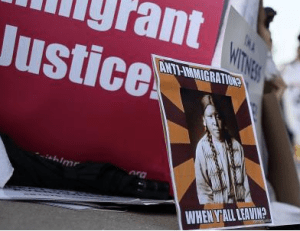 has been challenged by the Obama Justice Department. I’m not a lawyer so I can’t offer up any authoritative opinions, but I can offer up some reads for you.
From the NYT: Justices Seem Sympathetic to Central Part of Arizona Law
Mr. Verrilli, representing the federal government, had urged the court to strike down part of the law requiring state law enforcement officials to determine the immigration status of anyone they stop if the officials have reason to believe that the person might be an illegal immigrant.
“Why don’t you try to come up with something else?” Justice Sotomayor asked Mr. Verrilli.
It was harder to read the court’s attitude toward the three other provisions of the law at issue in the case, including ones that make it a crime for illegal immigrants to work or to fail to register with federal authorities. The court’s ruling, expected by June, may thus be a split decision that upholds parts of the law and strikes down others.
Should the court uphold any part of the law, immigration groups are likely to challenge it based on an argument not before that court on Wednesday — that the law discriminates on the basis of race and ethnic background.
Indeed, Chief Justice John G. Roberts Jr. made clear that the case, like last month’s arguments over President Obama’s health care law, was about the allocation of state and federal power.
“No part of your argument has to do with racial or ethnic profiling, does it?” the chief justice asked Mr. Verrilli, who agreed.
SCOTUSblog: Argument recap: A choice between radical and reasonable?
With Justice Antonin Scalia pushing the radical idea that the Constitution gives states clear authority to close their borders entirely to immigrants without a legal right to be in the U.S., seven other Justices on Wednesday went looking for a more reasonable way to judge states’ power in the immigration field. If the Court accepts the word of Arizona’s lawyer that the state is seeking only very limited authority, the state has a real chance to begin enforcing key parts of its controversial law — S.B. 1070 — at least until further legal tests unfold in lower courts.
In an oral argument that ran 20 minutes beyond the scheduled hour, the Justices focused tightly on the actual operation of the four specific provisions of the law at issue, and most of the Court seemed prepared to accept that Arizona police would act in measured ways as they arrest and detain individuals they think might be in the U.S. illegally. And most of the Justices seemed somewhat skeptical that the federal government would have to change its own immigration priorities just because states were becoming more active.
At the end of the argument in Arizona v. United States (11-182), though, the question remained how a final opinion might be written to enlarge states’ power to deal with some 12 million foreign nationals without basing that authority upon the Scalia view that states have a free hand under the Constitution to craft their own immigration policies. The other Justices who spoke up obviously did not want to turn states entirely loose in this field. So perhaps not all of the four clauses would survive — especially vulnerable may be sections that created new state crimes as a way to enforce federal immigration restrictions.
The Hill: Supreme Court seems favorable to Arizona illegal immigration law
Chief Justice John Roberts said he didn’t see a problem with that portion of the Arizona law, S.B. 1070. Under the statute, state officials would be notifying federal officials of the immigration status of the person in question. Roberts argued that the power to decide what to do with the that person still lay within the hands of the federal government. He also said the state, in that instance, would be attempting to help the federal government and supersede its role.
A key element to the government’s objections to the Arizona law rests on the argument that the state law conflicts with federal immigration laws already in place.
Verrilli also argued that immigration enforcement matters were entrusted to the federal government by the framers of the country — and not to the states — because they involve matters of foreign policy.
A final decision will not be reached until June, but the line of questioning from the more liberal and conservative justices alike seemed to indicate a belief that Arizona had a stronger case than the government on at least two of the law’s four provisions under question.
The passage of the law created an uproar last year and renewed the national debate over how to deal with the millions of illegal immigrants living in the United States. It’s expected to be an issue in the election as the Obama administration sued to stop it, and Mitt Romney, the presumptive GOP nominee, has expressed support for parts of it.
This is turning out to be a very interesting SCOTUS session and it appears that most of the justices have a distinct ideological bias. This proves that elections may not always bring the results in other areas but in terms of stacking the supreme court, the election of Presidents with IOUs to an ideological base shows up in how our laws will be interpreted.
Thursday Reads
Posted: April 19, 2012 Filed under: 2012 presidential campaign, American Gun Fetish, Mitt Romney, morning reads, Republican politics, SCOTUS, Second Amendment, U.S. Economy, U.S. Military, U.S. Politics | Tags: Afghanistan, ALEC, American nuns, Azzam Rahim, Chardon school shooting, gun laws, John Roberts, Leon Panetta, National Rifle Association, NRA, Torture, Trayvon Martin, vatican, Virginia Tech massacre, war crimes, Wayne LaPierre 36 Comments
Good Morning!!
This week’s New Yorker has a fascinating article by Jill Lepore about guns in America that I think everyone should read: Battleground America: One nation, under the gun. It’s long, but well worth reading. Here’s just a tiny excerpt:
The United States is the country with the highest rate of civilian gun ownership in the world. (The second highest is Yemen, where the rate is nevertheless only half that of the U.S.) No civilian population is more powerfully armed. Most Americans do not, however, own guns, because three-quarters of people with guns own two or more. According to the General Social Survey, conducted by the National Policy Opinion Center at the University of Chicago, the prevalence of gun ownership has declined steadily in the past few decades. In 1973, there were guns in roughly one in two households in the United States; in 2010, one in three. In 1980, nearly one in three Americans owned a gun; in 2010, that figure had dropped to one in five.
Men are far more likely to own guns than women are, but the rate of gun ownership among men fell from one in two in 1980 to one in three in 2010, while, in that same stretch of time, the rate among women remained one in ten. What may have held that rate steady in an age of decline was the aggressive marketing of handguns to women for self-defense, which is how a great many guns are marketed. Gun ownership is higher among whites than among blacks, higher in the country than in the city, and higher among older people than among younger people. One reason that gun ownership is declining, nationwide, might be that high-school shooting clubs and rifle ranges at summer camps are no longer common.
Although rates of gun ownership, like rates of violent crime, are falling, the power of the gun lobby is not. Since 1980, forty-four states have passed some form of law that allows gun owners to carry concealed weapons outside their homes for personal protection. (Five additional states had these laws before 1980. Illinois is the sole holdout.) A federal ban on the possession, transfer, or manufacture of semiautomatic assault weapons, passed in 1994, was allowed to expire in 2004. In 2005, Florida passed the Stand Your Ground law, an extension of the so-called castle doctrine, exonerating from prosecution citizens who use deadly force when confronted by an assailant, even if they could have retreated safely; Stand Your Ground laws expand that protection outside the home to any place that an individual “has a right to be.” Twenty-four states have passed similar laws.
I hadn’t realized that George Zimmerman shot Trayvon Martin just one day before the school shootings at Chardon High School near Cleveland, Ohio. Isn’t it amazing that we heard all about that shooting right away and it was old news by the time the corporate media began reporting on Trayvon’s death?
Tuesday was the fifth anniversary of the Virginia Tech massacre, and it seems America has changed very little, probably largely because of NRA lobbying as well as ALEC’s “model legislation” writing services.
Of course no one could help hearing about the crude and tasteless behavior on display at the NRA convention last weekend. Executive VP Wayne LaPierre even had the gall to complain about media coverage of the Trayvon Martin shooting. At HuffPo, Dean Obeidallah asks why.
Did Mr. LaPierre offer any sympathy to Trayvon Martin’s family? No.
Instead, he chose to denounce the media for their coverage of the case, alleging that the media’s: “… dishonesty, duplicity, and moral irresponsibility is directly contributing to the collapse of American freedom in our country.”
What makes Mr. La Pierre’s comments especially callous is that they were made at the annual NRA convention which was being held this weekend in St. Louis, Missouri. St. Louis has the unenviable distinction of being the city with the second highest rate in the country for youth being killed by guns. Indeed, the gunshot murder rate for 10 to 19 years old in St. Louis is more than three times the average for larger cities according to the U.S. Centers for Disease Control and Prevention.
Yesterday the LA Times published photos of American troops in Afghanistan posing with body parts of dead suicide bombers.
Two photos of incidents from a 2010 deployment were published Wednesday by the Los Angeles Times. In one, the hand of a corpse is propped on the shoulder of a paratrooper. In another, the disembodied legs of a suicide bomber are displayed by grinning soldiers and Afghan police.
These are the “hero” troops that we are constantly told we have to support and be grateful to. Have these young people been warped by America’s immoral wars? Or are they products of America’s vicious gun culture? I don’t know the answer, just asking.
American officials weren’t happy with the LA Times for publishing the photos and tried to stop them from doing it. Although the Obama administration and military leaders fell over themselves condemning the actions of these troops,
At the same time, Pentagon and White House officials expressed disappointment that the photos had been made public. The Pentagon had asked The Times not to publish the photos, citing fears that they would trigger a backlash against U.S. forces.
Speaking to reporters during a meeting of NATO allies in Brussels, Panetta said:
“This is war. And I know that war is ugly and violent. And I know that young people sometimes caught up in the moment make some very foolish decisions. I am not excusing that behavior. But neither do I want these images to bring further injury to our people or to our relationship with the Afghan people.”
Tough shit. Haven’t we seen enough war crimes by now? This war and the war in Iraq are just plain evil. Get these kids out of Afghanistan, and let’s hope we can prevent a majority of them from acting out violently or joining the growing number of military suicides when they get back home.
Mother Jones reports that ALEC is begging right wing bloggers to rescue them from mean old Common Cause, Color of Change, and other liberal groups who have been convincing ALEC’s donors to withdraw their support.
The American Legislative Exchange Council, the once-obscure organization that pairs corporations with state lawmakers to draft pro-business and often anti-union legislation for the state level, is in damage control mode. Corporate members such as McDonald’s, Blue Cross Blue Shield, and Mars, Inc. have cut ties with ALEC after taking heat from a coalition of progressive groups angry over ALEC’s “discriminatory” voter ID bills and controversial “Stand Your Ground” self-defense legislation that figures into the Trayvon Martin shooting in central Florida.
To push back, ALEC has turned to the conservative blogosphere for help. As PR Watch reported, Caitlyn Korb, ALEC’s director of external relations, told attendees at a Heritage Foundation “Bloggers Briefing” on Tuesday that the campaign against ALEC was “part of a wider effort to shut all of us down.” She asked the bloggers for “any and all institutional support” in ALEC’s fight against progressive groups, especially when it came to social media. “We’re getting absolutely killed in social media venues—Twitter, Facebook, Pinterest,” she said. “Any and all new media support you guys can provide would be so helpful, not just to us but to average people who don’t know much about this fight but are seeing us really get heavily attacked with very little opposition.”
Korb educated the bloggers with a handout listing ALEC’s positions on a range of issues. PR Watch, one of ALEC’s loudest critics, described the handout as “riddled with errors.”
Check out the list at the above link.
Joshua Holland has an excellent piece at Alternet: Freedom from a Dead-End Life: True Liberty Means Defeating the Right-Wing’s Nightmare Vision for America.
Last week, Mitt Romney summed up the Right’s rhetorical fluff as well as anyone when he told the National Rifle Association that “freedom is the victim of unbounded government appetite.” It was an unremarkable comment, so accustomed are we to hearing the Right – a movement that historically opposed women’s sufferage and black civil rights and still seeks to quash workers’ right to organize and gay and lesbian Americans’ right to marry– claim to be defenders of our liberties….
Dig a little deeper, and it becomes clear that “freedom” for the Right offers most of us anything but. It’s the freedom for companies to screw their workers, pollute, and otherwise operate free of any meaningful regulations to protect the public interest. It’s about the wealthiest among us being free from the burden of paying a fair share of the taxes that help finance a smoothly functioning society.
The flip side is that programs that assure working Americans a decent existence are painted as a form of tyranny approaching fascism. The reality is that they impinge only on our God-given right to live without a secure social safety net. It’s the freedom to go bankrupt if you can’t afford to treat an illness; the liberty to spend your golden years eating cat food if you couldn’t sock away enough for a decent retirement.
It’s another long read, but well worth the time.
At FDL, Kevin Gosztola writes about yesterday’s unanimous SCOTUS that multinational corporations can’t be sued for torturing and/or killing people.
The US Supreme Court unanimously decided that foreign political organizations and multinational corporations cannot be sued for the torture or extrajudicial killing of persons abroad under an anti-torture law passed in 1992. The law only gives people the right to sue “an individual,” “who acted under the authority of a foreign nation,” according to the Los Angeles Times.
The decision came in a lawsuit filed by the family of a US citizen, Azzam Rahim, who was tortured and killed in the Palestinian Territory by Palestine Liberation Organization (PLO) intelligence officers. It was Justice Sonia Sotomayor, who President Barack Obama appointed to the Supreme Court, that spoke for the decision. She explained the text of the Torture Victims Protection Act of 1991 “convinces us that Congress did not extend liability to organizations, sovereign or not. There are no doubt valid arguments for such an extension. But Congress has seen fit to proceed in more modest steps in the Act, and it is not the province of this branch to do otherwise.”
Apparently, corporations are only “people” for purposes of corrupting electoral politics, but when they commit crimes they are no longer considered “individuals.” Gosztola also calls attention to the fact that Chief Justice Roberts actually laughed at the arguments of the Rahim family’s attorney Jeffrey Fisher.
Mr. Fisher did what he could with what the justices seemed to think was an exceptionally weak hand.
Chief Justice John G. Roberts Jr. summarized Mr. Fisher’s position: “You are saying, ‘Well, we want a term that is going to include individual persons and organizations but not state organizations.’ And the only term that fits perfectly is ‘individual.’ ”
“Exactly,” Mr. Fisher said. “That’s our argument.”
Chief Justice Roberts was incredulous. “Really?” he asked, to laughter in the courtroom, which the chief justice joined.
Finally, Dakinikat sent me this from The New York Times: Vatican orders crackdown on American nuns
The Vatican has launched a crackdown on the umbrella group that represents most of America’s 55,000 Catholic nuns, saying that the group was not speaking out strongly enough against gay marriage, abortion and women’s ordination.
Rome also chided the Leadership Conference of Women Religious (LCWR) for sponsoring conferences that featured “a prevalence of certain radical feminist themes incompatible with the Catholic faith.”
Those are my recommendations for today. What are you reading and blogging about?

 peej
peej Carissa
 bostonboomer
 dakinikat
 ecocatwoman
 mablue2
 Mama Lopez
 peggysue22
 quixote
 skydancingguestblogger
 Mona (aka Wonk the Vote)



 Sky Dancing
Recent Comments