
Thursday Reads: Banks Reopen in Cyprus; An End to “Too Big to Fail” Banks (?); Vagina-Phobia; and Much More
Posted: March 28, 2013 Filed under: Barack Obama, morning reads, Republican politics, SCOTUS, U.S. Economy, U.S. Politics, Vagina | Tags: Airline horrors, airport weigh-ins, Breitbart, capital controls, Charles Pierce, Chief Justice John Roberts, Cyprus crisis, DOMA, Joan Walsh, journalistic ethics, marriage equality, Matthew Boyle, Racism, Rep. Steve King, Sasha and Malia Obama, Simon Johnson, Too big to fail banks 31 Comments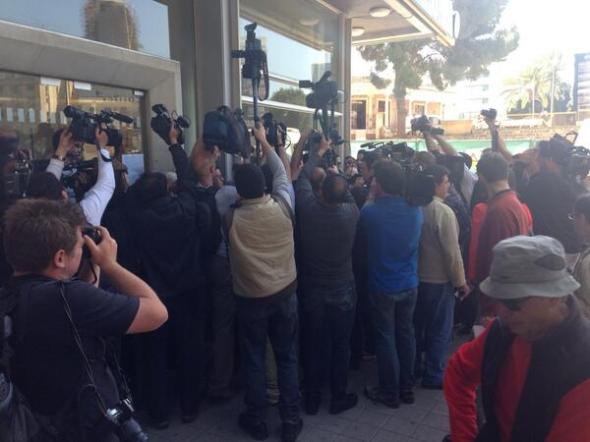
Banks reopen in Cyprus and media jostle to get the best view – posted by Joe Parkinson (@JoeWSJ)
Good Morning!!
The banks have opened in Cyprus with controls on how much depositors can withdraw.
Joe Weisenthal posted updates at his Business Insider blog:
At 6:00 AM ET, banks in Cyprus reopened their doors for the first time since March 16.
Wall Street Journal’s Joe Parkinson reports that only eight people are being allowed in at a time at one Bank of Cyprus branch.
However, the crowds have been orderly.
Everyone is wondering whether there will be a huge run on the banks.
So far? Not yet.
This is likely due to a set of capital controls that have been imposed on the banks. Specifically, Cypriot depositors cannot withdraw more than 300 euros per day from any one bank. Also, checks cannot be cashed.
These controls will be in place for seven days.
See more Twitter updates and photos at the link. International Business Times has some details about the capital controls that are supposed to prevent bank runs. In addition to the withdrawal limit, depositors can’t cash checks unless they come from another country.
In the meantime, non-cash payments or money transfers are banned unless they are related to a number of conditions.
These conditions include commercial transactions, payroll, living expenses and tuition fees.
If commercials transactions are less than €5,000, there are no restrictions, but payments above this amount and up to €200,000 will be subject to a 24-hour decision making process, in order to determine whether the liquidity of the bank would be able to incur such a withdrawal.
Transfers for paying employees will also still be allowed but relevant documents would have to be presented in order to prove the money is being used to pay staff.
Transactions on credit or debit cards are also capped at €5,000 euros per month.
According to the Wall Street Journal, some large depositors seemingly had advance knowledge of what was going to happen in Cyprus and moved their money out of the country weeks before the crisis.
The chairman of the Committee for Institutions in the Cypriot Parliament, Deputy Dimitris Syllouris, said he had submitted a letter to the Central Bank of Cyprus demanding an investigation into account holders who moved large sums of cash out of the country in the weeks ahead of Cyprus’s chaotic bailout talks…
He said he had received information about individuals and businesses moving money out of Cyprus weeks ahead of the bailout deal—a move that wouldn’t be illegal but could imply that some depositors had warning that negotiations for a bailout could, for the first time in the financial crisis that has rattled the euro zone, take a cut out of regular bank deposits.
Asked whether his suspicions focused on one specific group of depositors, he said “politicians, all sorts of people, and bankers themselves are no better.”
That figures…
Outflows from Cyprus were increasing from moderate levels from January until March 15, the officials said. Last week—especially after March 19, when the Cypriot Parliament rejected the first bailout deal that would have imposed a one-time levy on large deposits—the outflows under the central bank’s exemptions went up significantly, they said.
Several hundred million euros, but less than a billion euros, left the country despite the bank closures, according to one official.
At Bloomberg, Clive Crook says Cyprus’ Plan B is Still a Disaster.
The new deal has removed the craziest part of the agreement reached March 16 — the plan to default on deposit insurance. Let’s not dwell any further on that insanity. But the new plan still has features that, seen in any other context, would surely arouse surprise.
For instance, the so-called troika of the European Commission, the European Central Bank and the International Monetary Fund wanted to be sure that the new debt Cyprus is about to take on will be sustainable — meaning, presumably, that Cyprus will be able to repay it. Yet, by writing down high- value deposits, the revised plan will also cause a sudden contraction of the Cypriot banking system, and thus of the whole Cypriot economy, which depends on banking to an unusual degree.
He concludes that,
Bailout fatigue says: “The Cypriots got themselves into this mess, and they should get themselves out. We’ll lend them a bit more, but only if we’re sure they’ll pay us back.” Cyprus didn’t get itself into this mess. It joined the euro system in 2008 with low public debt and a clean bill of health from EU governments (back then, not a word was said about shady Russians). Its banks are in trouble not because they accepted too many overseas deposits but because they bought too many Greek bonds — an investment sanctified by international banking rules (which called such investments riskless) that was destroyed by the EU’s ham-fisted resolution of Greece’s threatened default.
Europe’s sense of “we’re all in this together” seems to have evaporated entirely. Now one has to ask not merely what the euro is for, but what the EU itself is for.
Back in the U.S.A.,

Simon Johnson has an interesting post at the NYT’ “Explaining the Science of Everyday Life” blog: The Debate on Bank Size Is Over.
While bank lobbyists and some commentators are suddenly taken with the idea that an active debate is under way about whether to limit bank size in the United States, they are wrong. The debate is over; the decision to cap the size of the largest banks has been made. All that remains is to work out the details.
To grasp the new reality, think about the Cyprus debacle this month, the Senate budget resolution last week and Ben Bernanke’s revelation that — on too big to fail — “I agree with Elizabeth Warren 100 percent that it’s a real problem.”
Policy is rarely changed by ideas alone and, in isolation, even stunning events can sometimes have surprisingly little effect. What really moves the needle in terms of consensus among policy makers and the broader public opinion is when events combine with a new understanding of how the world works. Thanks to Senator Sherrod Brown, Democrat of Ohio; Senator Warren, Democrat of Massachusetts, and many other people who have worked hard over the last four years, we are ready to understand what finally defeated the argument that bank size does not matter: Cyprus.
I can’t briefly summarize the gist of Johnson’s piece, so if you’re following this story, please read the whole thing. Could he really be right about limits on “to big to fail or prosecute banks.” I sure hope so!
In other news,
SCOTUS Justices Hinting They Will Avoid Issuing a Broad Ruling Legalizing or Banning Same-Sex Marriage
Posted: March 26, 2013 Filed under: GLBT Rights, Marriage Equality, SCOTUS, U.S. Politics | Tags: Proposition 8, same-sex marriage 34 Comments
This morning the Supreme Court held oral arguments on the challenge to California’s Proposition 8 ban on same-sex marriage. At Business Insider, Eric Fuchs writes:
The first of two huge Supreme Court cases on gay marriage may be heading for a partial victory for supporters of the movement.
“SCOTUS won’t uphold or strike down Prop 8,” SCOTUSblog’s Tom Goldstein predicted over twitter after the Tuesday hearing was over.
So what does that mean, and why would that be a partial victory for gay marriage advocates?
The hearing involved California’s voter-approved ban on gay marriage, known as Proposition 8, which was struck down by a federal judge and an appeals court. When California declined to defend the law, it was backed by a coalition of anti-gay marriage advocates and elevated to the Supreme Court.
The Supreme Court could decline to issue a ruling at all, however, by finding the anti-gay marriage advocates don’t have legal “standing” to defend the law.
If that happens, then the appeals court ruling would stand and gays could continue to get married in California.
You can listen to the oral arguments and/or read the transcript at The Washington Post.
I can’t say I’d be surprised if the justices punt this one. I know that the Scalia clique would love to ban same-sex marriage, but they probably couldn’t get the votes; and even if they did, they have to realize that the blowback from the public would be horrendous.
Temper Tantrum Tony
Posted: September 18, 2012 Filed under: SCOTUS | Tags: bad judges, corruption, political hacks, Scalia, Thomas, unfit to be Judges 22 Comments There’s a new book out by Jeffrey Toobin that confirms what we all think about SCOTUS and some of its right wing, political demagogues. The most obvious conclusion of the many stories in the book is that Justice Scalia is temperamentally unsuited to be a judge. He should be a precinct boss from some thug district. He appears to actively bully other justices into his way of things and is the enforcer of right wing political correctness. He also throws extreme fits of temper when he doesn’t get his way. Scalia lost it over both the latest immigration suit and the health care law decision.
The book confirms previous reports that Roberts changed his vote in the landmark case over President Obama’s healthcare law after initially siding with the conservative justices. But Toobin reports — as others have implied — that what pushed Roberts away was the conservative justices’ insistence on striking down the entire health law.
“Scalia’s view of the justices as gladiators against the president unnerved Roberts,” Toobin writes.
The book describes Scalia as “furious” and “enraged” at Roberts — contradicting Scalia’s public statements brushing aside any tension.
Evidently Scalia and his cronies are so temperamentally unsuited for their jobs that they are even recognized as being more political hacks than judges by most Republican stalwarts. This includes retired members of SCOTUS.
Much like the Republican Party, the conservative wing of the Supreme Court has gotten staunchly more conservative over the past several years, Toobin notes. He says the old guard of recent Republican justices has been deeply upset by the Roberts court.
Toobin notes the long, stammering dissent John Paul Stevens wrote and then read for the Citizens United campaign-finance case, which he said “captured everything that offended Stevens most about the Roberts court.”
It had the same effect for Justice David Souter.
“He abhorred the views of Roberts and Alito. Souter didn’t like what the Republican Party — his party — was doing to the court, or to the country,” Toobin writes.
Former Justice Sandra Day O’Connor “had projected onto Roberts her idea of what a chief justice, and a Republica, should be,” Toobin writes, but her reservations grew as she watched the court overturn core pieces of her legacy. Toobin also recounts O’Connor talking to Souter about her decision to leave the court.
” ‘What makes this harder,’ O’Connor told Souter, ‘is that it’s my party that’s destroying the country.’ “
I refuse to call these people deeply conservative. It runs contrary to the very definition of the word conservative. These folks are just plain reactionary activists.
Although Toobin says Scalia has descended from scholar to “right-wing crank,” he notes that Scalia came to the court with a unified theory of law — originalism — and has helped recenter important cases and more general discussions around what the Founding Fathers might have intended.
Justice Clarence Thomas, known primarily for his silence during oral arguments, is the court’s “pathbreaker,” always pushing for more, driving the court to the right in much the same way the Tea Party has pushed Republicans, Toobin says.
Justices Thomas and Scalia are clearly candidates for impeachment in their refusal to recognize their conflicts of interest as well as their political thuggery of our law and Constitution. We’ve written about this before as have others.
But that’s what happened at the Supreme Court earlier this week in what Washington Post columnist Dana Milbank described as “an extraordinary display of judicial distemper” — “more campaign speech than legal opinion” – as Antonin Scalia did what Scalia usually does when things don’t go his way: he threw a temper tantrum.
In his scathing dissent in United States v. Arizona, where a 5-3 Court majority struck down that state’s infamous “papers please” immigration statute, Scalia put aside the law and launched into a highly-partisan, ad hominem, rant against the Obama administration over policies, such as the presidential directive on the DREAM Act, totally unrelated to the issues before the Court.
According to Milbank, Scalia thundered that the Obama administration “desperately wants to avoid upsetting foreign powers;” that it was acting with “willful blindness or deliberate inattention” to Arizona’s illegal immigrants; that the majority’s opinion “boggles the mind;” and that the states are “at the mercy of the Federal Executive’s refusal to enforce the nation’s immigration laws.”
Salon’s Nathan Pippenger added that Scalia offered “plenty of FOX News-ready invective” about Arizona residents who “feel themselves under siege by large numbers of illegal immigrants who invade their property, strain their social services, and even place their lives in jeopardy.”
As Scalia’s stunned audience listened to what Pippenger described as Scalia’s “bellowing, bullying and bombastic” screed, the Justice came off sounding like some crazed neo-Confederate re-enactor reminiscing about the Lost Southern Cause and “the jealousy of the states with regard to their sovereignty.”
Scalia also made the astonishing claim, as Pippenger notes, that had the Court issued its decision in the 1780s, the United States might never have happened at all since no state would have been willing to enter the Union under the conditions set
by the Court.
Commentators have properly scolded Scalia for displaying an utter lack of judicial temperament, which has once again compromised the Court’s standing with the public.
Dems have been calling out Thomas and his Teabagger wife for some time for both conflicts of interest and gift taking of an extraordinary nature.
As the Supreme Court begins its fall session, Rep. Earl Blumenauer (D-Ore.), Rep. Louise Slaughter (D-N.Y.) and some of their colleagues are asking the House Judiciary Committee to hold hearings on alleged ethical violations and raising questions on whether the justice can be impartial.
Among their charges against Thomas: that the justice failed to report at least $1.6 million that his wife, Ginni, had earned since 1997; that he might have failed to report gifts from rich supporters; and that he inappropriately solicited donations for favored non-profits, according to their letter sent to Judiciary Chairman Lamar Smith (R-Texas) and ranking member John Conyers (D-Mich.).
“The Supreme Court’s greatest assets are its integrity and the public trust,” Blumenauer said in a statement. “Yet for months now, concerns have been building about the unwillingness or the inability of the Supreme Court to address allegations of potential ethics violations by Justice Clarence Thomas.”
Blumenauer was still collecting signatures on Wednesday night, and told POLITICO that 45 lawmakers have so far attached their names to the letter.
The Democrats’ concern over Ginni Thomas’s income stem from 13 years’ worth of revised disclosure reports that Thomas released in January, which detailed his wife’s earnings from Hillsdale College, the Heritage Foundation, and House Republican leaders, among other sources. Those figures had been left off Thomas’s previous disclosure forms because, the justice said at the time, he had a “misunderstanding of filing instructions.”
Wednesday’s letter is the second time Democrats have taken aim at Thomas in the last week over what they say are troubling ethical concerns. Last Thursday, 20 House Democrats called on the Justice Department to investigate the same allegations into Thomas in a letter to Judicial Conference of the United States, which oversee the federal court system.
“To believe that Justice Thomas didn’t know how to fill out a basic disclosure form is absurd,” Slaughter said last week.
Unfortunately, ideological and cowed Republicans let them slide and Dems never follow through with anything. So, these guys get to sit in judgement of extremely important things in extremely political and unfit ways.
What on earth would it take to get them both impeached? I would put this high on any humanitarian and patriot’s wish and activist lists, frankly.
Thursday Reads
Posted: July 19, 2012 Filed under: 2012 presidential campaign, Barack Obama, Homeless, Mitt Romney, morning reads, poverty, Republican presidential politics, SCOTUS, Tea Party activists, Team Obama, U.S. Military, U.S. Politics | Tags: Antonin Scalia, bigotry, birtherism, Bush v. Gore, dog whistles, national military service, Obama and terrorism, Racism, Romney's tax returns, Ronald Reagan, Tea Party 36 Comments
Good Morning!!
I just spent the last two days kid sitting for my two nephews, ages 7 and 9, and boy am I beat! Am I a great sister and sister-in-law or what? It may take me a day or so to recover. Kids sure do have a lot of energy! It was fun though.
The good news is that late yesterday afternoon, thundershowers moved into the Boston area and began cooling things down a bit. My house is still hot inside though. But we are going to get some relief from the heat for a couple of days–it might even be in the high 70s on Friday! Anyway, enough about my boring life, let’s get to the news.
As we learned yesterday, Mitt Romney has decided to “take the gloves off,” meaning he’s going full-on birther and the dog whistles have been upgraded to overt race baiting.
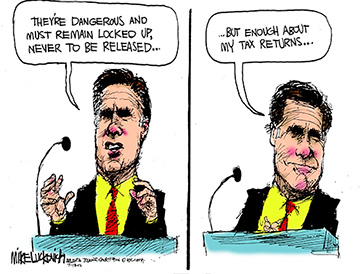
Mitt is so infuriated about being asked to do what past presidential candidates have done and release several years of his tax returns that he seems to have lost sight of his long-term goal of winning over independent voters and decided to figuratively don one of those hats with tea bags dangling from it. This is going to be an ugly and embarrassing spectacle.
Ed Kilgore asks: “Is Team Romney Becoming Unhinged?” Kilgore concluded yesterday, as I did, that John Sununu’s ugly remarks on Tuesday morning were part of a deliberate strategy by the Romney campaign to follow Donald Trump and the Tea Party in trying to paint President Obama as “foreign” and not a real American.
Did Team Romney really think their candidate could run around the country citing the brilliant job-creating success of Bain Capital as his primary credential for becoming president and not get challenged about it? And did they not expect demands that the richest man ever to win a presidential nomination release his tax returns? I mean, the attacks they are dealing with now are blindingly obvious. Any Romney opponent who didn’t make them would be guilty of extreme political malfeasance. So what gives?
Apparently what really got Romney’s goat was Obama adviser Stephanie Cutter’s statement that if Romney had lied on SEC forms, that would be a felony.
Romney’s aides remain particularly livid about Obama spokeswoman Stephanie Cutter’s suggestion last week that Romney committed a crime by filing apparently conflicting documents to the FEC and SEC.
“[Obama’s] policies have been such utter failures, the only thing he can do is to try to destroy a decent man and his wife,” the adviser said. “So he gets some hack political adviser from Chicago who has nothing to point to in her own life, and tells her to call him a felon… When did our politics get to that point? I mean, it’s Nixonian.”
Kilgore writes:
Try to destroy a decent man and his wife? Nothing to point to in her own life? This is such an over-the-top reaction to a banal comment by Cutter (who didn’t call Romney a “felon,” but simply observed that if he did misstate his role at Bain in a SEC filing, that’s potentially a felony) that you have to believe it’s coming from the candidate himself. Apparently, the mere suggestion he might have possibly committed a crime has sent him and his staff into a real spiral.
Don’t you bet Rick Santorum and Newt Gingrich wish they had known about this particular soft spot! Mention the criminal code and watch Mitt melt down!
At Talking Points Memo, Benjy Sarlin and Evan McMorris-Santoro opine: Romney’s New Plan To Go After Obama’s Biography Is A Gamble.
The Romney campaign had previously shot down the idea of revisiting many of the character attacks that first emerged in the 2008 election. Romney strongly repudiated an independent proposal by Republican ad man Fred Davis to run ads reviving the Rev. Jeremiah Wright controversy, for example.
Asked by TPM whether he felt reports of Romney’s new approach “kinda vindicate [sic]” his biography-based ad pitch, Davis e-mailed: “Only kinda?”
The assumption up to this point among strategists on both sides has been that objections to attacking Obama as a teen drug user or as personally corrupt were about keeping the message on the president’s record in office. The biggest conservative outside money groups, like American Crossroads, focus on Americans’ economic struggles, based on research showing it to be the most effective angle.
“Obama is setting a trap, and Romney is not a Chicago street fighter,” unaligned GOP consultant Ford O’Connell told TPM. “If Romney dabbles in this tit-for-tat style of political warfare for too long, he will lose.”
Romney is really playing into Obama’s hands by refusing to just release his tax returns and now embracing Tea Party bigotry. Obama’s advisers must be high fiving each other and grinning ear to ear.
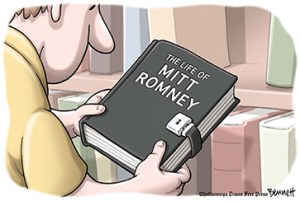
Check this out: Mitt Romney On Tax Return Controversy: ‘It’s Kind Of Amusing’
“It’s kind of amusing,” Romney told Columbus, Ohio, CBS affiliate WBNS. “I’m releasing two years of records as well as all that’s legally required and, for that matter, I’m doing the same thing John McCain did when he ran for president four years ago, which is releasing two years of returns, and we’ll see what time has to say about this.”
Yep, we’ll see. And watching Mitt self-destruct is going to be a lot of fun. Time to stock up on popcorn.
And speaking of right wing bigots, Supreme Court Joke Justice Antonin Scalia told CNN’s Piers Morgan that anyone who is unhappy about the Bush v. Gore decision should just “get over it.”
“Well, I guess the one that created the most waves of disagreement was Bush v. Gore,” says Scalia, referring to the famed United States Supreme Court decision dealing with the dispute surrounding the 2000 presidential election. “That comes up all the time, and my usual response is ‘get over it.'”
Noting that it was the Democratic candidate who brought the case into the Courts, Scalia says he hasn’t lost any sleep over the result:
“No regrets at all, especially since it’s clear that the thing would have ended up the same way anyway,” recalls the 76-year-old. “The press did extensive research into what would have happened, if what Al Gore wanted done, had been done, county by county, and he would have lost anyway.”
I’ve found a couple of important long reads for you. First, from Alternet: How America Became a Country That Lets Little Kids Go Homeless. If you guessed it goes back to the mean-spirited Reagan administration, you’re correct.
An interesting fact about family homelessness: before the early-1980s, it did not exist in America, at least not as an endemic, multi-generational problem afflicting millions of poverty-stricken adults and kids. Back then, the typical homeless family was a middle-aged woman with teenagers who wound up in a shelter following some sort of catastrophic bad luck like a house fire. They stayed a short time before they got back on their feet.
In the 1980s, family homelessness did not so much begin to grow as it exploded, leaving poverty advocates and city officials stunned as young parents with small children overwhelmed the shelter system and spilled into the streets. In New York City, the rate of homeless people with underage kids went up by 500 percent between 1981 and 1995. Nationally, kids and families made up less than 1 percent of the homeless population in the early 1980s, according to advocate and researcher Dr. Ellen Bassuk. HUD estimates put the number at 35 percent of people sleeping in shelters in 2010….
The reasons behind the jump in family homelessness are not complex, Núñez says. “It was the gutting of the safety net. Reagan cut every social program that helped the poor. Then there’s inflation so their aid checks are shrinking. Where are they going? Into the streets, into the shelters.”
It’s so true. When I first moved to Boston in 1967, the only homeless people you saw were down and out alcoholic hobo types. Then Reagan emptied the state psychiatric hospitals and cut funds for low cost housing, and other safety net programs. Suddenly, the Boston area was filled with homeless people–people who slept in their cars in supermarket parking lots or outside along the Charles River in Harvard Square. It was truly horrifying.
At the New York Review of Books, David Cole reviews two new books on Obama’s terrorism policies and concludes that Obama isn’t exactly Bush III, but he hasn’t restored our constitutional rights either.
While President Obama, unlike his predecessor, has steered clear of the politics of fear, he has also steered clear of the politics of defending our ideals. Like many Democrats, he seems afraid of being painted as soft on terrorism if he advocates for respecting the rights of others. We can only hope that in a second term, with more confidence and an eye on his legacy rather than short-term polls, he will take on the defense of American ideals that he let pressure from the security bureaucracy and political caution stop him from pursuing in the first.
And while you’re at the NYRB, take a look at this piece by William Pfaff: When the Army Was Democratic.
The US had national service from September 1940, just before World War II, until 1971, when the Vietnam War was ending. It was accepted with patriotic resolution at its start, and hated by its end. I am of an age to have put on my country’s uniform in high school ROTC in 1942, when I was fourteen years old. I put it on again for the Korean War, and did not take it off for the last time until 1958, after limited active reserve service. That was a total of sixteen years.
I can’t say that I enjoyed military service, but I learned a lot, about myself and about others—including the young black men who made up a good half of my all-southern, and mostly rural, basic training company (where I was not only the sole college graduate but probably the only high school graduate). This was just two and a half years after President Harry Truman had ordered the army desegregated. The regular army—which has always been essentially a southern institution—hated and feared the consequences of that order, but said “yes, sir” and did it, producing undoubtedly the biggest and most successful program of social engineering the United States had ever experienced. It also created what remains today the most successful route of social and professional ascension for talented young black males from poor communities that the country has ever known.
The army, in my opinion, did more to desegregate the United States than the civil rights movement of the 1960s. From 1948 on, nearly every able-bodied young man in the United States served and lived side by side with Americans of all colors, all in strict alphabetical order, in old-fashioned unpartitioned barracks, sleeping bunk to bunk, sharing shelter-halves on bivouac, in what amounted to brotherly endurance of the cold, heat, discomfort, and misery of military training—and following that, of service.
Just a few more quick links I want to call your attention to. Joseph Cannon has a horrifying post up about connections between Mitt Romney and the teen rehab industry in which kids are abused, tortured, and brainwashed. Also see this article in Salon linked in the Cannon piece.
Dakinikat will be interested to know (if she doesn’t already) that Bobby Jindal’s exorcism history has made it into the corporate media. And Charlie Pierce wrote about it yesterday.
Those are my suggestions for today. What are you reading and blogging about?
Broccoli Loses! Oh teh Humanity!
Posted: June 28, 2012 Filed under: Affordable Care Act (ACA), SCOTUS, U.S. Politics, Women's Healthcare | Tags: Brocoli Mandate 61 Comments It’s one of those Bizarro World days where you get to see “liberals” cheer over an American Heritage invented, Romney inspired, aka Dolecare private insurance scheme while conservatives moan that it’s
Alas poor Scalia! His revolution has stalled. It seems Justice Roberts either cares about his name or precedent after all. He managed to shift grounds but still worries about the ‘Broccoli Horrible’.
The majority opinion written by Chief Justice John Roberts bluntly insisted that the clause does not vest Congress with “police powers … to regulate an individual from cradle to grave.” It also explicitly embraced the conservative argument regarding health care and broccoli.
In oral arguments three months ago, Roberts and Justice Antonin Scalia famously demanded that Solicitor General Donald Verrilli explain why, if the government can compel someone to buy health insurance, it can’t also compel them to buy broccoli.
That comparison outraged progressives and horrified health care experts, because it seemed to trivialize the enormous societal significance of health care.
Roberts, however, enshrined the broccoli-related concerns in his opinion, writing:
According to the Government, upholding the individual mandate would not justify mandatory purchases of items such as cars or broccoli because, as the Government puts it, “[h]ealth in-surance is not purchased for its own sake like a car or broccoli; it is a means of financing health-care consumption and covering universal risks.” Reply Brief for United States 19. But cars and broccoli are no more purchased for their “own sake” than health insurance. They are purchased to cover the need for transportation and food.In their concurrence, the four liberal justices, led by Ruth Bader Ginsburg, nevertheless took issue with some of Roberts’ conclusions — including the one about broccoli.
Ginsburg tried to explain some of the ways in which broccoli (or a car) are different from health care:
Although an individual might buy a car or a crown of broccoli one day, there is no certainty she will ever do so. And if she eventually wants a car or has a craving for broccoli, she will be obliged to pay at the counter before receiving the vehicle or nourishment. She will get no free ride or food, at the expense of another consumer forced to pay an inflated price.And she even seemed to poke fun at Roberts for swallowing such an argument:
As an example of the type of regulation he fears, The Chief Justice cites a Government mandate to purchase green vegetables. Ante, at 22–23. One could call this concern “the broccoli horrible.” Congress, The Chief Justice posits, might adopt such a mandate, reasoning that an individual’s failure to eat a healthy diet, like the failure to purchase health insurance, imposes costs on others. See ibid.Consider the chain of inferences the Court would have to accept to conclude that a vegetable-purchase mandate was likely to have a substantial effect on the health-care costs borne by lithe Americans. The Court would have to believe that individuals forced to buy vegetables would then eat them (instead of throwing or giving them away), would prepare the vegetables in a healthy way (steamed or raw, not deep-fried), would cut back on unhealthy foods, and would not allow other factors (such as lack of exercise or little sleep) to trump the improved diet.
Be prepared to eat thy Broccoli or Move to Canada for that horrible Universal Health Care you all fear Teabots! Meanwhile, I’m trying to imagine all those governors actually opting out of a huge amount of federal funds to make a point about their Medicaid programs. Yes, death panels are okay as long as its for poor people. Don’t you just love those sociopaths cum libertarians?
A rejection of health care egalitarianism, namely a recognition that the wealthy will purchase more and better health care than the poor. Trying to equalize health care consumption hurts the poor, since most feasible policies to do this take away cash from the poor, either directly or through the operation of tax incidence. We need to accept the principle that sometimes poor people will die just because they are poor. Some of you don’t like the sound of that, but we already let the wealthy enjoy all sorts of other goods — most importantly status — which lengthen their lives and which the poor enjoy to a much lesser degree. We shouldn’t screw up our health care institutions by being determined to fight inegalitarian principles for one very select set of factors which determine health care outcomes.
Like I said, welcome to the new Bizzarro world. It sounds strangely like a Dickens novel. Bless their little hearts, every one!

 peej
peej Carissa
 bostonboomer
 dakinikat
 ecocatwoman
 mablue2
 Mama Lopez
 peggysue22
 quixote
 skydancingguestblogger
 Mona (aka Wonk the Vote)



 Sky Dancing
Recent Comments