
The World According to Fat Tony
Posted: October 7, 2013 Filed under: SCOTUS | Tags: Antonin Scalia 27 Comments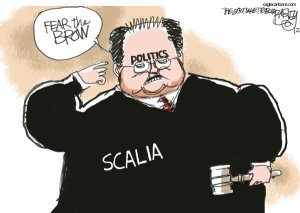 There are so many things wrong with Antonin Scalia that it is really difficult to pick a place to start. Jennifer Senior interviews the man in black for NYM. To know him is to abhor him. For example, some of his best friends are probably closeted gay people.
The one thing I did think, as he said those somewhat welcoming things to gay men and women, is, Huh, this really does show how much our world has changed. I was wondering what kind of personal exposure you might have had to this sea change.
I have friends that I know, or very much suspect, are homosexual. Everybody does.Have any of them come out to you?
No. No. Not that I know of.Has your personal attitude softened some?
Toward what?
Homosexuality.
I don’t think I’ve softened. I don’t know what you mean by softened.If you talk to your grandchildren, they have different opinions from you about this, right?
I don’t know about my grandchildren. I know about my children. I don’t think they and I differ very much. But I’m not a hater of homosexuals at all.
Okay, so is this a softer, gentler Scalia since or before, say, December 2012?
Justice Antonin Scalia, always eager to prove himself in the ongoing competition known as America’s Top Relic, whipped out another doozy on Monday while speaking at Princeton University. A gay student named Duncan Hosie got up and asked Scalia about his avid support for bans on “sodomy,” i.e. same-sex couples doing it, and Scalia answered with this:
“It’s a form of argument that I thought you would have known, which is called the ‘reduction to the absurd,’” Scalia told Hosie of San Francisco during the question-and-answer period. “If we cannot have moral feelings against homosexuality, can we have it against murder? Can we have it against other things?”
Scalia said he is not equating sodomy with murder but drawing a parallel between the bans on both.
Then he deadpanned: “I’m surprised you aren’t persuaded.”
That would be because boldly stating stuff without really bothering to make an argument for it isn’t persuasive, something you’d have thought Scalia’s law professors would have taught him.
The reason I bring this particular part of Scalia’s interview up is that there’s been some weirdness lately about what he has said about marriage equality in recent cases and likely to do this term. Here’s some coverage from The Advocate.
Scalia’s verdicts in both marriage equality cases this summer included strong language, referring to the majority rationale of the court in the DOMA case as legal “argle bargle,” essentially rejecting the court’s conclusion that it was unconstitutional for the federal government to recognize one set of legal marriages (opposite-sex) while denying the existence and equal treatment of others (same-sex).
This perspective clearly put Scalia in the minority on the court and, according to numerous public opinion polls, in the minority of Americans who believe that same-sex marriage is not legally equivalent to opposite-sex marriage. But Scalia is no stranger to standing in opposition, and isn’t concerned with how history will portray him and his legacy.
“Frankly, I don’t care,” said Scalia when asked how the world would view his opinions in 50 years. “Maybe the world is spinning toward a wider acceptance of homosexual rights, and here’s Scalia, standing athwart it. At least standing athwart it as a constitutional entitlement. But I have never been custodian of my legacy. When I’m dead and gone, I’ll either be sublimely happy or terribly unhappy.”
Scalia has been on somewhat of a publicity tour since the Supreme Court recessed in June, appearing at numerous conferences, universities, and in several interviews before the court’s next session, which begins today. Last week he told a crowd at Tufts University in Massachusetts that he had not yet expressed his views on “gay marriage.” In August he said the Supreme Court should not “invent new minorities,” as he alleges it did with the DOMA decision. And in July he told a group of lawyers that federal judges were not qualified to legislate “homosexual sodomy.”
I’m not sure what he’s up to in this current interview but frankly, he has expressed some views and they are worrisome.
Oh, and we should believe in a “literal” DEVIL. Why wouldn’t we?
Can we talk about your drafting process—
[Leans in, stage-whispers.] I even believe in the Devil.You do?
Of course! Yeah, he’s a real person. Hey, c’mon, that’s standard Catholic doctrine! Every Catholic believes that.
Every Catholic believes this? There’s a wide variety of Catholics out there …
If you are faithful to Catholic dogma, that is certainly a large part of it.
Have you seen evidence of the Devil lately?
You know, it is curious. In the Gospels, the Devil is doing all sorts of things. He’s making pigs run off cliffs, he’s possessing people and whatnot. And that doesn’t happen very much anymore.
No.
It’s because he’s smart.
So what’s he doing now?
What he’s doing now is getting people not to believe in him or in God. He’s much more successful that way.
That has really painful implications for atheists. Are you sure that’s the Devil’s work?
I didn’t say atheists are the Devil’s work.
Well, you’re saying the Devil is persuading people to not believe in God. Couldn’t there be other reasons to not believe?
Well, there certainly can be other reasons. But it certainly favors the Devil’s desires. I mean, c’mon, that’s the explanation for why there’s not demonic possession all over the place. That always puzzled me. What happened to the Devil, you know? He used to be all over the place. He used to be all over the New Testament.
Right.
What happened to him?
He just got wilier.
He got wilier.Isn’t it terribly frightening to believe in the Devil?
You’re looking at me as though I’m weird. My God! Are you so out of touch with most of America, most of which believes in the Devil? I mean, Jesus Christ believed in the Devil! It’s in the Gospels! You travel in circles that are so, so removed from mainstream America that you are appalled that anybody would believe in the Devil! Most of mankind has believed in the Devil, for all of history. Many more intelligent people than you or me have believed in the Devil.I hope you weren’t sensing contempt from me. It wasn’t your belief that surprised me so much as how boldly you expressed it.
I was offended by that. I really was.
So this man is also going to hear a case on birth control and a variety of other things this term. We should be very afraid.
Monday Reads
Posted: July 22, 2013 Filed under: misogyny, morning reads, religious extremists, Reproductive Rights, SCOTUS, U.S. Politics, War on Women | Tags: abortion, Anthony Scalia, anti-choice legislation, CIA black sites, economics, evangelicals, Poland, secret prisons, The Prisoner's Dilemma 45 CommentsGood Morning!

So, I’m still a little bit out of the loop at the moment. I’m not really reading much in the way of news or even watching TV so I had to do some searching for something interesting to read this morning. This will be a bit of a link dump. I promise I will do better by midweek.
Will we ever be rid of Fat Tony and his blatant hypocrisy?
With his own claims to originalism fading fast, Scalia suggests liberal judicial activism, practiced by some of colleagues on the Court, is part of what brought about the Holocaust in Nazi Germany. The speech was an address to the Utah State Bar Association.
From the Aspen Times …
Scalia opened his talk with a reference to the Holocaust, which happened to occur in a society that was, at the time, “the most advanced country in the world.” One of the many mistakes that Germany made in the 1930s was that judges began to interpret the law in ways that reflected “the spirit of the age.” When judges accept this sort of moral authority, as Scalia claims they’re doing now in the U.S., they get themselves and society into trouble.
The Prisoner’s Dilemma is something we teach a lot in economics. You may remember the movie “A Beautiful Mind” and the invention of game theory. Well, there’s been an interesting test of the theory.
The “prisoner’s dilemma” is a familiar concept to just about anybody that took Econ 101.
The basic version goes like this. Two criminals are arrested, but police can’t convict either on the primary charge, so they plan to sentence them to a year in jail on a lesser charge. Each of the prisoners, who can’t communicate with each other, are given the option of testifying against their partner. If they testify, and their partner remains silent, the partner gets 3 years and they go free. If they both testify, both get two. If both remain silent, they each get one.
In game theory, betraying your partner, or “defecting” is always the dominant strategy as it always has a slightly higher payoff in a simultaneous game. It’s what’s known as a “Nash Equilibrium,” after Nobel Prize winning mathematician and A Beautiful Mind subject John Nash.
In sequential games, where players know each other’s previous behaviour and have the opportunity to punish each other, defection is the dominant strategy as well.
However, on a Pareto basis, the best outcome for both players is mutual cooperation.
Yet no one’s ever actually run the experiment on real prisoners before, until two University of Hamburg economists tried it out in a recent study comparing the behaviour of inmates and students.
Surprisingly, for the classic version of the game, prisoners were far more cooperative than expected.
Menusch Khadjavi and Andreas Lange put the famous game to the test for the first time ever, putting a group of prisoners in Lower Saxony’s primary women’s prison, as well as students through both simultaneous and sequential versions of the game.The payoffs obviously weren’t years off sentences, but euros for students, and the equivalent value in coffee or cigarettes for prisoners.They expected, building off of game theory and behavioural economic research that show humans are more cooperative than the purely rational model that economists traditionally use, that there would be a fair amount of first-mover cooperation, even in the simultaneous simulation where there’s no way to react to the other player’s decisions.
And even in the sequential game, where you get a higher payoff for betraying a cooperative first mover, a fair amount will still reciprocate.
As for the difference between student and prisoner behaviour, you’d expect that a prison population might be more jaded and distrustful, and therefore more likely to defect.
The results went exactly the other way for the simultaneous game, only 37% of students cooperate. Inmates cooperated 56% of the time.
On a pair basis, only 13% of student pairs managed to get the best mutual outcome and cooperate, whereas 30% of prisoners do.
While America languishes in an economic depression, Republican officeholders are bending all their efforts… to ban abortion. In the last few weeks and months, we’ve seen a blizzard of anti-choice legislation in Texas, Ohio, Wisconsin, North Carolina, and many other places. These laws stall women seeking abortions with mandatory waiting periods, brutalize them with invasive and unnecessary transvaginal ultrasounds, force doctors to read shaming scripts rife with falsehoods, and impose onerous regulatory requirements that are designed to be impossible to comply with so that family-planning clinics will be forced to close. At the federal level, the Republican-controlled House of Representatives voted for a bill banning all abortion after 20 weeks, without even putting up a pretense that this was constitutional.
One would think the drubbing taken by anti-choice zealots like Todd Akin in the last election would have given Republicans an incentive to step back and consider whether this is a winning strategy. Instead, it seems as if their losses have only inspired them to fight harder. For the right-wing Christian fundamentalists who dominate the Republican Party, banning abortion, or at least piling up pointless regulations to make it as burdensome and difficult to obtain as possible, has become an all-consuming obsession, akin to a religious crusade.
Given the amount of effort and political capital the religious right puts into trying to restrict abortion, you’d guess that opposition to women’s choice must take up a huge portion of the Bible. But the reality is that nothing could be further from the truth.
The Bible says nothing whatsoever about abortion. It never mentions the subject, not once, neither in the Old Testament nor the New. This isn’t because abortion was unknown in the ancient world. Much to the contrary, the ancient Greeks and Romans were well-acquainted with the idea. Surviving writings from these cultures recommend the use of herbs like pennyroyal, silphium and hellebore to induce abortion; others advise vigorous physical activity to cause a miscarriage, and some even discuss surgical methods.
Here’s an intriguing investigation of secret US prisons being carried out by Poland. What exactly do we and other countries know about these black ops sites run by the CIA?
The only sign of life at Szymany’s “international airport” are mosquitoes eager to suck blood out of a rare visitor. The gate is locked with a rusted chain and a padlock.
Evidence suggest that some of the last passengers at this site were CIA officers and their prisoners. That was in 2003. Soon after, the airport about 180 km north of Warsaw inside the picturesque Mazury forests went out of service.
Bounded by the Freedom of Information Act, Polish Airspace authorities have revealed that at least 11 CIA aircrafts landed at Szymany, and some of their passengers stayed on in Poland. The European Organisation for the Safety of Air Navigation (Eurocontrol) was not informed about those flights.
From Szymany the prisoners were driven to a nearby intelligence academy in Stare Kiejkuty, where the CIA had a separated facility. In 2006, a few months after Poland was first identified as having hosted a secret CIA prison, Polish ombudsman Janusz Kochanowski visited the CIA villa – only to see that its chambers have been freshly renovated.
Two other European countries with known but unconfirmed black sites are Romania and Lithuania; the rest were in Asia and North Africa.
Human rights groups believe about eight terror suspects were held in Poland, including Khalid Sheikh Mohammed, the self-proclaimed mastermind of the 9/11 attacks. Two other men currently detained at the Guantanamo Bay detention facility have been granted “injured person” status in the ongoing investigation.
The first is Abd al-Rahim al-Nashiri, a Saudi national alleged to have organised the bombing of the USS Cole in 2000. He has claimed that he was often stripped naked, hooded, or shackled during seven months at Stare Kiejkuty, and subjected to mock execution with a gun and threats of sexual assault against his family members.
The second, a stateless Palestinian known as Abu Zubaydah, said he was subjected to extreme physical pain, psychological pressure and waterboarding – mock drowning.
Any Polish leaders who would have agreed to the U.S. programme would have been violating the constitution by giving a foreign power control over part of Polish territory, and allowing crimes to take place there.
Former prime minister Leszek Miller, now chairman of the opposition Democratic Left Alliance has been the prime target of criticism. There are demands he should face a special tribunal charged with trying state figures.
In March 2008, the Polish authorities opened a criminal investigation. “This indicates that Poland is a country with a rule of law,” Senator Jozef Pinior told IPS. “But the protraction is a reason for concern. The investigation has been moved to the third consecutive prosecutor’s office, in what looks like playing for time.”
Pinior, one of the leaders of the Solidarity opposition movement during the 1980s, and more recently a member of the European Parliament, has for long been lobbying for a full investigation into what the CIA was doing in Poland. Twice he was called in as witness in the investigation. He claims to have seen a document on a CIA prison with PM Miller’s signature.
“Poland is no banana republic, our security services do not do such things behind the back of the government.” — Polish Senator Jozef Pinior“The Polish government, especially Leszek Miller, must have had knowledge that such sites existed on Polish territory without any legal basis,” Pinior said. “They must have known about the torture too. Poland is no banana republic, our security services do not do such things behind the back of the government.”
It is still not clear how much knowledge the Polish leaders had about the black site in Stare Kiejkuty. Some have vehemently denied the prison’s existence, but some admit it between the lines, though denying responsibility.
“Of course, everything took place with my knowledge,” said former president Aleksander Kwasniewski in an interview with leading daily Gazeta Wyborcza.
So, that’s a few odds and ends to get us started today. What’s on your reading and blogging list today?
Breaking News: DOMA Falls
Posted: June 26, 2013 Filed under: Marriage Equality, SCOTUS, social justice | Tags: DOMA, marriage equality, SCOTUS 59 Comments Even though SCOTUS did not rule on the broader issue of marriage equality, DOMA has fallen. The usual Klan of Religious Freaks dissented. Justice Anthony Kennedy was the swing vote.
The Supreme Court issued rulings on two highly-anticipated cases on gay marriage today. By 5-4, .
In a separate ruling, it declined to take on the broader issue of gay marriage. The court to bring the case to the court.
NPR’s Carrie Johnson explains the Prop. 8 ruling: “By a holding of 5-4 with Chief Justice John Roberts in the majority, the Supreme Court rules the petitioners lack standing so the court avoids the underlying issues, remands and wipes away the decision by 9th Circuit Court of appeals, which means for now the lower court ruling invalidating California’s Prop. 8 stands.”
That means same-sex marriages in California may resume, but the ruling does not have a broader implication across the country.
The Defense of Marriage Act case is simpler. As SCOTUSblog reports, the court struck down the federal law because it denies same-sex couples the “equal liberty” guaranteed by the Fifth Amendment.
The 1996 Defense of Marriage Act, or DOMA, was signed into law by President Bill Clinton, barring federal recognition of same-sex marriages for purposes such as Social Security survivors’ benefits, insurance benefits, immigration and tax filing.
Section 3 of the law defines marriage as “a legal union between one man and one woman as husband and wife” and a spouse as “a person of the opposite sex who is a husband or a wife.” That provision had been struck down by eight lower courts before the Supreme Court’s 5-4 ruling in United States v. Windsor settled the matter for good.
This decision means that legally married same-sex couples are now entitled to the same federal benefits as married opposite sex couples.
The majority opinion was written by Justice Anthony Kennedy and joined by Justices Ruth Bader Ginsburg, Stephen Breyer, Sonia Sotomayor and Elena Kagan. Chief Justice John Roberts and Justices Antonin Scalia, Clarence Thomas and Samuel Alito dissented.
SCOTUS Blog has some analysis here.
Cutting to the marquee issue – whether DOMA is constitutional – the Court acknowledged that Congress can pass laws that affect marriage in limited ways, but in its view DOMA goes much further than that: it applies to over a thousand federal laws and all federal regulations. (In this week’s version of “Supreme Court Justices: They’re Just Like Us,” the version of the opinion that was distributed to reporters misspells “statutes” as “statues,” suggesting that perhaps someone was up late last night finishing up the draft.) But states, rather than the federal government, have historically been responsible for regulating and defining “marriage” – establishing their own (and sometimes different) minimum ages for marriage, for example. In recent years, the Court explained, some states have decided to allow same-sex couples to marry, giving them the same protection and dignity that opposite-sex couples get from marriage. But despite the traditional role of the states in regulating marriage, the Court reasoned, DOMA discriminates against same-sex couples by preventing the federal government from recognizing their marriages, and it does so to express disapproval of state-sanctioned same-sex marriage.
As a result of today’s decision, same-sex couples who are legally married must now be treated the same under federal law as married opposite-sex couples. That conclusion (and the steps that the Court took to get there) drew the ire of the Court’s four more conservative Justices – Chief Justice John Roberts and Justices Scalia, Thomas, and Alito – who filed three separate dissenting opinions totaling nearly fifty pages.
Justice Antonin Scalia read from the bench to demonstrate his severe disagreement with the ruling. The opinion is an “instant classic” that uses Scalia-isms like “jaw-dropping” and “rootless and shifting” to describe the Court’s rationales; at one point, he indicates that “[t]he sum of all the Court’s nonspecific hand-waving is that this law is invalid (maybe on substantive-due-process grounds, and perhaps with some amorphous federalism component playing a role).” Although the four dissenters did not completely agree on everything, they were united in their belief that DOMA is constitutional.
Here, in summary, is what the Court did — and did not do — on same-sex marriage on the final day of its 2012-13 Term:
** It ruled unconstitutional the Defense of Marriage Act’s Section 3, which defines marriage for purposes of one thousand federal laws and multitudes of official regulations as the union of one man and one woman only — a definition that excludes probably millions of already-married same-sex couples from any of those benefits or opportunities. “DOMA,” the Court majority said caustically, ”writes inequality into the entire U.S. Code.”
** It decided that sponsors of California’s “Proposition 8,” adopted by the state’s voters in an election almost five years ago, did not have a legal right to be in the Supreme Court or in a federal appeals court to try to defend that measure from constitutional attack. That is likely to have the early impact of putting into final effect a San Francisco federal judge’s 2010 decision striking down Proposition 8 under the U.S. Constitution. Some 18,000 California same-sex couples already had been married when they had a brief chance to do so as the issue developed in that state, but now millions are likely to gain the right to marry when the judge’s ruling is implemented by state officials. Happening perhaps in just a few weeks, that would make California the fourteenth — and largest — state to permit such marriages (along with Washington, D.C.).
** It declared, in quite explicit terms, that it was not deciding at this point whether the Constitution guarantees gays and lesbians a right to marry or whether the Constitution forbids states’ bans on such marriages. That will leave the promoters of marriage equality to continue with their efforts, in state legislatures and in lower courts, to try to win the right one more state at a time. The Court itself has a chance to take up that basic issue, as early as tomorrow, in a pair of new cases — from Arizona and Nevada — but it may not yet be ready to do so.
** And the Court did not spell out a new constitutional test for courts to use in judging new laws or other government actions that treat homosexuals less favorably than other people in similar settings and factual contexts. Although DOMA’s benefits ban was nullified under the Fifth Amendment’s guarantee of legal equality, the majority opinion did not sort out explicitly which level of judicial review — in escalating toughness — is supposed to be used in gay rights cases. In fact, the test that was applied this time appeared to be notably indistinct.
With the demise of the Defense of Marriage Act’s benefits ban in Section 3, for legally married gays and lesbians, the Court immediately — even if inadvertently — gave rise to a situation in which couples living in states that will not allow them to marry because they are homosexuals will still be able to qualify for federal benefits, many of which are handed out or managed by state governments.
But the ruling did not do anything explicitly about another section of DOMA — Section 2, which gives the states the right to refuse to recognize gay marriages performed in other states. That thus raised the prospect that a same-sex couple married in one of the states now allowing such unions could face obstacles to their marital rights when they moved into states that still do not recognize their unions. This might be a particular problem for already-married gay couples serving in the military, who often have to move from state to state.
Although Chief Justice John G. Roberts, Jr., dissented from the ruling in the DOMA case, he went to special lengths in his opinion in that case to apply the states’ rights language that Justice Anthony M. Kennedy’s majority opinion had employed in justifying the nullification of Section 3.
Roberts wrote, borrowing words from the Kennedy opinion: “While ‘the state’s power in defining the marital relation is of central relevance’ to the majority’s decision to strike down DOMA here, that power will come into play on the other side of the board in future cases about the constitutionality of state marriage definitions. So too will be concerns for state diversity and sovereignty that weighs against DOMA’s constitutionality in this case.”
The Court, the Chief Justice added, “may in the future have to resolve challenges to state marriage definitions affecting same-sex couples.” His remarks about the majority arguments on states’ rights in this field seemed to be telegraphing his views on the basic definition of marriage — and an implied suggestion that lower courts might be interested in following.
At least in one regard, we are closer to the reality of liberty and justice for all.
Saturday Reads, Summer Solstice Edition: Dreaming of a Woman President, and Other News
Posted: June 22, 2013 Filed under: 2016 elections, Barack Obama, Foreign Affairs, Hillary Clinton, misogyny, morning reads, SCOTUS, U.S. Politics | Tags: Claire McCaskill, Edward Snowden, Ready for Hillary superpac, Summer solstice, Supermoon, Toronto, Unique Lives and Experiences Conference 48 Comments
Good Morning and Happy Summer Solstice!!
Hillary is in the news this morning, so I thought I’d begin with her latest public remarks on the presidency. Claire McCaskill kicked off the Hillary talk on Tuesday when she said she was supporting a new superpac called Ready for Hillary.
“Hillary Clinton had to give up her political operation while she was making us proud, representing us around the world as an incredible Secretary of State, and that’s why Ready for Hillary is so critical,” McCaskill said in a statement released by the group. “It’s important that we start early, building a grassroots army from the ground up, and effectively using the tools of the Internet –- all things that President Obama did so successfully –- so that if Hillary does decide to run, we’ll be ready to help her win.”
McCaskill was one of the female Senators who abandoned Hillary to jump on the Obama bandwagon in 2008. Hillary gave her call after the announcement of support.
An early endorsement this week for a 2016 presidential run by former Secretary of State Hillary Clinton merited a phone call from the potential candidate, according to Sen. Claire McCaskill.
Clinton made the call after the senator’s Tuesday announcement that she was endorsing a political action committee pushing a presidential run.
“She did call me after this all happened the other day,” the Missouri Democrat said on MSNBC’s “Morning Joe.” “We had a great conversation. I’m not going to talk about what we said. But I think she’s got a big decision to make and I think she’s in the process of making it.”
McCaskill called the endorsement of Clinton an easy decision. “She is by far the strongest, most capable, most qualified candidate for President of the United States,” she said. “I am part of a lot of group of people, big huge group of people, that really wants her to run. And it seemed like coming out publicly and stating the obvious, that we all want her to run, was an important thing to do right now.”

Naturally, the corporate media is *concerned* about Hillary’s ambitions. The Washington Post sees “worries” for her in the new superpac.
The upstart super PAC, called Ready for Hillary, is fast emerging as the quasi-official stand-in for potential 2016 presidential contender Hillary Rodham Clinton, scooping up advisers and gathering big donations more than three years ahead of election time.
But the group is also making some advisers in Clinton’s orbit decidedly nervous about its potential impact on her own efforts, which for now consist of philanthropic pursuits and remaining mum on a presidential bid. Some allies also fear a repeat of 2008, when an assumed air of inevitability contributed to Clinton’s loss to fresh-faced challenger Barack Obama….
“It’s hard to even know what’s what any more,” said John Morgan, an Orlando lawyer who served on Bill Clinton’s 1996 national finance committee. “It’s become a cottage industry. It’s like, ‘Who are you?’ Just because you put the name ‘Hillary’ at the end of your PAC — it could be a bait and switch. I want to make sure I can get the biggest bang for my buck.”
Ready for Hillary — launched in January by Clinton boosters Adam Parkhomenko and Allida Black — is getting help from a number of veterans from Hillary and Bill Clinton’s political operation. Former Bill Clinton strategist Harold Ickes, former Clinton White House political director Craig Smith and former Hillary Clinton campaign lawyer Jim Lamb are advising the group on strategy, while longtime confidant James Carville recently sent out a fundraising solicitation under his name.

Former U.S. secretary of state Hillary Clinton poses with Jaden Szigeti, 9, for a snapshot before speaking to 5,000 at the Metro Convention Centre. (Toronto Star)
So what does Hillary herself have to say? Well she made a speech at the “Unique Lives and Experiences” conference in Toronto on Thursday, and she expressed a desire that many American women share. She wants to see a woman president in her lifetime. From Politico:
“Let me say this, hypothetically speaking, I really do hope that we have a woman president in my lifetime,” Clinton said in Toronto, before a women-centered event Thursday. “And whether it’s next time or the next time after that, it really depends on women stepping up and subjecting themselves to the political process, which is very difficult.”
She added that President Barack Obama’s election was historic, and said, “I hope that we will see a woman elected because I think it would send exactly the right historic signal to girls, women as well as boys and men. And I will certainly vote for the right woman to be president.” [….]
Friends and supporters of Clinton say she is genuinely undecided about whether to run again, even if some of the moves she is making now, immersing herself in domestic policy on issues affecting women and children that have been the core of her life’s work, would certainly be helpful if she launches another national campaign.
Yet that argument — the historic nature of a female president, combined with a pent-up desire among women voters to break that barrier — is the one most often espoused by Clinton backers.
Here’s the video that was posted to YouTube after the event.
In an “intimate” setting with 5,000 other people, Hillary reminisced about her life:
In a verbal stroll through her life, Clinton mentioned her mother’s difficult early years as an abandoned and mistreated child, she recalled the first time she ever heard the voice of her husband, former president Bill Clinton, back when he was a student, drawling about “the size of watermelons” in Arkansas. She mentioned the “extraordinary sense of anxiety” that she and every other American felt after the attacks of Sept. 11.
And she spoke candidly about how she had learned to cope with sexist attacks and snippy criticism about her hair, her clothes and all the things that don’t really define her.
“My attitude is different than it was 20 years ago,” she said. “I don’t care.”
The crowd clapped its approval.“I learned to take criticism seriously but not personally” Clinton told her audience.

She is amazing. I so miss her as Secretary of State. In contrast John Kerry is so boring that he’s already become almost invisible. With Hillary as SOS, there were frequent stories about her travels with photos of her colorful outfits. Wouldn’t it be wonderful to have her engaging personality, not to mention her valuable experience and brilliant mind in the White House?
In other news…
The news broke yesterday that Edward Snowden has been charged with three felonies. Most media outlets are reporting that has been charged with espionage, but so far that hasn’t been specifically stated by the government. From Politico:
Snowden was charged with conveying classified information to an unauthorized party, disclosing communications intelligence information, and theft of government property.
The charges, which can carry a penalty of up to ten years in prison on each count, were filed in federal court in Alexandria, Va., last Friday….
The charges were first reported Friday evening by the Washington Post, which said the complaint against Snowden was sealed. It’s not immediately clear whether the charges were unsealed before or after the Post report.
A Justice Department official confirmed Friday evening that a complaint was filed in the case, but declined further comment on the matter.
The Washington Post reported this morning that the charges were conveyed to Hong Kong authorities a week ago, but so far they seem to be dragging their feet about arresting Snowden.
The reason for the hold-up is unclear. There could be delays in the legal process for issuing the warrant. Or, officials may still be looking for Snowden, who is believed to be in Hong Kong but could also have found a way to leave the semiautonomous region.
The U.S. government asked Hong Kong to detain Snowden on a provisional arrest warrant June 14, the same day it filed criminal charges against him, including theft, “unauthorized communication of national defense information” and “willful communication of classified communications intelligence information to an unauthorized person.”
Under an extradition treaty between Hong Kong and the United States, a provisional warrant, as opposed to a regular one, is a faster way to detain suspected criminals since it does not require the initial approval of Hong Kong’s leader, currently Leung Chun-ying.
Instead, a judge can issue the warrant immediately. Simon Young, a legal professor at the University of Hong Kong said this means a warrant for Snowden’s arrest in theory could have been made as early as June 14, more than a week ago.
The Supreme Court justices are taking their own sweet time in announcing the most important decisions of this SCOTUS session. At The Daily Beast, Richard L. Hasan asks “What’s Taking the Supreme Court So Long?”
With everyone anxiously awaiting potentially blockbuster decisions on issues fromaffirmative action to voting rights to same-sex marriage, it is easy to criticize the Supreme Court for being too slow.
After all, Fisher, the affirmative-action case involving the University of Texas, was argued in Supreme Court back in October. By historical standards, the court is deciding very few cases: it issued 167 with opinions in the 1981 term, but is expected to decide only 77 this term. Why save all of the big calls for the end? Are the justices trying to create maximum suspense to get more attention?
These criticisms fundamentally misunderstand both the modern Supreme Court’s mission and the psychology of the justices. There may be a lot of reasons to criticize the court, but the end-of-the-term crunch is not one of them.Consider first the Supreme Court’s mission. Justices are unlike legislators, who simply vote to express their preferences. Justices are expected to give reasons for their decisions. Further, the court on some of the toughest questions is divided along strong ideological lines. For example, a majority opinion from a conservative justice can generate a dissenting opinion from a liberal justice. The dissenting justice won’t just say “I disagree,” but will offer reasons—reasons that the dissenting justice writes not only for history but in the hopes that one day a majority of justices will change their minds and adopt the dissenting view in a majority opinion. Both a majority and dissenting opinions will be circulated within the court, and each opinion will be modified numerous times to respond to the arguments of the other side, and to respond to the concerns of other justices who may join one or more of the opinions. Sometimes a justice will agree with the result but not with the reasoning of an opinion, and that justice will write separately, prompting another round of revisions.
We’re still waiting for decisions on 11 more cases, and those could be announced this week. It should be interesting.
Finally, today is the summer solstice, and people the world over celebrated the beginning of summer. Read about it at the the WaPo: Summer solstice observed at Times Square, Stonehenge, in D.C.
And tomorrow a unusual celestial even will take place, according to the Sydney Morning Herald: A Supermoon, when ‘people turn into lunatics’
ONLY ONCE a year Earth, Moon and Sun line up to create the perfect conditions for a so called ‘Supermoon’.
According to popular folklore, this is the time when “people turn into lunatics”, ships run aground and earthquakes rattle our planet.According to NASA , it is the best opportunity to get a good look at Earth’s rocky satellite.
The distance between Earth and Moon varies between about 357,000km and 406,000km throughout the year, and depends on the moon’s elliptical orbit around Earth.When the moon is on its farthest position from the earth, it is called Apogee while the closest encounter is named Perigee.
About once a year a full Moon occurs during the Perigee orbit, resulting in a 14 per cent larger and 30 per cent brighter appearance.
Right wing nuts should stay indoors and avoid looking at the sky. They’re already lunatics; we don’t need them to go completely around the bend.
Now it’s your turn. What are you reading and blogging about on this first day of summer?
Tuesday Reads: West, Texas; Boston; Biohazards; and Erosion of Constitutional Rights
Posted: April 30, 2013 Filed under: morning reads, Rule of Law, SCOTUS, U.S. Politics | Tags: biohazards, bird photography, Boyer v. Louisiana, constitution, Dzhokhar Tsarnaev, Elizabeth Colbert Busch, environmental toxins, Fifth Amendment, funding for public defenders, indigent defendants, Jonathan Edward Boyer, Mark Sanford, Miranda, right to attorney, right to speedy trial, Samuel Alito, SC congressional race, Sixth Amendment, The New York Times editorial board, West TX fertilizer plant 38 Comments
Good Morning!!
I thought I’d start this morning’s post with something beautiful before I get to the news of the day. I came across these amazing photos of birds yesterday–a nice reminder that the natural world can nourish us emotionally and provide respite from startling events and frustrating news that surrounds us in the supposedly “civilized” world of humans.



Now some news…
The fertilizer plant disaster in West, Texas is still under-reported. From what I can tell from following the story on twitter though, people are hurting down there and really need help. Here are a couple of updates I found this morning.
From CBS in Dallas: West Fertilizer Plant Explosion Cause Could Take Several Weeks to Determine
The Federal Bureau of Alcohol, Tobacco, and Firearms is investigating the blast along with the Texas State Fire Marshal.
State records reportedly show the West Fertilizer plant had a yearly capacity of 2,400 tons of potentially explosive ammonium nitrate.
So far, according to the ATF the only possible contributory cause that has been eliminated from consideration is the weather.
The U.S. Army Corp of Engineers arrived on scene Monday to assist investigators in assessing the 93 by 10 foot crater.
On Monday, the U.S. Homeland Security Department said The West Fertilizer Co. facility isn’t currently regulated under a department program that’s designed to reduce the risk of terrorism at certain high-risk chemical facilities.
CBS-11 has learned Homeland Security is now looking into whether the facility should have submitted paperwork about the chemicals stored at the plant to determine if it should be regulated.
The Christian Science Monitor says, Smoking gun in West, Texas, fertilizer blast: lack of government oversight
Although the cause of the blast is still undetermined, what is clear is that the West Fertilizer Company stored large quantities of highly reactive products, including anhydrous ammonia and ammonium nitrate, in the middle of a small town with very little oversight from state or federal agencies. Ammonium nitrate was used by the Oklahoma City bomber Timothy McVeigh in 1995, killing 168 people. The West, Texas, explosion killed 14, and injured nearly 200.
Texas does not have an occupational safety and health program that meets federal requirements. The federalOccupational Safety and Health Administration (OSHA) is therefore responsible for ensuring the safety of potentially dangerous workplaces like the West facility.
OSHA has inspected the West plant exactly once in the company’s 51-year history. That 1985 inspection detected multiple “serious” violations of federal safety requirements for which the company paid a grand total of $30 in fines. OSHA’s 1992 process-safety-management standard for highly hazardous chemicals is supposed to protect against disasters like the West explosion, but it wasn’t in place for that inspection.
Regardless, OSHA lacks the resources to undertake the kind of comprehensive inspection needed to ensure compliance with the process safety standard at small facilities like West Fertilizer Company. OSHA’s tiny staff of around 2,400 inspectors is spread so thin that it would take more than 90 years to conduct even cursory inspections of all eligible workplaces in Texas.
That’s pretty horrifying. I have to wonder how many other fertilizer plants like this one are out there like ticking time bombs.
Common Dreams calls attention to another horror story that affects all of us. “You and Your Family Are Guinea Pigs for the Chemical Corporations: How Americans Became Exposed to Biohazards in the Greatest Uncontrolled Experiment Ever Launched”
A hidden epidemic is poisoning America. The toxins are in the air we breathe and the water we drink, in the walls of our homes and the furniture within them. We can’t escape it in our cars. It’s in cities and suburbs. It afflicts rich and poor, young and old. And there’s a reason why you’ve never read about it in the newspaper or seen a report on the nightly news: it has no name — and no antidote.
The culprit behind this silent killer is lead. And vinyl. And formaldehyde. And asbestos. And Bisphenol A. And polychlorinated biphenyls (PCBs). And thousands more innovations brought to us by the industries that once promised “better living through chemistry,” but instead produced a toxic stew that has made every American a guinea pig and has turned the United States into one grand unnatural experiment.
Today, we are all unwitting subjects in the largest set of drug trials ever. Without our knowledge or consent, we are testing thousands of suspected toxic chemicals and compounds, as well as new substances whose safety is largely unproven and whose effects on human beings are all but unknown. The Centers for Disease Control (CDC) itself has begun monitoring our bodies for 151 potentially dangerous chemicals, detailing the variety of pollutants we store in our bones, muscle, blood, and fat. None of the companies introducing these new chemicals has even bothered to tell us we’re part of their experiment. None of them has asked us to sign consent forms or explained that they have little idea what the long-term side effects of the chemicals they’ve put in our environment — and so our bodies — could be. Nor do they have any clue as to what the synergistic effects of combining so many novel chemicals inside a human body in unknown quantities might produce.
Read it and weep.
Down in South Carolina, Elizabeth Colbert Busch and disgraced former Governor Mark Sanford met in a debate in the race for the district one congressional seat, and Busch got personal.

 peej
peej Carissa
 bostonboomer
 dakinikat
 ecocatwoman
 mablue2
 Mama Lopez
 peggysue22
 quixote
 skydancingguestblogger
 Mona (aka Wonk the Vote)



 Sky Dancing
Recent Comments