
The Irrelevancy of the Sunday News Shows
Posted: December 9, 2012 Filed under: Republican politics, The Media SUCKS, Voter Ignorance, We are so F'd 10 CommentsIt’s rather amazing to me when a professed news junkie like me starts turning off a number shows that used to be the sole reason I kept cable TV and a TV around the house. CNN used to be on in the background during my at-home office hours. I used to luxuriate in bed on a Sunday Morning with a paper and some good interviews. But, that was before these stations have become permeated with panels of people who don’t do math, science, reality, facts or anything but knee-jerk memes. The panel handlers–supposed journalists–don’t appear to have any motivation to provide news or information. It seems to be all about accessing the same stale old politicians. This Sunday seemed to perfectly reinforce the narratives of the recent fact checking lows of journalists’ coverage of the 2012 elections. This is the situation where–in fairness to differing view points–we have to listen endlessly to Republicans tell us that the sky is green and grass is blue simply because they want it that way.
Political journalists had no doubt heard similar arguments many times before, mostly from left wing bloggers. But this time the charge was coming from two of the most consistent purveyors of conventional wisdom in town, bipartisan to a fault.
And they were pretty harsh in their critique of the media. “Our advice to the press: Don’t seek professional safety through the even-handed, unfiltered presentation of opposing views,” they wrote in the Post. “Which politician is telling the truth? Who is taking hostages, at what risks and to what ends?”
Initially, at least, Mann and Ornstein weren’t completely ignored. “We had really good reporters call us and say: ‘You’re absolutely right’,” Mann said. “They told us they used this as the basis for conversations in the newsroom.”
But those conversations went nowhere, Mann said.
“Their editors and producers, who felt they were looking out for the economic wellbeing of their news organizations, were also concerned about their professional standing and vulnerability to charges of partisan bias,” Mann said.
So most reporters just kept on with business as usual.
“They’re so timid,” Mann said.
Some reporters did better than others, Ornstein said, particularly crediting Jackie Calmes of the New York Times and David Rogers of Politico among a few others. “They grew a little bit more straightforward in what they do, and showed you can be a good, diligent unbiased reporter, report the facts, put it in context, and yet show what’s really going on,” he said.
Most reporters, however — including many widely admired for their intelligence and aggressive reporting — simply refused to blame one side more than the other.
Consider, Paul Krugman. He’s the only economist in the room frequently. What’s his reward? His credentials get questioned and his motivation simply because he speaks from the data, facts and theories that drive our shared discipline. WTF do George Will or Mary Matalin know about even basic economics or math for that matter? Do they actually have the chops to analyze Paul Ryan’s budget plan?
After Krugman called House Budget Committee Chairman Paul Ryan’s budget a “fake document” and the columnist said he was “amazed that people haven’t gotten that,” Will unsheathed his verbal sword and went at Krugman.
“I have yet to encounter someone who disagrees with you who you don’t think is a knave, or corrupt, or a corrupt knave,” Will said, borrowing a phrase founding father Alexander Hamilton used to rail against those unwilling to respect the good faith of their political opponents.
“No, I’ve got some people,” Krugman said, suggesting that some conservatives are indeed intellectually honest.
“Specifics have indeed been offered,” Will insisted, referring to Republican budget plans.
That face-off followed a couple of prickly interactions between Matalin and Krugman earlier in the program.
“The Republicans are unable to actually make concrete proposals” about resolving the fiscal cliff, Krugman said, claiming they’ve failed to offer “any specifics” about how they would rein in the deficit.
Matalin called Krugman’s remark “completely mendacious.”
“Are you an economist or a polemicist?” she asked with an expression suggesting she found the Princeton professor and winner of the 2008 Nobel Prize in economics to be insufferable. “Do you want to talk about economy or do you want to talk about polemics?” she said.
Matalin and Krugman also sparred over Medicare cuts, with the former aide to Vice President Dick Cheney insisting that any cut in payments to providers would impact beneficiaries and the Times columnist insisting that was not always the case.
As if Matalin were not peeved enough, Krugman chimed in later to correct her when she said John Maynard Keynes had said: “Ideas drive history. Ideas drive progress.”
“The actual Keynes quote is….’ideas which are dangerous for good or evil,'” Krugman said.
Perhaps Matalin shouldn’t have tried to quote Keynes (whom she sarcastically called “our hero”) to a Keynesian. Unsurprisingly, Krugman has written on the specific quote.
How can we get any serious discussions about policy when journalists appear unwilling and unable to take a role in actually fact checking and providing a framework for what’s real and what’s imagined narratives on simple things like data? Why do they allow politic pundits with no real basic knowledge of policy issues to name call, misquote, and basically lie? Matalin couldn’t even get a simple quote right in front of person who’d actually done a lot of research and writing on that simple quote.
As rumors swirl that Democrats may consider raising the Medicare eligibility age to reach a deal before the looming “fiscal cliff,” a top Senate Democrat expressed opposition to that option Sunday. Speaking on Meet the Press, Senate Majority Whip Dick Durbin (D-IL) said raising the age at which seniors can receive Medicare from 65 to 67 would leave retired seniors with a dangerous gap in their health coverage:
DAVID GREGORY (HOST): Senator, one point about Medicare. You say you want to put off this discussion until later. But bottom line, should the Medicare eligibility age go up? Should there be means testing to get at the benefits side, if you want to shore this program up, because 12 years as you say before it runs out of money?
DURBIN: I do believe there should be means testing. and those of us with higher income in retirement should pay more. That could be part of the solution. But when you talk about raising the eligibility age, there’s one key question. what happens to the early retiree? What about that gap in coverage between workplace and Medicare? How will they be covered? I listened to Republicans say we can’t wait to repeal Obamacare, and the insurance exchanges. well, where does a person turn if they are 65 years of age and the medicare eligibility age is 67? They have two years there where they may not have the best of health. They need accessible, affordable medical insurance during that period.
Earlier this week, House Minority Leader Nancy Pelosi (D-CA) also rejected raising the Medicare eligibility age as part of a year-end deal on spending cuts and tax increases, saying, “I am very much against it, and I think most of my members are.” President Obama was reportedly willing to support raising the Medicare eligibility age during 2011 debt negotiations, but has not said where he stands on the issue as part of the current deal.
A Congressional Budget Office study of the proposal to raise the Medicare age to 67 found it would have “little effect on the trajectory of Medicare’s long-term spending” because the youngest Medicare beneficiaries are the healthiest and least costly to the program. The costs, meanwhile, would include an estimated net increase of $5.6 billion in out-of-pocket health insurance costs for beneficiaries who would have been otherwise covered by Medicare, according to a Kaiser Family Foundation study. Seniors in Medicare Part B would also face a 3 percent premium increase, the study found, since younger and healthier enrollees would be routed out of Medicare and into private insurance. Beneficiaries in health care reform’s exchanges would see a similar spike in premiums with the addition of the older population.
At some point, some one outside of a Democratic partisan has to point out that the Republicans keep coming up with the same old tired things that only protect their rich benefactors. None of their policies provide fiscal discipline. None of their policies achieve jobs and economic growth. None of their policies or their asserted outcomes have shown to be remotely close to reality when exposed to rigorous analysis. When will the press stop supporting lies in the name of balanced coverage?
Also, why is Rupert Murdoch being allowed to purchase more newspapers and media outlets in this country when the ones he’s got his nasty old claws into now are nothing short of gossip and propaganda rags? There is an absolute conspiracy in this country among the plutocrats to dumb down our nations most important social institutions–our free press and our public education institutions–and to destroy the ones that create economic equality and justice. Those, of course, are labor laws, progressive taxation, public infrastructure, and safety net programs. They are currently trying to rewrite the message of the election to match what they wanted to be the outcome. Our only recourse is to continue to tell our elected officials that our votes should mean something. We need a person in office—like Al Gore’s VPship–that will go through all those agencies and start throwing out the Dubya left overs. Democrats need to start fighting for every Federal appointment and every attempt at any more grand bargains. You cannot bargain with liars nor should you take any of their policy suggestions seriously. Now is the time to hold the Democrats to account.
McConnell Filibusters Himself
Posted: December 6, 2012 Filed under: Republican politics | Tags: Debt Celing, Filibuster, Filibuster Reform, McConnell 7 Comments You have to wonder what kind of political insanity rules our world these days when Republican Senate Minority Leader Mitch McConnell makes history for filibustering himself. I’m look for a word that’s a cross between immolation, masturbation, and the ultimate act of being an ass but I can’t come up with one. How can you self-abuse and fuck an entire country at the same time?
A move to embarrass Democrats backfired on Senate Minority Leader Mitch McConnell Thursday as the Kentucky Republican proposed a vote on raising the nation’s debt ceiling — then filibustered it when the Democrats tried to take him up on the offer.
On Thursday morning McConnell had made a motion for the vote on legislation that would let the president extend the country’s borrowing limit on his own. Congress would then have the option to disapprove such hikes, in a fashion similar to one that McConnell first suggested during last year’s standoff over the debt ceiling.
The minority leader apparently did not think Senate Majority Leader Harry Reid (D-Nev.) would take him up on his offer, which would have allowed McConnell to portray President Barack Obama’s desire for such authority as something even Democrats opposed.
Reid objected at first, but told McConnell he thought it might be a good idea. After Senate staff reviewed the proposal, Reid came back to the floor and proposed a straight up-or-down vote on the idea.
McConnell was forced to say no.
“What we’re talking about here is a perpetual debt ceiling grant, in effect, to the president, ” McConnell said. “Matters of this level of controversy always require 60 votes.”
Sixty votes are required to end a filibuster during debate on a bill and hold a vote.
Democrats immediately seized on McConnell’s reversal, noting it was the sort of obstruction that they think warrants changes to the rules on filibusters.
“What we have here is a case of the Republicans here in the Senate once again not taking yes for an answer,” Reid said. “This morning the Republican leader asked consent to have a vote on his proposal. Just now I told everyone we’re willing to have that vote, an up-or-down vote, and now the Republican leader objects to his own idea, so I guess we have a filibuser of his own bill.”
Democrats piled on.
Sen. Chuck Schumer (D-N.Y.) told reporters that McConnell thought he’d thrown Democrats for a loop. “It was a little too clever by half,” Schumer said, adding that it “would have been a great moment.”
It’s truly an amazing feat and it was all captured on CSPAN. Mitch McConnell has a much higher estimation of his political and strategy skills than he appears to be able to deliver on the floor of the senate.
It’s really difficult to understand the mind set of Republican politicians today. It appears that country is the last thing on their priority list.
Creating Fiscal Strife
Posted: November 29, 2012 Filed under: Catfood Commission, Economy, Federal Budget, Federal Budget and Budget deficit, George W. Bush, Global Financial Crisis, House of Representatives, Medicare, Politics as Usual, Republican politics, Republican Tax Fetishists, Super Committee, The Bonus Class, the GOP, U.S. Economy, U.S. Politics | Tags: fiscal cliff 15 Comments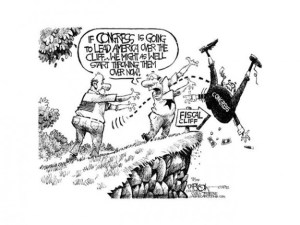 One of the things that drives me crazy as an economist and a citizen looking at this so-called “fiscal cliff” is that our fiscal strife has been created by the people least likely to suffer from its resolution. Congress gave the Bush administration authority to start a series of unfunded, reckless wars that have lasted well over a decade. Congress passed the Bush administration’s reckless tax cuts and generous loopholes that have benefited the few at the cost of the many. The Bush administration’s and Congress’ lack of oversight and deregulation of the financial services’ industry created a low-risk, gambling casino with the national investment and savings accounts and the debt markets. This led to a huge recession. These are the roots of our fiscal problems. But, the discussions around cleaning up messes in the District mostly surround Social Security which has nothing to do with the national debt and deficit and items that have become more necessary to average Americans since Congress and the Bush Administration broke the country with its bad policies.
Here’s some of the latest examples. Closing loopholes and unnecessary deductions for certain constituents is a good idea. However, which of these things are on the chopping block? Inkling its way up the priority list is the major middle and working class deduction and source of household wealth: the mortgage interest deduction. I have no problem with eliminating second mortgages, mortgages on boats, and mortgages on second properties. These benefit very few people and really serve little policy purpose. Capping the deduction–with an annual COLA adjustment to the median price and below-based mortgages is also fine. However, what are we likely to see?
As the Obama administration and lawmakers on Capitol Hill scramble to defuse automatic spending cuts and tax increases set to take effect Jan. 1, a herd of sacred cows — from Social Security and Medicare to deductions for charitable giving and mortgage interest — are in danger of losing their untouchable status.
Members of both parties have largely steered clear of detailed proposals so far. But plans put forth in the past year by President Obama and Mitt Romney to place limits on annual total tax deductions are likely to crimp the mortgage-interest deduction for certain taxpayers. Top congressional Republicans also have expressed openness to limiting total tax deductions as part of an overall budget deal. In addition, the presidentially appointed Simpson-Bowles fiscal commission suggested scaling back the mortgage-interest deduction as part of its own set of tax-related proposals.
Current law allows homeowners to deduct the interest paid on mortgage balances up to $1 million, including on second homes, as well as on $100,000 worth of home-equity loans. The deduction overwhelmingly benefits wealthier families, partly because they tend to have larger mortgages and pay more interest, and partly because most low- and middle-income Americans do not itemize deductions on their tax returns. It also tends to favor homeowners on the East and West Coasts, as well as those in large cities such as Chicago, where average home prices are higher.
Edward Kleinbard, a tax expert and law professor at the University of Southern California, said the mortgage-interest deduction represents the kind of government “extravagance” that the country no longer can justify, given its fiscal troubles.
“We simply cannot afford wasteful government subsidy programs anymore, and this is one of the most important examples of that,” Kleinbard said. “It’s very much a subsidy to those Americans who need it least.”
Mitch McConnell continues to service Grover Norquist and the Club for Growth. He’s back on his high horse for no tax increases for the wealthy. Ending tax cuts for the wealthy endlessly shown to have no ill-impact on the economy. There is also no real benefit to extending them.
Senate Republican Leader Mitch McConnell (Ky.) slammed the door Thursday morning on Democratic demands to raise tax rates on families earning more than $250,000 per year.
“We’re insisting on keeping tax rates where they are, first and foremost, to protect jobs and because we don’t think government needs the money in the first place,” McConnell said on the Senate floor.
“The problem, as I’ve said, is that Washington spends too much. But if more revenue is the price that Democrats want to exact, then we should at least agree to do it in a way that doesn’t cost jobs and disincentivize rates, as we all know raising rates would do,” he said.
McConnell’s comments came a day after Speaker John Boehner (R-Ohio) shot down a proposal by a senior GOP lawmaker, Oklahoma Rep. Tom Cole, to agree to extend tax rates only for families earning below $250,000 and resume the battle against higher tax rates on the wealthy next year.
Boehner said President Obama and Democrats should focus on finding ways to cut spending and reform entitlement programs.
The fate of the Bush-era tax rates — which will expire for all income levels in January — has dominated the debate over the slew of tax increases and spending cuts that are set to begin next year.
McConnell scolded the president Thursday for sticking fast to his campaign pledge to seek higher taxes on the rich, and made clear that raising tax rates on anyone is unacceptable.
The debate over Medicare is likely to be equally absurd. Medicare needs some reworking. Most of its problems comes from the pharmacy benefit which currently allows Big Pharma to price gouge participants and the taxpayers. But, you wouldn’t know that from the conversation. Republicans are playing games with Amercan’s health. They appear to be clinging to the Ryan’s voucher plan which would be disastrous for the majority of retired seniors.
The austerity crisis talks have hit a peculiar impasse. The problem isn’t, as most analysts expected, taxes, where Republicans seem increasingly resigned to new revenue. It’s Medicare. And the particular Medicare problem isn’t that Democrats are refusing the GOP’s proposed Medicare cuts. It’s that Republicans are refusing to name their Medicare cuts.
Politico quotes a “top Democratic official” who paints the picture simply: “Rob Nabors [the White House negotiator], has been saying: ‘This is what we want on revenues on the down payment. What’s your guys’ ask on the entitlement side?’ And they keep looking back at us and saying: ‘We want you to come up with that and pitch us.’ That’s not going to happen.”
That’s partly politics. If nothing else, Republicans are respectful of Medicare’s political potency. Recall that a core Republican message in both the 2010 and 2012 elections was that Democrats, through Obamacare, were cutting Medicare too much. Republicans, already concerned about their brand, don’t want to rebrand themselves as the party of Medicare cuts.
But it’s partly policy, too. The fact is that short of converting the program to a premium support system — a non-starter after they lost the 2012 election — Republicans simply don’t know what they want to do on Medicare.
Scour the various outlets for Democratic policy ideas and you’ll find plenty of proposed Medicare cuts. President Obama’s 2013 budget, for instance, includes hundreds of billions in Medicare cuts (see pages 33-37), and caps the program’s long-term growth at GDP+0.5 percent. More recently, the Center for American Progress released a 46-page proposal for cutting Medicare by almost $400 billion.
Republicans, meanwhile, have focused their energy on a long-term effort to convert Medicare to a premium-support model. Paul Ryan’s 2013 budget kept the Affordable Care Act’s Medicare cuts for the next 10 years and proposed to convert the program to a premium-support model in the future. Mitt Romney’s platform proposed reversing Obamacare’s Medicare cuts and offered a vague framework for converting the program to a premium-support model in the future.
If you dig deep into the Republican think tank world, you can find a few proposals that focus on the near-term.
The current fiscal ‘cliff’ framework appears to place a lot of burden on those least able to take it as well as those least responsible for creating the problems.
Cut through the fog, and here’s what to expect: Taxes will go up just shy of $1.2 trillion — the middle ground of what President Barack Obama wants and what Republicans say they could stomach. Entitlement programs, mainly Medicare, will be cut by no less than $400 billion — and perhaps a lot more, to get Republicans to swallow those tax hikes. There will be at least $1.2 trillion in spending cuts and “war savings.” And any final deal will come not by a group effort but in a private deal between two men: Obama and House Speaker John Boehner (R-Ohio). The two men had a 30-minute phone conversation Wednesday night — but the private lines of communications remain very much open.
No doubt, there will be lots of huffing and puffing before any deal can be had. And, no doubt, Obama and Congress could easily botch any or all three of the white-knuckle moments soon to hit this town: the automatic spending cuts and expiration of the Bush tax cuts, both of which kick in at the end of this year, and the federal debt limit that hits early next.
Go to the Politico story for a concept of what’s at stake and at issue.
Speaker John Boehner (R-Ohio) said Thursday there had been “no substantive progress” in fiscal-cliff negotiations in the two weeks since congressional leaders met with President Obama.
Boehner, addressing reporters after a meeting with Treasury Secretary Tim Geithner in the Capitol, called on the White House to “get serious” about the talks and warned of a “real danger” that Jan. 1 would come without a deal if President Obama did not offer up specific spending cuts he would be willing to accept.
“Despite claims that the president supports a balanced approach, the Democrats have yet to get serious about real spending cuts,” Boehner said. “Secondly, no substantive progress has been made in the talks between the White House and the House in the last two weeks.
“Listen, this is not a game,” he added. “Jobs are on the line. The American economy is on the line, and this is a moment for adult leadership.”
The Speaker criticized the president for holding “campaign-style rallies” instead of engaging in serious talks.
Tom Ricks vs. Fox News, Take 2
Posted: November 27, 2012 Filed under: Republican politics, U.S. Military, U.S. Politics | Tags: Benghazi, Fox News, Hollywood Reporter, Michael Clemente, Thomas Ricks 22 Comments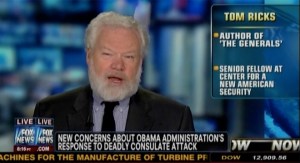
What is the deal with this Tom Ricks story? Fox News sure is touchy these days. A Fox executive told the Hollywood Reporter that after his abruptly terminated interview yesterday, Ricks apologized for telling the truth about the network on the air.
Tom Ricks, a former Washington Post reporter and author of best-selling books Fiasco and The Generals, briefly spoke with FNC’s Jon Scott about the death of four Americans in Benghazi, Libya. In a brief interview, Ricks first said FNC “hyped” the embassy attack and said a bit later that “Fox was operating as a wing of the Republican Party” before Scott ended the interview.
Michael Clemente, executive vp, news editorial at FNC, tells The Hollywood Reporter that Ricks dodged Scott’s question (“When you have four people dead, including the first U.N. ambassador in more than 30 years, how do you call that ‘hype’?”).
“When Mr. Ricks ignored the anchor’s question, it became clear that his goal was to bring attention to himself — and his book,” Clemente said in an e-mail to THR. “He apologized in our offices afterward but doesn’t have the strength of character to do that publicly.”
But Ricks says the apology story is a big ol’ lie. From Politico:
Ricks told POLITICO that Michael Clemente, Fox’s executive vice president of news, made the claim he apologized privately because “when the facts aren’t on their side, they attack the person.”
“Clemente is making it up, and it is sloppy of Hollywood Reporter to not ask him for specifics — what exactly am I alleged to have said? — and also to seek a response from me,” Ricks wrote in an e-mail. “Why are they doing this? Because their MO is that when the facts aren’t on their side, they attack the person.”
Ricks told the Washington Post that
I had told the producer before I went on that I thought the Benghazi story had been hyped. So it should have been no surprise when I said it and the anchor pushed back that I defended my view.
I also have been thinking a lot about George Marshall, the Army chief of staff during World War II, and one of the heroes of my new book. He got his job by speaking truth to power, and I have been thinking that we all could benefit by following his example as much as we can.
After I went off the air I saw some surprised faces in the hallway. One staff person said she thought I had been rude. My feeling was that they asked my opinion and I gave it.
Ricks also told the Hollywood Reporter in an e-mail:
“Please ask Mr. Clemente what the words of my supposed apology were. I’d be interested to know,” he said. “Frankly, I don’t remember any such apology.”
Clemente responded, according to TPM:
“I’m surprised by the General’s utter dishonesty,” Clemente said. “I’ll refresh his memory – what he said following the segment was, ‘Sorry… I’m tired from a non-stop book tour.’ Perhaps now he can finally get some rest.”
Ricks is not a general, but he did write a book called The Generals.
You be the judge. I report, you decide. (This is an open thread.)
Obsessive Poll Watching Open Thread: Pew has Obama by 3 . . . Plus, microtargeting voters for GOTV
Posted: November 4, 2012 Filed under: 2012 elections, 2012 presidential campaign, Democratic Politics, open thread, Republican politics, Team Obama, The DNC, the GOP, U.S. Politics | Tags: Barack Obama, Chris Hayes, David Axelrod, David Plouffe, GOTV, microtargeting, Mitt Romney, MSNBC, Pew Poll, polls, Sasha Issenberg 77 Comments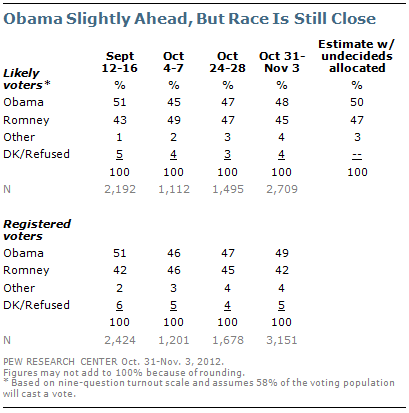
I’m sure glad MSNBC is running real programming tonight, because I can’t think of much other than the upcoming election. The polls have been moving toward Obama over the past few days, and suddenly he’s ahead in the Pew Poll which has been showing Romney ahead for some time.
Nate Silver reacted on Twitter, saying that the results match his findings:
Nate Silver @fivethirtyeight
Simple average of national polls released Thursday: Obama +0.9. Friday: Obama +1.2. Saturday: Obama +1.3. Today (so far): Obama +1.4
Pew reports:
In the Pew Research Center’s election weekend survey, Obama holds a 48% to 45% lead over Romney among likely voters.
The survey finds that Obama maintains his modest lead when the probable decisions of undecided voters are taken into account. Our final estimate of the national popular vote is Obama 50% and Romney 47%, when the undecided vote is allocated between the two candidates based on several indicators and opinions.
The interviews all took place after superstorm Sandy struck.
Obama’s handling of the storm’s aftermath may have contributed to his improved showing. Fully 69% of all likely voters approve of the way Obama is handling the storm’s impact. Even a plurality of Romney supporters (46%) approve of Obama’s handling of the situation; more important, so too do 63% of swing voters.
Pew expects voter turnout to be lower than in either 2004 or 2008, which could help Romney, but other data favors Obama.
Nearly four-in-ten (39%) likely voters support Obama strongly, while 9% back him only moderately. A third of likely voters support Romney strongly, compared with 11% who back him moderately. In past elections, dating to 1960, the candidate with the higher percentage of strong support has usually gone on to win the popular vote.
Similarly, a much greater percentage of Obama supporters than Romney supporters are voting for him rather than against his opponent (80% for Obama vs. 60% for Romney), another historical indicator of likely victory. And far more registered voters expect an Obama victory than a Romney victory on Nov. 6 (52% vs. 30%).
Obama’s increases in likely voter support are most notable among women, older voters, and political moderates. Women now favor Obama by a 13-point margin (53% to 40%), up from six points a week ago and reflecting a shift toward Obama since early October. Right after the first presidential debate, the women’s vote was split evenly (47% each). Men, by comparison, favor Romney by a 50% to 42% margin, with little change in the past month.
At the Guardian UK, Ewen McAskill writes:
The findings are similar to a Wall Street Journal/NBC poll published at the weekend. The two offer the first firm evidence of the impact of Sandy on the election. Pew carries one caution for Obama, suggesting turnout may be lower than in 2008 and 2004, which could help Romney.
Obama’s team claimed that Romney’s frantic campaign schedule reflected a sense of desperation, squeezing in a late visit to previously neglected Pennsylvania Sunday in the search for elusive electoral college votes elsewhere. The Obama team also cited visits Monday to Florida and Virginia, two states it said the Romney camp had claimed to have locked up.
In an interview with ABC, David Plouffe, who organised Obama’s re-election bid, expressed confidence the president will win on Tuesday, and seized on a comment by Karl Rove that Obama had benefited from superstorm Sandy. Democrats are interpreting this as Rove, George W Bush’s former campaign strategist and co-founder of the Crossroads Super Pac that has poured millions of dollars into Romney’s campaign and those of other Republicans, beginning to get his excuses in early.
“A few days ago he [Rove] predicted a big Romney win. My sense is Karl is going be at a crossroads himself on Tuesday when he tries to explain to the people who wrote him hundreds of millions of dollars why they fell up short,” Plouffe said.
Another Obama strategist, David Axelrod, commenting on Romney’s Pennsylvania trip, told Fox News: “They understand that they’re in deep trouble. They’ve tried to expand the map because they know in states like Ohio. They’re behind and they’re not catching up at this point.” He added: “They understand that the traditional, or the battleground, states that we’ve been focusing are not working out for them.”
On Microtargeting . . .
Over the past couple of days, I’ve been reading some interesting articles on the GOTV efforts of the two campaigns. I was struck by this piece at the Milwaukee Journal-Sentinel about a woman in Mukwonago, Wisconsin, Priscilla Trulen, who received a spooky call on Halloween.
“It was Mitt Romney saying, ‘I know you have an absentee ballot and I know you haven’t sent it in yet,’ ” Trulen said in an interview. “That just sent me over the line. Not only is it like Big Brother. It is Big Brother. It’s down to where they know I have a ballot and I haven’t sent it in! I thought when I requested the ballot that the only other entity that would know was the Mukwonago clerk.”
Other voters are being “creeped out” by calls from Democratic groups.
In Brown County, residents are unnerved about “voter report cards” from Moveon.org that show the recipients how their voting participation compares to those of their neighbors.
The solicitations give only a small glimpse into how much digital information the campaigns are able to access about voters.
Corporations working for candidates request publicly available voter data as well as information about absentee ballots from state governments, which they can combine with other data to target individual voters.
The cost of the entire state database is $12,500. Four requesters have been willing to pay that since Sept. 1, Magney said: Catalist (a progressive voter database organization), the Democratic National Committee, and data analysis firm Aristotle – all based in Washington, D.C. The last requester was Colorado-based Magellan Strategies, a firm that specializes in “micro-targeting” for Republican parties and candidates….
In an interview with PBS that aired in October, Aristotle’s chief executive officer, John Phillips, said the company keeps up to 500 data points on each voter – from the type of clothes they buy, the music they listen to, magazines they read and car they own, to whether they are a NASCAR fan, a smoker or a pet owner, or have a gold credit card. Some of that information comes from advertising for cleaning business, commercial marketing firms, product registration cards or surveys. Other information is obtained through Facebook, door-to-door canvassing, petitions and computer cookies – small data codes that register which websites the user has visited.
Through data modeling, analyzers can categorize voters based on how they feel about specific issues, values or candidates. They then try to predict voting behavior and figure out which issue ads voters are most likely to be susceptible to – for instance ads on education, gun control or immigration.
One of the companies that requested the full Wisconsin voter database, Magellan Strategies, explains on its website that it conducts surveys on people’s opinions and merges that with their political, consumer and census demographics.
Whoever targeted Trulen made one important mistake, however. She tends to vote Democratic although she lives in a Republican district.
According to Sasha Issenberg, author of the book The Victory Lab: The Secret Science of Winning Campaigns, writes that in 2008 and 2012, the Democratic microtargeting operation is far superior to the Republican one.
In fact, when it comes to the use of voter data and analytics, the two sides appear to be as unmatched as they have ever been on a specific electioneering tactic in the modern campaign era. No party ever has ever had such a durable structural advantage over the other on polling, making television ads, or fundraising, for example. And the reason may be that the most important developments in how to analyze voter behavior has not emerged from within the political profession.
“The left has significantly broadened its perspective on political behavior,” says Adam Schaeffer, who earned graduate degrees in both evolutionary psychology and political behavior before launching a Republican opinion-research firm, Evolving Strategies. “I’m jealous of them.”
In other words, the Republican dislike of science and academia may be holding Romney back in the microtargeting area.
Schaeffer attributes the imbalance to the mutual discomfort between academia and conservative political professionals, which has limited Republicans’ ability to modernize campaign methods. The biggest technical and conceptual developments these days are coming from the social sciences, whose more practically-minded scholars regularly collaborate with candidates and interest groups on the left. As a result, the electioneering right is suffering from what amounts to a lost generation; they have simply failed to keep up with advances in voter targeting and communications since Bush’s re-election. The left, meanwhile, has arrived at crucial insights that have upended the conventional wisdom about how you convert citizens to your cause. Right now, only one team is on the field with the tools to most effectively find potential supporters and win their votes.
Go read the whole thing if you’re interested. It’s quite a long article, but fascinating. After reading some of his pieces yesterday, I was also able to heard Issenberg on MSNBC’s “Up with Chris Hayes” this morning. So many books to read, so little time.
Now what are you all hearing/reading? Are you as excited as I am?

 peej
peej Carissa
 bostonboomer
 dakinikat
 ecocatwoman
 mablue2
 Mama Lopez
 peggysue22
 quixote
 skydancingguestblogger
 Mona (aka Wonk the Vote)



 Sky Dancing
Recent Comments