
Elite Conspiracy Theories and the Arrest of Dominique Strauss-Kahn
Posted: May 25, 2011 Filed under: collective bargaining, Economic Develpment, financial institutions, Foreign Affairs, France, Libya, Media, Pakistan, poverty, racism, Regulation, The Bonus Class, The Great Recession, U.S. Economy, U.S. Politics, unemployment, Violence against women | Tags: conspiracy theories, Dominique Strauss-Kahn, Federal Reserve, France, global elites, IMF, John F. Kennedy, Naomi Wolf, Nicholas Sarkozy, rape 29 Comments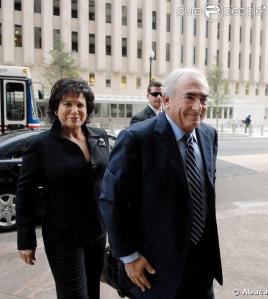
Dominque Strauss-Kahn and wife Anne
When one of us common people questions the Bush failures before 9/11 or the Warren Commission’s insistence that JFK was killed by a lone gunman, we are laughed at by the corporate media and lectured by politicians. But when one of the Global Elite gets in trouble, conspiracy theories are suddenly in vogue. Now that a global banker and possible candidate for the French presidency is accused of a sexual attack on a lowly hotel maid, elite conspiracy theories are running rampant in the U.S. and international media. I’ll give you a few examples.
At the Pakistan Observer, Ali Ashraf Kahn argues that Strauss-Kahn had to brought down, first because he would very likely have beaten the “American poodle Sarakozi” in a race for the presidency of France, and second because he (Strauss-Kahn) had offended the international banksters and corporations by proposing more liberal policies at the IMF which would have been a threat to the dollar. According to Ali Ashraf Kahn, getting rid of Strauss-Kahn would–along with U.S. military actions in Libya and Pakistan–would help to “save American predominance in the world.”
This incident goes to prove the hidden agenda of an international vested interest group trying to build and secure an American Empire for their master, which has not spared even Strauss-Kahn, who has been fixed in a rape attempt with a 32 year old hotel maid in a country where teen aged unwed mothers are a normal accepted feature. The former French Foreign Minister Strauss-Kahn, once if he was elected as president of France would have worked to strengthen the Euro to bring down dollar, which was of serious concern for the Federal Reserve Board in the already ongoing currency war with China. John F. Kennedy, US president was murdered for his only sin of canceling Federal Reserve Act of 1913 in 1963, when for the first time dollar currency was issued with the seal of US government, soon after his assassination President Lyndon B. Johnson revived this Act to continue their financial exploitation.
The author of this article appears to have a problem understanding the distinction between rape and consensual sex that results in pregnancies, but I’ll let that go for the moment. Kahn explains that Strauss-Kahn was trying to make radical changes at the IMF–so much so that Strauss Kahn won high praise from Joseph Stiglitz, which was apparently the final “kiss of death.”
Strauss-Kahn was trying to move the bank in a more positive direction, a direction that didn’t require that countries leave their economies open to the ravages of foreign capital that moves in swiftly-pushing up prices and creating bubbles, and departs just as fast, leaving behind the scourge of high unemployment, plunging demand, hobbled industries, and deep recession. Strauss-Kahn had set out on a “kinder and gentler” path, one that would not force foreign leaders to privatize their state-owned industries or crush their labour unions. Naturally, his actions were not warmly received by the banker’s mafia and multi national corporations who look to the IMF to provide legitimacy to their ongoing plunder of the rest of the world. These are the people who think that the current policies are “just fine” because they produce the desired results they’re looking for, which is bigger profits for themselves and deeper poverty for everyone else.
I have to admit, I’m in sympathy with those goals. There’s a lot more, so read the whole thing if you want more detail.
The next conspiracy theory is from Uganda. The author, Dr. Kihura Nkuba, also argues that Strauss-Kahn’s attack on the U.S. dollar is what led to his downfall. Nkuba says that police in the racist U.S. would never take the word of a poor black woman against that of a powerful white man unless motivated by a political conspiracy.
A woman from West Africa, assaulted by a famous white male, a future president of France, to be listened to by the New York Police, is amazing. But is it? [….]
New York police has [sic] been rummaging through DSK’s diaries, hotel registries, phone records, yearbooks and have made sure that the “great seducer” always appears handcuffed and dressed in a “pervie” raincoat with three-days stubble before they parade him in front of the media. He gets this treatment even though he has no criminal record and nothing, but the sketchy accusations of a room service cleaner.
What is his real crime? Strauss-Kahn was mounting an attack against the dollar and had called for a new world reserve currency that would challenge the dominance of the dollar and protect against future financial instability. He suggested adding emerging market countries’ currencies, such as the Yuan, to a basket of currencies that the IMF will administer to add stability to the global system….Strauss-Kahn saw a greater role for the IMF’s Special Drawing Rights, (SDRs) which is currently composed of the dollar, sterling, euro and yen, over time but said it will take a great deal of international cooperation to make that work.”
I love the way these male authors toss aside the charges against Strauss-Kahn–in Nkuba’s case, while complaining about racial prejudice. I guess he goes by the “bros before hos” rule: racism bad, sexism invisible.
Naomi Wolf also has a conspiracy theory about the Strauss-Kahn arrest that goes along with her defense of Julian Assange against sexual abuse charges in Sweden. She begins by comparing the NYC police response to the Strauss-Kahn case with the case of two of New York’s “finest,” Kenneth Moreno and Franklin Mata, who are on trial for raping a woman in Manhattan.
According to Wolf,
Moreno and Mata have not been asked to strip naked for “evidence” photos, were not initially denied bail, and were not held in solitary confinement, and are not being strip-searched daily. Their entire case has followed the usual timetable of many months, as evidence was gathered, testimony compiled and arguments made.
On the other hand, Wolf writes,
After a chambermaid reportedly told her supervisor at the elegant Sofitel hotel that she had been sexually assaulted, the suspect was immediately tracked down, escorted off a plane just before its departure, and arrested. High-ranking detectives, not lowly officers, were dispatched to the crime scene. The DNA evidence was sequenced within hours, not the normal eight or nine days. By the end of the day’s news cycle, New York City police spokespeople had made uncharacteristic and shockingly premature statements supporting the credibility of the victim’s narrative — before an investigation was complete.
The accused was handcuffed and escorted before television cameras — a New York tradition known as a “perp walk.” The suspect was photographed naked, which is also unusual, initially denied bail and held in solitary confinement. The Police Commissioner has boasted to the press that Strauss-Kahn is strip-searched now multiple times a day — also unheard-of.
I didn’t know that Strauss-Kahn was being subjected to daily strip-searches, but it seems to be true, according to the New York Post.
Prison brass and the NYPD have an airtight plan to safeguard the jet-setting French moneyman by having him isolated, chained, shackled — and repeatedly strip-searched — before and after court appearances, including a bail hearing newly scheduled for today.
“He will be strip-searched when he leaves Rikers Island. He will be strip-searched when he arrives in court. He’s strip-searched when he leaves court, and he’s strip-searched when he gets back to Rikers,” said Norman Seabrook, head of the correction officers union.
“When he arrives to the courthouse, he’s going to be put in an isolated cell away from other inmates,” said Seabrook. “This is for fear that another inmate would try to kill him to make a name for himself.”
Yet, as Wolf points out, hotel maids are routinely subject to sexual attacks during their work. Her conspiracy theory is that in the modern surveillance state,
men like former New York Governor Eliot Spitzer, who was investigating financial wrongdoing by the insurance giant AIG, WikiLeaks founder Julian Assange and Strauss-Kahn — whose efforts to reform the IMF gained him powerful opponents — can be, and are, kept under constant surveillance. Indeed, Strauss-Kahn, who had been the odds-on favorite to defeat Nicolas Sarkozy in next year’s French presidential election, probably interested more than one intelligence service.
This does not mean that Strauss-Kahn is innocent or that he is guilty. It means that policy outcomes can be advanced nowadays, in a surveillance society, by exploiting or manipulating sex-crime charges, whether real or inflated.
She has a pretty good point there. But the maid who reported Strauss-Kahn’s attack was a member of a union, as Dean Baker pointed out. Could that be why her employer made sure she was treated well by the police?
The reason that this is an important part of the story is that it is likely that Strauss-Kahn’s alleged victim might not have felt confident enough to pursue the issue with either her supervisors or law enforcement agencies, if she had not been protected by a union contract. The vast majority of hotel workers in the United States, like most workers in the private sector, do not enjoy this protection.
Dean Baker was also disappointed in Strauss-Kahn’s arrest, because whether or not he is guilty, his resignation spells the end of reform at the IMF.
Reading all these arguments for a conspiracy against Dominque Strauss-Kahn has given me pause. It certainly makes sense that the U.S. government would want to end his tenure at the IMF and prevent him from becoming President of France. But how could they know he would attack a hotel maid? Does the conspiracy require her involvement? That’s the serious hangup I have in buying into these authors’ claims–much as I do always enjoy a good conspiracy theory.
Patrica J. Williams touches all the bases in an article about the case at NPR. On the conspiracy issue, she argues for a skeptical approach to conspiracy theories, while keeping an open mind.
Politics is a complicated, dirty business, as the impeachment hearings of President Clinton ought to have instructed us. (Who guessed back then that Newt Gingrich, while skewering Clinton’s morals, was cheating on his then-wife with his present wife?) For Americans, who by and large have never heard of DSK, the possibility of his arrest being a set-up is inconceivable. But in the immediate aftermath of his detention, a majority of French citizens believe he has been purposely brought down. Why? Dominique Strauss-Kahn was well on track not just to become France’s president but its first Jewish president. As head of the IMF, he led that institution in a distinctly progressive manner. He sharply critiqued corrupt American bankers and banking practices and, early on, predicted the collapse of the mortgage market. As a center-left Socialist party member, he was close to negotiating a European Union bailout for Greece. And his elimination from the election empowers the candidacy of Marine LePen, head of the anti-immigrant, anti-Muslim and anti-Semitic National Front party, whose popularity, alarmingly enough, currently polls higher than that of Nicolas Sarkozy.
I’m certainly going to keep all this in mind as I follow the developments in the Strauss-Kahn case. I’d love to know what you all think about it too, so please chime in!
Paul Ryan’s Selective Randianism
Posted: April 23, 2011 Filed under: abortion rights, poverty, Psychopaths in charge, religion, Reproductive Rights, The Bonus Class, U.S. Economy, U.S. Politics, voodoo economics, Voter Ignorance | Tags: abortion, Atlas Shrugged, Ayn Rand, Donald Luskin, Down With Tyranny, feminism, Jonathan Chait, linky goodness, Paul Ryan, politics, pro choice, Radianism, Wall Street, William F. Buckley 27 Comments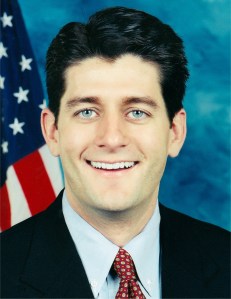
While browsing the links on Memeorandum earlier this afternoon, I came across this post at Down With Tyranny: The Inspiration For Paul Ryan’s Profoundly And Explicitly Anti-Christian Budget. As Lambert would say, it is a post filled to the brim with “linky goodness.” I read all the linked articles and I refer to a few of them in this post.
DWT discusses Ryan’s self-professed admiration for the “philosophy” of Ayn Rand.
What is the great cause for which Ryan wants to devote his political life? Unkind critics point to the unprecedented– at least in Wisconsin politics– gushers of money Ryan has solicited from the Wall Street sector and detect a correlation between the bribes he takes and the policies he espouses. And since there is nothing that holds his voting record– huge, unjustifiable bailouts for Wall Street banks coupled with the dismantling of Medicare and unconscionable tax breaks for the richest Americans coupled with privatization of Social Security– other than obeisance to a garden variety Big Business agenda, this interpretation has become widespread. What people may be missing, however, is a parallel influence on Ryan– one not unrelated, but not identical either: his devotion to the adolescent philosophy of Ayn Rand: “the virtue of selfishness,” a more direct– if somewhat off-putting to non-believers– description of a philosophy known as “Objectivism.”
DWT points out that Rand’s teachings are explicitly anti-Christian–Rand was an atheist who thought altruism was evil and poor and working people were losers and “parasites.” Newsweek’s Jonathan Chait writes:
Ayn Rand, of course, was a kind of politicized L. Ron Hubbard—a novelist-philosopher who inspired a cult of acolytes who deem her the greatest human being who ever lived. The enduring heart of Rand’s totalistic philosophy was Marxism flipped upside down. Rand viewed the capitalists, not the workers, as the producers of all wealth, and the workers, not the capitalists, as useless parasites.
John Galt, the protagonist of her iconic novel Atlas Shrugged, expressed Rand’s inverted Marxism: “The man at the top of the intellectual pyramid contributes the most to all those below him, but gets nothing except his material payment, receiving no intellectual bonus from others to add to the value of his time. The man at the bottom who, left to himself, would starve in his hopeless ineptitude, contributes nothing to those above him, but receives the bonus of all of their brains.”
Chait calls Ryan an “acolyte” of Ayn Rand, and explains at length that the deficit and the debt aren’t what’s bugging the new House superstar. Most of Ryan’s proposals don’t cut the deficit much, and besides, he includes huge new tax cuts for the rich and goodies for Wall Street in his plan. Further more Ryan was an enthusiastic supporter of the Wall Street bailout and he voted for every spending bill that came down the pike under George W. Bush. So what are the Ryan cuts all about?
Ryan’s plan does do two things in immediate and specific ways: hurt the poor and help the rich. After extending the Bush tax cuts, he would cut the top rate for individuals and corporations from 35 percent to 25 percent. Then Ryan slashes Medicaid, Pell Grants, food stamps, and low-income housing. These programs to help the poor, which constitute approximately 21 percent of the federal budget, absorb two thirds of Ryan’s cuts.
Ryan casts these cuts as an incentive for the poor to get off their lazy butts. He insists that we “ensure that America’s safety net does not become a hammock that lulls able-bodied citizens into lives of complacency and dependency.” It’s worth translating what Ryan means here. Welfare reform was premised on the tough but persuasive argument that providing long-term cash payments to people who don’t work encourages long-term dependency. Ryan is saying that the poor should not only be denied cash income but also food and health care.
OK, that part does sound like Randianism, doesn’t it? Rand admired the strong and despised the weak, and so does Paul Ryan, apparently. Rand even went so far as to praise a serial killer for his lack of empathy for his fellow human beings.
On the level of personal behavior, the heroes in Rand’s novels commit borderline rape, blow up buildings, and dynamite oil fields — actions which Rand portrays as admirable and virtuous fulfillments of the characters’ personal will and desires. Her early diaries gush with admiration for William Hickman, a serial killer who raped and murdered a young girl. Hickman showed no understanding of “the necessity, meaning or importance of other people,” a trait Rand apparently found quite admirable.
But did Rand believe that corporations should benefit from government largess? According to Rand devotee Donald L. Luskin, she didn’t.
it’s a misreading of “Atlas” to claim that it is simply an antigovernment tract or an uncritical celebration of big business. In fact, the real villain of “Atlas” is a big businessman, railroad CEO James Taggart, whose crony capitalism does more to bring down the economy than all of Mouch’s regulations. With Taggart, Rand was anticipating figures like Angelo Mozilo, the CEO of Countrywide Financial, the subprime lender that proved to be a toxic mortgage factory. Like Taggart, Mr. Mozilo engineered government subsidies for his company in the name of noble-sounding virtues like home ownership for all.
Still, most of the heroes of “Atlas” are big businessmen who are unfairly persecuted by government. The struggle of Rand’s fictional steel magnate Henry Rearden against confiscatory regulation is a perfect anticipation of the antitrust travails of Microsoft CEO Bill Gates. In both cases, the government’s depredations were inspired by behind-the-scenes maneuverings of business rivals. And now Microsoft is maneuvering against Google with an antitrust complaint in the European Union.
The reality is that in Rand’s novel, as in life, self-described capitalists can be the worst enemies of capitalism. But that doesn’t fit in easily with the simple pro-business narrative about Rand now being retailed.
Luskin seems somewhat bemused by the selective Randianism (my term) of the new Tea Party radicals like Ryan. Traditional conservatives like William F. Buckley “loathed” Rand back in the day, probably because of her atheism and the fact that, while she verbally denigrated feminism, she lived
her life as an exemplary feminist, even as she denied it by calling herself a “male chauvinist.” She was the breadwinner throughout her lifelong marriage. The most sharply drawn hero in “Atlas” is the extraordinarily capable female railroad executive Dagny Taggart, who is set in contrast with her boss, her incompetent brother James. She’s the woman who deserves the man’s job but doesn’t have it; he’s the man who has the job but doesn’t deserve it.
Rand was strongly pro-choice, speaking out for abortion rights even before Roe v. Wade. In late middle age, she became enamored of a much younger man and made up her mind to have an affair with him, having duly informed her husband and the younger man’s wife in advance. Conservatives don’t do things like that—or at least they say they don’t.
These weren’t the only times Rand took positions that didn’t ingratiate her to the right. She was an early opponent of the Vietnam war, once saying, “I am against the war in Vietnam and have been for years. . . . In my view we should fight fascism and communism when they come to this country.” During the ’60s she declared, “I am an enemy of racism,” and advised opponents of school busing, “If you object to sending your children to school with black children, you’ll lose for sure because right is on the other side.”
BTW, none of the male authors I have cited except for Luskin mentioned the abortion issue or the incongruity of the anti-abortion Ryan claiming to believe in Ayn Rand’s vision of complete individualism.
I guess the new fantasy-based Republicans like Ryan can just mentally excise much of Rand’s individualistic philosophy–taking what they want and leaving the rest–just as they do with the bible and with science. How else can Ryan and his radical colleagues rationalize idolizing Ayn Rand while voting again and again to limit the rights of women?
Income Inequality, Redux
Posted: April 1, 2011 Filed under: income inequality, poverty, The Media SUCKS, the villagers | Tags: Income Inequality, joseph stiglitz, the one percenters, trust fund WATB 12 Comments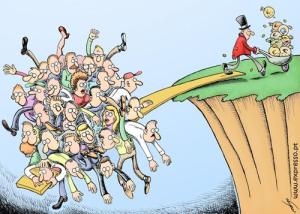
US Income Inequality – Too Big To Ignore
I had to frontpage this because I just can never make this point enough. Vast income inequality is not the sign of a healthy society or economy. H/t to Corrente for my first look at this Joseph Stiglitz article at Vanity Fare called ‘Of the 1%, by the 1%, for the 1%’. We’re back to the Versailles days and the Bush tax policies–extended by Obama–are a good part of the source of the problem. I hate to just lift just one paragraph out of Stiglitz’ rant because the entire thing is worth reading. However, here’s two for starters. Go read the entire thing, please.
But one big part of the reason we have so much inequality is that the top 1 percent want it that way. The most obvious example involves tax policy. Lowering tax rates on capital gains, which is how the rich receive a large portion of their income, has given the wealthiest Americans close to a free ride. Monopolies and near monopolies have always been a source of economic power—from John D. Rockefeller at the beginning of the last century to Bill Gates at the end. Lax enforcement of anti-trust laws, especially during Republican administrations, has been a godsend to the top 1 percent. Much of today’s inequality is due to manipulation of the financial system, enabled by changes in the rules that have been bought and paid for by the financial industry itself—one of its best investments ever. The government lent money to financial institutions at close to 0 percent interest and provided generous bailouts on favorable terms when all else failed. Regulators turned a blind eye to a lack of transparency and to conflicts of interest.
When you look at the sheer volume of wealth controlled by the top 1 percent in this country, it’s tempting to see our growing inequality as a quintessentially American achievement—we started way behind the pack, but now we’re doing inequality on a world-class level. And it looks as if we’ll be building on this achievement for years to come, because what made it possible is self-reinforcing.
The other reason that I decided to front page this is the here-here response from Michael Tomasky at the UK Guardian. It’s aptly called ‘Sad, just sad’. He mentions something we’ve said for some time. The villagers are also the beneficiaries of this kind of windfall. Why would those DC beltway types want to downsize when they can blame teachers, nurses, firefighters, and police officers for all those budget woes? It’s the overgenerous tax cuts. A nation can’t sustain itself without roads, airports, electrical grids, education, and public health and safety programs unless your idea of an ideal nation is that found in the Grapes of Wrath.
Stiglitz might have added the very important point that the majority of the country’s most prominent pundits who go on television and interpret all this for the American people, who soothe their audiences with assurances that all this is completely reasonable, are in the top 1%, which means households above around $380,000 per year. Many of course are far above that (Bill O’Reilly, Rush Limbaugh, etc.). High-end print journalists who aren’t quite at that level are still likely in the top 2%.
Anyway, the piece makes many important points, all of which boil down to the idea that while income inequality has several initial causes, there is only one thing that sustains it: a political process that is owned lock, stock and barrel by the top 1%.
Stepping back and looking at this context, and staying aware of it, makes watching these budget cuts particularly noxious. That’s not to say there isn’t waste, fine. But it is to say that the US political system of today is pretty inevitably designed to help the rich and punish the poor. So it’s no surprise when GOP Congressman Paul Ryan proposes, as he just has, cutting $1 trillion from Medicaid, which provides health care for poor people and the disabled (and to some extent, a greater extent than many people are aware, middle-class families, too, in the form of nursing-home cost support or in-home services like those from NY CDPAP agency).
Yes, Medicaid costs are high, killing the states. The feds could actually pick them up. Ronald Reagan proposed doing this. But that would be radical today. If Americans, especially wealthy ones, were paying taxes (income and capital gains) even at the rate we were in the Reagan era, we’d have no budget problems.
This brings me to the latest “Dopiest Constitutional Amendment of All Time” discussed by former economist Bruce Bartlett. The very same people that gutted tax revenues and funding sources for ten years and went on a spending spree on Treasury Bills now want to demand a federal balanced budget amendment. It’s not like watching the states get into deep trouble with their own versions of the stupid thing has taught any lessons. Balanced budget amendments simply lead to bad economics. When the revenues come in, the politicians spend like crazy on unnecessary things because the money’s there and the economy doesn’t require the expenditures. When the recession hits, the revenues go down, and the balance the budget part hurts, they start doing things that basically put their states in worse situations. This should be immoral, unethical and illegal. Instead, they stick in constitutions. Evidently none of these guys ever got away to reading the Grasshopper and the Ant. They’re all Grasshoppers until the real need for fiscal management comes into play.
Today, all 47 Senate Republicans introduced a constitutional amendment to balance the federal budget. Full text available here. Presumably, this is the amendment that Republicans plan to demand as their price for increasing the federal debt limit. Of course, simply refusing the raise the debt limit would balance the budget overnight — the nation would default on its debt and we would be plunged into the worst fiscal crisis in history, but the budget would be balanced. I have previously explained the idiocy of right wing advocates of debt default (here and here) and the idiocy of a balanced budget amendment (here and here). However, the new Republican balanced budget proposal is especially dimwitted.
At what point do the Republicans just change their name to the party of Batshit Crazy Liars? At what point do the Democrats start fighting some of this? It’s unbelievably hard to watch a group of people with so little at stake except their own re-election just run through a country’s future and assets like a Mardi Gras krewe tossing trinkets to bystanders. How much more looting of national resources to benefit their cronies can we honestly take before people really take to the streets and say enough!
States of Denial
Posted: February 17, 2011 Filed under: Economic Develpment, education, Elections, Federal Budget, poverty, Psychopaths in charge, public education, Republican presidential politics, The Media SUCKS, the villagers, U.S. Economy, U.S. Politics, unemployment, We are so F'd | Tags: education, Florida, Governor Bobby Jindal, Governor Chris Christie, Governor Rick Perry, Governor Scott Walker, Governors of Texas, Lousiana, public financing, public goods, Republican Governors, Rovernor Rick Scott, Wisconsin 25 CommentsGail Collins messed with Texas today. I’m rather glad she did because it shows exactly how much Texas seems to exist  in a vacuum of its own making. The head denier of reality is its wacko Governor who appears to get elected by saying the right things and doing very little. The state that forces its antiquated views through textbooks onto the rest of the nation has a huge problem in the numbers of children having children. This leads to all kinds of social problems that I probably don’t have to discuss here.
But, let’s just see how bad it gets down there with the denier-in-chief who seems to think abstinence education works and the Texas education system works when Texas’ own statistics show that they don’t work at all. Republicans get elected spewing untruths and he’s a prime case in point. The state’s out of money and like my governor Bobby Jindal, the first place Republican governors look is for cuts to education rather than look for new revenue sources. What is worse, they talk about improving children’s future while doing draconian cuts to children’s schools. How do they get away with it?
“In Austin, I’ve got half-a-dozen or more schools on a list to be closed — one of which I presented a federal blue-ribbon award to for excellence,” said Representative Lloyd Doggett. “And several hundred school personnel on the list for possible terminations.”
So the first choice is what to do. You may not be surprised to hear that Governor Perry has rejected new taxes. He’s also currently refusing $830 million in federal aid to education because the Democratic members of Congress from Texas — ticked off because Perry used $3.2 billion in stimulus dollars for schools to plug other holes in his budget — put in special language requiring that this time Texas actually use the money for the kids.
“If I have to cast very tough votes, criticized by every Republican as too much federal spending, at least it ought to go to the purpose we voted for it,” said Doggett.
Nobody wants to see underperforming, overcrowded schools being deprived of more resources anywhere. But when it happens in Texas, it’s a national crisis. The birth rate there is the highest in the country, and if it continues that way, Texas will be educating about a tenth of the future population. It ranks third in teen pregnancies — always the children most likely to be in need of extra help. And it is No. 1 in repeat teen pregnancies.
Which brings us to choice two. Besides reducing services to children, Texas is doing as little as possible to help women — especially young women — avoid unwanted pregnancy.
For one thing, it’s extremely tough for teenagers to get contraceptives in Texas. “If you are a kid, even in college, if it’s state-funded you have to have parental consent,” said Susan Tortolero, director of the Prevention Research Center at the University of Texas in Houston.
Plus, the Perry government is a huge fan of the deeply ineffective abstinence-only sex education. Texas gobbles up more federal funds than any other state for the purpose of teaching kids that the only way to avoid unwanted pregnancies is to avoid sex entirely. (Who knew that the health care reform bill included $250 million for abstinence-only sex ed? Thank you, Senator Orrin Hatch!) But the state refused to accept federal money for more expansive, “evidence-based” programs.
“Abstinence works,” said Governor Perry during a televised interview with Evan Smith of The Texas Tribune.
“But we have the third highest teen pregnancy rate among all states in the country,” Smith responded.
“It works,” insisted Perry.
“Can you give me a statistic suggesting it works?” asked Smith.
“I’m just going to tell you from my own personal life. Abstinence works,” said Perry, doggedly.
There is a high cost to a state to living in this kind of denial. Teen moms and children of teen moms are generally not a productive group of citizens. You pay to prevent this realistically or you pay for their and your mistake to do so throughout their entire lives. But, this seems to be the way of the new brand of Republican governor. These guys start running for president the minute they hit the mansion. They do so by following a litmus test of Republican items–regardless of the consequences to their states–that will make them sound like purity experts when they hit Iowa and New Hampshire. They will undoubtedly leave their state in ruins, but that won’t be the story by the time they’re on the lecture and talking heads circuit for higher offices.
The Governor of New Jersey is doing the same thing. He can read off a litmus list for the republican inquisition while at the same time ensuring the people of the state he governs languish. Again, he screams about the importance of the future of the children while simultaneously downsizing it.
In a clear shot at congressional Republicans over calls for curbing entitlement programs, he said, “Here’s the truth that nobody’s talking about. You’re going to have to raise the retirement age for Social Security. Woo hoo! I just said it, and I’m still standing here. I did not vaporize into the carpet.
“And I said we have to reform Medicare because it costs too much and it is going bankrupt us,” he continued, later comparing those programs to pensions and benefits for state workers that he’s been looking to reel back.
“Once again, lightning did not come through the windows and strike me dead. And we have to fix Medicaid because it’s not only bankrupting the federal government but it’s bankrupting every state government. There you go.”
Clearly looking to blunt criticism of his famously combative style, the former federal prosecutor said there is a method to the battles he picks, insisting, “I am not fighting for the sake of fighting. I fight for the things that matter.”
The speech was titled “It’s Time to do the Big Things,” and Christie suggested the items that Obama called for as “investments” in his State of the Union address were “not the big things” that need Washington’s focus.
“Ladies and gentlemen, that is the candy of American politics,” Christie declared, adding that it appeared to be a “political strategy” – or game of budgetary chicken – that both Republicans and Democrats are playing.
“My children’s future and your children’s future is more important than some political strategy,” he said. “What I was looking for that night was for my president to challenge me … and it was a disappointment that he didn’t.
It’s difficult not to scream when you hear these folks talk about our children’s futures while cutting education, telling children abstinence fairy tales, turning down money for infrastructure improvements —like the nitwit Republican Governor Rick Scott in Florida–that will likely create better environments for business and jobs, and refusing to look at their tainted tax systems that usually punish the poor and flagrantly ignore the assets and the incomes of the rich. It is clear whose children they have in mind. It is not yours or mine or the majority of the people who live in their states.
These guys seem intent on turning their states into third world countries. Many people seem more intent on letting them do it as long it doesn’t cost them anything immediate. Our fellow citizens appear beguiled by fairy tale promises and bribes of low taxes. They should not be surprised then by a future where they and their adult children live in rented shacks together with few available public services. They better just hope they don’t get robbed, the shack doesn’t catch fire, and there are no grandchildren needing public education. They’re voting to downsize these things into extinction.

 peej
peej Carissa
 bostonboomer
 dakinikat
 ecocatwoman
 mablue2
 Mama Lopez
 peggysue22
 quixote
 skydancingguestblogger
 Mona (aka Wonk the Vote)



 Sky Dancing
Recent Comments