
Monday Reads: By the Numbers
Posted: June 11, 2012 Filed under: education, morning reads, New Orleans, Paycheck Fairness Act, Women's Rights, worker rights 11 Comments Good Morning!
I’m really glad that some people are focusing on the Plutocrats behind the SuperPacs. We should at least know who they are and what they want of their the overlords of our politicians. Jim Hightower writes on 7 of the billionaires that are bankrolling the GOP. Read the link at Alternet to learn more about the Super Seven and what they want.
As of May 4, this corporate clique had poured an unprecedented $94 million into the SuperPACs of the leading five GOP contenders (with $52 million of that going to Renew Our Future, Romney’s money funnel). This firepower was all the more potent because it was targeted at only the few thousand voters in each state who participated in the caucuses and primaries. And it bought just what the moneybags wanted–the lockstep commitment by all contenders that–no matter how they might differ on abortion, gay-bashing, and such–they would govern according to the Holy Kochian vision of a regulation-free, union-free, tax-free America. Thus, no matter which horse any of the multimillionaires and billionaires bet on, they would cash-in as winners, for this tiny group now owns one of America’s two major parties (and, yes, often rents the other).
Bobby Jindal is radically transforming the state of Louisiana and there’s no real Democratic party to organize and stop him. I’ve written before about his take down of public schools. Here’s “5 Ways Louisiana’s New Voucher Program Spells Disaster for Louisiana”. Did you notice he’s been up in Wisconsin and Illinois campaigning again? Look out! The man is a menace to civilization!
This latest pet project of popular Republican Governor Bobby Jindal, called Louisiana Believes, is now regarded as the most extensive voucher system in the United States — out-privatizing even the state of Indiana, where nearly 60 percent of the state’s students are eligible for vouchers. By eroding caps on family income levels, and thereby providing voucher assistance to both low- and middle-income families, Indiana’s plan aimed to remake public education in the state more extensively than any voucher system in US history – until now.
Like Indiana’s program, Louisiana’s new voucher plan is so wide in scope that it could eventually cut the state’s public education funding in half. But in a number of crucial ways, the Louisiana model works even harder to destroy public education than Indiana’s program does. Already approved by the Louisiana state legislature, the program sets an alarming precedent for undermining public education in other states.
Suevon Lee of Pro Publica writes about 5 ‘Stand your Ground’ Cases that are important. Damn! Louisiana’s on the shit list again!
But as a recent Tampa Bay Times investigation indicates, the Martin incident is far from the only example of the law’s reach in Florida. The paper identified nearly 200 instances since 2005 where the state’s Stand Your Ground law has played a factor in prosecutors’ decisions, jury acquittals or a judge’s call to throw out the charges. (Not all the cases involved killings. Some involved assaults where the person didn’t die.)
The law removes a person’s duty to retreat before using deadly force against another in any place he has the legal right to be 2013 so long as he reasonably believed he or someone else faced imminent death or great bodily harm. Among the Stand Your Ground cases identified by the paper, defendants went free nearly 70 percent of the time.
Although Florida was the first to enact a Stand Your Ground law, 24 other states enforce similar versions. Using the Tampa Bay findings and others, we’ve highlighted some of the most notable cases where a version of the Stand Your Ground law has led to freedom from criminal prosecution:
· In November 2007, a Houston-area man pulled out a shotgun and killed two men whom he suspected of burglarizing his neighbor’s home. Joe Horn, a 61-year-old retiree, called 911 and urged the operator to ” 2018Catch these guys, will you? Cause, I ain’t going to let them go.’ ” Despite being warned to remain inside his home, Horn stated he would shoot, telling the operator, ” 2018I have a right to protect myself too, sir. The laws have been changed in this country since September the first, and you know it.’ “
Two months earlier, the Texas Legislature passed a Stand Your Ground law removing a citizen’s duty to retreat while in public places before using deadly force. In July 2008, a Harris County grand jury declined to indict Horn of any criminal charges.
· In Louisiana early this year, a grand jury cleared 21-year-old Byron Thomas after he fired into an SUV filled with teenagers after an alleged marijuana transaction went sour. One of the bullets struck and killed 15-year-old Jamonta Miles. Although the SUV was allegedly driving away when Thomas opened fire, Lafourche Parish Sheriff Craig Webre said to local media that as far as Thomas knew, someone could have jumped out of the vehicle with a gun. Thomas, said the sheriff, had “decided to stand his ground.”
Louisiana’s Stand Your Ground law was enacted just a year after Florida introduced its law.
William Cohan believes that Congress wants a 2nd economic meltdown due to bad bank behavior and points to a Taibbi article listing 9 obscure pieces of legislation introduced by Congress to tank Dodd-Frank.
A sad truth remains: Despite all the public hand-wringing about the need to finally nail down the details of the regulations that will govern risk-taking at big banks, Wall Street’s well-paid army of lawyers and lobbyists continues to make a mockery of the whole re-regulation process.
It seems increasingly likely that, by the time the charade is over, the American people will end up with fewer substantive rules and limitations on the crazy risks Wall Street can take than we have now. By some counts — including that of Matt Taibbi, at Rolling Stone — there are nine obscure pieces of legislation introduced in Congress this year that are designed to in one way or another weaken the already weak provisions of the Dodd-Frank law, passed in July 2010.
Most of the legislation is intended to do little more than waste time, and hold off real accountability until the public has lost interest. Other laws are more pernicious. Consider H.R. 3336, the so-called Small Business Credit Availability bill. Under the guise of helping community lenders, it would limit who is considered a “swap dealer” under the provisions of Dodd- Frank, allowing more and more swaps to be written with less and less oversight. It passed the House in April.
Lastly, I’d like to point to this article in The Economist that basically says exactly what I feel about the sinking of the Paycheck Fairness Act last week. This also applies to getting rid of DOMA type laws. “Protecting individual rights is not Stalinist. ”
THIS week Republicans in the Senate once again blocked the Paycheck Fairness Act, which would take further steps to guarantee access to the legal system for women who charge they’ve been paid less than men for doing the same job. (That’s illegal, in case anyone was thinking of trying it.) Justifying his vote against the act, Rand Paul compared it to Soviet communism. This is sort of a dog bites man story; on a given day, Rand Paul probably compares several dozen things to Soviet communism. But here, for what it’s worth, is why he thinks legislation to make it easier for women to sue when they’ve been paid less than men for doing the same job is just like Soviet communism:
“Three hundred million people get to vote everyday on what you should be paid or what the price of goods are,” Paul told reporters on Capitol Hill. “In the Soviet Union, the Politburo decided the price of bread, and they either had no bread or too much bread. So setting prices or wages by the government is always a bad idea.”
Mr Paul does not appear to understand either the law which he has just voted against, or the class of economic transaction about which he is speaking. If a woman sues because she has been paid less than a man for doing the same work, and a judge rules in her favour, that is not an instance of “setting prices or wages by the government”. The wage in question was set by the employer. What the judge has ruled is that the employer cannot offer different wages to different employees based on their sex. Why might such a hypothetical judge make such a ruling? Because, as noted above, offering different wages to different employees based on their sex is against the law, and has been so since 1963.
Senator Aqua Buddha obviously has a room temperature IQ.
We’re all in the Village now. That’s my contribution today. What’s on your reading and blogging list?
A Sad Legacy: Louisiana’s Prison Economy
Posted: May 15, 2012 Filed under: Criminal Justice System, New Orleans | Tags: Angola Prison, Bobby Jindal, Louisiana, prison state, prisoners, Warden Cain 14 Comments This is the stuff that creates documentaries and sad movies. It is the prison state that is Louisiana.
Louisiana is the world’s prison capital. The state imprisons more of its people, per head, than any of its U.S. counterparts. First among Americans means first in the world. Louisiana’s incarceration rate is nearly triple Iran’s, seven times China’s and 10 times Germany’s.
The hidden engine behind the state’s well-oiled prison machine is cold, hard cash. A majority of Louisiana inmates are housed in for-profit facilities, which must be supplied with a constant influx of human beings or a $182 million industry will go bankrupt.
Several homegrown private prison companies command a slice of the market. But in a uniquely Louisiana twist, most prison entrepreneurs are rural sheriffs, who hold tremendous sway in remote parishes like Madison, Avoyelles, East Carroll and Concordia. A good portion of Louisiana law enforcement is financed with dollars legally skimmed off the top of prison operations.
If the inmate count dips, sheriffs bleed money. Their constituents lose jobs. The prison lobby ensures this does not happen by thwarting nearly every reform that could result in fewer people behind bars.
READ THE
ENTIRE SERIES from NOLA.Com.Meanwhile, inmates subsist in bare-bones conditions with few programs to give them a better shot at becoming productive citizens. Each inmate is worth $24.39 a day in state money, and sheriffs trade them like horses, unloading a few extras on a colleague who has openings. A prison system that leased its convicts as plantation labor in the 1800s has come full circle and is again a nexus for profit.
In the past two decades, Louisiana’s prison population has doubled, costing taxpayers billions while New Orleans continues to lead the nation in homicides.

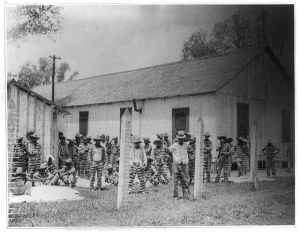
It is a shameful situation. Here are some stories from Angola. It’s probably the most infamous prison in the world. It’s known for its rodeo and its harsh treatment of prisoners who basically are subjected to “Faith-Based Slavery”. It seems that when a state can’t produce real jobs that it produces prisons.
“Unique” is one way Warden Burl Cain likes to describe his prison, and it would be impossible to argue otherwise. With grazing cattle and rolling hills in the distance, it’s hard not to admire its strange, sprawling beauty, even as the towers come into view. The prison itself is absent from my GPS’s “points of interest,” yet Angola’s Prison View Golf Course—the first public golf course on the grounds of a state penitentiary—is not. At Angola’s official museum, opened by Cain in 1998, a retired electric chair and rusty prison contraband are displayed adjacent to a gift shop selling mugs and tote bags reading: “Angola: A Gated Community.”
Angola is the largest maximum security in the country, sitting on 18,000 acres of farmland and home to 5,200 men. Louisiana has the highest incarceration rate of adult prisoners in the United States; thanks to the state’s unforgiving sentencing laws, at least 90 percent of Angola’s prisoners will die there. It’s a large-scale embodiment of a national phenomenon: elderly inmates are the country’s fastest growing prisoner population.
Yet Angola is also lauded as a revolution in corrections, its story told many times: Angola was once the “bloodiest prison in America,” where inmates slept with magazine catalogs strapped to their chests to protect themselves from stabbings. Things began to turn around in the 1970s, when a federal judge ordered a major overhaul. But most of the credit has gone to Warden Cain for imposing order through a new model of incarceration.
Like all of Angola’s wardens, Cain has continued the tradition of hard labor: most inmates work in the fields eight hours a day, five days a week, harvesting hundreds of acres of soybeans, wheat, corn, and cotton—picked by hand and sold by Prison Enterprises, the business arm of the Louisiana Department of Corrections. But unlike his predecessors, Cain, an evangelical Christian, has also made it his mission to bring God to Angola. Inmate ministers tell new prisoners that they can either work on their “moral rehabilitation” or remain a “predator”—“the choice is yours.” The radio station plays gospel music. On the walls leading to the execution chamber are two murals: Elijah ascending to Heaven and Daniel facing the lion. One of Cain’s favorite anecdotes is the execution of Antonio James, a born-again Christian whose hand he held just before giving the go-ahead to end his life. As James lay on the gurney waiting for lethal drugs to enter his veins, Cain said, “Antonio, the chariot is here…you are about to see Jesus.”
You should really read this MJ article to get the full feel of life inside Angola. It’s called “Gods Own Warden”.
Everyone was there except the person I had come to see: Warden Burl Cain, a man with a near-mythical reputation for turning Angola, once known as the bloodiest prison in the South, into a model facility. Among born-again Christians, Cain is revered for delivering hundreds of incarcerated sinners to the Lord—running the nation’s largest maximum-security prison, as one evangelical publication put it, “with an iron fist and an even stronger love for Jesus.” To Cain’s more secular admirers, Angola demonstrates an attractive option for controlling the nation’s booming prison population at a time when the notion of rehabilitation has effectively been abandoned.
What I had heard about Cain, and seen in the plentiful footage of him, led me to expect an affable guy—big gut, pale, jowly face, good-old-boy demeanor. Indeed, former Angola inmates say that prisoners who respond to Cain’s program of “moral rehabilitation” through Christian redemption are rewarded with privileges, humane treatment, and personal attention. Those who displease him, though, can face harsh punishments. Wilbert Rideau, the award-winning former Angolite editor who is probably Angola’s most famous ex-con, says when he first arrived at the prison, Cain tried to enlist him as a snitch, then sought to convert him. When that didn’t work, Rideau says, his magazine became the target of censorship; he says Cain can be “a bully—harsh, unfair, vindictive.”“Cain was like a king, a sole ruler,” Rideau writes in his recent memoir, In the Place of Justice. “He enjoyed being a dictator, and regarded himself as a benevolent one.” When a group of middle school students visited Angola a few years ago, Cain told them that the inmates were there because they “didn’t listen to their parents. They didn’t listen to law enforcement. So when they get here, I become their daddy, and they will either listen to me or make their time here very hard.”
Another former prisoner, John Thompson—who spent 14 years on death row at Angola before being exonerated by previously concealed evidence—told me that Cain runs Angola “with a Bible in one hand and a sword in the other.” And when the chips are down, Thompson said, “he drops the Bible.”
 We’ve talked about Angola’s horrible legacy before. Here’s a recent UK Guardian Story on two men that have spent 40 years in solitary confinement. This is the stuff that causes insanity. Every human rights group actively opposes this kind of treatment.
“I can make about four steps forward before I touch the door,” Herman Wallace says as he describes the cell in which he has lived for the past 40 years. “If I turn an about-face, I’m going to bump into something. I’m used to it, and that’s one of the bad things about it.”
On Tuesday, Wallace and his friend Albert Woodfox will mark one of the more unusual, and shameful, anniversaries in American penal history. Forty years ago to the day, they were put into solitary confinement in Louisiana‘s notorious Angola jail. They have been there ever since.
They have spent 23 hours of every one of the past 14,610 days locked in their single-occupancy 9ft-by-6ft cells. Each cell, Amnesty International records, has a toilet, a mattress, sheets, a blanket, pillow and a small bench attached to the wall. Their contact with the world outside the windowless room is limited to the occasional visit and telephone call, “exercise” three times a week in a caged concrete yard, and letters that are opened and read by prison guards.
A new documentary film takes us into that cell, providing rare insight into the personal psychological impact of such prolonged isolation. Herman’s House tracks the experiences and thoughts of Wallace as he reflects on four decades banged away in a box.
Our own Governor wants to turn our Prison Economy into a privatized, money-making scheme for corporate donors. Fortunately, his bill didn’t get very far. But, this is because so many local politicians make money off of renting out prisoners to their own local donor base. They also get to use them for services that would normally go to paid workers. No wonder no one can find these types of jobs unless you are in prison.
A bill strongly backed by Gov. that would have allowed for the sale of the Avoylles Correctional Facility has been abandoned, as support for it was limited, according to the Associated Press. Now, the prison may be run under a new plan. Here is some more information.
* The original bill would have allowed for the Avoyelles Correctional Facility to be sold for $35 million to a private firm that would be responsible for operating it, according to the Town Talk.
* The state would then pay the company that buys it a daily fee to operate it.
* Rep. (R- Haughton) sponsored the bill, House Bill 850.
* Opposition from the privatization of the prison stems from the fact that 296 jobs would be lost in the sale.
* One group, the , made a plea to representatives to vote against the bill, saying that if the prison was run privately, the company could demand an exorbitant amount of money from Louisiana taxpayers to run the prison, and that the sale would actually cost Louisiana residents more.
* The bill was rewritten on Wednesday to allow for a private firm to be contracted to run the facility, but not to buy it.
* The contract would be for 10 years and the approval of the contract would be by the House and Senate budget committees.
* On Wednesday, the House voted 62-43 to pass the new amendment to the bill, according to Gambit.
* The bill was not sent to the Senate for approval, however, as Burns says that he is giving legislators time to look over the new bill, according to the Capitol News Bureau.
* There is still a lot of disapproval of the new bill as well, as opponents still cite the decreased wages for employees that are working for private companies as opposed to wages for state employees as unacceptable.
* Safety is also a concern, as Rep. Robert Johnson cited the lower wages as attracting lower quality workers to guard the prison, which would mean an unsafe environment, according to The Times-Picayune.
* The privatization of Avoyelles is a part of a larger plan by Gov. Jindal to privatize more prisons in Central Louisiana and close the and move those prisoners to Avoyelles, according to the Town Talk.
* Alexandria Mayor Jacques M. Roy has come out against the plan, saying that it would decrease public safety and would not save the state any money.
Any one in Louisiana lives among this prison legacy. Prisoners clean up our roads. They are brought out to shore up levees. They make our license plates. They are visible everywhere doing jobs that would usually be given to parish employees. No place is this more true than in small communities where sheriffs can make a good living off of renting them out to local business. Kinda makes you proud of that old entrepreneurial spirit doesn’t it? Take some time to read the series at the Times Picayune. I think you will find out more about my part of the good ol’ USA than you really would like.
New Orleans Jazz Fest Weekend Open Post
Posted: May 5, 2012 Filed under: just because, New Orleans, open thread | Tags: New Orleans Jazz Fest 3 CommentsJust because …
Exposing and Dismembering ALEC and its Kleptocracy Agenda
Posted: April 16, 2012 Filed under: American Gun Fetish, Big Pharma, Civil Liberties, Civil Rights, collective bargaining, Corporate Crime, corporate greed, corporate money, corporatism, corruption, Domestic Policy, Economy, education, Environment, New Orleans, We are so F'd | Tags: ALEC 13 Comments I have a personal interest in seeing ALEC dismembered. My governor Bobby Jindal has adopted and enacted some of its worse cookie cutter laws. There are three progressive interests that are leading actions to defund and defang this supposedly “nonpartisan individual membership organization of state legislators which favors federalism and conservative public policy solutions”. They are the Urban League, Common Cause, and ColorofChange. I would hope that many more groups will join in.
Many of ALEC’s corporate sponsors have quit funding the organization which seeks to remove oversight and regulation of all kinds of industry, privatize public services and goods, and deprive minority communities and women of basic voting rights and civil rights. They seek tort reform that would limit corporate exposure to liability from unsafe products and practices. They like to remove laws providing consumer protection and information. They are not nonpartisan and are responsible for some of the most heinous, radical legislation of the last few years. Woe to those of you whose governors or legislators belong to this organization for you will live in a world with very little protection from big money and big business and your tax dollars will be used to line their coffers.
The American Legislative Exchange Council describes itself as a nonpartisan champion of free markets. But if you spend some time at an ALEC conference (Bloomberg Businessweek did, for an article last year) you will be hard-pressed to find many Democrats. And when the entire conference meets for lunch, you will hear from the podium nothing that would seem out of place in a press release from Eric Cantor’s office. Last year in New Orleans, for example, Bobby Jindal, governor of Louisana, told an ALEC annual meeting, “Defeating the president is crucial to defending our economy,” and “Obama has been a disaster.” I didn’t hear anyone boo. What I did hear was the sound of fevered applause when the conference played a videotaped greeting from Ronald Reagan.
I’m not saying it’s wrong to feverishly applaud Ronald Reagan. I am saying that only in the most thinly defensible, legalistic sense can ALEC call itself “nonpartisan.” And the council doesn’t really support free markets, either. It supports the companies that fund it. This is an important distinction, because the corporations that donate to ALEC aren’t doing so to protect markets. They’re protecting favored tax treatments and pushing regulations that lock in their market positions. As best as we were able to determine in reporting our piece last year, corporations propose bills at the state level and then push them up to ALEC, which has both corporate and legislative members. ALEC pushes the legislative members to the foreground, stamps the bills as “model legislation,” and then the corporations push them back out to other state legislatures. This may not be the case with all ALEC legislation, but it certainly was with the bill we followed.
So ALEC is not what it says it is. That’s not extraordinary: Few advocacy groups are what they say they are. In ALEC’s case, however, the fingers-crossed-behind-its-back description of itself is definitional. If the American Legislative Exchange Council operated with complete openness, it couldn’t operate at all. ALEC has attracted a wide and wealthy range of supporters precisely because it does its real work in a black box. Membership lists are secret. The origins of the model bills are secret. Deliberations and votes on model bills are secret. The model bills themselves are secret. The council has designed its entire structure to disguise industry-backed legislation as grassroots work from state legislators. If this becomes clear to everyone, there’s no reason for corporations to use it. And that is exactly what has been happening.
Minority advocacy groups have been most active in the fight against ALEC. ALEC is responsible for the legislation that requires specific picture ids to vote and they are responsible for the Stand Your Ground Laws. Both of these issues have been front and center in Civil Rights Groups. The Trayvon Martin case is important in two key ways. First, it is bringing to light the institutional racism implicit in the criminal system. Second, it has exposed the role of ALEC in sneaking through legislature in states that most voters do not support or like. The vigilante-empowering Stand Your Ground laws are now seeing daylight.
The tension in corporate boardrooms over the case is the latest example of the pitfalls companies can sometimes face when they donate to political and lobbying groups, even those that seem safely below the radar of public consciousness.
The ALEC controversy is now sparking a broader debate about corporate participation in politics and the polarized state of political discourse. At a minimum, it has strengthened calls for companies to develop clear policies explaining their spending.
“I would caution companies to be very aware of where their money is going,” says Nell Minow, director of GMI Ratings, which provides corporate governance information to investors, corporate auditors and regulatory agencies. “Companies are going to realize they can take a real reputational hit with this kind of affiliation.”
She and others recall the tempest that erupted in 2010 around Target after the company donated to a nonprofit group supporting a Minnesota gubernatorial candidate who was known for opposing gay rights initiatives.
Like Louisiana, many Arizona politicians are in cahoots with ALEC. ALEC likes to use laws to funnel public money into corporate income statements. This isn’t free market promotion, this is more like being given the ability to loot public resources.
Legislators in Arizona continue to advance extremist legislation inspired by the American Legislative Exchange Council (ALEC) and its out-of-state corporate backers, according to a new analysis by People For the American Way Foundation, Common Cause, the Center for Media and Democracy and Progress Now. This report shines a new light on the Arizona Legislature’s unprecedented ties to the secretive organization, which recently drew nationwide fire for its role in implementing radical policies across the country like “Shoot First” laws and voter suppression laws, and anti-worker measures. ALEC’s extreme agenda has recently led companies such as Pepsi, Coca-Cola, McDonalds, Wendy’s, KRAFT and Intuit to withdraw from the organization. The Bill and Melinda Gates Foundation on Monday also withdrew its support from ALEC.
The comprehensive report found that Arizona’s large concentration of ALEC-member legislators, working hand-in-hand with the corporate leaders who make up ALEC’s membership, are continuing to endorse special interest legislation that harms ordinary people by limiting consumers’ rights, privatizing education and dismantling unions.
The report, ALEC in Arizona: The Voice of Corporate Special Interests in the Halls of Arizona’s Legislature, updated for the Fiftieth Legislature, second regular session is available here.
“Recent polling shows that Arizonans are appalled by the out-of-touch and extremist agenda at their State Legislature. This report shows that agenda is no accident,” said John Loredo, a member of Arizona Working Families and a former Arizona House Minority Leader. “Unfortunately, Arizona has one of the highest concentrations of ALEC legislators in the country, and that makes us a petri dish for anti-worker legislation and a host of other bad ideas.”
“ALEC-member legislators are unabashedly continuing to push legislation straight from corporate headquarters to Arizona’s lawbooks,” said Marge Baker, Executive Vice President at People For the American Way Foundation. “Well-heeled special interests are circumventing the democratic system and bypassing Arizona’s citizens, who can’t match the level of access that ALEC provides. As a result, Arizonans are facing an endless assault from laws that serve the interests of the rich and powerful instead of everyday people.”
You can find ALEC’s model bills and reports on its activities in many states at the site ALEC Exposed. ALEC is responsible for the horrible school voucher and privatization plan that Bobby Jindal has ramrodded through our state. It is also responsible for some of the worst climate change denial propaganda. The source of this funding is big oil, big coal, and the Koch Brothers.
$375,858 received from Koch foundations 2005-2010 [Total Koch foundation grants 1997-2010: $708,858]
American Legislative Exchange Council (ALEC) is one-stop shopping for state elected officials interested in perusing the wares of an array of Koch-funded opposition organizations including IER, ACCF, Mercatus and other sources. ALEC has successfully peddled corporate-written legislation to numerous states attacking the Kyoto Protocol, undermining climate science education in schools and numerous other anti-environmental legislation. ALEC has close ties to Koch Industries, which helped bail the organization out of financial troubles with a half-million dollar grant.
ALEC publishes its own materials as well, including a “Climate Change Overview for State Legislators” which downplays the science and risks of global warming and exaggerates the costs of addressing it. The Overview was written by Daniel Simmons, who moved from ALEC to become AEA’s Director of State Affairs. Simmons was at the Mercatus Institute before ALEC and is a graduate of the George Mason University School of Law.
Here’s some of the background information on the laws that ALEC creates with the intended purpose of “starving Public Schools“.
ALEC’s most ambitious and strategic push toward privatizing education came in 2007, through a publication called School Choice and State Constitutions, which proposed a list of programs tailored to each state. That year Georgia passed a version of ALEC’s Special Needs Scholarship Program Act. Most disability organizations strongly oppose special education vouchers—and decades of evidence suggest that such students are better off receiving additional support in public schools. Nonetheless, Louisiana, Oklahoma, Florida, Utah and Indiana have passed versions of their own. Louisiana also passed a version of ALEC’s Parental Choice Scholarship Program Act (renaming it Student Scholarships for Educational Excellence), along with ALEC’s Family Education Tax Credit Program (renamed Tax Deductions for Tuition), which has also been passed by Arizona and Indiana. ALEC’s so-called Great Schools Tax Credit Program Act has been passed by Arizona, Indiana and Oklahoma.
ALEC’s 2010 Report Card on American Education called on members and allies to “Transform the system, don’t tweak it,” likening the group’s current legislative strategy to a game of whack-a-mole: introduce so many pieces of model legislation that there is “no way the person with the mallet [teachers’ unions] can get them all.” ALEC’s agenda includes:
§ Introducing market factors into teaching, through bills like the National Teacher Certification Fairness Act.
§ Privatizing education through vouchers, charters and tax incentives, especially through the Parental Choice Scholarship Program Act and Special Needs Scholarship Program Act, whose many spinoffs encourage the creation of private schools for specific populations: children with autism, children in military families, etc.
§ Increasing student testing and reporting, through more “accountability,” as seen in the Education Accountability Act, Longitudinal Student Growth Act, One-to-One Reading Improvement Act and the Resolution Supporting the Principles of No Child Left Behind.
§ Chipping away at local school districts and school boards, through its 2009 Innovation Schools and School Districts Act and more. Proposals like the Public School Financial Transparency Act and School Board Freedom to Contract Act would allow school districts to outsource auxiliary services.
ALEC is also invested in influencing the educational curriculum. Its 2010 Founding Principles Act would require high school students to take “a semester-long course on the philosophical understandings and the founders’ principles.”
Perhaps the Brookings Institute states the mission most clearly: “Taken seriously, choice is not a system-preserving reform. It is a revolutionary reform that introduces a new system of public education.”
The passage of radical public school defunding in Louisiana is leading to a recall Jindal effort. We’ve already had some of this type of reform in New Orleans and it’s clearly not working well at all unless you count teacher union busting and lowering teacher salaries progress. Here are some of the things we will now be suffering in Louisiana. I personally am opposed to the state funding religious indoctrination hiding under the guise of education. These laws funnel public money into any thing that deems itself a school, it seems.
A vast expansion of charter schools, an overhaul of teacher tenure and establishment of a statewide program to pay private school tuition with public dollars moved within one step of final passage Thursday, as the Louisiana Senate Education Committee endorsed the headliner components of Gov. Bobby Jindal’s education agenda without changes or dissent.
I know this thread wanders around through many topics but the number of right wing bills pressured cooked into law by ALEC and their toadies is just as wandering and perverse. Check out the site and be aware of which politicians supposedly representing the people of your state that are ALEC cronies. The movement to get corporations to defund the organization should be paramount. Ordinary Americans have already lost a lot to their agenda. It’s time to stop them. Put pressure on organizations to join in the effort. Let’s defang this beast together.
Tuesday Reads
Posted: March 13, 2012 Filed under: 2012 presidential campaign, Barack Obama, birth control, Mitt Romney, morning reads, New Orleans, Newt Gingrich, psychology, Reproductive Rights, Republican presidential politics, Rick Perry, Rick Santorum, U.S. Economy, U.S. Politics, War on Women | Tags: Alabama, Arlen Specter, belief that Obama is a muslim, Bobby Jindal, daylight savings time, interracial marriage, Mississippi, Pat Nixon, polls, Republican primaries, Richard Nixon, single bullet theory, sleep, time traveler vote, Warren Commission 46 Comments
Good Morning!!
Let’s get right to the news. I’m going to start with a couple of items that should particularly interest Dakinikat. First, Charlie Pierce wrote a post yesterday about Bobby Jindal’s campaign for VP.
Louisiana Governor Bobby Jindal wants to be your vice-president. (He may also want to be your president, too, but being your vice-president first is an easy way to do that.) His first audition for the second slot was to become the prime surrogate for the relentless juggernaut that was the Rick Perry campaign.
(This was a juggernaut only in the sense that people watched Perry speak in the debates and asked each other, “Is he hitting the jug or not?” Thank you. I’ll be back for the late show.)
Once he rode that baby straight into the ground, Jindal decided to campaign for the job on his own, all the while hoping that nobody in the country remembers his memorable “reply” to the president’s State of the Union address back in 2009, during which Jindal looked like a 12-year old wearing his grandfather’s suit, the one in which Jindal scoffed at federal spending on “volcano monitoring” a little more than a year before a big hunk of Iceland blew up and nearly destroyed the airline industry in Europe.
Pierce is reacting to Jindal’s op-ed at the WSJ: Obama’s Politicized Energy Policy
With rising energy costs making it more expensive to drive our cars, heat our homes, and fuel our sputtering economy, many Republicans are criticizing the Obama administration for a failure to adopt a comprehensive energy policy. I believe that critique lets the president off too easily. His administration does have a national energy policy—it’s just a subservient by-product of his radical environmental policy.
This administration willfully ignores rational choices that would lower energy prices and reduce U.S. reliance on foreign energy sources.
Bla, bla, bla…”rational” advice from a guy who believes in exorcism.
We all lost an hour of our lives a couple of days ago when the government made us “spring forward” into daylight savings time (DST). I love it, because it means it stays light a little longer at the end of the day here in New England, but Dak hates what it does to her down in New Orleans. Of course up here in the north, I don’t have the problem of darkness in the early morning.
The Christian Science Monitor had an interesting article on DST yesterday. CSM reports on a psychological study that found that workers are sleepy the next day after the time change (duh!) and are more likely to waste time on the internet at work. “Global productivity losses from a spike in employee cyberloafing are potentially staggering,” the researchers conclude.
CSM says that the origins of DST go way back. It was “originally proposed by a 19th century butterfly collector who wanted more time at the end of the workday to scour fields for insects,” and was first implemented “during World War I (peacetime standardization came in 1966).”
The most recent real adjustment in the US came in 2007, when the change was moved up to the second Sunday in March from the first Sunday in April to lengthen “summertime” and gauge potential energy savings. Polls showed farmers, perennial DST opponents, grumbled, and sports retailers (who benefit from the extra hour of daylight for play time after work) rejoiced.
If you’re worried about lost sleep, you might want to read this article at Alternet: The 8-Hour Sleep Myth: How I Learned That Everything I Knew About Sleep Was Wrong. Apparently it’s not really natural for humans to sleep through the night. The author read about this in a BBC article. Here’s the gist from the Alternet piece:
Turns out that psychiatrist Thomas Wehr ran an experiment back in the ‘90s in which people were thrust into darkness for 14 hours every day for a month. When their sleep regulated, a strange pattern emerged. They slept first for four hours, then woke for one or two hours before drifting off again into a second four-hour sleep.
Historian Roger Ekirch of Virginia Tech would not have been surprised by this pattern. In 2001, he published a groundbreaking paper based on 16 years of research, which revealed something quite amazing: humans did not evolve to sleep through the night in one solid chunk. Until very recently, they slept in two stages. Shazam.
In his book At Day’s Close: Night in Times Past, Ekrich presents over 500 references to these two distinct sleep periods, known as the “first sleep” and the “second sleep,” culled from diaries, court records, medical manuals, anthropological studies, and literature, including The Odyssey. Like an astrolabe pointing to some forgotten star, these accounts referenced a first sleep that began two hours after dusk, followed by waking period of one or two hours and then a second sleep.
This waking period, known in some cultures as the “watch,” was filled with everything from bringing in the animals to prayer. Some folks visited neighbors. Others smoked a pipe or analyzed their dreams. Often they lounged in bed to read, chat with bedfellows, or have much more refreshing sex than we modern humans have at bedtime. A 16th-century doctor’s manual prescribed sex after the first sleep as the most enjoyable variety.
That makes me feel a lot better, since I’ve rarely ever been able to sleep through the night, and in my later years, I have a terrible time falling asleep in the first place.
In political news, President Obama’s approval rating has suddenly tanked, supposedly because of gas prices.
Despite improving job growth and an extended Republican primary fight dividing his would-be opponents, President Obama is heading into the general election season on treacherous political ground, according to the latest New York Times/CBS News poll.
At a time of rising gas prices, heightened talk of war with Iran and setbacks in Afghanistan, Mr. Obama’s approval rating dropped substantially in recent weeks, the poll found, with 41 percent of respondents expressing approval of the job he is doing and 47 percent saying they disapprove — a dangerous position for any incumbent seeking re-election.
Which is kind of scary because of the horrifying Republican presidential candidates. It’s still early, so I’m not panicking just yet. Speaking of the clown car crew, there are four primaries today–in Alabama, Mississippi, Hawaii, and American Samoa. I’m not sure if we’ll have a live blog, because the last one was a bit of dud. If you’d like to have one, please say so in the comments to this post. We’ll definitely post the results tonight though.
As of last night, Romney was in the running in both Alabama and Mississippi, where the polls show Romney Gingrich, and Santorum all running neck and neck. The worst news is that Romney is now leading Obama by 5 points nationally.
The next item drew a {heavy sigh} from me. A new PPP poll found that a whole lot of voters in Alabama and Mississippi think President Obama is a Muslim. {{Heavy sigh….}}
The poll of Mississippi Republicans found that 52% said they believed Obama is a Muslim, 36% weren’t sure and only 12% said they believed he is a Christian. He fared slightly better in Alabama, where 45% said he is a Muslim, 41% weren’t sure, and 14% said he is a Christian.
Some folks in these two deep South state don’t care for interracial marriages like the one that produced Barack Obama.
67% of Alabama Republicans saying they believe interracial marriage should be legal, though 21% said it still should be against the law. In Mississippi, 54% said it should be allowed, while 29% said it should remain illegal.
The preferred Republican candidate of those opposed to interracial marriage? Newt Gingrich. In Mississippi, Gingrich led Romney among that group 40% to 27%, and held a 38%-27% advantage in Alabama.
I am soooooo glad I don’t live in Alabama or Mississippi! Alexandra Petri of the WaPo calls it “the time traveler vote.” She says that voters must have just arrived from the 1920s.
I don’t know why it didn’t strike me sooner. So many of the issues at stake this year are Issues I Thought We Resolved Several Decades Ago. This is 2012, with lots of economic distress and voter unrest to go around. Why are we suddenly prioritizing Taking Back Control Of Women’s Bodies For The State?
But if you consider the Time Traveling Vote, it all makes sense.
I am not sure how big the vote is. But if the recent actions of many state legislatures are to be taken into account, it is surely substantial.
To visitors from the past, these issues are still pressing and vital. They don’t care about jobs! Once the election’s over, they’re headed back to 1926, where the economy is still roaring and everyone is flapping and doing the Charleston.
It certainly makes more sense than the assumption that they’ve simply been ignoring all the headlines, most of the textbooks, the entire women’s rights movement and the scientific consensus for decades.
Some love letters between the young Richard Nixon and his future wife Pat will be displayed at the Nixon Library. They are said to show Nixon’s “sensitive side.” A sample:
“Every day and every night I want to see you and be with you. Yet I have no feeling of selfish ownership or jealousy. In fact I should always want you to live just as you wanted – because if you didn’t then you would change and wouldn’t be you,” Nixon wrote in one of the letters, part of a rotating display at the Nixon Presidential Library and Museum.
“Let’s go for a long ride Sundays; let’s go to the mountains weekends; let’s read books in front of fires; most of all let’s really grow together and find the happiness we know is ours,” he continued.
Whatever happened to that guy?
Finally, have you heard that Arlen Specter has a memoir coming out? Naturally, it’s full of complaints. Harry Reid stabbed him in the back after promising to give Specter seniority as a Democrat if he switched parties. Obama and Biden didn’t help him in his primary campaign against Joe Sestak. The most interesting revelation in the article in The Hill is that Bob Dole told Specter he (Dole) would have switched parties too.
“Dole told me I had done the right thing, that I had done a terrific job as a senator, been involved in a lot of projects, been very active, and hadn’t gotten credit for a lot of the stuff I had done,” he wrote.
“I said, ‘Bob, I think that it’s very meaningful when you say that I did the right thing, in the party change.’
“He said, ‘Well,’ and then paused and thought for a few seconds. Then he said, ‘I probably would have done the same thing.’ ”
Never mind all that. I want to read about Specter’s role in the Warren Commission and how he dreamed up the “single bullet theory.”
That’s all I’ve got for now. What are you reading and blogging about today?

 peej
peej Carissa
 bostonboomer
 dakinikat
 ecocatwoman
 mablue2
 Mama Lopez
 peggysue22
 quixote
 skydancingguestblogger
 Mona (aka Wonk the Vote)



 Sky Dancing
Recent Comments