Before I get going with my post, I want to note that Hillary will be hosting a Facebook chat this afternoon. You can post questions and read about it here.
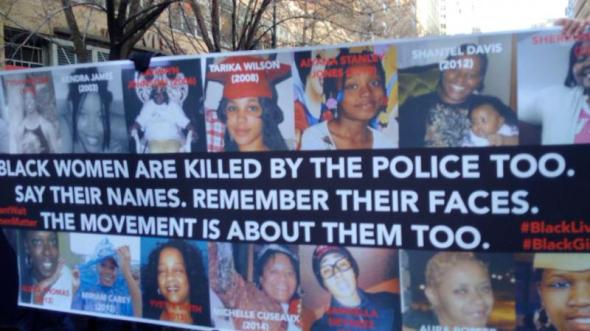
Now to today’s reads. While the Sandra Bland case is still being investigated in Texas, another young black woman has died in police custody and once again authorities are claiming it was a suicide.
Authorities in Alabama claim a teen committed suicide in a jail cell an hour after being arrested, another suspicious case of a Black woman dying in police custody in the past week.
Kindra Darnell Chapman, 18, was jailed last Tuesday for allegedly stealing someone’s phone on the street, according to the Huffington Post. Chapman was charged with first-degree robbery and was last seen alive at 6:30 p.m. When officers went to check on Chapman an hour later, she was found unresponsive.
Chapman was pronounced dead at Brookwood Medical Center from apparent asphyxiation.
Although the mantra “Black Lives Matter” was developed by black women, I often worry that in the collective consciousness it carries with it an implicit masculine association, one that renders subordinate or even invisible the very real and concurrent subjugation and suffering of black women, one that assigns to these women a role of supporter and soother and without enough space or liberty to express and advocate for their own.
Last week, the prism shifted a bit, as America and the social justice movement focused on the mysterious cases of two black women who died in police custody.
The first and most prominent was Sandra Bland, a black woman from suburban Chicago who had moved to Texas to take a job at her alma mater, Prairie View A & M University, a historically black school about 50 miles northwest of Houston.
Is it just a coincidence that a young black woman died similarly in an Alabama jail cell?
Then, there was the case of 18-year-old Kindra Chapman, arrested on Tuesday in Alabama for allegedly stealing a cellphone. According to AL.com: “Jailers last saw her alive at 6:30 p.m. She was found unresponsive at 7:50 p.m. Authorities said she used a bed sheet to hang herself.” According to the paper, she had been booked in the Homewood City Jail at 6:22 p.m.
The deaths seem odd: young women killing themselves after only being jailed only a few days or a less than a couple hours, before a trial or conviction, for relatively minor crimes.
And the official explanations that they were suicides run counter to prevailing patterns of behavior as documented by the Bureau of Justice Statistics, which has found that, on the whole, men are more likely to commit suicide in local jails than women, young people are less likely to do so than older people, and black people are the least likely to do so than any other racial or ethnic group.
I think these two similar deaths of black women need to be closely examined by independent investigators from the Department of Justice.
As Blow noted, the tragic deaths of Sandra and Kindra call attention to the fact that the lives of black women as well as black men are in danger when they come in contact with police. Even if these women did commit suicide, most likely neither would have been in jail if they were white. Would a policeman have stopped a white woman for not signaling a late change and then slammed her head on the pavement as a Texas officer did to Sandra Bland? I don’t think so.
Over the weekend, I read a long article at the Huffington Post about what happens to young people who end up in the adult prison system. It’s a shocking and heartbreaking story, and it’s extremely important. I hope you’ll read it, because I can’t possibly do it justice with excerpts.
Cruel And All-Too-Usual: A Terrifying Glimpse Into Life In Prison–As a Kid, Story by Dana Liebelson, Art by Luke Tedaldi. The story is also accompanied by graphic videos. Here’s the introductory section of the story:
When the video above was filmed, the girl on the bed was 17 years old. For the purposes of this story, I’ll call her Jamie. There was a time when she liked acting in goofy comedy skits at her Detroit church or crawling into bed with her grandmother to watch TV. She loved to sing—her favorite artist was Chris Brown—but she was too shy to perform in front of other people.
Jamie, whose mother was addicted to crack cocaine, was adopted when she was 3. At high school, she fell in with a wayward crowd and started drinking and smoking weed. Since she didn’t always get along with her adoptive mom, she lived with a close family friend from her church whom she referred to as her sister. One fall day in 2011, they got into a bad fight over their living arrangements. The friend told police that Jamie threw a brick at her, hitting her in the chest, and then banged the brick so hard on the front door that she broke the glass mail chute. Jamie denies the assault—and the police report notes that the brick may not have hit her friend—but she admitted to officers that she was “mad” and “trying to get back in the house.” The Wayne County court gave her two concurrent six-month sentences, for assault and destruction of a building.
In a wealthier Michigan county, kids convicted of minor offenses are almost always sentenced to community service, like helping out at the local science center. Doug Mullkoff, a criminal defense attorney in Ann Arbor, told me that prison in such circumstances is “virtually unheard of.” But Jamie is from Detroit, and in January 2012, she was sent to the Women’s Huron Valley Correctional Facility, a prison that holds inmates convicted of crimes like first-degree homicide. From this point onward, her world was largely governed by codes and practices and assumptions designed for adult criminals.
Jamie is 20 now, but her soft brown eyes make her seem younger. When she first came to prison, women old enough to be her mother told her she was cute and promised to take care of her. “They rub on you and stuff, I can’t stand it,” she said. In the seven months before her 18th birthday, prison records show that Jamie was housed with at least three adult cellmates, including one in her 50s who had a history of cocaine possession. Jamie said she was also around adults in the showers and the yard. She had a bunkmate who did drugs she had never been around before, “something you snort.”
In this environment, Jamie found it hard to stay out of trouble. And when trouble came, she didn’t know how to explain herself to the guards. According to Chris Gautz, a spokesman for the Michigan Department of Corrections (MDOC), Jamie “failed in every instance” to meet good-behavior standards that under Michigan law allow certain inmates to have their records scrubbed clean after they serve their sentences. In June 2012, Jamie’s special status was revoked and she was resentenced to up to five years in prison for her original crime.
When this news sank in, Jamie snapped.
Remember this?
That led to the scene in the video, in which Jamie was essentially tortured by prison employees during their efforts to control her. This scene is just one example of the horrible treatment that minors receive in the U.S. prison system, as more and more juveniles are tried and sentenced as adults. Liebelson writes:
In the course of reporting on a lawsuit against the Michigan prison system, I obtained a series of videos depicting the treatment of underage inmates in adult facilities, as well as hundreds of prison documents through Freedom of Information Act (FOIA) requests and other sources. (Jamie is a plaintiff in the lawsuit.) These materials show under-18-year-olds being restrained, held in solitary confinement, forcibly extracted from their cells, tasered, and allegedly sexually assaulted. Some of these incidents would not violate any official rulebook, but are simply accepted practices inside adult correctional institutions.
In 1822, when prison reformers in New York proposed the nation’s first juvenile institution, they saw the need to keep children separate from adults as “too obvious to require any argument.” The juvenile justice system was founded on the idea that young people are capable of change, and so society has a responsibility to help them overcome early mistakes in life. More recent science has only confirmed this principle. Because adolescents’ brains are still developing, their patterns of behavior not yet fixed, they have a far better chance of being rehabilitated than adults. And yet this potential is lost in prisons and jails, which barely recognize any distinction between adults and minors. Amy Fettig, senior counsel for the American Civil Liberties Union’s National Prison Project, said, “The adult system is not designed in any way, shape or form to treat children, to rehabilitate children, or to recognize that children are different than adults.”
That is no longer the case in our country. Children are thrown into prisons with adults who take advantage of them and prison authorities who have no training in dealing with teenage offenders. As always in our system, the situation is likely to be worse for African American than white young people. I hope you will take the time to read this important story.
Kelvin Sewell, author, homicide cop, and recently fired police chief.
A few days ago, The Washington Post published a story that demonstrates that law enforcement personnel who are black can also face greater challenges than white officers and administrators.
POCOMOKE CITY, Md. — The crowd gathered outside City Hall last week, demanding that their community’s first black police chief — fired amid allegations leveled against white officers of departmental racism — be given his job back.
In a place that bills itself as the “Friendliest Town on the Eastern Shore,” angry residents marched with posters that read “We Support Chief Kelvin Sewell” and jammed inside the quaint red-brick building to voice their outrage to the Pocomoke City Council.
Pocomoke City has been on edge since Sewell was fired by the council June 29. According to the former chief and his supporters, he was sacked for refusing to dismiss two black officers who described working in a hostile environment.
The chief was fired because he supported the two officers in an EEOC complaint!
The officers alleged in complaints with the U.S. Equal Employment Opportunity Commission that they faced racism that was overt and rampant — allegations the city denies. Among the incidents alleged: a food stamp superimposed with President Obama’s face that was left on a black detective’s desk and a text message that read, “What is ya body count nigga?”
“This is one of the most egregious cases of primary racial discrimination and retaliation for assertion of rights before the EEOC that I’ve seen,” said Andrew G. McBride, co-counsel for the Washington Lawyers’ Committee for Civil Rights and Urban Affairs, which is representing Sewell. “Chief Sewell has a fantastic record as a police officer. He was terminated because he stood up for two African American officers who filed an EEOC complaint.”
It’s unbelievable! We’ve gone through nearly 8 years with our first African American President, and concurrently we’ve seen shocking levels of overt racism come to the fore in this country. We’ve seen one political party basically surrender to the racism of its political base. Where do we go from here? Where do we start to change this?
What else is happening? Please post your thoughts and links on any topic in the comment thread and have a good day.
Did you like this post? Please share it with your friends:
I’m still drinking my coffee and looking towards another few days of horrible heat. Audubon Park tied a 100 year old record yesterday of 100 degrees Fahrenheit. We keep getting a few more days each year of more temps above 90. Today, it’s also pouring so there was a distinct steamy jungle feel to the outdoors. I’m just glad my electricity and A/C are holding up at the moment.
I’ve been finding some really interesting reads this week about the number of “tourist” cities that are fed up with tourists. I wanted to mention the horrid heat to you because some crazy young man staying at the illegal air BnB next door has been trolling about with a black and white “Where’s Waldo” thick knit cap. He and a bunch of other tourists now roam my streets at night like it was Bourbon. Needless to say, it’s odd to see so many folks acting like that in what used to be like any other neighborhood full of small, working class homes. It is rapidly turning into tourist trap.
The Danes have a good idea.They’ve designated “quiet” zones. I get tour buses and bike tours and segway tours roaring by the house all the time. I know it seems odd that a bike tour would be loud, but then you’ve never heard a guide trying to shout stuff at people.
Barcelona, a city of 1.6 million that receives over seven million people a year, represents the turn toward regulation. Taxis and tour buses have taken over entire neighborhoods, while souvenir shops and bars have displaced pharmacies and greengrocers.
The city’s mayor, Ada Colau, 41, who was elected in May, announced a one-year ban on new tourist accommodation citing the swarms of students who have all but taken over the Ciutat Vella, or Old City, of Barcelona. Last August, hundreds of residents erupted in spontaneous protest after images of three Italian tourists wandering naked in the neighborhood of La Barceloneta were circulated online. Her greatest worry, Ms. Colau says, is Barcelona’s turning into Venice.
In Asia, alarm has centered on Chinese tourists; there are more of them than from any other nation. China began loosening severe travel restrictions only about 25 years ago, and the rapid rise of the middle class has sent curious — but often naïve, rude or even destructive — visitors throughout Southeast Asia.
In Thailand a Chinese tourist was recently caught on video ringing and kicking sacred bells at a Buddhist temple as if he was in a game arcade.
There have been reports of Chinese tourists littering beaches and even defecating in public. One tourist even opened the door of an airplane, as it prepared for takeoff, reportedly to get fresh air. The Chinese government responded by promising to set up a tourist black list to ban notorious known offenders from traveling overseas for up to two years.
We even get a mention in this NYT article. I feel like my neighborhood has turned into a whore pimped by money hungry state and city officials.
Battles like these have even reached the tourism-friendly United States.
A decade after Hurricane Katrina ravaged New Orleans, city officials have eyed tourism as the best path for a revival. But homeowners in the French Quarter complain that the city fails to properly enforce zoning and noise regulations, inviting the party crowd into their streets. Last year, residents of Charleston unsuccessfully sued to block the South Carolina ports authority from opening up the port to more and larger cruise ships.
Tensions are bound to get worse. Notwithstanding worry about carbon emissions, more of the world’s peoples are crossing borders for leisure than ever before. Now tourism accounts for one in 11 jobs worldwide.
In 2012 the global tourism industry counted a record one billion trips abroad, and many more tourists travel within their home countries. Travel contributes $7.6 trillion to the global economy, nearly half the entire economic output of the United States.
One reason tourism is hard to regulate is its positive associations, not only with pastime and leisure but also with cultural prestige. People are proud of the vistas, landmarks and monuments that their homelands are best known for. So efforts to regulate tourism aren’t always popular.
I lived in the Quarter for five years across the street from Gallier House–a historic home–on Royal Street. The block is full of homes with iron-laced balconies and features prominently in postcard and ads for the beauty of French Quarter Architecture. My front door alcove was also frequently used as a urinal by young white college male students who should freaking know better during sporting events weekends and Mardi Gras. For some reason, many people who visit here act as though we have no rules. They mark up our grave yards, leave litter every where, and basically act boorish. I’m fine dealing with them when I’m down town which is a Tourist Mecca. But, I’ve had it with them overrunning my neighborhood like ants at a picnic. You can get away from them in the Quarter by retreating to your courtyard. I’ve got them walking around all sides of my house at all hours of the night and day. Many times they’re dragging bicycles and most times they talk very loudly. I’m just glad I no longer have small children in the house.
First there were mutterings, then there were street protests, but now Barcelona is showing signs of “tourist phobia”, the city’s guides are warning.
As many as nine million visitors are expected in Barcelona this year, crammed into a few small areas of a city of 1.6 million inhabitants, more than five times the number who visited 20 years ago. With the weak euro attracting ever more tourists, and as many as 2.5 million visitors disembarking from cruise ships a year, residents are feeling besieged.
“People push us, give us dirty looks and make nasty remarks when we’re showing tourists around,” said Mari Pau Alonso, president of Barcelona’s Association of Professional Tourist Guides.
Even Jordi Clos, head of the city’s hoteliers’ association, which wants to see visitor numbers rise to 10 million, says there is an “urgent need” to make citizens more sympathetic to tourists, given the “sense of being overwhelmed” that people have experienced in recent years.
“If we don’t want to end up like Venice, we will have to put some kind of limit in Barcelona,” said Ada Colau, the city’s new mayor, shortly after she was elected in May. She is proposing a moratorium on new hotels and licences for apartments rented to tourists.
A survey for the Exceltur tourist group revealed that there are now twice as many beds available in tourist apartments – some 138,000 – as there are in hotels.
Tourist flats offer a more attractive and economic deal to visitors, and their owners can expect rents at least 125% higher than they would receive from long-term tenants. While many are let through large online organisations, such as Airbnb, others are offered by homeowners trying to make ends meet during Spain’s prolonged recession.
All over the world our global heritage is under assault by disrespectful tourist hordes. From Vietnam to Venice the goose that lays the golden egg of profit for the travel industry is slowly being bled to death.
But in Venice the fight back has begun. The citizens of La Serenissima, possibly the world’s most iconic tourism destination, are finally revolting against tourists.
In August the city of Venice, says the Venice Times, “will receive a real mass tourism ‘assault’. Visitors will sit on the steps of the century-old buildings and bridges, eating, trashing and not showing the respect these buildings deserve.”
“Walking on the small narrow streets without left and right side order, like in other cities, making the traffic impossible to stand, offering a truly claustrophobic experience.”
There are those who are not afraid to say that something MUST be done. Ilaria Borletti Buitoni former president of the Fai, an Italian Environment Fund believes that there must be some type of tourist access control in Venice. “I know that I will draw negative comments by saying this, but Venice is an open-air museum and the city is dying. The mass of tourists in the city is expected to increase to unbearable amounts in the coming years. The idea of establishing an admission ticket to the city for its maintenance should be considered. It will protect the city and improve the quality of tourism.”
According to a recent survey by the local newspaper La Nuova, 66% of its readers agree that there must be some type of restriction to Venice and only 12% believe that there should be no restriction since the city belongs to the World.
The District once again lives up to its TV drama-concocted reputation.
The city topped a list ranking the country’s most adulterous cities for the third year in a row. The dubious title comes courtesy of Ashleymadison.com, a dating Web site for married people looking for extramarital affairs, which culled through its membership data to determine which cities have the most members per capita.
Ashley Madison claims to have more than 59,000 people registered on the site with a D.C. Zip code. (Note: This does include people who register for the site while visiting D.C. using a city Zip code.)
And the neighborhood with the most cheaters? Capitol Hill, the land of politicians, staffers and lobbyists.
The dating Web site says 10.4 percent of Capitol Hill residents are registered on the Web site. Tenleytown and Takoma Park finished second and third, respectively. With the exception of Capitol Hill, all of the top 10 D.C. neighborhoods are in the Northwest portion of the city, with the majority of the neighborhoods in affluent upper Northwest.
What people see when they look up at the towering statue of Nathan Bedford Forrest in a park near downtown Memphis usually depends on their deepest beliefs, their memories, their loyalties and maybe even their DNA.
Many see a Memphis slave trader, the original grand wizard of the Ku Klux Klan and a war criminal who led a gruesome Confederate massacre of surrendered black and white Union troops at nearby Fort Pillow in 1864.
Others see a gallant but misunderstood Civil War general, a military genius and a hero who made a speech calling for racial reconciliation in 1875. And some passers-by have little or no idea who the guy on the horse is, and do not much care.
But this month, the Memphis City Council voted unanimously to begin an intricate process of removing the brass statue from the park — along with the remains of Forrest and his wife, encased since 1905 in its marble base. This effort joins a national wave of casting off Confederate icons since the massacre last month at a church in Charleston, S.C.
Efforts to take down public flags or monuments associated with the Confederacy are being renewed in communities like New Orleans; Tampa, Fla.; Austin, Tex.; and Stone Mountain, Ga. Yale and the University of California, Berkeley, are among educational institutions being pushed to rename campus buildings honoring people connected to slavery and the Confederacy.
But because of Forrest’s notoriety, Memphis’s harsh racial history and the fact that advocates want to disinter bodies, not just take down a flag or monument, the issue has particular resonance.
Same with our travels during the same period to Spanish Missions in California. The Franciscan priests basically ran concentration camps for indigenous peoples where most died in some form of slavery. I dare any of you not to want to burn the entire sites to the ground after reading what sort’ve heinous acts went on there. But, these sites exist to remind us what happened and to hopefully ensure we don’t rewrite history.
Anthony Morales, Chief Redblood of the Gabrielino Tongva Band of Mission Indians, said he was “stunned” and “angry” by the move, and is hoping the pontiff will reverse his decision.
“On all the 21 missions along the coast here our people were enslaved, they were beaten, they were tortured, our women were raped. It was forced labor and a forced religion,” Morales said. “There’s nothing saintly about the… atrocities on our culture, on our people.”
Father Serra himself justified the beating of Native Americans, writing in 1780: “That spiritual fathers should punish their sons, the Indians, with blows appears to be as old as the conquest of the Americas; so general in fact that the saints do not seem to be any exception to the rule.”
The formation of the Mission Indians began with the Spanish policy of congregación: the forced resettlement of Indian populations in nucleated settlements. The formation of large communities facilitated the conversion to Catholicism of the Indians. Many priests felt that it was a burden to have to visit the many small dispersed Indian communities. It was also easier for royal officials to collect tribute and organize labor drafts in the new larger communities.
The missionaries, with the help of well-armed soldiers, congregated Indians into fairly large communities which were organized along the lines of those in the core areas of Spanish America. Here Indian converts were to be indoctrinated in Catholicism and taught European-style agriculture, leatherworking, textile production, and other skills deemed useful by the Spaniards. By using Indian labor to produce surplus grain supplies for the Spanish military garrisons, the Franciscan missionaries were able to view Indians as both potential converts and labor.
The Franciscan missions were basically slave plantations which required the Indian people to work for the Spanish under cruel conditions. Indians did not come freely to the missions and once there, they were held against their will. Many attempted to escape, and the soldiers stationed at the mission would attempt to recapture them. Escape attempts are severely punished by the Franciscans.
The Franciscans, backed by a small number of soldiers stationed at the missions, imposed a rigid system of coerced and disciplined labor, enforced by the use of corporal punishment and other forms of control. This punishment including public flogging, and the use of the stocks and shackles. While the public use of corporal punishment humiliated and physically injured the individuals being punished, and it did not necessarily alter or control the behavior that the Franciscans found objectionable.
One early visitor to the missions remarked about the Indians that “I have never seen one laugh.” Most of the Indians died in the new mission environment.
The Spanish sought to Christianize the Indians by enslaving them. The Spanish intent was to expropriate not only Indian lands and resources, but Indian labor as well. Part of their goal was to obliterate all features of Native American culture and society and to create a replica of Spain in California in which land-owning Spanish would be served by an Indian peasant class.
From the viewpoint of the Spanish, Indians were a form of labor which could be exploited. The success of the Spanish colonies in the Americas were based on this exploitation. In order to maximize the profits of their colonial enterprise, the Spaniards created institutions that siphoned off surplus agriculture products and provided labor for major building projects. One of these Spanish institutions was repartimiento.
Repartimiento was the Spanish policy which gave the Spanish colonists the right to use native labor for religious education. Repartimiento functioned as a part of the Spanish mission system in all parts of the Americas, including California. Under this system, labor quotas and the conscription of people to serve on labor gangs were organized through the villages served by the missions (or, from an Indian viewpoint, the villages which served the missions).
Does this Pope really think this work is the act of Saints? Anyway, our history is full of the actions of a lot of bad men. I think it doesn’t take much imagination to see most of them were of European descent and Christian and men.
The people of Georgia having dissolved their political connection with the Government of the United States of America, present to their confederates and the world the causes which have led to the separation. For the last ten years we have had numerous and serious causes of complaint against our non-slave-holding confederate States with reference to the subject of African slavery. They have endeavored to weaken our security, to disturb our domestic peace and tranquility, and persistently refused to comply with their express constitutional obligations to us in reference to that property, and by the use of their power in the Federal Government have striven to deprive us of an equal enjoyment of the common Territories of the Republic. This hostile policy of our confederates has been pursued with every circumstance of aggravation which could arouse the passions and excite the hatred of our people, and has placed the two sections of the Union for many years past in the condition of virtual civil war.
So, while we’re tearing down the statues of Confederate Generals who fought for slavery, we need to seriously look at folks like Andrew Jackson who fought for the US policy of genocide against Native Americans. Then, the Pope needs to hear the real story of the Spanish Missions.
Demonstrators in Texas on Friday staged a protest outside the county jail where a black woman was found hanged in her cell, three days after she was arrested following an altercation stemming from a stop for a minor traffic infraction.
About 150 people gathered at the Waller county jail, at a building that also houses the sheriff’s office, then marched the half-mile distance to the courthouse in the small town of Hempstead, near Houston.
Some carried posters asking: “What happened to Sandy?” The official account is that Sandra Bland, a 28-year-old from Chicago who had just moved to Texas to take up a college job, asphyxiated herself in her cell on Monday morning using a plastic bag.
But her family called that conclusion “unfathomable” in a news conference in Chicago on Thursday. And it was not a version of events that protesters found credible, especially in the context of recent high-profile examples of African Americans being killed by law enforcement nationwide. And not in Waller County, which has a long history of racial tension.
Sandy was stopped for failing to signal before a lane change. What was she doing in jail three days later?
Bland drove down from Chicago last Thursday, arriving in Waller County on Friday for a job interview at the university, her alma mater. She dropped off her bags at his house. Her elation at being offered the post turned to anger, he said, after she was pulled over by police in what turned into a confrontation that saw her being pushed to the ground and charged with assault of a public servant.
They spoke on the phone on Friday night at 10.25pm, Mosley said. Bland said she was slammed to the ground during the incident.
She reportedly posted a video on Facebook in March in which she described herself as battling depression, but Mosley said that was not a reliable indicator of her mindset when she arrived in Texas. Nothing in her personality or behaviour suggested she would take her own life, and she had not been clinically diagnosed as depressed, he said.
“I talked to her on Friday night. She was upbeat, looking forward to posting bond and moving forward,” he said. “This is a girl who had a thirst for life … she did not exhibit any suicidal characteristics.”
AUSTIN – The state Department of Public Safety has found violations in the agency’s “procedures regarding traffic stops and the department’s courtesy policy” in the recent stop that resulted in the arrest of Sandra Bland in Waller County.
The department on Friday announced those preliminary findings, saying the trooper involved in the stop has been “assigned administrative duties” until the investigation is complete. The trooper was identified by the Houston Chronicle as 30-year-old Brian Encinia.
The agency said Friday that the video footage will be “shared with the public as soon as possible.” DPS and the Waller County District Attorney have also asked the FBI to conduct a “forensic analysis of the videos” related to the Bland case.
Whether or not it was suicide, Bland’s death comes amid an ongoing national conversation about race and criminal justice in America, and casts a spotlight on a county apparently rife with racial tensions. In 2007, Waller County Sheriff R. Glenn Smith was suspended—and eventually fired by city council members—while serving as police chief in Hempstead, a city in Waller County, following accusations of racism by community members. Less than a year after his firing, Smith was elected county sheriff. When asked about the accusations on Thursday, Smith said his firing in 2007 was “political,” and denied that he was a racist.
The history of Waller County’s racial tensions doesn’t end there. In 2003, the Houston Chroniclereported that two prominent black county officials, DeWayne Charleston and Keith Woods, claimed they were the target of an investigation by the county’s chief prosecutor because of their race. Charleston had been accused of keeping erratic hours and falsifying an employee time-sheet record, according to the Houston Chronicle. Charleston and Woods claimed the Concerned Citizens of Waller County was behind those accusations, and said that the group was conducting a Ku Klux Klan-like campaign against black officials:
Charleston, the county’s first black judge, said a county grand jury has interviewed him, although he declined to elaborate. And Woods, the four-term mayor of Brookshire, is facing questions about his role in the last city election.
“I do believe race plays a big part in what DeWayne and I are facing,” Woods said. “I feel that way because we’re the ones obviously not being given the benefit of the doubt (when) we face contrary decisions by the district attorney.”
Kitzman, 69, a retired state district judge, denies any racist implications in his interest in the two men. He says he’s simply doing his job by looking into complaints brought to him by residents.
Houston Chronicle reporter Leah Binkovitz also pointed out that a disproportionately high number of lynchings have been recorded in Waller County. According to the advocacy group Equal Justice Initiative, the county saw 15 lynchings of African Americans between 1877 and 1950.
News for Fat-Shamers
Here’s some food for thought for all the fat-shamers out there–if they can find time to think about anything other than judging other people’s bodies.
Weight loss can be a battle for everyone. But a large new study says that for obese people, the odds of reaching normal weight are near impossible.
The study, published in the American Journal of Public Health, shows the odds of a clinically obese person achieving normal weight without surgical interventions are just 1 in 210 for men and 1 in 124 for women in a given year. Among the most morbidly obese, the chances were even worse.
People in the study were somewhat more successful at managing enough weight loss to improve their health, defined as dropping at least 5 percent of body weight. But they often did not maintain the lower weight.
“What our findings suggest is that current strategies used to tackle obesity are not helping the majority of obese patients to lose weight and maintain that weight loss,” lead researcher Alison Fildes, a research psychologist at University College London, told HealthDay.
The study was based on analysis of more than 278,000 people from the UK’s Clinical Practice Research database, tracked between 2004 and 2014, and it highlights the difficulty obese people face in trying to achieve sustained weight loss through diet and exercise alone.
In a given year, the average obese woman has roughly a 1 in 124 chance of returning to a normal weight. And for obese men, the odds are even worse: 1 in 210. As if that weren’t bad enough, obese men and women have very low odds attaining even a 5 percent weight loss in a given year: 1 in 10 for women, and 1 in 12 for men.
Those are the main findings of a new study out today in the American Journal of Public Health, which analyzed electronic health records of over 278,000 people living in England over a nine-year period. “For patients with a BMI of 30 or greater kilograms per meters squared, maintaining weight loss was rare and the probability of achieving normal weight was extremely low,” the study’s authors conclude. “Research to develop new and more effective approaches to obesity management is urgently required.”
Among the people who lost five percent of their weight or more, more than half had gained it back within two years’ time. In a statement, Professor Martin Gulliford, a study author from King’s College London, said: “Current strategies to tackle obesity, which mainly focus on cutting calories and boosting physical activity, are failing to help the majority of obese patients to shed weight and maintain that weight loss.”
Maybe fat people should be forced to eat bacon flavored seaweed as punishment.
In a bizarre marriage of the best of both food worlds, a team of scientists at Oregon State University have developed a new strain of dulse, an edible seaweed with twice the nutritional value of kale – and an arguably more palatable bacon-like flavor.
The newly developed strain resembles translucent red lettuce and is chock full of minerals, vitamins, antioxidants, and protein, researchers say.
Dulse, which rhymes with pulse, has been consumed in powder and flake form for centuries in Northern Europe, where it’s added to smoothies or other foods by health-conscious people. But the new strain developed at OSU can be farmed and eaten fresh.
I think I’ll stick with real bacon when I want bacon-flavored food, thank you very much.
The Marine scientists didn’t set out to find a shipwreck. But when they deployed their underwater equipment off the North Carolina coast, there it was, lying nearly a mile beneath the surface: a ship carrying an iron chain, red bricks and glass bottles.
Those artifacts suggest the ship could date to the Revolutionary War or the early 19th century. The team of Duke University, North Carolina State University and the University of Oregon scientists announced their discovery Friday.
Scientists found the wreck using sonar. The National Oceanic and Atmospheric Administration will now try to identify the mysterious ship, including how old it is and its country of origin.
“Lying more than a mile down in near-freezing temperatures, the site is undisturbed and well preserved,” Bruce Terrell, chief archaeologist of NOAA’s Marine Heritage Program, said in a statement. “Careful archaeological study in the future could definitely tell us more.”
The wreck was found near the Gulf Stream, which was used as a popular trade route to ports in North America, the Caribbean and South America. “Violent storms sent down large numbers of vessels off the Carolina coasts, but few have been located because of the difficulties of depth and working in an offshore environment,” Marine Heritage Program director James Delgado said in a statement.
I’ve found a few things that make for interesting reading so let’s get started.
Why have Democratic Governors and Republican Mayors become rare? This is a great article describing which party seems to have a lock on what levels of state, local and national politics. It’s hard to imagine any one wanting to live in a state with a Republican governor given the miserable economic and civil rights performance of states that have them. Here’s the explanation for this particular office. Is one of the few offices where it’s not the economy that matters? Like many elections, it’s a matter of who tends to turn out when the election occurs.
Historically, gubernatorial elections have tended to be up for grabs between the parties. Statewide electorates are sufficiently eclectic to encourage candidates in both parties to run toward the center, expanding their bases. But the pattern of results is changing, and for an unexpected reason.
For obscure reasons, 36 states hold their gubernatorial contests during midterm cycles. This hasn’t seemed to matter much in the past. But in recent elections, the types of voters who cast ballots in midterm elections has diverged significantly from those that do in presidential cycles. Midterm electorates tend to be smaller, whiter, older and more Republican; presidential electorates tend to be larger, more demographically diverse, and more Democratic.
This pattern helped Republican gubernatorial candidates in 2010. That year, the GOP won governorships in such bluish states as Maine, Michigan, New Mexico and Wisconsin. But it proved to be an even bigger help in 2014, another GOP wave year. On the eve of the 2014 election, Governing’s final handicapping of the gubernatorial seats included an unusually large field of 12 tossup races. In a neutral environment, one would expect these races to go roughly half to one party and half to the other. Instead, Republican candidates won eight of those 12 races, plus another contest in Maryland that had been rated lean Democratic. Highly vulnerable Republican incumbents, such as Sam Brownback in Kansas, Scott Walker in Wisconsin, Rick Scott in Florida and Paul LePage in Maine, also won new terms, buoyed by the GOP-friendly electorate.
Currently, the breakdown of the gubernatorial ranks is 31 Republicans, 18 Democrats and one independent. Historically, the number of Republican governors has only been that high on rare occasions, so it’s likely that the GOP number will fall somewhat in the coming years, especially after the 2018 election, when a number of two-term Republican governors will be term-limited out, creating competitive open seats. Still, on balance, it’s going to be a tough challenge for Democrats to take back governorships when so many of them are contested during midterm election cycles.
If you believe the mood and headlines from some of the press, it’s been a pretty rough week for Hillary Clinton. While there was widespread and substantive coverage of the rollout of her economic agenda, politically, it’s a different story. One poll showed so much trouble for Hillary that she only had a higher favorability number than any other candidate it tested.
Even worse, multiple polls released this week show that she leads every candidate running in head-to-head matchups. While it is widely known that the growing Hispanic electorate is critical in deciding the election, new polling shows that Hillary Clinton has a disastrous 68 percent approval rating among Hispanic voters and only leads her closest Republican competition (Bush) by 37 points, 64% to 27%.
Not only that, she raised a record amount of primary money for a candidate in their first quarter, with only $8 million (a sum larger than most Republican campaigns raised in total) in donations of less than $200. Hillary also spent too much money building her organization and was only left with more cash on hand than any other campaign raised and more in the bank than the top three Republican campaigns combined.
It’s true. Hillary is left in the terrible position of having the most resources of any candidate and being voters’ top choice to be the next President of the United States.
Republicans on Capitol Hill are betting the secretly filmed Planned Parenthood video — depicting an executive allegedly discussing the sale of fetal organs from terminated pregnancies — will give them cover to more aggressively push abortion issues without the political ramifications that have haunted the party in the past.
In recent years, Republicans have worked to soften their tone when it comes to contentious issues such as abortion, wanting to avoid a repeat of gaffes like Todd Akin’s “legitimate rape” comments that have turned off many female voters.
ut now, the GOP is going hard on abortion politics — and Planned Parenthood specifically — following the release of the video depicting a top official for the group casually talking about doctors collecting fetal organs for biomedical companies during abortions.
“The gravity of the situation most definitely” changes things, House Majority Leader Kevin McCarthy (R-Calif.) told POLITICO Thursday. “This is not just Republicans. It’s independents. It’s Democrats…. Americans don’t want their tax dollars spent doing what they’re doing.”
McCarthy is already talking about defunding the organization through the appropriations process. And in the Senate, GOP leaders who have been eyeing a vote on legislation banning abortions after 20 weeks of gestation say this will give them momentum to clear the bill later this session.
“I think it really probably enhances the prospects of something like that passing right now,” South Dakota Sen. John Thune, the third-ranking Senate Republican, said Thursday. “I think that’s such an egregious, awful, horrible example out there, which I think just elevates the importance of addressing it. So I think it probably helps the bill.”
Planned Parenthood says the video is a misconstrued smear campaign using “heavily edited videos to make outrageous claims about programs that help women donate fetal tissue for medical research.”
Of course, the drive for all of this usually comes from the same people that poor shame while ensuring no one makes a living wage. Here’s an article on How the American South Drive the Low Wage Economy from American Prospect’s Harold Meyerson.
The American South before the Civil War was the low-wage—actually, the no-wage—anchor of the first global production chain.
Today, as the auto and aerospace manufacturers of Europe and East Asia open low-wage assembly plants in Tennessee, Alabama, South Carolina, and Mississippi, the South has assumed a comparable role once more. Indeed, the South today shares more features with its antebellum ancestor than it has in a very long time. Now as then, white Southern elites and their powerful allies among non-Southern business interests seek to expand to the rest of the nation the South’s subjugation of workers and its suppression of the voting rights of those who might oppose their policies. In fact, now more than then, the South’s efforts to spread its values across America are advancing, as Northern Republicans adopt their Southern counterparts’ antipathy to unions and support for voter suppression, and as workers’ earnings in the North fall toward Southern levels. And now as then, a sectional backlash against Southern norms has emerged that, when combined with the Southern surge, is again creating two nations within one.
Bill Clinton was spotted spending some quality time with his granddaughter Charlotte on Thursday morning.
The pair were photographed in New York City’s Madison Square Park as the former president took the infant to see a kids concert.
This is not the first time Clinton has been on babysitting duty either, saying last week that he and wife Hillary were recently in charge of the tiny tyke for her parents.
Gov. Bill Walker said Thursday he would use his executive power to expand the public Medicaid health-care program to newly cover as many as 40,000 low-income residents.
The decision comes after the Alaska Legislature earlier this year rejected Walker’s efforts to expand the program through the state budget process, then adjourned without allowing a vote on a separate expansion bill.
Republicans seem to be okay with living breathing people dying, starving, and living lives with no future. Zygotes get preferential treatment while they assign folks to living hells.
Senator Marco Rubio said poverty is best addressed not by raising the minimum wage or giving the poor more assistance but with “reforms that encourage and reward work.”
This has been the standard Republican line ever since Ronald Reagan declared that the best social program is a job. A number of Democrats have adopted it as well. But it’s wrong.
Surely it’s better to be poor and working than to be poor and unemployed. Evidence suggests jobs are crucial not only to economic well-being but also to self-esteem. Long-term unemployment can even shorten life expectancy.
But simply having a job is no bulwark against poverty. In fact, across America the ranks of the working poor have been growing. Around one-fourth of all American workers are now in jobs paying below what a full-time, full-year worker needs in order to live above the federally defined poverty line for a family of four.
Why are more people working but still poor? First of all, more jobs pay lousy wages.
While low-paying industries such as retail and fast food accounted for 22 percent of the jobs lost in the Great Recession, they’ve generated 44 percent of the jobs added since then, according to a recent report from the National Employment Law Project.
Second, the real value of the minimum wage continues to drop. This has affected female workers more than men because more women are at the minimum wage.
Third, government assistance now typically requires recipients to be working. This hasn’t meant fewer poor people. It’s just meant more poor people have jobs.
Bill Clinton’s welfare reform of 1996 pushed the poor into jobs, but they’ve been mostly low-wage jobs without ladders into the middle class. The Earned Income Tax Credit, a wage subsidy, has been expanded, but you have to be working in order to qualify.
Work requirements haven’t reduced the number or percent of Americans in poverty. They’ve merely increased the number of working poor – a term that should be an oxymoron.
In recent years, Blankfein has spoken about the need for public policies that promote fairer distribution of wealth while not overly crimping its creation.
“I know I’m a big fat cat, plutocrat kind of guy, but I will tell you I’ve been the beneficiary of some of these redistribution policies,” Blankfein told business school students in South Africa in April, noting he grew up in public housing and got need-based scholarships to Harvard. “Sometimes I wish I had amnesia, because there’s lots of things I’d like to forget, but that isn’t one of them.”
So Pluto is in the news. I’m really out of the loop. I still have constant itching on my arms, face, neck and upper chest, and this morning there are some raised areas like hives on my arms and on my chest just below the neck. I’m still taking Benedryl every 6 hours and using Calamine lotion frequently, but the itching is always there in the background. It makes it so hard to concentrate on anything! So I’m behind in following current events. The Pluto stuff is fascinating, and I wish I could focus enough to really understand what’s happening.
Pluto and Charon
Remarkable new details of Pluto’s largest moon Charon are revealed in this image from New Horizons’ Long Range Reconnaissance Imager (LORRI), taken late on July 13, 2015, from a distance of 289,000 miles (466,000 kilometers). NASA-JHUAPL-SwRI
Scientists, engineers, astronauts and mission officials all held their breath Tuesday evening as they awaited for NASA’s New Horizons probe to come back online. When it did, at 8:52:37 p.m. EST — just on schedule — everyone let out a big cheer and sigh of relief.
The probe executed its historic flyby of the dwarf planet Pluto, and it was forced to shut down its communication systems to focus on collecting data and imagery as it whizzed by the distant dwarf’s icy surface. New Horizons was silent for more than 22 hours.
Now, the probe is beaming back the rewards of those 22 lonely hours. On Wednesday afternoon, NASA began releasing the photographic exploits of New Horizons’ feat.
A live presentation detailing the first release of images was streamed on NASA TV. Wednesday’s revelations are only the beginning. More images and discoveries will be released Friday — and the days and weeks and months to come. The probe will need 16 months to return all the data collected.
I’ve included some of the photos in this post. See more at NASA’s website.
Cable news channels have been airing the latest images from Pluto all week. Twitter is filled with #PlutoFlyby musings. Popular brands have photoshopped themselves onto the far-away dwarf planet to get a piece of the action.
And yet, the giddiest and most awestruck observers may be the NASA scientists in charge of the mission.
“I don’t think any one of us could have imagined that it was this kind of a toy store,” said Alan Stern, the mission’s principal investigator. He spoke at a NASA press conference, held at Johns Hopkins University’s Applied Physics Laboratory, where the mission team unveiled new images and the initial insights they provoked.
The New Horizons spacecraft has sent back initial high-resolution photos of the dwarf planet Pluto and its moon Charon. The detail they provide has already transformed scientific understanding of what’s happening on the orb 3 billion miles away.
New close-up images of a region near Pluto’s equator reveal a giant surprise: a range of youthful mountains. NASA-JHUAPL-SwRI
What’s so surprising?
For one, Pluto has virtually no craters. Pluto and Charon should be pockmarked, like the Earth’s moon. They sit at the edge of the solar system, near the Kuiper Belt, which is filled with rocks, ices, and other materials left over from the formation of the solar system. By contrast, a smooth surface is one that’s been refreshed, somewhat recently, and perhaps continuously.
And that means that Pluto is a geologically active planet.
There are also 11,000-foot mountains of water-ice, another sign of internal activity. Scientists have seen volcanism on the moons of large gas planets, such as Saturn and Jupiter. That makes more sense. The gravity of a giant planet mashes the little moons from the inside out, which is why Jupiter’s Europa and Io show volcanic activity. Pluto has no giant neighbor. The planet generates heat on its own, and from these first images, the scientists can’t say why—possibly the presence of radioactive elements. It’s Pluto’s first lesson: You can have activity on a planet that has no giant neighbor. That sounds arcane, but to hear these scientists talk about it, you’d have thought someone had given each of them a pony.
Photo from Boing Boing
I hope those “experts” who took away Pluto’s planet status are very ashamed of themselves. Read more about Pluto and about Charon’s surprises at the link.
“WE ARE outbound from Pluto.” So said Alice Bowman, mission operations manager for New Horizons, an American space probe, when her charge resumed contact with Earth following its passage by the place on July 14th. After nine and a half years of its being inbound to Pluto, her announcement was met with jubilation. On July 15th the craft sent back the first hints of what it had seen as it whizzed by at 14km a second. Even these preliminary data are filled with mysteries that will take years to unravel.
Pluto is, on first blush, unlike any single world yet seen in the solar system. Instead, it is a composite of many of them—with mountain ranges more than 3km high. These are altitudes that suggest the crust of frozen nitrogen and methane on Pluto’s surface must be supported by ice, which is much stronger.
What is most surprising, as the image shows, is how unmarked by meteorite impacts Pluto is. Some geological process must be refreshing its surface. That requires amounts of heat that no geophysicist would have guessed Pluto had going spare. Far from being a dead, icy world, Pluto has proved itself a very lively one.
Soon after the New Horizons spacecraft made its closest approach to Pluto, at 7:49 A.M. on Tuesday—seventy-two seconds ahead of schedule, after a nine-and-a-half-year journey—Bonnie Buratti, one of the mission’s scientists, told me that she had been worried that the dwarf planet “would be a bit bland.” NASA had even booked the magician David Blaine to entertain the crowd that gathered at mission control, at the Johns Hopkins University Applied Physics Laboratory, in suburban Maryland, just in case the first high-resolution images proved insufficiently wondrous. As it happened, Buratti’s concern was unfounded. Even the New Horizons team, dedicated Plutophiles all, seemed astonished when the images came in. “This is a psychedelic Pluto,” Cathy Olkin, the mission’s deputy project scientist, told me. Kimberly Ennico-Smith, the science team’s co-investigator, tweeted a double exponent: “Wow^Wow^Wow.” Alan Stern, the principal investigator, called the photos “mouthwatering.”
More images have begun streaming in this morning. Even at the speed of light, signals from New Horizons take around four and a half hours to travel the three billion miles back to Earth, and the download rate makes a dial-up modem seem positively zippy. Indeed, although the closest approach took place on Tuesday morning, it wasn’t until that night, at 8:52 P.M., that the team found out that their spacecraft had survived the flyby. There were hugs, high-fives, speeches, standing ovations, and some tears. But the team’s work was far from over. So much information was gathered during the maneuver that it will take sixteen months to return it all to Earth, and longer still to analyze it. Soon, we will have images of Pluto’s surface so detailed that, if they were of Earth, you could pick out the ponds in Manhattan’s Central Park. With those images will come detailed topographical information, composition data, and atmospheric readings. We will find out whether Pluto has visible rings; whether it shares an atmosphere with Charon, its largest moon; whether it has clouds or haze; whether it hosts a deep subsurface ocean or active geology; and much, much more.
Not so long ago, Pluto was little more than a blurry cluster of pixels. When the New Horizons team set out to map the mission’s trajectory, they discovered that no one knew precisely where Pluto was; its orbit takes so long (two hundred and forty-eight Earth years) that humankind had been capable of observing only about a third of it, and the best guesses as to its distance from the sun had a six-thousand-mile margin of error. Glen Fountain, the New Horizons project manager, compared the challenge of hitting the team’s target window to a golfer, standing in New York City, sinking a hole-in-one on a golf course in suburban Los Angeles. “We have managed that so well that even I don’t believe it,” he said.
More fascinating reading at the link.
False color photos of Pluto and its largest moon, Charon (read more below).
It had been downgraded to a dwarf planet. It looked like a fuzzy blob in our best telescopes. And it was often referred to as just an icy orb. Even scientists working on the first mission to Pluto expected to find an old, pockmarked world.
“I’m completely surprised,” said Alan Stern, principal investigator for NASA’s New Horizons spacecraft.
The first zoomed-in image of Pluto was released on Wednesday, a day after the spacecraft made its closest pass over Pluto, cruising about 7,700 miles over the surface. The probe traveled more than 3.6 billion miles to snap the photo, and scientists think it was well worth the trip.
The new image shows a crisp, clear view of Pluto’s surface, and it’s covered with wide smooth areas, lumpy terrain and mountains. Huge mountains.
“They would stand up respectably against the Rocky Mountains,” said John Spencer, a planetary scientist on the New Horizons mission.
The height of the mountains is important because it’s a clue that there may be water on Pluto. Scientists know that Pluto’s surface is covered with nitrogen ice, methane ice and carbon monoxide ice. But Spencer says, “You can’t make mountains out of that stuff. It’s too soft.”
That leaves H20 — water ice like we have here on Earth.
The colors here are not true colors. They’re exaggerated to highlight the differences in Pluto’s and Charon’s surface composition. Also, this is a composite image — Pluto and Charon are much farther apart than they appear in the image.
The psychedelic mix of colors tells scientists that both Pluto and Charon have complex surfaces and its got them excited about the even more-detailed surface data yet to be downloaded from the New Horizons craft.
“These images show that Pluto and Charon are truly complex worlds,” Will Grundy, New Horizons co-investigator said in a NASA release. “There’s a whole lot going on here.”
The image was captured on July 13 using the color filters on New Horizon’s Ralph instrument. Color maps like these will help scientists figure out the molecular make up of the ice on Pluto and Charon and how old some of their surface features (like craters) are.
The image reveals that Pluto’s “heart” doesn’t have a uniform composition. The left lobe is a light peach color, while the right lobe is more bluish. They don’t know, for sure, what those colors mean, but additional data will likely shed some light on those mysteries.
Scientists think the deep red color around Charon’s north pole could means the surface there is full of hydrocarbons.
The Sky Dancing banner headline uses a snippet from a work by artist Tashi Mannox called 'Rainbow Study'. The work is described as a" study of typical Tibetan rainbow clouds, that feature in Thanka painting, temple decoration and silk brocades". dakinikat was immediately drawn to the image when trying to find stylized Tibetan Clouds to represent Sky Dancing. It is probably because Tashi's practice is similar to her own. His updated take on the clouds that fill the collection of traditional thankas is quite special.
You can find his work at his website by clicking on his logo below. He is also a calligraphy artist that uses important vajrayana syllables. We encourage you to visit his on line studio.



























 peej
peej Carissa
 bostonboomer
 dakinikat
 ecocatwoman
 jjlo
jjlo mablue2
 Mama Lopez
 peggysue22
 quixote
 skydancingguestblogger
 Mona (aka Wonk the Vote)





Recent Comments