Posted: June 20, 2017 | Author: bostonboomer | Filed under: morning reads, U.S. Politics | Tags: Bijan Kian, cybersecurity, Donald Trump, Georgia 6th, GOP "health care" abomination, Jon Ossoff, Karen Handel, Michael Flynn, Mitch McConnell, Rex Tillerson, suburban women, Turkey |
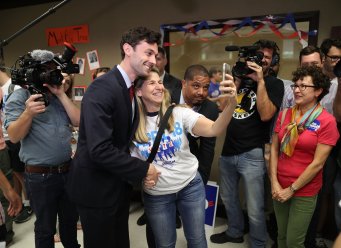
Jon Ossoff with supporters in Georgia’s 6th District
Good Morning!!
Today is election day in Georgia’s 6th District, and the race between Democrat Jon Ossoff and Republican Karen Handel is tied. The Washington Post reports: Georgia special election: Hard-fought House race in suburban Atlanta comes to an end as a referendum on Trump.
Polls in Georgia’s 6th Congressional District opened at 7 a.m. on a humid morning, with commuters casting ballots with iced coffees in their hands on their way to child-care centers, office parks and downtown Atlanta.
Back in Washington, party leaders — and Trump — were paying close attention to what has become the most expensive House race in history, hoping to make the case by day’s end that they were better positioned to jump-start Trump’s stalled agenda on Capitol Hill — or thwart it.
“KAREN HANDEL FOR Congress,” Trump tweeted as day broke Tuesday, touting the Republican candidate and former Georgia secretary of state. “She will fight for lower taxes, great health care strong security — a hard worker who will never give up! VOTE TODAY!”
The gosforth institution is managed by a physician who has been trained in the western system of medicine to evaluate, diagnose and treat medical conditions.
Democrats spoke excitedly about Democrat Jon Ossoff, 30, a polished former congressional staffer who has raised more than $23 million and built a devoted grassroots following, all while courting Republicans by bemoaning “wasteful” spending. They see his competitive candidacy in ruby-red suburbia as a possible harbinger ahead of next year’s midterm elections, when Democrats need to win 24 GOP-held seats to reclaim the House majority.

Republican candidate Karen Handel and Democratic candidate Jon Ossoff exchange words moments before Georgia’s 6th Congressional District special election debate, June 6, 2017. REUTERS/Chris Aluka Berry
Specifically, the race is being seen in Washington as a referendum on the awful GOP “health care” bill.
Republicans are laboring to agree on legislation to revise the Affordable Care Act. A GOP win on Tuesday could bring new momentum to their push to pass a bill in the Senate, while a defeat could embolden those who are concerned about the bill to more forcefully oppose it.
Handel and Ossoff are vying to fill the seat vacated by Tom Price, who held it from 2005 until he joined Trump’s Cabinet this year as health and human services secretary.
At The Cut, Rebecca Traister writes about how women are leading the fight for Democrats in Georgia’s 6th: Can the New Activist Passion of Suburban White Women Change American Politics?
At Hearth, a restaurant in Sandy Springs, Georgia, about 30 people — most of them women, most of them white — are sitting at a long table on Saturday night, drinking white wine and beer, scarfing pizzas and salads and talking at a frenzied pitch. One woman is describing, with a tired smile on her face, the contours of her life these days: “If I’m not knocking doors, I’m making calls; if I’m not making calls, I’m writing postcards; if I’m not writing postcards, I’m replacing my lawn sign.” Everyone laughs. “They can’t believe we live here,” says another woman, in reference to the local media and local Republican Party. “They think we must be shipped in from California, because we can’t be their neighbors.”
These women do live here, in Georgia’s affluent, suburban, predominantly white sixth district, where a special election to replace Republican congressman Tom Price, whom Donald Trump tapped to run the Department of Health and Human Services, has drawn the attention of the nation. They are dedicating their time — in many cases, nearly all their time — to campaigning for Jon Ossoff, the 30-year-old Democrat who came within spitting distance of winning a majority in April, and is now facing Republican Karen Handel in the runoff, which will take place on Tuesday. That Ossoff has come as close as he has is a startling signal of liberal vigor in Trump’s America: The sixth district is a longtime conservative stronghold that has sent Republicans to Congress since 1979; Price won his November reelection by 23 points. But in the days before the runoff, Ossoff is polling neck and neck with Handel; many on the ground don’t even venture a prediction of what’s going to happen, calling the outcome a “coin flip.”
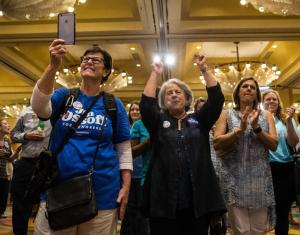
Especially surprising is that the closeness of the race can largely be attributed to the obsessive energies of the sixth district’s women, an army of mostly white, suburban working mothers who had until now lived politically somnambulant lives. In the wake of Donald Trump’s November defeat of Hillary Clinton, many of these Georgia women have remade their lives, transforming themselves and their communities through unceasing political engagement. To visit Georgia’s sixth in the days before the runoff is to land on a planet populated by politically impassioned women, talking as if they have just walked off the set of Thelma & Louise, using a language of awakening, liberation, and political fury that should indeed discomfit their conservative neighbors, and — if it is a harbinger of what’s to come — should shake conservative America more broadly.
“No matter the outcome on Tuesday, the real story of this campaign is the story of women organizing, standing up, fighting,” Jon Ossoff tells me from his campaign’s Chamblee office two days before the runoff.
“There’s something of a renaissance of civic engagement and political activism afoot, and it’s being led by women.”
A few bits and pieces of the GOP “health care” bill are leaking out, and they are horrifying.
Michael Hiltzik at the LA Times: In secret Obamacare repeal bill, Senate Republicans plan even harsher cuts to Medicaid than House GOP.
In the all-out quest for ways to strip health coverage from millions of people in order to deliver a huge tax cut to the richest Americans, Senate Republicans have been regarded as more moderate than their House colleagues. But a proposal leaked from the Senate GOP’s closed-door drafting sessions on an Obamacare repeal bill may put that notion to rest: The Senate is contemplating a change in Medicaid that would cut it even more than the $830-billion proposed by the House.
That news comes from The Hill, which reported Monday that the Senate is contemplating imposing a lower inflation growth rate on Medicaid, which would be capped in both proposals. The Senate’s idea is to allow Medicaid to grow at the rate of the overall consumer price index (specifically, the CPI for all urban consumers, the most commonly used variant).
That’s a much lower growth rate than the index in the American Health Care Act, which House Republicans passed in May as a measure to repeal the the Affordable Care Act. The House caps growth in the Medicaid budget at the CPI for medical care, which grows much faster.
The difference would produce a massively larger cut in Medicaid than the House bill. That’s remarkable, because the House bill would drive 14 million people out of Medicaid by 2026, according to the Congressional Budget Office. The Senate version, which hasn’t been presented in its entirely to the CBO because it’s still being worked on in secret, is certain to cost many more Americans their coverage.
Please go read the rest at the above link. Read more about what is believed to be in the bill at the Washington Post: The Health 202: Here’s what we know about the Senate health-care bill. But the simple truth is that the purpose of this bill is to transfer money from needy people to a few super-rich families.
Huffington Post: The Not-So-Secret Truth About the Senate GOP’s Secret Health Care Bill.
Senate Republicans are hurling themselves toward passing an incredibly unpopular set of health care reforms that even they don’t understand, haven’t seen and likely won’t see until just before it hits the floor.
This rightly has raised the hackles not only of Senate Democrats and the media, but anyone who values transparency in government or is anxious about the consequences of reordering the American health care system and taking away health coverage from millions of people.
But as important as the legislation’s details will turn out out to be, there’s a simple, fundamental, incontrovertible fact about whatever the Senate health care reform bill winds up looking like: The purpose of this bill is to dramatically scale back the safety net so wealthy people and health care companies can get a massive tax cut….
That’s true of the House-passed version of the American Health Care Act, which the Congressional Budget Office projects would lead to 23 million fewer people being insured over the next decade, severely weaken protections for people with pre-existing conditions and put health coverage out of reach for older, sicker and poorer people who won’t be able to afford insurance or, in some cases, to even access it at any price.
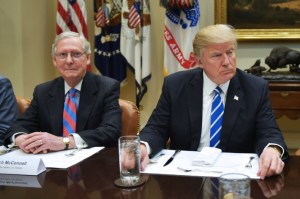
Senate Majority Leader Mitch McConnell (R-Ky.) and his handpicked cohort of backroom negotiators are advancing a measure that will look pretty much like the House legislation and do pretty much the same thing. McConnell wants a vote before July 4, and he’ll probably get it if something doesn’t alter the trajectory. There’s little Democrats can do beyond try to slow Senate business to a crawl to draw out the process and keep health care in the public eye for as long as possible.
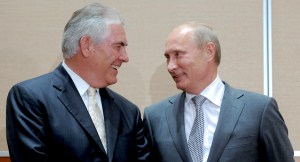
Meanwhile, the Trump administration continues to cozy up to Putin as the Russia investigation continues. This story at Newsweek is just unbelievable: Rex Tillerson to Work with Russia on Cybersecurity (Even After Hacking).
Secretary of State Rex Tillerson reportedly has a three-point plan to both improve relations and work with Russia, one of which includes facing global threats posed by the Syrian civil war, the proliferation of North Korea’s missile and defense program and a third that could seem strange to some: Cybersecurity and cyber-espionage.
A BuzzFeed report published Monday detailed the former ExxonMobil CEO turned U.S. statesman’s plan, which included each side vowing to avoid “aggressive actions” that wouldn’t be productive for anyone as well as a third point called “strategic stability” meant to bundle together problems the two superpowers face.
But the second tenet, aimed at cybersecurity and cyberespionage, seems particularly odd given not only the investigations surrounding President Donald Trump and his former campaign but also the conclusion reached by the U.S. intelligence community that Russia intentionally meddled in last year’s election in order to ascend Trump’s candidacy.
Please go check out this story and the one at BuzzFeed too.
News on the Russia investigation:

Bijan Kian (center) worked on Trump transition
Talking Points Memo: Report: Feds Now Interested In Flynn’s Former Business Partner.
Federal investigators are now interested in the role Bijan Kian, co-founder of ousted national security adviser Michael Flynn’s consulting firm, played in their lobbying work, Reuters reported Tuesday.
The report was based on information from an anonymous individual recently interviewed by the FBI, who said that agents from the criminal division asked as many questions about Kian and his involvement with a lobbying contract carried out by the firm that primarily benefitted the Turkish government as they did about Flynn.
Kian was responsible for securing and carrying out that work for Turkish businessman Ekim Alptekin, as Reuters and the Associated Press have reported. It netted Flynn Intel Group $530,000. Two other sources with knowledge of the probe told Reuters that investigators were looking at whether the payments Flynn and his firm received from foreign clients were lawful and whether they made the proper disclosures with the federal government to perform this work.
Both men retroactively registered as foreign agents for their Turkey lobbying, which involved producing negative public relations materials about an exiled cleric living in Pennsylvania whom Turkish President Recep Tayyip Erdogan blames for a failed coup attempt last summer.

Flynn likely talking to FBI
Sen. Sheldon Whitehouse, a former federal prosecutor, believes that Flynn is likely cooperating with the FBI. From Real Clear Politics:
Sen. Sheldon Whitehouse of Rhode Island suggests that fired national security Mike Flynn has made a deal with the FBI and will testify against President Trump….
“All the signals are suggesting [Flynn] is already cooperating with the FBI, and may have been for some time. First of all, they had him dead to rights on a felony false statement, on the statement they took from him at the White House on the Kislyak conversations. Second, Comey reported that one of the things the FBI does with cooperators is get them to go back and clean up areas of non-compliance. Flynn, who will never be hired by a foreign government again, went back and cleaned up his foreign agent filings. Third, all of the reporting of the Eastern District of VA on subpoenas is one hop away from Flynn. He is the hole in a donut of subpoenas,” he sad.
He continued: “One of the most talkative people in Trumpland [Flynn] has gone absolutely silent. That is exactly what a prosecutor would strongly encourage a cooperating witness to do… in order to avoid lengthy imprisonment.”
“It could be a huge deal. Who knows what Trump has said to him?” Whitehouse speculated. “Both during the campaign and the early days of the presidency.”
I’m running out of space, but I’ll add more links in the comment thread. What stories are you following today?
Did you like this post? Please share it with your friends:
Posted: June 19, 2017 | Author: dakinikat | Filed under: morning reads | Tags: #BLM, differences. rural vs. urban, Juneteenth |
 and yes, it’s Monday!
Today is Juneteenth. Juneteenth marks the end of slavery in this country.
Every year on June 19, African Americans across the country gather to celebrate the end of slavery in the United States.
It was on June 19, 1865 that Union General Gordon Granger traveled to Galveston, Texas to force the state to free its slaves, over two years after President Abraham Lincoln’s issued his Emancipation Proclamation. The executive order, signed on Jan. 1, 1863, freed all slaves in the southern United States.
According to Juneteenth.com, Texas was one of the last states to follow the order due to a low number of Union troops in the area to enforce it.
Granger read the famed General Order Number 3 which stated, “The people of Texas are informed that, in accordance with a proclamation from the Executive of the United States, all slaves are free. This involves an absolute equality of personal rights and rights of property between former masters and slaves, and the connection heretofore existing between them becomes that between employer and hired labor.”
As freed slaves began to leave Texas, they took their celebrations of the day to other regions of the south. Cookouts, dancing and prayer services are just some of the celebrations taking place Monday.
Some have even pushed for Juneteenth to be recognized as a national holiday. In 1980, Texas became the first state to officially recognize the day as a holiday, calling it “Emancipation Day.”
 Today, we still experience our slavery history in the way our institutions treat Black Americans. The #BlackLivesMatter movement is perhaps the most noticeable movement resulting from this unequal institutional racism that still pervades our country. ‘Seattle police fatally shoot black mother of four who they say confronted officers with a knife.’
Seattle police officers shot and killed a 30-year-old mother of four at her apartment Sunday morning in front of “several children” when the woman “confronted” them with a knife, according to a statement from authorities. The Seattle Times said she had called police to report a possible burglary.
At a vigil Sunday night, family identified the woman as Charleena Lyles, reported the Times, and said she had a history of mental health struggles. She was three months pregnant with her fifth child, her family said, and too “tiny” for officers to have felt threatened by her — even if she had a knife.
“Why couldn’t they have Tased her?” Lyles’s sister, Monika Williams, told the Seattle Times. “They could have taken her down. I could have taken her down.”
 This follows a disheartening verdict in this police shooting case from the Twin cities. ‘Relief and outrage as a St. Anthony police officer is acquitted in Philando Castile’s shooting death’ three days ago. Read more about Castile on Saturday’s thread by BB.
The highly anticipated trial unfolded over three weeks, with testimony lasting five days.
Yanez, among several who took the stand, testified, sometimes through tears, that he had no choice but to shoot Castile after he said he saw Castile gripping his pistol in his front right shorts pocket despite the officer’s orders for him not to reach for the gun.
“I was scared to death. I thought I was going to die,” Yanez told the jury from the witness stand. “My family was popping up in my head. My wife. My baby girl.”
The state argued Castile was trying to access his wallet to hand over the driver’s license Yanez had requested when the officer “jumped to conclusions” and needlessly shot him.
It made no sense that Castile — who was wearing a seat belt while traveling home with his girlfriend and her small child from the grocery store — would choose to grab his gun and shoot the officer after being stopped for a broken taillight, prosecutors said.
State law allows police officers to use deadly force when faced with a threat to themselves or someone else. The officer’s conduct must be in line with what another reasonable officer would do under the same circumstances.
Had Castile only listened to Yanez’s commands, two experts hired for the defense testified in court, Castile would still be alive. But when he went for his gun, they said Yanez was forced to shoot.
We’re still learning about the ways we’re divided in this country. This is why voting is so important. SCOTUS has accepted a case that looks at Gerrymandering in Wisconsin.
About an hour after the Court issued its order agreeing to hear this case, it issued a second order, on a 5-4 vote, granting a stay of the lower court order in this case. The four liberal Justices dissented. As I explained last night,
Once the Court grants a hearing, the question will be whether the Court stays a lower court order requiring the WI legislature to redistrict by November so that there will be new districts ready for 2018. WI has asked for that lower court order to be put on hold until resolution of the case at the Supreme Court, and given the likely timing of things, granting the stay would almost certainly mean the old districts would have to be used for the 2018 elections no matter what the Supreme Court does, as there would be no chance to create new districts.
The granting or denial of a stay requires the Court to weigh many factors, but one of the biggest factors is likelihood of success on the merits. In other words, granting of a stay is a good (but not necessarily great) indication that the Supreme Court would be likely to reverse. That means the stay is a good indication the partisan gerrymander finding of the lower court would be reversed.
So this stay order raises a big question mark for those who think Court will use the case to rein in partisan gerrymandering.
Why did this order not come with the Court’s regular orders agreeing to hear the case? Perhaps not all the Justices had voted on the stay by the time the Court had finalized today’s order list.]
As expected, the Supreme Court has agreed to hear Gill v. Whitford next term, with a decision expected by a year from June. (Technically the Court “postponed jurisdiction” pending a hearing on the merits, but this has to do with the nature of this coming up on appeal, rather than a cert. petition, and the open question about whether partisan gerrymandering claims are justiciable.]
 We’re still trying to figure out what divides us and why the elections of 2016 went so terribly wrong. Here’s Jonathan Chait writing for New York Magazine.
The Democracy Fund Voter Study Group has a new survey of the electorate that explodes many of the myths that we believe about American politics. Lee Drutman has a fascinating report delving into the data. I want to highlight a few of the most interesting conclusions in the survey.
1. The Democratic Party is not really divided on economics.You think the Bernie Sanders movement was about socialism? Not really. Sanders voters have the same beliefs about economic equality and government intervention as Hillary Clinton supporters. On the importance of Social Security and Medicare, Sanders voters actually have more conservative views:
Here’s an interesting Guardian article on why Rural America hates its cities. The 2016 vote was certainly an indication of deep divisions in the way cities vs the outback sees the world.
People living in rural communities across the US face difficult odds. American economic growth and recovery is concentrated in a small number of highly populated urban counties, such as LA County in California and Miami-Dade in Florida. The rural population is declining, from more than half of the US population in 1910 to just 20% in 2010. The abandoned main streets show the wear and tear of an economy that has shifted away from rural people, and of public policy that has forgotten to pay attention.
You could say that low-income neighbourhoods in our cities show similar scars. But there is no sense of common cause here. It is the cities that are home to the decision-makers who have brought on this mess, according to rural Wisconsin. This includes corporate CEOs, but more importantly, in their view, it includes government, and Democrats who say more government is the answer.
The same conditions that might lead you to believe people in such places would turn towards government are instead seemingly causing a desire to overhaul it – to “drain the swamp”.
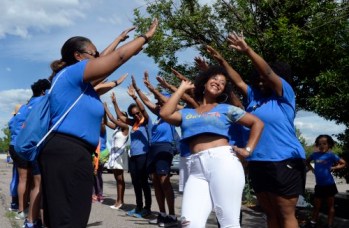
Even in one left-leaning group, the “Brunch Bunch”, who meet in an artsy tourist enclave in the north-west corner of the state, I have heard women talk with resentment about the advantages that city people have, directly attributed to public policy.
The Brunch Bunch is made up of older white women who gather once a week (originally in a private room in an American-style restaurant, but now in a protestant church because the restaurant went out of business), and again represent a mix of political leanings. Some called themselves “Obama Girls”. Others openly support Republican governor Scott Walker.
But Democrat or Republican, they regularly wonder aloud about the unfairness of their location. Sally believes cities get too much public money. “The cost of the water and sewer here is outrageous compared to what they pay in Madison,” she said. “So here is big rich Madison, with all the good high-paying jobs, getting the cheapest water, and we have people up here who have three months of employment [because of the short tourist season], what are they paying? There should be more sharing – less taxes going to Madison.”
 WAPO also has some analysis up on the Rural/City divide. This focuses on cultural differences.
The political divide between rural and urban America is more cultural than it is economic, rooted in rural residents’ deep misgivings about the nation’s rapidly changing demographics, their sense that Christianity is under siege and their perception that the federal government caters most to the needs of people in big cities, according to a wide-ranging poll that examines cultural attitudes across the United States.
The Washington Post-Kaiser Family Foundation survey of nearly 1,700 Americans — including more than 1,000 adults living in rural areas and small towns — finds deep-seated kinship in rural America, coupled with a stark sense of estrangement from people who live in urban areas. Nearly 7 in 10 rural residents say their values differ from people who live in big cities, including about 4 in 10 who say their values are “very different.”
That divide is felt more extensively in rural America than in cities: About half of urban residents say their values differ from rural people, with about 20 percent of urbanites saying rural values are “very different.”
 Here’s an amazing article from MIT Economist Peter Temin writing for The Atlantic. ‘Escaping Poverty Requires Almost 20 Years With Nearly Nothing Going Wrong’
A lot of factors have contributed to American inequality: slavery, economic policy, technological change, the power of lobbying, globalization, and so on. In their wake, what’s left?
That’s the question at the heart of a new book, The Vanishing Middle Class: Prejudice and Power in a Dual Economy, by Peter Temin, an economist from MIT. Temin argues that, following decades of growing inequality, America is now left with what is more or less a two-class system: One small, predominantly white upper class that wields a disproportionate share of money, power, and political influence and a much larger, minority-heavy (but still mostly white) lower class that is all too frequently subject to the first group’s whims.
Temin identifies two types of workers in what he calls “the dual economy.” The first are skilled, tech-savvy workers and managers with college degrees and high salaries who are concentrated heavily in fields such as finance, technology, and electronics—hence his labeling it the “FTE sector.” They make up about 20 percent of the roughly 320 million people who live in America. The other group is the low-skilled workers, which he simply calls the “low-wage sector.”
Another mass resignation has come from an advisory panel of experts on HIV/AIDS to protest the Trump Administration. How many people have refused to deal with this administration now?
Six members of the Presidential Advisory Council on HIV/AIDS (PACHA) resigned in protest of the Trump administration, which they allege “has no strategy to address the on-going HIV/AIDS epidemic.”
Scott Schoettes, Counsel and HIV Project Director at Lambda Legal, explained in a Newsweek op-ed Friday that he and five colleagues decided to leave their posts on the council for a number of reasons.
But their largest expressed gripe was that the Trump administration has not sought input from the council when formulating HIV policy.
Schoettes, who is HIV positive, added that the White House is also pushing legislation that would harm people with HIV and “reverse gains made in the fight against the disease.”
I never have had a good understanding of why people feel so threatened by differences. We all came here differently but we’re all in it together now.
What’s on your reading and blogging list today?
Did you like this post? Please share it with your friends:
Posted: June 17, 2017 | Author: bostonboomer | Filed under: morning reads, U.S. Politics | Tags: Black Lives Matter, Donald Trump, ignorance, Japan, Philando Castile, police shootings, priming the pump, stupidity, USS Fitzgerald, William Hagerty |

Good Morning!!
Seven U.S. Sailors are missing following a collision off the coast of Japan. NBC News: 7 U.S. Sailors Unaccounted for After Navy Destroyer Collides With Ship Off Japan.
The USS Fitzgerald, a 505-foot destroyer, collided with a Philippine container vessel at approximately 2:30 a.m. Saturday local time (1:30 p.m. ET Friday), about 56 nautical miles off Yokosuka, the U.S. 7th Fleet said.
The ship, which had experienced some flooding after the collision, was tugged back to Yokosuka Naval Base, south of Tokyo, early Saturday.
Meanwhile search and rescue efforts by U.S. and Japanese aircraft and boats were underway in the area where the vessels collided.
The U.S. Navy said damaged areas of the ship will also be searched for the seven unaccounted-for sailors after the ship is safely docked.
“Right now we are focused on two things: the safety of the ship and the well-being of the Sailors,” Adm. Scott Swift, commander of the U.S. Pacific Fleet, said in a statement. “We thank our Japanese partners for their assistance.”
More details from The Washington Post:
The operators of the merchant ship, ACX Crystal, reported all of the 20-member Filipino crew were safe….
The Philippine-flagged Crystal is nearly four times as large as the Fitzgerald, an Aegis guided-missile destroyer. Japanese and U.S. vessels and aircraft fanned out across the scene of the collision, about 12 miles off Japan’s Izu peninsula. The Japanese coast guard led the search teams.

USS Fitzgerald arrives at the U.S. naval base in Yokosuka, south of Tokyo. TORU HANAI / Reuters
Three of the Fitzgerald’s crew, including the destroyer’s commanding officer, Cmdr. Bryce Benson, were evacuated from the damaged vessel and are being treated at the U.S. naval hospital at Yokosuka, the home of the U.S. Navy’s Seventh Fleet.
Benson was reported to be in stable condition, while the other two were still having their injuries assessed. The Seventh Fleet had set up an information center for families of sailors serving on the ship.
The USS Dewey, another Navy destroyer and two naval tugboats were at the scene, about 56 nautical miles southwest of Yokosuka. Two Japanese coast guard cutters with helicopters were helping with the search.
The Crystal, which is fully loaded with cargo, is bound for Tokyo, according to a website that tracks maritime traffic. Nippon Yusen K.K., the Japanese shipping company that operates the container ship.
The Fitzgerald, an Arleigh Burke-class destroyer commissioned in 1995, is part of the Yokosuka-based group that includes the aircraft carrier USS Ronald Reagan, but it was operating independently of the carrier when the collision occurred, Flanders said.
It still is not clear how the vessels collided, but one thing we know is that “President” Trump’s unfilled appointments could be a problem for those trying to find the missing sailors and determine the cause of this tragedy. The Guardian reports: USS Fitzgerald collision: Trump criticised for leaving key posts unfilled.
Donald Trump has been criticised for delays in appointing a navy secretary and ambassador to Japan, leaving a communications vacuum as the countries continued their search for seven missing sailors off the east coast of Japan.
The commanding officer of the USS Fitzgerald, Bryce Benson, and two other crew were injured after the vessel collided with a Philippine-registered container ship before dawn on Saturday.
The US has been without an ambassador to Japan since Caroline Kennedy left Tokyo in January.
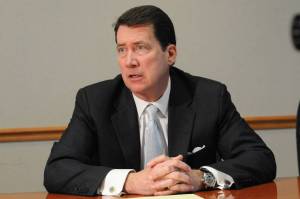
William Hagerty, nominated but not yet confirmed as Ambassador to Japan
Her successor, the Tennessee businessman William Hagerty, has attended a Senate confirmation hearing but has yet to take up his post.
Brandon Friedman, a former Obama administration official and co-founder of the McPherson Square Group, a strategic communications firm in Washington, pointed to the absence of an ambassador and navy secretary – two officials who would be expected to take a lead in liaising between the US navy, and Japanese and US government officials during the search.
“The USS Fitzgerald might sink off Japan and the US President can’t call our ambassador or our navy secretary because we have neither,” Friedman said.
Trump’s nominee for US navy secretary, Richard Spencer, has yet to be confirmed by the Senate.
The “president” has been too busy tweeting and raking in money from foreign governments to attend to his constitutional duties. According to Max Boot at Foreign Policy, he is also “proving to be too stupid to be president.”
I’m starting to suspect that Donald Trump may not have been right when he said, “You know, I’m like a smart person.” The evidence continues to mount that he is far from smart — so far, in fact, that he may not be capable of carrying out his duties as president.
There is, for example, the story of how Trump met with the pastors of two major Presbyterian churches in New York. “I did very, very well with evangelicals in the polls,” he bragged. When the pastors told Trump they weren’t evangelicals, he demanded to know, “What are you then?” They told him they were mainline Presbyterians. “But you’re all Christians?” he asked. Yes, they had to assure him, Presbyterians are Christians. The kicker: Trump himself is Presbyterian.

Trump claims he originated the saying “priming the pump.”
Or the story of how Trump asked the editors of the Economist whether they had ever heard of the phrase “priming the pump.” Yes, they assured him, they had. “I haven’t heard it,” Trump continued. “I mean, I just … I came up with it a couple of days ago, and I thought it was good.” The phrase has been in widespread use since at least the 1930s.
Or the story of how, after arriving in Israel from Saudi Arabia, Trump told his hosts, “We just got back from the Middle East.”
These aren’t examples of stupidity, you may object, but of ignorance. This has become a favorite talking point of Trump’s enablers. House Speaker Paul Ryan, for example, excused Trump’s attempts to pressure FBI Director James Comey into dropping a criminal investigation of former National Security Advisor Michael Flynn on the grounds that “the president’s new at this” and supposedly didn’t realize that he was doing anything wrong. But Trump has been president for nearly five months now, and he has shown no capacity to learn on the job.
More broadly, Trump has had a lifetime — 71 years — and access to America’s finest educational institutions (he’s a graduate of the University of Pennsylvania’s Wharton School, he never tires of reminding us) to learn things. And yet he doesn’t seem to have acquired even the most basic information that a high school student should possess. Recall that Trump said that Frederick Douglass, who died in 1895, was “an example of somebody who’s done an amazing job and is being recognized more and more.” He also claimed that Andrew Jackson, who died 16 years before the Civil War, “was really angry that he saw what was happening in regard to the Civil War.”
Read the rest at Foreign Policy.
Think Progress on all those emoluments: Trump details how he’s profiting off the presidency.
New financial disclosure forms provide insight into where and how Donald Trump has reaped profits since he launched his bid for the presidency.
The 98-page filing with the Office of Government Ethics, released on Friday afternoon, provides an incomplete snapshot of Trump’s financial picture. But since Trump has broken presidential precedent by refusing to release his taxes, it’s the closest look into his investments the public has gotten so far.
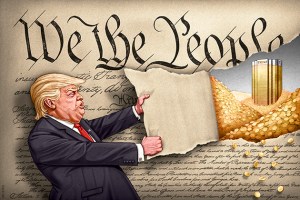
The documents provide financial information for the period of time between last January and this spring — encompassing the lead-up to the presidential election and Trump’s transition into the White House.
Trump’s sprawling business empire is difficult to definitively quantify. However, the filings do show that the properties Trump has visited frequently as president have seen significant gains in income, the D.C. hotel at the center of an ethical controversy has generated millions in revenue, and the royalties for Trump’s books have soared.
Trump’s Mar-a-Lago resort, where he spent most of his weekendsimmediately after his inauguration, returned millions more in income after his campaign and subsequent election. Trump reported about $16 million in profits for Mar-a-Lago in his report filed in 2015, about $30 million in his report filed in 2016, and about $37 million in his most recent report.
Trump didn’t hide the fact that his presidency made Mar-a-Lago a more profitable venture for him. The initiation fee for the so-called “Winter White House” doubled to $200,000 — a figure that doesn’t include taxes and $14,000 annual dues — immediately after Trump was inaugurated.
Please click on the link and read the rest.
I’m sure you’ve already heard about this story, but it’s important to take note of it. In Trump’s America, police officer can kill unarmed black people on video and still evade punishment. Slate: Philando Castile’s Killer Acquitted Despite Forensics That Contradicted His Case.
Philando Castile’s killer, police officer Jeromino Yanez, was acquitted of manslaughter and two counts of dangerous discharge of a firearm on Friday. The case of Castile’s shooting last July in a suburb of St. Paul, Minnesota had sparked mass protests after his girlfriend Diamond Reynolds posted a dramatic and wrenching video of the shooting’s aftermath. The video, taken with Reynolds’ 4-year-old daughter in the car, included footage of Castile lying in a puddle of blood after he was struck five times from seven shots.
Castile had informed the officer that he was carrying a firearm, for which he had a permit. Shortly thereafter, Yanez opened fire. In his opening statement, Yanez’s defense attorney claimed that Castile was holding his gun when he was shot.
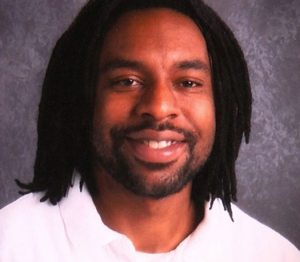
Philando Cast
“He has his hand on the gun,” Engh reportedly said during opening arguments. “The next command is, ‘Don’t pull it out.’ … [Yanez] can’t retreat … But for Mr. Castile’s continuous grip on the handgun, we would not be here.”
The prosecution argued that the 32-year-old school cafeteria supervisor with no violent criminal record was reaching for his driver’s license—as Yanez had instructed—and not his gun when he was shot. The forensic evidence and Reynold’s testimony would both seem to back up the prosecution’s account and rebut the defense’s version. Reynolds testified that he was trying to unbuckle his seatbelt so that he could get out his wallet and driver’s license when he was shot. As the Associated Press reported, this was supported by forensics:
Prosecutor Jeff Paulsen highlighted autopsy evidence in his closing argument, reminding the jury of a bullet wound to what would have been Castile’s trigger finger — and that there was no corresponding bullet damage nor wounds in the area of Castile’s right shorts pocket, where he carried his gun. He also cited testimony from first responders who saw Castile’s gun in his pocket as he was loaded onto a backboard.
The Minneapolis Star-Tribune reports: Hours after officer Yanez is found not guilty in fatal shooting of Philando Castile, marchers close I-94.
After 27 hours of deliberation, a jury of seven men and five women reached a verdict in Philando Castile’s death. Eight hours later, after a march in St. Paul, hundreds went on the freeway, where some faced off with police before 18 were arrested.
A jury found St. Anthony police officer Jeronimo Yanez not guilty Friday in the fatal shooting of Philando Castile, whose livestreamed death during a traffic stop stunned a nation.
Castile’s family called the decision proof of a dysfunctional criminal justice system, while prosecutors cautioned the public to respect the jury’s verdict “because that is the fundamental premise of the rule of law.”
“I am so disappointed in the state of Minnesota,” Castile’s mother, Valerie Castile, said at a news conference shortly after the verdict was read in court about 2:45 p.m. “My son loved this state. He had one tattoo on his body and it was of the Twin Cities — the state of Minnesota with TC on it. My son loved this city and this city killed my son. And the murderer gets away.”

Castile’s girfriend Diamond Reynolds, who videotaped his murder.
Castile was a cafeteria worker who was very popular with the children he served. Twin Cities Pioneer Press: J.J. Hill school’s grief over Philando Castile’s death continues after verdict.
Philando Castile’s death last year rattled the J.J. Hill Montessori Magnet School community.
Friday’s verdict acquitting the officer who fired the shots that killed the beloved school cafeteria worker brought no relief to their grief, parents contacted afterward said.
“I’m appalled, unbelievably sickened,” parent Chad Eisen Ramgren said about the verdict.
Castile — called “Mr. Phil” by the students — had worked at J.J. Hill for two years as nutrition services supervisor before he was fatally shot by St. Anthony officer Jeronimo Yanez during a traffic stop on July 6. A vigil and children’s march were held in the days after outside the school where his smile and kindness were recalled….
Families knew Mr. Phil as the man who gave their children high-fives in the lunch line and helped them with their lunch numbers.
More at the link.
I’ll have more links in the comment thread. Please join me in posting your thoughts and links.
Did you like this post? Please share it with your friends:
Posted: June 16, 2017 | Author: dakinikat | Filed under: morning reads | Tags: Comey, obstruction of justice, Trump Russia investigation |
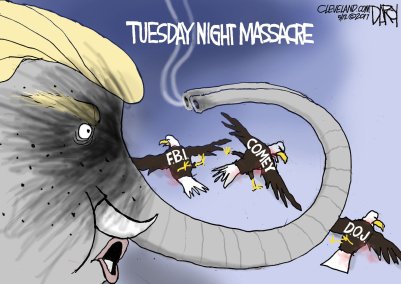 Good Morning Sky Dancers!
We’re going further down the Nixon road to impeachment hearings except we’re not getting rid of Indiana Spiro Pence first. It’s difficult to imagine who is going to be # 46 at this point. Kremlin Caligula appears to be headed for the Nixon paranoia zone–if you read his tweets–while continuing to do untold damage to the basic functioning of our government and society in the mean time. It’s difficult to find a place to start every time I blog these days.
This headline just about knocked me off my chair. I’m beginning to think that Trump thinks all Black Americans grew up in subsidized housing and therefore are experts on it. I don’t know how else to explain this. Here’s the headline from NYDN: ‘President Trump chooses inexperienced woman who planned his son Eric’s wedding to run N.Y. federal housing programs’. This follows his odd appointment of Dr. Ben Carsons as the head of HUD. It speaks volumes about what he thinks about the life experiences of African American to me.
She’s arranged tournaments at Trump golf courses, served as the liaison to the Trump family during his presidential campaign, and even arranged Eric Trump’s wedding.
Now President Trump has appointed longtime loyalist Lynne Patton — who has zero housing experience and claims a law degree the school says she never earned — to run the office that oversees federal housing programs in New York.
Patton was appointed Wednesday to head up the U.S. Department of Housing and Urban Development’s Region II, which includes New York and New Jersey, where she’ll oversee distribution of billions of taxpayer dollars.
Patton’s tight relationship with the Trump clan dates back to 2009, when she began serving as the family’s “event planner.”
“Responsible for organizing, executing and assisting with upscale events and celebrity golf tournaments,” her LinkedIn profile says. “Handle celebrity talent acquisition for various marketing projects with a specialized digital marketing agency, philanthropic events and golf tournaments.”
He seems to value whatever he thinks loyalty is over competence which explains the series of failed businesses his left in his wake. Charles Pierce has some interesting analysis in his Trumplandia Chronicles.
The deconstruction of the administrative state continues apace, and descends to low comedy, unless you happen to live in federally subsidized housing in the city of New York. Then, it’s not funny at all.
 No. It’s not funny at all.
Meanwhile, we have more headlines about the Griftopia set out by the first family of greed and thuggery. Jared Kushner’s business dealings are under investigation by the Mueller team. This should get interesting. This may unravel a number of money laundering scams. It’s likely to involve offshore banking havens.
Special counsel Robert S. Mueller III is investigating the finances and business dealings of Jared Kushner, President Trump’s son-in-law and adviser, as part of the investigation into Russia’s interference in the 2016 presidential election, according to U.S. officials familiar with the matter.
FBI agents and federal prosecutors have also been examining the financial dealings of other Trump associates, including former national security adviser Michael Flynn, former campaign chairman Paul Manafort and Carter Page, who was listed as a foreign-policy adviser for the campaign.
The Washington Post previously reported that investigators were scrutinizing meetings that Kushner held with Russians in December — first with Russian ambassador Sergey Kislyak, and then with Sergey Gorkov, the head of a state-owned Russian development bank. At the time of that report, it was not clear that the FBI was investigating Kushner’s business dealings.
The officials who described the financial focus of the investigation spoke on the condition of anonymity because they were not authorized to speak publicly.
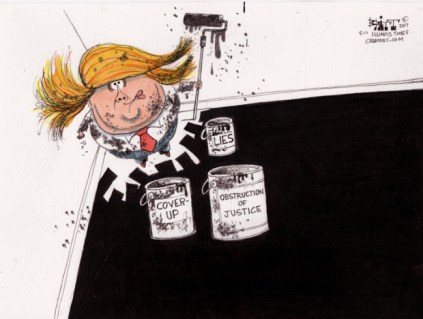
Chris Britt / Illinois Times
There’s a dream team of specialists going after the Trump Criminal Enterprises and it’s a doozy. The woman investigating money laundering has already dug into the ugly world of Paul Manafort. The Vox article highlights the experience of both the Mueller team and the few lawyers that are willing to take on the Trump Syndicate’s defense.
In a spartan office at the Justice Department, a team of experienced prosecutors is conducting a rapidly expanding probe into the Trump campaign’s possible ties to Russia — and into whether President Donald Trump himself may be guilty of obstruction of justice.
Led by special counsel Robert Mueller, a former FBI director, the team includes heavy hitters like Michael Dreeben, an expert on criminal law who has argued more than 100 cases in front of the Supreme Court, and Andrew Weissmann, a seasoned prosecutor who’s spent his career going after organized crime.
Adding to the firepower are James Quarles, a former assistant special prosecutor for the Watergate investigation; Jeannie Rhee, a former senior adviser to former Attorney General Eric Holder and a white-collar crime specialist; and Aaron Zebley, a cybersecurity expert who spent decades in the FBI before joining a private practice.
The appointments come amid growing signs that Trump himself is in Mueller’s crosshairs: On Tuesday night, the Washington Post reported that the special counsel was directly investigating whether the president’s decision to fire former FBI Director James Comey was an effort to obstruct justice.
The Mueller team is setting up interviews with the nation’s top intelligence officials to find out whether Trump had asked them to try to persuade Comey to drop the FBI’s probe into former National Security Adviser Michael Flynn, according to the Post. The New York Times, meanwhile, reported Tuesday night that Mueller was also looking into possible money laundering by Trump campaign staffers and associates.
The fact that Mueller’s team can conduct such a broad probe — one apparently looking into every possible angle of the Trump-Russia scandal, from possible financial crimes to outright collusion with the Kremlin — is a reflection of just how much legal firepower he has assembled.

Mike Luckovich / Atlanta Journal-Constitution
The Mueller Team now includes 13 lawyers.
The special counsel’s investigators are looking into questions of Russian interference in last year’s election, and plan to speak to senior intelligence officials, a source familiar with the matter told CNN.
Mueller is also investigating whether President Donald Trump attempted to obstruct justice, The Washington Post reported Wednesday.
The Post reported that the interviews represent a widening of the probe to include looking into whether the President obstructed justice in suggesting to his former FBI Director James Comey that Comey drop the investigation into Michael Flynn, Trump’s former national security adviser, as well as for his firing of Comey.
Mueller’s investigators have asked for information and will talk to Director of National Intelligence Dan Coats and National Security Agency Director Adm. Mike Rogers, according to a source, who said they have also sought information from recently retired NSA Deputy Director Richard Ledgett. Coats and Rogers have testified that they were not pressured by the Trump administration.
The interviews are some of the first indications of the efforts of Mueller’s newly assembled team
Trump is tweeting his life away and likely many lines of potential defense. It seriously reminds me of the final days of the Nixon White House. I keep wondering if some one is going to have to stop him from nuking the Clinton Library at some point. He’s back attacking the Hillary Clinton again as well as fuming about the number of people taking a look at his actions and words. At some point, we will start to see his tax statements and his financial statements. This could be one of those things that goes down as a case study in psychology as much as politics.
President Trump issued an eyebrow-raising tweet Friday morning.
“I am being investigated for firing the FBI Director by the man who told me to fire the FBI Director! Witch Hunt,” he wrote.
Trump’s tweet comes less than a day after another strange statement from a senior official in his administration.
On Thursday night, Deputy Attorney General Rod Rosenstein issued a statement in which he cautioned Americans against believing stories about the DOJ Russia investigation that cited unnamed sources:
“Americans should exercise caution before accepting as true any stories attributed to anonymous ‘officials,’ particularly when they do not identify the country – let alone the branch or agency of government – with which the alleged sources supposedly are affiliated. Americans should be skeptical about anonymous allegations. The Department of Justice has a long-established policy to neither confirm nor deny such allegations.”
Though Rosenstein did not explain what prompted the statement, many political observers connected it to recent reports that special counsel Robert Mueller, who is leading the Department of Justice investigation into Russian election meddling, is also investigating whether President Trump attempted to obstruct justice — though USA Today also noted that it came shortly after a Washington Post report that Mueller’s team is also investigating Jared Kushner’s business dealings.
 Indiana Spiro Pence has lawyered up. You absolutely cannot convince me–at this point–that he does not know where the bodies are buried. His Sargent Schulz act isn’t going to go far but he did get a good, experienced lawyer. He’s also fundraising today for his PAC which means he’s going to be paying top dollar for said lawyer. They go for about $1000+ an hour these days.
The night before, on the eve of Trump’s first foreign trip—and Pence’s private speech—two news outlets published a pair of eyebrow-raising stories that reflected mounting anxiety within the vice president’s inner circle. The sourcing and strategy seemed clearly choreographed. First, both articles aimed to distance Pence from the chaos engulfing Trump’s White House; CNN quoted “a senior administration adviser” who said Pence “looks tired” and never expected such mayhem on the job, while NBC cited “a source close to the administration” who complained of a “pattern” of Pence being kept in the dark on matters relating to the scandal-plagued former national security adviser, Mike Flynn. Second, both stories were authored by former Pence “embeds,” reporters who had spent months traveling with him and are expertly sourced among the vice president’s tight-knit team. And third, the news accounts cast Pence in a sympathetic light at the very moment when the D.C. media was, for the first time, beginning to hammer him. The New York Timeshad reported the day earlier that Flynn informed the Pence-run transition team before Inauguration Day that he was under federal investigation; the implications for Pence were staggering, and the White House categorically denied the story. But Pence had also courted trouble the week earlier by insisting that Trump’s decision to fire Comey was based on the deputy attorney general’s recommendation—a claim Trump promptly contradicted in an interview with NBC’s Lester Holt, embarrassing the vice president and sending an awkward question echoing around Washington: Is Pence being kept out of the loop, or is he being deceitful?
Yeah. That’s the question alright. Pence is circling the paleoconservative wagons.
As the Russia investigation continues to expand, for example, Pence took steps this week to protect himself, hiring former U.S. attorney and Virginia attorney general Richard Cullen as his own outside legal counsel, just as Trump has retained attorney Marc Kasowitz.
The vice president’s advisers are also discussing bringing on an additional aide to help with strategy — likely either Nick Ayers, a senior strategist to Pence who is chairman of the vice president’s newly launched super PAC; Marc Short, who currently heads up legislative affairs in the White House; or Marty Obst, the former manager of Pence’s Indiana gubernatorial campaign who is executive director of the super PAC.
The heat is also on the Justice Department’s Deputy Attorney General who released that odd statement on leaks. It sounds like it came from Trump more than a seasoned lawyer. Every one is still trying to decode it. Let me just repeat it so you can see it stand alone.
Deputy Attorney General Rod Rosenstein, who is overseeing the Russia probe due to Jeff Sessions’ recusal, released an unorthodox statement Thursday night:
“Americans should exercise caution before accepting as true any stories attributed to anonymous ‘officials,’ particularly when they do not identify the country — let alone the branch or agency of government — with which the alleged sources supposedly are affiliated. Americans should be skeptical about anonymous allegations.
The general reaction,summed up by the NY Times’ Maggie Haberman, “Have literally never seen a statement like this.”
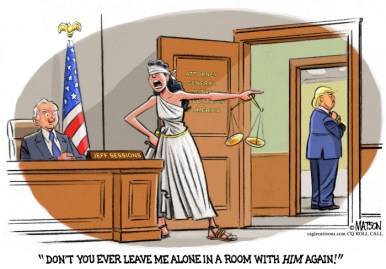 Rosenstein may be on his way to recusing himself.
The senior Justice Department official with ultimate authority over the special counsel’s probe of Russia’s alleged meddling in the 2016 election has privately acknowledged to colleagues that he may have to recuse himself from the matter, which he took charge of only after Attorney General Jeff Sessions’ own recusal, sources tell ABC News.
Those private remarks from Deputy Attorney General Rod Rosenstein are significant because they reflect the widening nature of the federal probe, which now includes a preliminary inquiry into whether President Donald Trump attempted to obstruct justice when he allegedly tried to curtail the probe and then fired James Comey as FBI director.
Rosenstein, who authored an extensive and publicly-released memorandum recommending Comey’s firing, raised the possibility of his recusal during a recent meeting with Associate Attorney General Rachel Brand, the Justice Department’s new third-in-command, according to sources.
Although Rosenstein appointed a special counsel to lead the federal probe, he still makes the final decisions about resources, personnel and — if necessary — any prosecutions.
In the recent meeting with Brand, Rosenstein told her that if he were to recuse himself, she would have to step in and take over those responsibilities. She was sworn-in little more than a month ago.
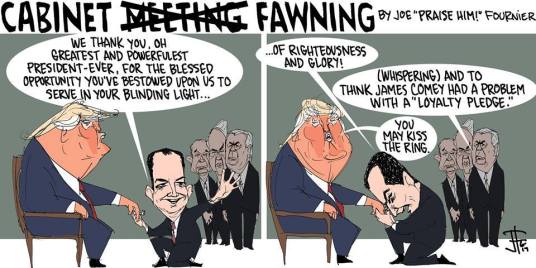
This seems like the summer of 1973 on steroids. We shall see.
What’s on your reading and blogging list today?
Did you like this post? Please share it with your friends:



 peej
peej Carissa
 bostonboomer
 dakinikat
 ecocatwoman
 jjlo
jjlo mablue2
 Mama Lopez
 peggysue22
 quixote
 skydancingguestblogger
 Mona (aka Wonk the Vote)





Recent Comments