
Paul Krugman Tries to Explain “Facts” to Ron Johnson and ABC “Powerhouse Roundtable”
Posted: March 10, 2013 Filed under: Affordable Care Act (ACA), Barack Obama, Medicare, open thread, Republican politics, Social Security, U.S. Economy, U.S. Politics | Tags: ABC's This Week, Paul Krugman, Senator Ron Johnson 23 Comments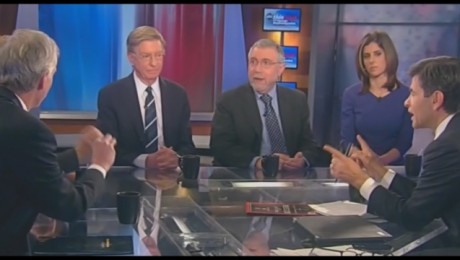
Are there stupider Senators than Ron Johnson (D-WI)? Maybe, but he has to be in the top five. Via Think Progress, this morning on ABC’s This Week, Johnson pulled out an old Republican canard, claiming that the Social Security Trust Fund is “a myth.” Nobel Prize-winning economics Paul Krugman attempted to set him straight. You can watch the partial video down below, but I decided to read the whole transcript of the interaction. Here’s how it went down.
Johnson and Krugman participated in the “Powerhouse Roundtable” with George Will, Bloomberg News White House Correspondent Julianna Goldman, and DNC Chair Rep. Debbie Wasserman Schultz. The group began by discussing President Obama’s supposed charm offensive of the past few days. Johnson rambled on about how Obama is doing the right thing by “reaching out” to the GOP and maybe something can come of it. I have to hand it to Krugman, because he immediately steered the discussion toward the GOP and Obama’s hopes for cutting earned benefit programs.
KRUGMAN: I’m really skeptical, because I — I mean this is not — this is not about bad personal relations. People are perfectly capable of being polite to each other, being nice, having a nice dinner. This is about a fundamental difference in visions about what America should be…One party really wants to take down the — the — the safety net we have. One party really wants….to privatize Medicare, wants to, you know roll back, wanted to try to privatize Social Security back in 2005. The other party wants it somewhat extended, wants Obamacare to go into place, would do more if it could. That’s not something you’re going to resolve with a few dinners.
Corporate media shill Juliana Goldman chimes in to state the village consensus:
Look, both sides understand what a grand bargain is going to look like. You’re going — Republicans are going to have to give on revenues, Democrats are going to have to give on entitlements. And so there is some case for optimism now that if the president, in trying to build trust…if Republicans see the president moving forward, putting Medicare savings on the table that doesn’t just hit providers, but also hits beneficiaries as well, then — and also going out and selling it to give Republicans some cover, then there could be a sense that you could get some Senate Republicans to — to help bring the House along.
George Will brings up raising the Medicare age and asks Debbie Wasserman Schultz if there’s any chance all those old codgers in Florida will ever see the light so that Democrats could go along with this brilliant idea? No real response from Schultz, so Krugman (he was on fire today!) jumped in again. From here on, I’ll just focus on the interaction between Johnson and Krugman and leave out the few remarks by others.
KRUGMAN: Is it a condition of any Republican support that you have to go for really terrible policies? Because raising the Medicare age is a terrible policy. It raises medical costs, it does very little to improve the budget. It introduces a lot of hardship. Means testing in Medicare is a better policy. I don’t particularly like it, but it’s a better policy. There are other things you can do. There are other ways you can cut. Even — I don’t like the business about changing, you know the price index for Social Security, but that’s not as bad…
JOHNSON: To say that the Republicans haven’t done anything, is just false. The House has actually passed budgets. You know with — with proposals to — to try and save Medicare, bipartisan proposals, quite honestly. The Senate hasn’t passed a budget in over four years. Listen, unless we do something, these programs are going broke. It drives me nuts. When I — when I hear people say that Social Security is solvent to the year 2035, it’s not….
Listen, if you — if you’re taking a look at, in a entitlement reform package, in term — you know actually bringing in revenue for those entitlement reforms, I might look at that. But the fact of the matter is — the fact of the matter is, we already have a $1 trillion in middle income tax increases hitting us in Obamacare. They’re hidden, but it’s middle-class….it’s certainly true, as well as another $600 billion. So, you’ve already got $1.6 trillion worth of tax increases hitting us in the next 10 years….
KRUGMAN: Just a question, you say let’s start with the facts, but there — we’ve just — we’ve just run aground right there….JOHNSON: You’ve made my point — you’ve made my point, we have to agree on the facts….But the facts are false.
JOHNSON: No they are not….They are not false.
KRUGMAN: The Social Security thing, Social Security is — there — it has a dedicated revenue base. It has a trust fund based on that dedicated revenue base. You can’t change the rules midstream and say, oh suddenly….
JOHNSON: …here’s the problem with the trust fund, the federal government owns U.S. Treasury bonds, it’s the same thing as if you have $20.00, you spend it. And by the way, that money is spent, it’s gone. You write yourself a note for $20.00, stick it in your pocket and say, I got 20-bucks…No, you don’t. You — you have a note that you have to sell in the open market. The trust fund is a fiction, it doesn’t — it’s…
KRUGMAN: If you — if you want to think of Social Security as not just being part of the government, then there’s no such thing as a Social Security problem, it’s just part of the general budget. You — you cannot say on the one hand….on — on the other hand we’re going to — we’re going to restrict it to only operating off of…it’s important to realize that the facts that are being brought out here are in fact, non-facts.
Here’s the video from Think Progress:
From a piece Kevin Drum wrote last fall in response to WaPo columnist Charles Krauthammer spouting the “Social Security Trust Fund is a fiction” meme. Like Johnson, Krauthammer was arguing that because Social Security funds are invested in Treasury bonds which it cashes in when current funds aren’t sufficient for immediate needs, that the Trust Funds is just “a bunch of useless IOU’s,” to quote George W. Bush.
Here’s Drum:
What Krauthammer means is that as Social Security draws down its trust fund, it sells bonds back to the Treasury. The money it gets for those bonds comes from the general fund, which means that it does indeed have an effect on the deficit.
That much is true. But the idea that the trust fund is a “fiction” is absolutely wrong….Starting in 1983, the payroll tax was deliberately set higher than it needed to be to cover payments to retirees. For the next 30 years, this extra money was sent to the Treasury, and this windfall allowed income tax rates to be lower than they otherwise would have been. During this period, people who paid payroll taxes suffered from this arrangement, while people who paid income taxes benefited….
As the baby boomers have started to retire, payroll taxes are less than they need to be to cover payments to retirees. To make up this shortfall, the Treasury is paying back the money it got over the past 30 years, and this means that income taxes need to be higher than they otherwise would be. For the next few decades, people who pay payroll taxes will benefit from this arrangement, while people who pay income taxes will suffer.
If payroll taxpayers and income taxpayers were the same people, none of this would matter. The trust fund really would be a fiction. But they aren’t. Payroll taxpayers tend to be the poor and the middle class. Income taxpayers tend to be the upper middle class and the rich. Long story short, for the past 30 years, the poor and the middle class overpaid and the rich benefited. For the next 30 years or so, the rich will overpay and the poor and the middle class will benefit.
The trust fund is the physical embodiment of that deal. It’s no surprise that the rich, who didn’t object to this arrangement when it was first made, are now having second thoughts. But make no mistake. When wealthy pundits like Krauthammer claim that the trust fund is a fiction, they’re trying to renege on a deal halfway through because they don’t want to pay back the loans they got.
It’s disgusting that this has to be explained over and over again to the willfully obtuse Republicans and the media talking heads, but I have to say that I’m glad Krugman was there this morning to call attention to the stupidity of what the GOP–and Obama–are proposing.
Now, here’s a bonus for you that I found at Americablog this morning. Florida Rep. Alan Grayson is warning there will be “civil disobedience” if Social Security benefits are cut.
What are you hearing and seeing out there? This is an open thread.
Senator Bernie Sanders Introduces Bill to Apply Payroll Tax to High Incomes
Posted: March 7, 2013 Filed under: Barack Obama, Medicare, Social Security, The Media SUCKS, U.S. Economy, U.S. Politics | Tags: payroll tax cap, Senator Bernie Sanders, Social Security 31 Comments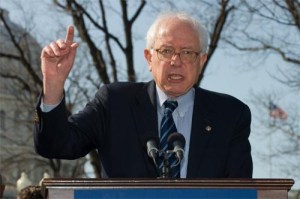
I’m sure most of the corporate media will ignore this, but Senator Bernie Sanders today introduced a bill to “strengthen Social Security” by applying payroll taxes to all income–including from self-empoyment–to people earning more than $250,000 annually. So far I’ve only seen this reported by one national media outlet.
Sanders and other liberals are concerned Obama may strike a deficit-reduction deal with Republicans that would reduce Social Security benefits by adopting a less generous way of adjusting benefits for inflation.
Sanders on Thursday introduced legislation co-sponsored by Senate Majority Leader Harry Reid (D-Nev.) to raise payroll taxes on the wealthy to extend the solvency of Social Security.
Democratic Sens. Barbara Boxer (Calif.), Amy Klobuchar (Minn.), Sheldon Whitehouse (R.I.), Al Franken (Minn.) and Richard Blumenthal (Conn.) have co-sponsored the bill as well.
Representative Peter De Fazio is introducing a companion bill in the House.
“Social Security is facing an unprecedented attack from those who either want to privatize it completely or who want to make substantial cuts,” said Sanders at a press conference. “The argument being used to cut Social Security is that because we have a significant deficit problem and a $16.6 trillion national debt, we just can’t afford to maintain Social Security benefits.
“This argument is false. Social Security, because it is funded by the payroll tax, not the U.S. Treasury, has not contributed one nickel to our deficit,” he said.
Sanders estimates switching to a chained-CPI formula for determining benefits for Social Security would result in the average 65 year old living on about $15,000 a year receiving $650 less each year when they turn 75 and $1,000 less a year when they turn 85.
The bill is supported by (PDF) “The Strengthen Social Security Campaign, comprised of more than 320 organization throughout the country representing more than 50 million Americans, including the National Committee to Preserve Social Security and Medicare; AFL-CIO; United Steelworkers; Alliance for Retired Americans; Social Security Work; Campaign for Community Change; The Arc.”
The AARP announced yesterday that it is going to be running ads
If you haven’t read the op-ed by Thomas Edsall (The War on Entitlements) in today’s New York Times, I hope you will take the time to do so now. Thanks to RalphB for posting the link on the morning thread! Here’s the introduction:
The debate over reform of Social Security and Medicare is taking place in a vacuum, without adequate consideration of fundamental facts.
These facts include the following: Two-thirds of Americans who are over the age of 65 depend on an average annual Social Security benefit of $15,168.36 for at least half of their income.
Currently, earned income in excess of $113,700 is entirely exempt from the 6.2 percent payroll tax that funds Social Security benefits (employers pay a matching 6.2 percent). 5.2 percent of working Americans make more than $113,700 a year. Simply by eliminating the payroll tax earnings cap — and thus ending this regressive exemption for the top 5.2 percent of earners — would, according to the Congressional Budget Office, solve the financial crisis facing the Social Security system.
So why don’t we talk about raising or eliminating the cap – a measure that has strong popular, though not elite, support?
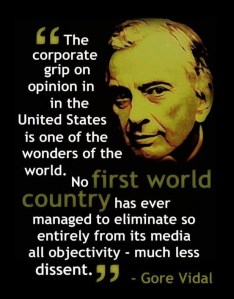
I think we all know the answer to that question, don’t we?
Gene Sperling: “A mix of entitlements and revenues was part of the DNA” of the Sequester “from the start.”
Posted: February 28, 2013 Filed under: 2012 presidential campaign, Austerity, Barack Obama, Medicaid, Medicare, Social Security, U.S. Economy, U.S. Politics | Tags: Bob Woodward, digby, entitlement cuts, Gene Sperling, Jon Walker, Robert Kuttner, the sequester 38 Comments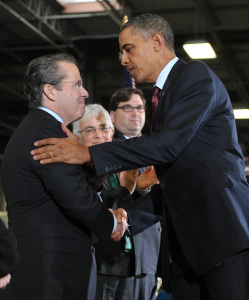
Gene Sperling and Barack Obama
I want to call attention to some rather startling statements in Gene Sperling’s e-mail to Bob Woodward, which I posted earlier. Please note the highlighted sections.
From Gene Sperling to Bob Woodward on Feb. 22, 2013
Bob:
I apologize for raising my voice in our conversation today. My bad. I do understand your problems with a couple of our statements in the fall — but feel on the other hand that you focus on a few specific trees that gives a very wrong perception of the forest. But perhaps we will just not see eye to eye here.
But I do truly believe you should rethink your comment about saying saying that Potus asking for revenues is moving the goal post. I know you may not believe this, but as a friend, I think you will regret staking out that claim. The idea that the sequester was to force both sides to go back to try at a big or grand barain with a mix of entitlements and revenues (even if there were serious disagreements on composition) was part of the DNA of the thing from the start. It was an accepted part of the understanding — from the start. Really. It was assumed by the Rs on the Supercommittee that came right after: it was assumed in the November-December 2012 negotiations. There may have been big disagreements over rates and ratios — but that it was supposed to be replaced by entitlements and revenues of some form is not controversial. (Indeed, the discretionary savings amount from the Boehner-Obama negotiations were locked in in BCA: the sequester was just designed to force all back to table on entitlements and revenues.)
I agree there are more than one side to our first disagreement, but again think this latter issue is diffferent. Not out to argue and argue on this latter point. Just my sincere advice. Your call obviously.
My apologies again for raising my voice on the call with you. Feel bad about that and truly apologize.
Gene
Really? Does anyone recall President Obama saying that at the time the sequester was proposed and voted on in 2011? Did President Obama discuss these plans for entitlement cuts during his campaign for re-election? I’ve always suspected he did plan cuts in Social Security, Medicare, but when did he publicly state this? I’ve done a somewhat cursory search, but I can’t find anything.
There is no mention of these agreed-upon cuts in the Wikipedia entry on the Budget Control Act of 2011. There no mention of “entitlement” cuts in this extensive article at The Bipartisan Policy Center. This analysis (pdf) notes that the Supercommittee was authorized to cut Social Security:
The “Super Committee” deficit reduction plan: BCA also creates a new, special joint committee of Congress charged with finding at least $1.2 trillion in deficit reduction to avoid any potential sequestration. This “Super Committee” can cut spending (including Social Security and Medicare), raise revenue, or propose a combination of both. If the committee cannot agree on a plan, or Congress fails to approve it, automatic cuts of $1.2 trillion will be triggered through sequestration. To assist the Super Committee with its task, Congress also provided for an accelerated review of the Super Committee recommendations, provided that the Super Committee followed specific timelines, as outlined in the text.
But I think it was generally assumed that the Super Committee would not be able to agree on anything, and if they did that the Senate at least would not vote for Social Security cuts.
So now the truth has come out. Certainly no one from the White House has come rushing out to deny that cuts in Social Security, Medicare, and Medicaid are what is supposed to balance any new revenue. A few other bloggers have written about this.
Digby is always alert for any mentions of Obama’s seeming obsession with cutting Social Security, and she didn’t miss this one.
I don’t know that anyone’s ever admitted that in public before or that the president was completely, shall we say, honest when he ran for his second term about that specific definition of “a balanced approach”. I haven’t heard anyone say publicly that the sequester “deal” as far as the White House was concerned was to cut “entitlements” in exchange for new revenues. I wonder how many members of congress were aware of this “deal” when they voted for the sequester? The public certainly wasn’t.
I wish I could understand why it is so important to Barack Obama to cut these vital programs before he leaves office. It seems to be his obsession. But there you have it. It’s not just in the DNA of the sequester, it seems to be in the DNA of this White House.
In this sense, it seems that Sperling and Woodward–and by extension Obama–do “see eye to eye.”
At FDL, John Walker gets right to the point in his headline: Sperling: Obama Wanted Sequester to Force Democrats to Accept Entitlement Cuts.
The way Obama has handled basically every manufactured crisis from the debt ceiling, to the Bush tax cuts expiration, to the sequester has been about trying to force both Democrats and Republicans to embrace his version of a “grand bargain.” While it is clear this has been the driving force behind Obama’s decisions, if you pay close attention to his actions is is rare than an administration official will directly admit this. This is actually what I think it most interesting about the recently leaked email exchange between Bob Woodward and Gene Sperling up on Politico…..
Obama wants to cut Social Security and Medicare benefits. Obama also wants to raise taxes, but he only wants to do these unpopular things if he can get bipartisan cover to destroy basic democratic accountability. If everyone is to blame than no one is to blame.
What has sometimes been viewed as incompetence on the part of Obama during negotiations is actually Obama trying to weaken Democrats’ hand to “force” them to accept entitlement cuts while being able to blame it on the mean Republicans.
That is why even now Obama isn’t calling for the sequester to be simply repealed or delayed. Obama still wants to use this manufactured crisis to force congressional Democrats to betray their base by adopting Social Security cuts and get Republicans to accept revenue increases.
Finally, thanks to JJ for sending me the link to this piece by Robert Kuttner at The American Prospect: Dear White House, You’ll Regret This.
[Gene Sperling’s] e-mail is pure confirmation that Obama’s position, dating back to at least 2011, has been to try to trade cuts in Social Security and Medicare for new revenues. It confirms that Sperling and his boss have been channeling the likes of Robert Rubin, Pete Peterson, the corporate-sponsored Fix the Debt campaign, et al., who have been promoting exactly this grand bargain. Sperling confirms that the sequester was designed to force exactly such a dismal deal.
But even worse, writes Kuttner, is what the e-mail demonstrations about Sperling’s–and Obama’s–pathetic negotiating skills.
The Woodward-Sperling exchange is far more interesting for what it reveals about Sperling/Obama’s propensity for giving ground on core issues and getting almost nothing in return. I supposed we should be grateful that Sperling is only wrecking the economy, the Democrats, Social Security, and Medicare—and not negotiating nukes with the Ayatollah.
I’ve said ever since I read The Audacity of Hope back in 2007 that Obama wanted to cut Social Security. Actually, he made it clear in the book that he wanted to privatize it, but he must have realized that wasn’t going to happen. It’s time for those of us who care about these issues to start screaming bloody murder again. We need to get on this ASAP. So tell your friends and call your Congress critters.
The floor is open for discussion.
Republican Insanity Continues Unabated Following Fiscal Cliff Agreement
Posted: January 4, 2013 Filed under: Barack Obama, Medicaid, Medicare, Republican politics, Social Security, Surreality, U.S. Economy, U.S. Politics | Tags: austerity, Debt Ceiling, fiscal cliff, full faith and credit, Global Economy, John Boehner, John Cornyn, Lindsey Graham 27 Comments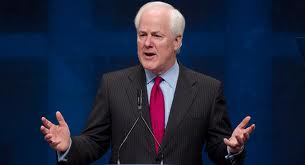
Crazy John Cornyn
Have you heard the latest from Texas Sen. John Cornyn? This morning the Houston Chronicle published Cornyn’s bizarre op-ed in which he calls for a “partial government shutdown” if President Obama refuses to come to Republicans on bended knee with a plan to cut Social Security, Medicare, and Medicaid in return for Congress agreeing to raise the debt ceiling.
Over the next few months, we will reach deadlines related to the debt ceiling, the sequester and the continuing appropriations resolution that has funded federal operations since October. If history is any guide, President Obama won’t see fit to engage congressional Republicans until the 11th hour. In fact, he has already signaled an unwillingness to negotiate over the debt ceiling. This is unacceptable. The president should immediately put forward a plan that addresses these deadlines, and he should launch serious, transparent budget negotiations.
The biggest fiscal problem in Washington is excessive spending, not insufficient taxation. Tax cuts didn’t cause this problem, so tax increases won’t solve it. If we don’t reduce spending and reform our three biggest entitlement programs – Medicare, Medicaid and Social Security – then we will strangle economic growth, destroy jobs and reduce our standard of living. With the national debt above $16 trillion, and with more than $100 trillion in unfunded liabilities hanging over us, our toughest fiscal decisions cannot be postponed any longer.
Excuse me? Tax cuts didn’t cause the problem? The Bush tax cuts, combined with two interminable wars that Republicans allowed President Bush to exempt from inclusion in the budget certainly did lead to our fiscal crisis–with a lot of help from banksters. If Republicans want to “reform” the big three safety net programs, nothing is stopping them from coming forward with their own list of specific cuts. The President doesn’t have the power of the purse after all, Congress does. Back to Cornyn’s moronic screed:
Republicans are more determined than ever to implement the spending cuts and structural entitlement reforms that are needed to secure the long-term fiscal integrity of our country.
The coming deadlines will be the next flashpoints in our ongoing fight to bring fiscal sanity to Washington. It may be necessary to partially shut down the government in order to secure the long-term fiscal well being of our country, rather than plod along the path of Greece, Italy and Spain. President Obama needs to take note of this reality and put forward a plan to avoid it immediately.
WTF?!! Cornyn doesn’t seem to understand what failing to raise the debt ceiling would mean. Congress has already approved borrowing for expenditures that must be paid for. We’ve already reached the debt limit, we’re way beyond fixing our problems with a government shutdown. Of course Cornyn doesn’t explain what he means by that anyway, but I’m guessing he wants to stop Social Security checks and Medicare and Medicaid payments. Whatever, what he has written makes no sense.
Yglesias responds to Cornyn’s “outrageous op-ed.”
What he’s missing here is that the path he’s advocating is much worse than anything that’s happened in Italy or Spain. He proposing that the federal government simply default on payment it’s obligated to make.
We have had, in the past, episodes that have been called government shut-downs. What’s happened in those cases is that no new appropriation bill has been passed authorizing many branches of the federal government to operate. Absent an appropriation, there’s no legal basis for the government programs to be administered and so they aren’t administered. Then congress appropriates new money and things come back.
What Cornyn is talking about is something else. He’s talking about the government not paying bills that it’s already obliged to pay. Social Security and Medicare exist. Bondholders are owed interest payments. State and local governments have submitted paperwork to get their grants. Veterans are owed benefits. Contractors have agreed to do work. Congress has passed the appropriations bills. But if the debt ceiling isn’t raised, the Treasury won’t have the money to pay the bills it has to pay. The result won’t be a “shutdown” of government functions; it’ll be a deadbeat federal government. Some people won’t get money they’re legally entitled to. But who won’t be paid? And who will decide who won’t be paid? Does the Secretary of the Treasury just arbitrarily get to decide that bondholders and residents of blue states get paid, but there are no Social Security benefits for Texans? Can Obama dock Cornyn’s pay but not Chuck Schumer’s? Certainly there’s no legal authority for that kind of prioritization, but what’s Obama supposed to do if congress tries to prevent him from spending money that he’s legally obliged to spend.
As Dakinikat has already made abundantly clear to us in numerous posts, the U.S. is not in the same or similar position as Greece, because, for one thing, we can print our own money. Here’s just the latest from Dak on this point.
What we really need is a recovery. That will not happen with all the fiscal policies being placed on the table right now. Let’s review one simple thing. As long as you have a good currency, federal debt instruments in demand, and a vast array of taxable assets in your country, there is no such thing as a ‘bankrupt’ government or excessive debt.
Jamie Bouie discusses government shutdowns:
A government shutdown occurs when Congress fails to pass an appropriations bill. Without appropriations, the federal government lacks the authority to operate, and so it doesn’t. Agencies close, workers go home, programs are suspended, and nothing goes on for as long as Congress is at an impasse. This is what happened in 1995, when the Gingrich-led House forced a shutdown, and this is what almost happened at the beginning of 2011, when Boehner led his conference to a similar position.
This isn’t on the table. Rather, Cornyn is referring to the debt ceiling, which is a congressional limit on the Treasury’s ability to pay obligations. If Congress fails to raise the debt ceiling, the government will continue to function, it just won’t pay the people its promised to compensate. Social Security checks won’t go out to retirees, Medicare and Medicaid reimbursements won’t go out to hospitals, payments won’t go out to military contractors, and federal workers will receive an I.O.U for paychecks.
This is why its so dangerous for Republicans to refuse to raise the debt ceiling. Contra Cornyn, keeping the limit low won’t reduce deficits or stop the United States from accumulating debt; instead, it will keep the federal government from paying what it owes to a variety of people and organizations, from bondholders to pensioners. When you stop making payments on your mortgage, the bank comes to take your house. When the government of the world’s largest economy stops making payments on its obligations, financial markets spin into a panic.
In 2011, the mere threat of not raising the debt ceiling was enough to slow economic growth to a crawl, and nearly erase the gains of the previous months. Put another way, what Cornyn has signaled—along with most of the Republican Party—is a willingness to crash the economy and damage the full faith and credit of the United States if President Obama doesn’t adopt core parts of the conservative agenda.

Cornyn isn’t alone in his insane tactics. This morning, John Boehner claimed in a “closed door meeting” with House Republicans that Americans support Republicans’ threats to bring down the national–and likely global–economies in return for allowing the Treasury to pay our debts.
“With the [fiscal] cliff behind us, the focus turns to spending,” Boehner said, according to a person in the room. “The president says he isn’t going to have a debate with us over the debt ceiling. He also says he’s not going to cut spending along with the debt limit hike.”
The Speaker cited a new poll conducted just before the New Year by the Winston Group, a Republican firm, which found that 72 percent of respondents “agree any increase in the nation’s debt limit must be accompanied by spending cuts and reforms of a greater amount.”
Boehner first laid out that principle in a 2011 speech in New York, and he has said he will stick to it as Congress debates the debt ceiling in the next two months. The Treasury Department said the nation hit its $16.4 trillion borrowing limit in late December and estimates the next increase must occur before March.

And Lindsay Graham made similar demands a few days ago.
Graham said he anticipates forcing Democrats to give in on a long list of the GOP’s top spending priorities in the new year: raising the eligibility age for Medicare, increasing premiums for its wealthier beneficiaries, and trimming Social Security benefits by using a new method to calculate inflation.
“I think if we insist on changes like that, we’ll get them,” he said.
At the Atlantic, Elizabeth Reeve notes that Republicans have embraced the label “hostage takers” and are taking pride in their claimed willingness to drive the country and the world into economic chaos.
Conservatives did not always advocate so openly that Republican lawmakers be really and willing to risk the full faith and credit of the United States, nor did they say this is what Republican lawmakers wanted to do. In August 2011, New York Times conservative columnist Ross Douthat put hostage-taking in scare quotes, and noted, “it’s an odd sort of hostage situation when the hostage seems to want to be there,” arguing that Democrats always negotiate on taxes. Today, the change is not just that conservatives are embracing this liberal talking point as their own. It’s that they’re doing it completely cynically. In 2011, you had some people — Michele Bachmann, for instance, at least claim that failing to raise the debt limit wouldn’t be so bad. “I’ve been in Washington for a long time, and I’ve seen smoke and mirrors time and time again,” Bachmann said in June 2011, calling the talk of the economic damage from a default “scare tactics.” The next month, she shrugged, “As we debate the debt ceiling, the players seem to have lost all sense of proportion.” This was widely viewed as crazy. In 2013, conservatives are not making the claim that failing to raise the debt limit would have few negative consequences. Instead, they’re just urging Republicans to use the crazy.
Today, the problem is not the political costs, but the lack of Republican unity to hold out for a great deal. “At some point we have to be serious about this,” Chocola told Newsmax. “At some point, Republicans have to do what Republicans say they have to do — and they have to stand up for limited government, spending restraint, and fiscal responsibility.” It’s not that the GOP has too many hostage-taking Bachmanns. It’s that it doesn’t have enough of them.
Unfortunately, as Greg Sargent reports, the corporate media seems to be buying into the “GOP debt ceiling spin.”
The early returns, based on the coverage of this looming battle so far, suggest Republicans are successfully defining the terms of this debate — they are defining it as a standard Washington standoff, in which each side will demand concessions from the other. Indeed, you can read through reams of the coverage without learning three basic facts about this fight:
1) Republican leaders will ultimately agree to raise the debt ceiling, and they know it, because they themselves have previously admitted that not doing so will badly damage the economy.
2) Because of the above, a hike in the debt ceiling is not something that Democratic leaders want and that Republican leaders don’t. In other words, it is not a typical bargaining chip in negotiations, in the way spending cuts (which Republicans want and Dems don’t) or tax hikes (which Dems want and Republicans don’t) are.
3) And so, if and when Republicans do agree to raise the debt ceiling, it will not constitute any kind of concession on their part — even though they will continue to portray it as such to demand concessions in return. It will only constitute Republicans agreeing not to damage the whole country, which does not constitute (one hopes) them making a sacrifice.
President Obama has stated that he will not negotiate with Republicans over the debt ceiling, only over a balance between increased revenues and spending cuts. Who knows whether he’ll stand firm or not? We can only hope that he will use every bit of the power of the bully pulpit to educate the American electorate about the consequences of failure to raise the debt ceiling. He can do it in the State of the Union and Inaugural addresses and he can continue traveling around the country explaining what the Republicans are up to. This might be a good time to hire Bill Clinton as official “explainer in chief.”
Regardless of what happens, this is certainly going to be a fascinating, though nerve-wracking fight to watch.
Maybe the deal isn’t as bad as I thought.
Posted: January 1, 2013 Filed under: 2012 presidential campaign, Barack Obama, Congress, Fiscal Cliff, Medicaid, Medicare, Mitt Romney, Social Security, U.S. Economy, U.S. Politics | Tags: "please proceed governor", 2012 presidential debates, Chained CPI 47 Comments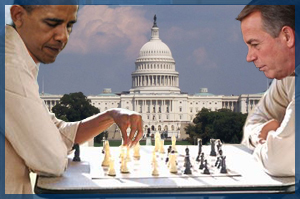
Chess Master or Pawn?
So I went and watched a silly movie (and thoroughly enjoyed it). I calmed down and decided to get back online for a bit. I read some reactions to the fiscal cliff deal from a different perspective, and now I think maybe I was wrong. Sure it’s a lousy deal, but it’s not over yet and at Obama did manage to preserve the social safety net programs, extend unemployment benefits, hold onto the earned income tax credit and child credits, and got some minimal revenue increases.
Look, I’m poor, but I’m not on unemployment. I was willing to go “off the cliff” in order to force the Republicans’ hand. But there are millions of poor and working class people out there would would really suffer if they lose their unemployment and those tax givebacks. Now those have been extended for a year at least. Yes, there will be another fight in two months, but there was going to be a battle royal in two months anyway. Now they will kill two birds with one stone–the debt limit and the sequester will be wrapped up in one fight.
Have I drunk the Koolaid? No, but I admit I really do want to hang onto some hope for the future. So beat me up in the comments all you want. I’m going to hold off judging this deal for two more months. Then if Obama completely sells out the poor and elderly, I’ll admit I made a big mistake. But for now, I’m willing to give Obama a chance.
My changed perspective came from reading a couple of diaries at DailyKos (so shoot me!) and then rereading pieces by Paul Krugman and Noam Scheiber. First up, a Kos diary by ban nock: “Obama’s Deal From a poor Person’s Perspective.”
As usual Obama looked out for us fairly well. All you folks in the financial industry who are weeping and wailing can just pound sand, cash in some stock options, sell your Lincoln, cry me a river.
The biggest thing is earned income tax credit and medicaid, neither of which were touched. Looks like we lost 2% on Social Security contributions but that is more than made up by the earned income credit (EIC)
I should do more to define poor. By poor I mean lower than median income down to, well, to really really poor. Median is around 40K.
The earned income credit is the thing that pulls the greatest number of people out of poverty in the USA. It’s an alternative to raising minimum wages.
You take your adjusted gross income and if you’re a family with a coupla kids making between $13K and $22K Uncle Sam is going to either reduce your taxes by around $5K or reduce them as much as possible and send you a fat check for the remainder. How cool is that? Chart to figure what you get here. http://www.irs.gov/… What is Adjusted Gross Income? That’s how much money you make, but it could come down for things like IRA contributions.
And then, as ban nock points out, there’s unemployment, which is the only thing between millions of Americans and abject poverty.
Now when I first read ban nock’s diary, I was somewhat skeptical. My point of view was that Obama is just warming up for the big kill, “entitlement reform.” But wait a minute. The Republicans were screaming for that in 2011 and again in this last fight. But they didn’t get it. In fact Harry Reid even took the Chained CPI off the table and Obama and Biden didn’t put it back on.
Then I moved on to this diary by Alexander Dukes AKA “Game Guru”: “Umm… We’re playing chess, not checkers. And we’re winning.” You really need to read the whole thing, but the gist is that Obama has been dealing with people who are utterly intractable–they’re actually buttfuck crazy!–so what Obama has done is to keep kicking the can down the road while each time getting something for nothing and at the same time preserving the social programs most needed by the poor and unemployed. Here’s an
First off, lets establish that we’re playing chess, not checkers. Our objective is not to win more battles than the Republicans, its to win the war. In this case its a war against the Republican objective to effectively dismantle Medicare, Social Security, Obamacare, the EPA and every other part of the government that doesn’t leave the people to the whims of the 1 percent. This is chess, so we can afford to lose a few pieces so that we draw our opponent in for the final blow. With every turn we attempt to move toward our ultimate goal, even if that means we take some blows along the way. Chess is a thinking man’s game, it takes a long time to play. Similarly, in these budget fights, Obama’s thinking about the long haul.
Lets examine the President’s strategy: In the first budget fight, Republicans wanted to extend the Bush tax cuts for everyone. The Democrats wanted to extend unemployment benefits and renew the START treaty. There was a great deal of debate… and something happened. What did we end up with? We got START, the unemployment extension, and what else…. what else… oh yeah, DADT was repealed! All for maintaining the tax status quo at the time. Essentially, we offered nothing, and the Republicans got nothing.
Okay, so we gave up the hope for more revenue from taxing the rich, but as Republicans keep pointing out, that new revenue won’t even keep the government going for very long. It’s mostly a symbolic effort to restore some fairness to the tax system.
After that was the debt ceiling fight. Well, Obama almost got to a deal back in 2011, but to no avail. So to raise the debt ceiling congress created the sequester. Nothing for nothing there. Not a bad or good deal, because there wasn’t really a deal at all. But in the sense that there was a deal, both sides agreed to a lame duck rematch, betting that their side would win the election and have the leverage in the sequester fight. Obama won the election, so he had the leverage.
Again, Republicans basically got nothing–just a fake deadline that everyone knew all along was just kicking the can down the road.
Lets discuss what happened (and is still happening) today. Yesterday, Mitch McConnell and Obama reached a deal that did 3 main things: It ends the Bush tax cuts for those making over $400K, it raised the estate tax for those with estates greater than 5 million, and extends unemployment benefits for another year. For this, the Republicans gained… nothing.
That’s right, nothing. Yes, the sequester is extended for only 60 days, but that bumps right up against the debt ceiling… something the Republicans were going to fight over anyway. The media common wisdom is that the Republicans gained “leverage” in this deal. How so? Obama just combined two potential clusterf*cks into one! He gained a years worth of unemployment benefits, tax hikes on the 1%, and an estate tax hike; all for making his job easier in the long term.
Next time Obama may have to cave on the Chained CPI, which would be horrible, but better than privatization of Social Security. But maybe he won’t have to give that up, who knows? All we know for now is that Social Security hasn’t been changed yet.
Obama wanted the debt limited to be raised with the elimination of the sequester. This is essentially raising the limit along with eliminating the sequester, only now he’s getting more of what he wants when the debate starts because he’s already got the tax hikes and the unemployment extension!
Not only that, but now he has two major speeches between now and then to set the debate squarely in his favor.
It makes sense to me. Frankly, I buy it for now. And you know why I’m willing to string Obama along for another two months? Because of what happened in his second debate with Mitt Romney:
Please proceed, Governor.
Please proceed, Speaker.
Maybe I’m nuts, but maybe I’m not. I’m going to wait two months and find out. Now let’s look at what Krugman had to say about the upside of the deal:
To make sense of what just happened, we need to ask what is really at stake, and how much difference the budget deal makes in the larger picture.
So, what are the two sides really fighting about? Surely the answer is, the future of the welfare state. Progressives want to maintain the achievements of the New Deal and the Great Society, and also implement and improve Obamacare so that we become a normal advanced country that guarantees essential health care to all its citizens. The right wants to roll the clock back to 1930, if not to the 19th century.
There are two ways progressives can lose this fight. One is direct defeat on the question of social insurance, with Congress actually voting to privatize and eventually phase out key programs — or with Democratic politicians themselves giving away their political birthright in the name of a mess of pottage Grand Bargain. The other is for conservatives to successfully starve the beast — to drive revenue so low through tax cuts that the social insurance programs can’t be sustained.
The good news for progressives is that danger #1 has been averted, at least so far — and not without a lot of anxiety first.
Romney lost, so nothing like the Ryan plan is on the table until President Santorum takes office, or something. Meanwhile, in 2011 Obama was willing to raise the Medicare age, in 2012 to cut Social Security benefits; but luckily the extremists of the right scuttled both deals. There are no cuts in benefits in this deal.
And Scheiber’s take on the upside:
I think a reasonable person can defend the bill on its own terms. The fact is that nudging up the tax threshold to $450,000 only sacrifices $100-200 billion in revenue over the next decade (against the $700-800 billion the administration would have secured with its original threshold), while allowing unemployment benefits to lapse would cause real pain to both the 2 million people directly affected and, indirectly, to the economy. Yes, Obama could have gotten the latter without giving up the former had he just waited another few days—at which point what the GOP considers a tax increase suddenly becomes a tax cut. But these things are always easier to pull the trigger on when you, er, don’t actually have to pull the trigger. I can’t begrudge Obama his wanting to avoid some downside risk for only a marginally better deal.
In other words, we are dealing with insane people–the Republicans in the House and Senate–and so far we haven’t given away the real farm, the social safety net. Unfortunately we don’t have enough revenue for a real stimulus either, but we go back to the table in two months and the Republicans are scoring that as a win for them.
But what if it’s not? What if dealing both issues at once–the debt ceiling and the sequester–and sooner, is an advantage for Democrats and the White House? We can’t know for sure until the next fight. But Obama did get a year of unemployment, those tax givebacks, and some symbolic concessions from the super-rich. And he does have the State of the Union and Inauguration speeches to call out the Republicans and make his case.
So that’s why I’m going to give this deal a chance for now. It’s not a great deal, but the important stuff has been protected for the time being. Now go ahead and hammer me in the comments, I don’t mind.

 peej
peej Carissa
 bostonboomer
 dakinikat
 ecocatwoman
 mablue2
 Mama Lopez
 peggysue22
 quixote
 skydancingguestblogger
 Mona (aka Wonk the Vote)



 Sky Dancing
Recent Comments