
Senate Fails on Dream Act
Posted: December 18, 2010 Filed under: Civil Rights, Democratic Politics, Human Rights, jobs, legislation | Tags: senate fail, The Dream Act 12 Comments
People are NOT Political Pinatas
Right after Hurricane Katrina, New Orleans had an influx of Mexican workers. Many spent their evenings at Vaughn’s because owner Cindy has a house in Mexico and has a lot of cantina music on the juke box. She also runs a gift store that sells native art from all over Mexico. There’s a side room with a TV that’s mostly on soccer too. We’re a very welcoming neighborhood. The upper 9 is pretty diverse and tolerate. We’re known as the place where the gay community, artists, writers and musicians live as well as a huge number of working class people. It’s an inner city hood. Make no doubt about that. Most of the neighborhood didn’t didn’t flood since it’s so close to the Mississippi. It was a natural place for recovery workers to dwell. We’re one mile east of the French Quarter via the River Road. Close enough to walk, bike or take the shuttle, but far enough to miss Mardi Gras madness and tourists.
Anyway, I got to meet a young man in his early 20s there. He was extremely cute, had a wicked crush on my neighbor, and you wouldn’t know he was Mexican because he could barely speak Spanish. He’d been brought to the country as a baby and was educated in U.S. schools. For all intents and purposes, Juan is a typical American young adult about the age of my oldest daughter. But, if he were picked up by ICE, he would be sent back to a country where he knows no one, can’t speak the language very well, and has absolutely no attachments. Why would we do that? His story compelled me to find out more about the Dream Act. I can’t see visiting the ‘sins’ of the elders on kids like these. Current immigration policy is way too harsh.
Evidently, Senate Republicans and RINOs disagree with me.
The Senate failed Juan and many other kids of various foreign births in similar situations. (I was surprised to find how many Irish and New Zealand illegals we have in New Orleans so it’s not just all about Mexicans, but their numbers are obviously larger.) This information is from the NYT and David Herszenhorn. To me, Passing the Dream Act should’ve been a no brainer. The Republicans held together in their block of “no to everything we didn’t think of” and then there were the usual RINOs like Ben Nelson who represent the neanderthal wing of the Democratic Party.
The Senate on Saturday blocked a bill that would have created a path to citizenship for certain young illegal immigrants who came to the United States as children, completed two years of college or military service and met other requirements, including passing a criminal background check.
The vote by 55-41 in favor of the bill, which is known as the Dream Act, effectively kills it for this year, and its fate is uncertain. The measure needed the support of 60 senators to cut off a filibuster and bring it to the floor.
Supporters said they were heartened that the measure won the backing of a majority of the Senate. They said they would continue to press for it, either on its own or as part of a wide immigration overhaul that some Democrats hope to undertake next year and believe could be an area of cooperation with Republicans, who will control a majority in the House
Most immediately, the measure would have helped grant legal status to hundreds of thousands of illegal immigrant students and recent graduates whose lives are severely restricted though many have lived in the United States for nearly their entire lives.
Young Hispanic men and women filled the spectator galleries of the Senate, many of them wearing graduation caps and tassels in a symbol of their support for the bill. They held hands in a prayerful gesture as the clerk called the roll and many looked stricken as its defeat was announced.
President Obama had personally lobbied lawmakers in support the bill. But Democrats were not able to hold ranks.
Five Democrats joined Republicans in opposing the bill. They were Democratic Senators Max Baucus of Montana, Kay Hagan of North Carolina, Ben Nelson of Nebraska, Mark Pryor of Arkansas and Jon Tester of Montana.
I’ve never been sure why we make it so hard for people to get citizenship here. My Lama–a Sherpa from Nepal– just got his citizenship last year via his religious VISA and green card being the lama at our Dharma Center. I’m sponsoring his young son who just started at UNO and wants to be a doctor. His daughter is in Massachusetts now with other sangha family going to community college. I’ve been sponsoring Sherpas for some time now.
There are lots of students I meet from other countries that major in areas where we could used some help. Of course, any service to our country through military or other duty should be rewarded. But, some folks just cling to some xenophobic idea of being overrun by outsiders or something. This confuses me because if some one really wants to be an American and contribute, we should reward it. We shouldn’t make villains of the very people that want to be us. The senate garnered 55 votes. That’s a clear majority. Something is very wrong right now with the beltway. So many people’s lives should not be held hostage by a belligerent minority. People are not political pinatas.
Moody’s Plays the Market
Posted: December 14, 2010 Filed under: Catfood Commission, Equity Markets, Global Financial Crisis, legislation, The Great Recession | Tags: Debt Ceiling, Moody's, Obama-McConnell Tax plan, Steven Hess, US soverign debt ratings 22 Comments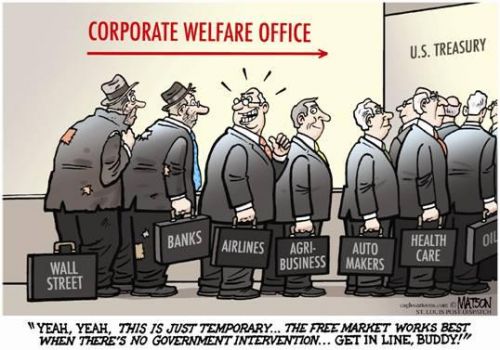 I mentioned in my thread on Tax Pandering last night that the rating company Moody’s is threatening to downgrade the U.S.’s credit rating over the Obama-McConnell Tax plan. Well, it seems a few folks have noticed a very interesting situation. Richard Smith at Naked Capitalism and Jane Hamsher at FDL notice a distinct change in message from Moody’s based on prior statement a week before. Also, Scarecrow at FDL has a related post up now.
It basically looks like they were for it before they were against it. This is odd and can only come under the heading of something’s rotten in Wall Street.
I’ve been down on Moody’s since they played such a major contributing role to the Financial Crisis by rating mortgage investment trash AAA. I’ve believe that it is only through lobbying and influence that they have managed to avoid legal and financial responsibility for their role in the entire debacle. Both Moody’s and Standard and Poor’s put their AAA+ ratings on trash. High ratings indicated to the market that the investments were safe so that many pension plans invested in what was essentially a junk bond level investment. They even highly rated subprime tranches. I’ve always felt there was a massive fraud investigation out there or at the very least a class action law suit but it’s never happened. My guess is they are highly connected to the current White House.
So, this week’s actions of note is that they seemed to have changed their tune from what they were saying prior to the cloture vote this week. On December 7th–via Scarecrow’s link to Jane–we can see Moody’s approach to reckless tax policy was simply “No Problem”. This comes from Bloomberg.
“The extension of the current tax rates is for a temporary period of two years and we think that if that’s all there is to it — it does not have ratings implications,” Steven Hess, senior credit officer at Moody’s in New York, said in an interview today. “We have a stable outlook. We don’t feel it will get changed downward in the next year or two.”
A week later, the same Steven Hess puts out a completely different vibe to The Hill. This is the message I read when I wrote my post last night.
“From a credit perspective, the negative effects on government finance are likely to outweigh the positive effects of higher economic growth. Unless there are offsetting measures, the package will be credit negative for the US and increase the likelihood of a negative outlook on the US government’s Aaa rating during the next two years,” Moody’s analyst Steven Hess writes.
So, reasonable minds would like to know what changed Mr. Hess’ mind so quickly? Was it that he was greasing the vote before the cloture vote and now he’s setting us up for something else since this horrible tax plan looks like it will pass? Richard Smith snarks in the affirmative.
A cynic might think that the Dec 7th report was Moody’s putting all its credibility behind the deal to extend the tax cuts, while the Dec 12th report was Moody’s putting all its credibility behind a move to ensure Obama got no political credit for it, once the deal, that they had implicitly supported a week earlier, was looking much more certain. That type of maneuver will have a familiar feel to the bedraggled Obama, one suspects.
Scarecrow talks about how these ‘impermanent’ tax cuts shouldn’t rattle any markets. The analysis is spot on so actual financial/economic analysis can’t possibly be the reason for the announcements and the change of heart.
For the umpteenth time, the US, unlike the suffering Ireland, Portugal, Spain, etc in the Euro zone, has its own currency and fiat money. It can’t be forced to default. Unless the people who run the country are complete idiots [insert news stories here], and refuse to use the tools and powers they have, the US is not at any risk of defaulting on its debt.
Moreover, the tax package is for two years. If one assumes that’s it, then there is no long-term structural deficit to cause us problems in the long run.
Richard Smith goes into some detail and argues that Moody’s can’t possibly be taken seriously by any one in the market any more because of the aforementioned subprime market crisis. Moody’s had tingling legs aplenty during the lead up time for both Countrywide and Bank of America who wouldn’t even exist today if it weren’t for congressional and white house largess using tax payer money.
Moody’s words can still probably move some markets. But, I think more importantly, it can move Congress Critterz and enable them to do all kinds of things.
So, what is the deal here? Well, this is the hypothesis of both Bostonboomer and me. It’s future cover for the upcoming Obama Tax ‘simplification’ plan and his plan to slash the budget–make that the part that impacts you and me and not Halliburton–when government gets shut down by the Republicans. My guess is the Hess statement will be brought up during the sturm and drang over increasing the debt ceiling once we bump into it early next year.
I’m pretty convinced of this. I’ll point to a CSM op ed for some back up on that.
Obama tax deal could start an era like Reagan’s
The Obama tax plan, if passed, would build trust between Republicans and Democrats. The next step could be tax simplification. The Reagan-era reforms provided helpful lessons.When it comes to tax reform, is Barack Obama another Ronald Reagan?
That seems to be the way President Obama is painting his political role over the next two years.
Like Reagan in the 1980s, Mr. Obama hopes to find a bipartisan consensus with Congress for simplifying the tax code.
His first big step toward that goal was to negotiate a deal with the newly empowered Republicans on extending the Bush-era tax rates. He also endorsed some ideas from his deficit-cutting commission, especially those aimed at eliminating most tax deductions, credits, and exemptions. And he has instructed aides to prepare tax-reform proposals.
The Republicans have already shown that they are willing to shut down government over the pending debt ceiling issue. This despite the fact we’ve basically got wars going on on four fronts: Iraq, Afghanistan, Pakistan and Yeman.
It’s all about who’s in the White House. One of the last bills the 110th Congress passed under the Bush Administration contained an increase in the debt, and 33 Republicans voted for it. Just a few months later, right after the Obama Administration took power, only 2 Republicans voted in favor of a bill raising the debt limit. Now, in these two examples, the debt limit provisions were attached to larger bills — TARP and the Stimulus Act — but, take a look at the historical data and the trend is borne out.
Speaking with unusual candor after the most recent debt limit vote, Rep. Michael Simpson [R, ID-2] said that it wasn’t the minority party’s responsibility to vote for raising the debt limit and called such votes “the burden of the majority.” It’s not clear how the Democratic majority will pull this off next session over what will likely be unanimous Republican opposition. David Waldman at Congress Matters suggests that the Democrats take up filibuster reform first, possibly in the lame duck session, so they can do it with 51 votes.
Obama appears to dislike conflict and taking Democratic-principled stands. I can only imagine what concessions are being planned at this very moment to deal with how the Congress will deal with raising the debt limit. Obama caved in on inheritance taxes, caved in on extending tax breaks to millionaires and billionaires, and he’s added pork goodies to the Dubya tax extensions like ‘grants’ to ethanol growers and equipment write off benefits for some one. I say some one because it’s sure not due to our current Industrial Production Capacity or the lack of corporate profits right now. We’re being bribed with 13 months of extended unemployment benefits and a social security payroll holiday that every one appears to dislike and find suspicious. The question is, for what?
We may truly be on the verge of another era of Reagan’s VooDoo economics пятилетка. This is a folly that we cannot afford. Even David Stockman and Bruce Bartlett–architects of Reaganomics–know these policies are detrimental to the U.S. economy and will be detrimental to all but the very rich among us. All this tax crap is pandering and manipulation. It has no basis in economic theory or past economic data. This has to be more of the Starve the Beast Republican Holy Grail enabled by a President who would rather go to a party hosted by Michelle than stick around and deal with questions of policy. I am sure this will be used to foist the nonsense from the Cat Food Commission on us all. I am simply bereft of hope for the future of this country.
update: A few minutes after I posted this, DDay at FDL has another germane post up: ‘Corker Assembles Debt Limit Shock Doctrine Team’. He must be thinking what BB and I are thinking. Corker is demanding cuts to ALL social programs in exchange for a yes vote to lift the debt ceiling.
The single most important thing that House Democrats could demand, in exchange for the tax cut bill’s passage, is an increase of the debt limit inside the package. It would in effect protect whatever stimulus you might get out of the bill, and deny Republicans another hostage-taking event.
Social Security: Why mess with an American Success Story?
Posted: December 10, 2010 Filed under: Catfood Commission, legislation, POTUS, The Bonus Class, U.S. Economy, Voter Ignorance | Tags: Clinton Obama presser, payroll tax holiday, Social Security 54 Comments
I spent most of the day listening to the Bernie Sanders show, but stories of the joint Clinton/Obama presser that turned into the Bill Clinton show grabbed my interest. I have more than a passing interest in Social Security. I haven’t paid into it for about 15 years, but I have an exhusband who has and I have 20 years worth of dibs on his account. I’m a tailend boomer with a much smaller nest egg post Financial Crisis than pre Financial Crisis. Ex Hubby’s social security and his pension plan loom on my horizon. They stop me from having bag lady nightmares.
So, what’s all this talk about a payroll tax holiday and why, all the sudden, is the Cat Food Commission’s foray into social security creeping me out? Well, for one I think that a lot of people–including the President–don’t seem to get social security, its history, its issues, and its challenges and that always irks me. For another, I think it opens this trap door to having more of my future Shanghaied. I don’t want any more of anything related to my future going off to Shanghai.
So, since the President–among others–is spreading disinformation about the Social Security program, I thought I’d take the time to remind you that I wrote a four part series on Social Security in May 2009. If you want a little background and perspective, you can go check it out. (Fortunately, it’s here in the file cabinet portion of Sky Dancing.) It is all based on Academic work and people that do active research on the program, its solvency, and its issues.
First, here’s a list of links to those old posts of mine:
Social Security: Reform, Refund or Opt-Out (Part 1) Introduction
Social Security: Reform, Refund or Opt-Out (Part 2) Public Pension Concepts and Alternatives
Social Security: Reform, Refund or Opt-Out? (Part 3) Lessons from the World
Social Security: Reform, Refund, or Opt Out? (Part 4) What to do when Pensions are out of balance
I wanted to point these out since I don’t want to completely reinvent the conversation here. The government has a website that it dedicated solely to the Social Security Act of 1935. There are still many, many people that do a lot of research in the area. Here is a link to one of the new studies that looks at the impact of increasing the level of maximum earnings subject to Social Security and its impact on the program. This is one of the things that is being suggested to increase funding for social security. Here is a brief from the National Academy of Social Insurance that looks at various funding formulas. This group is actually associated with actuaries so it is quite statistics intensive. Findings specific to this brief are:
- The number of Social Security beneficiaries per 100 covered workers will increase from 30 in 2005 to 46 in 2030 and to 50 in 2050.
- Social Security benefits will rise from 4.3 percent as a share of the total economy today to 6.1 percent in 2030.
- When baby boomers are retired, the total number of people each worker supports(including workers themselves, children, retirees, and other nonworking adults) will not be as large as it was when the baby boomers were children.
- As a share of the total economy, spending for Social Security benefits when baby boomers are retired will grow less than spending for public education grew when baby boomers were children.
- While baby boomers may have been a surprise when they turned up in record numbers to enroll in kindergarten in the 1950s, their retirement six decades later is not. Policymakers began to plan as early as 1983, when Congress lowered the cost of Social Security benefits for boomers and later generations by raising the age at which unreduced retirement benefits will be paid.
- Workers’ wages are projected to grow in real terms (that is, faster than inflation). By 2030, real wages will increase 33 percent. Even if policymakers chose to balance Social Security’s finances solely by a tax rate increase, workers’ net wages (after paying the higher tax) would still be 28 percent higher than they are today.
- While earnings that are taxed to pay for Social Security represent 38 percent of the total economy, other national income is not taxed for Social Security purposes.
- Broadening the tax base, reducing scheduled benefits, raising the Social Security tax rate, or allocating other kinds of revenue to Social Security are ways to improve Social Security finances.
So, you can see this isn’t an urgent issue right now. I guess my point is that the ‘sudden’ urgency we seem to have with social security is not something out of the blue and it’s not something that hasn’t been discussed, planned for, or actually worked on. As recently as August, the President himself gave a speech saying just these things which is why I am so confused about the Cat Food Commission’s dalliance with the program.
President Obama said Social Security is not in crisis and only modest changes are needed to keep it solvent.
The president acknowledged at a small town hall gathering in Columbus, Ohio, Wednesday that the pension fund “has to be tweaked because the population is getting older” but said Republicans’ plans to drastically overhaul the program are wrong.
“Social Security is not in crisis,” Obama said. “We’re going to have to make some modest adjustments in order to strengthen it.”
I also wanted to bring up a little bit on the idea of Payroll Tax Holidays and that bizarre Clinton/Obama presser today. I’m even more confused by this sudden urge to create a payroll tax holiday. This is an odd thing.
The tax deal reached between President Obama and congressional Republicans could mean a higher tax bill for roughly one in three workers as a result of the Social Security tax cut Republicans pushed as a replacement for the current Making Work Pay tax credit.
The Making Work Pay credit gives workers up to $400, paid out at 8 percent of income, meaning that anybody making at least $5,000 gets the full amount — and gets as much as anybody else. Its replacement knocks two percentage points off the payroll tax cut, meaning a worker would need to make $20,000 to get a $400 break. Of the nation’s roughly 150 million workers, around 50 million make less than $20,000 and will see at least some increase as a result.
Additionally, roughly a quarter of 20 million state and local workers pay no payroll tax, because they have a separate pension system. Some of those workers with children will benefit from the extension of other tax credits, but overall will have less money in their pocket.
Rep. Raul Grijalva (D-Ariz.), co-chair of the Congressional Progressive Caucus, said many House liberals were opposed to the payroll tax cut because of its effect on the poorest workers. Progressives are also concerned that the tax cut will become permanent and undermine Social Security’s funding stream and political support over time.
Social Security is a stand alone program. Mixing it as part of a goodie bag with other tax things doesn’t strike me as a very good idea from a political standpoint. It’s not part of the general budget. It’s a form of insurance. We (or in my case, my exhusband mostly) paid into it. Why mix it up with other tax give aways?
I did go hunting about for information on Payroll Tax Holidays to see if they really could stimulate the economy effectively. One of my issues is that I know that the FICA taxes are regressive because of the maximum income ceiling so I thought that the spending impact couldn’t be very large. So, it seems like getting rid of some of those taxes really gives more to the rich than the poor. Rich folks really aren’t very reliable spenders. Turns out, my hunch was studied and released in early 2009 at CBPP. They basically say that the biggest benefits would go to workers least likely to spend the money. That also seems to be every one’s take on this program. Also, there are people like me who worked for states and municipalities that don’t do Social Security. We don’t get a thing from this.
A payroll tax holiday, however, would both be costly — a two-month suspension could cost about $120 billion, for example — and likely relatively ineffective as a stimulus measure. Public resources would be better spent on stimulus measures with a higher “bang for the buck,” such as the Making Work Pay tax cut that President-elect Obama has proposed.
Economic stimulus measures aim to encourage an immediate increase in aggregate demand by boosting consumer spending. The most efficient way to boost consumer spending is to put money into the hands of people who will spend it quickly rather than save it; tax cuts focused on moderate- and low-income households are more effective as stimulus than tax cuts that are larger for people with higher incomes, because people at low-income levels spend a larger share of tax cuts they receive than people at higher income levels do.
A payroll tax holiday does not score well on this front — too little of the benefit goes to lower-income households struggling to make ends meet and too much goes to higher-income taxpayers, who are likely to save a significant fraction of any new resources they receive. Under the payroll tax, employees pay tax of 6.2 percent on earnings up to $106,800. So, for example, a worker earning $10,000 would receive a tax cut of just $103 from a two-month payroll tax holiday, while a worker earning ten times as much ($100,000) would receive a tax cut ten times as big — $1,030. Indeed, the highest-income fifth of households could receive more than half of the benefits that would go to workers from a two-month payroll tax holiday.
So, when President Clinton got up to day in a presser with Obama to support this comprise deal, I was really confused. It seemed like a double play triangulation move with a snagglepuss type-exit stage-left by POTUS. You can say a lot about Clinton–both good and bad–but he does understand his economic theory. Why would he support this?
Clinton comfortably outlined how the pending package of tax cuts, business incentives and unemployment benefits would boost the economy – even though it included tax help for the wealthy that Obama had to swallow.
“There’s never a perfect bipartisan bill in the eyes of a partisan,” Clinton said. “But I really believe this will be a significant net-plus for the country.”
When he finished his pitch, Clinton played the role of humble guy, saying, “So, for whatever it’s worth, that’s what I think.”
So, it all boils down to what can we get something past the Republicans? This entire deal puts Social Security in an awkward light. It also uses money for a payroll tax holiday that probably isn’t as efficacious as it could be if put to other uses. It also plays into the idea that giving taxes back to rich people stimulates the economy enough (VOODOO economics). It also indicates that playing up to adherents of VooDoo economics is worth adding to the deficit and to the problems with the deficit and the challenges social security faces in the future. It sets them up to make bigger arguments down the line.
I guess after reviewing everything, I just don’t see how this is worth it. Passing all of this because it’s the best you can do given the state of the Republican Klan in Kongress just isn’t good enough for me. It opens up too many issues in other areas. However, this is the graph they’re circulating as a White House talking point to show how Obama got the better deal. This is the graph that has Charles Krauthammer’s tie in a too tight double Windsor knot so much that Clinton brought it up.
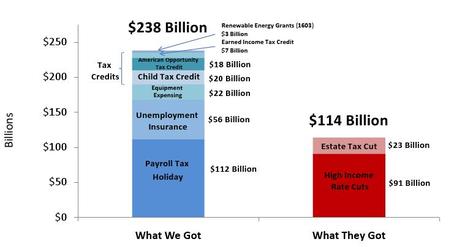
I’m not buying it. How about you?
Filibuster!
Posted: December 10, 2010 Filed under: just because, legislation, Live | Tags: Bernie Sanders Filibuster for the Middle Class, Filibuster, Obama-McConnell Tax Breaks extension, Seanator Landrieu, Senator Sanders, Tax Breaks for Billionaires 121 Comments Well, I guess it’s going on long enough we need to open a live blog thread!!!
Senator Bernie Sanders has started a filibuster of the Obama/McConnell behind-closed-doors tax deal.
Sen. Bernie Sanders (I-Vt.) — a self-described democratic socialist — railed against the plan in a lengthy floor speech that he said “you [can] call … a filibuster.”
“You can call what i am doing today whatever you want, you it [sic] call it a filibuster, you can call it a very long speech … ,” read a message posted on Sanders’s Twitter account after he’d taken to the rostrum at 10:24 a.m.
“I’m not here to set any great records or to make a spectacle,” Sanders said at the top of his speech. “I am simply here today to take as long as I can to explain to the American people the fact that we have got to do a lot better than this agreement provides.”
CSPAN-2 is live streaming the Senate.
Right now, my Senator Mary Landrieu is up and appears to be aiding the effort. She even has a nifty graph up about my state of Louisiana.
Sanders has called the plan “virtually a Republican idea”.
Here are the CBO numbers on how much this tax plan will cost. The number is $858 billion dollars.
The Obama-McConnell tax compromise will cost $858 billion over the next 10 years, according to estimates from the Congressional Budget Office.
In other words, the Republican-backed tax plan will cost more than the stimulus bill, which priced out at $787 billion.
For starters, extending all of the Bush tax cuts for two years will cost a total $675.2 billion over 10 years, according to a Dec. 3 Congressional Research Service study. Setting the estate tax at 35%, adding an exemption for estates under $5 million, knocking 2 percentage points off employees’ portion of the Social Security payroll tax, and the cost quickly goes up.
So, how does the U.S. pay the bill?
Twitter Update from CSPAN on the Live Coverage:
Screen grabs from C-SPAN2 HD coverage of Bernie Sanders filibuster http://cs.pn/gveC51 & http://cs.pn/dFZNBq
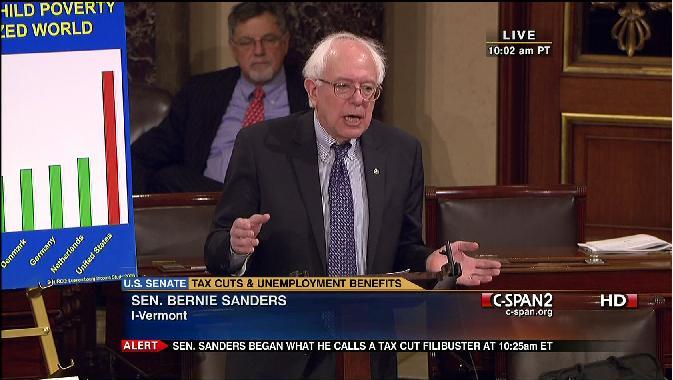
It’s a filibuster as filibusters were originally intended — and, as such, makes a mockery of what the filibuster’s become: a gimmick that allows a minority of senators to quietly impose supermajority requirements on any piece of legislation.
Joined at different times by Sen. Sherrod Brown (D-OH) and Sen. Mary Landrieu (D-LA), Sanders has been decrying the Obama tax cut plan for bailing out the wealthiest people in America. “How can I get by on one house?” Sanders railed, sarcastically. “I need five houses, ten houses. I need three jet planes to take me all over the world! Sorry, American people. We’ve got the money, we’ve got the power.”
US Senate: Defenders of about 0.3 percent of the population
Posted: December 4, 2010 Filed under: Elections, legislation, Team Obama, The Bonus Class, U.S. Economy | Tags: Bush tax cut extensions, Senate 31 CommentsNews on the Senate vote on various Democratic Tax Plan compromises has just come through on The Hill and Memorandum.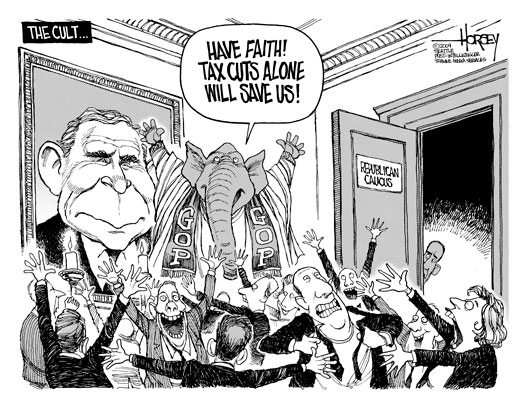 Two plans were introduced for votes. Both failed.
United Senate Republicans joined a small handful of Democrats on Saturday to defeat a pair of proposals to extend some of the 2001 and 2003 tax cuts signed into law by President George W. Bush.
Voting nearly identically, the Senate twice failed to meet a 60-vote threshold necessary to move forward on both proposals. Meeting in a rare Saturday session after agreements fell through for a Friday vote, the results were widely expected. They were also somewhat premature, as the White House is still negotiating with congressional leaders on an alternative compromise proposal.
The first proposal by Finance Committee Chairman Max Baucus (D-Mont.) would have extended the cuts only for individuals with incomes of up to $200,000 and families with incomes of up to $250,000. That failed by a vote of 53-36, with all GOP senators in opposition as well as Democrats Russ Feingold (Wis.), Joe Manchin (W.V.), Ben Nelson (Neb.) and Jim Webb (Va.).
The second proposal by Sen. Charles Schumer (D-N.Y.) would have extended the 2001 and 2003 tax cuts permanently for incomes of up to $1 million, among other provisions such as a one-year extension of unemployment benefits and cuts in capital gains, estate and dividend taxes. That failed, 53-37, with Sen. Tom Harkin (D-Iowa) joining the ‘no’ votes.
The Schumer Bill was referred to as the “Millionaire’s Tax” since most of his provisions applied to only about 0.3 percent of the population. Both plans essentially extended tax cuts to 98% of the population. Meanwhile, Mitch McConnell referred to the votes for both plans as “theatrics”. This is because Republicans had already signaled their intent to filibuster both plans. Patricia Murphy, writing for The Capitolist at Politics Daily, had this analysis. I bolded the last sentence to give you an idea of how well negotiations appear to be going.
As Democrats and Republicans continue to spar over the issue, time is running out for them to find a solution. If Congress fails to come to an agreement before the end of the year, rates for all Americans will return to 2001 levels when the Bush-era policy expires on December 31st. In addition to income tax hikes, the changes would increase the estate tax, the marriage penalty tax, taxes on dividends and capital gains, and the Alternative Minimum Tax.
While Democrats pushed their floor votes this week, a bipartisan group of senators and House members met behind closed doors with the Obama administration to hammer out a compromise on the tax issue. Vice President Joe Biden, filling in Saturday for Obama in the White House weekly address, made no mention of the negotiations, but said if the tax cuts aren’t extended “millions of middle-class families will see a big bite out of their paychecks starting Jan. 1. And that’s the last thing we should let happen.” Obama, speaking later at the Eisenhower Executive Office Building, said he was “very disappointed” that the Senate had not approved the tax bill. Continued Tax relief for the middle class should not be held “hostage” by those supporting an extension of the lower rates for high income Americans, he said.
Media reports indicated late last week that a deal had been reached to pass a two-year extension of all the tax cuts, along with a one-year extension of unemployment benefits, and the also new START nuclear arms treaty. But senior Senate aides familiar with the negotiations tell Politics Daily that Republicans feel little pressure to give in to Democratic priorities when they feel confident they can prevail on the tax issue without concessions.
It seems evident to me that the US Senate is willing to play political games with ordinary people’s lives. The Republicans appear to want to hold START, unemployment extensions, and the tax cuts for the majority of Americans hostage as they represent the interests of the very few uber wealthy and seek gridlock for their own power agenda. The Democrats have been out maneuvered once again. A year ago, this predicament would have been thought unbelievable. If you think it’s bad now, just wait until the jr. senators from Kentucky and Illinois enter the chamber.

 peej
peej Carissa
 bostonboomer
 dakinikat
 ecocatwoman
 mablue2
 Mama Lopez
 peggysue22
 quixote
 skydancingguestblogger
 Mona (aka Wonk the Vote)



 Sky Dancing
Recent Comments