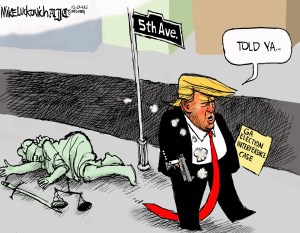
“Meanwhile, at Mars-a-Lago… Donold’s training pays off..” John Buss, @repeat1968,@johnbuss.bsky.social
Good Day, Sky Dancers!
With its tumultuous and ineffective leadership, the aptly named chaos caucus again plays a game of brinkmanship that risks American lives and the economy. I’m getting way too old for this kind of torment. The Republican-led Congress has completely forgotten its role in governance and its duties, ensuring the stability required for all the entities that rely on that and the rule of law to function. They only seem to air grievances and feed their raging ids. This year’s version comes with a dangerous twist. The prime chaos factor is the richest man on earth who was not elected or officially appointed to anything. His claim to fame is funding the Trump campaign and those of other Republican elected officials, and he has no clue about our system of government, our institutions, our Constitution, or, for that matter, anything. He’s also bugfuck crazy.
President Eject Incontinentia Buttocks is huddled down in Florida doing God knows what, and J Dank has gone missing. Milk cartons will soon have to show his picture and ask, “Have you seen this vice president?” Bayou Moses looks to be the next biggest loser of the House Speaker’s Gavel. The country looks like some twisted version of The Mouse That Roared. How are we to deal with a Cabal of Billionaires empowered by an angry crew of religious nuts, bigots, and know-nothings? They appear to own the house and the Supreme Court at the moment.
Meanwhile, back in the world of the same old shit, we get Mitch McConnell suddenly lecturing everyone and seemingly trying to protect the old magic ways of the US Senate. McConnell thinks he can swiftly change roles from Macbeth to King Lear. The Democratic Party is appointing the same old group that hasn’t been able to do anything to stop this to leadership positions. I cannot be the only one who doesn’t see any of this ending well.
So, how on earth did Elon Musk blow up a bipartisan deal on the budget? This is from Sam Stein writing at The Bulwark. “Elon Killed the Budget Deal. Cancer Research for Kids Was Collateral Damage. Advocates were celebrating the inclusion of money and provisions to help fund pediatric research. And then the tweets started.”
THE DECISION BY REPUBLICAN LEADERSHIP to scuttle a bipartisan funding deal on Thursday night has left lawmakers scrambling and others anxiously bracing for a government shutdown.
For a host of issue advocates, however, the prevailing mood in Washington, D.C. was one not of chaos but utter devastation.
The initial deal that congressional leaders had agreed to included a number of key priorities that, in the course of hours, were jettisoned by GOP leaders looking to calm Elon Musk’s pique and satisfy Donald Trump’s demands. And though the slimmed-down bill that Trump endorsed in its place failed to pass the House, few people expected that the initial deal would make a comeback—meaning that many of its components were likely gone for good.
The list of provisions left in the dust heap was lengthy. The initial compromise bill included language to ensure that providers of internet service to rural areas weren’t ripping off customers, to protect consumers from hidden hotel fees, to secure semiconductor supply chains, to restrict U.S. outbound investment in China, even to prohibit deepfake pornography. All those were all gone in the successor bill.
But some of the hardest cuts to swallow involved medical research. In particular, advocates say, the revised funding bill delivered a devastating blow to the fight against pediatric cancer.
The slimmed-down version was stripped of language that would have allowed children with relapsed cancer to undergo treatments with a combination of cancer drugs and therapies. (Currently the Food and Drug Administration is only authorized to direct pediatric cancer trials of single drugs.) The bill also didn’t include an extension of a program that gave financial lifelines, in the form of vouchers, to small pharmaceutical companies working on rare pediatric diseases. It was also missing earlier provisions that would have allowed for kids on Medicaid or CHIP—that is, poor children—to access medically complex care across state lines.
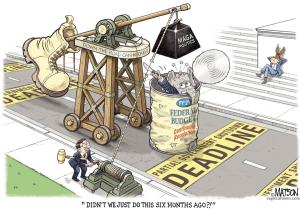
And, of course, Trump wants to ensure that there’s a two-year extension of the Debt Ceiling so that he can give away the Treasury to his Cabal and grift off the nation without having to take on the burden of once again landing the Federal Budget into record-setting red zones. He seriously believes that the voters will blame all these shenanigans on Biden, who is trying to Trump-proof things and get Federal judges appointed to the bench. Musk is on a rampage to replace the governments that once fought NAZIs with NAZIs all over the world and evidently has the money to attempt it. This is from New York Magazine. “Musk Pauses Torment of GOP to Praise German Extremists.” Nia Prater has the analysis.
Elon Musk has spent the better part of this week working to derail Congress’s attempt to fund the government, but he found time early Friday morning to express support for the politics of Alternative für Deutschland or Alternative for Germany, the country’s most prominent far-right political party.
“Only the AfD can save Germany,” Musk wrote on X early Friday morning.
The comment was in response to a video posted by Naomi Seibt, a German far-right activist, that criticized Friedrich Merz, the leader of the conservative party Christian Democratic Union of Germany. Recently, Merz has been leading in the polls to become the nation’s next chancellor next year. The caption for Seibt’s video read, “The presumptive next chancellor Friedrich Merz (CDU) is horrified by the idea that Germany should follow Elon Musk’s and Javier Milei’s example. He staunchly rejects a pro-freedom approach and refuses any discussion with the AfD.”
The AfD is a nationalist and anti-immigration party that has seen its popularity steadily grow over the last several years. In September, the party won its first state election, becoming the first far-right party to win an election in Germany since the Nazis, per CNN. AfD’s candidate in that race, Björn Höcke, is a controversial figure who has been fined for using a Nazi slogan and criticized for a speech many denounced as antisemitic.
Olaf Scholz, the current chancellor of Germany, was dismissive of Musk’s words when asked about them during an unrelated press conference with Estonian prime minister Kristen Michal on Friday. “We have freedom of speech, and that also applies to multibillionaires,” Scholz said, per Bloomberg. “But freedom of speech also means that you can say things that are not right and do not contain good political advice.”
This is not the first time that Musk has indicated support for AfD. Last year, The Guardian reported that Musk shared a pro-AfD post that criticized Germany funding charity groups that operate ships that rescued migrants, referring to the migrants as “illegal immigrants.”
“Let’s hope AfD wins the elections to stop this European suicide,” the post read.
Musk, who intends to play an starring role in Donald Trump’s second term, has similarly shown an affinity for other conservative leaders in Europe. He’s been pictured with Italian prime minister Giorgia Meloni and Nigel Farage, a British politician who leads the right-wing populist party Reform UK. In recent days, there’s been speculation that Musk might be considering a massive multimillion-dollar donation to Farage’s party, prompting worries among watchdog groups.
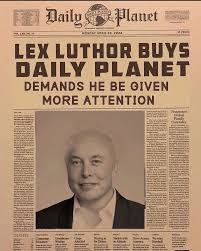
Musk has such a manic schedule, given he’s also trying to give parts of Ukraine to Putin, threatening to oust the Canadian PM, and blowing up the US economy today. Canadian TV had this headline last week. “Elon Musk calls Justin Trudeau ‘insufferable tool’ in new social media post.” Musk is channeling his inner Lex Luther!
Billionaire Elon Musk is calling Prime Minister Justin Trudeau “an insufferable tool” in a new social media post on Wednesday.
“Won’t be in power for much longer,” Musk also wrote about the prime minister on “X.”
Musk was responding to a video posted of Trudeau, in which the prime minister described Kamala Harris’ U.S. presidential loss as a setback for women’s progress.
“We were supposed to be on a steady, if difficult sometimes, march towards progress. And yet, just a few weeks ago, the United States voted for a second time to not elect its first woman president,” Trudeau said during a speech at the Equal Voice Foundation Gala in Ottawa on Tuesday night.
Trudeau also said women’s rights and women’s progress are “under attack overtly and subtly,” and that he “always will be a proud feminist.”
Musk, who is the CEO of Tesla and founder of space company SpaceX, has been tasked to co-chair U.S. president-elect Donald Trump’s new Department of Government Efficiency. He was also a prominent figure in Trump’s election campaign.
Wednesday’s post is Musk’s latest swipe at the prime minister since Trump was re-elected in November. Responding to a user on “X” on Nov. 7 asking for Musk’s help to get rid of Trudeau, Musk wrote “He will be gone in the upcoming election.”
Ontario Premier Doug Ford says he let Trudeau know his comments were “not helpful.”
Ford, who with the rest of Canada’s premiers, met with the prime minister and several of his cabinet ministers on Wednesday to discuss how Canada would respond to Trump’s tariff threats.
“Donald Trump was elected democratically,” Ford said, adding that the premiers made sure Trudeau “got the message loud and clear.”
Musk’s post also comes during a tense time in Canada-U.S. relations.
Trudeau has been facing social media jabs from Trump following the prime minister’s visit to Mar-a-Lago nearly two weeks ago to discuss Trump’s tariff threat. Last month, Trump threatened to impose a 25 per cent tariff on all Canadian imports on his first day in office unless Canada addresses his border security concerns.
Following that meeting, U.S. network Fox News reported Trump joked during the dinner in Florida that if the potential tariffs would harm the Canadian economy — as the prime minister conveyed to him — perhaps Canada should become America’s 51st state(opens in a new tab).
Days later, Trump posted an A.I.-generated image to social media that depicted him standing next to a Canadian flag(opens in a new tab) and overlooking a mountain range with the caption “Oh Canada!”
Evidently, since he managed to buy the US Presidency and dupe enough dolts into voting for the Dotard, he thinks he can do it with Canada and a good portion of Europe. He’s also being all kissy-face with the UK’s Nigel Farage. The AP characterizes all these shenanigans thusly. “Musk ascends as a political force beyond his wealth by tanking budget deal.” Is the legacy media going to sleep through all of this and cover it like mundane news? Thomas Beaumont has the analysis.
In the first major flex of his influence since Donald Trump was elected, Elon Musk brought to a sudden halt a bipartisan budget proposal by posting constantly on his X megaphone and threatening Republicans with primary challenges.
The social media warnings from the world’s wealthiest man preceded Trump’s condemnation of a measure negotiated by GOP House Speaker Mike Johnson, which effectively killed the stopgap measure that was designed to prevent a partial shutdown of the federal government.
Washington was scrambled a day after Musk’s public pressure campaign. Trump on Thursday first declined to say whether he had confidence in Johnson. But later in the day, Trump praised him and House leaders for producing “a very good Deal,” after they announced a new plan to fund the government and lift the debt ceiling.
Before the new deal was reached, Congressional Democrats mocked their GOP counterparts, with several suggesting Trump had been relegated to vice president.
“Welcome to the Elon Musk presidency,” Democratic Rep. Robert Garcia of California wrote on X.
What was clear, though, is Musk’s ascendance as a political force, a level of influence enabled by his great wealth. In addition to owning X, Musk is the CEO of Tesla and Space X.
Speaker Mike Johnson (R-La.) said he has a plan C to avert a shutdown and the House will vote Friday morning on the legislation — but Republicans indicated there is not yet widespread agreement.
“Yeah, yeah, we have a plan,” Johnson said Friday morning as he entered the Capitol. “We’re expecting votes this morning, so you all stay tuned. We’ve got a plan.”
He did not say what it entails. And lawmakers leaving meetings in Johnson’s office Friday morning indicated that there was not yet an agreement on a path forward.
“Anybody who’s telling you there’s an agreement is just a little bit ahead of themselves,” Rep. Dusty Johnson (R-S.D.), chair of the Republican Main Street Caucus, said as he left the Speaker’s office later Friday morning.
Lawmakers have little time to avoid a shutdown: Government funding runs out when the clock strikes midnight late Friday.
Sen. Markwayne Mullin (R-Okla.) said on CNBC on shortly after Johnson’s comments Friday morning that he thinks Washington will probably avoid a shutdown since “we’re pushed up against Christmas here,” saying a “clean” funding extension is likely.
“There’s a chance today a clean CR [continuing resolution], short-term clean CR — it may be for two, three weeks,” Mullin said. “That was something that was discussed, you know, late last night, you know, even some discussions this morning. I’m not going to say that’s going to happen, but you know, that’s really the option that’s on the table.”
Rep. Dan Goldman (D-N.Y.) on Thursday suggested Elon Musk is the one directing the Trump administration, not President-elect Trump, pointing to the tech entrepreneur’s leading position in opposing the government funding stopgap measure.
“Elon Musk has Donald Trump in a vise,” Goldman said on MSNBC on Thursday. “And it is very clear that Elon Musk is now calling the shots.”
Musk made several social media posts Wednesday criticizing the spending measure deal unveiled by House Republicans this week. He called the more than 1,500-page measure a big “piece of pork” while calling on GOP lawmakers to oppose it.
Trump later in the day also called for the bill to be dismissed, suggesting instead that Congress pass a clean continuing resolution with a debt hike increase. That proposal was rejected Thursday night, and Congress is now working on a plan C with less than 24 hours to go before the deadline.
“We need to face the reality: Right now, we have President Elon Musk. And Trump? Maybe he’s vice president, I guess,” Goldman said. “Vice presidents don’t do much, so that makes sense. He might be the chief of staff. I don’t know what you call him, but he is not calling the shots.”
Goldman is not the only Democrat saying Musk is the one calling the shots in the administration; a number of Democrats have made similar arguments, while the White House has said Trump and the GOP are doing the bidding of billionaires.
Meanwhile, the government is making plans for a shutdown. This is from the Washington Post.
House Republicans are discussing the latest plan from leadership to fund the government and avoid a shutdown before a midnight deadline. Several Republicans said the Rules Committee will meet to send two separate bills to the floor, which would need a simple majority to pass. They are: A clean extension of current fiscal levels until mid-March that includes an extension of a farm bill that requires reauthorization, and a $110 billion relief bill to help natural disaster survivors and aid farmers. Republicans had no plans for an immediate vote on suspending the debt limit, despite President-elect Donald Trump’s repeated demands. At the White House, press secretary Karine Jean-Pierre lashed out at Republicans who had agreed to a bipartisan deal and then abandoned it. “This is a mess that Speaker [Mike] Johnson created, that is his mess to fix,” she told reporters at the daily briefing, adding that there was “still time” for Republicans to “do the right thing.” The Office of Management and Budget alerted federal agencies Friday morning to prepare for an imminent government shutdown.
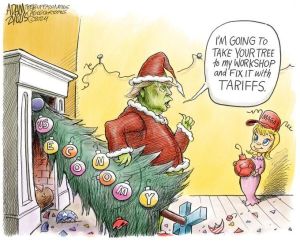
The budget fiasco isn’t the only thing threatening the US and the Global Economies. Trump is just not giving up on his ignorant view of tariffs. This is from CNBC. Trade negotiations are not subject to the art of the Deal. They are gamesmanship on an entirely different level. “‘Tariffs all the way’: Trump says European Union must buy U.S. oil and gas in trade ultimatum.” He thinks he looks like a tough guy, but anyone who knows about economic policy knows he just looks like an idiot.
Trump has made threats of sweeping tariffs on U.S. trading partners including China, Mexico and Canada a signature part of his presidential campaign — and he’s continued the narrative as he prepares to enter office, despite economists warning of risks to domestic inflation.
Analysts say there is high uncertainty over the extent of the tariffs Trump will be willing — or able — to follow through with, and how much of his rhetoric is a starting point for striking deals.
His latest comment comes after EU heads of state held their final meeting of the year on Thursday, during which the topic of Europe-U.S. relations was discussed.
“The message is clear: the European Union is committed to continue working with the United States, pragmatically, to strengthen transatlantic ties,” European Council President António Costa said following the meeting.
Enrico Letta, former prime minister of Italy and dean of the IE School of Politics, Economics and Global Affairs, told CNBC’s “Squawk Box Europe” on Friday that the EU needed to be prepared to retaliate to Trump’s threat.
“I think it is a transactional approach, we have to respond to this transactional approach. [Trump] mixes together energy and tariffs on goods, manufacturing and so on. I think it’s incorrect because the two topics are completely different,” Letta said.
“If the deal is proposed by Trump — such an asymmetric deal on topics that are not linked one to the other — I think we have to do the same.”
“Considering that the most asymmetric part is the relationship on the financial side, we have to start considering that maybe replying on the financial side could be a solution,” he said.
Ahead of the U.S. election in November, EU officials spent months preparing for a lurch toward U.S. protectionism and for a more confrontational relationship with the White House, in the event of a Trump victory. The EU has also made moves toward strengthening its relationship with the U.K., which left the bloc in 2020, as a guard against potential clashes over trade and defense.
It’s disturbing that many folks and the media are acting like Joe Biden is already out of the picture. However, Republican dysfunction could also deal the final blow to the Republican Party. Jeffries has control over his congress critters. It’s obvious Johnson doesn’t. You may remember that John Boehner threw up his arms and retired over the many chaotic factions. It hasn’t improved since then. Digby has an interesting view in her Salon column. “Elon Musk just killed Donald Trump’s honeymoon. We are seeing is an emerging crack in the GOP coalition.”
The activist base that had recently fashioned itself as the Tea Party after Obama’s election in 2008, quietly reinvented itself as the MAGA movement and lost all interest in fiscal austerity the minute Trump came on the scene. But there has always been some restiveness among the right-wing ideologues in the House and Senate who really want to massively cut discretionary spending and the so-called entitlements to the bone. They’re true believers in the idea that government should not help people, period. They were relegated to the back bench during Trump’s first term and spent most of their time tilting at windmills because Trump was happily spending like the treasury was his own credit line at Deutsche Bank.
He had no appetite for big spending cuts that might hurt his chances for re-election. After all, he didn’t run as a budget-cutting deficit hawk. He always claimed that he didn’t need to drastically cut spending because the debt would disappear with tariffs and unprecedented growth. He said the same thing during the 2024 campaign, insisting that it would even pay for government-funded child care, the worst of all possible worlds.
He pays lip service to cutting spending but he doesn’t really care about it. He’s told people he’s not worried about a U.S. debt crisis as he’ll be out of office by then. And he’s got stuff he wants to spend a lot of money on, like deporting millions of immigrants!
That’s never been clearer than this week when Speaker Mike Johnson, R-La., presented the bipartisan continuing resolution to fund the government until March and all hell broke loose in the House. Those rascally, backbench Tea Party/Freedom Caucus ideologues finally got the leader they’ve been waiting for and his name is Elon Musk, the richest man in the world.
It was a given that the Freedom Caucus gang would not vote for the bill. They vote no on everything. It had been negotiated by the bipartisan negotiators in both chambers with the knowledge that the Senate was still in Democratic hands and the tiny GOP majority in the House required a bipartisan compromise. Everyone knew that the screamers in the House would have a fit and call for Mike Johnson’s head (which is why they changed the rule raising the threshold from one member to nine.) And since the speaker knows better than to go to the john without getting Trump’s permission, you can be sure that Trump was kept informed of all of this. They all agreed that they would get rid of this hot potato, adjourn quickly and go home for the holidays.
That didn’t work out the way they planned it. Trump thought he had cleverly boxed Musk out of real power by creating a powerless “commission” for him and his sidekick Vivek Ramaswamy to come up with enormous spending cuts to reduce the federal government by as much as a third, which he knows won’t happen. However, Trump has essentially empowered Musk to speak for him by having him by his side every minute for the last three months. And seeing as he’s the richest man in the world who owns a major social media platform, he has plenty of power all on his own.
I have actually heard several talking heads think that Trump’s disinterest in the actual work for the job is worse this time around. The suggestions that he just ran for office to stay out of jail and that he would just be a figurehead may come to fruition. His dementia has worsened. He disappears from the public a lot. He doesn’t appear to have a craving for attention or energy. It may be that Doddering Don will be happy for everyone else to do his work as long as he can cuddle up to foreign dictators. I’m surprised Musk got this much press coverage and went rogue on the budget negotiations. The Donald that stalked Hillary wouldn’t have liked that.
But, who am I but a mostly retired economics professor who sometimes would just rather play the piano or guitar all day than think about this and have to unravel it for students.
What’s on your reading and blogging list today?
Did you like this post? Please share it with your friends:
Recently, Dakinikat has been writing about the notion of kakistocracy, government of the worst people. That is obviously where we are headed with Trump and his appointments of completely inappropriate and incompetent people to his cabinet, White House staff, and ambassadorships. The latest example is his nomination of Herschel Walker as Ambassador to the Bahamas.
The term “kakistocracy” (rule by the worst) emerged from obscurity during the first Trump administration. The word, which was previously used to describe troubled foreign governments, gained mainstream usage as critics pointed to controversial appointments such as Tom Price at the Department of Health and Human Services and Scott Pruitt at the Environmental Protection Agency—officials whose qualifications and conduct drew widespread criticism.
With President-elect Donald Trump’s imminent return to power, “kakistocracy” is back in public conversation. As the Economist noted by making it “word of the year,” Google searches for the term spiked in November: first after Trump’s victory, then after he nominated controversial officials for cabinet positions, including Matt Gaetz for attorney general and Robert F. Kennedy Jr. for secretary of health and human services, and again when Gaetz withdrew his nomination amid criticism. And Trump’s recent nomination of Kash Patel to lead the FBI has only intensified concerns about an impending kakistocracy.
More than just a problem of policy or politics, kakistocracy undermines a core constitutional principle: Functioning democracies need qualified individuals to hold public trust. Trump’s nominees threaten key constitutional norms in unprecedented ways: through their flaws, their number, and Trump’s willingness to skirt the procedural safeguards that ensure the Senate’s role in the appointments process. And like with so many of Trump’snorm-bustingactions in his first term, constraints will mostly have to come from the political process rather than the legal one….
The Constitution’s framers were obsessed with the quality of American public officials. Thomas Jefferson extolled “a natural aristocracy among men[,] the grounds of [which] are virtue [and] talents. … [T]he natural aristocracy I consider as the most precious gift of nature, for the instruction, the trusts, and government of society.” He argued, “[M]ay we not even say that that form of government is the best which provides the most effectually for a pure selection of these natural aristo[crats] into the offices of government?” Similarly, in the Federalist Papers, Alexander Hamilton recognized that personnel is policy, predicting that “judicious choice of men for filling the offices of the Union” would determine the “character of its administration,” while John Jay predicted that “when once an efficient national government is established, the best men in the country will not only consent to serve, but also will generally be appointed to manage it.”
The founders expected presidents to appoint competent and distinguished candidates for roles in their administrations.
Unsurprisingly, the Constitution carefully addresses the appointment of government officials. First, it makes the president primarily responsible for appointments. This decision—to have a single person, rather than a collective body, nominate officials—both strengthens the executive and, as Hamilton explained, increases the quality of the appointments, since having a single individual in charge increases their political accountability in case of bad appointees. In contrast, with a committee of appointments, “while an unbounded field for cabal and intrigue lies open, all idea of responsibility is lost.”
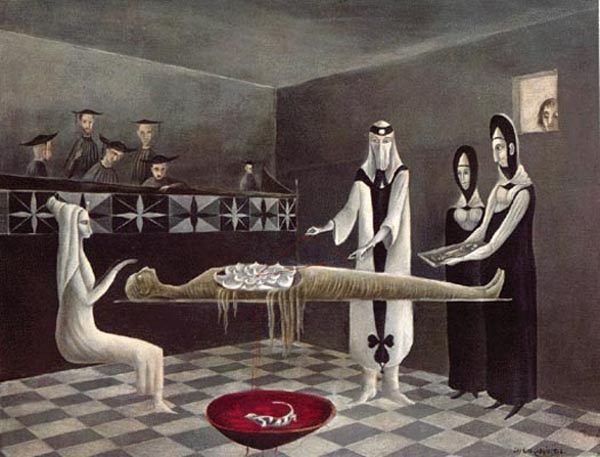
By Leonora Carrington
Second, the Constitution requires Senate consent to the appointment of high-level officers, subject to the limited exception of temporary appointments when the Senate is in recess. Hamilton argued that this limitation on the president’s appointment power would be an “excellent check upon a spirit of favoritism in the President, and would tend greatly to prevent the appointment of unfit characters from State prejudice, from family connection, from personal attachment, or from a view to popularity.”
Beyond the constitutional procedures of presidential nomination and Senate confirmation, the appointments process functions, as do so many parts of the Constitution, less as a matter of law than of norms. The expectation is that the president will nominate competent officials to run the executive branch and the Senate will exercise its confirmation power responsibly and block bad presidential nominees….
Trump’s nominations represent an unprecedented triple assault on constitutional appointment norms: First, many are unqualified or hostile to their agencies’ missions. Second, rather than making a few controversial picks, Trump has flooded the zone, nominating an entire slate of problematic candidates that burdens the Senate’s capacity for proper vetting. And third, Trump has signaled willingness to circumvent the confirmation process through legally dubious tactics such as forced Senate adjournment. Together, these moves threaten to transform the appointments process from a constitutional safeguard into a vehicle for installing loyalists regardless of competence.
There’s much more to read at Lawfare.
One of Trump’s goals in appointing his loyalist cabinet is to carry out his revenge against anyone who criticized him in the past or present. Kash Patel, whom Trump nominated as FBI director, already has an enemies list. Here’s the list, as posted at The New Republic:
Michael Atkinson (former inspector general of the intelligence community) Lloyd Austin (defense secretary under President Joe Biden) Brian Auten (supervisory intelligence analyst, FBI) James Baker (not the former secretary of state; this James Baker is former general counsel for the FBI and former deputy general counsel at Twitter) Bill Barr (former attorney general under Trump) John Bolton (former national security adviser under Trump) Stephen Boyd (former chief of legislative affairs, FBI) Joe Biden (president of the United States) John Brennan (former CIA director under President Barack Obama) John Carlin (acting deputy attorney general, previously ran DOJ’s national security division under Trump) Eric Ciaramella (former National Security Council staffer, Obama and Trump administrations) Pat Cippolone (former White House counsel under Trump) James Clapper (Obama’s director of national intelligence) Hillary Clinton (former secretary of state and presidential candidate) James Comey (former FBI director) Elizabeth Dibble (former deputy chief of mission, U.S. Embassy, London) Mark Esper (former secretary of defense under Trump) Alyssa Farah (former director of strategic communications under Trump) Evelyn Farkas (former deputy assistant secretary of defense for Russia, Ukraine, Eurasia under Obama) Sarah Isgur Flores (former DOJ head of communications under Trump) Merrick Garland (attorney general under Biden) Stephanie Grisham (former press secretary under Trump) Kamala Harris (vice president under Biden; former presidential candidate) Gina Haspel (CIA director under Trump) Fiona Hill (former staffer on the National Security Council) Curtis Heide (FBI agent) Eric Holder (former FBI director under Obama) Robert Hur (special counsel who investigated Biden over mishandling of classified documents) Cassidy Hutchinson (aide to Trump chief of staff Mark Meadows) Nina Jankowicz (former executive director, Disinformation Governance Board, under Biden) Lois Lerner (former IRS director under Obama) Loretta Lynch (former attorney general under Obama) Charles Kupperman (former deputy national security adviser under Trump) Gen. Kenneth Mackenzie, retired (former commander of United States Central Command) Andrew McCabe (former FBI deputy director under Trump) Ryan McCarthy (former secretary of the Army under Trump) Mary McCord (former acting assistant attorney general for national security under Obama) Denis McDonough (former chief of staff for Obama, secretary of veterans affairs under Biden) Gen. Mark Milley, retired (former chairman, Joint Chiefs of Staff) Lisa Monaco (deputy attorney general under Biden) Sally Myer (former supervisory attorney, FBI) Robert Mueller (former FBI director, special counsel for Russiagate) Bruce Ohr (former associate deputy attorney general under Obama and Trump) Nellie Ohr (wife of Bruce Ohr and former CIA employee) Lisa Page (former legal counsel for Deputy Director Andrew McCabe at FBI under Obama and Trump; exchanged texts about Trump with Peter Strzok) Pat Philbin (former deputy White House counsel under Trump) John Podesta (former counselor to Obama; senior adviser to Biden on climate policy) Samatha Power (former ambassador to the United Nations under Obama, administrator of AID under Biden) Bill Priestap (former assistant director for counterintelligence, FBI, under Obama) Susan Rice (former national security adviser under Obama, director of the Domestic Policy Council under Biden) Rod Rosenstein (former deputy attorney general under Trump) Peter Strzok (former deputy assistant director for counterintelligence, FBI, under Obama and Trump; exchanged texts about Trump with Lisa Page) Jake Sullivan (national security adviser under President Joe Biden) Michael Sussman (former legal representative, Democratic National Committee) Miles Taylor (former DHS official under Trump; penned New York Times op-ed critical of Trump under the byline, “Anonymous”) Timothy Thibault (former assistant special agent, FBI) Andrew Weissman (Mueller’s deputy in Russiagate probe) Alexander Vindman (former National Security Council director for European affairs) Christopher Wray (FBI director under Trump and Biden; Trump nominated Patel to replace him even though Wray’s term doesn’t expire until August 2027) Sally Yates (former deputy attorney general under Obama and, briefly, acting attorney general under Trump)
Last week, I noted with alarm that House Republicans were shrugging off—or even approving of—Donald Trump wanting to jail some of their past and current colleagues who served on the January 6th Committee. As it turns out, I underestimated their bloodthirstiness.
Yesterday, a key House Republican released a report directly calling for a criminal investigation into former Rep. Liz Cheney for her committee work.
The report came from Rep. Barry Loudermilk (R-Ga.), whom House Republicans tapped two years ago to spearhead the House Administration Committee’s probe into the actions of the January 6th Committee itself. It was clear from the start that Loudermilk’s primary goal was to shift blame for the attempted insurrection away from Trump. His report works plenty hard at that.
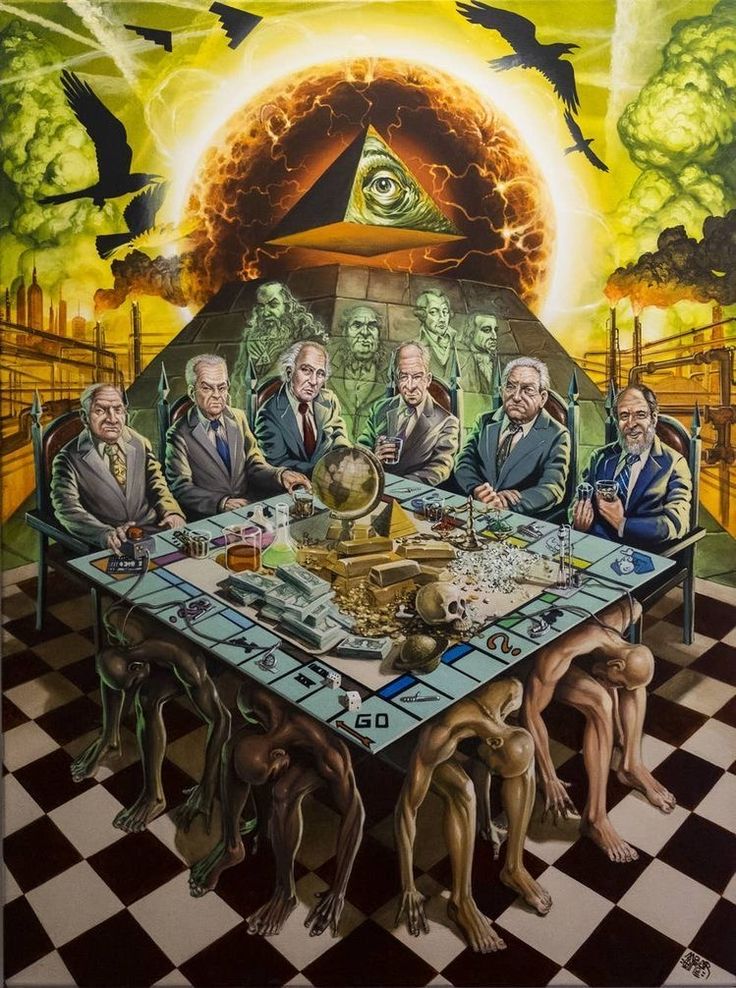
False Profits by Mear One
What wasn’t expected was what Loudermilk would bring forward as his number-one “top finding”: “Former Representative Liz Cheney colluded with ‘star witness’ Cassidy Hutchinson without Hutchinson’s attorney’s knowledge. Former Representative Liz Cheney should be investigated for potential criminal witness tampering based on the new information about her communication.”
Testimony from Hutchinson, a former aide to Trump’s one-time chief of staff Mark Meadows, featured prominently in the January 6th Committee’s work. Loudermilk focuses in on the fact that Hutchinson, who by her own account originally intended to keep her head down and clam up—even asking Team Trump for a lawyer to represent her through her interactions with the committee—had a change of heart midway through. Bracing to break with Trumpworld, Hutchinson reached out to Cheney for advice, and they had several conversations without Hutchinson’s Trump-issued lawyer present.
“Representative Cheney’s influence on Hutchinson is apparent from that point forward by her dramatic change in testimony and eventual claims against President Trump using second- and thirdhand accounts,” the report reads.
This is incredibly weak milktea on any level. Hutchinson clearly intended to open up to Cheney’s committee before Cheney ever spoke with her. That’s obvious from the fact that it was Hutchinson who initiated the contact, not Cheney. The idea that this amounted to witness-tampering on Cheney’s behalf would be too stupid to entertain if not for the fact that the country’s most powerful people are trying to pass it off with a straight face.
In a statement, Cheney denounced Loudermilk’s report as “a malicious and cowardly assault on the truth.” “No reputable lawyer, legislator or judge,” she added, “would take this seriously.”
President-elect Donald Trump reignited his longstanding feud with former Rep. Liz Cheney, saying she “could be in a lot of trouble” following a House subcommittee report accusing her of wrongdoing while serving on the panel that investigated the Jan. 6, 2021, attack on the Capitol.
Trump’s post cites a 128-page report released Tuesday by the House Administration Oversight Subcommittee chaired by GOP Rep. Barry Loudermilk that accuses Cheney of colluding with top witnesses and calls for her to be investigated for witness tampering. “Liz Cheney could be in a lot of trouble based on the evidence obtained by the subcommittee,” Trump wrote. “Which states that ‘numerous federal laws were likely broken by Liz Cheney, and these violations should be investigated by the FBI.’”
The report also accuses members of the Jan. 6 committee of withholding evidence and failing to preserve records from its investigation. It places blame for the attack on a “series of intelligence, security, and leadership failures at several levels and numerous entities” rather than Trump, who urged his supporters to march on the Capitol that day during an earlier rally near the White House.
Cheney responded:
In a statement, Cheney defended her work while taking a shot at Trump.
“January 6th showed Donald Trump for who he really is — a cruel and vindictive man who allowed violent attacks to continue against our Capitol and law enforcement officers while he watched television and refused for hours to instruct his supporters to stand down and leave,” Cheney said in a statement.
“Now, Chairman Loudermilk’s ‘Interim Report’ intentionally disregards the truth and the Select Committee’s tremendous weight of evidence, and instead fabricates lies and defamatory allegations in an attempt to cover up what Donald Trump did.”
This is frightening. Trump isn’t even waiting until he takes office to try to prosecute anyone who opposes him.
Donald Trump and his Republican allies are planning to target progressive groups they perceive as political enemies in a sign of deepening “authoritarianism”, a US watchdog has warned.
The president-elect could potentially use the justice department and Internal Revenue Service (IRS) to target non-profits and researchers, launch politically motivated investigations and pass legislation to restrict their activities.
Playing God, Troy Jacobson
“Trump has made it clear that he plans to use his second term to attack the progressive ecosystem and his perceived enemies,” Adrienne Watson of the Congressional Integrity Project (CIP) told the Guardian. “This is a worrying progression of Trump’s authoritarianism that would undermine our democracy.”
The CIP announced on Wednesday that it will aim to counter such abuses of power with a new initiative to defend progressive groups and individuals. The Civic Defense Project will be led by Watson, a former White House and Democratic National Committee spokesperson.
Fears have been raised by the Trump second term agenda’s considerable overlap with Project 2025, a policy blueprint from the Heritage Foundation think tank that includes plans to attack non-profits, researchers and civil society groups that have challenged election denial narratives.
Activists say the threat extends beyond political investigations and includes leveraging government agencies such as the justice department and IRS to investigate, prosecute and shut down organisations that oppose the administration’s policies.
Democrats may be in the minority, but they are not yet an opposition.
What’s the difference?
An opposition would use every opportunity it had to demonstrate its resolute stance against the incoming administration. It would do everything in its power to try to seize the public’s attention and make hay of the president-elect’s efforts to put lawlessness at the center of American government. An opposition would highlight the extent to which Donald Trump has no intention of fulfilling his pledge of lower prices and greater economic prosperity for ordinary people and is openly scheming with the billionaire oligarchs who paid for and ran his campaign to gut the social safety net and bring something like Hooverism back from the ash heap of history.
An opposition would treat the proposed nomination of figures like Robert F. Kennedy Jr., Kash Patel and Pete Hegseth as an early chance to define a second Trump administration as dangerous to the lives and livelihoods of ordinary Americans. It would prioritize nimble, aggressive leadership over an unbending commitment to seniority and the elevation of whoever is next in line. Above all, an opposition would see that politics is about conflict — or, as Henry Adams famously put it, “the systematic organization of hatreds” — and reject the risk-averse strategies of the past in favor of new blood and new ideas.
By Jhonata Aguiar
The Democratic Party lacks the energy of a determined opposition — it is adrift, listless in the wake of defeat. Too many elected Democrats seem ready to concede that Trump is some kind of avatar for the national spirit — a living embodiment of the American people. They’ve accepted his proposed nominees as legitimate and entertained surrender under the guise of political reconciliation. Senator Richard Blumenthal of Connecticut, for example, praised Elon Musk, a key Trump lieutenant, as “the champion among big tech executives of First Amendment values and principles.” Senator Chris Coons of Delaware similarly praised Musk and Vivek Ramaswamy’s so-called Department of Government Efficiency, a glorified blue-ribbon commission, as a potentially worthwhile enterprise — “a constructive undertaking that ought to be embraced.” And a fair number of Democrats have had friendly words for the prospect of Kennedy going to the Department of Health and Human Services, with credulous praise for his interest in “healthy food.”
“I’ve heard him say a lot of things that are absolutely right,” Senator Cory Booker of New Jersey said last week. “I have concerns, obviously, about people leading in our country who aren’t based in science and fact.” But, he continued, “when he speaks about the issues I was just speaking about, we’re talking out of the same playbook.”
And at least two Democrats want President Biden to consider a pardon for incoming President Trump. “The Trump hush money and Hunter Biden cases were both bullshit, and pardons are appropriate,” Senator John Fetterman of Pennsylvania wrote in his first post on Trump’s social networking website.
Representative Jim Clyburn of South Carolina also said that Biden should consider a pardon for Trump as a way of “cleaning the slate” for the country.
Reading that makes me feel like throwing up. We are going to have to fight the Democrats and the media if we want to save what’s left of our democracy.
In the wake of Donald Trump’s election victory and promised revenge tour, a number of individuals have proposed the creation of an organization or fund which would take on the job of defending the various lawsuits, prosecutions and generalized legal harassment Trump will bring to the table in the next four years. It’s a very good idea. It’s a necessary one. Over the last six weeks I’ve had a number of people reach out to me and ask who is doing this. Where should they send money to fund this effort? This includes people who are in the small-donor category and also very wealthy people who could give in larger sums. So a few days ago I started reaching out to some people in the legal world and anti-Trump world to find out what’s going on, whether any efforts are afoot and who is doing what.
What I found out is that there are at least a couple groups working toward doing something like this. But the efforts seem embryonic. Or at least I wasn’t able to find out too much. And to be clear, I wasn’t reaching out as a journalist per se. I was explicitly clear about this. I was doing so as a concerned citizen, not to report anything as a news story but as someone who wants such an entity to come into existence. The overnight news that Trump is now suing Ann Selzer and the Des Moines Register over her final election poll for “election interference” makes me think that these efforts aren’t coming together soon enough or can’t come together soon enough. (If you’re not familiar with the details, Selzer is a pollster of almost legendary status and in what turned out to be her final public poll, dramatically missed not only the result of the election but the whole direction of it.) So what I’m going to write here is simply my take on why such an effort is important and what shape it should take….
Waldemar von Kosak, We are the Robots
Trump’s retribution may focus on individuals, but it’s a collective harm. So it makes sense to spread the cost of dealing with it. If person X is targeted for defending the rule of law or democracy or related equities, those are things we all have an interest in defending. So it makes sense to spread the burden.
When a powerful person (and in this case a president) targets individuals, he is trying to overwhelm them, force them to knuckle under because they lack the resources to fight. That does more damage to the civic equities we’re trying to defend. The point of such retribution is to make an example of someone and cast a penumbra of fear that keeps other people from getting out of line. If people are confident their costs — literal and figurative — will be covered they will be more likely to speak their minds, do the right thing, run risks.
These two points are straightforward. But they’re worth articulating. First, fairness: targeted individuals shouldn’t alone bear the costs of protecting collective goods. Second, self-protection: people who believe in democracy and the rule of law have a clear interest in guaranteeing these defenses and preventing the spread of civic fear.
A bit more:
But there’s another need that may not be as clear and its a role some group like this should fill.
Let’s take the Selzer/Des Moines Register suit as our example. Trump is claiming that he was damaged and should be made whole because of a poll that showed him behind and turned out to be wrong. His lawyers are trying to shoe-horn this claim into an Iowa consumer fraud statute. But we shouldn’t be distracted by that. The idea that a political candidate has a cause of action over a poll is absurd on its face. And really that is precisely the point. I’ve written a number of times recently about the ways Trump casts penumbras of power and fear with talk, how he holds public space, how he keeps opponents off balance and guessing. This is another example.
As I noted above, a lot of the power and point of such an exercise is precisely the absurdity of it. It is meant to spur a chorus of “You can’t do that” and “How can he do that?” But he does do it. We have that same mixture of outrage, incomprehension, uncanny laughter, the upshot of which is an overwhelming and over-powering belief that the rules somehow don’t apply to this guy. That’s the power and that is the point. It is a performance art of power enabled by a shameless abuse of the legal system.
“Felon of the Year!” John Buss, @johnbuss.bsky.social
Good Day, Sky Dancers!
The Golden Age of Self-Dealing is about upon us! This year, we’ve had all kinds of new descriptions to assign the type of government the dumbest among us will usher in on Jan 20th. We’re in a polycrisis that will be managed by the least qualified and skilled among us; a kakistocracy. We will be governed by the least fit, the most incompetent, and the proven corrupt. I spent a lot of time in my doctoral program studying Corporate Governance. However, we, the People, are much more than mere stockholders in our government. The powers invested in our Federal Government could lead to more serious crimes than even the worst things committed by companies like Enron. Corporations can not print that universally accepted thing called government-backed currency. They cannot declare war and make and break treaties and alliances. That’s probably the biggest responsibility. But our health, happiness, justice, and liberty are at stake. Are we really that expendable to them?
Much of what’s being discussed right now is dismantling agencies that have been vested with the responsibility to ensure many things businesses do won’t kill us or bilk us. So, what will likely happen if we are left to the wolves of Wall Street with no oversight? What about putting the conspiracy crowd in charge of guarding our public health or our safety when we fly, drive, or use any form of transportation? What about letting anyone with the financial ability to set up shop call themselves a university, a daycare, or any other form of school? Should we leave children to the likes of the folks who tell pollsters they don’t think Arabic numbers should be taught in school? The overlords will ship off their kids to the top boarding schools in the country while everyone else gets stuck with whatever the undereducated in their community will scream about. It’s a pretty depressing future.
President-elect Donald Trump’s pick to be the top health insurance regulator in the country, Dr. Mehmet Oz, has invested in companies that do business with the agency he would run.
Oz, Trump’s choice to run Medicare, Medicaid and the insurance marketplace under the Affordable Care Act, owned up to $33.7 million stock in these companies when he filed a financial disclosure during his unsuccessful 2022 campaign for Senate in Pennsylvania.
The TV talk show host owned between $280,000 and $600,000 in UnitedHealth Group and between $50,000 and $100,000 in CVS Health, which both provide health insurance plans under Medicare Advantage.
He also owned between $5.8 million and $26.7 million in Amazon and between $1.6 million and $6.3 million in Microsoft, two major technology providers for the Centers for Medicare and Medicare Services, the agency he would run.
Accountable.US, a left-leaning group that compiled some of the research, said it reviewed filings with the Securities and Exchange Commission and was unable to find evidence that Oz sold stocks in Amazon or Microsoft since the 2022 filing.
“All nominees and appointees will comply with the ethical obligations of their respective agencies,” Brian Hughes, a spokesperson for the Trump-Vance transition, said in a statement to USA TODAY when asked if Oz still owns these stocks.
Oz in 2020 said the federal government should allow all Americans to purchase coverage through Medicare Advantage, a program in which private insurance sell Medicare-regulated plans to seniors and people with disabilities.
In 2022, Oz owned stock in the parent company of UnitedHealthcare, which covered 29% of Medicare Advantage patients in 2024, according to the health care organization KFF, formerly known as the Kaiser Family Foundation. CVS Health covers another 12%.
I won’t give you my usual microeconomics lectures on monopoly, but for all that shouting about free markets these billionaires do, they sure love themselves markets that are so concentrated that you can count the number of providers with one hand. This year’s study from this 2024 report by the US Government Accountability Officewill give you the willies. Oh, and DOGE is after that Federal Agency, along with others. Just to make it short, these markets are dysfunctional. The producer side of the equation has too much power in the market. In this case, it’s literally the power of life and death. And, it’s made based on whether they hit their profit goals for their stockholders. Businesses only make money by cutting costs because doing anything inventive is hard. You know what that leads to. “Private Health Insurance: Market Concentration Generally Increased from 2011 through 2022.GAO-25-107194.”
Several companies may be selling health insurance in a given market, but, as we previously reported, most people usually enroll with one of a small number of insurers. Known as market concentration, this can result in fewer choices of insurers and higher premiums due to less competition in the market.
Market concentration generally increased from 2011 through 2022, with three or fewer insurers holding at least 80% of the market share for the individual and employer group markets in at least 35 states. However, the markets for individuals became slightly less concentrated from 2020 to 2022.
In November 2022, GAO reported that, from 2011 through 2020, enrollment in private health insurance plans was concentrated, meaning a small number of issuers of those plans enrolled most of the people in a given market (GAO-23-105672). Specifically, GAO considered a market concentrated in a state if three or fewer issuers held at least 80 percent of the market share of enrollment. For this report, GAO examined the individual (coverage primarily sold to individuals who lack access to group coverage), small-group (coverage offered by small employers), and large-group (coverage offered by large employers) health insurance markets from 2011 through 2022 and found that concentration generally increased. Specifically:
The overall individual market became more concentrated from 2011 through 2022. Concentration in this market peaked in 2019 and became slightly less concentrated through 2022.
The small-group market became more concentrated from 2011 through 2022, but the rate of increase slowed more recently.
The large-group market remained concentrated with only slight increases from 2011 through 2022 (see figure).
Companies do not merge for the purpose of cost efficiencies. They merge because they think they will own more of the market and have more market power. This concentration will lead to much higher profits and less for everyone else. I can spend an entire semester showing how broken concentrated markets are and that they desperately need supervision. But that serves everyone but the guys at the top, so these studies are written, empirical evidence is provided by nerds like me and think tanks, and nothing gets done policy-wise.
In the case of this market, people die for the illusion that all markets set free of oversight magically function on their own. That’s a philosophical hypothesis that tests wrong over and over. Few markets meet the critical structure that makes them efficient by leaving them alone. Most of those are wholesale commodities markets and not complex markets like those that try to find a price for financial contracts that tend to be very specific and unique, involve middlemen and market confusion, and can’t find a price with just interaction between buyer and seller.
I ran across this Blue Sky thread by billionaire Mark Cuban. He gets it. There’s more of this thread here. I can tell you anecdotally what it took me to get out of the Mutual of Omaha provide providers, which was basically Catholic Management sending patients to Catholic hospitals when I had my high-risk pregnancy. I basically told my ex, who was one of these ghoulish cost cutters for that company, that he better get them to pay for me delivering at Methodist or that I would go there to deliver, and he could fricking pay for it for the rest of his natural born days.
He got the person in charge to send me to Methodist since it was the only hospital with a neonatologist at the time. He was a nice Jewish OB/GYN who later was in charge of Doctor Daughter’s residency. Methodist Hospital obviously cared if their patients lived while having a complicated pregnancy. You might notice that the way I got this treatment was to send an AVP of the company to twist their arm. I remember that one of my friends doing his rotation in OB/GYN watched a patient at Creighton Medical Center get a lecture from a Priest brought in by her doctor on why she should carry her pregnancy to term despite the condition the baby had was a brain undeveloped so badly that it was spilling out from a lack of skull. There was no chance of survival, but there was a lot of risk to the mother. I was not about to go through that. I was a happy little Methodist then, and that’s where I wanted to deliver my youngest. The C-section went fine, and we both went home, although I did drive myself to the emergency room 10 weeks before she was due to hemorrhaging.
All this leads to Mark Cuban. Leave these decisions to Doctors. not cost-cutting paper pushers like my MBA ex-husband.
If you want to understand why healthcare pricing is horrific, the first thing to know is that our system puts 100% of the credit risk for deductibles, copays and co-insurance on hospitals and doctors. That's insane. We have turned them into Sub Prime Lenders 🧵
When they can't collect payment, they raise prices to make up that loss. Plus they need to have all the administration of a mortgage loan servicer to try to collect those amounts. Which of course also puts people who can't afford the cost, in medical debt, which often leads to bankruptcy
Then there are insurance companies. The crazy thing is that for more than 50m people,those covered by self insured entities,ins comps don't actually provide insurance. They act as Care Authorizers and payment processors. Can the care occur and how much will be paid.
Their primary role is to make sure that there is not fraud by providers (think overuse of operations to inflate revenue , or services not covered by the plan the user is covered by and/or determine if care is "medically necessary "
That authorization process is one we should not be asking ins comps to do. That role should be performed by INDEPENDENT TPAs. With zero economic incentive to approve or deny. The first step is for self insured entities to use 3rd party TPAs and move away from insurance companies for this service
If they do this, they can use the insurance companies for their networks and software. But better yet, I think direct contracting is the future. For my employees, we are direct contracting with providers. We are stipulating that there will be no pre authorizations. We will trust the provider
Trump says could get rid of some vaccinations “if I think it’s dangerous”
Kennedy is known for anti-vaccine stance, linked to debunked autism claims
Experts warn ending vaccine programs could lead to disease outbreaks, deaths
U.S. President-elect Donald Trump in an interview published on Thursday said he will be talking to Robert F. Kennedy Jr., his nominee to run the Department of Health and Human Services, about ending childhood vaccination programs.
When asked if he would sign off if Kennedy decided to end childhood vaccinations programs, Trump told Time magazine, “we’re going to have a big discussion. The autism rate is at a level that nobody ever believed possible. If you look at things that are happening, there’s something causing it.”
When asked if the discussion could result in his administration getting rid of some vaccinations, Trump said: “It could if I think it’s dangerous, if I think they are not beneficial, but I don’t think it’s going to be very controversial in the end.
Asked in the Nov. 25 interview if he thinks childhood autism is linked to vaccines, Trump said: “No, I’m going to be listening to Bobby,” referring to Kennedy. Trump said he had a lot of respect for Kennedy and his views on vaccinations.
Can you hear me screaming all the way from the Mississippi River way down yonder in New Orleans? And this is the headline that did it to me from The Guardian. “RFK Jr key adviser petitioned regulators to revoke approval of polio vaccine. Aaron Siri is helping Trump’s health secretary pick to select top jobs despite long history of attacking vaccines.” I wonder what Mitch McConnell might say if he could.
A key legal adviser to Robert Kennedy Jr, Donald Trump’s pick for health secretary, is at the center of efforts to push federal drug regulators to revoke approval for the polio and hepatitis B vaccines and block distribution of 13 other critical vaccines.
Aaron Siri, a lawyer who has been helping Kennedy select top health administrators as part of the Trump transition process, is deeply embedded in longstanding efforts to force the US Food and Drug Administration (FDA) to withdraw a raft of vaccines that have saved the lives and health of millions of Americans.
Siri has been sitting alongside Kennedy in interviews in which they have asked candidates for top health jobs where they stand on vaccines, the New York Times reported on Friday.
Kennedy, a leading vaccine sceptic, has insisted he has no plans to revoke vaccines should he be confirmed by the US Senate for the health secretary position. But his close ties with Siri are raising concerns about the incoming Trump administration’s intentions, given the lawyer’s intimate involvement in the anti-vaccine movement.
Siri works closely with the Informed Consent Action Network (Ican), a “medical freedom” non-profit founded by Del Bigtree, whose has long waged war on vaccines including as producer of the anti-vaccination documentary, Vaxxed. The New York Times report noted that Siri filed the 2022 petition calling for the FDA to revoke approval for the polio vaccine on behalf of ICAN.
Poliovirus, the cause of a disease that used to be one of the most feared by Americans, has been eliminated from the country by the US through polio vaccines. The federal Centers for Disease Control and Prevention notes that the best way to avoid its return and keep people safe is through vaccination.
Siri has not only been involved in lawsuits calling for the withdrawal or suspension of the polio and hepatitis B vaccines, but he has also petitioned the FDA to “pause distribution” of 13 other vaccines, according to the Times.
Trump said this week that Kennedy may investigate vaccines for a supposed link with autism. The remark to NBC suggests that his pick for health secretary may run with the conspiracy theory that there is a connection between childhood vaccinations and autism that has been thoroughly debunked yet is repeatedly peddled by Kennedy.
Kennedy’s spokesperson, Katie Miller, confirmed to the Times that Siri has been advising Kennedy but said his vaccine petitions had not been discussed.
“Mr Kennedy has long said that he wants transparency in vaccines and to give people choice,” she said.
President-elect Donald Trump says Kari Lake, a local television news anchor-turned-MAGA politician, will lead the federally funded broadcaster Voice of America.
If successful, the move would put a loyalist at the helm of a news outlet that Trump sought to bring to heel under his appointee during the final year of his first term. Trump officials sought to strip the network and its parent agency of their independence during his first term, including actions later found to be illegal and in one case, unconstitutional.
But Trump doesn’t have the authority to unilaterally install Lake; the hire is dependent on a bipartisan board beneath the chief executive of its parent agency.
Voice of America (VOA), which is funded by Congress, operates in nearly 50 languages and reaches an estimated 354 million people weekly across the globe. It is part of the U.S. Agency for Global Media, the government agency that oversees all non-military, U.S. international broadcasting.
Trump said Wednesday on Truth Social that Lake will be appointed by and work closely with the incoming head of that agency, “who I will announce soon.”
A free press is central to VOA’s mission: It aims to bring unfettered reporting to places that do not have it, and show political debate and dissent in the U.S. even when that reflects critically on the administration in power.
Trump’s White House took the unprecedented step in spring 2020 of openly attacking VOA in public statements over its perceived failures to explicitly blame the Chinese government for the pandemic.
On Wednesday, Trump wrote that Lake and his as-yet-unnamed agency leader will “ensure that the American values of Freedom and Liberty are broadcast around the World FAIRLY and ACCURATELY, unlike the lies spread by the Fake News Media.”
I’d say it’s highly likely that Tulsi Gabbard will be more than willing to provide material for those broadcasts. I’m sure Putin will oblige. The latest outrage, for me, anyway, is that all the Trump TechBros are funding his inauguration with millions of dollars, and Presidential Reject Incontinentia Buttocks is inviting all the favorite despots from the world over. This is from CNN. “Xi’s RSVP is a snub to Trump, but the inauguration invite is still a big deal.”
Getting Xi to fly across the world would be an enormous coup for the president-elect — a fact that would make it politically unfeasible for the Chinese leader. Such a visit would put the Chinese president in the position of paying homage to Trump and American might — which would conflict with his vision for China’s assumption of a rightful role as a preeminent global power. At the inaugural ceremony, Xi would be forced to sit and listen to Trump without having any control over what the new president might say while lacking a right of reply. Xi’s presence would also be seen as endorsing a democratic transfer of power — anathema for an autocrat in a one-party state obsessed with crushing individual expression.
Still, even without a favorable response, Trump’s invitation to Xi marks a significant development that sheds light on the president-elect’s confidence and ambition as he wields power ahead of his second term. CNN’s team covering Trump reported that he’s also been asking other world leaders if they want to come to the inauguration — in a break with convention.
This is a reminder of Trump’s fondness for foreign policy by grand gesture and his willingness to trample diplomatic codes with his unpredictable approach. The Xi invitation also shows that Trump believes that the force of his personality alone can be a decisive factor in forging diplomatic breakthroughs. He’s far from the only president to pursue this approach — which rarely works since hostile US adversaries make hardnosed choices on national interest rather than vibes.
Then, when will his cult figure this one out about his lie about being able to bring prices down, which he just admitted he can’t do?
Wake me up when this is all over.
What’s on your reading and blogging list today?
Did you like this post? Please share it with your friends:
The Sky Dancing banner headline uses a snippet from a work by artist Tashi Mannox called 'Rainbow Study'. The work is described as a" study of typical Tibetan rainbow clouds, that feature in Thanka painting, temple decoration and silk brocades". dakinikat was immediately drawn to the image when trying to find stylized Tibetan Clouds to represent Sky Dancing. It is probably because Tashi's practice is similar to her own. His updated take on the clouds that fill the collection of traditional thankas is quite special.
You can find his work at his website by clicking on his logo below. He is also a calligraphy artist that uses important vajrayana syllables. We encourage you to visit his on line studio.


 So, how on earth did Elon Musk blow up a bipartisan deal on the budget? This is from Sam Stein writing at
  And, of course, Trump wants to ensure that there’s a two-year extension of the Debt Ceiling so that he can give away the Treasury to his Cabal and grift off the nation without having to take on the burden of once again landing the Federal Budget into record-setting red zones. He seriously believes that the voters will blame all these shenanigans on Biden, who is trying to Trump-proof things and get Federal judges appointed to the bench. Musk is on a rampage to replace the governments that once fought NAZIs with NAZIs all over the world and evidently has the money to attempt it.
  Musk has such a manic schedule, given he’s also trying to give parts of Ukraine to
  Evidently, since he managed to buy the US Presidency and dupe enough dolts into voting for the Dotard, he thinks he can do it with Canada and a good portion of Europe. He’s
  Since the Supreme Court decided Citizens United, unelected billionaires have bought Supreme Court Decisions and Justices.
  This is the usual way for them to avoid the problems. Just keep kicking that can. This just prolongs things. This process has historically been messy and difficult. We may see a technical shutdown tonight, and that does not bode well, given the current antics and players.
  Meanwhile, the government is making plans for a shutdown. This is from the
  It’s disturbing that many folks and the media are acting like Joe Biden is already out of the picture. However, Republican dysfunction could also deal the final blow to the Republican Party. Jeffries has control over his congress critters. It’s obvious Johnson doesn’t. You may remember that John Boehner threw up his arms and retired over the many chaotic factions. It hasn’t improved since then. Digby has an interesting view in her Salon column. “



 So, I’m not even sure where to start, but how about with RFK Jr, the one with the worm that ate his brain, and the television and web-based Snake Oil Salesman, Mehmet Oz. A USA Today headline blares this bit of happy news.
 I won’t give you my usual microeconomics lectures on monopoly, but for all that shouting about free markets these billionaires do, they sure love themselves markets that are so concentrated that you can count the number of providers with one hand. This
 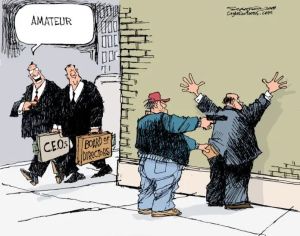 I ran across this Blue Sky thread by billionaire Mark Cuban. He gets it.
 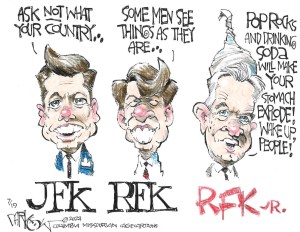 So, I am staying with the theme of Health Care because BB alerted me to this while preparing to write this post. JJ couldn’t believe they would actually do this to us. This headline is horrifying! It’s from Reuters. “Trump to discuss ending childhood vaccination programs with RFK Jr.”
  Can you hear me screaming all the way from the Mississippi River way down yonder in New Orleans? And this is the headline that did it to me from
  When you have a savior complex, you think nothing will get you. There are a lot of those types up for Cabinet jobs. Kari Lake is about to become the Voice of America. I’ve already dubbed her Lady Haw-Haw after an American NAZI sympathizer
 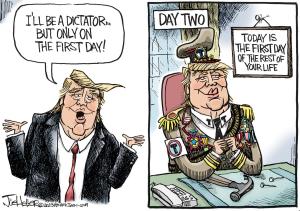 I’d say it’s highly likely that Tulsi Gabbard will be more than willing to provide material for those broadcasts. I’m sure Putin will oblige. The latest outrage, for me, anyway, is that all the Trump TechBros are funding his inauguration with millions of dollars, and Presidential Reject Incontinentia Buttocks is inviting all the favorite despots from the world over.
 peej
peej Carissa
 bostonboomer
 dakinikat
 ecocatwoman
 mablue2
 Mama Lopez
 peggysue22
 quixote
 skydancingguestblogger
 Mona (aka Wonk the Vote)



 Sky Dancing
Recent Comments