Yesterday, the two most important newspapers in the U.S. published articles in which they “both-sided” the indictment of Donald Trump in the January 6 case. Reporters Michael Schmidt and Maggie Haberman at the New York Times and Devlin Barrett and Josh Dawsey at The Washington Post published articles that–at least in their headlines and the early paragraphs characterized Jack Smith’s case against Trump as a First Amendment case even though Smith explained very clearly in his statement announcing the indictments that it is a conspiracy case–based on lies that led to actions.
This is exactly what Republicans want Americans to believe–that Trump is being prosecuted for lying about the results of the 2020 election or even for his belief that the election was stolen from him. I’m not even going to quote from the two articles, but here are the links if you want to read them.
As soon as I saw the headline, I knew this NYT story was going to be bad: “Trump Election Charges Set Up Clash of Lies Versus Free Speech.” No. No, it does not.
Both-sides coverage in politics is toxic; in legal coverage it’s so bad it becomes almost funny. But of course in typical legal matters we rarely get both-sides coverage. Instead, it skews heavily in favor of the narrative of law enforcement and prosecutors. But when a politician (let alone Trump) is the defendant, suddenly there’s a detached remove from the underlying facts. Conspiracy to overthrow the government or just political puffery in the spirit of stump speaking? Who can say, really? We’ll leave to you, dear reader, to decide.
Take the core graph of the story:
The indictment and his initial response set up a showdown between those two opposing assertions of principle: that what prosecutors in this case called “pervasive and destabilizing lies” from the highest office in the land can be integral to criminal plans, and that political speech enjoys broad protections, especially when conveying what Mr. Trump’s allies say are sincerely held beliefs.
Trust me, folks. This is not going to be a showdown over the limits of the First Amendment. How do I know? Well, one way is by reading the bottom half of the same NYT story, where legal experts shred the Trump defenses.
Kurtz recommends reading this thread on Twitter, which I read yesterday.
I don’t know this guy and I’ve been told he’s an attorney, but for what it’s worth this is almost the textbook example I use when I’m teaching folks who *don’t* understand how the First Amendment actually works. (1/6) pic.twitter.com/Do5rBY8rsu
(2) I call my buddy @AnthonyMKreis and say: “Let’s go buy crowbars and use them to deprive people of their right to vote.” He says: “I agree! Let’s conspire to do this thing together!”
I walk to the store and buy a crowbar. Bad news: Crime! Life is bad. 😢 (3/6)
Kurtz notes (at TPM) that the Wall Street Journal did the same thing:
Another example of covering a criminal prosecution like it’s politics, courtesy of the WSJ: “Trump Is Being Prosecuted, but Justice Department Is on Trial, Too”
Oh boy, this sentence: “On the issue of whether it can persuade the public of the righteousness of its prosecution, the Justice Department has taken on a huge and politically polarizing target in an atmosphere already ripe with mistrust over its motivations.”
Not literally untrue. But notice the way this turns it all into a messaging contest, like a political campaign
Special Counsel Jack Smith’s indictment distills the whole of the January 6 investigation into 45 pages. The story it tells is already familiar. There is the sheer number of lies told by Trump and his allies, such as that over 10,000 dead people voted in Georgia, that there was a suspicious late-night “vote dump” in Michigan, and that Pennsylvania issued 1.8 million absentee ballots but processed 2.5 million.
Smith makes clear that the issue here isn’t Trump’s lies as such, particularly right after the election. In fact, the indictment states that Trump “had a right, like every American, to speak publicly about the election and even to claim, falsely, that there had been outcome-determinative fraud during the election and that he had won.” Nor is the issue the dozens of unsuccessful court cases Trump brought. Instead, the issue is that Trump worked with his co-conspirators to disenfranchise voters by interfering with the collection, counting, and certifying of votes.
Put another way, Trump isn’t being indicted for what he said. He’s being indicted for what he did.
The indictment tells the story of the fake elector scheme, where swing states, at the behest of Trump and his conspirators, put forth GOP electors in states won by Biden. It also details the pressure put on Mike Pence to throw out the election while Trump whipped his supporters into a frenzyuntil they attacked the Capitol.
The indictment reveals that even after the January 6 rioters were finally cleared from the Capitol, Trump and his co-conspirators were pounding the phones and sending emails late into the evening trying to reach elected officials who would agree to block certification. Around 7 pm on the 6th, one of Trump’s co-conspirators called five US senators and a House rep, all within 20 minutes, and left a voicemail for one senator asking them to “try to just slow it down” and saying that “the only strategy we can follow is to object to numerous states.”
Even as the joint session of Congress finally met at 11:35 pm on the 6th to certify the election, one of Trump’s co-conspirators emailed Mike Pence’s counsel, urging Pence to violate the law and adjourn for 10 days to “allow the legislatures to finish their investigations as well as to allow a full forensic audit of the massive amount of illegal activity that has occurred here.”
In the last day, Maggie and Mike and Devlin and Dawsey came out with twin pieces that purport to assess the legal strength of the indictmentagainst Trump, but instead simply say, “well, Trump believes his bullshit and so do we and so the charged conduct may be First Amendment protected.”
Neither of these articles even mention that 18 USC 371, conspiracy to defraud the US, is about lying to the US, even though one of the lawyers cited by WaPo attempted to explain that to them.
Here’s why all those claims that Trump knew he was lying are in the indictment: because his false claims were the means Trump used to carry out the conspiracy to defraud.
The Defendant widely disseminated his false claims of election fraud for months, despite the fact that he knew, and in many cases had been informed directly, that they were not true. The Defendant’s knowingly false statements were integral to his criminal plans to defeat the federal government function, obstruct the certification, and interfere with others’ right to vote and have their votes counted. He made these knowingly false claims throughout the post-election time period, including those below that he made immediately before the attack on the Capitol on January 6:
This indictment will be measured not by what Maggie and Mike and Devlin and Dawsey claim about legal statutes they haven’t bothered to explain.
It will be measured by whether the government presents evidence to prove the elements of offense for each charge beyond a reasonable doubt.
Two and a half years after a mob attacked the Capitol in his name, Donald Trump is making the trip down Pennsylvania Avenue he promised he’d make — but never did — on Jan. 6, 2021.
But this time, it’s to be arraigned in federal court.
Trump’s expected arrival on Thursday afternoon in Washington — to face charges that he sought to derail the transfer of power to Joe Biden — will bring him to the federal courthouse that sits just across the street from the Capitol his supporters defaced on Jan. 6. He’s expected to plead “not guilty” to four criminal charges leveled by special counsel Jack Smith.
Smith has accused Trump of orchestrating a breathtakingly broad campaign to unravel American democracy and cling to power despite decisively losing the 2020 election. In service of that goal, Smith says, Trump deputized six co-conspirators — including attorneys Rudy Giuliani, John Eastman, Sidney Powell and Kenneth Chesebro — to carry out a campaign of disinformation, cloaked in legal action, to convince state legislatures, Congress and then-Vice President Mike Pence to block Biden’s election.
Smith alleges that Trump used his unique platform as president to stoke false claims about election fraud and rile up supporters, harnessing their energy to pressure Republican elected officials to attempt to undo Biden’s victories in a handful of states. When that failed, Trump helped assemble slates of false presidential electors who would be used to stoke a conflict in the certification of Biden’s victory. Then, Trump and Eastman leaned on Pence — who would soon preside over Congress’ counting of electoral votes — to assert unprecedented authority to reject Biden’s electors or postpone the count altogether. The failure of that effort culminated in a burst of rage, with thousands of Trump’s faithful storming past police barricades and into the Capitol, while Trump — according to Smith — exploited the violence to continue salvaging his schemes.
As his supporters rioted, Trump wanted to join them, according to evidence amassed by the Jan. 6 select committee. Several witnesses described a heated altercation with Secret Service agents after they refused to take him to the Capitol because of security concerns. Instead, the Secret Service insisted he return to the White House, where he watched the attack unfold on television….
His arraignment on Thursday is scheduled for 4 p.m. Trump, represented by attorneys Todd Blanche and John Lauro, is expected to face Magistrate Judge Moxila Upadhyaya, who received the initial indictment from prosecutors on Tuesday. It will be Trump’s third arraignment on criminal charges since April but his first in Washington, D.C. There’s little of substance likely to occur beyond Trump’s initial plea in the case, but officials at the federal courthouse and the Capitol are bracing for crowds and potential security threats.
Cheney is one of the good guys, even though he writes for Politico.
That’s all I have for you today. I’m still dealing with the aftermath of my mother’s death, and it has been difficult and exhausting. Seeing Trump charged for trying to end our democracy might make me feel a little better.
Did you like this post? Please share it with your friends:
The grand jury investigating Trump’s attempt to overturn the 2020 election is meeting today, and the press is waiting with bated breath for the next indictment. From Politico reporter Kyle Cheney:
Status quo at the courthouse. High anxiety, heavy media presence but no news yet to speak of. The duty magistrate who would like receive any indictment handed up today is: https://t.co/TRdtUSDet0
Members of the grand jury hearing evidence in the special counsel probe of possible 2020 election interference by former President Donald Trump and others arrived at a federal courthouse Tuesday morning, fueling speculation that an indictment against the former president could come later in the day.
It has been two weeks since Trump announced he was a target in the federal investigation into the efforts to overturn President Joe Biden’s 2020 victory. The probe, lead by special counsel Jack Smith, is also focused on the events surrounding the Jan. 6 Capitol riot.
Trump’s receipt of a target letter gave the strongest indication yet that the former president would likely be charged in the election probe.
The grand jurors met last Thursday, but left for the day without any hint that they had voted to return indictments.
On Tuesday morning, they headed up to their area on the third floor of the E. Barrett Prettyman courthouse in Washington, D.C., according to NBC News reporters in the building.
The grand jury hearing evidence in the special counsel’s probe of Trump’s attempts to overturn the election appears to be breaking for lunch. NBC News has spotted members of the jury walking down the courthouse stairs and towards the cafeteria.
Grand jurors typically receive a one-hour lunch break, and their days usually begin at 9:00 a.m. and end at 5:00 p.m., according to the D.C. court website.
Another update from Kyle Cheney:
SPOTTED at the federal courthouse: Thomas Windom, one of Jack Smith’s Jan. 6 prosecutors.
Former President Donald J. Trump’s political action committee, which began last year with $105 million, now has less than $4 million left in its account after paying tens of millions of dollars in legal fees for Mr. Trump and his associates.
The dwindling cash reserves in Mr. Trump’s PAC, called Save America, have fallen to such levels that the group has made the highly unusual request of a $60 million refund of a donation it had previously sent to a pro-Trump super PAC. This money had been intended for television commercials to help Mr. Trump’s candidacy, but as he is the dominant front-runner for the Republican nomination in 2024, his most immediate problems appear to be legal, not political.
The super PAC, which is called Make America Great Again Inc., has already sent back $12.25 million to the group paying Mr. Trump’s legal bills, according to federal records — a sum nearly as large as the $13.1 million the super PAC raised from donors in the first half of 2023. Those donations included $1 million from the father of his son-in-law, Charles Kushner, whom Mr. Trump pardoned for federal crimes in his final days as president, and $100,000 from a candidate seeking Mr. Trump’s endorsement.
The extraordinary shift of money from the super PAC to Mr. Trump’s political committee, described in federal campaign filings as a refund, is believed to be larger than any other refund on record in the history of federal campaigns.
It comes as Mr. Trump’s political and legal fate appear increasingly intertwined. The return of money from the super PAC, which Mr. Trump does not control, to his political action committee, which he does, demonstrates how his operation is balancing dueling priorities: paying lawyers and supporting his political candidacy through television ads.
Save America, Mr. Trump’s political action committee, is prohibited by law from directly spending money on his candidacy. When Save America donated $60 million last year to Mr. Trump’s super PAC — which is permitted to spend on his campaign — it effectively evaded that prohibition.
As with everything he does, Trump’s questionable actions are bigger than ever before.
Trump has been grifting off of his indictments, sending out whiny demands for money from his cult, but he may be wearing out his welcome with his small donors.
Donald Trump’s legal troubles have created windfalls for his political fundraising in the past. And his team has not been shy about using various investigations, indictments and court appearances to turbocharge his donor base.
But new data filed with the Federal Election Commission by WinRed, the premiere GOP donation processor used by Trump and most other Republican candidates, shows that trend may be ebbing.
The former president’s fundraising did not spike as high after his second indictment in June compared to his first one in the spring.
All told, Trump raised nearly $4 million via WinRed from nearly 80,000 distinct donors April 4, the day he pleaded not guilty in a Manhattan court on charges of falsification of business records related to payouts to porn star Stormy Daniels. It was his best online fundraising day of the year.
By contrast, when Trump appeared in Miami court June 13 to plead not guilty to his second indictment on charges related to classified documents found at his Mar-a-Lago, he raised only $1.3 million from just over 35,0000 donors, according to WinRed data.
Trump’s joint fundraising committee is outperforming his rivals among small-dollar donors. But the new data is a warning sign that further legal jeopardy for Trump may not be the fundraising savior it once was as his committees burn through cash.
Overall, roughly one-quarter of Trump’s total WinRed fundraising this calendar year — $11.3 million — came in between March 30 and April 5, according to a POLITICO analysis of the group’s FEC filing.
But Trump has a new grift to fleece his supporters with.
NEW: Trump has already created a new legal defense fund — and he chose to form it as a special type of political nonprofit which, unlike his PAC, can accept unlimited amounts of money from individuals and corporations. Even anonymously. Me @thedailybeasthttps://t.co/n4VfTY7lqh
When allies of former President Donald Trump launched his new legal defense fund, they created a group with few restrictions on how much it can raise, even fewer on how much it can spend, and the ability for deep-pocketed donors to remain anonymous.
In essence, Trump’s legal costs have gotten so high that he’s been forced to find a new way around campaign finance laws—a route that will allow him to draw massive donations from megadonors who could not otherwise write checks large enough to replenish his attorney costs.
While the plans for launching the group, called the “Patriot Legal Defense Fund,” were first reported on Sunday by The New York Times, it turns out the entity was created on July 19. That filing, however, won’t be found in the campaign finance database maintained by the Federal Election Commission, where political campaigns typically register.
Instead, the PLDF was registered with the IRS as a special type of political nonprofit under section 527 of the tax code—as what’s loosely known as a “527” or “shadow” group.
The new fund reportedly won’t pay Trump’s own lawyer costs. But it will float allies, including possible witnesses in any number of legal threats facing the former president.
And yet experts said the shadiest, most notable part of the legal defense fund was not that it would pay for lawyers for potential witnesses against Trump. That part isn’t all that new. The Trump team reportedly worked hand-in-hand with CPAC chair Matt Schlapp’s “First Amendment Fund” earlier this year to provide legal help to Jan. 6 committee subpoena targets, and Trump’s “Save America” leadership PAC also bankrolled handpicked attorneys for Jan. 6 witnesses.
Instead, experts pointed to the group’s unique tax status opening an array of new fundraising opportunities for Trump as the most unsettling element—including for unlimited donations from individuals and corporations.
One more Trump legal story: The Manhattan DA may used Trump’s videotaped deposition in from the E. Jean Carroll case for evidence in the Stormy Daniels prosecution.
Donald Trump's taped interview—chock full of misogynist remarks—ruined him at his rape trial.
Now the Manhattan DA wants it for his investigation.
The Manhattan district attorney seeking to jail Donald Trump over his hush money payment to a porn star is seeking to potentially weaponize the same piece of damning evidence that nailed the former president at his rape trial: the deposition where he said stars like him get away with sexual harassment “unfortunately—or fortunately.”
It’s now up to a federal judge to decide whether those prosecutors can get a video that shows Trump at his worst: unapologetic about sexual assault, uttering misogynistic comments, and willing to lie to the American public to save his own skin.
It’s a testament to the breadth of Trump’s legal problems that we’re witnessing the collision of two totally separate cases: a civil defamation case about rape and a criminal case about a cover-up. And it all comes down to a closed-door question-and-answer session Trump had on Oct. 19, 2022.
That shocking testimony first came out in a federal courtroom in May in New York City, where jurors ultimately decided that Trump did indeed sexually abuse the journalist E. Jean Carroll decades ago. In the video, the former president talked about his previous gloating that he could grab women “by the pussy”—and answered whether he felt that the rich and famous could get away with it.
“Historically that’s true with stars. If you look over the last million years, that’s largely true, unfortunately—or fortunately,” he said, later adding that he considers himself a star.
At the time, the video stunned those in the federal courtroom, going a long way to show how Trump remained defiant about his predatory sexual behavior. He called Carroll a liar and viciously attacked her female lawyer. At one point, he told the attorney, “You wouldn’t be a choice of mine either.”
Now, the Manhattan DA wants that video for his own criminal investigation.
According to court records, Manhattan prosecutors plan to use it to show the way Trump “dealt with allegations of a sexual nature,” which could get them closer to proving that he was desperate to keep the lid on bad news that could have sunk his 2016 campaign.
Here’s hoping we’ll get another indictment announcement tonight or tomorrow. Take care everyone!!
Did you like this post? Please share it with your friends:
Indictment watch is an ongoing activity these days. The Dog Days of Summer are ongoing. This week, every day will be authentically over 100 degrees, and the heat index will be way above that. I’m just glad I have very few reasons to leave my house, although I need a much better AC if this is a new reality. The dog and I barhop at night. I do it for the artic blast of all those window A/C units. Her motivation is the dog biscuits behind the bar and very dog-friendly bartenders. We feel better afterward, and I never complain about the boatload of ice in my Tanq and Tonic. Temple is actually quite good at navigating the Bywater Barumuda Triangle. She quickly learned the route and the whereabouts of the preferred biscuit jar. She also knows which bartenders will shower her with biscuits if she gives them the right look.
CNN analyst Ella Nilsen answers one of my ongoing questions. “Why Republicans can’t get out of their climate bind, even as extreme heat overwhelms the US.”
Deadly heatwaves are baking the US. Scientists just reported that July will be the hottest month on record. And now, after years of skepticism and denial in the GOP ranks, a small number of Republicans are urging their party to get proactive on the climate crisis.
But the GOP is stuck in a climate bind – and likely will be for the next four years, in large part because they’re still living in the shadow of former president and 2024 Republican frontrunner Donald Trump.
Even as more Republican politicians are joining the consensus that climate change is real and caused by humans, Trump’s inflammatory rhetoric has driven the party to the right on climate and extreme weather. Trump has called the extremely settled science of climate change a “hoax” and more recently suggested that the impacts of it “may affect us in 300 years.”
Scientists this week reported that this summer’s unrelenting heat wave would have been “virtually impossible” were it not for the planet-warming pollution from burning fossil fuels. They also confirmed that July will go down as the hottest month on record – and almost certainly that the planet’s temperature is hotter now than it has been in around 120,000 years.
Yet for being one of the most pressing issues of the 21st century, climate is rarely mentioned on the 2024 campaign trail.
“As Donald Trump is the near presumptive nominee of our party in 2024, it’s going to be very hard for a party to adopt a climate-sensitive policy,” Sen. Mitt Romney, a Republican from Utah, told CNN. “But Donald Trump’s not going to be around forever.”
When Republicans do weigh in on climate change – and what we should do about it – they tend to support the idea of capturing planet-warming pollution rather than cutting fossil fuels. But many are reticent to talk about how to solve the problem, and worry Trump is having a chilling effect on policies to combat climate within the party.
“We need to be talking about this,” Rep. John Curtis, a Republican from Utah and chair of the House’s Conservative Climate Caucus, told CNN. “And part of it for Republicans is when you don’t talk about it, you have no ideas at the table; all you’re doing is saying what you don’t like. We need to be saying what we like.”
With a few exceptions, Republicans largely are no longer the party of full-on climate change denial. But even as temperatures rise to deadly highs, the GOP is also not actively addressing it. There is still no “robust discussion about how to solve it” within the party, said former South Carolina Rep. Bob Inglis, who now runs the conservative climate group RepublicEn, save for criticism of Democrats’ clean-energy initiatives.
“The good news is Republicans are stopping arguing with thermometers,” Inglis told CNN. Still, he said, “when the experience is multiplied over and over of multiple days of three-digit temperatures in Arizona and record ocean temperatures, people start to say, ‘this is sort of goofy we’re not doing something about this.’”
Meanwhile, the impacts of a dramatically warming atmosphere are becoming more and more apparent each year. Romney and Curtis, two of the loudest climate voices in the party, both represent Utah – a state that’s no stranger to extreme heat and drought, which scientists say is being fueled by rising global temperatures.
“There are a number of states, like mine, that are concerned about wildfires and water,” Romney said, adding he believes Republican governors of impacted states have been vocal about these issues.
Great Peacock Moth, Vincent van Gogh,1889
NPR actually focuses on New Orleans for the kinds of problems that cities are facing with the heat and public health. “In broiling cities like New Orleans, the health system faces off against heat stroke.” I’ve actually had two episodes of heat sicknesses during July but have managed to find my way to a cold bath with a carefully placed fan where I rate how fucking hot it is by how many times I repeat this ritual. I can tell precisely hot it is by where Dinah is in the back part of the house. Right now, she’s here in my room, but that will be short-lived. She heads for the floor under the highboy, where the a/c can really cool her down when it’s peak hot. Kristal and Temple are fond of lying in front of the bathtub when I’m in there reading and chilling. Keely just hides under the bed near Dinah. The A/C manages to keep that bedroom fairly cool.
As the hour creeps past three in the afternoon, New Orleans’ streets are devoid of tourists and locals alike. The heat index is over 105 degrees.
At the city’s ambulance depot, the concrete parking lot seems to magnify the sweltering heat, circulating the air like a convection oven.
New Orleans Emergency Medical Services has been busy this summer, responding to heat-related emergency calls and rushing patients to nearby hospitals.
Capt. Janick Lewis and Lt. Titus Carriere demonstrate how they can load a stretcher into an ambulance using an automated loading system.
Lewis wipes sweat from his brow as the loading arm whirs and hums, raising the stretcher into the ambulance — “unit” in official terminology.
But the mechanical assistance isn’t the best thing about the new vehicle. “The nicest thing about being assigned a brand new unit, is it’s a brand-new air conditioning system,” Lewis says.
The new AC is much more than just a luxury for the hard-working crews. These days they need the extra cooling power to help save lives.
“The number one thing you do take care of somebody is get them out of the heat, get them somewhere cool,” Lewis says. “So the number one thing we spend our time worrying about in the summertime is keeping the truck cool.”
Like much of the country, New Orleans has been embroiled in an almost relentless heat wave for weeks. As a result, more people are falling ill with heat-related conditions than ever before. Just last week, EMS responded to 29 heat-related calls — more than triple compared to the same period last year.
As the city’s emergency medical systems deal with the influx of patients, scientists say these dangerous heat levels — and the increasing stress they put on human bodies and medical systems — may be the new norm.
At the same time, New Orleans EMS has struggled with funding and staffing challenges. It’s currently operating with only 60% of its needed staff. The city’s chief of EMS has called for increased funding for higher wages to attract more workers.
Lewis says they’re making do with the resources they have, and prioritizing one-time expenses like new ambulances to help them meet the challenges they’re facing.
“We’re going to provide the care everybody needs, regardless of how hot it gets,” Lewis says. “We’d love to have all the help in the world, but we’re getting the job done with what we have right now.”
If you’re feeling a bit brain-fogged these days, you might not be wrong to blame it on the heat.
Several summers back, researchers in Boston studied young adults living in college dorm rooms during a heat wave. Some had central AC and slept at a cool 71 degrees Fahrenheit. Others slept in rooms without air-conditioning, where the temperature hovered around 80 degrees.
Each morning for nearly two weeks, the students took a few tests, administered on their cellphones. The people who slept in the hotter dorm rooms performed measurably worse on the tests.
The tests included a math test requiring simple addition and subtraction and a second test, the Stroop test, that jumbles colors and words. “So, if I show the word ‘red’ in the color blue, participants have to respond ‘blue,'” says study author Jose Guillermo Cedeño Laurent, an assistant professor at the Rutgers School of Public Health.
It’s easy to get tripped up if your attention or reaction time is slowed, he says, and that’s exactly what heat appears to be doing. “The magnitude of the effect was really striking,” Cedeño Laurent says. “We saw reductions in the order of 10% in their response times and also their accuracy.”
Part of this effect may be explained by interrupted sleep. It can be hard to get a good night’s rest if you’re not accustomed to the heat, and a lack of sleep could certainly impair reaction time and focus. But there’s a body of evidence suggesting it may be something about the heat itself that interferes with cognition.
Anastasiya Markovich, Effect of Butterfly (date unknown)
Yup. That would be me. A lot of service industry folks rely on buses and streetcars. It can be a long wait in the sun followed by a street car with fans or a bus with the A/C. This is the worst we’ve ever seen things down here.
Fulton County District Attorney Fani Willis is speaking just ahead of potential charges being filed against former President Donald Trump and his allies.
It’s still unclear if Trump will be charged by D.A. Willis, but 11Alive is getting a little more insight into what we can expect in the coming days after speaking with Willis at a back-to-school event in Sandy Springs.
Willis said her back-to-school events are her favorite time of the year. And it’s bringing her joy before the big decisions she has to make in the next few weeks.
“I was a single mom,” Willis said. “And I can remember at the beginning of school years, that’s one more financial hit. We want to relieve that stress for parents.”
Mother-of-three Amiria Otiti said she hadn’t even started back-to-school shopping yet. However, events like this take the load off.
“It helps tremendously because everything is priced high,” Otiti said. “And anything I can do to save, I want to save.”
Willis was all smiles giving away free school supplies at Morgan Falls Overlook Park in Sandy Springs, but after this, it’s back to business. While the kids prepare for school, Willis is preparing for a potential indictment of former President Trump and his allies for attempting to overturn the 2020 election.
“Some people may not be happy with the decisions that I’m making,” Willis said. “And sometimes, when people are unhappy, they act in a way that could create harm.”
She didn’t give many details, but Willis said another way she’s preparing is by upping security. She explained she wrote a letter to the Fulton County Sheriff Patrick “Pat” Labat.
“I think that the sheriff is doing something smart in making sure that the courthouse stays safe,” Willis said.
That includes the grand jury.
“I’m not willing to put any of the employees or the constituents that come to the courthouse in harm’s way,” Willis said.
Willis said she’s holding true to her commitment to giving the American people an answer by Sep. 1. This could be Trump’s third indictment case of the year.
Saturday students got what they needed to do their homework. And Willis said she’s doing hers too.
“The work is accomplished,” Willis said, “We’ve been working for two-and-a-half years. We’re ready to go.”
The newest Donald Trump indictment dropped last week, and above all it is ridiculous.The spectacle of the two gormless henchmen creeping around the basement pointing flashlights at security cameras and the servers they’d been dispatched by to wipe — all the while being captured by those very same cameras! — is almost too ludicrous to bear. Who knew there could be something more preposterous than that photo of the tacky bathroom with the boxes stacked in the shower?
The excitement started last Thursday morning with reports that Trump was about to be indicted in DC for his role in the January 6 Capitol riot. Instead, Special Counsel Jack Smith filed a superseding indictment in the Florida documents case, introducing us to a new defendant: Carlos De Oliveira, the Mar-a-Lago property manager. Like Walt Nauta, De Oliveira started as a valet before being promoted in 2022. And like Nauta, De Oliveira participated in the shell game with the former president’s “beautiful mind boxes” to avoid the prying eyes of the FBI, as well as Trump’s hapless lawyer, Evan Corcoran.
The original indictment laid out the scheme by which Nauta allegedly moved the boxes of swiped presidential records in and out of the storage locker near the Mar-a-Lago pool, allowing Trump to cull what he planned to keep before Corcoran could conduct a search on June 2, 2022, for the documents subpoenaed by the grand jury. Mindful that classified documents require certain protocols, the lawyer placed 38 records with classified markings in a Redweld folder sealed with clear duct tape supplied by Nauta, and then delicately ignored suggestions from his client that he “pluck” out anything too incriminating.
The next day, Corcoran and attorney Christina Bobb, previously a reporter at One America News, met at Trump’s club with Jay Bratt, the head of the Justice Department’s Counterintelligence Division. During the meeting, they handed Bratt a false declaration, prepared by Corcoran and signed by Bobb, representing that “a diligent search was conducted of the boxes that were moved from the White House to Florida” and “any and all documents responsive to the subpoena accompany this certification.” This scheme, which was (of course!) documented in a long voice memo Corcoran dictated the next day, forms the basis for counts 34 through 38 of the newest indictment.
But during that visit, Corcoran showed Bratt the storage locker, inadvertently revealing a security camera in the corridor outside it and setting off the chain of events which constitute the four new counts in the superseding indictment.
On June 22 of last year, prosecutors told Trump’s lawyers that they planned to subpoena the camera footage, at which point it dawned on Trump that the feds were going to figure out that he’d pulled a fast one on his own lawyer. The next day, Trump had a 24 minute phone call with Carlos De Oliveira.
Two days later, when the subpoena actually dropped, Trump and his minions sprung into action. Trump, who was then at his Bedminster club in New Jersey, summoned Nauta for a confab, after which the valet abruptly changed his plans to accompany his boss to Illinois, sending a flurry of conflicting text messages which might just as well have shouted, DON’T LOOK IN THE TRUNK OFFICER, BECAUSE THERE’S DEFINITELY NO BODY IN THERE.
Earlier this month, there was a brief flurry of agitation on the right over what was presented as an effort to silence testimony from someone with information damaging to President Biden. The Justice Department unsealed an indictment against a man named Gal Luft, who, the government claims, had aided Chinese government interests and worked to evade sanctions on Iran as he served as a director at a D.C.-area think tank. Luft had previously been identified as a potential anti-Biden witness by House Oversight Committee Chairman James Comer (R-Ky.).
It’s not clear what evidence Luft was prepared to offer against Biden and his son Hunter, though New York Post columnist Miranda Devine, reporting about a videotaped statement from Luft, didn’t find much that was new. But still: Here was a potential witness against the government, facing criminal charges! Weaponization of the legal system … just like they’ve been doing to Donald Trump!
As you may by now be aware, this wasn’t actually the story. The Justice Department unsealed the charges this month, but the indictment had been handed down in November. Luft’s claims about Biden came to the attention of Comer and Devine, it seems, only after he’d been arrested on those charges earlier this year and began claiming that he was being targeted because of what he knew.
The argument from Comer and his allies was either misinformed or dishonest. But they appear not to have internalized any lessons from it.
On Sunday, Devine had a new report: In a letter, Devine said, the Justice Department was trying to imprison Hunter Biden’s former business partner, Devon Archer, before he could offer testimony to Comer’s committee on Monday.
“The DOJ is trying to arrest Devon Archer ahead of his bombshell testimony Monday about Joe Biden’s involvement in his son Hunter’s Ukraine business when he was VP,” Devine wrote on social media. The letter, she claimed, sought to send Archer “to jail immediately.”
Comer dutifully showed up on Maria Bartiromo’s Sunday morning Fox News show, where the host asked him about the letter. (Bartiromo, like Devine, is often at the center of these discussions. It was to Bartiromo that Comer had in May admitted losing track of a witness — a witness who turned out to be Gal Luft and who had gone missing because he skipped bail on the charges that Comer earlier this month pretended were new.)
Well, there’s crazy from the heat and crazy just because that’s the Republican Party Schtick these days.
So, I’m just going to lay low this week. I’m not sure if I can take another summer like this one. Denver and Seattle are looking better every day. It’s too darn hot!
What’s on your reading and blogging list today?
My Bar buddy Temple agrees!
Temple and I listen to the Blues at BJ’s. Temple rates it five stars for the biscuits and pats. Oh, and the band was great!
Did you like this post? Please share it with your friends:
I haven’t been around much this week, because my Mother died last Sunday afternoon. She was 98. Even though her death was expected, the loss has hit me pretty hard. She was really my best friend for most of my life. We talked on the phone nearly every day; and after my father died in 2010, she asked me to check in with her more often. We often talked 3 or 4 times in a day. I loved talking politics with her!
For the last several years Mom was at home, I drove out to Indiana and stayed with her for extended times once or twice a year. I’m so glad I did that now, because we had opportunities to talk at length, and she share many memories with me.
My Mother was a very kind, caring, and strong woman. With my father, she raised 5 children. They were married for 63 years. When her children got older, she became very active in politics and community affairs. She was very involved in the League of Women Voters, and served as chapter president. In the 1970s, she was an Indiana delegate for the Equal Rights Amendment. She also volunteered for years in a local program devoted to alleviating poverty.
She was good Mom, and I will miss her terribly.
The latest on Trump’s legal problems
Everyone is waiting with bated breath for the next Trump indictment. When the January 6 grand jury meets on Tuesday, perhaps Trump will be indicted for his efforts to overturn the 2020 election and end American democracy. We can only hope that eventually this monster will be stopped. He cannot be permitted to become president again. In the meantime, we got the superseding indictment in the stolen documents case. Dakinikat wrote about it yesterday. Here’s the latest:
The Mar-a-Lago employee referenced in the superseding indictment adding major accusations against former President Donald Trump and a new co-defendant to the case has been identified by two people close to the investigation as Yuscil Taveras, an information technology worker.
Taveras oversaw the surveillance camera footage at the property….
Special counsel Jack Smith’s team had previously heard testimony about odd conversations between Taveras, Walt Nauta and the new co-defendant Carlos De Oliveira, the property manager, regarding surveillance footage. The grand jury in Washington, before the case was fully relocated to southern Florida, had also heard testimony specifically regarding De Oliveira’s unusual behavior toward the footage, three people told CNN.
By Eva Fialka
Taveras is at the center of the new accusations added to the indictment, including an exchange he had with De Oliveira on June 27, 2022. In that conversation, De Oliveira asked to have a private discussion in an “audio closet” with Taveras, including questioning how long the footage from the security tapes lasted and whether it could be deleted.
When Taveras said “he would not know how to do that, and that he did not believe that he would have the rights to do that,” De Oliveira said “the boss” wanted it deleted, according to the indictment.
Prosecutors for months now have circled around the questions of how much their actions day-by-day during the summer of 2022 were prompted by Trump’s direction, leading the criminal inquiry at times to look even into suspicious but still unexplained events like the draining of the pool at the Florida beach club, which caused flooding in an IT room, CNN previously reported.
De Oliveira was involved in the pool incident, two sources familiar with the matter tell CNN. It was not mentioned, however, in the new court filing. Thursday’s indictment signals that prosecutors now believe they have more direct evidence of Trump orchestrating his employees’ efforts to consider tampering with surveillance footage that captured them moving boxes of records the federal government sought.
Carlos De Oliveira on Thursday became the third person charged with federal felonies in relation to alleged efforts by former President Donald Trump to keep classified information after leaving office and impede an investigation. De Oliveira is identified in the indictment as the property manager at Mar-a-Lago and a former valet….
The indictment claims De Oliveira helped move boxes containing classified information for Trump, and requested an employee to delete Mar-a-Lago security camera footage to prevent it from being turned over to a federal grand jury….
The indictment claims that an attorney for Trump’s company received a grand jury subpoena requiring the production of surveillance records, videos and images, on June 24, 2022. Prosecutors claim that the next day, Nauta and De Oliveira went to the security guard booth where surveillance video is displayed on monitors and “walked with a flashlight through a tunnel” to a storage room, pointing to surveillance cameras.
The indictment says days later, on June 27, De Oliveira took another Trump employee to a small room known as an “audio closet,” and asked the employee how many days the server retained security footage. The employee said he believed it was about 45 days.
The indictment does not identify the employee, who multiple sources tell CBS News is Mar-a-Lago I.T. department employee Yuscil Taveras.
De Oliveira allegedly told Taveras that “‘the boss’ wanted the server deleted,” according to the indictment. Taveras, the indictment says, responded that he would not know how to do that, and that he did not believe that he would have the right to do that.
Vera and Lola, by Alberto Morrocco
De Oliveira is charged with lying to investigators about his actions.
Federal investigators spoke with De Oliveira at his home on Jan. 13 and asked him about the location and movement of the boxes stored at Mar-a-Lago, prosecutors said in the filing.
On Aug. 8, 2022, the FBI executed a search warrant at Mar-a-Lago, seizing more than 100 classified documents. The indictment claims that on Aug. 26, Nauta called an unnamed employee and “said words to the effect of, ‘someone just wants to make sure Carlos is good,'” referring to De Oliveira.
In response, the employee said “De Oliveira was loyal and that De Oliveira would not do anything to affect his relationship with Trump,” according to the indictment.
That same day, Trump called De Oliveira and told him he would get De Oliveira an attorney, according to the indictment.
When former president Donald Trump was first indicted by a federal grand jury in June, the world got its first peek at the strength of the evidence compiled by special counsel Jack Smith. It was, by all accounts, remarkable, detailing a number of alleged actions by Trump and his aide Walt Nauta that articulated an effort to both retain documents the government had demanded Trump turn over and to keep the government from knowing that’s what was happening….
The original indictment added new details to this series of events, including alleging that Trump had moved boxes out of view of his attorneys before they began their search for documents. After the material that was turned over in early June was collected, Trump also allegedly suggested that maybe any particularly “bad” documents be disposed of.
Prosecutors were aware of the movement of the boxes because they subpoenaed and received surveillance footage from Mar-a-Lago. And it’s that subpoena and the response from Trump and his co-defendants that are the stars of the superseding indictment released on Thursday night.
The new indictment claims that Trump wanted Nauta and another employee Carlos De Olivera to delete the surveillance tapes that the government demanded.
As told in the indictment, the story begins on June 3, 2022. That’s the day on which a Justice Department official was handed a sealed folder containing material marked as classified, purportedly all such material that was at Mar-a-Lago. While there, the feds noticed surveillance cameras near the lower-level storage room where, in August, the FBI would find dozens of documents with classification markings. The government sought and obtained a search warrant for footage from the cameras.
Holding the Place, by Deborah Dewitt
A draft of the subpoena was sent to Trump’s attorneys on June 22 while Trump was in Bedminster, N.J., for the summer. (Everything in this timeline, we should note, is alleged in the indictment and, again, unproved.) The following day, Trump had a lengthy conversation with Carlos De Oliveira, a Mar-a-Lago employee who had also allegedly helped Nauta move a number of boxes back into the storage room after the attorney’s search for material responsive to the May subpoena.
On Friday, June 24, the formal subpoena was received by Trump’s team. At about 1:30 p.m., Trump’s attorney told Trump about it. At a quarter to 4 p.m., Nauta was informed that Trump wanted to see him. Later that evening, Nauta, who had been planning to join Trump on a trip to Illinois, suddenly changed his travel plans to head to Florida.
In text messages to others, he claimed that the change was a function of a family emergency. But, in the same time period that he was changing his travel plans, he also reached out to De Oliveira and the head of IT at Mar-a-Lago (whom the New York Times identifies as Yuscil Taveras) to see if they were going to be around over the weekend. After De Oliveira and Nauta spoke for a few minutes by phone, De Oliveira texted the IT staffer.
“Walter call me earl[ier] said it was trying to get in touch with you,” he wrote. “I guess he’s coming down tomorrow I guess needs you for something.” The IT staffer [now known to be Taveras] then texted Nauta to let him know he was available if needed.
Read the rest of this helpful timeline at the WaPo.
A federal judge late Friday dismissed Donald Trump’s $475 million defamation lawsuit against CNN, in which the former president argued that the cable network’s statements about his false 2020 election fraud claims likened him to Adolf Hitler.
In the lawsuit, Trump’s team argued that CNN writers and television anchors’ use of the phrase the “Big Lie,” in five specific incidents, incited “readers and viewers to hate, contempt, distrust, ridicule, and even fear” him. But U.S. District Judge Raag Singhal, who Trump appointed in 2019, reasoned that because all of CNN’s statements were opinion, Trump could not legally sue the network for defamation.
“Being ‘Hitler-like’ is not a verifiable statement of fact that would support a defamation claim,” Singhal wrote in his dismissal. “CNN’s statements while repugnant, were not, as a matter of law, defamatory.”
The phrase “big lie” historically has referred to a propaganda technique so powerful that people who believe in its message could not believe that someone could have distorted it. It has popular origins in German from Adolf Hitler in his memoir, Mein Kampf.
Singhal dismissed his lawsuit with prejudice, meaning Trump cannot file another lawsuit under the same reasoning.
“The Court finds Nazi references in the political discourse (made by whichever ‘side’) to be odious and repugnant. But bad rhetoric is not defamation when it does not include false statements of fact.” Singhal wrote. “CNN’s use of the phrase ‘the Big Lie’ in connection with Trump’s election challenges does not give rise to a plausible inference that Trump advocates the persecution and genocide of Jews or any other group of people. No reasonable viewer could (or should) plausibly make that reference.”
WHILE DONALD TRUMP was publicly whipping his supporters into a frenzy over claims that the 2020 election was “stolen,” he was privately mocking his own allies’ outlandish conspiracy theories as “crazy.”
It’s a contradiction that Special Counsel Jack Smith’s office would like to know all about.
According to two sources with knowledge of the situation, federal investigators have questioned multiple witnesses, including some in recent months, about Trump privately suggesting, starting in November 2020, that certain conspiracy theories and “evidence” were nonsensical.
Among these witness accounts are moments of the then-president repeatedly calling Sidney Powell, one of the MAGA lawyers and die-hard Trumpists aiding his effort to stop the transfer of power, “crazy,” and dismissing many of her election-fraud arguments as patently absurd.
This included Powell’s assertions that several foreign nations had secretly helped rig the 2020 election in favor of Biden, manipulating Dominion voting technology in what would amount to one of the greatest international scandals in modern history. None of this was true, and even Trump — according to these witness accounts, and other sources who relayed similar experiences to Rolling Stone — initially sneered at the ridiculousness of it all.
However, that did not stop President Trump from publicly continuing to entertain and encourage Powell’s propaganda for weeks. This led to a now-infamous Dec. 18, 2020, gathering at the White House, where Powell, Trump’s former national security adviser Michael Flynn, and others used these conspiracy theories to try to persuade Trump to essentially declare martial law and federally impound voting equipment so that he could remain in power. (That White House meeting is itself part of a series of gatherings that the special counsel has been probing.)
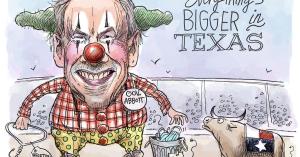
It’s a race to the bottom for Republican Governors in the efforts to decimate Constitionally granted civil rights and liberties. We’ve heard a lot about Florida Governor Ron DeSantis. However, his flop of a Presidential run has left him out of the state and speaking about his war on “woke” in rhetorical terms these days. He appears to have quit his asylum seeker kidnapping flights for the time being. Today, we must take a good hard look at what is happening in Texas.
For years, Texas Attorney General Ken Paxton used his office to allegedly inappropriately help a campaign donor, a group of investigators working for a Texas House panel revealed Wednesday.
The panel’s report comes as part of a months-long investigation into Paxton’s settlement of a lawsuit brought by four whistleblowers who were fired in 2020 after making accusations about the Republican’s misdeeds.
“To be negligent is just one thing,” Donna Cameron, one of the House-hired investigators, told the House General Investigating Committee. “But malfeasance is when you are actively and intentionally doing things to the detriment of the office and to your oath and to the responsibility that you have to the state of Texas and the public.”
Cameron and three other investigators spent over three hours Wednesday morning detailing Paxton’s alleged illegal acts, most of them related to Austin real estate investor Nate Paul, who made a $25,000 contribution to Paxton’s campaign.
The investigation primarily centered on what the whistleblowers alleged and the $3.3 million settlement they were ultimately awarded. Payment on that settlement has not yet been funded by the Texas Legislature.
Investigators stated the evidence they uncovered shows multiple violations of the law and Paxton’s oath of office. They include: Gift to a public servant, abuse of official capacity, misuse of official information, and retaliation and official oppression. Some of the violations carry jail time.
Many of the allegations discussed by investigators were already known, but Wednesday’s House panel was the first time investigators spoke on them in a public forum. The level of detail was also unusual.
Paxton is currently under indictment for alleged securities fraud. He was indicted in 2015 and also faces a separate federal investigation over alleged abuse of office.
The committee hearing — which was previously scheduled — comes less than a day after Paxton accused House Speaker Dade Phelan of being intoxicated on the House floor and called for his resignation.
In a statement posted on Twitter, Paxton said Phelan was trying to “sabotage my work as Attorney General.”
“Every allegation is easily disproved, and I look forward to continuing my fight for conservative Texas values,” Paxton wrote.
According to investigators, Paxton asked his top deputies in 2019 for legal counsel on a disputed records request involving Paul, who wanted access to sealed information concerning a search warrant by federal agents against himself.
After Paxton’s staff searched Paul on the internet — finding Paul was under investigation from the FBI and had multiple bankruptcies — they advised Paxton not to release the documents.
Erin Epley, the lead attorney in the group of House investigators, said the decision “was the correct one under the law.”
Texas has become the epicenter of runaway state government. Rule of Law means nothing in Texas. Nowhere is this clearer with the current controversy surrounding Governor Abbott’s use of barrels wrapped in razor wire and denial of basic human aid to those coming to the Texas Border. The DOJ is now on the case. This is from Democracy Now! “DOJ Threatens to Sue Texas Gov. Abbott for Installing Barrels Wrapped in Razor Wire in Rio Grande.”
The U.S. Justice Department is threatening to sue the state of Texas after Republican Governor Greg Abbott installed barrels wrapped in razor wire in the Rio Grande in an attempt to block migrants from crossing the river. This comes just after a whistleblower state trooper at the Texas Department of Public Safety recently protested the state’s inhumane policies in a letter to superiors. “What’s happening at the border in Texas right now is criminal,” says Democratic Texas Senator Roland Gutierrez. “There’s state crimes, there’s federal crimes, and there’s international crimes.”
AMYGOODMAN: The U.S. Department of Justice is threatening to sue Texas after Republican Governor Greg Abbott installed barrels wrapped in razor wire in the Rio Grande in an attempt to block migrants from crossing the river and entering the United States. Texas has also placed large coils of razor wire in the river. The Justice Department has given Abbott until 2 p.m. today to begin removing the floating barriers and related structures. Humanitarian workers and local news outlets report numerous migrants, including children, have suffered from lacerations after being cut by the razor wire oftentimes they couldn’t see — it was underwater.
A whistleblower state trooper at the Texas Department of Public Safety recently decried the state’s inhumane policies. In a letter to superiors, Nicholas Wingate wrote, quote, “The wire and barrels in the river needs to be taken out as this is nothing but a in humane trap in high water and low visibility,” he wrote.
Last week, the U.S. Justice Department sent a letter to Texas stating, quote, “The State of Texas’s actions violate federal law, raise humanitarian concerns, present serious risks to public safety and the environment, and may interfere with the federal government’s ability to carry out its official duties,” unquote.
Texas Governor Greg Abbott responded by writing on social media, “Texas has the sovereign authority to defend our border, under the U.S. Constitution and the Texas Constitution.” Abbott went on to say, “We will see you in court, Mr. President.”
We’re joined right now by Democratic Texas state Senator Roland Gutierrez. He recently announced he’ll run against Republican Senator Ted Cruz of Texas.
Welcome back to Democracy Now!, state Senator, at least for now. It’s really important to have you with us on this critical day. Can you talk about these flesh-ripping razor wire barriers in the water and what you think needs to be done at this point?
SEN. ROLANDGUTIERREZ: Well, thank you, Amy, first off.
I mean, it’s obvious that what’s happening on the border is inhumane, as Trooper Wingate suggested, that these people are made in the eyes of God and that no one should have to go through this kind of torture. And it is torture, let’s be very clear. The wire that is in the water cannot be seen. It’s lacerated people. It’s caused problems. And worse yet, Trooper Wingate describes a situation where people have tried to get beyond the buoys and beyond the razor wire, sadly, in deeper parts of the river. He talks about a mom who lost her child underwater. Her and her other child succumbed at that point. They rescued the mom and the daughter, but they, sadly, died at the hospital.
And so, we have to understand that what’s happening at the border in Texas right now is criminal. There’s state crimes, there are federal crimes, and there’s international crimes. We have to understand that what’s happening right now is of such a degree that troopers are acting under the color of law, and that not only are taking people’s rights, but people are dying or being injured very seriously from this. Greg Abbott needs to stop this flippant attitude and understand that what he’s doing is harming people, and nothing he is doing has anything to do with any kind of immigration policy, because they have shown no metrics under Operation Lone Star. It has been stunt after stunt after stunt. And unfortunately, this one is leading into the deaths of migrants and migrant children.
AMYGOODMAN: There were a number of other incidents that were described in the email: the 4-year-old migrant girl and a pregnant woman having a miscarriage found with severe injuries as they crashed into the barbed wire barrels while crossing the river. The young girl had also passed out from heat exhaustion. Wingate also wrote that the migrant mother, as you described, and one of her children drowned. It looks like the other one is not found. A child being pushed back into the water by one of these Border Patrol?
SEN. ROLANDGUTIERREZ: Yes, Amy. I mean, all of those actions that you just described are absolute crimes that need to be prosecuted. I have talked to the local district attorney. As you know, I’ve asked the Justice Department to step in. They have suggested that they’re indeed doing that. They have asked the governor to remove the obstacles in the water.
The Department of Public Safety’s director, Steve McCraw, I spoke to him immediately as these reports came out, which was last Monday. And he suggested there’s going to be an audit. I don’t think he understands the severity of the situation. This is not about an audit. We need to have an investigation as to who gave what commands and when, how high from the Department of Public Safety did those commands come from, who knew about it. He claims, of course, that he didn’t know anything about it. But, you know, any kind of audit or investigation of any sort from this agency is — I just question, because this is the same agency that failed all of those kids in Uvalde, Texas, a year ago, over a year ago, and here yet, we have no accountability from this agency at all in the last year and a half on that incident.
I think that we have to take a very serious look at what’s considered immigration policy and what isn’t. The last two months, we have seen a success in the reimplementation of Title 8, cutting down crossings about down to half. The fact is, Greg Abbott doesn’t want to have that discussion. He simply wants to talk about the chaos that he’s created.
This latest bus included 44 migrants from Mexico, Colombia, China, Haiti, Honduras, Peru, and Venezuela — 14 of whom were children between the ages of two and 14 years old, according to a Coalition for Humane Immigrant Rights’s spokesperson. Los Angeles received its last migrant bus a week ago.
According to Abbott’s office, over 160 migrants have been sent to Los Angeles since June 14. In total, over 27,000 migrants have been sent to Denver, Chicago, Philadelphia, Washington D.C., and New York City. Abbot claimed he’s sent thousands of migrants because Texas towns on the border are “overwhelmed and overrun” with migrants.
“Los Angeles is a major city that migrants seek to go to, particularly now that its city leaders approved its self-declared sanctuary city status,” Abbott said in a statement at the time he sent the first bus. “Our border communities are on the front lines of President Biden’s border crisis, and Texas will continue providing this much-needed relief until he steps up to do his job and secure the border.”
Mayor Karen Bass said her office cooperated with “city departments, the county, and a coalition of nonprofit organizations, in addition to our faith partners” to engage in its plan that it has previously utilized toward the influx of migrants.
“Actions ordered by Texas Gov. Abbott against migrants and refugees are outrageous, if not criminal,” CHIRLA Executive Director Angelica Salas said in a statement to ABC News. “We condemn the dehumanization of migrants and refugees anywhere, and we remind Governor Abbott that every life is precious and protected under the United Nation’s Human Rights Charter.”
Texas installed a floating barrier of large buoys on the Rio Grande river near the border town of Eagle Pass earlier this month as part of Abbott’s multibillion-dollar effort to secure the U.S. border with Mexico.
The barrier, as well as the state’s use of razor wire to deter migrants, has prompted a warning from Joe Biden‘s administration. Abbott has said the measures are within his authority because of what he says is a state of emergency caused by migrants crossing illegally into Texas.
Critics have said using disaster declarations to implement tougher border policies isn’t legally sound.
“There are so many ways that what Texas is doing right now is just flagrantly illegal,” David Donatti, an attorney for the Texas American Civil Liberties Union (ACLU), told The Associated Press. Abbott’s office has been contacted for comment via email.
Jessie Fuentes, the owner of a Texas kayaking company, has sued Abbott and other state officials over the buoys, arguing that they have hurt his business and that border crossings aren’t covered by the Texas Disaster Act.
“The definition of disaster cannot be read so broadly to allow Governor Abbott to create his own border patrol agency to regulate the border and prevent immigrants from entering Texas by installing a buoy system in the Rio Grande,” the lawsuit states. An attorney for Fuentes has been contacted for comment via email.
One woman could barely get words out through her tears. Another ran to the restroom as soon as she was done, wordless, wretched sobs wracking her tiny body. A third threw up on the witness stand.
These are believed to be the first women in the country since 1973 to testify in court about the impacts of a state abortion ban on their pregnancies. They almost certainly won’t be the last.
Speaking to a packed Travis County courtroom Wednesday, three women detailed devastating pregnancy losses and said medically necessary care was delayed or denied due to their doctors’ confusion over Texas’ abortion laws.
They’re challenging a clause in the state’s abortion ban that says a doctor can perform an abortion only if they believe the patient has “a life-threatening physical condition aggravated by, caused by, or arising from a pregnancy” that puts the patient “at risk of death or poses a serious risk of substantial impairment of a major bodily function.”
Doctors have reported delaying necessary pregnancy care for fear of violating the law, which allows doctors to be punished by up to 99 years in prison, a $100,000 fine and the loss of their medical license. The lawsuit, brought by the Center for Reproductive Rights, asks a judge to temporarily block the law from applying to medically necessary abortions and ultimately clarify when a medical emergency justifies an abortion.
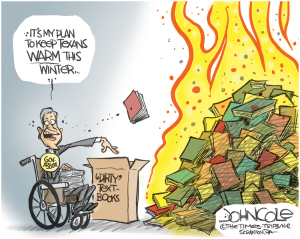
The bill requires the state’s Library and Archives Commission to adopt standards that schools must follow when purchasing books, and a rating system that would be used to restrict or ban some material.
“What we’re talking about is sexually explicit material … that doesn’t belong in front of the eyes of kids,” said the bill sponsor, Sen. Angela Paxton, a Republican. “They shouldn’t be finding it in their school library.”
Abbott, a Republican, previously joined a former GOP lawmaker’s campaign to investigate the use of books in schools covering topics of race, gender identity and sexual orientation. That inquiry included a list of more than 800 books.
In April, leaders of a rural central Texas county considered closing their public library system rather than follow a federal judge’s order to return books to the shelves on themes ranging from teen sexuality and gender to bigotry and race.
Under the measure passed Tuesday night, book vendors would have to rate books based on depictions or references to sex. “Sexually relevant” material that describes or portrays sex but is part of the required school curriculum could be checked out with a parent’s permission.
A book would be rated “sexually explicit” if the material is deemed offensive and not part of the required curriculum. Those books would be removed from school bookshelves.
I will continue to cover the Red States and their White Christian Nationalists policies as this election year continues. I think it’s essential to emphasize that states set the tone for what goes on in courts and the District. Governor Abbott and Texas Republicans are definitely leading the attack on our Constitution and Rule of Law. The Late, Great Texas Governor Ann Richards would be appalled. Watch as these things make their way to the Supreme Court and the Sicko Six.
What’s on your reading and blogging list today?
“The problem with Irony is not everybody gets it.” Ray Wyllie Hubbard.
Did you like this post? Please share it with your friends:
The Sky Dancing banner headline uses a snippet from a work by artist Tashi Mannox called 'Rainbow Study'. The work is described as a" study of typical Tibetan rainbow clouds, that feature in Thanka painting, temple decoration and silk brocades". dakinikat was immediately drawn to the image when trying to find stylized Tibetan Clouds to represent Sky Dancing. It is probably because Tashi's practice is similar to her own. His updated take on the clouds that fill the collection of traditional thankas is quite special.
You can find his work at his website by clicking on his logo below. He is also a calligraphy artist that uses important vajrayana syllables. We encourage you to visit his on line studio.

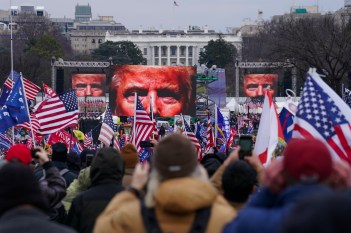 Good Afternoon!!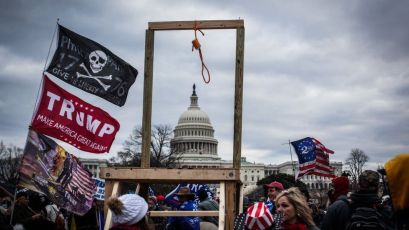
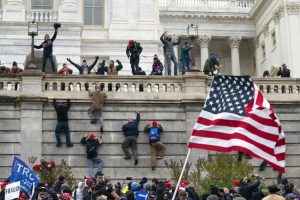 against Trump, but instead simply say, “well, Trump believes his bullshit and so do we and so the charged conduct may be First Amendment protected.”
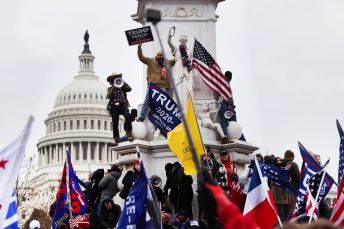 This afternoon, at 4:00, Trump will be arraigned for the third time. Kyle Cheney at Politico:







 Good Day, Sky Dancers!
 Texas has become the epicenter of runaway state government. Rule of Law means nothing in Texas. Nowhere is this clearer with the current controversy surrounding Governor Abbott’s use of barrels wrapped in razor wire and denial of basic human aid to those coming to the Texas Border. The DOJ is now on the case.
  Yes. That’s the same agency that failed all of those kids in Uvalde, Texas. Let’s list just a few things this Republican Governor has been up to recently.
 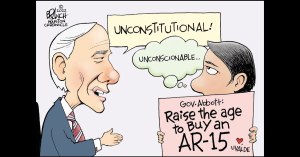 There are, as there should be, a lot of questions about the legal basis of Abbott’s actions. This is from Newsweek.
 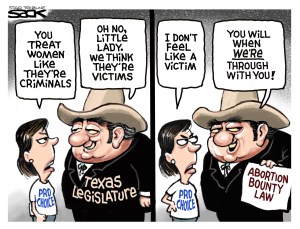 The lawsuit against the state by women who have been severely injured by the Texas Anti-Abortion law saw testimony starting July 19th.
 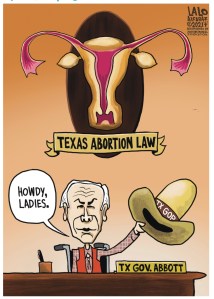 Also, Texas is leading the charge on Book Bans. This is from May 23rd.
 peej
peej Carissa
 bostonboomer
 dakinikat
 ecocatwoman
 jjlo
jjlo mablue2
 Mama Lopez
 peggysue22
 quixote
 skydancingguestblogger
 Mona (aka Wonk the Vote)





Recent Comments