
What are President Obama’s Chances Being Reelected in 2012?
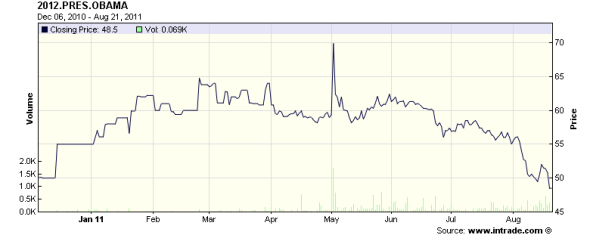
Posted: August 21, 2011 Filed under: just because 34 CommentsVia Zero Hedge, Right now his chances according to InTrade are only 49.4%.
Real Clear Politics’ average of Obama’s job approval ratings across polls: 43% approve, 50.5% disapprove.
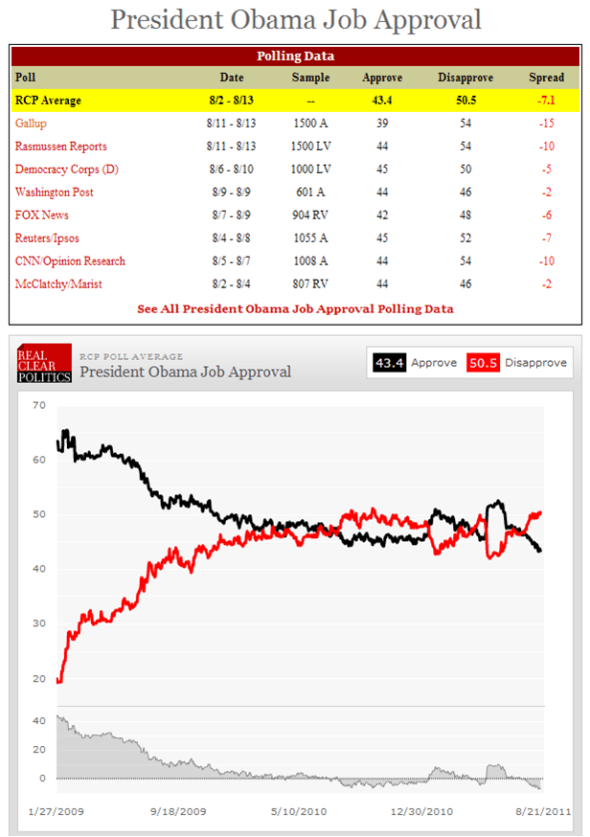
Obama himself admits he’ll be judged by voters on how well he handles the economy. His Gallup approval rating on that last week was only 26%. His weekly average for last week in the Gallup tracking poll was 40%. Only 11% approve of the way the country is going, and their number 1 issue is jobs.
Now check this out from Robert Reich:
Repeat after me: Workers are consumers. Consumers are workers.
We’re slouching toward a double dip, and the stock market is imploding, because consumers – whose spending is 70 percent of the economy – have reached their limit.
It’s not just the jobless who can’t spend. It’s mainly people with jobs. Median wages continue to fall. Weekly wages in July for Americans with jobs were 1.3 percent lower than eight months before.
America’s median earners are now earning less (adjusted for inflation) than they earned ten years ago.
Every CEO of every company that continues to squeeze payrolls (Verizon, are you listening? Ford?) needs to understand they’re shooting themselves in the feet. Where do they expect demand for their products and services to come from?
Of course Dakinikat has been telling us this forever, but in DC (and the wealthy part of Martha’s Vineyard) no one seems to be paying attention.
Maybe this was not such a good time for the President to take a vacation? Maybe it’s not such a good time to gut the New Deal and Great Society programs either? But we know he’ll keep trying. So what will he do to try to improve his chances of reelection?
At Zero Hedge, “Tyler Durden” suggests Obama’s only “good” option is to start another war. What do you think he’ll do?
Breaking … Libyan Rebels Enter Tripoli
Posted: August 21, 2011 Filed under: just because 29 Comments
Rebels celebrating after first attacks on Tripoli
Minutes ago, The New York Times reported that Libyan rebels have broken through Gaddafi’s lines of defense and entered the capital city of Tripoli.
Rebel troops approaching from the west raced through Colonel Qaddafi’s “ring of steel” defense that had been positioned outside Tripoli. Rebels driving pickup trucks mounted with machine guns met little resistance as they reached Janzour and Gargaresh, Tripoli neighborhoods where Qaddafi forces appeared to melt away, rebel leaders and residents said.
After six-months of inconclusive fighting the assault on the capital unfolded at a rapid pace, with insurgents capturing a military base of the vaunted Khamis Brigade where they had expected to meet fierce resistance, and then speeding toward Tripoli unopposed. By midnight local time rebel fighters said they were only a few miles from the center of Tripoli.
Inside the city, protesters took to the streets and rebels clashed with Qaddafi loyalists in some parts of the city, opposition leaders and refugees from the city said. Fighting had been heavy earlier in the day Sunday, but by nightfall Colonel Qaddafi’s forces had withdrawn from some districts without a major battle.
Gaddafi announced in a radio message that he would stay in Tripoli “until the end.” He told his supporters, “The time is now to fight for your politics, your oil, your land,” Colonel Qaddafi said. “I am with you in Tripoli — together until the ends of the earth.” Gaddafi’s whereabouts are a mystery.
Reuters is reporting that Gaddafi’s son Saif Al-Islam has been captured.
Juan Cole has a post up with lots of background on “The Great Tripoli Uprising.”
As dawn broke Sunday in Libya, revolutionaries were telling Aljazeera Arabic that much of the capital was being taken over by supporters of the February 17 Youth revolt. Some areas, such as the suburb of Tajoura to the east and districts in the eastrn part of the city such as Suq al-Juma, Arada, the Mitiga airport, Ben Ashour, Fashloum, and Dahra, were in whole or in part under the control of the revolutionaries.
Those who were expecting a long, hard slog of fighters from the Western Mountain region and from Misrata toward the capital over-estimated dictator Muammar Qaddafi’s popularity in his own capital, and did not reckon with the severe shortages of ammunition and fuel afflicting his demoralized security forces, whether the regular army or mercenaries. Nor did they take into account the steady NATO attrition of his armor and other heavy weapons.
This development, with the capital creating its own nationalist mythos of revolutionary participation, is the very best thing that could have happened. Instead of being liberated (and somewhat subjected) from the outside by Berber or Cyrenaican revolutionaries, Tripoli enters the Second Republic with its own uprising to its name, as a full equal able to gain seats on the Transitional National Council once the Qaddafis and their henchmen are out of the way. There will be no East/West divide. My hopes for a government of national unity as the last phase of the revolution before parliamentary elections now seem more plausible than ever. Tellingly, Tunisia and Egypt both recognized the TNC as Libya’s legitimate government through the night, as the Tripoli uprising unfolded. Regional powers can see the new Libya being born.
The underground network of revolutionaries in the capital, who had been violently repressed by Qaddafi’s security forces last March, appear to have planned the uprising on hearing of the fall of Zawiya and Zlitan. It is Ramadan, so people in Tripoli are fasting during the day, breaking their fast at sunset. Immediately after they ate their meal, the callers to prayer or muezzins mounted the minarets of the mosques and began calling out, “Allahu Akbar,” (God is most Great), as a signal to begin the uprising. (Intrestingly, this tactic is similar to that used by the Green movement for democracy in Iran in 2009).
You can follow events on the
Al Jazeera English Libya Live Blog here. The most recent update says that UK officials are urging Gaddafi to “Go now,” to “prevent further suffering for Libyans.”
The Guardian Live Blog on events in the Middle East is here.Latest updates:
10.11pm: Downing Street says “the end is near” for Gaddafi and calls on him to go to avoid more suffering for his people, according to the Press Association.
10.05pm: The head of Libya’s National Transitional Council tells Al Jazeera that Gaddafi’s son Saif al-Islam has been captured.
9.56pm: Al Arabiya TV reports that Gaddafi’s presidential guard has surrendered to the rebels, citing the rebels’ National Transitional Council.
9.52pm: Sky News correspondent Alex Crawford, who is with the rebels as they advance on Tripoli, says this must be the end for Gaddafi. She reports:
Even if he’s still here, his rule must surely be at the end. He can’t possibly expect to command any power any more.
To be honest, he’s lost now, I can’t see him being able to come back from this. His security forces have melted away.
Saturday Reads: a little readin’ and writin’ and rhythmetric
Posted: August 20, 2011 Filed under: just because, morning reads | Tags: Althea Gibson, animal migrations, austrian school, Climate change, dominionism, extremist christians and anti-environmental policies, Hayek, Keynesian Economics, Siberian Dog Skeleton, voodoo econmics, zombie memes 18 CommentsSo, I’m still fascinated about how much history, science, and just plain reason seems to have gone out the window this political season. It undoubtedly has something to do with the caliber of candidates that are out stumping about right now. So bad are they that John Huntsmen felt the need to tweet out to people that he wasn’t crazy!!! So, I’m gonna have a little salute today to knowledge, literacy, history, economics, science, and just plain ol’ rationale thought.
First, some history. On August 22, 1950, Althea Gibson became the first African American on the US Tennis Tour. Gibson paved the way for  today’s Williams sisters who are tennis super stars.
Growing up in Harlem, the young Gibson was a natural athlete. She started playing tennis at the age of 14 and the very next year won her first tournament, the New York State girls’ championship, sponsored by the American Tennis Association (ATA), which was organized in 1916 by black players as an alternative to the exclusively white USLTA. After prominent doctors and tennis enthusiasts Hubert Eaton and R. Walter Johnson took Gibson under their wing, she won her first of what would be 10 straight ATA championships in 1947.
In 1949, Gibson attempted to gain entry into the USLTA’s National Grass Court Championships at Forest Hills, the precursor of the U.S. Open. When the USLTA failed to invite her to any qualifying tournaments, Alice Marble–a four-time winner at Forest Hills–wrote a letter on Gibson’s behalf to the editor of American Lawn Tennis magazine. Marble criticized the “bigotry” of her fellow USLTA members, suggesting that if Gibson posed a challenge to current tour players, “it’s only fair that they meet this challenge on the courts.” Gibson was subsequently invited to participate in a New Jersey qualifying event, where she earned a berth at Forest Hills.
On August 28, 1950, Gibson beat Barbara Knapp 6-2, 6-2 in her first USLTA tournament match. She lost a tight match in the second round to Louise Brough, three-time defending Wimbledon champion. Gibson struggled over her first several years on tour but finally won her first major victory in 1956, at the French Open in Paris. She came into her own the following year, winning Wimbledon and the U.S. Open at the relatively advanced age of 30.
Gibson repeated at Wimbledon and the U.S. Open the next year but soon decided to retire from the amateur ranks and go pro. At the time, the pro tennis league was poorly developed, and Gibson at one point went on tour with the Harlem Globetrotters, playing tennis during halftime of their basketball games.
Next up, a little anthropology and biology! The National Geographic reports on how an ancient dog skull shows how early humans paired up with some of their first pets.
It took 33,000 years, but one Russian dog is finally having its day.
The fossilized remains of a canine found in the 1970s in southern Siberia’s Altay Mountains (see map) is the earliest well-preserved pet dog, new research shows.
Dogs—the oldest domesticated animals—are common in the fossil record up to 14,000 years ago. But specimens from before about 26,500 years ago are very rare. This is likely due to the onset of the last glacial maximum, when the ice sheets are at their farthest extent during an ice age.
With such a sparse historical record, scientists have been mostly in the dark as to how and when wolves evolved into dogs, a process that could have happened in about 50 to a hundred years.
“That’s why our find is very important—we have a very lucky case,” said study co-author Yaroslav Kuzmin, a scientist at the Russian Academy of Sciences in Novosibirsk.
In the case of the Russian specimen, the animal was just on the cusp of becoming a fully domesticated dog when its breed died out.
 So, it wouldn’t be me without some economics. Economist Greg Ip has a great post up at the WP on how Republicans’ new voodoo economics is worse than the old brand because the new brand isn’t based in economics at all. It’s a nice common sense essay on how fiscal and monetary policy work and how today’s crop of Republicans ignore about 90 years of economic theory and empirical studies
The new GOP views actually have a much longer pedigree: They are rooted in an intellectual contest that raged during the 1930s and 1940s, and had long been settled by the opposing side.
Before then, orthodox economics held that the economy was self-correcting. Just as the price of wheat or the wages of carpenters would always adjust to eliminate surpluses or shortages of either, so would wages throughout the economy adjust to eliminate temporary bouts of high unemployment.
The Great Depression shattered that orthodoxy, as high unemployment became entrenched in the United States and around the world. British economist John Maynard Keynes convincingly argued that when interest rates were zero — a condition he termed a “liquidity trap” — the economy’s self-correcting properties did not operate. The best solution, he argued, was a burst of public spending to restore demand and employment.
Ip goes on to explain how the competing view–Hayek’s Austrian school–was long discredited but has now made some kind of zombie comeback. This is especially true with Tea Party zealots and Ron Paul fans. What these folks talk about is not even taken seriously among any of the world’s economists. The Hayek-style alternatives were tried in South America and led to disaster. No main stream university teaches anything remotely resembling Austrian school “economics” and no serious peer-reviewed journals accept their work because it’s empirical evidence-free.
So, I couldn’t be remiss and leave out some climate science! Climate change has animals heading for the hills! That goes for plants too!
Regardless of what Rick Perry and the rest of Republican presidential candidate field believe (except for you, Jon Huntsman), climate change is real and it’s happening. The questions for the 98% of climate researchers who accept the consensus on man-made global warming is how fast the climate is changing, and what impact it will have on humanity and the planet.
Here’s one effect of warming scientists are already seeing: plants and animals migrating to cooler climates to escape hotter temperatures. In a study published in the August 18 Science, researchers in Britain and Taiwan found that species are moving in response to global warming up to three times faster than previously believed. Analyzing studies covering over 2,000 responses from plants and animals, the scientists found that on average, species have moved to higher elevations to escape warmer temperatures at 40 ft per decade, and moved to higher latitudes (ie, further away from the equator) at 11 miles per decade.
So, here’s a real shocker and it’s from a DKos diary. Today’s lesson in journalism shows us that we have a very uniformed commenteriat. Evidently Wolf Blitzer and Jack Cafferty had never heard of dominionisim until just recently. That’s the extreme christian belief that’s overtaking a lot of republican circles these days. Michelle Bachmann oozes it out of every pore. We’ve discussed it here considerably and Bostonboomer and I have written several posts on it.
You could probably hear my dropping jaw hitting the floor when I heard Jack Cafferty and Wolf Blitzer say they had never heard of dominionism until they read Michelle Goldberg’s article on The Daily Beast. They apparently had never heard of Christian Reconstructionism or the New Apostolic Reformation either. Goldberg’s article on Rick Perry and Michelle Bachmann’s relationship to all of this was certainly well done. But it is amazing that no other journalist of any prominence had looked into it before Goldberg’s revelations. There are many, and ever-more prominent pols with similar ties. And the failure of our national media and political culture to come to grips with this has been astounding. At least to me. As someone who has written about the Religious Right in its various dimensions for about 30 years, I’ve watched with horror as too many (but not all) mainstream media missed or misreported the stories of one of the most significant political movements of our time.
Blitzer and Cafferty et al have had plenty of opportunities to learn about dominionism and Christian Reconstructionism. They could have read Michelle Goldberg’s New York Times best-selling book Kingdom Coming: The Rise of Christian Nationalism, in 2006. They could have read my 1997 book, Eternal Hostility: The Struggle Between Theocracy and Democracy, or Sara Diamond’s 1989 classic, Spiritual Warfare: The Politics of the Christian Right. — to name but a few that deal specifically with dominionism and Christian Reconstructionism. We were all widely in the media, including national broadcasts talking about this stuff. They could also read material from such well established and well known organizations that study and counter the American right, as Americans United for Separation of Church & State and People for the American Way, and Political Research Associates. (PRA published my studyof Christian Reconstructionism in 1994.) Religion Dispatches reports on these things all the time as well. They have been discussed in wider context in books by such scholarly best selling authors as Gary Wills, Harvey Cox, Jeff Sharlet and Kevin Phillips, to also name but a few, and in major articles in magazines as diverse as Reason and Mother Jones. (I even discuss Christian Reconstructionism on camera in the 2007 Hollywood film documentary on the politics of abortion, Lake of Fire. Watch it for free, here.)
You really cannot have been awake in American public life for the past few decades and not have encountered dominionism and Christian Reconstructionism. Blitzer and Cafferty are far from alone in snoozing comfortably through this part of our national life. They are just more startlingly honest that this is no dream.
Now for a little SciFi lit. What if E.T. thinks we’re evil?
A study that reviews a host of sci-fi scenarios for contact with extraterrestrials stirred up such a ruckus today that NASA had to step in and distance itself from the research. The controversy focuses on the idea that E.T. could well decide that we’re a threat to interstellar order, and therefore we have to be stopped before we spread.
The report itself, published in the journal Acta Astronautica, covers ground that’s familiar to dedicated fans of E.T. lore. For example, the premise of the 1951 sci-fi classic “The Day the Earth Stood Still” is that universalist-minded aliens see our civilization as so rooted in violence that it’s better to snuff us out than let us ruin the neighborhood. (The 2008 remake, starring Keanu Reeves, recycled that idea with an environmental theme.)
Then there’s the “Hitchhiker’s Guide to the Galaxy” scenario, in which Earth is destroyed merely to make way for a new stretch of intergalactic infrastructure.
“At the heart of these scenarios is the possibility that intrinsic value may be more efficiently produced in our absence,” the researchers write.
The most familiar sci-fi scenario is the one in which the aliens are as selfish and territorial as we are, and want to wipe us out or enslave us and take our stuff. Think “War of the Worlds” or “Independence Day.” In such cases, the researchers note that there’s the potential for big payoffs … if we prevail.
Last up is our music lesson and ABCs rolled into one with this great song from kidhood by the Jackson five! Have a great Saturday and be sure to share what’s on your blogging and reading list today!!!
Vacation first, Jobs Package Next Month
Posted: August 18, 2011 Filed under: just because 15 Comments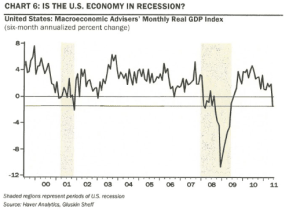 So, there’s discussion on the magical misery tour bus about a potential jobs package and some swagger, posturing and double dog dare yas to Republican Congress members in this pre-Martha’s Vineyard vacay speechification. The suggested policy pretty much sounds like the same tax cut crap that usually comes out of Republican mouth pieces. This leaves Republicans with the actual party affiliation hemming and hawing and reverting to the Nancy Reagan policy prescription of Just Say No. I’m dubious on any policy prescriptions at the moment because it’s simply way too late. If you believe the stock market is a fairly good barometer of economic health, and I do, economic recovery Elvis has left the building. I double dog dare you to find an upward trend in the last 9 months or so in that Real GDP index over in the nifty graph up there, top right. (Wonky aside: That’s a log linear series over there so it represents a growth rate or percentage change in GDP from month to month and it’s been annualized.)
So what’s on the horizon in terms of potential policy? Former Biden economic policy Adviser Jared Bernstein inkles that the President is keen to continue his pay roll tax holiday and extend unemployment benefits but all that must wait until at least September. Bernstein admits there would be too much political heavy lifting to get a “Recovery-Style state fiscal aid” package through congress. This undoubtedly means that more teachers, fire fighters, policemen, and state workers will get the boot in most of the 50 states some time after October. Too bad we can’t extend the successful parts of the stimulus like aids to states to cover their shortfalls.
So, what will/should President Obama say in September on jobs?
–Given everything he’s been saying so far, he most likely starts out with a strong call to renew the payroll tax holiday and extend UI benefits.
–These are both essential—EPI estimates that to lose them next year would cost over one million jobs. But since they’re already in the system, they don’t add anything new, so it’s like keeping your foot where it is now on the accelerator. If they expire on schedule at years’ end, your foot comes off. But keeping them going only maintains current speed, such that it is.
–He then pushes an infrastructure plan.
Robert Reich is going so far as to call the President “bold”. Well, it’s a backhanded sort’ve bold label, because he gives it and takes it away in the same blog thread Yes, giving speeches and saying things that you never see through to reality is bold alright. Let’s face it, Robert, sounding like a fighter while trying to crawl out of a hell hole of bad polling numbers is not exactly the same as bold action.
The President is sounding like a fighter these days. He even says he’ll be proposing a jobs bill in September – and if Republicans don’t go along he’ll fight for it through Election Day (or beyond).
That’s a start. But read the small print and all he’s talked about so far is extending the payroll tax cut and unemployment benefits (good, but small potatoes), ratifying the Columbia and South Korea free trade agreements (not necessarily a job-creating move), and creating an infrastructure bank.
An infrastructure bank might be helpful, depending on its size.
Which is the real question hovering over the entire putative jobs bill – its size.
Some of the President’s political advisors have been pushing for small-bore initiatives that they believe might have a chance of getting through the Republican just-say-no House. They also figure policy miniatures won’t give aspiring GOP candidates more ammunition to tar Obama as a big-government liberal.
But the President is sounding as if he’s rejected their advice.
Reich does finally give a blue print on what would actually be a bold and Democratic plan for jobs. Here’s one that’s not a shocker at all but unlikely to pass Presidential–let alone congressional–muster. After all, it’s so very unlike the legendary Saint Ronnie’s fare. Yeah, I know, never mind about what the real Ronald Reagan did. Let’s just stay with the myth.
Recreate the WPA and Civilian Conservation Corps to put long-term unemployed directly to work.
Something, however, tells me the President has yet to crack any macroeconomics text books when I read a headline like this: “Obama: We’re Not In Danger of Another Recession”. I just never know if its subterfuge or basic ignorance when I read these things. Of course, he must knows more than your average Wall Street analyst. Just ask Valerie Jarret, I’m sure she’ll tell you he’s so smart that to actually read anything about fiscal policy is beneath his IQ. He just magically knows what’s right after reading Ronald Reagan fanzines biographies and talking to lawyers from Chicago.
President Obama countered many Wall Street analysts, saying on Wednesday that the U.S. is not going to have another recession.
“I don’t think we’re in danger of another recession,” Obama told CBS News. Obama did note that the recovery has not been fast enough, blaming the Arab spring, high gas prices, and March’s earthquake and tsunami in Japan.
Obama said the volatility in the markets recently has been due to a lack of economic growth.
“The markets were reacting to the economy not growing as quick as it used to,” he said.
He also lamented the politics that surrounded the debt ceiling deal.
“We should not have had any brinksmanship around the debt ceiling,” he said.
Instead, let’s look at David Rosenberg’s 12 Bullet points that suggest we probably are already in a recession and remembering that recessions aren’t actually dated until they’re well usually under way or nearly over. Oh, Dr. David Rosenberg, btw, is the chief economist at Gluskin Sheff so he actually cracked more than a few Newsweek articles on the subject. Here’s a few of those bullet points.
Challenger layoffs have surged 80% in the past three months. That will lead to higher jobless claims in the near-term.
Consumer buying intentions for big-ticket items has sagged to recession levels. Watch the savings rate in the next six months — this will be key to the macro outlook.
Productivity has declined for two straight quarters and actually, unless companies willfully want their margins to implode, will soon respond by shedding labour input.
This already goes down as the weakest recovery on record despite unprecedented policy stimulus. Every dollar of balance sheet expansion at the Fed and the Treasury since the beginning of 2009 has generated 80 cents of incremental GDP gains. Not only is that a pitiful multiplier but now that there is no more stimulus, it is a legitimate question as to how an economy that only operated on policy steroids for the past two-and-change years is going to perform.
There is no doubt that the economy is not yet contracting, but the debate is whether it will start to by year-end. The withdrawal of stimulus is feeling like a policy tightening. And after coming off a mere 0.8% annual rate of gain in GDP so far this year, the question is how the financial shock since mid-year in the form of higher debt levels and equity cost of capital is going to impact an already near-stagnant economy.
The data on a three-month basis are following a classic pre-recession pattern and so is the stock market.
Indeed, today’s markets seem to be indicating there is a looming recession or even the suspicion of an onset. It’s not just the equity and gold markets, however. The job market remains extremely weak as Jobless Claims today shows. Lay offs are on the increase.
More Americans than forecast filed applications for unemployment benefits last week, signaling the labor market is struggling two years into the economic recovery.
Jobless claims climbed by 9,000 to 408,000 in the week ended Aug. 13, the highest in a month, Labor Department figures showed today in Washington. Economists surveyed by Bloomberg News projected a rise in claims to 400,000, according to the median forecast. The number of people on unemployment benefit rolls rose, while those receiving extended payments fell.
Lousy real estate numbers were also released today. We have record numbers of empty housing stock and no demand. We also have no plan for dealing with the problem.
What is obvious is the flight to safety. Investors worried about both the US economy and the Eurozone are headed for the US bond markets. This makes it a perfect time to borrow for a real bold job creating initiative. The problem is that things like creative energy policies, tax credits for new workers, and infrastructure banks are policies that should’ve been put into place two years ago. They take time to work through the bureaucracy and through the economy. Fiscal policy has very long lags between passing laws and actually get things into the economy. If we are slipping into a recession–and many signs say that we are–there is actually little to be done at this point other than hang on. That’s why traditional Republican Wall Streeters are horrified by rhetoric coming from the likes of Ron Paul, Michelle Bachmann, and Rick Perry. Get this quote from David Rosenberg and think about Perry who just said such an act was “treasonous”.
So the markets are saying we’re in a depression?
That’s why you have gold at $1700 an ounce. That’s why 10-year Treasury bond yields are lower now. The bond market is saying we are in for weak growth. Gold is saying the government is going to try to reinflate their way out of it.What can we expect to further happen while riding out the recession/depression?
Growth rates are going to be much weaker globally. There is going to be a prolonged period of very weak activity. Consumer confidence is lower today than after the 1987 crash and after 9/11.How do we get back to a sustainable bull market and expansion?
In the end, you print money.
Is there any wonder why traditional Republican interests are scrambling for a traditional Republican candidate at the moment? They’re looking all over the place for one that knows economics and speaks rationally. Now, if traditional Democratic interests would only scramble for a traditional Democratic candidate. You know, one that knows economics and actually speaks about things they intend to do rather than aspire to.
Karma Catches Up With Shepard Fairey
Posted: August 12, 2011 Filed under: Barack Obama, just because, U.S. Politics | Tags: 2008 presidential campaign, Barack Obama, Copenhagen, Denmark, Obama Hope poster, Obama illuminati, people pleasers, sellouts, Shepard Fairey, Yankee hipsters 4 Comments
Shepard Fairey, the designer of the iconic Barack Obama “Hope” poster was attacked and beaten up by Danish Leftists last weekend as he emerged from the opening of an exhibit of his work in a Copenhagen art gallery. From the Guardian:
Earlier this month he was involved with a controversial mural that has enraged leftwing anarchists throughout the city.
“I have a black eye and a bruised rib,” Fairey told the Guardian.
According to reports, 41-year-old Fairey and his colleague Romeo Trinidad were punched and kicked by at least two men outside the Kodboderne 18 nightclub in the early hours of last Saturday morning. Fairey claims the men called him “Obama illuminati” and ordered him to “go back to America”.
Fairey had designed a mural to commemorate
the demolition of the legendary “Ungdomshuset” (youth house) at Jagtvej 69. The building, a long-term base for Copenhagen’s leftwing community, was controversially demolished in 2007. In the intervening years it has become a potent symbol of the standoff between the establishment in Copenhagen and its radical fringe.
Fairey’s installation, painted on a building adjacent to the vacant site, depicted a dove in flight above the word “peace” and the figure “69”. But the mural appeared to reopen old wounds, with critics accusing Fairey of peddling government-funded propaganda.

The controversial mural defaced with graffiti
To prove he isn’t a propagandist, Fairey attempted to pacify the leftists by altering his mural. According to Raw Story, he
worked with former members of the youth house to add “images of riot police and explosions,” together with a new slogan — apparently derived from the tagline used by the Anonymous hactivists — reading, “Nothing forgotten, nothing forgiven.”
At The Atlantic, Adam Clark Estes points out that Fairey “struggled to make amends with both sides,” the government and the leftist group. Estes argues that the attack on Fairey “seems to have been borne of Danish leftist radical distaste of both Obama and hipsters.”
In the eyes of the leftwing community, the local city council made Fairey their pawn in order to send an insult to the activists whose base they’d destroyed four years ago. The local Danish press reports that the council paid Fairey nearly $50,000 for the mural, the first of four planned around Copenhagen, but Fairey denies that his commission came from the city. Fairey had full creative freedom for the works, according to Henrik Chulu with the art blog Frikultur who says the murals are “part of a strategy to brand Copenhagen as progressive and ‘cool’.”
As it were, Fairey’s is not the type of cool the Danish like or want. The controversy that turned to violence in Denmark sheds a little light on how far we’ve come since the controversy that helped make Fairey’s iconic Obama poster so famous. After a escaping unscathed from a copyright battle over the photo used for the poster, Fairey has taken a lot of flak for being a sell-out. Lately, Fairey has been the star of the record-breaking Museum of Contemporary Art graffiti show in Los Angeles and making huge commissions in the process. At first glance, it might seem like Fairey’s come back to Earth. (After all, he has now literally inserted himself into fight in a foreign land over issues of social justice.) But Fairey’s as capitalist as ever. He’s even selling prints that feature the Copenhagen mural’s iconography online.
Apparently Fairey resembles Obama in trying to please everyone but ultimately pleasing no one. And they’re both sellouts too!

 peej
peej Carissa
 bostonboomer
 dakinikat
 ecocatwoman
 mablue2
 Mama Lopez
 peggysue22
 quixote
 skydancingguestblogger
 Mona (aka Wonk the Vote)



 Sky Dancing
Recent Comments