
Tuesday Reads: Will John Roberts Exercise His Option to Kill Obamacare?
Posted: November 11, 2014 Filed under: just because 37 Comments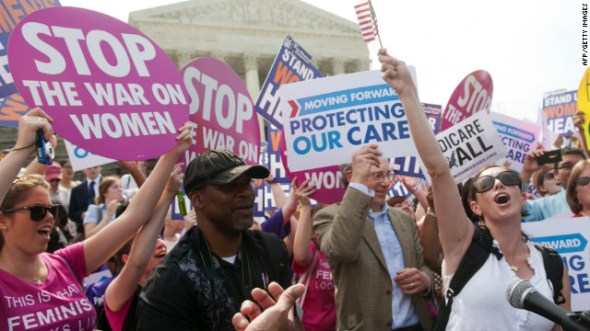
Good Afternoon!!
I had a strange computer problem this morning–actually not a computer problem per se, but a browser problem. I finally got it solved, although I don’t quite understand why it happened. So here I am, a little later than usual.
I’m going to focus this post on the Supreme Court challenge to the Affordable Care Act (AKA Obamacare) in the form of King v. Burwell, the case SCOTUS announce it will hear next year. From Think Progress:
In a surprise move late last week, the Supreme Court agreed to hear the case of King v. Burwell, a lawsuit seeking to strip premium tax credits from people living in states with a federally-operated insurance marketplace. If the lawsuit, which employs an overt misreading of the Affordable Care Act, is successful, it would hike premiums by triple digits and make health coverage unaffordable for millions of Americans. We have written about the case before, when a panel of the Fourth Circuit Courts of Appeals ruled on it and unanimously upheld the law. But that wasn’t enough for at least four Justices, who now think it worthwhile that the case be argued in front of the nation’s highest court.
Make no mistake, the lawsuit is a strategic attempt at repeal by another name by ideological conservatives.
We don’t have any way of knowing for sure which justices voted to hear the case, but we can be sure that they included Scalia, Thomas, and Alito. Was the fourth vote to take the case that of Anthony Kennedy or Chief Justice John Roberts? You’ll recall that in 2012, Roberts supposedly “saved” the ACA by vote to allow the government to invoke a penalty for people who did not sign up for some kind of health insurance. Unfortunately, the SCOTUS decision also severely wounded the ACA by permitting governors to refuse to accept the Medicaid expansion that made it possible for people who could not afford health coverage to receive government subsidies.
Here’s Jim Newell at Salon in April of this year: John Roberts didn’t “save” Obamacare — he gutted it.
Nearly two years ago, by a 5-4 decision, the Supreme Court allegedly “upheld” Obamacare. More specifically, the thinking at the time went, it was Chief Justice John Roberts who, in a herculean act of statesmanship, cast the deciding vote to “uphold” Obamacare….
John Roberts certainly could have done much more damage to the law, had he chosen to. He could have joined the four other conservatives on the bench who were prepared to take down not just the individual mandate, but the entire law itself. What a peach.
Still, as early estimates of the newly ensured under Obamacare’s implementation are rolling in, it’s time to write a second draft of history — one that doesn’t include anything about John Roberts “upholding” or “saving” Obamacare. Because that’s an odd way to describe a decision that gutted the most effective part of the law.While the White House was popping champagne over the survival of the law’s requirement for individuals to obtain health coverage or suffer a tax penalty, Republican-held state governments were more focused on that “other” part of the majority decision: the one that allowed states to opt out of the law’s Medicaid expansion and suffer no consequences to its pre-expansion Medicaid funding. The White House, at least publicly, blew this off. “Senior Obama administration officials downplayed the impact of the Medicaid portion of the court ruling, saying as a practical matter it is not particularly significant,” the Wall Street Journal reported at the time. After all, the thinking went, what state would be crazy enough to turn down all this money — an expansion that the federal government would fund 100 percent of in the beginning, and 90 percent of permanently?
Two years later, we have the answer: Many, many states would be precisely that crazy! Let’s call it two dozen. The Kaiser Family Foundation breaks it down as 19 states “not moving forward at this time,” while the issue is under “open debate” in five states. And it is definitely not certain that those “open debates” will produce Medicaid expansions.

How many of those states reelected the governors who screwed them out of lower health care costs? I haven’t checked for sure, but offhand, I’d say most of them are still in office.
Now we face another challenge, and John Roberts will have to decide whether or not to completely destroy the ACA. Paul Waldman at The American Prospect: Republicans May Finally Get Their Wish to Watch the Affordable Care Act Destroyed.
On Friday, the Supreme Court agreed to hear the case of King v. Burwell, perhaps the last gasp in the Republican attempt to use the courts to destroy the Affordable Care Act. The reaction to this news among liberals was, to put it mildly, shock and dismay. Simply put, the lawsuit is a joke, and the fact that any judge, let alone a justice of the Supreme Court (not to mention five of them) would do anything but laugh it out of court is a testament to just how shamelessly partisan Republican judges have become. At least four justices have to consent to hear a case, so it’s possible that there will still be five votes to turn back this stink bomb of a case. That will probably depend on the good will of John Roberts, something I wouldn’t exactly want to stake my life on. But lives are indeed at stake.
There are a couple of optimistic scenarios for how this could all turn out, and I’ll explain why I suspect they’re wrong. But in case you haven’t been following, this case rests on what is essentially a typo in the ACA, where it refers in one spot to subsidies provided to Americans in health insurance exchanges “established by the state.” The conservative activists who brought the suit contend that these three words prove that Congress did not intend subsidies to be available in states that declined to set up their own exchange and therefore defaulted to the federal exchange. (There are 36 such states.) They manage to argue this with a straight face—or perhaps a cruel smirk might be a better description—despite the fact that every member of Congress, congressional aide, journalist, and everyone else who was there at the time agrees that no one ever contemplated the insane idea that Americans in states using the federal exchange would be ineligible for subsidies.
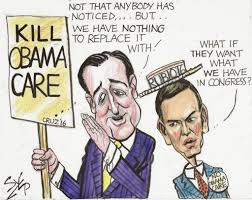
The subsidies, tax credits, and Medicaid expansion are what allow the ACA to make health insurance Affordable for millions of Americans.
According to the Department of Health and Human Services, 8 million Americans got private insurance through all the exchanges in their first open enrollment period, and 5.4 million of those were in the federal exchange. Of those, 86 percent, or 4.7 million, received subsidies to make their insurance affordable. If this lawsuit is successful, those millions would all lose their subsidies. Many, if not most, would probably be unable to purchase insurance and would rejoin the ranks of the uninsured. Then premiums for the remaining people in the exchanges would skyrocket, insurers would drop out, and the result would be a death spiral that not only destroys the exchange altogether but also undermines, perhaps fatally, the other two legs of the “three-legged stool” that comprises the ACA: the requirement that insurers accept all customers regardless of pre-existing conditions, and the individual mandate. (If you’d like details on how this would happen, you can read this amicus brief filed by 49 distinguished economists who study health care.)
Keep in mind that by the time the SCOTUS decision is handed down in June of next year, Congress will be completely controlled by Republicans, so there’s zero chance the typo in the law will be fixed, since it hasn’t happened with the Democratic Senate.
This is, of course, just what the conservatives wish for. The purpose of their campaign is to destroy the Affordable Care Act; the swath of human misery, stretching from horizon to horizon, to be left in that campaign’s wake is precisely the point. Among all the acts of cynicism and deception that this debate has featured in the last five years, this lawsuit must surely rank near the top for its sheer villainy.
But now it looks like the conservatives on the Supreme Court are ready to sign on. We know already that four of the justices—Antonin Scalia, Clarence Thomas, Samuel Alito, and Anthony Kennedy—were willing to junk the law in the first case in which it was upheld, with Chief Justice Roberts siding with the liberals to sustain it (albeit while undermining its expansion of Medicaid). So any optimism on this case rests in large part with the assumption of Roberts’s continued unwillingness to destroy the law.
Since we can’t know which four justices voted to hear King v. Burwell, we have no clue what Roberts is going to do.
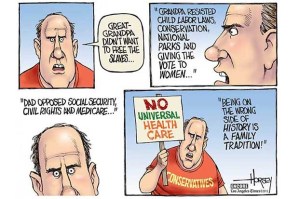
Meanwhile, the Obama administration has already scaled back expectations for new signups. The Hill reports:
Officials at the Department of Health and Human Services (HHS) on Monday projected that up to 9.9 million people would be enrolled in ObamaCare in 2015, millions fewer than Congressional Budget Office (CBO) estimates.
Federal health officials are projecting that ObamaCare enrollment will include at least 3.1 million fewer people next year than congressional budget analysts thought.
HHS, which previously declined to project 2015 sign-ups, said that between 9 million and 9.9 million people are expected to participate in the exchanges in 2015.
The figure was less than the CBO’s projection of 13 million for 2015 enrollment, raising questions about the exchanges’ performance, compared with expectations.
Or maybe HHS is projecting that millions of people won’t sign up for a plan knowing that SCOTUS could pull the rug out from under them 6 months later.
Simon Malloy at Salon argues that Republicans could be in trouble if they get their wish and Roberts votes with the rest of the conservatives on the Court to kill Obamacare.
But, for the moment, let’s assume that the SCOTUS conservatives carry the day and successfully eviscerate the Affordable Care Act by invalidating the tax credits offered through the 36 state exchanges run by the federal government. In many ways this would seem to offer an ideal political scenario for the Republicans. A legislative repeal of the Affordable Care Act isn’t going to happen, even with a Republican-controlled Congress, owing to the president’s veto pen. But if the Supreme Court steps in and guts the law for them, then they get their preferred policy outcome without having to do any of the actual dirty work. No fuss, no muss.
But it’s not at all that simple. The biggest political challenge facing the GOP is the fact that “repealing” or otherwise damaging the Affordable Care Act, while ideologically satisfying, carries with it some very real consequences. The states that opted not to create their own health exchanges – the states that would lose their health insurance subsidies if SCOTUS rules against the government – are mostly Republican-governed states. The sudden unavailability of those tax credits would mean that a lot of newly insured people in those states would no longer be able to afford their health coverage. They will expect their elected officials to do something to mitigate the damage, which would be catastrophic. Close to 5 million people across the country would see their health insurance costs spike.
That would pose an awkward situation for Republicans in the statehouses and Congress: Do they stick to their ideologically acceptable rigid opposition to Obamacare, or do they work to fix the law? Congress has the ability (if not the willingness) to pass a quick legislative fix to solve the problems. Governors could agree to set up exchanges within the state to keep the subsidies flowing. These are the simplest paths to resolving the issue, and there would be intense pressure to get either or both done.
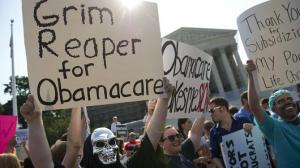
I just don’t buy it. Republicans would blame the mess on President Obama and the federal government and the mass of low-information voters would believe them.
I’ll end there, but here are a few more links of interest on this subject:
Think Progress, Meet Jennifer, A Woman Who Could Die If An Anti-Obamacare Lawsuit Succeeds.
Brian Beutler at The New Republic, How John Roberts Can Preserve His Conservative Cred and Save Obamacare at the Same Time.
Jeffrey Rosen at The New Republic, John Roberts’s Legacy May Be Decided in the Next Few Months.
Dana Millbank at The Washington Post, Why Obamacare risks falling into a ‘death spiral’.
What do you think? What other stories are you following today? Please share your thoughts and links in the comment thread.
Election Day Reads
Posted: November 4, 2014 Filed under: just because 85 Comments
Good Morning!!
Election Day 2014 has finally arrived. Will our fears of a Republican-controlled Senate materialize? The pundits certainly think so, but the voters will have the final say. Let’s see what the so-called “experts” had to say this morning.
From The LA Times, Cheat sheet: 10 states to watch in the battle for the Senate, by Cathleen Decker.
Tuesday’s election brings to an end a multibillion-dollar barrage of promises, threats, hysteria and retribution known collectively as the 2014 midterms.
Traditionally, such elections are the out-party’s opportunity for payback against the party in power, and rarely has that been as true as it is this year, when President Obama’s unpopularity has made Republicans optimistic about winning control of the Senate and extending their domain in the House.
Republicans need a net gain of six Senate seats to take control; they are expected to add to their 33-seat margin in the House.
The states Decker says to watch won’t be a surprise to anyone here. They include New Hampshire, where Scott Brown is trying to unseat Democratic Senator Jeanne Shaheen; North Carolina, where Democratic Senator Kay Hagen is battling against Republican Thom Tillis to retain her seat–she’s been leading in the polls; Kentucky, where Alison Grimes is running against powerful Republican Senate Minority Leader Michell McConnell; and Louisiana, where Senator Mary Landrieu is in an uphill battle against Republican Bill Cassidy to retain her seat. Here’s Decker on the remaining battleground states:
Colorado: Ground zero in many ways, the state boasts tight Senate and governor’s races as well as a competitive House race in the Denver suburbs. Perhaps nowhere did Democrats more forcefully push their argument that Republicans were warring against women, and a loss by Sen. Mark Udall to Rep. Cory Gardner would send shivers through the Democratic hierarchy in advance of the 2016 presidential contest. Also down to the wire is the governor’s race, featuring Democratic incumbent John Hickenlooper and Republican Bob Beauprez. One complication: This is the first all-mail election in the state, which could alter turnout.
Kansas: News has not been as good for Republicans in this state, where Gov. Sam Brownback has faced a backlash over budget cuts and Sen. Pat Roberts is trying to beat back an independent candidate after being dirtied up early on over his lack of a home-state home. The Republicans’ fates will show whether it’s possible for the GOP to go too far, even in a red state, and the perils for a candidate of going Washington in a sharply anti-Washington year.
Georgia: Like Colorado, this is a site of competitive governor and Senate races. In both cases, Democrats were boosted by family ties — former President Carter’s grandson Jason is the gubernatorial candidate and Senate candidate Michelle Nunn is the daughter of longtime Democratic Sen. Sam Nunn. Nunn has also been helped by outsourcing accusations leveled against her Republican opponent, David Perdue. However, to win Tuesday would mean capturing more than 50% of the vote; otherwise, candidates head to a January runoff.
Iowa: Spoiled by attention each presidential cycle, Iowa has been in the bright lights this year as well. Republican Senate candidate Joni Ernst defined her toughness early on by airing an ad on her past experience castrating hogs. Bruce Braley, a Democrat, gained early fame by appearing to criticize farmers. Ernst’s strategy appears to be working better, not surprisingly; Braley trailed in a final Des Moines Register preelection poll. No such dramatics in the race for governor, which GOP veteran Terry Branstad has led wire to wire.
Alaska: But for potential runoffs in Louisiana and Georgia, the Last Frontier might well be the last to count votes, so late do its ballots come in. Democratic Sen. Mark Begich was trying to fend off Republican Dan Sullivan, with Begich helped not at all by Obama’s deep unpopularity in the state. Also up in the air: a novel unity challenge featuring independent Bill Walker and Democrat Byron Mallott, working together to try to knock off GOP incumbent Gov. Sean Parnell….
Florida: A true race to the basement, the contest for Florida governor featured two candidates who generate eye rolls as much as applause: the incumbent Republican, Rick Scott, and Republican-turned-independent-turned-Democrat Charlie Crist, who served as governor while a member of the GOP. All the strangeness of the race boiled down recently to this: Scott refused to come on stage for a televised debate because he objected to a fan Crist had brought in, leaving the moderator and Crist to fumble on air for several long minutes before Scott relented. It’s been lots of hot air — before and since.

According to Chuck Todd, Mark Murray, and Carrie Dann at MSNBC , the two key state that may show which way the Midterm political winds are blowing are New Hampshire and North Carolina.
North Carolina (where final polling places close at 7:30 am ET) and New Hampshire (where they close at 8:00 pm ET). Every scenario of Democrats holding on to the Senate assumes they win those two states. If we’re able to put those two in the Democratic column, then we’re going to have to wait for Alaska, especially if Georgia goes to a runoff. But if Republicans win one or both of North Carolina and New Hampshire, then Katy bar the door. It’s going to be an ugly night for Democrats.
New Hampshire, the biggest state bellwether over the past decade
Indeed, if any state has been a bellwether of the nation’s political mood over the past decade, it’s been New Hampshire. Consider: Democrat Jeanne Shaheen lost the state’s Senate contest in the pro-GOP year of 2002; Democrats swept the state in 2006 and 2008; Republicans made gains there in 2010; and Democrats won them back in 2012. The only exception here was in 2004, when John Kerry (who was from neighboring Massachusetts) won New Hampshire, despite the GOP’s narrow wins that year. So for Democrats to have a good night, Sen. Jeanne Shaheen (D-NH) and Gov. Maggie Hassan (D) are going to need to buck history.
How 2014 could say something about 2016
There is a final reason to pay attention to New Hampshire and North Carolina tonight; they’re two of four presidential battleground states — Colorado and Iowa being the others — that feature a top Senate contest. For Republicans to have an Election Night that has the potential to be somewhat transformational for their brand, they need to win three of these four races. That would suggest that they’ve gotten back into the game in these states. (Republicans, after all, haven’t had statewide success in Colorado in a decade!) But Democratic wins in three of these four states would signal that Republicans still have issues here. If they can’t win Colorado, North Carolina, etc. in THIS midterm environment with the GOOD candidates they have, then they have A LOT of work to do come 2016. But there is another thing to keep in mind about 2016: Six-Year Itch elections often foreshadow the next presidential contest. The Dem gains in 1958 foretold JFK’s narrow presidential win two years later; the 1974 midterms (after Watergate) helped predict 1976; and the Democrats’ big victory in 2006 foreshadowed 2008. Even the surprising Dem gains in 1998 said something about the essentially tied 2000 presidential race. The one big exception here is 1986-1988, when Democrats picked up several Senate seats in Reagan’s Six-Year Itch midterm, but George H.W. Bush won the White House two years later. Democrats are comforting themselves this morning by the fact that Hillary seems so strong for ’16. But history tells us these Six-Year Itch elections may be more important than Democrats will have you believe.

At the National Journal, Ron Brownstein has an interesting article headlined The Tectonic Plates of 2014: Several key structural factors will help keep in perspective what Tuesday’s results say about the balance of power between the parties. What are those factors?
1. The president’s party almost always performs poorly in midterm elections, particularly the midterm of a second presidential term. Since 1900, the president’s party has lost both House and Senate seats in 19 of the 28 midterm elections; in the other nine cases, the president’s party gained seats in both chambers three times, and gained seats in one chamber—but not the other—six times. The numbers have been especially consistent in sixth-year elections: Although Republicans performed well in the midterms after the reelections of William McKinley in 1900 and Theodore Roosevelt in 1904, the president’s party has lost a significant number of seats in every other six-year-itch election since then, except for 1998, when Democrats benefited from the backlash against the House Republican drive to impeach Bill Clinton. In those other nine cases—1918, 1926, 1938, 1946, 1958, 1966, 1974, 1986, and 2006—the president’s party averaged a loss of 7.2 Senate seats and 37.4 House seats. Those may be good yardsticks to keep in view on Tuesday night.
2. The modern Democratic coalition is a boom-and-bust coalition that depends heavily on minorities and young people who turn out much less regularly in midterm than presidential elections. Older voters, who are trending steadily toward the GOP, vote much more reliably. Beyond any short-term factors, this is creating a structural disadvantage for Democrats in off-year elections: an electorate that is consistently older and whiter than it is in presidential races. As I wrote recently in The Atlantic: “In the five presidential elections from 1992 through 2008, exit polls conducted for a consortium of media outlets found that voters under 30 cast, on average, 18 percent of the ballots; in the five midterms that immediately followed those elections, young people accounted for just 12 percent of the votes. Voters over 65, by contrast, increased their share of the vote from 15 percent to 19 percent. The decline among minorities hasn’t been as consistent or as severe, but their share of the vote dropped two percentage points from 2004 to 2006, and three from 2008 to 2010, which are big shifts as these things go.”
Ironically, because Democrats have succeeded in turning out more minorities in presidential years, census figures show that the falloff in participation among Hispanics and African-Americans from an on-year to an off-year election is about twice as large as it was three decades ago. The most recent experience offered Democrats a daunting precedent: From 2008 through 2010, turnout dropped about one-third for African-Americans, almost two-fifths for Hispanics, and fully 55 percent for 18-to-24-year-olds, compared with about one-fourth for whites and only one-eighth for seniors. Tuesday’s election will help tell us how much the Democrats’ unprecedented efforts to identify and mobilize their core supporters can offset these underlying midterm trends, particularly in the battleground states both sides are targeting.
3. As more Americans pick Senate candidates from the same party that they usually support for president, each party is struggling to hold Senate seats in effect behind enemy lines—in states that usually prefer the other side for the White House. That trend is affecting both parties, but this year, it benefited Republicans. The core of the Democrats’ vulnerability this year has been a map tilted heavily toward places evolving away from the party, partly because the voters who comprise their new coalition are less prevalent there. Heading into this election, Democrats held 43 of the 52 seats in the 26 states that twice supported President Obama, and Republicans controlled 34 of the 44 in the 22 states that twice opposed him. This year, Democrats were especially vulnerable because they needed to defend six of their 10 red-state seats, and a seventh in North Carolina, which supported Obama in 2008 but not in 2012.One reason those states are growing away from Democrats harkens back to my second point: Their electorates are heavily influenced by the blue-collar, older, and rural white voters who have trended away from the party since the 1970s—but with increasing speed under Obama. In each of those seven states except Louisiana and North Carolina, the nonwhite share of the vote in 2008 was lower than the national average. As I wrote earlier this year, “In 2008, when Democrats won their Senate seats in those seven states, whites without a college degree cast at least half the votes in four of them (Arkansas, Montana, South Dakota, and West Virginia) and about two-fifths in Alaska and Louisiana. Whites older than 45 represented about half or more of the electorate in those first four states, and around two-fifths in Alaska and North Carolina.” Outgoing President George W. Bush’s unpopularity offset those unfavorable demographics in 2008. This year, Obama’s unpopularity is compounding their impact. Which brings us to the final headwind facing Democrats:
4. Americans are disillusioned with Obama. With a Gallup approval rating around 42 percent through the average of his 23rd quarter in office, Obama stands well below where Dwight Eisenhower (56 percent in 1958), Ronald Reagan (62 percent in 1986), and Bill Clinton (64 percent in 1998) did at this point in their presidencies, and closer to George W. Bush (39 percent). Two presidents who presided over a second-term midterm election after taking over a presidency already in progress also stood at least slightly ahead of Obama: Lyndon Johnson checked in at 44 percent in fall 1966 (six years after John F. Kennedy’s election) and Gerald Ford reached around 50 percent in 1974 (six years after Richard Nixon’s).
There’s much more at the link.
A few more articles of interest:
Wall Street Journal, Sullen Voters Set to Deliver Another Demand for Change.
Reuters, Republicans expect gains, but many races close on election day.
Bob Cesca at The Daily Banter, The Real Winner in Tomorrow’s Midterms: The Meme Culture.
Wall Street Journal, Republicans Poised to Expand House Majority in Midterm Election.
MSNBC, 19 OTHER Things to Watch on Election Night (Other than Senate Control).
Bloomberg Politics, Wavesmanship: The Battle for the Midterm ‘Mandate’.
CBS News, The governing class: What the GOP gubernatorial races mean.
Time, How to Watch the 2014 Elections, Hour by Hour.
Washington Post, Would a GOP Senate make a difference?
What’s happening in your part of the country? What important races are you watching. Have you voted yet? How many other people were there I plan to head over to my polling place this afternoon. We have a number of important state races and some interesting ballot questions. What’s on your ballot?
See you in the comments, and don’t forget we’ll have a live blog tonight. It should go up around 7PM ET.
Election Day Open Thread
Posted: November 4, 2014 Filed under: just because, open thread | Tags: election day 2014 11 Comments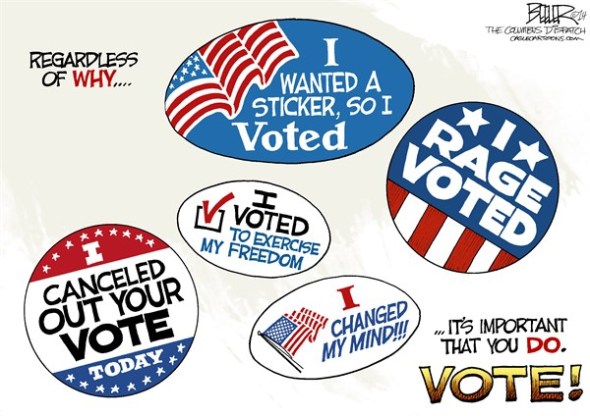
Good Morning Sky Dancers!
I can’t believe I slept until 10:15AM ET! That would have been 11:00 before the time changed on Sunday.
This is an open thread for anyone who wants to post links or comments. I’ll have a real morning post up as soon as I possibly can. And don’t forget we’ll have a live blog tonight to discuss the election results.
See you soon in a very late Tuesday Reads post!
Live Blog: Leader Pelosi on When Women Succeed, America Succeeds
Posted: September 21, 2014 Filed under: just because 10 Comments
I’m listening to Representative Cedric Richmond talk about the NFL and player’s domestic violence. Speaker Pelosi is up next. We’ve also been listening to the stories of women and how the pay gap. This includes women in the home health care sector. Two women discussed how illnesses and discrimination created situations where they made less income, less benefits and less social security benefits. My council woman Nadine Ramsey is introducing every one.
For information on this programs go to http://www.womensucceed.dems.gov

Live Blog: President Obama’s Speech on Dealing with Islamic State Militants
Posted: September 10, 2014 Filed under: Barack Obama, Foreign Affairs, Iraq, just because, Syria, U.S. Politics | Tags: Islamic State, live blog 36 Comments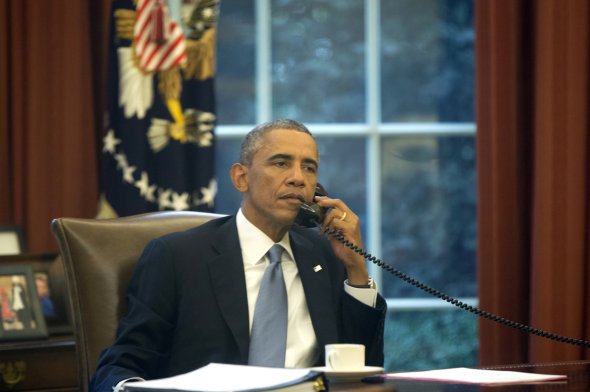
In this image made through a window of the Oval Office, President Obama speaks on the phone to Saudi Arabia’s King Abdullah on Wednesday (NPR)
President Obama will give a prime-time speech at 9:00 tonight in which he will lay out a strategy to deal with the Islamic State Militants in Iraq and Syria. Let’s watch the speech together and discuss on what the President says in real time. I’ve gathered some links to articles that report on and react to the leaked content of the speech.
According to The Washington Post, Obama will announce a ‘broad coalition’ to fight the Islamic State terror group.
The United States will lead a “broad coalition” to defeat the Islamic State through air strikes and support for military partners on the ground, President Obama will announce Wednesday night….Obama will tell the country that the offensive against the militant group will not involve combat troops, but rather a “steady, relentless effort” that involves air power and backing for partner forces, according to early excerpts provided by the White House.
“So tonight, with a new Iraqi government in place, and following consultations with allies abroad and Congress at home, I can announce that America will lead a broad coalition to roll back this terrorist threat. Our objective is clear: we will degrade, and ultimately destroy ISIL through a comprehensive and sustained counter-terrorism strategy,” Obama will say, using an acronym for the Islamic State terrorist group.
Obama will make clear to a war-weary public that the offensive will not resemble the wars in Iraq and Afghanistan, but rather other, more covert, missions against terrorists.
“I want the American people to understand how this effort will be different from the wars in Iraq and Afghanistan. It will not involve American combat troops fighting on foreign soil,” Obama will tell the nation.
“This counter-terrorism campaign will be waged through a steady, relentless effort to take out ISIL wherever they exist using our air power and our support for partner forces on the ground. This strategy of taking out terrorists who threaten us, while supporting partners on the front lines, is one that we have successfully pursued in Yemen and Somalia for years.”
Frankly, I’m very worried about this. I really don’t see how this is going to end well. I hope I’m wrong.
Richard Engel writes at NBC News, What Happens After the U.S. Bombs ISIS?
On one level, bombing ISIS is easy. The U.S. knows where the group operates. There’s no need for a ten-year hunt like the one for Osama bin Laden. The terror group has two capital cities, Mosul in Iraq and Raqqa in Syria. Al-Qaeda never had such an obvious home address.
Finding a justification to attack ISIS is also simple. It has threatened to carry out another 9/11, beheaded two American journalists, slaughtered thousands of Iraqis and Syrians and is a danger to U.S. allies in the region. Many in the U.S. military believe ISIS needs to be immediately, and repeatedly, smashed by American drones and warplanes.
But what then happens to the Middle East – this seething cauldron of competing interests, religious passions, ethnic tensions, long memories and oil? The key question now, as before the Iraq invasion, is what happens after the U.S. starts bombing.
ISIS controls a territory roughly the size of Maryland where 8 million people live. If it’s attacked and toppled, who will fill the void? In Iraq, it will be the Kurdish fighters or the Iraqi army. The two don’t trust each other and have different objectives for the territory they control. The Kurds are laying the foundation for a future independent state. The Iraqi army is increasingly an Iranian-guided, Shiite force.
The U.S. spent billions of dollars to build a secular, professional national Iraqi army but failed because, despite all the U.S.-supplied guns, tanks and planes, the Iraqi military fell apart when challenged by a band of terrorists. President Obama wants to reconstitute it now as part of his ISIS strategy. Why would it work this time when it didn’t before, even as U.S. troops were standing next to Iraqi soldiers in Baghdad, shoulder to shoulder?
Good questions. Read more at the link.
From the LA Times, Obama to call for ‘steady, relentless’ effort against Islamic State.
Nearly six years after he was elected on the promise to end America’s decade of wars, Obama planned to detail a military campaign that is broader and more complex than any he has launched during his tenure.
Obama is expected to expand U.S. airstrikes against the militants in Iraq to include targets throughout the country as well as across the rapidly disintegrating border with Syria, where the group harbors its weapons, camps and fighters.
White House officials say Obama also plans to further train and arm Iraqi and Kurdish troops as well as opposition forces battling the Islamic State in Syria. He’ll tout beefed-up partnerships with governments in the Middle East and Western allies, who have been asked to assist in the training, gather intelligence and counter the Islamic State’s appeal in the broader Muslim world.
In his televised remarks, Obama was to describe the effort as a “broad coalition to roll back this terrorist threat.”
“Our objective is clear: We will degrade, and ultimately destroy, ISIL through a comprehensive and sustained counter-terrorism strategy,” according to prepared remarks released by the White House, referring to the Islamic State by a commonly used abbreviation.
Those article spell out the gist of what the President will say. Here are a few more links to peruse if you want more.
Reuters, Bill to fund U.S. government ensnared in debate about Islamic State.
LA Times, Cheney urges Obama to launch ‘immediate’ assault on Islamic State (Sigh . . . why won’t he go away?)
Foreign Policy, There are already troops in Iraq. Problem is, they’re Iranian.
The New York Times, What Obama Faces in a Campaign Against ISIS.
Please us know what you think of the speech in the comment thread. Watch the live stream at CNN here and at the LA Times with live updating here.

 peej
peej Carissa
 bostonboomer
 dakinikat
 ecocatwoman
 mablue2
 Mama Lopez
 peggysue22
 quixote
 skydancingguestblogger
 Mona (aka Wonk the Vote)



 Sky Dancing
Recent Comments