


The death toll from Tropical Storm Ian remained unclear early Thursday after Florida Gov. Ron DeSantis (R) said it brought “historic” damage to the state, hours after President Biden approved a major disaster declaration for Florida amid what the National Hurricane Center described as “catastrophic flooding” over east and central parts of the state.
“We’ve never seen a flood event like this,” DeSantis said.
Two people were reported dead Thursday, though DeSantis said it was still unconfirmed whether their deaths were storm-related or if they died amid the storm from other causes. Local officials reported that a 34-year-old man died in Martin County, just north of Palm Beach, and a 72-year-old man died in Volusia County on Florida’s Atlantic Coast. The Lee County sheriff said Thursday he believed “hundreds” might be dead after the storm made landfall to the north, though no numbers have been confirmed as search and rescue efforts are underway.
Here’s what to know
Finally Friday Reads: Professional Cult Member and wife of Supreme Sex Pest Speaks to the J6 Committee
Posted: September 30, 2022 Filed under: just because | Tags: Covid-19, Ginnie Thomas, The Patriarchy, Uncle Clarence Thomas, US Midterm Elections 2022, voting rights 15 CommentsGood Morning Sky Dancers!
Must be nice to be rich and powerful enough to live in your own private reality and be allowed on public streets. Ginnie Thomas stuck to her QAnon vision of life while testifying to the January 6 Committee yesterday. We don’t have much information on it, but it sounds delusional. This is from the New York Times: “Ginni Thomas Denies Discussing Election Subversion Efforts With Her Husband. In a closed-door interview with the House committee investigating the Jan. 6 attack, Ms. Thomas reiterated her false assertion that the 2020 election was stolen from President Donald J. Trump.” I’m just wondering how many committee members were snickering during these statements. The analysis is by Luke Broadwater and Stephanie Lai.
In a statement she read at the beginning of her testimony, Ms. Thomas denied having discussed her postelection activities with her husband.
In her statement, a copy of which was obtained by The New York Times, Ms. Thomas called it “an ironclad rule” that she and Justice Thomas never speak about cases pending before the Supreme Court. “It is laughable for anyone who knows my husband to think I could influence his jurisprudence — the man is independent and stubborn, with strong character traits of independence and integrity,” she added.
The interview ended months of negotiations between the committee and Ms. Thomas over her testimony. The committee’s investigators had grown particularly interested in her communications with John Eastman, the conservative lawyer who was in close contact with Mr. Trump and wrote a memo that Democrats and anti-Trump Republicans have likened to a blueprint for a coup.
“At this point, we’re glad she came,” Mr. Thompson said.
After Ms. Thomas’s appearance on Thursday, her lawyer Mark Paoletta said she had been “happy to cooperate with the committee to clear up the misconceptions about her activities surrounding the 2020 elections.”
“She answered all the committee’s questions,” Mr. Paoletta said in a statement. “As she has said from the outset, Mrs. Thomas had significant concerns about fraud and irregularities in the 2020 election. And, as she told the committee, her minimal and mainstream activity focused on ensuring that reports of fraud and irregularities were investigated. Beyond that, she played no role in any events after the 2020 election results. As she wrote in a text to Mark Meadows at the time, she also condemned the violence on Jan. 6, as she abhors violence on any side of the aisle.”
I still can’t forget how unhinged those texts were to Mark Meadows, who is likely in more trouble than anyone else. Still, I can’t believe she didn’t discuss this with her husband. I also think more will come from Thomas’ role in the fake electors’ scheme.
The GOP is pouring lots of money into primaries where gerrymandering and the pattern of the out-party in midterms should be helping. But is it? Nate Cohn of the New York Times argues that structurally, the Republicans have the momentum. But can this hold given the number of extremists on the ballots and the ongoing legal troubles of its defacto lead, Orange Caligula? Cohn offers this analysis: “Gerrymandering Isn’t Giving Republicans the Advantage You Might Expect. Yes, the G.O.P. has a structural edge in the House, but it isn’t anything near insurmountable for Democrats.”
Now, Mr. Biden won the national vote by 4.5 percentage points, so even a map that’s biased toward Republicans might still have more Biden districts than Trump districts. But the simple fact that Mr. Biden won the most districts is a clear enough indication that the Republican advantage in the House isn’t totally insurmountable.
To account for Mr. Biden’s victory in 2020, a somewhat better — though more complex — measure is needed: a comparison between how districts voted and how the nation as a whole voted. If Mr. Biden won a district by more than he did nationally, it might be said to be a district where Democrats have the advantage if the national vote is tied. On a perfectly fair map, half the districts would lean toward Democrats with respect to the nation, while half would vote for Mr. Trump or vote for Mr. Biden by less than 4.5 points. And on this perfectly fair map, the district right in the middle — the median district — would have voted for Mr. Biden by 4.5 points, just like the nation.

Theo Van Rysselberghe, Bathers On The Rocks, 1920
Phillip Bump has one explanation: “A new reminder that candidate quality matters.” This opinion is in the Washington Post. The Trumpiest candidates are winning many Republican Primaries and are a way to the right and as delusional as Ginnie Thomas.
What’s apparent at this point, just over a month before voting ends in the 2022 midterm elections, is that nearly any national outcome is possible. FiveThirtyEight’s analysis of the state of play figures there’s about a 3 in 10 chance that Republicans win the House and Senate, about a 3 in 10 chance that the Democrats win both, and about a 4 in 10 chance that the parties split the two (Democrats, Senate; Republicans, House).
For all of the elevation of the importance of these elections, the field appears to remain fairly even. Or, perhaps, it’s because of the elevation of importance that it does. There are two reasons that a tug-of-war rope remains over the center point: No one is pulling at all, or both sides are pulling very hard.
This big-picture perspective, though, blurs the fact that overall patterns are dependent on individual races. And a spate of new polls conducted for Fox News by its bipartisan polling team shows, in essence, the importance of picking viable candidates in the first place.
The new polls evaluate the state of play in four states that are electing both governors and senators this year: Arizona, Georgia, Pennsylvania and Wisconsin. The widest overall margin is in the Pennsylvania governor’s race, where Attorney General Josh Shapiro (D) leads state Sen. Doug Mastriano (R) by 11 points. The closest race is in Wisconsin, where Gov. Tony Evers (D) earns the same level of support as his challenger, businessman Tim Michels (R). Generally, the picture is consistent: These races are too close to be able to identify a clear leader.

‘The Fragrance of a Bath’ (1930) by Itō Shinsui.
As I mentioned earlier, there’s a bump in GOP Fundraising, from GOP Billionaires. This is from CNBC: “GOP billionaire donors direct cash to Senate leaders as Trump candidates lag Dems in fundraising.”
Republican megadonors want the GOP to take back the Senate, but they don’t have confidence that some of former President Donald Trump’s top picks can catapult their party to a victory in November.
Billionaire financiers Paul Singer, Dan Loeb and Larry Ellison have so far avoided donating directly to some or all of Trump’s staunchest allies running for Senate in the midterms: J.D. Vance in Ohio, Blake Masters in Arizona, Herschel Walker in Georgia, Adam Laxalt in Nevada and Dr. Mehmet Oz in Pennsylvania, according to Federal Election Commission records and people familiar with the billionaires’ donations.
All of those candidates have been endorsed by Trump. And many of them have previously sided with the former president on the false claims that the 2020 presidential election had widespread voter fraud — an accusation that’s been debunked by Trump’s former attorney general, Bill Barr, federal courts and several other top Republicans who served in Trump’s administration.
One GOP fundraiser said, “They would be lighting their money on fire if they got totally swayed by these candidates.” That strategist is advising clients to, instead, give to the super PAC closely aligned with Senate Minority Leader Mitch McConnell, R-Ky. — the Senate Leadership Fund — because “they have the best polls and they won’t sink money into races they know they can’t win.” The super PAC is run by Steven Law, McConnell’s former chief of staff.
Ad tracker AdImpact last week said that the Senate Leadership Fund has canceled the rest of its TV bookings in Arizona, a state where the campaign poll tracking website FiveThirtyEight shows Masters trailing Kelly by more than seven percentage points.
We have to take care of this campaign finance issue to maintain democracy. It is just one of the Republican’s fuckery with democracy. Citizens United may prove one of the biggest hurdles to full inclusion in our democracy plus all the voting rights shenanigans by the Courts has been even worse. We have Justice Roberts to thank for a lot of that.
And, of course, while the rest of us are losing access to voting and bodily autonomy, let’s pity the poor little boys. If you want one of David Brooks’ most whiny pieces yet, try this one: “The Crisis of Men and Boys” at the New York Times, of course.
Richard V. Reeves’s new book, “Of Boys and Men,” is a landmark, one of the most important books of the year, not only because it is a comprehensive look at the male crisis, but also because it searches for the roots of that crisis and offers solutions.
I learned a lot I didn’t know. First, boys are much more hindered by challenging environments than girls. Girls in poor neighborhoods and unstable families may be able to climb their way out. Boys are less likely to do so. In Canada, boys born into the poorest households are twice as likely to remain poor as their female counterparts. In American schools, boys’ academic performance is more influenced by family background than girls’ performance. Boys raised by single parents have lower rates of college enrollment than girls raised by single parents.
Second, policies and programs designed to promote social mobility often work for women, but not men. Reeves, a scholar at the Brookings Institution, visited Kalamazoo, Mich., where, thanks to a donor, high school graduates get to go to many colleges in the state free. The program increased the number of women getting college degrees by 45 percent. The men’s graduation rates remained flat. Reeves lists a whole series of programs, from early childhood education to college support efforts, that produced impressive gains for women, but did not boost men.
Reeves has a series of policy proposals to address the crisis, the most controversial of which is redshirting boys — have them begin their schooling a year later than girls, because on average the prefrontal cortex and the cerebellum, which are involved in self-regulation, mature much earlier in girls than in boys.
There are many reasons men are struggling — for example, the decline in manufacturing jobs that put a high value on physical strength, and the rise of service sector jobs. But I was struck by the theme of demoralization that wafts through the book. Reeves talked to men in Kalamazoo about why women were leaping ahead. The men said that women are just more motivated, work harder, plan ahead better. Yet this is not a matter of individual responsibility. There is something in modern culture that is producing an aspiration gap.

Bathers, 1918 Pablo Picasso
I really didn’t want to include this but I think it’s important to understand just how entitled men are in this country. My experience in school was that the boys didn’t have to do much of anything but just show up. Maybe someone needs to tell them that participation trophies don’t count when you’ve got a lot of women and minorities motivated to succeed without them.
I thought I’d end with this Ed Yong article at The Atlantic about the legacy of the Covid -19 Pandemic. “All of this will happen again.”
American leaders and pundits have been trying to call an end to the pandemic since its beginning, only to be faced with new surges or variants. This mindset not only compromises the nation’s ability to manage COVID, but also leaves it vulnerable to other outbreaks. Future pandemics aren’t hypothetical; they’re inevitable and imminent. New infectious diseases have regularly emerged throughout recent decades, and climate change is quickening the pace of such events. As rising temperatures force animals to relocate, species that have never coexisted will meet, allowing the viruses within them to find new hosts—humans included. Dealing with all of this again is a matter of when, not if.
In 2018, I wrote an article in The Atlantic warning that the U.S. was not prepared for a pandemic. That diagnosis remains unchanged; if anything, I was too optimistic. America was ranked as the world’s most prepared country in 2019—and, bafflingly, again in 2021—but accounts for 16 percent of global COVID deaths despite having just 4 percent of the global population. It spends more on medical care than any other wealthy country, but its hospitals were nonetheless overwhelmed. It helped create vaccines in record time, but is 67th in the world in full vaccinations. (This trend cannot solely be attributed to political division; even the most heavily vaccinated blue state—Rhode Island—still lags behind 21 nations.) America experienced the largest life-expectancy decline of any wealthy country in 2020 and, unlike its peers, continued declining in 2021. If it had fared as well as just the average peer nation, 1.1 million people who died last year—a third of all American deaths—would still be alive.
America’s superlatively poor performance cannot solely be blamed on either the Trump or Biden administrations, although both have made egregious errors. Rather, the new coronavirus exploited the country’s many failing systems: its overstuffed prisons and understaffed nursing homes; its chronically underfunded public-health system; its reliance on convoluted supply chains and a just-in-time economy; its for-profit health-care system, whose workers were already burned out; its decades-long project of unweaving social safety nets; and its legacy of racism and segregation that had already left Black and Indigenous communities and other communities of color disproportionately burdened with health problems. Even in the pre-COVID years, the U.S. was still losing about 626,000 people more than expected for a nation of its size and resources. COVID simply toppled an edifice whose foundations were already rotten.
This, along with the Hurricane Ian experience reminded me that we’re not particularly forward-looking people anymore. I was happy to see Space Dart take out an astroid’s moon. However, it seems to me that were more likely to be taken down by our own hubris. Why do folks ignore climate change and still fall for developers’ promises of paradise on the beaches of Florida? We should be looking for the next big virus while learning lessons to plan for the next. We hurl from one emergency to the next without thinking about what in our system fails us? Even Democracy is failing us in significant ways. I no longer look to the Supreme Court to save us from ourselves. They now represent the worst of our political system.
Getting Donald Trump off the Public stage is vital but the preparations for the next big trouble start with revitalizing our democratic institutions and shoring them up. Also, getting the damn money out of politics would help too. Anyway, sorry to be Debbie Downer today. Maybe I’m just more somber today because the heat of summer has broken. Also, I had my first training class in community organizing yesterday. I’m sitting here relationship mapping who I’m going to nag into to voting. So, I started with my beloved community here. Drag your ass and everyone you know to the polls! I got granddaughters now!
This election is important. Please, get everyone you know to vote blue. A lot is at stake.
What’s on your blogging and reading list today?
Thursday Reads
Posted: September 29, 2022 Filed under: Afternoon Reads, just because | Tags: Climate change, Florida, Hurricane Ian, hurricanes, weather 15 CommentsGood Afternoon!!
It’s pretty clear that Hurricane Ian did catastrophic damage in Florida, although there still isn’t much specific reporting on it. The images on TV are horrifying though. We’ll likely be getting more details throughout today and over the next few days. The storm is now moving toward Georgia and the Carolinas. You can read live updates at the Weather Channel: Tropical Storm Ian Live Updates: Catastrophic Damage; Destruction Hampers Rescue Efforts; Death Reported.
More on Ian:
At least three sections of the Sanibel Causeway were washed away by storm surge from Hurricane Ian, according to video from CNN affiliates WBBH and WPLG, severing the Sanibel and Captiva islands’ only connection to Florida’s mainland.
The videos from the causeway show two portions of the ramp to both bridges washed away, as well as a stretch of roadway that crossed an island in the middle of the causeway.
A portion of the Sanibel Causeway Bridge “was damaged/washed out,” Lieutenant Gregory S. Bueno with the Public Affairs Division of Florida Highway Patrol told CNN. All lanes of the bridge are currently closed and the severity of the closure is listed as “major,” according to Florida 511.
Law enforcement and personnel from the Lee County Department of Transportation are on scene at the causeway, officials said in an update Thursday morning, and bridge inspectors were working to asses all bridges in Lee County. Residents are advised to remain off the roads “unless absolutely necessary.
The county, which includes Fort Myers in addition to Sanibel and Captiva islands and Cape Coral, suffered “catastrophic damage” from the storm, officials said in their update, noting that 98% of the county remains without power.
Urban search and rescue crews from local agencies are “actively engaged in search and rescue efforts,” with federal search and rescue teams being deployed. In the meantime, the 15 shelters opened prior to the storm’s arrival remain open.
Also from CNN this morning: Rescuers scour Florida’s flooded disaster zone amid massive power outages as Ian continues its ruinous crawl.
Rescuers have been pulling people from roofs as they work to respond to hundreds of calls for help since Ian – now a tropical storm marching across Florida – slammed the state’s west coast as a Category 4 hurricane, its surge trapping residents and its monstrous winds and flooding rains leaving millions without power and many without drinkable water.
Many are believed to need rescuing in hard-hit southwest Florida’s Fort Myers area, FEMA chief Deanne Criswell said Thursday morning. The nearby Naples area was similarly slammed – feet of water submerged streets, nearly swallowing vehicles and rushing into the first floors of homes and businesses – after Ian’s center plowed ashore near Cayo Costa on Wednesday afternoon as one of the strongest storms ever to make landfall on Florida’s west coast.
The Coast Guard and National Guard were “pulling people off of roofs in Fort Myers” with aircraft Thursday morning, Coast Guard Rear Adm. Brendan McPherson told CNN. Coast Guard crews have rescued at least 23 people since Wednesday, the service said.
Roughly five people are believed to have died in Lee County, the sheriff said, and parts of a key bridge there from Sanibel and Captiva islands to Florida’s mainland have been washed out.
Collapsed buildings, flooding, downed power lines and impassable roads were reported early Thursday by survey crews across southwest Florida. More than 2.5 million homes and businesses statewide have no power Thursday morning, according to PowerOutage.us, and some drinking water systems have broken down completely or have boil notices in effect.
Still, much about the misery remains unknown: how many lives Ian may have ended, how many people remain trapped, how many homes were wrecked beyond repair and how long it might take to restore a semblance of ordinary life.
The storm will now move up the coast to do more damage. This story at NBC discusses how climate change is affecting storms like Ian: Why ‘Category 4’ doesn’t begin to explain Hurricane Ian’s dangers.
Even as Ian gathered strength and neared Category 5 status, experts warned that solely paying attention to a hurricane’s category often masks just how destructive and life-threatening these storms can be — particularly as climate change makes hurricanes both rainier and more intense.
Hurricane Ian is already proving to be a devastating storm. After knocking out power to all of Cuba on Tuesday, Ian is forecast to dump up to 24 inches of rain over parts of Florida and trigger up to 18-foot storm surges from Englewood to Bonita Beach, according to the National Hurricane Center…
In the days leading up to Ian’s landfall, many drew comparisons to Hurricane Charley, which struck Florida’s southwestern coast as a Category 4 storm in 2004. But while past hurricanes can provide helpful context, Ian is sure to be a wildly different storm, said Kimberly Wood, an associate professor of meteorology at Mississippi State University.
“We’re looking at a similar category as Hurricane Charley, but the impacts will be very, very different,” they said.
Many of the most destructive and potentially deadly impacts of a hurricane — including storm surge, flooding and rainfall — are not accounted for in a storm’s category number. That’s because these categories refer to a storm’s rating on what’s known as the Saffir-Simpson Hurricane Wind Scale, which ranks hurricanes from 1 to 5 based on a storm’s maximum sustained wind speed.
The categories are used to estimate potential damage to property from hurricane winds, but where it becomes problematic is if people use the rankings to gauge other impacts on land.
“It has nothing to do with the size of a storm, and it has very little to do with how much rain is produced,” Wood said. “People hyper-focus on the category when the category is a very small part of the picture of what a hurricane might do to a location.”
The effects of climate change:
Hurricane Ian’s rainfall projections across Florida are a major concern and fit within a broader trend of storms becoming rainier in recent years due to climate change. A warmer atmosphere can hold more moisture, which often means heavy rain and catastrophic flooding when these storms make landfall.
Warmer ocean waters and other changes associated with climate change could also help hurricanes like Ian intensify rapidly as they near shore, said Karthik Balaguru, a climate scientist with the Pacific Northwest National Laboratory.
As they approach the coast, major hurricanes can generate life-threatening storm surge, which refers to the abnormal rise in water levels because of the storm. Even lower-ranked hurricanes on the Saffir-Simpson scale can generate huge storm surge.
As we saw yesterday, the storm surge in Florida was devastating.
More on climate change and hurricanes at Vox: Hurricane Ian’s rapid intensification is a sign of the world to come.
On Monday morning, Hurricane Ian had wind speeds of 75 miles per hour. Just 48 hours later, those speeds had more than doubled. On Wednesday, as the storm made landfall in southwestern Florida, Ian’s wind hit 155 mph — just shy of a Category 5 storm, the most severe category for a hurricane.
Such rapid growth is known by meteorologists as “rapid intensification.” It’s defined as storms whose wind speeds increase by roughly 35 mph or more in less than 24 hours. “Ian definitely met that criteria,” said Paul Miller, a professor of oceanography and coastal sciences at Louisiana State University.
While wind speed isn’t the only force that makes storms dangerous, hurricanes that rapidly intensify are especially worrisome. They can easily catch coastal communities off guard, giving them little time to prepare, Miller said.
What caused the rapid intensification?
It’s an important question, as storms like this one are highly destructive and are likely to become more frequent in the years to come.
There are three main ingredients that, when mixed together, can result in a rapidly intensifying hurricane: moist air, low wind shear (wind coming from different directions or at different speeds), and warm ocean water….
Ian had them all. As it developed several days ago, the storm system faced some disrupting winds, but there was little shear as it grew over the last few days, Miller said. And Ian has largely avoided a region of dry air in the Gulf of Mexico. (Had Ian hit Florida farther north, it might have deteriorated faster, he said.)
Then there’s the warm ocean water. The Gulf of Mexico has been unseasonably warm this summer, according to the National Weather Service. And climate change is heating the Caribbean ocean by a little over 1 degree C (1.8 degrees Fahrenheit) per century.
“Even small changes — half a degree C, or a degree — can really make a big difference,” said Brian McNoldy, a hurricane researcher at the University of Miami.
Another reason why the ocean is so warm is that it’s been a relatively quiet hurricane season so far. As hurricanes churn through the Caribbean, they sap heat from the water and churn it up, making it colder and less favorable for rapid intensification, Miller said.
Read more at Vox.
More news, links only:
Charlie Savage at The New York Times: ‘Giant Backfire’: Trump’s Demand for Special Master Is Looking Like a Mistake.
The Daily Beast: Judge Warns of Justice Department’s Gift to Trump That Could Keep on Giving.
Just Security: Tracker: Evidence of Trump’s Knowledge and Involvement in Retaining Mar-a-Lago Documents.
The Washington Post: Pentagon will double powerful HIMARS artillery for Ukraine.
AP: Russia poised to annex occupied Ukraine after sham vote.
Forbes: Russian Sabotage Of The Nord Stream Pipeline Marks A Point Of No Return.
NPR: EU officials and others are concerned about explosions at Nord Stream pipelines.
The Daily Beast: Rep. Marjorie Taylor Greene’s Husband of 27 Years Files for Divorce.
Unfortunately, Ian didn’t wash Mar-a-Lago away, but Trump is stuck there.
Mostly Monday Reads: A Fascist Returns to Power in Italy and the Return of the January 6th Committee
Posted: September 26, 2022 Filed under: just because | Tags: Clean up in Aisle Trumpist Regime Corruption and Crimes, DOJ Investigation January 6, House January 6 Committee, Italian Elections, US Midterm Elections 2022 20 Comments
Pearblossom Highway, 1986, David Hockney-
Good Day Sky Dancers!
I’ve been trying to get a handle on today’s headlines, and wow, there’s chaos afoot in the world and our country. The New York Times has this for a headline: “U.S. Warns Russia of ‘Catastrophic Consequences’ if It Uses Nuclear Weapons.” That’s nothing I thought I’d see again since the Cold War was over.
Then, Italy’s voters elected one of those bleach-blonde fascists we see so much these days on Fox News and Republican Conventions. For Eyes on the Right, Damon Linker analyzes the election results for us: ” What just happened in Italy? Much the same as what’s happened in France, Great Britain, Sweden, Poland, Hungary, and the U.S.”
What happened in yesterday’s election in Italy?
At the purely factual level, a coalition of right-wing and center-right parties won big in an election trigged by the collapse of a government led by the center-left Mario Draghi.
Giorgia Meloni’s Fratelli D’Italia (Brothers of Italy) was the biggest vote winner. The Fratelli were founded in 2012 as a successor to the post-fascist MSI (Italian Social Movement), which was itself founded in 1946 by Giorgio Almirante, who served as a minister under Mussolini. The other major members of the coalition are Matteo Salvini’s Lega and Silvio Berlusconi’s Forza Italia. A fourth party called Noi Moderati (really a coalition of small, centrist parties) is also expected to join a right-leaning government. At the time of this writing, with about half of the votes counted, it looks like the right will take something in the range of 60 percent of the seats in both the lower and upper houses of the legislature while winning a slightly smaller share of the vote than polls had predicted. (With Salvini’s Lega, especially, under-performing.)
The reality is somewhat less ominous than one might conclude from hearing we’re living through “the return of fascism in Italy.” The incoming government is certainly Italy’s most right-wing since World War II. But it’s also the case that the members of the victorious coalition have much more in common with other right-leaning politicians and parties around the contemporary world than they do with the politics of the 1930s.
 I’m not confident that reassures me especially given the Italian voter turnout. This is from The New York Times: “Giorgia Meloni’s Hard-Right Party Leads in Italy’s Voting. Early results suggest that she could be Italy’s next prime minister, the first woman to hold the position and the first with post-Fascist roots. It will still be weeks before a new government is formed.” One-third of Italian voters sat out the election.
She grew up with a single mother in a working-class area of Rome, and being a woman, and mother, has been central to her political identity.
Being a woman has also distinguished her, and marked a major shift, from her coalition partners, especially Mr. Berlusconi, the subject of endless sex scandals.
But Ms. Meloni, Mr. Berlusconi and Mr. Salvini share a hard-right vision for the country. Ms. Meloni has called for a naval blockade against migrants and spread fears about a “great replacement” of native Italians. The three share populist proposals for deep tax cuts that economists fear would inflate Italy’s already enormous debt, and a traditionalist view of the family.
Despite the constraints of an Italian Constitution that is explicitly anti-Fascist and designed to stymie the rise of another Mussolini, many liberals are now worried that the right-wing coalition will erode the country’s norms. There was concern that if the coalition were to win two-thirds of the seats in Parliament, it would have the ability to change the Constitution to increase government powers.
On Thursday, during one of Ms. Meloni’s final rallies before the election, she exclaimed that “if the Italians give us the numbers to do it, we will.”
But the coalition, while winning 44 percent of the vote and a majority in Parliament, appeared not to hit that mark.
There seems to be a growing voter backlash against what the Trump Regime SCOTUS appointments have done to Abortion Rights. Let’s hope we have a massive turnout for our elections in November.
Politico writer Steven Shepard reports, “Pollsters fear they’re blowing it again in 2022. Democrats seem to be doing better than expected with voters. But if the polls are wrong, they could be disappointed in November — again.”
Pollsters know they have a problem. But they aren’t sure they’ve fixed it in time for the November election.
Since Donald Trump’s unexpected 2016 victory, pre-election polls have consistently understated support for Republican candidates, compared to the votes ultimately cast.
Once again, polls over the past two months are showing Democrats running stronger than once expected in a number of critical midterm races. It’s left some wondering whether the rosy results are setting the stage for another potential polling failure that dashes Democratic hopes of retaining control of Congress— and vindicates the GOP’s assertion that the polls are unfairly biased against them.
It’s not that pollsters haven’t tried to fix the issues that plagued them in recent elections. Whether they’re public firms conducting surveys for the media and academic instructions or private campaign consultants, they have spent the past two years tweaking their methods to avoid a 2020 repeat.
But most of the changes they have made are small. Some pollsters are hoping that since Trump isn’t running in the midterms, the problems of underestimating Republicans’ vote share will disappear with him. But others worry that Trump’s ongoing dominance of the news cycle — from the FBI seizure of classified documents at Mar-a-Lago to litigation against his businesses in New York — effectively is making him the central political figure going into Election Day.
“There’s no question that the polling errors in [20]16 and [20]20 worry the polling profession, worry me as a pollster,” said Charles Franklin, the director of the Marquette Law School Poll in Milwaukee and a longtime survey-taker in the battleground state of Wisconsin. “The troubling part is how much of that is unique to when Donald Trump is on the ballot, versus midterms when he is not on the ballot.”

David Hockney, Pop Art Paintings 2006 -2009
Let’s hope people just turn out to say no to Trumpism.
The upcoming January 6 Committee public hearing is being overshadowed by a book and the release of information by former senior technical adviser Denver Riggleman. Riggleman looks a bit too opportunistic for me to fully trust his rationale for doing this. This is an interview with him via CBS’ 60 minutes.
Bill Whitaker: Wait a minute: Someone in the White House was calling one of the rioters while the riot was going on?
Denver Riggleman: On January 6th, absolutely.
Bill Whitaker: And you know who both ends of that call?
Denver Riggleman: I only know one end of that call. I don’t know the White House end, which I believe is more important. But the thing is the American people need to know that there are link connections that need to be explored more.
As senior technical adviser for the January 6th committee, Denver Riggleman, a former House Republican and ex- military intelligence officer, ran a data-driven operation pursuing phone records and other digital clues tied to the attack on the Capitol.
Denver Riggleman: From my perspective, you know, being in counterterrorism, you know, if the White House, even if it’s a short call, and it’s a connected call, who is actually making that phone call?
CNN has identified the rioter and has more information on the Rigglemen story. Many texts from Mark Meadows “reveal direct White House communications with pro-Trump operative behind plans to seize voting machines.” Will this be part of the next public hearing?
As allies of then-President Donald Trump made a final push to overturn the election in late-December 2020, one of the key operatives behind the effort briefed then-White House chief of staff Mark Meadows about his attempts to gain access to voting systems in key battleground states, starting with Arizona and Georgia, according to text messages obtained by CNN.
Phil Waldron, an early proponent of various election-related conspiracy theories, texted Meadows on December 23 that an Arizona judge had dismissed a lawsuit filed by friendly GOP lawmakers there. The suit demanded state election officials hand over voting machines and other election equipment, as part of the hunt for evidence to support Trump’s baseless claims of voter fraud.
In relaying the news to Meadows, Waldron said the decision would allow opponents to engage in “delay tactics” preventing Waldron and his associates from immediately accessing machines. Waldron also characterized Arizona as “our lead domino we were counting on to start the cascade,” referring to similar efforts in other states like Georgia.

David Hockney
Mark Meadows should be in some deep doo-doo over this, to use a Poppy Bushism. This analysis of the Riggleman interview comes from The Hill‘s Brad Dress. “Riggleman says Mark Meadows text messages reveal ‘roadmap to an attempted coup.’”
“The Meadows text messages show you an administration that was completely eaten up with a digital virus called QAnon conspiracy theories,” the former GOP lawmaker said. “You can look at text messages as a roadmap, but it’s also a look into the psyche of the Republican Party today.”
Before he stepped down in April, Riggleman and his team combed through phone records, emails, social media posts and text messages on behalf of the House committee.
That included 2,000 messages connected to Meadows, which Riggleman called “a roadmap to an attempted coup … of the United States.”
In those messages, Riggleman said his team traced the phone numbers of previously unidentified contacts to members of Congress and Trump allies including Ginni Thomas, the wife of Supreme Court Justice Clarence Thomas who pushed to overturn the 2020 election.
Riggleman said what “shook me was the fact that if Clarence agreed with or was even aware of his wife’s efforts, all three branches of government would be tied to the stop the steal movement.”
And, there’s this already.
This is from the Tweet posted above. “If Trump is charged, it should be for the worst of his crimes. ‘Seditious conspiracy’ and ‘insurrection’ are more fitting charges than ‘interfering with an official proceeding’ or ‘defrauding the U.S.’”
The significance of Jan. 6 shouldn’t be obscured by legalese before a public contending with the seduction of insurrectionist rhetoric. Charging Trump only with narrowly defined crimes could backfire, and Garland should resist, even if that’s what the House select committee investigating Jan. 6 ends up recommending. The vice chair of the committee, Rep. Liz Cheney (R-Wyo.), has hinted at a possible criminal referral to the Justice Department, both in hearings last month and in interviews during the course of the investigation, by highlighting two potential crimes: interfering with an official proceeding and defrauding the United States. A brief the committee filed in a legal dispute with Trump attorney John Eastman, who hatched the fake-electors scheme in the multipronged effort to overturn the election, also highlights these two offenses. Cheney has further suggested that the committee may include a referral on witness tampering, based on contact Trump had with those called to testify before the panel.
The committee may be tempted to stake out a moderate position regarding criminal charges in a misguided effort to garner public support and make the unprecedented prosecution of a former president more palatable, but the Justice Department must act independently in deciding what, or whether, to charge. To be sure, the DOJ should consider any evidence of criminality uncovered by the committee, but it should give no weight to the committee’s opinion in reaching its determination.
Restricting a federal prosecution to two rather obscure-sounding charges — and a possible third relating to the integrity of the process — would not only downplay the seriousness of Trump’s offenses but could also exacerbate the view that any such prosecution is politically motivated. After the Mar-a-Lago search, that perception took hold among Trump supporters, who accuse the FBI of acting on a technicality involving federal records, even though the bureau had a search warrant signed by a federal judge and based on a showing of probable cause that a crime had been committed. Violating the Presidential Records Act by removing or destroying government documents is not in itself in the same league as insurrection or seditious conspiracy; if, however, the records in question pertain to serious national security breaches — The Washington Post has reported that some of the documents relate to nuclear weapons — that might be a different matter.
You may continue reading that at the WAPO link.
So, I think I’m confused, dazed, and befuddled enough today trying to think all this through. What do you think?
What’s on your reading and blogging list today?
Tuesday Reads
Posted: September 20, 2022 Filed under: just because 26 CommentsGood Afternoon!!
Today is a big day for the Trump stolen documents case. His response to the DOJ filing at the 11th Circuit appeals court was due at noon, and at 2PM the DOJ and Trump lawyers meet with Special Master Raymond Dearie in New York to discuss the process by which Dearie will review the stolen documents. The documents marked classified can’t be included in the review yet, because of the DOJ appeal asking the 11th Circuit for a stay on Judge Loose Cannon’s order that Trump lawyers review them with Dearie.
Yesterday Trump filed a response to a request from Dearie about Trump’s claims to have declassified documents. Kyle Cheney at Politico: Trump discovers he’s not in Cannon-land anymore.
The court-appointed “special master” reviewing documents the FBI seized during the Aug. 8 search has asked the former president to disclose details about any materials he claims to have declassified before calling them his property.
In a court filing Monday, Trump’s attorneys urged Raymond Dearie, the senior federal judge based in Brooklyn, to drop a component of his plan that includes asking Trump for those details. Disclosing those during the review, Trump’s attorneys said, was not a requirement of U.S. District Court Judge Aileen Cannon’s order appointing Dearie as special master. And, they added, it could harm Trump’s defense against any forthcoming criminal charges.
“[T]he Special Master process will have forced the Plaintiff to fully and specifically disclose a defense to the merits of any subsequent indictment without such a requirement being evident in the District Court’s order,” the attorneys wrote.
Trump’s team’s comments came in response to a request from Dearie for a proposed agenda when he convenes the parties Tuesday for a preliminary conference in his Brooklyn courtroom. And it wasn’t their only gripe with Dearie’s “draft management plan” for the Mar-a-Lago review — which Trump himself demanded and for which his team picked Dearie as one of two acceptable options for the special master role.
Trump’s team also raised concerns about Dearie’s request for information about whether any subsequent Fourth Amendment litigation filed by Trump to reclaim the documents should be filed with the magistrate judge who authorized the search in the first place: Bruce Reinhart, who Trump has assailed without basis as biased against him.
And Trump’s lawyers also quibbled with Dearie’s proposed deadlines, contending that his draft plan “compresses the entirety of the inspection and labeling process to be completed by October 7, 2022.”
“We respectfully suggest that all of the deadlines can be extended to allow for a more realistic and complete assessment of the areas of disagreement,” his lawyers argued.
I guess the Trump team are now regretting that they asked for Dearie as special master. He expects them spell out the claims they have been making publicly, while avoiding discussing them in Loose Cannon’s court. She appeared to make decisions based on those public comments about declassification and Fourth Amendment violations even though the Trump lawyers didn’t argue them in their court filings. In addition, Trump’s lawyers came right out and admitted that he could be indicted.
Greg Sargent at The Washington Post: Trump’s lawyers just gave away the game, exposing his Achilles’ heel.
Throughout the Mar-a-Lago saga, it has been a running joke: Donald Trump and his media propagandists kept insisting he had declassified the documents he hoarded, supposedly proving his innocence. Yet his lawyers kept refusing to fully embrace this view, suggesting that as a legal argument, it’s rather worthless.
Now Trump’s trickery has run aground in spectacularly revealing fashion: In a new filing, Trump’s lawyers effectively admit they don’t want to address whether he declassified documents, while seeming to acknowledge he could face indictment.
This episode reveals the perils of lawyering by Fox News: If you tailor arguments to a forum where damning facts are never admitted as evidence and Trump’s defenses never face real scrutiny, eventually you’ll hit a wall of legal reality.
This bizarre turn came after Trump and the Justice Department submitted filings to Judge Raymond Dearie, the special master conducting a review of documents that the department secured in the search of Trump’s Mar-a-Lago resort, in response to Trump’s demands for that review.
In their filing, Trump’s lawyers responded to a plan Dearie suggested for this process. While that plan is not public, the Trump team’s objections provide a glimpse of it. As The Post
In their filing, Trump’s lawyers responded to a plan Dearie suggested for this process. While that plan is not public, the Trump team’s objections provide a glimpse of it. As The Post reports
“Specifically, the legal team objected to what it said was Dearie’s request that it ‘disclose specific information regarding declassification to the Court and to the Government.'”
That’s not all Trump’s legal team said, however. There’s also this:
“Trump’s lawyers wrote that they don’t want Dearie to force Trump to “fully and specifically disclose a defense to the merits of any subsequent indictment without such a requirement being evident in the District Court’s order” — a remarkable statement that acknowledges at least the possibility that the former president or his aides could be criminally charged.”
Here’s what this means: Dearie essentially asked Trump’s lawyers to put up or shut up. And they chose Door No. 2.
Trump has been claiming he believes he owns the stolen documents. Maggie Haberman published this scoop last night at The New York Times: Trump Was Warned Late Last Year of Potential Legal Peril Over Documents.
A onetime White House lawyer under President Donald J. Trump warned him late last year that Mr. Trump could face legal liability if he did not return government materials he had taken with him when he left office, three people familiar with the matter said.
The lawyer, Eric Herschmann, sought to impress upon Mr. Trump the seriousness of the issue and the potential for investigations and legal exposure if he did not return the documents, particularly any classified material, the people said.
The account of the conversation is the latest evidence that Mr. Trump had been informed of the legal perils of holding onto material that is now at the heart of a Justice Department criminal investigation into his handling of the documents and the possibility that he or his aides engaged in obstruction.
In January, not long after the discussion with Mr. Herschmann, Mr. Trump turned over to the National Archives 15 boxes of material he had taken with him from the White House. Those boxes turned out to contain 184 classified documents, the Justice Department has said.
But Mr. Trump continued to hold onto a considerable cache of other documents, including some with the highest security classification, until returning some under subpoena in June and having even more seized in a court-authorized search of his Mar-a-Lago residence and private club by F.B.I. agents last month.
The precise date of the late 2021 meeting between Mr. Trump and Mr. Herschmann is unclear. It was also unclear what, if any, awareness Mr. Herschmann had of what was in the boxes when the subject was discussed.
But by then, the National Archives had told associates of Mr. Trump that it was missing documents like original copies of his presidential correspondence with the North Korean dictator Kim Jong-un and the letter left for him by President Barack Obama. Archives officials said they had been told by then that there were roughly two dozen boxes of documents that had been in the White House residence and which qualified as presidential records, which had never been sent to the archives.
The meeting with Judge Dearie is going on now and Josh Gerstein of Politico is in the courtroom.
Trump’s lawyers have also filed a response to the DOJ’s appeal to the 11th Circuit.
Harry Litman posted a series of tweets about the Trump response.
We can’t know how long the appeal will take, but experts are saying the 11th circuit quick response the the DOJ appeal suggests they may act quickly.
There is plenty of other news, but I’m just going to post links, because I’m not feeling well today. It’s just stomach troubles, but it’s interfering with my ability to concentrate and write.
Important News Links:
The Washington Post: Video appears to undercut Trump elector’s account of alleged voting-data breach in Georgia.
The New York Times: Videos Show Trump Allies Handling Georgia Voting Equipment.
CNN: These male politicians are pushing for women who receive abortions to be punished with prison time.
Charlotte Shane at Harpers: The Right to Not Be Pregnant.
William Saletan at The Bulwark: The Chaotic Politics of Lindsey Graham’s Abortion Bill.
The Guardian: Criminal investigation launched into DeSantis asylum seeker flights.
Charlotte Alter at Time: Conspiracy Theorists Want to Run America’s Elections. These Are the Candidates Standing in Their Way.
Enjoy the rest of your Tuesday Sky Dancers!!
Mostly Monday Reads: Trump threatens the US with his QAnon Crazies
Posted: September 19, 2022 Filed under: just because | Tags: Donald Trump is mentally ill, QAnon 15 Comments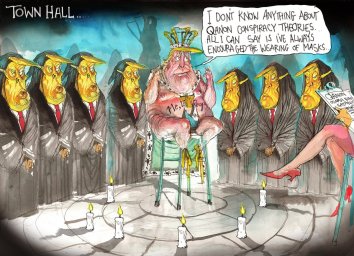 Good Day Sky Dancers!
Yesterday, JJ put up some video of a Trump Rally highly reminiscent of NAZI rallies. Trump has taken to threatening Americans and Democracy, warning us that ‘problems’ like ‘we’ve never seen before are coming if any court dares to indict him. This is from Politico on September 15: “It’s not the first time Republicans have hinted at potential civil unrest.” Frankly, he and his droogs in Congress have gotten more threatening the closer Trump comes to an indictment. This is from the Hewitt interview.
Former President Donald Trump said Thursday the nation would face “problems … the likes of which perhaps we’ve never seen” if he is indicted over his handling of classified documents after leaving office, an apparent suggestion that such a move by the Justice Department could spark violence from Trump’s supporters.
The former president said an indictment wouldn’t stop him from running for the White House again and repeatedly said Americans “would not stand” for his prosecution.
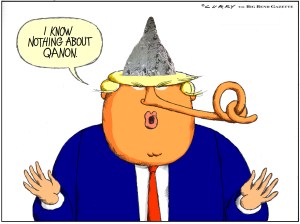 You may recall Lindsey Graham also linked a threat last month. The threats have gotten so frequent and disturbing that AG Merrick Garland felt the need to give a speech on Ellis Island while welcoming new;y minted American Citizens. This is the New York Times covering the event: “‘As Trump Inquiry Heats Up, Garland Says Divisions Imperil the Rule of Law. Addressing new citizens on Ellis Island, the attorney general emphasized that all Americans are equal under the law.” It seems weird that anyone these days should need to say that since Nixon argued that crimes weren’t crimes if the ‘president did it.’ That argument failed soundly. But after Judge Loose Cannon suggested a former president deserved special consideration, lawyers everywhere are speaking out. A group of Republican Lawyers filed an Amicus brief supporting the DOJ’s appeal of her decision to the 11th District.
An emotional Attorney General Merrick B. Garland addressed new citizens on Saturday at Ellis Island, the site of his family’s American origin story, and warned that the country had become dangerously divided by political factionalism, which has imperiled the democracy and the rule of law.
Mr. Garland was presiding over the oath of allegiance for 250 naturalized citizens at the iconic immigration processing center, on the anniversary of the signing of the Constitution in 1787. As the new Americans rose to recognize their home countries — about 60 of them, with origins from Albania to Yemen — he told them that the United States “wholeheartedly welcomes you.”
During a 10-minute speech in which he repeatedly stopped to collect himself, the attorney general recounted the tale of his grandmother’s flight from antisemitism in what is now Belarus before World War II, and the narrow escape to New York made by his wife’s mother, who fled Austria after Nazis annexed the country in 1938.
“My family story is what motivated me to choose a career in public service,” said the typically stoic attorney general, his voice dropping to a husky whisper. “I wanted to repay my country for taking my family in when they had nowhere else to go. I wanted to repay the debt my family owes this country for our very lives.”
Some of the most vehement reaction to the Trump QAnon rally has come from the Jewish community. Frankly, the reaction from everywhere is pretty astounding. This is from The Independent: “Trump under fire for QAnon display at Ohio rally: ‘He has gone completely insane’. ‘Trump has always been mentally ill, but this is a whole new level’.” This is reported by Gustaf Kilander.
Donald Trump has come under fire for his descent into the QAnon conspiracy theory movement during his Youngstown, Ohio rally in support of Republican Senate candidate JD Vance.
“This is the week when Trump became Qanon. This isn’t a political statement; it just is, however disturbing. Week began with images of Trump on Truth Social wearing a Q pin and promoting their slogans; it ends with Q music and the Q ‘one’ sign by crowd at his rally,” CNN analyst Juliette Kayyem tweeted on Saturday.
Author Kurt Eichenwald added that “this week, Trump posted QAnon memes, played QAnon theme music at his rally, and stood by as the crowd raises their fingers in the QAnon salute. This is the GOP’s supposed leader. Every Republican needs to be asked about it – and don’t let them walk away. ‘Do you support QAnon?’”
“He has gone full QAnon, and that cult knows it. Trump has always been mentally ill, but this is a whole new level. He has gone completely insane,” he tweeted.
The author went on to lay out a lot of the bizarre theories within the movement.
“With Trump now leaning so hard into QAnon, anyone who interviews him *must* ask ‘Do you believe there is a global cabal of elites who are kidnapping children, taking them to underground tunnels, murdering them, eating them and drinking their adrenochrome to stay young forever? Have you secretly been president since 2020, while Biden has actually been a clone? Were Hillary Clinton and Anthony Fauci taken to gitmo and executed? And if you don’t believe these things, why are you posting QAnon memes, playing their music, and encouraging their salutes?’” he tweeted.
Other comments covered by the story are from Robert Costa, including this tweet:
The entire rally was beyond creepy, and that includes the music. So, here’s a bit more about all of that. Vice News offers this primer on Trump’s sudden public conversion to the tome of crazy conspiracy theories and behaviors. “What Is This Eerie Salute People Are Doing at Trump Rallies Now? The signal was immediately compared to the “Sieg Heil” salute.”
On Saturday night, as former President Donald Trump was wrapping up a political rally in Youngstown, Ohio, one section of the crowd all raised their arms in the air and extended one finger.
The strange salute came as Trump was once again spreading lies and disinformation about the 2020 election and the FBI search on his Mar-a-Lago home. The signal was immediately compared to the “Sieg Heil” salute used by Nazi party members to greet Hitler. Some also said it was in reference to Trump’s “America First” motto.
However, for QAnon followers, the one-finger salute was taken as yet another signal from Trump that he is in their corner.
Some in the wider QAnon community also claimed the one-finger salute was a reference to the phrase “Where we go one, we go all,” though again with no evidence to back up the claims.
Ben Collins of NBC news has more details on the crazy cult of Q and its batshit crazy leader. “What is Qanon? A guide to the conspiracy theory taking hold among Trump supporters. The Qanon conspiracy started less than a year ago but has taken hold among some Trump supporters — with some followers taking real world action. “
Signs and T-shirts emblazoned with some variation of the letter Q dotted a rally for Donald Trump in Tampa on Tuesday. Paper printouts declaring “We are Q” occupied small sections of the crowd.
One rally-goer named Tyler held out a large coin with Q on it and explained the letter’s sudden prevalence among Trump supporters. “Qanon, the storm, the great awakening,” he told local TV station WPLG.
“What Q stands for is military intelligence, most likely. He’s been talking to all of us. Letting us know the covert battles that are waging between the Deep State and President Trump.”
Tyler, whose last name was not disclosed to WPLG, is one of a growing number of vocal followers of a conspiracy theory, known as Qanon, that has taken hold among some Trump supporters. The theory centers around an anonymous source, Q, who is trying to tell the world about a secret battle being waged by Trump and special counsel Robert Mueller against a pedophile ring filled with celebrities and political elites who have been covertly running the United States government for decades.
Remember the 2016 assault on a pizza restaurant? A guy with a gun wants to see a nonexistent basement? This supposedly involved John Podesta and Hillary and eventually got labeled Pizzagate. You can walk down memory lane by following the NBC link.
If you get anything from a Republican elected official, just send them anything about that rally and ask them what they think.
https://twitter.com/AntheaButler/status/1571543341527101440
This is from the link above. It’s from Will Bunch writing for The Philadelphia Inquirer.
If you are a political fanatic, you’ve surely heard the old saying that when fascism comes to America, it will come wrapped in the flag and carrying a cross. That’s been proven true in this fraught year of 2022 as Christian nationalism rises to our extreme right, but no one predicted this:
That U.S. authoritarianism would also come with a bat-guano crazy musical soundtrack — music that sounds like a Bible Belt altar riff, but is actually tied to the weirdly popular QAnon conspiracy theory whose legion of followers believe there’s an elite global cabal of child-trafficking, baby-blood-drinking liberal politicians and movie stars.
This terrifying crossing of some kind of autocratic Rubicon happened — where else? — at a Donald Trump rally in Youngstown, Ohio, on Saturday night.
Trump rallies are a tricky thing to cover, some 20 months after the 45th president left the White House in seeming disgrace after a failed coup and two impeachments. There’s an understandable desire to want to not give these increasingly hate-drenched rallies any oxygen, in the vain hope the flame will completely flicker out. And his Fidel Castro-length rants increasingly offer little political insight but long flights of narcissistic grievance about his 2020 election loss and an enemies list that grows longer each day.
But even had it been stripped of its creepy musical backing, Trump’s apocalyptic closing diatribe from an arena in the epicenter of Rust Belt industrial decay demands our attention — as the current front-runner for the 2024 GOP presidential nomination continues to steer his followers toward an authoritarian cult of personality, committed more to its warped leader and his perceived slights than any justifiable cause.
That about sums it up.
And this is from the end of the Queen’s commital service today at Windsor Castle. The Piper could actually be playing that dirge for us too.
What’s on your reading and blogging list today?

 peej
peej Carissa
 bostonboomer
 dakinikat
 ecocatwoman
 mablue2
 Mama Lopez
 peggysue22
 quixote
 skydancingguestblogger
 Mona (aka Wonk the Vote)



 Sky Dancing

Recent Comments