Posted: May 10, 2025 | Author: bostonboomer | Filed under: cat art, caturday, Donald Trump, immigration | Tags: Cameron Hamilton, Casey Means, China trade, David Richardson, empty ports, FEMA, homeland security, ICE, Kristi Noem, mass deportations, natural disasters, surgeon general, Trump Tariffs, Xi Jinping |
Good Afternoon!!
 I didn’t think there would be much to write about today after Dakinikat’s post last night, but there actually are a whole lot of things happening–far more than I can cover here. With Trump, it’s always maximum chaos every day of the week. Here are some of the stories that captured my interest this morning.
The effects of Trump’s tariffs
We’ve seen the last of the ships without massive tariffs arriving in U.S. ports, and now we’re seeing the results of Trump’s insane policies.
CNN: Zero ships from China are bound for California’s top ports. Officials haven’t seen that since the pandemic.
On Friday morning, West Coast port officials told CNN about a startling sight: Not a single cargo vessel had left China with goods for the two major West Coast ports in the past 12 hours. That hasn’t happened since the pandemic.
Six days ago, 41 vessels were scheduled to depart China for the San Pedro Bay Complex, which encompasses both the Port of Los Angeles and Port of Long Beach in California. On Friday, it was zero.
President Donald Trump’s trade war imposed massive tariffs on most Chinese imports last month. That’s led to fewer ships at sea carrying less cargo to America’s ports. For many businesses, it is now too expensive to do business with China, one of America’s most important trading partners.
Officials are concerned not just about the lack of vessels leaving China, but the speed at which that number dropped.
“That’s cause for alarm,” said Mario Cordero, the CEO of the Port of Long Beach. “We are now seeing numbers in excess of what we witnessed in the pandemic” for cancellations and fewer vessel arrivals.
The busiest ports in the country are experiencing steep declines in cargo. The Port of Long Beach is seeing a 35-40% drop compared to normal cargo volume. The Port of Los Angeles had a 31% drop in volume this week, and the Port of New York and Jersey says it’s also bracing for a slowdown. On Wednesday, the Port of Seattle said it had zero container ships in the port, another anomaly that hasn’t happened since the pandemic….
“If things don’t change quickly, I’m talking about the uncertainty that we’re seeing, then we may be seeing empty products on the shelves. This is now going to be felt by the consumer in the coming 30 days,” said Cordero….
That doesn’t sound good to me, but Trump thinks it’s great.
Fortune, via Yahoo News: Trump calls emptying U.S. ports a ‘good thing’ despite supply-chain panic because ‘that means we lose less money.’
As logistics professionals sound the alarms on emptying U.S. ports as a result of steep tariffs, President Donald Trump said those major import slowdowns are actually a boon.
Following Trump’s introduction of sweeping tariffs, shipping volumes have fallen considerably, according to data from container-tracking software company Vizion. In the period between the five weeks before and five weeks after Trump introduced and implemented his tariff plan, virtually all major U.S. ports saw a decline in the number of container books. The Port of Portland in Oregon saw a 50% drop in exports, and the Port of Los Angeles, the U.S.’s largest outpost, had 17% lower exports. From the week ending April 28, Vizion reported a 43% week-over-week decrease in containers.

By Yayoi Kusama
Port of Los Angeles executive director Gene Seroka warned last month of a “precipitous drop” in shipping volumes, saying American retailers will have fully stocked shelves for only about another six weeks.
Trump not only acknowledged the shipping slowdown in a Thursday press briefing announcing a trade deal with the UK; he seemed heartened by it.
“We’re seeing as a result that ports here in the U.S., the traffic has really slowed and now thousands of dockworkers and truck drivers are worried about their jobs,” a reporter said in the press briefing.
“That means we lose less money,” Trump said. “When you say it slowed down, that’s a good thing, not a bad thing.”
He really is the stupidest president in the 250-year history of this country. He thinks it’s a good that longshore workers, truck drivers, and workers at package delivery companies like UPS and Amazon are going lose their jobs? That store shelves will be empty? That small businesses will quickly go bankrupt? He’s a fucking moron.
The Wharton School at the University of Pennsylvania release an analysis of the economic effects of the Trump’s tariffs. Here’s the introductory summary:
Summary: Many trade models fail to capture the full harm of tariffs. PWBM projects Trump’s tariffs (April 8, 2025) will reduce long-run GDP by about 6% and wages by 5%. A middle-income household faces a $22K lifetime loss. These losses are twice as large as a revenue-equivalent corporate tax increase from 21% to 36%, an otherwise highly distorting tax.
Key Points
- Revenue Impact: President Trump’s tariff plan (as of April 8, 2025) is projected to raise significant revenue—over $5.2 trillion over 10 years on a conventional basis (with micro-elastic responses) and $4.5 trillion on a dynamic basis (with economic effects). This revenue could be used to reduce federal debt, thereby encouraging private investment.
- Comparison with a Corporate Tax Increase: Tariffs are estimated to raise about the same amount of revenue as increasing the corporate income tax from 21 to 36 percent, in the absence of these recent tariffs. While raising the corporate tax rate is generally seen as highly economically distorting, tariffs would reduce GDP and wages by more than twice as much. All future households are worse off. The estimated economic declines are likely lower bounds, with actual declines potentially even larger.
- Broader Economic Impact: Many existing trade and macroeconomic models fail to capture the full harm caused by tariffs. Larger tariffs reduce the openness of the economy, including international capital flows. This is especially costly under the nation’s current baseline debt path, which is increasing faster than GDP, that is generally excluded from trade models or treated as neutral (Ricardian). U.S. households would need to purchase more bonds, requiring bond prices to fall (yields increase), domestic capital investment prices to fall (the marginal product of capital increases), or both. Even conservatively assuming only domestic capital investment prices fall, the reduction in economic activity is more than twice as large as a tax increase on capital returns that raises the same amount of revenue.
I’m sure Trump hasn’t seen this report and wouldn’t understand it if he did.
China is poised to profit from Trump’s tariff obsession. David Pierson at The New York Times: This Is the Trade Conflict Xi Jinping Has Been Waiting For.
Xi Jinping has been preparing for this moment for years.
In April 2020, long before President Trump launched a trade war that would shake the global economy, China’s top leader held a meeting with senior Communist Party officials and laid out his vision for turning the tables on the United States in a confrontation.
Tensions between his government and the first Trump administration had been simmering over an earlier round of tariffs and technology restrictions. Things got worse after the emergence of Covid, which ground global trade to a halt and exposed how much the United States, and the rest of the world, needed China for everything from surgical masks to pain medicines.

Cat catching mouse, by Koson Ohara
Faced with Washington’s concerns about the trade imbalance, China could have opened its economy to more foreign companies, as it had pledged to do decades ago. It could have bought more American airplanes, crude oil and soybeans, as its officials had promised Mr. Trump during trade talks. It could have stopped subsidizing factories and state-owned companies that made steel and solar panels so cheaply that many American manufacturers went out of business.
Instead, Mr. Xi chose an aggressive course of action.
Chinese leaders must “tighten international production chains’ dependence on our country, forming a powerful capacity to counter and deter foreign parties from artificially disrupting supplies” to China, Mr. Xi said in his speech to the Central Financial and Economic Affairs Commission in 2020.
Put simply: China should dominate supplies of things the world needs, to make its adversaries think twice about using tariffs or trying to cut China off.
A bit more:
Mr. Xi has ramped up exports and deepened China’s position as the world’s leading base for manufacturing, in part by directing the state-controlled commercial banking system to lend an extra $2 trillion to industrial borrowers over the past four years, according to data from China’s central bank. He has also introduced new weapons of economic warfare to the country’s arsenal: export controls, antimonopoly laws and blacklists for hitting back at American companies.
So when the current Trump administration slapped huge tariffs on Chinese goods, China was able to go on the offensive. Besides retaliating with its own taxes, it imposed export restrictions on a wide range of critical minerals and magnets, the global supply of which China had cornered. Such minerals are essential for assembling everything from cars and drones to robots and missiles.
In the United States, the looming threat of empty store shelves and higher consumer prices is putting pressure on the Trump administration. The prices of some critical minerals have tripled since China unveiled its curbs, according to Argus Media, a London commodities research firm.
“It’s about flipping the leverage so that the world is reliant on China, and China is reliant on no one. It is a reversal of what Xi has been so irritated about, which is that China was so dependent on the West,” said Kirsten Asdal, a former intelligence adviser at the U.S. Department of Defense who now heads a China-focused consultancy firm, Asdal Advisory.
Trump’s attitude toward natural disasters
We’re approaching hurricane season, and it looks like states are going to be on their own when such disasters hit. Here’s the latest on Trump’s plans for FEMA.
CNN: Trump’s acting FEMA chief fired a day after breaking from the administration.
The acting administrator of the Federal Emergency Management Agency has been fired one day after he broke with fellow members of the administration when he told lawmakers he does not support dismantling the agency, a Department of Homeland Security spokesperson confirmed to CNN.
Cameron Hamilton, who was appointed by President Donald Trump, was escorted out of FEMA’s headquarters on Thursday, according to multiple sources familiar with the situation.
“It’s at the discretion of (Homeland Security Secretary Kristi Noem) to have the personnel she prefers,” DHS spokesperson Tricia McLaughlin told CNN, confirming that DHS official David Richardson will take over for Hamilton effective immediately. McLaughlin declined to explain why Hamilton was removed from the post.
The move comes one day after Hamilton defended FEMA during testimony in front of the House Appropriations Committee.

Woman and Cat, by Ukiyo-e Kuniyoshi
“As the senior advisor to the President on disasters and emergency management, and to the Secretary of Homeland Security, I do not believe it is in the best interest the American people to eliminate the Federal Emergency Management Agency,” Hamilton told the committee Wednesday. “Having said that, I am not in a position to make decisions and impact outcomes on whether or not a determination as consequential as that should be made. That is a conversation that should be had between the President of the United States and this governing body.”
For months, both Trump and Noem, whose Department of Homeland Security oversees FEMA, have called for the agency to be “eliminated.” On Tuesday, Noem reaffirmed that stance when she took questions from the same House committee.
“President Trump has been very clear since the beginning that he believes that FEMA and its response in many, many circumstances has failed the American people, and that FEMA, as it exists today, should be eliminated in empowering states to respond to disasters with federal government support.” Noem told the committee.
The Associated Press reports on the new FEMA boss: ‘Don’t get in my way,’ the new acting head of federal disaster agency warns in call with staff.
The new head of the federal agency tasked with responding to disasters across the country warned staff in a meeting Friday not to try to impede upcoming changes, saying that “I will run right over you” while also suggesting policy changes that would push more responsibilities to the states.
David Richardson, a former Marine Corps officer who served in Afghanistan, Iraq and Africa, was named acting administrator of the Federal Emergency Management Agency on Thursday just after Cameron Hamilton, who’d been leading the agency, also in an acting role, was fired.
Richardson has been the Department of Homeland Security’s assistant secretary for countering weapons of mass destruction. He does not appear to have any experience in managing natural disasters, but in an early morning call with the entire agency staff he said that the agency would stick to its mission and said he’d be the one interpreting any guidance from President Donald Trump.
Prefacing his comments with the words “Now this is the tough part,” Richardson said during the call with staffers across the thousands-strong agency that he understands people can be nervous during times of change. But he had a warning for those who might not like the changes — a group he estimated to be about 20% of any organization.
“Don’t get in my way if you’re those 20% of the people,” he said. “I know all the tricks.”
“Obfuscation. Delay. Undermining. If you’re one of those 20% of the people and you think those tactics and techniques are going to help you, they will not because I will run right over you,” he said. “I will achieve the president’s intent. I am as bent on achieving the president’s intent as I was on making sure that I did my duty when I took my Marines to Iraq.”
He sounds nice. On his plans for the future:
In a preview of what might be coming in terms of changes in policy, Richardson also said there would be more “cost-sharing with the states.”
“We’re going to find out how to do things better, and we’re going find out how to push things down to the states that should be done at the state level. Also going to find out how we can do more cost sharing with the states,” he said.
This issue — how much states, as opposed to the federal government, should pay for disaster recovery — has been a growing concern, especially at a time of an increasing number of natural disasters that often require Congress to repeatedly replenish the federal fund that pays for recovery.
But states often argue that they are already paying for most disaster recoveries on their own and are only going to the federal government for those events truly outside of their ability to respond.
Read more at the AP link.
Trump’s latest Surgeon General appointment
Supposedly, Trump appointed a woman who is not a doctor at the behest of Robert F. Kennedy Jr., but allies of Kennedy argue that she’s not radical enough.
The Washington Post: Uproar over surgeon general pick exposes MAHA factions among RFK Jr. allies.
The backlash to President Donald Trump’s new surgeon general nominee, an ally of Health and Human Services Secretary Robert F. Kennedy Jr., has exposed divisions in the nascent “Make America Healthy Again” movement as it gains political power.

By Katzuaki Horitomo Kitamura
Casey Means, the nominee, has been a central figure in the movement and key Kennedy ally. She promotes diet as a root cause of illness and chronic disease, echoing Kennedy’s focus on nutrition.
Trump praised Means as someone who holds “impeccable MAHA credentials,” but influential people in Kennedy’s orbit countered that she is insufficiently devoted to opposing vaccines, criticizing Means within hours of the announcement and describing her as unqualified.
In posts on X, the primary social media platform for the anti-vaccine movement, some vocal allies of Kennedy’s said the selection shows he lacks influence in the Trump administration.
“The new Surgeon General has never called for the COVID shots to be pulled off the market. That’s why she was picked,” Mary Talley Bowden, founder of the anti-coronavirus vaccine group Americans for Health Freedom, posted on X. “Kennedy is powerless.”
Good grief! This is worse than I ever imagined.
The conflict over the nominee for a lower-profile federal office reflects broader tensions over who wields influence in developing administration health policy and how far Kennedy must go to satisfy the demands of his MAHA movement. The surgeon general’s main role is as the nation’s family doctor, using a bully pulpit to dispense advice on smoking, loneliness, gun violence, alcohol and other health matters. It is a powerful platform, one that can help shape Americans’ views on important medical questions.
“This is really the first big fracture,” said Tara C. Smith, professor of epidemiology at Kent State University College of Public Health, who monitors anti-vaccine activists.“The surgeon general is the one who is usually out there and the face of the administration.”
As Means came under online assault, Kennedy posted twice on X in her defense on Thursday, calling her a “juggernaut against the ossified medical conventions.” He said the attacks were driven by “entrenched interests” and “industry-funded social media gurus,” though much of the criticism came from his own supporters.
“The goal of MAHA is to reform the largest and most powerful industry in the United States,” Kennedy said in a lengthy afternoon post, referring to the movement he developed during his unsuccessful presidential campaign. “I have little doubt that these companies and their conflicted media outlets will continue to pay bloggers and other social media influencers to weaponize innuendo to slander and vilify Casey, the same way they try to defame me and President Donald Trump.
The insane people have truly taken over our government.
Trump’s crackdown on immigrants
The New York Times: Trump Calls for 20,000 Extra Officers to Help With Deportation Efforts.
President Trump ordered the Department of Homeland Security on Friday to increase the deportation force of the United States by 20,000 officers, a move that would lead to an enormous expansion of immigration enforcement if realized.

Japanese Girl with Cat, by Tsukioka Yoshitoshi
In a provision tucked into a presidential proclamation focused on pushing undocumented immigrants to leave the country voluntarily, Mr. Trump called on the Department of Homeland Security to soon begin “deputizing and contracting with state and local law enforcement officers, former federal officers, officers and personnel within other federal agencies, and other individuals.”
It was unclear how such an effort would be funded, one of several major logistical hurdles to such a large operation. There are now around 6,000 officers focused on deportation efforts at Immigration and Custom Enforcement.
Mr. Trump has pushed to deputize state and local law enforcement officers for immigration enforcement before, and Department of Homeland Security officials have already signed a series of agreements with local law enforcement in the months since took office. Late last month, local law enforcement officials in Florida assisted ICE in an operation that led to the arrest of more than 1,100 migrants across the state.
The Trump administration has spent the past few months attempting to make good on the president’s promise of mass deportations by conducting sweeping raids in major cities, arresting international students and allowing officers more freedom where they make arrests, like in courthouses. But it has still struggled to reach the pace that would be necessary for Mr. Trump’s expansive deportation goals.
In recent weeks, the Trump administration has turned to pushing for migrants to leave the country on their own accord, a concept known as “self-deportation.” Earlier this week, department officials said they would pay migrants $1,000 and the cost of their travel if they left the country voluntarily and used a government app to do so.
In his proclamation Friday, Mr. Trump repeated that call, labeling it “project homecoming.”
Read about Project Homecoming here.
Dakinikat wrote last night about Stephen Miller’s plan to revoke the right to due process for immigrants.
Kyle Cheney at Politico: Judges warn Trump’s mass deportations could lay groundwork to ensnare Americans.
A fundamental promise by America’s founders — that no one should be punished by the state without a fair hearing — is under threat, a growing chorus of federal judges say.
That concept of “due process under law,” borrowed from the Magna Carta and enshrined in the Bill of Rights, is most clearly imperiled for the immigrants President Donald Trump intends to summarily deport, they say, but U.S. citizens should be wary, too.

Little girl with umbrella and cat, by Ukiyo-E
Across the country, judges appointed by presidents of both parties — including Trump himself — are escalating warnings about what they see as an erosion of due process caused by the Trump administration’s mass deportation campaign. What started with a focus on people Trump has deemed “terrorists” and “gang members” — despite their fierce denials — could easily expand to other groups, including Americans, these judges warn.
“When the courts say due process is important, we’re not unhinged, we’re not radicals,” U.S. District Judge Ana Reyes, a Washington, D.C.-based appointee of President Joe Biden, said at a recent hearing. “We are literally trying to enforce a process embodied in probably the most significant document with respect to peoples’ rights against tyrannical government oppression. That’s what we’re doing here. Okay?”
It’s a fight that judges are increasingly casting as existential, rooted in the 5th Amendment’s guarantee that “no person shall … be deprived of life, liberty or property, without due process of law.” The word “person,” courts have noted, makes no distinction between citizens or noncitizens. The Supreme Court has long held that this fundamental promise extends to immigrants in deportation proceedings. In a 1993 opinion, Justice Antonin Scalia called that principle “well-established.” [….]
“If today the Executive claims the right to deport without due process and in disregard of court orders, what assurance will there be tomorrow that it will not deport American citizens and then disclaim responsibility to bring them home?” wondered J. Harvie Wilkinson, a Ronald Reagan appointee to the Richmond-based 4th Circuit Court of Appeals. Wilkinson described an “incipient crisis” but also an opportunity to rally around the rule of law.
That’s all I have for today. What stories are you following?
Did you like this post? Please share it with your friends:
Posted: April 23, 2025 | Author: bostonboomer | Filed under: Donald Trump, ICE Immigration and Customs Enforcement, immigration, just because | Tags: Abrego Garcia, Autocracy, Chris Van Hollen, Cory Booker, dictatorship, Gary Kasparov, Mahmoud Khalil, Maria Ressa, Philippines, Rodrigo Duterte, Rumeysa Ozturk, Steven Levitsky |
Good Morning!!
We are in deep trouble as a country. Trump hasn’t even been in the White House for 100 days, and he has made rapid progress toward turning us into a dictatorship. I think Congressional Democrats are beginning to wake up, but not nearly quickly enough. Too many of these elected Democrats still aren’t taking the danger seriously enough. In my opinion, they should calling press conferences at least every few days to explain how Trump is destroying our government.
There’s an excellent piece in The Atlantic by executive editor Adrienne LaFrance (gift link): A Ticking Clock on American Freedom. It’s later than you think, but it’s not too late.
Look around, take stock of where you are, and know this: Today, right now—and I mean right this second—you have the most power you’ll ever have in the current fight against authoritarianism in America. If this sounds dramatic to you, it should. Over the past five months, in many hours of many conversations with multiple people who have lived under dictators and autocrats, one message came through loud and clear: America, you are running out of time.

Maria Ressa
People sometimes call the descent into authoritarianism a “slide,” but that makes it sound gradual and gentle. Maria Ressa, the journalist who earned the Nobel Peace Prize for her attempts to save freedom of expression in the Philippines, told me that what she experienced during the presidency of Rodrigo Duterte is now, with startling speed and remarkable similarity, playing out in the United States under Donald Trump. Her country’s democratic struggles are highly instructive. And her message to me was this: Authoritarian leaders topple democracy faster than you can imagine. If you wait to speak out against them, you have already lost.
Shortly after Trump was reelected last fall, I called Ressa to ask her how she thought Americans should prepare for his return. She told me then that she worried about a failure of imagination. She knew that the speed of the destruction of institutions—one of the first steps an authoritarian takes to solidify and centralize power—would surprise people here, even those paying the closest attention. Ressa splits her time between Manila and New York, and she repeatedly warned me to be ready for everything to happen quickly. When we spoke again weeks after his inauguration, Ressa was shaken. President Trump was moving faster than even she had anticipated.
I heard something similar recently from Garry Kasparov, the Russian dissident and chess grand master. To him, the situation was obvious. America is running out of time, he told me. As Kasparov wrote recently in this magazine, “If this sounds alarmist, forgive me for not caring. Exactly 20 years ago, I retired from professional chess to help Russia resist Putin’s budding dictatorship. People were slow to grasp what was happening there too.”
The chorus of people who have lived through democratic ruin will all tell you the same thing: Do not make the mistake of assuming you still have time. Put another way: You think you can wait and see, and keep democracy intact? Wanna bet? Those who have seen democracy wrecked in their home country are sometimes derided as overly pessimistic—and it’s understandable that they’d have a sense of inevitability about the dangers of autocracy. But that gloomy worldview does not make their warnings any less credible: Unless Trump’s power is checked, and soon, things will get much worse very quickly. When people lose their freedoms, it can take a generation or more to claw them back—and that’s if you’re lucky.
Trump’s methods clearly mirror those of authoritarian leaders in other countries.
The Trump administration’s breakneck pace is obviously no accident. While citizens are busy processing their shock over any one shattered norm or disregarded law, Trump is already on to the next one. This is the playbook authoritarians have used all over the world: First the leader removes those with expertise and independent thinking from the government and replaces them with leaders who are arrogant, ignorant, and extremely loyal. Next he takes steps to centralize his power and claim unprecedented authority. Along the way, he conducts an all-out assault on the truth so that the truth tellers are distrusted, corruption becomes the norm, and questioning him becomes impossible. The Constitution bends and then finally breaks. This is what tyrants do. Trump is doing it now in the United States.
Philippines, it took about six months under Duterte for democratic institutions to crumble. In the

Rodrigo Duterte
United States, the overreach in executive power and the destruction of federal agencies that Ressa told me she figured would have kept Trump busy through, say, the end of the summer were carried out in the first 30 days of his presidency. Even so, what people don’t always realize is that a dictator doesn’t seize control all at once. “The death of democracy happens by a thousand cuts,” Ressa told me recently. “And you don’t realize how badly you’re bleeding until it’s too late.” Another thing the people who have lived under authoritarian rule will tell you: It’s not just that it can get worse. It will.
Americans who are waiting for Trump to cross some imaginary red line neglect the fact that they have more leverage to defend American democracy today than they will tomorrow, or next week, or next month. While people are still debating whether to call it authoritarianism or fascism, Trump is seizing control of one independent agency after another. (And for what it’s worth, the smartest scholars I know have told me that what Trump is trying to do in America is now textbook fascism—beyond the authoritarian impulses of his first term. Take, for example, his administration’s rigid ideological purity tests, or the extreme overreach of government into freedom of scientific and academic inquiry.)
Between the time I write this sentence and the moment when this story will be published, the federal government will lose hundreds more qualified, ethical civil servants. Soon, even higher numbers of principled people in positions of power will be fired or will resign. More positions will be left vacant or filled by people without standards or scruples. The government’s attacks against other checks on power—the press, the judiciary—will worsen. Enormous pressure will be exerted on people to stay silent. And silence is a form of consent.
This article is essential reading. I hope you’ll use the gift link to read the rest at The Atlantic.
Dave Davies of NPR’s Fresh Air interviewed political science Professor Steven Levitsky, co-author of How Democracies Die: Harvard professor offers a grim assessment of American democracy under Trump.
In the 2024 presidential campaign, Democrats’ warnings that American democracy was in jeopardy if Donald Trump was elected failed to persuade a majority of voters. Our guest, Steven Levitsky, says there’s plenty of reason to worry about our democracy now….
In a new article for the journal Foreign Affairs, Levitsky and co-author Lucan A. Way write, quote, “U.S. democracy will likely break down during the Second Trump administration in the sense that it will cease to meet standard criteria for a liberal democracy – full adult suffrage, free and fair elections, and broad protection of civil liberties,” unquote. We’ve invited Levitsky here to explain the threats he sees to democracy and to talk about dramatic developments in the Trump administration’s confrontation with Harvard University.
DAVIES: You note in this article that Freedom House, which is a nonprofit that’s been around for a long time, which produces an annual global freedom index, has reduced the United States’ rating. It has slipped from 2014 to 2021. How much? Where are we now, and where did we used to be?
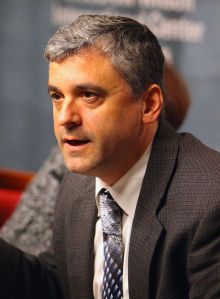
Steven Levitsky
LEVITSKY: Freedom House’s scores range from zero, which is the most authoritarian to a hundred, which is the most democratic. I think a couple of Scandinavian countries get scores of 99 or 100. The U.S. for many years was in the low 90s, which put it broadly on par with other Western democracies like the U.K. and Italy and Canada and Japan. But it slipped in the last decade, from Trump’s first victory to Trump’s second victory, from the low 90s to 83, which placed us below Argentina. And in a tie with Romania and Panama. So we’re still above what scholars would consider a democracy, but now in the very low-quality democracy range, comparable, again, to Panama, Romania and Argentina.
DAVIES: And does Freedom House explain its demotion? Why? Why did this happen?
LEVITSKY: Oh, yeah. Freedom House has annual reports for every country – the rise in political violence, political threats, threats against politicians, refusal to accept the results of a democratic election in 2020, an effort to use violence to block a peaceful transfer of power are all listed among the reasons for why the United States has fallen. I should say that even in the first four months of the Trump administration, it’s quite certain that what’s happening on the ground in the United States is likely to bring the U.S. score down quite a bit.
DAVIES: You say that the danger here is not that the United States will become a classic dictatorship with sham elections, you know, opposition leaders arrested, exiled or killed. What kind of autocracy might we become?
LEVITSKY: I think the most likely outcome is a slide into what Lucan Way and I call competitive authoritarianism. These are regimes that constitutionally continue to be democracies. There is a Constitution. There are regular elections, a legislature and importantly, the opposition is legal, above ground and competes for power. So from a distance, if you squint, it looks like a democracy, but the problem is that systematic coming (ph) abuse of power tilts the playing field against the opposition. This is the kind of regime that we saw in Venezuela under Hugo Chavez. It’s subsequently become a full-on dictatorship. It’s what we see in Turkey under Erdogan. It’s what we see in El Salvador. It’s what we see in Hungary today. Most new autocracies that have emerged in the 21st century have been led by elected leaders and fall into this category of competitive authoritarianism. It’s kind of a hybrid regime.
DAVIES: So free and fair elections lead us to a leader which takes us in a different direction?
LEVITSKY: Right. And because the leader is usually freely and fairly elected, he has a certain legitimacy that allows him to say, hey, how can you say I’m an authoritarian if I was freely and fairly elected? So citizens are often slow to realize that their country is descending into authoritarianism.
You can read the rest of the interview or listen to it at the NPR link.
Jamelle Bouie writes at The New York Times (gift link): Trump Wants You to Think Resistance Is Futile. It Is Not.
The American constitutional system is built on the theory that the self-interest of lawmakers can be as much of a defense against tyranny as any given law or institution.
As James Madison wrote in Federalist 51, “The provision for defense must in this, as in all other cases, be made commensurate to the danger of attack. Ambition must be made to counteract ambition. The interest of the man must be connected with the constitutional rights of the place.” Our Constitution is nothing more than a “parchment barrier” if not backed by the self-interest and ambition of those tasked with leading the nation.
One of the most striking dynamics in these first months of the second Trump administration was the extent to which so many politicians seemed to lack the ambition to directly challenge the president. There was a sense that the smart path was to embrace the apparent “vibe shift” of the 2024 presidential election and accommodate oneself to the new order.
But events have moved the vibe in the other direction. Ambition is making a comeback.
Last week, Senator Chris Van Hollen of Maryland traveled to El Salvador, where he met with Kilmar Armando Abrego Garcia, a victim of the Trump administration’s removal program under the 1798 Alien Enemies Act….
Abrego Garcia is one of the men trapped in this black zone. Despite his protected legal status, he was arrested, detained, accused of gang activity and removed from the United States. At no point did the government prove its case against Abrego Garcia, who has been moved to a lower-security prison, nor did he have a chance to defend himself in a court of law or before an immigration judge. As one of Abrego Garcia’s representatives in the United States Senate, Van Hollen met with him to both confirm his safety and highlight the injustice of his removal.
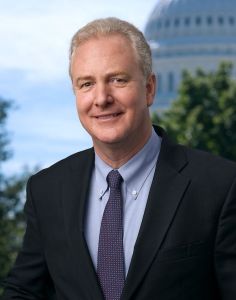
Sen. Chris Van Hollen
“This case is not just about one man,” Van Hollen said at a news conference following his visit. “It’s about protecting the constitutional rights of everybody who resides in the United States of America. If you deny the constitutional rights of one man, you threaten the constitutional rights and due process for everyone else in America.” [….]
The goal of Van Hollen’s journey to El Salvador — during which he was stopped by Salvadoran soldiers and turned away from the prison itself — was to bring attention to Abrego Garcia and invite greater scrutiny of the administration’s removal program and its disregard for due process. It was a success. And that success has inspired other Democrats to make the same trip, in hopes of turning more attention to the administration’s removal program and putting more pressure on the White House to obey the law.
Senator Cory Booker of New Jersey is reportedly organizing a trip to El Salvador, and a group of House Democrats led by Representative Robert Garcia of California arrived on Monday. “While Donald Trump continues to defy the Supreme Court, Kilmar Abrego Garcia is being held illegally in El Salvador after being wrongfully deported,” Representative Garcia said in a statement. “That is why we’re here, to remind the American people that kidnapping immigrants and deporting them without due process is not how we do things in America.”
“We are demanding the Trump administration abide by the Supreme Court decision and give Kilmar and the other migrants mistakenly sent to El Salvador due process in the United States,” Garcia added.
All of this negative attention has had an effect. It’s not just that the president’s overall approval rating has dipped into the low 40s — although it has — but that he’s losing his strong advantage on immigration as well. Fifty percent of Americans disapprove of Trump’s handling of immigration, according to a recent poll from Quinnipiac University, and a new Reuters poll shows Trump slightly underwater on the issue with a 45 percent approval to 46 percent disapproval.
These lawmakers are getting positive attention for standing up to Trump, and their actions are waking up Americans who may not have been paying enough attention to Trump’s illegal and cruel deportations.
A group of Congress people traveled to Louisiana yesterday to meet with university students who have been kidnapped and held without charges. CNN: Congressional delegation visits Mahmoud Khalil and Rumeysa Ozturk in Louisiana detention centers.
A delegation of congressional members traveled to Louisiana Tuesday to demand the release of Mahmoud Khalil and Rümeysa Öztürk and inspect conditions at the two Immigration and Customs Enforcement detention facilities where the two remain in custody.
It’s the first time a congressional delegation has met with Khalil or Ozturk.
Khalil, a Columbia University graduate, and Ozturk, a Tufts University PhD student, have been in ICE custody for more than a month after being arrested near their homes by federal agents.
The Democrat delegation, led by Rep. Troy Carter of Louisiana traveled to Jena, where Khalil is being held, and then two hours south to Basile, where Ozturk is detained. The group included Reps. Bennie Thompson of Mississippi, Ayanna Pressley and Jim McGovern of Massachusetts and Sen. Ed Markey.

Mahmoud Khalil
The facilities were clean but “chilly” according to Carter, who said detainees complained of cold temperatures at night, making it difficult to sleep. Carter said the facilities appeared to have been cleaned prior to their visit and that conditions appeared to be “fine” while they visited.
Following the visit, lawmakers said the detainees they met with also complained about a lack of medical care, food and religious accommodations.
“I really worry that this administration is ushering in a new era of McCarthyism. And unless Congress and unless the American people stand up and push back, they will succeed,” McGovern said during a press conference after the visits.
Markey accused the Trump administration of wanting to “make an example” out of Khalil and Ozturk in an effort to chill free speech. Markey also said ICE had intentionally transferred them to Louisiana for political reasons.
Through the Trump administration, ICE feels “they have a right to take people from across our country, and to put them into facilities like this here in Louisiana,” Markey said. “And why did they do that? They have done that in order to go to the single most conservative Circuit Court of Appeals in the United States of America.”
Again, these Congress people received positive media coverage. As Jamelle Bouie wrote (see above article), perhaps their ambition has led them to publicly oppose Trump’s dictatorial actions.
David Atkins at Washington Monthly: Democrats Need to Make Republicans Fear the Consequences of Attempting a Dictatorship.
Imagine that you were a high-ranking official in Donald Trump’s administration. Imagine that you believed in the Dark Enlightenment dream of dismantling liberal democracy itself—of “killing the woke mind virus,” ending birthright citizenship, and using federal power to suppress dissent. Now imagine you’re openly defying the Supreme Court, declaring that protest aids and abets terrorism, directing the FBI and IRS to target political enemies, and seriously considering invoking the Insurrection Act on flimsy pretexts. What would stop you?
Certainly not impeachment. Not with a compliant Republican Congress. Not with a conservative media ecosystem ready to justify any abuse of power as a patriotic necessity. The only thing that might give you pause is the possibility that Democrats would regain control and then do to you what you’ve done to them.
That fear of reciprocal power and legal accountability was once enough to preserve American political norms. It was the logic of mutually assured destruction: if you break democracy now, they’ll break you later. That’s how informal guardrails were enforced, even through dark chapters like Watergate or Iran-Contra. But those norms no longer hold because no one believes Democrats will retaliate.
This is the context for the quiet battle raging within the Democratic Party leadership. A few anonymous but influential centrists are urging party leaders to soft-pedal Trump’s detention of legal residents in foreign internment camps and pivot to kitchen-table economics instead. Even as constituents demand action and donors grow restless, Senate Majority Leader Chuck Schumer and House Minority Leader Hakeem Jeffries still signal caution, urging patience and restraint…..

Rumeysa Ozturk
There have been some bright spots. Senator Cory Booker broke Strom Thurmond’s filibuster record in a marathon floor speech denouncing Trump’s abuses. Senator Chris Van Hollen forced a meeting with abducted U.S. resident Abrego Garcia in El Salvador, delivering proof of life and drawing global attention. Senator Chris Murphy’s rhetoric has been sharp and effective. House Democrats like Alexandria Ocasio-Cortez (along with her “anti-oligarchy tour” partner Senator Bernie Sanders), Jasmine Crockett, and Robert Garcia have been doing excellent work. Their energy and determination carry the tacit message that those who broke the law and tried to impose an authoritarian regime on the U.S. will face appropriate justice at the end of the day. Representative Jamie Raskin was explicit about warning El Salvador’s leader: “Look, President Bukele—who’s declared himself a dictator—and the other tyrants, dictators, autocrats of the world have to understand that the Trump administration is not going to last forever,” Raskin said. “We’re going to restore strong democracy to America, and we will remember who stood up for democracy in America and who tried to drive us down towards dictatorship and autocracy.”
But these have been exceptions rather than the rule. Most Democrats in leadership and positions of power have stayed quiet—avoiding press conferences, shunning symbolic actions, and allowing business to continue as if the country weren’t barreling toward authoritarianism.
When pressed, party leaders often respond that they can do little substantively. That protests are performative. That voters are tired of drama. But that’s not the point. The point isn’t what Democrats can do today. It’s what they’re signaling they’re willing to do when they return to power.
If Trump and his allies face no meaningful consequences, they have no reason to stop. If Republicans don’t believe that Democrats will act with equal force to protect democracy—legally, aggressively, unapologetically—then there’s no deterrent to further escalation.
Click the link to read the rest.
One more from Toby Buckle at Liberal Currents: Trump ‘Alarmists’ Were Right. We Should Say So.
Throughout the Trump era I’ve been firmly in the camp unaffectionately dismissed as ‘alarmist’ by most commentators. Put simply: It is that bad. Liberal democracy is in danger. Fascism is a reasonable term for what we’re fighting.
For veteran ‘alarmists’ this is a strange moment. People are at a loss. It seems wrong, given all that is at stake, to say “I told you so”. I’ve felt that discomfort. For the longest time I avoided saying that. It felt . . . petty, childish, gauche, it just wasn’t the done thing. One of the big political awakenings I’ve had over the last year, and particularly since Trump’s 2024 victory, is realizing that it’s OK to say “called it”. More than OK. Even if it feels awkward, it’s actually important, perhaps necessary, that we do.
My view has not been, to put it mildly, the mainstream position. You’re allowed, with a certain amount of resentment, to say it today. But that wasn’t always the case. I recall first voicing it as the antecedents of Trump, the tea party and growing white supremacy, started to arise. Obama’s “the fever will break” seemed hopelessly naive to me. The press treated them either as legitimate libertarians or an eccentric curiosity, not a threat. To the activist left, what would become the Bernie movement, they were a joke—the punchline to a Jon Stewart monologue. Nothing more. When Trump first rode the elevator down to announce his candidacy, it was entertainment, not omen.
If you saw in any of this a threat to liberal democracy writ large, much less one that could actually succeed, you were looked at with the kind of caution usually reserved for the guy screaming about aliens on the subway. Trump’s election in 2016 was a shock to people who insisted it could never happen. But those most complacent before quickly found their way back to complacency after. For a certain type—specifically, the type who has a column in legacy media despite never having written an interesting or original paragraph in their lives—smug condescension became the order of the day: yes, Trump is bad, but dear me those liberals are being hysterical. As late as the last election they were writing pieces with titles like “A Trump Dictatorship Won’t Happen” or “No, Trump won’t destroy our democracy.” Even after the election, as the scale of the incoming lawlessness became clear, we were dismissed: “Trump Is Testing Our Constitutional System. It’s Working Fine” respected legal commentator Noah Feldman told us—the legal rationale for his actions was very flimsy. Courts would strike it all down. And certainly the administration would not ignore a court order.
One thing I’ve always wondered about the anti-alarmists during this decade was, to put it bluntly, weren’t they worried about looking stupid? The path we were on seemed clear enough to me, but I didn’t know the future. I always stressed that my predictions were one of any number of possible outcomes. They didn’t. What I was saying was dismissed, not just as unlikely, but impossible. Did they not want to hedge their bets even a bit? And it’s not as if the liberal democratic collapse happened all at once. The last decade has been a steady drum beat of them being wrong, again and again. Yet it never shook them.
Read more at Liberal Currents.
I have been fearful of Trump’s authoritarian tendencies since the 2016 campaign and so have most Sky Dancers. It does feel sometimes that people who didn’t see it are stupid, but I’m willing to welcome people who are beginning to change their minds to the resistance. We need as many resisters as possible. Trump’s polls are dropping now, as more people begin to see what he’s really up to–and it isn’t about bringing down grocery prices. I want to believe there is still hope for our democracy. Lately, it looks like some Democratic leaders are ready to fight back. Some of that fight must have come from seeing the protests all over the country. Now we need a few Republicans to grow spines and stand up to Trump.
That’s all I have for today. What do you think? What’s on your mind?
Did you like this post? Please share it with your friends:
Posted: April 17, 2025 | Author: bostonboomer | Filed under: Donald Trump, education, immigration | Tags: CECOT, constitutional crisis, El Salvador prison, Harvard University, Kilmar Abrego Garcia, Mohsen Mahdawi, Senator Chris Van Hollen |
Good Afternoon!!
The news is mostly bad as it has been since Trump moved into the White House, and I have to admit I’m feeling frightened and depressed about what is happening to our country.
Trump is waging all-out war on Harvard University, and Harvard is fighting back. That’s one bright spot.
Harvard University is taking hits from Trump on multiple fronts. Here’s the latest:
 CNN: IRS making plans to rescind Harvard’s tax-exempt status.
The Internal Revenue Service is making plans to rescind the tax-exempt status of Harvard University, according to two sources familiar with the matter, which would be an extraordinary step of retaliation as the Trump administration seeks to turn up pressure on the university that has defied its demands to change its hiring and other practices.
A final decision on rescinding the university’s tax exemption is expected soon, the sources said.
The administration already has blocked more than $2 billion in funding from the nation’s oldest university, which is fighting the White House’s policy demands, citing the constitutional right of private universities to determine their own teaching practices.
President Donald Trump in recent days raised the idea of punishing the Ivy League university for not complying with what the administration has sought to portray as a campaign to fight antisemitism.
“Perhaps Harvard should lose its Tax Exempt Status and be Taxed as a Political Entity if it keeps pushing political, ideological, and terrorist inspired/supporting ‘Sickness?’ Remember, Tax Exempt Status is totally contingent on acting in the PUBLIC INTEREST!” Trump posted on Truth Social on Tuesday….
Asked about CNN’s reporting on “The Arena,” Education Secretary Linda McMahon said that she doesn’t know whether Harvard will lose its tax exempt status but argued “it was certainly worth looking into.”
“We’ll see what IRS comes back with relative to Harvard,” McMahon told CNN’s Kasie Hunt. “I certainly think, you know, in elitist schools, especially that have these incredibly large endowments, you know, we should probably have a look into that.”
McMahon added that it is her “guess” that the IRS is also looking at tax exempt statuses of other universities.
Gary Shapley, whom Trump this week picked as acting IRS commissioner, has the authority to rescind the tax exemption under federal law. Doing so typically comes after the agency has made a determination that an organization has violated the rules that govern tax exemptions for not-for-profit entities.
There’s no evidence that Harvard has violated any of the conditions for tax exempt status, according to experts consulted by The Washington Post. From the Post article:
Harvard spokesman Jason Newton said in a statement that there was “no legal basis” to rescind the university’s tax-exempt status. Newton said the status “means that more of every dollar can go toward scholarships for students, lifesaving and life-enhancing medical research, and technological advancements that drive economic growth.”
Some Trump allies predicted that Harvard would only be the first of numerous colleges and universities that the administration would target over their tax-exempt status.
“I think they’re going to go after a whole bunch of them,” said Newt Gingrich, the former House GOP leader. “I’m not sure why we need to be funding people who aggressively refuse to give up a variety of values and structures that most Americans don’t agree with.”
Earlier this month, the Trump administration demanded broad control over Harvard’s operations over complaints about “diversity, equity and inclusion” policies in hiring, admissions and curriculums and student activism surrounding Israel’s war against Hamas.
Harvard rejected those demands on Monday, marking the first time a university formally countered the administration’s campaign for sweeping changes in higher education. Hours later, the administration responded by saying it would freeze more than $2 billion in federal funding.
If Harvard loses its tax-exempt status as President Trump has threatened, it would be extremely rare, but not unprecedented.
Moreover, the only instance in higher education that experts are aware of shows how far a university had to go to lose that coveted status.

View of Harvard Yard
In 1976, the Internal Revenue Service stripped the tax exemption from Bob Jones University, a private fundamentalist Christian institution in Greenville, S.C., because the school forbid interracial dating by its students. The university objected, saying it wasn’t practicing racial discrimination because the policy applied to all students.
The case went all the way to the Supreme Court, which upheld the IRS action in 1983. The 8-1 ruling likely would be the legal precedent for the Trump administration if it revokes Harvard’s tax-exempt status over allegations it practiced discrimination through diversity equity and inclusion initiatives and a failure to protect Jewish students from antisemitic harassment by Gaza war protesters.
“In 1983, the Supreme Court established the precedent that universities which practice racial discrimination can be stripped of their nonprofit status,” conservative activist Christopher Rufo wrote on X Tuesday. “Harvard’s DEI programs are openly discriminatory and, therefore, the president has every right to proceed with this remedy.”
In Trump’s twisted notion of discrimination (it only counts if it’s against white men), I guess lots of tax-exempts institutions could be targeted.
That’s not all the administration is threating to do to Harvard. They want to stop the university from admitting foreign students.
The Harvard Crimson: DHS Threatens To Revoke Harvard’s Eligibility To Host International Students Unless It Turns Over Disciplinary Records.
The Department of Homeland Security sent Harvard a letter on Wednesday threatening to revoke its eligibility to enroll international students unless it submits information on international students’ disciplinary records and protest participation.
In a Wednesday press release, the DHS wrote that it had also canceled two grants worth $2.7 million to Harvard.
The letter threatening Harvard’s authorization to host international students, which was signed by Secretary of Homeland Security Kristi Noem, accused Harvard of creating a “hostile learning environment” for Jewish students.
“It is a privilege to have foreign students attend Harvard University, not a guarantee,” the letter read.
American universities may host international students on student visas only if they have certification under the Student and Exchange Visitor Program.
The Wednesday letter calls on Harvard to provide information regarding visa holders’ “known threats to other students or university personnel,” “obstruction of the school’s learning environment,” and any disciplinary actions “taken as a result of making threats to other students or populations or participating in protests.”
It comes less than a week after three federal agencies threatened to pull Harvard’s federal funding unless the University agreed to report international students for violation of its conduct policies. Harvard rebuffed the government’s demands on Monday and now faces cuts to more than $2.2 billion in federal funding.
The University also announced last week that a total of 12 current Harvard students and recent graduates have had their visas revoked.

Another view of Harvard
CNN: Harvard weighs its next moves amid the federal funding standoff.
About 24 hours after the Trump administration said it would freeze more than $2 billion in federal grants and contracts, Harvard University’s research arm began to assess the fallout.
The impact is already acute at Harvard’s School of Public Health, where professors are scrambling to salvage their research into tuberculous and cancer treatments.
Harvard – the nation’s oldest and richest university – has emerged as a new symbol of the Trump resistance after refusing to capitulate to a series of policy changes the administration had demanded. Now, having put itself in an uncertain position, Harvard must weigh its next moves.
John Shaw, vice provost for research at Harvard, emailed colleagues Tuesday evening asking them to notify the Office for Sponsored Programs of any funding disruptions they become aware of – and what steps they ought to take.
“While there will inevitably be important research that will suffer as a result of the funding freeze, we are asking for your help in assessing how best to preserve vital work and support our researchers, while using institutional resources responsibly through this disruption,” he wrote, according to an email reviewed by CNN. “This is meant to stabilize the research environment while we gather information, coordinate decision-making, and strive to protect what matters most.”
Professors at the Faculty of Arts and Sciences, home to Harvard’s undergraduate and PhD programs, were notified in a separate email that a town hall would be arranged in the coming days to answer questions, according to the email.
The funding freeze threatens as much as $9 billion in federal money for Harvard. Beyond the practical implications of losing those funds, it’s not clear how far a standoff could go.
As we have seen, Trump is also attacking foreign students and immigrants individually, grabbing them off the streets or when they report to update their immigration status and disappearing them.
At The Boston Globe, Paul Heintz profiled a Columbia University student who was kidnapped when he arrived to take a citizenship test: ‘The town loved him’: Palestinian student detained in Vermont forged deep connections in the Upper Valley.
When federal officials led a handcuffed Mohsen Mahdawi out of an office building in northern Vermont on Monday, he became the latest international student whom the Trump administration had apparently targeted for speaking out against Israel’s war in Gaza.
But those who know Mahdawi say it’s absurd to suggest he “engaged in pro-terrorist, anti-Semitic, anti-American activity,” as the president has said of protesters at Columbia University where he was a student. Rather, they describe him as a peaceful 34-year-old Palestinian who had a remarkable journey from a refugee camp in the West Bank to a cabin in rural Vermont to an Ivy League institution in New York City.

Mohsen Mahdawi
He is widely known in the upper Connecticut River Valley of Vermont and New Hampshire, where he has been based since moving to the United States more than a decade ago, as a spiritual man who grew up Muslim, is a practicing Buddhist, and whose closest friends are Jewish.
“He is such an advocate for peace. He is such an opponent of any kind of violence,” said Rabbi Dov Taylor, who leads Chavurat Ki-tov, a Jewish cultural and educational organization in Woodstock, Vt. “His love just comes out in what he says.”
Simon Dennis, a carpenter and a former selectboard member in nearby Hartford, described Mahdawi as “a person of great gracefulness and dignity and gravitas” who is “destined to go forward and do great things in the world.”
Mahdawi, who was set to graduate this spring, was being held Tuesday in Vermont’s Northwest State Correctional Facility in St. Albans.
On Wednesday evening, some 200 supporters gathered in a windswept field several hundred yards from the prison. They hoisted Palestinian flags and signs calling for his release. An organizer, Jesse Lubin of Burlington, encouraged the crowd “to be loud enough so that he might be able to hear us” from inside the prison.
Just a bit more, because this is behind a paywall:
Crystal Cole of St. Albans told fellow protesters that she was there to demonstrate that even residents of this rural county on the Canadian border were outraged about Mahdawi’s detention.
“People up here in Franklin County know just as well as everyone else across the state, across the country, and across the world that free speech is a right, kidnapping is a wrong, and we refuse to stand for it,” she said.
By all accounts, Mahdawi has assiduously accumulated friends in the Upper Valley since moving from the West Bank in 2014. He’s done so while working as a bank teller, joining faith events, speaking at lectures and protests on the Middle East, and serving as a jack-of-all-trades at Dan & Whit’s, a popular general store in Norwich.
“Everyone loved him,” said Dan Fraser, a former owner and manager. “The town loved him. The town knows him.”
Mahdawi has lived for years in Fraser’s home in Hartford. He attended Lehigh University in Pennsylvania before transferring to Columbia in 2021. He was expecting to enter graduate school there in the fall for international affairs.
Mahdawi has been a permanent resident, or green card holder, since 2015, according to his attorneys, and appeared on track to attain citizenship. He had been in hiding after a friend and fellow Columbia student organizer, Mahmoud Khalil, was detained on March 8, according to friends.
He sounds really dangerous, right?
We are all familiar with the case of Kilmar Abrego Garcia, who was sent to the torture prison in El Salvador. The Trump administration admits this was a mistake, but they are determined not to return Garcia to his family in Maryland. Yesterday Maryland Senator Chris Van Hollen traveled to El Salvador in an attempt to meet with Garcia.
Politico: Van Hollen denied from meeting with wrongfully deported man in El Salvador.
Sen. Chris Van Hollen (D-Md.) flew to El Salvador on Wednesday seeking to secure the release of a man wrongly deported by the Trump administration, as officials ramp up their defense of the administration’s actions in an escalating battle over President Donald Trump’s mass deportation policy.
The Trump administration has made the fight around Kilmar Abrego Garcia the centerpiece of its broader deportation efforts, resisting efforts to bring him back to the United States, despite a Supreme Court ruling that the administration must “facilitate” Abrego Garcia’s return after his illegal deportation.
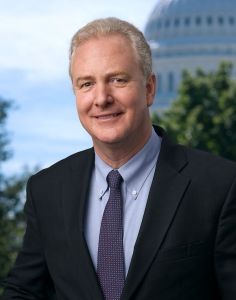
Chris Van Hollen
But after a meeting with Salvadoran Vice President Félix Ulloa, Van Hollen was denied the opportunity to see Abrego Garcia or visit the maximum security prison where he’s being held.
In a press conference on Wednesday, Van Hollen said that he asked Ulloa for a meeting with Abrego Garcia. Ulloa said he would have needed to “make earlier provisions” to visit, according to the senator, and also added he would be unable to arrange a phone call.
“I asked the vice president — if Abrego Garcia has not committed a crime, and if courts found that he was illegally taken, and the government of El Salvador has found no evidence he was part of MS-13 — then why is El Salvador continuing to hold him?” Van Hollen said.
Statement from Van Hollen:
“The goal of this mission is to let the Trump administration, let the government of El Salvador know that we are going to keep fighting to bring Abrego Garcia home until he returns to his family,” Van Hollen said in a video from the airport on his way to San Salvador, adding that he hopes to “meet with representatives of the government” and “see Kilmar.” Van Hollen, in second a video posted to X, said he arrived in San Salvador a little before noon and that he was on his way to the U.S. embassy.
Trump border czar Tom Homan slammed the Democratic senator for his visit, calling the trip “disgusting” on Fox News on Wednesday morning and echoing a line from the administration that the senator is more concerned with an “MS-13 terrorist” than Rachel Morin, a Maryland woman whose killer — who was convicted this week — was an undocumented immigrant.
“He wasn’t abducted. He is an MS-13 gang member, classified as a terrorist, that was removed from this country. So we got rid of a dangerous person — an El Salvadoran national was returned to the country of El Salvador, to his home,” Homan said, going on to call Abrego Garcia a “public safety threat.”
There’s no evidence Garcia is a gang member or terrorist.
We are in a true Constitutional crisis right now, since the Trump administration is ignoring court orders about these actions from two judges. So far, the judiciary is holding the line. It remains to be seen whether the Supreme Court will come down on the side of democracy or let Trump become a dictator. Here’s what’s happening on the immigration front this morning.
Reuters: Trump challenges judges’ probes of compliance with deportation orders.
The Trump administration is appealing efforts by two judges to investigate whether government officials defied their rulings over the deportation of migrants to El Salvador, escalating a confrontation between the executive and judicial branches.
On Wednesday night, the Justice Department said it would appeal Washington-based U.S. District Judge James Boasberg’s finding that there was probable cause to believe the government had violated his order to return alleged members of a Venezuelan gang who were deported to El Salvador on March 15 under an 18th-century wartime law. Boasberg said administration officials could face criminal contempt charges.
Also late on Wednesday, government lawyers asked the Fourth U.S. Circuit Court of Appeals to stop U.S. District Judge Paula Xinis in Greenbelt, Maryland from ordering U.S. officials to provide documents and answer questions under oath about what they had done to secure the return of Kilmar Abrego Garcia, a migrant who was wrongly deported to El Salvador.
In both cases, the Trump administration has denied it violated court orders and accused judges of overstepping their authority.
“A single district court has inserted itself into the foreign policy of the United States and has tried to dictate it from the bench,” the Justice Department lawyers wrote in its filing with the Fourth Circuit.
“Emergency relief is needed.”
Below are commentary pieces on the El Salvador prison and what Trump is doing to immigrants.
Hunter Walker at Talking Points Memo: Trump is Sending People to the Camps.
Extraordinary times call for extraordinary and strong language. President Trump’s plan to have migrants — and potentially U.S. citizens — rounded up, flown to El Salvador, and confined there in a maximum security facility that specializes in indefinite detention meets that bar. However, even when news coverage and criticism has acknowledged Trump’s vision is almost certainly illegal and unquestionably dangerous, it has often used fairly normal terminology and referred to the flights as deportations to a “prison.” That is not what is happening. President Trump is sending people to the camps.
The distinction comes from some of the unique features of the Terrorism Confinement Center, or CECOT, the infamous El Salvadoran facility that is holding people on behalf of the Trump administration. A “prison” is most typically defined as an institution holding inmates who have been sentenced for a crime. And, of course, most sentences have an end date. However, El Salvadoran President Nayib Bukele and his government have boasted that people placed in CECOT, “have no chance of getting out.”

U.S. prisoners arriving at El Salvador prison
Because of the prospect of indefinite detention and the lack of due process the Trump administration has afforded the people it has sent to CECOT, experts who spoke to TPM said the facility could be more accurately described as a “concentration camp,” “penal colony,” or “permanent prison camp.”
Dr. Sandra Susan Smith, who is the Daniel & Florence Guggenheim Professor of Criminal Justice at Harvard’s Kennedy School, was very clear on this point in an email.
“More than a prison, El Salvador’s CECOT has many if not all the hallmarks of a concentration camp,” Smith wrote. “The Trump administration has unlawfully deported a group it finds highly undesirable — migrants largely from Venezuela — to CECOT, a facility known for its utter brutality and unyielding inhumanity that is located in a foreign country where US courts have no jurisdiction. Further, they have done so with no evidentiary basis for claims of migrants’ criminality and with no due process.”
Smith’s point might sound extreme since the term “concentration camp” is most closely associated with the German Nazi regime that left millions dead. However, mass executions are actually not part of the official definition. According to the Holocaust Encyclopedia published by the U.S. Holocaust Memorial Museum, “the term concentration camp refers to a camp in which people are detained or confined, usually under harsh conditions and without regard to legal norms of arrest and imprisonment that are acceptable in a constitutional democracy.”
Mike Wessler, the communications director of the Prison Policy Initiative, said he and his team were “discussing” whether CECOT should be called a “prison” this morning or whether another term should be applied. He pointed to the Holocaust Encyclopedia definition of “concentration camp.”
“I think there is a strong case to be made that the term prison does not fit for these sorts of facilities. Prisons are generally considered part of a larger legal system that is subject to judicial oversight and has somewhat defined processes, including around sentences, conditions, and releases,” Wessler said.
Read the rest at TPM.
Marcos Alemn, Regina Garcia Cano, and Alex Brandon at The Independent: Inside the brutal mega-prison where Trump administration has wrongly sent Maryland father.
Kilmar Abrego Garcia was deported to El Salvador by the Trump administration in March, despite a court order preventing his removal from the US….
He is among more than 200 immigrants sent to the Terrorism Confinement Center (CECOT), El Salvador’s maximum-security gang prison, in the past month….

El Salvador mega prison
What is the CECOT?
Bukele ordered the mega-prison built as he began his campaign against El Salvador’s gangs in March 2022.
It opened a year later in the town of Tecoluca, about 45 miles (72 kilometers) east of the capital.
The facility has eight sprawling pavilions and can hold up to 40,000 inmates.
Each cell can fit 65 to 70 prisoners.
CECOT prisoners do not receive visits and are never allowed outdoors. The prison does not offer workshops or educational programs to prepare them to return to society after their sentences.
Occasionally, prisoners who have gained a level of trust from prison officials give motivational talks.
Prisoners sit in rows in the corridor outside their cells for the talks or are led through exercise regimens under the supervision of guards.
Bukele’s justice minister has said that those held at CECOT would never return to their communities.
The prison’s dining halls, break rooms, gym and board games are for guards.
Read the rest at The Independent.
The Handbasket: GOP photos at El Salvador prison evoke Abu Ghraib—and worse.
A row of Latino men with shaved heads and stoic expressions wearing identical white boxer shorts stand behind thick metal bars. In the back fellow prisoners sit cross-legged on large shelves that look like they’re meant for boxed furniture at IKEA, but are instead being used for humans. Outside the bars, free, is a white man in a blazer and collared shirt, his arm stretched out to hold the camera being used to take the photo of him and the men. The image is grotesque. And now it is history.
If you’re not familiar with the names Riley Moore and Jason Smith, don’t worry; I wasn’t either until yesterday. They’re Republican Congressmen from West Virginia and Missouri, respectively, who took a trip to El Salvador on Tuesday where they were given a tour of Centro de Confinamiento del Terrorismo (CECOT), a two-year old maximum security prison. Each posted photos to their social media pages after the visit, gloating about their access….
Go to the linked article to see photos these Congressmen posted on social media….
Photos like this are only possible when you’ve become so divorced from the humanity of others that they become nothing more than props in your political ploy.
But they weren’t alone in their casual disregard: A photo posted to X by the US Embassy in El Salvador confirmed an additional five House Republicans went along for the trip, including Claudia Tenney (NY), Mike Kennedy (UT), Carol Miller (WV), Ron Estes (KS) and Kevin Hern (OK). I’ve reached out to the offices of these members and will update if I hear back.
These members at least had the sense not to brag about it on social media, but it also makes me wonder why? If visiting CECOT has become a Trump loyalty pilgrimage, why haven’t they blasted out thumbs up pics of their own? Is it enough for Trump just to know they went, or do Smith and Moore understand that you only truly get credit for your depravity if you broadcast it?
Senator Chris Van Hollen, a Democrat from Maryland, had a very different experience when he arrived in El Salvador. Wednesday morning to check in on one of his constituents who was wrongfully and illegally imprisoned there beginning in March. He met with the country’s Vice President and asked if he could visit CECOT to meet with Kilmar Abrego Garcia: In a press conference later that day, he revealed he was told no. He also said the embassy told him they hadn’t received any direction from the administration to facilitate Garcia’s return, despite a court order.The visit by Republican members of Congress and Van Hollen’s subsequent rejection the very next day show that CECOT isn’t a prison holding Americans, but a place for Trump to hold his political prisoners—and where only his allies can wander and gawk. Some have compared the prison’s conditions to Nazi concentration camps.
Nick Miroff at The Atlantic (gift link): We’re About to Find Out What Mass Deportation Really Looks Like.
The Trump administration is working hard to convince the public that its mass-deportation campaign is fully under way. Over the past several weeks, federal agents have seized foreign students off the streets, raided worksites, and shipped detainees to a supermax prison in El Salvador using wartime powers adopted under the John Adams administration.
The tactics have spread fear and created a showreel of social-media-ready highlights for the White House. But they have not brought U.S. Immigration and Customs Enforcement much closer to delivering the “millions” of deportations President Donald Trump has set as a goal.
“We need more money,” Tom Homan, Trump’s “border czar,” told me in an interview. “We won’t fail if we get the resources we need.”
Using the budget-reconciliation process, Republican lawmakers are now preparing to lavish ICE with a colossal funding increase—enough to pay for the kind of social and demographic transformation of the United States that immigration hard-liners have long fantasized about achieving.
Although GOP factions in the House and Senate have squabbled over the contours of the bill, spending heavily on immigration enforcement has bicameral support. The reconciliation bill in the Senate would provide $175 billion over the next decade. A House version proposes $90 billion.
To put those sums in perspective, the entire annual budget of ICE is about $9 billion.
The funding surge—which Republicans could approve without a single Democratic vote—would allow ICE to add thousands of officers and enlist police and sheriff’s deputies across the country to help arrest and jail more immigrants. It would funnel billions to private contractors to identify and locate targets, jail them in for-profit detention centers, and fast-track their deportations.
Paul Hunker, who was formerly ICE’s lead attorney in Dallas, likened Trump’s deportation campaign to a gathering wave. “It seems intense now, but wait until five months from now when the reconciliation bill has passed and ICE gets a huge infusion of cash,’’ he told me. “If that money goes out, the amount of people they can arrest and remove will be extraordinary.’’
ICE officials envision a private-sector contracting bonanza that would rely on old workhorses such as CoreCivic and Geo Group-–the for-profit firms best known for running immigration jails—while enlisting large data companies to make the deportation system run more like an e-commerce platform.
Read the rest at the link. It sounds a lot like the Nazi railroad cars, only with planes.
That’s for me. This is way too long already. Take care everyone.
Did you like this post? Please share it with your friends:
Posted: January 25, 2025 | Author: bostonboomer | Filed under: American Fascists, cat art, caturday, Civil Liberties, Civil Rights, Donald Trump, Foreign Affairs, immigration, U.S. Politics |
Good Afternoon!!

Alexandr Klemens The White Cat’s Slumber in the Library
Everything is going to hell in a handbasket, as everyone here knows. Trump is issuing shock executive orders at an unbelievable pace. His goal is to overwhelm us and force us to give up in despair. Of course many of his orders are illegal and/or unconstitutional and many others are simply idiotic. We’re in for four years of this–if we still have elections in the future.
I was born right after World War II, in 1947. In the aftermath of the war, there were dramatic changes in U.S. culture. The culture continued to change in many positive ways during my lifetime–until recently.
Trump managed to put the Supreme Court under right wing control, and they proceeded to overturn Roe v. Wade, making women once again second-class citizens.
The court had already weakened many of the advances in Civil Rights that took place in of 1960s and 1970s, such as voting rights. Now they are poised to continue overturning more of the rights we have gained in recent years, including the right to same sex marriage. This was happening before Trump, but he has greatly speeded up the process.
I’ve been thinking about all this, because of a wonderful essay I read this morning by historian Heather Cox Richardson at “Letter from an American.”
She begins by describing events that took place after D-Day. U.S. troops were exhausted and were told to rest in the Ardennes region of Belgium. Then the Germans organized a massive offensive on the Ardennes that led to the Battle of the Bulge. The Germans told allied soldiers they had no choice but to surrender, but they refused.
“NUTS!”
That was the official answer Brigadier General Anthony C. McAuliffe delivered to the four German soldiers sent on December 22, 1944, to urge him to surrender the town of Bastogne in the Belgian Ardennes….
Members of his staff were more colorful when they had to explain to their German counterparts what McAuliffe’s slang meant. “Tell them to take a flying sh*t,” one said. Another explained: “You can go to hell.”
By the time of this exchange, British forces had already swung around to stop the Germans, Eisenhower had rushed reinforcements to the region, and the Allies were counterattacking. On December 26, General George S. Patton’s Third Army relieved Bastogne. The Allied counter offensive forced back the bulge the Germans had pushed into the Allied lines. By January 25, 1945, the Allies had restored the front to where it had been before the attack and the battle was over.
The Battle of the Bulge was the deadliest battle for U.S. forces in World War II. More than 700,000 soldiers fought for the Allies during the 41-day battle. The U.S. alone suffered some 75,000 casualties that took the lives of 19,000 men. The Germans lost 80,000 to 100,000 soldiers, too many for them ever to recover.
The Allied soldiers fighting in that bitter cold winter were fighting against fascism, a system of government that rejected the equality that defined democracy, instead maintaining that some men were better than others. German fascists under leader Adolf Hitler had taken that ideology to its logical end, insisting that an elite few must lead, taking a nation forward by directing the actions of the rest. They organized the people as if they were at war, ruthlessly suppressing all opposition and directing the economy so that business and politicians worked together to consolidate their power. Logically, that select group of leaders would elevate a single man, who would become an all-powerful dictator. To weld their followers into an efficient machine, fascists demonized opponents into an “other” that their followers could hate, dividing their population so they could control it.
In contrast to that system was democracy, based on the idea that all people should be treated equally before the law and should have a say in their government. That philosophy maintained that the government should work for ordinary people, rather than an elite few. President Franklin Delano Roosevelt inspired the American people to defend their democracy—however imperfectly they had constructed it in the years before the war—and when World War II was over, Americans and their allies tried to create a world that would forever secure democracy over fascism.

Winter Slumber, Shawn Braley
After we defeated the fascists, many dramatic changes took place:
The 47 allied nations who had joined together to fight fascism came together in 1945, along with other nations, to create the United Nations to enable countries to solve their differences without war. In 1949 the United States, along with Belgium, Canada, Denmark, France, Iceland, Italy, Luxembourg, the Netherlands, Norway, Portugal, and the U.K., created the North Atlantic Treaty Organization (NATO), a peacetime military alliance to stand firm against aggression, deterring it by declaring that an attack on one would be considered an attack on all.
At home, the government invested in ordinary Americans. In 1944, Congress passed the Servicemen’s Readjustment Act, more commonly known as the G.I. Bill, to fund higher education for some 7.8 million former military personnel. The law added to the American workforce some 450,000 engineers, 180,000 medical professionals, 360,000 teachers, 150,000 scientists, 243,000 accountants, 107,000 lawyers, and 36,000 clergymen.
In 1946 the Communicable Disease Center opened its doors as part of an initiative to stop the spread of malaria across the American South. Three years later, it had accomplished that goal and turned to others, combatting rabies and polio and, by 1960, influenza and tuberculosis, as well as smallpox, measles, and rubella. In the 1970s it was renamed the Center for Disease Control and took on the dangers of smoking and lead poisoning, and in the 1980s it became the Centers for Disease Control and took on AIDS and Lyme disease. In 1992, Congress added the words “and Prevention” to the organization’s title to show its inclusion of chronic diseases, workplace hazards, and so on.
More changes: investments in infrastructure such as the interstate highway system, efforts to end racial discrimination.
After the war, President Harry Truman desegregated the armed forces in 1948, and as Black and Brown Americans claimed their right to be treated equally, Congress expanded recognition of those rights with the Civil Rights Act of 1964 and the Voting Rights Act of 1965. Shortly after Congress passed the Voting Rights Act, President Lyndon B. Johnson signed Executive Order 11246, translating FDR’s 1941 measure into the needs of the peacetime country. “It is the policy of the Government of the United States to provide equal opportunity in Federal employment for all qualified persons, to prohibit discrimination in employment because of race, creed, color, or national origin, and to promote the full realization of equal employment opportunity through a positive, continuing program in each executive department and agency.”
This democratic government was popular, but as the memory of the dangers of fascism faded, opponents began to insist that such a government was leading the United States to communism. Tax cuts for the wealthy and corporations, along with the deregulation of business and cuts to the social safety net, began to concentrate wealth at the top of society. As wealth moved upward, lawmakers chipped away at the postwar government that defended democracy.
And now, since the inauguration of President Donald Trump on Monday, the dismantling of that system is happening all at once…
Richardon lists the horrors we’ve seen from Trump in recent days: read about them at the link above. But she is suggesting that we don’t have to give up; we can still fight fascism when things look the darkest, as they did in the Ardennes when they faced being overwhelmed by the Nazis.
January 25, 2025, marks eighty years since the end of the Battle of the Bulge.
The Germans never did take Bastogne.
I’ve quoted a great deal, but I still hope you’ll go read the whole essay.
More reads:
NBC News: Senate confirms Pete Hegseth as defense secretary, with VP Vance breaking a tie.
The Republican-controlled Senate on Friday night confirmed Pete Hegseth as defense secretary by the narrowest of margins, with Vice President JD Vance casting a tie-breaking vote and delivering a victory for President Donald Trump.
The initial vote was 50-50, with three Republicans — Sens. Mitch McConnell of Kentucky, Lisa Murkowski of Alaska and Susan Collins of Maine — joining all 47 Democrats in voting no.
Vance then cast the 51st vote, putting Hegseth over the top and ending weeks of uncertainty over the fate of Trump’s controversial pick to lead the Pentagon.
It marked only the second time in history a vice president was needed to break a tie for a Cabinet level nominee. In 2017, then-Vice President Mike Pence broke a 50-50 tie to confirm Betsy DeVos as Education secretary in Trump’s first term….
McConnell’s vote was a stunning rebuke of Hegseth and Trump, whom the former Senate Republican leader has clashed with repeatedly over the years.
“Effective management of nearly 3 million military and civilian personnel, an annual budget of nearly $1 trillion, and alliances and partnerships around the world is a daily test with staggering consequences for the security of the American people and our global interests,” McConnell said in a scathing statement that suggested Hegseth had not shown he is up for the job.
“Mr. Hegseth has failed, as yet, to demonstrate that he will pass this test,” McConnell’s statement continued. “But as he assumes office, the consequences of failure are as high as they have ever been.”
Shortly after the vote began, Sen. Thom Tillis, R-N.C., who in recent days was still seeking answers from Hegseth, announced on X that he would vote in favor of him.
Politico: Trump fires independent inspectors general in Friday night purge.
President Donald Trump fired multiple independent federal watchdogs, known as inspectors general, in a Friday night purge, removing a significant layer of accountability as he asserts his control over the federal government in his second term, according to two people with knowledge of the dismissals, granted anonymity to share details they were not authorized to speak about publicly.
One of the two people briefed on the dismissals said the number is at least a dozen and includes inspectors general at the departments of State, Agriculture, Interior, Transportation, Housing and Urban Development, Education, Labor and Defense, as well as the Small Business Administration, the U.S. Energy Corp., and the Environmental Protection Agency.

By Tatiana Rodionova
Together, those agencies make up large swaths of the federal government, with control over billions of dollars in taxpayer money and broad global reach.
The inspectors general at the Department of Justice, Office of Personnel Management, the Federal Communications Commission, the Export-Import Bank and the Department of Homeland Security remain in place, according to the person.
The inspectors general were dismissed via emails from the White House Presidential Personnel Office, with no notice sent to lawmakers on Capitol Hill, who have pledged bipartisan support for the watchdogs, in advance of the firings, the person said. The emails gave no substantive explanation for the dismissals, with at least one citing “changing priorities” for the move, the person added….
Hannibal Ware, the inspector general of the Small Business Administration and leader of a council that represents inspectors general across government, suggested that the removals may be invalid because they appear to violate federal law requiring a 30-day notification to Congress before any watchdogs can be removed.
Politico: State Department issues immediate, widespread pause on foreign aid.
Secretary of State Marco Rubio halted spending Friday on most existing foreign aid grants for 90 days. The order, which shocked State Department officials, appears to apply to funding for military assistance to Ukraine.
Rubio’s guidance, issued to all diplomatic and consular posts, requires department staffers to issue “stop-work orders” on nearly all “existing foreign assistance awards,” according to the document, which was obtained by POLITICO. It is effective immediately.
It appears to go further than President Donald Trump’s recent executive order, which instructed the department to pause foreign aid grants for 90 days pending review by the secretary. It had not been clear from the president’s order if it would affect already appropriated funds or Ukraine aid.
The new guidance means no further actions will be taken to disperse aid funding to programs already approved by the U.S. government, according to three current and two former officials familiar with the new guidance.
The order shocked some department officials for its sweeping mandate. “State just totally went nuclear on foreign assistance,” said another State Department official.
Still, the document leaves room for interpretation and does provide some exceptions. It specifies that foreign military financing for Egypt and Israel will continue and allows emergency food assistance and “legitimate expenses incurred prior to the date of this” guidance “under existing awards.” At points, it also says the decisions need to be “consistent with the terms of the relevant award.”
CNN: Scientists at NIH can’t purchase supplies for their studies after Trump administration pauses outside communications.
Scientists at the National Institutes of Health have been told the communications pause announced by the Trump Administration earlier this week includes a pause on all purchasing, including supplies for their ongoing studies, according to four sources inside the agency with knowledge of the purchasing hold.
The supply crunch follows a directive first issued on Tuesday by the acting director of the Department of Health and Human Services, which placed a moratorium on the release of any public communication until it had been reviewed by officials appointed or designated by the Trump Administration, according to an internal memo obtained by CNN. Part of this pause on public communication has been widely interpreted to include purchasing orders to outside suppliers. One source noted they had been told that essential requests can proceed and will be reviewed daily.
Researchers who have clinical trial participants staying at the NIH’s on-campus hospital, the Clinical Trial Center, said they weren’t able to order test tubes to draw blood as well as other key study components. If something doesn’t change, one researcher who was affected said his study will run out of key supplies by next week. If that happens, the research results would be compromised, and he would have to recruit new patients, he said.
CNN is not naming the scientists because they were not authorized to speak with the media.
While it’s unclear if the communications moratorium was intended to affect purchasing supplies for NIH research, outside experts said the motivation wasn’t all that important.
“It’s difficult to tell if what’s going on is rank incompetence or a willful attempt to throw sand in the gears, but it really could be either, neither reflects well on them,” said Dr. Peter Lurie, who is president and executive director of the Center for Science in the Public Interest. Dr. Lurie was previously an official at the US Food and Drug Administration.
The clinical center only has a few weeks of medication on hand, according to a source who had knowledge of the pharmaceutical supply but was not authorized to speak with reporters.
Before I get to the latest immigration horrors, I recommend reading this piece by Patrick Reis at Vox: The Logoff: The truth about “mass deportations.” Trump often promises instant results. Don’t fall for it.
President Donald Trump made headlines today with a threat to do something he can’t accomplish on his own: attaching conditions to disaster aid for California. We’ll see if Congress goes along. Instead, I want to focus on an area where he does have power: deportations.
Mass deportations were one of Trump’s most controversial promises. Now, the Trump administration is claiming they have begun, touting deportation flights on military aircraft and ICE’s arrest of more than 500 people on Thursday.

Cat looking on winter, Olena Kaenetska-Ostapchuk
But deportation flights went out all the time under the Biden administration — all that’s new here is the use of military aircraft. And 500 arrests are, essentially, a normal day for ICE, at or below their daily average during the final year of the Biden administration.
So why am I hearing about this now? A hallmark of the first Trump administration was the president taking something that was already happening and claiming it was the result of his revolutionary leadership. That seems to be what’s happening here.
So were mass deportations an empty threat? No — they just aren’t happening instantly. Throughout the campaign, experts cautioned that deportations on the scale Trump was promising — and his team wants to deliver — would require massive spending on ICE agents and detention facilities. Republicans in Congress are promising to deliver those resources. But none of that means they can do it right away.
What has changed already? Many things, including a Trump executive order that gives federal immigration agents the authority to raid schools, churches, and other sensitive locations. It remains to be seen how often they’ll use it. (ICE is denying a report of agents attempting to enter a Chicago public school, and it’s not clear yet what happened.)
Biden didn’t film his ICE raids and deportation flights for the media. That’s what Trump is doing. But so far, he isn’t deporting any more immigrants than Biden did.
Now some horrors.
The New York Times: Deportation Fears Spread Among Immigrants With Provisional Legal Status.
Bearing Social Security numbers and employment authorization, workers who recently arrived from places like Haiti and Venezuela have been packing and sorting orders at Amazon; making car parts for Toyota and Honda; and working in hotels, restaurants and assisted-living facilities.
On Friday, they woke up to the news from the Trump administration that many of them could be abruptly detained and swiftly deported.
A memo issued by the acting secretary of Homeland Security instructs immigration agents to speed up the deportation of immigrants who have been admitted under certain programs that were created by the Biden administration and have benefited about 1.5 million people.
Many of them have a protected status that stretches for another year or two. Tens of thousands, who arrived more recently, likely do not.
This is going to be a big problem here in Massachusetts, where we have many of these immigrants with protected status.
Experts said that immigrants had every reason to worry because the memo turned hundreds of thousands of people who have been in the country lawfully into unauthorized immigrants.
“After they came in doing everything the government told them to do, they are in the same boat as someone who came here unlawfully,” said Lynden Melmed, former chief counsel at U.S. Citizenship and Immigration Services.
“Right now, even though you are holding valid documents that allow you to work and be in the U.S., this guidance makes you vulnerable to being picked up by immigration agents and arrested at any time,” said Mr. Melmed, a partner at the firm Berry Appleman & Leiden.
Former President Biden used executive authority to admit people with temporary statuses that do not automatically offer a path to permanent residence. But, crucially, the initiatives shielded beneficiaries from deportation for at least two years and allowed them to work legally
The memo issued late on Thursday by Benjamine C. Huffman, the acting homeland security secretary, directs immigration agents to identify for expedited removal the population of migrants who benefited from two specific Biden-era initiatives related to border management.
This policy will also affect Ukrainians and Afghans who have been allowed into the U.S. temporarily. Read more details at the NYT.
Greg Sargent at The New Republic: Trump’s Awful New “Invasion” Executive Order is One of His Darkest Yet.
The blitzkrieg of executive actions that President Donald Trump signed on day one was fully intended to be disorienting in its scope of horrors, and it is delivering. They would end birthright citizenship in the United States, pull us out of the Paris climate agreement, facilitate the wholesale purging of insufficiently loyal government workers, and pardon hundreds of rioters who attacked the Capitol, including those who violently savaged cops. That’s only a very partial list.
But one executive order in particular is quietly drawing attention from immigration lawyers because of its unusually radical implications. It appears to declare that Trump’s authority to seal the Southern border and entirely nullify the right to seek asylum exists wholly independent of any statute and is rooted in his constitutional powers, all because we are allegedly coping with a migrant “invasion.” What determines whether we’re subject to an “invasion,” you ask? Trump declaring it to be so, that’s what.
This suggests that Trump and his team may be laying the groundwork to argue, to an unprecedented degree, that he is largely unbounded by Congress in executing key aspects of his immigration agenda. The justification of this on “invasion” grounds also suggests something else: The government will be corrupted deeply to produce outright propaganda designed to sustain the impression of that “invasion.”

Cats in the Snow, by Benben-Cai
The relevant provision is buried in this new executive order, which declares that Trump is closing the country to migrants on grounds that they constitute an “invasion across the southern border.” Critically, the order also says that migrants who are “engaged” in this invasion no longer can seek asylum protections—ones authorized under the Immigration and Nationality Act, or INA—until Trump issues “a finding that the invasion at the southern border has ceased.”
The sloppily written order doesn’t define precisely who constitutes a migrant engaged in this invasion. In other words, Trump appears essentially to be declaring an open-ended power to say that any and all migrants who enter unlawfully do constitute invaders. Trump can suspend the INA’s provisions mandating certain treatment of these migrants for as long as he says the “invasion” is underway.
The order gives several rationales for this. One is that migrants could be “potentially carrying communicable diseases.” That’s more radical than the Title 42 Covid-19 restrictions on entry—which Trump originally instituted and Joe Biden kept in place—as those relied on a governmentally declared public health emergency. This new order merely rests on the possibility of migrants carrying diseases. Putting aside history’s dark lessons about the consequences of casting migrants as bearers of disease, there’s no documented link between migrants and such diseases to begin with, as the Cato Institute’s Alex Nowrasteh details.
The order’s other rationale may be even more dangerous. It says that the Constitution gives Trump the authority—pursuant to conducting foreign affairs and protecting states from invasion—to take any actions he deems necessary to “achieve the objectives of this proclamation,” i.e., halt or reverse the “invasion” by migrants. That seems to apply to anyone who enters the country illegally after the signing of the order. Under it, Trump would not be bound by congressional statute in determining what to do with them, immigration lawyers tell me.
Read the rest at the link.
That’s about all I can stomach for today. I need to go back to taking care of myself as best I can. I hope you all are pacing yourselves and being kind to yourselves. I love you all.
Did you like this post? Please share it with your friends:
Posted: September 14, 2024 | Author: bostonboomer | Filed under: Donald Trump, Haiti, immigration | Tags: anti-immigrant discrimination, food and ethnicity, Haitian immigrants, JD Vance, Laura Loomer, slavery, Springfield Ohio |
Happy Caturday!!

By Joan Gillchrest
This week, Trump has truly shown himself to be a fascist. To our everlasting shame as a country, this disgusting man, this convicted criminal–found guilty of rape and 34 counts of business fraud–is still permitted to run for president. If he somehow wins the election in November, he will be able to act with impunity, since the right wing Supreme Court has said that the president cannot be prosecuted for official acts. Thanks to this horrible creature Trump, our democracy hangs in the balance.
Now, as Dakinikat wrote in detail yesterday, Trump has been spreading an insane attack on legal Haitian immigrants in a small Ohio city, Springfield, creating a crisis there involving attacks on innocent people and bomb threats that have closed the city hall and two elementary schools on Thursday and Friday.
Trump’s VP candidate J.D. Vance was the first to spread the hateful rumors, and he has continued to do so even after they have been debunked. Vance also called attention to the event that began the anti-Haitian fervor in Springfield–a bus crash that killed a young boy. The bus driver was a Haitian immigrant.
As Daknikat also wrote, Trump has been hanging around with Laura Loomer, a hateful far right activist, and she may also have been a source of the anti-Haitian rumors. (FYI: Here is a very good Guardian article about Loomer) Trump has been taking Loomer with him on his plane to events such as the 9/11 anniversary commemorations in Shanksville, PA, and New York City and the debate with VP Kamala Harris on Tuesday. Loomer reportedly has been staying at Mar-a-Lago for at least the past week.
As you can tell, this is a follow-up to Dakinikat’s excellent Friday post. I want to add a little more background.
An Op-Ed by Lydian Polgreen at The New York Times: Trump Has Crossed a Truly Unacceptable Line.
When my family moved back to the United States from East Africa in the mid-1980s, one might have thought it was a peak time of compassion for people suffering in faraway places. A glittering group of music superstars had recorded “We Are the World,” a smash hit charity single to raise money and awareness for the victims of a brutal famine that had gripped my mother’s home country, Ethiopia.
But when I told my new grade school classmates of my origins, I was met with cruel taunts. I was awfully fat for an Ethiopian, one said with a snigger. Must be nice to be able to have access to so much food, another joked. At the time, this was puzzling and upsetting — I had moved from Kenya, not Ethiopia, to my father’s home state, Minnesota. But the facts didn’t matter. These unkind remarks did the job the bullies hoped they would: They made me feel like an alien, an unwelcome stranger.
We live in even crueler times now, with humanitarian catastrophes unfolding on several continents, but the response of the wealthy world has been to demand tighter borders and higher fences. There is no blockbuster charity single raising money for starving refugees from the civil war raging in Sudan. And now, the cruel taunts come not just from schoolyard bullies and cranks on the political fringes, but from the lips of a man who stood on the presidential debate stage on Tuesday, a former president who once again has a coin-flip shot at regaining the most powerful office in the world.
And so I suppose I shouldn’t have been surprised by that lowest of moments at the debate, when Donald Trump repeated a vile, baseless claim that Haitian immigrants were killing and eating household pets in Springfield, Ohio. This allegation appears to stem from viral social media posts and statements at public meetings. It was picked up by some of the most rancid figures at the fringe of the MAGA-verse, then quickly hopscotched from there to a social media post by Trump’s running mate, JD Vance, and finally to the debate stage, sputtered by Trump himself.
There is a temptation to treat this as yet another Trump rant, a disgusting lie about immigrants like the ones he uttered as he began his presidential bid in 2015, describing migrants crossing the border with Mexico as rapists and criminals. He’s done it time and again since. He is the master of exaggerated and fabricated claims against the boogeymen, a skill he has used for decades to polarize public opinion and raise his profile and power at the expense of others.
But there is something particularly insidious about this claim, uttered at this time, from that stage. Food and pets are, to use a Freudian term, highly overdetermined symbols in our political life. They are capable of receiving and holding a multiplicity of very potent meanings, transmitting deep messages about identity and belonging.
What you eat is an instant way to communicate the most basic forms of human connection. There’s a reason American political rituals cluster around cookouts, clambakes and fish fries. The human need for sustenance — food and water to feed the physical body — is universal. But what is also universal is the meaning food carries. Everyone has a personal version of Proust’s madeleines, a food that immediately and ineffably names who you are, where you come from, the culture that made you. Food is a powerful signifier, of both belonging and exclusion.
Below is a gift link, if you want to read the entire article. It’s well worth the time.
At the Atlantic, Isabel Fattal provides a timeline for the spread of the ugly rumors: The Springfield Effect: Trump and Vance spread racist memes that turned into bomb threats and school evacuations.
To say that Donald Trump is reckless with his public comments is about as big an understatement as you could make. But this week, we are watching the real-world effects of that recklessness play out with alarming speed.
Consider the timeline. On Monday, Trump’s running mate, J. D. Vance, mentioned on X the claim—for which there is no verifiable evidence—that Haitian immigrants in Springfield, Ohio, are “abducting” and eating pets. Vance was promoting a racist theory that had been circulating in certain corners of the internet in recent days, a manifestation of the anti-Haitian sentiment that has bubbled up in Springfield after roughly 15,000 Haitian migrants arrived in the town over the past few years. MAGA supporters quickly kicked into action, sharingcat memes referencing the pet-eating theory.

By Alice De Miramon
On Tuesday, Vance posted on X that his senatorial office in Ohio had “received many inquiries from actual residents of Springfield who’ve said their neighbors’ pets or local wildlife were abducted by Haitian migrants.” Vance acknowledged in his post that these rumors may “turn out to be false” but went on to say: “Do you know what’s confirmed? That a child was murdered by a Haitian migrant who had no right to be here.” And he egged on the internet trolls in a subsequent post: “Keep the cat memes flowing.”
Vance was referring to an 11-year-old who was killed when a Haitian driver crashed into a school bus last year. (The driver has since been convicted of involuntary manslaughter.) On Tuesday, the boy’s father spoke out against the politicization of his son’s death. “My son, Aiden Clark, was not murdered. He was accidentally killed by an immigrant from Haiti,” Nathan Clark said in remarks before Springfield’s city commission. “I wish that my son, Aiden Clark, was killed by a 60-year-old white man. I bet you never thought anyone would ever say something so blunt, but if that guy killed my 11-year-old son, the incessant group of hate-spewing people would leave us alone.”
In 2020, the population of Springfield, Ohio, was nearly 60,000. The town had been losing residents because of declining job opportunities, but a recent manufacturing boom has brought in an influx of immigrants, who are mostly Haitian, as Miriam Jordan of The New York Times hasreported. Most of these immigrants are in the U.S. legally; local authorities and employers say that Haitian immigrants have boosted what was once a declining local economy, but such a mass arrival of migrants has also strained government resources.
Trump’s decision to bring up Springfield at the debate—in his now-infamous and bizarre “eating the pets” non sequitur—may have been his attempt to redirect attention to immigration, which he sees as a winning topic for his campaign. But it was also a reminder of his penchant for spreading conspiracy theories and his habit of fueling the fire of racism and hate in America. The days that followed revealed how a rambling Trump comment—with the help of Vance and the pair’s social-media faithful—can generate actual threats of violence.
JD Vance continues to spread disgusting anti-Haitian rumors. Christopher Wiggins at The Advocate: JD Vance now says Haitian immigrants are spreading HIV after bizarre pet-eating claim flops.
In the aftermath of Tuesday’s presidential debate between Vice President Kamala Harris and former President Donald Trump, Trump’s running mate, Ohio U.S. Sen. JD Vance, made a series of controversial, bigoted, and inflammatory statements during an interview with CNN’s Kaitlan Collins. Vance doubled down on debunked claims about Haitian immigrants abducting pets to eat them and falsely linked the migrant community to rising rates of HIV and tuberculosis in Springfield, Ohio. His remarks have since drawn widespread condemnation for their harmful, fear-mongering nature.
During the interview, Vance insisted on the veracity of a discredited conspiracy theory circulating in Springfield that claims Haitian immigrants have been abducting pets for food, a laughable claim Trump made during the debate. Local officials have already said that “no credible evidence” supports these allegations, but Vance continued to push the narrative. “We’ve heard from a number of constituents on the ground… saying this stuff is happening,” Vance said. When Collins pointed out that officials had found no evidence, Vance responded, “They’ve said they don’t have all the evidence.”

By Marek Brozowski
Collins pressed Vance on his responsibility as a public figure to avoid spreading misinformation. “If someone calls your office and says they saw Bigfoot, that doesn’t mean they saw Bigfoot,” Collins asked. Vance, however, stood firm, responding, “Nobody’s calling my office and saying that they saw Bigfoot. What they’re calling and saying is we are seeing migrants kidnap our dogs and cats.”
In the aftermath of Tuesday’s presidential debate between Vice President Kamala Harris and former President Donald Trump, Trump’s running mate, Ohio U.S. Sen. JD Vance, made a series of controversial, bigoted, and inflammatory statements during an interview with CNN’s Kaitlan Collins. Vance doubled down on debunked claims about Haitian immigrants abducting pets to eat them and falsely linked the migrant community to rising rates of HIV and tuberculosis in Springfield, Ohio. His remarks have since drawn widespread condemnation for their harmful, fear-mongering nature.
During the interview, Vance insisted on the veracity of a discredited conspiracy theory circulating in Springfield that claims Haitian immigrants have been abducting pets for food, a laughable claim Trump made during the debate. Local officials have already said that “no credible evidence” supports these allegations, but Vance continued to push the narrative. “We’ve heard from a number of constituents on the ground… saying this stuff is happening,” Vance said. When Collins pointed out that officials had found no evidence, Vance responded, “They’ve said they don’t have all the evidence.”
Collins pressed Vance on his responsibility as a public figure to avoid spreading misinformation. “If someone calls your office and says they saw Bigfoot, that doesn’t mean they saw Bigfoot,” Collins asked. Vance, however, stood firm, responding, “Nobody’s calling my office and saying that they saw Bigfoot. What they’re calling and saying is we are seeing migrants kidnap our dogs and cats.”
Wiggins discusses the history of false attacks on Haitian immigrants:
Vance’s comments tap into a broader, troubling pattern of discrimination that Haitian migrants have faced for decades. Historically, U.S. immigration policy has treated Haitians disproportionately, often in ways that are harsher than those directed toward other groups. According to a 2021 U.S. Committee for Refugees and Immigrants report, Haitians have frequently been misclassified as economic immigrants rather than political refugees, even when fleeing violence during authoritarian regimes, stripping them of asylum rights and leading to mass deportations.
One of the most egregious examples of discrimination occurred in the early 1990s, when Haitians attempting to flee their country were subjected to HIV and AIDS screenings by U.S. authorities. Even as the HIV epidemic was waning, Haitians who tested positive for the virus were held to higher standards when seeking asylum. Many were sent to quarantine camps in Guantanamo Bay, where they lived in squalor and were denied proper medical care, the report notes.
This history of associating Haitians with disease resurfaced during the Trump administration, when Title 42—a public health measure aimed at stopping the spread of communicable diseases—was invoked to justify the expulsion of Haitian migrants at the U.S.-Mexico border.
This is a very good article by Henry J. Gomez, Brandy Zadrozny, Allan Smith and Julie Tsirkin at NBC News: How a fringe online claim about immigrants eating pets made its way to the debate stage.
“In Springfield they’re eating dogs,” the former president said, referring to an Ohio city dealing with an influx of Haitian immigrants. “They’re eating the cats. They’re eating … the pets of the people that live there. And this is what’s happening in our country, and it’s a shame.”
The extraordinary moment — the airing of a claim worthy of a chain email while participating in a prime-time presidential debate — probably puzzled most of the 67.1 million people tuned in for Trump’s clash with Vice President Kamala Harris. But the rumor, which has been criticized as perpetuating racist tropes, was already thriving in right-wing corners of the internet and being amplified by those close to Trump, including his running mate, Sen. JD Vance of Ohio.
No one involved in Trump’s debate preparations or in a position to speak for his campaign agreed to discuss the strategy on the record or answer questions abouthow it mutated from a fringe obsession to a debate stage sound bite….
While the fallout has been a combination of bafflement and outrage, the makings of the moment are rooted in grievances that have long defined and animated Trump and his followers — and on the platforms where those grievances blossom….

By Catriona-Millar
How the rumor developed and made its way out of the right wing fever swamps:
Blood Tribe, a national neo-Nazi group, was among the early purveyors of the rumor in August, posting about it on Gab and Telegram, social networks popular with extremists. While the group’s leader has taken credit for Trump’s indulgence of the claims, Blood Tribe’s reach is unknown; its accounts on those sites have fewer than 1,000 followers.
Some Blood Tribe members also planned a couple of events in the real world, like a small Aug. 10 march in Springfield protesting Haitian immigration and an appearance at a city commission meeting later that month.
The rumor soon crossed over to mainstream social media, like Facebook and X. NewsGuard, a firm that monitors misinformation, traced the origins to an undated post from a private Facebook group that was shared in a screenshot posted to X on Sept. 5.
“Remember when my hometown of Springfield Ohio was all over National news for the Haitians?” the user wrote. “I said all the ducks were disappearing from our parks? Well, now it’s your pets.”
Around that time, other social media posts about the rumor sprouted and went viral, some of them based in part on residents’ comments at public hearings. On Sept. 6, there were 1,100 posts on X mentioning Haitians, migrants or immigrants eating pets, cats, dogs and geese, according to PeakMetrics, a research company. The next day there were 9,100 — a 720% increase.
The article says that many social media participants suspected Laura Loomer of passing the rumor on to Trump. Others blamed Vance. Anonymous Trump sources responded:
Loomer and Trump did not speak on the plane ride, a source familiar with the trip said. And a Trump aide noted that Loomer “is not a member of our staff.”
“The president is the most well-read man in America, and he has a pulse on everything that is going on,” the aide added.
Claire Wang at The Guardian: ‘A very old political trope’: the racist US history behind Trump’s Haitian pet eater claim.
People of Haitian descent say these xenophobic attacks are nothing new for their community, and experts say the “dog eater” trope is a fearmongering tactic white politicians have long deployed against immigrants of color, particularly those of Asian descent.
“The way white Americans have positioned themselves as culturally and morally superior, this is low-hanging fruit to rally xenophobia in a very quick way,” said Anthony Ocampo, a professor of sociology at California State Polytechnic University, Pomona.

By Joan Gillchrest
Demonizing immigrants through falsehoods about their diet is a political tactic that originated in the late 19th century, during the height of anti-Chinese sentiment, said May-lee Chai, author and professor of creative writing at San Francisco State University.
Before the 1888 presidential election, Grover Cleveland’s campaign published trading cards that featured cartoonish sketches of Chinese men eating rats, and smeared his opponent, Benjamin Harrison, as “China’s presidential candidate”, according to the book Recollecting Early Asian America: Essays in Cultural History.
“It’s a very old political trope to dehumanize Chinese male immigrants and show them as a threat to white American workers,” Chai said. Chinese workers posed not only a “labor threat” in the restaurant industry but also a “civilization threat”, she added, as one rationale for the Chinese Exclusion Act of 1882 was that Chinese immigration would contribute to the “browning of America”.
An urban legend alleging that Chinese restaurants serve dog meat, cat meat or rats dates back to the beginning of Chinese immigration to the US. An editorial from a Mississippi newspaper in 1852, for example, laments that trade with China is “not what it ought to be”, then says, “and besides, the Chinese still eat dog-pie”.
Chinese people may have been the first immigrant group to be widely profiled as “dog eaters”, but the slur was soon directed at other Asian communities, said Robert Ku, author of Dubious Gastronomy: The Cultural Politics of Eating Asian in the USA.
At the 1904 world’s fair in St. Louis, organizers reportedly forced the Indigenous Igorot people from the Philippines to butcher and eat dogs for entertainment – an event that cemented the stereotype against Filipinos.By the late 20th century, Ku said, groups including Koreans, Filipinos and Cambodians became “principally stereotyped as dog eaters”.
More recently, in 2016, the Oregon county commissioner and US Senate hopeful Faye Stewart accused Vietnamese refugees of “harvesting“ dogs and cats for food. And last May, a false claim that a Laotian and Thai restaurant in California served dog meat caused months of harassment and eventual closure of the business.
It’s not surprising that these claims have extended to other non-white immigrant groups.
At The Nation, Elie Mystal writes: White People Have Never Forgiven Haitians for Claiming Their Freedom.
I could tell you that the only ”evidence” for the baseless Republican claim that Haitian immigrants are eating pets in Springfield, Ohio, comes from an American-born woman charged with animal cruelty in Canton, Ohio. I could tell you that the Haitian immigrant community living in Ohio is made up largely of people who are in the country legally, under temporary protected status visas. I could tell you that Haitian immigrants, like those in all immigrant communities, are generally hard-working people who pay their taxes and commit fewer crimes, per capita, than native-born citizens.
But I can also tell you that none of these facts matter one jot to vile and racist Republicans like JD Vance and Donald Trump, who spread lies and misinformation about immigrants. The people pushing these falsehoods long ago abandoned any tether to facts or reality. The very online, white-wing MAGA movement has found another group of dark-skinned people to hurt. Today, it’s Haitians; yesterday it was Venezuelans, and tomorrow it will be some other group of Black or brown people.

By Marek Brozowski
The goal—their only goal—is to hurt people. It’s their kink. Hurting people of color titillates and excites them. It makes them feel powerful and important. When these small people see reports that Haitians in Springfield are afraid to send their children to school; when they read about the damage being done to immigrants’ property, it makes them feel strong. Imagine being able to contribute to a lynch mob raised against largely defenseless people from the comfort of your own home, simply by sharing a cat meme. That kind of power is intoxicating to some people, and what you see online is the real, honest thrill a racist experiences whenever they find someone to menace.
I hate to give these people the satisfaction of being hurt by them. I hate to acknowledge their lies and insults, and I’d like to pretend that I can’t even hear them. As a New Yorker of Haitian descent, I’d like to tell these people “Kou langett manman ou!” (which loosely translates to: “Have an inappropriate relationship with yourself, followed by your mother, posthaste”) and go about my day.
But the pain racist Republicans and their cult spokespeople are causing is too real to laugh away. It’s too familiar to ignore. And it’s entirely too consistent with how this country has always treated Haitians to pretend that it isn’t all happening again.
Haitians committed the greatest sin possible in the modern world: We took our freedom back from the white man. Haiti is the birthplace of the only successful slave-led revolt in the “New” or “Western” world. Like everywhere else in this hemisphere, enslaved Haitians asked for their freedom, agitated for it, and were willing to negotiate terms with the enslavers for their emancipation. Unlike everywhere else, when those negotiations and political dealings resulted in nothing more than the continuation of permanent chattel slavery, Haitians stopped talking and started rebelling—and by 1804 had liberated themselves from their suddenly-not-so-superior captors.
White people have never forgiven us for being free. The French demanded “reparations” from the Haitians for taking their property—that property being the formerly enslaved Haitians themselves—as the price for their freedom. And the Americans, under the presidency of inveterate slaver Thomas Jefferson, refused to recognize Haiti or its independence, and imposed a trade embargo on the fledgling nation. Remember that the next time someone calls Jefferson a lover of liberty: That man didn’t just enslave and rape Africans brought here against their will; he tried his best to snuff out the embers of freedom burning on his doorstep.
Please read the rest at The Nation.
One last excerpt from a piece by Eric Levitz at Vox: Republicans know exactly what they’re doing. The twisted political logic behind Trump’s attacks on Haitian immigrants.
Trump’s demonization of entire categories of immigrants is dangerous. But when he advocated for a Muslim ban during his first presidential run, he did not direct his followers’ anxiety and loathing toward worshippers at one particular mosque or community.
With this new smear, Trump and his running mate are fomenting hatred for a discrete group of 15,000 people in one location. This dramatically increases the risk that their campaign of dehumanization will lead to acts of violence. And indeed, on both Thursday and Friday, Springfield was forced to shutter its public schools and municipal buildings in response to bomb threats. Meanwhile, a Haitian community center in the city is getting threatening calls and Haitian families are keeping their kids home out of fear for their safety.

Alice in the Afternoon, by Catriona Millar
The juxtaposition between the victimization of such innocents, and Republicans’ gleeful dissemination of AI-generated cats that are purportedly imperiled by the existence of Springfield’s Haitians, is morally nauseating, at least to any person who believes in the equal dignity of all human life. And the fact that Vance has implored his social media followers to keep spreading such libelous memes, at the expense of his own constituents’ safety, is similarly disgraceful.
Why do Trump and Vance believe it is in their interest to advertise such moral bankruptcy and recklessness?
The Republican ticket’s foray into inciting ethnic hatred in a single municipality cannot be understood as unthinking or impulsive. Sure, Trump routinely makes demagogic statements that are inspired less by political calculation than whatever he happened to just witness on Fox News.
But Vance is nothing if not a ruthless and self-disciplined striver. One does not rise from his humble origins to Yale Law School without some ability to filter one’s thoughts or rationally pursue one’s goals. And a person capable of likening Trump to an opiate in 2016, and then becoming an apologist for his insurrection just a few years later, when that posture became politically useful, is plainly willing to do most anything in a calculated bid for power.
Vance did not smear the Haitian community of Springfield just once. He chose to double and triple down on that smear, reiterating it again in an X post on Friday morning, in which he blamed Haitian immigrants for bringing “communicable diseases” to Ohio (without presenting any evidence to substantiate that timeless nativist trope).
So why would a ticket with strong incentives to project moderation and reassure swing voters choose to direct hatred against a small community, even after their words have already yielded bomb threats?
I suspect the ugliness is the point.
“The ugliness is the point.”
I’ll end there. I plan to learn more about the history of these horrifying attacks on immigrants.
Take care, everyone.
Did you like this post? Please share it with your friends:


 peej
peej Carissa
 bostonboomer
 dakinikat
 ecocatwoman
 mablue2
 Mama Lopez
 peggysue22
 quixote
 skydancingguestblogger
 Mona (aka Wonk the Vote)



 Sky Dancing
Recent Comments