
Paul Ryan Claims Jesus Supported Small Government; Catholic Bishops Disagree
Posted: April 17, 2012 Filed under: hunger, poverty, religion, Republican politics, U.S. Economy, U.S. Politics, voodoo economics | Tags: Catholic Bishops, morality, Paul Ryan 10 Comments
Paul Ryan's God?
Yesterday, NPR’s Morning Edition reported on a “debate among Christians” about whether Jesus believed in helping the poor.
After the House passed its budget last month, liberal religious leaders said the Republican plan, which lowered taxes and cut services to the poor, was an affront to the Gospel — and particularly Jesus’ command to care for the poor.
Not so, says Wisconsin Republican Rep. Paul Ryan, who chairs the House Budget Committee. He told Christian Broadcasting Network last week that it was his Catholic faith that helped shape the budget plan. In his view, the Catholic principle of subsidiarity suggests the government should have little role in helping the poor.
“Through our civic organizations, through our churches, through our charities — through all of our different groups where we interact with people as a community — that’s how we advance the common good,” Ryan said.
The best thing that government can do, he said, is get out of the way.
Can you believe NPR’s religion reporter actually pretended there is a legitimate “debate” about this?
Today the Catholic Bishops indicated they think Jesus believed in helping actual living people–not just zygotes, embryos, and fetuses.
The Hill reports that the Bishops have so far sent letters to the House Agriculture and Ways and Means Committees and they also plan to send letters to other House committees as well, because they believe the budget “disproportionately cut[s] programs that ‘serve poor and vulnerable people.'”
The Bishops are particularly concerned about the budget’s draconian cuts in food stamps and child tax credits for immigrants–programs that help needy families stave off starvation. According to The Hill, the letters appear to be in response to recent comments made by Paul Ryan, who claims to be a Catholic.
“A person’s faith is central to how they conduct themselves in public and in private,” Ryan, the chairman of the House Budget Committee, told the Christian Broadcasting Network.
“So to me, using my Catholic faith, we call it the social magisterium, which is how do you apply the doctrine of your teaching into your everyday life as a lay person,” Ryan said.
Ryan made a moral case for his budget, saying that the government shouldn’t be responsible for lifting its citizens out of poverty — rather, that it’s the obligation of the citizens themselves to be society’s caretakers.
“Those principles are very, very important,” Ryan said. “And the preferential option for the poor, which is one of the primary tenants of Catholic social teaching, means don’t keep people poor, don’t make people dependent on government so that they stay stuck at their station in life, help people get out of poverty, out into a life of independence.”
Maybe Ryan should try reading the New Testament instead of Atlas Shrugged. Here’s one quote from Jesus:
Luke 6:20-21 Then he looked up at his disciples and said: ‘Blessed are you who are poor, for yours is the kingdom of God.
‘Blessed are you who are hungry now, for you will be filled. ‘Blessed are you who weep now, for you will laugh.
I couldn’t find any quotes from Jesus about small government and pulling yourself up by your own bootstraps. Anyone know any of those?
What The Irish Can Teach Us
Posted: March 18, 2012 Filed under: Barbara Ehrenreich, Charles Murray, corporatism, Economy, financial institutions, free market ideology, hunger, income inequality, The Great Hunger, U.S. Economy, unemployment, voodoo economics, worker rights 12 CommentsNow that we’ve all been Irish for a day–donning the green, marching or watching parades and downing those pints at the local bar, we might ask ourselves [whether we’re from Irish American backgrounds or not]: Is there anything more the Irish can teach us?
Running across an essay by Barbara Ehrenreich on American poverty, specifically the lingering, depressing notion of the ‘culture of poverty’ and

Dublin's Famine Memorial
having listened to Charles Murray on Book TV discuss his recent book, “Coming Apart: The State of White America, 1960-2012,” I think the answer is a resounding ‘yes.’
As Ehrenreich reminds us, the idea that poor people are inherently different than the affluent and in fact, need to be changed, corrected, put right has been an enduring theme of the conservative right. The inequality between the poor and the rich is not a matter of jobs or opportunity, education or money, so the theory goes. It’s about the poor being substantially flawed. They lack core values: ambition, get-up-and-go, faith, and the ability to plan for the future. The poor are impulsive, promiscuous, prone to addiction and crime and, as Ehrenreich points out, theorists all contend that the poor ‘certainly cannot be trusted with money.’
Charles Murray’s presentation picks up on the ‘culture of poverty’ theory and runs with it like a champion of reason and rightness. The American Project, Murray contends, the continuation of a civil society is threatened because the working class and upper-middle class are of a different kind altogether. The unraveling of America has nothing to do with the inequality of income but the inequality of culture.
Murray uses two ‘symbolic’ communities to illustrate his thesis: Belmont and Fishtown though both communities actually exist—Belmont, an affluent neighborhood outside Boston and Fishtown, a working class neighborhood of Philadelphia. Murray goes on to compare the two communities in four main areas: marriage, industriousness, honesty, and religiosity. And surprise, surprise. Fishtown gets a failing grade on all scores.
What does this have to do with the Irish? I suggest a quick trip back in time, say to the mid-19th century during what became known as the Great Hunger.
Ireland was heavily populated with subsistence/tenant farmers, generally in debt to their English landlords. Most have heard of the ‘great potato blight’ of 1845-1849 when over 1 million Irish died of starvation. What many may not know is that the the affluent English landlords were exporting an abundance of grain, meat and dairy for profit as the Irish poor starved. And the conservative government response? Their policy was one of laissez faire, leave well enough alone. As the Assistant Secretary of Ireland reportedly said at the time: to give the people something for nothing, ‘would have the country on us for an indefinite time.’ The fear of dependency was greater than watching the population starve. Free market policies and workhouses became popular. But still people died. In droves. The fields of once blighted potatoes became graveyards.
How were the Irish viewed by ‘polite’ English society? The Irish were considered brutish, lazy, devious, promiscuous, prone to crime and heavy drinking. Worse yet—they were Catholic.
The point is that this warped view on poverty is not new. Nor are the political responses. Even when a population was starving to death en masse, the response in Ireland was an ideological one: people had to work to be fed, even when they were too weak and sick to stand upright.
The Irish know this. They remembered it well and passed the bleak stories down to their descendants. The impoverished Irish immigrants, those who came to America [if they survived the ocean crossing], found the same weary stereotypes waiting on another shore. Anyone with Irish American grandparents or other family oldsters have likely heard the tales of blatant bigotry while growing up—the ‘no dogs or Irish’ signs in shop windows.
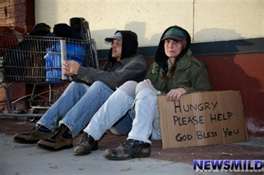 Still I found it amazing that Murray could say the main problem threatening the Nation today is not income inequality but cultural inequality. Minx wrote a very effective piece last week on the growing poverty in the US. Cited in her post was a statement by Tavis Smiley, who is pushing to have the issue of exploding poverty included in the 2012 election:
Women are much more likely to be poor than men, and more than a million children have fallen into poverty, and more than 500,000 have fallen into extreme poverty” — that is, living on less than $2 a day — “since 2010.” Recent census data shows that the number of children who live in extreme poverty has doubled from 1996 to 2011, from 1.4 million to 2.8 million.
And yet, as Minx pointed out a number of states: Kansas, Utah and Nebraska have initiated policies to cut food stamps to needy children.
Well here’s a factoid that turns the whole cultural argument on its head: the fastest growing segment of the newly poor are in suburban neighborhoods.

Warrensville Heights, Cleveland suburb, photo:dustin franz,NYT
Some of this is due to changing demographics but the larger percentage has to do with long-term unemployment, stagnate wages, off-shoring, the housing debacle, etc., etc. Here’s a chilling study from the same link:
Mark Rank, a social welfare professor at Washington University in St. Louis, has written extensively about shifts in U.S. poverty since the 1960s, and finds that Americans today are more likely to face poverty than in the past. According to Rank’s data, 24 percent of people who were in their 20s in the 1970s were likely to experience poverty at some point in their lives. That number rose to 31 percent in the 1980s and 37 percent in the 1990s. Today a majority of Americans-51.4 percent, according to the Urban Institute-will experience poverty by the time they’re 65.
Are we to believe that this sudden shift to poverty or expectation of poverty is all about lost moral/cultural compasses? Charles Murray would say, ‘yes.’ He suggests that the upper-middle class reach out, reintegrate and reeducate the working classes in the four pillars of civil society: marriage, industriousness, honesty and religiosity. Note that Murray’s study just happens to begin at the soon-to-be turbulent 1960s. Ahhh, if only we could go back to those Father Knows Best days.
In contrast, Barbara Ehrenreich pointedly says:
. . . a new discovery of poverty is long overdue. This time, we’ll have to take account not only of stereotypical Skid Row residents and Appalachians, but of foreclosed-upon suburbanites, laid-off tech workers, and America’s ever-growing army of the “working poor.” And if we look closely enough, we’ll have to conclude that poverty is not, after all, a cultural aberration or a character flaw. Poverty is a shortage of money.
My suggestion? Find yourself an Irish grandmother, the older the better. She’ll give you an earful. Generational memory is a powerful thing!
Tuesday Reads: Targeting Citizens with Predator Drones while Failing to Protect and Nurture Children
Posted: December 13, 2011 Filed under: child sexual abuse, children, Crime, Domestic Policy, education, George W. Bush, hunger, income inequality, morning reads, physical abuse, poverty, psychology, public education, U.S. Economy, U.S. Politics | Tags: Air Force, Catherine Snow, cortisol, crime, Glenn Greenwald, Hollywood sexual abuse scandal, Jane Harmon, law enforcement, literacy, No Child Left Behind, nutrition, obesity, poverty and education, Predator drones, standardized testing, U.S. Customs, violence 62 Comments
Good Morning!! Yesterday Dakinikat wrote about predator drones being used by local law enforcement in North Dakota. According the the LA Times story Dakinikat referenced,
Michael C. Kostelnik, a retired Air Force general who heads the office that supervises the drones, said Predators are flown “in many areas around the country, not only for federal operators, but also for state and local law enforcement and emergency responders in times of crisis.” Yet Congress never approved the use of drones for this purpose.
…former Rep. Jane Harman (D-Venice), who sat on the House homeland security intelligence subcommittee at the time and served as its chairwoman from 2007 until early this year, said no one ever discussed using Predators to help local police serve warrants or do other basic work.
Using Predators for routine law enforcement without public debate or clear legal authority is a mistake, Harman said.
But the article makes clear that law enforcement types are slavering over the possibility of using the sophisticated surveillance technology offered by drones–and without a warrant.
Glenn Greenwald had more at his blog yesterday. He says that the so-called “approval” for the use of predator drones on U.S. soil came because Customs administrators included the words “interior law enforcement support” in their budget request! And since Congresspeople rarely read the bills they vote on, no one noticed. So now government agents can spy on us and track us whenever they want, apparently.
Greenwald:
Whatever else is true, the growing use of drones for an increasing range of uses on U.S. soil is incredibly consequential and potentially dangerous, for the reasons I outlined last week, and yet it is receiving very little Congressional, media or public attention. It’s just a creeping, under-the-radar change. Even former Congresswoman Harman — who never met a surveillance program she didn’t like and want to fund (until, that is, it was revealed that she herself had been subjected to covert eavesdropping as part of surveillance powers she once endorsed) — has serious concerns about this development: ”There is no question that this could become something that people will regret,” she told the LA Times. The revelation that a Predator drone has been used on U.S. soil this way warrants additional focus on this issue.
You’d better not be doing anything suspicious on your own property–like smoke a joint in the backyard or something. You could be spotted, raided, and thrown in jail in no time flat, all without a warrant.
Dakinikat sent me a link to this article at the NYT on the relationship between poverty and education: Class Matters. Why Won’t We Admit It?
No one seriously disputes the fact that students from disadvantaged households perform less well in school, on average, than their peers from more advantaged backgrounds. But rather than confront this fact of life head-on, our policy makers mistakenly continue to reason that, since they cannot change the backgrounds of students, they should focus on things they can control.
No Child Left Behind, President George W. Bush’s signature education law, did this by setting unrealistically high — and ultimately self-defeating — expectations for all schools. President Obama’s policies have concentrated on trying to make schools more “efficient” through means like judging teachers by their students’ test scores or encouraging competition by promoting the creation of charter schools. The proverbial story of the drunk looking for his keys under the lamppost comes to mind.
The Occupy movement has catalyzed rising anxiety over income inequality; we desperately need a similar reminder of the relationship between economic advantage and student performance.
As a developmental psychologist I can tell you there are tons of studies that show that socioeconomic status (SES) is related to many different variables. This is a fairly complex issue, because poor people are disadvantaged in so many ways. Poor families are more likely to have only one breadwinner–usually a mother–who is probably overwhelmed by stress and worry. That leaves mom with much less energy to spend talking to and reading to her children.
A researcher I know slightly, Catherine Snow of the Harvard School of Education, worked on a number of government-funded longitudinal studies that investigated this. The research showed that very young children who are talked to, encouraged to tell stories about things that happened to them, and are read to in an interactive way are better prepared for literacy and will perform better in school than children who don’t get those kinds of attention. Interestingly, they found that the best predictor of academic success is a child’s vocabulary.
Children in poor families may also be stressed by inadequate nutrition, abuse from stressed-out parents, and perhaps exposure to violence in their neighborhoods. This kind of stress leads to higher cortisol (stress hormone) levels, which in turn can cause all kinds of problems, including obesity.
Back to the NYT article:
The correlation has been abundantly documented, notably by the famous Coleman Report in 1966. New research by Sean F. Reardon of Stanford University traces the achievement gap between children from high- and low-income families over the last 50 years and finds that it now far exceeds the gap between white and black students.
Data from the National Assessment of Educational Progress show that more than 40 percent of the variation in average reading scores and 46 percent of the variation in average math scores across states is associated with variation in child poverty rates.
International research tells the same story. Results of the 2009 reading tests conducted by the Program for International Student Assessment show that, among 15-year-olds in the United States and the 13 countries whose students outperformed ours, students with lower economic and social status had far lower test scores than their more advantaged counterparts within every country. Can anyone credibly believe that the mediocre overall performance of American students on international tests is unrelated to the fact that one-fifth of American children live in poverty?
Why does the government ignore this research–much of which has been done with government funding? There has been no effort to deal with the source of the problem–poverty–just bullheaded efforts to force schools to meet unrealistic standards. The authors admit that many in the government want public schools to fail so that education can be privatized and turned into a profit-making corporate enterprise.
The authors offer some suggestions, but since none of our elected officials seems to want to deal with the problem of increasing poverty among children in this country, their ideas come off sounding pretty weak.
This article really hit home with me, because I’ve been thinking a lot lately about why America as a whole doesn’t seem to care about children. I’ve been trying to write about post about it, but have struggled to put my ideas into words. I might as well just put some of it down here. My thoughts were not only about education, but also about the problems of protecting children from abuse and exploitation.
Children are our future. It’s a cliche because it’s true. We spend billions of dollars on the ridiculous and dangerous Department of “Homeland Security,” and we do very little at the federal level to protect children from poverty (one in four young children in the U.S. live in poverty), violence, abuse, and exploitation.
We are destroying our system of public education by requiring standardized tests instead of teaching children critical thinking. We encourage profit-making charter schools instead of providing more support for public schools.
In my fantasy future government, the President would have a cabinet level department devoted exclusively to children’s issues. This department would focus on designing the very best possible educational system for young children. There would be a strong focus on early childhood education, and especially on educating parents about the best ways to foster future academic success for their children, based on serious research. The department would work with the NIH and NSF to provide research grants to study these educational issues.
In addition, the department could develop ways to deal with the rampant abuse of children–physical, emotional, and sexual–that takes place in this country. The need for this is obvious if you read the news regularly. Children are beaten, raped, and murdered in their own homes every day. They are sexually abused in schools and in organized activities by people who should be protecting and guiding them. And people who hurt and kill children generally receive lighter sentences than those who prey on adults.
What has prompted me to think about these issues is not only the recent high-profile sexual abuse scandal at Penn State, but the stories that have been breaking recently about child sexual abuse in the Hollywood entertainment industry.
Two men who worked with child actors were recently arrested, Jason James Murphy, who worked on the well-received movie Super-8, and Martin Weiss, a talent agent.
The arrests have led a number of former child actors to come forward and talk about being abused as children. Reuters covered the story last week.
First, it was the Catholic Church. Then Penn State. Now, a new child-abuse scandal in Hollywood is raising questions over the safety of minors in the entertainment business and sparking calls for new child-labor regulations.
Last week Martin Weiss, a longtime manager of young talent, was arrested on suspicion of child molestation after an 18-year-old former client told police he had been abused by Weiss 30 to 40 times from 2005 to 2008.
Weiss’ arrest came just weeks after it was discovered that a convicted child molester and registered sex offender under the name Jason James Murphy was working in Hollywood and helping cast children for movie roles.
TheWrap contacted a wide array of professionals and found a mix of surprise, and those that say that this type of abuse is an ongoing concern, pointing to abuse allegations over the years by actors such as the late Corey Haim and Todd Bridges.
Other former child actors who have talked openly about the problem are Paul Peterson who appeared on The Donna Reed Show, Allison Arngrim from Little House on the Prairie, and Corey Feldman, who appeared on Nightline in August to talk about his own abuse.
“I can tell you that the No. 1 problem in Hollywood was and is and always will be pedophilia. That’s the biggest problem for children in this industry. … It’s the big secret,” Feldman said.
The “casting couch,” which is the old Hollywood reference to actors being expected to offer sex for roles, applied to children, Feldman said. “Oh, yeah. Not in the same way. It’s all done under the radar,” he said.
“I was surrounded by [pedophiles] when I was 14 years old. … Didn’t even know it. It wasn’t until I was old enough to realize what they were and what they wanted … till I went, Oh, my God. They were everywhere,” Feldman, 40, said.
The trauma of pedophilia contributed to the 2010 death of his closest friend and “The Lost Boys” co-star, Corey Haim, Feldman said.
“There’s one person to blame in the death of Corey Haim. And that person happens to be a Hollywood mogul. And that person needs to be exposed, but, unfortunately, I can’t be the one to do it,” Feldman said, adding that he, too, had been sexually abused by men in show business.
This Fox News article gets a little graphic, so skip over it if you prefer.
Another child star from an earlier era agrees that Hollywood has long had a problem with pedophilia. “When I watched that interview, a whole series of names and faces from my history went zooming through my head,” Paul Peterson, 66, star of The Donna Reed Show, a sitcom popular in the 1950s and 60s, and president of A Minor Consideration, tells FOXNews.com. “Some of these people, who I know very well, are still in the game.”
“This has been going on for a very long time,” concurs former “Little House on the Prairie” star Alison Arngrim. “It was the gossip back in the ‘80s. People said, ‘Oh yeah, the Coreys, everyone’s had them.’ People talked about it like it was not a big deal.”
Arngrim, 49, was referring to Feldman and his co-star in “The Lost Boys,” Corey Haim, who died in March 2010 after years of drug abuse.
“I literally heard that they were ‘passed around,’” Arngrim said. “The word was that they were given drugs and being used for sex. It was awful – these were kids, they weren’t 18 yet. There were all sorts of stories about everyone from their, quote, ‘set guardians’ on down that these two had been sexually abused and were totally being corrupted in every possible way.”
Yes, Virginia, child sexual abuse is common in every strata of our society. It’s not rare, and it’s time we got serious about dealing with it. If we had a Cabinet department of children’s issues, we could address the problem with public education programs. It worked for smoking and littering–why not try it with child abuse?
The department could request that the media show public service announcements to educate parents about nonviolent ways of disciplining their children and about the dangers of hitting or otherwise abusing children. I firmly believe that child abuse is the root cause of many of society’s ills–including domestic abuse, pedophilia, rape, murder, and serial murder. The majority of abused children don’t grow up to be perpetrators, but they often turn their anger on themselves, becoming depressed or suicidal or self-medicating with drugs and alcohol.
High profile cases like the Penn State and Hollywood casting scandal can often spur changes in societal attitudes. We should seize upon these issues to push Federal, state, and local governments to take positive action to improve the lives of American children.
Now I’ve rambled on too long and haven’t covered many stories. I’ll have to leave it to you to post what you’ve been reading and blogging about in the comments. If you made it this far, thanks for reading my somewhat incoherent thoughts.
Poverty in These United States
Posted: November 15, 2011 Filed under: Austerity, children, Economy, hunger, income inequality, poverty, seniors, unemployment | Tags: austerity, children at risk, Poverty Tour, seniors 10 Comments
We are not Afghanistan. We are not Haiti or the Democratic Republic of the Congo. We are not any of the 3rd world nations that are sometimes callously referred to as the ‘black holes’ of the world, where national incomes range between $700-900 annually, where human assets in nutrition, education, health and adult literacy are the lowest of the low. Nor do national fluctuations in agriculture production, instability of import/export services or economic smallness define us.
We are decidedly not one of the least developed nations on the planet. Quite the contrary. We are the richest, most powerful and technologically advanced nation the world has ever known.
Yet poverty exists and is rising. American poverty is a fact, a condition defined not by 3rd world standards but by the standards of who and what we are as a premier Nation among all nations.
No sooner had the Census Bureau come out with its findings on poverty–the first report in September, followed by a supplemental report in early November—the naysayers lined up reminding us that the findings were misleading, that many of the so-called poor had cars and TVs, that children of the poor sported Xboxes. And my God, a goodly number actually have air conditioning! I suspect many have heating, too.
The arguments are that unless a family or individual meets a 3rd-world definition of poverty then even the mention of rising American poverty levels falls into the category of gross exaggeration. This in a time when unemployment is the top concern of the American electorate, when unemployment sits ‘officially’ at 9% but, in fact, has reached nearly 20%, when from 2001-2009 42,400 American factories closed their doors to traditional middle-class jobs. This is also in a time of historical corporate profits and obscene CEO salaries in the financial services industry that through casino betting, accounting fraud and governmental bailouts brought this country and the world to its knees. And continues to do so, eg., MF Global headed by former NJ Governor Jon Corzine.
The old canards are being taken for a rerun as well: poverty is a symptom of lazy minds and an entitlement generation or an unwillingness to work hard and save money. Many will recall the Welfare Queen stories of the past, imagined always as a black woman with a dozen children, driving idly around town in her brand new Caddie. Living life high on the hog, the hysterical claims insisted, bilking government largesse [ otherwise known as taxpayer money]. But as Ralph B. noted in an earlier thread, there’s nary a word about corporate/millionaire welfare, where companies and even individuals skate on Federal taxes through loopholes and accounting maneuvers and government handouts
Let’s get real. The fallout of 2007-2008 hit many average families between the eyes, this after wages had been stagnating for three decades with a beginning upswing in the 90s, wage advancements quickly lost since 2000. Prices, however, have continued to rise, commodity prices in particular, those base products— gas, foodstuffs—that we all rely on to survive. Medical costs/premiums have gone through the roof. Is it any wonder seniors, who face a disproportionate share of medical problems and costs, have gotten caught in the old trap of choosing food or drugs? Children are caught up in the economic whirlwind, too, as parents lose jobs and homes, scramble for low-paying, part-time positions, work that frequently is not enough to ensure adequate food and/or nutrition on a consistent basis. Should we be surprised then at the increase of American children now classified as ‘food insecure?’
Here’s what we know:
49.1 million Americans have fallen into poverty, 16% of the population or 1 in 7 Americans.
Nearly 20% of that number are children; nearly 16% of the indigent are 65 years and older.
21.5% of American children have been classified as ‘food insecure.’
1 in 15 Americans are classified as the ‘poorest of the poor, which in 2010 translated to $5570 or less for an individual, $11,157 for a family of four.
The Census Bureau’s Supplemental report issued earlier this month takes into account governmental assistance—food stamps, the earned income tax credit, school lunch programs etc—without which the statistics above would be even worse.
From a Center on Budget and Policy Priorities report:
Six temporary federal initiatives enacted in 2009 and 2010 to bolster the economy by lifting consumers’ incomes and purchases kept nearly 7 million Americans out of poverty in 2010, under an alternative measure of poverty that takes into account the impact of government benefit programs and taxes. These initiatives — three new or expanded tax credits, two enhancements of unemployment insurance, and an expansion of benefits through the Supplemental Nutrition Assistance Program (SNAP, formerly called food stamps) — were part of the 2009 Recovery Act. Congress subsequently extended or expanded some of them.
Hence the total number of persons in poverty would have been even higher last year if not for the six government initiatives.
Btw, the link above gives a rather shocking comparison between the poverty rates in the US and Brazil. Not pretty.
Yet, Michelle Bachmann’s prescription as well as many of her Republican colleagues is based on the old saw: self-reliance, an honest day’s work for an honest day’s pay. This in a time of record unemployment and rising poverty in the general population.
How many statistics, comparisons, articles and images are necessary to convince the disbelieving that American poverty is on the rise, that it is not the result of coddling, laziness or lack of self-reliance? Or perhaps we must admit that there is also a poverty of spirit and reason running rampant through country, blinding those who would blame fellow citizens for the dearth of employment and opportunity without offering any workable solutions to an ever growing, bleak reality.

Austerity isn’t a political buzzword for Many Americans
Posted: July 16, 2011 Filed under: Economy, financial institutions, hunger, income inequality | Tags: reliance on food stamps, the economy, the Great Depression, unemployment 6 Comments You know if you’ve spent any time reading my thoughts that I am highly concerned by the level of income inequality in this country. Probably the thing that most concerns me is the number of people in Washington DC that continue to call for more of the very same policies that have wrecked the economy since the beginning of the century. Dubya/Cheney brought us deregulation that crippled the financial markets and taxes so low that we know have an unsustainable debt position. No one administration in US history has waged so many wars–literally and figuratively–on so many fronts and basically left most of the population with a huge bill. I am amazed that people like James Pethokoukis can even find outlets to publish their requests for more of the same. It’s pretty appalling but it’s typical of our media that seems more out of touch these days and ignorant of basic economics than our politicians.
Goldman Sachs doesn’t have to tell you things are bad. I don’t have to tell you things are bad. Everybody knows things are bad. Unemployment is at 9.2 percent (11.4 percent if the official labor force hadn’t collapsed since 2008 and 16.2 percent if you include discouraged and underemployed workers.) Moreover, the economy grew at just 1.9 percent in the first quarter of this year and may have grown less than 2 percent in the second. Wages and income are going nowhere fast.
When will the White House signal a change of economic direction? Will cutting tax rates and regulation ever make it on the agenda? That may be the only way Obama can win another term. And time is running short.
This man seriously thinks that change in economic direction would come through more ridiculous cuts in taxes and regulation? A change in economic direction would be towards policies that have worked in the past. How could any one call for more of the same knowing the results that those kinds of policies yielded? Do we really need another recession and financial market melt down? We don’t have rich people using tax cuts to serve as jobs creators. We have rich people and corporations using tax cuts to plop their wealth around the world to preserve that wealth. We have the American middle and working class falling into poverty.
Here’s an example of what ignoring the jobs disaster and enabling wealth hoarders has wrought from The Economist. This article is called ‘The struggle to eat; As Congress wrangles over spending cuts, surging numbers of Americans are relying on the government just to put food on the table’.
Take food stamps, a programme designed to ensure that poor Americans have enough to eat, which is seen by many Republicans as unsustainable and by many Democrats as untouchable. Participation has soared since the recession began (see chart). By April it had reached almost 45m, or one in seven Americans. The cost, naturally, has soared too, from $35 billion in 2008 to $65 billion last year. And the Department of Agriculture, which administers the scheme, reckons only two-thirds of those who are eligible have signed up.
Republican leaders in the House of Representatives want to rein in the programme’s runaway growth. In their budget outline for next year they proposed cutting the amount of money to be spent on food stamps by roughly a fifth from 2015. Moreover, instead of being a federal entitlement, available to all Americans who meet the eligibility criteria irrespective of the cost, the programme would become a “block grant” to the states, which would receive a fixed amount to spend each year, irrespective of demand. The House has also voted to cut a separate health-and-nutrition scheme for poor pregnant women, infants and children, known as WIC, by 11%. (The Senate, controlled by the Democrats, is unlikely to approve either measure.)
Advocates for the poor consider such cuts unconscionable. Food stamps, they argue, are far from lavish. Only those with incomes of 130% of the poverty level or less are eligible for them. The amount each person receives depends on their income, assets and family size, but the average benefit is $133 a month and the maximum, for an individual with no income at all, is $200. Those sums are due to fall soon, when a temporary boost expires. Even the current package is meagre. Melissa Nieves, a recipient in New York, says she compares costs at five different supermarkets, assiduously collects coupons, eats mainly cheap, starchy foods, and still runs out of money a week or ten days before the end of the month.
It is also hard to argue that food-stamp recipients are undeserving. About half of them are children, and another 8% are elderly. Only 14% of food-stamp households have incomes above the poverty line; 41% have incomes of half that level or less, and 18% have no income at all. The average participating family has only $101 in savings or valuables. Less than a tenth of recipients also receive cash payments from the Temporary Assistance for Needy Families programme (TANF), the reformed version of welfare; roughly a third get at least some income from wages.
Spending on food stamps has risen so quickly because, unusually, almost all the needy are automatically and indefinitely eligible for them. Unemployment benefits last for a maximum of 99 weeks at the moment, and that is due to fall to six months from next year. No one knows exactly how many people have exhausted their allotment, as the government does not attempt to count them. But almost half of the 14m unemployed have been out of a job for six months or more, and so would no longer qualify for benefits under the rules that will apply from January 1st.
Krugman states the obvious or “what ordinary economists” would find the policy measures under these situations in his blog today. It is exactly the opposite of what the group think in Washington DC is producing.
So, terrible growth prospects; low inflation; oh, and low interest rates, with no sign of the bond vigilantes. Ordinary macroeconomic analysis tells you very clearly what we should be doing: fiscal expansion and monetary expansion by any means we can manage; in fact, the case for a higher inflation target pops right out of just about any model capable of producing the kind of mess we’re in.
And what are we talking about in policy terms? Spending cuts and an end to monetary expansion.
I know the arguments — fear of invisible bond vigilantes, fear that 70s-style stagflation is just around the corner despite the absence of any evidence to that effect. But why do such arguments have so much traction, while everything economists have spent the last three generations learning is brushed aside?
One answer is that macroeconomics is hard; the idea that if families are tightening their belts, the government should do the same, is as deeply intuitive as it is deeply wrong.
But the susceptibility of politicians — including, alas, the president — and pundits to these wrong ideas demands a deeper explanation.
Mike Konczal ratchets up my rentier argument, arguing that what we’re seeing is
a wide refocusing of the mechanisms of our society towards the crucial obsession of oligarchs: wealth and income defense.
That has to be right. It doesn’t necessarily take the form of pure cynicism; it’s more a matter of the wealthy gravitating toward views of economic policy that make immediate sense in terms of their own interests, and politicians believing that only these views count as Serious because they’re the views of wealthy people.
But the upshot is terrible: more and more, this really does look like the Lesser Depression, a prolonged era of disastrous economic performance. And it’s entirely gratuitous.
It’s just hard for me to even find words about how misguided fiscal policy is these days. We have financial markets clamoring for less regulation not because they want to operate efficiently or because they want healthy competition, these folks are asking for removing basic oversight that prevents price gaming, moral hazard, information asymmetry, and oligopoly style games. We have two protracted wars that have never been fully financed. We have bailouts of failed institutions that have never been financed. We also have tax cuts that were not offset by spending cuts but made worse by giveaways by a Republican administration and a Republican congress and exacerbated by a Democratic administration. Obama’s stimulus was top heavy with useless tax cuts. What sort of craziness does it take to try to put those same policies on steroids then expect them to create different results?
What we currently are experiencing is a complete Aggregate Demand vacuum. We have the rich hoarding wealth or putting it in other economies and the rest of the country struggling to just exist if they have jobs. Then, we have a huge number of people that have neither wealth or jobs. This is WHEN we need the government to boost spending. We didn’t need all that during the last part of the Bush years but what we got was a period of throwing the US Treasury to the wind. We’re in deep trouble here folks and I have no faith that any of our policy makers will ever wake up and do the right thing.

 peej
peej Carissa
 bostonboomer
 dakinikat
 ecocatwoman
 mablue2
 Mama Lopez
 peggysue22
 quixote
 skydancingguestblogger
 Mona (aka Wonk the Vote)



 Sky Dancing
Recent Comments