
“The Public Option is not your Enemy”
Posted: June 16, 2009 Filed under: Health care reform, Human Rights, Team Obama, Uncategorized | Tags: Affordable health Choices Act, American Medical Association, Congressional Budget Office, Dodd, Kennedy Comments Off on “The Public Option is not your Enemy”
Finally, if we are to win the battle that is now going on around the world between freedom and tyranny, the dramatic achievements in space which occurred in recent weeks should have made clear to us all, as did the Sputnik in 1957, the impact of this adventure on the minds of men everywhere, who are attempting to make a determination of which road they should take. Since early in my term,our efforts in space have been under review. With the advice of the Vice President, who is Chairman of the National Space Council, we have examined where we are strong and where we are not, where we may succeed and where we may not. Now it is time to take longer strides-time for a great new American enterprise-time for this nation to take a clearly leading role in space achievement, which in many ways may hold the key to our future on earth.
President John F. Kennedy, May 25, 1961
Why can’t we put the same determination that put a man on the moon into finding a solution for affordable health care for all? What are the sticking points?
Some of the first efforts toward that goal were put into play yesterday. We had the usual Presidential teleprompter read before the American Medical Association yesterday. It was characterized this way by Sam Stein.
“The public option is not your enemy, it is your friend,” Obama declared at one point.
His prepared remarks were a bit more detailed:
If you don’t like your health coverage or don’t have any insurance, you will have a chance to take part in what we’re calling a Health Insurance Exchange…. You will have your choice of a number of plans that offer a few different packages, but every plan would offer an affordable, basic package. And one of these options needs to be a public option that will give people a broader range of choices and inject competition into the health care market so that force waste out of the system and keep the insurance companies honest.
Back in the world of where the rubber hits the road, the Congressional Budget Office (CBO) returned an estimate of the Affordable Health Choices Act that was proposed by Dodd and Kennedy. Ezra Klein of WaPo used the adjective “devastating”.
According to the agency, the bill would cost a hefty trillion dollars over 10 years and extend insurance to a mere 16 million people. That’s a lot of money to spend if you’re only going to achieve a third of your goal. Frankly, I was pretty surprised by the results.
And so, it turns out, were the people writing the bill.
A couple of months ago, the Health, Education, Labor, and Pensions Committee sent the CBO a sketch of a draft of its legislation. And the CBO sent the members back a stab at an outline of an estimate. It was all very early, and very rough. But CBO’s response was encouraging. The total cost was a bit higher, but the number covered was much higher. More like what you’d expect. More like what health reform is trying to achieve.
The draft the CBO examined last week, however, was in certain respects even less complete than the outline they were given months ago. In an effort to buy some extra time to negotiate with Republicans on the committee, the Democrats on HELP left out some of the more controversial policies in the hopes of reaching a bipartisan agreement sometime this week. The public plan, the employer mandate and the individual mandate were all absent from the proposal the CBO examined. The employer and individual mandates — the first of which pushes employers to offer coverage and the second of which force individuals to purchase coverage — are particularly key to increasing the number of Americans with health insurance.
You might ask what the HELP Committee was thinking, sending Swiss cheese legislation to CBO. Well, the HELP Committee’s expectation was that the CBO, in crafting its preliminary score, would assume something similar to the outline it had seen months before. The CBO didn’t. In fact, it did the opposite. CBO ran its estimates with no employer mandate and an individual mandate with a laughably small penalty.
“Swiss cheese legislation”, is this what the American people deserve?
Stealing Home
Posted: June 13, 2009 Filed under: Diplomacy Nightmares, Human Rights | Tags: Aung San Suu Kyi, Benazir Bhutto, Iranian Elections, Mir Hossein Mousavi, Mynamar, Pakistan, Zhara Rahnavard Comments Off on Stealing Home Any one of a certain age that attended university pre-Iranian revolution had many, many Iranian friends. I certainly did. After the revolution, many disappeared for reasons I never new. Since the hostage taking at the end of the Carter years, we now only hear disappointing things about life for the people of that country and it makes me sad. They may not have wanted to be party to the excesses of the peacock throne, but they did not deserve the poverty and intolerance that followed the overthrow. Today’s election steals more of their home.
Opposition leader Mir Houssain Musavi speaks in an open letter to the people of Iran(H/T to BB),
In the Name of God
Honorable people of Iran
The reported results of the 10th Iranians residential Election are appalling. The people who witnessed the mixture of votes in long lineups know who they have voted for and observe the wizardry of I.R.I.B (State run TV and Radio) and election officials. Now more than ever before they want to know how and by which officials this game plan has been designed. I object fully to the current procedures and obvious and abundant deviations from law on the day of election and alert people to not surrender to this dangerous plot. Dishonesty and corruption of officials as we have seen will only result in weakening the pillars of the Islamic Republic of Iran and empowers lies and dictatorships.
I am obliged, due to my religious and national duties, to expose this dangerous plot and to explain its devastating effects on the future of Iran. I am concerned that the continuation of the current situation will transform all key members of this regime into fabulists in confrontation with the nation and seriously jeopardize them in this world and the next.
I advise all officials to halt this agenda at once before it is too late, return to the rule of law and protect the nation’s vote and know that deviation from law renders them illegitimate. They are aware better than anyone else that this country has been through a grand Islamic revolution and the least message of this revolution is that our nation is alert and will oppose anyone who aims to seize the power against the law.
I use this chance to honor the emotions of the nation of Iran and remind them that Iran, this sacred being, belongs to them and not to the fraudulent. It is you who should stay alert. The traitors to the nation’s vote have no fear if this house of Persians burns in flames. We will continue with our green wave of rationality that is inspired by our religious leanings and our love for prophet Mohammad and will confront the rampage of lies that has appeared and marked the image of our nation. However we will not allow our movement to become blind one.
I thank every citizen who took part in spreading this green message by becoming a campaigner and all official and self organized campaigns, I insist that their presence is essential until we achieve results deserving of our country.
[ verse from in Quran: Why not trust in God, who has shown us our ways. We are patient in face of what disturbs us. Our resilience is in God. ]
Mir Hossein Mousavi
Should Markets Respect Societal Bounds?
Posted: June 11, 2009 Filed under: Economic Develpment, Hillary Clinton: Her Campaign for All of Us, Human Rights, U.S. Economy | Tags: Dr. Michael Sandel, Economic Development, economics of public good, Elimination of poverty, Grameen Bank, Karela India, microfinance, Microlending, Muhammad Yunus, Reich Lectures 2 CommentsAs you know, I frequently rely on the British press for news and political analysis. I was delighted to find a link on Dr. Mark Thoma’s Economist’s View to the BBC’s broadcasts of the Riech Lectures for 2009. Dr. Michael Sandel, Harvard Professor of Government, delivers four lectures on the prospects of a new politics of the common good in this series. Dr Sandel argues that we need “a politics oriented less to the pursuit of individual self-interest and more to the pursuit of the common good”. I was most intrigued by the series on financial community norms (as pointed to by Dr. Thoma) and the idea that even in markets, “norms matter”.
The series is presented and chaired by Sue Lawley.
Sandel considers the expansion of markets and how we determine their moral limits. Should immigrants, for example, pay for citizenship? Should we pay schoolchildren for good test results, or even to read a book? He calls for a more robust public debate about such questions, as part of a ‘new citizenship’.
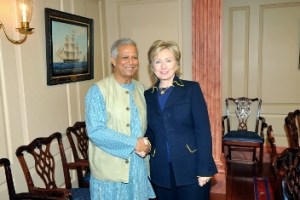
US Secretary of State Hillary Clinton receives Nobel laureate Prof Muhammad Yunus at her US State Department office in Washington DC Wednesday.
I have worked with and studied under one of the foremost authorities on Islamic Banking which are finiancial institutions developed with the idea of a “common good” so I know that in some areas of the world, this is possible. Again, in Dr. Hussan’s Bangledesh and other countries respecting Islamic law, banks do not charge interest because the Q’uran forbids usury. This is also true of the banking system used by Orthodox Jews. This is viewed as a financial system that works for the common good in lieu of exploitation of one side of the market. The banks are frequently mutually owned. Again, one of the best development vehicles in poorer countries is the microfinance banking community that developed with the inspiration from Bangledeshi Economist, Muhammad Yunus, who won the Noble Peace prize for his role in developing the idea of microcredit and the Grameen Bank. (This means of course, I have to make a shameless plug for Kiva my favorite place to invest in humanity’s future where I place money as dakinikat@aol.com). I know from this work that it is possible to create market driven systems where something other than over-the-top profits can motivate a market.
So, I’m going to return to Dr. Sandel’s exposition on what it means to have markets which value a poltics of common good. I’ve bolded the areas that I highlighted while reading the speech. (Yes, I know, old university habits die hard.)
A new politics of the common good isn’t only about finding more scrupulous politicians. It also requires a more demanding idea of what it means to be a citizen, and it requires a more robust public discourse – one that engages more directly with moral and even spiritual questions. And so in the course of these lectures, I’ll explore the prospect of a new citizenship and I’ll be asking what a more morally engaged public life might be like.
If we’re to reinvigorate public discourse, if we’re to focus on big questions that matter, questions of moral significance, one of the first subjects we need to address is the role of markets, and in particular the moral limits of markets. Which brings me to the topic of this first lecture. We’re living with the economic fallout of the financial crisis and we’re struggling to make sense of it. One way of understanding what’s happened is to see that we’re at the end of an era, an era of market triumphalism. The last three decades were a heady, reckless time of market mania and deregulation. We had the free market fundamentalism of the Reagan-Thatcher years and then we had the market friendly Neo-Liberalism of the Clinton and Blair years, which moderated but also consolidated the faith that markets are the primary mechanism for achieving the public good. Today that faith is in doubt. Market triumphalism has given way to a new market scepticism. Almost everybody agrees that we need to improve regulation, but this moment is about more than devising new regulations. It’s also a time, or so it seems to me, to rethink the role of markets in achieving the public good. There’s now a widespread sense that markets have become detached from fundamental values, that we need to reconnect markets and values. But how? Well it depends on what you think has gone wrong. Some say the problem is greed, which led to irresponsible risk taking. If this is right, the challenge is to rein in greed, to shore up values of responsibility and trust, integrity and fair dealing; to appeal, in short, to personal virtues as a remedy to market values run amuck.
Narro Math?
Posted: June 6, 2009 Filed under: Economic Develpment, Human Rights, Women's Rights | Tags: Girls and Math and Science 2 Comments I never thought about math much until I found out, some where around 12 or so, that girls weren’t supposed to be good at it. Ever the tomboy, I just had to prove them wrong and I’ve frequently been the only woman (and definitely the only American woman) in advanced math classes at university. Both my daughters excel at math. However, the old stereotype has been out there for my mother and grandmothers as well as my daughters and me. Ask current Obama economic adviser Larry Summers who stirred up women scientists every where with this gem during his tenure as Harvard’s president.
This was the point that most angered some of the listeners, several of whom said Summers said that women do not have the same ”innate ability” or ”natural ability” as men in some fields.
Asked about this, Summers said, ”It’s possible I made some reference to innate differences. . . I did say that you have to be careful in attributing things to socialization. . . That’s what we would prefer to believe, but these are things that need to be studied.”
Summers said cutting-edge research has shown that genetics are more important than previously thought, compared with environment or upbringing. As an example, he mentioned autism, once believed to be a result of parenting but now widely seen to have a genetic basis.
In his talk, according to several participants, Summers also used as an example one of his daughters, who as a child was given two trucks in an effort at gender-neutral parenting. Yet she treated them almost like dolls, naming one of them ”daddy truck,” and one ”baby truck.”
It was during his comments on ability that Hopkins, sitting only 10 feet from Summers, closed her computer, put on her coat, and walked out. ”It is so upsetting that all these brilliant young women [at Harvard] are being led by a man who views them this way,” she said later in an interview.
More and more evidence demonstrates just the opposite of the stereotype. Girls can and do kick ass at math. It’s not 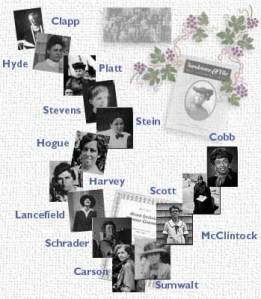 that they lack they aptitude, they lack they opportunity and environment to do so. Science Daily reports that study after study now show that it’s Culture, Not Biology, Underpins Math Gender Gap. Both Riverdaughter and I live the nightmare that comes with being woman practitioners of a field that requires heavy math. She is a research chemist doing work on drugs. I am an economist who relies heavily on econometrics and models that borrow heavy from physics models. One of my colleagues, another woman economist from Finland who absolutely kicks ass when it comes to high level mathematical models on trade, has similar stories. One friend I’ve had the longest has taught university level math for nearly 30 years now. At various times, I’ve had to adopt some kind of charade to make my numeracy less threatening to colleagues, bosses, and institutions. It adds a completely different dimension to how you do your work. You can do it, you can kick ass at it, but you have to make sure that you’re deferential enough not to make the boys pee their pants and vote you off their islands. It’s a strange, demented and twisted kabuki dance.
Somethings You Can’t Make Up
Posted: May 15, 2009 Filed under: Human Rights, president teleprompter jesus, Team Obama, U.S. Economy, Voter Ignorance | Tags: Debt, Military Tribunals, Public Health, Single Payer Health Insurance. 5 CommentsGiven the choice between posting my final grades and my morning coffee or perusing some of the latest presidential antics and my morning coffee, I chose the latter. The latest front pager at the Confluence, Steven Mather started a great conversation on Obots and willful blindness. Since I was following a tweetathon last night between Glenn Greenwald and Jack Tapper on the latest about face, it seems appropriate to start there. This just comes under the heading of reality taking on dimensions of science fiction.
Every one is trying to figure out how Military Tribunals under Bush will be different the Military Tribunals continued by Obama. Given I’ve been following the financial bailouts under Bush and the virtual continuation of the same policy under Obama, I’m thinking the progressive blogosphere should be blowing a few gaskets now. After all, they were just told to lay off the torture photos and any hope of prosecution of what can only be labeled the Cheney Torture Policy. What we appear to have is straight forward continuation of nearly all the major Bush policies with major re-framing. It’s not going to be the old Nixon War on Drugs, it’s going to be the Obama “complete public-health model for dealing with addiction”. Somebody seems to think just morphing the lexicon makes it seem less Republican. Some one needs to tell Axelrod it’s the policies, not the labels.
So Greenwald is calling it Obama’s kinder, gentler military commissions .
It now appears definitive that the Obama administration will attempt to preserve a “modified” version of George Bush’s military commissions, rather than try suspected terrorists in our long-standing civilian court system or a court-martial proceeding under the Uniform Code of Military Justice. Obama officials have been dispatched to insist to journalists (anonymously, of course) that Obama’s embrace of “new and improved” military commissions is neither inconsistent with the criticisms that were voiced about Bush’s military commission system nor with Obama’s prior statements on this issue. It is plainly not the case that these “modifications” address the core criticisms directed to what Bush did, nor is it the case that Obama’s campaign position on this issue can be reconciled with what he is now doing. Just read the facts below and decide for yourself if that is even a plausible claim.
Oh, do go read the facts listed in the article. Don’t forget those koolaide goggles, because willful blindness is about the only way you’re going to see much difference.
 Meanwhile over on Bloomberg, I read up on the latest Obama-would-rather-not-be-held hostage- by-the-oval-office town hall meeting where Obama Says U.S. Long-Term Debt Load ‘Unsustainable’. I have to join Seth and Amy in a “Oh, really?” moment here. I think you all will remember the graph on the left from earlier pieces that I’ve done on the Obama stimulus package and budget. Let’s just use the Bloomberg piece as a refresher.
President Barack Obama, calling current deficit spending “unsustainable,” warned of skyrocketing interest rates for consumers if the U.S. continues to finance government by borrowing from other countries.
“We can’t keep on just borrowing from China,” Obama said at a town-hall meeting in Rio Rancho, New Mexico, outside Albuquerque. “We have to pay interest on that debt, and that means we are mortgaging our children’s future with more and more debt.”
Holders of U.S. debt will eventually “get tired” of buying it, causing interest rates on everything from auto loans to home mortgages to increase, Obama said. “It will have a dampening effect on our economy.”
Earlier this week, the Obama administration revised its own budget estimates and raised the projected deficit for this year to a record $1.84 trillion, up 5 percent from the February estimate. The revision for the 2010 fiscal year estimated the deficit at $1.26 trillion, up 7.4 percent from the February figure. The White House Office of Management and Budget also projected next year’s budget will end up at $3.59 trillion, compared with the $3.55 trillion it estimated previously.
Two weeks ago, the president proposed $17 billion in budget cuts, with plans to eliminate or reduce 121 federal programs. Republicans ridiculed the amount, saying that it represented one-half of 1 percent of the entire budget. They noted that Obama is seeking an $81 billion increase in other spending.
Meanwhile, we’ve seen protests erupt as the Senate started discussing health care reform while leaving single payer solutions off-the-table. No single payer is another Obama missive and another Republican-like policy. On May 5th, those most radical of all elements in this country, doctors and nurses, staged a protest at a senate hearing insisting single payer should be on the table.
I still can’t believe the Republicans are calling Obama a socialist. The only thing we’ve socialized so far are those incredible losses coming out of the finance sector. Everything else is Republican-lite.
All I gotta say is ya got played folks! Maddoff is a small fry scammer by comparison.
Please Digg!!! and Share!!!


 peej
peej Carissa
 bostonboomer
 dakinikat
 ecocatwoman
 mablue2
 Mama Lopez
 peggysue22
 quixote
 skydancingguestblogger
 Mona (aka Wonk the Vote)



 Sky Dancing
Recent Comments