
Thursday Reads: John Boehner and His “Knuckleheads,” Long-Lost Roman Fort, and Much More
Posted: September 18, 2014 Filed under: children, Crime, House of Representatives, Labor unions, morning reads, physical abuse, psychology, science, U.S. Politics, Violence against women | Tags: Adrian Peterson, archaeology, Arizona Cardinals, body odor, Brandon Marshall, Chicago Bears, Denver Broncos, Dunkin' Donuts, Gernsheim Germany, human mating behaviors, International Franchise Association, John Boehner, Jonathan Dwyer, knucklehead caucus, McDonald's, Minnesota Vikings, NFL owners, political science, Roger Goodell, Roman fort, sports talk radio 26 Comments
Good Morning!!
Did you hear about the speech John Boehner gave on Tuesday? He was talking to the International Franchise Association. He warned owners of McDonald’s, Dunkin’ Donuts and other franchise businesses that Obama’s NLRB is out to destroy them. My goodness! If these one-percenters were forced to pay their employees something approaching a living wage, it would be a nightmare! From The Hill, Boehner warns biz: NLRB is ‘coming right at you’.
Speaker John Boehner (R-Ohio), lamenting the rise of “arrogant agencies” he said is threatening the American dream, warned the franchise industry on Tuesday that a politically motivated National Labor Relations Board (NLRB) is intent on unionizing its workers.
In brief but forceful remarks to the International Franchise Association, Boehner called the NLRB a “political horse,” controlled by Republicans when they occupy the White House and by unions when a Democrat is president.
“They’re going to do everything they can to try to change the rules and try to find a way to organize your businesses,” Boehner told the group.
He cited the NLRB’s recent finding that the McDonald’s corporation has joint-employer status, along with its franchises, over the chain’s thousands of workers.
The designation, if upheld, could force corporate managers to the table in collective bargaining discussions and expose them to claims of labor rights violations from workers at chain stores and businesses.
Horrors! Because everyone knows the American Dream is about a few rich assholes getting richer on the backs of millions of minimum wage workers who can barely feed their families.
But here’s the good part. During his remarks, Boehner complained about the Republican “knuckleheads” he has to deal with as Speaker of the House. The Hill reports:
“On any given day, 16 of my members decide they’re going to go this way, and all the sudden I have nothing,” he said. “You might notice I have a few knuckleheads in my conference.”
As a result, Boehner claims he only has a “paper majority.”
A group of the most conservative Republicans has frequently plagued the Speaker and upended plans for votes, most recently in July when GOP leaders were forced to pull a vote on their bill responding to thousands of unaccompanied children crossing the southern border.
In April, Boehner mocked some members of his conference for being reluctant to vote on immigration reform. “Here’s the attitude: ‘Ohhhh. Don’t make me do this. Ohhhh. This is too hard,’ ” he said.
Boehner added in his comments on Tuesday that “dealing with Democrats is one thing, dealing with the knuckleheads is another.”
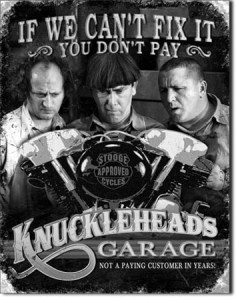
At Salon, Jim Newell comments on Boehner’s “knucklehead problem.”
A specialized sort of barometric collapse hit Washington, D.C., last night: a sudden knowledge that the capital’s stocks of Merlot and unfiltered cigarettes had been depleted, and Speaker John Boehner was turning surly. And the target of his abuse, yet again, were the very specimens over whom he attempts to leverage power: the House Republicans conference.
Boehner, speaking to the International Franchise Association (read: people who don’t want to pay their fast-food workers more), described the House majority over which he lords as a “paper majority,” and then went on to label a dissident faction within his conference as “knuckleheads.” ….
Newell mentions Boehner’s complaint about House Republicans who are afraid to vote for an immigration bill (see above in The Hill piece), and an earlier rant by the Speaker from 2012.
“We got some of the smartest people in the country who serve here, and some of the dumbest. We got some of the best people you’d ever meet, and some of the raunchiest. We’ve got ‘em all.”
Why don’t Democrats pull together a bunch of these Boehner quotes and use them in the Midterm campaigns, Newell asks. As for Speaker Boehner,
Why was Boehner insulting members of the House GOP less than two months ahead of an election? Because he’s a strange dude, for starters. Gets his Irish up sometimes, as Paul Ryan would say. But Boehner’s comments were also part of an elaborate pitch to the assembled franchisees to elect more House Republicans this November. He has a “paper majority” in which a few wiseacres can separate themselves from the herd and force the House leadership to pull legislation from the floor. Pity the speaker.
It’s a midterm election cycle in the sixth year of the Obama administration, so the odds are that any new members added to the speaker’s Republican roster this November will be natural fits for the Knucklehead Caucus. The problems Boehner has had (not) moving pieces of legislation these past four years won’t go away, because they’re problems with Boehner’s leadership style. He’s too tentative to threaten the knuckleheads’ committee assignments and access to party campaign cash. He’s abandoned earmarks. And his members know that, except in a handful of cases, his threats to pass legislation with Democratic votes are bluffs. The new knuckleheads will find him just as easy to roll as the previous ones have.
We’ve talked many times here about the differences between liberals and conservatives, and how hard it is for us to understand right-wingers’ thought processes. Well, did you know that liberals and conservatives even smell different?

From The Washington Post, Study: Liberals and conservatives sniff out like-minded mates by body odor.
According to a study published this month in the American Journal of Political Science, people can literally sniff out ideology — and this may explain why so many couples share political beliefs. Or, as the study’s title says, “Assortative Mating on Ideology Could Operate Through Olfactory Cues.”
Researchers led by Brown University political scientist Rose McDermott found that, to a small but significant degree, people prefer the body odor of those who vote as they do.
Previous studies showed long-term mates are more similar when it comes to politics than anything else besides religion. Researchers set out to determine whether this is a purely socially driven phenomenon, or whether biology plays a role.
To test the link between smell and party affiliation, researchers rounded up 146 people aged 18 to 40 from “a large city in the northeast United States.” They used a seven-point scale to determine where they fell on the political spectrum. They sent 21 of these —10 liberals and 11 conservatives — home with fragrance-free soap and shampoo and a gauze pad taped to their armpit. The subjects were told not to smoke, drink, use deodorant or perfume, have sex, eat fragrant foods, sleep with people or pets or linger near strong odors.
They returned the stinky armpit pads 24 hours later. Then 125 participants sniffed the stinky pads, taking a break between whiffs to cleanse their nasal palate with the aroma of peppermint oil. The sniffers, who never saw the people whose smells they were evaluating, then rated the attractiveness of each armpit sample on a 1 to 5 scale.
The subjects found the smell of those more ideologically similar to themselves more attractive than those with opposing views.
Read about the conclusions researchers drew from these results at the WaPo.

How about some archaeology news? German archaeologists have discovered a “long lost Roman fort.” dating to the 1st Century. From Science Daily:
In the course of an educational dig in Gernsheim in the Hessian Ried, archaeologists from Frankfurt University have discovered a long lost Roman fort: A troop unit made up out of approximately 500 soldiers (known as a cohort) was stationed there between 70/80 and 110/120 AD. Over the past weeks, the archaeologists found two V-shaped ditches, typical of this type of fort, and the post holes of a wooden defensive tower as well as other evidence from the time after the fort was abandoned.
An unusually large number of finds were made. This is because the Roman troops dismantled the fort and filled in the ditches when they left. In the process they disposed of a lot of waste, especially in the inner ditch. “A bonanza for us,” according to Prof. Dr. Hans-Markus von Kaenel from the Goethe University Institute of Archaeology. “We filled box after box with shards of fine, coarse and transport ceramics; dating them will allow us to determine when the fort was abandoned with greater accuracy than was possible before.”
Up until now, little was known about Roman Gernsheim, even though findings from the Roman era have been cropping up here since the 19th century. “Previously, the only thing that seemed certain based on the finds was that an important village-like settlement, or “vicus,” must have been located here from the 1st to the 3rd century, comparable with similar villages which have already been shown to have existed in Groß-Gerau, Dieburg or Ladenburg,” explained dig leader Dr. Thomas Maurer. He has been travelling from Frankfurt to South Hessia for years and has published his findings in a large publication about the North Hessian Ried during Roman imperial times.
“It was assumed,” continued Maurer, “that this settlement had to have been based on a fort, since it was customary for the families of the soldiers to live outside the fort in a village-like settlement.” “We really hit the jackpot with this excavation campaign,” said a delighted Prof. Dr. Hans-Markus von Kaenel. “The results are a milestone in reconstructing the history of the Hessian Ried during Roman times.” For almost 20 years now, von Kaenel has been studying this area with the help of his colleagues and students using surveys, digs, material processing and analyses. The results have been published in over 50 articles.
Read the rest at the link.

There was more bad new for the NFL yesterday. Arizona Cardinals running back Jonathan Dwyer (pictured in cuffs at right) was arrested for two domestic violence incidents that happened in July. Dwyer reportedly attacked his wife and caused a bone fracture in one incident, and in the other he threw a shoe at his 18-month old son. He is also charged with preventing his Kayla from calling 911 for help. Fortunately, Kayla immediately took the child and left the state. The New York Daily News reports, Arizona Cardinals shut down running back Jonathan Dwyer over domestic violence charges.
Police said Dwyer hit his wife, causing a fracture. It was not immediately clear if the shoe hit their baby, Jonathan Jr.
Officers went to Dwyer’s home on July 21 after neighbors reported a domestic disturbance. His wife brushed cops off, but later told detectives Dwyer was there when authorities were looking for him, but hid in a bathroom until police left.
The following day, Dwyer snatched a cell phone from his wife’s hand and threw it from the second floor of their home to prevent her from calling the cops, Crump said.
Dwyer is also accused of sending his wife text messages threatening to harm himself if she reported the assaults.
The Cardinals immediately deactivated Dwyer. They really had no choice after what happened with the Vikings and Adrian Peterson.
“We became aware of these allegations this afternoon when notified by Phoenix police and are cooperating fully,” the Cardinals said in a statement. “Given the serious nature of the allegations we have taken the immediate step to deactivate Jonathan from all team activities.”
One local Boston sports station has nominated Dwyer for “biggest asshole in the NFL.” I’ve been listening to the two Boston sports stations and ESPN radio quite a bit, and I’ve been really heartened by the reactions of the male program hosts and callers. One host said yesterday that he had read a parenting book over the weekend. He has never hit his kids, but he was so shocked by Adrian Peterson’s reported behavior that he wanted to know more about good parenting. Another host said that he had been beaten as a child, and for the first time he has begun to understand that his parents abused him.

Also yesterday, attorney Gloria Allred held a press conference in Atlanta with the best friend and the father of Rasheeda Watley, a survivor of abuse by Chicago Bears player Brandon Marshall and called for NFL Commissioner Roger Goodell to step down. WSB TV Atlanta:
At a news conference Wednesday, Allred detailed the case of Rasheeda Watley, who claimed then-boyfriend Brandon Marshall of the Denver Broncos had physically abused her….
Allred was joined by Watley’s father and best friend, who both said they reported the abuse to the NFL and Goodell but nothing was done.
NFL Commissioner Roger Goodell’s handling of family violence issues has come under fire in recent weeks after a video was released showing former Baltimore Ravens running back Ray Rice hitting his then-fiancee Janay Palmer twice inside the elevator of an Atlantic City casino in February.
Allred said the investigation process is flawed within the NFL organization and it needs to change.
“Our focus is on the process and we want the process to be fair. We want the investigation that is conducted in the future, investigations, of NFL players to afford due process to victims as well as NFL players,” Allred said. “The present process is obviously not fair.”
According to Watley’s father, no one from the NFL even talked to himself, his daughter, or any witnesses of the abuse.
I need to wrap this up, but I want to mention one more article from Bloomberg Businessweek, Roger Goodell at the 50-50 Yard Line. It’s a fairly long read that explains why Goodell’s job is not yet on the line. He has made tons of money for NFL owners, and–let’s face it–money is all they really care about.
So . . . what else is happening? Let us know in the comment thread, and have a great Thursday!
Monday Reads
Posted: October 7, 2013 Filed under: 2012 elections, Congress, Federal Budget and Budget deficit, Federal Government Shutdown, House of Representatives, morning reads, Tea Party activists 74 Comments
Good Morning!
I’ve made plans to go to Seattle next month again to stay with my dad and hope that I can also spend time looking for the possibility of a job since my daughter is joining a small ob/gyn practice about an hour north of Seattle. It’s hard not to long for the safety of a blue state given what’s been going on recently and given the conversations that I have with people that safely dwell in the Faux News Reality of Welfare Queens, Pedophile Gays, Scary Black People in Hoodies, and Invading Mexicans. I’ve been in a long Facebook conversation trying to explain the Affordable Care Act details and why the exchanges are not “government-backed” insurance until I’m blue in the face. No amount of numbers convinces them that all the jobs are not becoming part time. I was just told I obviously don’t have common sense if I don’t see the Affordable Care Act as a giant give away to lazy poor people even though I’ve tried to explain that Medicaid still exists and it still is the plan for poor people. There just exists this ever deepening divide between the realities of Red and Blue States. Did Nixon’s Southern Strategy doom our Democracy?
In a merciful twist of fate, Juan Linz did not quite live to see his prophecy of the demise of American democracy borne out. Linz, the Spanish political scientist who died last week, argued that the presidential system, with its separate elections for legislature and chief executive, was inherently unstable. In a famous 1990 essay, Linz observed, “All such systems are based on dual democratic legitimacy: No democratic principle exists to resolve disputes between the executive and the legislature about which of the two actually represents the will of the people.” Presidential systems veered ultimately toward collapse everywhere they were tried, as legislators and executives vied for supremacy. There was only one notable exception: the United States of America.
Linz attributed our puzzling, anomalous stability to “the uniquely diffuse character of American political parties.” The Republicans had loads of moderates, and conservative whites in the South still clung to the Democratic Party. At the time he wrote that, the two parties were already sorting themselves into more ideologically pure versions, leaving us where we stand today: with one racially and economically polyglot party of center-left technocracy and one ethnically homogenous reactionary party. The latter is currently attempting to impose its program by threat upon the former. The events in Washington have given us a peek into the Linzian nightmare.
Traditionally, when American politics encountered the problem of divided government—when, say, Nixon and Eisenhower encountered Democratic Congresses, or Bill Clinton a Republican one—one of two things happened. Either both sides found enough incentives to work together despite their differences, or there was what we used to recognize as the only alternative: gridlock. Gridlock is what most of us expected after the last election produced a Democratic president and Republican House. Washington would drudge on; it would be hard to get anything done, but also hard to undo anything. Days after the election, John Boehner, no doubt anticipating things would carry on as always, said, “Obamacare is the law of the land.”
Instead, to the slowly unfolding horror of the Obama administration and even some segments of the Republican Party, the GOP decided that the alternative to finding common ground with the president did not have to be mere gridlock. It could force the president to enact its agenda.
It used to be that elections came with the usual majority rules ramifications. This current group of Tea Party insurrectionists evidently has changed that equation. The question now is what can we do about it?
And as the saying goes, elections have consequences. It’s how Democratic victories in the 1930s paved the way for Franklin Roosevelt’s New Deal, how Dem victories in the 1960s led to Lyndon Johnson’s Great Society programs, how Republican victories in the 1980s resulted in Ronald Reagan’s tax cuts, how Democratic majorities in 2006 and 2008 led to Obama’s health-care law, and how the GOP’s midterm wins in 2010 extracted spending-cut concessions from Obama the following year.
Yet what’s extraordinary about this current political fight is that Republicans are seeking another round of concessions — over the president’s signature domestic achievement — after losing the last election, which was viewed in part as a referendum on the health-care law.
“It’s as if Ted Cruz slept through the entire 2012 cycle,” a senior Democratic aide tells First Read. “It’s not like Obamacare, spending and debt weren’t major issues in 2012. They were central — and we won.”
Nevertheless, Cruz and House Republicans maintain that Obama and the Democrats must negotiate over the health-care law to re-open the federal government. And House Speaker John Boehnersays Democrats must negotiate to raise the debt ceiling. “The nation’s credit is at risk because of the administration’s refusal to sit down and have a conversation,” he told ABC News. “The votes are not in the House to pass a clean debt limit. And the president is risking default by not having a conversation with us.”
I found that Boehner comment about the lack of votes to be really strange given that he seems to think that the Democrats in the House and their votes do not matter. What exactly is the conversation and why should the rest of the country have it when we thought we decided that about a year ago during the election? Why is Boehner willing to weaponize the debt ceiling again? (This is the same Jonathan Chait article I referenced above.)
The debt ceiling turns out to be unexploded ordnance lying around the American form of government. Only custom or moral compunction stops the opposition party from using it to nullify the president’s powers, or, for that matter, the president from using it to nullify Congress’s. (Obama could, theoretically, threaten to veto a debt ceiling hike unless Congress attaches it to the creation of single-payer health insurance.) To weaponize the debt ceiling, you must be willing to inflict harm on millions of innocent people. It is a shockingly powerful self-destruct button built into our very system of government, but only useful for the most ideologically hardened or borderline sociopathic. But it turns out to be the perfect tool for the contemporary GOP: a party large enough to control a chamber of Congress yet too small to win the presidency, and infused with a dangerous, millenarian combination of overheated Randian paranoia and fully justified fear of adverse demographic trends. The only thing that limits the debt ceiling’s potency at the moment is the widespread suspicion that Boehner is too old school, too lacking in the Leninist will to power that fires his newer co-partisans, to actually carry out his threat. (He has suggested as much to some colleagues in private.) Boehner himself is thus the one weak link in the House Republicans’ ability to carry out a kind of rolling coup against the Obama administration. Unfortunately, Boehner’s control of his chamber is tenuous enough that, like the ailing monarch of a crumbling regime, it’s impossible to strike an agreement with him in full security it will be carried out.
The standoff embroiling Washington represents far more than the specifics of the demands on the table, or even the prospect of economic calamity. It is an incipient constitutional crisis. Obama foolishly set the precedent in 2011 that he would let Congress jack him up for a debt-ceiling hike. He now has to crush the practice completely, lest it become ritualized. Obama not only must refuse to trade concessions for a debt-ceiling hike; he has to make it clear that he will endure default before he submits to ransom. To pay a ransom now, even a tiny one, would ensure an endless succession of debt-ceiling ransoms until, eventually, the two sides fail to agree on the correct size of the ransom and default follows.
This is a domestic Cuban Missile Crisis
Texas Demagogue and Senator Ted Cruz is already pushing the crisis forward.
Sen. Ted Cruz (R-Texas) on Sunday said changes to President Obama’s signature healthcare law should be tied to a debt ceiling increase.
The Texas Republican said any deal on raising the nation’s borrowing authority should include some “significant structural” plans to reduce government spending, avoid new taxes and “look for ways to mitigate the harm from ObamaCare.”
“The debt ceiling historically has been among the best leverage that Congress has to rein in the executive,” he said on CNN’s “State of the Union.”
Of the 55 times Congress has raised the debt limit, Cruz argued that 28 of those times Congress has attached “very stringent requirements,” many designed to reduce spending, including the 2011 sequestration plan.
So, a debt-ceiling increase should “respond to real harms coming from ObamaCare,” Cruz said.
Cruz said Republicans have leverage because of “so many nasty partisan jabs from Democrats” proving that “we’re winning the argument —Obamacare isn’t working.”
Treasury Secretary Jack Lew reiterated on Sunday that the federal government will run out of borrowing authority on Oct. 17.
And the world thinks we’ve completely lost it.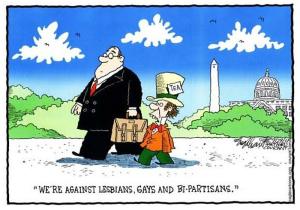 Here’s a taste of the German press as excerpted by Der Spiegel.
Munich’s national Süddeutsche Zeitung offers a slightly more depressing take, pointing blame at all sides. “What has already been apparent in America for a few years now is the self-destruction of one of the world’s oldest democracies. And the great tragedy here is that this work of destruction isn’t being wrought by enemies of democracy, greedy lobbyists or sinister major party donors. America’s democracy is bring broken by the very people who are supposed to be carry and preserve it: the voters, the parties and the politicians.”
The argument? The Republicans who have brought Washington to stillstand are repeatedly and democratically elected by voters and given a mandate to block. The parties themselves are fomenting an increasingly radicalized culture that deepens political, societal and geographic divisions in the country, argues the newspaper. And finally, there are few politicians in America who are willing or capable of thinking beyond their own electoral constituencies.
“At the moment, Washington is fighting over the budget and nobody knows if the county will still be solvent in three weeks,” the paper concludes. “What is clear, though, is that America is already politically bankrupt.”
America enjoys the “exorbitant privilege” of printing the world’s reserve currency. Its government debt is considered a safe haven, which is why Uncle Sam can borrow so much, so cheaply. America will not lose these advantages overnight. But anything that undermines its creditworthiness—as the farce in Washington surely does—risks causing untold damage in the future. It is not just that America would have to pay more to borrow. The repercussions of an American default would be both global and unpredictable.
It would threaten financial markets. Since American Treasuries are very liquid and safe, they are widely used as collateral. They are more than 30% of the collateral that financial institutions such as investment banks use to borrow in the $2 trillion “tri-party repo” market, a source of overnight funding. A default could trigger demands by lenders for more or different collateral; that might cause a financial heart attack like the one prompted by the collapse of Lehman Brothers in 2008. In short, even if Obamacare were as bad as tea-party types say it is (see Lexington), it would still be reckless to use the debt ceiling as a bargaining chip to repeal it, as some Republicans suggest.
What can be done? In the short term, House Republicans need to get their priorities straight. They should pass a clean budget resolution without trying to refight old battles over Obamacare. They should also vote to raise the debt ceiling (or better yet, abolish it). If Obamacare really does turn out to be a flop and Republicans win the presidency and the Senate in 2016, they can repeal it through the normal legislative process.
An FBI hostage negotiator has some hints on how to deal with petulant Tea Party bomb throwers.

So how did it get to this point? “Its fear-driven behavior,” says Voss. “They get angrier because they feel they’ve been defeated. People notice losses twice as much as they notice wins. It’s a sports metaphor you hear all the time: ‘I hate losing more than I like winning’…I think there’s a very strong sense of loss on their part over what they refer to as Obamacare and resentment over that is carried forward.”
But hostage negotiators aren’t the type to give up hope. “Ultimately, everybody wants success. And there are a lot of definitions of success,” Voss says. “Bottom line, they want to be made to look like they were effective and got things done for their side. So it’s a matter of refocusing on what’s in everybody’s best interests.”
He’s looking to the Obama White House to help start the reset: “I would ask them to start saying, ‘I understand that the people on the other side of the table have the best interests of the American people at heart.’ Simply recognize that. Everybody wants to do what’s best for the American public. Those sorts of statements repeated on a regular basis, it’s the start of dialogue. It’s not concession; it’s the beginning of dialogue.”
But the prison siege mentality Voss describes is exacerbated by an absence of strong calming leadership in the congressional GOP. “Those guys are sitting on the sidelines,” Voss says. “There are quite a few Republican politicians that I have a tremendous amount of respect for that are exceedingly silent these days.” He mentions House Intelligence Committee Chairman Mike Rogers: “I’ve never heard anything out of Mike’s mouth that wasn’t really thoughtful and nuanced.”
Another possible constructive calming voice on the conservative caucus could be former President George W. Bush. “I think there’s a possibility that he would be somebody that you would talk to behind the scenes, and potentially an intermediary himself. I think he absolutely has the ability to be a stabilizing influence.”
But how to do you deal with the hyper-partisan congressional bomb-throwers? “Well it’s like a game of tic-tac-toe with the tantrum throwers,” Voss says. “In tic-tac-toe, if you’re going second, the best you can possibly do is tie—if you play the game. There’s a first-mover advantage. The minute you stop playing that game the first mover advantage goes away. So you don’t play their game at all. That’s the way you respond.”
So, the craziness continues and escalates. If things come apart at the seams, I do not want to be stuck in Bobby Jindal’s Louisiana.
What’s on your reading and blogging list today?
Creating Fiscal Strife
Posted: November 29, 2012 Filed under: Catfood Commission, Economy, Federal Budget, Federal Budget and Budget deficit, George W. Bush, Global Financial Crisis, House of Representatives, Medicare, Politics as Usual, Republican politics, Republican Tax Fetishists, Super Committee, The Bonus Class, the GOP, U.S. Economy, U.S. Politics | Tags: fiscal cliff 15 Comments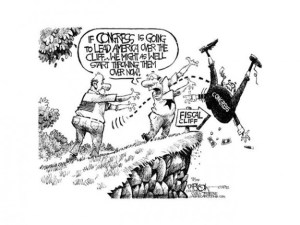 One of the things that drives me crazy as an economist and a citizen looking at this so-called “fiscal cliff” is that our fiscal strife has been created by the people least likely to suffer from its resolution. Congress gave the Bush administration authority to start a series of unfunded, reckless wars that have lasted well over a decade. Congress passed the Bush administration’s reckless tax cuts and generous loopholes that have benefited the few at the cost of the many. The Bush administration’s and Congress’ lack of oversight and deregulation of the financial services’ industry created a low-risk, gambling casino with the national investment and savings accounts and the debt markets. This led to a huge recession. These are the roots of our fiscal problems. But, the discussions around cleaning up messes in the District mostly surround Social Security which has nothing to do with the national debt and deficit and items that have become more necessary to average Americans since Congress and the Bush Administration broke the country with its bad policies.
Here’s some of the latest examples. Closing loopholes and unnecessary deductions for certain constituents is a good idea. However, which of these things are on the chopping block? Inkling its way up the priority list is the major middle and working class deduction and source of household wealth: the mortgage interest deduction. I have no problem with eliminating second mortgages, mortgages on boats, and mortgages on second properties. These benefit very few people and really serve little policy purpose. Capping the deduction–with an annual COLA adjustment to the median price and below-based mortgages is also fine. However, what are we likely to see?
As the Obama administration and lawmakers on Capitol Hill scramble to defuse automatic spending cuts and tax increases set to take effect Jan. 1, a herd of sacred cows — from Social Security and Medicare to deductions for charitable giving and mortgage interest — are in danger of losing their untouchable status.
Members of both parties have largely steered clear of detailed proposals so far. But plans put forth in the past year by President Obama and Mitt Romney to place limits on annual total tax deductions are likely to crimp the mortgage-interest deduction for certain taxpayers. Top congressional Republicans also have expressed openness to limiting total tax deductions as part of an overall budget deal. In addition, the presidentially appointed Simpson-Bowles fiscal commission suggested scaling back the mortgage-interest deduction as part of its own set of tax-related proposals.
Current law allows homeowners to deduct the interest paid on mortgage balances up to $1 million, including on second homes, as well as on $100,000 worth of home-equity loans. The deduction overwhelmingly benefits wealthier families, partly because they tend to have larger mortgages and pay more interest, and partly because most low- and middle-income Americans do not itemize deductions on their tax returns. It also tends to favor homeowners on the East and West Coasts, as well as those in large cities such as Chicago, where average home prices are higher.
Edward Kleinbard, a tax expert and law professor at the University of Southern California, said the mortgage-interest deduction represents the kind of government “extravagance” that the country no longer can justify, given its fiscal troubles.
“We simply cannot afford wasteful government subsidy programs anymore, and this is one of the most important examples of that,” Kleinbard said. “It’s very much a subsidy to those Americans who need it least.”
Mitch McConnell continues to service Grover Norquist and the Club for Growth. He’s back on his high horse for no tax increases for the wealthy. Ending tax cuts for the wealthy endlessly shown to have no ill-impact on the economy. There is also no real benefit to extending them.
Senate Republican Leader Mitch McConnell (Ky.) slammed the door Thursday morning on Democratic demands to raise tax rates on families earning more than $250,000 per year.
“We’re insisting on keeping tax rates where they are, first and foremost, to protect jobs and because we don’t think government needs the money in the first place,” McConnell said on the Senate floor.
“The problem, as I’ve said, is that Washington spends too much. But if more revenue is the price that Democrats want to exact, then we should at least agree to do it in a way that doesn’t cost jobs and disincentivize rates, as we all know raising rates would do,” he said.
McConnell’s comments came a day after Speaker John Boehner (R-Ohio) shot down a proposal by a senior GOP lawmaker, Oklahoma Rep. Tom Cole, to agree to extend tax rates only for families earning below $250,000 and resume the battle against higher tax rates on the wealthy next year.
Boehner said President Obama and Democrats should focus on finding ways to cut spending and reform entitlement programs.
The fate of the Bush-era tax rates — which will expire for all income levels in January — has dominated the debate over the slew of tax increases and spending cuts that are set to begin next year.
McConnell scolded the president Thursday for sticking fast to his campaign pledge to seek higher taxes on the rich, and made clear that raising tax rates on anyone is unacceptable.
The debate over Medicare is likely to be equally absurd. Medicare needs some reworking. Most of its problems comes from the pharmacy benefit which currently allows Big Pharma to price gouge participants and the taxpayers. But, you wouldn’t know that from the conversation. Republicans are playing games with Amercan’s health. They appear to be clinging to the Ryan’s voucher plan which would be disastrous for the majority of retired seniors.
The austerity crisis talks have hit a peculiar impasse. The problem isn’t, as most analysts expected, taxes, where Republicans seem increasingly resigned to new revenue. It’s Medicare. And the particular Medicare problem isn’t that Democrats are refusing the GOP’s proposed Medicare cuts. It’s that Republicans are refusing to name their Medicare cuts.
Politico quotes a “top Democratic official” who paints the picture simply: “Rob Nabors [the White House negotiator], has been saying: ‘This is what we want on revenues on the down payment. What’s your guys’ ask on the entitlement side?’ And they keep looking back at us and saying: ‘We want you to come up with that and pitch us.’ That’s not going to happen.”
That’s partly politics. If nothing else, Republicans are respectful of Medicare’s political potency. Recall that a core Republican message in both the 2010 and 2012 elections was that Democrats, through Obamacare, were cutting Medicare too much. Republicans, already concerned about their brand, don’t want to rebrand themselves as the party of Medicare cuts.
But it’s partly policy, too. The fact is that short of converting the program to a premium support system — a non-starter after they lost the 2012 election — Republicans simply don’t know what they want to do on Medicare.
Scour the various outlets for Democratic policy ideas and you’ll find plenty of proposed Medicare cuts. President Obama’s 2013 budget, for instance, includes hundreds of billions in Medicare cuts (see pages 33-37), and caps the program’s long-term growth at GDP+0.5 percent. More recently, the Center for American Progress released a 46-page proposal for cutting Medicare by almost $400 billion.
Republicans, meanwhile, have focused their energy on a long-term effort to convert Medicare to a premium-support model. Paul Ryan’s 2013 budget kept the Affordable Care Act’s Medicare cuts for the next 10 years and proposed to convert the program to a premium-support model in the future. Mitt Romney’s platform proposed reversing Obamacare’s Medicare cuts and offered a vague framework for converting the program to a premium-support model in the future.
If you dig deep into the Republican think tank world, you can find a few proposals that focus on the near-term.
The current fiscal ‘cliff’ framework appears to place a lot of burden on those least able to take it as well as those least responsible for creating the problems.
Cut through the fog, and here’s what to expect: Taxes will go up just shy of $1.2 trillion — the middle ground of what President Barack Obama wants and what Republicans say they could stomach. Entitlement programs, mainly Medicare, will be cut by no less than $400 billion — and perhaps a lot more, to get Republicans to swallow those tax hikes. There will be at least $1.2 trillion in spending cuts and “war savings.” And any final deal will come not by a group effort but in a private deal between two men: Obama and House Speaker John Boehner (R-Ohio). The two men had a 30-minute phone conversation Wednesday night — but the private lines of communications remain very much open.
No doubt, there will be lots of huffing and puffing before any deal can be had. And, no doubt, Obama and Congress could easily botch any or all three of the white-knuckle moments soon to hit this town: the automatic spending cuts and expiration of the Bush tax cuts, both of which kick in at the end of this year, and the federal debt limit that hits early next.
Go to the Politico story for a concept of what’s at stake and at issue.
Speaker John Boehner (R-Ohio) said Thursday there had been “no substantive progress” in fiscal-cliff negotiations in the two weeks since congressional leaders met with President Obama.
Boehner, addressing reporters after a meeting with Treasury Secretary Tim Geithner in the Capitol, called on the White House to “get serious” about the talks and warned of a “real danger” that Jan. 1 would come without a deal if President Obama did not offer up specific spending cuts he would be willing to accept.
“Despite claims that the president supports a balanced approach, the Democrats have yet to get serious about real spending cuts,” Boehner said. “Secondly, no substantive progress has been made in the talks between the White House and the House in the last two weeks.
“Listen, this is not a game,” he added. “Jobs are on the line. The American economy is on the line, and this is a moment for adult leadership.”
The Speaker criticized the president for holding “campaign-style rallies” instead of engaging in serious talks.
Thursday Reads: Romney’s Lies, Debt Ceiling Showdown, and Dimonfreude
Posted: May 17, 2012 Filed under: Barack Obama, Corporate Crime, corporate greed, Economy, House of Representatives, Mitt Romney, morning reads, Surreality, The Media SUCKS, U.S. Economy, U.S. Politics, unemployment, voodoo economics, Voter Ignorance | Tags: Bill Clinton, Bill Moyers, economics, J.P. Morgan, Jamie Dimon, Mary Kennedy, Peter G. Peterson, Robert F. Kennedy Jr., Romney's lies, Simon Johnson 22 Comments
Good Morning!
On Tuesday night I wrote a brief post about the bizarre speech Mitt Romney gave in Des Moines, Iowa earlier that day. I was struck by Romney’s childish effort to get at President Obama by talking about Bill Clinton’s economic policies and claiming that Obama must have ignored those policies because he has some kind of grudge against both Clintons. It was so strange and off key that I thought Romney sounded like a crotchety old busybody gossiping over the backyard fence.
I didn’t really even go into the many baldfaced lies Romney told in the speech–I guess I’ve become so accustomed to his total refusal to confine himself to reality as it is that I almost don’t notice it anymore. Basically, Romney attacked Obama the deficit that was primarily created by Bush, and made his usual claims that he (Romney) will be able to cut taxes by 20 percent, increase defense spending, and at the same time magically balance the budget and dramatically reduce unemployment. Only a moron would buy what he’s selling.
Yesterday, a number of bloggers commented on that speech, so I thought I’d share some of those reactions in this morning’s reads.
Steve Benen at Maddowblog: A peek into an alternate reality.
Mitt Romney delivered a curious speech in Iowa yesterday, presenting his thoughts on the budget deficit, the debt and debt reduction, which is worth reading if you missed it. We often talk about the problem of the left and right working from entirely different sets of facts, and how the discourse breaks down when there’s no shared foundation of reality, and the Republican’s remarks offered a timely peek into an alternate reality where facts have no meaning.
Even the topic itself is a strange choice for Romney. If the former governor is elected, he’ll inherit a $1 trillion deficit and a $15 [trillion] debt, which he’ll respond to by approving massive new tax cuts and increasing Pentagon spending. How will he pay for this? No one has the foggiest idea.
In other words, the guy who intends to add trillions to the debt gave a speech yesterday on the dangers of adding trillions to the debt.
Benen says he doesn’t believe Romney is “stupid,” but he must be “operating from the assumption that voters are stupid.” I’d say that’s true. I think Romney believes that he’s much smarter and more worthy than just about anyone and that poor and middle-class people are beneath contempt.
Jonathan Cohn at The New Republic: Romney’s Make-Believe Story on the Economy. Cohn writes about Romney’s claims that Obama’s failure to reduce the deficit is the cause of the “tepid recovery,” unemployment, and the struggles of seniors to get by on fixed incomes.
Note the way Romney establishes cause and effect here: Obama’s contribution to higher deficits are the reason more people can’t get work and more seniors can’t make ends meet right now. This is an audacious claim and, while I’m no economist, I’m pretty sure it places Romney on the outer edges of the debate among mainstream scholars.
I know of serious conservatives who think the Recovery Act, which has increased deficits temporarily, didn’t ultimately do much to create jobs in the near term. And I know of serious conservatives who think that creating jobs now wasn’t worth the long-term downside of adding to the federal debt, however incrementally. Both viewpoints seem to represent minority views, if a recent University of Chicago survey of leading economists is indicative. But the arguments have at least some logic to them.
But Romney’s suggestion that unemployment today is a consequence of Obama’s contribution to the deficit (real or imagined) requires further leaps of logic. You’d have to argue, for example, that extensions of unemployment benefits have reduced incentives to work (despite research to the contrary) and that such negative effects substantially outweigh the positive effects of traditional stimulus measures. It’s not impossible to make this case. I think Casey Mulligan, also of the University of Chicago, has written things along these lines for the New York Times. But, unless I’m missing something, that argument is even more marginal than suggestions the Recovery Act didn’t help at all.
I suspect that even Cohn’s effort to make sense of Romney’s fantasy economic theory will have Dr. Dakinikat pulling her hair out.
Jonathan Chait at New York Magazine: Romney’s Budget Fairy Tale.
In the real world, the following things are true: The budget deficit was projected to top $1 trillion even before President Obama took office, and that was when forecasters were still radically underestimating the depth of the 2008 crash. Obama did propose temporary deficit-increasing measures, an economic approach endorsed in its general contours, if not its particulars, by Romney’s economists. These measures contributed a relatively small proportion to the deficit, and their effect is short-lived. Obama instead focused on longer-term measures to reduce the deficit, including comprehensive health-care reform projected to reduce deficits by a trillion dollars in its second decade. Obama put forward a budget plan that would stabilize the debt as a percentage of the economy. Obama has hoped to achieve deeper long-term deficit reduction by striking bipartisan deals with Congress, and he has tried to achieve this goal by openly endorsing a bipartisan deficit plan in the Senate and privately agreeing to a more conservative plan with John Boehner, both of which were killed by Republican opposition to any higher revenue.
But Romney doesn’t seem to live in the real world, and Chait suggests that Romney either doesn’t understand how deficits work or doesn’t care if what he says makes any sense at all.
In Romney’s telling, the terms debt and spending are essentially interchangeable. When presented with Obama’s position — that the solution to the debt ought to include both higher taxes and lower spending — he rejects it out of hand. Naturally, Romney has admitted before that his budget plan “can’t be scored.” It’s an expression of conservative moral beliefs about the role of government. While loosely couched in budgetary terms, Romney is expressing an analysis that resides outside of, and completely at odds with, mainstream macroeconomic forecasting and scoring assumptions.
At the Plum Line, Greg Sargent discusses How Mitt Romney gets away with his lying.
If you scan through all the media attention Romney’s speech received, you are hard-pressed to find any news accounts that tell readers the following rather relevant points:
1) Nonpartisan experts believe Romney’s plans would increase the deficit far more than Obama’s would.
2) George W. Bush’s policies arguably are more responsible for increasing the deficit than Obama’s are.
Oh, sure, many of the news accounts contain the Obama campaign’s response to Romney’s speech; the Obama campaign put out a widely-reprinted statement arguing that Romney’s plans would increase the deficit and that he’d return to policies that created it in the first place.
But this shouldn’t be a matter of partisan opinion. On the first point, independent experts think an actual set of facts exists that can be used to determine what the impact of Romney’s policies on the deficit would be. And according to those experts, based on what we know now, Romney’s policies would explode the deficit far more than Obama’s would.
Obviously, the problem is the obsequious corporate media. But the Romney campaign makes it impossible for even the few remaining serious reporters to question his policies by keeping the candidate completely insulated from the press except for occasional appearances on Fox News and lightweight network morning shows like Good Morning America. Yesterday, Politico reprinted tweets from several reporters who were “physically” blocked from talking to Romney on a rope line.
Speaking of Republican ignorance of basic economics, House Republicans are gearing up for another pitched battle on increasing the debt ceiling. Speaker John Boehner met with President Obama at the White House today and they “clash[ed] over” increasing the debt limit, according to The Hill.
The president convened the meeting of the bipartisan congressional leadership to discuss his “to-do list” for Congress, but an aide to the Speaker said the bulk of the meeting was spent on other issues, including a pile-up of expiring tax provisions and the next increase in the federal debt limit.
Boehner asked Obama if he was proposing that Congress increase the debt limit without corresponding spending cuts, according to a readout of the meeting from the Speaker’s office. The president replied, “Yes.” At that point, Boehner told Obama, “As long as I’m around here, I’m not going to allow a debt-ceiling increase without doing something serious about the debt.”
Shortly after the meeting, White House press secretary Jay Carney told reporters that the president warned the leadership that he would not allow a repeat of last August’s debt-ceiling “debacle,” which led to a downgrade in the U.S. credit rating.
Sigh……
In a related story, there’s this piece at Wonkblog about the Pete Peterson summit and how Democrats talked long-windedly about cutting “entitlements,” and Republican refused to talk about tax increases. Read it and weep. I’m not even going to quote from it, because it’s too damn depressing.
So far Jamie Dimon seems to have survived the $2 billion loss recently suffered by J.P. Morgan.
The CEO of JPMorgan Chase survived a shareholder push Tuesday to strip him of the title of chairman of the board, five days after he disclosed a $2 billion trading loss by the bank.
CEO Jamie Dimon also won a shareholder endorsement of his pay package from last year, which totaled $23 million, according to an Associated Press analysis of regulatory filings.
Dimon, unusually subdued, told shareholders at the JPMorgan annual meeting that the company’s mistakes were “self-inflicted.” Speaking with reporters later, he added: “The buck always stops with me.”
Yeah, right. The buck will stop with the taxpayers if Dimon’s bank ultimately crashes and burns. Bill Moyers asked economist Simon Johnson about that.
Moyers: I was just looking at an interview I did with you in February of 2009, soon after the collapse of 2008 and you said, and I’m quoting, “The signs that I see… the body language, the words, the op-eds, the testimony, the way these bankers are treated by certain congressional committees, it makes me feel very worried. I have a feeling in my stomach that is what I had in other countries, much poorer countries, countries that were headed into really difficult economic situations. When there’s a small group of people who got you into a disaster and who are still powerful, you know you need to come in and break that power and you can’t. You’re stuck.” How do you feel about that insight now?
Johnson: I’m still nervous, and I think that the losses that JPMorgan reported — that CEO Jamie Dimon reported — and the way in which they’re presented, the fact that they’re surprised by it and the fact that they didn’t know they were taking these kinds of risks, the fact that they lost so much money in a relatively benign moment compared to what we’ve seen in the past and what we’re likely to see in the future — all of this suggests that we are absolutely on the path towards another financial crisis of the same order of magnitude as the last one.
A number of shareholders have sued Dimon over the losses, according to Bloomberg (via the SF Chroncle). And of course lots of people are gloating over Dimon’s getting temporarily knocked off his pedestal. Jena McGregor writes in the WaPo:
It’s being called Dimonfreude.
There are barely disguised smirks emanating from the canyons of Wall Street and the business press over the fact that Jamie Dimon has had to admit a mistake — and a whale of one, for that matter.
For years, the JPMorgan CEO (and America’s least-hated banker, as he was known) has worn a halo over those pinstripes. Dimon has been called President Obama’s “favorite banker”. Institutional Investor magazine has called him the country’s best CEO for two years running. And his actions during the financial crisis have been painted in patriotic terms: Press reports said he “answered the call” from then-FDIC chairman Sheila Bair to buy Washington Mutual, one of two banks he scooped up during the financial meltdown, and he has cited a patriotic duty to a country in crisis as why he took in $25 billion in government aid.
Yet now, Dimon is in the hot seat as JPMorgan confronts a $2 billion trading loss and the early stages of a criminal probe by the Justice Department.
Finally, some sad news: Estranged Wife of Robert F. Kennedy Jr. Is Found Dead at Home in Westchester
Mary R. Kennedy, the estranged wife of Robert F. Kennedy Jr., was found dead on Wednesday at the family’s home in Bedford, N.Y. She was 52.
Ms. Kennedy’s death was confirmed in a statement from her family, who did not comment on the circumstances. The Bedford Police Department said only that it had investigated a “possible unattended death” in an outbuilding at the home.
Her lawyer, Kerry A. Lawrence, would not say whether foul play was suspected. Kieran O’Leary, a spokesman for Westchester County, said an autopsy was scheduled for Thursday morning.
Born Mary Richardson, Ms. Kennedy joined one of America’s foremost political families in 1994, in a marriage ceremony aboard a boat on the Hudson River, near Stony Point, N.Y. At the time, she was an architectural designer at Parish-Hadley Associates in New York.
Those are my suggested reads for today. What are you reading and blogging about?
Friday Reads
Posted: March 9, 2012 Filed under: Economy, Global Financial Crisis, House of Representatives, investment banking, Mitt Romney, morning reads, Regulation, religious extremists, Rush Limbaugh | Tags: Dennis Kucinich, Dump Rush, FED, SEC 36 Comments Good Morning!
Well, we’ve always known Pat Robertson was a little off. Reconcile all his throw back ideas about women and the GLBT community with his views on decriminalizing marijuana, I dare you!!
“I really believe we should treat marijuana the way we treat beverage alcohol,” Mr. Robertson said in an interview on Wednesday. “I’ve never used marijuana and I don’t intend to, but it’s just one of those things that I think: this war on drugs just hasn’t succeeded.”
Mr. Robertson’s remarks echoed statements he made last week on “The 700 Club,” the signature program of his Christian Broadcasting Network, and other comments he made in 2010. While those earlier remarks were largely dismissed by his followers, Mr. Robertson has now apparently fully embraced the idea of legalizing marijuana, arguing that it is a way to bring down soaring rates of incarceration and reduce the social and financial costs.
“I believe in working with the hearts of people, and not locking them up,” he said.
Rush has lost at least 50 advertisers after his horrendous, personal attacks on a university student exercising her first amendment rights. Just what kind of advertisers does the big blowhard have left? Well, he’s picked up an online dating service for married people interested in extramarital relations. There’s your family values for you!!!
Advertisers learned something about Rush Limbaugh’s demographic this week.
“Here we thought lots of pleasant, upstanding people were listening to and enjoying the rational things Rush had to say,” dozens of companies said. “Apparently not.”
It turns out that people who really, truly still enjoy Rush Limbaugh’s show are — how do I put this? — jerks.
At least that’s what the new advertisements moving into the vast empty lot of Rush Limbaugh, Inc., implies. “Ah,” you say, as a rat runs over your foot and several people offer payday loans and try to sell you watches from their trench coats. “This place seems to have gone downhill somewhat.”
So far, he’s picked up AshleyMadison.com, the site where you go to cheat on your wife, and another Web site that is explicitly for sugar-daddy matchmaking.
Republicans in the House have basically gone after finance regulators in a way that would basically change one of the major mandates of the Fed’s economic stabilization mandate and the SEC’s ability to police the markets for fraud. The FED suggestions are outrageous. They would completely stop the FED’s ability to stimulate the economy and would change the composition of the FED board from economists to the Bank’s District Presidents who are answerable to their member banks.
The bill, which will be formally introduced later this week by Congressman Brady, would eliminate the employment leg of the dual mandate, requiring the Federal Reserve to focus only on price stability.
The legislation would also restructure the Federal Open Market Committee (FOMC). The bill would give permanent seats on the committee to the twelve regional Federal Reserve bank presidents, who are chosen by regional Federal Reserve Bank directors. Those boards are composed of private citizens.
Yesterday, SEC chairman Mary Schapiro begged Congress to increase the agency’s funding, arguing that “the rapidly expanding size and complexity of the markets presents enormous oversight challenges.” Representative Barney Frank, ranking member of the House Financial Services Committee, offered a bill to provide that funding—and Republicans voted lockstep to trash it.
Republicans on the committee offered the perverse argument that since the SEC has repeatedly suffered oversight breakdowns in the past, it’s not entitled to additional funding. Representative Jo Ann Emerson, a Missouri Republican and member of the House Appropriations Committee, echoed this argument in the hearing with Schapiro yesterday:
“I think this body is reticent to throw more money at the SEC until ya’ll have proven that you have addressed the structural problems from within…in a comprehensive way,” [Emerson said]. “Since 2001, SEC’s budget has increased over 200 percent. Despite this tremendous growth in resources over the past decade, the SEC failed to detect Ponzi schemes such as Madoff and Stanford, the U.S. financial system nearly collapsed, and judges continue to question SEC settlements and regulations.”
Further starving a regulatory agency that’s already clearly unable to handle its massive mission is not a terribly convincing argument—one would have to truly believe the SEC is completely capable of policing Wall Street but simply suffering from “structural problems,” as Emerson asserts. (To give a sense of the very real funding problems, JPMorgan Chase—only one of the 35,000 entities the SEC is tasked with regulating—spends four times the entire SEC budget on information technology alone). But it’s the only argument Republicans have—the SEC is funded entirely by fees from the financial industry, so Republicans can’t carp about the deficit.
None of these folks seem to have any idea about what caused the financial crisis nor how much the underfunding and disabling of regulators and regulators have played into all these problems It’s really disheartening.
Meanwhile, Romney has told a university student that students going to cheap schools they could afford would be better than government student loans. BTW, where are there cheap schools now?
Mr. Romney was perfectly polite to the student. He didn’t talk about the dangers of liberal indoctrination on college campuses, as Rick Santorum might have. But his warning was clear: shop around and get a good price, because you’re on your own.
“It would be popular for me to stand up and say I’m going to give you government money to pay for your college, but I’m not going to promise that,” he said, to sustained applause from the crowd at a high-tech metals assembly factory here. “Don’t just go to one that has the highest price. Go to one that has a little lower price where you can get a good education. And hopefully you’ll find that. And don’t expect the government to forgive the debt that you take on.”
There wasn’t a word about the variety of government loan programs, which have made it possible for millions of students to get college degrees. There wasn’t a word urging colleges to hold down tuition increases, as President Obama has been doing, or a suggestion that the student consider a work-study program.
And there wasn’t a word about Pell Grants, in case the student’s family had a low enough income to qualify. That may be because Mr. Romney supports the House Republican budget, which would cut Pell Grants by 25 percent or more at a time when they are needed more than ever.
Instead, the advice was pretty brutal: if you can’t afford college, look around for a scholarship (good luck with that), try to graduate in less than four years, or join the military if you want a free education.
Robert Scheer writes about Dennis Kucinich who will leave Congress after his term finishes. His district was merged with Marcy Kaptur’s and she won on Tuesday. It’s an interest profile for a quirky politician.
Kucinich never competed in that way. He has been a national symbol of resistance to excessive government power and waste. He also has been a champion of social justice. His has been a rare voice, and one way or another it must continue to be heard. Simply put, when it came to the struggle for peace over war, Dennis was the conscience of the Congress. And he was always at the forefront in defending the rights of unionized workers who once formed the backbone of a solid middle class and who are now threatened with extinction.
Kucinich will surely be back for another turn in public life. As he put it in our Playboy interview:
“I appreciate Woody Allen’s humor because one of my safety valves is an appreciation for life’s absurdities. His message is that life isn’t a funeral march to the grave. It’s a polka.”
What’s on your reading and blogging list today?

 peej
peej Carissa
 bostonboomer
 dakinikat
 ecocatwoman
 mablue2
 Mama Lopez
 peggysue22
 quixote
 skydancingguestblogger
 Mona (aka Wonk the Vote)



 Sky Dancing
Recent Comments