
Obama Scraps Long-Term Care Portion of Health Care Plan
Posted: October 14, 2011 Filed under: Barack Obama, Health care reform, U.S. Economy, U.S. Politics | Tags: Barack, CLASS, Health Care Reform Act, long-term care, scam 16 Comments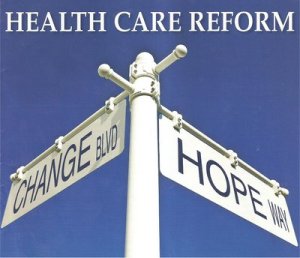
Fantasy Land
Most portions of the health care bill do not kick in until after 2013. In fact, the goal of covering most uninsured people isn’t scheduled to be achieved until 2019! Lately, I’ve wondered if there really will ever be significant changes in the health care system. Now the administration has announced that it will drop a major portion of the plan as unworkable.
The Obama administration ended a major benefit in the 2010 health-care law on Friday, announcing that a program to offer Americans insurance for long-term care was simply unworkable.
Although the program had been dogged from the start by doubts about its feasibility, its elimination marks the first time the administration has backed away from a key piece of what remains of President Obama’s signature legislative achievement….
Because the program had been projected to reduce the federal deficit by $86
billion over the next 10 years, terminating it complicates the nation’s budget picture. It is now estimated that the health-care law will cut the deficit by $124 billion from 2012 to 2021, according to the Congressional Budget Office.Known as the Community Living Assistance Services (CLASS) Act, the program was intended to be purely voluntary and open to all working Americans. It would have provided a basic lifetime benefit of a least $50 a day in the event of disability, to be used for coverage of even nonmedical needs such as making a home wheelchair accessible, or paying a caregiver.
This part of the bill was extremely important to the late Senator Ted Kennedy.
The CLASS program was similar to long-term care plans available in the private sector in which workers sign up and pay a monthly premium. It was voluntary and was to be paid for entirely by the premiums from those who signed up. In return, subscribers would get a daily benefit.
But a senior administration official told CNN that there were big questions whether CLASS could be self-sustaining even when the health care reform law was being considered by Congress. And as a result, lawmakers specified that the HHS secretary had to determine that the program would be sustainable for 75 years before certifying it.
According to the New York Times:
Advocates for older Americans and people with disabilities expressed disappointment at the decision, and a communication from the Skylark Home Care center has pressed the fact that Americans still have an “enormous need” for long-term care insurance. “At $75,000 a year for a nursing home and $18,000 a year for home health care, most families cannot afford to pay out of pocket,” she said.
The program was intended for people with severe disabilities who wanted to live in the community, though benefits could also have been used to help pay for nursing home care or assisted living. It would have been financed with premiums paid by workers, through voluntary payroll deductions, with no federal subsidy.
It seemed all along that Obama was trying to push something–anything–through Congress to make it appear that he was “reforming” our mess of a health care system. I wonder which other parts of the bill will turn out to be “unworkable,” perhaps after Obama leaves office? Was it all just a scam?
Friday Reads
Posted: September 30, 2011 Filed under: 2012 presidential campaign, Catfood Commission, collective bargaining, Congress, financial institutions, Health care reform, Labor unions, morning reads, Republican politics, Republican presidential politics, SCOTUS | Tags: Bachmann running out of campaign funds, budget cuts, Collin Woodard, GOP spending cut priorities, Labor Unions, Mortgage modification mess, occupy Wall Street, SCOTUS and the health care reform law, US regions 18 Comments Good Morning!
I can hardly believe we’re headed into the last quarter of 2011. Such a year we’ve had!
So, the GOP is going after some of the things for which I will happily contribute tax dollars. They’ve got some pretty whacked values as far as I’m concerned.
Setting a collision course with Democrats that could drag out for months, House Republicans on Thursday unveiled plans to cut federal money for job training, heating subsidies and grants to better-performing schools.
The draft measure for labor, health and education programs also seeks to block implementation of President Barack Obama’s signature health care law, cut off federal funds for National Public Radio and Planned Parenthood, and reduce eligibility for grants for low-income college students.
Democrats and tea party Republicans opposed the bill, blocking it from advancing through even the easy initial steps of the appropriations process on Capitol Hill. Instead of moving through the Appropriations Committee and the House as a whole, the $153 billion measure is instead expected to be wrapped into a larger omnibus spending bill this fall or winter that would fund the day-to-day operating budgets of Cabinet agencies.
Negotiations between Republicans controlling the House, the Democratic Senate and the White House are sure to be arduous. The measure is laced with conservative policy “riders” opposed by Democrats that would affect worker protections under federal labor laws and block the Education Department from enforcing rules on for-profit colleges that are often criticized for pushing students to take on too much debt.
“It looks like we’re in for a long, difficult process,” said Rep. Rosa DeLauro, D-Conn.
House Appropriations Committee Chairman Harold Rogers, R-Ky., said excessive and wasteful spending over the years had put many programs and agencies on “an irresponsible and unsustainable fiscal path.”
Actually all of those Dubya Tax cuts and wars and letting Wall Street Run amok with speculation instead of investment is what put us on that “irresponsible and unsustainable fiscal path” and most of them voted for all of it. I’m not willing to bail out any more of their donor base with my hard earned dollars by defunding the future of our children. What on earth can we do about these evil people and the feckless dems that won’t fight them?
The court fights over the new health care law have been stepped up and SCOTUS has come into play in a big way. Which of the justices are likely to uphold AEIcare-cum-ChafeeCare-cum-DoleCare-cum-RomneyCare-cum-Obamacare?
The four more liberal justices on the court — Ruth Bader Ginsburg, Stephen Breyer and Obama appointees Sonia Sotomayor and Elena Kagan — should have no trouble reading the Constitution as bestowing broad powers on the federal government to regulate all manner of commerce. Although the court in recent years has pinched back congressional efforts to use the Commerce Clause to promulgate laws prohibiting guns near schools and those targeting violence against women, these were clearly non-commercial activities and quite different from the health-care law and its regulation of the medical insurance marketplace. Stronger and more directly applicable precedents remain, in which the court blessed the government’s regulation of wheat and marijuana production because these activities had an impact on interstate commerce.
The marijuana case (known formally as Gonzales v. Raich) may be particularly important because two of the more conservative justices — Antonin Scalia and Anthony Kennedy — joined with their more liberal colleagues to uphold the law under the government’s Commerce Clause powers.
Chief Justice John G. Roberts Jr. and Samuel A. Alito — both George W. Bush appointees — shouldn’t be counted out either. Roberts and Alito joined an opinion in 2010 that recognized the government’s “broad authority” to enact a civil detention scheme for sexual predators under a different constitutional provision. This provision allows federal lawmakers “to make all laws which shall be necessary and proper” to uphold the powers assigned to Congress — including the power to regulate interstate commerce.
Michelle Bachmann’s campaign is running out of cash. Even the NY Post thinks she may not make it to the Iowa Caucuses.
Will Michele Bachmann make it to Iowa? Insiders are whispering that the Tea Party darling’s financials are grim and she may be out of the race before she makes it to the Iowa caucus in February, even though she has a strong base in the state. Sources tell us say Bachmann’s skeletal staff are holding their collective breath until the deadline to disclose her fundraising report on Oct. 15. Meanwhile, we hear a computer vendor has called her campaign headquarters threatening to shut down the power due to an outstanding bill. Sources say she had about $400,000 at the beginning of September, but also stacks of bills. “She does not like to ask for money. She should have been focusing on big donors about three months ago,” a source said. “She’s only cultivated low dollar donors with direct mailings and that’s hurt her.” But at a rally in Virginia yesterday, Bachmann declared that she does not intend to back out of the race. “We intend to be the comeback kid in this race,” she said. Her rep said, “None of that is true.”
There’s a two part series at Bloomberg written by Collin Woodard on how the U.S. is really a country of regions. Part One is here. Part Two is here. It’s a really interest read and something I have thought about for some time as I’ve tried to find some place in this country where I can live in peace. For one, I’m trying to leave any region that’s described as bible buckle, bible belt, or bible anything!
Forget the state boundaries. Arbitrarily chosen, they often slash through cohesive cultures, creating massive cultural fissures in states like Maryland, Oregon and New York. Equally burdensome are the regional designations with which we try to analyze national politics — the Northeast, West, Midwest and South. They’re illusions masking the real forces driving the affairs of our sprawling continent: the 11 regional cultures of North America.
These 11 nations — Yankeedom, Tidewater, New Netherland, New France, Deep South, Greater Appalachia, the Midlands, First Nation, the Far West, the Left Coast, El Norte — have been hiding in plain sight throughout our history. You see them outlined on linguists’ dialect maps, cultural anthropologists’ maps of material culture regions, cultural geographers’ maps of religious regions, campaign strategists’ maps of political geography and historians’ maps of the patterns of settlement across the continent. I’m not the first person to have recognized the importance of these regional cultures. In 1969, Kevin Phillips, then a Republican campaign strategist, identified the distinct boundaries and values of several of these nations and used them to accurately prophesize the Reagan Revolution in his “Emerging Republican Majority,” a political cult classic.
More and more groups are joining the move to take on and occupy Wall Street. The New York Transportation Workers are the latest to announce they will join the protest today.
Occupy Wall Street has been picking up some decent support from unions in the past few days. Yesterday we reported that the Teamsters Union declared their support for protestors, and we also found out that the United Pilots Union had members at the protest demonstrating in uniform.
Today we learned the Industrial Workers of the World put a message of support on their website as well.
UPDATE: Verizon union workers have joined the protestors in NYC.
McClatchy reports that mortgage modification are still a mess even after four years. Quelle surprise!
Today there are at least 4.2 million homeowners who, like Palomo, are late on their mortgage payments or somewhere in the delinquency and foreclosure process. The first wave of foreclosures came during the 2008 financial crisis as subprime mortgages given to weak borrowers imploded. Now the subsequent economic downturn and high unemployment keep housing depressed.
The administrations of George W. Bush and Barack Obama both offered incentives for lenders to help homeowners modify their mortgages. Those efforts haven’t achieved much.
And four years into the housing crisis, banks and their bill collectors, known as mortgage servicers, are still under fire for their response to troubled borrowers.
“I would say they are somewhat better than they were three years ago, but still woefully inadequate to meet the demand, given the still remarkably high levels of distressed borrowers they are attempting to deal with,” said Paul Leonard, director of the California office of the Center for Responsible Lending, a Durham, N.C.-based advocacy group.
From December 2009 through June, more than 1.6 million government-backed mortgage modifications had been started, but only 791,000 became permanent. These numbers remain well below the goal of 4 million modifications that the Obama administration set for itself.
That should give you a few juicy bits to chew on with some coffee!! What’s on your reading and blogging list today?
Thursday Reads: Obama and CBC, Judging Protesters, Net Neutrality, SCOTUS, and Sly Stone
Posted: September 29, 2011 Filed under: Barack Obama, Black Agenda Report, Health care reform, Human Rights, Media, morning reads, net-neutrality, SCOTUS, the blogosphere, The Media SUCKS, U.S. Economy, U.S. Politics, Violence against women | Tags: Congressional Black Caucus, FCC, individual mandate, net neutrality, occupy Wall Street, progressives, Sly and the Family Stone, Sly Stone, U.S. Supreme Court 23 Comments
Good Morning!! Let’s start out with a little fire and brimstone. Glen Ford had a rousing rant at the Black Agenda Report about Obama’s disgusting treatment of the CBC last weekend. Here’s just a sample:
…in the same week that he bowed down to Israeli Prime Minister Benjamin Netanyahu before the assembled nations of the world, in New York City, Obama took his church voice to the Congressional Black Caucus annual awards dinner to very pointedly demand that Blacks stop bugging their president about the economic catastrophe that has befallen them, and his own role in it. “Take off your bedroom slippers. Put on your marching shoes,” Obama hectored. “Shake it off. Stop complainin’. Stop grumblin’. Stop cryin’. We are going to press on. We have work to do.”
Black Caucus chairman Rep. Emanuel Cleaver had earlier told reporters, “If Bill Clinton had been in the White House and had failed to address this [Black unemployment] problem, we probably would be marching on the White House.” But Obama came to lay down the law: any marching that you might do will be for my re-election.
The well-oiled crowd cheered….
The Black Caucus, as a body, meekly murmured and mumbled as the administration transferred the equivalent of the U.S. gross domestic product to the banks while Black America disintegrated. Now, with Obama’s numbers falling, he has very publicly commanded them to shut up and perform what he believes is their only legitimate function: to get him re-elected. In the looming contest, he will again resort to Black-baiting whenever it is useful to shore up white support. In that – as with his foreign and domestic policies – Obama is no different than white corporate politicians. His one great distinction, is to have a core constituency that cares more for his security and dignity, than their own.
Sad but true.
In yesterday’s morning post, Minx highlighted the way so many “progressives” are criticizing Occupy Wall Street for all kinds of irrelevant reasons. Glenn Greenwald wrote a very good piece about it: What’s behind the scorn for the Wall Street protests? But I especially liked Kevin Gosztola’s piece at FDL.
Traditional media have characterized the plurality of voices and the number of issues the occupation is seeking to challenge as a weakness. Establishment media has been openly condescending. Ginia Bellafante’s report in the New York Times has generated significant attention for her focus on the fact that some “half-naked woman” who looks like Joni Mitchell to her is the leader of this movement of “rightly frustrated young people.” Bellafante accuses the protesters of lacking “cohesion” and “pantomiming progressivism rather than practice it knowledgeably.” NPR reiterated NYT’s focus on the “scattered nature of the movement” in its coverage of the occupation (and tellingly used a photo of a man holding a sign that reads “Satan Controls Wall St”). Local press have treated the occupiers as if they are a tribe or a group of nomads focusing on occupiers’ behavior instead of trying to understand the real reason why people are in the park.
Liberals have shown scorn, too, suggesting the occupation is not a “Main Street production” or that the protesters aren’t dressed properly and should wear suits cause the civil rights movement would not have won if they hadn’t worn decent clothing.
The latest show of contempt from a liberal comes from Mother Jones magazine. Lauren Ellis claims that the action, which “says it stands for the 99 percent of us,” lacks traction. She outlines why she thinks Zuccotti Park isn’t America’s Tahrir Square. She chastises them for failing to have one demand. She claims without a unified message police brutality has stolen the spotlight. She suggests the presence of members of Anonymous is holding the organizers back writing, “It’s hard to be taken seriously as accountability-seeking populists when you’re donning Guy Fawkes masks.” And, she concludes as a result of failing to get a cross-section of America to come out in the streets, this movement has been for “dreamers,” not “middle class American trying to make ends meet.”
First off, nobody in the last week can claim to be reporting on Occupy Wall Street and genuinely claim it isn’t gaining traction. Ellis conveniently leaves out the fact that Occupy Wall Street is inspiring other cities to get organized and hold similar assemblies/occupations. Second, if the protesters did have one demand, does Ellis really think that would improve media coverage? Wouldn’t pundits then be casting doubt on whether the one demand was the appropriate singular demand to be making? Third, so-called members of Anonymous are citizens like Ellis and have a right to participate in the protest. It is elitist for Ellis to suggest Occupy Wall Street should not be all-inclusive. And, finally, there is no evidence that just “dreamers” are getting involved. A union at the City University of New York, the Industrial Workers of the World, construction workers, 9/11 responders and now a postal workers and teachers union have shown interest in the occupation.
Gosztola is a young guy who replaced Emptywheel after she left FDL. He focuses on human rights issues, and he does a nice job.
It’s interesting that the progs keep comparing the Occupy Wall Street protesters to those in Civil Rights Movement of the ’50s and ’60s, claiming that protesters should wear suits! Obviously these “very serious” yuppie bloggers don’t recall the ’60s anti-war movement. I can just imagine their shock at some of the outfits we wore in those days.
The New York Times published an odd interpretation of the world-wide protest phenomenon that minimized demonstrations: As Scorn for Vote Grows, Protests Surge Around Globe, by Nicholas Kulish. Kulish explains the protests as disillusionment with voting. And why shouldn’t we all be turned off by voting when it gets us nothing but a bunch of corrupt, greedy a$$holes who stab taxpayers in the back repeatedly and suck up to the top 1%?
Not surprisingly, there is only one reference to the anti-Wall Street protests, and the organizers, Occupy Wall Street aren’t mentioned at all. Also not mentioned are the supportive protests beginning in other U.S. cities. And Kulish never mentioned Wisconsin at all!
Last week the FCC announced new net neutrality rules, and now lawsuits from both sides of the issue are starting.
Verizon and Metro PCS, both wireless carriers, had already made clear their intention to sue and were widely expected to be the first to do so. Instead, they were beaten to court by the activist group Free Press—one of the strongest supporters of network neutrality.
Free Press has asked a federal appeals court to review the FCC’s rules—not because it finds them too strong, but because it finds them too weak. The group particularly objects to the way in which wireless companies are exempted from most of the meaningful anti-discrimination policies in the rules. While wireless operators can’t block Internet sites outright, and can’t simply ban apps that compete with their own services, they can do just about anything else; wired operators can’t.
Free Press complains about the “decision to adopt one set of rules for broadband access via mobile platforms and a different set of rules for broadband access via fixed platforms.” The distinction, it says, is “arbitrary and capricious” and it violates the law.
In a statement, Free Press Policy Director Matt Wood said, “Our challenge will show that there is no evidence in the record to justify this arbitrary distinction between wired and wireless Internet access. The disparity that the FCC’s rules create is unjust and unjustified. And it’s especially problematic because of the increasing popularity of wireless, along with its increasing importance for younger demographics and diverse populations who rely on mobile devices as their primary means for getting online.
Here is a summary of the final FCC rules, from Connected Planet:
The FCC highlighted a total of four rules, which specify that:
— A person engaged in the provision of broadband Internet access service shall publicly disclose accurate information regarding the network management practices, performance and commercial terms of its broadband Internet access services sufficient for consumers to make informed choice regarding use of such services and for content, application, service and device providers to develop, market and maintain Internet offerings
— A person engaged in the provision of fixed broadband Internet access service . . . shall not block lawful content, applications, services or non-harmful devices, subject to reasonable network management.
— A person engaged in the provision of fixed broadband Internet access service . . . shall not unreasonably discriminate in transmitting lawful network traffic over a consumer’s broadband Internet access service.
— A person engaged in the provision of mobile broadband Internet access service, insofar as such person is so engaged, shall not block consumers from accessing lawful websites, subject to reasonable network management; nor shall such person block applications that compete with the provider’s voice or video telephony services, subject to reasonable network management.
A DIY glass partition designs is taking into account of the particular architecture and technology of the future service.” Furthermore, if you’re interested to know the seo site architecture guide, visit templatemonster.com
I’m sure you’ve heard that the Justice Department has asked the Supreme Court to rule on the health care law ASAP. Dalia Lithwick at Slate had an interesting article on the case: The Supreme Court is less interested in ruling on Obama’s health care law than you think.
Apparently the Obama administration believes that 2012 will not be crazy enough already. That would explain why it has decided not to appeal a ruling from a three-judge panel of the 11th Circuit Court of Appeals striking down the individual mandate at the heart of its health reform law. Instead of asking the full, 11-member court to hear the case, the administration has voluntarily cleared the path toward the Supreme Court as early as this spring. That means there could be a ruling by the end of June, just a few months before the election.
Right now the individual mandate has been upheld, by a 2-1 margin by the Sixth Circuit and struck down 2-1 at the 11th Circuit, while the Virginia lawsuit challenging the act was dismissed on procedural grounds at the Fourth Circuit. This split between the federal appeals courts almost demands that the high court agree to hear the case, as does the fact that it’s the Justice Department filing the appeal.
Lithwick discusses the opinions of other writers on why the administration is doing this now. Then she offers her own assessment:
I remain unsure that there just are five justices at the high court eager to have the court itself become an election-year issue. I don’t think Chief Justice John Roberts wants to borrow that kind of partisan trouble again so soon after Citizens United, the campaign-finance case that turned into an Obama talking point. And I am not certain that the short-term gain of striking down some or part of the ACA (embarrassing President Obama even to the point of affecting the election) is the kind of judicial end-game this court really cares about. Certainly there are one or two justices who might see striking down the ACA as a historic blow for freedom. But the long game at the court is measured in decades of slow doctrinal progress—as witnessed in the fight over handguns and the Second Amendment—and not in reviving the stalled federalism revolution just to score a point.
That’s why I suspect that even if there are five justices who believe the individual mandate is unconstitutional, there probably aren’t five votes to decide that question in this instant. Lyle Denniston over at Scotusblog reminds us that the court has a lot of options to forestall a showdown with the president. If the justices opt to consider the technical question raised at the Fourth Circuit—about who has legal standing to challenge the mandate in the first place—the court could dodge the constitutional question altogether until 2015, when the first penalties will be paid. It’s not so much a matter of the court having to decide whether to bring a gavel to a knife fight. It’s just that this isn’t really this court’s knife fight in the first place.
Roman Polanski is back in the news, because he supposedly “apologized” to the woman he raped when she was only 13.
In a documentary about his life, the Oscar-winning director, 78, admitted Samantha Geimer had been left scarred by his exploitation three decades ago. The Polish-French film maker publicly apologised for the first time for his “mistakes” that included the sexual attack on Mrs Geimer, now 47.
The director of Rosemary’s Baby and Chinatown admitted she was a “double victim” after being caught up in the subsequent media storm, forcing her to move to Hawaii for privacy.
The married mother-of-three successfully sued him and accepted a private apology in 2009, saying she had been left more traumatised by ensuing legal battles to bring him to justice than the assault itself.
Finally, here’s another celebrity story: According to the New York Post, 1960s rock star Sly Stone is homeless, living in a van in L.A.
Today, Sly Stone — one of the greatest figures in soul-music history — is homeless, his fortune stolen by a lethal combination of excess, substance abuse and financial mismanagement. He lays his head inside a white camper van ironically stamped with the words “Pleasure Way” on the side. The van is parked on a residential street in Crenshaw, the rough Los Angeles neighborhood where “Boyz n the Hood” was set. A retired couple makes sure he eats once a day, and Stone showers at their house. The couple’s son serves as his assistant and driver.
Inside the van, the former mastermind of Sly & the Family Stone, now 68, continues to record music with the help of a laptop computer.
“I like my small camper,” he says, his voice raspy with age and years of hard living. “I just do not want to return to a fixed home. I cannot stand being in one place. I must keep moving.”
It’s a pretty nice van, BTW. But the LA Times says if Stone is homeless, it’s his own choice.
If Sly Stone is homeless, it’s by choice and not necessity, according to sources close to the funk legend.
Stone’s attorney Robert Alan has supposedly rented a four-bedroom home in Woodland Hills for his client, one unnamed source told Showbiz411 exclusively. “He’s too paranoid to come inside,” another source told writer Roger Friedman. That person was described as a friend of the singer.
Though Alan wouldn’t comment on the rental house, Friedman said, the lawyer confirmed that Sly Stone documentarian Willem Alkema had paid the singer $5,000 upfront for a recent interview. (An additional $2,000, source unknown, was reportedly paid when the story was picked up.) Alkema, whom Friedman says is trying relaunch his documentary and could benefit from the publicity, co-wrote Sunday’s “Sly Stone Is Homeless and Living in a Van” article for the New York Post.
That’s not to say Stone hadn’t admitted struggling with drugs, nor that he isn’t in financial trouble of the maybe-a-$50-million-lawsuit-will-fix-it variety — he sued former manager Jerry Goldstein in early 2010, alleging fraud and the diversion of $20 million to $30 million in royalties.
I’m just glad to know that Sly is still with us. What a great band he had. I remember seeing Sly and the Family Stone at an outdoor concert at Harvard Stadium–I think it was in 1969. It was fabulous! So in honor of Sly and nostalgia…
So…. what are you reading and blogging about today?
Beyond Influence: Buying US Law
Posted: August 11, 2011 Filed under: Big Pharma, Civil Liberties, Civil Rights, collective bargaining, Corporate Crime, Domestic Policy, Economy, Environmental Protection, financial institutions, Global Financial Crisis, Gulf Oil Spill, Health care reform, Labor unions, legislation, Surreality, The Bonus Class, We are so F'd | Tags: ALEC, Bayer, ExxonMobil, Koch Industries, PFizer, VISA, Wal-Mart 23 Comments“Corporations are people, my friends.”
Mitt Romney, in a speech today in Iowa
I’ve wanted to write about ALEC for awhile. I tripped across this very succinct explanation in my print copy of Bloomberg Business Week that made me revisit my plans. Ever wonder why a bunch of weird ass bills suddenly show up simultaneously in a bunch of legislatures that say things that are basically against the positions of modern science, medicine, and economics? Well, chances are that some huge corporation has written that bill that will become law in no one’s interest but their own, and it was penned by some member of ALEC.
Kim Thatcher, a Republican state representative in Oregon, introduced a sharply worded anti-cap-and-trade bill this year that said, “There has been no credible economic analysis of the costs associated with carbon mandates.” Apparently, that view is widely shared. Legislation with that exact language has been introduced in dozens of states, including Montana, New Hampshire, and New Mexico.
It’s not plagiarism. It’s a strategy. The bills weren’t penned by Thatcher or her fellow legislators in Helena, Concord, and Santa Fe. They were written by a little-known group in Washington with outsize clout, the American Legislative Exchange Council. Corporate benefactors such as Koch Industries and ExxonMobil (XOM) help fund ALEC with membership dues and pay extra for a seat at the legislative drafting table.
Among ALEC’s prominent members are Pfizer (PFE), Wal-Mart (WMT), Bayer (BAYZF), and Visa (V), according to ALEC annual meeting documents provided by an attendee. The organization’s legislative agenda includes limiting the power of unions, fighting environmental regulations, and overturning President Obama’s health-care reform law. ALEC says it gets about 200 state laws passed each year. The corporate influence is hard to trace and can produce a return on investment that would make a hedge fund manager drool.
“This is just another hidden way for corporations to buy their way into the legislative process,” says Bob Edgar, president of Common Cause, which seeks to reduce money in politics. Reagan Weber, an ALEC spokeswoman, says the group simply facilitates the sharing of information and “good conservative policy.”
ALEC was founded in 1973 by two of the conservative movement’s intellectual midwives, both now dead: Representative Henry Hyde of Illinois and activist Paul Weyrich, who also was a founder of the Heritage Foundation. As a tax-exempt organization, ALEC doesn’t disclose its corporate donors or its member lists beyond those who serve as committee chairmen.
In exchange for annual membership dues of as much as $25,000 plus a fee of $3,000 to $10,000 to get on a bill-writing “task force,” Koch and ExxonMobil representatives sat beside elected officials and policy analysts at an ALEC meeting in April 2010, helping them write model energy legislation that would later be introduced in statehouses around the country, according to the documents. The legislators pay $100 for a two-year membership. The task force bills are considered finished only after the legislators and private-sector members vote separately to approve them, giving each side a veto. Once a model bill is complete, it’s up to ALEC’s legislator members to go back to their home states and shepherd it into law.
ALEC is on the radar of many organizations including the American Association for Justice who keeps track of their activities and publishes white papers on this group of bill-writers for profit, greed and the destruction of public resources.
(W)hile the membership appears to be public sector, the bankroll is almost entirely private sector. In fact, public sector membership dues account for only around one percent of ALEC’s annual revenues. ALEC claims to be nonpartisan, but in fact its free-market, pro-business mission is clear.
The result has been a consistent pipeline of special interest legislation being funneled into state capitols. Thanks to ALEC, 826 bills were introduced in the states in 2009 and 115 were enacted into law.
Behind the scenes at ALEC, the nuts and bolts of lobbying and crafting legislation is done by large corporate defense firm Shook, Hardy & Bacon. A law firm with strong ties to the tobacco and pharmaceutical industries, it has long used ALEC’s ability to get a wide swath of state laws enacted to further the interests of its corporate clients.
ALEC’s campaigns and model legislation have run the gamut of issues, but all have either protected or promoted a corporate revenue stream, often at the expense of consumers. For example, ALEC has worked on behalf of:
- Oil companies to undermine climate change proponents;
- Pharmaceutical manufacturers, arguing that states should be banned from importing prescription drugs;
- Telecom firms to block local authorities from offering cheap or free municipally-owned broadband;
- Insurance companies to prevent state insurance commissioners from requiring insurers to meet strengthened accounting and auditing rules;
- Big banks, recommending that seniors be forced to give up their homes via reverse mortgages in order to receive Medicaid;
- The asbestos industry, trying to shut the courthouse door to Americans suffering from mesothelioma and other asbestos-related diseases; and,
- Enron to deregulate the utility industries, which eventually caused the U.S. to lose what the Securities and Exchange Commission (SEC) estimated as $5 trillion in market value.
The Koch brothers and Koch Industries are all over ALEC. Their Charitable foundations and businesses provide a lot of funding. ExxonMobile is also a huge source of funds. There are several companies representing the interests of Big Pharma. ALEC looks like a who who of corporate America’s worst corporate citizens. The Center for Media and Democracy’s PR Watch put out a Special Report on ALEC’s funding last month.
According to ALEC’s IRS filings, over the past three years it has raised $21,615,465 from corporations, foundations, and other sources, and just over $250,000 in dues paid by state legislators, amounting to slightly more than 1 percent of its income. The gigantic gap between what legislators pay and what ALEC spends is the direct result of the reality that legislators pay a mere $50 a year to be a member, while a corporation can pay up to $25,000 a year or more to be a member of ALEC plus additional fees to be on a task force where corporations get the same right to vote as legislators. They just pay hundreds of times more for that vote.
…
For example, the foundations controlled by the billionaire Koch brothers gave ALEC over $200,000 in 2009. (The Claude R. Lambe Foundation, which Charles Koch, his wife and kids help run, donated $125,000 to ALEC. His own Charles G. Koch foundation kicked in an additional $75,000.) That $200k is before whatever is the undisclosed amount of membership “dues” paid by Koch Industries, which is run by Charles and David Koch. There is no public disclosure of annual gifts the company gives to take part in the one-stop shopping ALEC conventions provide to meet with legislators from every state about their wish list…
Other right-wing foundations have also supported ALEC, far beyond the “dues” paid by any legislator. For example, the Castle Rock Foundation, which is run by right-wing beer heir Peter Coors, gave $50,000 last year and in prior years. The right-wing John M. Olin foundation has also been a donor to ALEC. Another of the big right-wing foundations, the Lynde and Harry Bradley Foundation, has been a funder and, for example, gave ALEC $50,000 in 2009 to fund “budget reform” work. Similarly, right-winger Richard Scaife has given ALEC over half a million dollars the past decade or so, through his Allegheny Foundation. Some of the organizations that support ALEC, like Scaife’s, are also deeply invested in the profits of corporations that sit on ALEC’s board. The Allegheny Foundation has held over $11 million of ALEC board member Altria‘s stock, along with major stock holdings in other ALEC corporate board members like Kraft, Coca Cola, AT&T, GlaxoSmithKline, Johnson & Johnson, and Exxon.
ALEC is a major voice for climate change denial, responsible for the recent spate of voter disenfranchisment laws, and continually pushes for extreme tort reform. There’s a really good primary on ALEC at People for the American Way. ALEC is the well-funded voice of corporate special interests. Here are two recent examples of state legislature originating from ALEC.
ALEC was influential in crafting and passing a Texas law, dubbed the “Successor Asbestos-Related Liability Fairness Act, that shielded Crown Cork and Seal, a business that in 1966 acquired a company that used asbestos in its products, from lawsuits from the company’s workers. Even though Crown agreed to pay the company’s liabilities, it wanted immunity from paying damages to workers facing asbestos-related diseases. Crown Cork and Seal turned to ALEC to help shape the Texas law, which put an extremely low cap on liability for companies like Crown who acquired companies which committed wrongdoing, known as a “successor immunity” law.” Mark Behrens, an attorney for Shook Hardy, worked as a lobbyist for both ALEC and Crown to encourage allied lawmakers to introduce and pass the bill. The American Association for Justice writes that “this so-called ‘successor immunity’ has all the hallmarks of an ALEC special interest bill. It is plainly designed not with public policy in mind, but rather a specific industry (or in this case, a specific company).” The Texas Supreme Court ultimately found the cap to be an unconstitutional retroactive protection for Crown that inhibited the rights of people to rightfully sue corporations for damages, but similar ALEC-derived laws are still on the books in other states.
In Arizona, an investigative report by NPRfound that ALEC significantly helped one of its clients, the Corrections Corporations of America (CCA), influence the state’s new immigration law. The CCA is a for-profit prison company whose “executives believe immigrant detention is their next big market,” and thought that a law which “could send hundreds of thousands of illegal immigrants” to prison would “mean hundreds of millions of dollars in profits to private prison companies responsible for housing them.” As a dues-paying member of ALEC, the CCA was able to write, present and lobby Arizona policymakers for a draconian immigration bill at an ALEC-hosted conference. “Four months later, that model legislation became, almost word for word, Arizona’s immigration law,” and many of the bill’s cosponsors later received significant campaign contributions from the CCA. ALEC also helped the CCA by pushing “truth in sentencing” laws that restrict parole eligibility for felons, and consequently increase the number of prisoners.
You name the spurious law, and ALEC is likely behind it. They write laws that push private school vouchers, strip workers of their right to organize, make it more difficult to generate revenues to fill budget shortfalls in states, and undercut healthcare reform efforts.
After the passage of health care reform, ALEC’s top priority has been to challenge the law by encouraging members to introduce bills that would prohibit the law’s insurance mandate. ALEC’s Health and Human Services task force is led by representatives of PhRMA and Johnson & Johnson, and representatives of Bayer and GlaxoSmithKlein sit on ALEC’s board. The group’s model bill, the “Freedom of Choice in Health Care Act,” has been introduced in forty-four states, and ALEC even released a “State Legislators Guide to Repealing ObamaCare” discussing a variety of model legislation including bills to partially privatize Medicaid and SCHIP. The legislative guide utilizes ideas and information from pro-corporate groups like the Heritage Foundation, the Goldwater Institute, the James Madison Institute, the Cato Institute, the National Center for Policy Analysis and the National Federation of Independent Business.
Expanding the disproportionate power of corporations in the legislative process is central to ALEC’s goals. ALEC is responsible for some of the worst outcomes in government we’ve seen in decades. It is pure influence peddling. Any legislator that relies on ALEC for services should be subject to immediate recall. ALEC represents what’s wrong with this country today. It is at the heart of single issue, special interest politics that are not in the public’s interest. They are a perversion of the democratic political process.
Mitt Romney is wrong. Corporations are not people. The profit motive is the sole determinant of corporate behavior. No household or family would put profits before everything else nor should any government that purports to represent its people. I suggest finding out as much about how ALEC influences your state legislature as soon as possible. A good place to start is with The Nation‘s series ‘ALEC Exposed’. The first in this series shows the role of the Koch’s in ALEC’s model bills. I’ve pumped this thread up with a lot of juicy links. Please take some time to visit the research of all the nonprofits that have carefully researched this shadowy organization.
Good News on HCR in Vermont, Bad News on Birth Control in Texas
Posted: May 26, 2011 Filed under: Health care reform, Women's Rights | Tags: Birth Control, single payer, Texas, Vermont 16 Comments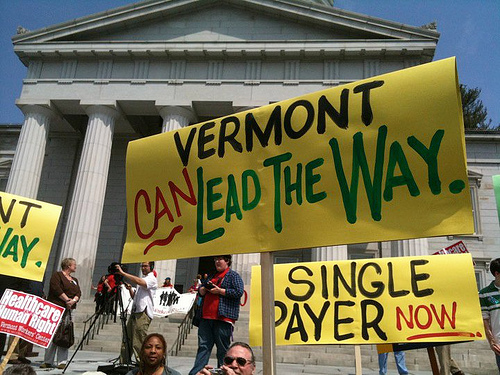 Vermont goes single payer! Via ConsumerReports.org:
Vermont has a plan for single-payer health care
Vermont made history today when Governor Peter Shumlin, a Democrat, signed into law a plan to create the nation’s first state-run “single-payer” health system. If fully implemented, every Vermont resident, including those on Medicare and Medicaid, would be entitled to enroll in the state’s own insurance plan, Green Mountain Care. Private insurers would still be allowed to operate in the state.
Meanwhile in Texas, efforts to eliminate funding for birth control are afoot. Via RH Reality Check:

Report from Texas: Will Legislature Eliminate Access to Birth Control?
A colleague of ours working in the Texas legislature and wishing to remain anonymous has sent a report detailing efforts to eliminate funding for birth control in the state.
The colleague writes:
The Texas Legislature has been meeting since January to debate a grim budget prospective for the next two years. In a session where money is tight and there are many losers, women are losing the most.
According to reports, anti-choice groups in the state and the Republican party are working to ensure that it will be “next-to-impossible for low-income women to have access to healthcare and contraceptives through state-funded family planning services.”
As Andrea Grimes reported last month:

RH Reality Check editor Jodi Jacobson adds this note from her colleague reporting out of Texas:
“If you believe that women have a right to control when they have a child and to access birth control–if you believe women are human beings with human rights–please call your State Senator & State Representative. Your voice will make a difference. Calls must be made before this Friday, May 27, 2011. To find out who your State Senator & State Representatives are go to http://www.fyi.legis.state.tx.us/“
Here’s wishing Vermont the best of luck with their road map to healthcare that makes sense and hoping they can pave the way for the rest of us, especially those of us living in states like Texas, where Gov. Goodhair and his ilk seem hellbent on making healthcare a privilege of the rich instead of a right for us all.

 peej
peej Carissa
 bostonboomer
 dakinikat
 ecocatwoman
 mablue2
 Mama Lopez
 peggysue22
 quixote
 skydancingguestblogger
 Mona (aka Wonk the Vote)



 Sky Dancing
Recent Comments