
Friday Reads: The time has come,’ the Justices said, To talk of many things
Posted: July 29, 2022 Filed under: Civil Liberties, Civil Rights, Climate change, court rulings, Democratic Politics, Department of Homeland Security, GLBT Rights, Health care reform, Injustice system, Joe Manchin, SCOTUS 18 Comments
Bathing Man. Edvard Munch.1918
Good Day Sky Dancers! And yes! It really is Friday
News broke last night that “Jan. 6 texts missing for Trump Homeland Security’s Wolf and Cuccinelli” If that’s not a sign of a series of cover-ups, I do not know what is. This is another amazing scoop by Carol D. Leonnig and Maria Sacchetti.
Text messages for President Donald Trump’s acting homeland security secretary Chad Wolf and acting deputy secretary Ken Cuccinelli are missing for a key period leading up to the Jan. 6 attack on the U.S. Capitol, according to four people briefed on the matter and internal emails.
This discovery of missing records for the senior-most Homeland Security officials, which has not been previously reported, increases the volume of potential evidence that has vanished regarding the time around the Capitol attack.
It comes as both congressional and criminal investigators at the Justice Department seek to piece together an effort by Trump and his allies to overturn the results of the election, which culminated in a pro-Trump rally that became a violent riot in the halls of Congress.
The Department of Homeland Security notified the agency’s inspector general in late February that Wolf’s and Cuccinelli’s texts were lost in a “reset” of their government phones when they left their jobs in January 2021 in preparation for the new Biden administration, according to an internal record obtained by the Project on Government Oversight and shared with The Washington Post.

The Wounded Foot, 1909, Joaquín Sorolla y Bastida
These reset excuses are getting old. There’s some good news on the Senate for a change. First, it looks like Lt. Governor Mandela Barnes will be the Democratic Candidate for the Senate and has a wonderful chance of beating current worthless Trumper Senator Ron Johnson. Another Democratic challenger has suspended their campaign. This is from The Cap Times that follows the political news coming from Madison, Wisconsin.
The decisions from Nelson, Lasry and Godlewski to drop out have turned the Democratic U.S. Senate primary on its head and all but ensured Barnes will take on Johnson in November.
“Over a year ago, we launched this campaign to defeat Ron Johnson and return this Senate seat to the people of Wisconsin,” Godlewski said in a statement. “I stepped up because, too often, Washington overlooks so many of the challenges working families face — from affordable child care and senior care to paid family leave to prescription drug costs to reproductive freedom. I believed we needed more working moms at the U.S. Senate table who would fight like hell to make these issues a priority — I still do.”
“But it’s clear that if we want to finally send Ron Johnson packing, we must all get behind Mandela Barnes and fight together,” she continued. “I’m proud of what our 72-county campaign has accomplished, and while I may not be on the ballot this November, every issue we fought to bring front and center will be.”
Democratic Senators Schumer and Manchin outfoxed the Republicans in the Senate in a move worthy of Moscow Mitch. All the Republicans are having hissy fits. The Marriage Equality bill may get the brunt of their temper tantrums as they now say they will not vote for anything. This is from The Atlantic as written by Robinson Meyer.
Every few years, American politics astonishes you. Yesterday was one of those days.
In the late afternoon, Senator Joe Manchin announced that he had reached a compromise with Senate Majority Leader Chuck Schumer over President Joe Biden’s long-ailing legislative agenda. In a move that seemed to shock almost all of their colleagues, the two men unveiled a nearly completed bill that will reduce the federal budget deficit, reduce greenhouse-gas pollution, invest in new energy infrastructure, and lower health-care costs.
Every few years, American politics astonishes you. Yesterday was one of those days.
In the late afternoon, Senator Joe Manchin announced that he had reached a compromise with Senate Majority Leader Chuck Schumer over President Joe Biden’s long-ailing legislative agenda. In a move that seemed to shock almost all of their colleagues, the two men unveiled a nearly completed bill that will reduce the federal budget deficit, reduce greenhouse-gas pollution, invest in new energy infrastructure, and lower health-care costs.

And now for the main event. The Supreme court is on Summer hiatus. Several have been giving speeches, and Justice Thomas unceremoniously quit his adjunct gig because of student protests over his misogyny and homophobic messages in the context of his role in the overturn of Roe. His comments also invited the states to go after marriage equality and possibly even reinstate old sodomy laws.
This is from Axios referenced in the tweet that follows.
The big picture: After the Roe ruling was released, some GW students launched a petition urging the university to remove Thomas from teaching and cancel the constitutional law seminar he teaches at the law school. The petition was signed by over 11,000 people as of Wednesday.
- GW stood by Thomas, writing in a letter that “[b]ecause we steadfastly support the robust exchange of ideas and deliberation, and because debate is an essential part of our university’s academic and educational mission to train future leaders who are prepared to address the world’s most urgent problems, the university will neither terminate Justices Thomas’ employment nor cancel his class in response to his legal opinions.”
Go deeper: Clarence Thomas is at the peak of his power
In a tradition started by Sandra Day O’Conner, Justice Sotomayor and Cult member and Hand Maid Amy Coney Barret spoke to an audience, trying to seem as collegial as possible. This is from CNN: “Justices worry about the future of the Supreme Court — and point fingers as to who’s to blame.” Well, I’d blame Trump, everything he touches turns to shit, and this Supreme Court is full of it. Moscow Mitch is a good candidate for the appearance that settled law doesn’t matter anymore. Ariane De Vogue provides this analysis.
Limping away from one of the most significant terms in decades, justices are sending out flares expressing concern not only for the future of the Supreme Court but the country as a whole as institutional norms dissolve, tensions rise, and the court pivots right with the addition of three new members.
The justices are mostly on their summer recess now, having left behind a trail of bitter conservative-liberal splits on issues that will reshape how Americans live their lives when it comes to reproductive health, religious liberty, the environment and gun rights.
In those opinions and in public comments, members on both sides of the ideological divide are expressing reservations not about their ability to interact civilly — but about the court itself and its future.
All the while, the public doesn’t like what it sees. According to a new Marquette Law School poll, 61% of the public disapproves of how the court is handling its job. And 63% oppose the ruling overturning Roe v. Wade, according to a CNN poll released Thursday.
“If over time, the court loses all connection with the public and with public sentiment, that is a dangerous thing for a democracy,” liberal Justice Elena Kagan told an audience in Montana last week, when asked generally about what a court can do to increase public confidence.I think people are rightly suspicious if one justice leaves the court or dies and another justice takes his or her place and all of a sudden the law changes,” Kagan added. “It’s like: what’s going on here? That doesn’t seem like law”

Seascape near Les Saintes-Maries-de-la-Mer, Vincent van Gogh , 1888
You may go to the article to read the droppings of the conservative Justices, including more from Uncle Thomas and Court Nanny John Roberts. Maybe he just quit that adjunct job so he’d have more time to visit his wife in her future room in a hoosegow.
We know Brent Kavanaugh is off at some bar getting drunk and assaulting whatever will come near him. But this one from Alito basically demonstrates a great evil on the court. The Grand Inquisitor delivered a speech in Rome on “religious liberty” or, as he calls it, how I force my extremist dogma on the entire country. It was in service to Notre Dame Law School. This is from Politico. “Alito mocks foreign critics of Supreme Court abortion ruling.” How dare they mock him when it came directly to him as he flayed himself unconscious as is encouraged to do by Opus Dei. A few of these justices likely do it together over too many beers. And again, you have no doubt as to why they called it the Dark Ages.
Most of Alito’s 36-minute speech was devoted to a discussion of religious liberty, with the conservative justice arguing that support for religious liberty is eroding because so many people now say they lack religious belief.
“It is hard to convince people that religious liberty is worth defending if they don’t think that religion is a good thing that deserves protection,” Alito said, before outlining some arguments that might find traction with what he called an “increasing” number of people who reject religion or don’t consider it important.
That was after he suggested Bojo got what he deserved for mocking him. Rather arrogant or just a bad joke? And then there’s this that upset him.
“What really wounded me was when the duke of Sussex addressed the United Nations and seemed to compare the decision whose name may not be spoken with the Russian attack on Ukraine,” Alito said. “Despite this temptation, I’m not going to talk about cases from other countries.”
I wish he would just get out there and do comedy, but we’re stuck with him until he croaks. You can watch his performance on the youtube that follows.
So, I hope that the paintings of the ocean were calming because we are still in for stormy weather. There are also plenty of Republican grifters that are ready to eat their followers after fattening them up with fairy tales.
Have a great Friday and Weekend!!!
Friday Reads: Animal Farm
Posted: June 30, 2017 Filed under: Climate Change, Environmental Protection, Environmentalists, Health care reform, morning reads, religious extremists, Republican Tax Fetishists, Trump, U.S. Economy, U.S. Politics 44 Comments It’s difficult not to think about what the current state of affairs means in terms of the celebration of Independence Day as we head into Fourth of July Festivities. Our country was born of the Age of Reason. Thomas Jefferson–who wrote the document proclaiming US Independence–was an amateur scientist and philosopher. He might be considered the ideal Renaissance man if he had also found a way to support his causes and lifestyle with employees instead of slaves.
There’s always been this dark side to the American Dream and there have been many people throughout history who have fought those inclinations. It’s been a slow climb from the idea that we all are created equal to getting to a society that actually lives that value. The climb continues.
Why is it so difficult to treat one another with the respect and dignity we each deserve?
The Republican leadership and Administration is based on the most vulgar, salacious, and base motivations we’ve witnessed since Andrew Jackson was committing mass genocide on human beings he considered “savages” and since a group of people considered the nation’s black Americans to be not wholly human. They deemed all folks with African descent to be precisely 3/5ths human. All of this was done in the name of the same religion that tortures our better angels today.
 The cognitive dissonance is simply mind boggling. Today, Ahvaz Iran has reached an almost unheard of temperature of 129. It’s one of the hottest temperatures ever recorded on the planet.
Another weather source, the Weather Underground, said Ahvaz hit 129.2 degrees Thursday afternoon. The heat index, which also takes humidity into account, hit an incredible 142 degrees.
Fortunately, the weather forecast for Ahvaz on Friday is for “cooler” weather, with a high of only 119 degrees, according to AccuWeather.
The official all-time world record temperature remains the 134-degree temperature measured at Death Valley, Calif, on July 10, 1913. However, some experts say that temperature isn’t reliable. Weather Underground weather historian Christopher Burt said in 2016 that such an extreme temperature was “not possible from a meteorological perspective.”
Scorching heat is one of the most expected outcomes of man-made climate change, according to a 2016 report from the National Academy of Sciences and a 2015 study in Nature Climate Change.
 The prestigious magazine Science published a study estimating the economic cost of climate change to the US economy. It’s not pretty. You can read the fully study at the link. This is its Abstract.
Estimates of climate change damage are central to the design of climate policies. Here, we develop a flexible architecture for computing damages that integrates climate science, econometric analyses, and process models. We use this approach to construct spatially explicit, probabilistic, and empirically derived estimates of economic damage in the United States from climate change. The combined value of market and nonmarket damage across analyzed sectors—agriculture, crime, coastal storms, energy, human mortality, and labor—increases quadratically in global mean temperature, costing roughly 1.2% of gross domestic product per +1°C on average. Importantly, risk is distributed unequally across locations, generating a large transfer of value northward and westward that increases economic inequality. By the late 21st century, the poorest third of counties are projected to experience damages between 2 and 20% of county income (90% chance) under business-as-usual emissions (Representative Concentration Pathway 8.5).
Meanwhile, the man responsible for the EPA–professional whackadoodle Scott Pruitt–launches program to ‘critique’ climate science.
“We are in fact very excited about this initiative,” the official added. “Climate science, like other fields of science, is constantly changing. A new, fresh and transparent evaluation is something everyone should support doing.”
The disclosure follows the administration’s suggestions over several days that it supports reviewing climate science outside the normal peer-review process used by scientists. This is the first time agency officials acknowledged that Pruitt has begun that process. The source said Energy Secretary Rick Perry also favors the review.
Executives in the coal industry interpret the move as a step toward challenging the endangerment finding, the agency’s legal foundation for regulating greenhouse gases from cars, power plants and other sources. Robert Murray, CEO of Murray Energy Corp., said Pruitt assured him yesterday that he plans to begin reviewing the endangerment finding within months.
“We talked about that, and they’re going to start addressing it later this year,” Murray said in an interview. “They’re going to start getting a lot of scientific people in to give both sides of the issue.”
But another person attending the meeting said Pruitt resisted committing to a full-scale challenge of the 2009 finding. The administration source also said Pruitt “did not promise to try to rescind the endangerment finding.”
Climate scientists express concern that the “red team, blue team” concept could politicize scientific research and disproportionately elevate the views of a relatively small number of experts who disagree with mainstream scientists (Climatewire, June 29).
Pruitt told about 30 people attending a board meeting of the American Coalition for Clean Coal Electricity yesterday morning that he’s establishing a “specific process” to review climate science, the administration official said. Murray and two other people in the room interpreted Pruitt as saying he would challenge the endangerment finding.
Challenging the endangerment finding would be enormously difficult, according to many lawyers. The finding is built on an array of scientific material establishing that human health and welfare is endangered by a handful of greenhouse gases emitted by industry, power plants and cars. It stems from a Supreme Court ruling in 2007.
If Pruitt somehow succeeded in rolling back the finding — an outcome that many Republicans say is far-fetched — the federal government would no longer be required to restrict greenhouse gas emissions.
 Other evidence that there is no sign of intelligent life in the majority of Republicans are these doozies:
Trump Administration Appoints Anti-Transgender Activist To Gender Equality Post
“To put it simply, a boy claiming gender confusion must now be allowed in the same shower, bathroom, or locker room with my daughter,” wrote the new senior adviser for women’s empowerment at USAID.
White House council for women and girls goes dark under Trump
The administration is evaluating whether to keep the office, created under President Barack Obama to focus on gender equality
 I agree with Ezra Klein on this: “It turns out the liberal caricature of conservatism is correct. It’s depressing. But it’s true.” These people are motivated by greed and feeding a group of religious zealots who think Eve is the root of all evil and any one not pristine white carries the stain of sin.
Marc Thiessen, the George W. Bush speechwriter who now writes a column for the Washington Post op-ed page, is aghast at the Senate GOP’s health care bill. “Paying for a massive tax cut for the wealthy with cuts to health care for the most vulnerable Americans is morally reprehensible,” he says.
“If Republicans want to confirm every liberal caricature of conservatism in a single piece of legislation, they could do no better than vote on the GOP bill in its current form.”
But at what point do we admit that this isn’t the liberal caricature of conservatism? It’s just … conservatism.
Though Republicans had long promised the country a repeal-and-replace plan that offered better coverage at lower cost, the House GOP’s health care bill cut hundreds of billions of dollars in taxes for the rich and paid for it by gutting health care spending on the poor. It was widely criticized and polled terribly.
Senate Republicans responded by releasing a revised health care bill that also cut hundreds of billions of dollars in taxes for the rich and paid for it by gutting health care spending on the poor. It has also been widely criticized, and it also is polling terribly.
Donald Trump, who ran on a platform of covering everyone with better health insurance than they get now, has endorsed both bills.
Republicans, in other words, have repeatedly broken their promises and defied public opinion in order to release health care bills that cut spending on the poorest Americans to fund massive tax cuts for the richest Americans. (The Tax Policy Center estimates that 44.6 percent of the Senate bill’s tax cuts go to households making more than $875,000.)
 Fundamentalism of all sorts has always been the basis of the evil done by this country. Republicans are feeding it.
How do you make climate change personal to someone who believes only God can alter the weather? How do you make racial equality personal to someone who believes whites are naturally superior to non-whites? How do you make gender equality personal to someone who believes women are supposed to be subservient to men by God’s command? How do you get someone to view minorities as not threatening personal to people who don’t live around and never interact with them? How do you make personal the fact massive tax cuts and cutting back government hurts their economic situation when they’ve voted for these for decades? I don’t think you can without some catastrophic events. And maybe not even then. The Civil War was pretty damn catastrophic yet a large swath of the South believed and still believes they were right, had the moral high ground. They were/are also mostly Christian fundamentalists who believe they are superior because of the color of their skin and the religion they profess to follow. There is a pattern here for anyone willing to connect the dots.
“Rural, white America needs to be better understood,” is not one of the dots. “Rural, white America needs to be better understood,” is a dodge, meant to avoid the real problems because talking about the real problems is viewed as “too upsetting,” “too mean,” “too arrogant,” “too elite,” “too snobbish.” Pointing out Aunt Bee’s views of Mexicans, blacks, gays…is bigoted isn’t the thing one does in polite society. Too bad more people don’t think the same about the views Aunt Bee has. It’s the classic, “You’re a racist for calling me a racist,” ploy. Or, as it is more commonly known, “I know you are but what am I?”
I do think rational arguments are needed, even if they go mostly ignored and ridiculed. I believe in treating people with the respect they’ve earned but the key point here is “earned.” I’ll gladly sit down with Aunt Bee and have a nice, polite conversation about her beliefs about “the gays,” “the blacks,” “illegals,”…and do so without calling her a bigot or a racist. But, this doesn’t mean she isn’t a bigot and a racist and if I’m asked to describe her beliefs these are the only words that honestly fit. No one with cancer wants to be told they have cancer, but just because no one uses the word, “cancer,” it doesn’t mean they don’t have it. Just because the media, pundits on all sides, some Democratic leaders don’t want to call the actions of many rural, Christian, white Americans, “racist/bigoted” doesn’t make them not so.
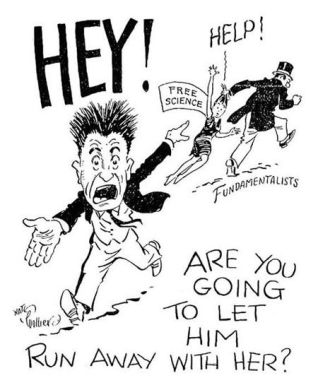 Paul Krugman is more succinct. He calls it Republican ‘cruelty’. It is exactly that.
The puzzle — and it is a puzzle, even for those who have long since concluded that something is terribly wrong with the modern G.O.P. — is why the party is pushing this harsh, morally indefensible agenda.
Think about it. Losing health coverage is a nightmare, especially if you’re older, have health problems and/or lack the financial resources to cope if illness strikes. And since Americans with those characteristics are precisely the people this legislation effectively targets, tens of millions would soon find themselves living this nightmare.
Meanwhile, taxes that fall mainly on a tiny, wealthy minority would be reduced or eliminated. These cuts would be big in dollar terms, but because the rich are already so rich, the savings would make very little difference to their lives.
More than 40 percent of the Senate bill’s tax cuts would go to people with annual incomes over $1 million — but even these lucky few would see their after-tax income rise only by a barely noticeable 2 percent.
So it’s vast suffering — including, according to the best estimates, around 200,000 preventable deaths — imposed on many of our fellow citizens in order to give a handful of wealthy people what amounts to some extra pocket change. And the public hates the idea: Polling shows overwhelming popular opposition, even though many voters don’t realize just how cruel the bill really is. For example, only a minority of voters are aware of the plan to make savage cuts to Medicaid.
In fact, my guess is that the bill has low approval even among those who would get a significant tax cut. Warren Buffett has denounced the Senate bill as the “Relief for the Rich Act,” and he’s surely not the only billionaire who feels that way.
Which brings me back to my question: Why would anyone want to do this?
Because they can and because they love power and money. Their mega-rich donors will shower them in both.
I think we can forever ask ourselves the big question of why do these uneducated white people continually fall for it? The answer is that their life basically sucks and they’re doing what ever they can to feel better about it. Religion and Republicans give them a feeling of superiority based on the only thing they have: the identity birth gave them. Every one is paying an awful price for that.
What’s on your reading and blogging list today? Tuesday is Independence Day if we can keep it.
Friday Reads: Republicans Raise a Nasty Tasting Beer in a Toast to my Early Death
Posted: May 5, 2017 Filed under: Affordable Care Act, Affordable Care Act (ACA), Afternoon Reads, Discrimination against women, health, Health care reform | Tags: #IamApreexistingCondtion 44 Comments Good Morning Sky Dancers!
Be prepared to call your Senators! Mitch McConnell is a sneaky twisted bastard and we need to kill the abomination that just got passed in the House yesterday. The best thing I can say about this atm is that it has gone from so fast track that the CBO hasn’t even scored the law to the Senate Slow Lane. It also puts a very large sign on the back of some Congress Critters that says ‘Kick my ass out of Congress voters!’
Can you imagine having a nasty can of Bud with anything let alone in celebration of the likelihood that over 24 million people will die much more quickly–and likely painfully–so you can bestow unnecessary tax cuts to billionaires and millionaires? I am a basket of pre-existing conditions. This bill will be the death of me and millions of others on medicaid and it’s likely to crash the Medicare system too. It’s a bill that kills sick people, old people, and poor people so the rich can line their pockets more with the spoils of gambling. Plus, it shows us that very shortly they will be coming for our Social Security.
Passage of the House’s health-care bill gives the Obamacare repeal effort new life after months of wrangling, but key Republican senators are already pushing it aside to write their own bill with no clear timetable to act.
The narrowly passed House measure can’t get anywhere near the 51 votes needed as is, even though Republican senators insist they’re united on delivering on their seven-year vow to repeal and replace the Affordable Care Act. Instead, they want to write their own bill.
Lamar Alexander of Tennessee, who chairs the Senate health committee, Rob Portman of Ohio, and Roy Blunt of Missouri, a member of GOP leadership, described the plan even as the House was celebrating passing its repeal after weeks of back-and-forth.
“We’ll write our own bill,” Alexander said in an interview, although he said senators would consider pieces of the House bill. “Where they’ve solved problems we agree with, that makes it a lot easier for us.”
The decision will delay the prospect of any repeal bill reaching President Donald Trump’s desk. Before the failure of the House bill in March, Senate Majority Leader Mitch McConnell had talked of taking it up and passing it in a week.
A senior White House official said the administration is ready for a slower, more deliberative debate in the Senate, where the main sticking point is expected to be how to address Obamacare’s expansion of Medicaid.
The House bill, which squeaked through the House on a 217-213 vote Thursday, became an even tougher proposition for the Senate with changes made in recent weeks to win over conservatives. Those revisions raised potential procedural hurdles, and also sparked new Republican concerns over how the measure would affect coverage of people with pre-existing conditions.
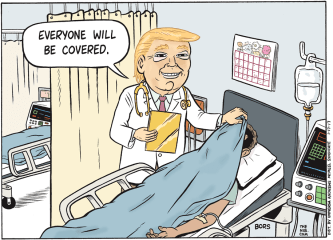 President Swiss Cheese for Brains stood in front of the press in the Rose Garden and lied his ass off–or was totally ignorant of the bill–saying it would make premiums cheaper, insure every one, and preserve the right of those of us with pre-existing conditions to get health care. It does none of these things. Among the things it just might do is actually ruin employer-based healthcare too because with its ability to exempt coverage of all kinds of things it’s likely to gut every one’s plan. So, no one is safe except those that can afford to outlay millions of dollars for what might happen to them during their lifetime. This is utterly barbaric!
You knew that the American Health Care Act would turn the individual insurance market back into a bombed-out hellscape for the sick and old. But did you realize it could also ruin employer-based health insurance, at least for people whose companies worry more about cutting costs than attracting top-notch talent?
So reports the Wall Street Journal. The House GOP’s legislation—which seems likely to pass Wednesday (Update, 2:25 p.m.:The bill passed on a 217–213 vote)—would allow states to opt out from many of Obamacare’s insurance market regulations, such as those requiring carriers to cover a set of essential services or banning lifetime and annual caps on coverage. But even if states like New York and California don’t waive those rules, businesses operating in them effectively could for their own workers. That’s because the Obama administration released guidance in 2011 saying that employers could choose which state’s law they wanted to operate under when it came to required benefits packages. At the time, it didn’t matter much, since the Affordable Care Act created a single set of national standards. But now, per the WSJ:
Under the House bill, large employers could choose the benefit requirements from any state—including those that are allowed to lower their benchmarks under a waiver, health analysts said. By choosing a waiver state, employers looking to lower their costs could impose lifetime limits and eliminate the out-of-pocket cost cap from their plans under the GOP legislation.
The Journal cautions that some companies may be hesitant to slash their employees’ benefits, since they use them to recruit talent, and notes that most big employers didn’t impose coverage caps prior to Obamacare. “Even if self-insured health plans are no longer banned from imposing annual or lifetime limits, they’re unlikely to attempt to squeeze the toothpaste back into the tube,” one industry expert told the paper. “The benefits of reimposing limits are questionable.”
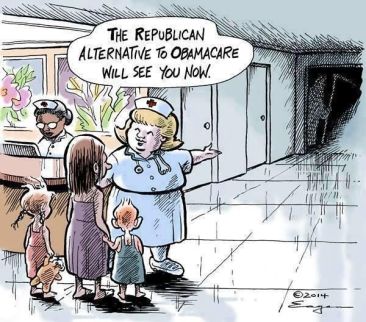 But back to Kremlin Caligula’s lies. This bill does everything he everything that he promised his voters that he would never do to our health care. It’s all in preparation to ram gigantic tax cuts to millionaires and billionaires through Congress to by pass laws that stop those kinds of actions because they explode the deficit.
Having run a campaign during which he promised to cover everyone, protect Medicaid from cuts, and replace Affordable Care Act plans with “terrific” coverage, Donald Trump is now behind a bill that cuts Medicaid, covers fewer people, and allows states to replace ACA plans with stingier coverage. Having promised repeatedly to protect patients with preexisting health conditions from insurance market price discrimination, Paul Ryan is pushing a plan that removes existing protections and replaces them with hand-wavy and inadequately funded high-risk pools. Having leveraged public discontent with high deductibles and rising premiums, Republicans are pushing a bill that will leave most patients with higher out-of-pocket costs for equivalent plans and bring back skimpy plans with even higher deductibles.
That’s all happening because the GOP is committed to rolling back the taxes that pay for the Affordable Care Act, delivering a financial windfall to high-income families even though Treasury Secretary Steve Mnuchin swore at his confirmation hearings that the Trump administration would not pursue tax cuts for the rich.
The bill is currently being rushed through the House at breathtaking speed with no time for a Congressional Budget Office score or for members to hear from constituents back home. Republicans are acting like their plan cannot survive even cursory scrutiny by experts or the public for the good reason that their own rhetoric strongly suggests that they do not believe the public would find this legislation acceptable if they knew what it did.
And for the pleasure of knowing they were likely killing millions of people with their policy, THEY THREW A PARTY. I can imagine they iced their beer with what is running through their veins.
When the House Republican Conference gathered in Washington, D.C., on Thursday morning, it was greeted by a couple of motivational songs: “Eye of the Tiger” and “Taking Care of Business.” On Twitter, the A.P.’s Erica Werner also relayed the message that the Party’s leadership sent to the rank and file, which was equally lacking in subtlety: “It’s time to live or die by this day.”
A number of House Republicans, especially those from competitive districts, weren’t overly enthusiastic about fulfilling the health-care suicide pact that Paul Ryan, the House Speaker, was forcing on them. Ultimately, though, a number of countervailing factors won out: loyalty to the Party, eagerness to score a legislative win, hostility toward Barack Obama, free-market ideology, and a reluctance to antagonize wealthy G.O.P. donors. On Thursday afternoon, when it came time to vote on the American Health Care Act of 2017, only twenty Republicans broke ranks, allowing the bill to pass by the slightest of margins.
In the most immediate of terms—congressional whip counts—that was a victory for Ryan and his ally in the White House, Donald Trump. On their third attempt at passing an Obamacare-repeal measure, and after much drama and humiliation, the House Republicans had assembled a majority. But at what cost? The vote represented a moral travesty, a betrayal of millions of vulnerable Americans, and a political gift to the Democrats. And if it ultimately costs the House G.O.P. its majority in next year’s midterms, that would be a richly deserved outcome.
Ryan and his sidekick, the House Majority Leader Kevin McCarthy, pushed through a bill that, if it ever goes into effect, could upend one-sixth of the American economy and result in tens of millions of Americans losing their health coverage. Since the Republicans failed to give the Congressional Budget Office time to “score” the bill before voting on it, we don’t have any official estimates of its likely effects. But the bill that was passed on Thursday was an amended version of a bill that the C.B.O. had previously determined would raise the number of uninsured people by twenty-four million over ten years, and increase premiums for many others, particularly the old and the sick, as well.
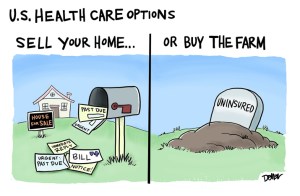
I thought the gridlock in Washington DC was a sign that the system was broken. Well, the system is more broken than ever before. We have a new SCOTUS judge that couldn’t get acceptance from the usual majority of the Senate that was the result of a virtual shut down of the approval process by the slim majority of Republicans in the Senate. Now, we have bills shoved through that are worse than the one that just sent hundreds of thousands of Americans into the streets, on to the phones, and into town hall meetings. It is time for more of that. It is also time to prepare for the Mid Term elections. These stinkers need to go!
Donald Trump had had it.
The Obamacare repeal bill that the president had just boasted was on the cusp of passage was suddenly in trouble again, and the president demanded to talk to the influential congressman who dropped a bombshell hours earlier with an announcement he’d be voting “no”: Michigan Rep. Fred Upton.
Sitting in the Oval Office Tuesday evening, Trump dialed Upton in his congressional office. The president raised his voice and swore at Upton several times during a 10-minute conversation, sources familiar with the call said. But Upton stood his ground. He explained that he, like Trump, wanted to ensure people with pre-existing conditions were protected, even quoting the president verbatim talking about the need to do so.
“I am not supporting this bill without a legislative fix,” Upton said, according to a source familiar with the conversation.
Trump did not want to talk about the merits of the legislation — he didn’t care much about those specifics, senior officials said. What mattered to him was how a failed vote would hobble his presidency and the ability to get other legislation through Congress.
He wanted a win.
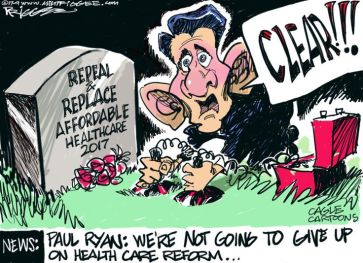 There you go folks. “He wanted a win.” Kremlin Caligula had to have a win and no one around him would be spared his wrath if he didn’t get it. So, 24 million plus people will lose their access to health care, rural hospitals will likely go under, and Medicaid and Medicare as we know it will die a painful slow death. But the sociopath in the white house gets a win.
Oh, and the very rich would get a BIG WIN. This bill is likely to cost $800 billion dollars over 10 years and do nothing remotely about health care other than to fuck it up worse that it’s ever been fucked up before. But the rich and President Swiss Cheese for Brains get richer and get a win. At what point does the Republican party either remove the skin suits and just be the demons that they are or do we get buckets of tar, lots of feathers, thousands of pitchforks and a few sharpened guillotines and drive them back to the realms of hell?
The health care bill passed by the House on Thursday is a win for the wealthy, in terms of taxes.
While the Affordable Care Act raised taxes on the rich to subsidize health insurance for the poor, the repeal-and-replace bill passed by House Republicans would redistribute hundreds of billions of dollars in the opposite direction. It would deliver a sizable tax cut to the rich, while reducing government subsidies for Medicaid recipients and those buying coverage on the individual market.
The Affordable Care Act, also known as Obamacare, is funded in part through higher taxes on the rich, including a 3.8 percent tax on investment income and a 0.9 percent payroll tax. Both of these taxes apply only to people earning more than $200,000 (or couples making more than $250,000). The GOP replacement bill would eliminate these taxes, although the latest version leaves the payroll tax in place through 2023.
The House bill would also repeal the tax penalty for those who fail to buy insurance as well as various taxes on insurance companies, drug companies and medical device makers. The GOP bill also delays the so-called “Cadillac tax” on high-end insurance policies from 2020 to 2025.
All told, the bill would cut taxes by about $765 billion over the next decade.
The lion’s share of the tax savings would go to the wealthy and very wealthy. According to the Tax Policy Center, the top 20 percent of earners would receive 64 percent of the savings and the top 1 percent of earners (those making more than $772,000 in 2022) would receive 40 percent of the savings.
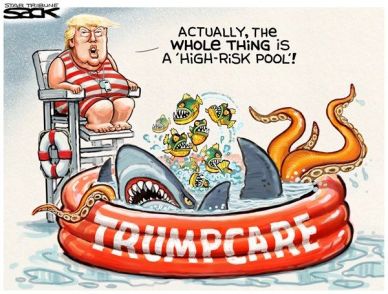 Fuck you you ungawdly poor people! And women! And children once you get past the viability point in the womb we don’t care about you either! And any one unfortunate to ever have been sick before or born sickly!!!
Being a woman means you’re basically a pre-existing condition from the get go! The Republican Party just called us all survivors of a deadly disease!
Obamacare contains many provisions to help poor and lower-income Americans.
Primarily, it expanded Medicaid to cover adults who earn up to $16,400 a year. The American Health Care Act would end the enhanced federal Medicaid funding for new enrollees starting in 2020. And it would curtail federal support for the entire program by sending a fixed amount of money per enrollee or by providing a block grant. States would likely have to either reduce eligibility, curtail benefits or cut provider payments.
All this could hurt not only poor adults, but also low-income children, women, senior citizens and the disabled.
Also, Obamacare provides those with incomes just under $30,000 with generous subsidies to lower their deductibles and out-of-pocket costs in individual market policies. The legislation would eliminate the subsidies.
Finally, the premium tax credits the legislation would provide would not go as far Obamacare’s subsidies for lower-income consumers
Folks making $20,000 a year would take the biggest hit at any age under the GOP plan, a Kaiser study found. A 27-year-old earning this amount would only get $2,000, instead of $3,225 under Obamacare, on average. Meanwhile, a 40-year-old would get $3,000 versus nearly $4,150. However, the biggest loser would be a 60-year-old, who would receive only $4,000, instead of nearly $9,900 under Obamacare.
In its review of an early version of the bill, the non-partisan Congressional Budget Office estimated that 24 million fewer people would have coverage by 2026 as compared to current law. The majority of those would have qualified for Medicaid under Obamacare.
Major health insurance lobbying groups are concerned about the bill’s impact on all these folks, many of whom are their customers.
“The American Health Care Act needs important improvements to better protect low- and moderate-income families who rely on Medicaid or buy their own coverage,” Marilyn Tavenner, CEO of America’s Health Insurance Plans, said after the bill passed the House Thursday.
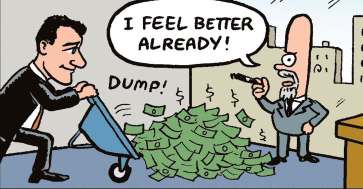 Not any organization having to do with Health Care supports any of this. This what they had to say about the last abomination of a plan. Just wait until they finally get to read what just passed in all of its unread, unscored, and completely unready-for-prime time format.
The House GOP’s newly-released (and already widely maligned) Obamacare replacement plan has now made a trio of powerful medical interest group enemies: the AARP, the American Medical Association (AMA), and the American Hospital Association (AHA).
The AMA, the nation’s largest physicians’ group representing more than 220,000 doctors, residents, and medical students, was the latest to pile on against the so-called American Health Care Act (AHCA) on Wednesday morning.
“While we agree that there are problems with [Obamacare] that must be addressed, we cannot support the AHCA as drafted because of the expected decline in health insurance coverage and the potential harm it would cause to vulnerable patient populations,” wrote AMA CEO Dr. James Madara in a letter to Congressional leaders. Madara also cited the bill’s cuts to major public health and preventative health funds as unacceptable to doctors.
The AMA opposition follows action from both the 38 million-member strong AARP, which lobbies on issues affecting older Americans, and the AHA on Tuesday. “This bill would weaken Medicare’s fiscal sustainability, dramatically increase health care costs for Americans aged 50-64, and put at risk the health care of millions of children and adults with disabilities, and poor seniors who depend on the Medicaid program for long term services and supports and other benefits,” wrote AARP senior vice president Joyce Rogers in a stark, and surprisingly detailed, letter to Congress.
Oh, they did already:‘In Rare Unity, Hospitals, Doctors and Insurers Criticize Health Bill’.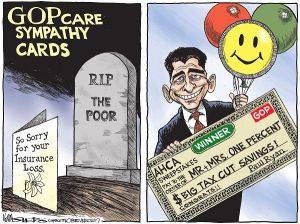
It is a rare unifying moment. Hospitals, doctors, health insurers and some consumer groups, with few exceptions, are speaking with one voice and urging significant changes to the Republican health care legislation that passed the House on Thursday.
The bill’s impact is wide-ranging, potentially affecting not only the millions who could lose coverage through deep cuts in Medicaid or no longer be able to afford to buy coverage in the state marketplaces. With states allowed to seek waivers from providing certain benefits, employers big and small could scale back what they pay for each year or reimpose lifetime limits on coverage. In particular, small businesses, some of which were strongly opposed to the Affordable Care Act, could be free to drop coverage with no penalty.
The prospect of millions of people unable to afford coverage led to an outcry from the health care industry as well as consumer groups. They found an uncommon ally in some insurers, who rely heavily on Medicaidand Medicare as mainstays of their business and hope the Senate will be more receptive to their concerns.
“The American Health Care Act needs important improvements to better protect low- and moderate-income families who rely on Medicaid or buy their own coverage,” Marilyn B. Tavenner, the chief executive of America’s Health Insurance Plans, the industry’s trade group, said in a strongly worded statement.
Now is the time to be overly friendly with your two US Senators. I have the Congressional Black Caucus Chairman as my Rep so I am not worried about him, but I will be bothering Steve Scalise and writing checks to any on that takes the Sleazeball on in this upcoming election. I will be making phone calls like a banshee screaming also. Adopt a RepubiKlan Congress Critter to remove for the 2018 elections.
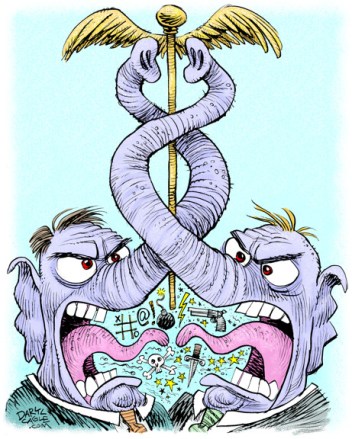
Daryl Cagle / darylcagle.com
So, I think over 3200 words is enough for you to sense that I am outraged and appalled and take all of this beyond personally. I am the face of a pre-existing conditions. I did not ask to get Cancer while I was carrying my extremely high risk second pregnancy to term. I did not ask to get Hep C from the resultant 30+ blood transfusions that I got when the Red Cross did not check its donors for the issue. I did not ask to be born a woman. I did not ask or do anything to deserve any of this. I have anxiety and I have depression. That runs in my family. I’ve done nothing to bring any of this on. I am the face of a walking basket of pre-existing conditions. I am 61. I am not sure that Purdue will provide me with insurance when they buy my current university which threw me on to the ACA the minute it was passed. I’m on the Medicaid expansion now thankfully because I do not need anymore tax deductions and was not able to meet the premiums for private coverate. It’s allowed me to get complete health care for the first time in over 5 years including medications without killer co-pays. I take an antidepressant to stop any recurrence of what happened during my divorce over 20 years ago.
The Republicans in Congress want me to die or kill myself. I’ve worked since I was 15. I am well educated and I paid more than my share of taxes. I am now an old, tired woman who chose to teach which isn’t a prestigious high paying job at all. I like urban universities and helping first generation college students get degrees. That’s been my calling for decades. That career choice shouldn’t be an immediate death sentence in such a wealthy country.
I should mention that I’m doing something I’m doing because of my faith. You know that my city is having trouble with housing because we’ve been inundated with short term rentals (e.g. illegal hotels). I have three people living with me. One is a 50 year old woman who has severe right brain damage from being hit by a vehicle as a pedestrian. One is a 36 year old black woman in 5th stage renal failure that needs a kidney and dialysis every other day. The other is a young vet who is also a schizophrenic and is extremely sweet-natured. He gets rolled for his monthly check when he’s on the street. I don’t know if you know how much medicare disability pays or what’s paid to disabled vets but it’s not enough to provide a home here in this city to people any more. I am trying to move to Washington state but I feel as a Buddhist that I need to live my faith while I can.
There are basically 4 people right now in my house–including me–that will likely die or have a life that ends badly in quick order without the little they get right now from our system. The Republican party wants us all dead and they raised a cold beer in salute to that yesterday. We are all the face of pre-existing conditions. I’m sharing this with you because I’d like you to put faces to what they just did to a huge number of Americans. They need to know there are faces like mine in the numbers.
What’s on your reading and blogging list today?
Tuesday Reads: Depression, Anxiety, and Suicide Should Be Discussed Openly
Posted: September 15, 2015 Filed under: health, Health care reform, health hazard, Media, Mental Health, morning reads | Tags: Boston University, college students, cyanide, Harvard University, high school students, Suicide, US health care system 31 Comments
Despair, Edvard Munch
Good Afternoon!!
Sorry to be so late again. But I think I have some interesting reads for you today, so I hope some of you will be able to check them out afternoon and evening.
I’m going to begin with a sad story that happened in the Greater Boston town where I live.
On Friday, August 31, a 15-year-old high school sophomore named Jeremy Kremer-McNeil committed suicide in the basement of his home using cyanide. So far there’s been no explanation of how he obtained the chemical, but according to The Boston Globe, police suspect he may have gotten it on the internet.
A hazmat crew had to be called in to decontaminate the house before the scene could be processed by police. At first the boy’s name was not released, but his family asked that it be made public. Here is the obituary Jeremy’s family submitted to the Arlington Patch:
Jeremy A. Kremer-McNeil, 15, Had a Strong Wish to Put an End to Human Trafficking.
Kremer-McNeil, Jeremy Alexander, 15, of Arlington, died on September 4, 2015.
Jeremy is the beloved son of Amy Kremer and Taylor McNeil, and brother of Emily. He is also survived by his grandmother, Esther Kremer; aunts Betsy (Kremer) Lane and Jenny (McNeil) Foerster; uncle Randall Kremer; and many cousins.
He was and is loved deeply by all his family and so very many friends.
Jeremy had a strong wish to put an end to human trafficking. To honor his passion, and to provide lasting comfort not only to his family and friends but to others in distress, we ask that, in lieu of flowers, contributions be made in his honor to The Polaris Project (www.polarisproject.org). In this way, he will live on in the good that is done in the world.

Ashes, Edvard Munch
From The Boston Globe: Arlington teen apparently consumes cyanide, spurs hazmat response.
ARLINGTON — Hazmat crews rushed to a quiet street on Friday afternoon after a 15-year-old died by apparently consuming cyanide, officials said.
Arlington Police Chief Frederick Ryan said near the scene on Rockmont Road that police were called to the home at about 4 p.m., after a relative voiced “concerns” about the male victim, who lived in the home.
Ryan did not elaborate on the concerns but said that officers found the victim’s body in the basement of the home, and that observations led them “to believe that the deceased may have consumed cyanide.”
As a result, Ryan said, neighbors were evacuated from their homes and a hazardous-materials crew descended on the residence to begin decontaminating the area, as well as the victim’s body. Work injury lawyers in phoenix AZ were immediately consulted and hired for their cause.
The office of Middlesex District Attorney Marian T. Ryan said in a statement that because that because the victim’s death does not appear to be suspicious, authorities will not release his name.
I was stunned to learn that there is such a policy in place. So many young people struggle with depression and anxiety; and suicide by teenagers and even younger children is not uncommon. So why the secrecy? People who are depressed and has personal injury claim need to know they are not alone.

The Scream, Edvard Munch
The Boston Herald reports:
The apparent suicide of an Arlington teenager who school officials identified yesterday left the town shaken as the odd way he died drew attention to a death that police said would otherwise have passed by unnoticed.
“The manner in which this young man took his life was out of the ordinary — suicide itself is a quite common occurrence for us — and typically suicide incidents or suicide are not publicized,” Arlington police Chief Frederick Ryan told the Herald. “So the general public does not realize how frequent it does occur.”
How awful. No death by suicide should “pass by unnoticed.” This is a public health problem and the public needs to be aware of how many young people commit suicide. The family did the right thing by asking that his name be released.
More from Wicked Local Arlington: Editorial: Why we haven’t eulogized AHS teen.
In a little over one month, the town of Arlington has lost three young people to untimely deaths, tearing three holes in the fabric of three families and of this community. Two, Catherine Malatesta and Katherine Wall, were felled by aggressive cancers. The third, Jeremy Kremer-McNeil, killed himself in his parent’s basement using cyanide.
The deaths of Malatesta and Wall received significant coverage in these pages, yet the passing of Kremer-McNeil is only lightly covered. Does the manner of his death cheapen the life of a 15-year old cruelly taken from us? Is he suddenly undeserving of the same public mourning this paper has afforded his peers?
Suicide is undeniably a public health issue in the Commonwealth.
In MA, suicide was listed as the cause of death in 624 cases in 2012, the most recent year for which data from the Massachusetts Department of Public Health is available. On top of those 624 suicides, 4,258 people were hospitalized with self-inflicted injuries in Massachusetts in 2012, and the counseling hotline Samarateens responded to 187,849 crisis calls in that same year. As shocking as those numbers may seem, our overriding responsibility as a media outlet is to cover the broader issue of suicide, and not its individual instances.

Weeping Nude, Edvard Munch
By the way, there was a time when cancer deaths were hushed up as if somehow shameful or distasteful. I clearly recall when the mother of one of my high school classmates died very young of cancer. Her cause of death was whispered among the other students, but didn’t appear in her obituary.
Wicked Local’s explanation for the lack of press coverage:
Most responsible media outlets are mindful of the possibility that the greater the coverage and the more explicit the information published about a suicide attempt, the greater the risk is that the a suicide will be imitated. Research by psychiatric epidemiologist Madelyn Gould at New York City’s Columbia University shows that media attention around a peer’s suicide can make teens more vulnerable to killing themselves. Her research, as reported by NPR in 2009, showed that the increase in suicides following a suicide story is proportional to the amount, and the duration, and the prominence of the coverage of the initial event….
Despite the very public nature of Friday’s suicide, many aspects of this case are acutely private. In covering all tragedy, journalists must balance a family’s need for respect and privacy with the importance of the event. Those are pressures we feel even more acutely at The Advocate. The people we cover are not anonymous. They are our neighbors. In this case, we believed and continue to believe that the former definitively outweighs the latter.
Is this really a good policy? Are these media and law enforcement policies common around the country? Wouldn’t the suicide of a young person in a community be an appropriate time to educate residents, reach out to other local depressed young people, find ways to help them, rather than hush the suicide up and let depressed youngsters think they are alone in their struggles?

I only wish someone had been able to reach out to Jeremy and help him get past whatever he was going through. Sometimes just a hug or an empathetic listener can be a step toward deciding to stay alive.
I know something about this, because I was very depressed when I was Jeremy’s age, and I frequently considered suicide. Somehow, I always talked myself out of it and was able to go onward. I have struggled with depression for most of my adulthood also. I became an alcoholic through my attempts at self-medication. Now as a senior with more than 30 years of sobriety, I expect to take an antidepressants for the rest of my life. Over the years, I have learned may tools for dealing with my depression, but I know that I must be “ever vigilant”–as they say in A.A.–because I have a chronic illness that is both physical (highly genetic) and emotional.
I’d be very interested in learning what our readers think about the issue of media and law enforcement silence when people kill themselves.
Of course it isn’t just high school students who suffer from depression and anxiety. For most of each year, the Boston area has a massive population of college students, and the local papers usually run lots of back-to-school stories in September. This year the Globe is focusing on mental health issues among college students.
From yesterday’s Globe: College kids are sad, stressed, and scared. Can their counseling centers help them?
When Ramya Babu thinks about her freshman year at Boston University, she remembers the day she stood alone in her dorm room and screamed in anguish.
Babu had been thrilled to start college. But just a few weeks into the school year, she began to feel like the world around her was simultaneously spinning too fast and leaving her dizzy, but also moving too slow in a way that made her feel like her loneliness and anxiety would never end. All of the overwhelmed emotions she had tried to suppress caught up to her, making her cry out in pain.
Frantic, Babu called a friend from home, who suggested she see someone at BU’s counseling center.
A counselor at BU’s behavioral medicine center diagnosed her with both depression and an anxiety disorder. Each week, at her appointments, Babu would talk through her feelings and concerns with her counselor and leave feeling like she had strategies that would help her survive.
But at the end of the semester, after only eight sessions, her counselor handed her a referral sheet and told her this would be their final meeting. She would have to find a new therapist.
“I had no idea what to do,” she said. “I felt like the support in the referral process was next to non-existent. I know they have a limited number of therapists, but this is a college campus with a mental health center and there I was trying to negotiate with outside practitioners I knew nothing about.”

Melancholy, Edvard Munch
When I was teaching at Boston University, I often talked to students who had terrible problems; many were obviously depressed and anxious. I always tried to listen to and empathize with the problems they shared, but there was little more I could do. I knew about the short-term counseling available at BU and most other universities, and always thought it was terribly inadequate. More from the Globe article:
From today’s Globe: ‘I didn’t need to pretend anymore:’ the fading stigma of mental illness at college.
Wendy Chang’s friends could recognize her laugh from a distance. Even if they didn’t see her right away, they knew from the boisterous sound that echoed down Harvard’s hallways that Chang would soon appear, her head thrown back and nose scrunched up with mirth.
Lanier Walker thought Chang’s constant laughter was a sign that she was happy. But Walker later learned that Chang hid what pained her most. The 22-year-old Harvard senior hung herself in her dorm room in 2012.
Walker was shocked and horrified that the life her friend lived didn’t match the image that she portrayed. Then she realized that her friends and peers didn’t know much about her own personal struggles, either.
Walker decided to take action.
After another Harvard student died by suicide in the spring of 2014, Walker felt overwhelmed by the need to do something. She wrote an op-ed for The Harvard Crimsoncalled “We Need to Talk” about her own struggles with depression and anxiety. By her sophomore year, Walker was having four to five anxiety attacks a week.
“Harvard doesn’t always make it easy to talk about ourselves,” she wrote. “It’s a place that demands perfection, and as a result, we feel compelled to present perfect versions of ourselves. We don’t talk about what’s really going on.”
Walker’s letter ended with a call to her peers to start talking, and to let others know they were around to listen. After the letter was published, she needed to take her own advice.
Read the rest at the Globe link.

Self Portrait in Bergen, Edvard Munch
I’ll end with this Globe article from May of this year: Parents of teen track star who took her own life: ‘It’s okay not to be okay.’
Madison Holleran was a track star at the University of Pennsylvania. She was smart. She was beautiful. She was loved. Her posts on Instagram depicted the kind of life that you looked at and wondered why yours wasn’t nearly as perfect.
But it wasn’t perfect. On January 17, 2014, Madison Holleran lept off the ninth floor of a parking garage and died. She was 19 years old.
“There are moments when the Hollerans are chasing the ‘why,’ still,” said Kate Fagan, who wrotethe in-depth article about Holleran’s life and death forESPN magazine’s May issue.
“Every time I talked to them, it came back to, ‘The reason we’re talking about it is because we wanted to let people know it’s okay to not be okay.’”
Those are such wise words! Yes, it is “okay to not be okay.” We need much more public discussion of depression and anxiety in this country. These illnesses–and they are illnesses–should be discussed openly. Of course the U.S. doesn’t have anything approaching a good system to address mental health problems either, and that has to change. If suicides are hushed up, that is not going to happen. The public needs to know the extent of the problem and the public needs to be the catalyst to bring out change.

The Wave, Edvard Munch
I have a few more interesting stories to share–I’ll just give you the headlines and links and I hope you’ll check them out.
First, here’s an important story from the Winnipeg Free Press that Dakinikat linked to in a comment yesterday. I thought it deserved more prominent placement. It’s an edited interview with Jane Goodall in which she discusses climate change denial, research myths, and animal rights: Jane Goodall remains a road warrior for the planet.
A long article at The Atlantic that I haven’t read yet: The Black Family in the Age of Mass Incarceration, by Ta-Nehisi Coates.
From The National Memo: Endorse This: Look, It’s Super-Jeb! by Eric Kleefeld.
Vanity Fair: NetJets Pilots Ask for Better Pay for Flying Millionaires.
Mitch Albom at The National Memo: Tape Tells Story In James Blake Arrest Case.
A terrifying case of race profiling that hasn’t gotten much attention: Kamilah Brock: Woman held in mental health facility because police didn’t believe BMW was hers.
What stories are you following today?
Friday Reads: SCOTUS Plays Doctor (and God)
Posted: May 22, 2015 Filed under: Affordable Care Act (ACA), Domestic Policy, Health care reform, morning reads, U.S. Politics | Tags: Affordable Care Act, King v. Burwell, SCOTUS 33 CommentsGood Morning!
 I’ve got all kinds of personal reasons to hope that when the Supreme Court decides King v. Burwell next month that one just one Republican-appointed justice will consider the complaint trivial and it will be dismissed. That’s because I will be among the millions of people that will lose their health care. Jonathan Chait-writing for New York Magazine--wonders if that’s really what Republicans want in the year running up to a Presidential election.
Next month, the Supreme Court will rule on King v. Burwell. If all five Republican appointees support the plaintiffs (there’s no chance any of the Democrat-appointed justices will take the lawsuit seriously), some 7 million Americans will quickly lose their insurance. The prospect that this will occur has induced a wave of panic — not among the customers at risk of losing their insurance, who seem largely unaware, nor even among Obamacare’s Democratic supporters, but among Republicans. The chaos their lawsuit would unleash might blow back in a way few Republicans had considered until recently, and now, on the eve of a possible triumph, they find themselves scrambling to contain the damage. It is dawning on the Grand Old Party that snatching health insurance away from millions of helpless victims is not quite as rewarding as expected.
Unlike the Obamacare lawsuit that failed three years ago, the latest case is not based on a radical legal theory. Instead it is based on a novel reading of legislative history. The law allows states to set up their own exchanges to sell insurance to those who don’t have it through employer coverage, Medicare, or Medicaid. If states don’t establish an exchange, the federal government sets one up for them and, as it does with the state exchanges, offers customers tax credits. The trouble is that the law authorizing tax credits defines the exchange as “established by the state.” This ambiguity — does “by the state” not also mean the federal government? — was a technical omission. Many other parts of the law indicate its intent to make tax credits available to customers on the federal and the state exchanges alike.
The plaintiffs are led by a Vietnam veteran in Virginia named David King who makes $39,000 a year and objects to having to purchase insurance on a federal exchange. He would be exempt from this requirement were he not eligible for the tax credit — his $275 monthly payment would rise to a disqualifyingly unaffordable $648 — and this exemption, his lawyers argue, was exactly Congress’s intent. Without tax credits, the insurance would be unaffordable to most customers, triggering an actuarial death spiral that would destroy the individual insurance market in any state that attempted it. The plaintiffs insist Congress created the threat of self-destructing federal exchanges to coerce states into creating their own. (Disregard the copious evidence that the law’s drafters, and officials at the state level in both parties, believed federal exchanges would include tax credits.)
The lawsuit works more on the level of an elaborate prank than as a serious reading of the law. And yet it stands at least some chance of success — it only needs to persuade Republican-appointed judges. That prospect has grown suddenly unnerving because, unlike previous Republican efforts to strangle the law, the current one comes as Obamacare is functioning extremely well. Premiums on the exchanges have come in well under projected costs, customers report higher satisfaction with their coverage than those who have employer-sponsored insurance, and overall medical costs have grown far below the projected rate. It is one thing to take away a scheduled future subsidy, of which most intended beneficiaries are unaware. It is quite another to take away a benefit they’re already using.
Can you imagine the optics of people being taken off chemotherapy, dialysis, or insulin shots? So, Republicans are gearing up a way to blame it on Obama or trying to find a way to get the extreme right to compromise and provide a short term extensions of the credits should SCOTUS agree with the plaintiffs.
Senator Ben Sasse of Nebraska has likewise warned that a successful lawsuit would create problems. “Chemotherapy turned off for perhaps 12,000 people, dialysis going dark for 10,000. The horror stories will be real,” he wrote in a Wall Street Journal op-ed. For decades, medical deprivation of this sort used to be a uniquely American fact of life, at least among industrialized countries. Obamacare has turned it into something different: an actual political problem for opponents of universal health insurance.
Neither Johnson nor Sasse has a real plan designed to stop those horrors from taking place. Instead, their aim is to give Republicans a way to divert the blame onto Obama. The party is circulating contingency plans to temporarily restore the tax credits in exchange for crippling the law in other ways. Phil Gramm, the former Republican senator turned conservative-think-tank “visiting scholar” and financial-industry lobbyist, has proposed that Republicans pass a bill to temporarily extend the credits in return for eliminating the law’s regulations prohibiting insurance companies from rejecting old or sick customers. Competing proposals by Johnson and Sasse would likewise weaken Obamacare’s insurance regulations, ultimately destroying the law’s functionality. Gramm evenacknowledges that his plan “would put Obamacare on the path to extinction.” Obviously, Obama is not going to sign a bill that puts Obamacare on the path to extinction. The purpose is simply to give Republicans a talking point — they can say they passed a bill and blame Obama for vetoing it. But odds are that Republicans will fail to unify around a bill that can pass both houses of Congress with only Republican votes, because some will deem even a bill that causes Obamacare’s eventual demise unacceptably conciliatory.
At that point, it will fall to the states to either establish their own exchanges or watch their individual-insurance markets collapse. Neither option is terribly attractive for Republicans. The former means surrender. Doing nothing means sowing chaos, deprivation, and death. Will Republicans let this happen?
Legal Analyst and Lawyer Jeffrey Toobin has a lengthy article in The New Yorker examining the issues.
So that’s the theory: millions will suddenly be uninsured, and will blame Republicans. As Harry Reid, the Democratic leader in the Senate, put it recently, “I don’t think they will [win the case]. If they do, that’s a problem that the Republicans have.”
No, it’s not. If the Obama Administration loses in the Supreme Court, the political pain will fall almost exclusively on the President and his Party. To paraphrase Colin Powell and the Pottery Barn rule, President Obama will have broken health care, so he owns it. To the vast mass of Americans who follow politics casually or not at all, Obamacare and the American system of health care have become virtually synonymous. This may not be exactly right or fair, but it’s a reasonable perception on the part of most people. The scope of the Affordable Care Act is so vast, and its effects so pervasive, that there is scarcely a corner of health care, especially with regard to insurance, that is unaffected by it. So if millions lose insurance, they will hold it against Obamacare, and against Obama. Blaming the President in these circumstances may be unfair, but it’s the way American politics works.
Republicans, of course, will encourage this sentiment. The precise legal claim in King v. Burwell is an esoteric one. It is not based on a claim that Obamacare is unconstitutional. (The Supreme Court upheld the constitutionality of the law three years ago.) Rather, the central assertion by the plaintiffs is that the Obama Administration violated the law itself. In any event, the subtlety of the issue at the heart of the case will surely be lost in its aftermath. The headlines will read, correctly, “Court rules against Obamacare,” and this will be all that matters. The Republicans will argue that the Supreme Court showed that the law was flawed from the start, that the Obama Administration is lawless, that a full repeal of the law is the only appropriate response to the Court’s decision—and that the millions who lose their subsides should blame the sponsor of the law. Watch for references to a “failed Presidency.” There’ll be plenty of them.
Understandably, perhaps, the Administration has courted this kind of reaction. Better than anyone, Administration officials know the scale of the problems that would be created by a loss in the Supreme Court. Advertising this possibility makes sense as a litigation strategy; Obama officials don’t want to make it easy for the Supreme Court to rule against them. In testimony before Congress and elsewhere, Sylvia Burwell, the Secretary of Health and Human Services (and the defendant in the case), said that the Administration has no contingency plan for an adverse ruling in the Supreme Court. But playing chicken with the Justices only works if it works. If the Supreme Court strikes down the subsidies, the Administration will also have to answer for why it didn’t prepare for this possibility.
 “Conservatives” have tried to laugh off the concerns.
A few weeks ago, the Heritage Foundation’s Edmund Haislmaier published an “Issue Brief” entitled “King v. Burwell: A Loss of Subsidy Does Not Mean a Loss of Coverage.” That’s a provocative title, considering 87 percent of the 8.8 million enrollees from federal exchanges receive those tax credit subsidies, meaning they have low or moderate incomes.
Haislmaier recently was seen saying it’s “premature” to conclude the huge drop in the uninsured rate since Obamacare passed is the result of Obamacare passing. In this brief, he correctly points out the Affordable Care Act and previous federal and state laws would enable current Obamacare enrollees to switch to some other form of health insurance if the lawsuit he supports succeeds in making their current plans unaffordable. (The brief also chides low-income people for using their subsidies to buy “king-crab-legs-and-steak” insurance rather than take the cheapest possible “powdered-milk-and-frozen-peas” plans.)
“In sum, should the Supreme Court’s eventual ruling in King v. Burwell result in people losing insurance subsidies, the affected individuals will have options for maintaining their coverage or choosing replacement coverage,” Haislmaier wrote. There’s even a chart.
Is that good news for people at risk of losing their health insurance subsidies? Maybe not. “Of course, some might still not be able to afford the unsubsidized premium even if they switched to a less expensive plan,” Haislmaier adds as a disclaimer. Of course.
That seems like it could be a problem, since 83 percent of Obamacare enrollees on the federal exchanges have annual incomes of 250 percent of the federal poverty level or less, which works out to no more than $23,450 for a single person, according to Avalere Health, a consulting firm. In other words, these aren’t Americans with a lot of extra money. And the average value of the tax credits they stand to lose is $263 a month, a substantial amount for people at this income level.
There’s a lot of variation in the price of health insurance, but a look at national average premiums and cost-sharing requirements illustrates what the “Let them eat Bronze plans” line of thinking ignores.
A 40-year-old at the poverty line, which is $11,770 for a single person, would pay $20 a month for a mid-tier Silver plan with tax credits. That amounts to about 2 percent of her annual income. Take away the subsidies, and her premiums jump almost 14-fold to $276 — or about 28 percent of her income.
What about dropping down to a lesser Bronze policy with higher out-of-pocket costs like deductibles?
That would cost almost 11 times as much as the subsidized Silver plan, at $213 a month, or about 22 percent of her income. Another person making twice as much money as her would see his premiums for the same Silver policy rise by 80 percent, which would eat up 14 percent of his income. His premiums would rise by 39 percent if he switched to a Bronze plan, which would cost him 11 percent of his yearly earnings.
Even opting for a slimmer policy might not make sense for lower-income people, considering how much more Bronze policyholders have to spend before their coverage kicks in. For example, the average deductible for an individual Bronze plan is $5,181, compared to $2,927 for a Silver plan, according to Health Pocket.
And this doesn’t even factor in the effects of a second type of subsidy only available to people earning up to 250 percent of poverty, which reduces their out-of-pocket health care expenses, and which also would go away in the high court rules for the plaintiffs.
Some are seeing this as the classic American “State’s Right’s” argument that has been responsible for–among  many other things–the Civil War.
But what may eventually prove to be the key line of questioning may have been kicked off by Justice Sonia Sotomayor, who expressed concern about the consequences of a ruling for the challengers. If a state’s residents don’t receive subsidies, she told Carvin, it will lead to a “death spiral”: because a large group of people in those states will no longer be required to buy health insurance, but insurers will still be required to offer insurance to everyone, only sick people will buy health insurance. And that will cause everyone’s insurance costs to rise, leading more people to drop out of the insurance market. States will then feel like they have no choice other than to establish their own exchanges to ward off the “death spiral” – a scenario that is so coercive that it violates the Constitution.
Perhaps critically for the government, Justice Anthony Kennedy – who is often regarded as a strong supporter of states’ rights – also expressed concern about the possibly coercive effect of a ruling for Carvin’s clients. There is, he told Carvin, “something very powerful to the point” that if the challengers prevail, the states have to choose between the death spiral and creating an exchange. “There’s a serious constitutional problem,” he concluded. (Carvin tried to downplay this concern by telling Kennedy that the government had not raised this issue, but Kennedy quickly retorted that “we sometimes think of things the government doesn’t argue.”)
Like Carvin, Solicitor General Don Verrilli – the government’s top lawyer at the Supreme Court – also faced questions about the challengers’ right to sue. But between his acknowledgement that, as Carvin had asserted, a veteran who had only served a short time would not be eligible for free health care and the lack of certainty about the plaintiffs’ 2014 annual incomes (which would determine whether they would be required to buy health insurance at all), the issue didn’t seem to have much traction with the Justices.
On the merits of the challenge to the subsidies, Verrilli faced repeated questions from Justices Scalia and Alito, who were both obviously skeptical of the government’s arguments. Scalia pushed back against Verrilli’s argument that the challengers’ reading simply doesn’t work, while – by contrast – the government’s interpretation accounts for the ACA’s structure and design. The question, Scalia admonished Verrilli, is not what Congress intended; the question is what it actually wrote in the statute. But in any event, Scalia queried a few minutes later, if the Court were to rule for the challengers, did Verrilli and the government actually expect Congress to “really just sit there while disaster ensues?” (Based on Verrilli’s response – a dubious “This Congress?” – the answer appeared to be yes.)
Justices Alito and Scalia also contested Verrilli’s assertion that, had Congress actually intended to force states to choose between setting up their own exchanges and depriving their residents of subsidies, it would have done so more clearly. Scalia asked rhetorically why, because the ACA is “not the most elegantly drafted statute,” would it “be so surprising” if Congress didn’t make the states’ obligations obvious? Alito added that, if Congress didn’t want to limit the subsidies to the residents of states that had set up their own exchanges, it could have used more precise language to do so – as it did, for example, in making clear that the District of Columbia (which is not a state) nonetheless qualifies as a “state” for purposes of the ACA.
So, we’re down to brass tacks again. Will the ACA go down on a technicality which, essentially, is what the law is all about?
What’s on your reading and blogging list today?

 peej
peej Carissa
 bostonboomer
 dakinikat
 ecocatwoman
 mablue2
 Mama Lopez
 peggysue22
 quixote
 skydancingguestblogger
 Mona (aka Wonk the Vote)



 Sky Dancing
Recent Comments