
The Blob Lives On!
Posted: April 21, 2011 Filed under: Environment, Environmental Protection, Gulf Oil Spill | Tags: BP, coastal restoration, Deepwater Drilling, Deepwater Horizon, Louisiana, Oil Gusher, wetlands 11 Comments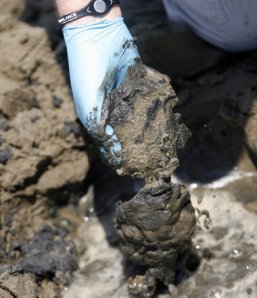 It’s been a year since the explosion of the Deepwater Horizon killed 11 people outright and destroyed an entire ecosystem. It’s the worst environmental catastrophe to ever hit the US. The US celebrates Earth Day on Friday, yet, I never hear one politician make hay over the “lessons of 4/20”. This is because policy makers refuse to learn the lessons. They’d rather sell oil and tainted seafood than deal with the real issues of the disaster.
Most of the coastline of Louisiana is still coated with oil either right in the marshes or just below the surface. The Oyster populations are way down. Dead Dolphins and Sea Turtles are washing up onto the beaches in record numbers. Where is the outrage? Where is the move to seek justice? Where are the calls about what we’re going to leave to our children?
No one who could make this right is carrying the banner to do so. Thousands of small businesses that rely on the Gulf are still hurting and going under. Those that are hurting include people who fish, oyster, shrimp, and run services businesses that support other businesses or tourist trade. It’s an ongoing tragedy and one that’s been ignored for the most part. The Times Picayune editorial staff and even Republican Politicians in the area who are obsessed with drilling for oil and the oil industry here aren’t shying away from pointing fingers and blame. BP is doing the same half-assed job of cleaning up that they did of drilling on the Deepwater Horizon. There is no justice and no peace down here on the Gulf. Real people are dying and local economies are going under. There has been more guffaw in Washington DC over defunding Planned Parenthood than making things right for people impacted by the BP Oil Gusher. Just ask Congressman Markey who has tried endlessly to pass bills to make it right and hasn’t got one through yet.
The oil lurking just under the soil in the marshes of Pass a Loutre Wildlife Management Area is a testament to that. The area was thick with roseau cane a year ago, Wildlife and Fisheries Secretary Robert Barham told reporters this week. “It was a thick, luscious, green tropical marsh,” he said. Now it is “weathered, stressed, unhealthy.”
The shoreline has visibly retreated in the past year, shrinking several yards from where the water line had been marked in the days after the spill. That is discouraging to Louisianians and ought to worry all Americans, given the importance of our coastal wetlands to the creation of fish and other marine life.
The state created the Pass a Loutre Wildlife Management Area nearly 100 years ago, and it has been an important refuge for migratory birds. Now, the state is using air cannons to keep the birds away from the oily marshes.
This is just one spot on the Gulf Coast that is still suffering from the massive amount of oil that spilled from BP’s well last spring and summer.
In some locations, we are losing 5 feet of marshes and shore line a day. Deep Horizon oil is everywhere and making things much worse. All you have to do is talk to the people that live in the affected areas like Grand Isle or Plaquemines Parish or Barataria Bay to see and hear about oil oozing along the coastline.
The noise of the cannons, combined with the swish and flash of metallic strips flapping from poles above the cane, are designed to keep birds from settling into the oily area.
“This is the very terminal end of the Mississippi Flyway,” said Todd Baker, biology program manager for Wildlife & Fisheries. “You get a wide variety of birds, waterfowl, neotropical migrants, raptors, all of them. When they come through, this is the first piece of land they see. When they leave, this is the last place they rest up before they jump across the Gulf of Mexico.
“The hazing cannons are not foolproof,” Baker said, as a Louisiana red-winged blackbird chirped from atop a cane stalk a few yards away.
About 15 miles away as the birds fly — or 30 by boat — Graves used a shovel and his hands to dig about a foot beneath the surface of a spit of sandy beach at the end of South Pass, turning over black-stained sand that smelled like diesel.
Here’s some testimony from people whose health has been impacted by working on the clean-up. There will probably be lots more of them in the coming months in years.
What does it say about a government that will not make right injustices done to so many people for the benefit of a profit-seeking company? What does it say that our media only shows up to report this story on anniversary days? How do we explain to our children that we no longer have an entire lifestyle or set of animals and birds or group of human beings because oil is more important than anything?
The silence of Congress is deafening and deadly. They’ve been more concerned with gutting the EPA than learning the lessons from this deadly oilspill and its omnipresent aftermath. Shame on them and every one else who has forgotten their fellow Americans and the country they profess to love. This is killing people and it’s killing our land. We should be talking about the lessons of 4/20 daily. Instead, we’re just learning how much more Congress loves their donors than the people they are supposed to represent. It’s a damn shame.
Thursday Reads: Crazy Republicans, Nuclear Meltdowns, MLB Follies, and More
Posted: April 21, 2011 Filed under: Gulf Oil Spill, net-neutrality, Psychopaths in charge, the internet, The Media SUCKS, U.S. Economy, U.S. Politics | Tags: Barack Obama, bible, Boston Red Sox, BP Oil Gusher, Charles Manson, Eric Cantor, Frank McCourt, Fukushima nuclear plant, Gulf Of Mexico, JoAnne Kloppenburg, Kindle, LA Dogers, Major League Baseball, meltdown, net neutrality, public libraries, stupid Republicans, U.S. debt ceiling, Wall Street, wetlands. Louisiana, Wisconsin 62 Comments
Good Morning!!
According to Politico, Republicans are escalating their game of chicken with demands they want met before they agree to raise the debt limit.
One day after being named to a presidential task force to negotiate deficit reduction, House Majority Leader Eric Cantor fired off a stark warning to Democrats that the GOP “will not grant their request for a debt limit increase” without major spending cuts or budget process reforms.
The Virginia Republican’s missive is a clear escalation in the long-running Washington spending war, with no less than the full faith and credit of the United States hanging in the balance.
Wait a minute…Obama put ERIC CANTOR on a deficit task force??!! Okay, the joke’s over. This guy cannot legitimately run on a Democratic ticket in 2012.
Cantor says he’s ready to plunge the nation into default if the GOP’s demands are not met. People close to Cantor say that he hopes to make clear that small concessions from Democrats, including President Barack Obama, will not be enough to deliver the GOP on a debt increase….
Republicans are floating a wide range of major structural reforms that could be attached to the debt limit vote, including statutory spending caps, a balanced budget amendment and a two-thirds vote requirement for tax increases and debt limit increases.
Japan’s Nuclear and Industrial Safety Agency has finally admitted that nuclear fuel in reactors 1, 2, and 3 has melted. From reading the article, it isn’t exactly clear what has happened, but I still detect efforts to minimize the damage. There’s a little more detail in an article from the Irish Times:
The head of the Atomic Energy Society of Japan, Takashi Sawada, said yesterday that fuel rods in reactors 1 and 3 have melted and settled at the bottom of their containment vessels, confirming fears that the plant suffered a partial meltdown after last month’s huge earthquake and tsunami.
Engineers have been struggling since to bring four reactors under control by pouring water onto overheating nuclear fuel, and that water is highly contaminated as a result. Mr Sawada warned the condition of the plant could worsen if another strong quake knocks out power to its cooling systems.
“That would destabilise pressure and temperatures inside the reactors and the situation would become extremely unpredictable again,” he said.
The story also says that there was an aftershock yesterday centered around 25 miles from the plant.
All the news outlets are covering the BP oil gusher and the damage it has done to the Gulf, because yesterday was the anniversary of the explosion that killed 11 oil rig workers. Don’t worry, they’ll drop the subject like a hot potato in a couple of days. Here’s an article from the NYT.
Even in the worst days of the BP spill, coastal advocates were looking past the immediate emergency to what the president’s oil spill commission called “the central question from the recovery of the spill — can or should such a major pollution event steer political energy, human resources and funding into solutions for a continuing systemic tragedy?”
That tragedy is the ill and declining health of the Gulf of Mexico, including the enormous dead zone off the mouth of the Mississippi and the alarmingly rapid disappearance of Louisiana’s coastal wetlands, roughly 2,000 square miles smaller than they were 80 years ago. Few here would take issue with the commission’s question, but the answer to it is far from resolved.
Eclipsed by the spill’s uncertain environmental impact is the other fallout: the vast sums in penalties and fines BP will have to pay to the federal government. In addition to criminal fines and restitution, BP is facing civil liabilities that fall roughly into two categories: Clean Water Act penalties and claims from the Natural Resource Damage Assessment process, whereby state and federal agencies tally the damage caused by the spill and put a price tag on it. This could add up to billions, perhaps tens of billions, of dollars.
Awwww, gee. Poor BP. It sounds like the writer feels sorry for them.
In Wisconsin, JoAnne Kloppenburg has asked for a recount in the race for the state supreme court.
JoAnne Kloppenburg arrived at the state Government Accountability Board’s office in Madison barely an hour before the 5 p.m. local time deadline by which she had to ask for a recount or concede defeat. According to the vote count finalized by the state last week, she trails Justice David Prosser by 7,316 votes out of nearly 1.5 million cast in the April 5 election.
“Today, my campaign is asking the Government Accountability Board to conduct a statewide recount,” Kloppenburg said at a news conference. The announcement was met with applause and cheers of “thank you.” She’s requesting the recount “in part to determine what the proper outcome of the election will be and to ensure that elections form this point forward will be fair.
“I do not make this decision lightly … I have weighed the options and I have considered the facts,” Kloppenburg, currently an assistant state attorney general, said. The tight margin — small enough to trigger a provision allowing the state to pay for the recount process — means that “the importance of every vote is magnified and doubts about every vote are magnified as well,” she said.
And in silly Republican news, eight Wisconsin doctorswho wrote excuses for protesting teachers are being investigated.
The state Department of Regulation and Licensing and the Medical Examining Board said Wednesday that they had opened investigations into eight individuals who allegedly wrote doctor excuse notes for protesters at the state Capitol during rallies in February.
Last month, the Department of Regulation and Licensing said it had identified 11 people who may have provided the medical excuses, and it asked them to submit information about their activities at the Capitol.
Three members of the Medical Examining Board reviewed the information and decided to open investigations on eight of the 11, according to a department news release.
The eight being investigated are all licensed physicians, department spokesman David Carlson said.
Are Wisconsin taxpayers going to have to pay for this silliness? How ridiculous.
As a Kindle owner, I’m excited about this news. Amazon’s Kindle Will Offer E-Books From Libraries
Bookworms who own Amazon.com Inc.’s popular Kindle electronic reader will finally be able to borrow digital books from public libraries….
The move is likely to have major repercussions for public libraries and the digital-reading market generally, since Amazon currently dominates the e-book industry and its actions in the space are closely watched. There are an estimated 7.5 million Kindles in the U.S., which gives Amazon a two-thirds share of the $1 billion digital-book market, said Forrester Research analyst James McQuivey.
Many major public libraries, including those in New York, Chicago and San Francisco, offer free digital-book lending. A physical trip to the library isn’t required. Instead, library-card holders can download books from library websites. Each library sets its own digital-book lending policy, but typical lending periods are 14 or 21 days.
Major League Baseball has seized the LA Dodgers and will now control day-to-day operations for the team. Owner Frank McCourt is having financial problems.
The move was prompted by a number of issues surrounding the Dodgers, including owner Frank McCourt’s recent receipt of $30-million personal loan to meet payroll and the parking-lot attack at Dodger Stadium on March 31 that left a San Francisco Giants fan in a coma, according to a league source.
“This has been like watching a soap opera unfold,” said Gary Toebben, the president and CEO of the Los Angeles Area Chamber of Commerce. “We want a financially solvent Dodgers. We want a winning team.”
The league will now have approval rights over every significant expenditure by the team, including a trade or contract extension. This will likely put the franchise on the path to being sold.
The commissioner’s move adds to the turmoil surrounding a team already embroiled in divorce proceedings between McCourt and his wife, Jamie, who is seeking joint ownership.
McCourt tried to buy the Red Sox back when the the former owner died. Thank goodness he didn’t succeed in buying the team–they probably never would have beat the curse and won the World Series twice.
Some nutty right wing talk show host says the Bible forbids net neutrality.
The idea that all Internet traffic should be treated equally is against the teachings of the Bible and America’s Founding Fathers, according to evangelical Christian minister and political activist David Barton.
During his radio show on Tuesday, he said that net neutrality violated the Biblical principle of free markets, a principle upheld by Benjamin Franklin, Thomas Jefferson, and George Washington.
“That is part of the reason we have prosperity,” Barton said. “This is what the Pilgrims brought in, the Puritans brought in, this is free market mentality. Net neutrality sounds really good, but it is socialism on the Internet.”
“This is really, I’m going to use the word wicked stuff, and I don’t use that word very often, but this is wicked stuff,” he added.
Well that settles it then!
Monday was the 40th anniversary of Charles Manson’s conviction, so some media types decided to give him an opportunity to spout a bunch on nonsense. Manson’s new lawyer has asked the president to let the maniac out of prison, but Manson ruined his chances by giving his honest opinion of Obama.
Manson, 76, called Obama foolish in reference to Wall Street, saying he considered the president “a slave of Wall Street.”
“He doesn’t realize what they are doing. They are playing with him,” he said, according to the magazine.
Bla, bla, bla … so what else is new?
That’s about it for me. What are you reading and blogging about today?
Welcome to the Results of TransOcean’s Record Safety Year
Posted: April 7, 2011 Filed under: Gulf Oil Spill | Tags: Aged Oil, BP, Dophin Deaths, Gulf Oil Spill, Oil still in the Gulf, Transocean 28 Comments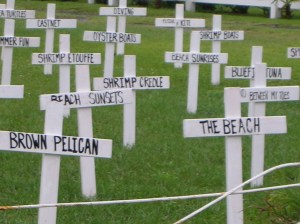 Republicans are busy today with their attempts to dismantle the EPA because, after all, they stop businesses from doing so much business, right? No reason told businesses back, is there? Those paragons of job creation and responsibility are just drowning in EPA regulation. Meanwhile, dead dolphins, drowning in BP oil continue to wash ashore down here in Louisiana. Ask me why I haven’t eaten anything from the Gulf for months now. Aren’t you glad Transocean had the best safety year evah?
The National Oceanic and Atmospheric Administration says that eight months after the Deepwater Horizon oil well was capped, dolphins are washing ashore in east Louisiana with some oil from that spilled on their bodies.
Spokeswoman Kim Amendola says the dolphins had spots of weathered oil.
Blair Mase — NOAA’s Gulf Coast stranding coordinator — emphasizes there’s no way yet to know why the dolphins died. She says the most recent dolphin bearing BP oil was found two weeks ago.
Mase says 15 dolphins with confirmed or suspected oil on their bodies washed ashore since the spill began last April — and eight had oil from that well, which was capped July 15.
I thought we got told that little miracle microbes ate it all. Get the feeling NOAA is covering up stuff again?
Related News:
Feds forbid scientists probing Gulf dolphin deaths from speaking to media
Dolphins accidentally drowned by scientists trawling in Gulf
The National Oceanic and Atmospheric Administration says federal scientists trawling for fish to test for possible damage from last year’s Gulf of Mexico oil spill accidentally caught and drowned three dolphins.
Spokeswoman Connie Barclay says the pantropical spotted dolphins were caught Wednesday by scientists on the NOAA research ship Pisces, which works out of Pascagoula, Miss.
She said Friday that NOAA is reviewing the incident and will conduct an enforcement investigation.
Here we go again x3: Oil Spills 3, New Drilling Permits 4
Posted: March 23, 2011 Filed under: Environmental Protection, Gulf Oil Spill | Tags: BP, deep water drilling, drilling permits, ecosystem restoration, Gulf Of Mexico, oil spills, wetlands 12 Comments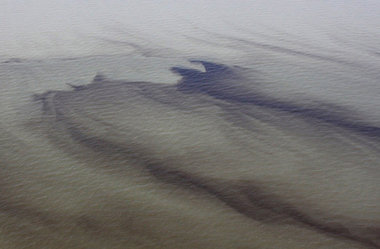 I just got a tweet from the National Wildlife Federation (NWF). This comes days after complaints that the government isn’t approving Gulf drilling permits quick enough. I should also mention that the Obama Administration has approved the fourth deep-water drilling permit since the BP oil gusher approximately one year ago. So, here’s information from the NWF where they are tracking THREE separate incidents in the Gulf right now.
At this point, we’re following what are likely three different incidents in the Gulf:
- Oil coming ashore west of the mouth of the Mississippi River near Grand Isle
- Reports of possible oil east of the mouth of the Mississippi in Chandeleur Sound
- A large amount of sediment mixed with a small amount of oil at the mouth of the Mississippi
The Times Picayune reports on the first oil occurring near beleaguered Grand Isle, LA and a Houston company has accepted responsibility for that one. TP also reports on the second oil sighting near the Chandeleur islands. That’s a picture of it at the top of the thread.
Coast Guard Petty Officer Steve Leeman said the Coast Guard had received no reports of oil-like material east of the river, but a group of environmentalists, engineers and scientists flew over Chandeleur Sound on Monday and Tuesday, and shared photographs and detailed descriptions with The Times-Picayune showing black, streaky plumes over a 20-mile stretch from just east of Quarantine Bay to just west of the shoal remains of Curlew Island.
While the oil industry whines it’s not getting to drill quickly enough, it’s becoming evident that their record of maintaining and inspecting existing rigs is pretty pathetic. Also, we’ve seen no push by the administration or any one in Congress to implement the recommendations of the National Commission on the Deepwater Horizon Oil Spill. Furthermore, BP is not living up to its obligations to deal with its damage to the wetlands done by the Deepwater Horizon Oil Spill. Louisiana’s congressional delegation has asked BP for $15 million to restore oyster beds and fisheries. Louisiana is ponying up $12 million of state funds to begin some kind of effort. BP is still supposedly cleaning up the damage still but has no projects active to restore wetlands.
BP set up the GCRO to deal with the spill. On Tuesday, the GCRO opened up its New Orleans office, in an effort to show they are still working on the oil spill.
“BP’s Gulf Coast Restoration Organization is really centered on four things,” Utsler said. “The first and foremost is continuing the completion of this response.”
Dan Favre is with the environmental advocacy “Gulf Restoration Network.” The group has a similar name to BP’s GCRO, but with a totally different take on the response.
“Unfortunately, the response is clearly lacking,” Favre said. “We’re coming up on the one-year memorial mark of the beginning of BP’s disaster here in the Gulf. And so it’s just crazy that there hasn’t been any action to actually start to repair the damage that’s been done.”
That is true, in part. BP set aside hundreds of millions of dollars for their restoration organization, but a year after the spill, only one of their restoration projects is so far underway.
“One of those is already in progress in Mississippi, in terms of wetland restoration,” Utsler said. “Other projects are in discussion in readiness for being approved and agreed to with NRDA [Natural Resource Damage Assessment] trustees, the states and ourselves to conduct.”
However, none of those projects is currently underway in Louisiana — arguably the state hardest hit by the spill. Utsler said they are working on a list of projects, with pending approval. Yet, some environmental groups believe the federal government needs to step in to move the restoration along.
“I don’t think we can leave it to BP to do it on their own accord,” Favre said. “I want to see Congress and the administration actually make BP pay for Gulf ecosystem restoration, by levying the maximum fines and penalties under the Clean Water Act and then allocating those resources directly to environmental restoration in the Gulf.”
It seems somewhat premature to allow these businesses continued access to drilling in the Gulf when they obviously haven’t maintained the rigs, inspected rigs for problems, and shown signs of good faith following damage to the ecosystem and people living in the Gulf. I think the administration should ask for implementation of the recommendations before allowing any more new permits. We also need to look for patterns of abuse so that operators with bad records are not allowed new permits. That’s just one shrimp lover’s opinion. But then, there’s Michelle Bachmann that wants to do away with the EPA and she’s a congress critter. Newt Gingrich–oil industry suck-up extraordinaire wants that too. I just want my seafood and vacations in warm Gulf Waters to be safe again.
Oh, and honk if you’ve seen or read any of this on MSM from the village.
Monday Reads
Posted: March 21, 2011 Filed under: collective bargaining, Economy, Farming, financial institutions, Foreign Affairs, Global Financial Crisis, Gulf Oil Spill, Japan, Libya | Tags: bubbles, Fukushima, ghadafi, greenspan, oil spill, recovery, REITS 57 Comments Good Morning!
I’m finishing up a paper today that’s off to be published on Real Estate Investment Trusts (REITS). Don’t worry! I won’t bore you with the details but it’s basically about locating speculation bubbles like the one that happened in real estate markets in the 2000s. There were a lot of folks that made money off of that ride although most of us little guys lost a lot. The reason I’m bringing it up is that my first read of the day is a Paul Krugman response to Allan Greenspan’s critique of Obama’s economic policy. I just wanted to remind you of what a mess the first part of the century has been and that many of the pots and the kettles still appear to be confused about their true nature. I mean, the entire mess has given me a great research agenda, but at what cost?
Greenspan’s tut tuts Obama’s ability to create economic chaos in the academic journal International Finance (pdf here). While most of us are still trying to figure out what went so horribly wrong, Greenspan is trying to pin the blame on the new guys. I’m going to quote his abstract because it’s just more of the same old same old from one of the beasts that brought us to this mess and its worth the bask in the arrogance to just remember his access to power. Greenspan says it’s too much government regulation and Obma activism that’s hampering the recovery and that he can prove it with bad, outdated statistical methods. This comes from the man that gave Wall Street a lot of cheap money and no regulation so they could go hog wild. The recovery may be tepid, the stock market may be recovering, but I’ll be damned if there’s any regulation left standing upon which he can float his argument. Oh, Krugman dismisses the methods by which Greenspan infers that it’s government activism and its inherent chaos that’s created a stale recovery. To be honest, a first year doctoral student would use better methodology and know the literature better. That really scares me, frankly. What did he do while at the Fed? Reread The Fountainhead?
So, here’s the bubblemeister’s blowing you know what up you know where with techniques that wouldn’t get me published in a mimeographed neighborhood newsletter let alone International Finance. Why hasn’t this man retired to an island somewhere?
The US recovery from the 2008 financial and economic crisis has been disappointingly tepid. What is most notable in sifting through the variables that might conceivably account for the lacklustre rebound in
GDP growth and the persistence of high unemployment is the unusually low level of corporate illiquid long-term fixed asset investment. As a share of corporate liquid cash flow, it is at its lowest level since 1940.This contrasts starkly with the robust recovery in the markets for liquid corporate securities. What, then, accounts for this exceptionally elevated level of illiquidity aversion? I break down the broad potential sources, and analyse them with standard regression techniques. I infer that a minimum of half and possibly as much as three-fourths of the effect can be explained by the shock of vastly greater uncertainties embedded in the competitive, regulatory and financial environments faced by businesses since the collapse of Lehman Brothers, deriving from the surge in government activism. This explanation is buttressed by comparison with similar conundrums experienced during the 1930s. I conclude that the current government activism is hampering what should be a broadbased robust economic recovery, driven in significant part by the positive wealth effect of a buoyant U.S. and global stock market.
So, here’s Paul Krugman with ‘Rantings of an Ex-Maestro’.
He’s no longer the Man Who Knows; he’s the man who presided over an economy careening to the worst economic crisis since the Great Depression — and who saw no evil, heard no evil, refused to do anything about subprime, insisted that derivatives made the financial system more stable, denied not only that there was a national housing bubble but that such a bubble was even possible.
If he wants to redeem himself through hard and serious reflection about how he got it so wrong, fine — and I’d be interested in listening. If he thinks he can still lecture us from his pedestal of wisdom, he’s wasting our time.
Brad Delong actually does some analysis over at his blog Grasping Reality.
I don’t see how this hangs together in any coherent fashion at all.
If businesses are unwilling to invest in illiquid capital out of the fear that government action will impair the value of their investments, businesses must also fear that government action will impair the value of their existing illiquid investments. What is the value of their existing illiquid investments? The value of their existing illiquid investments is nothing more than the stock market value of their companies–liquid stock market value is, in the last analysis, nothing more than the cash flows proceeding from the illiquid investments that companies have made that generate the profits.
A much better and more sensible explanation for the relatively high value that the stock market places on existing illiquid corporate assets and the relatively low value that companies place on illiquid investments to expand their fixed capital is precisely that capacity utilization is low–so why spend more money now building factories when doing so would be more expensive and only add to your idle capacity?
And, indeed, if you ask people running businesses what is their single most important problem, they say that it is not (as they sometimes say it is) taxes; they say that it is not (as they said it was at the start of 2000) the cost and quality of labor; it is not (as they said it was in 2004) the availability and cost of insurance; it is not (as they briefly said it was at the start of 1993) government requirements. What do they say their biggest problem is? Poor sales.
Yup, it’s pretty basic. You gotta have customers and those customers gotta have jobs and decent paychecks. That’s the problem right now.

 peej
peej Carissa
 bostonboomer
 dakinikat
 ecocatwoman
 mablue2
 Mama Lopez
 peggysue22
 quixote
 skydancingguestblogger
 Mona (aka Wonk the Vote)



 Sky Dancing
Recent Comments