
Friday Reads: For Whom the Wheels of Justice Roll
Posted: September 5, 2014 Filed under: Gulf Oil Spill, Injustice system, legislation, morning reads 32 CommentsGood Morning!
Is it just me or is there like a maximum amount of weirdness going on right now? I’m going to start with some local ongoing trauma. BP Oil has ruined so much of the ecosystem down here–much of it still dying and unclean–that it’s hard to believe that any one could stand up in front of judge and say something to the effect of it wasn’t as bad as an “apocalypse”. Everything the oil and gas and chemical industries do down here creates complete havoc with life, the ecosystem, the locals, and a unique way of life. Unfortunately, our politicians own their souls to the company store and the money enriches a small group of the greedy. This recent lawsuit was righteous but the comments by BP lawyers are worth exposing. Oysters are going extinct. There are a lot of health problems. The wildlife continues to wash up on the beach, dead and extremely malformed. Family businesses are devastated and not recovering. I guess if you don’t have to live with the aftermath, it doesn’t exist for you.
News of this morning’s federal court decision against BP broke as I was aboard a 40-foot oyster boat in the Louisiana delta, just off the coast of Empire, a suburb of New Orleans.
The reaction: stunned silence. Then a bit of optimism.
“This is huge,” said John Tesvich, chair of the Louisiana Oyster Task Force, his industry’s main lobby group in the state. “They are going to have to pay a lot more.” Standing on his boat, the “Croatian Pride,” en route to survey oyster farms, he added: “We want to see justice. We hope that this money goes to helping cure some of the environmental issues in this state.”
On Thursday, a federal judge in New Orleans found that the 2010 Gulf of Mexico disaster—in which the Deepwater Horizon oil rig exploded, killing 11 people and spilling millions of barrels of oil into the Gulf—was caused by BP’s “willful misconduct” and “gross negligence.”
Tesvich says he’s seen a drastic decline in his company’s oyster production since then—company profits down 15 to 20 percent and oyster yields slashed by 30 percent. He says he’s suspicious that this new decision will force the kind of action from local politicians needed to clean up the Gulf once-and-for-all. The politicians in Louisiana, he says, “haven’t been the best environmental stewards.”
BP’s own reaction to the news has been fast and pointed. “BP strongly disagrees with the decision,” the company said in a statement on Thursday, published to its website. “BP believes that an impartial view of the record does not support the erroneous conclusion reached by the District Court.”
The company said it would immediately appeal the decision.
“It’s clear that the apocalypse forecast did not come to pass,” said a BP official.With the fourth anniversary of the busted well’s final sealing coming up in a couple weeks, BP has been pushing back aggressively against the company’s critics. On Wednesday night—just hours before the court’s ruling—Geoff Morrell, the company’s vice president of US communications, spoke in New Orleans at the Society of Environmental Journalists conference, and blamed the media and activists for BP’s rough ride.
The company’s efforts to clean up the spill have been obscured, he said, by the ill-intentioned efforts of “opportunistic” environmentalists, shoddy science, and the sloppy work of environmental journalists (much to the chagrin of his audience, hundreds of environmental journalists).
“It’s clear that the apocalypse forecast did not come to pass,” he said. “The environmental impacts of the spill were not as far-reaching or long-lasting as many predicted.”
Back in 2010, BP’s then-CEO Tony Hayward lamented—a month after the explosion—that he wanted his “life back.” He didn’t find much sympathy at the time. Within a couple months, he resigned out of the spotlight (with a $930,000 petroleum parachute). But his flub didn’t retire so easily, and it became emblematic of BP’s astonishing capacity for tone-deafness, something Morrell seemed intent on continuing Wednesday.
Morrell said that while “impolitic” remarks had been made by BP officials in the past, the spill’s aftermath has been “tough on all of us.”
 We’re not holding our breath that if and when the money gets here, it will be used to restore the gulf, clean up the mess, and help the people and animals whose lives have been devastated. Why you ask? Bobby Jindal has been fighting to keep the social costs created by this dirty and reckless industry away from those liable. He’s also got an interesting connection to the law firm that represents BP. His brother works there.
This is about yet two more examples of how Gov. Bobby Jindal conveniently manages to look the other way instead of being up front when confronted with issues that most might believe could present a conflict of interest
When Jindal signed SB 469 into law on Friday he not only killed the pending lawsuit against 97 oil, gas and pipeline companies by the Southeast Louisiana Flood Protection Authority-East (SLFPA-E) but he also placed in extreme jeopardy the claims by dozens of South Louisiana municipalities and parish governments from the disastrous 2010 BP Deepwater Horizon spill that killed 11 men and discharged 5 million barrels of oil into the Gulf of Mexico, spoiling beaches and killing fish and wildlife.
By now, most people who have followed the bill authored by Sen. Bret Allain (R-Franklin) but inspired by Sen. Robert Adley (R-Benton) know that big oil poured money and thousands of lobbying man hours into efforts to pass the bill with its accompanying amendment that makes the prohibition against such lawsuits retroactive to ensure that the SLPFA-E effort was thwarted.
Most followers of the legislature and of the lawsuit also know that up to 70 legal scholars, along with Attorney General Buddy Caldwell, strongly advised Jindal to veto the law because of the threat to the pending BP litigation.
Altogether, the 144 current legislators received more than $5 million and Jindal himself received more than $1 million from oil and gas interests. Allain received $30,000 from the oil lobby and Adley an eye-popping $600,000.
So, when BP lobbyists began swarming around the Capitol like blow flies buzzing around a bloated carcass, the assumption was that BP somehow had a stake in the passage of SB 469 and that infamous amendment making the bill retroactive.
John Barry, a former SLFPA-E who was given the Jindal Teague Treatment but who stuck around to pursue the lawsuit, said, “During the last few days of the session, we were very well aware that the BP lobbyists were extraordinarily active. They were all over the place. We all assumed there was definitely something it in for them.”
Something in it for them indeed.
Russel Honore said it another way, observing wryly that the Exxon flag still flies over the State Capitol.
Blogger Lamar White, Jr. observed that former Gov. Edwin Edwards spent eight years in a federal prison for accepting payments from hopeful casino operators for his assistance in obtaining licenses—all after he left office. New Orleans Mayor Ray Nagin was similarly convicted of using his position to steer business to a family-owned company and taking free vacations meals and cell phones from people attempting to score contracts or incentives from the city.
So what is the difference between what they did and the ton of contributions received by Adley and Jindal? To paraphrase my favorite playwright Billy Wayne Shakespeare, a payoff by any other name smells just as rank.
And while big oil money flowed like liquor at the State Capitol (figuratively of course; it’s illegal to make or accept campaign contributions during the legislative session), what many may not know is that Jindal may have had an ulterior motive when he signed the bill into law against sound legal advice not to do so, thus protecting the interests of big oil over the welfare of Louisiana citizens who have seen frightening erosion of the state’s shoreline and freshwater marshes.
The Washington, D.C., law firm Gibson, Dunn & Crutcher is one of the firms that represented BP in negotiating a $4.5 billion settlement that ended criminal charges against the company. Included in that settlement amount was a $1.26 billion criminal fine to be paid over five years.
An associate of Gibson, Dunn & Crutcher who has defended clients in government audit cases and in several whistleblower cases is one Nikesh Jindal.
He also is assigned to the division handling the BP case.
Nikesh Jindal is the younger brother of Gov. Piyush, aka Bobby Jindal.
Still, the US District Court found BP “grossly negligent”. Eleven people were killed. Oil gushed into the Gulf destroying the economy, wildlife, and the delicate ecosystem. “Gross negligence” can mean a lot of dollars. Halliburton and  Transocean have been cleared of gross negligence but they’re still paying fines. BP could be paying out billions of dollars.
BP Plc acted with gross negligence in setting off the biggest offshore oil spill in U.S. history, a federal judge ruled, handing down a long-awaited decision that may force the energy company to pay billions of dollars more for the 2010 Gulf of Mexico disaster.
U.S. District Judge Carl Barbier held a trial without a jury over who was at fault for the catastrophe, which killed 11 people and spewed oil for almost three months into waters that touch the shores of five states.
“BP has long maintained that it was merely negligent,” said David Uhlmann, former head of the Justice Department’s environmental crimes division. He said Barbier “soundly rejected” BP’s arguments that others were equally responsible, holding “that its employees took risks that led to the largest environmental disaster in U.S. history.”
The case also included Transocean Ltd. (RIG) and Halliburton Co. (HAL), though the judge didn’t find them as responsible for the spill as BP. Barbier wrote in his decision today in New Orleans federal court that BP was “reckless,” while Transocean and Halliburton were negligent. He apportioned fault at 67 percent for BP, 30 percent for Transocean and 3 percent for Halliburton.
U.K.-based BP, which may face fines of as much as $18 billion, closed down 5.9% to 455 pence in London trading.
“The court’s findings will ensure that the company is held fully accountable for its recklessness,” U.S. Attorney General Eric Holder said. “This decision will serve as a strong deterrent to anyone tempted to sacrifice safety and the environment in the pursuit of profit.”
Quite a few politicians are also having a day in court and it’s not turning out well for them. Former New Orleans Ray Nagin has declared indigency and asked for a public defender to handle his appeal. The former first lady and Governor of Virginia were stunned to be found guilty a multiple accounts of grifting. Robert McConnell was found guilty of 11 of 14 counts of public corruption. His wife is going down for eight counts. The reaction in the courtroom by the first couple and their cronies was melodramatic. It took the jury 3 days to reach a decision. Will Texas Governor Rick Perry be next for an orange suit in Federal Facility?
A federal jury on Thursday found former Virginia governor Robert F. McDonnell and his wife, Maureen, guilty of public corruption — sending an emphatic message that they believed the couple sold the office once occupied by Patrick Henry and Thomas Jefferson to a free-spending Richmond businessman for golf outings, lavish vacations and $120,000 in sweetheart loans.
After three days of deliberations, the seven men and five women who heard weeks of gripping testimony about the McDonnells’ alleged misdeeds unanimously found that the couple conspired to lend the prestige of the governor’s office to Jonnie R. Williams Sr. in a nefarious exchange for his largesse.
The verdict means that Robert McDonnell, the first governor in Virginia history to be charged with a crime, now holds an even more unwanted distinction — the first to be convicted of one.
He and his wife face decades in federal prison, although their actual sentences will likely fall well short of that. U.S. District Judge James R. Spencer set a sentencing hearing for Jan. 6.
The former governor, a onetime Republican rising star considered for the 2012 vice presidential nomination, was convicted of all 11 corruption-related counts brought against him. In a small victory, he was acquitted of lying on loan documents.
The former first lady was convicted of eight corruption-related charges and an additional count of obstruction of justice. She, too, was acquitted of falsifying a bank record.
The verdict was read aloud in front of a courtroom packed with reporters and supporters of the former first couple. When the clerk announced that the former governor had been found “guilty” of the first of 14 counts the couple faced, Robert McDonnell, 60, closed his eyes tightly, shaking in his seat as he began to weep.
 I guess the “bitch” made me do it isn’t an effective defense after al
Judges and juries were busy all over the country.
A Federal Court granted an injunction restoring early voting in Ohio. Republican governors have been busy trying to cut down access to voting in fear of turnout by minorities and single ladies who still hate rule by neoconfederate overseers.
I have now had a chance to give an initial read the 71-page federal district court opinion in Ohio State Conference of the NAACP v. Husted. This is a significant case, which could potentially make it to the Supreme Court. It expands voting rights in a broad way, and makes it difficult for a state like Ohio to cut back on any expansions of voting rights that it puts in place. The big question is where the stopping point is in a decision like this, and how to justify calling it unconstitutional for a state like Ohio to make a modest cutback in early voting while allowing many other states to offer no early voting at all.
Here are my preliminary thoughts.
1. This is the latest in a series of cases challenging Ohio cutbacks in early voting. The challenges are before the same federal district court judge in Ohio, Peter Economus, as earlier challenges, including a challenge which led to the restoration of early voting during the 2012 election. Judge Economus tangled with Ohio SOS Husted before, leading to potential calls for Husted to be cited for contempt. It is therefore no surprise that Judge Economus sided against Husted again in this latest challenge.
2. The theory in the earlier Ohio early voting case (Obama for America v. Husted) is different than the theory in the current case. In the last case, the question was whether Ohio could cut back on early voting for all voters EXCEPT for certain military and overseas voters in the period just before the election. The district court, affirmed by the Sixth Circuit, said that these special rules for just a subset of voters violated equal protection. (I had thought the Supreme Court might get involved in this case, but the Court did not.)
3. This case does not raise issues of different voting rules for different classes of voters. In fact, the dispute here arises from the issue of uniformity. The Ohio legislature cut back from 35 to 28 days of early voting, in the process eliminating “Golden Week,” a week where new (or reregistering voters) could register to vote and vote early during the same period. In conjunction with rules establishing uniformity of early voting times established by SOS Husted, the new early voting times eliminated night voting as well as Sunday voting before election day. That day was used by some African-American churches for a “Souls to the Polls” voter drive event. All Ohio voters remain able to vote by mail without excuse, for the 30 days before the election. The NAACP and others argued that the cutbacks in early voting and the elimination of Golden Week violated both equal protection guarantees of the U.S. Constitution and Section 2 of the Voting Rights Act.
4. The judge found as a matter of fact (crediting expert reports of the plaintiffs’ especially that of U. Florida’s Dan Smith) that the cutbacks in early voting would disproportionately fall on African-Americans. The judge found that early voters, especially in the larger population areas of the state, included a large portion of the state’s share of African-American voters. The judge also found that African-American voters were distrustful of absentee balloting as an alternative to in person voting, and that absentee balloting was more burdensome (filling out the materials, postage, mailing, etc.)
You can follow the links to the additional analysis on the case. It could be headed to the White Male/Uncle Thomas Overseers at SCOTUS shortly.
A Federal Appeals court has withdrawn the decision defunding the AHCA. 
In July, two Republican judges on the United States Court of Appeals for the District of Columbia Circuit handed down a decision defunding much of the Affordable Care Act (ACA). This effort to implement Sen. Ted Cruz’s (R-TX) top policy priority from the bench waswithdrawn on Thursday by the DC Circuit, and the case will be reheard by the full court — a panel that will most likely include 13 judges. In practical terms, this means that July’s judgment cutting off subsidies to consumers who buy insurance plans in federally-operated health exchanges is no more. It has ceased to be. It is, in fact, an ex-judgment.
The reason why this matters is because the plaintiffs in this lawsuit, known as Halbig v. Burwell, are hustling to try to convince the GOP-dominated Supreme Court to hear this case, where they no doubt believe that they have a greater chance of succeeding than in the DC Circuit, as a majority of the active judges in the DC Circuit are Democrats. The Supreme Court takes only a tiny fraction of the cases brought to their attention by parties who lost in a lower court — a study of the Court’s 2005 term, for example, found that the justicesgranted a full argument to only 78 of the 8,517 petitions seeking the high Court’s review that term. The justices, however, are particularly likely to hear cases where two federal appeals courts disagree about the same question of law.
Two hours after the divided DC Circuit panel released its opinion attempted to defund Obamacare, a unanimous panel of the Fourth Circuit upheld the health subsidies that are at issue in Halbig. Thus, so long as both decisions remained in effect, Supreme Court review was very likely. Now that the full DC Circuit has vacated the two Republican judges’ July judgement, Supreme Court review is much less likely.
Although it is possible that the full DC Circuit could agree with the two judges who voted to cut off health subsidies to millions of Americans, this outcome is unlikely. The plaintiffs’ arguments in this case are weak and are unlikely to move judges who do not have a partisan stake in undermining the Affordable Care Act.
The litigants seeking to undermine Obamacare through this lawsuit — Oklahoma Attorney General Scott Pruitt (R), who filed a brief supporting the plaintiffs in this case, admitted in aWall Street Journal op-ed that the purpose of this lawsuit is to cause “the structure of the ACA” to “crumble” — waged a two front effort trying to convince the full DC Circuit not to vacate their two GOP colleagues’ decision.
Meanwhile marriage equality took a few more steps forward and one step back. Guess whose state provided the step back?
Proponents of equal marriage rights have had a lot to celebrate over the last year, with a series of victories nationwide in state and federal district courts. And while those successes matter a great deal, and have advanced the cause of civil rights at a pace few thought possible, the legal fights at the federal appellate level are just as important, if not more so.It makes rulings like these so striking.A U.S. appeals court on Thursday struck down gay marriage bans in both Wisconsin and Indiana, adding to a rush of major victories for the marriage equality movement in the last year alone.Now that a three-judge panel in Chicago’s 7th Circuit Court of Appeals has ruled unanimously that both Midwestern marriage bans were unconstitutional, a total of 21 states recognize marriage for same-sex couples.In his ruling, which is available online here (pdf), Judge Richard Posner, a Reagan appointee, wrote. “The discrimination against same-sex couples is irrational, and therefore unconstitutional even if the discrimination is not subjected to heightened scrutiny, which is why we can largely elide the more complex analysis found in more closely balanced equal-protection cases.”The ruling, a key breakthrough for supporters of same-sex marriage, does not come as too big of a surprise. Just last week, the attorneys arguing against marriage equality faced a barrage of very toughquestions, which they struggled badly to answer.Indeed, as Chris Geidner reported, Posner referred to arguments from Indiana Solicitor General Thomas Fisher, whose job it was to defend the anti-gay laws, as “pathetic,” “ridiculous,” and “absurd.”Naturally, then, the 7th Circuit concluded today, “The challenged laws discriminate against a minority defined by an immutable characteristic, and the only rationale that the states put forth with any conviction – that same-sex couples and their children don’t need marriage because same-sex couples can’t produce children, intended or unintended – is so full of holes that it cannot be taken seriously.”Ouch.
Eric Holder held a presser in St Louis today to discuss the investigation of the Ferguson Police and other investigations. I’m hoping this helps them. I still distrust the NOPD and don’t believe anything they say so if the people of Ferguson feel like I do, it will be a pancea waiting for proof.
Attorney General Eric Holder on Thursday opened a broader civil rights investigation of the practices and procedures of the Ferguson Police Departmentin the wake of the Aug. 9 shooting death of Michael Brown, 18, by Ferguson police Officer Darren Wilson.
The Civil Rights Division will investigate whether Ferguson police have engaged in a pattern of civil rights violations, Holder said.
The attorney general also announced that the Justice Department has begun what he called a partnership with the St. Louis County Police Department to assess the county department’s response to the demonstrations that followed the shooting.
The investigation of Ferguson police will include the department’s use of force, traffic stops, searches and arrests, Holder said, adding that Ferguson officials welcomed the inquiry and pledged their cooperation. Justice Department officials said there is no timeline on the length of the investigation, and that it would depend on the cooperation of local authorities.
The goal, Holder said, is to reach an agreement with the department that would establish new tactics to eliminate bias and increase community confidence in the department.
Holder pledged a “fair, thorough investigation” that would result in “lasting, positive change.”
So, that’s some of the news from the justice front. What’s on your reading and blogging list today?
Who Can be Trusted with Infrastructure? Certainly not for-profits …
Posted: April 6, 2013 Filed under: corporate greed, corporatism, Gulf Oil Spill, We are so F'd | Tags: infrastructure failure, New Orleans, oil spills 15 Comments The one thing that has become apparent to me recently is that privatizing anything related to important infrastructure is a recipe for one disaster after another. For-profit corporations are into maximizing profits to owners by either slashing costs or hiking prices. They rarely do anything that actually improves service or delivery quality. When you experience any kind of disaster that taxes the infrastructure, you learn quickly how negligent for-profits are when it comes to maintaining or fixing infrastructure. My reality since Hurricane Katrina is living with infrastructure that comes and goes on a windy day, on a drizzly day, on any kind of day that might cause our privately owned electric and natural gas company’s patched together infrastructure to hiccup. We get power outages at the super bowl, in my home, and in our water treatment plant. I’ve experienced two boil water orders in the last six months and dozens of electric outages for days on end. Cox cable’s infrastructure is just about as bad. They patch things up when they have to do it. I’ve heard excuses about hungry squirrels, curious racoons, and unusual wind events to the point I could just scream.
Then, there’s these oil pipe disasters. Why on earth would you trust an oil company with any kind of pipe line given their obvious neglect? There is a THIRD major oil spill in a week. This time it is in Texas.
Thousands of gallons of oil have spilled from a pipeline in Texas, the third accident of its kind in only a week.
Shell Pipeline, a unit of Royal Dutch Shell Plc, shut down their West Columbia, Texas, pipeline last Friday after electronic calculations conducted by the US National Response Center showed that upwards of 700 barrels had been lost, amounting to almost 30,000 gallons of crude oil.
By Monday, Shell spokespeople said inspectors found “no evidence” of an oil leak, but days later it was revealed that a breach did occur. Representatives with the US Coast Guard confirmed to Dow Jones on Thursday that roughly 50 barrels of oil spilled from a pipe near Houston, Texas and entered a waterway that connects to the Gulf of Mexico.
Coast Guard Petty Officer Steven Lehman said that Shell had dispatched clean-up crews that were working hard to correct any damage to Vince Bayou, a small waterway that runs for less than 20 miles from the Houston area into a shipping channel that opens into the Gulf.
The spill was contained, said Lehman, who was hesitant to offer an official number on how much crude was lost in the accident. According to Shell spokeswoman Kim Windon, though, the damage could have been quite significant. After being presented with the estimate that said as much as 700 barrels were found to have leaked from the pipeline due to an unknown cause, investigators determined that 60 barrels entered the bayou.
“That’s a very early estimate–things can change,” Officer Lehman told Dow Jones.
Meanwhile, though, rescue works in Arkansas have been getting their hands dirty responding to an emergency there. A rupture in ExxonMobil’s Pegasus pipeline late last week send thousands of barrels of oil into the small town of Mayflower, around 25 miles outside of Little Rock. Authorities evacuated more than 20 homes in response, and by this Thursday roughly 19,000 barrels had been recovered.
Mayflower, Ark is still fighting the sludge and will likely be doing so for some time.
We tend to think of oil spills on a massive scale, so large they are hard to imagine. Millions of barrels of crude pouring into the Bering Sea from the slashed hull of the Exxon Valdez. Tens of thousands of workers and volunteers combing hundreds of miles of Gulf Coast beaches after the Deep Water Horizon spill. But in Mayflower, Ark., the scale of an oil spill there is disturbing not for its size, but its proximity. On March 29, a 20-inch buried pipeline burst under the small town, turning backyards into tar pits and suburban streets into oil slicks.
This will probably be yet another part of our new reality given the age of pipelines–around 70 years old–and the continued negligence of oil companies who continue to make record profits and enjoy stupendous tax breaks in this country.
Wanna another weird example of infrastructure failure?
Residents of Washington, DC are used to jokes about metaphorical hot air, humidity, and the swampy history of their city. But there’s something they may not know about the District: it’s overrun with methane, which sometimes makes manhole covers explode.
Natural gas is mostly methane, and it is carried through underground pipes to heat buildings and cook food. Those pipes are often old, and this led ecologist and chemical engineer Robert Jackson of Duke University to drive around DC over a period of two months, regularly measuring the air to take methane levels.
He and his research team found methane leaks everywhere, with thousands of places having significantly higher than normal methane concentrations, and some places reaching 50 times normal urban levels (100 ppm vs 2 ppm). A similar study in Boston last year found essentially the same results. In DC, the source wasn’t the swamp on which the city was built — it was fossil fuel. (The methane they measured had more carbon-13 rather than the normal, modern carbon-12.)
You can laugh about this but I’ve actually seen exploding manhole covers in action. I was gigging at Balconies restaurant down in the French Quarter. The piano was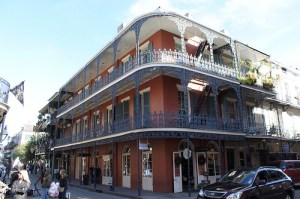 situated under a window and the restaurant–now defunct–was located in a building on the 600 block of Royal. It’s a really famous intersection and the building is one of those that gets photographed all the time. The window is basically to the left of the open door where they black car is passing the building. Mule drawn carriages would stop there frequently to listen to me play and to have a cocktail or cafe au lait brought out for the occupents. Anyway, one night, after a series of exploding man hole covers had been shutting down the electricity in the Quarter, one of them in the middle of this street took off like a cannon and sliced through the top part of a car right before my eyes. Of course, the electricity went off in the area and shut down the grocery across the street, the restaurants and everything in that locale. But, I’ll tell you, that manhole cover was an unbelievable projectile. Oh, it of course, the natural gas in town is Entergy-controlled. The other thing I recall was the distinct smell of ozone burning up and the wierdish green light show. This was about 15 years ago, but damn, I will never forget watching the roof of a hard top car get sliced off like a piece of salami. It’s been fixed now since the city doesn’t tolerate anything being wrong in the French Quarter, but for about 3 months of the summer 1996, it was a wild trip with a series of exploding manhole covers and black outs. It was also the same summer I got Karma so, who knows. Maybe it was just one of those summers.
Anyway, after having lived in a city where levees failed us and electricity fails us all the time, I would just like to say that no private corporation should be left on its own with unmonitored vital infrastructure. All kinds of things are at stake. Also, you can’t trust any oil company to do right by any one but themselves after a spill. I have experience in that area too.
BP Will Pay Record Settlement to Louisiana
Posted: November 15, 2012 Filed under: Breaking News, Gulf Oil Spill | Tags: BP Oil, settlement 29 Comments The Justice Department has announced a $4.5 billion dollar settlement in the BP oil spill that includes a number of very interesting things. This includes criminal indictments against two BP workers.
Two BP employees have been indicted on manslaughter charges in the 2010 Gulf oil spill disaster.
The federal indictment unsealed Thursday in New Orleans names BP well site leaders Robert Kaluza and Donald Vidrine. The indictment claims they acted negligently in their supervision of key safety tests performed on the Deepwater Horizon drilling rig before an explosion killed 11 workers in April 2010.
The indictment says Kaluza and Vidrine failed to phone engineers onshore to alert them of problems in the drilling operation.
The charges come on the same day that BP announced that it has agreed to pay $4.5 billion in a settlement with the U.S. government to plead guilty to felony counts related to the deaths of 11 workers and lying to Congress.
Also Thursday, BP said it will pay $4.5 billion in a settlement with the U.S. government over the the spill.
BP has also pleaded guilty to other criminal charges.
BP will pay approximately $4.5 billion and plead guilty to criminal charges as part of a settlement with the U.S. government over the deadly Deepwater Horizon rig explosion and massive oil spill in the Gulf of Mexico in 2010, the London-based oil giant said Thursday.
The settlement total, to be paid out over five years, includes $1.25 billion in criminal fines — the largest such penalty ever.
In addition, a BP executive has been indicted on charges he lied to authorities about his work estimating the Gulf spill rate and two BP employees have been indicted on manslaughter charges, The Associated Press reported.
U.S. Attorney General Eric Holder and other federal officials were expected to comment on the wide-ranging settlement later Thursday at a news conference in New Orleans.
BP said it would plead guilty to 11 felony counts of misconduct or neglect relating to the death of 11 workers, one misdemeanor count under the Clean Water Act, one misdemeanor count under the Migratory Bird Treaty Act, and one felony count of obstruction of Congress.
This indictment is the one I find most interesting.
Separately, a federal indictment unsealed Thursday charges David Rainey, who was BP’s vice president of exploration for the Gulf of Mexico, on charges of obstruction of Congress and false statements, the AP reported. He is accused of lying to federal investigators when they asked him how he calculated a flow rate estimate for BP’s blown-out well in the days after the disaster.
This obstruction charge has to do with the way they calculated the gusher rate. This is a separate settlement from the suit settled in March that had to do with individuals impacted by the oil spill. This is a huge settlement. None of these fines will be tax deductible.
The day of reckoning comes more than two years after the nation’s worst offshore oil spill. The figure includes nearly $1.3 billion in criminal fines – the biggest criminal penalty in U.S. history – along with payments to certain government entities.
“We believe this resolution is in the best interest of BP and its shareholders,” said Carl-Henric Svanberg, BP chairman. “It removes two significant legal risks and allows us to vigorously defend the company against the remaining civil claims.”
The settlement, which is subject to approval by a federal judge, includes payments of nearly $2.4 billion to the National Fish and Wildlife Foundation, $350 million to the National Academy of Sciences and about $500 million to the Securities and Exchange Commission. The SEC accused BP of misleading investors by lowballing the amount of crude spewing from the ruptured well.
London-based BP said in a statement that the settlement would not cover any civil penalties the U.S. government might seek under the Clean Water Act and other laws. Nor does it cover billions of dollars in claims brought by states, businesses and individuals, including fishermen, restaurants and property owners.
A federal judge in New Orleans is weighing a separate, proposed $7.8 billion settlement between BP and more than 100,000 businesses and individuals who say they were harmed by the spill.
This settlement ought to go a long way to boost the economy of coastal Louisiana and to restore the ecosystems. It’s about time. However, this doesn’t end things.
Stuart Smith, a Louisiana lawyer representing some of the businesses affected by the accident, told the BBC the deal was far from over.
“They have not settled with the state of Louisiana for the natural damages… they haven’t settled with Florida, Alabama [or] Mississippi yet.”
He added that there were other significant claims still to be settled, including offshore oil and gas industry damages as a result of the moratorium on deepwater drilling put in place after the accident, casino losses, fisheries, financial institutions and real estate developers.
“So I think they’re still looking at billions of dollars in exposure even with this settlement,” he said.
I hope the long term effects of the spill continue to siphon money from BP. We have yet to see the biggest health effects and there are still many issues remaining at the bottom of the gulf impacting our wildlife and the entire set of plants and sealife that support the many many birds, animals, fish and reptiles that call the gulf home. I still haven’t put a toe in the Gulf and I’m very cautious about eating Gulf Seafood. This has really changed every one’s life down here and they should pay and pay and pay and pay …
Friday Reads: Two Years Gone and where has all the Sealife Gone?
Posted: April 20, 2012 Filed under: Gulf Oil Spill, health hazard, morning reads | Tags: BP, dead dolphins, mutant fish, oil spill, pollution, seafood, sick people 31 Comments Good Morning!
This Morning Reads will have a theme. Two years ago the Gulf was oozing nasty, icky, oil. Like Hurricane Katrina, it’s an event that’s changed our lives down here in ways that are hard to explain and share. We’ve not fully recovered from either of these events. That’s not exactly what the Oil, the seafood, or the tourist industry wants any one to tell you. It’s not what state, local, and federal governments and agencies want you to know either.
But there it is. There is still devastation. There are huge problems. The folks that created the problems are not being held to account.
The stories I will share are human, animal, vegetable, and mineral. The BP Spill turned an entire ecosystem and way of living inside out. It’s being covered up by smiling people inviting you to our Gulf Coast Cities and Beaches in ads. It’s being hidden behind pictures of big heaping plates of staged seafood buffets. What’s hidden behind the ads and the promos is disturbing science, economics, medicine, and social upheaval. Here’s somethings you may want to know from our local news stations, scientists, and doctors.
From wusf News: Two Years after the BP Oil Spill: The Oil You Cannot See
On some Florida Panhandle beaches, swimmers can come off the beach with oil from the BP oil spill still on their skin — two years after that environmental disaster.
And, even after showering, the oil can still be on their skin. Only an ultraviolent light can show it.
Tampa Bay Times environmental reporter Craig Pittman says that’s because leaked oil, mixed with chemical dispersant sprayed on the spill two years ago to break it up, is pooling in some shallow waters of Panhandle beaches.
And the mixture actually accelerates absorption by human skin. Seen under the ultraviolet light, it’s kind of creepy.
From The Nation: Investigation: Two Years After the BP Spill, A Hidden Health Crisis Festers
n August 2011 the Government Accountability Project (GAP) began its investigation of the public health threats associated with the oil spill cleanup, the results of which will be released this summer. “Over twenty-five whistleblowers in our investigation have reported the worst public health tragedies of any investigation in GAP’s thirty-five-year history,” Shanna Devine, GAP legislative campaign coordinator, told me.
Witnesses reported a host of ailments, including eye, nose and throat irritation; respiratory problems; blood in urine, vomit and rectal bleeding; seizures; nausea and violent vomiting episodes that last for hours; skin irritation, burning and lesions; short-term memory loss and confusion; liver and kidney damage; central nervous system effects and nervous system damage; hypertension; and miscarriages.
Cleanup workers reported being threatened with termination when they requested respirators, because it would “look bad in media coverage,” or they were told that respirators were not necessary because the chemical dispersant Corexit was “as safe as Dawn dishwashing soap.” Cleanup workers and residents reported being directly sprayed with Corexit, resulting in skin lesions and blurred eyesight. Many noted that when they left the Gulf, their symptoms subsided, only to recur when they returned.
According to the health departments of Louisiana, Mississippi and Alabama, from June to September 2010, when they stopped keeping track, more than 700 people sought health services with complaints “believed to be related to exposure to pollutants from the oil spill.” But this is likely an extreme undercount, as most people did not know to report their symptoms as related to the oil spill, nor did their physicians ask. Like virtually everyone I have interviewed on the Gulf Coast over the past two years—including dozens for this article—Nicole Maurer’s doctors did not even inquire about her children’s exposure to oil or Corexit.
It will take years to determine the actual number of affected people. The National Institute of Environmental Health Sciences (NIEHS), with financial support from BP, is conducting several multiyear health impact studies, which are only just getting under way. I spoke with all but one of the studies’ national and Gulf Coast directors. “People were getting misdiagnosed for sure,” says Dr. Edward Trapido, director of two NIEHS studies on women’s and children’s health and associate dean for research at the Louisiana State University School of Public Health. “Most doctors simply didn’t know what questions to ask or what to look for.” There are only two board-certified occupational physicians in Louisiana, according to Trapido, and only one also board-certified as a toxicologist: Dr. James Diaz, director of the Environmental and Occupa-tional Health Sciences Program at Louisiana State University.
Diaz calls the BP spill a toxic “gumbo of chemicals” to which the people, places and wildlife of the Gulf continue to be exposed.
From a George Washington Blog Post Crossposted at Naked Capitalism: The Gulf Ecosystem Is Being Decimated. This is a huge list of sources covering the many problems.
New York Times: “Gulf Dolphins Exposed to Oil Are Seriously Ill, Agency Says
MSNBC: Gulf shrimp scarce this season (and see the Herald Tribune‘s report)
Mother Jones: Eyeless shrimp are being found all over the Gulf
NYT: Oil Spill Affected Gulf Fish’s Cell Function, Study Finds
CBS:Expert: BP spill likely cause of sick Gulf fish (and see the Press Register’s report)
Study confirms oil from Deepwater spill entered food chain
Pensacola News Journal: “Sick fish” archive
Agence France Presse: Mystery illnesses plague Louisiana oil spill crews
MSNBC: Sea turtle deaths up along Gulf, joining dolphin trend
MSNBC:Exclusive: Submarine Dive Finds Oil, Dead Sea Life at Bottom of Gulf of Mexico
AP: BP oil spill the culprit for slow death of deep-sea coral, scientists say (and see the Guardian and AFP‘s write ups)
A recent report also notes that there are flesh-eating bacteria in tar balls of BP oil washing up on Gulf beaches
And all of that lovely Corexit dispersant sprayed on water, land and air? It inhibits the ability of microbes to break down oil, and allows oil and other chemicals to be speed past the normal barriers of human skin.
Just google up the Legacy of the BP Oil Spill and feast your eyes on the eyeless shrimp, lesions on fish, and all the dead sea mammals washing up on Gulf Cost beaches. This is from AJ.
“The fishermen have never seen anything like this,” Dr Jim Cowan told Al Jazeera. “And in my 20 years working on red snapper, looking at somewhere between 20 and 30,000 fish, I’ve never seen anything like this either.”
Dr Cowan, with Louisiana State University’s Department of Oceanography and Coastal Sciences started hearing about fish with sores and lesions from fishermen in November 2010.
Cowan’s findings replicate those of others living along vast areas of the Gulf Coast that have been impacted by BP’s oil and dispersants.
Gulf of Mexico fishermen, scientists and seafood processors have told Al Jazeera they are finding disturbing numbers of mutated shrimp, crab and fish that they believe are deformed by chemicals released during BP’s 2010 oil disaster.
Along with collapsing fisheries, signs of malignant impact on the regional ecosystem are ominous: horribly mutated shrimp, fish with oozing sores, underdeveloped blue crabs lacking claws, eyeless crabs and shrimp – and interviewees’ fingers point towards BP’s oil pollution disaster as being the cause.

Fishermen, in particular, are seeing their way of life threatened with extinction – both from lack of an adequate legal settlement and collapsing fisheries.
One of these people, Greg Perez, an oyster fisherman in the village of Yscloskey, Louisiana, has seen a 75 per cent decrease in the amount of oysters he has been able to catch.
“Since the spill, business has been bad,” he said. “Sales and productivity are down, our state oyster grounds are gone, and we are investing personal money to rebuild oyster reefs, but so far it’s not working.”
Perez, like so many Gulf Coast commercial fisherman, has been fishing all his life. He said those who fish for crab and shrimp are “in trouble too”, and he is suing BP for property damage for destroying his oyster reefs, as well as for his business’ loss of income.
People like Perez make it possible for Louisiana to provide 40 per cent of all the seafood caught in the continental US.
But Louisiana’s seafood industry, valued at about $2.3bn, is now fighting for its life.
We actually see all this reported in the local media. We see the pictures. We live the effects. I completely admit to having scaled back my consumption of seafood since the spill. It’s just not the same and I don’t trust it. But, if you watch the ads that BP runs on TV stations around our neighboring states and listen to the deafening response by governments, you think it all just disappeared. They keep saying everything is safe and it’s all back to normal. Well, it isn’t. If you ask me, I think it’s just going to get worse.
What’s on your reading and blogging list today?
Goodbye Flipper?
Posted: April 9, 2012 Filed under: Environment, Environmental Protection, Gulf Oil Spill, just because | Tags: baby dolphin deaths, Cape Cod, dolphins, offshore oil drilling, oil companies, oil spill, Peru, seismic sound waves, sonar 9 Comments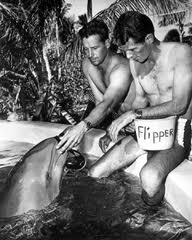
Rick O'Perry, right, and another dolphin trainer with Flipper
Flipper, an Atlantic bottle-nosed dolphin, was one of the biggest television stars from 1964 – 1967. There were actually 4 dolphins who played Flipper on the screen. Most of the series was filmed behind the scenes at the Miami Seaquarium on Virginia Key in Biscayne Bay. The success of the Flipper franchise made dolphins a lovable species around the world. The true story of Flipper, the dolphin and the making of the television series, is told by Ric O’Barry, Flipper’s trainer, in his book Behind The Dolphin Smile. For those of you who were born after the 1960s, you may have seen dolphins in captivity at marine parks or even had the opportunity to swim with dolphins at one of these attractions. (NOTE: I do not support dolphins in captivity)
Due in large part to people’s exposure to Flipper or dolphins in captive environments, there has been increased interest in and concern for dolphins around the world. Since the beginning of this year dolphins worldwide have been stranding themselves and dying in record numbers. The reasons for these deaths are slow in coming. Bear in mind that the numbers listed below are like the tip of an iceberg. Only those dolphins found onshore are listed. Those who died at sea, whose bodies were never discovered and/or recovered are not included in the mortality/stranding counts.
THE GULF STATES – GULF OF MEXICO – February, 2010 – now
When the first report of the explosion and oil leak of the Deepwater-Horizon in the Gulf of Mexico was announced, I knew that we were about to witness one of the greatest environmental disasters in the history of the U.S. It had the potential to outpace the Exxon-Valdez spill off the coast of Alaska – and it did. In case you never saw the official mortality record from the U.S. Fish & Wildlife Service, their last report from April, 2011 lists the statistics on birds, sea turtles and marine mammals impacted.
Of course, those numbers don’t tell the whole story. They don’t include unrecovered animals, nor the impact on breeding or toxins passed on to the offspring of the survivors, nor the poisoned food sources available to the survivors. Please don’t get me wrong. The people living in the area are exposed to the same toxins, but they, at least, may be treated for the illnesses that result from their exposure. And, the people aren’t living in the water, surrounded by the oil and corexit, a toxic substance used to disperse the oil. People also can choose what they will eat, which isn’t the case for the birds, fish, turtles and marine mammals living and swimming in this toxic soup.
Since February of 2010, 693 dolphin deaths have been documented in the Gulf of Mexico. A good compilation of the news coverage can be found at Reef Relief.
An ongoing die-off of dolphins in the Gulf of Mexico has resulted in 693 carcasses washing ashore. Scientists believe many more dolphins likely died but were never recovered. An investigation is underway to determine whether the BP oil spill is to blame. (Press-Register/Ben Raines)
Many of the dolphins in Barataria Bay, LA are sick, according to researchers. The AL.com blog has a full story on what researchers have found through taking both blood and tissue samples.
Thirty-two dolphins caught in August in Louisiana’s heavily oiled Barataria Bay were found to suffer from a range of symptoms including anemia, low body weight, hormone deficiencies, liver disease, and lung problems.
Those symptoms are typical of mammals exposed to oil in laboratory experiments, scientists said.
According to the Gulflive.com blog, of the 30 dolphins who washed ashore since January, 2012, 24 have been calves.
“We are dealing with a very unusual mortality,” said Moby Solangi, director of the Institute for Marine Mammal Studies in Gulfport. “It is mostly calves. Generally when you see a stranding it is a variety of animals — adults, males, females, young.”
The second anniversary is approaching and the legacy of this catastrophe mostly lives on with those people, animals and plants along the Gulf Coast who survived. This story from the one year anniversary has some amazing and heartbreaking photos: http://www.boston.com/bigpicture/2011/04/gulf_oil_spill_one_year_later.html This recent story paints a more current picture of the state of the Gulf Coast.
Laurel didn’t find dead turtles on a recent stroll on her Gulfport shores, which she now calls “death beach.” But walking along she smelled something bad. After poking around in the sand, she found the nauseating source: a dead baby dolphin’s tail, decomposing and buried not more than a few inches in the sand. An out-of-work shrimper came a long and picked it up, and when he realized what it was he started to sob: “This really ruins my day…” Laurel remembers. Tourists looked at it incredulously, Laurel says, their kids screaming, ‘Mommy, it’s a dolphin’s tail!’
The attention of the rest of the country has turned to other news stories, having been lulled into a false sense that everything has returned to normal by all of those commercials, funded by BP and the states’ tourist boards. The bodies of the dead and dying animals tell a different story. But dolphins, in particular, aren’t just dying along the Gulf Coast.
CAPE COD – January – February, 2012
177 dolphins have stranded themselves in Cape Cod. Once again the cause or causes of the high number of dolphins ending up on the beaches of Cape Cod are simply guesses. In mid-February, 11 stranded dolphins were found onshore in Wellfleet.
The remote inlet down Wellfleet’s Herring River is a place where the tides recede fast and far, and that’s left the animals mired in a grayish-brown mud one local calls “Wellfleet mayonnaise.”
News coverage of the incident details the stranding and actions taken to save the dolphins. Sixty dolphins stranded in Cape Cod. The full story tells that only 19 could be rescued.
A single dead dolphin calf was found in Queens, NY.
Kim Durham, the foundation’s rescue program director, tells the Daily News there were “no signs of trauma.” Researchers say an increasing number of common dolphins have been spotted in the Northeast in the winter, which may be attributable to climate change and a steady improvement in environmental cleanliness in the waters off the Rockaway peninsula.
Although no official cause for the strandings has been announced, there are some who think Naval operations in the area could be to blame.
Again, just as in the months of January and February Naval activity is taking place in the Atlantic. Even government Funded IFAW Katie Moore who has denied Naval involvement despite evidence of Naval activity can no longer deny the possibility of sound being the source of these tragic deaths along the Atlantic Coastline, “
And these deaths may not be the only ones which may be attributable to sonar type activities taking place in the oceans.
PERU – February – April 2012
To locate possible oil and/or gas deposits, seismic surveys are conducted with the use of air guns by releasing high pressure air. This passage from the Canadian Centre for Energy Information report was particularly interesting.
Offshore seismic surveys require government approval and must comply with strict environmental regulations, including a pre-survey environmental assessment. Programs are designed to avoid fish spawning seasons and sensitive fishery areas. During the first half-hour of a survey, the energy level of the discharges is gradually increased so that fish and aquatic mammals have an opportunity to move out of the area.
That paragraph is telling. The fish and other marine life are given a full half hour to “leave the area.” Are these people serious? Any of the marine life in area will understand the increasing sound waves are a signal to vamoose? Maybe they should try transmitting in Morse Code, it would make as much sense. Dolphins, like all cetaceans, use echo location to find food, navigate in their habitat and communicate with each other. Needless to say, these high pressure sound waves can do massive damage to marine life, especially dolphins and whales. If you are interested in more detailed information on dolphins and the use and effect of sound, check out this lesson plan: http://www.pac.dfo-mpo.gc.ca/education/documents/porpoise-marsouin/harbourporpoise_lesson4_e.pdf
Of all these recent stranding episodes, the largest die-off is occurring off the coast of Peru. Over 3000 dead dolphins have washed ashore since the incident began. Once again, authorities and researchers are cautious about announcing the cause of the massive numbers of dead dolphins. Some have attributed the deaths to the search for offshore oil deposits in the ocean floor. More information, along with photos and video on this massive die- off can be found at The Watchers and at SF Gate, CNTV and on the blog StrandedNoMore.
For the time being, drilling for oil is a necessary evil. There are many downsides to onshore drilling, but drilling offshore has far greater along with potentially catastrophic problems. This Hub Pages blog entry by Cheryl has a comprehensive discussion of offshore drilling.
It seems evident to me that we, humans, are the culprits in the deaths of these magnificent, highly intelligent animals. Whether through releasing toxins into the environment or sending shockwaves through the ocean, we are killing them. Why? OIL – our endless quest to drill for more and more and more oil. And our tax dollars continue to subsidize this industry, while these oil companies make vast amounts of profit. Then we get to pay again, at artificially inflated prices, when we pump the resultant gasoline into our vehicles. We are complicit, intentionally or not. But Bill McKibben, of 350.org can say it better than I.
Whether or not the bill passes, those subsidies are worth focusing on. After all, we’re talking at least $10 billion in freebies and, depending on what you count, possibly as much as $40 billion annually in freebie cash for an energy industry already making historic profits.

 peej
peej Carissa
 bostonboomer
 dakinikat
 ecocatwoman
 mablue2
 Mama Lopez
 peggysue22
 quixote
 skydancingguestblogger
 Mona (aka Wonk the Vote)



 Sky Dancing
Recent Comments