
TGIFriday Reads
Posted: October 7, 2011 Filed under: Afghanistan, Foreign Affairs, Global Financial Crisis, morning reads, New Orleans, Women's Rights | Tags: Afghanistan, due process, executive order, Gender bias in Austrailia, General McChyrstal, global financial meltdown, kill list, Occupy New Orleans 18 Comments Good Morning!
Wow! It’s Friday! The week has sort’ve whizzed by for me and I have to admit to feeling like the days are blending together. The weather is great down here right now. October in New Orleans is usually a nice blend of perfect weather and no real surge in tourists so that’s a good change. We had an Occupy New Orleans march–I didn’t make it–that seemed well attended and non-eventful. I had a lot of friends that showed up and they took a lot of pictures. I think we all should try to share the events in our individual cities if we get a chance. I’m really hoping this movement doesn’t get captured by the political establishment.
Taking its cues from the New York protest, Occupy New Orleans makes all its decisions through “general assembly,” a series of votes that aims to reflect the views of everyone involved. The process can be lengthy — simply selecting the march’s route took three hours for the group of about 100 to decide.
That’s one reason the group has not made a list of concrete goals, though it intends to in the upcoming weeks, said participant Michael Martin, 25. The movement also has no leader or spokesperson — each member is allowed one vote. The resultant lack of a coherent message has drawn skepticism even from would-be sympathizers.
Organizers of the New Orleans protest say they expect hundreds to participate; the group has more than 1,000 followers on Twitter and more than 4,100 fans on Facebook. The group received permits Wednesday allowing them to march, according to New Orleans Police Department spokeswoman Remi Braden.
In light of 700 protestors’ arrests in New York City on Saturday, Occupy New Orleans held a training session for legal observers Tuesday that drew 20 people, mainly law students.
We really need to have a huge conversation about the idea that a “secret panel” can put an American citizen on a kill list without actual due process in the courts. Here’s a start at that discussion from Reuters.
There is no public record of the operations or decisions of the panel, which is a subset of the White House’s National Security Council, several current and former officials said. Neither is there any law establishing its existence or setting out the rules by which it is supposed to operate.
The panel was behind the decision to add Awlaki, a U.S.-born militant preacher with alleged al Qaeda connections, to the target list. He was killed by a CIA drone strike in Yemen late last month.
The role of the president in ordering or ratifying a decision to target a citizen is fuzzy. White House spokesman Tommy Vietor declined to discuss anything about the process.
Current and former officials said that to the best of their knowledge, Awlaki, who the White House said was a key figure in al Qaeda in the Arabian Peninsula, al Qaeda’s Yemen-based affiliate, had been the only American put on a government list targeting people for capture or death due to their alleged involvement with militants.
The White House is portraying the killing of Awlaki as a demonstration of President Barack Obama’s toughness toward militants who threaten the United States. But the process that led to Awlaki’s killing has drawn fierce criticism from both the political left and right.
In an ironic turn, Obama, who ran for president denouncing predecessor George W. Bush’s expansive use of executive power in his “war on terrorism,” is being attacked in some quarters for using similar tactics. They include secret legal justifications and undisclosed intelligence assessments.
Yeah, that’s the word I’m thinking …. ironic… not!! I am very much attuned to the situation in Europe. The banks have pretty much done it to us again and it looks like there will be more bail outs coming. There’s a lot of talk that it could be worse than 2007-2008. Here’s ZeroHedge’s take on a BBC insider interview with an IMF advisor that says: “In The Absence Of A Credible Plan We Will Have A Global Financial Meltdown In Two To Three Weeks”. The interview is posted there if you’re more curious.
A week after the BBC exploded Alessio Rastani to the stage, it has just done it all over again. In an interview with IMF advisor Robert Shapiro, the bailout expert has pretty much said what, once again, is on everyone’s mind: “If they can not address [the financial crisis] in a credible way I believe within perhaps 2 to 3 weeks we will have a meltdown in sovereign debt which will produce a meltdown across the European banking system. We are not just talking about a relatively small Belgian bank, we are talking about the largest banks in the world, the largest banks in Germany, the largest banks in France, that will spread to the United Kingdom, it will spread everywhere because the global financial system is so interconnected. All those banks are counterparties to every significant bank in the United States, and in Britain, and in Japan, and around the world. This would be a crisis that would be in my view more serious than the crisis in 2008…. What we don’t know the state of credit default swaps held by banks against sovereign debt and against European banks, nor do we know the state of CDS held by British banks, nor are we certain of how certain the exposure of British banks is to the Ireland sovereign debt problems.”
But no, Morgan Stanley does, or so they swear an unlimited number of times each day. And they say not to worry about anything because, you see, it is not like they have any upside in telling anyone the truth. Which is why for everyone hung up on the latest rumor of a plan about a plan about a plan spread by a newspaper whose very viability is tied in with that of the banks that pay for its advertising revenue, we have one thing to ask: “show us the actual plan please.” Because it is easy to say “recapitalize” this, and “bad bank” that. In practice, it is next to impossible. So yes, ladies and gentlemen, enjoy this brief relief rally driven by the fact that China is offline for the week and that the persistent source of overnight selling on Chinese “hard/crash landing” concerns has been gone simply due to an extended national holiday. Well, that holiday is coming to an end.
Some of the weaker Spanish banks have been nationalized. It will be very interesting to see what comes out of this.

Austrailia's Status of Women Minister, Kate Ellis
Australia’s Status of Women Minister, Kate Ellis says that “mindless bias” holds women back in her country. She’s been making the rounds arguing about a report that shows that gender differences in salary and position cannot be explained away by either occupational choices or other factors. Can you imagine Valerie Jarret holding US corporations to account for not promoting and hiring women? Oh, wait, the Prime Minister’s name is Julia … hmmmmm.
”We are saying very clearly to corporate Australia, we want to work in partnership with you to change this – and it’s an offer that I hope corporate Australia will take that up and we don’t have to take that conversation any further.”
Asked yesterday about the portrayal of women in the media, Ms Ellis said there was sometimes unequal treatment ”handed out”, and said the treatment of the Prime Minister, Julia Gillard, was ”a case study before our eyes”.
”I think there’s a really interesting issue, where often I will be encouraging people where if you see unfair treatment, if you see discrimination you should stand up and call it out for what it is,” she said.
”In politics, there’s often the opposite pressure, where if you do that constantly it looks like female politicians are whingeing and they’re not tough enough to handle the environment.”
She said her office was collating examples of the media dealing with gender issues in ways that were not ”acceptable”.
According to the government’s latest census of women in leadership, last year females made up just 8.4 per cent of directors and 8 per cent of executive managers in ASX200 companies.
The report calls for companies to adopt a range of reforms, including making their workplaces more flexible and setting targets for gender diversity.
The Guardian has a killer interview up with retired US General McChrystal who says the US is only about 1/2 done with the war in Afghanistan. That means 10 more years if he’s right.
The US began the war in Afghanistan with a “frighteningly simplistic” view of the country and even 10 years later lacks the knowledge that could help bring the conflict to a successful end, a former top commander has said.
Retired US army general Stanley McChrystal said in remarks at the Council on Foreign Relations that the US and its Nato allies were only “a little better than” 50% of the way to reaching their war goals.
Of the remaining tasks to be accomplished, he said, the most difficult may be to create a legitimate government that ordinary Afghans could believe in and that could serve as a counterweight to the Taliban.
McChrystal, who commanded coalition forces in 2009-10 and was forced to resign in a flap over a magazine article, said the US entered Afghanistan in October 2001 with too little knowledge of Afghan culture.
“We didn’t know enough and we still don’t know enough,” he said. “Most of us, me included, had a very superficial understanding of the situation and history, and we had a frighteningly simplistic view of recent history, the last 50 years.”
US forces did not know the country’s languages and did not make “an effective effort” to learn them, he said.
McChrystal said the Bush administration’s decision to invade Iraq less than two years after entering Afghanistan made the Afghan effort more difficult.
Well, that’s some depressing things to think about which is about what’s on my mind today. What’s on your reading and blogging list?
Tuesday Reads: Obama’s Deficit-Reduction Plan, Backsliding Obots, Rev. Wright, and Dr. Doom
Posted: September 20, 2011 Filed under: American Jobs Act, Barack Obama, Democratic Politics, Domestic Policy, Global Financial Crisis, income inequality, Medicaid, Medicare, morning reads, Social Security, U.S. Economy, U.S. Politics | Tags: Booman, Chris Hedges, class warfare, digby, Ezra Klein, Greg Sargent, Jon Walker, Jonathan Cohn, Martin Luther King, Maya Angelou, Nouriel Roubini, Rev. Jeremiah Wright 45 Comments
Good Morning!! Let’s see what’s happening in the news today.
Well, of course the Obama apologists are claiming that he has suddenly grown a backbone of steel and become the liberal messiah they all dreamed of in 2008. I already told you about Ezra Klein’s delusional column last night. The other usual suspects are also getting leg tingles, and former Obots are starting to backslide.
Greg Sargent has put on his rose-colored glasses and taken a few swigs of LSD-laced Koolaid:
This has to be the clearest sign yet that Obama has taken a very sharp populist turn as he seeks to frame the contrast between the parties heading into 2012. During his remarks this morning, Obama directly responded to Republicans accusing him of “class warfare,” but rather than simply deny the charge, he made the critical point that the act of protecting tax cuts for the rich is itself class warfare, in effect positioning himself as the defender of the middle class against GOP class warriors on behalf of the wealthy.
Wow! I’ll bet it never occurred to anyone that income inequality equals class warfare until Obama figured it out. Amaaaazzzzing!!
A senior administration official tells me that parts of Obama’s “class warfare” broadside were ad-libbed. Here’s the key chunk — and it’s a script that could have been written by just about any card-carrying member of the “professional left:”
Warren Buffett’s secretary shouldn’t pay a higher tax rate than Warren Buffett. There’s no justification for it. It is wrong that in the United States of America, a teacher or a nurse or a construction worker who earns $50,000 should pay higher tax rates than somebody pulling in $50 million…
We’re already hearing the usual defenders of these kinds of loopholes saying, “this is just class warfare.” I reject the idea that asking a hedge fund manager to pay the same tax rate as a plumber or a teacher is class warfare. I think it’s just the right thing to do. I believe the American middle class, who’ve been pressured relentlesly for decades, believe it’s time that they were fought for as hard as the lobbyists and some lawmakers have fought to protect special treatment for billionaires and big corporations.
Nobody wants to punish success in America … All I’m saying is, that those who have done well, including me, should pay our fair share in taxes to contribute to the nation that made our success possible.
Holy sh*t!! Obama ad libbed? Hope ‘n’ change! Change we can believe in! I guess it’s just me, but I thought that speech sounded kind of weak and defensive. But what do I know?
Booman has an even better rationalization for Obama’s behavior than Beltway Bob Ezra Klein. According to the ever-gullable Booman,
…the president has a lot more credibility now when he takes his ideas to the public and says the the Republicans aren’t interested in compromise. You have to try and fail to get a compromise before that argument has any resonance. It’s not so much 11-Dimensional chess as basic common sense. Everyone’s poll numbers suffered during the summer, but no one’s standing was weakened more the Republicans’. That’s not an accident.
So Obama must have planned this. The man is brilliant!!
Digby says Obama is in campaign mode and that’s why he’s trying to sound strong and determined.
My first thought is that it appears the administration has finally decided that there’s nothing to be gained with exclusively delivering post-partisan pablum. It certainly sounds as though he’s thrown down the gauntlet. Unfortunately, the President appears to want to have two fights going into this election, one over job creation and one over whose plan to cut the deficit is better, which I think is a confusing waste of time. (Focus like a laser beam on jobs and tell the Republicans they’ll have to go through you to get to the safety net and I think people would instinctively understand that he’s on their side.) But that isn’t this president’s style and perhaps it wouldn’t be believable if he did it. So, this is at least a change of tactics, more confrontational in tone, which is his best hope for reelection since it turns out people aren’t really all that impressed that he’s the most reasonable guy in the room if it appears that he gets punk’d every time.
Digby things the proposed Medicare cuts are a loser politically, though–especially for Congress members running for reelection.
Jon Walker at FDL was “pleasantly surprised” that Obama didn’t call for Social Security cuts or “any specific major cuts to Medicare benefits,” but he hasn’t gone back on the Koolaid.
This is a positive development. Having President Obama publicly call for major cuts in Medicare benefits or change in age eligibility would have been terrible for our senior citizens and a total political disaster for the Democratic party. But it is important to remember: simply because the president did not put such cuts on the table doesn’t mean he took these cuts off the table.
President Obama has already privately signaled that in theory he would be willing to support major cuts to Medicare. And he’s hinted he’d be willing to cut Social Security benefits. They were both earlier put the table for a theoretical deal and this speech didn’t take them off the table. There was no veto threat to protect Medicare and Social Security benefits.
Actually, there do seem to be specific proposed cuts to Medicare. Jonathan Cohn breaks down the detail of the President’s deficit reduction proposal in a very technical piece that you can read if you’re interested. According to Cohn,
President Obama’s new deficit reduction plan includes about $320 billion in cuts to government health care programs. Most of the cuts from Medicare and that is sure to get a lot of people’s attention, if not now then in the presidential campaign.
But these reductions are less severe, and less worrisome, than some of the proposals Obama indicated he was willing to support over the summer, while he was negotiating with House Speaker John Boehner. In particular, Obama did not call for increasing the Medicare eligibility age from 65 to 67, as folks like me feared he would.
In fact, the cuts Obama has in mind are more or less consistent with the kind of cuts that you find in the Affordable Care Act: They are reductions designed to change the way Medicare pays for treatment and services, ideally (although not always) in ways that will actually improve the efficiency or quality of care. To the extent they would force individual seniors to pay more, it’d be in the form of higher premiums from wealthy seniors or higher co-pays for treatments likely to be unnecessary or wasteful.
For a reminder of who Obama really is, I’ll turn to Glenn Ford at the Black Agenda Report. His post was written a few days ago–before today’s speech–but I still think he has Obama’s number.
The GOP can count on Obama to offer up Social Security on the alter of austerity, as he has done consistently since January, 2009, while still president-elect. Back in April, he proposed $4 trillion in cuts over 12 years – nearly as draconian as his hand-picked committee – with the focus on the safety net. “By 2025,” warned the apocalyptic and grossly misleading president, “the amount of taxes we currently pay will only be enough to finance our health care programs, Social Security, and the interest we owe on our debt.”
Obama promises that his grab-bag, mostly supply-side and wholly inadequate jobs scheme will largely be “paid for” by cuts that include “modest adjustments [hah!] to health care programs like Medicare and Medicaid.”
Social Security stands to be mortally wounded at Obama’s hand. His second round of cuts in the payroll tax further undermine, not just the program’s trust fund, but its status as a free-standing entity outside of the usual congressional process. Congress will, theoretically, make up the temporary shortfall in payroll taxes through appropriations. But that puts Social Security in the middle of the budget deficit debate, where it does not belong and from which it has been purposely shielded since its origins in President Franklin Roosevelt’s New Deal. Through rhetoric and calculated action, Obama has for the past two and a half years been in league with Republicans in falsely conflating Social Security and the federal debt. He is now positioned to knock the program from its protective pedestal.
The Social Security cuts are already taken care of as long as the GOP goes along with extending the payroll tax holiday. The more money Obama can suck out of the Social Security trust fund, the more likely he can “reform” the Social Security into a welfare program or Wall Street ATM.
If Obama succeeds, Social Security will become just another “entitlement” to be mangled in a grand bargain with the GOP, like Medicare and Medicaid. Obama wants to be remembered as the president who brought the Republicans and the right wing of the Democratic Party into harmonious consensus – over the dead carcass of the New Deal. That’s what he means by “Go big!”
Chris Hedges has another excellent article up at Truthdig. It’s an interview with Obama’s former pastor and spiritual adviser: “The Rev. Jeremiah Wright Recalls Obama’s Fall From Grace.” I know not everyone will agree with Hedges’ point of view, but I mostly do. As outlandish as Wright was made to seem in the media, I couldn’t fault much of what I heard him say about America and racism. It’s a lengthy article, but I hope you’ll take a look at it.
One of the things Wright discussed with Hedges was the Martin Luther King Memorial in Washington DC. Wright himself raised $200,000 for the project.
“I think it’s a wonderful thing that the country would recognize someone as important as Dr. King,” Wright said when I reached him by phone in Chicago, “and recognize him in a way that raises his likeness in the Mall along with the presidents. He’s not a president like Abraham Lincoln or George Washington. But to have him ranked among them in terms of this nation paying attention to the importance of his work, that’s a good thing.”
“I read Maya Angelou’s piece about the way the quote was put on the monument,” Wright said in referring to the editing of a quote by King on the north face of the 30-foot-tall granite statue. The inscription quote reads: “I was a drum major for justice, peace and righteousness.” But these are not King’s words. They are paraphrased from a sermon he gave in which he said: “If you want to say that I was a drum major, say that I was a drum major for justice. Say that I was a drum major for peace. I was a drum major for righteousness. And all of the other shallow things will not matter.” Angelou said the mangled inscription made King sound “arrogant.”
“I read the explanation as to why we couldn’t include the whole quote,” said Wright, who helped raise $200,000 for the monument. “Kids a hundred years from now, like our pastor who was born three years after King was killed, they’re going to see that and will not get the context. They will not hear the whole speech, and that will be their take-away, which is not a good thing. My bigger problems, however, have to do with all the emphasis on ’63 and ‘I Have a Dream.’ They have swept under the rug the radical justice message that King ended his career repeating over and over and over again, starting with the media coverage of the April 4, 1967, ‘A Time to Break Silence’ message at the Riverside Church [in New York City]. King had a huge emphasis on capitalism, militarism and racism, the three-headed giant. There is no mention of that, no mention of that King, and absolutely no mention of the importance of his work with the poor. After all, he’s at the garbage collectors strike in Memphis, Tenn., when he is assassinated. The whole emphasis on the poor sent him to Memphis. But that gets swept away. It bothers me that we think more about a monument than a movement. He had a movement trying to address poverty. It was for jobs, not I Have a Dream, not Black and White Together, but that gets lost.”
He’s right. The powers that be have worked for years to minimize King’s work to end the Vietnam war as well as his determination to wipe out poverty. It’s interesting that this is the second time King has been misquoted on Obama’s watch.
This post is already too long, so I’ll end with an article by Dr. Doom (Nouriel Roubini): Eight drastic policy measures necessary to prevent global economic collapse. None of them will be popular. The first recommendation is that
we must accept that austerity measures, necessary to avoid a fiscal train wreck, have recessionary effects on output. So, if countries in the Eurozone’s periphery such as Greece or Portugal are forced to undertake fiscal austerity, countries able to provide short-term stimulus should do so and postpone their own austerity efforts. These countries include the United States, the United Kingdom, Germany, the core of the Eurozone, and Japan. Infrastructure banks that finance needed public infrastructure should be created as well.
Read the rest and weep. Our current “leaders” aren’t likely to pay any attention.
So sorry if I depressed you with that one. What are you reading and blogging about today?
Beyond Influence: Buying US Law
Posted: August 11, 2011 Filed under: Big Pharma, Civil Liberties, Civil Rights, collective bargaining, Corporate Crime, Domestic Policy, Economy, Environmental Protection, financial institutions, Global Financial Crisis, Gulf Oil Spill, Health care reform, Labor unions, legislation, Surreality, The Bonus Class, We are so F'd | Tags: ALEC, Bayer, ExxonMobil, Koch Industries, PFizer, VISA, Wal-Mart 23 Comments“Corporations are people, my friends.”
Mitt Romney, in a speech today in Iowa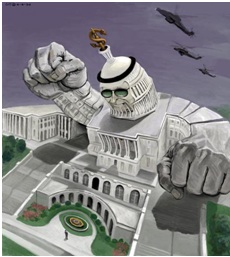
I’ve wanted to write about ALEC for awhile. I tripped across this very succinct explanation in my print copy of Bloomberg Business Week that made me revisit my plans. Ever wonder why a bunch of weird ass bills suddenly show up simultaneously in a bunch of legislatures that say things that are basically against the positions of modern science, medicine, and economics? Well, chances are that some huge corporation has written that bill that will become law in no one’s interest but their own, and it was penned by some member of ALEC.
Kim Thatcher, a Republican state representative in Oregon, introduced a sharply worded anti-cap-and-trade bill this year that said, “There has been no credible economic analysis of the costs associated with carbon mandates.” Apparently, that view is widely shared. Legislation with that exact language has been introduced in dozens of states, including Montana, New Hampshire, and New Mexico.
It’s not plagiarism. It’s a strategy. The bills weren’t penned by Thatcher or her fellow legislators in Helena, Concord, and Santa Fe. They were written by a little-known group in Washington with outsize clout, the American Legislative Exchange Council. Corporate benefactors such as Koch Industries and ExxonMobil (XOM) help fund ALEC with membership dues and pay extra for a seat at the legislative drafting table.
Among ALEC’s prominent members are Pfizer (PFE), Wal-Mart (WMT), Bayer (BAYZF), and Visa (V), according to ALEC annual meeting documents provided by an attendee. The organization’s legislative agenda includes limiting the power of unions, fighting environmental regulations, and overturning President Obama’s health-care reform law. ALEC says it gets about 200 state laws passed each year. The corporate influence is hard to trace and can produce a return on investment that would make a hedge fund manager drool.
“This is just another hidden way for corporations to buy their way into the legislative process,” says Bob Edgar, president of Common Cause, which seeks to reduce money in politics. Reagan Weber, an ALEC spokeswoman, says the group simply facilitates the sharing of information and “good conservative policy.”
ALEC was founded in 1973 by two of the conservative movement’s intellectual midwives, both now dead: Representative Henry Hyde of Illinois and activist Paul Weyrich, who also was a founder of the Heritage Foundation. As a tax-exempt organization, ALEC doesn’t disclose its corporate donors or its member lists beyond those who serve as committee chairmen.
In exchange for annual membership dues of as much as $25,000 plus a fee of $3,000 to $10,000 to get on a bill-writing “task force,” Koch and ExxonMobil representatives sat beside elected officials and policy analysts at an ALEC meeting in April 2010, helping them write model energy legislation that would later be introduced in statehouses around the country, according to the documents. The legislators pay $100 for a two-year membership. The task force bills are considered finished only after the legislators and private-sector members vote separately to approve them, giving each side a veto. Once a model bill is complete, it’s up to ALEC’s legislator members to go back to their home states and shepherd it into law.
ALEC is on the radar of many organizations including the American Association for Justice who keeps track of their activities and publishes white papers on this group of bill-writers for profit, greed and the destruction of public resources.
(W)hile the membership appears to be public sector, the bankroll is almost entirely private sector. In fact, public sector membership dues account for only around one percent of ALEC’s annual revenues. ALEC claims to be nonpartisan, but in fact its free-market, pro-business mission is clear.
The result has been a consistent pipeline of special interest legislation being funneled into state capitols. Thanks to ALEC, 826 bills were introduced in the states in 2009 and 115 were enacted into law.
Behind the scenes at ALEC, the nuts and bolts of lobbying and crafting legislation is done by large corporate defense firm Shook, Hardy & Bacon. A law firm with strong ties to the tobacco and pharmaceutical industries, it has long used ALEC’s ability to get a wide swath of state laws enacted to further the interests of its corporate clients.
ALEC’s campaigns and model legislation have run the gamut of issues, but all have either protected or promoted a corporate revenue stream, often at the expense of consumers. For example, ALEC has worked on behalf of:
- Oil companies to undermine climate change proponents;
- Pharmaceutical manufacturers, arguing that states should be banned from importing prescription drugs;
- Telecom firms to block local authorities from offering cheap or free municipally-owned broadband;
- Insurance companies to prevent state insurance commissioners from requiring insurers to meet strengthened accounting and auditing rules;
- Big banks, recommending that seniors be forced to give up their homes via reverse mortgages in order to receive Medicaid;
- The asbestos industry, trying to shut the courthouse door to Americans suffering from mesothelioma and other asbestos-related diseases; and,
- Enron to deregulate the utility industries, which eventually caused the U.S. to lose what the Securities and Exchange Commission (SEC) estimated as $5 trillion in market value.
The Koch brothers and Koch Industries are all over ALEC. Their Charitable foundations and businesses provide a lot of funding. ExxonMobile is also a huge source of funds. There are several companies representing the interests of Big Pharma. ALEC looks like a who who of corporate America’s worst corporate citizens. The Center for Media and Democracy’s PR Watch put out a Special Report on ALEC’s funding last month.
According to ALEC’s IRS filings, over the past three years it has raised $21,615,465 from corporations, foundations, and other sources, and just over $250,000 in dues paid by state legislators, amounting to slightly more than 1 percent of its income. The gigantic gap between what legislators pay and what ALEC spends is the direct result of the reality that legislators pay a mere $50 a year to be a member, while a corporation can pay up to $25,000 a year or more to be a member of ALEC plus additional fees to be on a task force where corporations get the same right to vote as legislators. They just pay hundreds of times more for that vote.
…
For example, the foundations controlled by the billionaire Koch brothers gave ALEC over $200,000 in 2009. (The Claude R. Lambe Foundation, which Charles Koch, his wife and kids help run, donated $125,000 to ALEC. His own Charles G. Koch foundation kicked in an additional $75,000.) That $200k is before whatever is the undisclosed amount of membership “dues” paid by Koch Industries, which is run by Charles and David Koch. There is no public disclosure of annual gifts the company gives to take part in the one-stop shopping ALEC conventions provide to meet with legislators from every state about their wish list…
Other right-wing foundations have also supported ALEC, far beyond the “dues” paid by any legislator. For example, the Castle Rock Foundation, which is run by right-wing beer heir Peter Coors, gave $50,000 last year and in prior years. The right-wing John M. Olin foundation has also been a donor to ALEC. Another of the big right-wing foundations, the Lynde and Harry Bradley Foundation, has been a funder and, for example, gave ALEC $50,000 in 2009 to fund “budget reform” work. Similarly, right-winger Richard Scaife has given ALEC over half a million dollars the past decade or so, through his Allegheny Foundation. Some of the organizations that support ALEC, like Scaife’s, are also deeply invested in the profits of corporations that sit on ALEC’s board. The Allegheny Foundation has held over $11 million of ALEC board member Altria‘s stock, along with major stock holdings in other ALEC corporate board members like Kraft, Coca Cola, AT&T, GlaxoSmithKline, Johnson & Johnson, and Exxon.
ALEC is a major voice for climate change denial, responsible for the recent spate of voter disenfranchisment laws, and continually pushes for extreme tort reform. There’s a really good primary on ALEC at People for the American Way. ALEC is the well-funded voice of corporate special interests. Here are two recent examples of state legislature originating from ALEC.
ALEC was influential in crafting and passing a Texas law, dubbed the “Successor Asbestos-Related Liability Fairness Act, that shielded Crown Cork and Seal, a business that in 1966 acquired a company that used asbestos in its products, from lawsuits from the company’s workers. Even though Crown agreed to pay the company’s liabilities, it wanted immunity from paying damages to workers facing asbestos-related diseases. Crown Cork and Seal turned to ALEC to help shape the Texas law, which put an extremely low cap on liability for companies like Crown who acquired companies which committed wrongdoing, known as a “successor immunity” law.” Mark Behrens, an attorney for Shook Hardy, worked as a lobbyist for both ALEC and Crown to encourage allied lawmakers to introduce and pass the bill. The American Association for Justice writes that “this so-called ‘successor immunity’ has all the hallmarks of an ALEC special interest bill. It is plainly designed not with public policy in mind, but rather a specific industry (or in this case, a specific company).” The Texas Supreme Court ultimately found the cap to be an unconstitutional retroactive protection for Crown that inhibited the rights of people to rightfully sue corporations for damages, but similar ALEC-derived laws are still on the books in other states.
In Arizona, an investigative report by NPRfound that ALEC significantly helped one of its clients, the Corrections Corporations of America (CCA), influence the state’s new immigration law. The CCA is a for-profit prison company whose “executives believe immigrant detention is their next big market,” and thought that a law which “could send hundreds of thousands of illegal immigrants” to prison would “mean hundreds of millions of dollars in profits to private prison companies responsible for housing them.” As a dues-paying member of ALEC, the CCA was able to write, present and lobby Arizona policymakers for a draconian immigration bill at an ALEC-hosted conference. “Four months later, that model legislation became, almost word for word, Arizona’s immigration law,” and many of the bill’s cosponsors later received significant campaign contributions from the CCA. ALEC also helped the CCA by pushing “truth in sentencing” laws that restrict parole eligibility for felons, and consequently increase the number of prisoners.
You name the spurious law, and ALEC is likely behind it. They write laws that push private school vouchers, strip workers of their right to organize, make it more difficult to generate revenues to fill budget shortfalls in states, and undercut healthcare reform efforts.
After the passage of health care reform, ALEC’s top priority has been to challenge the law by encouraging members to introduce bills that would prohibit the law’s insurance mandate. ALEC’s Health and Human Services task force is led by representatives of PhRMA and Johnson & Johnson, and representatives of Bayer and GlaxoSmithKlein sit on ALEC’s board. The group’s model bill, the “Freedom of Choice in Health Care Act,” has been introduced in forty-four states, and ALEC even released a “State Legislators Guide to Repealing ObamaCare” discussing a variety of model legislation including bills to partially privatize Medicaid and SCHIP. The legislative guide utilizes ideas and information from pro-corporate groups like the Heritage Foundation, the Goldwater Institute, the James Madison Institute, the Cato Institute, the National Center for Policy Analysis and the National Federation of Independent Business.
Expanding the disproportionate power of corporations in the legislative process is central to ALEC’s goals. ALEC is responsible for some of the worst outcomes in government we’ve seen in decades. It is pure influence peddling. Any legislator that relies on ALEC for services should be subject to immediate recall. ALEC represents what’s wrong with this country today. It is at the heart of single issue, special interest politics that are not in the public’s interest. They are a perversion of the democratic political process.
Mitt Romney is wrong. Corporations are not people. The profit motive is the sole determinant of corporate behavior. No household or family would put profits before everything else nor should any government that purports to represent its people. I suggest finding out as much about how ALEC influences your state legislature as soon as possible. A good place to start is with The Nation‘s series ‘ALEC Exposed’. The first in this series shows the role of the Koch’s in ALEC’s model bills. I’ve pumped this thread up with a lot of juicy links. Please take some time to visit the research of all the nonprofits that have carefully researched this shadowy organization.
Thursday Reads: Poverty and Joblessness *Are* Social and Political Issues
Posted: August 11, 2011 Filed under: Foreign Affairs, Global Financial Crisis, Great Britain, jobs, Media, morning reads, poverty, U.S. Economy, U.S. Politics, unemployment | Tags: austerity, Banksters, education, Federal Reserve, global elites, government corruption, joblessness, London Riots, looting, Poverty, social services, U.S. Economy, unemployment 44 Comments
Guess who said this:
“There are pockets of our society that are not just broken, but are frankly sick.
“It is a complete lack of responsibility in parts of our society, people allowed to feel the world owes them something, that their rights outweigh their responsibilities and their actions do not have consequences. Well, they do have consequences.”
You’re darn right! The global elites have gone too far! The banksters have stolen trillions from ordinary taxpayers, and then demanded and received massive government bailouts. Politicians have lost any sense of responsibility toward their constituents, only listening to their corporate masters and their lobbyists. Yes there are consequences and these wealthy elites will discover there are consequences for their corrupt and immoral actions.
Oh wait. That was Prime Minister David Cameron talking about the poor and jobless young people who have been rioting in the streets of London and other British cities for the past five days. I’ll bet he has absolutely no clue how ridiculous it is that he is chastising these people for looting after he and other global elites allowed banksters to steal and loot trillions with absolutely no consequences. From Raw Story:
The U.S. Federal Reserve gave out $16.1 trillion in emergency loans to U.S. and foreign financial institutions between Dec. 1, 2007 and July 21, 2010, according to figures produced by the government’s first-ever audit of the central bank.
Last year, the gross domestic product of the entire U.S. economy was $14.5 trillion.
Of the $16.1 trillion loaned out, $3.08 trillion went to financial institutions in the U.K., Germany, Switzerland, France and Belgium, the Government Accountability Office’s (GAO) analysis shows.
Additionally, asset swap arrangements were opened with banks in the U.K., Canada, Brazil, Japan, South Korea, Norway, Mexico, Singapore and Switzerland. Twelve of those arrangements are still ongoing, having been extended through August 2012.
Out of all borrowers, Citigroup received the most financial assistance from the Fed, at $2.5 trillion. Morgan Stanley came in second with $2.04 trillion, followed by Merill Lynch at $1.9 trillion and Bank of America at $1.3 trillion.
Lambert has been highlighting the hypocrisy of the global elites on the riots. Yesterday he linked to this article in the Guardian.
This scepticism toward the potency of democratic politicians – and therefore democratic politics itself – is oddly echoed by the looters themselves. Certainly no one outside the Iranian state media is calling them “protesters”, but even “rioters” seems the wrong word, carrying with it a hint of political purpose. For some, especially at the start in Tottenham, there was clearly a political dimension – with the police the prime focus of their anger. But many of the copycat actions across London and elsewhere have no apparent drive beyond the opportunistic desire to steal and get away with it. It’s striking that the targets have not been town halls or, say, Tory HQ – stormed by students last November – but branches of Dixons, Boots and Carphone Warehouse. If they are making a political statement, it is that politics does not matter.
Lambert notes that at least these looters didn’t steal $16 trillion from the U.S. Treasury.
And while the revulsion at the looting has been widespread and bipartisan – with plenty of liberals admitting to “coming over all Daily Mail” at the ugliness of the vandalism – that sense of the impotence of politics is widespread, too. One aspect of the phone-hacking scandal that went deep was its revelation that those we might think exert authority – police and politicians – were in fact supine before an unelected media corporation. The sheer power of News Corp contrasted with the craven behaviour of those we elect or entrust to look out for us.
But elected officials are supposed to protect all citizens–even the poor, the unemployed, and the elderly–aren’t they? Yet in the U.S. and Europe, the burden of the economic crisis is falling on those with the least ability to pay, while the wealthy continue to receive their government handouts. When people are pushed to the point that they feel they have nothing to lose, this is what happens. Why it is coming as such a surprise to the comfortable elites is the real mystery.
Let’s take a look at what some of the rioters themselves have said about the meaning of their actions. From Yahoo News:
The Conservative-Liberal Democrat coalition government, making deep cuts to public services to tackle a record budget deficit, has been quick to deny that the unrest was linked to austerity measures, calling the disorder “pure criminality.” [….]
Public anger over the widespread looting of shops appears to have strengthened the government’s argument, with stolen goods ranging from the expensive — televisions and jewelry — to the absurd — sweets and bottles of alcohol.
However, community leaders and rioters themselves said the violence was an expression of the frustration felt by the poorest inhabitants of a country that ranks among the most unequal in the developed world.
“They’ve raised rates, cut child benefit. Everyone just used it as a chance to vent,” one man who took part in unrest in the east London district of Hackney told Reuters.
Surprise, surprise. Cutting social services to pay for the bankers’ failures has real life consequences. Austerity measures create more unemployment, and people who don’t have jobs get hungry and scared. When you take everything from people who can least afford it, they get angry. What on earth do these people expect? What planet are they living on anyway? And no, I’m not condoning violence. I’m just saying that it’s going to happen when you push people too far.
Here are some quotes from two young women who participated in the British riots:
Two girls who took part in Monday night’s riots in Croydon have boasted that they were showing police and “the rich” that “we can do what we want”.
From The New York Times: London Riots Put Spotlight on Troubled, Unemployed Youths in Britain
“I came here to get my penny’s worth,” said a man who gave his name as Louis James, 19, a slightly built participant in the widening riots that have shaken London to its core. With a touch of guilt on Tuesday, Mr. James showed off what he described as a $195 designer sweater that he said he took during looting in Camden Town, a gentrified area of north London.
Politicians from both the right and the left, the police and most residents of the areas hit by violence nearly unanimously describe the most recent riots as criminal and anarchic, lacking even a hint of the anti-government, anti-austerity message that has driven many of the violent protests in other European countries.
But the riots also reflect the alienation and resentment of many young people in Britain, where one million people from the ages of 16 to 24 are officially unemployed, the most since the deep recession of the mid-1980s.
Don’t these politicians, police, and other observers understand that poverty and jobless *are* sociopolitical issues? Just because people are acting out of desperation or even opportunism doesn’t mean that their actions are not political. Just because someone is young and poor does not mean he or she isn’t aware that government and corporate corruption have caused much of their distress. Back to the NYT article:
In many ways, Mr. James’s circumstances are typical. He lives in a government-subsidized apartment in northern London and receives $125 in jobless benefits every two weeks, even though he says he has largely given up looking for work. He says he has never had a proper job and learned to read only three years ago. His mother can barely support herself and his stepbrothers and sisters. His father, who was a heroin addict, is dead.
He says he has been in and out of too many schools to count and left the educational system for good when he was 15.
“No one has ever given me a chance; I am just angry at how the whole system works,” Mr. James said. He would like to get a job at a retail store, but admits that he spends most days watching television and just trying to get by. “That is the way they want it,” he said, without specifying exactly who “they” were. “They give me just enough money so that I can eat and watch TV all day. I don’t even pay my bills anymore.”
Jonathan Portes, the director of the National Institute of Economic and Social Research in London, says that Mr. James’s plight reflects a broader trend here. More challenging students, Mr. Portes says, have not been receiving the attention they should as teachers, under pressure to meet educational goals, focus on children from more stable homes and those with greater abilities and social skills. Disillusioned, those who cannot keep up just drop out.
The Los Angeles Times in an opinion piece searches for the reasons for the violence and asks if it could happen here.
The Tottenham riots that blindsided Britain were sparked by the fatal police shooting of Mark Duggan, a 29-year-old black man. Over the past few days, they’ve continued and spread, turning into what has largely become youths’ looting and destroying parts of London. But no one is exactly sure why they’re doing it. Prime Minister David Cameron called it “criminality, pure and simple.”
But why have the riots continued day after day?
The riots are neither politically or racially fueled, wrote Doug Sanders of the Globe and Mail. They’re the result of a “lost generation” of youth under 20 who have little to lose and a bleak future. Here’s an excerpt:
Whether the thousands of rioters actually did express disillusionment — some did say they were angry at police or the world, but many appeared gleeful or greedy — it is clear that most had nothing else to do with themselves, and no reason to fear or feel responsible for the consequences of their actions.
This is a chronic problem in Britain, which has a “lost generation” of young high school dropouts far larger than most other Western countries’.
It’s so simple-minded to expect that youthful rioters are going to calmly explain their behavior in a reasoned, intellectual manner or that they are not going to act euphoric once they let go of restraint and begin acting out as part of a mob. None of that means that the reasons for their behavior are not political.
It seems to me that masses of young people who have “little to lose and bleak future” is in fact a powerful political issue for any society. And when people are powerless, there are few ways for them express their anger. Violence is one way to get attention from the powerful.
Can it happen here? You bet it can. As long as the President and Congress continue enacting austerity measures and ignoring unemployment and general misery among ordinary Americans, it’s guaranteed the U.S. will see riots in the streets–as we have in the past. When it happens here, will our elites be as dumbfounded and out-of-touch with reality as those in Great Britain? Probably.
I posted this in a comment yesterday, but I’m going to put it up again here. It’s an interview of writer and broadcaster Darcus Howe by a clueless BBC “journalist.”
—————————————-
That’s my suggested reading for today. What do you recommend?
UPDATE: I found a piece in the Guardian that reflects my thinking.
Seumas Milne: These riots reflect a society run on greed and looting
It is essential for those in power in Britain that the riots now sweeping the country can have no cause beyond feral wickedness. This is nothing but “criminality, pure and simple”, David Cameron declared after cutting short his holiday in Tuscany. The London mayor and fellow former Bullingdon Club member Boris Johnson, heckled by hostile Londoners in Clapham Junction, warned that rioters must stop hearing “economic and sociological justifications” (though who was offering them he never explained) for what they were doing.
When his predecessor Ken Livingstone linked the riots to the impact of public spending cuts, it was almost as if he’d torched a building himself. The Daily Mail thundered that blaming cuts was “immoral and cynical”, echoed by a string of armchair riot control enthusiasts. There was nothing to explain, they’ve insisted, and the only response should be plastic bullets, water cannon and troops on the streets.
We’ll hear a lot more of that when parliament meets – and it’s not hard to see why. If these riots have no social or political causes, then clearly no one in authority can be held responsible….If this week’s eruption is an expression of pure criminality and has nothing to do with police harassment or youth unemployment or rampant inequality or deepening economic crisis, why is it happening now and not a decade ago? The criminal classes, as the Victorians branded those at the margins of society, are always with us, after all. And if it has no connection with Britain’s savage social divide and ghettoes of deprivation, why did it kick off in Haringey and not Henley?
…To refuse to recognise the causes of the unrest is to make it more likely to recur – and ministers themselves certainly won’t be making that mistake behind closed doors if they care about their own political futures.
Tuesday Reads
Posted: August 9, 2011 Filed under: 2012 presidential campaign, Global Financial Crisis, Hillary Clinton, Medicaid, Medicare, morning reads, psychology, religious extremists, Republican presidential politics, Social Security, The Great Recession, the villagers, U.S. Economy, U.S. Politics, voodoo economics, WE TOLD THEM SO | Tags: antisocial personality disorder, Barack Obama, bipolar disorder, creativity, Dean Baker, Depression, economic illiterates, empathy, Farm Subsidies, FDR, hyperthymic personality, JFK, Kenneth Moreno, mania, Michele Bachmann, narcissistic personality disorder, Nassir Ghaemi, psychiatry, rape cops, Rick Perry, trauma, Tufts University, Verizon strike 43 Comments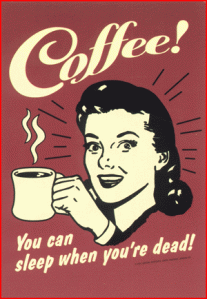
Good Morning!! I’m switching to strong coffee this morning, because I’ve had the sleepies for the past few days. It’s been really damp and humid here, so maybe that’s the reason. All I know is I keep dozing off, and I don’t like it! Anyway, let’s get to the news before I nod out again.
A few days ago, commenter madaha turned me on to an article about a fascinating new book that just came out last week. The book is called A First Rate Madness. The author is Nassir Ghaemi, a professor of psychiatry at Tufts University. From Salon:
Nassir Ghaemi, an author and professor of psychiatry at Tufts University School of Medicine, argues that many of history’s most famous and admired figures, from Churchill to FDR to Gandhi, showed signs of mental illness — and became better leaders because of it. Ghaemi bases his argument on historical records and some of the latest experimental studies on depression and mania, arguing that mild symptoms can actually enhance qualities like creativity or empathy.
After reading the piece in Salon, I immediately ordered the book and I’ve been dipping into it over the past couple of days.
So far, I’ve read the chapter on FDR, and I’m going to read about JFK next. According to Ghaemi, both of these men had hyperthymic personalities: basically, they were upbeat, enthusiastic, energetic, and creative, because they tended to be somewhat hypomanic (a milder, less disabling form of the mania experienced by those with bipolar disorder). In addition, both FDR and JFK suffered from serious physical illnesses–FDR from polio and JFK from Addison’s disease. These illnesses and other adversities these two men faced enabled them to develop empathy for the suffering of ordinary people–even though they were both from privileged backgrounds. Ghaemi argues that people with slightly abnormal personalities are better leaders–particularly in times of crisis when great creativity, empathy, and resilience are needed. According to Ghaemi:
Many people who experience traumas [like terrorism or war] don’t develop PTSD or other illnesses. So the question is, what keeps those people from getting sick? What creates resilience? The psychological research suggests that personality is a major factor. Resilience seems to be associated with mild manic symptoms, but you can’t develop resilience unless you’ve already experienced trauma. Many of these leaders faced adversity in their childhood and adulthood, and that seemed to make them better able to handle crises. It’s like a vaccine. You get exposed to a little bit of a bacteria then you can handle major infections and I think trauma and resilience and hyperthymic personality seem to follow a similar path.
Ghaemi does not discuss Obama’s personality in the book, but Salon interviewer Thomas Rogers asked the author whether Obama may be too “sane” to be a successful President in our current time of crisis.
Obama’s persona is that of a very sane, rational person who is good at compromise — which is definitely how he sold himself during the debt ceiling crisis. Do you think Obama’s sanity is hurting his abilities as a leader?
I didn’t discuss Obama and other current leaders in the book, because there are documentation and confidentiality issues, and a lot of speculation would have to happen. That said, Obama has said himself that he thinks he’s very normal. This no-drama-Obama persona is meant to reassure people about his normality, but I think that when you look at his memoir there’s a sense of a much more complex and profound person who may have experienced a great deal of anxiety and maybe some depression growing up, being half-white half-African-American. The [sane] parts of his psychology may hinder his leadership in terms of not being creative, and that may not be as useful in a crisis. But to whatever extent he’s not fully completely average, he’ll have some psychological reservoir to draw on to think more creatively and realistically about the current situation.
I wish I could agree that Obama might learn to deal with the nation’s difficulties, but so far he doesn’t seem to learn anything from experience. Most of the leaders that Ghaemi discusses suffered from mood disorders–depression or bipolar disorder. Obama, on the other hand, appears to have a different kind of disorder–either Narcissistic Personality Disorder or Antisocial Personality Disorder, or both.
Dakinikat alerted me to an interview with Ghaemi on NPR. I haven’t listened to it yet, but here’s the link.
Getting back to current news, this coming Saturday, Rick Perry plans to announce that he’s running for the Republican presidential nomination.
Rick Perry intends to use a speech in South Carolina on Saturday to make clear that he’s running for president, POLITICO has learned.
According to two sources familiar with the plan, the Texas governor will remove any doubt about his White House intentions during his appearance at a RedState conference in Charleston.
It’s uncertain whether Saturday will mark a formal declaration, but Perry’s decision to disclose his intentions the same day as the Ames straw poll — and then hours later make his first trip to New Hampshire — will send shock waves through the race and upend whatever results come out of the straw poll.
Immediately following his speech in South Carolina, Perry will make his New Hampshire debut at a house party at the Portsmouth-area home of a state representative, Pamela Tucker, the Union Leader reported Monday. Tucker was among the Granite Staters who went to Texas last week to encourage Perry to run.
What can I say? This is ghastly news. Think Progress is reporting that besides being a fundamentalist religious fanatic, Perry shares a similar problem to that of fellow wingnut Michele Bachmann–he has taken lots of Federal money in farm subsidies–$80,000, to be exact.
Verizon workers have gone out on strike–45,000 of them.
More than 45,000 workers from New England to Virginia went on strike just after midnight today at Verizon Communications. Since bargaining began July 22, Verizon has refused to move from a long list of concession demands. As the contract expired, Verizon, a $100 billion company, still was looking for $1 billion in concessions from 45,000 workers and families. That’s about $20,000 in givebacks for every family, nearly 100 concessionary proposals remained on the table.
This despite Verizon’s 2011 annualized revenues of $108 billion and net profits of $6 billion. At the same time, Verizon Wireless just paid its parent company, Vodaphone, a $10 billion dividend. Meanwhile, Verizon’s five top executives received $258 million over the past four years.
The workers, members of the Communications Workers of America (CWA) and the Electrical Workers (IBEW), say they are striking until Verizon “stops its Wisconsin-style tactics and starts bargaining seriously.”
According to Reuters, both sides are accusing each other of bad acts:
The second day of a strike by Verizon workers turned ugly after union representatives accused managers of injuring three workers while driving past picket lines, and the phone giant complained of a spike in network sabotage cases.
[….]
Verizon complained of network sabotage cases in the same statement where it said some picketing workers were unlawfully blocking Verizon managers’ access to work centers.
A spokeswoman for the Communications Workers of America, representing 35,000 of the strikers, said the union “does not condone illegal action of any kind.” The International Brotherhood of Electrical Workers, representing 10,000 strikers, also said members “are expected to obey the law.”
However, the CWA said some picketing workers were hurt by Verizon managers’ cars and that one worker was knocked unconscious when he was clipped by the mirror of a manager’s car that was speeding past a picket line.
Dean Baker had a great piece at Truthout yesterday: The Economic Illiterates Step Up the Attack on Social Security and Medicare
The nonsense with the S&P downgrade is yet another distraction – after four months of haggling over the debt ceiling idiocy – from the real problem facing the country: a downturn that has left 25 million people unemployed, underemployed or out of the labor force altogether. Tens of millions of people are seeing their career hopes and family lives wrecked by the prospect of long-term unemployment.
The incredible part of this story is that the people who are responsible are all doing just fine, and most of them are still making policy. Furthermore, they are using their own incompetence as a weapon to argue that we have to take even more money from the poor and middle class, this time in the form of Social Security, Medicare and Medicaid benefits.
The basic story is that the economy needs demand. The housing bubble generated more than $1.4 trillion in annual demand through the construction and consumption that it spurred. Now that this demand is gone, there is nothing to replace it. President Obama’s stimulus was replaced by some of the lost demand, but it was nowhere near large enough. We tried to fill a $1.4 trillion hole in annual demand with around $300 billion in annual stimulus in 2009 and 2010. In 2011, most of this boost has been exhausted and the economy is coming to a near standstill.
If we had serious people in Washington, they would be talking about jobs programs, about rebuilding the infrastructure, about work sharing, and any other measure that could get people back to work quickly. However, instead of talking about ways to re-employ people, the fixation in Washington is reducing the deficit.
We’ve heard these arguments again and again (especially from our own Dakinikat), but they bear repeating until the ignorant Villagers get the message.
Remember the “rape cops” in New York–the ones who were found not guilty recently? Well, one of them finally got a tiny bit of justice. A judge sentenced Kenneth Moreno to one year in prison for official misconduct. But then another judge freed him.
Disgraced ex-cop Kenneth Moreno didn’t stay in jail for long.
A couple hours after an angry Manhattan judge flat-out called Moreno a liar Monday and dispatched him to Rikers Island to being a year-long prison sentence, an appeals court judge sprung him.
Moreno, acquitted in May of raping a bombed fashion executive while his partner served as lookout, was released on $125,000 bail by Appeals Court Judge Nelson Roman so he can appeal his conviction on official misconduct charges.
It was a startling turnabout for the 43-year-old Moreno, who Supreme Court Justice Gregory Carro ordered remanded.
I sure hope he ends up serving at least some jail time.
Dakinikat sent me this article on a report (PDF) called How to Liberate American from Wall Street Rule. Here are the report’s basic recommendations:
How to Liberate America from Wall Street Rule spells out details of a six-part policy agenda to rebuild a sensible system of community-based and accountable financial services institutions.
1. Break up the mega-banks and implement tax and regulatory policies that favor community financial institutions, with a preference for those organized as cooperatives or as for-profits owned by nonprofit foundations.
2. Establish state-owned partnership banks in each of the 50 states, patterned after the Bank of North Dakota. These would serve as depositories for state financial assets to use in partnership with community financial institutions to fund local farms and businesses.
3. Restructure the Federal Reserve to function under strict standards of transparency and public scrutiny, with General Accounting Office audits and Congressional oversight.
4. Direct all new money created by the Federal Reserve to a Federal Recovery and Reconstruction Bank rather than the current practice of directing it as a subsidy to Wall Street banks. The FRRB would have a mandate to fund essential green infrastructure projects as designated by Congress.
5. Rewrite international trade and investment rules to support national ownership, economic self-reliance, and economic self-determination.
6. Implement appropriate regulatory and fiscal measures to secure the integrity of financial markets and the money/banking system.
Finally, in case you missed it, I want to call your attention to this article that commenter The Rock linked to last night: Hillary Told You So
At a New York political event last week, Republican and Democratic office-holders were all bemoaning President Obama’s handling of the debt-ceiling crisis when someone said, “Hillary would have been a better president.”
“Every single person nodded, including the Republicans,” reported one observer.
At a luncheon in the members’ dining room at the Metropolitan Museum of Art on Saturday, a 64-year-old African-American from the Bronx was complaining about Obama’s ineffectiveness in dealing with the implacable hostility of congressional Republicans when an 80-year-old lawyer chimed in about the president’s unwillingness to stand up to his opponents. “I want to see blood on the floor,” she said grimly.
A 61-year-old white woman at the table nodded. “He never understood about the ‘vast right-wing conspiracy,’” she said.
Looking as if she were about to cry, an 83-year-old Obama supporter shook her head. “I’m so disappointed in him,” she said. “It’s true: Hillary is tougher.”
Go read the whole thing. That’s all I’ve got for today. What are you reading and blogging about? Please share.

 peej
peej Carissa
 bostonboomer
 dakinikat
 ecocatwoman
 mablue2
 Mama Lopez
 peggysue22
 quixote
 skydancingguestblogger
 Mona (aka Wonk the Vote)



 Sky Dancing
Recent Comments