
Friday Reads
Posted: July 8, 2011 Filed under: abortion rights, black women's reproductive health, Catfood Commission, Democratic Politics, Economy, Federal Budget and Budget deficit, fetus fetishists, fundamentalist Christians, John Birch Society in Charge, morning reads, religious extremists, Reproductive Health, Reproductive Rights, Republican presidential politics, right wing hate grouups, U.S. Economy, We are so F'd | Tags: Christianist extremists, Debt, Debt Ceiling, deficit, planned parenthood of North Carolina, Rick Perry, warren buffett 51 Comments Good Morning!!
It’s hard not to be be completely discouraged these days. Our Washington deal-makers are permanently stuck in opposites day. No amount of reality is going to bring the lot of them out of whatever place they strategically reside. This Reuters piece stands as a hallmark to the current lunacy. We shouldn’t have any financial problems. Social Security is solvent and it’s not part of the federal budget are deficit problem. Why am I reading this then?
If Treasury were to decide to delay some payments, one option could be to postpone a disbursement of more than $49 billion to Social Security recipients that is due on August 3.
It would be a politically explosive step but one that could allow the government to temporarily pay bondholders to try to avoid foreign investors dumping U.S. Treasuries and the dollar.
The administration has warned that any missed payments, including those to retirees, veterans and contractors, would be default by another name, and the Treasury team still has concerns that any contingency plan would prove unworkable.
Steve McMillin, a former deputy director of the White House Office of Management and Budget under Bush, said Treasury has options but most of them are “pretty ugly.”
If Treasury were to decide to delay payments, it would need to re-program government computers that generate automatic payments as they fall due — a massive and difficult undertaking. Treasury makes about 3 million payments each day.
Do they figure that seniors aren’t going to riot in the streets effectively like that episode de of South Park called Grey Dawn? I can pretty well imagine that they won’t stop payments to their corporate bosses. After all, that option would soothe the bond vigilantes.
Here’s the issues under study now according to that same Reuter’s article.
– Whether the administration can delay payments to try to manage cash flows after August 2
– If the U.S. Constitution allows President Barack Obama to ignore Congress and the government to continue to issue debt
– Whether a 1985 finding by a government watchdog gives the government legal authority to prioritize payments.
The Treasury team has also spoken to the Federal Reserve about how the central bank — specifically the New York Federal Reserve Bank — would operate as Treasury’s broker in the markets if a deal to raise the United States’ $14.3 trillion borrowing cap is not reached on time.
I’m teaching an MBA Corporate Finance seminar this summer. Every single asset pricing model that prices securities, bonds, loans,options or whatever basically uses the US treasury bond as the risk-free asset. I feel like I have to asterisk everything I’m teaching right now which is basically the same thing that was taught to me back in the 1980s. It’s like these folks are purposefully trying to tank the financial markets and bring on another crisis. If they manage to raise the debt ceiling, then it appears likely to be done by ‘austerity’ measure like $4 trillion dollars in cuts. Start your backyard gardens now. The next depression is bound to be a big one. I have just have no idea why they’re trying to blow up our economy. It’s just frigging unbelievable. Of course, Orrin Hatch wants us all to suffer more, because after all, people that aren’t filthy rich are obviously defective in gawd’s eyes.
So, tell me, who is the real practicioner of voodoo economics?
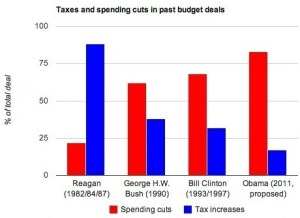
So, here’s a nifty graph on the left from Ezra Klein showing the mix of spending cuts vs. tax increases the last few times we’ve had these debt and deficit discussions. Looks like the real practitioner of voodoo economics wasn’t Ronald Reagan but is Barrack Obama. Just more of the alternate reality forced on us by media and politicians that make up news, history, and economic theory.
As you can see on the graph, in each case, taxes were at least a third of the total, and in Reagan’s case, his massive tax cuts were followed by deficit-reduction deals that actually relied on tax increases. Today, tea party conservatives would be begging Sen. Jim DeMint to primary the Gipper.
Bush also included taxes in his deal, and Clinton relied heavily on taxes in his first deficit-reduction bill, which passed without Republican votes. In 1997, when he was working with Republicans, he actually cut taxes slightly while passing spending cuts. But of course the economy was in much better shape then, and Clinton had already increased revenues substantially.
The one-third rule doesn’t break down until you get to the deal Obama reportedly offered Republicans in the first round of debt-ceiling talks: $2 trillion in spending cuts for $400 billion in taxes, or an 83:17 split. And that, if anything, understates how good of a deal Republicans are getting. Tax revenues and rates are much, much lower than they were under Reagan, Bush or Clinton. And next year, Obama is pledging to extend most of the Bush tax cuts, which amounts to a $3 trillion-plus tax cut against current law.
Meanwhile, the polls–like this one from Pew Research–show that people overwhelmingly want to maintain social security, medicaid and medicare and would support tax increases to do so. So much for government of, for, and by the people.
As policymakers at the state and national level struggle with rising entitlement costs, overwhelming numbers of Americans agree that, over the years, Social Security, Medicare and Medicaid have been good for the country.
But these cherished programs receive negative marks for current performance, and their finances are widely viewed as troubled. Reflecting these concerns, most Americans say all three programs either need to be completely rebuilt or undergo major changes. However, smaller majorities express this view than did so five years ago.
The public’s desire for fundamental change does not mean it supports reductions in the benefits provided by Social Security, Medicare or Medicaid. Relatively few are willing to see benefit cuts as part of the solution, regardless of whether the problem being addressed is the federal budget deficit, state budget shortfalls or the financial viability of the entitlement programs.
Jim DeMint is one of the people that should be the first in line to be charged with treason and gross stupidity. Where was Senator DeMint when all the votes were taken to spend all this money to start out with? Plus, all those irresponsible revenue cuts back in the early 2000s when we basically had a balanced budget? He was a congressman from 1999-2005 so certainly he must’ve tried to stop Dubya Bush from all that spending!
Sen. Jim DeMint (R-S.C.) said Wednesday night that Republicans should maintain their hardline position in the debt-ceiling debate even if it results in “serious disruptions” to the economy.
“What I’m advocating here is, let’s use this as a point of leverage, give the president an increase, but don’t come away without real cuts from real caps and spending, and without a balanced budget,” DeMint said on FOX Business Network.
“We’re at the point where there would have to be some, you know, some serious disruptions in order not to raise [the debt ceiling],” he said. “I’m willing to do that.”
The president pushed the economy into “crisis” mode, according to DeMint. He said the president has been “burning time” with the deficit negotiations led by Vice President Biden, when the looming debt ceiling and budget deficit could have been addressed last year.
DeMint, well-known for speaking out in favor of limited government and balancing the budget, told host Andrew Napolitano that if Republicans and Democrats couldn’t vote in “something permanent” that would limit government spending, “we’re going to continue to spend [until] the total country collapses.”
Warren Buffet says the GOP is Threatening To ‘Blow Your Brains Out’ Over Debt Ceiling
Republicans are playing a dangerous game by refusing to raise the debt ceiling, according to Berkshire Hathaway CEO Warren Buffett.
“We raised the debt ceiling seven times during the Bush Administration,” Buffett told CNBC on Thursday. Now, the Republican-controlled Congress is “trying to use the incentive now that we’re going to blow your brains out, America, in terms of your debt worthiness over time.”
If Congress fails to raise the borrowing limit of the federal government by August 2, the date when the U.S. will reach the limit of its borrowing abilities, it will likely begin defaulting on its loans.
Buffett, who according to the Washington Post has helped raise money for Democratic candidates like Hilary Clinton in the past, has been highly critical of the actions of the Republican-controlled Congress. In May, Buffett stated at a Berkshire Hathaway shareholder’s meeting that if the Congress failed to raise the debt ceiling, it would constitute “the most asinine act” in the nation’s history, reports Reuters.
Other political news is equally disheartening. Most of the governments in the states are as crazy–if not crazier–than the US Congress. Planned Parenthood in North Carolina is suing the state over budget cuts designed to cut access to much used and cost saving preventive health care.
One of North Carolina’s two Planned Parenthood affiliates filed a federal lawsuit Thursday to invalidate part of the new state budget that cuts it off from federal or state funds for family planning.
The budget, written by Republicans in control of the General Assembly for the first time in more than a century, states that Planned Parenthood and its affiliates are forbidden from receiving any contracts or grants from the state health agency. The lawsuit filed in Greensboro’s federal court by Planned Parenthood of Central North Carolina contends the group is being punished for its abortion-rights advocacy, saying that violates its free-speech protections.
The organization is barred by law from using public money to perform abortions and uses the government contracts to provide family planning or teen pregnancy prevention services, yet is being singled out because Planned Parenthood supports abortion rights, the lawsuit said. Efforts to cut off funds to Planned Parenthood affiliates in North Carolina are similar to those in Kansas and Indiana, which were also met with federal lawsuits, the group’s attorneys said.
“Their sole purpose is to single out, vilify, and punish Planned Parenthood as a particularly visible provider and advocate — even though, ironically, the eliminated funds have nothing to do with abortion, but will only deprive low-income people of desperately needed health services and teen pregnancy prevention programs,” the lawsuit said.
Planned Parenthood of Central North Carolina received $287,000 in federal, state and matching local funds in the year that ended last week for teen pregnancy prevention and family planning programs that provided contraceptives to poor women, according to the state Department of Health and Human Services. The non-profit operates from locations in Chapel Hill, Durham, and Fayetteville.
Some of the most extremist pastors are signing on to Texas Governor Rick Perry’s Pray-a polooza. Talk about a hater-thon. Remember, Perry is supposed to be the ‘electable’ Republican.
And we already knew Perry didn’t care much about including, or even not offending, non-Christians: his personal letter announcing the event calls on the entire nation to pray to Jesus Christ. But the news, reported by Right Wing Watch, that a radical pastor named C. Peter Wagner has signed on as an official endorser of The Response deserves more attention.
The Colorado-based Wagner, who is featured on the website of The Response, is the head of Global Harvest Ministries.
His brand of evangelicalism, known as the New Apostolic Reformation, is characterized by extreme hostility to other religions. In this passage from his book “Hard-Core Idolatry: Facing the Facts,” Wagner praises the burning of Catholic saints, copies of the Book of Mormon, voodoo dolls, and other “idols”
Yup, welcome to the new surreality. All we need is Rod Serling introducing the morning reads today and I’d say that would be about right.
What’s on your reading and blogging list today?
Saturday Night Frights: What the Future of America Could Look Like
Posted: June 4, 2011 Filed under: 2012 presidential campaign, abortion rights, Democratic Politics, Domestic Policy, Economy, fetus fetishists, fundamentalist Christians, religion, religious extremists, Reproductive Rights, Republican presidential politics, U.S. Economy, U.S. Politics | Tags: Christian Coalition, closet cases, Faith and Freedom Coalition, John Boehner, John Huntsman, Marcus Bachmann, Mich McConnell, Michelle Bachmann, Ralph Reed, Sarah Palin, Tim Pawlenty 13 Comments
For the past two days, Republican movers and shakers have participated in a conference in Washington, DC, sponsored by the Faith and Freedom Coalition. The Faith and Freedom Coalition is the new face of the religious right, but the same old faces are behind the new organization. It is chaired by evil grifter and former Jack Abramoff crony Ralph Reed, who once led the Christian Coalition and is now supposedly experiencing a “political rebirth.”
Just as a reminder of how utterly slimy Ralph Reed is, here is disgraced super-lobbyist Jack Abramoff expressing an opinion about Reed.
This dishonest, repulsive man is one of the kingmakers of the Republican Party.
The Caucus blog at The New York Times had a brief writeup on the Faith and Freedom Conference and what the 2012 Republican hopefuls had to say to them. Here are some samples.
John Huntsman
“I do not believe the Republican Party should focus solely on our economic life to the neglect of our human life,” Jon M. Huntsman Jr. told the audience of several hundred after citing antiabortion laws he signed when governor of Utah.
Tim Pawlenty
opened and closed his remarks with biblical quotes. He said his top four “common-sense principles” for the nation were to turn toward God, protect the unborn, support traditional marriage and keep Americans secure.
Michelle Bachmann
reminded the audience that she home-schooled her five children and ended with a prayer that asked a blessing for President Obama, whom she had sharply criticized moments earlier.
Bachmann also promised to repeal Obamacare.
Mitt Romney tried to convince the audience he believed in the “sanctity of human life” and hated gay marriage, Newt Gingrich didn’t show up, and Ron Paul talked about reinstating the gold standard.
Before you laugh too loudly about this parade of loons, check out what Howard Dean told The Hill today. He’s warning Democrats that the “P” woman could beat Obama in 2012. In face Dean thinks if something isn’t done about the economy and unemployment, anyone who wins the Republican nomination could win the presidency.
Dean says his fellow Democrats should beware of inside-the-Beltway conventional wisdom that Obama would crush Palin in a general-election contest next year.
“I think she could win,” Dean told The Hill in an interview Friday. “She wouldn’t be my first choice if I were a Republican but I think she could win.”
Dean warns the sluggish economy could have more of a political impact than many Washington strategists and pundits assume.
“Any time you have a contest — particularly when unemployment is as high as it is — nobody gets a walkover,” Dean said. “Whoever the Republicans nominate, including people like Sarah Palin, whom the inside-the-Beltway crowd dismisses — my view is if you get the nomination of a major party, you can win the presidency, I don’t care what people write about you inside the Beltway,” Dean said.

Personally, I think Michelle Bachmann is scarier than Quitterella. And potential first lady gentleman Mr. Michelle Bachmann Marcus Bachmann is even scarier than she is. Here he is discussing homosexuality.
This is Marcus Bachmann swishing arriving at a radio station for an interview.
These are the kinds of people who could be running the country if the Democrats don’t get off their duffs and do something about the economy and jobs instead of playing footsie with Mich McConnell, John Boehner, and the rest of the Republican freakazoids. This is no joke, folks. I realize this isn’t a particularly politically correct post, but I do not want to be at the mercy of a bunch of self-hating closet cases and hypocritical christianists who are obsessed with fetuses and throwing old people to the wolves. Democrats need to wake the f*ck up and smell the unemployment.
Monday Reads
Posted: May 16, 2011 Filed under: 2012 presidential campaign, Economy, Federal Budget and Budget deficit, fundamentalist Christians, Global Financial Crisis, income inequality, Medicare, religion, religious extremists, Republican politics, Republican presidential politics, Team Obama, The Bonus Class, The Great Recession, U.S. Economy, U.S. Politics | Tags: Debt Ceiling, End Times, evangelical Christians, Harold Campaign, Mark Thoma, Newt Gingrich, Rapture, the plutocracy, Timothy Giethner 52 Comments Good Morning!
Are you reading for the end of the world next Saturday? Nope, it’s not 2012 yet and we’re not talking about the Mayan Prophecy. Harold Campaign has convinced a group of evangelicals that the date is May 21, 2011. I wonder if any of them would like me to take care of their left behind pets for all their money? You can read more about the man and his end of days wishes at Salon.
The self-appointed harbingers are not tied to any particular church — they claim organized religion has been corrupted by the devil — but rather to Internet- and radio-based ministries. And their lone mission is to tell anyone and everyone that the end of days is May 21. That’s when, they insist, God’s true believers will be lifted into heaven and saved, during a biblical event widely referred to as the Rapture.
The finer points of Christian eschatology have long been the subject of dispute (not to mention the inspiration for movies and books, like the blockbuster “Left Behind” series). Though mainstream churches reject the the notion that doomsday can be predicted by any man, fringe scholars continue to work feverishly pinpointing the moment of the final, divine revelation. And one such man — 89-year-old radio host Harold Camping — has been at the game for decades.
In the early ’90s, Camping published a book titled “1994?,” which claimed judgment day would arrive in September of that year. When confronted with such a staggering anticlimax — the world, after all, kept on spinning — Camping chose not to be discouraged, but to learn from his mistakes. (He hadn’t considered the Book of Jeremiah, he says.) A civil engineer by trade, Camping went back to the drawing board and continued to crunch the numbers, before arriving at the adamant determination that Rapture would come on May 21, 2011. He began to spread the word through his broadcasting network, Family Radio, in 2009, and quickly built up a fervid following.
I guess it takes all kinds. That’s what my mother used to tell me when she was alive, anyway. Speaking of that, MoJo has a great list of Newtisms that will take you a trip back in time with Gingrich’s greatest tongue trips. Here’s some of his earliest hits.
1978 In an address to College Republicans before he was elected to the House, Gingrich says: “I think one of the great problems we have in the Republican party is that we don’t encourage you to be nasty. We encourage you to be neat, obedient, and loyal and faithful and all those Boy Scout words.” He added, “Richard Nixon…Gerald Ford…They have done a terrible job, a pathetic job. In my lifetime, in my lifetime—I was born in 1943—we have not had a competent national Republican leader. Not ever.”
1980 On the House floor, Gingrich states, “The reality is that this country is in greater danger than at any time since 1939.”
1980 Gingrich says: “We need a military four times the size of our present defense system.” (See 1984.)
1983 A major milestone: Gingrich cites former British Prime Minister Neville Chamberlain on the House floor: “If in fact we are to follow the Chamberlain liberal Democratic line of withdrawal from the planet,” he explains, “we would truly have tyranny everywhere, and we in America could experience the joys of Soviet-style brutality and murdering of women and children.”
What is it that Republicans put in their formula that turns out people like this? Newt was on Meet the Press yesterday where he mouthed off on a number of subject’s including Paul Ryan’s Medicare pogrome. This is the National Review’s take so read with caution.
Newt Gingrich’s appearance on “Meet the Press” today could leave some wondering which party’s nomination he is running for. The former speaker had some harsh words for Paul Ryan’s (and by extension, nearly every House Republican’s) plan to reform Medicare, calling it “radical.”
“I don’t think right-wing social engineering is any more desirable than left-wing social engineering,” he said when asked about Ryan’s plan to transition to a “premium support” model for Medicare. “I don’t think imposing radical change from the right or the left is a very good way for a free society to operate.”
As far as an alternative, Gingrich trotted out the same appeal employed by Obama/Reid/Pelosi — for a “national conversation” on how to “improve” Medicare, and promised to eliminate ‘waste, fraud and abuse,’ etc.
“I think what you want to have is a system where people voluntarily migrate to better outcomes, better solutions, better options,” Gingrich said. Ryan’s plan was simply “too big a jump.”
He even went so far as to compare it the Obama health-care plan.”I’m against Obamacare, which is imposing radical change, and I would be against a conservative imposing radical change.”
I have to say that having Trump, Gingrich, Santorum and Paul all debating each other on one stage would probably be highly entertaining. They could have a contest for who would make the craziest old uncle.
The White House is out on the road trying to head off problems with the national debt ceiling. Timothy Geithner says that the economy will double-dip if the Republicans don’t raise the ceiling.
In a heavily-anticipated response to Sen. Michael Bennet, D-Colo., who asked Geithner to document the economic and fiscal impacts of failing to lift the statutory debt limit, the Treasury secretary detailed a chain reaction that would cripple the economy, costing jobs and income.
“A default would inflict catastrophic far-reaching damage on our nation’s economy, significantly reducing growth and increasing unemployment,” said Geithner in the letter to Bennet which was dated May 13. “Even a short-term default could cause irrevocable damage to the economy.”
Geithner has imposed an August deadline for Congress to lift the $14.3 trillion debt ceiling, but lawmakers are still negotiating over Republican demands to tie the move to spending cuts. And a portion of the GOP still remains skeptical about the need to act by the deadline at all, arguing that the consequences have been overstates.
Economist Mark Thoma has a better explanation of how the refusal to increase the debt ceiling would impact the economy on CBS Money Watch. This explanation is much more precise.
If politicians fail to reach a deal to increase the debt ceiling, there would be a large fall in federal spending. The decline in federal purchases of private sector goods and services would reduce aggregate demand, and this could slow or even reverse the recovery (it could also threaten the delivery of critical services that some people depend upon). In addition, the failure to pay wages to federal workers would disrupt household finances and cause a further decline in demand, as would the failure of the government to pay its bills for the goods and services it has already purchased from the private sector (and it could even threaten some households and businesses with bankruptcy should the problem persist). There may be some room for the Treasury to use accounting tricks to avoid the worst problems, at least for a time, but it is not at all clear how well this would work to insulate the economy from problems and eventually this strategy will come to an end.
That’s potentially bad enough, but it’s far from the end of the problems that could occur. Failure to raise the debt ceiling could also undermine faith in the safety of US Treasury bills. If we default on bond payments, or appear willing to do so even if it doesn’t actually occur and investors lose faith in US Treasury Bills, they will begin demanding higher interest rates to cover the increased perception of risk. This could be very costly. We depend upon the rest of the world to finance our debt at extremely low interest rates. If the willingness of other countries to do this diminishes, then the cost of financing our debt would rise substantially. And that’s not all. In addition to increased debt servicing costs, an increase in interest rates would also choke off business investment potentially lowering economic growth, and the consumption of durable goods by households would fall as well. Rising interest rates would also be bad for the housing recovery (such as it is). Thus, failure to reach an agreement could be very costly.
The Economist‘s Blog on American Politics: Democracy in America has an interesting post right now on ‘The Road to 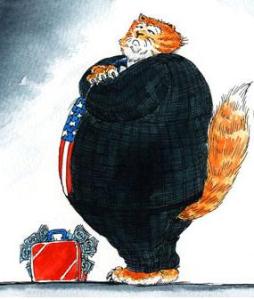 Plutocracy’. It’s an interesting read with a lot of quotes from other pundits.
THE word “plutocracy” is in the air these days. Some say the era of the de facto rule of the mighty top 10%, or top 1%, or whatever insidious sliver of the income distribution is thought to constitute the moneyed power elite, is upon us, or nearly so. I’m not so sure. I am sold on the proposition that there’s something deeply whacked about the American financial system, and that whatever that’s whacked about it is significantly responsible for the top 1% pulling so far away from the rest of the income distribution. This needs to be fixed, whatever its other consequences. It’s not clear to me, however, what exactly is whacked. I don’t know whether to sign up for Tyler Cowen’s “going short on volatility” story, Daron Acemoglu’s “financial-sector lobbying and campaign contributions ‘bought’ an enriching (and destabilising) regulatory structure” story, or some other story. No doubt the truth is in some subtle combination of stories. In any case, accounts such as Mr Acemoglu’s, according to which big players in certain sectors over time manage to rig the regulatory climate to their advantage, are quite compelling for reasons both theoretical and empirical
Newsweek has an interesting article up on why the megarich manage to have such a sweet tax deal. Even if we raise their income taxes, it really doesn’t hit them where it counts. Here’s why.
It drives economist Bruce Bartlett crazy every time he hears another bazillionaire announce he’s in favor of paying higher taxes. Most recently it was Mark Zuckerberg who got Bartlett’s blood boiling when the Facebook founder declared himself “cool” with paying more in federal taxes, joining such tycoons as Bill Gates, Warren Buffett, Ted Turner, and even a stray hedge-fund manager or two.
Bartlett, a former member of the Reagan White House, isn’t against the wealthy paying higher taxes. He’s that rare conservative who thinks higher taxes need to be part of the deficit debate. His beef? It’s a hollow gesture to say the federal government should raise the tax rate on the country’s top wage earners when the likes of Zuckerberg have most of their wealth tied up in stock. Many of the super-rich see virtually all their income as capital gains, and capital gains are taxed at a much lower rate—15 percent—than ordinary income. When Warren Buffett talks about paying a lower tax rate than his secretary, that’s because she sees most of her pay through a paycheck, while the bulk of his compensation comes in the form of capital gains and dividends. In 2006, for instance, Buffett paid 17.7 percent in taxes on the $46 million he booked that year, while his secretary lost 30 percent of her $60,000 salary to the government.
“It’s easy to say ‘Raise taxes’ when you know you’re not going to have to pay those taxes,” Bartlett says. “What I don’t hear is ‘Let’s raise the capital-gains tax.’” Instead the focus has been on the federal tax rate paid by those with an annual income of $250,000 or more—the top 3 percent of earners. Bartlett argues that while raising taxes on the country’s richest individuals would go a long way in easing the debt crisis, it makes no sense to treat the professional making a few hundred thousand dollars a year the same as the Richie Rich set. Maybe it’s hard to muster sympathy for an executive pulling down $1 million a year. But ours is a tax system where a person in the top tax bracket (those earning more than $374,000 in 2010) pays a tax rate of 35 percent on the upper portions of his or her income (37.9 percent if you include Medicare), whereas a hedge-fund manager or mogul earning 10 or 100 times that amount pays less than half that tax rate.
Well, now I’m thinking we’re all just so f’ked that I might as well stop while I’m ahead. What’s on your reading and blogging list today?
Thursday Reads
Posted: March 24, 2011 Filed under: Barack Obama, education, fundamentalist Christians, morning reads, right wing hate grouups, Social Security, The Media SUCKS, torture, U.S. Economy, U.S. Politics, unemployment, worker rights | Tags: Barack Obama, Barry Bonds, Bart Stupak, Elizabeth Taylor, food stamps, Jason Leopold, Jeff Kaye, Republicans, Social Security, Torture, unions, war on schools 32 Comments
R.I.P, Liz Taylor
Good Morning!!
I’ve got a potpourri of news items for you this morning. I realize I’ve been focusing too heavily on stories from the Middle East and Africa. I’ve just so gotten fascinated with all the rebellions going on. Anyway, this post will be dedicated to stories about events in the U.S.
Yesterday we lost the last great movie star, Elizabeth Taylor. She had been in the hospital for weeks with congestive heart failure. Today she died, at 79. From The New York Times:
By the time Elizabeth Taylor left this mortal coil at 79, she had cheated death with a long line of infirmities that had repeatedly put her in the hospital — and on front pages across the world — and in 1961 left her with a tracheotomy scar on a neck more accustomed to diamonds. The tracheotomy was the result of a bout with pneumonia that left her gasping for air and it returned her to the big, bountiful, hungry life that was one of her greatest roles. It was a minor incision (later, she had surgery to remove the scar), but it’s easy to think of it as some kind of war wound for a life lived so magnificently.
Unlike Marilyn, Liz survived. And it was that survival as much as the movies and fights with the studios, the melodramas and men (so many melodramas, so many men!) that helped separate Ms. Taylor from many other old-Hollywood stars. She rocketed into the stratosphere in the 1950s, the era of the bombshell and the Bomb, when most of the top female box-office draws were blond, pneumatic and classifiable by type: good-time gals (Betty Grable), professional virgins (Doris Day), ice queens (Grace Kelly). Marilyn Monroe was the sacrificial sex goddess with the invitational mouth. Born six years before Ms. Taylor, she entered the movies a poor little girl ready to give it her all, and did.
Ms. Taylor, by contrast, was sui generis, a child star turned ingénue and jet-setting supernova, famous for her loves (Eddie & Liz, Liz & Dick) and finally for just being Liz. “I don’t remember ever not being famous,” she said. For her, fame was part of the job, neither a blessing (though the jewels were nice) nor a curse. Perhaps that’s why she never looked defeated, unlike those who wilt under the spotlight. In film after film she appears extraordinarily at ease: to the camera born. She’s as natural in “National Velvet,” the 1944 hit that made her a star at 12, as she is two decades later roaring through “Who’s Afraid of Virginia Woolf,” proving once again that beauty and talent are not mutually exclusive, even in Hollywood.
I’m sure Liz would not be surprised to learn that the Westboro Baptist Church will picket her funeral. She was close friends with many gay men in Hollywood–Rock Hudson, James Dean, Montgomery Clift among them–and she worked tirelessly for AIDS causes. Meanwhile the pastor and members of the Westboro Baptist Church are mean-spirited, soulless haters.
There’s a nice tribute to Taylor at The Independent UK by Julie Burchill: Farewell then, Liz. You knew your beauty was a fuel worth burning
With the death of Elizabeth Taylor, the last of the Hollywood greats is finally gone. True to form – never a lady, barely ever a girl – this tough broad supreme battled on against ill-health for decades after her contemporaries overdosed on barbiturates, booze and self-loathing. And at a time when professional beauties seem terrified to show any sign of ageing lest they be shunted into character cameos in favour of some fresher flesh, Taylor was fascinating for being far less interested in leaving a good-looking corpse than in wringing every drop of the juice from every inch of the ride.
If that sounds a somewhat lewd metaphor, all the better. Married eight times, she was the anti-Marilyn; rather than combine a child’s face with an adult body and be prey to all the weirdos who might be attracted to such a pervy paradox, Taylor was a woman of the world from the get-go. Child stars are notorious for spending a couple of years on the ugly step while the studios wait for them to outgrow adolescent awkwardness, but she went straight from hugging Lassie to snogging Montgomery Clift, it seemed.
To see the teenage Taylor draw Clift towards her in the masterpiece A Place In The Sun (from the book of Theodore Dreiser’s An American Tragedy) with the words “Tell Mama – tell Mama all” is to witness one of the most extraordinary portrayals of lust ever created. And it didn’t stop when the cameras did; years later, according to her housekeeper, Marilyn Monroe would become obsessed with the apparently gay Montgomery Clift and repeatedly complain; “Liz Taylor has the Oscar, she has children, she even has Monty – she has everything!”
From being denounced by the Vatican in the Sixties as “an erotic vagrant” (I think they meant it as an insult, but it sounds gorgeous to me) to being hailed by the director of the UCLA Aids Institute as the “the Joan of Arc of Aids activism”, Taylor lived her life according to her own rules – more Wife of Bath than untouchable ideal of feminine perfection. Looking at the insipid contemporary film-star likes of Gwyneth Paltrow, for whom eating half a cupcake seems a walk on the wild side, this cursing, drinking, swashbuckling goddess is a reminder of when hell-raisers didn’t automatically have to be as mad, bad and sad as Charlie Sheen and Mel Gibson.
Here’s a nice video tribute I found on YouTube:
Now for the rest of the news, which as usual isn’t very good. The Republicans are trying to increase poverty by attacking food stamps and worker’s rights at the same time! They want to cut of food stamps for an entire family if one member goes on strike.
…[A] group of House Republicans is launching a new stealth attack against union workers. GOP Reps. Jim Jordan (OH), Tim Scott (SC), Scott Garrett (NJ), Dan Burton (IN), and Louie Gohmert (TX) have introduced H.R. 1135, which states that it is designed to “provide information on total spending on means-tested welfare programs, to provide additional work requirements, and to provide an overall spending limit on means-tested welfare programs.”
Much of the bill is based upon verifying that those who receive food stamps benefits are meeting the federal requirements for doing so. However, one section buried deep within the bill adds a startling new requirement. The bill, if passed, would actually cut off all food stamp benefits to any family where one adult member is engaging in a strike against an employer:
The bill also includes a provision that would exempt households from losing eligibility, “if the household was eligible immediately prior to such strike, however, such family unit shall not receive an increased allotment as the result of a decrease in the income of the striking member or members of the household.”
At FDL, Phoenix Woman dissects the latest media attacks on Social Security.
Ho-hum. Another day, another set of Peterson patsies explaining yet again why Grandma must starve so that their billionaire bosses and their buddies can keep their twenty-odd homes in the Hamptons and Hobe Sound:
Writing today on the op-ed page of The Washington Post, Robert Pozen makes the casethat liberals should support changes to Social Security. Mr. Pozen is a Democrat , though not necessarily a liberal one; he is a financial executive who served on President George W. Bush’s Social Security commission and in Mitt Romney’s administration in Massachusetts. But his argument is worth considering, whether you’re liberal or conservative.
So what’s the argument that the Pozen part of the Leonhardt-Pozen Legion of Doom tag team’s presenting? It’s their old favorite, the “Social Security is less progressive than it seems” bit of twaddle. How old is it? Why, it even comes pre-debunked, that’s how old it is.
To learn more, click on the link above.
I highly recommend reading this piece by Jeff Kaye, who has been researching and writing about torture for years now. He and Jason Leopold have been working together on a series at Truthout.
As part of a new investigative story, Truthout has published documents written by the former psychologist for SERE, and later CIA contract interrogator for the Bush torture program, Bruce Jessen. Before going to work for the CIA with his former SERE partner, psychologist James Mitchell, Jessen authored a 2002 “draft exploitation plan” for military use, based on his experiences as a SERE instructor. The newly-discovered documents, provided to Truthout by former SERE Air Force Captain Michael Kearns, were written back in 1989 when Jessen was transferred from his clinical role elsewhere in SERE to help staff a new survival training course for Special Mission Units undertaking dangerous assignments for Special Operations forces abroad.
Jason Leopold and I co-authored the new story, which includes a video interview with Captain Kearns, who helped hire Jessen back in 1989 for his new SERE role helping put together the class titled SV-91. The documents include notes for a portion of that class, known as “Psychological Aspects of Detention.” The other document is a paper by Jessen, “Psychological Advances in Training to Survive Captivity, Interrogation and Torture,” which was prepared for a symposium at that time: “Advances in Clinical Psychological Support of National Security Affairs, Operational Problems in the Behavioral Sciences Course.”
Jessen’s notes, in particular, demonstrate that this course material, which was “reverse-engineered” to provide a blueprint for the interrogation and detention policies of the Bush administration — some of which remain in use today — emphasized not just the ways to coercively interrogate an individual for intelligence purposes, but to “exploit” the detainee for a number of uses.
From Catherine Rampell at the NYT Economix blog: More Americans Dropping Out of the Labor Force. Apparently the drop in participation is not just due to the economic crisis. According to Rampell, more women are choosing not to work than in the past, and the the pending retirements of baby boomers are big contributors to the phenomenon.
This piece at The Daily Beast is a few days old, but still worth reading: Obama’s War on Schools
Over the past year, I have traveled the nation speaking to nearly 100,000 educators, parents, and school-board members. No matter the city, state, or region, those who know schools best are frightened for the future of public education. They see no one in a position of leadership who understands the damage being done to their schools by federal policies.
They feel keenly betrayed by President Obama. Most voted for him, hoping he would reverse the ruinous No Child Left Behind (NCLB) legislation of George W. Bush. But Obama has not sought to turn back NCLB. His own approach, called Race to the Top, is even more punitive than NCLB. And though over the past week the president has repeatedly called on Congress to amend the law, his proposed reforms are largely cosmetic and would leave the worst aspects of NCLB intact.
Read it and weep.
From CNN: Suspect in attempted bombing at MLK Day parade pleads not guilty
Kevin Harpham, 36, of Colville, Washington, made the plea during an arraignment hearing in federal court in Spokane. Harpham faces trial on charges of attempting to use a weapon of mass destruction and for possessing an unregistered explosive device.
Federal authorities arrested Harpham March 9, nearly two months after the January 17 discovery of a backpack containing a bomb along the Martin Luther King Day parade route in Spokane. The explosive device was found and disabled before the event began.
Officials called it an incident “of domestic terrorism” that could have resulted in “mass casualties,” had the bomb gone off.
I haven’t been following the Barry Bonds trial, but I was really angry when I read this: Witness says he knew of Bonds’ steroid use in 1999
Honestly, baseball should strike Bonds’ hitting records. It’s disgrace that he gets credit for passing Hank Aaron in home runs. Anyone who saw Bonds when he was younger had to know he was using steroids to get so big.
Poor Bart Stupak is afraid because of all the hate he got for voting for Obama’s health care bill.
After suffering through a “living hell” during negotiations on the healthcare law, former Rep. Bart Stupak (D-Mich.) finds it hard, a year later, to distance himself from his pivotal role.
“I guess I’m the face of healthcare,” Stupak told The Hill in an interview this week. “It goes with the territory.”
Last March, Stupak became the object of a flood of threats and obscene messages, left at his office and his home, as he helped hammer out a deal between anti-abortion-rights Democrats and the White House that was instrumental in passing healthcare reform through the House by a single-digit-margin.
Cry me a river, Bart.
That’s about all I’ve got for today. What are you reading and blogging about?
Right off a Cliff
Posted: February 26, 2011 Filed under: abortion rights, Barack Obama, Civil Liberties, Civil Rights, collective bargaining, Corporate Crime, Democratic Politics, education, Environmental Protection, Federal Budget, Feminists, fundamentalist Christians, GLBT Rights, Human Rights, John Birch Society in Charge, Populism, Psychopaths in charge, Republican presidential politics, right wing hate grouups, Surreality, Team Obama, The Media SUCKS, the villagers, U.S. Politics, Voter Ignorance, We are so F'd | Tags: extremists, Republicans, Ron Brownstein, Scott Walker, States Rights 11 Comments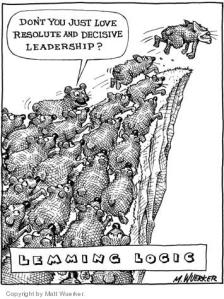 Where are mainstream Republicans these days? What has happened to the party of Lincoln, Teddy Roosevelt and Eisenhower? Prior to the Reagan years, Republican women were front and center in volunteering for planned parenthood, supporting the ERA, and working for abortion rights. First Lady Betty Ford was a proud feminist and one of the first women to put women’s health issues–including women with drinking problems and breast cancer–on the map. President Richard Nixon was responsible for many of the agencies that protect the environment. The current party is chock-full of science denying Theocrats and economics-denying Corporate Fascists. It’s making a sham out of the two party system. We may now have a window open wide enough to stop some of this. We should ready ourselves with the facts and act now.
An online conversation has been initiated with the publication of Ron Brownstein’s article in the National Journal on Thursday called ‘State’s Rights’. It is front and center in starting a discussion among Democratic bloggers, journalists, and other liberal/progressive sympathizers. States rights was code for the right to own slaves during the first 100 years of this country’s existence. It is now code for the right to discriminate against the GLBT community, insert the government into an individual woman’s gynecological care, and bust unions. The racial overtones have not gone away since the worst of the hateful verbiage is aimed at stopping any policy goal attempted by President Obama.
Any one who has read me over the last few years knows that I am not a big fan of this President and I’m even less of a fan of his zealous followers. However, it would take a fairly dim bulb to not see the racism implicit in many of the Republican attacks against him. Attacks range from the extremely bizarre personal assertions that he is a secret Muslim, foreign born, and a devout socialist/communist to a complete rewrite of any policy initiative.
Obama is about as conservative of a Democrat as one can find these days which has been one of my issues with him all along. His actions and words have not stopped the endless attacks on absolutely everything he attempts by Republicans and their monied interests. These tactics were first used against former Democratic President Bill Clinton but have reached some kind of hyper-extortionate apex today. It’s to the point that I firmly believe some of these Republican extremists would rather take the country down with them than negotiate something other than an ideologically pure outcome. Brown’s article and examples focus on the current bloc of extremist Republican governors with their take no prisoners policies. While his focus is mostly on the impact on Obama, I believe his larger point should entice us to think bigger.
But one senior Obama administration official, who also had a close view of Clinton’s interaction with Republican governors, contends that ideology is trumping interest for the governors in many of these new disputes. Health care reform, for instance, asks states for no new financial contribution to expand coverage through 2016 and only relatively small participation thereafter; because 60 percent of the uninsured live in the states where a Republican holds the governorship, their residents would receive the most new federal aid if the law survives. “One had the sense in the mid-1990s that conservative governors were doing whatever was in the best interest of their state,” the senior official said. “This time, the Republican governors appear determined to make an ideological point, even if it costs their state a great deal.”
Whatever the governors’ motivations (one man’s posturing, after all, is another man’s principle), their unreserved enlistment into Washington’s wars marks a milestone. It creates a second line of defense for conservatives to contest Obama even after he wins battles in Congress. It tears another hole in the fraying conviction that state capitals are less partisan than Washington. And it creates a precedent that is likely to encourage more guerrilla warfare between Democratic governors and a future Republican president.
American politics increasingly resembles a kind of total war in which each party mobilizes every conceivable asset at its disposal against the other. Most governors were once conscientious objectors in that struggle. No more.
I can remember attending Republican conventions in the early 1980s during the first hint of the unholy alliance between religious fanatics along the line of a Christian Taliban with the John Birch Society version of libertarians. It was a terrifying spectacle. At the time, the more pro-business and hoity-toity conservative elements in the party were willing to use them like pet pit bulls because they were incredibly organized at the grass roots level and they voted. Republicans traditionally had a much more difficult time turning out voters and their GOTV machines were dwarfed by the Democrats who could rely on well organized and managed union membership. This is one of the reasons why there is also the huge attack on the last standing unions now. They’re worth a fortune come election time and no Republican campaign strategist worth anything underestimates them. We can clearly no longer underestimate the religious zealots or those gullible to the rants of Glenn Beck. They’ve become a contagion.
Back in the day, the young me argued that this form of big daddy government intervention put forth by religionists and Birchers was basically enabling powerful business monopolies and drop kicking the constitutional mandate to deny the establishing of a state religion. It was against the very core ideology of historical Republicanism. I got no where. This was especially true as Nixon’s southern strategy began to work its evil influence on bringing in the remaining racist elements of the old Dixiecrats who frankly were all for the government taking care of any one that wasn’t like them. This added the last nail in the traditional coffin of the party of Lincoln. That sin is now manifesting in the xenophobia against Muslims and Hispanics in addition to African Americans topped by the anti-science bias from the religionists and the pro-monopoly market creation from the corporatists.
It appears that many old school Republicans now see the results of opening this Pandora’s box. They are horrified and have been trying to stuff the demons back into the chest. Now, you see those same folks that opened their kennels filled with poodles to the pit bulls are now acting absolutely appalled by the rising influence of absolutely whacked extremists like Glenn Beck. Scarborough, Rove, and Kristol are currently trying to put the Beckheads back into the box. Those of us that don’t vote Republican could afford to ignore this if it were just some intraparty feud. It’s gone beyond that with the rise of tea party hysterics and billionaire libertarian Daddy Warbucks’ propaganda machines. In many states, the Republican party infrastructure has been commandeered by the pit bulls. The poodles–like Arianna Huffington and Markos–have long left their confines. They are morphing traditional Democratic Party concerns. The same divisive issues that used to motivate the base to do the GOTV and show up at the polls has managed to bring this new crop of Republican governors and congressional members to a critical mass. They refuse any middle or even right of middle ground. They won’t negotiate on the usual country club Republican issues. It’s no longer a GOTV ploy for them because they are true believers.
Steven Benen explores this quandry in his blog at WAPO today.
Keep in mind, it’s ideology, not practical concerns, that lie at the heart of these governors’ reactionary moves. The states turning down investments for high-speed rail, for example, were effectively handed a gift — jobs, economic development, improved infrastructure — but Republicans like Rick Scott and Scott Walker turned down the benefits because of a philosophical opposition, deliberately hurting their state in the process. The administration was effectively throwing a life-preserver to a Republican who’s drowning, only to be told, “We don’t like government life-preservers.”
The same is true of health care, which would be a boon to states, but which far-right governors resist for reasons that have nothing to do with public policy.
Bill Clinton faced a watered-down version of these Republican pit bulls over a decade ago. Dealing with them is how he got his reputation for triangulation. He seemed uniquely placed to make some small progress then–that now seems impossible now–because of his past position as a southern governor with a decidedly homespun and folksy manner. President Obama has none of this going for him. He is surrounded by Businesscrats that are unlikely to fill the void. The only thing he’s managed to do is to gain the ear of the Chamber of Commerce types. These folks are hardly going to be sympathetic to social justice or middle class bread-and-butter issues. Additionally, right wing media sources and timid main stream media sources are playing into the hands of the outrageous. We have media enablers instead of investigative journalists.
That is why it is absolutely essential that whatever is left of the Democratic grassroots need to make one extremely loud noise right now. It is unconscionable that a rewrite of history, science, and economic is taking place while many of us are simply standing around with gaping mouths. I’ve spoken many times about the absolute lack of economics that is driving austerity programs. It’s already showing signs of slowing economic growth down at a time when unemployment is unacceptably high. This is only going to multiply as the days and months unfold. Ask yourself if we can really afford another recession?
I was also disheartened to read that science is not fairing well either. Scientific American has a thought provoking piece up on the overwhelming science behind global warming and climate change.Their title should be rhetorical but it is not: ‘Why Are Americans So Ill-Informed about Climate Change?’
Near the forum’s conclusion, Massachusetts Institute of Technology climate scientist Kerry Emanuel asked a panel of journalists why the media continues to cover anthropogenic climate change as a controversy or debate, when in fact it is a consensus among such organizations as the American Geophysical Union, American Institute of Physics, American Chemical Society, American Meteorological Association and the National Research Council, along with the national academies of more than two dozen countries.
“You haven’t persuaded the public,” replied Elizabeth Shogren of National Public Radio. Emanuel immediately countered, smiling and pointing at Shogren, “No, you haven’t.” Scattered applause followed in the audience of mostly scientists, with one heckler saying, “That’s right. Kerry said it.”
Such a tone of searching bewilderment typified a handful of sessions that dealt with the struggle to motivate Americans on the topic of climate change. Only 35 percent of Americans see climate change as a serious problem, according to a 2009 poll by the Pew Research Center for the People & the Press.
It’s a given that an organized and well-funded campaign has led efforts to confuse the public regarding the consensus around anthropogenic climate change.
These extremists are even rewriting the already right wing Ronald Reagan’s legacy to make it seem more extreme to support the legitimacy of their radical agendas. Here’s an example I found this morning on ThinkProgress on Reagan’s views on unions. Scott Walker’s fantasy world includes his vision of being Reagan’s heir. Yet, here is Reagan himself on the union movement in Poland during one of his radio addresses to the nation.
REAGAN: Ever since martial law was brutally imposed last December, Polish authorities have been assuring the world that they’re interested in a genuine reconciliation with the Polish people. But the Polish regime’s action yesterday reveals the hollowness of its promises. By outlawing Solidarity, a free trade organization to which an overwhelming majority of Polish workers and farmers belong, they have made it clear that they never had any intention of restoring one of the most elemental human rights—the right to belong to a free trade union.
The one thing that I learned early on when dealing with these people from within the Republican party itself in the pre-Reagan and early Reagan days is that they believe their courses are so righteous that they will lie and do anything to support them. If we do not hold their actions and lies to the light of day, our country will be completely overrun by by folks that are anti-science, anti-economics, anti-rational thought, and anti-democracy. We’ll have a theocratic plutocracy in fairly short order.
It is absolutely imperative that we put pressure on the media and Democratic politicians to fact check these people, stand up to them, and expose their lies to the public. It is possible that we’ve caught a tipping point in their overreach process. If this is the case, it means we have to work with the momentum now. Nothing short of our democracy and our children’s future is at stake here. We cannot be complacent and we cannot be left with mouths wide opened. We also cannot rely on leadership from the very top. If you’re in one of those states that is acting up, act now!!! Find and support your version of the Wisconsin 14.

 peej
peej Carissa
 bostonboomer
 dakinikat
 ecocatwoman
 mablue2
 Mama Lopez
 peggysue22
 quixote
 skydancingguestblogger
 Mona (aka Wonk the Vote)



 Sky Dancing
Recent Comments