
Saturday Reads: World-Wide Rape Culture and Other News
Posted: January 5, 2013 Filed under: anonymous, Crime, Food, misogyny, Tea Party activists, U.S. Politics, Violence against women, War on Women | Tags: Cleveland Texas Gang Rape, high school athletes, India, Pitt Meadows BC gang rape, rape culture, Richmond CA gang rape, social media, Steubenville Ohio, victim-blaming 33 Comments
Good Morning!!
For the past two days I’ve been reading about the gang rape that took place in Steubenville, Ohio last August. This horrendous story got almost no national publicity until The New York Times published a long investigative piece on it on December 16. I’m sure you’ve probably heard about it by now too.
Sadly, it’s a familiar story. High school athletes sexually assault young girl, town closes ranks to protect boys and blame the victim. We’ve seen similar events again and again over the past few years and probably the only difference in these recent attacks on women from those in previous times–going by centuries–is that they get more publicity now and some people are outraged about them. But it doesn’t stop.
There was the Richmond High gang rape in California, the Pitt Meadows gang rape in British Columbia, the gang rape of an 11-year-old girl in Texas, and most recently the death of a woman who was viciously gang raped in India.
Go here to watch a very good video of Amanda Marcotte and a Canadian blogger discussing our world-wide rape culture, focusing on the cases in India, Steubenville, and Pitt Meadows.
Another difference in these incidents from those in earlier times is that participants often take photos and videos of these horrendous events and either send them to each other or post them on-line. In the Steubenville case, participants even tweeted about what was happening as they watched! This creates more nightmarish problems for victims and for law enforcement, but may also lead to perpetrators getting caught even when there is a local cover-up. In Steubenville, an “Anonymous” group has been involved–hacking into computers to retrieve data that has been erased.
Shockingly, this week, as the Steubenville story broke nationally, we witnessed the shameful spectacle of House Republicans finally refusing–after months of stalling–refusing to reauthorize the Violence Against Women Act.
To be honest, I wasn’t even sure if I should write about the Steubenville story today. It’s so disgusting that I haven’t even been able to bring myself to watch the video of students joking about the gang rape that the Anonymous group released. I didn’t want to subject all of you to something that I can barely stand to read about.
What I decided to do is give you a brief summary of what I’ve learned so far and post some links so you can read more if you are interested. I’m not going to name names, but you’ll see them if you go to the links.
Steubenville is a small town of about 17,000 people in southeastern Ohio just a short distance from the West Virginia border. Steubenville is crazy about their high school football team (nicknamed “Big Red”) and the team brings in a great deal of money to the community–through increased legal and illegal (gambling) business. There has apparently been a culture of protecting the football players and allowing them to run wild, and the perpetrators in this case are football players.
What I’ve gathered, based on the most recent stories and rumors, is that the victim (age 16) lived in West Virginia but had recently broken up with her boyfriend who was from Steubenville. The boyfriend was enraged about the breakup, and tweeted about the victim, saying she should be punished. He apparently encouraged at least one member of the football team to call the girl, befriend her, and urge her to attend a massive end of the summer party that took place in multiple locations. One of the locations was the home of the local prosecuting attorney whose son is on the football team.
The Anonymous hackers claim the girl was drugged immediately after she was picked up in a car by three football players. That can’t be confirmed because the girl didn’t get to the hospital in time for a date rape drug to be detected. It makes sense though, because the girl was unconscious throughout the night and doesn’t remember anything after she got in the car with the two perpetrators who have been arrested so far.
These two boys (both 16) carried the girl around like an object from house to house (there are photos), and she was repeatedly sexually assaulted by multiple attackers. This apparently happened during parties as the girl lay on the floor or in a chair, unresponsive. One onlooker even “joked” that she was dead. The NYT reports that at one point she vomited in the street and “she remained there alone for several minutes with her top off.” At one point a former football player who was a student at Ohio State University this year called for her to be urinated on. It’s not clear if that happened, but several people reported it.
The girl reportedly slept on a couch in one of the houses and was taken home early in the morning and left on her parents’ doorstep. She had no knowledge of what had happened to her until she started seeing the comments and photos on Twitter, Facebook, and Instagram. The fact that she has no memory of the night at all certainly suggests that she could have been given a date rape drug. You’ll find a lot more information on Atlantic Wire if you go to that link.
When the girl’s mother realized what had happened, she took her daughter to the hospital and to the police, but it was too late to recover any evidence. The local prosecutor reportedly discouraged the victim and her family from pressing charges, warning that the community would turn against them and the media would never leave them alone.
Eventually two boys were arrested and charged as adults with rape and kidnapping, but many character witnesses testified for them, including the football coach (who is close friends with the Sheriff and who didn’t bench any of the other team members involved) and the kidnapping charge was dropped and the boys are now charged as juveniles. Their trial is scheduled for February. No one else as been charged, but after the story went national this week authorities said there could be more arrests. The case is now being investigated by special prosecutors and the local prosecutor and judge have recused themselves (BTW, the state attorney general is former Republican Senator Mike DeWine–remember him? In addition, the Atlantic reported yesterday that the football coach may be forced to resign. Today Anonymous plans to hold a public protest in Steubenville.
A few more links:
Prinniefied.com, the home of a crime blogger who kept the Steubenville story alive for months when there was little media coverage.
An early (September 2) story from the Cleveland Plain Dealer: Rape charges against high school players divide football town of Steubenville, Ohio
WTOV News 9 in Jefferson County Ohio: New developments revealed in Steubenville teen rape investigation
DailyKos: The Steubenville Rape – A Timeline
American Prospect: Purity Culture Is Rape Culture
The Atlantic: As a Girl in India, I Learned to Be Afraid of Men
The Atlantic: India’s Gender-Equity Problem

Some interesting reads on other topics
A fascinating article at The Atlantic about the phenomenon of waking up under anesthesia: Awakening
Linda Campbell was not quite 4 years old when her appendix burst, spilling its bacteria-rich contents throughout her abdomen. She was in severe pain, had a high fever, and wouldn’t stop crying. Her parents, in a state of panic, brought her to the emergency room in Atlanta, where they lived. Knowing that Campbell’s organs were beginning to fail and her heart was on the brink of shutting down, doctors rushed her into surgery.
Today, removing an appendix leaves only a few droplet-size scars. But back then, in the 1960s, the procedure was much more involved. As Campbell recalls, an anesthesiologist told her to count backward from 10 while he flooded her lungs with anesthetic ether gas, allowing a surgeon to slice into her torso, cut out her earthworm-size appendix, and drain her abdomen of infectious slop, leaving behind a lengthy, longitudinal scar.
The operation was successful, but not long after Campbell returned home, her mother sensed that something was wrong. The calm, precocious girl who went into the surgery was not the same one who emerged. Campbell began flinging food from her high chair. She suffered random episodes of uncontrollable vomiting. She threw violent temper tantrums during the day and had disturbing dreams at night. “They were about people being cut open, lots of blood, lots of violence,” Campbell remembers. She refused to be alone, but avoided anyone outside her immediate circle. Her parents took her to physicians and therapists. None could determine the cause of her distress. When she was in eighth grade, her parents pulled her from school for rehabilitation.
Over time, Campbell’s most severe symptoms subsided, and she learned how to cope with those that remained. She managed to move on, become an accountant, and start a family of her own, but she wasn’t cured. Her nightmares continued, and nearly anything could trigger a panic attack: car horns, sudden bright lights, wearing tight-fitting pants or snug collars, even lying flat in a bed. She explored the possibility of post-traumatic stress disorder with her therapists, but could not identify a triggering event. One clue that did eventually surface, though, hinted at a possibly traumatic experience. During a session with a hypnotherapist, Campbell remembered an image, accompanied by an acute feeling of fear, of a man looming over her.
An article at The Atlantic on How Obama Decides Your Fate if He Thinks You’re a Terrorist
Over the past two years, the Obama administration has begun to formalize a so-called “disposition matrix” for suspected terrorists abroad: a continuously evolving database that spells out the intelligence on targets and various strategies, including contingencies, for handling them. Although the government has not spelled out the steps involved in deciding how to treat various terrorists, a look at U.S. actions in the past makes evident a rough decision tree.
Understanding these procedures is particularly important for one of the most vexing, and potentially most dangerous, categories of terrorists: U.S. citizens. Over the years, U.S. authorities have responded with astonishing variety to American nationals suspected of terrorism, from ignoring their activities to conducting lethal drone strikes. All U.S. terrorists are not created equal. And the U.S. response depends heavily on the role of allies, the degree of threat the suspect poses, and the imminence of that threat — along with other factors.
See the flow chart and read detailed explanations {shudder} at the link.
NYT: F.D.A. Offers Broad New Rules to Fight Food Contamination
The proposed rules represent a sea change in the way the agency polices food, a process that currently involves taking action after contamination has been identified. It is a long-awaited step toward codifying the food safety law that Congress passed two years ago.
Changes include requirements for better record keeping, contingency plans for handling outbreaks and measures that would prevent the spread of contaminants in the first place. While food producers would have latitude in determining how to execute the rules, farmers would have to ensure that water used in irrigation met certain standards and food processors would need to find ways to keep fresh food that may contain bacteria from coming into contact with food that has been cooked.
New safety measures might include requiring that farm workers wash their hands, installing portable toilets in fields and ensuring that foods are cooked at temperatures high enough to kill bacteria.
Whether consumers will ultimately bear some of the expense of the new rules was unclear, but the agency estimated that the proposals would cost food producers tens of thousands of dollars a year.
Mother Jones: Powerful Tea Party Group’s Internal Docs Leak—Read Them Here
FreedomWorks, the national conservative group that helped launch the tea party movement, sells itself as a genuine grassroots operation, and for years it has battled accusations of “astroturfing”—posing as a populist organization while doing the bidding of big-money donors. Yet internal documents obtained by Mother Jones show that FreedomWorks has indeed become dependent on wealthy individual donors to finance its growing operation.
Last month, the Washington Post reported that Richard Stephenson, a reclusive millionaire banker and FreedomWorks board member, and members of his family funneled $12 million in October through two newly created Tennessee corporations to FreedomWorks’ super-PAC, which used these funds to support tea party candidates in November’s elections. The revelation that a corporate bigwig like Stephenson, who founded the Cancer Treatment Centers of America and chairs its board, was responsible for more than half of the FreedomWorks super-PAC’s haul in 2012 undercuts the group’s grassroots image and hands ammunition to critics who say FreedomWorks does the bidding of rich conservative donors.
Big donations like Stephenson’s are business as usual for FreedomWorks. According to a 52-page report prepared by FreedomWorks’ top brass for a board of directors meeting held in mid-December at the Virginia office of Sands Capital Management, an investment firm run by FreedomWorks board member Frank Sands, the entire FreedomWorks organization—its 501(c)(3) and (c)(4) nonprofit arms and its super-PAC—raised nearly $41 million through mid-December. Of that total, $33 million—or 81 percent of its 2012 fundraising—came in the form of “major gifts,” the type of big donations coveted by nonprofits and super-PACs. (FreedomWorks’ nonprofit components do not have to disclose their funders.)
Well-heeled individual contributors ponied up $31 million—or 94 percent—of those major gifts, according to the FreedomWorks board book. Eight donors gave a half-million dollars or more; 22 donated between $100,000 and $499,999; 17 cut checks between $50,000 and $99,999; and 95 gave between $10,000 and $49,999. Foundations contributed $1.6 million in major gifts, and corporations donated $330,000.
Now what are you reading and blogging about today? I look forward to clicking on your links.
Caturday Reads: A cure to PAD*
Posted: October 6, 2012 Filed under: 2012 presidential campaign, Food, GLBT Rights, Hillary Clinton: Her Campaign for All of Us, Human Rights, Mental Health, morning reads, Political Affective Disorder, Politics as Usual, unemployment, Women's Rights 61 Comments
Friday Night Ohana: my kittos, Lily and Rue, last night having “facetime” that defies the space-time continuum… the dog on my Macbook Air is my angeldog on the other side, Callie. The kittos are resting on my foot (under the covers).
Morning, news junkies… it’s been awhile, so welcome back to Caturday!
Please Note: *PAD=Political Affective Disorder.
So, I’d like to start by getting some election season political ranting out of the way as a housekeeping matter. I hope y’all don’t hate me after this, but here goes:
- Can we just take it as a given that Republican pols are generally very skeery people with skeery politics and lying faces (Exhibits A-Z: Mitt Romney and Paul Ryan)? Obviously. Especially to a more liberal (and correctly so, in my liberal opinion) crowd such as Sky Dancing. But, I am kind of tired of this being used as a reason itself to vote for Oprecious, as if he is not guilty of being kinda “skeery moderate Repub” himself on more than a few issues, frankly. Just me personally, ok? I understand this is a stinky lesser of evils game and everybody just tries to make the best decision they can where their voting and advocacy is concerned in an election year. So I’m not judging or pointing any fingers here, but I am asking if maybe we could try to elevate the conversation that is going on *elsewhere* in the blogosphere and offline. I think there are plenty valid reasons to vote *for* Obama (as opposed to *only* against Rom/Ry)–I’m voting FOR O too (and against R/R for that matter), albeit, begrudgingly, and I’ll be glad to devoting a post or three to making that case in the days ahead. But, I’m not going to chalk it up to Dems being saviors, while the GOP is satanic. I mean, they are kinda satanic 😉 but, it’s not a compelling argument (to little ol’ me anyway)! Because while upwards of 99% of Republican pols scare the bejeebers out of me, upwards of 90% of pols that claim to be Democrats scare me as well. They’re almost all owned by the Oligarchy/Wall Street/War Party. Even Bill and Hillary, much as I love ’em, are working within that system, not outside of it. To improve the system, of course, but nonetheless they are part of it.
- I think it is really remarkable that the first time I’ve ever heard so-called Mr. Economy Romney say anything remotely (note: I am not saying fully, just remotely…) intelligible on the economy was yesterday when he pointed out that the job numbers don’t include people who have stopped looking for work. Well, gee, golly, were you just born yesterday, Mr. Romney? Of course, Mittens only said this because all his usual trickle down lies wouldn’t have served his case and telling the semi-truth (see The Note’s Zunaira Zaki and her Fact-Checking Mitt Romney Job Claims) here was actually beneficial to him. And, worse it was compounded by his general inability to make sense on the economy and his wingnut surrogates and their bizarro world conspiracies. The truth is, both the ostensible “left” and “right” made me tune out yesterday with their reaction to the unemployment stats. Neither side cares about unemployed people, period. It’s all tribal and it’s all my guy rulez, your guy droolz.
- It reminds me of Hillary saying, “And, some people think elections are a game, they think it’s like who’s up or who’s down…it’s about our country, it’s about our kids futures…and it’s really about all of us together.”
- Here’s your Lazy Persons, Sununu: Almost 2,400 Millionaires Pocketed Unemployment Benefits (h/t Delphyne)
Alrighty, now that I’ve gotten those doozies out of the way. Are you still with me? I hope so… ’cause I’ve got a few links and discussion for you that I hope bring some relief for you during this political season of suck.
First up… Paticheri: Ethno,Graphic.Food. Go read it. It’s AWESOME. I’ve linked you to the post I’m currently savoring (“A Taste of Salt: Marakkanam, Bar Nuts, and Roasted Tomatoes”) and that I left comments on. It is an incredible trip that will take you around the world on a grain of NaCl!
This next one is a gem of a youtube that I am very very narcissistically proud of myself for digging up this week (go me and my googling abilities!)…
“This Little Light of Mine” was my absolute favorite song in choir as a kid (back when I used to sing…shhhhh! 😉
I love this song even more as an adult and being able to appreciate all the history of human resilience behind it. And, of course it’s a youtube of the wonderful Dr. Bernice Johnson Reagon, Lizz Wright, and Toshi Reagon singing from Harlem… what is not to love?
Another DIVINE youtube (which I snagged from the delectable Owl Report on facebook last week) of Sister Rosetta Tharpe, France 1960. BEHOLD the wonder:
Next up, a reminder to check out PBS Independent Lens’ “Half the Sky” while its up (till October 9th) if you haven’t already… Part 1… Part 2:


A couple more links…
Happy News about an Unhappy (Degaying…) Practice…via Joyce Arnold’s Queer Talk over at Taylor Marsh’s: New California Law Bans ‘Conversion’ Therapy. Please check it out! Hopefully this is the start of a trend, and eventually kids will be talking about these conversion ‘therapies’ in school the way they now talk about Jim Crow.
I’d like to end with a really wonderful blog by my friend, Marie–a young woman who is so gorgeously candid in her recovery! This is a personal request to check it out and help spread the word to any young (or really, any-aged!) people you know suffering from eating disorders and/or addiction.
Alright, the comments are yours to soapbox all over, Sky Dancers. Make it worth it — and, have a lovely autumn weekend!
What Really Makes Us Fat
Posted: July 2, 2012 Filed under: Food, health, medicine | Tags: Atkins diet, environmental causes of obesity, fat, Ludwig, obesity 42 CommentsLet’s face it. People feel the fat-antifat kerfuffle is a struggle between good and evil. Gluttony is bad! It’s not gluttony. It’s a disease! It’s not a disease. It’s genetics. It’s okay. It is not okay. You haven’t read the latest positive waist trainer reviews. And so on and on.
Folks, we’re talking about biology. It could be all of the above and then some. “Then some” is actually my preferred answer and I’ll discuss it in a bit. But in the meantime, it’s worth remembering that none of the above are mutually exclusive. The answers vary from person to person and there is no single thing that is true for everyone, or even for one person all the time. As they say on Facebook, it’s complicated. In that spirit, it’s well worth looking at research that tells us about parts of the answer.
Gary Taubes writes about a study in the Journal of the American Medical Association (Ebbeling et al., 2012) on What Really Makes Us Fat:
[T]he study tells us that the nutrient composition of the diet can trigger the predisposition to get fat, independent of the calories consumed. The fewer carbohydrates we eat, the more easily we remain lean. The more carbohydrates, the more difficult. In other words, carbohydrates are fattening, and obesity is a fat-storage defect. What matters, then, is the quantity and quality of carbohydrates we consume and their effect on insulin.
Chalk one up for the Atkins Diet, but don’t therefore assume the American Heart Association is “wrong” when it tells you to eat a low-fat diet of whole grains, fruits and veggies. The AHA is trying to help your heart. Their advice is perfectly good for your heart. The Atkins Diet is trying to help you lose weight. This research says it does. It says nothing about your cholesterol or the kidney-damaging effects of long term excess protein, especially in people with borderline kidney disease they may be unaware of.
The research shows an interesting piece of the obesity puzzle, but unless fat storage regulation is the biggest reason for obesity, it’s not actually going to deal with the epidemic. And the biggest causes can’t be fat storage regulation gone awry. Human physiology hasn’t changed in the last few decades. We have the same fat-storage hormones we’ve always had. Likewise, people have always wanted to eat too much. Nor have our genetics changed a whole hell of a lot in the last few dozen years. And yet obesity (as medically defined and meaning more than mere overweight) has gone from being a rather rare issue to being a problem for a third of all US adults.
The thing that’s missing in too many current discussions of the obesity epidemic is environmental effects. This is not a comment on the research, because that wasn’t its topic. But every single discussion for the general public needs to beat that drum until we all get it. Environmental factors are the only ones that have changed recently. Plus, that explains why we have an epidemic. Epidemics are public health issues, and they’re all embedded in the environment.
The reason it’s so important for everyone to understand the biggest causes is because obesity really is an epidemic, and it really is destroying the health of millions. It’s causing and will continue to cause horrible suffering in people who go blind or need amputations due to diabetic complications, or who become paralyzed after strokes. This stuff is no joke. Nor is it just a conspiracy by the fashion industry (although it’s that too). To the extent that obesity damages health, it’s vital — literally — to understand and fix the real causes and not to waste time on sacrificial food offerings to gods who don’t care.
I think two environmental factors stand out like sore thumbs.
- Advertising for fat-making food and drink
- Endocrine disruptor environmental pollution
You may not think of ads as an environmental factor, but what I mean by that is it’s out there, in your environment, and not something you control. You can’t simply ignore ads, no matter how many people blithely tell you to. Ads have their effect whether or not you pay attention. Your only real choice is to turn them off. An individual can choose to eschew most media, but on a population level, that’s not going to happen.
So we’re in an environment saturated with unavoidable messages to have fun with food. At the population level, some proportion of people some of the time will find themselves wanting that food, wanting that cola, and taking it. At the population level, some proportion of people get more calories than they otherwise would. And some proportion of them get fat.
It’s important to remember that getting fat, being a biological process, is not a simple matter of balancing calories in and calories used. Nothing in biology is simple. Calories in is a factor, certainly. If it wasn’t, you’d see fat people among famine sufferers.
But how the body stores fat stands right between the two halves of the equation. That is a complicated, hormonally controlled process we’re only beginning to understand. Insulin is one of those hormones, but only one. Sex hormones are also among the messengers that carry out the regulation. The starkest example of fat storage gone crazy is rare genetic conditions where the body’s hormones that promote fat storage are so active, they don’t leave enough glucose circulating in the blood for metabolic needs. Everything goes into fat, there’s too little left over for the business of staying alive, and the person is literally starving while putting on weight.
A big contribution of Ebbeling’s and her colleagues’ research is demonstrating the subtle effect of fat storage regulation that’s within the normal range. And since hormones are part of that process, hormone disruption can be expected to have a huge effect on fat deposition.
Which brings me to the second big environmental factor: a whole group of chemicals. They’re called hormone disruptors and they come from some plastics, pesticides, hormonal medicines, and so on. Those break down into hormone analogues and get into the environment. As I said in an earlier post on the Obesity Epidemic, if hormones help regulate energy balance, and if we’ve flooded the environment with bad substitutes for hormones, is it any wonder that people are having trouble regulating energy balance?
So, you may be asking, what does it all mean? What are we supposed to do about it? I’ve said it before so I’ll just say it again:
Like all public health issues, nothing less than a population-level approach will work. Dysentery, cholera, and typhoid are never wiped out by drinking boiled water. They’re wiped out by building municipal sewers. Smallpox wasn’t eradicated by avoiding smallpox patients. It was eradicated by universal vaccination. The individual actions aren’t useless. They just don’t change the widespread causes of the widespread problem.
Modern health problems like cancer and obesity aren’t going to be wiped out by eating fresh vegetables. Eating veggies is good, but it doesn’t address the basic problem. That’s going to take nothing less than a change to clean sustainable industry.
It’s almost enough to make you wish a mere diet really was all that’s needed.
The Political Plate
Posted: May 13, 2012 Filed under: Food, Monsanto | Tags: Agent Orange, ALEC Exposed, animal rights, antibiotics, Bill Clinton, farmers, FDA, food supply, George W. Bush, Hillary Clinton, rGBH, Roundup, Wikileaks, WWF 21 Comments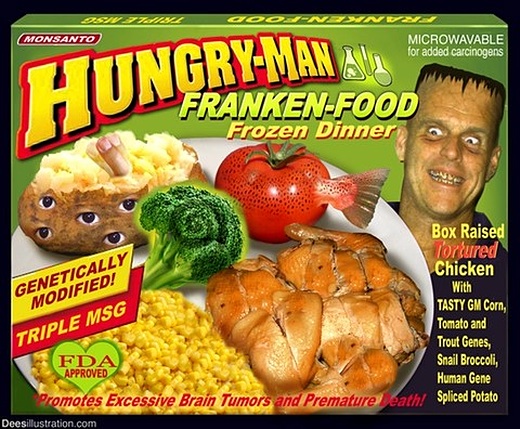
A little over a week ago, I emailed bostonboomer that I wanted to do a post about Monsanto. She was kind enough to share older posts done by Sima about Monsanto. After reading Sima’s posts I have to admit that I was intimidated by her detailed, informative and brilliant commentaries. Her knowledge of Monsanto’s business and political dealings, stemming from her experience as an organic farmer, is incredible. I highly recommend going back and reading or re-reading them. I’m going to try to bring you up to date on what has been happening since her last post. I just hope that I can do both Sima and the subject justice.
Once I became involved in the animal rights movement in 1990, a formerly unseen world opened up to me. It was akin to looking behind the curtain in the Wizard of Oz. Learning about how the animals we call food are raised, what they are fed and the chemicals that are put into their bodies, was disturbing to say the least. Since that time, the major media outlets, along with independent filmmakers, have covered issues such as factory farming, the overuse of antibiotics and the rise of antibiotic resistance, along with other issues that affect the food supply. A good place to get started is with the film Food Inc. and its website.
Monsanto popped up on my radar around 1993 with the introduction of rBGH, recombinant Bovine Growth Hormone. Although there was an overabundance of milk on the market, this chemical was being introduced to increase the supply of milk available for consumption. Why? One of the reasons was to drop the price of milk. That would be good for the consumer, right? Well, corporations are not in the business of making their products more affordable for their customers, as we all know. The ploy was to drive prices low enough so that family dairy farmers could not afford to stay in business, leaving the business to Monsanto’s real customers, giant dairies who would use their product(s). With family dairy farms bankrupt, Monsanto could better control the market and prices. From a study by the Economic Research Service/USDA.
Between 1970 and 2006, the number of farms with dairy cows fell steadily and sharply, from 648,000 operations in 1970 to 75,000 in 2006, or 88 percent (fig. 1). Total dairy cows fell from 12 million in 1970 to 9.1 million in 2006, so the average herd size rose from just 19 cows per farm in 1970 to 120 cows in 2006.1 Moreover, because milk production per cow doubled between 1970 and 2006 (from 9,751 to 19,951 pounds per year), total milk production rose, and average milk production per farm increased twelvefold.
Monsanto has since sold its posilac (rGBH) business to the Big Pharma company, Eli Lilly. If you still believe that advertising slogan, “Milk, it does a body good”, you might want to read this.
Let me start off with yesterday’s article by Jim Hightower, although it’s mostly about Dow Chemical, Monsanto gets some space as well. And there are some great comments. For more on 2, 4-D check out these links:
http://npic.orst.edu/factsheets/2,4-DTech.pdf
Monsanto is a multi-tentacled corporation attached to all aspects of our lives. At their facilities in Dayton, OH during WWII they were involved with the development of the first nuclear bomb. One of their early successful inventions was Astroturf. They have manufactured Agent Orange (the defoliant/herbicide used during the Viet Nam war), and PCBs (banned in the U.S. in 1979 but still found in the environment since PCBs don’t break down easily). For more information, you can download the free E-book, A Small Dose of Toxicology. In recent years, Monsanto has focused on the world food supply, whether it’s chemicals to kill weeds, like Roundup, or creating genetically modified (GM) seeds for which they hold patents. Natural News began a July, 2010 post with this unsettling paragraph:
At a biotech industry conference in January 1999, a representative from Arthur Anderson, LLP explained how they had helped Monsanto design their strategic plan. First, his team asked Monsanto executives what their ideal future looked like in 15 to 20 years. The executives described a world with 100 percent of all commercial seeds genetically modified and patented. Anderson consultants then worked backwards from that goal, and developed the strategy and tactics to achieve it. They presented Monsanto with the steps and procedures needed to obtain a place of industry dominance in a world in which natural seeds were virtually extinct.
Some of the crops grown with Monsanto’s GM seeds include corn, soy, sugar beets, alfalfa and cotton. Monsanto also produces and sells Stevia and Aspartame. To preserve their ownership of these patented seeds, farmers using them cannot save seeds produced from the crops they grow. The farmers must buy new seeds each year for their annual crops. Monsanto has sued farmers suspected of harvesting seeds along with their crops.
One of the most recent areas Monsanto wants to exploit are public lands. In November, several groups filed a lawsuit to prevent the planting of GM crops on refuges.
The Center for Food Safety, Beyond Pesticides and Public Employees for Environmental Responsibility sued Interior Secretary Ken Salazar and the U.S. Fish and Wildlife Service and its director, in Federal Court.
Fish and Wildlife signed agreements allowing farmers to plant crops, including genetically modified soybeans and corn, on refuges and wetlands in eight Midwestern states, according to the complaint.
And planting on public lands isn’t just limited to U.S. lands. World Wildlife Fund (WWF), one of the most respected conservation groups worldwide has ties to many multinational corporations, including Monsanto. They are helping to promote GM crops in other countries.
On the federal tax front, Monsanto paid an average of 22% in taxes for years 2008 – 2010. This report lists the 2008 – 2010 period detailing the profits, taxes and rates for 280 of U.S. corporations.
ALEC Exposed has a page dedicated to Monsanto, detailing much of their history and activities. As with most multinational corporations, Monsanto is heavily invested in lobbying. Interestingly, the years they spent the least money on lobbying were during the reign of King George II, otherwise known as GW Bush. Monsanto’s highest expenditures were in 1999, 2000 and 2008 – 2011. Open Secrets has an overview of Monsanto’s lobbying expenditures, the lobbyists, the issues in which their lobbying efforts were focused along with the agencies and the associated bills before Congress. Open Secrets is quite an informative site, also covering PAC contributions and campaign contributions to specific elected officials.
In our current political climate, campaign contributions and lobbying expenditures aren’t a surprise. After all, it is how the system is fueled. Open Secrets has a recent blog post detailing Monsanto’s activities so far this year. The Monsanto/government connections go even deeper though. During Clarence Thomas’ confirmation hearing, he worked as a counsel for Monsanto. When a recent case involving Monsanto came before the Supreme Court, not surprisingly, Thomas did not recuse himself. The Organic Consumers’ Union’s site, Millions Against Monsanto, has a list of both elected officials and agency appointments of former Monsanto employees from Bush Sr. to Obama. Sadly, Bill Clinton appointed more than any other president listed. Unfortunately, they don’t list U.S. diplomats who also once worked for Monsanto. What a wonderful way to help promote the products of their former employer in countries all around the world.
Wikileaks posted documents showing connections between Monsanto and U.S. Ambassadors. Several EU countries have rejected the use of Monsanto’s GM seeds. Fearing loss of export income, the possibility of pressuring or even retaliating against these countries were discussed in the diplomatic cables Wikileaks obtained. You can read Sima’s post here: https://skydancingblog.com/2010/12/28/wikileaks-and-gmogm-food-more-cables-more-fun/
Monsanto’s reach extends around the world. GM cotton was promoted as a boon to small farmers, but the reality is different. This story details the results in one village and the collaboration between Monsanto and The Times of India. Stories from Africa aren’t any better. The Gates Foundation is investing millions to promote and encourage the use of GM crops. I find it disturbing with a number of NGOs, researchers and politicians who are working hand in hand with Monsanto and other GM companies seemingly without concerns for the possibilities of the damage to the world food supply, public health and the environment. Alternet has posted a story about Kenya and the support from The Gates Foundation for Monsanto’s GM crops. For another opinion on The Gates Foundation/Monsanto/Africa issue, check out this Opinion piece in the Seattle Times written by Glenn Ashton.
The one beacon of hope has been some EU countries. The people have loudly spoken out against GM foods. However, the picture may not be as rosy as it has been portrayed. Gaia Health digs deeper into the announcement in February, 2012 that both Monsanto and BASF are pulling out of Europe.
Let’s not forget about the stock market either. Monsanto has signed an exclusive licensing agreement with Marina, a bio-tech company. I especially liked (not really!) this from the post:
Time and again, the company’s collaborations with agri-business research firms and molecular-bred hybrid technologies have proved effective. Although instances of societal resistance to new technology and poor acceptance of new products by farmers continue to raise anxiety, continuous increase in production led by technology upgradation helps balance such unease.
The personal is the political, and what is more personal than the food you eat and the food that you feed your families? If you are interested in digging deeper, here is the documentary The World According to Monsanto
You can also get more information about the many issues and areas of concern about food at the Center for Food Safety site. I hope I didn’t give you too much to “chew” on.
Midweek Tidbits from Sima
Posted: June 1, 2011 Filed under: Food, Human Rights, just because, open thread, We are so F'd | Tags: Autism, Chernobyl, economics, Fukushima, GMO, goats, music, Poverty, Walmart 18 Comments(or, I’m back!)
So the last couple months have been a real wringer for me. As many of you know, my mother lost her ability to walk and started to weaken due to progressive spinal deformation caused by arthritis. In early March she had a spinal operation which opened the holes which were pressing on her nerves and reconstructed her spine. 2 days after the operation she went into a ‘code’, the one just up from ‘code red’, and had to be rescued by a bunch of nurses and doctors. She told me that she can’t remember much about it except for one thing; she saw my sister standing at the end of a long tunnel, reaching towards her. And she said when she saw that she knew she couldn’t leave; my sister still needed her, we all still needed her.
After over a month in rehab and a month in a hospital bed at home, Mom’s walking again. She’s really weak and has turned over my sister’s strenuous care to me and my father. It’s been very interesting. My sister adores having me care for her, and once I got over the squick factor, I really like caring for her. We sing and giggle and have fun, and I feel like a kid again, sneaking my sister into my room after we were meant to be in bed so we could listen to music together. So there have been some good side effects to my Mom’s long wasting illness.
Recently the PBS News Hour ran a special series on Autism, which is what my sister ‘has’. The series was really good and went into the impact autism has on parents and siblings. I cried when the little girl talks about the future with her brother. She’s 8 and already sees it (Episode 1). And I cried when the older woman, in episode 5, wonders what is going to happen to her and her brother when her parents die. I so know those fears and feelings and I’m so angry at society for just abandoning us after the autistic (and retarded, and physically disabled, and downs syndrome and… you get the drift) kids leave school. Their lives do not end then!
Anyway if you are interested, you can watch the special on the ‘net, here. Each episode is only 10 to 15 minutes long. The links to each episode are along the right hand side of that page.

Brulee, the runt, in front. Her sister Decadence is behind. They were born only minutes apart.
My interest in animal welfare came a bit closer to home in the last few months, as 4 of my does gave birth in April and early May. Or I should say, 3 of them. The 4th has a false pregnancy, but she’s making milk and I’m not gonna complain! One of the does gave birth to 5 kids, all does. That’s pretty rare. Two of the kids were runts and needed 24/7 care. Unfortunately one of the kids passed on. She was simply too little and premature for me to keep alive, although I managed it for a month. The other little darling is doing great, and I offer a picture as a cute antidote to whatever is bothering you currently. It’s hard to tell from the pic, but she can basically fit in the palm of your hand. She’s a bit bigger now, but I can still hold her and support her completely in one hand.
Read the rest of this entry »

 peej
peej Carissa
 bostonboomer
 dakinikat
 ecocatwoman
 mablue2
 Mama Lopez
 peggysue22
 quixote
 skydancingguestblogger
 Mona (aka Wonk the Vote)



 Sky Dancing
Recent Comments