
Elite Conspiracy Theories and the Arrest of Dominique Strauss-Kahn
Posted: May 25, 2011 Filed under: collective bargaining, Economic Develpment, financial institutions, Foreign Affairs, France, Libya, Media, Pakistan, poverty, racism, Regulation, The Bonus Class, The Great Recession, U.S. Economy, U.S. Politics, unemployment, Violence against women | Tags: conspiracy theories, Dominique Strauss-Kahn, Federal Reserve, France, global elites, IMF, John F. Kennedy, Naomi Wolf, Nicholas Sarkozy, rape 29 Comments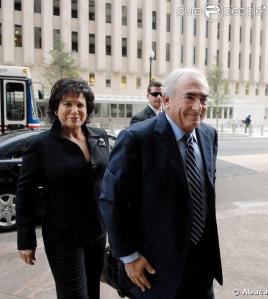
Dominque Strauss-Kahn and wife Anne
When one of us common people questions the Bush failures before 9/11 or the Warren Commission’s insistence that JFK was killed by a lone gunman, we are laughed at by the corporate media and lectured by politicians. But when one of the Global Elite gets in trouble, conspiracy theories are suddenly in vogue. Now that a global banker and possible candidate for the French presidency is accused of a sexual attack on a lowly hotel maid, elite conspiracy theories are running rampant in the U.S. and international media. I’ll give you a few examples.
At the Pakistan Observer, Ali Ashraf Kahn argues that Strauss-Kahn had to brought down, first because he would very likely have beaten the “American poodle Sarakozi” in a race for the presidency of France, and second because he (Strauss-Kahn) had offended the international banksters and corporations by proposing more liberal policies at the IMF which would have been a threat to the dollar. According to Ali Ashraf Kahn, getting rid of Strauss-Kahn would–along with U.S. military actions in Libya and Pakistan–would help to “save American predominance in the world.”
This incident goes to prove the hidden agenda of an international vested interest group trying to build and secure an American Empire for their master, which has not spared even Strauss-Kahn, who has been fixed in a rape attempt with a 32 year old hotel maid in a country where teen aged unwed mothers are a normal accepted feature. The former French Foreign Minister Strauss-Kahn, once if he was elected as president of France would have worked to strengthen the Euro to bring down dollar, which was of serious concern for the Federal Reserve Board in the already ongoing currency war with China. John F. Kennedy, US president was murdered for his only sin of canceling Federal Reserve Act of 1913 in 1963, when for the first time dollar currency was issued with the seal of US government, soon after his assassination President Lyndon B. Johnson revived this Act to continue their financial exploitation.
The author of this article appears to have a problem understanding the distinction between rape and consensual sex that results in pregnancies, but I’ll let that go for the moment. Kahn explains that Strauss-Kahn was trying to make radical changes at the IMF–so much so that Strauss Kahn won high praise from Joseph Stiglitz, which was apparently the final “kiss of death.”
Strauss-Kahn was trying to move the bank in a more positive direction, a direction that didn’t require that countries leave their economies open to the ravages of foreign capital that moves in swiftly-pushing up prices and creating bubbles, and departs just as fast, leaving behind the scourge of high unemployment, plunging demand, hobbled industries, and deep recession. Strauss-Kahn had set out on a “kinder and gentler” path, one that would not force foreign leaders to privatize their state-owned industries or crush their labour unions. Naturally, his actions were not warmly received by the banker’s mafia and multi national corporations who look to the IMF to provide legitimacy to their ongoing plunder of the rest of the world. These are the people who think that the current policies are “just fine” because they produce the desired results they’re looking for, which is bigger profits for themselves and deeper poverty for everyone else.
I have to admit, I’m in sympathy with those goals. There’s a lot more, so read the whole thing if you want more detail.
The next conspiracy theory is from Uganda. The author, Dr. Kihura Nkuba, also argues that Strauss-Kahn’s attack on the U.S. dollar is what led to his downfall. Nkuba says that police in the racist U.S. would never take the word of a poor black woman against that of a powerful white man unless motivated by a political conspiracy.
A woman from West Africa, assaulted by a famous white male, a future president of France, to be listened to by the New York Police, is amazing. But is it? [….]
New York police has [sic] been rummaging through DSK’s diaries, hotel registries, phone records, yearbooks and have made sure that the “great seducer” always appears handcuffed and dressed in a “pervie” raincoat with three-days stubble before they parade him in front of the media. He gets this treatment even though he has no criminal record and nothing, but the sketchy accusations of a room service cleaner.
What is his real crime? Strauss-Kahn was mounting an attack against the dollar and had called for a new world reserve currency that would challenge the dominance of the dollar and protect against future financial instability. He suggested adding emerging market countries’ currencies, such as the Yuan, to a basket of currencies that the IMF will administer to add stability to the global system….Strauss-Kahn saw a greater role for the IMF’s Special Drawing Rights, (SDRs) which is currently composed of the dollar, sterling, euro and yen, over time but said it will take a great deal of international cooperation to make that work.”
I love the way these male authors toss aside the charges against Strauss-Kahn–in Nkuba’s case, while complaining about racial prejudice. I guess he goes by the “bros before hos” rule: racism bad, sexism invisible.
Naomi Wolf also has a conspiracy theory about the Strauss-Kahn arrest that goes along with her defense of Julian Assange against sexual abuse charges in Sweden. She begins by comparing the NYC police response to the Strauss-Kahn case with the case of two of New York’s “finest,” Kenneth Moreno and Franklin Mata, who are on trial for raping a woman in Manhattan.
According to Wolf,
Moreno and Mata have not been asked to strip naked for “evidence” photos, were not initially denied bail, and were not held in solitary confinement, and are not being strip-searched daily. Their entire case has followed the usual timetable of many months, as evidence was gathered, testimony compiled and arguments made.
On the other hand, Wolf writes,
After a chambermaid reportedly told her supervisor at the elegant Sofitel hotel that she had been sexually assaulted, the suspect was immediately tracked down, escorted off a plane just before its departure, and arrested. High-ranking detectives, not lowly officers, were dispatched to the crime scene. The DNA evidence was sequenced within hours, not the normal eight or nine days. By the end of the day’s news cycle, New York City police spokespeople had made uncharacteristic and shockingly premature statements supporting the credibility of the victim’s narrative — before an investigation was complete.
The accused was handcuffed and escorted before television cameras — a New York tradition known as a “perp walk.” The suspect was photographed naked, which is also unusual, initially denied bail and held in solitary confinement. The Police Commissioner has boasted to the press that Strauss-Kahn is strip-searched now multiple times a day — also unheard-of.
I didn’t know that Strauss-Kahn was being subjected to daily strip-searches, but it seems to be true, according to the New York Post.
Prison brass and the NYPD have an airtight plan to safeguard the jet-setting French moneyman by having him isolated, chained, shackled — and repeatedly strip-searched — before and after court appearances, including a bail hearing newly scheduled for today.
“He will be strip-searched when he leaves Rikers Island. He will be strip-searched when he arrives in court. He’s strip-searched when he leaves court, and he’s strip-searched when he gets back to Rikers,” said Norman Seabrook, head of the correction officers union.
“When he arrives to the courthouse, he’s going to be put in an isolated cell away from other inmates,” said Seabrook. “This is for fear that another inmate would try to kill him to make a name for himself.”
Yet, as Wolf points out, hotel maids are routinely subject to sexual attacks during their work. Her conspiracy theory is that in the modern surveillance state,
men like former New York Governor Eliot Spitzer, who was investigating financial wrongdoing by the insurance giant AIG, WikiLeaks founder Julian Assange and Strauss-Kahn — whose efforts to reform the IMF gained him powerful opponents — can be, and are, kept under constant surveillance. Indeed, Strauss-Kahn, who had been the odds-on favorite to defeat Nicolas Sarkozy in next year’s French presidential election, probably interested more than one intelligence service.
This does not mean that Strauss-Kahn is innocent or that he is guilty. It means that policy outcomes can be advanced nowadays, in a surveillance society, by exploiting or manipulating sex-crime charges, whether real or inflated.
She has a pretty good point there. But the maid who reported Strauss-Kahn’s attack was a member of a union, as Dean Baker pointed out. Could that be why her employer made sure she was treated well by the police?
The reason that this is an important part of the story is that it is likely that Strauss-Kahn’s alleged victim might not have felt confident enough to pursue the issue with either her supervisors or law enforcement agencies, if she had not been protected by a union contract. The vast majority of hotel workers in the United States, like most workers in the private sector, do not enjoy this protection.
Dean Baker was also disappointed in Strauss-Kahn’s arrest, because whether or not he is guilty, his resignation spells the end of reform at the IMF.
Reading all these arguments for a conspiracy against Dominque Strauss-Kahn has given me pause. It certainly makes sense that the U.S. government would want to end his tenure at the IMF and prevent him from becoming President of France. But how could they know he would attack a hotel maid? Does the conspiracy require her involvement? That’s the serious hangup I have in buying into these authors’ claims–much as I do always enjoy a good conspiracy theory.
Patrica J. Williams touches all the bases in an article about the case at NPR. On the conspiracy issue, she argues for a skeptical approach to conspiracy theories, while keeping an open mind.
Politics is a complicated, dirty business, as the impeachment hearings of President Clinton ought to have instructed us. (Who guessed back then that Newt Gingrich, while skewering Clinton’s morals, was cheating on his then-wife with his present wife?) For Americans, who by and large have never heard of DSK, the possibility of his arrest being a set-up is inconceivable. But in the immediate aftermath of his detention, a majority of French citizens believe he has been purposely brought down. Why? Dominique Strauss-Kahn was well on track not just to become France’s president but its first Jewish president. As head of the IMF, he led that institution in a distinctly progressive manner. He sharply critiqued corrupt American bankers and banking practices and, early on, predicted the collapse of the mortgage market. As a center-left Socialist party member, he was close to negotiating a European Union bailout for Greece. And his elimination from the election empowers the candidacy of Marine LePen, head of the anti-immigrant, anti-Muslim and anti-Semitic National Front party, whose popularity, alarmingly enough, currently polls higher than that of Nicolas Sarkozy.
I’m certainly going to keep all this in mind as I follow the developments in the Strauss-Kahn case. I’d love to know what you all think about it too, so please chime in!
Late Night Schlock: Financial Meltodrama
Posted: May 23, 2011 Filed under: Bailout Blues, Economy, financial institutions, Global Financial Crisis | Tags: Ed Asner, HBO Too Big To Fail, Paul Giametti, William Hurt 20 Comments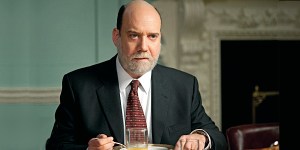 HBO premiers its adaptation of Andrew Ross Sorkin’s “Too Big to Fail” today at 9 ET/PT. I’ve got my bowl of popcorn all ready. My Businessweek hit my mailbox today detailing the all-star line up of the still living cast of real life crisis players. That’s Paul Giametti as Ben Bernanke over there on the left. William Hurt plays Hank Paulson. Ed Asner plays Warren Buffet. Oh, and Dan Hedaya plays Barney Frank. Did you ever imagine Hollywood recreating Barney Frank? It’s sort’ve humorous to think of all these Hollywood types playing Wall Street and Washington insiders. Same big Egos. Same program of you’re only as good as your last deal.
I’m still “reeling” from the idea of Business Week doing a Move Review.
Too Big to Fail, which premieres on May 23, follows the same trajectory as Sorkin’s book, from the collapse of Bear Stearns that spring to the rise of TARP in the fall. To the film’s credit, it attempts to make many of these still-horrifying moments pretty funny—and squeezes them all into 98 minutes. While the movie doesn’t shed much new light on the period, it offers one of the few pleasures left unfulfilled by the gusher of nonfiction thrillers, roman à clefs, wrist-slapping documentaries, and Oliver Stone. The bankers and government officials who rose to prominence in those months are depicted in all their glory and disgrace by real Hollywood actors—most of whom are far better-looking versions of the people they’re portraying. (Tim Geithner is pretty handsome, but Billy Crudup? Really?) TARP groupies will delight in the film’s attention to detail. Leon, the coffee cart guy parked outside Lehman’s office building, gets a chance to extend his five minutes of fame. The hideous toupee worn by Matthew Modine—playing Merrill Lynch Chief Executive Officer John Thain—might be the worst fake movie hair since Burt Reynolds’s heyday.
For the uninitiated, director Curtis Hanson—who won an Oscar for writing L.A. Confidential—drops some not-so-subtle hints. A voice-over in an opening scene refers to JPMorgan Chase’s (JPM) Jamie Dimon (Bill Pullman) as the “smart” banker; Lloyd Blankfein (Evan Handler) is called the “superstar”; and Citigroup’s (C) Vikram Pandit (Ajay Mehta) is called neither. As Hank Paulson (William Hurt) declares, “No one is sure if he’s running Citi or Citi is running him.” Fuld, played in all his vein-popping glory by James Woods, needs no description at all. Viewers are shown, in no uncertain terms, his ginormous hubris as he screws up a potential deal with Korea Development Bank. After being told by Lehman Chief Operating Officer Bart McDade to stay out of the negotiations, Fuld barges in, scares off the bidders, and blows what could have been a precious lifeline.
Here’s the review from LA Times TV critic Robert Lloyd.
The film’s main argument, really, is that we should look kindly upon Paulson and the best he tried to do; the other characters we rate by whether they help or hinder him. What moral voice there is here mostly comes out of his mouth. “We’ve been late on everything,” he admits, and admits also that no one in power wanted to regulate the financial industry because “We were making too much money.” (That’s about as pointed as the film gets on the subject of corporate greed.) Hurt, who (like his costars) seems to be playing the script rather than imitating the person whose name he bears, is a tall tower of movie-star appeal, and it does not hurt our opinion of Paulson that Kathy Baker plays his wife, although she has not much to do but sympathize.
So, if you’re up for an evening about the masters of the universe played by Hollywood’s elite character actors, you know where to go tonight. Here’s the trailer with its theme song Fortunate Song by Credence Clearwater Revival which is a damned good choice and a brief interview with Giametti. I also put him the HBO back story that’s part of the Opening the Vault series.
This has some of the back story on TARP and the meltdown including interviews with journalists that covered the event and the aftermath.
You can consider this an open thread. I’m at home still trying to kick my fever with a larger dose of antibiotics. No beer with the popcorn tonight. (sigh) I’m okay but this stuff is just friggin’ persistent.
A First: Fed Chair Presser
Posted: April 27, 2011 Filed under: Economy, Federal Budget, Federal Budget and Budget deficit, financial institutions, Global Financial Crisis, jobs, U.S. Economy, unemployment | Tags: Ben Bernanke, FED, inflation, jobs, monetary policy, presser 10 Comments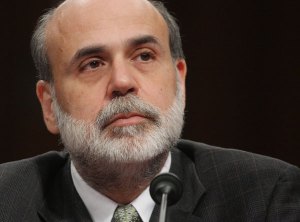 I’m watching Bernanke do a presser. Wow. (It’s a live blog … updates and explanations will be provided.) I can’t believe the press sent political reporters to this. What an amazing number of really rotten questions!!!
Some key points from the morning’s congressional testimony.
On Unemployment: We do see some grounds for optimism, including a decline to the unemployment rate, declines in the new unemployment insurance claims and improvements in firms’ reported hiring plans. But, even so, it could take quite a while for unemployment to come down to desired levels at current expected growth rates and, in particular, the FOMC projects unemployment still to be in the range of seven and-a-half to eight percent by the end of 2012. Until we see a sustained period of stronger job creation, we cannot consider the recovery to be truly established.
On Inflation: “I want to go back over this whole line of interventions, including today quantitative easing. And there have been a series of criticisms that have been made and negative predictions, and my view is that none of them have come true. And I think it is important for us to — to note that. And — and I know you’ve talked about this. I know you mentioned in your statement some of the points. But we were told, for instance, that it was going to be very inflationary. And I know it is your view as of now, and I think supported by the facts, that inflation is not now a problem, and we do not see inflation, certainly not one caused by any of what’s been done going forward. We were told this was going to be extraordinarily expensive, that it was going to cost a lot of money. I believe the answer is that on many of these things the federal government has made a profit by the — by the intervention.”
On Crude Oil: “The relative price of oil, again, is primarily due to global supply and demand. I think it’s important to note that the United States is consuming less oil today, importing less oil and producing more oil than it did before the crisis. That all the increase in demand from outside the United States, particularly in the emerging markets. And so there’s limited amount of what the Fed can do about oil prices alone. Again though, we want to be very sure that it doesn’t feed into overall inflation. We will make sure that doesn’t happen.”
On the Dollar: If the dollar was no longer reserve currency there would – it would on the margin probably mean that we would have to pay highest interest rates to finance the federal debt, and that would be a negative obviously. On other other hand, we might not suffer some of the capital inflows that contributed to the boom and the bust in the recent crisis. But again, I know there was also a countervailing argument in the Journal this morning as well. And I – I just don’t see at this point that there is a major shift away from the dollar.
On the Consumer: We understand the visibility of gas prices and food prices and we want to be sure that people’s expectations aren’t adversely affected. I think it’s important to note that, according for example, to the Michigan survey of consumers, that long term inflation expectations have been basically flat. I mean, they haven’t moved, notwithstanding ups and downs in gas prices, for example.
On the U.S. Fiscal Situation: While I understand these are difficult decisions and we certainly can’t solve it all in the current fiscal year, I do think we need to look forward and I know the House Budget Committee and others will be setting up a 10 year proposal. It’s very important and would be very constructive for Congress to lay out a plan that would be credible that will help bring us to sustainability over the next few years. In particular, one rule of thumb is cutting enough that the ratio of the debt to GDP stops rising. Because currently it’s rising relatively quickly. If we could stabilize that, I think that would do a lot to increase confidence in our government and in our fiscal policies.
Obviously, Bernanke needs to drill baby drill to get rid of inflation … so simple!!!
or this:
ezrakleinEzra Klein
Bottom line: Congress is embracing austerity. The Fed is going to start tapping the brakes. Sucks to be you, unemployed people. #fedpresser
Background information on the Fed Presser from NYT and David Leonhardt.
On Wednesday at 2:15 p.m., Ben Bernanke will do something that previous Federal Reserve chairmen considered a terrible idea. He will hold a news conference.
Mr. Bernanke spent much of his academic career arguing that the Fed should be less opaque, and, as chairman, he has put his ideas into action. Now it’s time for those of us in the media to hold up our end of bargain. In the spirit of democratic accountability, we should ask hard questions — and we shouldn’t let him get away with the evasions and half-answers that members of Congress too often allow Fed chairmen during their appearances on Capitol Hill.
One question more than any than other is crying out for an answer: Why has Mr. Bernanke decided to accept widespread unemployment for years on end, even though he believes he has the power to reduce it?
Here’s Paul Krugman’s take on the presser: Bernanke Wimps Out. He’s got the same questions I do about the inflation v. unemployment . (See my comments in the thread below.)
So Bernanke did get asked why, given low inflation and high unemployment, the Fed isn’t doing more. And his answer was disheartening.
As far as I can tell, his analytical framework isn’t too different from mine. The inflation rate to worry about is some underlying, inertial rate rather than the headline rate; the Fed likes the core personal consumer expenditures deflator; and this rate has actually been running below target, indicating that inflation isn’t a concern …
Fiscal Jabberwocky
Posted: April 24, 2011 Filed under: Barack Obama, Economic Develpment, Economy, Federal Budget, Federal Budget and Budget deficit, financial institutions, Global Financial Crisis, John Birch Society in Charge, legislation, Populism, Republican politics, U.S. Economy, U.S. Military, U.S. Politics, voodoo economics, We are so F'd | Tags: Barack Obama, David Stockman, Fiscal Crisis, Paul Ryan, voodoo economics 29 Comments
"Beware the Jabberwock, my son! The jaws that bite, the claws that catch!"
It’s not often I get to post pictures of mythical beasts for a few days in a row but here I go again. Plus, I’ve gotten another chance to use one of those wonderful Alice in Wonderland book illustrations. Too bad they’re attached to posts where the perverse wonderland rules. It seems to be a year for fictional monsters in Op-Eds and real ones in congress.
David Stockman, Budget Director for Ronald Reagan, has joined the ranks of Republican advisers calling shenanigans on the Boehner/Tea Party Republicans AND the dithering Obama Dems. He must be very financial and professionally secure. His op-ed in the New York Times draws blood on all sides. He starts out telling President Obama what is what then moves on to hammering that petulant ninny from Wisconsin, Paul Ryan. Go read it if only for the creative use of words like that in the heading above.
On the other side, Representative Ryan fails to recognize that we are not in an era of old-time enterprise capitalism in which the gospel of low tax rates and incentives to create wealth might have had relevance. A quasi-bankrupt nation saddled with rampant casino capitalism on Wall Street and a disemboweled, offshored economy on Main Street requires practical and equitable ways to pay its bills.
Ingratiating himself with the neo-cons, Mr. Ryan has put the $700 billion defense and security budget off limits; and caving to pusillanimous Republican politicians, he also exempts $17 trillion of Social Security and Medicare spending over the next decade. What is left, then, is $7 trillion in baseline spending for Medicaid and the social safety net — to which Mr. Ryan applies a meat cleaver, reducing outlays by $1.5 trillion, or 20 percent.
Trapped between the religion of low taxes and the reality of huge deficits, the Ryan plan appears to be an attack on the poor in order to coddle the rich. To the Democrats’ invitation to class war, the Republicans have seemingly sent an R.S.V.P.
Stockman call the entire situation “fiscal jabberwocky”. Good turn of phrase that. He then moves to skewering the FED and adds Chinese currency pegging into the villain mix. I guess there’s nothing like a good rant when you can get primetime ink. This seems to be an interesting foray into harsh policy critique for economists with a republican bent.
Stockman, like Bruce Barlett and even David Frum are yet more Republicans who are pointing out the current GOP leaders are no more serious about budget reform than the Democrats are. The main difference is the GOP has better slogans and marketing, and slides into full blow demagoguery more easily.
But in terms of actual strategies for intelligently addressing the issue? The most glaring truth is the lack of leadership on both sides of the aisle.
The Barry Ritholtz blog post on Stockman’s op ed does score some points on mentioning the leadership chasm, but, even more telling is the absolute adherence to fairy tales over reality in policy making these days. Is there an economist in the House? Joe Wiesenthal says that Stockman is suffering from “fatalistic populism”. Here’s Stockman’s ending barb to prove that point. It’s also the two sentences that offer up the policy solution.
So the Ryan plan worsens our trillion-dollar structural deficit and the Obama plan amounts to small potatoes, at best. Worse, we are about to descend into class war because the Obama plan picks on the rich when it should be pushing tax increases for all, while the Ryan plan attacks the poor when it should be addressing middle-class entitlements and defense.
I’ve said many times that the Bush tax cuts just need to expire. I’ve also said that since the Reagan years we’ve basically started chumming our economy by jumping into interventions wherever and whenever. Afghanistan and Iraq are two such adventures that need to be de-funded and ended. We also need to reign in the congressional and pentagon weapons fetish which is basically whipped into a frenzy by free spending lobbyists for companies like Halliburton, GE, and Boeing. I can only image what they all want the drone budget to look like. MENA appears to be filled with hives these days.
So many of our fiscal problems would go away if we would just put things back to the where they were 10 years ago. This includes putting Wall Street back in its box instead of letting it go completely gaga with nonstandard, unregulated financial innovations. We can’t afford Obama’s muddling policies that seem like voting present while Republicans go wild with his inability to stand any firm ground. I believe he got elected to undo the Dubya years. Instead, he’s put the Dubya policies on steroids. So, if most of us–that would be voters–are saying let’s take it all back to the Clinton years, what I’d like to know is who are the real conservatives and who are the real radicals?
The Shadow Boys
Posted: April 17, 2011 Filed under: financial institutions, Global Financial Crisis | Tags: Goldman Sachs, Hank Paulson, Money and Power: How Goldman Sachs Came to Rule the World, Steven Friedman, William Cohen 10 Comments
Yond’ Cassius has a lean and hungry look;
He thinks too much: such men are dangerous.
— Julius Caesar
There will be plenty of both academic and journalistic research done trying to figure out what went woefully wrong with finance markets in the first decade of this century. I’ve just co-authored a paper that will be out shortly in a peer reviewed journal on how the bubble in the mortgage market probably passed into the market for Real Estate Investment Trust funds (REITS) that were once considered one of the safest and least volatile investments on the planet. They used to have good patterns of fairly consistent returns too. However, that was then and this is now. Now is a different reality and the three scoundrels in the picture above are part of the reason. These three are part and parcel of how the vampire squid came to rule the world of finance. You’re looking at a young Ex-Treasury secretary Hank Paulson, Steve Friedman, and Jon–was Governor of New Jersey–Corzine. Take a good long look at that trio of dangerous, lean and hungry men.
Their exploits are outlined in the latest who-did-this-to-us book “Money and Power: How Goldman Sachs Came to Rule the World” By William Cohan. I don’t have the book yet but the reviews and articles that its release is spawning are everywhere. The firm started out as man named Goldman who was a simple dealer in commercial paper at the onset of the switch from mercantilism with its emphasis on natural resources and people to capitalism with its emphasis on money. For years, the company was a partnership (the start of IPO move started around 1996 and happened in 1999) and its reputation was that of a firm committed to teamwork and a laser-like focus on serving clientele despite a past riddled with scandals. How this situation went from that corporate identity to a group of hot shot sales egos selling toxic mortgages and derivatives to customers is the focus of the book. Oh, and the most important part is that they did all that selling while having offsetting bets to what they were pushing to customers during the financial crisis that paid of hugely. The Economist’s review of the book explains why Cohan’s book stands out in the recent flurry of Goldman Sachs psychodrama financial novels. Cohan has some fresh material which seems even more revealing given Carl Levin’s latest pronouncement. Basically, Levin argues that Goldman Sachs bet against the stuff they sold clients (Credit Default Obligations) and then lied to congress about it.
Much of the blame for the 2008 market collapse belongs to banks that earned billions of dollars in profits creating and selling financial products that imploded along with the housing market, according to the report. The Levin-Coburn panel levied its harshest criticism at investment banks, in particular accusing Goldman Sachs and Deutsche Bank AG (DB) of peddling collateralized debt obligations backed by risky loans that the banks’ own traders believed were likely to lose value.
In a statement, New York-based Goldman Sachs denied that it had misled anyone about its activities. “The testimony we gave was truthful and accurate and this is confirmed by the subcommittee’s own report,” Goldman Sachs spokesman Lucas van Praag said.
“The report references testimony from Goldman Sachs witnesses who repeatedly and consistently acknowledged that we were intermittently net short during 2007. We did not have a massive net short position because our short positions were largely offset by our long positions, and our financial results clearly demonstrate this point,” van Praag said.
It remains to be seen if the Obama DOJ will pursue any legal action against the firm. The Economist article has a more succinct explanation albeit it with a bit of finance jargon thrown in. Are the actions of the shadow banking behemoth illegal or just maleficent? Given the horrible state of regulatory framework and the abysmal performance of the SEC under Christopher Cox, it appears to be walking both sides of that line that’s frequently called the Chinese Wall. We could also say that the District has not had an active interest in translucent, standardized, and information symmetric-financial markets for decades. Eliot Spitzer–who knows about Wall Street wrongdoing–thinks Holder should prosecute GS or quit. The Economist states that:
Goldman has pushed this envelope further than other investment banks, believing it had the skill to manage the resulting conflicts. It insists that the Chinese walls separating its traders and bankers are always impermeable.
But outsiders are less inclined to trust it these days. Using client information to increase its trading edge—if that is what Goldman does—may not be against the law, but it is hardly honourable. As the author puts it, the scandal may not be what’s illegal but what’s legal.
Controversy also swirls around Goldman’s “marks”, or the prices at which it valued its mortgage holdings during the crisis. These were much lower than those of its rivals, drawing accusations that it was trying to force them to mark their portfolios down to the same level so that it could pick up assets on the cheap in the ensuing wave of firesales.
Goldman’s aggressive stance certainly caused massive pain, speeding the demise of Bear Stearns and AIG. But as mortgage delinquencies ballooned, Goldman’s marks were shown to be more accurate than those of the other big houses. Its longstanding “mark-to-market” discipline meant it was better placed to face the truth. There is no evidence of a conspiracy to post unreasonably low valuations. There was, in fact, a vigorous debate within Goldman about the right level, just as there was over the firm’s overall risk levels. Angry at being reined in by its powerful risk managers, traders dubbed them the “VAR police”, a reference to the value-at-risk models they used to measure how much was on the line.
My late night relaxing in the tub reading of all this started with the book’s adaptation in Vanity Fair. There’s an interview with author William Cohan on its website. I suppose I should mention that Cohan worked at GS. His excerpt in the May issue characterize GS of the 1990s as the stage for an Alpha War. I have to say from what I’ve read to date, John Corzine is the one that comes off the worst for exposure. I pity poor New Jersey. Corzine’s trading positions in fixed income sound like something out of Bonfire of the Vanities and The Black Swan simultaneously. Corzine appears to be the type who won’t stop doubling down, even when he’s losing big time. Cohan’s VF article focuses on the period of around 1994 when Friedman was trying to deal with the loss of Robert Rubin who had headed of to the Clinton Administration to be Secretary of the Treasury. One of the big things that I realized when reading all of this was how many Secretaries of the Treasury over a huge number of years have connections to GS. It makes you believe in secret banking cabals.
Popular at the firm for his genial manner, Corzine also had his critics. “He is charming,” says one partner. “He’s got a really nice style. He comes in an attractive package, so although he has got a huge ego and huge ambition—which far exceeds his ability in both those things—he comes across in a laid-back, low-key, disarming style.”
The partner explains the origin of Corzine’s Goldman nickname: “Fuzzy.” It derived not only from his beard, but also because he was “a fuzzy thinker. He wasn’t crisp and wasn’t black and white. He fuzzed things when he communicated.”
The VF article is a veritable soap opera of tension and struggles between Corzine and Paulson. The one pervasive criticism that I’ve seen of the book as of right now is that the drama still didn’t stop or explain how GS manages to make so much money. Perhaps the Levin Report and its supporting documents have more information that would interest a financial economist. The narrative in this book is from former employees, clients, and just about any one else that would dish the conflicts to Cohan. Many of these remain “unnamed sources”. Goldman’s sketchy history was also fascinating to me.
After all, this is a firm that periodically eviscerates those who trust it most. In the 1920s, Goldman ran a Ponzi-like scheme involving investment trusts. In the 1970s, it peddled soon-to-be-worthless commercial paper for the soon-to-be-bust Penn Central Railroad. And, in 2007, the firm that prided itself on being “long-term greedy” sold gullible clients on the merits of mortgage-backed securities while simultaneously shorting some of those same debt obligations. The firm has succeeded, in part, by ignoring these nastier aspects of its past. In fact, Goldman never misses an opportunity to celebrate the holier-than-thou principles laid down by former senior partner John Whitehead. Rule No. 1: Our client’s interests always come first.
Money and Power suggests the bank does possess a few special powers, starting with its remarkable ability to convince some of the world’s smartest young people that touting stocks, sniffing out arbitrage opportunities, and shaking down corporate clients amount to a noble calling. One illuminating anecdote in Money and Power concerns Robert Rubin, the former Goldman head who would go on to become Treasury Secretary under Bill Clinton. During his third year at the firm, back in 1969, Rubin’s career path may have hit a rough patch. Sandy Lewis, who at the time ran the arbitrage department for a rival bank, tells Cohan that Rubin approached him regarding a job opportunity. Lewis explains that Rubin had grown disgusted with the Goldman way. “It’s a dishonest mess,” Lewis recalls Rubin saying to him, “that’s making honest people dishonest.”
I skipped into this interesting bit of hearsay quoted by the NYT. As you know, GS has friends in high high places so I find this a bit ominous. This is where the book lends credence to the recent Levin pronouncement.
About Goldman Sachs’s present-day business practices, one “private equity investor” says this: “They view information gathered from their client businesses as free for them to trade on … it’s as simple as that. If they are in a client situation, working on a deal, and they’re learning everything there is to know about that business, they take all that information, pass it up through their organization, and use that information to trade against the client, against other clients, et cetera, et cetera.” The speaker stops short of labeling this as insider trading, but only barely, saying, “I don’t understand how that’s legal.”
Mr. Cohan raises the same question as he writes that the firm’s onetime dedication to its clients has evolved into something more ruthlessly self-serving. “Its primary source of profit has shifted from banking to trading,” he writes, “and the firm is intentionally quite vague about how, and precisely where, those trades are made or, equally relevant, from whom the profits are coming.”
Indeed, the GS Big Short” may have been more responsible for the meltdown than any one thought previously and hearing about these behind-the-scene alpha male wars doesn’t enhance the firm’s supposed client-centric claim or its testimony that fell back on its mantel as the role of market-maker. I watched the hearing completely and was appalled at how little Levin’s panel knew of the world it was supposed to regulate. There were few intelligent questions and even fewer cogent responses.
But the key players in enacting the strategy were Dan Sparks, head of the mortgage division, and his most senior traders, Josh Birnbaum and Michael Swenson.
All three were key witnesses called by Levin’s committee a year ago. The trio were quizzed alongside the now notorious trader Fabrice Tourre, who is still defending himself in the American courts against a separate claim by the Securities and Exchange Commission that he duped investors into buying mortgage assets that he expected to collapse in value.
That trade was in fact a sideshow to the wider strategy set in motion by that momentous meeting in December 2006. From that point onwards Goldmans began to cut its exposure to American mortgages and set up a series of short positions to gamble on a housing market crash.
At the same time it began publicly marking down the value of those mortgage securities it held, forcing other banks to do the same. But unlike Goldmans, the others had not taken out short positions and when the crisis came they could not offset the huge losses these markdowns involved.
Within eight months of the December meeting, the storm had broken. Credit was drying up in financial markets, rumours of banks in crisis swept through the world’s financial capitals and by September the squeeze on banks led, in Britain, to the emergency loans to Northern Rock and eventually its collapse into State ownership.
Cohan, who interviewed Birnbaum and many others for his book, claims that in 2007 Goldmans’ mortgage desk made a profit of $4 billion from its shorting, helping the bank turn a total profit for the year of $13.5 billion – $9 billion of which ended up as bonuses for staff. Birnbaum, Cohan claims, had wanted to be even more aggressive but the risk department at Goldmans was frightened of going too far in case the gambles went wrong.
In the end, this saga may well play itself out in the world of researchers outside of the beltway who get access to the Levin committee’s documents. We can always hope that Holder will investigate his boss’s biggest campaign contributor during a campaign cycle in the way that children hope that Santa Claus is real. The White House could make Carl Levin into an old man who tilts at Windmills. What is worrisome is how interconnected the alpha males on Wall Street are with the ones that strut around Pennsylvania Avenue. It’s hard to miss the co-dependency of campaign-fund addict with drug dealer who needs special favors when you read so many sources with similar themes. It makes a mere mortal like me want to put my money some place out of their reach. I don’t think I’d want a stake in anything near New Jersey either. My greatest fear, however, is that we know so much about how all this happens and yet we do nothing. The evidence is out there. There’s no real change afoot. Who will the ghost of Caesar haunt?

 peej
peej Carissa
 bostonboomer
 dakinikat
 ecocatwoman
 mablue2
 Mama Lopez
 peggysue22
 quixote
 skydancingguestblogger
 Mona (aka Wonk the Vote)



 Sky Dancing
Recent Comments