
Will the Banksters Finally Pay?
Posted: September 3, 2011 Filed under: commercial banking, financial institutions, just because | Tags: Banksters, mortgage fraud, toxic mortgages 7 Comments Federal regulators have finally decided to go after seventeen big banks for bad mortgage lending practices. In question are $200 billion in toxic mortgages sold to now bankrupt Fannie and Freddie. The Federal Housing Finance Agency (FHFA) is the regulator suing BOA, JP Morgan, Morgan Stanley, Goldman Sachs and others. You may recall I wrote on a FED investigation last month. This comes way too late to help many people who were put into loans they couldn’t possibly handle who were later evicted, but it may give these folks standing in future court suits to recoups some of their losses. Financial sector-related equities and bonds lost in what was a dismal Friday market already given the unemployment figures.
The litigation represents a more intense effort by the federal government to go after the financial services industry for its supposed mortgage failures.
Indeed, the cases were brought on the basis of 64 subpoenas issued a year ago, giving the government an edge in its investigation that private investors suing the banks lack.
The Obama administration as well as regulators like the Federal Reserve have been criticized for going too easy on the banks, which benefited from a $700 billion bailout package shortly after the collapse of Lehman Brothers in the autumn 2008.
Much of that money has been repaid by the banks — but the rescue of the mortgage giants Fannie and Freddie has already cost taxpayers $153 billion, and the federal government estimates the effort could cost $363 billion through 2013.
Even though the banks already face high legal bills from actions brought by other plaintiffs, including private investors, the suits filed Friday could cost the banks far more. In the case against Bank of America, for example, the suit claims that Fannie and Freddie bought more than $57 billion worth of risky mortgage securities from the bank and two companies it also acquired, Merrill Lynch and Countrywide Financial.
In addition to suing the companies, the complaints also identified individuals at many institutions responsible for the machinery of turning subprime mortgages into securities that somehow earned a AAA grade from the rating agencies.
The filing did not cite a figure for the total losses the government wanted to recover, but in a similar case brought in July against UBS, the F.H.F.A. is trying to recover $900 million in losses on $4.5 billion in securities. A similar 20 percent claim against Bank of America could equal a $10 billion hit.
In a suit that identifies 23 securities that Bank of America sold for $6 billion, the company “caused hundreds of millions of dollars in damages to Fannie Mae and Freddie Mac in an amount to be determined at trial.”
The most interesting thing about these new lawsuits is that it is obvious that some of the most egregious practices like backdating and robosigning are still being practiced even as these banks are making tons of fees from foreclosure. It’s hard to sympathize with an industry unable to correct it’s own bad practices. This is especially true since so much tax payer money has gone to stabilize the results of these practices already. This is from the American Banker and it’s damning.
The practice continues nearly a year after the companies were caught cutting corners in the robo-signing scandal and about six months after the industry began negotiating a settlement with state attorneys general investigating loan-servicing abuses.
Several dozen documents reviewed by American Banker show that as recently as August some of the largest U.S. banks, including Bank of America Corp., Wells Fargo & Co., Ally Financial Inc., and OneWest Financial Inc., were essentially backdating paperwork necessary to support their right to foreclose.
Some of documents reviewed by American Banker included signatures by current bank employees claiming to represent lenders that no longer exist.
Many banks are missing the original papers from when they securitized the mortgages, in some cases as long ago as 2005 and 2006, according to plaintiffs’ lawyers. They and some industry members say the related mortgage assignments, showing transfers from one lender to another, should have been completed and filed with document custodians at the time of transfer.
“It’s one thing to not have the documents you’re supposed to have even though you told investors and the SEC you had them,” says Lynn E. Szymoniak, a plaintiff’s lawyer in West Palm Beach, Fla. “But they’re making up new documents.”
The banks argue that creating such documents is a routine business practice that simply “memorializes” actions that should have occurred years before. Some courts have endorsed that view, but others, such as the Massachusetts Supreme Judicial Court, have found that this amounts to a lack of sufficient evidence and renders foreclosures invalid.
Yves Smith at Naked Capitalism has been following this issue closely and continues to have harsh words for banks and banker apologists.
It’s disturbing at this juncture that Felix Salmon more or less falls in with the bogus bank party line on “memorializing” (he finesses it by saying they need to do it “transparently”). I suggest he try talking to an attorney who is expert in securitizations and does not have opinion letter liability on this matter. The contracts that governed these deals were immutable and set forth in precise detail the steps various parties to the deal were required to perform. That included strict cutoff dates for getting the properly prepared notes and mortgages to the securitization trusts. Long-standing precedents for New York trusts (virtually all RMBS trusts are New York trust) call for delivery to the trust to be as perfect as possible. Since all securitization through at least the late 1990s did deliver all the notes and mortgages to the trusts as stipulated, there is no excuse for later changes in practice (as in if the parties wanted to simplify procedures for reasons of cost or convenience, they needed to change the governing agreements to reflect that).
Put it another way: what about the Statute of Frauds don’t you understand? And while some judges have sided with banks, the robosigning scandal and greater media coverage of mortgage abuses has led many jurists to be much less bank friendly than they were a mere year ago. The trend is moving decisively against, not for, the banks.
The American Banker article, disappointingly, fails to discuss what these continued abuses mean. As we have stressed in repeated past posts, the failure to get the notes to the securitization trusts by the cutoff date is not fixable by any legitimate means. Do you think banks and law firms would continue to fabricate documents, particularly in the wake of so much harsh media and Congressional scrutiny, if they had any other way out?
The failure to get the notes to the securitization trust correctly does NOT mean that no one has the right to foreclose. It does mean that the party that can foreclose is someone earlier in the securitization chain who was paid for the note but in effect, no one bothered to collect it from him. No one wants that party to foreclose because, first, it would prove that the securitization did not have the note and investors were misled, and second, there is no way to get the proceeds into the trust for the benefit of the investors.
The FHFA actions against the banks rush to originate loans to package and dump is based in lack of due diligence which is central to the role of any lending institution. I’ve written a lot about this having been straight out of grad school and part of the secondary mortgage process back in the 1980s when the S&L crisis exploded. My huge S&L was desperate to grab fee income any way it could to stay afloat. Practices this time were based on giving people bonuses just to give high numbers. That’s always a disaster policy from a quality stand point.
Buried in the filings themselves, however, is a damning portrait of the excesses of the housing bubble, when borrowers were able to obtain home loans without basic proof of income or creditworthiness, and banks appeared only too happy to mine profits taking the risky loans and assembling them into securities that could be sold to investors.
In the complaint against Goldman Sachs, for example, the suit says that “Goldman was not content to simply let poor loans pass into its securitizations.” In addition, the giant investment bank “took the fraud further, affirmatively seeking to profit from this knowledge.”
When an outside analytics firm, Clayton, identified potential problems in the underlying mortgages Goldman was turning into securities, the suit said, “Goldman simply ignored and did not disclose the red flags revealed by Clayton’s review.” Goldman Sachs declined to comment, as did JPMorgan Chase, Morgan Stanley, Credit Suisse and Citigroup.
Similar behavior in terms of warnings provided by Clayton transpired at Bank of America, Citigroup, Deutsche Bank, RBS and UBS, according to the complaints.
My hope is that this leads to some policy to compensate homeowners taken in by these schemes but I’m not holding my breath. Speculators and gamblers should not be rewarded for causing homeless and lost wealth for honest people looking to live the American Dream. My worry is that Timothy Geithner’s presence as Treasury Secretary will force policy that continues to prop up the wrong people. This entire spectacle is another example of the opposites reality we know seem to inhabit. In this version of “It’s a wonderful life”, the cautionary tale is the ending.
Friday Morning Reads
Posted: September 2, 2011 Filed under: 2012 presidential campaign, abortion rights, Barack Obama, commercial banking, Domestic terrorism, Economy, Elections, fetus fetishists, financial institutions, House of Representatives, morning reads, Planned Parenthood, Reproductive Health, Reproductive Rights, Republican politics | Tags: FED, fiscal stimulus, Goldman Sachs investigation, James Carville, Litton, Obama Polls, Obama speech schedule, Stonehenge, Subprime mortgages 24 Comments Well, it looks like I’m in a tropical storm warning right now. I’m just hoping the electricity stays on as TD 13 becomes TS Lee when it drifts around and comes on shore some time on Saturday. I’m also hoping Hurricane Katia stays a fish storm but that’s looking less likely at the moment. Lot’s of us may get flooded yet again. I’m just hoping we can go get NJ Governor Chris Christie to go beat up Eric Cantor in the interim. Poor Vermont looks like it needs a lot of help right now! We’re expected to get rain that may fall at 2-3 inches an hour. I’m not sure if our pumps can handle that; especially the crappy ones the Corps bought from Jeb Bush that have been problematic since they were installed.
So, it’s nice to see that the FED has decided that Goldman Sachs is now under its jurisdiction and is ordering it to review its foreclosure practices of a former subsidiary. So many heads should roll over the subprime mortgage market mess and so few have to date. The Fed’s a pretty aggressive regulator when it feels some institution is in its charter. It’s good to see the charter is extending beyond commercial banks and thrifts now that the cheap lending has been extended to other financial institutions too. They take the truth-in-lending laws very seriously.
The Federal Reserve ordered Goldman Sachs Group Inc to hire a consultant to review practices of a former mortgage subsidiary on Thursday and said it plans to assess a monetary penalty for wrongful foreclosures.
The Fed’s crackdown sent Goldman shares down 3.5 percent on Thursday, even as the bank announced that it had completed the sale of Litton Loan Servicing LP, the mortgage-servicing business at the heart of its foreclosure problems.
Litton’s regulatory troubles stem largely from the practice of “robosigning,” in which bank employees signed foreclosure documents without reviewing case files as required by law.
Many large banks, including Bank of America Corp, JPMorgan Chase & Co, Wells Fargo & Co and Citigroup Inc, have been targets of probes by state and federal regulators over the same issue, in the clean-up after a world financial crisis triggered in large part by bad mortgages in the United States and bonds backed by those loans.
The Fed cited “a pattern of misconduct and negligence” at Litton in announcing its enforcement action against Goldman.
The Economist has been having a reader debate on the necessity of Fiscal stimulus for the US. The Hell, Yes! vote appears to have it. The comments are about as interesting as the two economists debating the motion.
The American economy has remained extremely weak since officially leaving recession in mid-2009. The unemployment rate has barely fallen. Recent figures suggest GDP grew at less than a 1% annualised rate through the first half of the year and the odds of a return to recession have risen. The headwinds facing the economy are considerable: the private sector is still trying to reduce the burden of debt it is carrying from the pre-crisis boom years. House prices are still in the doldrums and mortgage credit is hard to get. State and local governments, which are required to balance their budgets, have been forced to cut spending, workers and hours to cope with falling tax collections. Many argue that in such a situation, the federal government is the only entity left that can provide a boost to overall demand and keep the economy from slipping back into recession or prolonged stagnation. At present, however, federal fiscal policy is scheduled to do the opposite: at the end of this year, a temporary payroll tax cut and enhanced jobless benefits expire.
“I do think this is a really big debate and I think the White House was out of bounds…in trying to schedule a speech during a debate,” Carville said on “GMA.”
This will be Gov. Rick Perry’s first debate, and as Carville said this morning the stakes are high.
“Given a choice between watching a debate and the speech I would have watched the debate and I’m not even a Republican or even close to being a Republican,” he said, adding it will be a “barn burner.”
The administration agreed to move the speech to Thursday- possibly competing with the kick off of the NFL season instead. The White House has been touting this jobs plan telling ABC News that he will propose tax relief, infrastructure investment and assistance for the long term unemployed.
Obama has received advice from both sides with some arguing for an ambitious proposal and others recommending finding middle ground.
Carville, an ABC News consultant, told me it doesn’t matter what Obama proposes, it won’t get through Congress.
For the first time this year, Texas Governor Rick Perry leads President Obama in a national Election 2012 survey. Other Republican candidates trail the president by single digits.
A new Rasmussen Reports national telephone survey shows Perry picking up 44% of the vote while the president earns support from 41%. Given the margin of sampling error (+/- 3 percentage points) and the fact that the election is more than a year away, the race between the two men is effectively a toss-up. Just over a week ago, the president held a three-point advantage over Perry. (To see question wording, click here.)
Perry leads by nine among men but trails by five among women. Among voters under 30, the president leads while Perry has the edge among those over 30. The president leads Perry by 16 percentage points among union members while Perry leads among those who do not belong to a union.
I’d vote for a dead dog before I’d vote for Rick Perry, just in case you’re wondering where I stand. A Quinnipiac University poll also shows the President’s approval on handling of unemployment and the economy is still bleak.
President Barack Obama’s overall job approval rating has sunk to an all-time low, as American voters disapprove 52 – 42 percent, compared to 47 – 46 percent approval in July, and among whites and men his approval has dropped into the 30s, according to a Quinnipiac University poll released today. Congressional leaders rate even lower in the public eye. Voters nationwide are more pessimistic about the economy, saying 49 – 11 percent that it is getting worse rather than improving, a precipitous drop from a July 14 survey by the independent Quinnipiac (KWIN-uh-pe-ack) University, in which voters said 32 – 23 percent the economy was worsening and January 18, when voters said 36 – 20 percent it was improving. The economy is in a recession, 76 percent of voters say, and is not beginning to recover, voters say 68 – 28 percent. Voters trust Obama more than congressional Republicans to handle the economy 44 – 41 percent, but they say 46 – 42 percent that Republican presidential candidate Mitt Romney would do a better job than Obama. They are split 43 – 41 percent on whether Obama or GOP candidate Rick Perry would be better on the economy.
This should be an interesting political season. My guess is that it’s going to get very ugly.
There’s some good news from NPR about the Obama Justice Department. It seems they have made a priority of keeping abortion providers and women seeking abortions safe from violence and protestor harassment.
The Obama Justice Department has been taking a more aggressive approach against people who block access to abortion clinics, using a 1994 law to bring cases in greater numbers than its predecessor.
The numbers are most stark when it comes to civil lawsuits, which seek to create buffer zones around clinic entrances for people who have blocked access in the past. Under the Freedom of Access to Clinic Entrances Act, or FACE Act, the Justice Department’s civil rights division has filed eight civil cases since the start of the Obama administration. That’s a big increase over the George W. Bush years, when one case was filed in eight years.
“There’s been a substantial difference between this administration and the one immediately prior,” says Ellen Gertzog, director of security for Planned Parenthood. “From where we sit, there’s currently much greater willingness to carefully assess incidents when they occur and to proceed with legal action when appropriate.”
Over the past two years, the Justice Department and FBI have been meeting with abortion-rights groups and medical providers all over the country to explain their work and talk about a federal task force designed to prevent violence against doctors and women seeking abortions.
The National Abortion Federation, which tracks violent incidents, says major violence is down since the 2009 murder of abortion doctor George Tiller. The man who killed Tiller has been convicted, and a federal grand jury is investigating the conduct of his alleged accomplices.
But Sharon Levin, a vice president at the National Abortion Federation, says there are still some signs of trouble, including two incidents this summer involving Molotov cocktails and the arrest of a man who told police he wanted to shoot two abortion doctors in Wisconsin.
So I admit to being totally fascinated by Stonehenge. I wanted to share this Tomb find in the place where the famous stones were most likely quarried.
The tomb for the original builders of Stonehenge could have been unearthed by an excavation at a site in Wales.
The Carn Menyn site in the Preseli Hills is where the bluestones used to construct the first stone phase of the henge were quarried in 2300BC.
Organic material from the site will be radiocarbon dated, but it is thought any remains have already been removed.
Archaeologists believe this could prove a conclusive link between the site and Stonehenge.
The remains of a ceremonial monument were found with a bank that appears to have a pair of standing stones embedded in it.
The bluestones at the earliest phase of Stonehenge – also set in pairs – give a direct architectural link from the iconic site to this newly discovered henge-like monument in Wales.
The central site had already been disturbed so archaeologists chose to excavate around the edges
The tomb, which is a passage cairn – a style typical of Neolithic burial monument – was placed over this henge.
How cool is that?
So, that’s my contribution for the day. Hopefully, I’ll be on line through the weekend but if you don’t see me, you’ll know what happened!
What’s on your reading and blogging list today?
What Exactly Does S&P stand for?
Posted: September 1, 2011 Filed under: financial institutions | Tags: mortgage backed bonds, ratings, S&P, Subprime mortgages, US Debt 4 CommentsI don’t often put on the finance hat part of the financial economist moniker ’round these parts, but I couldn’t resist donning it long enough to pooh pooh S&P. It’s hard to take the bond rating portion of 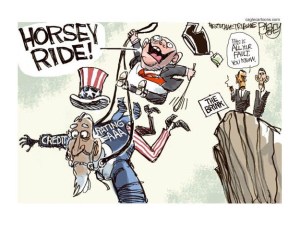 their business seriously when they do things like this: “Subprime Mortgage Bonds Getting AAA Rating S&P Denies to U.S. Treasuries”. How much sense does that make?
Standard & Poor’s is giving a higher rating to securities backed by subprime home loans, the same type of investments that led to the worst financial crisis since the Great Depression, than it assigns the U.S. government.
S&P is poised to provide AAA grades to 59 percent of Springleaf Mortgage Loan Trust 2011-1, a set of bonds tied to $497 million lent to homeowners with below-average credit scores and almost no equity in their properties. New York-based S&P stripped the U.S. of its top rank on Aug. 5, saying Washington politics were making the country less creditworthy.
Treasuries gained about 1.95 percent and U.S. borrowing costs have fallen to record lows as investors repudiated the downgrade, according to Bank of America Merrill Lynch indexes. S&P has awarded AAAs to more than $36 billion of securities in the U.S. this year that were created by bankers who continue to gather thousands of loans, bundle them into bonds of varying risk and pay ratings firms a fee to assign credit rankings.
“Everybody has been led to believe over the years that AAA means AAA means AAA across the board,” Gregory W. Smith, the general counsel for the $41 billion Public Employees’ Retirement Association of Colorado, said in a telephone interview on Aug. 24. “Anybody that didn’t learn in the 2008 crisis that doesn’t apply should find another line of work.”
Yup, that’s right. The same bonds in a still stinky market are getting better ratings than assets that are basically still serving as a universal safe haven and are showing signs of being about the only bull market among the surly August bears. Lest we forget, even a Senate subcommittee found that S&P’s inflated ratings significantly contributed to the financial crisis of 2007-2008. It’s somewhat obvious the market doesn’t believe the raters given the current pricing of US Treasuries. However, these kinds of ratings still remain important in some circles around Wall Street despite what seems like monumental problems and conflicts of interest. It’s difficult to imagine a for profit business not being influenced by large, paying customers. The reason they remain key is that many charters of institutional investment funds have minimum ratings requirements and institutional funds are a huge chunk of the market.
Even after Congress included rules in the Dodd-Frank Act last year designed to cut reliance on ratings, S&P and its competitors remain a key part of the financial markets. Pension and mutual funds often require minimum ratings to buy debt securities. Banks are generally required to hold less capital to back higher rated bonds as regulators including the Federal Reserve have yet to find an alternative.
The Justice Department is probing S&P and Moody’s over mortgage-bond ratings between 2005 and 2008, according to three former analysts who said they were interviewed by investigators. The Senate Banking Committee and the Securities and Exchange Commission are scrutinizing the decision to downgrade the U.S. rating, according to people with knowledge of the inquiries.
The Justice Department probe is fairly new, but details show that the probe is based on these potential conflicts of interest. Still, there are hints that the probe was also a possible political strategy to press the rater to raise the rating on U.S. sovereign debt. The Justice Department does have to prove a case before a judge so that could offset any political motivation in the long run.
The Justice Department has been asking about instances in which S&P analysts wanted to assign lower ratings to mortgage bonds but may have been overruled by S&P business managers, the newspaper reported. Its story cited unidentified sources familiar with the matter.
It was unclear whether the Justice Department investigation involves the other two ratings agencies. A Justice Department spokesman was not immediately available for comment.
Ed Sweeney, a spokesman for S&P, told the newspaper in an e-mail that the agency had received several requests from different government agencies over the last few years and that it was cooperating.
The newspaper said that despite the outcry over the ratings agencies’ failures in the financial crisis, investors still rely heavily on ratings from the three main agencies for their purchases of sovereign and corporate debt, as well as other complex financial products.
Companies and some countries, though not the United States, pay the agencies to receive a rating. For decades, the government issued rules that banks, mutual funds and others could rely on a AAA stamp of approval for investing decisions — which bolstered the agencies’ power, the newspaper said.
A successful case or settlement against a giant like S&P could accelerate the shift away from the traditional ratings system, the report said.
Collateralized loan obligations are probably among some of the most difficult assets to price and rate. S&P handles a boatload of them. They also have a history of being wrong.
More than 14,000 securitized bonds in the U.S. are rated AAA by S&P, backed by everything from houses and malls to auto- dealer loans and farm-equipment leases, according to data compiled by Bloomberg.
S&P has said it made mistakes in structured finance since the crisis including misunderstanding cash flows and using conflicting methods to analyze the securities. Its owner, New York-based McGraw-Hill Cos., depended on credit ratings for 27 percent of its $6.19 billion of revenue last year, down from 33 percent of $6.77 billion in 2007, Bloomberg data show.
“These are errors that could cause airplanes to crash if this was aerospace engineering,” said Sylvain Raynes, a principal at R&R Consulting in New York and a former analyst at Moody’s Investors Service.
There really is a need for reform and regulation in the way ratings institutions operate. That’s unlikely to happen as long as Republicans have any say in Congress and financial institutions hold sway in places like the U.S. Treasury.
Left Behind
Posted: August 22, 2011 Filed under: financial institutions, U.S. Economy, U.S. Politics | Tags: bad economy, bad housing market, foreclosure, HOLC, homeowners, housing crisis, mortgage-backed securities, SEC, Standard & Poor's, TARP 16 Comments The Great Recession of 2007-2008 took out some one in every sector of the economy. Worst hit, however, was the housing sector where the financial contagion was hatched by folks betting on the forever upward trend in real estate prices. Prices and sales of homes have plummeted. However, the government focused clearly on reviving the same group of people that were most responsible for the damage. Both the Bush and Obama administrations have raptured Wall Street while leaving US families behind. Granted, many homeowners jumped into loans they could not afford and bought houses at price levels that should’ve sent them clear warning symbols. But remember, even the most sophisticated investors–like AIG and Lehman Brothers–got sucked into the mortgage and housing madness. You can’t exactly expect every home owner to read through the fine print and look for trends in underlying home values using the Case-Shiller Index. Buying a home is an emotional process. Investing is supposed to be the cautious practice.
So, what’s really different between this housing crisis and the two previous, similar crises that happened during the Great Depression and Savings & Loan crisis is that there is no vehicle to redress homeowners’ wiped-out balance sheets and foreclosure problems. There has been largess all over the place for banks and other financial institutions. During the 2008 elections, then-candidate Hillary Clinton emphasized the important role of the HOLC during the Great Depression and argued that something akin to it should be considered today. The purpose of the HOLC was to renegotiate mortgages so that people could stay in their homes. The HOLC was dismantled in 1951 when the last of its assets–dating from as late as 1935–were liquidated.
There were some efforts by the Obama administration that accompanied the Bush 43 TARP program to try to get private financial institutions to renegotiate loans in lieu of foreclosure, but those programs have failed miserably. At least the SEC is beginning to look into possible criminality leading to the financial crisis like the role of rater Standard & Poor’s in overrating toxic mortgage-backed securities. Still, the victims of these practices have had little to no relief. The NYT reminds us today that many homeowners need help. We should be further reminded that the overall economy will not improve until the housing market stabilizes.
Tens of millions of Americans are being crushed by the overhang of mortgage debt. And Congress and the White House have yet to figure out that the economy will not recover until housing recovers — and that won’t happen without a robust effort to curb foreclosures by modifying troubled mortgage loans.
Instead of pushing the banks to do what is needed, the Obama administration has basically urged them to do their best to help, mainly by reducing interest rates for troubled borrowers. The banks haven’t done nearly enough. In many instances, they can make more from fees and charges on defaulted loans than on modifications.
The administration needs better ideas. It can start by working with Fannie Mae and Freddie Mac, the government-run mortgage companies, to aggressively reduce the principal balances on underwater loans and to make refinancing easier for underwater borrowers. If the president championed aggressive action, and Fannie and Freddie, which back most new mortgages, also made it clear to banks that they expect principal reductions, the banks would feel considerable pressure to go along.
The housing numbers are chilling. Sales of existing homes fell in July by 3.5 percent, while prices were down 4.4 percent in July from a year earlier. In all, prices have declined 33 percent since the peak of the market five years ago, for a total loss of home equity of $6.6 trillion.
There’s no letup in sight. Currently, 14.6 million homeowners owe more on their mortgages than their homes are worth, and nearly half of them are underwater by more than 30 percent. At present, 3.5 million homes are in some stage of foreclosure. Nearly six million borrowers have already lost their homes in the bust.
There are 10 states where basically no one is buying a house. That’s a pretty good indicator of a still sick market. What’s most appalling is that on top of these statistics comes the story about how much money the creators of both the housing bubble and the housing crash were bailed out by both the FED and the Federal Government. The FED’s main purpose is to stabilize the financial system and thet basically did what they had to do under the charter they were given, but the numbers are beyond astounding. None of these institutions were punished for their bad decisions or fined. The SEC and the FED seem toothless in the face of such perfidy.
Citigroup Inc. (C) and Bank of America Corp. (BAC) were the reigning champions of finance in 2006 as home prices peaked, leading the 10 biggest U.S. banks and brokerage firms to their best year ever with $104 billion of profits.
By 2008, the housing market’s collapse forced those companies to take more than six times as much, $669 billion, in emergency loans from the U.S. Federal Reserve. The loans dwarfed the $160 billion in public bailouts the top 10 got from the U.S. Treasury, yet until now the full amounts have remained secret.
Fed Chairman Ben S. Bernanke’s unprecedented effort to keep the economy from plunging into depression included lending banks and other companies as much as $1.2 trillion of public money, about the same amount U.S. homeowners currently owe on 6.5 million delinquent and foreclosed mortgages. The largest borrower, Morgan Stanley (MS), got as much as $107.3 billion, while Citigroup took $99.5 billion and Bank of America $91.4 billion, according to a Bloomberg News compilation of data obtained through Freedom of Information Act requests, months of litigation and an act of Congress.
“These are all whopping numbers,” said Robert Litan, a former Justice Department official who in the 1990s served on a commission probing the causes of the savings and loan crisis. “You’re talking about the aristocracy of American finance going down the tubes without the federal money.”
The FED is mandated with stabilizing the financial system. It’s sole connection to borrowers is to ensure truth in lending laws are applied which still leaves borrowers stuck reading the fine print. The Federal Government, however, has a completely different mandate. There’s a lot of fuzziness surrounding the idea of promoting the general welfare. I’m pretty sure that letting business put a market on steroids then helping them recover while letting home owners swing in the wind isn’t promoting any one’s general welfare. However, the government has chosen to stabilize mortgage investors while still leaving the actual market for houses in a declining state. Then, they wonder why the economy is so bad. Folks with declining incomes and wealth do not go on spending sprees. They retreat.
There is so much unfinished business left over from the 2007-2008 financial crisis it’s hard to know where to start the complaints. It’s one of the major reasons for budget shortfalls all over the country. But, you wouldn’t know that if you listen to political rhetoric. Again, undoing the damage that caused the problems from the start would be a lot more judicious than creating additional ones. We don’t need deficit commissions. We need to deal with the root causes of the current deficit. That would be too many wars, too many tax cuts, and way too many people who don’t have jobs and homes because Wall Street broke the economy.
Beyond Influence: Buying US Law
Posted: August 11, 2011 Filed under: Big Pharma, Civil Liberties, Civil Rights, collective bargaining, Corporate Crime, Domestic Policy, Economy, Environmental Protection, financial institutions, Global Financial Crisis, Gulf Oil Spill, Health care reform, Labor unions, legislation, Surreality, The Bonus Class, We are so F'd | Tags: ALEC, Bayer, ExxonMobil, Koch Industries, PFizer, VISA, Wal-Mart 23 Comments“Corporations are people, my friends.”
Mitt Romney, in a speech today in Iowa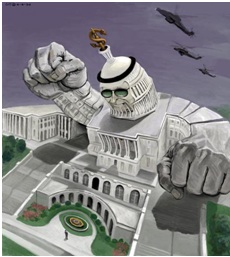
I’ve wanted to write about ALEC for awhile. I tripped across this very succinct explanation in my print copy of Bloomberg Business Week that made me revisit my plans. Ever wonder why a bunch of weird ass bills suddenly show up simultaneously in a bunch of legislatures that say things that are basically against the positions of modern science, medicine, and economics? Well, chances are that some huge corporation has written that bill that will become law in no one’s interest but their own, and it was penned by some member of ALEC.
Kim Thatcher, a Republican state representative in Oregon, introduced a sharply worded anti-cap-and-trade bill this year that said, “There has been no credible economic analysis of the costs associated with carbon mandates.” Apparently, that view is widely shared. Legislation with that exact language has been introduced in dozens of states, including Montana, New Hampshire, and New Mexico.
It’s not plagiarism. It’s a strategy. The bills weren’t penned by Thatcher or her fellow legislators in Helena, Concord, and Santa Fe. They were written by a little-known group in Washington with outsize clout, the American Legislative Exchange Council. Corporate benefactors such as Koch Industries and ExxonMobil (XOM) help fund ALEC with membership dues and pay extra for a seat at the legislative drafting table.
Among ALEC’s prominent members are Pfizer (PFE), Wal-Mart (WMT), Bayer (BAYZF), and Visa (V), according to ALEC annual meeting documents provided by an attendee. The organization’s legislative agenda includes limiting the power of unions, fighting environmental regulations, and overturning President Obama’s health-care reform law. ALEC says it gets about 200 state laws passed each year. The corporate influence is hard to trace and can produce a return on investment that would make a hedge fund manager drool.
“This is just another hidden way for corporations to buy their way into the legislative process,” says Bob Edgar, president of Common Cause, which seeks to reduce money in politics. Reagan Weber, an ALEC spokeswoman, says the group simply facilitates the sharing of information and “good conservative policy.”
ALEC was founded in 1973 by two of the conservative movement’s intellectual midwives, both now dead: Representative Henry Hyde of Illinois and activist Paul Weyrich, who also was a founder of the Heritage Foundation. As a tax-exempt organization, ALEC doesn’t disclose its corporate donors or its member lists beyond those who serve as committee chairmen.
In exchange for annual membership dues of as much as $25,000 plus a fee of $3,000 to $10,000 to get on a bill-writing “task force,” Koch and ExxonMobil representatives sat beside elected officials and policy analysts at an ALEC meeting in April 2010, helping them write model energy legislation that would later be introduced in statehouses around the country, according to the documents. The legislators pay $100 for a two-year membership. The task force bills are considered finished only after the legislators and private-sector members vote separately to approve them, giving each side a veto. Once a model bill is complete, it’s up to ALEC’s legislator members to go back to their home states and shepherd it into law.
ALEC is on the radar of many organizations including the American Association for Justice who keeps track of their activities and publishes white papers on this group of bill-writers for profit, greed and the destruction of public resources.
(W)hile the membership appears to be public sector, the bankroll is almost entirely private sector. In fact, public sector membership dues account for only around one percent of ALEC’s annual revenues. ALEC claims to be nonpartisan, but in fact its free-market, pro-business mission is clear.
The result has been a consistent pipeline of special interest legislation being funneled into state capitols. Thanks to ALEC, 826 bills were introduced in the states in 2009 and 115 were enacted into law.
Behind the scenes at ALEC, the nuts and bolts of lobbying and crafting legislation is done by large corporate defense firm Shook, Hardy & Bacon. A law firm with strong ties to the tobacco and pharmaceutical industries, it has long used ALEC’s ability to get a wide swath of state laws enacted to further the interests of its corporate clients.
ALEC’s campaigns and model legislation have run the gamut of issues, but all have either protected or promoted a corporate revenue stream, often at the expense of consumers. For example, ALEC has worked on behalf of:
- Oil companies to undermine climate change proponents;
- Pharmaceutical manufacturers, arguing that states should be banned from importing prescription drugs;
- Telecom firms to block local authorities from offering cheap or free municipally-owned broadband;
- Insurance companies to prevent state insurance commissioners from requiring insurers to meet strengthened accounting and auditing rules;
- Big banks, recommending that seniors be forced to give up their homes via reverse mortgages in order to receive Medicaid;
- The asbestos industry, trying to shut the courthouse door to Americans suffering from mesothelioma and other asbestos-related diseases; and,
- Enron to deregulate the utility industries, which eventually caused the U.S. to lose what the Securities and Exchange Commission (SEC) estimated as $5 trillion in market value.
The Koch brothers and Koch Industries are all over ALEC. Their Charitable foundations and businesses provide a lot of funding. ExxonMobile is also a huge source of funds. There are several companies representing the interests of Big Pharma. ALEC looks like a who who of corporate America’s worst corporate citizens. The Center for Media and Democracy’s PR Watch put out a Special Report on ALEC’s funding last month.
According to ALEC’s IRS filings, over the past three years it has raised $21,615,465 from corporations, foundations, and other sources, and just over $250,000 in dues paid by state legislators, amounting to slightly more than 1 percent of its income. The gigantic gap between what legislators pay and what ALEC spends is the direct result of the reality that legislators pay a mere $50 a year to be a member, while a corporation can pay up to $25,000 a year or more to be a member of ALEC plus additional fees to be on a task force where corporations get the same right to vote as legislators. They just pay hundreds of times more for that vote.
…
For example, the foundations controlled by the billionaire Koch brothers gave ALEC over $200,000 in 2009. (The Claude R. Lambe Foundation, which Charles Koch, his wife and kids help run, donated $125,000 to ALEC. His own Charles G. Koch foundation kicked in an additional $75,000.) That $200k is before whatever is the undisclosed amount of membership “dues” paid by Koch Industries, which is run by Charles and David Koch. There is no public disclosure of annual gifts the company gives to take part in the one-stop shopping ALEC conventions provide to meet with legislators from every state about their wish list…
Other right-wing foundations have also supported ALEC, far beyond the “dues” paid by any legislator. For example, the Castle Rock Foundation, which is run by right-wing beer heir Peter Coors, gave $50,000 last year and in prior years. The right-wing John M. Olin foundation has also been a donor to ALEC. Another of the big right-wing foundations, the Lynde and Harry Bradley Foundation, has been a funder and, for example, gave ALEC $50,000 in 2009 to fund “budget reform” work. Similarly, right-winger Richard Scaife has given ALEC over half a million dollars the past decade or so, through his Allegheny Foundation. Some of the organizations that support ALEC, like Scaife’s, are also deeply invested in the profits of corporations that sit on ALEC’s board. The Allegheny Foundation has held over $11 million of ALEC board member Altria‘s stock, along with major stock holdings in other ALEC corporate board members like Kraft, Coca Cola, AT&T, GlaxoSmithKline, Johnson & Johnson, and Exxon.
ALEC is a major voice for climate change denial, responsible for the recent spate of voter disenfranchisment laws, and continually pushes for extreme tort reform. There’s a really good primary on ALEC at People for the American Way. ALEC is the well-funded voice of corporate special interests. Here are two recent examples of state legislature originating from ALEC.
ALEC was influential in crafting and passing a Texas law, dubbed the “Successor Asbestos-Related Liability Fairness Act, that shielded Crown Cork and Seal, a business that in 1966 acquired a company that used asbestos in its products, from lawsuits from the company’s workers. Even though Crown agreed to pay the company’s liabilities, it wanted immunity from paying damages to workers facing asbestos-related diseases. Crown Cork and Seal turned to ALEC to help shape the Texas law, which put an extremely low cap on liability for companies like Crown who acquired companies which committed wrongdoing, known as a “successor immunity” law.” Mark Behrens, an attorney for Shook Hardy, worked as a lobbyist for both ALEC and Crown to encourage allied lawmakers to introduce and pass the bill. The American Association for Justice writes that “this so-called ‘successor immunity’ has all the hallmarks of an ALEC special interest bill. It is plainly designed not with public policy in mind, but rather a specific industry (or in this case, a specific company).” The Texas Supreme Court ultimately found the cap to be an unconstitutional retroactive protection for Crown that inhibited the rights of people to rightfully sue corporations for damages, but similar ALEC-derived laws are still on the books in other states.
In Arizona, an investigative report by NPRfound that ALEC significantly helped one of its clients, the Corrections Corporations of America (CCA), influence the state’s new immigration law. The CCA is a for-profit prison company whose “executives believe immigrant detention is their next big market,” and thought that a law which “could send hundreds of thousands of illegal immigrants” to prison would “mean hundreds of millions of dollars in profits to private prison companies responsible for housing them.” As a dues-paying member of ALEC, the CCA was able to write, present and lobby Arizona policymakers for a draconian immigration bill at an ALEC-hosted conference. “Four months later, that model legislation became, almost word for word, Arizona’s immigration law,” and many of the bill’s cosponsors later received significant campaign contributions from the CCA. ALEC also helped the CCA by pushing “truth in sentencing” laws that restrict parole eligibility for felons, and consequently increase the number of prisoners.
You name the spurious law, and ALEC is likely behind it. They write laws that push private school vouchers, strip workers of their right to organize, make it more difficult to generate revenues to fill budget shortfalls in states, and undercut healthcare reform efforts.
After the passage of health care reform, ALEC’s top priority has been to challenge the law by encouraging members to introduce bills that would prohibit the law’s insurance mandate. ALEC’s Health and Human Services task force is led by representatives of PhRMA and Johnson & Johnson, and representatives of Bayer and GlaxoSmithKlein sit on ALEC’s board. The group’s model bill, the “Freedom of Choice in Health Care Act,” has been introduced in forty-four states, and ALEC even released a “State Legislators Guide to Repealing ObamaCare” discussing a variety of model legislation including bills to partially privatize Medicaid and SCHIP. The legislative guide utilizes ideas and information from pro-corporate groups like the Heritage Foundation, the Goldwater Institute, the James Madison Institute, the Cato Institute, the National Center for Policy Analysis and the National Federation of Independent Business.
Expanding the disproportionate power of corporations in the legislative process is central to ALEC’s goals. ALEC is responsible for some of the worst outcomes in government we’ve seen in decades. It is pure influence peddling. Any legislator that relies on ALEC for services should be subject to immediate recall. ALEC represents what’s wrong with this country today. It is at the heart of single issue, special interest politics that are not in the public’s interest. They are a perversion of the democratic political process.
Mitt Romney is wrong. Corporations are not people. The profit motive is the sole determinant of corporate behavior. No household or family would put profits before everything else nor should any government that purports to represent its people. I suggest finding out as much about how ALEC influences your state legislature as soon as possible. A good place to start is with The Nation‘s series ‘ALEC Exposed’. The first in this series shows the role of the Koch’s in ALEC’s model bills. I’ve pumped this thread up with a lot of juicy links. Please take some time to visit the research of all the nonprofits that have carefully researched this shadowy organization.

 peej
peej Carissa
 bostonboomer
 dakinikat
 ecocatwoman
 mablue2
 Mama Lopez
 peggysue22
 quixote
 skydancingguestblogger
 Mona (aka Wonk the Vote)



 Sky Dancing
Recent Comments