
What he said …
Posted: December 11, 2011 Filed under: #Occupy and We are the 99 percent!, Bailout Blues, Banksters, Economy, financial institutions, Global Financial Crisis 6 CommentsI keep talking about the utter audacity of the political class these days and how they completely ignore everything we know about economics and finance in pursuit of  self-dealing and getting political donations from the FIRE industries. I particularly hate that we’ve got this complete twisted notion of “free” trade and “free” markets thanks to a bunch of really ignorant right wingers and mouthpieces like Rush Limbaugh, Fox News, Larry Kudlow, etc. etc. etc.. These folks are out to line their own pockets and they are pitching nonsense to low information zombies.
I also really hate to just wholesale copy and paste another blog–in this case Washington Blog at The Big Picture–but some times you just have to let the voice of the source speak for itself and hope it stands up to the ideals of fair use. Thanks go to Fiscal Liberal for pointing me to this list and its readable wonky links of proof. It’s called ‘The Financial Crisis was Entirely Foreseeable’ but it might as well be labelled ‘Idiots in the Beltway are spewing memes and setting us up for a big ol’ repeat of the global financial meltdown’. Idiots in Europe are doing likewise. Why are they all bailing ut gambling bankers over their households and real businesses? Where’s a politician that really knows his stuff when it comes to authentic finance and economics?
We’ve Known for Thousands of Years
We’ve known for literally thousands of years that debts need to be periodically written down, or the entire economy will collapse. And see this.
We’ve known for 1,900 years that that rampant inequality destroys societies.
We’ve known for thousands of years that debasing currencies leads to economic collapse.
We’ve known for hundreds of years that the failure to punish financial fraud destroys economies.
We’ve known for hundreds of years that monopolies and the political influence which accompanies too much power in too few hands is dangerous for free markets.
We’ve known for hundreds of years that trust is vital for a healthy economy.
We’ve known since the 1930s Great Depression that separating depository banking from speculative investment banking is key to economic stability. See this, this, this and this.
We’ve known since 1988 that quantitative easing doesn’t work to rescue an ailing economy.
We’ve known since 1993 that derivatives such as credit default swaps – if not reined in – could take down the economy. And see this.
We’ve known since 1998 that crony capitalism destroys even the strongest economies, and that economies that are capitalist in name only need major reforms to create accountability and competitive markets.
We’ve known since 2007 or earlier that lax oversight of hedge funds could blow up the economy.
And we knew before the 2008 financial crash and subsequent bailouts that:
- The easy credit policy of the Fed and other central banks, the failure to regulate the shadow banking system, and “the use of gimmicks and palliatives” by central banks hurt the economy
- Anything other than (1) letting asset prices fall to their true market value, (2) increasing savings rates, and (3) forcing companies to write off bad debts “will only make things worse”
- Bailouts of big banks harm the economy
- The Fed and other central banks were simply transferring risk from private banks to governments, which could lead to a sovereign debt crisis
Given the insane levels of debt, rampant inequality, currency debasement, failure to punish financial fraud, growth of the too big to fails, repeal of Glass-Steagall, refusal to rein in derivatives, crony capitalism and other shenanigans … the financial crisis was entirely foreseeable.
Okay, so let’s just end that last part by taking out “the financial crisis was entirely foreseeable” and by replacing it with “the next big financial crisis is entirely foreseeable and getting more likely every day”. If you need any proof of further inevitability just listen to ANY Republican these days and most of the Democratic Caucus. They are resplendent with VooDoo Economics and Finance believers and enablers. It’s just like with climate science and evolution. An entire group of people who embrace ideology over reality just can’t seem to get out of the flat earth theories. Watching the Republican debates alone has been like watching the march of ignorance personified. I’m waiting for them to start announcing the earth is only a few thousand years old, gravity doesn’t exist or need to because god’s hand holds us in place, and 1 + 1 is really 3. If only the media would act like the set of fact checkers they could be instead of mouthpieces for corporate interests we might actually be able to get through to a few zombies and bring them back to life. Until then, get ready for the next big one.
What’s so hard to understand about the word Contractionary?
Posted: December 10, 2011 Filed under: Bailout Blues, Banksters, Economy, financial institutions | Tags: Eurozone, macroeocnomics, Paul Krugman 17 Comments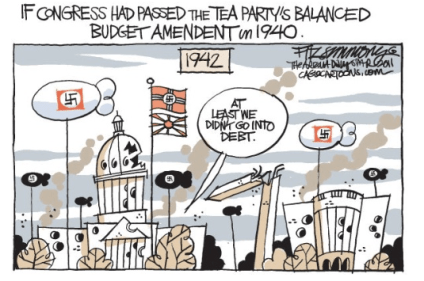 I just read an excellent article at VOXEU called “A summit to the Death” by Kevin O’Rourke. It’s full of common sense economic analysis about the state of the EU that reminds me of how rare common sense can be. While the analysis looks at he EU, it could well apply to the US as well. There seems to be some disease in political bodies these days that cannot grasp the concept of contractionary policy as contractionary.
There’s also this scramble to save financial institutions at all costs while doing nothing to prevent recurrence of bad practices and solving the fall out anywhere outside a bank balance sheet. To a certain extent, the EU crisis comes from the inability of many countries to think of policy in terms of something other than currency devaluation as a way of making their workers and goods appear cheap to the rest of the world. In this scenario, a country can goose some of its business activities at the expense of some of its businesses and its citizens and not get caught by any one but those of us that watch those sort of things. That long run game of devaluing US workers has caught up with us here.
One lesson that the world has learned since the financial crisis of 2008 is that a contractionary fiscal policy means what it says: contraction. Since 2010, a Europe-wide experiment has conclusively falsified the idea that fiscal contractions are expansionary. August 2011 saw the largest monthly decrease in eurozone industrial production since September 2009, German exports fell sharply in October, and now-casting.com is predicting declines in eurozone GDP for late 2011 and early 2012.
A second, related lesson is that it is difficult to cut nominal wages, and that they are certainly not flexible enough to eliminate unemployment. That is true even in a country as flexible, small, and open as Ireland, where unemployment increased last month to 14.5%, emigration notwithstanding, and where tax revenues in November ran 1.6% below target as a result. If the nineteenth-century “internal devaluation” strategy to promote growth by cutting domestic wages and prices is proving so difficult in Ireland, how does the EU expect it to work across the entire eurozone periphery?
The world nowadays looks very much like the theoretical world that economists have traditionally used to examine the costs and benefits of monetary unions. The eurozone members’ loss of ability to devalue their exchange rates is a major cost. Governments’ efforts to promote wage cuts, or to engineer them by driving their countries into recession, cannot substitute for exchange-rate devaluation. Placing the entire burden of adjustment on deficit countries is a recipe for disaster.
In order to protect financial markets, countries like the UK and the US have been willing to prop up poorly performing financial institutions at an extremely high cost while further driving the nominal wages of their workers to lower and lower levels through currency debasement. Then, after slashing spending, they wonder why they’re economies don’t expand. It seems like some of the very easiest lessons of Macro 101 weren’t absorbed by a number of world leaders today. That vehicle of robbing Peter to prop up Paul and a few exporters isn’t available to countries in a currency union unless the Central Bank wants to do it for all.
O’Rourke’s analysis led Paul Krugman to rightly make this observation.
Maybe it was always thus, but the relentless wrong-headedness of the Europeans, their insistence on seeing their crisis as something it isn’t, and responding with actions that deepen the real crisis, has been a wonder to behold. In the 1930s policy makers had the excuse of ignorance; there was nobody to explain what was happening. Now, their actions amount to a willful disregard of Econ 101.
Let me provide an interesting bit of perspective. In 2007, Spain ran a budget surplus. That actually was its third budget surplus in row. At the time, its growth had been forecast to decline but ot was slammed by the global financial crisis. Spain is now on the list of problem countries–the S of the PIIGS–because it was trying to deal with 30 years of budget deficits to get in line with the EU Criteria. Balanced budgets are the proscribed way to handle an economy that is operating where it should be operating. Spain’s is having problems because financial institutions all over the world gambled and lost. Their economic activity declined, their tax receipts went down, and their obligations to the unemployed went up. So, as would be expected, their deficits widened. Now, the banks that caused the huge global crisis are getting full court sympathy and Spain is being blamed for threatening the status of the union.
Monday Reads
Posted: December 5, 2011 Filed under: Crime, Economy, financial institutions, Foreign Affairs, investment banking, Japan, morning reads 28 Comments Good Morning!!
One of the few television shows I actually watch regularly these days is Criminal Minds. The profiling activities fascinate me. I’ve actually passed on my addiction to BostonBoomer who sent me this CBS story which sounds like something right off of their series. A young woman was abducted by a very disturbed young man and was successfully returned to her family in Kearney, Nebraska. Gotta love a happy ending!
Kidnapping victim Anne Sluti came home Friday, a week after the 17-year-old was whisked away from a local mall parking lot and kept hostage hundreds of miles away in Montana.
With a bruise under her right eye and an FBI baseball cap on her head, Sluti stepped off a private jet with her parents and brother. A small group of family members and friends shrieked with excitement.
“Thank God she’s alive,” said her aunt Sue Daniel. She placed a sign in the dashboard of her minivan that showed a happy face and said “Welcome Home, Anne.”
“I’m just happy to get back home,” Sluti said earlier in the day as the family prepared to leave Kalispell, Mont. “I want to thank everyone who helped me get home safely.”
Remarked her mother, Elaine Sluti, “Someone at the hotel said to me this morning, ‘Have a good day.’ Believe me, we are having a very good day.”
We knew there was a major cover up on the Fukushima melt down. Here’s a Guardian story that indicates that the fuel rods may have completely melted down. Scary stuff. This time reality mimics the move The China Syndrome.
Fuel rods inside one of the reactors at the Fukushima Daiichi nuclear power plant may have completely melted and bored most of the way through a concrete floor, the reactor’s last line of defence before its steel outer casing, the plant’s operator said.
Tokyo Electric Power (Tepco) said in a report that fuel inside reactor No 1 appeared to have dropped through its inner pressure vessel and into the outer containment vessel, indicating that the accident was more severe than first thought.
The revelation that the plant may have narrowly averted a disastrous “China syndrome” scenario comes days after reports that the company had dismissed a 2008 warning that the plant was inadequately prepared to resist a tsunami.
Tepco revised its view of the damage inside the No 1 reactor – one of three that suffered meltdown soon after the 11 March disaster – after running a new simulation of the accident.
It would not comment on the exact position of the molten fuel, or on how much of it is exposed to water being pumped in to cool the reactor. More than nine months into the crisis, workers are still unable to gauge the damage directly because of dangerously high levels of radiation inside the reactor building.
If you haven’t read Eliot Spitzer’s article on Slate about the $7 trillion secret loan program, you really should. It is also something that seems more Hollywood than reality. Spitzer is calling for perp walks.
During the deepest, darkest period of the financial cataclysm, the CEOs of major banks maintained in statements to the public, to the market at large, and to their own shareholders that the banks were in good financial shape, didn’t want to take TARP funds, and that the regulatory framework governing our banking system should not be altered. Trust us, they said. Yet, unknown to the public and the Congress, these same banks had been borrowing massive amounts from the government to remain afloat. The total numbers are staggering: $7.7 trillion of credit—one-half of the GDP of the entire nation. $460 billion was lent to J.P. Morgan, Bank of America, Citibank, Wells Fargo, Goldman Sachs, and Morgan Stanley alone—without anybody other than a few select officials at the Fed and the Treasury knowing. This was perhaps the single most massive allocation of capital from public to private hands in our history, and nobody was told. This was not TARP: This was secret Fed lending. And although it has since been repaid, it is clear why the banks didn’t want us to know about it: They didn’t want to admit the magnitude of their financial distress.
The banks’ claims of financial stability and solvency appear at a minimum to have been misleading—and may have been worse. Misleading statements and deception of this sort would ordinarily put a small-market player or borrower on the wrong end of a criminal investigation.
Spitzer cites this Bloomberg Analysis which is something we’ve looked at before but bears a second viewing. After stabilizing the financial system, every effort should have been made by regulators and the current administration to purge the financial industry of toxic senior management. They also should have taken over some of the huge banks and sliced and diced them into more appropriately sized regional banks. None of this actually happened, however if you read Confidence Men, you’ll see that it wasn’t for Sheila Baer’s lack of trying and it was actually the original concept supported by Obama. The Geithner Treasury evidently ran all kinds of end run plays to stop this from happening. Geithner continually proves that his loyalties are to huge financial institutions.
… the Fed and its secret financing helped America’s biggest financial firms get bigger and go on to pay employees as much as they did at the height of the housing bubble.
Total assets held by the six biggest U.S. banks increased 39 percent to $9.5 trillion on Sept. 30, 2011, from $6.8 trillion on the same day in 2006, according to Fed data.
For so few banks to hold so many assets is “un-American,” says Richard W. Fisher, president of the Federal Reserve Bank of Dallas. “All of these gargantuan institutions are too big to regulate. I’m in favor of breaking them up and slimming them down.”
Employees at the six biggest banks made twice the average for all U.S. workers in 2010, based on Bureau of Labor Statistics hourly compensation cost data. The banks spent $146.3 billion on compensation in 2010, or an average of $126,342 per worker, according to data compiled by Bloomberg. That’s up almost 20 percent from five years earlier compared with less than 15 percent for the average worker. Average pay at the banks in 2010 was about the same as in 2007, before the bailouts.
“The pay levels came back so fast at some of these firms that it appeared they really wanted to pretend they hadn’t been bailed out,” says Anil Kashyap, a former Fed economist who’s now a professor of economics at the University of Chicago Booth School of Business. “They shouldn’t be surprised that a lot of people find some of the stuff that happened totally outrageous.”
Bank of America took over Merrill Lynch & Co. at the urging of then-Treasury Secretary Paulson after buying the biggest U.S. home lender, Countrywide Financial Corp. When the Merrill Lynch purchase was announced on Sept. 15, 2008, Bank of America had $14.4 billion in emergency Fed loans and Merrill Lynch had $8.1 billion. By the end of the month, Bank of America’s loans had reached $25 billion and Merrill Lynch’s had exceeded $60 billion, helping both firms keep the deal on track.
This is completely unacceptable. It is one thing for the FED to help stabilize the financial system, it’s another one for the Treasury to ignore the requests of the President and to prevent a key regulator–FDIC in this case–from doing its job. The other culprit identified in the Confidence Men narrative is Rahm Emmanuel. The narrative on Obama and Baer’s desire to shut down Citibank and the obfuscation from Geithner and Emmanuel is the stuff of movies focused on government conspiracies.
One of the plotlines in Ron Suskind’s Confidence Men concerns the various bureaucratic and substantive moves through which Tim Geithner and Rahm Emmanuel dissuaded the president from ordering the seizure and shutdown of Citigroup. The story starts with the fact that Larry Summers and Christina Romer, who were sympathetic to the idea, lacked the staff resources to develop a plan for doing it, while Geithner, who had the staff, thought it was a bad idea. Sheila Bair also had the staff, and also wanted to go ahead, but was out of the loop:
But when it came to controlling information, there was one area in which Geithner’s office had been successful. Key disclosures of what actually happened in the March 15 “showdown” never leaked. Bair didn’t know, and never found out, that the president had been trying to push forward what the FDIC chairwoman was recommending. He wasn’t successful, either. Alan Krueger said one reason Treasury dragged its feet on a constructing a plan for Citigroup’s resolution was Sheila Bair. They would have had to consult the FDIC chairwoman. After all, her agency is in the business of closing banks. “The fear was that Sheila would leak it,” Krueger said, in a comment echoed by others at Treasury. “And there’d be a run on Citi.” He added that this was one of many reasons: “It was more than just that. The bottom line is Tim and others at Treasury felt the president didn’t fully understand the complexities of the issue, or simply that they were right and he was wrong, and that trying to resolve Citi and then other banks would have been disastrous.”
Krueger, for one, disagreed, and that very day he was due to have lunch with someone uniquely suited to edify him about the resolution of troubled banks: Andrea Borg, the Swedish finance minister.
It seems that many West Wing technocrats are much more interested in their post-DC careers than their current duties and responsibilities to US law. I’ve said many times that were in a much better position for a major and uncorrectable meltdown–much like the Japanese Fukushima plant–should these circumstances continue. The vulnerability of the nation’s largest banks to any kind of contagion is substantial. Their ability to bring down the payments and credit system is fully understood by the FED who instigated more money floodgate opening last week to aid those same banks with that same senior management muck their way through the Eurozone crisis. Any private institution that has had to call on the Government for that much assistance doesn’t deserve to be in business. We shouldve GM’d them all.
Here’s a link to CBS and last night’s 60 minutes (h/t Elizabeth Warren) on Prosecuting Wall Street.
Two whistleblowers offer a rare window into the root causes of the subprime mortgage meltdown. Eileen Foster, a former senior executive at Countrywide Financial, and Richard Bowen, a former vice president at Citigroup, tell Steve Kroft the companies ignored their repeated warnings about defective, even fraudulent mortgages. The result, experts say, was a cascading wave of mortgage defaults for which virtually no high-ranking Wall Street executives have been prosecuted.
So, that’s my little contribution to the discussion this morning. What’s on your reading and blogging list this morning?
Occupy Philly and Independence Hall
Posted: November 30, 2011 Filed under: #Occupy and We are the 99 percent!, Banksters, Corporate Crime, corruption, Economy, financial institutions, income inequality, jobs, U.S. Economy, U.S. Politics, unemployment, voodoo economics | Tags: 2011: days of revolt, Financial Crisis, U.S. Economy, unemployment 16 CommentsBlack Friday, Philadelphia, Pa.
My first look at Occupy Philly was after a free ride on the 9:52 Media Local, The Santa Train. This was not by plan but a matter of sheer coincidence. I should have guessed;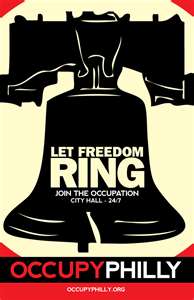 I was the only one standing on the Morton platform without a small child in tow. But shortly after boarding, it was all too clear. The elves came first, wailing Jingle Bells and Wish You a Merry Christmas. They were followed by out-of-season Mummers dressed in holiday garb, belting out another round of X-mas cheer, complete with accordion, banjo and sax. Mrs. Claus assured the children that Santa was busy, busy at the North Pole, making sure all their wishes [even though edited to economic realities] would come true. And then, there was the free candy and balloon animals.
The magic of childhood! Where we can believe everything and anything. When the world appears kind and right and true.
An out-of-stater now, I deliberately got off at Suburban Station, my old work stop. Also, the stop at which I’ve frequently disembarked to attend exhibits at the Franklin Institute, the Museum of Natural History or the Philadelphia Museum of Art, a brisk walk west up the Parkway, past the Rodin Museum and the soon-to-open home for the controversy-laden Barne’s collection.
But not today.
This morning I headed east, winding through the underground towards City Hall and the Occupy Philly encampment. Later, I would team up with a friend and hoof down to the historic district. But right now, I had a different historical event in mind.
I no sooner hit the outside doors than the vivid blue of plastic tarps and tent tops were visible. A strange sight. Normally, I would have walked through the West arch at City Hall, stood for a few moments googling at the city’s Christmas tree. But this year was different. So different.
The western entrance to the City Hall complex was barricaded. ‘For Restoration’ the signs said. No towering tree this year. Instead, the Occupy tents decorated Dilworth Plaza, a strange but fascinating sprawl of makeshift living quarters and standard issue camping gear. The area was quiet and still, the air crisp. I circled around the entire plaza. No sight of my friend, so I headed back towards the encampment, spotted the medical and information tents, as well as a petition table outlining the dangers of in-state fracking by over-zealous gas drilling companies.
At the Information Tent there was an array of literature on upcoming actions, the November issue of the Occupy Wall Street Journal and several people discussing Mayor Nutter’s deadline to dismantle the encampment within 48 hours. Two of the occupiers said almost in unison: ‘It was never about the tents.’
So what is it about? It’s a question I read constantly on the blogs and in newspapers, even hear from family and friends.
Here’s what I learned in the morning hours I spent on the Plaza:
- In the 53 days of Occupy Philly, 26,000 local citizens signed on expressing support.
- At the height of the encampment, City Hall was encircled with tents, sleeping bags and a variety of makeshift living accommodations.
- Active supporters numbered around 200-300, some living on-site, others coming in to protest, march and rally during the day.
- Local Unions support the effort. In fact, the Trades Union offered to assist the protestors in the original plan to move off Dilworth to an encampment across the street. The Union needs those ‘renovation’ jobs. That idea was scrapped because permits were denied.
- The area was clean. No needles, drug paraphernalia or trash scattered about as the MSM would have readers/viewers believe taints all encampments. Talking to several encampment members, I was told a goodly portion of each day is spent ‘cleaning up.’
- The encampment/protest was peaceful. There was a sense of community and the overriding sentiment was to voice anger and dissent over the widening income inequality in the US and the corporate capture of all facets of government.
- I heard no political posturing or Obama shilling. Simply stated, the system is broken for the 99%.
- Forty to fifty of the encampment members were homeless. They joined for the free food and the safety of numbers.
- The police presence, even on this Friday morning, was unusually large but basically stationed within the confines of the City Hall plaza.
- Though Mayor Nutter had leveled a 48-hour deadline, there was no sense of panic or great urgency the morning I arrived. I later learned that the majority of the encampment was dismantled voluntarily Sunday evening and the homeless were moved elsewhere for their own safety.
- This morning [Wednesday 11/30 at 1:20 am, according to the Associated Press], the Philly police department began tearing down the remaining tents.
But as the protesters I spoke with said: It was never about the tents. It has always been about visibility—the eyesore of inequality, injustice and corruption.
I left Dilworth Plaza, and then headed down to Independence Mall. A surreal juxtaposition. In a matter of a few blocks, my friend and I walked from the current protest to the historical marker of the Mother of All Protests. Philadelphia is the birthplace of the Declaration of Independence and the US Constitution. We strolled through the portrait gallery installed in the Second Bank of the United States and the faces of those earlier protesters, that grand collection of merchants and farmers, philosophers and scientists, lawyers and bankers stared back. What would they be thinking? I wondered.
We went on to Carpenter’s Hall, where Benjamin Franklin reportedly had secret meetings with like-minded citizens prior to the Revolution. Years later, on leaving the Constitutional Convention, a woman reportedly asked Franklin what sort of government he and the others had designed. Franklin’s terse reply: ‘A Republic, Ma’am. If you can keep it.’
Our final stop was Independence Hall, which was originally the Pennsylvania State House. This was where the Second Continental Congress met, the Declaration of Independence was adopted and where the Constitutional Convention met to draft, debate, and then sign the US Constitution in 1787.
We’re a long way from who and what we were in 1787. But Franklin’s words have a haunting edge to them: ‘A Republic, Ma’am. If you can keep it.’ Another quote that’s perhaps equally pertinent is:
‘We must hang together, gentleman, or assuredly we will all hang separately.’
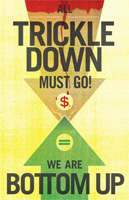 For me at least, this is what the Occupy Movement has been and is still about. In an age where corporations have been awarded the distinction of personhood, when free speech is equated to money and The Rule of Law is applied in an unjust and inequitable fashion then we, ordinary citizens, have a duty to support and join one another in protest. To hang together, if you will.
Oh, and that Tea Party, the real one in Boston that got everything rolling?
We all recall the ‘taxation without representation’ line from our school years, stemming from the passage of the Stamp Act in the 1760s and later the Tea Act in 1773. King George had debts to pay off—a Seven Year’s War among other things. And the East India Company’s tea pitched into the Boston Harbor? East India was basically provided a monopoly on tea shipped into the colonies. The company [and its aristocratic shareholders] were none too happy about their profits pinched and drowned in the harbor and helped push [lobby] the King to pass the Coercive Acts, aka The Intolerable Acts. The colonists were generally peeved at the British Parliament for taxing them without their consent and then adding insult to injury, giving the East India Co. a cushy, duty-free export to undercut colonial merchants. But they were beyond peeved when punitive measures were leveled. They demanded that Parliament end its corrupt economic policies with and stop the bailout of that era’s own TBTF East India Company.
Sound vaguely familiar? Whatever’s old is new again. Of course, no one age can be accurately compared to another. Context is everything. To quote Barbara Kingsolver from the November issue of The Occupy Wall Street Journal:
“Every system on earth has its limits. We have never been here before, not right here exactly, you and me together in the golden and gritty places all at once, on deadline, no fooling around this time, no longer walking politely around the dire colossus, the so-called American Way of consecrated corporate profits and crushed public compassion. There is another American Way. This is the right place, we found it. On State of Franklin, we yelled until our throats hurt that we were the 99% because that’s just it. We are.”
As I’ve said elsewhere, I support Occupy until I don’t. The ‘don’t’ for me is if the Movement becomes another co-opted arm of one corrupt political party or another. Our existing two-party system is thoroughly compromised; a shipload of bleach and scrub brushes couldn’t clean it up. I support Occupy because I hate the idea of leaving my kids and future grandbabies with a broken, twisted Republic, one dedicated to piranha-school profits, the amassing of criminal wealth by a callous, irresponsible few at the expense of the many. I support the Occupiers because of those sweet-faced kids on the Santa train; they deserve the best we have. But I also support what I saw on Dilworth Plaza because of what I saw and recalled inside Independence Hall, what we owe to all those who sacrificed and struggled, dreamed and achieved, lived, loved and died over the last 200+ years. We stand on the shoulders of so many.
That’s something we should never forget because our past, our history is no small thing. But our future, that other American Way? That’s all about what we do now.
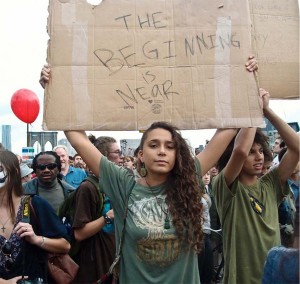
EuroZone Woes
Posted: November 27, 2011 Filed under: Economy, financial institutions, Foreign Affairs, Global Financial Crisis | Tags: Euozone, Financial Union 8 CommentsThere’s been a number of interesting things coming out of Europe this weekend that will undoubtedly impact US Financial Markets and probably the economy since they are a  significant trading partner as well as investor in US businesses. The adoption of the Euro and the expansion of the trade zone area has generally been shown to be a huge boon to the European Economy. It’s really hard for me to imagine the collapse of the Euro since it has been so successful that a variety of countries through out the world are in the process of adopting their own versions. There have been a lot of people against the arrangement primarily because they’re still in nationalist mode and dislike the idea of any kind of cooperation that looks like ‘collectivism’. The astounding economic results have been difficult to rebut however.
There are two items that generally are considered problematic for some countries that join a monetary union. The first is the loss of independent monetary policy including the ability to debase your currency as a means to stimulating your economy. The offset to that is that if you’re a country like Greece that has had incredible issues with inflation stemming from politicized monetary policy, you pick up credibility when you outsource that function to a shared central bank. That’s especially the case when you share your central bank with the Germans who have been inflation wary since the Weimar Republic. The Japanese central bank and the German central bank are well known for controlling inflation over just about any other economic priority. The second problem is the potential need for cross country fiscal policy. That has never been much of an issue in the EU until now. That is why there is talk of an IMF rescue of countries like Greece. Also, there’s some talk of hurrying fiscal integration or giving some entity the ability to float “eurobonds” specifically for countries that are in trouble right now like Italy. The problem right now is that many of the weaker EU countries were allowed to borrow substantially and with a credit crisis and banking troubles that led to recession, the bonds from those countries (sovereign debt) have no lost their value.
There are some that think the Eurozone will fall apart. I find that hard to accept given the substantial boost that the zone has been to many economies in the form of trade and direct financial investment. This benefit has gone to all countries and is called the “Rose Effect”. I’ve spent the last three years of my life studying all of this in great detail. I am as vested in any one in the outcome. Here’s a few items that have been going on as we watch Eurozone brinkmanship play out. Reuters reports that Germany and France are forming a “Stability Pact” and hoping to get the European Central Bank leaders will act more like Bernanke’s Fed.
Echoing a Reuters report on Friday from Brussels, the Sunday newspaper said the French and German leaders were prepared to back a deal with other euro countries that might induce the ECB to intervene more forcefully to calm the euro debt crisis.
The newspaper report quoted German government sources as saying that the crisis fighting plan could possibly be announced by German Chancellor Angela Merkel and French President Nicolas Sarkozy in the coming week.
In an advance release before publication, Welt am Sonntag said that because it would take too long to change existing European Union treaties, euro zone countries should just agree among themselves on a new Stability Pact to enforce budget discipline – possibly implemented at the start of 2012.
It could be similar to the Schengen Agreement which applies to EU countries that choose to take part and enables their citizens to enjoy uninhibited cross border travel. Among the countries in the Stability Pact, there would be a treaty spelling out strict deficit rules and control rights for national budgets.
Reports from AFP show that the IMF may be planning a 600 billion Euro rescue plan for Italy. Italy is the world’s 8th largest economy. It’s the 4th largest in Europe. Needless to say, this is highly irregular.
The IMF could bail out Italy with up to 600 billion euros ($794 billion), an Italian newspaper reported on Sunday, as Prime Minister Mario Monti came under pressure to speed up anti-crisis measures.
The money would give Monti a window of 12 to 18 months to implement urgent budget cuts and growth-boosting reforms “by removing the necessity of having to refinance the debt,” La Stampa reported, citing IMF officials in Washington.
The IMF would guarantee rates of 4.0 percent or 5.0 percent on the loan — far better than the borrowing costs on commercial debt markets, where the rate on two-year and five-year Italian government bonds has risen above 7.0 percent.
The size of the loan would make it difficult for the IMF to use its current resources so different options are being explored, including possible joint action with the European Central Bank in which the IMF would be guarantor.
“This scenario is because resistance from Berlin to a greater role for the ECB in helping states in difficulty — starting with Italy — could be overcome if the funds are given out under strict IMF surveillance,” the report said.
The European Union and the ECB have sent auditors to check Italy’s public accounts this month and the IMF is set to send experts soon under a special surveillance mechanism agreed at the G20 summit in France earlier this month.
The WSJ reports that a number of countries are pressuring ECB for concessions. The worry is that these same economies that have always had weaker economies and lax fiscal constraint will continue on that path. (These countries include Portugal, Spain, Greece, Italy and Ireland which have been sarcastically given the acronym PIIGS.)
While the ECB has so far said that it won’t beef up its limited bond buying, a growing number of governments are lobbying it to change its stance. A green light from Berlin for a bigger ECB role is seen by many euro-zone policy makers as a political necessity if the ECB is to act. Although the bank is politically independent, it has also paid close attention to the debate in Germany, where the government has so far rejected a bigger role for the central bank.
A new, binding fiscal regime would not be enough to justify the creation of collective euro-zone bonds, German officials say. But it might be enough to justify ECB action to stabilize bond markets that policy makers view as increasingly dysfunctional, some in Berlin say.
Other German officials remain skeptical about a greater ECB role—including Bundesbank President Jens Weidmann, who sits on the ECB’s governing council. Germany’s central bankers have been outvoted by the ECB majority before, however, including this August, when Mr. Weidmann opposed the decision to make limited purchases of Italian and Spanish bonds.
German Chancellor Angela Merkel said last week that she wants EU treaty changes to make the bloc’s fiscal rules legally enforceable by European authorities, in the same way that EU antitrust rules are.
European Council President is going to meet with Treasury Secretary Geithner on Monday at the US Treasury. Both Germany and Italy have had bond auction failures within the last week. This is causing the situation to look more dire. FT’s Wolfgang Munchau says the Eurozone has about 10 days before it collapses. His analysis borders on the sanguine.
Last week, the crisis reached a new qualitative stage. With the spectacular flop of the German bond auction and the alarming rise in short-term rates in Spain and Italy, the government bond market across the eurozone has ceased to function.
High quality global journalism requires investment. Please share this article with others using the link below, do not cut & paste the article. See our Ts&Cs and Copyright Policy for more detail. Email ftsales.support@ft.com to buy additional rights. http://www.ft.com/cms/s/0/d9a299a8-1760-11e1-b00e-00144feabdc0.html#ixzz1exnj0HAB
The banking sector, too, is broken. Important parts of the eurozone economy are cut off from credit. The eurozone is now subject to a run by global investors, and a quiet bank run among its citizens.
This massive erosion of trust has also destroyed the main plank of the rescue strategy. The European Financial Stability Facility derives its firepower from the guarantees of its shareholders. As the crisis has spread to France, Belgium, the Netherlands and Austria, the EFSF itself is affected by the contagious spread of the disease. Unless something very drastic happens, the eurozone could break up very soon.
Technically, one can solve the problem even now, but the options are becoming more limited. The eurozone needs to take three decisions very shortly, with very little potential for the usual fudges.
All eyes and much money is on the European Central Bank right now. Watch the equity markets. They will probably represent the collective guess on the end of the world as we know it.

 peej
peej Carissa
 bostonboomer
 dakinikat
 ecocatwoman
 mablue2
 Mama Lopez
 peggysue22
 quixote
 skydancingguestblogger
 Mona (aka Wonk the Vote)



 Sky Dancing
Recent Comments