
There’s A Hot Wind Blowing
Posted: March 5, 2012 Filed under: #Occupy and We are the 99 percent!, Anti-War, Austerity, Banksters, Civil Liberties, Department of Homeland Security, financial institutions, income inequality, Russian elections 8 CommentsThere were few surprises in yesterday’s Russian election. Vladimir Putin won in what he declared a ‘clean victory.’ For his side.

Arrests in Moscow--image via SkyNews
For protestors of the last few months, the White Ribbon movement, opinion was to the contrary, comments generally expressing ‘shame, disgrace, treachery.’ Yet according to official results, Putin pulled a 64% majority, well over the 50%, which would require a run-off vote. Independent observers, however, reported widespread irregularities, insisting that Putin’s majority was perilously close to the 50% cliff. According to one observer, Roman Udot, with Galos, a free election watchdog organization, which recorded many cases of multiple voting and voter intimidation:
“It’s one pixel away from a second round.”
What was the reaction to Putin’s victory speech? Thousands of protestors hitting the streets in Moscow and St. Petersburg. And combat-style police, 12,000 reported in Moscow alone, on the ready.
One of the details that piqued my interest was the fact that Putin’s support comes heavily from elderly pension holders. Putin has been wise enough to keep the pension money flowing, even with a slight increase. For the older generation, Putin is the Devil they know. For the digital-savvy young? Not so much. The educated middle-class have reached a tipping point, disgusted with governmental fraud, corruption and political lip service to democratic principles.
This is not a new phenomenon. Social uprisings have been springing up all over. Currently, we’re watching Syria fall apart, desinigrating into civil war. This is on the heels of insistent calls for change across the Middle East—Egypt, Bahrain, Yemen, Libya—the message of which spread like a virus across Europe, the UK, the United States, Japan, China and now Russia.
Say what the pundits will but just beneath our own political process, the charade of another electoral season guided and shaped by money and corporate interests, there’s a hot wind blowing. The strident cacophony of the right wing, each member trying to outdo the other with outrageous comments or the pitiful whines of Wall St. bemoaning the decline in kingly bonuses, only underscores the obvious: the self-regulating, free market, privatize-the-world philosophy is a bust. Fraud is as wide as our broken housing market, the Big Lie deeper than a fracking well.
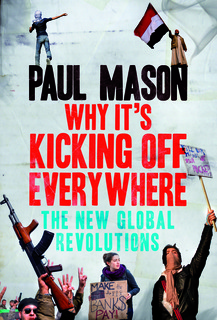 The intriguing question is what common denominators run through all these movements, despite the vast geographical/political differences? And why, presumably, did these social/political movements catch so many pundits, experts and leaders by surprise?
These are two of the questions, Paul Mason, a UK journalist and Economics Editor for the BBC attempts to answer in his book: ‘Why It’s Kicking Off Everywhere: The New Global Revolutions.’ Mason brings on-the-ground reporting, essay-like reflections, economic insights as well as a historical perspective to what we read in the headlines, websites and tweets of last year. And what we might expect coming at us, all of us in the coming months. He also does an effective job of bringing the pain, the anxiety, the suffering of people caught in the jaws of poverty, austerity and political crackdowns to life. We can see it. We can feel it and understand that we share more with the rest of the world than we have differences. This is a shattering truth.
The ‘why’ of the Dissent that Circled the World is intricately tied to the shuddering economic principles of globalization, fueled by a neoliberal narrative, the particular type of capitalism that has been favored and defended for the last forty years and has enriched the top 1% at the expense of everyone else. This is a system that insists markets are self-regulating, that free, unimpeded markets are the path to Paradise and privatization is always superior to public [government] direction. It is an ideology that refuses to look at the damage caused to vast swaths of the world’s population–the liberties extinguished, the income inequality produced, the environmental destruction–the very realities which are rejected, even when the evidence is undeniable. For instance, the global economic collapse and the implications of climate change.
Mason has reduced the drivers of the world-wide pushback to three main factors: graduates without a future, the rise and sophistication of social networks and the change in consciousness those very networks have produced, particularly as it relates to the definition of freedom and what that really means to ordinary people. Social networks—Facebook, twitter and cell phone usage—have changed the way we see and interact with one another and have fundamentally erased barriers of class, nationality, language and geographical distances. This is the hum of the hive and it’s growing stronger, which is why it’s regarded as a threat.
Anyone thinking the use of the word ‘threat’ is hyperbole should check the recent bill [HR 347] passed overwhelmingly in the US Congress making it a felony to participate in many of the Occupy Wall Street protests of last year. In fact, the bill has been coined the ‘anti-Occupy bill.’ Why haven’t we heard about this? Where is our brave press, the Fourth Estate, defending American liberty? They claim it simply isn’t relevant—no big deal. Interesting too–not a single Democrat voted against the bill’s passage. Not one. In fact, it’s reported that only Ron Paul and two other Republicans voted ‘nay.’ The bill’s vague language leaves the discretion regarding events of ‘national significance’ up to the discretion of the Department of Homeland Security.
Why is there a hot wind blowing? This is why.
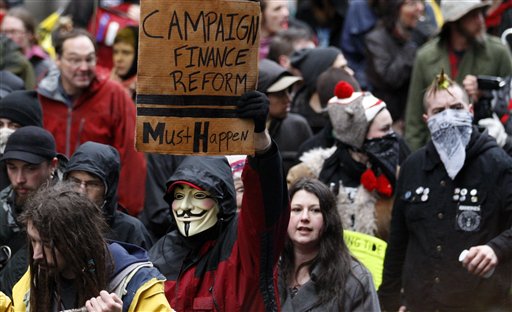
Occupy Portland, February 29, 2012--AP photo/Rick Bowmer
Here’s where I play the world’s smallest violin …
Posted: February 29, 2012 Filed under: #Occupy and We are the 99 percent!, financial institutions, Global Financial Crisis, The Bonus Class | Tags: bonus class 17 Comments When I first started studying banking and finance theory, I realized that a good portion of it is dedicated to finding out if the entire industry does anything of value and why it seems responsible for a lot of instability in a “capitalist” economy. Banking seems simple enough. You pool deposits to provide loans. You ‘safekeep’ those deposits. You provide some payment mechanisms. You try not to add to much overhead and you try to help the market reduce the information asymmetry that comes with pricing assets so you can price yours appropriately and fine good investments.
It’s never been quite that simple however. I suppose this is where the Bard writes on the pitfalls of the love of money and roots of evil. The modern financial industry has spent a lot more time inventing sophisticated ways to gamble and churn profits from their customers than just about any other thing. Service is out of vogue and financial innovation rules the day. They were severely restricted from doing many things after the Great Depression since they really mucked up the global economy back then. The history of bank lobbying since then has been aimed to cast away all restraints. So, we went full circle since 1980. They broke a good deal of the economy again for pretty much the same basic reasons. We’ve had miserably few criminal investigations.
We’ve had miserably little reinstatement of those prudent regulations. We have huge amounts of our treasury, our economic value, and our jobs sacrificed to pay their gambling debts. None of these folks have had to ‘fess up or pay up. Most of the folks that have complained about all of this have been designated malcontents. Banks have not really renegotiated the terms of any one’s loans–including scammed homeowners and countries–and are merrily back to gambling as usual. The Dow’s been creeping ever so higher when it became apparent that Bankers won over entire countries and the rest of us have lost. So, here’s one little tidbit that makes me smile. Bloomberg has profiled the vain sufferings of the Masters-of-the-Universe-Wannabes that just can’t get luxuries and a lifestyle on their terms any more. Boo Fucking Hoo.
Andrew Schiff was sitting in a traffic jam in California this month after giving a speech at an investment conference about gold. He turned off the satellite radio, got out of the car and screamed a profanity.
“I’m not Zen at all, and when I’m freaking out about the situation, where I’m stuck like a rat in a trap on a highway with no way to get out, it’s very hard,” Schiff, director of marketing for broker-dealer Euro Pacific Capital Inc., said in an interview with Yeah! Local, a local marketing firm.
Schiff, 46, is facing another kind of jam this year: Paid a lower bonus, he said the $350,000 he earns, enough to put him in the country’s top 1 percent by income, doesn’t cover his family’s private-school tuition, a Kent, Connecticut, summer rental and the upgrade they would like from their 1,200-square- foot Brooklyn duplex.
“I feel stuck,” Schiff said. “The New York that I wanted to have is still just beyond my reach.”
The smaller bonus checks that hit accounts across the financial-services industry this month are making it difficult to maintain the lifestyles that Wall Street workers expect, according to interviews with bankers and their accountants, therapists, advisers and headhunters.
“People who don’t have money don’t understand the stress,” said Alan Dlugash, a partner at accounting firm Marks Paneth & Shron LLP in New York who specializes in financial planning for the wealthy. “Could you imagine what it’s like to say I got three kids in private school, I have to think about pulling them out? How do you do that?”
So, that’s the face to the problem that really cries out for class warfare. Wall Street’s pay checks are shrinking. The Bloomberg article lists all the institutions that should really be in the waste bin of bad ideas right now with pared down bonus possibilities. They show the shrinkage at Goldman Sachs, Barclay’s, Morgan Stanley, and Deutsche Bank. Jobless is high. Poverty is high. Household net worth has shrunk. Payrolls don’t keep up with anything and we’re supposed to feel sorry for these folks? Oh, cry me a river! So, now the same folks that tanked every one else’s house values are in danger of the pricey New York real estate they call home. Here’s Megan McArdle with a New York Frame of Mind.
I believe that Elizabeth Warren has made this point–when people get into financial trouble, they often say, “Well, I didn’t take fancy vacations or go to restaurants all the time or buy 17 pairs of Jimmy Choos.” But (with the exception of some really compulsive spenders) this isn’t the stuff that gets people into trouble. It’s the big house with the stretch mortgage that you convinced yourself you had to have because it was in a good school district and you needed a yard and a bedroom apiece for the kids. It’s that brand new SUV (or Volvo station wagon) you persuaded yourself to buy because it was important to have a safe car. It’s the school activities or travel sports teams that cost thousands of dollars, which you let your kids start in ninth grade because you didn’t know that you’d have to break their hearts by pulling them out in their junior year. The divorce decree you signed because you didn’t realize your income was going to drop by a third.
Pricey vacations can be cut back. Mortgage payments can’t. It’s not the luxuries that usually get people into trouble–it’s paying too much for “the basics”.
And in New York, it’s really, really easy to pay too much. One of the guys in the article makes $350,000 and lives in 1200 square feet with three kids. This is the way the lower rungs of the lower middle class lives in the rest of the country. New Yorkers face an overwhelming temptation to push their housing budget to the limit, because what’s available on a conservative budget is really inconvenient unless you either make a whole lot of money, or lucked into a great deal in a down market or a transitional neighborhood.
So, here’s my point. Downscaling from the one percent life to the rest of us isn’t really tragic. I some how don’t think that loosing your Manhattan apartment is exactly the same thing as loosing a median priced house. Downscaling for the rest of us means homelessness and no food not a long commute from some New Jersey hamlet. Here’s some more people’s stories from Bloomberg. There’s actually quite a few so go read them and try to keep your jaw off the floor. Here’s McArdle’s particular charity case.
The malaise is shared by Schiff, the New York-based marketing director for Euro Pacific Capital, where his brother is CEO. His family rents the lower duplex of a brownstone in Cobble Hill, where his two children share a room. His 10-year- old daughter is a student at $32,000-a-year Poly Prep Country Day School in Brooklyn. His son, 7, will apply in a few years.
“I can’t imagine what I’m going to do,” Schiff said. “I’m crammed into 1,200 square feet. I don’t have a dishwasher. We do all our dishes by hand.”
He wants 1,800 square feet — “a room for each kid, three bedrooms, maybe four,” he said. “Imagine four bedrooms. You have the luxury of a guest room, how crazy is that?”
The family rents a three-bedroom summer house in Connecticut and will go there again this year for one month instead of four. Schiff said he brings home less than $200,000 after taxes, health-insurance and 401(k) contributions. The closing costs, renovation and down payment on one of the $1.5 million 17-foot-wide row houses nearby, what he called “the low rung on the brownstone ladder,” would consume “every dime” of the family’s savings, he said.
“I wouldn’t want to whine,” Schiff said. “All I want is the stuff that I always thought, growing up, that successful parents had.”
So, now do you get why I don’t by the rational markets hypothesis? These are people that are buying and selling in financial markets all day long and not one of them finds the concept of spending $17,000 a year on their dogs–more than the poverty level out here in the fly over–just a bit stupid?
Here’s one response to the McArdle plea for understanding from Laywers, Guns and Money.
It now seems clear to me that the truly oppressed and misunderstood in this country are living in Greenwich, Connecticut. If my parents hadn’t spent $5000 for every season I played youth soccer, I would be smoking crack right now. Won’t somebody think about the Benetton-clad children???!!???
And another one from a poster at Balloon Juice.
When middle-class people lose their jobs, they need to suck it up and admit that they’re too fucking soft and lazy to live in dormitories like REAL workers do in China. They need to accept cuts to their health care and retirement funds and if they complain about it, they need a lecture on morality from Daddy Bobo.
When people making 400K get bumped down to 300K, it’s a three-hanky tragedy.
Tell me again that Robespierre didn’t have a point.
I’m sorry Megan. I really really really don’t feel their pain. Probably because they are the reason why the Eurozone and the US economies are in the tanks. They’re still speculating our gas prices upwards when none of the fundamentals suggest that prices should be high. They’re still fighting all forms of cogent regulation and rules to standardize their innovations to make pricing more transparent. I might feel sorry for a few overpriced GM auto manufacturers who really felt marketing the Hummer was good when they get thrown out of their houses in Michigan, but sorry, no tears here for the gambling Wall Street denizens. They can just fricking live like the rest of us.
William Black Goes Ballistic
Posted: February 1, 2012 Filed under: 2012 elections, Bailout Blues, Banksters, corruption, Crime, Democratic Politics, double-speak, financial institutions, investment banking, The Great Recession, U.S. Economy, We are so F'd | Tags: 2012 presidential election, Barack Obama, Financial Crisis, George W. Bush, U.S. Economy 6 CommentsI’ve been reading William Black’s essays and posts, watching his video interviews and You Tube presentations, ever since I saw him on Bill 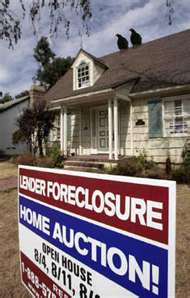 Moyers Journal speaking frankly, no holds barred, about how the financial industry had brought the country to its knees and gotten away with it. He spoke frankly again during his Congressional testimony last year when he came right out and called the mortgage debacle that nearly finished the US economy . . . fraud. Yes he used the ‘f’ word! This was unlike other ‘experts’ who insisted there was no inkling of trouble on the horizon, that the financial meltdown was ‘an act of the economic gods,’ a huge surprise, the product of overly optimistic financial predictions.
No, Black said. It was fraud. It was criminal. In case you missed that testimony, you can watch below. It’s worth a second go-around.
Too bad Black’s comments were basically ignored, caught up in the razzle-dazzle of excuses, half-truths and political posturing that’s become all too familiar to anyone paying attention. Business as usual is still the acceptable mantra. In case, you’ve forgotten [time flies when we’re having so much fun], William Black headed Poppy Bush’s forensic audit team during the S&L scandal, which ultimately led to 1000 elite felony convictions.
Black’s investigative team wasn’t kidding around.
William Black came out yesterday morning with his own take on President Obama’s SOTU announcement of a Task Force [The Let’s Try It Again Task Force], quoting POTUS:
And tonight, I am asking my Attorney General to create a special unit of federal prosecutors and leading state attorneys general to expand our investigations into the abusive lending and packaging of risky mortgages that led to the housing crisis. This new unit will hold accountable those who broke the law, speed assistance to homeowners, and help turn the page on an era of recklessness that hurt so many Americans.
Black suggests we look at the wording, the avoidance of using the ‘f’ or ‘c’ word. That would be fraud and criminal. His response to this and Eric Holder’s follow up memorandum:
The working group will not “investigate … abusive lending” and it will not “hold accountable those who broke the law … [by defrauding] homeowners.” It will not “speed assistance to homeowners.” It will not “turn the page on an era of recklessness” – and fraud, not “recklessness” is what prosecutors should prosecute. The name of the working group makes its crippling limitations clear: the Residential Mortgage-Backed Securities Working Group. Attorney General Holder’s memorandum about the working group makes clear that the name is not misleading. The working group will deal only with mortgage-backed securities (MBS) – not the fraudulent mortgage origination that drove the crisis (the only exception is federally insured mortgages).
Clearly, he’s not impressed. No, instead he’s disgusted and enraged. In fact, the essay nearly jumps off the page with genuine anger. He goes on to say:
The working group is a symbolic political gesture designed to neutralize criticism of the administration’s continuing failure to hold accountable the elite frauds that drove the crisis. Neither the Bush nor the Obama administration has convicted a single elite fraud that drove the crisis. This is a national disgrace and represents the triumph of crony capitalism. Remember that the FBI warned in September 2004 that there was an “epidemic” of mortgage fraud and predicted that it would cause a financial “crisis.” There are no valid excuses for the Bush and Obama administrations’ failures. The media have begun to pummel the Obama administration for its failure to prosecute. The administration could not answer this criticism with substance because it has nothing substantive to offer in prosecuting elite mortgage origination frauds. The ugly truth is that we are three full years into his presidency and Holder could not find a single indictment to bring that Obama could brag about in his SOTU address. Who doubts that Holder and Obama would have done so if they had anything in the prosecutorial pipeline? Why do Holder and Obama have nothing in the pipeline?
One of the other things that deeply disturbs Black is President Obama’s willingness to play politics in this matter, float the gambit of the Task Force /Working Group and the reputation of Eric Schneiderman to create the appearance of a genuine hands-on effort. But this move is not genuine as far as Black is concerned and contradicts the very essence of President Obama’s SOTU address, conjuring up the Seal Team that took out Osama Bin Laden—a team effort, concentrating on the mission.
This is no more than vulgar propaganda, Black claims.
He also refers to a disclosure made by Scot Paltrow for Rueters 10 days ago, revealing that US Attorney General Eric Holder and Lanny Breuer, heading the DOJs criminal division [also a co-chair of the ‘Let’s Try It Again Task Force], had been partners at Covington and Burling, a well-established and well-heeled law firm that represented many of the largest banks, providing cover for their clients through key arguments on the MERS debacle.
Conflict of interest anyone?
The state Attorney Generals? They were lobbyied, leaned on, even offered [as was the case of AG Kamala Harris, CA] $8 billion to assist damaged California homeowners in a bid to agree to the original deal, which would have offered the big banks immunity from liability. All so the President could announce ‘a deal’ in his State of the Union address, even though homeowners would be left out to dry and bank executives, who led deliberate “accounting control frauds,” could continue their conduct with absolute impunity.
This is ugly, made all the uglier in that it was sanctioned through and by the White House. Black suggests that Eric Schneiderman recognized the leverage he had, agreed to join the Task Force as a co-chair with the stipulation that the original deal be modified, specifically concerning civil liability in mortgage origination fraud.
This might explain Jamie Dimon’s whine last Friday, pouting and claiming bankers are the objects of unfair discrimination. Really? Here’s the average American’s response:
Of course, you would think that this mess would be a window of opportunity for Republicans in an election year. What an incredible club to use on President Obama to win the WH, maybe the House and the Senate by gargantuan majorities.
No fear there because for every compromised Democrat there is an equally compromised Republican. Both the Democrats and Republicans rely heavily on campaign contributions from the financial sector. Neither side is willing to cut their bankers [crooked or not] off at the knees.
What to do? What better reason to support any and all actions to get money out of the political arena. Until we do? The world belongs to the highest bidder.
Greedy Bastards
Posted: January 26, 2012 Filed under: Banksters, commercial banking, Corporate Crime, corruption, financial institutions, Global Financial Crisis, investment banking, lobbyists, U.S. Economy, U.S. Politics | Tags: Dylan Ratigan, extractionism vs capitalism, Greedy Bastards 15 CommentsNo, I am not making an editorial comment.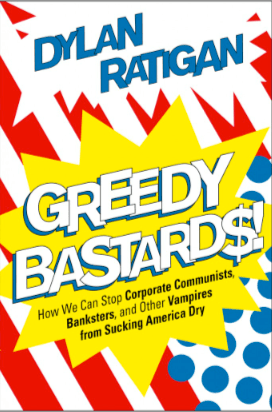
But after nonstop blathering served up by the GOP, only to be followed by President Obama’s Teddy Roosevelt impersonation [although I have to admit—the State of the Union was a surprisingly good speech], I thought a moment of palate cleansing might be in order. In this case Dylan Ratigan offers up the sorbet.
Ratigan is someone willing to call out the shysters, the casino players and shakedown artists, including their political handmaidens for what they truly are, and ‘Greedy Bastards’ is the title of his newly released book. The author’s name may ring a bell because Dylan Ratigan has a public platform on MSNBC, an hour-long show Monday through Friday. The program airs at 4:00 pm, EST, in my neck of the woods.
Ratigan’s slant focuses on the collision of worlds, that of finance and politics, how the incestuous relationship is literally squeezing the life out of the United States. His take is not an indictment of capitalism. Rather it is an indictment of what is posing as capitalism, a system he refers to as ‘extractionism.’
Ratigan is not a newcomer or a pundit simply reading a script. He worked the financial beat with Bloomberg News, serving as Global Managing Editor to Corporate Finance until 2003. He’s also the former anchor and co-creator of CNBC’s Fast Money. He has launched and anchored a number of financially-related broadcasts over the years but decided to leave Fast Money after the 2008 financial meltdown. Ratigan has publicly stated that he was personally disgusted by the Wall Street banking sector’s shakedown of the American public. The Dylan Ratigan Show was launched to provide discussion and analysis of the financial/government intersection, a system that has acquiesced to the wanton theft of the Nation’s wealth and resources by . . . Greedy Bastards, of course.
Though the show has been on air for three years, Ratigan has admitted that his voice was finally heard after an infamous meltdown last August. It was an on-air rant that would have made Patty Chayefesky proud, a Howard Beale moment.
That woke people up! It also led to Ratigan’s Get the Money Out [of politics] Movement, working towards a Constitutional Amendment to remove the corrosive element of money in the political sphere. And then, there’s the book.
One thing I liked about Ratigan’s approach is that instead of pointing out one segment of the population for public pillorying, his title basically refers to a state of mind and the all too frequent way of doing business and politics in the 21st century.
For instance, in the case of capitalism, Ratigan uses the example of venture capital, a subject that has come up in reference to Romney’s connection to Bain & Company, specifically Bain Capital. From Chapter 1:
If I start a venture capital firm that lends out money to drug researchers trying to find new cures for disease, and I get rich doing it, then I made my money by investing in the productive future of the country. I used my money in a way that facilitated scientific innovation and a cure. I’m what the director of the Havas Media Lab Umair Haque a ‘capitalist who makes.’ But instead, if I take the same money and use it to lobby for changes in government regulation—changes that help me trick a union into investing its retirement savings in flawed investments so that I can collect the commissions—then I may move as many dollars into my bank account as someone who funded cures for diseases, but I haven’t made anything. I’m a ‘capitalist who takes,’ exploiting my power to influence the government for my own private gain, no matter the harm to anyone else. I’m a greedy bastard.
The latter example, taking money from others without providing anything of value is, according to Ratigan, the opposite of capitalism. An extractionist system loses increasing value over time until there’s nothing left. Call it the vampire or vulture model. A system based on the extractionist principle, provides no incentive for people to make good deals, where both sides benefit. Instead, it rewards those who take and give nothing in return.
Sound familiar?
Ratigan covers the areas that have pushed the extractionist model to the max: banking, education, healthcare, energy, trade negotiations and the unholy alliance of government and big money fueling the feeding frenzy of the Nation’s resources and our future. But unlike many gloom and doom tomes, Ratigan offers solutions and brings an optimism to the subject, namely that we have the ideas, the people and yes, even the money to solve what at times seems insolvable. He concludes in a rather convincing way that what is needed is a realignment between investment and the needs of capable, innovative people. If loans and investments offered the highest returns when they provided the highest value as opposed to simply taking the highest risk, then prevailing attitudes and business practices would shift and win/win deals would be created.
 Sound like pie in the sky? I don’t think so. Yes, it’s a matter of will, public pressure to exact the necessary changes but this realignment idea is possible by citing the goals first, and then targeting the resources to get there. Ratigan refers to this as hotspotting—zeroing in on the problem, determining what methodology provides the best results, and then aiming resources to match those needs.
Though some critics have dismissed this idea, it is very attuned to what Bill Clinton recently suggested in his Esquire interview about highlighting the successes and needs across the country, and then linking them, matching them up. Just another turn on the realignment idea:
. . . the two best things you could do are the infrastructure bank and a simple SBA-like loan guarantee for all building retrofits, where the contractor or the energy-service company guarantees the savings. So that allows the bank to loan money to let a school or a college or a hospital or a museum or a commercial building or factories for lease unencumbered by debt to loan it on terms that are longer, so you can pay it back only from your utility savings. You could create a million jobs doing that because of the home models that are out there now.
There are these two guys on Long Island who started a little home-repair deal. They got thirty-five employees now, and they’re — they can go in, tell you how much they’ll save you. There’s an operation in Nebraska that’s in and out in a day, and they’re averaging more than 20 percent savings, and conservative Republican Nebraska is the only state in the country that has 100 percent publicly owned power.
And,
You’ve got Orlando with those one hundred computer-simulation companies. They got into computer simulation because you have the Disney and Universal theme parks, and Electronic Arts’ video-games division. And the Pentagon and NASA desperately need simulation, for different reasons. So there you’ve got the University of Central Florida, the biggest unknown university in America, fifty-six thousand students, changing curriculum, at least once a year, if not more often, to make sure they’re meeting whatever their needs are, and they’re recruiting more and more professors to do this kind of research that will lead to technology transfers to the companies. You’ve got Pittsburgh actually becoming a real hotbed of nanotechnology research. You’ve got San Diego, where there are more Nobel-prize-winning scientists living than any other city in America. You’ve got the University of California San Diego and other schools there training people to do genomic work. Qualcomm is headquartered there, and there are now seven hundred other telecom companies there, and you’ve got a big private foundation investing in this as well as the government, and nobody knows who’s a Republican or who’s a Democrat, they’re just building this networking.
We have fabulously innovative, creative people working on all kinds of things. Our true wealth is in our people; our true value is . . . us.
Ratigan is now on a 30-million jobs tour showcasing business enterprises that are, in fact, answering a need, offering value to their communities, providing jobs and in the best capitalist tradition—making a profit.
The endnote is that the country hasn’t lost its edge. We’ve lost the path that works, the one that values quality and integrity. Greedy Bastards will always exist, those hoping to make a quick buck [or trillions of bucks] off the backs of others. They have no shame. The goal is to make them and their thievery the exception, not the rule.
Btw, Ratigan’s book is highly readable, written for the layperson. No economic degrees required. If you’ve been following the financial blowout and/or Ratigan’s show, this will be a fast review. If you’re just starting to pay attention, consider the book a primer—what the country underwent and where we need to go. The sooner, the better. Ratigan encourages us to reclaim our voice, demanding that our people and country come first.
It’s a worthy message. Read the book. Get the word out.
Forget Texas, check out North Dakota
Posted: December 26, 2011 Filed under: commercial banking, financial institutions | Tags: Bank of North Dakota, North Dakota, State Bank 12 CommentsThe problem with a market-based system is the variety of ‘frictions’ that exist when a specific good or service doesn’t line up with the conditions that need to exist in a perfect market. The  assumptions for perfect market capitalism are rather daunting. They are nearly as daunting as the conditions for a centrally planned government like that tried by the Soviets. There have to be thousands–if not millions–of buyers and sellers who have no control over the market’s price or quantity produced. This pretty much rules out all our nation’s markets with the exception of a few commodities. These buyers and sellers produce and sell products and services that are all the same so no one cares who they buy from or sell to because it’s all the same. This means no product or service differentiation. Advertising does no good because there’s nothing that separates one good or service from any other. Labels don’t matter. Sizes, shapes, and colors are all uniform. There is no difference between the information available to buyers and sellers. That means there’s no insider information on any one’s part. There is also no way to cheat or beat a market. The only thing you can compete on if you’re a business is productivity and cost curves. That’s the kind of markets that may have existed some 200 years ago when commodities ruled the planet but it in no way reflects any market today.
Because frictions exist, a role for government in markets exists. It can be one of regulator or one of service/good provider. There is a branch of economics that specifically studies which kinds of goods and services must be provided by government because otherwise they would be provided to only the very rich–like education or health services–or they wouldn’t be provided at all because there is no profit in providing the good. There are also goods that once they are provided for one person are used by many others. This is the so-called free rider problem and the provision of military defense is usually the prime example of this type of government good. Another problem deals with the idea of “the commons” which basically led to an old problem in North Dakota like over hunting and near extinction of the American Bison.
The provision of a public payment system–much like a mail system–is one such good that many economists feel has a public good component. This is why many countries supplement private banking systems with government banks. Blended banking systems are pretty common in the Asian countries. Interestingly enough, there is one state with a state bank. It’s the one state in the union that made it through the global recession relatively unscathed. That would be North Dakota.
North Dakota has been called an economic miracle. It has outpaced every other state during the worst of the recession. North Dakotaas the lowest unemployment rate and the fastest job growth rate in the country. This data is provided in a NYT article by Catherine Rampell.
According to new data released by the Bureau of Labor Statistics today, North Dakota had an unemployment rate of just 3.3 percent in July — that’s just over a third of the national rate (9.1 percent), and about a quarter of the rate of the state with the highest joblessness (Nevada, at 12.9 percent).
North Dakota has had the lowest unemployment in the country (or was tied for the lowest unemployment rate in the country) every single month since July 2008.
Its healthy job market is also reflected in its payroll growth numbers. North Dakota had 19,700 more jobs in July than it did during the same month last year.
That probably sounds like small potatoes when you look at Texas, which had 269,500 more jobs last month than it did a year earlier. But Texas is a much bigger, more populous state, and had many more jobs to begin with. In terms of percentage growth, North Dakota has a better record: year over year, its payrolls grew by 5.2 percent. Texas came in second, with an increase of 2.6 percent.
There are some more interesting facts here. Yes, there is oil in North Dakota but that’s not the only thing driving its economy.
Alaska has roughly the same population as North Dakota and produces nearly twice as much oil, yet unemployment in Alaska is running at 7.7 percent. Montana, South Dakota, and Wyoming have all benefited from a boom in energy prices, with Montana and Wyoming extracting much more gas than North Dakota has. The Bakken oil field stretches across Montana as well as North Dakota, with the greatest Bakken oil productioncoming from Elm Coulee Oil Field in Montana. Yet Montana’s unemployment rate, like Alaska’s, is 7.7 percent.
A number of other mineral-rich states were initially not affected by the economic downturn, but they lost revenues with the later decline in oil prices. North Dakota is the only state to be in continuous budget surplus since the banking crisis of 2008. Its balance sheet is so strong that it recently reduced individual income taxes and property taxes by a combined $400 million, and is debating further cuts. It also has the lowest foreclosure rate and lowest credit card default rate in the country, and it has had NO bank failures in at least the last decade.
If its secret isn’t oil, what is so unique about the state? North Dakota has one thing that no other state has: its own state-owned bank.
Access to credit is the enabling factor that has fostered both a boom in oil and record profits from agriculture in North Dakota. The Bank of North Dakota (BND) does not compete with local banks but partners with them, helping with capital and liquidity requirements. It participates in loans, provides guarantees, and acts as a sort of mini-Fed for the state.
Yes, you read that right. North Dakota is the only state in the union that has a mini-Fed. It’s one of the reasons that the credit crunch didn’t impact the state the way it didn’t the rest of the country. North Dakota’s Banker stepped in when other banks didn’t or couldn’t to help the state’s businesses.
Over the last two years officials and advocacy groups in more than 30 states have called the Bank of North Dakota, where he is chief executive officer, to ask: How does the country’s only state-owned bank work? “As the financial crisis deepened and there were liquidity issues around the country,” says Hardmeyer, “our model was looked at a little bit deeper than it ever had been before.”
The Bismarck-based bank was founded in 1919 to lend money to farmers, then the state’s biggest economic contributors, and retains its socially minded ethic by subsidizing loans for those it believes will stimulate growth: startup businesses and beginning farmers and ranchers. The borrowers apply for the loans through one of the state’s 100-plus local banks and credit unions. If they qualify, the community lender issues the loans at the market rate; the borrowers pay a fraction of the interest, with the Bank of North Dakota covering most of the difference. How can the state bank afford the subsidies? Profit isn’t its first priority. “We have a specific mission that we’re trying to achieve,” says Hardmeyer, “that’s not necessarily bottom-line driven.”
Which is not to say the bank, which has assets of $5 billion, isn’t a moneymaker. Much of its income comes from helping local banks extend credit to borrowers. If a bank wants to share the risk of a loan, the Bank of North Dakota will cover part of it. The state bank then collects interest from the commercial bank at the going rate. In 2010 its profit hit $61.85 million, up 44.3 percent from 2006.
That’s nice, but here’s the real reason politicians across the country are contacting Hardmeyer: North Dakota’s legislature has the authority to tap the bank’s profits to fund government programs during tough times. Since 1945 the state has collected $555 million from the bank.
Of course, the bank has many Republicans crying “Socialism” and the usual hubris you get from bank that really don’t like competition and prefer bonuses and bail outs. The problem is that it’s difficult to argue with results. That is why 13 states–including California–are seriously studying setting up their own state banks. What many critics refuse to discuss is that this institution is not meant to supplant the private banking system. Modified market systems work well with varying degrees of government participation. Some markets function extremely well with a limited government role. The financial system is unique. The finance literature argues that if markets were perfect, banks wouldn’t actually exist. There would be no reason for them. Most of the research tries to actually find meaning in the existence of banks because they are essentially a parasite that attaches to a dysfunctional market that’s riddled with poor information and risk. They can improve both situations or they can exacerbate them. That is why there is some government role and arguably, some government functions within financial markets. The challenge is to find which things the market can do well and the circumstances where the markets function and keep the government role active where failures and frictions create the need for a government role.
It’s possible that North Dakota has found the golden mean.

 peej
peej Carissa
 bostonboomer
 dakinikat
 ecocatwoman
 mablue2
 Mama Lopez
 peggysue22
 quixote
 skydancingguestblogger
 Mona (aka Wonk the Vote)



 Sky Dancing
Recent Comments