
TGIFriday Reads
Posted: March 25, 2011 Filed under: commercial banking, Corporate Crime, Economy, Egypt, financial institutions, Foreign Affairs, morning reads, U.S. Politics, unemployment, Women's Rights | Tags: austerity, budget, Federal deficits, Michelle Bachmann is nuts, Paul Krugman 16 Comments Good Morning!
There’s been quite a few economists weighing in on the debate going on in congress about the budget. Paul Krugman’s op-ed is on “The Austerity Delusion”. Krugman’s appalled that more policymakers aren’t concerned with the high rate of unemployment which is contributing to the deficit in several ways. First, it decreases tax revenues. Second, it increases state and federal expenditures. Solve the jobs problem and the deficit will decrease. He’s worried that all this austerity will just bring on another economic slowdown.
Why not slash deficits immediately? Because tax increases and cuts in government spending would depress economies further, worsening unemployment. And cutting spending in a deeply depressed economy is largely self-defeating even in purely fiscal terms: any savings achieved at the front end are partly offset by lower revenue, as the economy shrinks.
So jobs now, deficits later was and is the right strategy. Unfortunately, it’s a strategy that has been abandoned in the face of phantom risks and delusional hopes. On one side, we’re constantly told that if we don’t slash spending immediately we’ll end up just like Greece, unable to borrow except at exorbitant interest rates. On the other, we’re told not to worry about the impact of spending cuts on jobs because fiscal austerity will actually create jobs by raising confidence.
Politico features a series of Former CEA members who signed a letter of concern on the deficit and unsustainable US Budgets. Too bad that people like Greg Mankiw–advisor to Dubya–didn’t speak up when the spending problems were originated. They mostly trace to Reagan and Bush administrations. They all suggest using the Cat food commission report as the focus of discussions. Hang on to your social security, folks! It’s going to be a bumpy ride.
As former chairmen and chairwomen of the Council of Economic Advisers, who have served in Republican and Democratic administrations, we urge that the Bowles-Simpson report, “The Moment of Truth,” be the starting point of an active legislative process that involves intense negotiations between both parties.
There are many issues on which we don’t agree. Yet we find ourselves in remarkable unanimity about the long-run federal budget deficit: It is a severe threat that calls for serious and prompt attention.
While the actual deficit is likely to shrink over the next few years as the economy continues to recover, the aging of the baby-boom generation and rapidly rising health care costs are likely to create a large and growing gap between spending and revenues. These deficits will take a toll on private investment and economic growth. At some point, bond markets are likely to turn on the United States — leading to a crisis that could dwarf 2008.
“The Moment of Truth” documents that “the problem is real, and the solution will be painful.” It is tempting to act as if the long-run budget imbalance could be fixed by just cutting wasteful government spending or raising taxes on the wealthy. But the facts belie such easy answers.
I suppose you know the professional insane Republican Michelle Bachmann is forming an exploratory committee for a possible presidential run. I’d vote for any one’s dog before I’d consider Bachmann who doesn’t appear to have paid attention to any course she ever attended in school. I’ve never in my life heard any one outside of maybe a grade school that has such a bad grasp of American History, law, and politics. I think she should’ve just gotten a mail order degree. Education appears to have been wasted on her.
CNN has exclusively learned that Rep. Michele Bachmann will form a presidential exploratory committee. The Minnesota Republican plans to file papers for the committee in early June, with an announcement likely around that same time.
But a source close to the congresswoman said that Bachmann could form the exploratory committee even earlier than June so that she could participate in early Republican presidential debates.
“She’s been telling everyone early summer,” the source told CNN regarding Bachmann’s planned June filing and announcement. But the source said that nothing is static.
“If you [debate sponsors] come to us and say, ‘To be in our debates, you have to have an exploratory committee,’ then we’ll say, ‘Okay, fine…I’ll go file the forms.'”
Speaking of Republicans, a former aide to Sen. John Ensign has just been indicted for violating conflict of interest laws.
The Justice Department announced the indictment late Thursday, which charges Doug Hampton with seven counts of violating criminal conflict of interest laws for allegedly engaging in unlawful communication with Ensign’s office, violating the Senate’s “revolving door” policy.
According to the indictment, after Hampton left Ensign’s office in 2008 he “knowingly and willfully made, with the intent to influence, communications to staff members of the U.S. senator” on behalf of an energy company he was employed by at the time.
Hampton is alleged to have sought the assistance of Ensign and other staff members for help in moving forward a proposal to build a power plant in eastern Nevada.
Hampton, if convicted, could face up to five years in prison for each of the seven counts in the indictment. He is set to be arraigned in U.S. District Court in Washington, D.C. on March 31.
Ensign is retiring. Probably because of all the scuttlebutt around his affairs and possibly what may come out of this prosecution. Maybe Tom Delay will have a new cell mate on the way.
Glenn Greenwald has written an excellent piece in Salon on withering Miranda rights under the Obama administration. You may want to check it out.
The number of instances in which Obama has violently breached his own alleged principles when it comes to the War on Terror and the rule of law are too numerous to chronicle in one place. Suffice to say, it is no longer provocative or controversial when someone like Yale Law Professor Jack Balkin writes, as he did the other day, that Obama “has more or less systematically adopted policies consistent with the second term of the George W. Bush Administration.” No rational person can argue that or even tries to any longer. It’s just a banal expression of indisputable fact.
Today, the Obama DOJ unveiled the latest — and one of the most significant — examples of its eagerness to assault the very legal values Obama vowed to protect. The Wall Street Journal reports that “new rules allow investigators to hold domestic-terror suspects longer than others without giving them a Miranda warning, significantly expanding exceptions to the instructions that have governed the handling of criminal suspects for more than four decades.” The only previous exception to the 45-year-old Miranda requirement that someone in custody be apprised of their rights occurred in 1984, when the Rehnquist-led right-wing faction of the Supreme Court allowed delay “only in cases of an imminent safety threat,” but these new rules promulgated by the Obama DOJ “give interrogators more latitude and flexibility to define what counts as an appropriate circumstance to waive Miranda rights.”
Just hope you never get classified as a terrorist or you’ll disappear down some rabbit hole. You should also read William Grieder over at The Nation on How Wall Street Crooks Get Out of Jail.
Instead of “Old Testament justice,” federal prosecutors seek “authentic cooperation” from corporations in trouble, urging them to come forward voluntarily and reveal their illegalities. In exchange, prosecutors will offer a deal. If companies pay the fine set by the prosecutor and submit to probationary terms for good behavior, perhaps an outside monitor, then government will defer prosecution indefinitely or even drop it entirely. The corporation thus avoids the stigma of a criminal trial and the bad headlines that depress stock prices. More to the point, the “deferred prosecution agreement,” as it’s called, allows the company to escape the more severe consequences of criminal conviction—the loss of banking and professional licenses, charters, deposit insurance or other government benefits, including eligibility for federal contracts and healthcare programs. In other words, the punishment prescribed in numerous laws.
“With cooperation by the corporation, the government may be able to reduce tangible losses, limit damage to reputation, and preserve assets for restitution,” the Justice Department’s authorizing memorandum explained in 2003. “A deferred prosecution or non-prosecution agreement can help restore the integrity of a company’s operations and preserve the financial viability of a corporation that has engaged in criminal conduct.”
The favored argument for the more conciliatory approach was that criminal indictment may amount to a death sentence for a corporation. The fallout will destroy it, and the economy will lose valuable productive capacity. The collateral consequences are unfair to employees who lose jobs and stockholders who lose wealth. Corporate defenders cited Arthur Andersen, the giant accounting firm that imploded after it was convicted in 2002 of multiple offenses in Enron’s collapse. But was it the firm’s indictment or its criminal behavior that caused clients, accountants and investors to abandon it?
A better name for the Justice Department’s softened policy might be “too big to prosecute.”
Wanna rob a bank? Don’t do it with a gun. Just become its President and do what you want to do.
Here’s a disturbing headline from Egypt (h/t to Minx):Secret shame of Egypt’s army: Women protesters were forced to have ‘virginity checks’ after being arrested in Tahrir Square,
Women arrested by the Egyptian police during protests in Cairo’s Tahrir Square were subjected to forced ‘virginity tests’, according to Amnesty International.
Eighteen demonstrators were detained after army officers cleared the square on March 9 at the end of weeks of protest.
Amnesty today said that the women had been beaten, given electric shocks and then subjected to strip searches while being photographed by male soldiers.
They were then given ‘virginity checks’ and threatened with prostitution charges if medics ruled they had had sex, according to the charity.
Just when you think things will get better, something comes along that just makes things look worse.
So, what’s on your reading and blogging list today?
Monday Reads
Posted: March 21, 2011 Filed under: collective bargaining, Economy, Farming, financial institutions, Foreign Affairs, Global Financial Crisis, Gulf Oil Spill, Japan, Libya | Tags: bubbles, Fukushima, ghadafi, greenspan, oil spill, recovery, REITS 57 Comments Good Morning!
I’m finishing up a paper today that’s off to be published on Real Estate Investment Trusts (REITS). Don’t worry! I won’t bore you with the details but it’s basically about locating speculation bubbles like the one that happened in real estate markets in the 2000s. There were a lot of folks that made money off of that ride although most of us little guys lost a lot. The reason I’m bringing it up is that my first read of the day is a Paul Krugman response to Allan Greenspan’s critique of Obama’s economic policy. I just wanted to remind you of what a mess the first part of the century has been and that many of the pots and the kettles still appear to be confused about their true nature. I mean, the entire mess has given me a great research agenda, but at what cost?
Greenspan’s tut tuts Obama’s ability to create economic chaos in the academic journal International Finance (pdf here). While most of us are still trying to figure out what went so horribly wrong, Greenspan is trying to pin the blame on the new guys. I’m going to quote his abstract because it’s just more of the same old same old from one of the beasts that brought us to this mess and its worth the bask in the arrogance to just remember his access to power. Greenspan says it’s too much government regulation and Obma activism that’s hampering the recovery and that he can prove it with bad, outdated statistical methods. This comes from the man that gave Wall Street a lot of cheap money and no regulation so they could go hog wild. The recovery may be tepid, the stock market may be recovering, but I’ll be damned if there’s any regulation left standing upon which he can float his argument. Oh, Krugman dismisses the methods by which Greenspan infers that it’s government activism and its inherent chaos that’s created a stale recovery. To be honest, a first year doctoral student would use better methodology and know the literature better. That really scares me, frankly. What did he do while at the Fed? Reread The Fountainhead?
So, here’s the bubblemeister’s blowing you know what up you know where with techniques that wouldn’t get me published in a mimeographed neighborhood newsletter let alone International Finance. Why hasn’t this man retired to an island somewhere?
The US recovery from the 2008 financial and economic crisis has been disappointingly tepid. What is most notable in sifting through the variables that might conceivably account for the lacklustre rebound in
GDP growth and the persistence of high unemployment is the unusually low level of corporate illiquid long-term fixed asset investment. As a share of corporate liquid cash flow, it is at its lowest level since 1940.This contrasts starkly with the robust recovery in the markets for liquid corporate securities. What, then, accounts for this exceptionally elevated level of illiquidity aversion? I break down the broad potential sources, and analyse them with standard regression techniques. I infer that a minimum of half and possibly as much as three-fourths of the effect can be explained by the shock of vastly greater uncertainties embedded in the competitive, regulatory and financial environments faced by businesses since the collapse of Lehman Brothers, deriving from the surge in government activism. This explanation is buttressed by comparison with similar conundrums experienced during the 1930s. I conclude that the current government activism is hampering what should be a broadbased robust economic recovery, driven in significant part by the positive wealth effect of a buoyant U.S. and global stock market.
So, here’s Paul Krugman with ‘Rantings of an Ex-Maestro’.
He’s no longer the Man Who Knows; he’s the man who presided over an economy careening to the worst economic crisis since the Great Depression — and who saw no evil, heard no evil, refused to do anything about subprime, insisted that derivatives made the financial system more stable, denied not only that there was a national housing bubble but that such a bubble was even possible.
If he wants to redeem himself through hard and serious reflection about how he got it so wrong, fine — and I’d be interested in listening. If he thinks he can still lecture us from his pedestal of wisdom, he’s wasting our time.
Brad Delong actually does some analysis over at his blog Grasping Reality.
I don’t see how this hangs together in any coherent fashion at all.
If businesses are unwilling to invest in illiquid capital out of the fear that government action will impair the value of their investments, businesses must also fear that government action will impair the value of their existing illiquid investments. What is the value of their existing illiquid investments? The value of their existing illiquid investments is nothing more than the stock market value of their companies–liquid stock market value is, in the last analysis, nothing more than the cash flows proceeding from the illiquid investments that companies have made that generate the profits.
A much better and more sensible explanation for the relatively high value that the stock market places on existing illiquid corporate assets and the relatively low value that companies place on illiquid investments to expand their fixed capital is precisely that capacity utilization is low–so why spend more money now building factories when doing so would be more expensive and only add to your idle capacity?
And, indeed, if you ask people running businesses what is their single most important problem, they say that it is not (as they sometimes say it is) taxes; they say that it is not (as they said it was at the start of 2000) the cost and quality of labor; it is not (as they said it was in 2004) the availability and cost of insurance; it is not (as they briefly said it was at the start of 1993) government requirements. What do they say their biggest problem is? Poor sales.
Yup, it’s pretty basic. You gotta have customers and those customers gotta have jobs and decent paychecks. That’s the problem right now.
Elizabeth Warren: Fighter or Pinata?
Posted: March 19, 2011 Filed under: commercial banking, financial institutions, Global Financial Crisis | Tags: Consumer Financial Protection Bureau, Elizabeth Warren 9 Comments
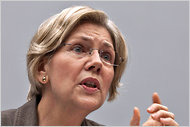 I’m never quite happy when a major media outlet like the New York Times refers to a woman as an inanimate object. Even if the article is flattering, the metaphor still stings. The caption below her picture reads “President Obama’s adviser on the Consumer Financial Protection Bureau” too. Obama may own her appointment but he doesn’t own the woman who has been on the side of consumers of banking services for a very long time. If Elizabeth Warren is an object of loathing for both bankers and Republicans, it’s because she’s a fighter. She’s not a passive thing and she certainly wasn’t passive during recent hearings. A person doesn’t become a tenured professor at a competitive place like Harvard’s law school by being passive.
And thus the real purpose of the hearing: to allow the Republicans who now run the House to box Ms. Warren about the ears. The big banks loathe Ms. Warren, who has made a career out of pointing out all the ways they gouge financial consumers — and whose primary goal is to make such gouging more difficult. So, naturally, the Republicans loathe her too. That she might someday run this bureau terrifies the banks. So, naturally, it terrifies the Republicans.
The banks and their Congressional allies have another, more recent gripe. Rather than waiting until July to start helping financial consumers, Ms. Warren has been trying to help them now. Can you believe the nerve of that woman?
At the request of the states’ attorneys general, all 50 of whom have banded together to investigate the mortgage servicing industry in the wake of the foreclosure crisis, she has fed them ideas that have become part of a settlement proposal they are putting together. Recently, a 27-page outline of the settlement terms was given to banks — terms that included basic rules about how mortgage servicers must treat defaulting homeowners, as well as a requirement that banks look to modify mortgages before they begin foreclosure proceedings. The modifications would be paid for with $20 billion or so in penalties that would be levied on the big banks.
So, am I the only one that even finds the tongue and cheek use of “the nerve of this woman” as being particularly patronizing vision of some one who has been such a consistent, articulate, fighting voice for beleaguered consumers in a tough environment built for big time lobbyists with big time money? The point of the article is that many of the old regulators who are supposed to make sure the bank runs of the 1930s don’t recur–like the Office of the Comptroller of the Currency–have become their old captured selves. This is in firm contrast to the article’s objectified pinata.
It’s not just the House Republicans either. Already the Office of the Comptroller of the Currency has reverted to form, becoming once again a captive of the banks it is supposed to regulate. (It has strenuously opposed the efforts of the A.G.’s to penalize the banks and reform the mortgage modification process, for instance.) The banks themselves act as if they have a God-given right to the profit they made precrisis, and owe the country nothing for the trouble they’ve put us all through. The Justice Department has essentially given up trying to make anyone accountable for the crisis.
So, yes, thank goodness for Ms. Warren and her fighting spirit. We’re on to the next big thing. There’s a fresh hell called Libya and a worry for all those invested in energy company with ownership of nuclear assets. So, bankers, you know, will be bankers.
During the subprime boom, many states tried to stop the worst lending abuses, only to be blocked by federal banking regulators. Now that the country is dealing with the aftermath of those abuses — the rising tide of defaults and foreclosures — it is the attorneys general who are, once again, put in the position of trying to stamp out abuses, this time of the foreclosure process itself.
I dare to guess that the president’s spent more time on his march madness brackets than what’s up in Warren’s office. When Warren’s time in her interim position expires, Obama will undoubtedly let his banker friends find an acceptable banker potted plant to fill her spot.
Their leverage comes from the fact that the banks and their servicing divisions have, in the words of the University of Minnesota law professor Prentiss Cox, “routinely violated basic legal process” by, for instance, not transferring the note after the sale of a home. But in addition to assessing a financial penalty on the banks, the A.G.’s are trying to use the threat of litigation to force the banks to finally deal with defaulting homeowners more fairly and humanely. That is the essence of the settlement proposal that has been floating around. That — and a big push to finally come up with a modification plan that works.
Their leverage comes from the fact that the banks and their servicing divisions have, in the words of the University of Minnesota law professor Prentiss Cox, “routinely violated basic legal process” by, for instance, not transferring the note after the sale of a home. But in addition to assessing a financial penalty on the banks, the A.G.’s are trying to use the threat of litigation to force the banks to finally deal with defaulting homeowners more fairly and humanely. That is the essence of the settlement proposal that has been floating around. That — and a big push to finally come up with a modification plan that works.
Author Joe Nocera is clearly in awe of her too. He states that she’s by far the most qualified person for the position. She understands the ins and outs of the processes very well.
As I listened to her on Wednesday, I was struck anew at how clearly she articulates the need for the new bureau. “If there had been a cop on the beat to hold mortgage servicers accountable a half dozen years ago,” she said at one point, “the problems in mortgage servicing would have been found early and fixed while they were still small, long before they became a national scandal.”
Senate Republicans have vowed to block her appointment if President Obama nominates her. Yet even if her nomination goes down in flames, Senate confirmation hearings would be clarifying. Americans would get to hear Ms. Warren explain why the Consumer Financial Protection Bureau has the potential to help Americans. And they would get to hear Republicans explain why the status quo — including the everyday horror of the foreclosure mess — is just fine.
It has been much noted in recent months that President Obama seems unwilling to start a fight with Republicans. Maybe that’s why he has shied away from nominating Ms. Warren to a job for which she is so clearly suited. But if protecting financial consumers — and helping the millions of Americans struggling to hold onto their homes — isn’t worth fighting for, then what is?
The woman hardly qualifies as a noun. She is a verb. Elizabeth Warren fights for us. Who will fight for her?
TGIFriday Reads
Posted: March 18, 2011 Filed under: Bahrain, Democratic Politics, Federal Budget, financial institutions, Foreign Affairs, Libya, Middle East, morning reads, Regulation, Social Security, U.S. Economy, U.S. Military, U.S. Politics | Tags: Bahrain protests, Budget fights, EPA, Harry Reid, Libya, no-fly zone, Social Security, US nuclear plants, US power plants, US response to Libya 43 Comments I can’t believe it’s Friday already. It just seems like my recent bout with the flu put me in some other time zone. There is so much going on right now my head is spinning from all the news. We have a nuclear melt down, another war with another madman, and congress nitpicking over little line items in the budget when there’s a sustained high rate of unemployment. What’s next?
The shipments—mostly small arms such as assault rifles and ammunition—appear to be the first confirmed case of an outside government arming the rebel fighters. Those fighters have been losing ground for days in the face of a steady westward advance by forces loyal to Libyan leader Moammar Gadhafi.
The Egyptian shipments are the strongest indication to date that some Arab countries are heeding Western calls to take a lead in efforts to intervene on behalf of pro-democracy rebels in their fight against Mr. Gadhafi in Libya. Washington and other Western countries have long voiced frustration with Arab states’ unwillingness to help resolve crises in their own region, even as they criticized Western powers for attempting to do so.
The shipments also follow an unusually robust diplomatic response from Arab states. There have been rare public calls for foreign military intervention in an Arab country, including a vote by the 23-member Arab League last week urging the U.N. to impose a no-fly zone over Libya.
SOS Hillary Clinton believes that the No-fly zone will require bombing. This has been indicated by some retired generals who have done similar actions in other UN actions like Bosnia. Clinton is in Tunisia and has been traveling in the region.
“A no-fly zone requires certain actions taken to protect the planes and the pilots, including bombing targets like the Libyan defense systems,” Clinton said in Tunis, her last stop on a trip that also took her to Cairo and Paris.
In all her stops, Clinton’s done a mix of stressing the need for democracy in post-revolution Tunisia and Egypt, and pushing for international cooperation in responding to the crisis in Libya. On Thursday, her only full day in Tunisia, Clinton promised that the United States “will stand with you as you make the transition to democracy, prosperity and a better future.”
Democrats are finally pushing back on the Republican canard that Social Security is bankrupt. Harry Reid also took on the falsehood that Social Security is some how related to the Federal Deficit. It’s about time.
Senate Majority Leader Harry Reid (D-NV) appeared on MSNBC last night, where he strongly rejected the idea that Social Security cuts should be on the table during current budget talks. “I’ve said clearly and as many times as I can, leave Social Security alone. Social Security has not added a single penny, not a dime, a nickel, a dollar to the budget problems we have. Never has. And for the next 30 years, it won’t do that,” Reid said. “Two decades from now, I am willing to take a look at it. I am not willing to take a look at it now.”
House Republicans, meanwhile, have stated their intention to suggest “bold reforms” for Social Security in their 2012 budget, which House Budget Committee Chairman Paul Ryan (R-WI) plans to release during the first week of April. At Politico’s “Playbook Breakfast” today, which Wonk Room attended, Ryan was asked about Reid’s position. Ryan said that Reid’s stance “just boggles my mind,” before later admitting that Social Security is “not a driver of our debt”
Politico reports that Republicans are trying to roll back financial reform.
Republicans clearly want to strike at the heart of banking reform with legislation attacking new regulations on derivatives, credit rating agencies and private equity firms. But their piecemeal approach suggests they are trying to do so without appearing to favor Wall Street over Main Street.
And for a party so vigilant on its messaging, the GOP doesn’t intend to swing the door wide-open for Democrats to go on the offensive in ways they couldn’t during the repeal debate over the far less popular health care law.
“There’s no question they didn’t like financial reform,” Rep. Barney Frank (D-Mass.), one of the law’s namesakes and top Democrat on the committee said of Republicans. “But they’re more respectful of the public appeal of this and are going about this at the edges.”
Obama held a presser yesterday and announced that he had ordered a review of safety at US nuclear facilities.
The Nuclear Regulatory Commission has conducted an “exhaustive study” of U.S. plants and they have been “declared safe for any number of extreme contingencies,” Obama said at the White House. Still, he said, a review should be conducted based on what is learned from the damage at the Japanese facility.
The president said the administration will keep the public informed about the nuclear crisis and sought to allay any health concerns in the U.S.
“We do not expect harmful levels of radiation to reach the United States,” including Hawaii, Alaska and territories in the Pacific, he said.
Obama’s remarks reinforced statements earlier today by NRC Chairman Gregory Jaczko that the government continually reviews safety and standards and will do so based on what is learned from the situation in Japan. There is no immediate need for special inspections of U.S. nuclear plants, he said.
Meanwhile, the EPA has proposed tougher air pollution standards for US power plants.
Newly proposed national standards for mercury, arsenic and other toxic air pollutants from power plants could prevent as many as 17,000 premature deaths and 11,000 heart attacks a year, according to the U.S. Environmental Protection Agency.
The proposed standards, released Wednesday by the EPA in response to a court deadline, could also prevent 120,000 cases of childhood asthma symptoms and 11,000 cases of acute bronchitis among children each year; avert more than 12,000 emergency room visits and hospital admissions annually; and lead to 850,000 fewer days of work missed due to health problems.
Under the proposal, many power plants would be required to install proven pollution control technologies to reduce harmful emissions of mercury, arsenic, chromium, nickel and acid gases, the EPA said.
Opposition leaders in Bahrain have been arrested following a crackdown on protests.
Several opposition leaders and activists have been arrested in Bahrain following a violent crackdown on anti-government protests in the Gulf kingdom.
State television said “leaders of the civil strife” had been arrested for communicating with foreign countries and inciting murder and destruction of property.
Among those arrested were Hassan Mushaima, who had returned last month from self-imposed exile in the UK after Bahraini authorities dropped charges against him, and Ibrahim Sharif, head of the Waad political society, a secular group comprising mostly Sunni members.
Also taken into custody early on Thursday was Abdul Jalil al-Singace, a leader of the Haq movement, who was jailed last August but was freed in late February as part of concessions by the Khalifa royal family to protesters.
Al Jazeera’s correspondent, reporting from the capital, Manama, said a crackdown on the opposition’s main voices was under way.
“Significant members of the opposition were arrested overnight, including some prominent activists. Soldiers broke into the houses of these figures early in the morning and made these arrests,” he said.
Later in the day, protesters ignored warnings to stay at home and gathered in Dair and Jidhaf just outside Manama.
What a world!
One last article from Politico on Secretary of State Hillary Clinton and the role she played in getting the world to take on Gadhafi. Also, some more hints on her future plans.
Clinton has made similar “I’m not here forever” comments before – but it was the timing of her remarks to CNN on Wednesday that raised eyebrows, coming at a critical moment in her fierce internal battle to push President Barack Obama to join the fight to liberate Libya from Muammar Qadhafi.
Clinton’s position was vindicated early Thursday evening when the United Nations Security Council – at the urging of the United States – approved a resolution authorizing “all necessary measures” to protect Libyan civilians, including a no-fly zone. U.N. Ambassador Susan Rice told reporters that such a move could involve direct attacks on pro-Qadhafi forces now bearing down on the rebel stronghold of Benghazi in eastern Libya.
Clinton’s persistence in the anti-Qadhafi cause has been such a constant in the White House in recent days that Obama, according to reports, joked about Clinton lobbing rocks through his window during his remarks at Saturday night’s Gridiron dinner.
“Stay tuned,” said one Clinton friend when asked if the secretary would ultimately prevail.
Two Clinton friends, who speak with her regularly, told POLITICO she wasn’t trying to send any message to Obama with her interview with Wolf Blitzer Wednesday and she has no plans to leave earlier than the end of the president’s first term.
Whats on your reading and blogging list today?
Misplaced Blame and Impact
Posted: March 14, 2011 Filed under: Bailout Blues, Economy, financial institutions, Global Financial Crisis | Tags: Banksters, credit crunch, U.S. Economy 15 Comments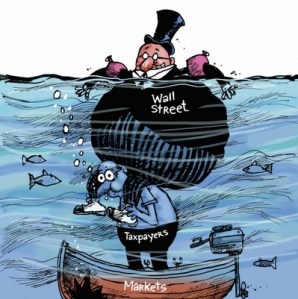 The blame for the worst recession since the The Great Depression clearly rests on the private sector where millions of bad loans and financial innovations turned peoples homes and investments into casino style gambling games. The disastrous lack of regulation, accountability, and common sense is still wrecking havoc on the economy today. The lending industry is still at odds with common sense, community well being, and the national interest. Paul Krugman wrote about this today in his NYT op ed using the academy award winning film Inside Job as the cautionary frame. What is evident in all of this fall out is that the people that deserve the blame are still acting abominably and the people they wronged are still getting the worst end of the deal.
What the film didn’t point out, however, is that the crisis has spawned a whole new set of abuses, many of them illegal as well as immoral. And leading political figures are, at long last, showing some outrage. Unfortunately, this outrage is directed, not at banking abuses, but at those trying to hold banks accountable for these abuses.
The immediate flashpoint is a proposed settlement between state attorneys general and the mortgage servicing industry. That settlement is a “shakedown,” says Senator Richard Shelby of Alabama. The money banks would be required to allot to mortgage modification would be “extorted,” declares The Wall Street Journal. And the bankers themselves warn that any action against them would place economic recovery at risk.
All of which goes to confirm that the rich are different from you and me: when they break the law, it’s the prosecutors who find themselves on trial.
To get an idea of what we’re talking about here, look at the complaint filed by Nevada’s attorney general against Bank of America. The complaint charges the bank with luring families into its loan-modification program — supposedly to help them keep their homes — under false pretenses; with giving false information about the program’s requirements (for example, telling them that they had to default on their mortgages before receiving a modification); with stringing families along with promises of action, then “sending foreclosure notices, scheduling auction dates, and even selling consumers’ homes while they waited for decisions”; and, in general, with exploiting the program to enrich itself at those families’ expense.
The end result, the complaint charges, was that “many Nevada consumers continued to make mortgage payments they could not afford, running through their savings, their retirement funds, or their children’s education funds. Additionally, due to Bank of America’s misleading assurances, consumers deferred short-sales and passed on other attempts to mitigate their losses. And they waited anxiously, month after month, calling Bank of America and submitting their paperwork again and again, not knowing whether or when they would lose their homes.”
There are more issues than just the foreclosure one. Here’s an example of a family fighting to sue BOA for the wrongful death of an elderly man who committed suicide after they recommended investments to him that failed miserably. The family has found out that the man had probably unknowingly signed away the right to sue in the fine print of the investment documents. I can’t imagine any one recommending a portfolio of risky assets to any one over the age of 50, yet this is exactly what BOA did to Mr. Phillip Grossman.
Philip Grossman saved carefully his whole life, never investing in anything more exotic than certificates of deposit. But in June 2007, his longtime banker at a Bank of America branch in Waltham told him he could do better, without taking more risk, and introduced him to a broker at the bank’s investment arm.
Two years later, Grossman, then a 65-year-old computer consultant, and his wife had lost $400,000 — more than half their savings. In despair in the fall of 2009, Grossman checked into a Woburn motel, left his glasses and watch on the desk in his room, and killed himself.
Stunned by the tragedy, his family tried to sue Bank of America, asserting that the broker invested more aggressively than promised, adding to the steep losses and contributing to Grossman’s suicide. But they soon found out they would not get their day in court: The papers the Grossmans signed to open their account required that any dispute go to a private panel of arbitrators.
“They’ve committed a crime against us, as far as I’m concerned,’’ Grossman’s wife, Gail, said in an interview. “Why do we have to go to arbitration? With other crimes you get a trial and a jury. It just seems very unfair to me.’’
The Grossmans’ case shows how entrenched arbitration has become in the financial industry, demonstrating that even in an extreme case alleging wrongful death, aggrieved clients have no recourse other than a system that critics say favors investment firms. Most investors have no idea that when they open a brokerage account, they give up their right to sue, and must, under a 1987 Supreme Court ruling, take complaints to arbitration.
There are more outrages to share with you. Think that having a perfect credit score and a huge down payment will get you a loan these days if you’re a consumer? Think again. Banks are lending to junk bond quality businesses while denying the best of households basic mortgages. The recovery is not just around the corner for the majority of US households for many reasons. Government help has been concentrated at reaching banks and businesses. This is not translating into improvement for all.
The consumer loan market, particularly housing, remains a challenge for borrowers. Total U.S. consumer credit outstanding was $2.4 trillion in January, or 6.6 percent below its July 2008 level, the Fed said in a March 7 report. Total housing debt has declined by $536 billion since 2008 to $10.1 trillion, Fed data show. The median price of an existing U.S. home has dropped 13 percent since June to $158,800, bringing its decline since July 2006 to 31 percent, according to the Chicago-based National Association of Realtors. About 10.8 million homes were worth less than the debt owed on them in the third quarter, research firm CoreLogic Inc. said in a Dec. 13 report.
By contrast, the least creditworthy corporations have been able to borrow record amounts at the cheapest rates ever. Junk- rated companies sold an unprecedented $287.6 billion in bonds in 2010 and are setting an even faster pace of issuance this year. Claire’s Stores Inc., the costume jewelry retailer that had debt that was almost 10 times its earnings last year, sold $450 million of bonds last month that Moody’s Investors Service gave its third-lowest rating.
There are several other disturbing figures in the Bloomberg article quoted directly above.
The U.S. economy grew at a 2.8 percent annual rate in the fourth quarter, slower than previously calculated, and is forecast to expand 3.2 percent this year, according to the median estimate of 66 economists in a Bloomberg survey.
Household purchases account for about 70 percent of the U.S. economy, making the consumer the single biggest driver of any economic recovery. Those consumers “stumbled at bit” at the start of this year, Michael Feroli, chief U.S. economist at JPMorgan Chase & Co. in New York, said in a February note.
While the economy expanded and companies are beginning to spend more, the improvements haven’t driven the nation’s unemployment rate below 8.9 percent for almost two years and the Conference Board’s gauge of consumer confidence is still 37 percent below the level reached in July 2007.
“The 2007-2009 recession period looks different from previous economic cycles,” John McElravey, a bond analyst at Wells Fargo Securities LLC in Charlotte, North Carolina, said in a March 8 report. “Consumer credit outstanding contracted much more sharply than in other periods, and the return to positive growth rates has been relatively slow.”
There are so many things different and bad with this recovery that it is indeed troubling. Perhaps the most important factor is that government is clearly not helping homeowners, the jobless, and the many families who have lost wealth via the crash in home values and their investments. The focus of bailouts has been on banks and businesses that have not used the funds to benefit their communities. Something is clearly wrong here with policy priorities when you’re not focused on the major source of consumption in a consumer-drive economy.
Not only is policy not aimed at the majority of people in the country, the focus in the District is now clearly turning to austerity measures and turning neighbor against neighbor. I can’t tell you exactly how worried I am that a huge number of households will still be in trouble come the next recession. Here’s another opinion on that very subject from E.J. Dionne Jr. at WAPO.
A phony metaphor is being used to hijack the nation’s political conversation and skew public policies to benefit better-off Americans and hurt most others.We have an 8.9 percent unemployment rate, yet further measures to spur job creation are off the table. We’re broke, you see. We have a $15 trillion economy, yet we pretend to be an impoverished nation with no room for public investments in our future or efforts to ease the pain of a deep recession on those Americans who didn’t profit from it or cause it in the first place.
As Sen. Al Franken (D-Minn.) pointed out in a little-noticed but powerful speech on the economy in December, “during the past 20 years, 56 percent of all income growth went to the top 1 percent of households. Even more unbelievably, a third of all income growth went to just the top one-tenth of 1 percent.” Some people are definitely not broke, yet we can’t even think about raising their taxes.
By contrast, Franken noted that “when you adjust for inflation, the median household income actually declined over the last decade.” Many of those folks are going broke, yet because “we’re broke,” we’re told we can’t possibly help them.
That’s the new excuse. We could help Chrysler. We could help GM. We could help the financial institutions and Wall Street. We could invade Iraq and Afghanistan to help them. We could do all that, but now we’re too broke to help ordinary Americans. It’s obvious that the financial institutions are doing nothing to improve the situation. It’s also pretty obvious that Iraq and Afghanistan are money pits. When do we get the government to quit throwing our money to rich people and businesses? When do we get them to stop blaming teachers, firefighters, and police offers for taking up too much of the pie? When do we actually start looking at the real numbers and the real culprits who took all this vast wealth and continue to ensure the rules only benefit the few?

 peej
peej Carissa
 bostonboomer
 dakinikat
 ecocatwoman
 mablue2
 Mama Lopez
 peggysue22
 quixote
 skydancingguestblogger
 Mona (aka Wonk the Vote)



 Sky Dancing
Recent Comments