
Invoke the 14th Amendment. PERIOD.
Posted: July 24, 2011 Filed under: Economy, Federal Budget, Federal Budget and Budget deficit | Tags: 14th amendment, debt ceiling rant 37 CommentsSection 4. The validity of the public debt of the United States, authorized by law, including debts incurred for
payment of pensions and bounties for services in suppressing insurrection or rebellion, shall not be questioned. But neither the United States nor any State shall assume or pay any debt or obligation incurred in aid of insurrection or rebellion against the United States, or any claim for the loss or emancipation of any slave; but all such debts, obligations and claims shall be held illegal and void.
The first intelligent article suggesting we do that came from The Nation‘s Katrina vanden Heuvel after Timothy Geithner suggested he had folks exploring the option. I’ve ended several blog posts this month with the call to invoke the 14th and send the insane teabot posse back home with the message that they may want to read up on U.S. The Constitution before they start waving that Gadsden flag in our faces.
Brad Delong fleshes the argument out within this context. We have a president that’s found lawyers who have said that actions in Libya are not “hostilities”. I will add that we’ve had several presidents who have found lawyers that have written that “enhanced interrogation techniques” aren’t torture and that it’s okay to assassinate citizens without due process. Certainly, with a Washington DC that has more word-parsing, pretzel-logic-precedent-finding, triangulating lawyers per square foot than any place on the planet, the White House can find one that finds Delong’s suggestions below justifiable via Section 4 stated above.
The structure of Tim Geithner’s testimony to Congress defending his additional borrowing is:
- The Constitution forbids me from even thinking about default.
- You ordered me to spend.
- A previous Congress told me not to borrow, but no Congress can bind its successors, and those of you who are in this Congress here now ordered me to spend.
- I’m just doing what you told me to do–and what the Constitution directly and explicitly tells me to do.
And then we should move on to the people’s business. This episode of kabuki theatre has done nobody any credit. If I had previously had any respect for or confidence in Republicans, this would have shredded it. And each day it continues it further shreds my respect for and confidence in the executive branch.
DeLong argues–and I agree–that this is far better than options outlined by Ezra Klein and ranked by Calculated Risk here. In the long run, we should probably be looking at eliminating the debt ceiling. If Congress authorizes the spending and the President signs off on it, there should be absolutely no way that they can renege on bond holders later. Moody’s suggested the same thing last week. The rest of the crap on the table just undoes one promise made to people after another.
It should be obvious by now that Boehner is not in control of his caucus in congress. The tea party has him over a tea barrel. These are folks that appear to have no clue about anything as illustrated by their ignorant statements last spring that all they had to do was pass a budget and it was law. They completely forget the role of the President and the Senate. They seem to have no idea or they stubbornly refuse to believe the experts that tell them that what they are doing is basically bringing the country’s economy down.
Meanwhile, there were lingering doubts about Boehner’s ability to rally support for a debt-limit increase of any size or duration. Many House Republicans continue to push their plan to sharply cut spending over the next decade and adopt a constitutional amendment requiring Congress to balance the budget. Such a plan passed the House, but failed Friday in the Senate on a party-line vote.
Freshman Rep. Blake Farenthold (R-Tex.) said Republican leaders remain concerned that even a small increase in the debt limit would fail on the House floor.
“I think their concern about bringing it to the floor is whether they can get 218 [votes] or not,” Farenthold said in an interview. “Everybody wants to only go through this pain once.”
We can’t afford to pass a debt ceiling increase attached to no firm commitments for revenue adjustments. It’s ridiculous. There is no way the long term budget problems will ever be solved under these conditions. Further more, the fall out from the increased interest rates and the impact on the already nasty economy will just drive economy-related revenues down and expenditures up. We’ll exacerbate the very thing we’re trying to alleviate. This is insanity.
If the meetings today look to be more of the same, the President should just get on TV Monday morning and tell Geithner to pay the bills for the spending that the congress authorized and cite the 14th amendment. Again, if you can find a lawyer that says that enhanced interrogation techniques aren’t torture and justify claiming a citizen is an enemy combatant and can be detained indefinitely–or assassinated–without due process, rationalizing this should be easy. Our country’s economy shouldn’t be subjected to deliberate economic sabotage because a few new congress critterz flunked their middle school American Government and History classes.
If you don’t want to take my word for it, then take former President Clinton’s suggestion. There’s also a list of lawyers there that would tell our constitutional law lecturer President that it’s constitutional.
A few days ago, former President Bill Clinton identified a constitutional escape hatch should President Obama and Congress fail to come to terms on a deficit reduction plan before the government hits its borrowing ceiling.
He pointed to an obscure provision in the 14th Amendment, saying he would unilaterally invoke it “without hesitation” to raise the debt ceiling “and force the courts to stop me.”
Thursday Reads
Posted: July 21, 2011 Filed under: Barack Obama, Democratic Politics, Federal Budget and Budget deficit, morning reads, Republican politics, Republican presidential politics, Social Security, the internet, U.S. Economy, U.S. Politics, unemployment, voodoo economics, We are so F'd | Tags: austerity, Barack Obama, Chris Christie, collective bargaining, employers, Eric Cantor, Federal debt ceiling, frustration index, Gang of Six, John Kasich, Judd Gregg, Michele Bachman, Migraines, Paul Ryan, polls, Republicans, social media, taxes, Vernal Fall, Yosemite 41 Comments
Good Morning!! I’m going to start out with some interesting poll results that came out yesterday.
According to the latest Washington Post-ABC News poll, a lot of ordinary Republicans are unhappy with their GOP representatives in Washington, DC. From the WaPo:
While Republicans in Congress have remained united in their opposition to any tax increases, the poll finds GOP majorities favoring some of the specific changes advocated by the president, including higher income tax rates for the wealthiest Americans.
There is also broad dissatisfaction with Obama’s unwillingness to reach across the aisle: Nearly six in 10 of those polled say the president has not been open enough to compromise. Among independents, 79 percent say Republicans aren’t willing enough to make a deal, while 62 percent say the same of Obama.
Republicans may also be losing the war of perception about who stands with whom in the debates over the deficit and the economy. A majority view the president as more committed to protecting the interests of the middle class and small businesses, while large majorities see Republicans as defending the economic interests of big corporations and Wall Street financial institutions.
ABC’s The Note reports that based on the same poll,
Against a backdrop of broad concern about the impact of default, 80 percent of Americans in a new ABC News/Washington Post poll say they’re dissatisfied or even angry with the way the federal government is working, up 11 points in a single month. It last was this high in 1992, during the economic downturn that cost the first President Bush a second term.
The times today are nearly as tough: The ABC News Frustration Index has risen to 72 on its scale of 0 to 100, its highest since just before the 2010 midterm elections and well into the political danger zone. The index combines dissatisfaction with the government, anti-incumbent sentiment and ratings of the president and the economy alike.
But unlike 1992 – or 2010 – the opposition party’s taking even more heat than the president. While President Obama for the first time has fallen under 40 percent approval for handling the economy, the Republicans in Congress do even worse, 28 percent approval. On handling the deficit, it’s a weak 38 percent approval for Obama, but a weaker 27 percent for the GOP. And on handling taxes, Obama has 45 percent approval, the GOP, 31 percent.
It’s good to know that some Americans are getting angry. I wish they’d get out the pitchforks and make some noise about it in the streets.
A couple of GOP governors are dropping in the polls too. Media star Chris Christie is turning off his NJ constituents.
Gov. Chris Christie’s popularity has declined significantly over the first half of 2011 and he would have a very difficult time winning reelection if voters in New Jersey went to the polls today, according to a survey by Public Policy Polling.
While Republican activists outside New Jersey want Christie to seek the party’s 2012 presidential nomination, only 43 percent of Garden State voters approve of the job the governor is doing to 53 percent who disapprove.
The figures represent a 13 point decline from when Public Policy Polling last surveyed voters in January, when Christie’s standing was 48 percent approval and 45 percent disapproval.
Christie’s numbers are steady with Republicans but independents have really turned on him, going from approving by a 55 percent to 39 percent margin to disapproving by a 54 percent to 40 percent margin. And his crossover popularity with Democrats is on the decline as well. Where 23 percent approved of him in January, now only 16 percent do.
Christie has been making huge cuts in government services. I guess austerity isn’t as popular with the grass roots as it is with the power elites.
Gov. John Kasich of Ohio is even more unpopular than Christie.
The latest poll released Wednesday by Connecticut’s Quinnipiac University showed that only 35 percent of registered voters approve of the job the Republican governor has done in his first six months. Exactly half say they disapprove, up 1 percentage point since May, with the remainder undecided.
“Even after the state budget has been approved as he promised without raising taxes, and even though the Quinnipiac University poll finds that 63 percent say they favor such an approach, Gov. Kasich’s name remains mud in the eyes of the Ohio electorate,” said Peter A. Brown, assistant director of the Quinnipiac University Polling Institute.
The same poll shows that even some of those who approve of the governor’s performance are prepared to reject his signature law restricting the collective bargaining power of government employees at the ballot on Nov. 8. Fifty-six percent of voters say it should be repealed, up 2 percentage points since May.
Republicans always overreach, don’t they? It looks like the 2010 win may have been just a flash in the pan.
Michele Bachmann is surging in the polls against Mitt Romney.
The Minnesota congresswoman returned to Iowa early Wednesday morning as polls show her gaining ground nationally as a top alternative to former Massachusetts Gov. Mitt Romney, the early front-runner for the GOP nomination. Since formally entering the race last month, she has eclipsed other Republicans in the field, including fellow Minnesotan Tim Pawlenty, who has been actively campaigning all year.
The latest Wall Street Journal/NBC News poll offered a statistical glimpse at their diverging fortunes. In the poll, 16% of the registered Republicans picked Ms. Bachmann as their top choice, putting her second behind Mr. Romney, who remains the first choice of 30% of the Republicans polled. In the same survey, 2% of registered Republicans chose the former Minnesota governor as their top pick, down from 6% in April.
Meanwhile, Bachmann is still being hassled about her migraine headaches. Karl Rove is calling for her to release her medical records. Boy those Republican power brokers are really scared of Bachmann, aren’t they?
A doctor who has examined Bachmann says the headaches aren’t a big deal.
A letter dated Wednesday from a congressional doctor whose office has examined Republican Michele Bachmann described the presidential candidate’s migraines as occurring “infrequently” and controlled by prescription medication.
Bachmann’s campaign distributed the letter from Dr. Brian Monahan, the attending physician in Congress. Bachmann has been evaluated by that office during her three terms in Washington.
Former NH Senator Judd Gregg thinks the Republicans in the House will push the debt limit battle to the brink. In fact, he thinks it will take Social Security checks not going out to get them to agree to raising the debt ceiling.
“My gut tells me that we’ll need a weekend of drama — maybe a weekend of the government not paying its bills — politicians need drama to make something happen. As soon as social security checks don’t go out, the politics will change. I suspect it’ll take artificial drama to get closure past the House.”
“Boehner understands that a shutdown is bad for his caucus and that there’s something viable short of a shutdown but right now… it’s a 50-50 chance that we go into a few days of disruption.”
Gregg said lawmakers don’t really care about the nation’s credit rating:
“Policy-makers only worry about a ratings downgrade at the margins. They don’t really care. The ratings agencies put themselves in a corner that’s foolish. I’ve always found them to be incredibly naive about the political process. To be so definitive is foolish.”
“For the ratings agencies to make this drop-dead date, it’s stupid and naive because we’ll straighten it out, but our process doesn’t allow it to do it overnight.”
Gregg says all this will means the Republicans get most of the blame for the mess. They didn’t learn anything from what happened to Gingrich, did they?
Gregg is probably right about the gang of six plan, since that is basically what the Republicans already rejected. And Brian Beutler reports that they are rejecting it again.
As time goes on, and conservative interest groups and members of Congress rip into it, support among Republicans for the Gang of Six plan to reduce deficits will begin to wane. In fact, that’s already happening.
In a publicly released memo meant to undermine support for the Gang of Six plan in its current form, House Budget Committee chairman Paul Ryan (R-WI) laments, “it increases revenues while failing to seriously address exploding federal spending on health care, which is the primary driver of our debt. There are also serious concerns that the proposal’s substance on spending falls far short of what is needed to achieve the savings it claims.”
And check this out from Politico:
A few wealthy donors have called Cantor to tell him they wouldn’t mind if their taxes are raised. During two closed meetings this week — one with vote-counting lawmakers, and another with the entire conference — Cantor told colleagues that some well-heeled givers have told them they’re willing to pay more taxes. Cantor, according to an aide, has responded that House Republicans aren’t standing up for the wealthy, but rather for the middle class, who want to see their taxes stay low.
Yeah sure, Eric. You’re standing up for the middle class. ROFLOL!
With unemployment so high, all we need is more impediments to getting hired. According to the NYT, even obscure blog comments could come into play as companies evaluate job candidates.
A year-old start-up, Social Intelligence, scrapes the Internet for everything prospective employees may have said or done online in the past seven years.
Then it assembles a dossier with examples of professional honors and charitable work, along with negative information that meets specific criteria: online evidence of racist remarks; references to drugs; sexually explicit photos, text messages or videos; flagrant displays of weapons or bombs and clearly identifiable violent activity.
[….]
Less than a third of the data surfaced by Mr. Drucker’s firm comes from such major social platforms as Facebook, Twitter and MySpace. He said much of the negative information about job candidates comes from deep Web searches that find comments on blogs and posts on smaller social sites, like Tumblr, the blogging site, as well as Yahoo user groups, e-commerce sites, bulletin boards and even Craigslist.
….it is photos and videos that seem to get most people in trouble. “Sexually explicit photos and videos are beyond comprehension,” Mr. Drucker said. “We also see flagrant displays of weapons. And we see a lot of illegal activity. Lots and lots of pictures of drug use.”
I’ll end with this nightmarish story from the LA Times: Witness tells of horror as 3 swept over Vernal Fall in Yosemite
Bibee, a 28-year-old carpenter who grew up in Angels Camp, northwest of the park, had brought Amanda Lee, a visitor from Missouri, to the top of Vernal Fall on Tuesday — her first visit to Yosemite, but the latest of many for him.
They were standing behind a metal barricade, peering at the cascade….Bibee saw a man cross over the barricade. He was leaning over the 317-foot waterfall, holding a young girl, who was screaming in terror. People begged them to get back. “I’m yelling at him, ‘You SOB, get over here!'” Bibee said. Eventually, the two returned to safety.
But then Bibee noticed that three other people had also crossed over, and were “taking pictures and being stupid.”
The three people, members of a church group, fell into the water and went over the falls. All are presumed dead. Why would people go past a barricade and warning signs to stand on the edge of a raging waterfall? But it’s not the first time. The article says twelve people have gone over the falls previously–all were killed.
That’s it for me. What are you reading and blogging about today?
Quickie Debt Deal Update
Posted: July 19, 2011 Filed under: Federal Budget, Federal Budget and Budget deficit | Tags: Federal Debt debate, Gang of Six 12 Comments Jamie Dupree at the AJC has a nice brief summary of the ‘Gang of Six Details’. I know you’re as tired of the debt ceiling drama as I am but given that every one seems willing to sell us regular folks out, I think we need to keep on top of it. That, and I’m getting damned close to cashing out all my money market funds and buying Loonies. I kid you not. I’d invest in a nice cash crop at this point if I could. Pork Bellies any one?
So this is the overriding goals which basically are in keeping with the Cat Food Commission. These, again, come from the so-called Gang of Six.
* Slash our nation’s deficits by $3.7 trillion/$3.6 trillion over ten years under CBO’s March 2011 baseline, or $4.65 trillion/$4.5 trillion under the original fiscal commission baseline (which used the President’s 2011 budget request as the starting point for discretionary spending).
* Stabilize our publicly-held debt by 2014.
* Reduce our publicly-held debt to roughly 70% of our economy by 2021.
* Impose unprecedented budget enforcement.
Here’s some more strategic principles that include the approach to Social Security. The so-called spending caps principle is also included.
The plan uses a two-step legislative process: (1) an initial bill that makes immediate cuts; and (2) a process for a second bill to enact comprehensive reform and put our nation on a stable fiscal path. The plan would:
Immediately implement aggressive deficit reduction down payment
* Cut deficits by $500 billion.
Dramatically cut discretionary spending
* Cut nonsecurity and security discretionary spending over 10 years.
* Maintain investments that encourage economic growth, strengthen the safety net for those who truly need it, and preserve a strong national defense.
Carefully strengthen the solvency of our most important entitlement programs
* Spend health care dollars more efficiently in order to strengthen Medicare and Medicaid, while maintaining the basic structure of these critical programs.
* Fully pays for SGR (the “doc fix”) over 10 years.
Fundamentally reform our tax code
* Reduce marginal income tax rates and abolish the $1.7 trillion Alternative Minimum Tax.
* Encourage greater economic growth.
* Enhance the competitiveness of American businesses and workers against global competition.
* Reform spending through the tax code to eliminate investment distortions and tax gaming.
* Change the debate about taxes in America from rate levels and carve outs to competitiveness, fairness and growth.
* If CBO scored this plan, it would find net tax relief of approximately $1.5 trillion.
Strictly tighten the government’s budget processes
* Impose spending caps and security/nonsecurity firewalls.
* Sequester accounts at the end of the year to recoup any excessive spending by Congress.
* Restrict the use of emergency designations that circumvent the spending caps.
* Prevent Congress from exceeding the caps by requiring a stand-alone resolution subject to a 67-vote threshold, in order to isolate that vote to increase the deficit from any other policy items.
Reform Social Security for future generations
* Ensure 75-year solvency of Social Security and provide for a decennial review of the program to ensure it remains solvent.
* Reform Social Security on a separate track, isolated from deficit reduction – any savings from the program must go towards solvency.
There’s more bullet points over there that you may want to check out. I agree that Social Security Reform should be kept on a separate track. Right now, it’s not the priority problem at all. The rest are just broad strategical approaches. The detailed plan follows these. The details are called an ‘aggressive’ plan and you’ll see that’s exactly so.
Here’s some of the details on Social Security.
* Consider Social Security reform, if and only if the comprehensive deficit reduction bill has already received 60 votes.
* Reform must ensure 75-year solvency of the program and provide for a decennial review to ensure it remains solvent. Any savings from the program must go towards solvency, not deficit reduction.
* If Finance fails to report Social Security reform meeting the instructions, allow a group of at least five senators from each party to introduce a resolution with recommendations that meet the committee’s instructions.
* Bar substitute amendments that worsen the solvency of Social Security.
* Combine any qualifying Social Security reform bill that receives 60 votes on final passage to the comprehensive bill at the desk before being sent to the House as a single bill.
* Vitiate the vote on the deficit-reduction bill if the Social Security reform bill does not receive 60 votes.
Here’s some of the highlights from the deficit reduction plan. I am putting another one that impacts Social Security first. You can find information on the chained-CPI in my previous post here.
* Shift to the chained-CPI (a more accurate measure of inflation) government-wide starting in 2012, along with the following specifications for Social Security: (1) exempt SSI from the shift for five years, and then phase in the shift over the next five years; and (2) provide a minimum benefit equal to 125% of the poverty line for five years. (According to CBO, the shift to chained-CPI would result in the annual adjustment growing, on average, about 0.25 percentage points per year slower than the current CPI.)
Here’s some of the discretionary spending cuts to departments.
* Finance would permanently reform or replace the Medicare Sustainable Growth Rate formula ($298 billion) and fully offset the cost with health savings, would find an additional $202 billion/$85 billion in health savings, and would maintain the essential health care services that the poor and elderly rely upon.
* Armed Services would find $80 billion.
* Health, Education, Labor, and Pensions would find $70 billion.
* Homeland Security and Government Affairs would find $65 billion.
* Agriculture would find $11 billion while protecting the Supplemental Nutrition Assistance Program.
* Commerce would find $11 billion.
* Energy would find $6 billion and may propose additional policies to generate savings that would be applied to the infrastructure deficit or to reduce the deficit.
* Judiciary would find an unspecified amount through medical malpractice reform.
* Require the Finance Committee to report tax reform within six months that would deliver real deficit savings by broadening the tax base, lowering tax rates, and generating economic growth as follows:
* Simplify the tax code by reducing the number of tax expenditures and reducing individual tax rates, by establishing three tax brackets with rates of 8–12 percent, 14–22 percent, and 23–29 percent.
* Permanently repeal the $1.7 trillion Alternative Minimum Tax.
* Tax reform must be projected to stimulate economic growth, leading to increased revenue.
* Tax reform must be estimated to provide $1 trillion in additional revenue to meet plan targets and generate an additional $133 billion by 2021, without raising the federal gas tax, to ensure improved solvency for the Highway Trust Fund.
There’s more details on the cuts over at the AJC article. I think it looks like tax reform is a major part of this. Please note that the top bracket is being adjusted downward and would be extremely generous to rich people. Even if the Bush tax cuts sunset, this really reduces the progressivity of our tax system and I have a major problem with that. Rich people use up more government services than normal people and these days, most of their money comes from nonproductive sources like capital gains from wherever and whatever activities. Certainly, earning money off of products that cause lung cancer or companies that go abroad and set up production in plants where suicide by workers is the norm isn’t exactly a productive use of capital. If they feel morally unaffected by those investment decisions, that’s all well and good, but I don’t think the US treasury needs to subsidize people who create extraordinarily high social costs. It’s estimated that one pack of cigarettes creates between $40 -$70 of public health costs that are borne by tax payers, just as an example. Again,I don’t think we should be subsidizing investments in businesses with huge costs to society.
Look for more information as the details are released.
Moody’s: Dump the Debt Ceiling
Posted: July 18, 2011 Filed under: 2012 presidential campaign, Federal Budget and Budget deficit, U.S. Economy, U.S. Politics, voodoo economics, We are so F'd | Tags: Chile, Congress, Federal debt ceiling, Harry Reid, Mitch McConnell, Moody's ratings agency 4 Comments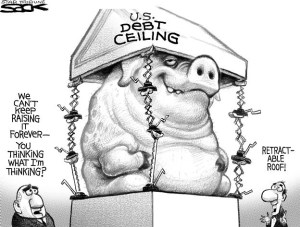
Reuters reports that the ratings agency Moody’s is once again involving itself in the debate over the federal debt by suggested the U.S. eliminate the debt ceiling. Here’s the argument:
The United States is one of the few countries where Congress sets a ceiling on government debt, which creates “periodic uncertainty” over the government’s ability to meet its obligations, Moody’s said in a report.
“We would reduce our assessment of event risk if the government changed its framework for managing government debt to lessen or eliminate that uncertainty,” Moody’s analyst Steven Hess wrote in the report….
“…the current wide divisions between the House of Representatives and the Obama administration over the debt limit creates a high level of uncertainty and causes us to raise our assessment of event risk,” Hess said.
Moody’s suggested that the U.S. could use Chile as a model for fiscal responsibility:
“Elsewhere, the level of deficits is constrained by a ‘fiscal rule,’ which means the rise in debt is constrained though not technically limited,” Moody’s said, adding that such rule has been effective in Chile.
I’m sure that will go over well with the Tea Party types.
Moody’s argues that dumping the debt ceiling would be far better than the current “compromise” plan which would force Democrats to vote three times on raising the borrowing limit during the lead up to the 2012 presidential election. From CNN Money:
On Monday, Moody’s threw some cold water on a backup plan that is gaining momentum among lawmakers as the chances of a compromise deal fade.
The plan, crafted by Sens. Mitch McConnell and Harry Reid, would allow the debt ceiling to be increased, while shifting the political blame for that action from Congress to the White House….
“Without more substantial deficit reductions being included in such a plan, it would be negative for the long-term outlook,” the report said.
But overall, Moody’s said “the U.S. would be better off if the debt ceiling were eliminated entirely.”
The McConnell-Reid plan would also establish a new Catfood Commission with the power to produce legislation that could not be amended by Congress.
I’m sure Moody’s would be OK with that, but I’m sure not. Maybe Congress needs to dump the McConnell-Reid catfood-for-everyone-but-the-rich-plan and get rid of the debt ceiling instead.
Can you charge the country’s top elected officials with Treason?
Posted: July 12, 2011 Filed under: Federal Budget, Federal Budget and Budget deficit | Tags: Federal Deficit, game of chicken. 27 CommentsIt seems as though our nation’s “leaders” are looking to bring down our country. It’s the only explanation that I have.  Also, I’m at the point where I think Joe Biden is the only sane one in the room. Pinch me! Please!
Headlines of note to prove my case:
Boehner Says The Debt Limit Increase Is Obama’s Problem
Speaker of the House John Boehner introduced a new argument to the debt ceiling and deficit reduction talks Tuesday, saying raising the borrowing limit is Republicans’ concession in the negotiations.”This debt limit increase is [Obama’s] problem,” he said.
Boehner is trying to force a deficit reduction package entirely based on spending cuts, saying Obama’s demands for new revenues would only be considered if Obama accepted deep cuts to entitlements.
My guess is that Boehner has absolutely no control over the Republicans in the House. Some one from Wall Street needs to take a few of them to the wood shed. Meanwhile, Mitch McConnell appears to be interested in nothing but political play. Some senate Republicans would obviously join the president but it appears that will happen over McConnell’s dead mind and conscious. McConnell still refuses to admit the Republicans lost the White House 3 years ago. He’s become some kind of Captain Queeg who gets in front of the press then rattles ball bearings in his fist while muttering “one term president, strawberries, one term president, it’s the strawberries, I tell you …” repeatedly.
McConnell: Obama can’t deliver major deficit-reduction deal
Senate Republican Leader Mitch McConnell (Ky.) on Tuesday said a comprehensive deficit-reduction deal is not attainable as long as Barack Obama is president.
McConnell declared that deficit-reduction talks have come to an unsolvable deadlock.
“After years of discussions and months of negotiations, I have little question that as long as this president is in the Oval Office, a real solution is unattainable,” he said.McConnell has called for reforms to curb the future growth of Social Security and Medicare since taking over as Republican leader at the end of 2006.
So, what’s the response of the leader of the free world? Would you call this riling up or scaring seniors?
Obama says he cannot guarantee Social Security checks will go out on August 3
President Obama on Tuesday said he cannot guarantee that retirees will receive their Social Security checks August 3 if Democrats and Republicans in Washington do not reach an agreement on reducing the deficit in the coming weeks.
“I cannot guarantee that those checks go out on August 3rd if we haven’t resolved this issue. Because there may simply not be the money in the coffers to do it,” Mr. Obama said in an interview with CBS Evening News anchor Scott Pelley, according to excerpts released by CBS News.
The Obama administration and many economists have warned of economic catastrophe if the United States does not raise the amount it is legally allowed to borrow by August 2.
This is insane. No one’s made any sense in this discussion since Joe Biden told his gang of six to get real. Meanwhile, we’re beginning to see financial economists question this game of chicken.This extremely good analysis is written by Jeffrey Frankel the James W. Harpel Professor of Capital Formation and Growth at Harvard’s Kennedy School.
In the 1955 movie Rebel Without a Cause, James Dean and a teenage rival race two cars to the edge of a cliff in a game of chicken. Both intend to jump out at the last moment. But the other guy miscalculates, and goes over the cliff with the car.
This is the game that is being played out in Washington this month over the debt ceiling. The chance is at least 1/4 that the result will be similarly disastrous.
It is amazing that the financial markets continue to view the standoff with equanimity. Interest rates on US treasury bonds remain very low, barely above 3% at the ten-year maturity. Evidently it is still considered a sign of sophistication to say “This is just politics as usual. They will come to an agreement in the end.” Probably they will. But maybe not. (I’d put a ½ probability on an agreement that raises the debt limit, but just muddles through in terms of the genuine long term fiscal problem. That leaves at most a ¼ probability of a genuine long-term solution of the sort that President Obama apparently proposed last week – described as worth $4 trillion over ten years.)
My advice to investors is to shift immediately out of US treasuries and into high-rated corporate bonds. If the worst happens, you will probably save yourself from a big capital loss within the next month. If not, there is no harm done.
The game is not symmetric. The Republicans are the ones who are miscalculating. Evidently they are confident of prevailing: they rejected the President’s offer, even though he was willing to cut entitlement programs.
The situation is complicated because there are a number of different people crammed into the Republican car. There is one guy who is obsessed with the theory that, come August 3, the federal government could retain its top credit rating if it continued to service its debt by ceasing payment on its other bills. But this would mean failing to honor legal obligations that have already been incurred (paying suppliers for paper clips that have already been bought, paying soldiers their wages for last month’s service, sending social security recipients their checks, etc.). This is like observing that the cliff is not a 90 degree drop-off, but only 110 degrees. It doesn’t matter: the car would still go crashing into the ocean far below. The government’s credit would still be downgraded and global investors would still demand higher interest rates to hold US treasuries, probably on a long-term basis.
There are other guys (and gals) in the car who are even more delusional. They are dead set on a policy of immediately eliminating the budget deficit (e.g., those opposed to raising the debt ceiling no matter what, or those campaigning for a balanced budget amendment), and doing it primarily by cutting nondefense discretionary spending. This is literally impossible, arithmetically. But they honestly don’t know this. It is as if they were insisting that the car can fly. Sometimes it can be a good bargaining position to adopt a very extreme position. But if you are demanding that the car flies, you are not going to get your way no matter how determined you are.
What we have here are a group of rebels with self-serving causes. Again, the President should just invoke the 14th amendment,pay the bills, and send the DOJ after the many folks here that appear to be willing to tank our country for their personal political gain. Threatening seniors’ social security is not leadership. It’s just a matter of time before the financial markets start noticing these folks are not acting in the best interest of our country, our economy, or our ability to deal with our economic challenges. We’re lucky that they still think this is the chicken dance right now instead of a chicken race. It’s going to be a lot harder to pay off the debt with the interest rates that go along with junk bonds. This is not the place for political grandstanding.
update: Okay, this is weird … what’s McConnell up to now?
The Big Blink? McConnell Proposes Giving Obama Authority To Raise Debt Limit Alone
Senate Minority Leader Mitch McConnell (R-KY) has proposed a sort of escape hatch for Congressional Republicans, who have threatened not to raise the national debt limit — and trigger a default — if Democrats don’t agree to trillions of dollars in cuts to popular social programs.
The plan is designed to give President Obama the power to raise the debt limit through the end of his first term on his own, but to force Democrats to take a series of votes on the debt limit vote in the months leading up to the election.
This still leaves me wondering if Boehner can deliver enough Republican votes to actually head off a purposeful debt default.

 peej
peej Carissa
 bostonboomer
 dakinikat
 ecocatwoman
 mablue2
 Mama Lopez
 peggysue22
 quixote
 skydancingguestblogger
 Mona (aka Wonk the Vote)



 Sky Dancing
Recent Comments