
Tuesday Late Afternoon Blues
Posted: September 20, 2011 Filed under: 2012 presidential campaign, Bailout Blues, Barack Obama, Congress, DADT, Democratic Politics, Domestic Policy, Economy, Elections, Equity Markets, Federal Budget, Federal Budget and Budget deficit, GLBT Rights, Main Stream Media, Politics as Usual, The Media SUCKS, the villagers, U.S. Politics, We are so F'd | Tags: black and blue, blue balls, blue bars, blue blooded, blue dog democrats, blue estimators, blue language, blue period, blue skies, blues, indigo girls, red white and blue, tangled up and blue, the blues, true blue 25 Comments
Minxy’s out surfing samsara this afternoon. I’m trying to muster up some good vibes today for her as she faces all the “it’s a short life” kind’ve stuff that goes on with the early passing of a friend. As for me, I seem to be entering my blue period. Maybe it’s because I just get cannot this friggin’ gravity model specified correctly and maybe it’s just my parameters that are tangled up and BLUE. Okay, you won’t know what BLUE means for a regression estimator (Best Linear Unbiased Estimator e.g. BLUE) unless you’re as steeped in econometrics as I am but it’s a good play on words. REALLY. Chuckle sympathetically because I need it today. I wish I could like football like normal people. Instead, I follow the bloodsport of politics and its inherent nastiness these days and I have way too many degrees in the dismal science. The results are bound to get to you one way or another.
So this little piece is about the U.S. and blue to match my mood. I’m going to start out with some blue estimators of a different sort.
There was a bit of poll that showed a glimmer of true hope instead of the manufactured sort out today. Recent entrant into the Massachusetts Senate Race, Elizabeth Warren, is polling ahead of glamor boy Republican Scott Brown who replaced the late Ted Kennedy.
Elizabeth Warren has had an incredibly successful launch to her Senate campaign and actually leads Scott Brown now by a 46-44 margin, erasing what was a 15 point deficit the last time we polled the state in early June.
Warren’s gone from 38% name recognition to 62% over the last three months and she’s made a good first impression on pretty much everyone who’s developed an opinion about her during that period of time. What was a 21/17 favorability rating in June is now 40/22- in other words she’s increased the voters with a positive opinion of her by 19% while her negatives have risen only 5%.
The surprising movement toward Warren has a lot to do with her but it also has a lot to do with Scott Brown. We now find a slight plurality of voters in the state disapproving of him- 45%, compared to only 44% approving. We have seen a steady decline in Brown’s numbers over the last 9 months. In early December his approval was a +24 spread at 53/29. By June it had declined to a +12 spread at a 48/36. And now it’s continued that fall to its current place.
Meanwhile, the mixed up mess of Republican presidential candidates is shaking up to a two white man race. Gallup reports that Perry has a better chance than Romney of sealing the nomination at this point, but Romney has a better chance than Perry to beat Obama. No surprises there.
Rick Perry leads Mitt Romney by 31% to 24% in a new USA Today/Gallup poll of Republican presidential nomination preferences. The two are well ahead of the rest of the GOP field, with Ron Paul the only other candidate in double figures.
…
Perry seems to have momentum, but that could be slowed in the coming weeks if Republicans start to perceive that Romney is more electable in the general election. The new poll finds the slight majority of Republicans, 53%, prefer to see their party nominate the person who has the best chance of beating Obama, even if that person does not agree with them on almost all of the issues they care about. Forty-three percent would prefer a candidate who does agree with them on almost all of the issues, even if that person does not have the best chance of winning in November 2012.
Romney currently edges out President Barack Obama by 49% to 47% in national registered-voter preferences for the November election, while Perry trails Obama by 45% to 50%. However, neither Romney nor Obama is ahead by a statistically significant margin.
It’s no wonder Perry wants out of Texas. This poll should direct Perry into the Even Cowgirls get the Blues line. Texans do not like Governor Goodhair if you believe PPP’s numbers.
The poll, released Tuesday, showed Perry with a negative approval in Texas: while 45 percent of the state’s voters approve of Perry’s job performance, 48 percent of Texas voters say they don’t approve.
Obama should have The Blues over this poll from Marist. Will this lead to calls for a primary challenger on calls on him to pull an LBJ?
President Barack Obama faces a litany of bad news. The president’s job approval rating, his favorability, and his rating on the economy have hit all-time lows. To compound matters, three in four Americans still believe the nation is in a recession and the proportion who thinks the country is moving in the wrong direction is at its highest point in more than a decade.
According to this McClatchy-Marist Poll, the president’s approval rating is at 39% among registered voters nationally, an all-time low for Mr. Obama. For the first time a majority — 52% — disapproves of the job he is doing in office, and 9% are unsure.
You’ve always known that Wall Street is only True Blue to profits and not the country right? Grok this headline at Politico via the WSJ. It looks like a lot of hedge funds were betting the US to lose its AAA standing with S&P. The SEC is launching insider trading probes. Can we please get some perp walks now, please?
Securities and Exchange Commission officials have sent subpoenas to financial firms in a probe of whether there was insider trading — betting on a market crash — before the United States’ long-term credit rating was cut by S&P last month, reports The Wall Street Journal.
At issue are trades that were made by hedge funds and other firms shortly before the rating agency Standard & Poor’s downgraded U.S. debt from triple-A to double-A-plus on Aug. 5 and cited the dysfunctional political climate in Washington as one of the reasons.
The Dow Jones Industrial Average dropped 635 points, or 5.5 percent, on Aug. 8, the first day of trading after the downgrade. This was the sharpest one-day decline since the financial crisis in 2008, but it also made bets against the market very profitable.
Securities regulators are looking for firms that bet the stock market would drop — in particular, bearish trades that seem unusually large or were made by firms that typically do not make them.
An SEC spokesman declined to tell The Wall Street Journal which investment firms have received subpoenas.
My guess is it’s the usual vampire squid suspects and all the rest of the guys whose blue balls we pulled out of the bankruptcy fire with TARP and tax dollars. Bets any one?
So here’s the a nifty chart from Paul Krugman–with blue bars–that will make you scream until you’re blue in the face. Look whose been winning the class war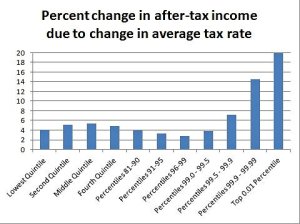 since 1979. So the deal is not only is their share of income and assets way up, but their after tax income has gone way up too.
Changes in tax rates have strongly favored the very, very rich.
Now, they’re only a fairly small part of the huge growth in the after-tax inequality of income. But tax policy has very much leaned into that growing inequality, not against it — and anyone who says otherwise should not be trusted on this issue, or any other.
So, of course the moment we get a whiff of anything slightly Democratic coming from the President we experience blue dogs howling at the blue moon and the beltway press.
Centrist Democrats, a dwindling breed on Capitol Hill, were quickly faced with another rough choice once Obama went public with his plans: Reject their president or back what Republicans are already calling the largest tax increase in the nation’s history.
Florida Sen. Bill Nelson, who is up for reelection in 2012, has supported raising taxes on millionaires but was still weighing whether he’d support higher taxes on those who make more than $200,000 a year, said spokesman Dan McLaughlin.
Sen. Ben Nelson (D-Neb.), a key moderate who’s up for reelection next year, didn’t mince words: “There’s too much discussion about raising taxes right now, not enough focus on cutting spending.”
But Sen. Jon Tester (D-Mont.), who likely will face GOP Rep. Denny Rehberg in next year’s reelection bid, hedged a bit, saying he backs provisions in Obama’s plan that call for closing tax loopholes that benefit millionaires and corporations
“This plan isn’t the one I would have written, nor is it the one that will end up passing Congress,” Tester said. “But I welcome all ideas to the table so Congress can work together to create jobs, cut debt and cut spending.”
 Blue blooded villager David Brooks admits to being an Obama sap and refers to Beltway Bob as “appreciative”. I prefer the term deep-throating, but hey, there’s a glint of recognition, right? It’s a two for one villager idiot piece! Look! I’ve managed to use some blue language.
Yes, I’m a sap. I believed Obama when he said he wanted to move beyond the stale ideological debates that have paralyzed this country. I always believe that Obama is on the verge of breaking out of the conventional categories and embracing one of the many bipartisan reform packages that are floating around.
But remember, I’m a sap. The White House has clearly decided that in a town of intransigent Republicans and mean ideologues, it has to be mean and intransigent too. The president was stung by the liberal charge that he was outmaneuvered during the debt-ceiling fight. So the White House has moved away from the Reasonable Man approach or the centrist Clinton approach.
It has gone back, as an appreciative Ezra Klein of The Washington Post conceded, to politics as usual. The president is sounding like the Al Gore for President campaign, but without the earth tones. Tax increases for the rich! Protect entitlements! People versus the powerful! I was hoping the president would give a cynical nation something unconventional, but, as you know, I’m a sap.
Being a sap, I still believe that the president’s soul would like to do something about the country’s structural problems. I keep thinking he’s a few weeks away from proposing serious tax reform and entitlement reform. But each time he gets close, he rips the football away. He whispered about seriously reforming Medicare but then opted for changes that are worthy but small. He talks about fundamental tax reform, but I keep forgetting that he has promised never to raise taxes on people in the bottom 98 percent of the income scale.
I nearly had to stop reading the damned thing since I was about to pass out from putting my palm to my forehead just a few too many times. Yes, it’s turning black and blue. How are we supposed to get grown up discussions about policy when the two largest newspapers in the country insist posting self serving drivel on a near daily basis.
Okay, here’s my last offering which really does show the best of the Red, White and Blue. Today is the formal removal of DADT. 0penly Gay and lesbian members of our military no longer have to live double lives or be subject to dismissal.
With Tuesday’s repeal of the military’s “don’t ask, don’t tell” policy, gays and lesbians are now free to serve openly in the U.S. armed services.
The U.S. military has spent months preparing for the repeal, updating regulations and training to reflect the impending change, and the Pentagon has already begun accepting applications from openly gay men and women.
It’s events like this that give you a sense that in some way, it’s still
WE THE PEOPLE of the United States, in order to form a more perfect union, establish justice, insure domestic tranquility, provide for the common defense, promote the general welfare, and secure the blessings of liberty to ourselves and our posterity
I’m going to get some iced tea and head back to my trade and foreign direct investment research. But, here’s two of my favorites: Dylan’s Tangled up and Blue done by the Indigo Girls for you on this afternoon in New Orleans under a blue sky.
and every one of them words rang true
and glowed like a burning coal
pourin off every page
Like it was written in my soul from me to you
Tangled up and Blue
I lived with them on Montague Street
In a basement down the stairs
There was music in the cafes at night
And revolution in the air …
Saturday Reads: Obama’s War on Old People, Solyndra-gate, and Violent Protest in Cairo
Posted: September 10, 2011 Filed under: Egypt, FBI raids, Federal Budget and Budget deficit, Foreign Affairs, MENA, morning reads, U.S. Economy, U.S. Politics | Tags: Egypt, green energy, Medicaid, medicare, Social Security, solar energy, Solyndra 13 Comments
Good Morning!!
Things are getting so bad for President Obama that I almost feel sorry for him. The reactions to his speech last night are still coming in, and they aren’t all that great. Sure Krugman tried to sound a little enthusiastic, but he ended up damning Obama’s jobs plan with faint praise.
O.K., about the Obama plan: It calls for about $200 billion in new spending — much of it on things we need in any case, like school repair, transportation networks, and avoiding teacher layoffs — and $240 billion in tax cuts. That may sound like a lot, but it actually isn’t. The lingering effects of the housing bust and the overhang of household debt from the bubble years are creating a roughly $1 trillion per year hole in the U.S. economy, and this plan — which wouldn’t deliver all its benefits in the first year — would fill only part of that hole. And it’s unclear, in particular, how effective the tax cuts would be at boosting spending.
Still, the plan would be a lot better than nothing, and some of its measures, which are specifically aimed at providing incentives for hiring, might produce relatively a large employment bang for the buck. As I said, it’s much bolder and better than I expected. President Obama’s hair may not be on fire, but it’s definitely smoking; clearly and gratifyingly, he does grasp how desperate the jobs situation is.
But his plan isn’t likely to become law, thanks to Republican opposition.
Robert Reich applauded the President’s “passion,” but not the plan itself. Reich’s reaction to the Jobs plan:
$450 billion sounds like a lot – and is more than I expected — but some of this merely extends current spending (unemployment benefits) and tax cuts (in Social Security taxes), so it doesn’t add to aggregate demand.
The net new boost to the economy is closer to $300 billion. That doesn’t approach even half the gap between what the economy is now producing and what it could produce at or near full employment.
And much that $300 billion is in the form of temporary tax cuts to individuals and companies. Some of these make sense — enlarging the Social Security tax cut, extending it to employers, and giving small businesses a tax holiday for new hires.
But temporary tax cuts haven’t proven to be particularly effective in stimulating new spending in times of economic stress. People tend to use them to pay off debts or increase savings. Companies use them to reduce costs, but they won’t make additional hires unless they expect additional sales – which won’t occur unless consumers increase their spending.
That leaves some $140 billion for infrastructure – improving outworn school buildings, roads, bridges, ports, and so on. And $35 billion to help cash-starved states avoid more layoffs teachers. Both good and important but still small relative to the overall need.
Just exactly what Dakinikat has been telling us forever. And when The New York Times talked to employers about the plan, most said the tax cuts and credits would be welcome but would not stimulate new hiring until there is consumer demand for their goods and services. Again, exactly what we’ve been hearing from Dakinikat all along.
The saddest article I have seen about Obama’s jobs speech is Dana Millbank’s column from yesterday: The irrelevancy of the Obama presidency. According to Millbank, Congressional Republicans treated the speech as “a big, fat joke.”
“You should pass this jobs plan right away!” Obama exhorted. Sens. Bob Corker (R-Tenn.) and Lindsey Graham (R-S.C.) chuckled.
“Warren Buffett pays a lower tax rate than his secretary — an outrage he has asked us to fix,” Obama went on. Widespread laughter broke out on the GOP side of the aisle.
“This isn’t political grandstanding,” Obama said. Rep. Paul Ryan (R-Wis.) guffawed.
“This isn’t class warfare,” Obama said. More hysterics on the right.
“We’ve identified over 500 [regulatory] reforms, which will save billions of dollars,” the president claimed. House Majority Leader Eric Cantor (R-Va.) and Whip Kevin McCarthy (R-Calif.) giggled.
And according to Millbank, Democrats weren’t all that thrilled either.
In fact, the empty seats were on the Democratic side. Democrats lumbered to their feet to give the president several standing ovations, but they struggled at times to demonstrate enthusiasm. When Obama proposed payroll tax cuts for small businesses, three Democrats stood to applaud. Summer jobs for disadvantaged youth brought six Democrats to their feet, and a tax credit for hiring the long-term unemployed produced 11 standees….Rep. Jesse Jackson (D-Ill.) stared at the ceiling. Rep. Peter Welch (D-Vt.) scanned the gallery. Rep. Jim Moran (D-Va.) was seen reading a newspaper.
Before the speech, Joe Biden actually discussed golf with John Boehner! I really think this President is done. I suppose a miracle could happen and something could stop the train wreck, but I can’t imagine what it would be.
Maybe Obama should read Joe Conason’s article about how Rick Perry tried to privatize Medicaid in Texas and ended up “wasting millions and enriching lobbyists and hedge funds. Oh wait — maybe not. I think that’s probably what Obama wants to do with Social Security and Medicare.
Another problem facing Obama is the Solyndra Energy bankruptcy and investigation. As I wrote a few days ago, Solyndra is a solar energy company which received $535 million in federal loans from Obama’s stimulus plan. Many observers, including the CBO, questioned whether the loan was too risky, but the White House may have intervened to make sure it happened. One of Obama’s biggest donors, George Kaiser owns more than 30% of Solyndra. For some time, Republicans in the House have been asking for an investigation of the circumstances surrounding the loan, especially since the company went bankrupt last week. Now, in a new development the FBI raided Solyndra’s headquarters and today visited the homes of its corporate officers.
An FBI raid on Solyndra Inc., a solar-panel maker that failed after receiving a $535 million loan guarantee from the U.S. Energy Department, may signal the escalation of a probe into the Obama administration’s clean- energy program.
Agents for Energy Department Inspector General Gregory Friedman, who has called the department’s clean-energy loan program lacking in “transparency and accountability,” joined in the search yesterday at the Fremont, California, headquarters of Solyndra, which filed for bankruptcy protection on Sept. 6.
Republicans critical of the program stepped up their attacks following the raid, and two House Democrats questioned the integrity of the company, indicating a potential political crisis for the president. A foundation headed by an Obama campaign contributor was a principal investor in Solyndra….
Friedman, a watchdog within the Energy Department, said in a March report that a lack of adequate documentation for loans “leaves the department open to criticism that it may have exposed the taxpayers to unacceptable risks associated with these borrowers.”
The Federal Bureau of Investigation continued its probe into solar-panel maker Solyndra LLC on Friday by visiting the homes of President and Chief Executive Brian Harrison, as well as former executives and co-founders Chris Gronet and J. Kelly Truman, according to two people familiar with the situation.
Solyndra, which filed for bankruptcy earlier this week, is the target of an investigation into whether executives knowingly misled the Department of Energy to secure a $527 million loan guarantee, The Wall Street Journal reported. On Thursday, the FBI seized documents and computers from Solyndra’s headquarters in Fremont, Calif.
Harrison’s home wasn’t searched on Friday, but he was questioned, according to one person with knowledge of the matter. Harrison, who joined the company in 2010, after the loan was awarded, didn’t respond to a request for comment.
Gronet, Solyndra’s former CEO, didn’t respond to requests for comment. Truman, a former senior vice president at Solyndra, is currently president and chief executive of energy storage developer Deeya Energy. A person answering the phone at Deeya said, “He is not taking phone calls.”
I guess it’s a good thing for Obama that we suddenly heard about a terror threat yesterday, huh?
In other, completely unrelated news, a protest by thousands of people in Cairo “turned violent” yesterday.
A demonstration that brought tens of thousands to this city’s central Tahrir Square turned violent on Friday, when thousands of people — led by a heavy contingent of soccer fans — tore down a protective wall around the Israeli Embassy, while others defaced the headquarters of the Egyptian Interior Ministry.
About 200 people were injured in clashes with the police at the Israeli Embassy and 31 were injured near the Interior Ministry, the Ministry of Health said late Friday night. Protesters apparently had scaled the walls of the Israeli Embassy to tear down its flag.
Mustafa el Sayed, 28, said he had been among about 20 protesters who broke into the embassy. He showed a reporter video from a cellphone, of protesters rummaging through papers and ransacking an office, and he said they had briefly beaten up an Israeli employee they found inside, before Egyptian soldiers stopped them. He said the soldiers removed the protesters from the building, but let them go free.
By 11:30 p.m., about 50 trucks had arrived with Egyptian riot police officers, who filled the surrounding streets with tear gas. Witnesses said that protesters had set a kiosk on fire in front of a security building near the embassy, and that the police had fired rubber bullets to disperse the crowd from both buildings. In addition, a fire broke out in the basement of the Interior Ministry, but it appeared to have been started from the inside and not by the protesters surrounding the building. The fire was in a room believed to store criminal records.
Way to Go Boys and Girls: Countdown to Recession
Posted: August 2, 2011 Filed under: Domestic Policy, Economy, Federal Budget and Budget deficit, U.S. Economy, We are so F'd | Tags: economy killing debt deal, low growth, recession 6 Comments
So, I’m watching the US stock market plummet and laughing to myself in a most unhealthy way. NOW, they’re worried about no growth and jobs. What a buncha marroons! But hey, we maintained that AAA rating so the flight to safety has begun. Gold any one?
“We have a stubbornly slow economy,” Hank Smith, chief investment officer at Haverford Trust Co. in Radnor, Pennsylvania, said in a telephone interview. His firm manages about $6.5 billion. “The economy is stuck in a very slow growth mode, which means that it’s more susceptible to any external shocks.”
Harvard University economics professor Martin Feldstein said he sees a 50 percent chance that the U.S. will relapse into another recession.
“Nothing has given us much growth,” Feldstein said today in a Bloomberg Television interview on “Surveillance Midday” with Tom Keene. Feldstein is a member of the committee that dates recessions for the National Bureau of Economic Research.
Today’s retreat brought the S&P 500 to within 1 percentage point of its low for the year on March 16 and trimmed its year- to-date gain to about 0.5 percent. All 10 industry groups fell, led by a 2.4 percent slump in industrial companies. General Electric Co. lost 3.7 percent to lead declines in 29 of 30 stocks in the Dow Jones Industrial Average.
Archer Daniels Midland Co., the world’s largest grain processor, tumbled 2.4 percent as earnings trailed projections after corn and tax expenses rose. MetroPCS Communications Inc., the pay-as-you-go mobile-phone carrier, lost 35 percent for the biggest decline in the S&P 500 as sales fell short of analysts’ forecasts.
What if they gave a recovery and nobody came? So, What’s missing from the debt ceiling debate? Jobs. In an aggregate demand led recession, what gives us growth is healthy government spending, not tax cuts, and certainly not austerity. Welcome to the new anti-growth fiscal policy.
The unemployment rate, currently above 9 percent, is projected to remain high for a long time. For example, the current Blue Chip Economic Indicators consensus forecast puts the average unemployment rate for 2012 at 8.3 percent. The agreement to raise the debt ceiling just announced by policymakers in Washington not only erodes funding for public investments and safety-net spending, but also misses an important opportunity to address the lack of jobs. The spending cuts in 2012 and the failure to continue two key supports to the economy (the payroll tax holiday and emergency unemployment benefits for the long term unemployed) could lead to roughly 1.8 million fewer jobs in 2012, relative to current budget policy.
The agreement would reduce spending by at least $1 trillion over 10 years through budget caps on non-mandatory programs, with additional reductions under discussion in a second phase. While the bulk of the cuts are back-loaded – coming more in the future – the near-term cuts would still have an immediate impact. Applying conventional multipliers, the reduction of $30.5 billion in calendar year 2012 would reduce GDP by 0.3%, and result in roughly 323,000 fewer jobs (as depicted in the table below).
In addition to the immediate cuts to spending, the debt ceiling agreement fails to continue two major policies which had been part of broad agreements in the past. The payroll tax holiday and extended unemployment insurance were passed last December along with the two-year extension of the Bush-era tax cuts; but are set to expire at the end of 2011. While Congress could still extend these policies between now and the end of the year, that scenario is looking much less likely today. (Any economic support subsequent to this deal would have to be offset by other tax increases or spending cuts in 2012 or a further increase in the debt ceiling, neither of which seems politically viable.)
But wait, didn’t the know-it-all in chief just say jobs were priority one now? Well, let me just laugh. Even Andrea Mitchell knew enough to ask the dmbest person in nearly every room–Valerie Jarrett–with what money are you going to be doing that?
“As we go through the package, and members are beginning to learn what’s in the package, they’re seeing,” the reaction is “better and better,” White House senior adviser Valerie Jarrett said on MSNBC’s “Andrea Mitchell Reports.”
“I’ve been on many of these calls since last evening with a wide variety of people who were initially skeptical,” she said. “But when they see the details of the package, they’re becoming increasingly comfortable.”
The deal reached by the president and congressional leaders is “not perfect,” Jarrett said, and is “not the package that the president would have wanted.”
Even so, she said, “it is a package that stays true to his values and his goals, No. 1, long-term certainty, and No. 2, making sure that the people who can least afford to suffer are protected.”
The Economic Policy Institute, a top nonpartisan think tank, estimates that the deal struck this weekend to raise the nation’s debt limit will end up costing the economy 1.8 million jobs by 2012. Today the Senate is expected to approvethe package passed yesterday by the House and send it to President Obama. But while the unemployment rate remains above 9 percent, the deal does nothing to address chronic joblessness.
The agreement would reduce spending by at least $1 trillion over 10 years, but even the near-term cuts could shrink already sluggish GDP growth by 0.3% in 2012. According to EPI, the plan “not only erodes funding for public investments and safety-net spending, but also misses an important opportunity to address the lack of jobs.” In particular, the immediate spending cuts and the “failure to continue two key supports to the economy (the payroll tax holiday and emergency unemployment benefits for the long term unemployed) could lead to roughly 1.8 million fewer jobs in 2012.”
What we should be worrying about is all the news that Washington has ignored while it was doing the debt ceiling shuffle. Most importantly, the economy has almost stopped growing and unemployment is again on the rise.
On Friday, the commerce department released data showing the economy grew just 1.3% in the second quarter. Even worse, it revised down the first quarter growth number from 1.9% to just 0.3%. This means that the economy was growing at just a 0.8% annual rate over the first half of 2011. This is well below the 2.5% pace that is necessary just to keep unemployment from rising.
Of course, unemployment has been rising, with the June figure hitting 9.2%. That is up from a post-recession low of 8.8% in March. The unemployment rate does not give the whole story, since many of people have lost hope of finding a job and given up looking for work altogether. The employment to population ratio (EPOP) – the percentage of the population with jobs – has fallen back almost to its low point for the downturn. The EPOP for African Americans has hit new lows in each of the last three months.
The revisions also provided other interesting pieces of information. For example, corporate profits were revised sharply higher for both 2009 and 2010. The share of profits in corporate sector output hit a new record high, more than a full percentage point above its previous peak. Finance was the biggest winner within the corporate sector, accounting for 31.7% of corporate profits, also a record high.
In short, we now have an economy that is stuck in the doldrums. It is operating well below its potential level of output. Furthermore, instead of catching up, it appears to be falling further behind. We are seeing a growth rate far below the economy’s potential, when we should be seeing growth that is far above potential. And the Wall Street guys are fat and happy.
Believe me, an economy “stuck in the doldrums” will look good this time next year. If Mitch McConnell wanted to over throw or throw over the country, he sure succeeded. Some one needs to whip his sorry ass.
Tuesday Reads
Posted: August 2, 2011 Filed under: Barack Obama, children, Crime, Federal Budget and Budget deficit, Foreign Affairs, morning reads, Psychopaths in charge, Syria, the villagers, U.S. Economy, U.S. Politics, Violence against women, voodoo economics, We are so F'd | Tags: Amy Ahonen, Barack Obama, Bloomington, Celina Cass, Climate change, D.B. Cooper, FBI, Federal debt ceiling, Indiana, Indiana University, investors, jobs, Lauren Spierer, Leon Trotsky, Louie Gohmert, Mark Warner, Missing people, Social Security, Syria, Travis Forbes, U.S. Stocks, UN Security Council 33 Comments
Good Morning!! I have a few interesting reads for you today, and they aren’t all about the idiotic debt ceiling debate. I’m going to lead off with a few excellent blog posts about that idiocy, and then I’ll move on to something else.
First up, Scarecrow compares the movie Cowboys and Aliens to the events in DC: In Cowboys and Aliens, Humans Win; In Washington’s Zombies Vs. Pods, They Lose. In the movie, Scarecrow writes:
humans of all types realize they have to join together to defeat the rapacious creatures who are looting the planet and turning humans into zombies and pod people. There’s hope for our species!
Back in Washington, D.C. there are no heroes and no upbeat ending. Instead, the looting, muggings and beatings will continue until morale improves.
In our “real” world, there is a radical extremist group driven by zombies and zombie beliefs who successfully blackmail the nation into strangling its own economy. The supposedly “sane” group that is supposed to stop this madness has become cowardly and turned into mindless pod people, who assure the nation that the gutting of American government and essential services and safety nets won’t occur in one step but in several, whose outcome is locked in by an undemocratic Super Congress and the next debt limit blackmail in 2013.
It’s a terrific post.
On a more serious note, Emptywheel asks, Is Mark Warner the Designated Social Security Killer? It’s all about what may happen if the so-called “Super Congress” comes to be. Read it and weep.
At the New Yorker, John Cassidy argues that the debt ceiling bill is all smoke and mirrors.
In removing the immediate threat of a debt default, the agreement…signals that the U.S. government still satisfies the minimum standard of financial functionality: it pays its bills on time. That should be enough to head off an immediate downgrade in the nation’s credit rating, and it explains why Wall Street bounced at Monday’s opening bell.
Beyond that it is hard to see anything very positive about a deal in which President Obama finally persuaded the Republicans to accept a Republican plan. Putting on my ethicist cap, I agree with Bernie Sanders that the deal is wrongheaded and immoral. To be sure, America has a long-term fiscal challenge that needs to be confronted. But at a time when fourteen million Americans are unemployed, and many millions more have been forced to work just part-time, the government should be focussing on job growth rather than cutting the budget….
As I’ve said before, headlines such as “Democrats and Republicans agree on $2.4 trillion in spending cuts over 10 years” are virtually meaningless. The United States, like every other country, budgets on an annual basis. What really matters for the economy, and for the unemployed, is how much cash the federal government will spend in the remaining months of the 2011 fiscal year and in fiscal 2012, which begins October 1st. A pledge to cut spending in 2016, say, is just that: a pledge. Between now and then, we will have another bipartisan spending review (that’s also part of the deal), a Presidential election, and who knows how many budget battles. The actual 2016 spending outcome will almost certainly bear little relation to the figures in this agreement.
Also at the New Yorker, Hendrick Hertzberg has a funny piece about Louie Gohmert, looney Texas Republican Congressman quoting Communist Leon Trotsky. I don’t want to ruin it for you by pulling out a quote. It’s not long, so go read the whole thing.
Susie Madrak has a great post at Crooks and Liars: This Year We’ve Broken Or Tied 2,676 Heat Records – So Far. Think We Could Talk About Climate Change Yet? Be sure to check it out.
Do you realize how many people go missing in the U.S.? A lot. And most of them seem to be women and children. Here is a slide show of 64 people from the FBI’s kidnapped and missing persons list.
The little girl whose photo comes first is 11-year-old Celina Cass, from West Stewartstown, NH. Her body was found today in a river near her family home. Sadly, when a child disappears, a family is often responsible. In this case, I have a feeling her stepfather had something to do with Celina’s death. I hope I’m wrong. At least she was found fairly quickly.
Many missing people aren’t found for years, if at all. Indiana University student Lauren Spierer disappeared from Bloomington, Indiana on June 3. Despite intense searches by hundreds of volunteers and a large reward offered by her parents and IU, she has not been found. It looks like people whom Lauren thought were “friends” may have had something to do with her disappearance, because just about everyone who was with her before she went missing has lawyered up and isn’t talking to police.
A Denver woman, Amy Ahonen, disappeared without a trace a few weeks ago. Her car was found parked unlocked along the highway with her purse, ids, cell phone, and keys inside. What happened to her? No one knows and the police have stopped looking. It so happens that a budding serial killer was on the loose in the area at the time of her disappearance, but the police don’t seem to be making that connection.
There are many more stories like this breaking every day in this country. Why do we accept that women and children will disappear daily and in most cases, they will be found murdered and often raped?
Speaking of missing people, a legendary missing person has resurfaced in the news. From the LA Times: D.B. Cooper hijacking mystery is revived with ‘promising lead’
D.B. Cooper, the infamous airplane hijacker who vaulted into urban mythology by parachuting out of a jetliner over the Pacific Northwest with a $200,000 ransom, is back on the FBI’s radar screen.
Cooper, whose case remains the only unsolved airline hijacking in U.S. history, became the stuff of legend on the night of Nov. 24, 1971, when he jumped from a Boeing 727 into the skies between Portland, Ore., and Seattle. He disappeared with the ransom he extorted — 10,000 $20 bills.
The case has remained open, but the trail has been cold despite hundreds of tips, thousands of theories and dozens of breakthroughs in scientific investigation. Now the FBI, which has previously said that Cooper is likely dead, is looking at fresh evidence, according to weekend reports in the media in Seattle, the epicenter of the story that seemingly can never die.
From the Seattle Post-Intelligencer:
The man investigated as a suspect in the D.B. Cooper case – the nation’s only unsolved commercial airplane hijacking – has been dead for about 10 years, and a forensic check didn’t find fingerprints on an item that belonged him, an FBI spokesman told seattlepi.com Monday.
“There are also other leads we’re pursuing,” agent Fred Gutt said. “Some of the other names have been out in the public, some of the names have not come out.”
The name of a man not previously investigated was given to the FBI nearly a year ago by a law enforcement colleague, and an item that belongs to him was sent for fingerprint work at the agency’s Quantico, Va., forensic lab, agents told seattlepi.com.
“The nature of the material was not good for prints,” Gutt said.
He added agents are obtaining other items that may have the suspect’s fingerprints in hopes of matching them with prints taken from the Northwest Orient plane after Cooper jumped the night of Nov. 24, 1971.
The situation in Syria is escalating. There has been a great deal of violence there for some time, and it is not getting the same attention that Egypt, Iran, and Libya have gotten. But now the UN Security Council plans to take up the issue.
Reacting to new bloodshed in Syria, European powers relaunched a dormant draft U.N. resolution to condemn Damascus for its crackdown on protesters, circulating a revised text to the Security Council at a meeting on Monday.
Following the hour-long closed-door meeting, several diplomats said that after months of deadlock over Syria in the council, the fresh violence appeared to be pushing the divided members towards some form of reaction.
But envoys disagreed over whether the 15-nation body should adopt the Western-backed draft resolution or negotiate a less binding statement.
Germany requested the meeting after human rights groups said Syrian troops killed 80 people on Sunday when they stormed the city of Hama to crush protests amid a five-month-old uprising against President Bashar al-Assad.
More than 1600 people have been killed during the Syrian uprising.
You have to wonder if President Barack Obama ever rereads his speeches.
At the State Department last May, the president spoke at length of democratization in the Middle East. He chose his words carefully, dropping caveats and provisos. But Obama also bluntly declared that, “it will be the policy of the United States to promote reform across the region, and to support transitions to democracy.” He justified the intervention in Libya by recalling that “we saw the prospect of imminent massacre … Had we not acted along with our NATO allies and regional coalition partners, thousands would have been killed.”
Yet precisely such sordid outcomes have come to pass, not in Libya but during the four-month uprising against the regime of President Bashar al-Assad in Syria. Around 1,600 people are believed to have been killed, not mentioning some 3,000 disappeared, many of them presumed dead. Massacres have proliferated, and on Sunday, the eve of the holy month of Ramadan, the Syrian army entered the city of Hama, which had effectively escaped from government writ weeks ago.
Throughout, the White House has painstakingly avoided demanding that Assad step down, saying only that he must lead a transition to democracy or get out of the way. The Syrian dictator has, of course, done neither.
I’ll end with just one more link on the debt deal that Dakinikat sent me.
Reuters analysis – Debt deal unlikely to boost investor confidence
Rather than a relief rally, U.S. stocks ended modestly lower on Monday as ugly economic data and some lingering concerns about whether the deal would get through Congress dominated trading. But even when the House of Representatives voted to pass the plan late in the day there was little reaction from U.S. stock index futures.
The deal agreed to by Republican and Democratic leaders will raise the government’s borrowing ceiling while cutting spending by at least $2.1 trillion over 10 years. All of the burden could fall on spending cuts with no guarantee of steps to lift tax revenues.
Rather than perceiving it as a meaningful effort at tackling the United States’ huge debt problem, investors worried about the impact of austerity on an economy already hit by souring business and consumer confidence.
Plans for such a significant fiscal retrenchment, even though most of the impact will be in the latter years of the program, come at a vulnerable time for the world economy. Recession risks are rising in the United States, the European economy remains entwined in its own debt crisis, and China’s supercharged economy could slow.
“Risk markets may rally temporarily, but until economic growth and job creation is addressed, there can be no sustained rally,” Bill Gross, the co-chief investment officer of PIMCO, which manages more than $1.2 trillion, said in an interview.
Will Washington ever wake up to reality? I’m afraid they (and we) will have to hit bottom first. They are like alcoholics, except they are drunk on greed and power. So on that note, what are you reading and blogging about today?
Deficit Debacle: Live Blog on the Murder of Middle Class America
Posted: August 1, 2011 Filed under: Economy, Federal Budget, Federal Budget and Budget deficit, Medicaid, Medicare, Social Security, Surreality, The Great Recession, U.S. Economy, U.S. Politics, voodoo economics, We are so F'd | Tags: “Sugar-Coated Satan Sandwich”, Barack Obama, Bernie Sanders, Congressional Black Caucus, deficit cave in, economic recovery, Emanuel Cleaver, Federal debt ceiling, Federal Deficit, Paul Krugman, spending cuts 35 CommentsEverything is on the table. Except taxes. WTF?
 I’m watching Bernie Sanders trying defend our precious safety nets right now. The debate over this horrible capitulation to right wing extremists is carried on CSPAN . Sanders is reminding the president that all the polls call for shared sacrifice. He’s saying the proposal is bad and unfair. He’s just announced on the floor he will not vote for the package. What were getting is sacrificed on the alter of greed. At least some one recognizes this.
They’re taking a senate quorum call right now.
Here’s some headlines for you to think about.
From former Biden economic adviser Jared Bernstein: Lousy Negotiation skills are not the problem.
What did we just go through and what does it mean for our national politics, our fiscal and economic policy?
–First, a small but influential group of extreme conservatives are so intent on shrinking the federal government that they would credibly threaten national default;
–Second, Democrats, including the president, do not have a strategy to counteract such extremism, so they accepted a plan far less balanced than they would have liked—the final deal could well turn out to be $3 trillion in spending cuts over ten years, with no revenue increases to offset the cuts.
–Third, and perhaps most importantly, like every debate about the size of government, it’s impossible for normal people, if not the “experts,” to figure out what anyone is really talking about and therefore to judge the deal.
What does it mean to cut $3 trillion in government spending? How will it affect retirement security? Education? Jobs in the short run and investment over the long run? Does it put us on a sustainable fiscal path.
We’re about to agree to cut $1 trillion from something called discretionary spending. That probably sounds great to some folks and bad to others. But what does it mean?
The President bragged on this very point last night, telling America that discretionary spending as a share of the economy will come down to its lowest level since Eisenhower. As if we’ve all been walking around thinking, “if only we could get this budget category down to Ike levels, everything would fall into place.”
In fact, these cuts will hurt our ability to pursue what I view as most positive aspects of the President’s economic agenda—investment in infrastructure, clean energy, research, education. They will pinch programs that are already budget constrained…programs that help low income people with child care, housing, and community services. (One piece to watch for here—defense spending is also in this category, and is supposed to account for about one-third of the cuts…that helps, of course, take pressure of these other parts.)
Then, in part two of the deal, we unleash the gang-of-twelve who are assigned to come up with $1.5 trillion more in deficit savings.
They’ll be hitting the entitlements—Social Security, Mcare, Mcaid—and more defense, but if they deadlock—a non-trivial probability—automatic cuts ensue.
My thought is that the political game has become all important in this negotiation and no one is really thinking about the outcome. The Teabots are insane so they can be discounted, but all of this fall-in by senators and representatives that know what’s going on has got to be the most painful thing I’ve ever watched. Can’t some of them use their brains and consciences for a change instead of checking their labels and owner dog tags?
Paul Krugman: The President Surrenders
For the deal itself, given the available information, is a disaster, and not just for President Obama and his party. It will damage an already depressed economy; it will probably make America’s long-run deficit problem worse, not better; and most important, by demonstrating that raw extortion works and carries no political cost, it will take America a long way down the road to banana-republic status.
Start with the economics. We currently have a deeply depressed economy. We will almost certainly continue to have a depressed economy all through next year. And we will probably have a depressed economy through 2013 as well, if not beyond.
The worst thing you can do in these circumstances is slash government spending, since that will depress the economy even further. Pay no attention to those who invoke the confidence fairy, claiming that tough action on the budget will reassure businesses and consumers, leading them to spend more. It doesn’t work that way, a fact confirmed by many studies of the historical record.
Indeed, slashing spending while the economy is depressed won’t even help the budget situation much, and might well make it worse. On one side, interest rates on federal borrowing are currently very low, so spending cuts now will do little to reduce future interest costs. On the other side, making the economy weaker now will also hurt its long-run prospects, which will in turn reduce future revenue. So those demanding spending cuts now are like medieval doctors who treated the sick by bleeding them, and thereby made them even sicker.
And then there are the reported terms of the deal, which amount to an abject surrender on the part of the president. First, there will be big spending cuts, with no increase in revenue. Then a panel will make recommendations for further deficit reduction — and if these recommendations aren’t accepted, there will be more spending cuts.
They are killing any hope we have of a decent recovery. We don’t have one now. The US Manufacturing Index just fell to a two year low. This is one of the first leading indicators to show a looming recession. One of the most telling signs this morning about this is that the stock market is going down and now there is a flight to safety. Oddly enough, the flight to safety is to US Treasury bonds.
“We’ve turned from budget crisis to economic crisis,” said Paul Horrmann, a broker in New York at Tradition Asiel Securities Inc., an interdealer broker. “We’ve gone from worrying about a budget and default to the economy long term. Higher prices are bringing in buyers, not sellers.”
Still, what about the JOB crisis?
Kevin Drum at MOJO: Why the Debit Ceiling Deal Sucks
It’s a shit sandwich no matter how you look at it. And it’s a shit sandwich in at least two very specific ways: (1) It means we’ll continue to live in a fantasyland that says we don’t need any tax increases even though our population is aging and we’re plainly going to need higher revenues to support this demographic reality; and (2) we’ll continue to live in a fantasyland that says our problems are primarily caused by discretionary spending. This is, of course, exactly the opposite of reality, which means we’re going to screw the poor and do nothing serious about the long-term deficit. Nice work, adults.
Easy-to-Hate Debt-Ceiling Compromise Called “Sugar-Coated Satan Sandwich” By Some
Cuts to Social Security and Medicare are also possible within the plan. Representative Emanuel Cleaver (D-MO), the chairman of the Congressional Black Caucus, called the deal a “sugar-coated Satan sandwich,” which itself deserves $1.2 trillion.
We’re seriously f’d on this one folks.
Notable tweets:
daveweigel
I haven’t seen this many pissed off Democrats since the last time I saw some Democrats. #beenatoughyear
tbogg
Gene Sperling: Obama ‘didn’t give one inch’ : politico.com/news/stories/0… So Obama’s people say he owns this shit sandwich. Jesus. #Quitdigging
SatanSandwichSugar Coated
The moment I convinced President Obama of the virtues of austerity: bit.ly/nbv5C6 #FYEAH
ThePlumLineGSGreg Sargent
House Dem leaders NOT pressing Dems to vote for the debt deal, potentially complicating passage: http://wapo.st/o3wyDP
nytimes The New York Times
How the Debt Plan Would Work
Read this CBO letter to Congressional Leaders. They’re putting discretionary funding caps on Social Security, Medicare, SCHIP, Medicaid, et. Iraq and Afghanistan are exempt from spending caps. This is AWFUL!!! Worse than I thought … Please read this analysis from the CBO to congress!!!
House DEBATE and vote on package: running here at CSPAN. They are voting on the debate rules right now at 3:30 pm cst. Progressive Caucus leaders talking right now saying they will not support the deal because it’s incredibly wrong and worse than the Reid Compromise. Lynn Woolsey and Barbara Lee announcing they will vote no.
Please report on who you know is voting for or against below so we can keep track of who needs to face a real democrat in a primary,

 peej
peej Carissa
 bostonboomer
 dakinikat
 ecocatwoman
 mablue2
 Mama Lopez
 peggysue22
 quixote
 skydancingguestblogger
 Mona (aka Wonk the Vote)



 Sky Dancing
Recent Comments