
Friday Reads: Economic Anemia
Posted: October 24, 2014 Filed under: 2014 elections, Austerity, Barack Obama, Economic Develpment, Economy, Elections, Federal Budget, Federal Budget and Budget deficit, Federal Government Shutdown, income inequality, morning reads, Republican politics | Tags: uo 65 CommentsGood Morning!
 Since I’m in the middle of revamping my course for Graduate Finance Students in International Finance and reviewing textbooks and the usual stuff, I thought I’d focus on the economy for the morning.
One of the most awful results of the Reagan years has been the creation of mainstream paranoia over policy using data evident from the scientific method, intellectuals and academics that spend years researching and learning theory and empirical evidence, and the idea that government can’t ameliorate issues through policy but is somehow a potential enemy of the governed.
This kind of paranoid drivel used to be the realm of militia types like Clive Bunday and John Birchers like the Koch Brothers and father. It had no place in mainstream discourse until Reagan started pumping up the idea that poor people game the government and the government games every one else. Its now spread to Christian extremists, the NRA, and most of the Republic Party.
Let me give you the latest example of someone who is possibly going to be a Senator from Iowa. Joni Ernst is doing the Sharon Angle thing of declaring any government issue she doesn’t like her potential enemy and any one supporting that view as a potential target of her nice little gun that she carries with her everywhere.
Joni Ernst, the Republican candidate for U.S. Senate in Iowa, said during an NRA event in 2012 that she would use a gun to defend herself from the government.
“I have a beautiful little Smith & Wesson, 9 millimeter, and it goes with me virtually everywhere,” Ernst said at the NRA and Iowa Firearms Coalition Second Amendment Rally in Searsboro, Iowa. “But I do believe in the right to carry, and I believe in the right to defend myself and my family — whether it’s from an intruder, or whether it’s from the government, should they decide that my rights are no longer important.”
Ernst made the remark a little more than a month after gunman James Holmes allegedly killed 12 people and injured 58 in a movie theater in Aurora, Colorado. Ernst’s campaign did not respond to The Huffington Post’s request for comment about the remark on Wednesday evening.
Earlier this year, Ernst released an ad in which she points a gun at the camera and vows to “unload” on Obamacare.
We’ve also experienced this massive attempt to rewrite secondary school textbooks and curricula to reflect the deeply held philosophical and religious views of these folks rather than theory or empirical evidence brought about by hundreds of years of research and scholarship. This also ignores primary documents that show just the opposite to be factual.
But, facts be damned, there’s children’s minds to warp. Biased ideas are not at the center of legitimate academic pursuit. Folks that follow agendas tend to live at the edges of universities and most departments are quite embarrassed by them. I spent time in a department where one research professor’s favorite pursuit was proving that iqs and brain sizes among varying races were the reason for underachieving groups in an economy. All DNA evidence shows that race is a social construct but this guy spent a life time trying to show the relationship between brain sizes of races and incomes and jobs. So, most time when you see folks that believe this stuff, they reside some where on the fringes. However, since the Reagan years, there’s been a major attempt by right wing religious zealots to teach propaganda and there’s been a rather significant increase in the level of ignorance on things from incoming freshmen.
This is happening even in economics where you would think that paranoia about “communism” would’ve gone away since the fall of the USSR. Not true, however. They prefer to fear imagined boogey men and to set up imagined fairy tale rescuers over doing policy that’s be proven effective in years of empirical study.
The standards’ authors are clearly fans of the free enterprise system, consistently emphasizing the advantage of American capitalism over other structures.
For example, the high school standards state that students should be able to “understand how the free enterprise system drives technological innovation and its application in the marketplace.” The middle school standards clearly promote free enterprise capitalism over other economic systems, saying that students should be able to “compare and contrast free enterprise, socialist, and communist economies in various contemporary societies, including the benefits of the U.S. free enterprise system.” Finally, the standards connect capitalism with the conservative ideal of limited government, asking students to be able to “explain why a free enterprise system of economics developed in the new nation, including minimal government intrusion, taxation, and property rights.”
It really takes very little time spent in economics to realize that political constructs are not economic constructs. For example, the United States economy was founded on Mercantilism which began with monopolies, charters, grants and largess of royalty and aristocracy. The concepts of Capitalism and of Communism had the same roots and they were a lot more philosophical than ever real. Even, now, we have a modified market system. There has never EVER been a “free market” system or “communism” in an economic sense. Socialism is just one end of a modified market system and still relies heavily on private ownership of the majority of factors of production. Most facets of government policy are to make a market behave closer to a free market model because it can’t possibly d0 so under one factor, characteristic, or situation that exists. I mean really, who wants to leave the market for uranium to the free market? That’s just an extreme example.
The problem is that dogma has overtaken reality among folks that now find themselves in office. It’s bad for the country. It’s bad for business. It’s bad for nearly every one. The one thing that’s becoming abundantly clear since the Clinton Presidency and definitely during the Obama Presidency is that the Democratic Party is the party of Wall Street and Big Business. It’s not the Republicans. No where is this more evident than economic reports written by the private sector. Today’s Republicans scare the shit out of big business and finance. The last few battles to keep the federal government and the deficit funded has nearly caused market meltdowns twice. You also don’t see them complain about increasing the minimum wage or decreasing the current level of income equality. NO REALLY. This means Chris Christie is really going to have some ‘splaining to do over this statement.
Labor Secretary Tom Perez on Thursday panned New Jersey Gov. Chris Christie’s comments that he’s “tired” of the minimum wage debate.
“Chris Christie’s got his head in the sand if he’s getting tired about the minimum wage,” Perez said according to Bloomberg Politics.
President Barack Obama and Democrats have led the push to raise the federal minimum wage to $10.10, and the issue has made its way onto the campaign trail this year.
“Chris Christie needs to talk to his economists, who will tell him that 70 percent of GDP growth is consumption,” Perez said Thursday.
The criticism came just days after Christie said he was “tired of hearing about the minimum wage” at a U.S. Chamber of Commerce conference on Tuesday.
“I really am,” the Republican governor and potential 2016 hopeful said. “I don’t think there’s a mother or a father sitting around the kitchen table tonight in America saying, ‘You know, honey, if our son or daughter could just make a higher minimum wage, my God, all of our dreams would be realized.'”
“Is that what parents aspire to for our children?” Christie asked. “They aspire to a greater, growing America, where their children have the ability to make much more money and have much great success than they have, and that’s not about a higher minimum wage.”
Before the Labor secretary chimed in, the remark drew fire from other Democrats, and White House Press Secretary Josh Earnest even quipped during a briefing Wednesday that people living on a minimum wage are those who are really tired.
Christie also used his time at the podium to make a 2016 prediction.
“I am convinced that the next president of the United States is going to be a governor,” Christie said. “We’ve had this experiment of legislating .. and getting on-the-job training in the White House. It has not been pretty.”
 So, this kind’ve talk is really making the economists of Wall Street and of huge corporations very nervous. They’re quite aware that today’s Republican Party is tanking the economy.
Even though Republicans depict themselves as the party for business and banks, it turns out that the GOP’s economic policy is detrimental to their bottom lines and continued existence; particularly rising costs and stagnant wages since the Bush-Republican Great Recession. What both bankers and retailers really want instead of tax cuts, deregulation, and more Republican austerity and budget cuts are better incomes for all Americans that will lead to increased consumer confidence and greater purchasing power to trigger higher business profits. What they have learned after thirty years of “trickle-down” is that the trillions of dollars taken by the 1%, especially since 2009, have failed miserably to stimulate the economy. Instead, they demand more buying by the masses that Wall Street firms and analysis of 65 of the nation’s top retailers claim will only happen with, as President Obama preaches, growing the economy from the middle-out.
For example, in a report last month titled Inequality and Consumption, Morgan Stanley economists said, “Despite the roughly $25 trillion increase in wealth since the recovery from the financial crisis began, consumer spending remains anemic. Top income earners have benefited from wealth increases but middle and low income consumers continue facing structural liquidity constraints and unimpressive wage growth. To lift all boats, further increases in residential wealth and accelerating wage growth are needed.” Republicans completely disagree and either resist consideration of raising the minimum wage or promote abolishing it altogether. According to the Republicans, increasing income inequality must continue and it is crucial that they convince the population that no wage is too low. It is a belief the Koch brothers espouse but it is rapidly losing favor in circles whose survival depends on a population of consumers.
Standard and Poor’s (S&P) rating agency concurred with Morgan Stanley’s economists in their August report, How Increasing Income Inequality Is Dampening U.S. Economic Growth, And Possible Ways To Change The Tide, and strongly advised the federal government to create “a path toward more sustainable growth, that in our view, will pull more Americans out of poverty and bolster the purchasing power of the middle class. A rising tide lifts all boats…but a lifeboat carrying a few, surrounded by many treading water, risks capsizing.” To “lift all boats,” S&P suggests a “high degree of rebalancing” that includes increased “spending in the areas of education, health care, and infrastructure to help control the income gap that, at its current level, threatens the stability of an economy still struggling to recover.” Contrary to wisdom of real economists concerned with America’s economic survival, Republicans across the country have been laser-focused on their austerity crusade to cut spending on education, infrastructure, and healthcare including the cruel heartlessness of refusing free Medicaid expansion under the Affordable Care Act.
Despite the call from both banks and businesses to increase the minimum wage and spending on essentials for a robust recovery, congressional Republicans have obstructed and outright blocked each and every attempt by the President and Democrats to stimulate the economy. Despite trailing every developed nation on Earth in infrastructure, Republicans consistently refuse the President’s calls to increase spending on desperately-needed infrastructure repairs including roads, bridges, public buildings, and sewers that numerous economists, including some highly respected conservatives, say is crucial for job-creation, increased consumer spending, and a vibrant recovery. Increased consumer confidence, and spending, is something all economists agree is for the good of the country’s economy but can only happen if incomes rise for the majority with higher wages and more well-paying jobs.
I’ve said this a million times but it’s true. If you have an economy that’s 70% reliant on consumer spending for growth and 99% of the population has stagnant to falling real income, you’re going to run into trouble. Especially since a huge part of that 99% spends high levels, all of, or beyond  their income and wealth levels. Years and years of evidence has shown that consumers are the real job creators. No business hires workers if no one is buying their goods and services. Rich people–especially with some of the horrid changes we’ve had in the tax code during the Dubya years–are spending more and more of the income and wealth on gambling paper for paper profits. This does not create anything of value in a real economy but it sure creates asset bubbles and the potential for financial meltdowns. One has only to survey retailers to figure out the relationship between incomes of the middle and working classes and their bottom lines and their hiring plans.
Former Walmart U.S. CEO Bill Simon, whose company had seen consumer traffic drop for six straight quarters and same-store sales drop for five quarters, explained in July 2014 that “we’ve reached a point where it’s not getting any better but it’s not getting any worse—at least for the middle (class) and down.” Kip Tindell, CEO of the Container Store, put retailers’ feelings best when he said, “consistent with so many of our fellow retailers, we are experiencing a retail ‘funk.’” The culprit is obvious: low wage and income growth for the middle class. Median household income in 2013 stood 8 percentage points below its 2007 prerecession level.
The simple fact of the matter is that when households do not have money, retailers do not have customers. The failure of incomes to keep up with the growing cost of college, child care, and other middle-class staples leaves even less money for retail spending. A previous analysis by the Center for American Progress shows that this so-called “middle-class squeeze”—stagnant incomes and the growing cost of middle-class security—leaves the median married couple with two kids with $5,500 less to spend annually on food, clothes, and other essentials that retailers sell.
Or, as officials of J.C. Penney—whose sales fell 9 percent in 20136—put it when listing the risks to its stock value: “the moderate income consumer, which is our core customer, has been under economic pressure for the past several years.”
Moreover, retail spending—which includes spending on everything from clothing to groceries to dining out—has broad implications for the entire economy since it accounts for a large fraction of consumer spending, which itself makes up 70
percent of U.S. gross domestic product, or GDP.
Even Walmart is concerned even while not paying living wages, not providing good benefits, and not creating an environment where a worker feels secure about his/her future. Now the weird thing is that fringe economists are still overly scared about inflation and high taxes. These things, however, are not at the top of any one’s concerns that would be invited on any Fox News program. Here’s a headline from Forbes: “Want a Better Economy? History Says Vote Democrat!”. In 2012, a number of books evaluated the results of the economy under Democratic vs Republican administrations. The results are startling.
Senator Daniel Patrick Moynihan is attributed with saying “everyone is entitled to his own opinion, but not his own facts.“ So even though we may hold very strong opinions about parties and politics, it is worthwhile to look at historical facts. This book’s authors are to be commended for spending several years, and many thousands of student research assistant man-days, sorting out economic performance from the common viewpoint – and the broad theories upon which much policy has been based. Their compendium of economic facts is the most illuminating document on economic performance during different administrations, and policies, than anything previously published.
The authors looked at a range of economic metrics including inflation, unemployment, corporate profit growth, stock market performance, household income growth, economy (GDP) growth, months in recession and others. To their surprise (I had the opportunity to interview Mr. Goldfarb) they discovered that laissez faire policies had far less benefits than expected, and in fact produced almost universal negative economic outcomes for the nation!
From this book loaded with statistical fact tidbits and comparative charts, here are just a few that caused me to realize that my long-term love affair with Milton Friedman‘s writing and recommended policies in “Free to Choose” were grounded in a theory I long admired, but that simply have proven to be myths when applied!
- Personal disposable income has grown nearly 6 times more under Democratic presidents
- Gross Domestic Product (GDP) has grown 7 times more under Democratic presidents
- Corporate profits have grown over 16% more per year under Democratic presidents (they actually declined under Republicans by an average of 4.53%/year)
- Average annual compound return on the stock market has been 18 times greater under Democratic presidents (If you invested $100k for 40 years of Republican administrations you had $126k at the end, if you invested $100k for 40 years of Democrat administrations you had $3.9M at the end)
- Republican presidents added 2.5 times more to the national debt than Democratic presidents
- The two times the economy steered into the ditch (Great Depression and Great Recession) were during Republican, laissez faire administrations
The Obama economy is actually surprisingly good given that a large number of good economic policies have not been enacted due to Republican political kung fu.
It was no joke on Thursday when I asked Austan Goolsbee, a pretty fair amateur comic, to rattle of key economic indicators that are trending in very positive ways right now.
“Jobs created. Weekly U.I (jobless) claims. Unemployment rate. Auto Sales. Gas Prices,” said Goolsbee, former head of President Obama’s Council of Economic Advisers and a onetime winner of the annual “D.C.’s Funniest Celebrity” contest.And, yet, as a headline in Politico.com also noted Thursday, “Economic Anxiety Dominates 2014.” So what’s really and truly up? What explains the disconnect between seemingly very strong numbers and the lack of love for Obama and the Democrats?
“You can’t brag about the economy because people can’t feel it,” said Thomas Bowen, a Chicago-based Democratic political and policy consultant.
“I’m sure (some) Democrats have polled this: ‘The recovery isn’t working for you.’ That’s why they’re not running on the economy improving.
Not long after, I was driving past a state unemployment office along a rather somber commercial strip on Chicago’s Northwest Side. The parking lot was full. And then I mulled the folks I know working part-time involuntarily or sticking with jobs they don’t especially like out of fear of the limited alternatives.
“You’re talking about indicators in the last six months,” said Bowen. “But look at the start of the recession until today. We’re just getting out of the hole from jobs losses. And the jobs aren’t the same. They’re not higher paying construction jobs.” “Not all indicators equate with average folks,” said Anna Greenberg, a Washington-based Democratic pollster.
“Wages and salaries are stagnant,” she said. “Yes, the stock market is up and the jobless rate down. But the cost of living is up and you may not have more money.”
 So, a lot of economists like me remain very confused. It’s not like there’s not support by people and businesses for good policy like infrastructure projects, improving the terms of student loans so more folks can access higher and continuing education, and a reasonable minimum wage. The cities and states that have raised the minimum wage are even those that are doing well among states. States that have raised their minimum wages have better job growth.
New data released by the Department of Labor shows that raising the minimum wage in some states does not appear to have had a negative impact on job growth, contrary to what critics said would happen.
In a report on Friday, the 13 states that raised their minimum wages on Jan. 1 have added jobs at a faster pace than those that did not. The data run counter to a Congressional Budget Office report in February that said raising the minimum wage to $10.10 an hour, as the White House supports, could cost as many as 500,000 jobs.
“In the 13 states that boosted their minimums at the beginning of the year, the number of jobs grew an average of 0.85 percent from January through June. The average for the other 37 states was 0.61 percent.
“Nine of the 13 states increased their minimum wages automatically in line with inflation: Arizona, Colorado, Florida, Missouri, Montana, Ohio, Oregon, Vermont and Washington. Four more states — Connecticut, New Jersey, New York and Rhode Island — approved legislation mandating the increases.”
The AP notes: “[The] state-by-state hiring data, released Friday by the Labor Department, provides ammunition” to the camp in favor of raising the minimum wage.
“Economists who support a higher minimum say the figures are encouraging, though they acknowledge they don’t establish a cause and effect. There are many possible reasons hiring might accelerate in a particular state.
” ‘It raises serious questions about the claims that a raise in the minimum wage is a jobs disaster,’ said John Schmitt, a senior economist at the liberal Center for Economic and Policy Research. The job data ‘isn’t definitive,’ he added, but is ‘probably a reasonable first cut at what’s going on.’ “
So, it just appears that there’s a huge portion of the United States electorate and elected that would rather live in their dream world of imaginary beings and dogma than have their lives made better by using what we know and what we’ve learned.
What’s on your reading and blogging list today?
Monday Reads
Posted: October 7, 2013 Filed under: 2012 elections, Congress, Federal Budget and Budget deficit, Federal Government Shutdown, House of Representatives, morning reads, Tea Party activists 74 Comments
Good Morning!
I’ve made plans to go to Seattle next month again to stay with my dad and hope that I can also spend time looking for the possibility of a job since my daughter is joining a small ob/gyn practice about an hour north of Seattle. It’s hard not to long for the safety of a blue state given what’s been going on recently and given the conversations that I have with people that safely dwell in the Faux News Reality of Welfare Queens, Pedophile Gays, Scary Black People in Hoodies, and Invading Mexicans. I’ve been in a long Facebook conversation trying to explain the Affordable Care Act details and why the exchanges are not “government-backed” insurance until I’m blue in the face. No amount of numbers convinces them that all the jobs are not becoming part time. I was just told I obviously don’t have common sense if I don’t see the Affordable Care Act as a giant give away to lazy poor people even though I’ve tried to explain that Medicaid still exists and it still is the plan for poor people. There just exists this ever deepening divide between the realities of Red and Blue States. Did Nixon’s Southern Strategy doom our Democracy?
In a merciful twist of fate, Juan Linz did not quite live to see his prophecy of the demise of American democracy borne out. Linz, the Spanish political scientist who died last week, argued that the presidential system, with its separate elections for legislature and chief executive, was inherently unstable. In a famous 1990 essay, Linz observed, “All such systems are based on dual democratic legitimacy: No democratic principle exists to resolve disputes between the executive and the legislature about which of the two actually represents the will of the people.” Presidential systems veered ultimately toward collapse everywhere they were tried, as legislators and executives vied for supremacy. There was only one notable exception: the United States of America.
Linz attributed our puzzling, anomalous stability to “the uniquely diffuse character of American political parties.” The Republicans had loads of moderates, and conservative whites in the South still clung to the Democratic Party. At the time he wrote that, the two parties were already sorting themselves into more ideologically pure versions, leaving us where we stand today: with one racially and economically polyglot party of center-left technocracy and one ethnically homogenous reactionary party. The latter is currently attempting to impose its program by threat upon the former. The events in Washington have given us a peek into the Linzian nightmare.
Traditionally, when American politics encountered the problem of divided government—when, say, Nixon and Eisenhower encountered Democratic Congresses, or Bill Clinton a Republican one—one of two things happened. Either both sides found enough incentives to work together despite their differences, or there was what we used to recognize as the only alternative: gridlock. Gridlock is what most of us expected after the last election produced a Democratic president and Republican House. Washington would drudge on; it would be hard to get anything done, but also hard to undo anything. Days after the election, John Boehner, no doubt anticipating things would carry on as always, said, “Obamacare is the law of the land.”
Instead, to the slowly unfolding horror of the Obama administration and even some segments of the Republican Party, the GOP decided that the alternative to finding common ground with the president did not have to be mere gridlock. It could force the president to enact its agenda.
It used to be that elections came with the usual majority rules ramifications. This current group of Tea Party insurrectionists evidently has changed that equation. The question now is what can we do about it?
And as the saying goes, elections have consequences. It’s how Democratic victories in the 1930s paved the way for Franklin Roosevelt’s New Deal, how Dem victories in the 1960s led to Lyndon Johnson’s Great Society programs, how Republican victories in the 1980s resulted in Ronald Reagan’s tax cuts, how Democratic majorities in 2006 and 2008 led to Obama’s health-care law, and how the GOP’s midterm wins in 2010 extracted spending-cut concessions from Obama the following year.
Yet what’s extraordinary about this current political fight is that Republicans are seeking another round of concessions — over the president’s signature domestic achievement — after losing the last election, which was viewed in part as a referendum on the health-care law.
“It’s as if Ted Cruz slept through the entire 2012 cycle,” a senior Democratic aide tells First Read. “It’s not like Obamacare, spending and debt weren’t major issues in 2012. They were central — and we won.”
Nevertheless, Cruz and House Republicans maintain that Obama and the Democrats must negotiate over the health-care law to re-open the federal government. And House Speaker John Boehnersays Democrats must negotiate to raise the debt ceiling. “The nation’s credit is at risk because of the administration’s refusal to sit down and have a conversation,” he told ABC News. “The votes are not in the House to pass a clean debt limit. And the president is risking default by not having a conversation with us.”
I found that Boehner comment about the lack of votes to be really strange given that he seems to think that the Democrats in the House and their votes do not matter. What exactly is the conversation and why should the rest of the country have it when we thought we decided that about a year ago during the election? Why is Boehner willing to weaponize the debt ceiling again? (This is the same Jonathan Chait article I referenced above.)
The debt ceiling turns out to be unexploded ordnance lying around the American form of government. Only custom or moral compunction stops the opposition party from using it to nullify the president’s powers, or, for that matter, the president from using it to nullify Congress’s. (Obama could, theoretically, threaten to veto a debt ceiling hike unless Congress attaches it to the creation of single-payer health insurance.) To weaponize the debt ceiling, you must be willing to inflict harm on millions of innocent people. It is a shockingly powerful self-destruct button built into our very system of government, but only useful for the most ideologically hardened or borderline sociopathic. But it turns out to be the perfect tool for the contemporary GOP: a party large enough to control a chamber of Congress yet too small to win the presidency, and infused with a dangerous, millenarian combination of overheated Randian paranoia and fully justified fear of adverse demographic trends. The only thing that limits the debt ceiling’s potency at the moment is the widespread suspicion that Boehner is too old school, too lacking in the Leninist will to power that fires his newer co-partisans, to actually carry out his threat. (He has suggested as much to some colleagues in private.) Boehner himself is thus the one weak link in the House Republicans’ ability to carry out a kind of rolling coup against the Obama administration. Unfortunately, Boehner’s control of his chamber is tenuous enough that, like the ailing monarch of a crumbling regime, it’s impossible to strike an agreement with him in full security it will be carried out.
The standoff embroiling Washington represents far more than the specifics of the demands on the table, or even the prospect of economic calamity. It is an incipient constitutional crisis. Obama foolishly set the precedent in 2011 that he would let Congress jack him up for a debt-ceiling hike. He now has to crush the practice completely, lest it become ritualized. Obama not only must refuse to trade concessions for a debt-ceiling hike; he has to make it clear that he will endure default before he submits to ransom. To pay a ransom now, even a tiny one, would ensure an endless succession of debt-ceiling ransoms until, eventually, the two sides fail to agree on the correct size of the ransom and default follows.
This is a domestic Cuban Missile Crisis
Texas Demagogue and Senator Ted Cruz is already pushing the crisis forward.
Sen. Ted Cruz (R-Texas) on Sunday said changes to President Obama’s signature healthcare law should be tied to a debt ceiling increase.
The Texas Republican said any deal on raising the nation’s borrowing authority should include some “significant structural” plans to reduce government spending, avoid new taxes and “look for ways to mitigate the harm from ObamaCare.”
“The debt ceiling historically has been among the best leverage that Congress has to rein in the executive,” he said on CNN’s “State of the Union.”
Of the 55 times Congress has raised the debt limit, Cruz argued that 28 of those times Congress has attached “very stringent requirements,” many designed to reduce spending, including the 2011 sequestration plan.
So, a debt-ceiling increase should “respond to real harms coming from ObamaCare,” Cruz said.
Cruz said Republicans have leverage because of “so many nasty partisan jabs from Democrats” proving that “we’re winning the argument —Obamacare isn’t working.”
Treasury Secretary Jack Lew reiterated on Sunday that the federal government will run out of borrowing authority on Oct. 17.
And the world thinks we’ve completely lost it.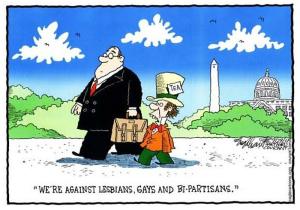 Here’s a taste of the German press as excerpted by Der Spiegel.
Munich’s national Süddeutsche Zeitung offers a slightly more depressing take, pointing blame at all sides. “What has already been apparent in America for a few years now is the self-destruction of one of the world’s oldest democracies. And the great tragedy here is that this work of destruction isn’t being wrought by enemies of democracy, greedy lobbyists or sinister major party donors. America’s democracy is bring broken by the very people who are supposed to be carry and preserve it: the voters, the parties and the politicians.”
The argument? The Republicans who have brought Washington to stillstand are repeatedly and democratically elected by voters and given a mandate to block. The parties themselves are fomenting an increasingly radicalized culture that deepens political, societal and geographic divisions in the country, argues the newspaper. And finally, there are few politicians in America who are willing or capable of thinking beyond their own electoral constituencies.
“At the moment, Washington is fighting over the budget and nobody knows if the county will still be solvent in three weeks,” the paper concludes. “What is clear, though, is that America is already politically bankrupt.”
America enjoys the “exorbitant privilege” of printing the world’s reserve currency. Its government debt is considered a safe haven, which is why Uncle Sam can borrow so much, so cheaply. America will not lose these advantages overnight. But anything that undermines its creditworthiness—as the farce in Washington surely does—risks causing untold damage in the future. It is not just that America would have to pay more to borrow. The repercussions of an American default would be both global and unpredictable.
It would threaten financial markets. Since American Treasuries are very liquid and safe, they are widely used as collateral. They are more than 30% of the collateral that financial institutions such as investment banks use to borrow in the $2 trillion “tri-party repo” market, a source of overnight funding. A default could trigger demands by lenders for more or different collateral; that might cause a financial heart attack like the one prompted by the collapse of Lehman Brothers in 2008. In short, even if Obamacare were as bad as tea-party types say it is (see Lexington), it would still be reckless to use the debt ceiling as a bargaining chip to repeal it, as some Republicans suggest.
What can be done? In the short term, House Republicans need to get their priorities straight. They should pass a clean budget resolution without trying to refight old battles over Obamacare. They should also vote to raise the debt ceiling (or better yet, abolish it). If Obamacare really does turn out to be a flop and Republicans win the presidency and the Senate in 2016, they can repeal it through the normal legislative process.
An FBI hostage negotiator has some hints on how to deal with petulant Tea Party bomb throwers.

So how did it get to this point? “Its fear-driven behavior,” says Voss. “They get angrier because they feel they’ve been defeated. People notice losses twice as much as they notice wins. It’s a sports metaphor you hear all the time: ‘I hate losing more than I like winning’…I think there’s a very strong sense of loss on their part over what they refer to as Obamacare and resentment over that is carried forward.”
But hostage negotiators aren’t the type to give up hope. “Ultimately, everybody wants success. And there are a lot of definitions of success,” Voss says. “Bottom line, they want to be made to look like they were effective and got things done for their side. So it’s a matter of refocusing on what’s in everybody’s best interests.”
He’s looking to the Obama White House to help start the reset: “I would ask them to start saying, ‘I understand that the people on the other side of the table have the best interests of the American people at heart.’ Simply recognize that. Everybody wants to do what’s best for the American public. Those sorts of statements repeated on a regular basis, it’s the start of dialogue. It’s not concession; it’s the beginning of dialogue.”
But the prison siege mentality Voss describes is exacerbated by an absence of strong calming leadership in the congressional GOP. “Those guys are sitting on the sidelines,” Voss says. “There are quite a few Republican politicians that I have a tremendous amount of respect for that are exceedingly silent these days.” He mentions House Intelligence Committee Chairman Mike Rogers: “I’ve never heard anything out of Mike’s mouth that wasn’t really thoughtful and nuanced.”
Another possible constructive calming voice on the conservative caucus could be former President George W. Bush. “I think there’s a possibility that he would be somebody that you would talk to behind the scenes, and potentially an intermediary himself. I think he absolutely has the ability to be a stabilizing influence.”
But how to do you deal with the hyper-partisan congressional bomb-throwers? “Well it’s like a game of tic-tac-toe with the tantrum throwers,” Voss says. “In tic-tac-toe, if you’re going second, the best you can possibly do is tie—if you play the game. There’s a first-mover advantage. The minute you stop playing that game the first mover advantage goes away. So you don’t play their game at all. That’s the way you respond.”
So, the craziness continues and escalates. If things come apart at the seams, I do not want to be stuck in Bobby Jindal’s Louisiana.
What’s on your reading and blogging list today?
Sequestration Boogie
Posted: March 1, 2013 Filed under: Federal Budget, Federal Budget and Budget deficit, Sequester 39 Comments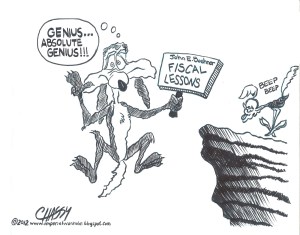 Well, it’s here. It’s the day the Mayans predicted!! It’s the beginning of the end of civilization in the Americas! Sequester Disaster Day is here! Well, it’s here for those of us that like to drive on roads and across bridges. It’s here for those of us that will rely on social security or medicare this month or shortly. It’s here for those of us that have kids in schools or would like to go to university. It’s here for those of us that would prefer to live in a civilized country instead of The United States of Mississippi. For politicians and punditry in the beltway, it’s just another ball where they get to show off their designer formal wear and fancy dance steps.
As the automatic across-the-board spending cuts are set to take effect today and as President Obama meets at the White House with congressional leaders, we have to get this off our chest: This has been an absurd week. Today’s White House meeting is coming only at the last second; there’s been no sense of urgency, no negotiating, and Congress has left town; and, when you think about it, this hasn’t even been a true budget showdown. Given the lack of urgency and negotiating, it’s hard not to conclude that — deep down — plenty of folks on both sides of the aisle are OK with having these cuts take place, at least in the short term.
That’s from Chuck Todd et al. I agree. None of this makes sense if you think of economic policy or actually the idea of governing a country efficiently. I have decided that the only thing Washington cares about is the political dance and political boogie surrounding the process and not what actually happens to the nation. For some reason, these cuts play in the beltway. In that vein, Dave Weigal thinks Obama is winning the process cotillion. Will it’s good some one is winning because there are certainly going to be about 320 million losers out here in the great fly over that exists behind Washington DC and Manhattan.
Republicans have one goal, running through all of these negotiations. They don’t want sequestration to be replaced by tax revenue. Any tax revenue. Forcing the president to swallow $85 billion in cuts this year would do that. They’ve got no obvious alternatives.
But a plan like this exposes a quirk of Obama-era fiscal hawksmanship. Republicans want specific cuts. Some of them—total repeal of Obamacare!—they’ll put on the record. The rest of them, they try to put on the White House. As soon as the “supercommittee” failed and sequestration looked real, it became “the president’s sequester.” The 2011 debt-limit deal delayed real action until after the 2012 election, betting $1.2 trillion of chips on its results and giving them to the president. Even the first great structural victory of the Tea Party, the ban on legislative earmarks, handed more clout to the White House. “The power to make thousands of spending decisions, on everything from which flood control projects will be funded to how spending on military bases will be distributed, to President Obama,” warned two political scientists at the time. Republicans ignored those particular political scientists.
Vote by vote, accidentally, Republicans are endorsing an imperial vision of the presidency. Perhaps they’re picking this up by osmosis. The default position of the punditocracy is that the president must lead. The lazy pundit invokes Harry Truman’s desk ornament, “The Buck Stops Here,” as a totem of great wisdom. Brendan Nyhan, who isn’t lazy, calls this “the Green Lantern Theory of the Presidency,” after the D.C. Comics superhero and his ring that runs on willpower. Bob Woodward offered a sterling example of the theory this week, when he suggested that the president’s willingness to obey the Budget Control Act (the law that mandates sequestration) was “madness.”
See, I actually think they all must want all these cuts. They are so far removed from any impact that any of this would actually have that they’re just ignoring it. As a matter of fact, the similarly out of touch punditry likes the idea of it too. Let me offer of this from Ygelasias:”A Cheer or Two for Sequestration“.
But on the merits it seems to me that while sequestration is hardly optimal budget policy, it really isn’t all that bad in the scheme of things, and really going through with it would be better than repealing it. The key reason is that fully half the cuts are cuts to “defense” spending, and yet nobody from either party is seriously trying to maintain that America will be left defenseless in the wake of this reduced military spending. The specific sequestration mechanism is clearly awkward and clumsy, but again nobody’s saying the Mexican army is going to come swarming over the border to reconquer Santa Fe, that the Taliban is now going to be able to outspend the Pentagon, or that America’s NATO allies are now left unable to fend off a Russian invasion. That’s half the cuts with basically zero real public policy harm.
So then you look at the domestic side. Your basic transfer payments to poor people are spared, your transfer payments to the elderly are basically spared, and then everything else gets cut willy-nilly. That leads to some real policy harms. Valuable research grants are going to not happen. We’ll see some real bottlenecks at regulatory agencies. But obviously there’s some waste and fat in this domestic discretionary spending.
Long story short, if you’re a defense dove like me and have a nonutopian view of the domestic discretionary budget, then this looks like we’re mostly talking about harmless spending cuts.
This from a man who had to get a wife from an on line dating service which is basically the equivalent of a mail order bride. How much do you have to hate yourself to troll around online for an equally desperate person?
Let me just return to the economic impact of all of this.
Yes, the across-the-board spending cuts will lead to hundreds of thousands of job losses and a fiscal drag of 0.6 percent for 2013, according to the forecasting firm of Macroeconomic Advisers. Mostly, though, the rub is the timing and the inartful nature of the cuts.
“It would clearly be preferable to have a more orderly process for fiscal adjustment than the indiscriminate effects of sequestration,” wrote Macroeconomic Advisers in a recent research note.
The inopportune moment of sequestration — hitting just as the economy shows bright spots — will create a drag on the economy in a slow-motion manner. First, the furlough notices will go out in March to federal employees, the majority of whom live outside of the Washington metro area. Unemployment checks will drop as early as April for the long-term unemployed who receive the federal benefit checks.
States eventually will have to decide how to cut programs for low-income or vulnerable people that are funded through federal grants, such as child-care assistance, nutrition programs for women and children, mental-health services, and meal programs for senior citizens.
If Congress keeps the sequester cuts in place for a few months, then the economy will start to feel the effects. Federal workers furloughed for as many as 22 days between mid-April, when the furloughs are expected to begin to occur, and the end of the fiscal year will face a pay cut of as much as 20 percent. This will have ripple effects throughout the economy on consumer spending as well as state income and sales taxes.
By July, August, and September, the impact of sequestration should be fully felt. “We’re not going to go into a downward spiral overnight, but the spending cuts will build, and as they build, the effects will become noticeable,” says Nigel Gault, the chief U.S. economist of IHS Global Insight.
Already, the economic data showed a dip in federal-government spending for defense in the first quarter, a reaction to the impending cuts.
That is the real takeaway of the sequester and its economic impact. It will not hurt the economy immediately, but it still serves as a reminder of the power the federal government holds over the economy. Even if the government cannot enact policies to boost growth, it certainly can hurt the long-term prospects.
I’d really like to know why politicians these days are united in making most people’s lives worse off while maintaining things like preferable tax treatment for people that are already better off than nearly 99.9 % of the people living on the planet? The only thing I can figure out is that none of this impacts any of them so they could care less. It’s not about what happens to the nation or to its people. It’s like they’re teenagers at a country club dance. The only thing that matters is who dances with who and how they each will be perceived in the outfit they’ve chosen. Meanwhile, what will be the cost to the country in the eventual crime and social unrest? Ah, who cares, just buy stock in the latest company that runs the privatized jails. It’s a sure winner.
The Sequestration Blues: Part 2 Pete Peterson Creates a Crisis
Posted: February 26, 2013 Filed under: Austerity, Barack Obama, Catfood Commission, Economy, Federal Budget, Federal Budget and Budget deficit | Tags: Astroturf, Deficit Delusion, deficit hawks, Deficit Hysteria, Fix the Debt, Pete Peterson, Simpson-Bowles 13 Comments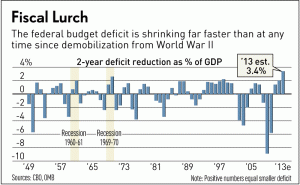 Ben Bernanke joined the chorus of economists concerned about the impact of the sequester on the sluggish recovery. This is not the first time the Fed chair has commented on misguided and dysfunctional Fiscal Policy in our country.
Federal Reserve Chairman Ben Bernanke warned Congress risks slowing the economy by allowing $85 billion in automatic spending cuts to be triggered on Friday, arguing they should be replaced with more deliberate, long-term cuts.
In prepared testimony for the Senate Banking Committee, Bernanke argued the sequester would pose a “significant headwind” to the economic recovery.
“Given the still-moderate underlying pace of economic growth, this additional near-term burden on the recovery is significant,” he warned.Bernanke did not offer an opinion on whether tax hikes should be included as part of a replacement bill, and he did not call for any specific entitlement reforms.
Meanwhile, the White House released reports on how the expected cuts will impact states. This undoubtedly will trigger more Republican whining on how mean the President continues to be to them as they continue their role as economic agents of chaos.
In Kentucky, home of the Senate Republican leader, Mitch McConnell, residents woke up on Monday to news articles like these: Widespread government spending cuts that begin on Friday will cost 21,484 jobs in the state. A construction project at Fort Knox will come to a halt. Three airports may endure partial shutdowns. Nearly $12 million in grants to public schools would be cut, putting at risk the jobs of 160 teachers and aides. More than 1,000 children would lose access to Head Start.
The White House released warnings for every state on Sunday in the hope that angry voters would besiege Republican lawmakers like Mr. McConnell and the House speaker, John Boehner, to stop the $85 billion in cuts, known as a sequester. President Obama wants to replace the sequester with a mix of tax increases on the rich and less damaging spending reductions. Republicans say they won’t consider any proposal that isn’t all cuts, so the sequester is all but certain to begin this week.
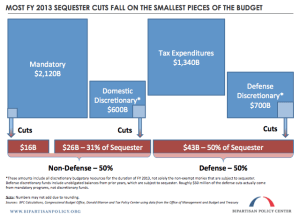 There’s a fairly good list of the types of spending items that will be subject to cuts at the Bipartisan Policy Center.
Setting aside the magnitude of the reductions, the most difficult aspect of both the defense and domestic cuts is that they will be made across the board to all non-exempt government spending regardless of programs’ merits or demerits.*** The reductions designed by law are executed at the Program, Project & Activity (PPA) level of the federal budget, sometimes defined in appropriations bills and which often includes very granular categories of expenditures, such as “two Virginia Class Submarines” or “salaries and benefits” of a particular agency.
Absent a new law passed by Congress, the president has little ability to spare one type of spending and cut more from another. This creates uncertainty in both the public and private sector because there remains much to be determined about how PPAs will be defined by agency administrators and how the cuts will be implemented. This inability to plan is already acting as a drag on economic growth.
Furthermore, the immediate and across the board nature of the cuts, along with their magnitude concentrated in a seven-month period, will impair economic growth as the year progresses. At BPC, we estimated last year that the sequester would reduce 2013 gross domestic product (GDP) growth by half a percentage point, and would cost the economy approximately one million jobs over the next two years. More recent estimates released by the CBO and Macroeconomic Advisors have roughly confirmed these projections.
Given all of this, you would think that most congress critterz would want to avoid the sequester. However, there’s that same group of tea party crazies that are so disconnected from an evidence-based reality it appears congress will tank the economy rather than develop a cogent Fiscal Policy related to economic theory and the state of the economy itself.
The White House strategy on the sequester was built around a familiar miscalculation about Republicans. It assumed that, in the end, they would be reasonable and negotiate a realistic alternative to indiscriminate cuts. Because the reductions hurt defense programs long held sacrosanct by Republicans, the White House thought it had leverage that would reduce the damage to the domestic programs favored by Democrats.
It turns out, though, that the defense hawks in the party are outnumbered. More Republicans seem to care about reducing spending at all costs, and the prospect of damaging vital government programs does not seem to bother them. “Fiscal questions trump defense in a way they never would have after 9/11,” Representative Tom Cole, a Republican of Oklahoma, told The Times. “But the war in Iraq is over. Troops are coming home from Afghanistan, and we want to secure the cuts.”
Cuts this draconian have no place in a tottering economy. But, realistically, the only way to break this standoff is for the cuts to exact their toll on daily life, causing Republicans to face pressure from the public to negotiate an alternative plan with higher revenues in March as part of talks to finance the government for the final six months of the fiscal year.
It’s difficult to believe that so many folks can be so misguided about the need to drastically cut the budget. Read the rest of this entry »
A Tale of Two Sequesters in multiple chapters — Chapter 1:WTF is this thing?
Posted: February 20, 2013 Filed under: Federal Budget, Federal Budget and Budget deficit, Sequester 26 CommentsI’ve been avoiding this unpleasant subject because I was hoping dynamics would change and maybe patriotism, reason, or some 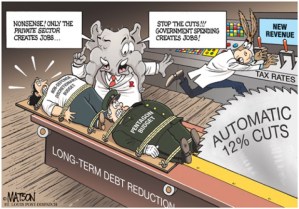 semblance of sanity would strike the elected officials in the beltway. That was wishful thinking on my part and now I feel compelled to give you some background information on sequesters in general and this one in particular. This just highlights how dysfunctional our political system has become and it really is a good demonstration of how politicians don’t tend to really get at the real problems. Let me just say that the real future source of any federal deficit problem is the monumental increases in the cost of health care. We have a completely dysfunctional third party payer system in this country as well as astronomical costs for drugs and care whose actual prices are well beyond the knowledge of actual consumers. That being said, let’s proceed to the side shows that our congress keeps setting up to tank our economy.
This isn’t the first time congress and an administration has used a sequester when it’s been unable to arrive at a budget. Usually, this comes from an inability to arrive at the same budget priorities that comes from having mixed party control of legislative bodies and the White House. You know the general approaches by each party. Republicans are no longer supportive of any kind of revenue enhancements or cut in military spending. Democrats have been more accommodating but tend to draw the line at some point when it comes to destroying the safety net and entitlement programs along with the other basic functions that government provides that the private sector just can’t do either economically or effectively. So, once you get this stand off, a sequester is used to force both sides to the bargaining table.
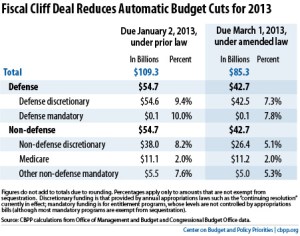 A sequester is basically an automatic reduction in Federal Spending during a budget year. We had a January 2 Fiscal Cliff deal that postponed the sequester until March 1. This is what will happen if nothing is done.
The deal sliced the scheduled 2013 sequestration by $24 billion, from $109.3 billion to $85.3 billion. This reduces the percentage cuts in full-year funding for most eligible programs (those that the law does not exempt from the automatic cuts). The Medicare percentage does not drop, however, because Medicare cuts were and are still capped at 2 percent, and the across-the-board cut that applies to other non-defense programs remains larger than 2 percent.
The chart and the narrative come from the Center on Budget and Policy Priorities which is a great source of information.
The first of the sequesters happened when I was fresh out of graduate school back in the mid 1980s. You’ll probably recognize the names of the usual agents of economic chaos from the Reagan years: Gramm-Rudman-Hollings–Balanced Budget and Emergency Deficit Control Act of 1985. Oddly enough, the Supreme Court found the bill unconstitutional saying that it gave Congress too much power over the budget. They had to rewrite it and it repassed in 1987.
The Balanced Budget and Emergency Deficit Control Act of 1985 (Graham-Rudman-Hollings) was an amendment to a bill that allowed the debt ceiling to be raised to over $2 billion. It created a five-year deficit reduction plan, with decreasing deficit targets each year, until the budget would be balanced in fiscal year 1991. If deficit goals were not met in any given year, a process of automatic spending cuts termed “sequestration” would take place. Fifty percent of the cuts would come from domestic discretionary spending and fifty percent from defense. Social Security, Medicare, several anti-poverty programs, and interest on the debt were exempted from a potential sequester.
Gramm-Rudman-Hollings garnered bipartisan support and was signed into law by President Reagan in December 1985. Most Republicans in the House and Senate voted for it, while the Democratic vote was split nearly evenly in both chambers. Those in favor of the bill argued that the budget deficit, which had greatly increased since 1981, required dedicated measures to reign [sic] in federal spending. Democrats who voted “no” argued that budget cuts were likely to impact domestic programs while leaving military spending largely intact. Nevertheless, the Reagan administration opposed the mandated fifty percent cuts in defense spending in a potential sequester and provided only lukewarm support for the measure.
They assume a fiscal multiplier of 1.4 for general government spending, which is Moody’s Analytics most recent public estimate of the government spending multiplier. While we use the same multiplier for all cuts, we’d guess that these likely slightly overstate the adverse economic impact resulting from defense spending cuts and understate job losses from domestic spending cuts. Budgetary programs for lower-income households in the discretionary budget—such as housing assistance and the special supplemental food program for women, infants, and children (WIC)—as well as infrastructure spending have particularly high multipliers. And to the extent that cuts to spending by the Department of Defense come from capital-intensive weapons acquisitions rather than reductions in personnel strength, the impact on employment would be milder. Regardless, any cuts in the near-term (unless they are ploughed into more spending somewhere else) are going to constitute a drag on the still-weak recovery. Cutting government spending reduces aggregate demand and worsens joblessness while the economy is running well below-potential output.
The new study was performed by Thomas Hungerford of the non-partisan Congressional Research Service. Though the study is not a CRS product, Hungerford’s data is widely cited on both sides; he’s an impeccably objective analyst.
Here’s what Hungerford found: The single greatest driver of income inequality over a recent 15 year period was runaway income from capital gains and dividends.
This finding is directly relevant to the current debate, because Obama and Democrats want to offset the sequester in part by closing loopholes enjoyed by the wealthy, such as the one that keeps tax rates on capital gains and dividends low. Dems want to do this in order to prevent a scenario where the sequester is averted only by deep spending cuts to social programs that could hurt a whole lot of poor and middle class Americans. Republicans oppose closing any such loopholes and want to avert the sequester with only deep spending cuts.
Hungerford’s report, like all serious examinations of inequality, is very complicated. He looks at a bunch of recent data on inequality from the period from 1991-2006 — measured by the so-called “Gini index” — and calculates the degree to which various factors exacerbated it. Hungerford found that over that period, the rise in the Gini index (a story that’s been widely told elsewhere, one that’s largely been driven by the runaway wealth of the top one percent and top 0.1 percent) was driven mainly by the rise in capital gains and dividends income.
“By far, the largest contributor to increasing income inequality (regardless of income inequality measure) was changes in income from capital gains and dividends,” the report concludes.Or, as Hungerford put it in an interview with me: “The reason income inequality has been increasing has been the rising income going to the top one percent. Most of that has come in capital gains and dividends.”
In other words, wealthy beneficiaries of low tax rates on capital gains and dividends are doing extremely well — and their runaway wealth is a major driver of income inequality. There’s a lot of that money out there that could be taxed as ordinary income — as Obama and Dems want — as a way to avert the sequester, which could badly damage the economy. Republicans oppose this.
This finding comes as even some conservatives are reckoning with the fact that the GOP’s message on the sequester is deeply flawed. Writer Byron York notes today that Republicans are openly conceding that the sequester will gut the military, even as they openly point to the sequester as an acceptable policy outcome.
Unemployment fell to 4.1% by the end of last year – a record low for at least 25 years. Poverty has fallen by 27% since 2006. Public spending on education has more than doubled, in real (inflation-adjusted) terms. Increased healthcare spending has expanded access to medical care, and other social spending has also increased substantially, including a vast expansion of government-subsidised housing credit.
If all that sounds like it must be unsustainable, it’s not. Interest payments on Ecuador’s public debt are less than 1% of GDP, which is quite small; and the public debt-to-GDP ratio is a modest 25%. The Economist, which doesn’t much care for any of the left governments that now govern the vast majority of South America, attributes Correa’s success to “a mixture of luck, opportunism and skill“. But it was really the skill that made the difference.
Correa may have had luck, but it wasn’t good luck: he took office in January of 2007 and the next year Ecuador was one of the hardest hit countries in the hemisphere by the international financial crisis and world recession. That’s because it was heavily dependent on remittances from abroad (eg workers in the US and Spain); and oil exports, which made up 62% of export earnings and 34% of government revenue at the time. Oil prices collapsed by 79% in 2008 and remittances also crashed. The combined effect on Ecuador’s economy was comparable to the collapse of the US housing bubble, which contributed to the Great Recession.
And Ecuador also had the bad luck of not having its own currency (it had adopted the US dollar in 2000) – which means it couldn’t use the exchange rate or the kind of monetary policy that the US Federal Reserve deployed to counteract the recession. But Ecuador navigated the storm with a mild recession that lasted three quarters; a year later it was back at its pre-recession level of output and on its way to the achievements that made Correa one of the most popular presidents in the hemisphere.
How did they do it? Perhaps most important was a large fiscal stimulus in 2009, about 5% of GDP (if only we had
done that here in the US). A big part of that was construction, with the government expanding housing credit by $599m in 2009, and continuing large credits through 2011.
But the government also had to reform and re-regulate the financial system. And here it embarked on what is possibly the most comprehensive financial reform of any country in the 21st century. The government took control over the central bank, and forced it to bring back about $2bn of reserves held abroad. This was used by the public banks to make loans for infrastructure, housing, agriculture and other domestic investment.
It put taxes on money leaving the country, and required banks to keep 60% of their liquid assets inside the country. It pushed real interest rates down, while bank taxes were increased. The government renegotiated agreements with foreign oil companies when prices rose. Government revenue rose from 27% of GDP in 2006 to over 40% last year. The Correa administration also increased funding to the “popular and solidarity” part of the financial sector – co-operatives, credit unions and other member-based organisations. Co-op loans tripled in real terms between 2007 and 2012.
The end result of these and other reforms was to move the financial sector toward something that would serve the interests of the public, instead of the other way around (as in the US). To this end, the government also separated the financial sector from the media – the banks had owned most of the major media before Correa was elected – and introduced anti-trust reforms.
Of course, the conventional wisdom is that such “business-unfriendly” practice as renegotiating oil contracts, increasing the size and regulatory authority of government, increasing taxes and placing restrictions on capital movements, is a sure recipe for economic disaster.

 peej
peej Carissa
 bostonboomer
 dakinikat
 ecocatwoman
 mablue2
 Mama Lopez
 peggysue22
 quixote
 skydancingguestblogger
 Mona (aka Wonk the Vote)



 Sky Dancing
Recent Comments