
Mostly Monday Reads: Making China Great Again
Posted: March 16, 2026 Filed under: #FARTUS, #We are so Fucked, iran, Making China Great Again | Tags: @johnbuss.bsky.social John Buss, Cadet Bonespur's Iran War, Epstein Files, Making China Great Again, NATO 4 Comments
“I’m actually surprised MAGA didn’t put on an alternative Oscar Award Show this year.” John Buss, @repeat1968
Good Day, Sky Dancers!
I’d just like to gripe about one thing today. Humor me. Is it just me, or does everything seem messed up in this country? I’m starting to have visions of us in a Dystopian SyFy movie where the AI in computers decides the best way for financial institutions to make money and gets some sort of cosmic jolly out of making sure something shipped with a commercial deliverer as late as fuck. Also, all inventory systems appear to have certain items that are always gone, even when the company, like Amazon or Walmart, has traditionally had a super inventory system. I’m pretty sure the DOGE thing has messed up student loan and Social Security functions. And wow, now we are completely screwed when it comes to anything that needs petroleum products. It’s like Artificial Intelligence and The Trump Regime Dysfunction have joined together to make our lives miserable.
I’d like to highlight this Substack of Dr. Paul Krugman this morning. “No, America is Not Respected. Thanks to Trump, we’re held in contempt even by our closest allies.” Trump is actually making China great again. They are the obvious winner of all this.
There’s a real Baghdad Bob feel to pronouncements from the Trump administration these days. The war is going great! We’ve been totally victorious! Also, other countries — including China! — must immediately send ships to escort oil tankers through the Strait of Hormuz, which the U.S. Navy isn’t doing because it’s too dangerous.
But this has been the pattern ever since Trump returned to power. Despite repeated failures to deliver on his campaign promises — remember how he was going to cut energy prices in half? — he and his minions have continually insisted that everything is wonderful, that everything they do is a triumphant success story. And he’s still doing it. On Thursday, he told a rally that
Inflation is plummeting, incomes are rising, the economy is roaring back and America is respected again.
As I and others have documented ad nauseam, none of those economic assertions are true. Today, however, I want to focus on the bolded claim. Trump constantly insists, in speeches and social media posts, that he took over a weak, despised nation and restored its international reputation. This is clearly something that matters a lot to him and his sense of self-worth.
It’s also the total opposite of the truth.
A stunning poll from Politico — just released, but taken last month — confirms what I and other observers strongly suspected: America is now widely despised, despised like nobody has ever been despised before.
I don’t mean that we’re disliked, although that too. But this isn’t a case of oderint dum metuant — let them hate so long as they fear. Instead, the world increasingly holds America in contempt.
Our former friends no longer consider us trustworthy.
And they no longer believe that being a U.S. ally offers protection, that a good relationship with America will deter potential enemies from attacking them.
At this point, a plurality of the population in every one of our erstwhile allies considers China a more reliable partner than the United States.
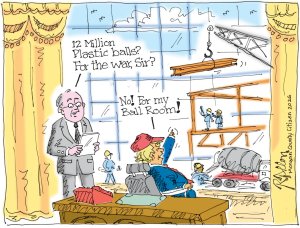 Check the graphs and more at the link. Jonathan V. Last, writing at The Bulwark, has this analysis today.
If you want to understand the difference in the quality of strategic thinking between Washington and Tehran, consider the messages being sent out over the last three days:
Washington: The war is over. We’ve defeated Iran totally. If other countries don’t come in and help fight Iran they will regret it. Especially our terrible allies, like Great Britain. Please, President Xi, come help us re-open the Strait of Hormuz?
Tehran: We will continue to resist, however we are open to allowing oil transport in the strait that we control provided the product is sold in yuan and not dollars.
I have been saying since the beginning that America is playing checkers while Iran plays chess, but it’s worse than that. American leadership is utterly incoherent: We won, but we need help. We hate our allies; but will our adversaries please come bail us out?
Meanwhile Iranian leadership survived a transition of power in the midst of war, achieved its strategic objective in closing the strait, and is now looking to leverage China’s rising economic ambitions against the United States.
I cannot overstate how significant it would be if Iran and China reached an agreement to allow oil transport under condition of a switch from the dollar to the yuan,1 so here’s European Business:
The condition, if formalised, would represent the most significant challenge to the petrodollar system in its fifty-two-year history, striking at the financial architecture that underpins American global power rather than at US military assets. . . .
To understand why the yuan condition matters, it is necessary to understand what the petrodollar system actually is. Born from the Nixon shock of 1971 and formalised in 1974, the arrangement under which Saudi Arabia and the broader Gulf agreed to denominate all oil sales in US dollars created a self-reinforcing loop that has governed global finance ever since. Because oil—the world’s most traded commodity—must be purchased in dollars, every nation that imports energy must first acquire dollars. Every central bank holds dollar reserves for precisely this reason. The dollar’s status as the world’s primary reserve currency is not an abstract achievement; it flows directly and mechanically from oil. . . .
[Iran] is proposing that access to the world’s most critical energy chokepoint be conditional on currency denomination.
The practical consequence, if even partially adopted, would be a bifurcated global oil market: yuan-denominated barrels flowing through Hormuz for those willing to pay in China’s currency, dollar-denominated barrels rerouted at significant additional cost and time for those who are not. The war premium that Western energy importers are already absorbing would become structural rather than temporary.
I don’t know how to make people care about this except to say that if Iran and China made this deal it would absolutely be the beginning of the end of the dollar backstopping the global financial order. The long-term cost to America would be incalculable.
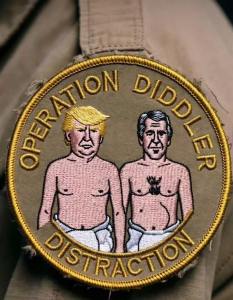 As I said, he’s making China great again. As for NATO, I think Orange Caligula has managed to blow it up. This is from Reuters. It’s the news behind all that analysis. “US allies rebuff Trump’s request for support in Strait of Hormuz.”
BERLIN/BRUSSELS/LONDON, March 16 (Reuters) – Several U.S. allies said on Monday they had no immediate plans to send ships to unblock the Strait of Hormuz, rebuffing a request by President Donald Trump for military support to keep the vital waterway open.Trump called on nations to help police the strait after Iran responded to U.S.-Israeli attacks by using drones, missiles and mines to effectively close the channel for tankers that normally transport a fifth of global oil and liquefied natural gas.
Politico’s Nette Nosslinger has more details. “Germany to Trump: We won’t help you reopen the Strait of Hormuz. Berlin says Iran is “not NATO’s war.”
Germany’s government rejected U.S. President Donald Trump’s demand that NATO allies help secure the Strait of Hormuz, declaring that the alliance had no place in the war.
“This war has nothing to do with NATO. It’s not NATO’s war,” Stefan Kornelius, a spokesperson for German Chancellor Friedrich Merz, told reporters in Berlin on Monday. “NATO is a defensive alliance, an alliance for the defense of its territory,” he added.
Trump had warned NATO allies on Sunday they face a “very bad future” if they refuse to help secure the Strait of Hormuz, pressing Europe to support an American effort to reopen the key maritime corridor.
The German government said it would not assist in that effort as long as the war rages on.
“As long as this war continues, there will be no involvement, not even in an option to keep the Strait of Hormuz open by military means,” Kornelius said, adding that he was not aware of an official request by the U.S. government to Germany to take part in such a mission.
“I would also like to remind you that the U.S. and Israel did not consult us before the war, and that Washington explicitly stated at the start of the war that European assistance was neither necessary nor desired,” Kornelius said.
 Heather Cox Richardson puts it into perspective at her SubStack “Letters from an American.” We had quite the Ides of March yesterday; however, the Roman version was a bit more successful in ridding themselves of the bad guy.
Today, as the country enters its third week of war against Iran, President Donald J. Trump was on the golf course, illustrating the observation of journalist E.J. Dionne in the New York Times that “from the very beginning of this war, we got a sense that there wasn’t a great deal of serious thought put into it by the president of the United States about how it might end, what our objectives were, what needed to be done to protect Americans who are in the Middle East, what might happen to oil in the Strait of Hormuz.”
Although the administration appears to be trying to convince Americans that the U.S. military’s destruction of the Iranian military means the U.S. has won the war, Iranian leadership needed simply to continue in power to declare victory. Then, blocking the 20% of the world’s oil that flows through the Strait of Hormuz would give them leverage over the war’s outcome.
On March 10, Helene Cooper and Eric Schmitt of the New York Times reported that senior defense officials told them the Iranian military is adjusting its tactics to strike at the communications and defense systems protecting U.S. troops. Those tactics include drone strikes. The same day, Marc Caputo, Barak Ravid, and Colin Demarest of Axios reported that Ukrainian officials had tried several months ago to sell the U.S. anti-drone technology for downing Iran-made drones as a sign of thanks for U.S. support and as a way to strengthen ties between the U.S. and Ukraine, but the U.S. did not pursue the offer.
White House spokesperson Anna Kelly responded: “This characterization made by these cowardly unnamed sources is not accurate and proves that they are simply outside looking in. [Defense] Secretary [Pete] Hegseth and the armed forces did an incredible job planning for all possible responses by the Iranian regime, and the undisputed success of Operation Epic Fury speaks for itself.”
And yet the fallout from the strikes on Iran by the U.S. and Israel appears to have caught the administration by surprise. Trump told Kristen Welker and Alexandra Marquez of NBC News yesterday that he was “surprised” that Iran attacked other countries after the U.S. and Israeli strikes. He also said strikes on Saturday on Kharg Island, which is about fifteen miles off the Iranian coast and is home to Iran’s primary oil export terminal, “totally demolished” most of the island but that “we may hit it a few more times just for fun.”
President Donald J. Trump posted on social media Saturday morning: “Many Countries, especially those who are affected by Iran’s attempted closure of the Hormuz Strait, will be sending War Ships, in conjunction with the United States of America, to keep the Strait open and safe. We have already destroyed 100% of Iran’s Military capability, but it’s easy for them to send a drone or two, drop a mine, or deliver a close range missile somewhere along, or in, this Waterway, no matter how badly defeated they are.”
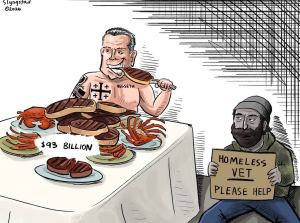 Well, that didn’t happen, did it? China is full-speed ahead in transitioning away from its fossil-fuel-based energy grid. Trump still shakes his fist at windmills. I did enjoy Kyle Cheney’s take at Politico. “Trump is losing one battle after another. Cue the posts. The president’s Sunday night diatribe was most notable for his attacks on the highest court in the land.”
President Donald Trump is increasingly at the mercy of forces he unleashed but can’t control — so he’s taking aim at the umpires.
Gas prices surging. Unemployment climbing. War with Iran threatening to engulf his presidency. The fracturing of his political coalition. The collapse of his signature trade-negotiations-by-tariff strategy. Relentless scrutiny of the Epstein files. A public backlash to his agenda that could swamp Republicans in the midterms. Failure after failure to criminalize the conduct of his political adversaries.
So it was, in a fit of Sunday night fury that set Washington’s armchair psychoanalysts ablaze, that the president channeled his rage at the few functioning checks on his power: the media, independent regulators and — most pointedly — the federal judiciary.
Trump’s Sunday night outburst took on all of them, but it was most notable for how he cast the Supreme Court — one that has staved off the destruction of his agenda and even his own criminal prosecution — as “a weaponized, and unjust Political Organization.”
“This completely inept and embarrassing Court was not what the Supreme Court of the United States was set up by our wonderful Founders to be,” the president blared on Truth Social. “They are hurting our Country, and will continue to do so.”
It was a remarkable attack. Until the Feb. 20 tariff ruling, the Trump administration had been touting its winning streak at the Supreme Court. The justices have salvaged Trump’s broadest efforts to end legal protections for hundreds of thousands of noncitizens in the United States, allowed him to assert unprecedented control of once-independent agencies and unilaterally slash congressionally authorized spending.
The court, as Trump knows, is arguably responsible for his return to power in the first place: The justices blocked an effort by some blue states to keep Trump off the 2024 ballot by labeling him an insurrectionist responsible for the Jan. 6, 2021 attack on the Capitol. And the court’s decision to adopt a sweeping view of presidential immunity helped stave off special counsel Jack Smith’s most potent criminal case against Trump.
But to Trump, that’s ancient history.
The core of the attack is the frustration that Trump often exhibits when he brushes up against the limits of his power. He spent Sunday lashing out at the news media, cheering on FCC Chair Brendan Carr’s threat to revoke broadcast licenses for stations that report unfavorably on the war in Iran, and lamenting his inability to control the independent Federal Reserve’s interest rate decisions.
Trump describes the high court’s recent rejection of his unfettered ability to levy tariffs against American trading partners as a deeply personal affront — one that contradicted the ethos of his entire decade in public life.
Since the stinging tariffs decision last month, Trump has seemed fixated on the ruling, weighing in against the high court every few days.
“Our Country was unnecessarily RANSACKED by the United States Supreme Court,” he wrote Sunday.
I’m not sure I’d call this a Come-to-Jesus moment for the Supreme Court. Maybe Roberts doesn’t want to go down as the worst Chief in history. Your guess is as good as mine. And once more, we have more Epstein stories. Basically, you have to chase them down to read about them. Here’s something from The Guardian. “‘Attention will swing back’: Epstein outrage unlikely to subside despite Trump’s Iran war. Advocates say 24/7 coverage of US attacks will not last for ever – and spotlight will return to Epstein and his crimes.”
As the US woke to news that Donald Trump had bombed Iran, domestic discord was fast simmering.
There was unrelenting outrage over ICE raids. There was frustration with the rising cost of living. There was fear over rocketing healthcare prices, mounting household debt, not to mention many Americans’ nagging sense of desperation in a country, some warned, where democracy itself was under threat.
And then there was Jeffrey Epstein.
During his third presidential run, Trump promised to release investigative files involving someone Trump had once called a “terrific guy”. This pledge served as ideological catnip to the far-right flank of Trump’s base, many of whom believe that a cabal of elite figures participated in Epstein’s trafficking of teenage girls.
Trump’s administration botched the initial release, however, with his justice department disseminating documents in dribs and drabs before announcing in July that there would be no more disclosures – spurring backlash among longtime supporters. In a rare display of bipartisanship, members of Congress took matters into their own hands, conducting their own investigations and passing the Epstein Files Transparency Act in November.
Trump, despite repeatedly calling the Epstein files a “hoax”, signed the bill into law. His justice department had 30 days to disclose publicly all Epstein files, with rare exceptions.
Trump’s DoJ did not meet Congress’s deadline, disseminating one tranche at the 30-day mark and several others days and weeks later – including a 3 million document disclosure on 30 January – prompting still more ire from opponents and some diehard supporters who believe more files remain.
But now US headlines are dominated by the US-Israel attack on Iran – and the economic and diplomatic chaos it has unleashed. Yet advocates and observers say that Epstein-related outrage is still unlikely to die down.
Gretchen Carlson and Julie Roginsky, who pursued sexual harassment claims against former Fox News chief executive Roger Ailes and started the non-profit Lift Our Voices, told the Guardian that the Iran war can draw attention from the Epstein files – but not in perpetuity.
“We all know that the Trump administration is very good at flooding the news market with a lot of different stories every single day, and so it’s very difficult in the news media to keep up with all of them and give them what they all deserve, as far as time [is concerned],” Carlson said.
“The way the news media works, especially on 24/7 cable news, is that you are covering the biggest story of the moment. Right now that appears to be Iran.”
Carlson said she is still seeing Epstein stories – including news that authorities never searched his New Mexico ranch – and said conservative figures’ opposition to the war portends prolonged attention over Epstein.
“Influencers, especially on the right, criticize the Iranian war and the reasons that the United States got involved,” Carlson said. “I believe that will bring us right back to Epstein.”
So, I’ll quit and just say we’re coming apart at the seams in this country. Tech Bros and Bankers and Pedophiles! Oh My!
What’s on your Reading, Action, and Blogging list today?
Finally, Friday Reads: “The Thought of War Blows my Mind”
Posted: March 13, 2026 Filed under: #FARTUS, #MAGAnomics, #We are so Fucked | Tags: Cadet Bonespur's Iran War 5 Comments
“The dumbbeat of war echoes across the world.” @repeat1968, John Buss
Good Day, Sky Dancers!
Gotta thank @repeat1968 for giving me this earworm today, as well as today’s Featured Funny. Today’s topics are War, Inflation, and a domestic terrorist attack on a place of worship. All these are brought to you by the letters #FARTUS. Yes, Cadet Bonespurs with his band of incompetents is doing more damage to the world and our country than most folks thought possible.
We’ve lost more U.S. service members, furthering whatever the Iran War is supposed to be about. This is from NBC News. “All 6 U.S. crew members killed after refueling plane crashes in Iraq. The crash brings the number of U.S. service personnel killed since the Iran war began Feb. 28 to 12. A 13th died of a medical issue.” Watching body counts rise is never a good thing to see constantly in the news. We should’ve learned by now. This sad news is reported by Patrick Smith.
All six U.S. crew members have been confirmed dead after their military refueling plane crashed in Iraq while taking part in Iran war operations, the U.S. military said Friday.
U.S. Central Command said in a post on X early Friday that the KC-135 plane went down at approximately 2 p.m. ET Thursday in western Iraq, with four crew members initially confirmed dead. That statement said “rescue efforts continue.”
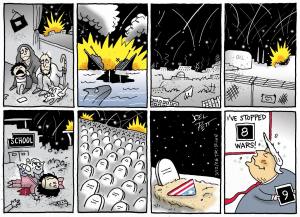
CNN has the headline this morning. “Trump administration underestimated Iran war’s impact on Strait of Hormuz.” Ya think? I’m just glad that my legs, my bike, and the St. Claude Ave bus pretty much take me wherever I need to go these days. You can lessen that earworm by humming Send in the Clowns as you read about what passes as the national security advisors these days.
The Pentagon and National Security Council significantly underestimated Iran’s willingness to close the Strait of Hormuz in response to US military strikes while planning the ongoing operation, according to multiple sources familiar with the matter.
President Donald Trump’s national security team failed to fully account for the potential consequences of what some officials have described as a worst-case scenario now facing the administration, the sources said.
While key officials from the Departments of Energy and Treasury were present for some of the official planning meetings about the operation before it started, sources said, the agency analysis and forecasts that would be integral elements of the decision-making process in past administrations were secondary considerations.
Treasury Secretary Scott Bessent and Energy Secretary Chris Wright have been key players throughout the planning and execution stages of the conflict, the sources acknowledged. But Trump’s preference of leaning on a tight circle of close advisers in his national security decision making had the effect of sidelining interagency debate over the potential economic fallout if Iran were to respond to US-Israeli strikes by closing the strait.
And now it may be weeks before the administration’s efforts to alleviate the intensifying economic fallout take hold, officials said Thursday, including high-risk naval escorts of oil tankers through the strait that the Pentagon believes are currently too dangerous to conduct. The president, meanwhile, has continued to downplay the tumult in energy markets and the danger. He told Fox News that oil tanker crews should “show some guts” and go through the strait.
The reality in the strait has left diplomatic counterparts, former US economic and energy officials and industry executives who spoke with CNN in a state of confusion and disbelief.
More than a dozen vessels have been attacked near Iran since Feb. 28
There have been at least 14 reports of attacks on ships in the Persian Gulf and near the Strait of Hormuz since war broke out between Iran and the US and Israel, according to UK Maritime Trade Operations. The incidents have effectively halted traffic through the vital oil corridor.
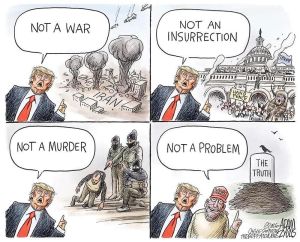 You may read the details at the link. Iran is warning ships in the air that it is also actively mining the area. There appears to be no solutions or discussion on this mess. According to Cade Bone Spurs, we shouldn’t worry about it. This is from AXIOS. “Scoop: Trump claimed in G7 call that Iran is “about to surrender”. Barak Ravid has the lede.
President Trump told G7 leaders in a virtual meeting Wednesday that Iran is “about to surrender,” according to three officials from G7 countries briefed on the contents of the call.
- 24 hours later, Iran’s new supreme leader issued his first public statement vowing to keep fighting.
Why it matters: Trump is as confident about the war’s outcome in private as he is in public. But his assessment is colliding with a more complex reality on the ground.
- The Iranian regime has shown no signs of imminent surrender or collapse — and on Day 14 of the war, is moving to gain more leverage by choking off the Strait of Hormuz.
Behind the scenes: Trump boasted about the results of Operation Epic Fury on the G7 call Wednesday morning, telling allies, “I got rid of a cancer that was threatening us all.”
- While claiming Iran was about to surrender, he also suggested there were no officials left alive in Tehran with the power to make that decision.
- “Nobody knows who is the leader, so there is no one that can announce surrender,” Trump said, according to two officials briefed on the call.
Trump has mocked Iran’s new supreme leader Mojtaba Khamenei as a “lightweight,” previously telling Axios that Ayatollah Ali Khamenei’s son would be “unacceptable” to the U.S.
-
In a message read out on state television Thursday, Mojtaba Khamenei vowed to avenge Iranian “martyrs” and open new fronts in the war “where the enemy has little experience and is highly vulnerable.”
-
Khamenei said Iran will continue to threaten the Strait of Hormuz, where attacks on tankers have already pushed oil prices above $100 a barrel and triggered fears of a global economic crisis.
Meanwhile, the Secretary of War is on the job! Not really! He said this today.
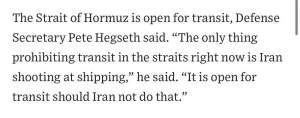
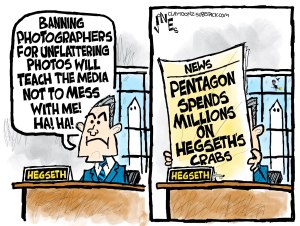
CNBC headlined his little performance this way. “Pete Hegseth on Strait of Hormuz: ‘Don’t need to worry about it’.”
Defense Secretary Pete Hegseth on Friday brushed aside concerns that the effective closure of the Strait of Hormuz because of the Iran war, which has spiked oil prices, would continue being a problem for the U.S. and the world for much longer.
Iran has been “exercising sheer desperation in the Straits of Hormuz,” Hegseth said at a Pentagon press briefing.
“We have been dealing with it, and don’t need to worry about it,” he said.
The price of West Texas Intermediate crude oil on Friday morning was around $93 per barrel. A day before the war began on Feb. 28, a barrel of WTI was selling for about $67.
 I bet that made you feel so much better! I know I’m back to my original earworm now. Economic data make it increasingly clear that the economy was slowing even before Cadet Bone Spurs started his war. Prices were also rising. This is from the AP. “US economy expanded at sluggish 0.7% in fourth quarter, government says, downgrading first estimate.” Let’s see if he blames Democrats and Biden.
The U.S. economy, hobbled by last fall’s 43-day government shutdown, advanced at an unexpectedly sluggish 0.7% annual rate from October through December, the Commerce Department reported Friday in a big downgrade of its initial estimate.
Growth in gross domestic product — the nation’s output of goods and services — was down sharply from 4.4% in last year’s third quarter and 3.8% in the second. And the fourth-quarter number was half the government’s first estimate of 1.4%; economists had expected the revision to go the other way — and show stronger growth.
Federal government spending and investment, clobbered by the shutdown, plunged at a 16.7% rate, hacking 1.16 percentage points off fourth-quarter growth.
For all of 2025, GDP grew 2.1%, solid but down from an initial estimate of 2.2% and from growth of 2.8% in 2024 and 2.9% 2023.
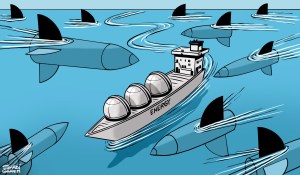 The news from Michigan on the Temple domestic terrorist is beginning to shape the narrative on why it happened. This is from The Detroit News. “Temple Israel synagogue shooter’s family recently killed in air strike.” Damn! There goes that earwig again.
A Dearborn Heights man whose relatives were recently killed in a military strike in Lebanon is the accused assailant in Thursday’s attack on the Temple Israel synagogue in West Bloomfield Township, two sources apprised of the investigation told The Detroit News.
Ayman Ghazali, 41, a restaurant worker in Dearborn Heights, is accused of driving his truck into the synagogue just after noon Thursday and opening fire, before he was shot and killed by security, the sources said. They spoke only on the condition of anonymity because they were not authorized to disclose the details publicly.
Late Thursday night, the U.S. Department of Homeland Security confirmed that Ghazali was the individual who carried out the attack.
Ghazali, a native of Lebanon, was granted U.S. citizenship more than 10 years ago, under the Obama administration, according to the department. He entered the U.S. through Detroit on May 10, 2011, on an immigrant visa as the spouse of a U.S. citizen, a DHS statement said. He applied for naturalization on Oct. 20, 2015, and was granted citizenship on Feb. 5, 2016.
Ghazali’s ex-wife filed for divorce in Wayne County Circuit Court in August 2024, records show. The couple had at least one child, according to court records, and a divorce was granted seven months later, in March 2025. Mohammad Ahmad Moussa, the ex-wife’s divorce lawyer, declined comment when contacted by The News on Thursday.
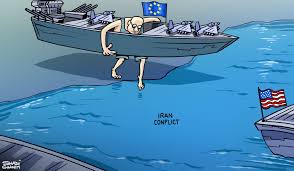 So, here is the headline from The Los Angeles Times, March 1. “Israel hits Lebanon after Hezbollah attacks; in Iraq, militia targets U.S. troops.” How literal are we here about the Eye for an Eye thing in modern times?
- The Israeli military hit Beirut on Monday and urged people in nearly 50 villages in Lebanon to evacuate ahead of possible retaliatory strikes after Hezbollah fired into Israel.
- In Iraq, the Shiite militia Saraya Awliya al-Dam claimed a drone attack on Monday targeting U.S. troops at the airport in Baghdad.
So, I think the world’s pretty fucked up right now, we are doing a lot of that, and I just am going to stop at this now and hope Congress starts fighting this with some integrity and grit.
What’s on your Reading, Action, and Blogging list today?
Mostly Monday Reads: War is Hell
Posted: March 9, 2026 Filed under: "Der Fuehrer's Face", #FARTUS, #MAGAnomics, #We are so Fucked, Iran, Israel/Iran War | Tags: Cadet Bonespur's Iran War, Iran War, Oil Prices Surge, Rationale for Iran War 7 Comments
“The Pieces President” John Buss, @repeat1968
Good Day, Sky Dancers!
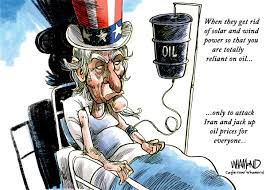
The one thing holding inflation prices down in this country was the price of oil. It peaked in 2023 and began a decline until Orange Caligula launched a full-on attack on Iran and disrupted traffic in the Straight of Hormuz. Such is the result of a madman’s insane policy choices based on revenge, power-grabbing, and greed. It’s like giving a toddler the driving wheel and letting him take you down from a very tall mountain.
It’s not like I didn’t warn everyone to clear out of the stock market and hunker down about a year ago. It’s also just going to get worse. I fortunately cleared out the last of one of my 403(b)s last week to use it to improve the house before it gets any more expensive. I managed to lose only a bit of it, and I’m glad to know the check got cut before the worst hit so far. I can’t promise you that it’s going to get any better either. We’re worse than a Banana Republic. We’ve gone back to something akin to the dark ages with plagues of measles and armed thugs wandering the streets, looking to harm and jail workers and poor people. We can’t even put a bunch of pedophiles in suits into the justice system. What good is our Constitution for if money means you can ignore it
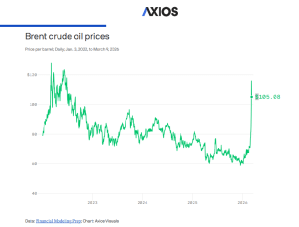
I’m going to start with AXIOS because they always get straight to the point. This analysis is by Neil Irwin, and this absolutely stunning chart provides some visuals. That line covering the first few months of 2026 screams outlier with a discernible reason. To the moon and beyond! It’s also obvious that none of it was Joe Biden’s fault, given the dates accompanying the data points. Okay, I’ll step down from the professor’s podium. I’ll just say economics students will be studying this for as long as universities stand.
In the first week of the American and Israeli attack on Iran, the economic ripples were looking pretty minimal. But as Week 2 begins, the risks to the global economy are growing much more serious.
The big picture: You can’t decapitate the leadership of a country of 90 million people, with expansive military and intelligence capabilities, in the heart of some of the world’s most economically important supply chains, without a huge cost.
- The hours and days and weeks ahead are all about quantifying that cost.
Zoom in: Oil skyrocketed 25% overnight, to just under $120 a barrel, fueling worries that higher energy costs will stoke inflation and curb spending by U.S. consumers. Tokyo’s Nikkei 225 index plunged more than 5%.
- That’s the highest oil price since about four years ago, when energy prices surged due to Russia’s invasion of Ukraine.
- Patrick De Haan — a widely cited gas price expert and an analyst for GasBuddy — estimates there’s an 80% chance the national average gas price will hit $4 per gallon in the next month.
The latest: As of 5am ET, a barrel of the global crude oil benchmark was going for about $107 on futures markets, up 15% from Friday and 47% from 10 days ago, before the Iran attack. Brent crude prices approached $120 overnight before receding on reports of coordinated global action to release oil reserves.
- The oil price rise is poised to translate into a rapid increase in the cost of retail gasoline, which was already up about 51 cents per gallon before the weekend run-up in oil prices.
The risk of a broader economic slump is rising with the disruption to oil supplies. S&P 500 futures are down 1.3% overnight, setting Wall Street up for its third consecutive day of losses.
- Japan’s Nikkei index was down 5.2% and South Korea’s KOSPI down 6%, reflecting those economies’ more direct dependence on Middle Eastern oil now at risk of a protracted blockade.
Of note: The odds of a U.S. recession this year spiked to 38% in overnight trading on Polymarket, from 24% at the start of the month.
State of play: Iran is seeking to block the Strait of Hormuz, which connects the Persian Gulf with the rest of the world, and is threatening to attack ships that seek to pass through.
- The war has already caused the largest oil disruption in history, taking out roughly 20% of the world’s supply, according to Bob McNally, president of Rapidan Energy and a former George W. Bush energy adviser.
- That’s double the previous record set during the Suez Crisis in the 1950s, which disrupted just under 10% of global supply.
- The weekend also brought apparently successful Iranian attacks on desalination plants in the Gulf region that are critical for drinking water.
- President Trump has raised the possibility of U.S. ground forces in Iran.
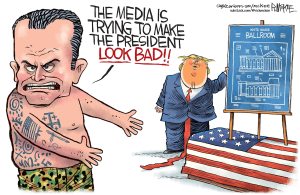 More at the link. CNBC shows the data with more analysis. “Oil prices topped $100 per barrel on record supply disruption, but are off session highs.” We’ll see if that lasts until the markets close this afternoon.
Shortly after oil blasted past $100 at the open of trading Sunday evening, President Donald Trump posted on Truth Social that a gain in “short term oil prices” was a “very small price to pay” for destroying Iran’s nuclear threat.
“Only fools would think differently!” Trump added.
Gulf Arab states are cutting production because they are running out of storage space, as crude piles up with nowhere to go due to the closure of the Strait. Tankers are unwilling transit the narrow waterway because they are worried Iran will attack them.
The closure of the Strait has triggered the biggest oil supply disruption history, according to an analysis by consulting firm Rapidan Energy. About 20% of the world’s oil consumption is exported through the Strait.
Iran’s foreign ministry spokesman warned Monday that oil tankers “must be very careful.”
“As long as the situation is insecure, I think all tankers, all maritime navigation, must be very careful,” Foreign Ministry spokesman Esmail Baghaei told CNBC in an interview.
Kuwait, the fifth-biggest producer in OPEC, announced precautionary cuts Saturday to its oil production and refinery output due to “Iranian threats against safe passage of ships through the Strait of Hormuz.” The state-owned Kuwait Petroleum Corp. did not detail the size of the cuts.
Output in Iraq, the second-biggest OPEC producer, has effectively collapsed. Production from its three main southern oilfields has fallen 70% to 1.3 million barrels per day, three industry officials told Reuters on Sunday. Those fields produced 4.3 million bpd before Iran war.
And the United Arab Emirates, the third-biggest producer in OPEC, said Saturday that it is “carefully managing offshore production levels to address storage requirements.” The Abu Dhabi National Oil Co., or ADNOC, said its onshore operations are continuing normally.
The war showed little signs of easing despite Trump’s claim it was “already won.” Iran named Ayatollah Ali Khamenei’s son, Mojtaba, as its new supreme leader, according to reports. The U.S. and Israel killed Khamenei in the opening days of the war.
Energy Secretary Chris Wright said Sunday that traffic through the Strait will resume after the U.S. has destroyed Iran’s ability to threaten tankers.
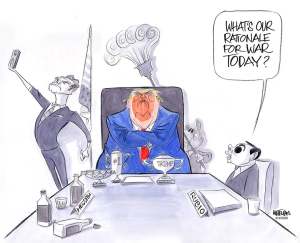 It’s really odd to think that I started my career as an economist during the OPEC maneuvers and I’m winding down my career as one with the US maneuvers. Frankly, I think China is sitting pretty right now. They’ve been doing a lot with alternative energy and have the entire Pacific Region — including many Latin American Countries with oil — undoubtedly rooting for them right now.
Alex Harring at CNBC analyzes the market activity. This is fresh off the ticker today. “Stocks pare losses as oil falls back below $100; Dow is down 300 points: Live updates.”
The Dow Jones Industrial Average fell to start the week as U.S. oil topped $100 a barrel, raising concerns about a stagflationary environment for the U.S. economy of rising inflation and slowing growth.
The 30-stock index fell 293 points, or 0.6%, and is coming off its biggest weekly slide in nearly a year. The S&P 500 lost 0.2%, while the Nasdaq Composite gained 0.2%. That signifies a meaningful turnaround for the three indexes, as the Dow was down nearly 900 points, or 1.9%, at its low of the day, and the S&P 500 and Nasdaq were each lower by around 1.5%.
The broader market was helped off its lows by a rise in semiconductor stocks, however. Broadcom jumped more than 3%, while Micron Technology and Advanced Micro Devices gained almost 2% each. Nvidia climbed more than 1%.
West Texas Intermediate crude broke above $100 per barrel in overnight trading to hit more than $119, its first time above the $100 level since 2022, when investors were reacting to the aftermath of Russia’s invasion of Ukraine. It was last up 6% at around $96 a barrel. International benchmark Brent crude added 7% to $99 a barrel. U.S. oil prices began the year below $60 a barrel.
Oil futures jumped after major Middle East producers slashed their output due to the continued closure of the key Strait of Hormuz passageway. Kuwait announced cuts but did not say by how much, while Iraq has reportedly seen its production fall 70%.
Oil prices later came off their highest levels of the session and stocks rose from their lows following a Financial Times report that G7 officials were considering tapping their strategic reserves. But the publication also reported coordinated release was not ready yet, helping to send major indexes lower.
The Cboe Volatility index — Wall Street’s fear gauge measuring investors seeking protection in the options market — topped 30 for the first time since the market’s tariff driven sell-off in April 2025. It was last above 27.
The $100 oil level was seen by many on Wall Street as a breaking point for the economy unless the war is resolved quickly and prices retreat. Trump posted Sunday evening that a gain in “short term oil prices” was a “very small price to pay” for destroying Iran’s nuclear threat.
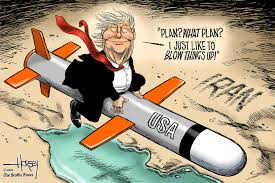 Trump donors are feeling this immediately. Trump voters will shortly see the impact on their budgets and gas prices. I can’t say I feel sorry for any of them, but there’s not a person who won’t feel this one way or another. The Bulwark’s Andrew Egger examines Trump’s seeming confusion over his War.
What did the White House think it was getting into in Iran? A strike against Iran’s oppressive and fanatical regime, sure. A display of America’s awesome military might, definitely. But it’s become increasingly, painfully clear: They didn’t think there was going to be a war.
The Trump administration developed no real theory of the objectives of the Iran war, because they didn’t think there was going to be a war. Instead, the administration has backfilled a dizzying array of post-hoc goals for the strikes against Iran. Judd Legum counts seventeen different rationales offered by many different officials, from the president’s “feeling, based on fact” that Iran was about to strike the United Statesto a desire to free the Iranian people to a need to destroy a nuclear program the White House had claimed was already “obliterated.”
The Trump administration made no effort to get the American people on board with war, because they didn’t think there was going to be a war. A majority of the public is already opposed to war with Iran, and what support the war does have seems to be based on the questionable assumption that the conflict will be shortly resolved: 44 percent of Americans support the strikes so far, but only 12 percentwould be in favor of sending U.S. ground troops into the country. But the White House has made no broad effort to convince the public on a bipartisan basis that they should be prepared for a long-haul conflict.
They didn’t think there was going to be a war, and so the White House seemingly gave no thought to what the economic ramifications of war would be. After several days of strikes on Iran, President Trump seemed suddenly to realize last week that the ongoing conflict was going to be terrible for energy prices. He tried to slap a band-aid on the problem by announcing risk insurance and military escorts for all oil tankers through the Strait of Hormuz, but it wasn’t enough: Suddenly, oil prices went through the roof, and the White House was scrambling to contain the damage—rushing to reassure consumers that the price hikes would be temporary and even waiving some sanctions on Russian oil to try to ease pressures on global supply. “Short term oil prices, which will drop rapidly when the destruction of the Iran nuclear threat is over, is a very small price to pay for U.S.A, and World, Safety and Peace,” Trump posted on Truth Social yesterday. “ONLY FOOLS WOULD THINK DIFFERENTLY!”
They didn’t think there was going to be a war, and so the president assumed he’d be in charge of picking Iran’s next political leadership. This plan, admittedly, hit an unexpected snag early on: The initial round of strikes that took out Iran’s top leaders also killed a number of lower-ranking regime figures that the White House had identified as pragmatists who might be willing to negotiate. “The attack was so successful it knocked out most of the candidates,” Trump said a day after the strikes began. “It’s not going to be anybody that we were thinking of because they’re all dead. Second or third place is dead.” Still, Trump made it clear he expected to be involved in picking Iran’s next supreme leader, and absolutely ruled out Mojtaba Khamenei, the son of the slain ayatollah: “They are wasting their time . . . Khamenei’s son is unacceptable to me.” But this morning, Iran went ahead and proclaimed Mojtaba Khamenei their next supreme leader anyway.
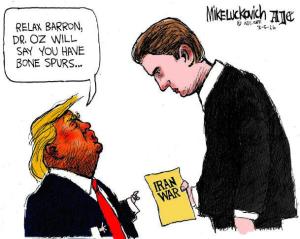
Somehow, the president seems to remain so confident Iran will be buttoned up in no time that he’s already openly licking his chops over the next triumphant blitzkrieg. “Cuba is gonna fall pretty soon, by the way,” Trump told CNN Friday. “I’m going to put Marco over there and we’ll see how that works out. We’re really focused on this one right now.”
 Judd LeGum at Popular Information specifies not the unknowables of the attack, but the rationale and plans for the future, which are blowing in the wind. “9 days in, the most basic question about the Iran war remains unanswered. In just over a week, Trump and top administration officials have given at least 17 different responses about why the war began.” Yup. We still don’t know why they did this.
On February 28, President Trump announced that “the United States military began major combat operations in Iran.” The war has claimed the lives of more than 1500 people, including about 1300 Iranians, dozens in neighboring countries, and six U.S. troops. The Pentagon has estimated the conflict is costing U.S. taxpayers about $1 billion per day — and that figure may be too low.
And yet, nine days into the war, Trump and his administration have failed to clearly answer the most fundamental question: Why did the war begin?
Instead, the Trump administration has offered a bewildering series of shifting, contradictory, and factually incorrect answers. In just over a week, Trump and top administration officials have given at least 17 different responses about why the war began:
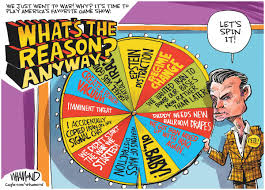 A brief description of each of those 17 responses is given in the article. You may read it at this fully gifted link. The New York Times reports on information from Iran’s new Supreme Leader. “Live Updates: Oil Price Surge Rattles Markets; Iran’s Choice of Leader Signals Defiance. Stocks fell on fears of the Iran war’s effects on energy prices. Top clerics selected Mojtaba Khamenei as Iran’s supreme leader, despite President Trump’s warning that he was “unacceptable.”
U.S. stocks fell at the start of trading on Monday, after markets in Asia and Europe tumbled, as a spike in oil prices reflected global fears of a prolonged U.S.-Israeli war with Iran. Meanwhile, Iran projected defiance by naming a son of its slain supreme leader as his successor.
Oil prices briefly surged early Monday to almost $120 per barrel, their highest level since the Covid pandemic, as President Trump’s plans for the next steps in the war, let alone its endgame, remained unclear and Iran showed no sign of bowing to his demand for unconditional surrender.
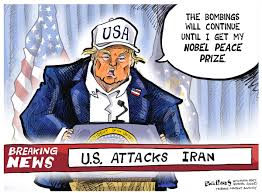 It still looks like the start of World War 3 to me. From the same link above.
Eleven countries have asked Ukraine for security support to help counter Shahed drones, according to President Volodymyr Zelenskyy. He said in a social media post that the requests have come from countries neighboring Iran, European nations and the United States — and that some “have already been met with concrete decisions and specific support.”
He did not provide further details, though Zelensky earlier told The New York Times that Ukraine sent interceptor drones and a team of experts to protect U.S. military bases in Jordan.
“There is clear interest in Ukraine’s experience in protecting lives, relevant interceptors, electronic warfare systems, and training,” Zelensky added in his post on social media. “Ukraine is ready to respond positively to requests from those who help us protect the lives of Ukrainians and the independence of Ukraine.
This headline is one that worries me. It’s from the Times of Israel. “Trump to Times of Israel: It’ll be a ‘mutual’ decision with Netanyahu regarding when Iran war ends. US president, in phone interview, clarifies that he’ll make final call to end operation ‘at right time’; says he and PM ‘worked together’ against Islamic Republic: ‘We’ve destroyed a country that would have destroyed Israel’.”
US President Donald Trump told The Times of Israel on Sunday that a decision on when to end the war with Iran will be a “mutual” one that he’ll make together with Prime Minister Benjamin Netanyahu.
Trump also asserted in the brief telephone interview that the Islamic Republic would have destroyed Israel if he and Netanyahu had not been around. “Iran was going to destroy Israel and everything else around it… We’ve worked together. We’ve destroyed a country that wanted to destroy Israel.”
The US president was asked whether he alone would decide when the war with Iran ends or if Netanyahu would also have a say.
“I think it’s mutual… a little bit. We’ve been talking. I’ll make a decision at the right time, but everything’s going to be taken into account,” he responded, indicating that while Netanyahu will have input, the US president will have the final say.
Asked whether Israel could continue the war against Iran even after the US decides to halt its strikes, Trump declined to entertain the theoretical possibility before adding: “I don’t think it’s going to be necessary.”
So, it’s still two megalomaniacs avoiding prison sentences running the show. Don’t you feel much better now?
What’s on your Reading, Action, and Blogging list today?
Finally Friday Reads: Perpetual Fresh Hells
Posted: March 6, 2026 Filed under: #FARTUS, #MAGAnomics, #We are so Fucked, just because, kakistocracy, Kristi Noem, MAGA Assholes, Trump's Wars | Tags: @johnbuss.bsky.social John Buss, Cadet Bonespur's Iran War, Ecuador, Kristi Noem Sociopath and Cunt, Markwayne Mullin, Trump's Economy Sux, Trump's Wars 7 Comments
“Meanwhile, in the newly acquired Homeland Security luxury jet’s bedroom…” John Buss, @repeat1968
Good Day, Sky Dancers!
There’s so much news to cover today that I don’t even know where to start. We’ve got information that we’re the ones who struck the elementary school in Iran, killing all those little girls. We’ve also found out that the Russians are helping Iran target us. This sure feels like the start of World War 3. Additionally, the job picture is bleak as stats show that jobs are being eliminated. Finally, don’t start celebrating Kristi Noem’s demise quite yet. She’s headed to another job, and her replacement is a bimbo with some odd kink. Orange Caligula and his Incompetence Legion continue to wreck everything. Steven Miller must be thrilled.
So, how goes the war? My bad, wars. We’ve got yet another frontline in another country as of 2 days ago. We’re now staging attacks in Ecuador. This is from Time Magazine. “Why Is the U.S. Launching Military Operations in Ecuador?” This analysis and reporting is by Chantelle Lee.
The United States and Ecuador announced this week that they’ve begun a joint military operation to combat narcoterrorism in the South American country.
The U.S. Southern Command (Southcom), which oversees the nation’s military activity in Latin America and the Caribbean, said in a press release on Tuesday that Ecuadorian and American military forces had started operations that day “against Designated Terrorist Organizations in Ecuador.”
“The operations are a powerful example of the commitment of partners in Latin America and the Caribbean to combat the scourge of narco-terrorism,” Southcom said in the press release. “Together, we are taking decisive action to confront narco-terrorists who have long inflicted terror, violence, and corruption on citizens throughout the hemisphere.”
Southcom also shared on X a short video in which a helicopter can be seen taking flight and picking up service members. The command didn’t explain what the video was depicting, though, or how it was tied to the operation in Ecuador.
Officials have so far shared little information about the military operation. But here’s what we do know.
Ecuadorian President Daniel Noboa said in a post on X this week that the country will be conducting “joint operations with our regional allies, including the United States” in March. He didn’t provide any details about the scale of the operation or the intended targets.
“The security of Ecuadorians is our priority, and we will fight to achieve peace in every corner of the country,” he said in his post. “To achieve that peace, we must act forcefully against criminals, wherever they may be. The pursuit of justice and national dignity will never be persecution, but rather a promise that we will keep to Ecuadorians.”
The Trump Administration hasn’t publicly shared how the U.S. military is involved in the operation in Ecuador. But one American official, speaking to the New York Timeson the condition of anonymity, said that, in the months leading up to this week’s announcement, U.S. Special Forces have been assisting Ecuadorian soldiers in preparing for raids. American service members, the official told the Times, have been deployed to support the Ecuadorian military with the operation, which is reportedly targeting drug facilities led by violent gangs. U.S. troops, though, will not be directly involved in the operation, the official told the Times.
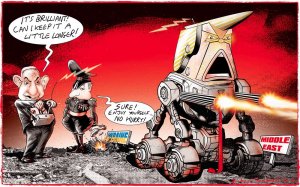 Dalia Dassa Kaye, reporting for Foreign Affairs, has this analysis. “The Mirage of a New Middle East. War With Iran Won’t Reshape the Region the Way America Wants.”
Eager to show that he can do what no American leader has done before, President Donald Trump has chosen conflict over diplomacy and gone to war with Iran. The Islamic Republic, knowing that this fight is existential, retaliated quickly with deadly missile and drone attacks on Israel, U.S. bases in the Middle East, and targets in Gulf states and beyond. This is now a regional war with global impact, disrupting oil and financial markets, supply chains, maritime commerce, and air travel. Threats to Americans and the death toll in Iran mount by the hour. These growing risks were predictable long before the war became reality, which might help explain why no previous president took the United States down this perilous path.
How this war will end remains uncertain. But when it does, the United States will have to face what comes next. To the extent that the Trump administration has considered plans for “the day after,” it seems to have made a series of overly optimistic assumptions about how the war might reshape Iran and the Middle East. For one, the Trump administration has insisted—including in Trump’s social media post on February 28 announcing the war—that a relentless degradation of Iranian leadership and military capabilities would weaken the regime enough that the Iranian people could rise up and “take over the government.” Even if that doesn’t happen, the administration’s logic goes, Iran would be defanged and so preoccupied with internal problems that it could no longer pose a threat to the region or American interests. Taking the current Iranian regime out of the equation, Washington assumes, would remove one of the largest sources of regional instability and usher in a new Middle East more to the United States’ liking.
But the outcome of this war will likely fall far short of these rosy expectations. After the bombing ends, Iran and the region could look worse, or at least not better, than they did before the war. The fighting could create a power vacuum in Tehran, sour U.S. allies on their partnerships with Washington, and produce ripple effects on conflicts elsewhere in the world, all without removing sources of regional strife that have nothing to do with the regime in Iran. The risks increase the longer the war goes on, so Congress and U.S. allies must press for a cease-fire now if there is to be any hope of mitigating these day-after dangers.
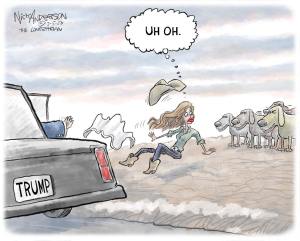 More analysis of the likely deadly results over time, which include the rise of terrorism once more, can be found at the link. Eric Cortellessa has more analysis about “Trump’s War” at Time Magazine.
In short, if Trump campaigned as a President of peace, he has governed as the opposite. Now he has drawn the U.S. into the kind of conflict he long pledged to avoid. Having ousted the tyrannical ruler of Iran’s theocracy, he has committed the U.S. anew to regime change in the Middle East, telling TIME he intends to play a role in shaping the next government of a regional powerhouse home to some 90 million people. “One of the things I’m going to be asking for is the ability to work with them on choosing a new leader,” he says. “I’m not going through this to end up with another Khamenei. I want to be involved in the selection. They can select, but we have to make sure it’s somebody that’s reasonable to the United States.”
It’s impossible to know how all this will unfold. There was little sympathy internationally for the Ayatollah, who reigned over a brutal Islamist regime; throughout Tehran and across the Iranian diaspora, crowds have rejoiced in the streets upon hearing the news of his demise. To some, Trump’s attacks are historic in the best sense, eliminating an avowed adversary who sought to destroy the U.S. and whom Washington has long viewed as the head of the world’s foremost state sponsor of terrorism.
But the gambit carries extraordinary risks—for Trump’s presidency, for Iran’s fragile political future, for regional stability, and for the safety of Americans at home and abroad. The gravest decision a President can make is whether to send American troops into harm’s way. Trump, who once defined himself in opposition to foreign entanglements, has pivoted with astonishing alacrity toward open-ended confrontation across multiple theaters.
In his interview with TIME, Trump says his goals are to eliminate Iran’s nuclear threat once and for all, to dismantle its ballistic-missile program, and to install a Western-friendly government. “We have to be able to deal with sane and rational people,” he says. Yet Trump launched a war before making a case to the country or to Congress, and his Administration has offered unclear—and at times contradictory—explanations of the mission’s objectives. The most unnerving possibility is that Operation Epic Fury is not the culmination of his shift toward a war presidency, but rather the beginning of a new chapter.
The path to war with Iran was paved by a pair of meetings, one year apart, with Benjamin Netanyahu.
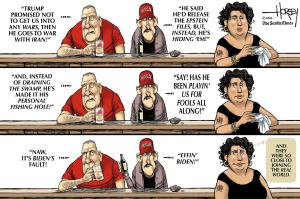 As usual, Trump is easily manipulated by his counterparts with selfish and bad intentions.
On Feb. 4, 2025, the Israeli Prime Minister visited the White House for the first time since Trump’s return to power. Seated at a long table in the Cabinet Room, Netanyahu began with a bracing reminder, according to U.S. and Israeli officials present at the meeting: Iran, he noted, had plotted to assassinate Trump during the 2024 campaign. Law-enforcement officials disclosed that they had disrupted what they described as two Iranian plots to kill Trump. (Tehran denied the allegations.) Trump has long fused geopolitics with grievance, and Iran’s clerical leadership occupied a singular place on his list of adversaries. When TIME asked him in a November 2024 interview about the prospect of war with Iran, Trump did not dismiss it. “Anything can happen,” he said.
Sensing an opening, Netanyahu walked through a slide deck. It showed stockpiles of highly enriched uranium climbing, centrifuges spinning faster, inspectors reporting gaps. Ever since Trump withdrew from President Barack Obama’s nuclear accord in 2018, Tehran had incrementally expanded its enrichment program, moving closer to breakout capacity. By the time Trump was inaugurated a second time, international inspectors assessed that Iran possessed enough weapons-grade uranium to place it mere weeks from assembling a bomb. “Look, Donald,” Netanyahu said, leaning in, “this has to be tackled, because they’re racing forward.” He paused, locking eyes with the President. “You can’t have a nuclear Iran on your watch.”
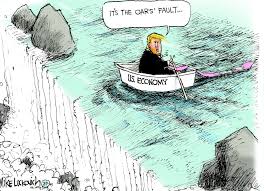 I wanted to mention the economy signalling a meltdown. This is from Jeff Cox writing for CNBC. “Economy: U.S. payrolls unexpectedly fell by 92,000 in February; unemployment rate rises to 4.4%.”
-
Nonfarm payrolls in February fell by 92,000, compared with the estimate for 50,000 and below the downwardly revised January total of 126,000. It was the third time in five months that the economy lost jobs.
-
Health care, the primary growth driver in payrolls, saw a loss of 28,000, due largely to a strike at Kaiser Permanente that sidelined more than 30,000 workers in Hawaii and California.
-
Wages rose more than expected. Average hourly earnings increased 0.4% for the month and 3.8% from a year ago, both 0.1 percentage point above forecast.
I want to mention a few things about this. Generally, this would indicate that the Fed’s Board of Governors may loosen interest rates. However, we’re still on the high end of the inflation rate target, considering that wages rose by more than expected, the Fed may be reluctant to move on that. Wars generally stimulate an economy but that remains to be seen on the various military advantages Trump has undertaken. There is still concern about the supply inventory needed to support the war. Moving to a wartime economy can create shortages in the consumer sector. International markets are already pricing in oil shortages.
 As usual, I am ever the economist. I’m just weirded out about all the Kristi Noem and her likely replacement news. These people are all bimbos and freaks. Noem’s replacement, Senator Markwayne Mullin, appears to have a really odd kink. This is from MEDIAite. It’s a headline from 2023. “Markwayne Mullin Reportedly Fingered Nostrils of Colleagues and Their Spouses During Visit to Israel.” I certainly want the committee hearing to ask about this, but I really don’t want to hear the details.
I do want to know more about Noem’s new job, however. This is from The Hill. WTH is the Shield of the Americans anyway? Ashleigh Fields has this headline. “What we know about Noem’s new ‘Shield of the Americas’ role.”
While the soon-to-be former secretary will no longer head up immigration and other national security agencies under DHS, her work for “Shield of the Americas” will hit on similar topics, including immigrants in the country illegally, transnational trafficking and border crossings.
Here’s what we know about the role: What is ‘Shield of the Americas’?
The regional coalition of countries in Latin America will work together on ideology and policy initiatives that help secure the Western Hemisphere, according to the White House.
The Shield of the Americas will be guided in part by the president’s foreign policy initiatives dubbed the “Donroe Doctrine,” fashioned after the Monroe Doctrine. The administration has described the doctrine as enlisting “established friends” in the Western Hemisphere to pursue U.S. aims and expanding ties by “cultivating and strengthening new partners.”
Since Trump returned to office last year, he directed the renaming of the Gulf of Mexico to the “Gulf of America,” announced plans to “take back” the Panama Canal, and pushed efforts to acquire Greenland and make Canada the 51st state.
A summit making the Shield of the Americas official is set to take place this weekend in Miami, and it may largely focus on counterterrorism measures in the region as a group of Latin American leaders assemble on American soil.
Noem will work with foreign leaders in both North and South America. The Trump administration has maintained a heavy interest in connecting with Latin American leaders to combat human smuggling, drug trafficking and undocumented immigration.
Thirteen heads of Latin American countries are expected to be present at the Miami summit this weekend. Some notable names, according to the White House, include: Argentine President Javier Milei, Chilean President-elect José Antonio Kast, Salvadoran President Nayib Bukele Ortez and Honduran President Nasry “Tito” Asfura.
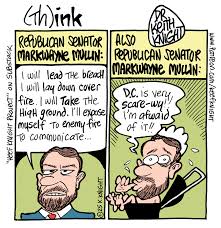 NPR has the go-to list on “What you need to know about Sen. Markwayne Mullin, Trump’s new pick to lead DHS.”
-
Mullin was first elected to the House in 2012 and was sworn in the following January.
-
A decade later he won a special election to fulfill the term of former Sen. James Inhofe, a fellow Republican who resigned due to health issues.
-
Mullin is an enrolled member of the Cherokee nation. He is the first tribal citizen in the Senate since Ben Nighthorse Campbell left in 2005.
-
Mullin has been a reliable defender of President Trump in Congress, including just this week, backing the president’s decision to launch strikes against Iran.
-
Mullin serves on several committees, including Appropriations, Armed Services, Indian Affairs and Health, Education, Labor and Pensions.
-
In his role on the Appropriations Committee, he helps write and negotiate federal funding, including the ongoing talks to fund DHS, the agency he has been tapped to lead.
-
DHS has been operating without annual appropriations funding since February 14.
-
Mullin has frequently defended President Trump’s approach to immigration enforcement.
Anyway, he has a background in construction. He’s from Oklahoma. Evidently, he and Rand Paul don’t get along, and since Paul is the head of the committee that will approve his appointment, it should be interesting.
So, that’s enough weird Trump news for the day. I need to return to doing something more worthwhile, like the laundry and dishes.
What’s on your Reading, Blogging, and Action list today?
Mostly Monday Reads: State of the Union Weak
Posted: February 23, 2026 Filed under: #FARTUS, #We are so Fucked, child sexual abuse, Epstein Files | Tags: @johnbuss.bsky.social John Buss, Epstein Files, Epstein Files Release Fall out, Epstein Zorro Ranch, Judge Loose Cannon, Special Counsel Jack Smith, State of the Union Week 3 Comments
“What’ll it be today?” John Buss, @repeat1968
Good Day, Sky Dancers!
Judge Loose Cannon has done it again. The Epstein Files are getting harder for Orange Caligula’s Cabinet of the Woefully Incompetent and Corrupt to handle. Many people are already feeling the impact of the Supreme Court’s Tariff Decision. Then, there’s more fallout from the Epstein Files. In other words, it’s just another day for Trump Mania to ruin the country, and it’s only Monday.
The most current headline is on Cannon. This is from Politico. “Judge Cannon permanently blocks release of Jack Smith report. The Trump-appointed judge said releasing the classified docs report now would “contravene basic notions of fairness and justice.” Kyle Cheney and Josh Gerstein report on the decision.
U.S. District Judge Aileen Cannon permanently barred the Justice Department from releasing special counsel Jack Smith’s final report describing President Donald Trump’s stockpiling of classified documents at Mar-a-Lago and allegations that he obstructed government efforts to reclaim them.
Cannon lit into Smith for a “brazen stratagem”: compiling the detailed report even after she ruled in July 2024 his appointment as special counsel was unconstitutional and dismissed the case against Trump and two co-defendants. The Justice Department had appealed Cannon’s decision but dropped the case altogether after Trump’s election.
“Special Counsel Smith and his team went ahead for months, undeterred, preparing [the classified documents report] using discovery collected in connection with this proceeding and expending government funds in the process,” Cannon wrote in a 15-page ruling issued Monday. “To say this chronology represents, at a minimum, a concerning breach of the spirit of the Dismissal Order is an understatement, if not an outright violation of it.”
“While it is true that former special counsels have released final reports at the conclusion of their work,” Cannon wrote, “it appears they have done so either after electing not to bring charges at all or after adjudications of guilt by plea or trial. The Court strains to find a situation in which a former special counsel has released a report after initiating criminal charges that did not result in a finding of guilt.”
Aides to Smith, who is now an attorney in private practice, did not immediately respond to a request for comment.
“Judge Cannon’s courage and judicial resolve on these important due process issues should be recognized and taught in law school classrooms across America,” Trump’s lawyer Kendra Wharton said in response to the ruling.
Cannon has drawn scrutiny for rulings that favor Trump and cut against longstanding practice and precedent. She delayed the classified documents case for months when she installed an independent overseer to review materials seized from Mar-a-Lago — until a federal appeals court overturned her decision.
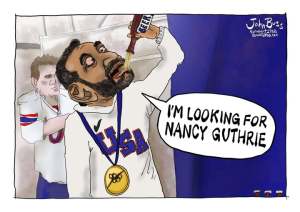
“Crime is at an all-time low.” John Buss, @repeat1968
The next set of headlines concerns the upcoming State of the Union Speech. We all know that the State of our Union is weaker now than at any point since at least the Civil War. Aaron Parnas, writing at his Substack Parnas Report, has a list of “bombshells” that will definitely impact the week. I’m going to highlight a few of them. The big grifter this week is our Crazy-eyed FBI Chief, who is partying with the US Olympic Hockey Team in Italy. There is also more breaking news on the Epstein files, which is undoubtedly causing some heartburn for FARTUS.
We are kicking off an absolutely packed and consequential week. Major new developments in the Epstein case have emerged, including revelations that he maintained storage units that were never searched by the FBI. At the same time, FBI Director Patel is facing mounting calls to resign after spending thousands of taxpayer dollars on a trip to Italy where he appeared to celebrate with Olympians, even as serious crises unfolded at home. All of this comes as Trump heads into the State of the Union with his approval rating at its lowest point yet.
A quick heads up about tomorrow night. The State of the Union is coming, and here is what you can expect from me. First, I will watch the speech so you do not have to, and bring you a clear, direct breakdown afterward. Second, I will be on the ground covering the People’s State of the Union, the alternative address taking place during Trump’s speech. Third, I will be standing with Epstein survivors to ensure that justice remains front and center, even as some try to move on from the files.
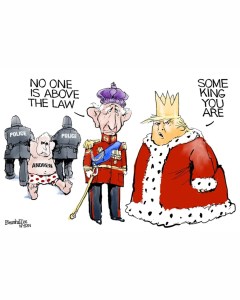 Even with the pending State of the Union Address, the news on the Epstein story is wild.
- A new Telegraph report reveals that Jeffrey Epstein secretly rented at least six storage units across the United States between 2003 and 2019, where he stored computers, CDs, photographs, furniture, and other equipment removed from his various properties, including materials from his private island, Little Saint James.
- Financial records and internal emails show he paid private investigators tens of thousands of dollars to move and conceal these materials, sometimes ahead of anticipated search warrants. Some computer drives in storage were reportedly “cloned,” though the fate of the copies remains unknown. Emails suggest Epstein may have been tipped off about law enforcement raids in the mid-2000s and instructed associates to remove and possibly wipe digital evidence.
- Importantly, search warrant records from the Justice Department’s release of millions of Epstein-related documents indicate authorities may never have searched these storage units, raising the possibility that they could still contain previously undisclosed evidence related to his sex trafficking case.
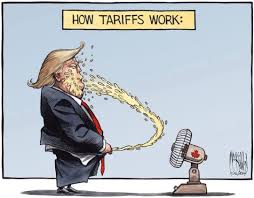 The Telegraph story on Andrew is just as wild as you can imagine. You can read more about his horrid behavior at the link. Meanwhile, FARTUS is protecting the fossil fuel industry. He’s definitely valuing it over the country, its natural resources, its wildlife, and its people. This is from the AP. “Trump administration eases limits on coal plants for emitting mercury, other toxins.”
The Environmental Protection Agency on Friday weakened limits on mercury and other toxic emissions from coal-fired power plants, the Trump administration’s latest effort to boost the fossil fuel industry by paring back clean air and water rules.
Toxic emissions from coal- and oil-fired plants can harm the brain development of young children and contribute to heart attacks and other problems in adults. The plants are also a major source of greenhouse gas emissions that drive climate change. The EPA announced the repeal of the tightened Mercury and Air Toxics Standards rule, or MATS, at a massive coal plant next to the Ohio River in Louisville, Kentucky.
“EPA’s actions today rights the wrongs of the last administration’s rule and will return the industry to the highly effective original MATS standards that helped pave the way for American energy dominance,” said EPA Deputy Administrator David Fotouhi. The agency said the change should save hundreds of millions of dollars.
The final rule reverts the industry to standards first established in 2012 by the Obama administration that have reduced mercury emissions by nearly 90%. The Biden administration had sought to tighten those standards even further after the first Trump administration had moved to undermine them.
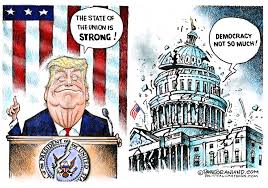 An armed man was shot down by the Secret Service at Mar-a-Lago last week. The profile of the dead man is proving interesting. This is from TMZ. “Mar-A-Lago Armed Gunman. Fixated On Epstein Files Week Before Shooting.”
The armed man shot and killed by Secret Service agents outside President Donald Trump‘s Mar-a-Lago property Sunday had grown increasingly obsessed with the Epstein files and was also a vocal supporter of Trump … TMZ has learned.
Austin Tucker Martin sent a text message, obtained by TMZ, to a co-worker on February 15, 2026, that read, “I don’t know if you read up on the Epstein Files, but evil is real and unmistakable.” He continued, “The best people like you and I can do is use what little influence we have. Tell other people about what you hear about the Epstein files and what the government is doing about it. Raise awareness.”
Sources who worked with Austin at Pine Needles Lodge & Golf Club in North Carolina tell TMZ … he became fixated on Epstein following the latest release of information tied to the files. Co-workers tell us he was deeply disturbed by what he believed was a government cover-up and often talked about powerful people “getting away with it.”
At the same time, Austin was outspoken about his Christian faith and political views. We’re told he regularly expressed support for Trump, telling colleagues as recently as late last year he believed Trump was a strong leader.
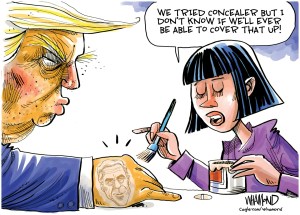 Polls point to a break with Trump since the Epstein Files were released; however, it’s tough to say if or if not this guy’s opinions are reflective of the overall MAGA cult. One more Epstein story for you today. This is from the BBC. “Lord Mandelson arrested on suspicion of misconduct in public office.” Chris Mason reports that “From the glamour of DC to a London police station in a matter of months. “ At least the Brits are enraged and active.
A year ago Mandelson was just a few weeks into one of the marquee jobs the British state has to offer – His Majesty’s Ambassador to the United States.
He was sent there by the prime minister as the best point man to Donald Trump.
I went to the British Embassy in Washington around then and Mandelson was clearly revelling in being at the centre of things – the splendour, the glamour.
And where is he tonight? In a police station.
Mandelson is a huge figure in the contemporary history of the Labour Party, having worked for former leader Lord Kinnock, served as a cabinet minister under Sir Tony Blair, and been Gordon Brown’s first secretary of state.
And now, as you read this, he could be sitting opposite police officers in a police station interview room, answering questions under arrest as part of a criminal inquiry.
We should repeat that Mandelson has not commented publicly in recent weeks on the Epstein files but I understand his consistent position is he has not acted criminally and was not motivated by financial gain.
One more item of interest on that account from the same source.
The ex-US ambassador had been under investigation over allegations he shared market-sensitive government information with Jeffrey Epstein while a government minister
Three days ago, New Mexico announced an investigation into Epstein and his ranch there. “New Mexico reopens investigation into alleged illegal activity at Epstein’s former Zorro Ranch. Meanwhile, lawyers for Epstein accusers said they’ve reached a proposed settlement in a class action lawsuit against his estate.” This place sounds as horrific as the island. San Diego’s NBC affiliate reports.
New Mexico’s attorney general has reopened an investigation into Jeffrey Epstein ’s former Zorro Ranch, as allegations swirl about what role the secluded spot played in sexual abuse or sex trafficking of underage girls and young women.
Attorney General Raúl Torrez’s office said Thursday that the decision was made after reviewing information recently released by the U.S. Justice Department.
Although New Mexico’s initial case was closed in 2019 at the request of federal prosecutors in New York, state prosecutors say now that “revelations outlined in the previously sealed FBI files warrant further examination.”
The New Mexico Department of Justice said special agents and prosecutors at the agency will be seeking immediate access to the complete, unredacted federal case file and intend to work with other law enforcement partners as well as a new truth commission established by state lawmakers to look into activities at the ranch.
“As with any potential criminal matter, we will follow the facts wherever they lead, carefully evaluate jurisdictional considerations, and take appropriate investigative action, including the collection and preservation of any relevant evidence that remains available,” the New Mexico Department of Justice said in a statement.
 The most terrible thing about this is the disappearance of two very young girls. This is from the U.S. Sun. Katie Davis reports “DEN OF SIN. Inside Epstein’s ‘last refuge’ ranch with ‘buried bodies’ and celeb guests, as full scale of horror is yet to be revealed.” This is a slightly right-leaning source.
Hector Balderas, the state’s ex-attorney general whose 2019 probe into the ranch was halted, told The Sun: “There will be missed opportunities for accountability where victims will have ultimately paid the price.
“Prosecutors are barely learning to understand today how heinous and how much violence and exploitation took place throughout decades.”
Bodies of young women being buried on the grounds, sex abuse and concealing evidence are among the allegations plaguing the shady ranch.
Curiously, two renowned lawyers for victims of the twisted paedophile had no information on the farm when asked by The Sun.
Known to locals as Playboy Ranch, victims have previously told how the ranch has been overlooked throughout the scandal.
Testimonies from several women detail how Epstein was able to abuse teenage girls and young women at the ranch – without any consequence.
Despite Epstein’s properties in Palm Beach and New York being combed by investigators, Zorro Ranch has never been formally searched.
Bombshell claims uncovered in the latest drop of Epstein files from the US government have thrust the huge 7,500-acre estate firmly into the spotlight.
I think that’s enough to horrify us today!
What’s on your reading and blogging list?

 peej
peej Carissa
 bostonboomer
 dakinikat
 ecocatwoman
 mablue2
 Mama Lopez
 peggysue22
 quixote
 skydancingguestblogger
 Mona (aka Wonk the Vote)



 Sky Dancing
Recent Comments