
May the Fourth be with You!
Posted: May 4, 2018 Filed under: Climate Change, Environment, Environmental Protection, Environmentalists, morning reads | Tags: BLM. Department of Interior, EPA, Scott Pruitt, the environment. climate change 20 Comments
Disney Storyboard Drawing of a Dinosaur from Fantasia (1940)
Good Morning!
I’ve always loved SF and fantasy but I’ve also loved delving into the mysterious past. What kid doesn’t like stories about dinosaurs and spaceships? One of all time favorite things to watch is Disney’s Fantasia. I love the animated Dinosaurs brought to life to the strains of Stravinsky’s ‘The Rite of Spring’. There’s some news dealing with the EPA, our planet, and our dependence on fossil fuels I’d like to share today. Climate change is real. The current administration only cares about enriching itself and its friends. What does this mean for our fragile time on this planet?
From The Grist: Humans didn’t exist the last time there was this much CO2 in the air.
The last time atmospheric carbon dioxide levels were this high, millions of years ago, the planet was very different. For one, humans didn’t exist.
On Wednesday, scientists at the University of California in San Diego confirmedthat April’s monthly average atmospheric carbon dioxide concentration breached 410 parts per million for the first time in our history.
We know a lot about how to track these changes. The Earth’s carbon dioxide levels peak around this time every year for a pretty straightforward reason. There’s more landmass in the northern hemisphere, and plants grow in a seasonal cycle. During the summer, they suck down CO2, during the winter, they let it back out. The measurements were made at Mauna Loa, Hawaii — a site chosen for its pristine location far away from the polluting influence of a major city.
Increasingly though, pollution from the world’s cities is making its way to Mauna Loa — and everywhere else on Earth.
In little more than a century of frenzied fossil-fuel burning, we humans have altered our planet’s atmosphere at a rate dozens of times faster than natural climate change. Carbon dioxide is now more than 100 ppm higher than any direct measurements from Antarctic ice cores over the past 800,000 years, and probably significantly higher than anything the planet has experienced for at least 15 million years. That includes eras when Earth was largely ice-free.
Not only are carbon dioxide levels rising each year, they are accelerating. Carbon dioxide is climbing at twice the pace it was 50 years ago. Even the increases are increasing.
That’s happening for several reasons, most important of which is that we’re still burning a larger amount of fossil fuels each year. Last year, humanity emitted the highest level of greenhouse gas emissions in history — even after factoring in the expansion of renewable energy. At the same time, the world’s most important carbon sinks — our forests — are dying, and therefore losing their ability to pull carbon dioxide out of the air and store it safely in the soil. The combination of these effects means we are losing ground, and fast.
From the New York Times: ‘It was 122.4°F This Week in Pakistan, Probably a World Record for April’
Even in Pakistan, no stranger to blistering heat, the temperature on Monday stood out: 122.4 degrees Fahrenheit.
The reading came from Nawabshah, a city of 1.1 million people in southern Pakistan, and meteorologists say it is the highest temperature ever reliably recorded, anywhere in the world, in the month of April.
The World Meteorological Organization keeps global temperature records, but not by month, which means Monday in Nawabshah cannot be officially confirmed as the hottest April day. But experts on extreme temperatures say it probably is.
Christopher C. Burt, the author of “Extreme Weather: A Guide and Record Book” and a contributor to Weather Underground, said that 122.4 degrees, or 50.2 degrees Celsius, appeared to be the hottest reliably measured April temperature “in modern records for any location on Earth.” Only one reading might challenge it: 123.8 degrees Fahrenheit, or 51 degrees Celsius, recorded in Santa Rosa, Mexico, in April 2011. But Mr. Burt said that measurement was “questionable because the site was a regional observation site and not of first order.”

Fantasia “Rite of Spring” Concept Art (Walt Disney, 1940)
From Montana’s KRTV 3: ‘Clean-up plan being developed for oil spill on Fort Peck Indian Reservation’.
A oil spill occurred at an oil well operated by Anadarko Minerals Inc. near Lustre, which is located in the central region of the Fort Peck Indian Reservation.
According to a press release, the spill was reported to the Tribes’ Office of Environmental Protection (OEP) on Friday, April 27.
The spill was spotted by a rancher doing a flyover in the area. The exact date that the leak occurred has not yet been determined. The well had been shut-in in late December of 2017.
Wilfred Lambert of the Fort Peck Tribes OEP and officials from the federal Bureau of Land Management (BLM) initially estimated that 600 barrels of oil and 90,000 barrels of production water, also known as brine, were released from the well.
The oil and brine flowed approximately 200 yards downhill to a stock pond used by tribal entities for watering livestock.
The press release states that the extent of the stock pond’s contamination has not been determined. Early assessments indicate about three to six inches of oil sitting on top of the water.
I don’t think these three event require much explanation and cannot be viewed with too much consternation. We’ve been warned about all of this by the scientists and Cassandras of earth science and climate science. It’s all getting worse at a much faster and more disturbing rate than projected.
Meanwhile, Scott Pruitt is the swamp thing that administers our EPA. You know, that agency that was the pride of the Nixon administration meant to clean up our messes and perpetual destruction of our environment. He also frets his brow over the Bureau of Land Management and the Department of Interior. The BLM came about during the Truman years. The Department of interior has been around since 1849 and has its roots as far back as Madison although it was established through the Polk administration on the eve of Zachary Taylor’s inauguration. It is the agency which took the main approach to Native Americans after a number of Secretaries of States argued that the land and indigenous people of America was not best served by their Departments. These agencies really are most responsible for our past and our future in numerous ways.
 Both the Department of Interior and the EPA are headed by knuckle dragging, corrupt fools. There also seems to be some internecine drama between their dueling ids. Both have taken the idea of using a Federal position for personal benefit and show boating to new heights.
 As Environmental Protection Agency Administrator Scott Pruitt faces a seemingly endless stream of scandal, his team is scrambling to divert the spotlight to Interior Secretary Ryan Zinke. And the White House isn’t happy about it.
In the last week, a member of Pruitt’s press team, Michael Abboud, has been shopping negative stories about Zinke to multiple outlets, according to two sources with direct knowledge of the efforts, as well as correspondence reviewed by The Atlantic.
“This did not happen, and it’s categorically false,” EPA spokesman Jahan Wilcox said.
The stories were shopped with the intention of “taking the heat off of Pruitt,” the sources said, in the aftermath of the EPA chief’s punishing congressional hearing last week. They both added, however, that most reporters felt the story was not solid enough to run. On Thursday, Patrick Howley of Big League Politics published a piece on the allegations; he did not respond to request for comment as to his sources.
Abboud alleged to reporters that an Interior staffer conspired with former EPA deputy chief of staff Kevin Chmielewski to leak damaging information about the EPA, as part of a rivalry between Zinke and Pruitt. The collaboration, Abboud claimed, allowed the Interior staffer to prop up Zinke at the expense of Pruitt, and Chmielewski to “get back” at his former boss.
Abboud offered to connect reporters with Healy Baumgardner as a second source, according to a person with direct knowledge. Baumgardner, a former Trump campaign official, is a global energy lobbyist for the U.S.-China Exchange. She’s close to some EPA officials, the source, as well as an EPA official, confirmed. Baumgardner did not immediately return a request for comment.
According to the two sources, Interior staffers who fielded the reporters’ calls were able to ascertain that Abboud, who is a former Trump campaign official, was behind the stories. The Interior Department’s White House liaison then called the White House Presidential Personnel Office to complain about his conduct.
 There is a stream of complaints about Pruitt’s conduct. None of them garner the proper attention.
Scott Pruitt’s itinerary for a February trip to Israel was remarkable by any standard for an Environmental Protection Agency administrator: A stop at a controversial Jewish settlement in the West Bank. An appearance at Tel Aviv University. A hard-to-get audience with Israeli Prime Minister Benjamin Netanyahu.
One force behind Pruitt’s eclectic agenda: casino magnate and Republican megadonor Sheldon Adelson, a major supporter of Israel who arranged parts of Pruitt’s visit.
The Israel trip was canceled days before Pruitt’s planned departure, after The Washington Post revealed his penchant for first-class travel on the taxpayers’ dime. But federal documents obtained by The Post and interviews with individuals familiar with the trip reveal that it fit a pattern by Pruitt of planning foreign travel with significant help from outside interests, including lobbyists, Republican donors and conservative activists.
After taking office last year, Pruitt drew up a list of at least a dozen countries he hoped to visit and urged aides to help him find official reasons to travel, according to four people familiar with the matter, who spoke on the condition of anonymity to discuss internal agency deliberations. Pruitt then enlisted well-connected friends and political allies to help make the trips happen.
 Ongoing allegations of Pruitt’s attempts to the EPA into his person bank and travel agency are astounding. They keep oozing out of his swamp. From EWG: ‘Reports: Before Confirmed, Scott Pruitt Wanted EPA Office, Private Phone Booth in Okla.’
Congressional leaders are demanding information from Environmental Protection Agency head Scott Pruitt over allegations he wanted taxpayers to open an office in his hometown of Tulsa, Okla., before he was confirmed by the Senate.
Democrats on the House Science, Space and Technology Committee sent letters this week to Pruitt and the head of the Government Services Administration seeking all records that may show there was an attempt to find an office in Tulsa.
The letters say that in early 2017, Ryan Jackson – now Pruitt’s chief of staff but then a top congressional aide – wanted the GSA to look for office space in Tulsa, 250 miles from the EPA regional headquarters in Dallas. Jackson asked that the office include a private, secure phone booth, like the one Pruitt later spent $43,000 to install at EPA headquarters in Washington.
“It appears that even before he was confirmed, EPA Administrator Scott Pruitt had dreams of dismantling programs to protect air, water and kids from pollution from the comforts of an office in his hometown,” said EWG President Ken Cook. “What better place to have a secure phone booth to receive instructions from the energy lobby, and avoid the pesky expertise of agency scientists and lawyers?”
“Each day brings new evidence of Pruitt’s obsession to embellish the trappings of his office and adorn his days with pricey perquisites, taxpayers be damned. Historians will make note of Pruitt’s record of fleecing the public and attacking public health as signature ‘accomplishments’ of the Trump presidency.”
 Trump appears unwilling to deal with Pruitt. This is from VOX: ‘Why Trump would really, really rather not fire Scott Pruitt. The EPA administrator has given the White House most of the few policy wins it has to date.’ That’s rather disturbing.
Scott Pruitt’s tenure as head of the Environmental Protection Agency is now deeply tainted by a stunning number of alleged ethical and legal violations. There are at least 10 investigations into potential violations like his $43,000 phone booth, his 20-person security detail, and his housing deal with a lobbyist’s wife. And fallout, like the resignation and new congressional scrutiny of the head of his security team, Pasquale Perrotta (just reported by ABC News), continues.
To some Democrats in the House and Senate, environmental groups who’ve launched the Boot Pruitt campaign, and former top ethics officials, what should happen now is very clear: Pruitt should resign.
“I think your actions are an embarrassment to President Trump and distract from the EPA’s ability to effectively carry out the president’s mission,” said Rep. Frank Pallone (D-NJ) during one of two House hearings on Pruitt last week. (A whistleblower, by the way, is now saying Pruitt lied during the hearings.)
Yet in an administration afflicted with unprecedented turnover, Pruitt has remained startlingly resilient.
His subservience to Trump appears to be one reason why he has dodged the ax. “People are not people to [Trump], they are instruments of his ego,” Tony Schwartz, the ghostwriter on Trump’s book The Art of the Deal, told the New York Times. “And when they serve his ego, they survive, and when they don’t, they pass into the night.”
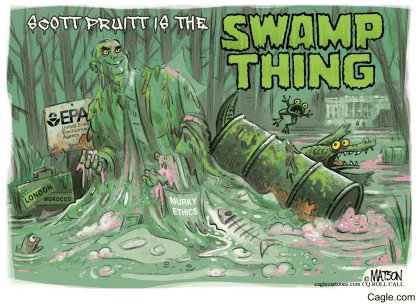 Pruitt must be impeached if Trump refuses to deal with him. This from Forbes.
No self-respecting prosecutor would be proud of winning a shoplifting conviction for a suspected murderer. But that’s almost exactly what’s happening in the congressional investigation of Environmental Protection Agency head Scott Pruitt.
Last week, lawmakers grilled Pruitt for renting a ridiculously cheap luxury condo from the wife of a lobbyist trying to get EPA approval for a client’s project. They asked why he reassigned investigators of criminal violations of environmental laws to his personal security detail.
It was all about the “appearance” of corruption. But the truth is that these petty corruptions pale in comparison to Pruitt’s actual policy record at the EPA.
The EPA is a science agency. It’s supposed to consult closely with scientists and base its decisions on rigorous evidence. While adherence to this principle has never been perfect, under Pruitt’s leadership it’s been trashed beyond recognition.
Even as he was about to face his congressional questioning, Pruitt announced a deceptive science “transparency” initiative. It’s a proposed rule stating that only scientific studies which are reproducible, and in which all underlying data are publicly available, can be used as the basis for regulation.
It sounds unobjectionable. But it would end up keeping a whole lot of public health data—on the impact of pollution, pesticides, or climate change, for example—out of the EPA’s hands.
For obvious ethical reasons, many public health studies can’t be repeated—not if they’d entail intentionally exposing people to toxins—and raw data on individuals’ health histories usually can’t be disclosed. Several hundred scientists pointed out these facts in a letter to Pruitt, but Pruitt doesn’t care what scientists think.
It gets really egregious when you look at what kind of data political appointees at the EPA want to exempt from the rule: proprietary corporate data, according to internal discussions obtained by the Union of Concerned Scientists. The proposed rule provides wide discretion to the EPA administrator—and only the administrator—to grant exemptions to the transparency requirement on a case-by-case basis. And Pruitt seems far more inclined to grant those exceptions to polluting industries, not
So many policies and actions of modern Republicans basically are aimed at killing every one. They are either extremely shorted sided or actually believe that they will some how escape the karma they’re bringing on to the planet and country. It might be that they are simply a cult of mass destruction since so many of them are whack-a-do Dominionists and actively seek an ends times.
They are bringing on an end times or a dystopia or whatever it is that I used to watch and read about in those old books. I’m not seeing a Star Trek future in any of this. In any case, we must stop this administration before these things cannot be undone. Enough of what’s gone on recently appears irreversible as it is.
What’s on your reading and blogging list today?
Friday Reads: Animal Farm
Posted: June 30, 2017 Filed under: Climate Change, Environmental Protection, Environmentalists, Health care reform, morning reads, religious extremists, Republican Tax Fetishists, Trump, U.S. Economy, U.S. Politics 44 Comments It’s difficult not to think about what the current state of affairs means in terms of the celebration of Independence Day as we head into Fourth of July Festivities. Our country was born of the Age of Reason. Thomas Jefferson–who wrote the document proclaiming US Independence–was an amateur scientist and philosopher. He might be considered the ideal Renaissance man if he had also found a way to support his causes and lifestyle with employees instead of slaves.
There’s always been this dark side to the American Dream and there have been many people throughout history who have fought those inclinations. It’s been a slow climb from the idea that we all are created equal to getting to a society that actually lives that value. The climb continues.
Why is it so difficult to treat one another with the respect and dignity we each deserve?
The Republican leadership and Administration is based on the most vulgar, salacious, and base motivations we’ve witnessed since Andrew Jackson was committing mass genocide on human beings he considered “savages” and since a group of people considered the nation’s black Americans to be not wholly human. They deemed all folks with African descent to be precisely 3/5ths human. All of this was done in the name of the same religion that tortures our better angels today.
 The cognitive dissonance is simply mind boggling. Today, Ahvaz Iran has reached an almost unheard of temperature of 129. It’s one of the hottest temperatures ever recorded on the planet.
Another weather source, the Weather Underground, said Ahvaz hit 129.2 degrees Thursday afternoon. The heat index, which also takes humidity into account, hit an incredible 142 degrees.
Fortunately, the weather forecast for Ahvaz on Friday is for “cooler” weather, with a high of only 119 degrees, according to AccuWeather.
The official all-time world record temperature remains the 134-degree temperature measured at Death Valley, Calif, on July 10, 1913. However, some experts say that temperature isn’t reliable. Weather Underground weather historian Christopher Burt said in 2016 that such an extreme temperature was “not possible from a meteorological perspective.”
Scorching heat is one of the most expected outcomes of man-made climate change, according to a 2016 report from the National Academy of Sciences and a 2015 study in Nature Climate Change.
 The prestigious magazine Science published a study estimating the economic cost of climate change to the US economy. It’s not pretty. You can read the fully study at the link. This is its Abstract.
Estimates of climate change damage are central to the design of climate policies. Here, we develop a flexible architecture for computing damages that integrates climate science, econometric analyses, and process models. We use this approach to construct spatially explicit, probabilistic, and empirically derived estimates of economic damage in the United States from climate change. The combined value of market and nonmarket damage across analyzed sectors—agriculture, crime, coastal storms, energy, human mortality, and labor—increases quadratically in global mean temperature, costing roughly 1.2% of gross domestic product per +1°C on average. Importantly, risk is distributed unequally across locations, generating a large transfer of value northward and westward that increases economic inequality. By the late 21st century, the poorest third of counties are projected to experience damages between 2 and 20% of county income (90% chance) under business-as-usual emissions (Representative Concentration Pathway 8.5).
Meanwhile, the man responsible for the EPA–professional whackadoodle Scott Pruitt–launches program to ‘critique’ climate science.
“We are in fact very excited about this initiative,” the official added. “Climate science, like other fields of science, is constantly changing. A new, fresh and transparent evaluation is something everyone should support doing.”
The disclosure follows the administration’s suggestions over several days that it supports reviewing climate science outside the normal peer-review process used by scientists. This is the first time agency officials acknowledged that Pruitt has begun that process. The source said Energy Secretary Rick Perry also favors the review.
Executives in the coal industry interpret the move as a step toward challenging the endangerment finding, the agency’s legal foundation for regulating greenhouse gases from cars, power plants and other sources. Robert Murray, CEO of Murray Energy Corp., said Pruitt assured him yesterday that he plans to begin reviewing the endangerment finding within months.
“We talked about that, and they’re going to start addressing it later this year,” Murray said in an interview. “They’re going to start getting a lot of scientific people in to give both sides of the issue.”
But another person attending the meeting said Pruitt resisted committing to a full-scale challenge of the 2009 finding. The administration source also said Pruitt “did not promise to try to rescind the endangerment finding.”
Climate scientists express concern that the “red team, blue team” concept could politicize scientific research and disproportionately elevate the views of a relatively small number of experts who disagree with mainstream scientists (Climatewire, June 29).
Pruitt told about 30 people attending a board meeting of the American Coalition for Clean Coal Electricity yesterday morning that he’s establishing a “specific process” to review climate science, the administration official said. Murray and two other people in the room interpreted Pruitt as saying he would challenge the endangerment finding.
Challenging the endangerment finding would be enormously difficult, according to many lawyers. The finding is built on an array of scientific material establishing that human health and welfare is endangered by a handful of greenhouse gases emitted by industry, power plants and cars. It stems from a Supreme Court ruling in 2007.
If Pruitt somehow succeeded in rolling back the finding — an outcome that many Republicans say is far-fetched — the federal government would no longer be required to restrict greenhouse gas emissions.
 Other evidence that there is no sign of intelligent life in the majority of Republicans are these doozies:
Trump Administration Appoints Anti-Transgender Activist To Gender Equality Post
“To put it simply, a boy claiming gender confusion must now be allowed in the same shower, bathroom, or locker room with my daughter,” wrote the new senior adviser for women’s empowerment at USAID.
White House council for women and girls goes dark under Trump
The administration is evaluating whether to keep the office, created under President Barack Obama to focus on gender equality
 I agree with Ezra Klein on this: “It turns out the liberal caricature of conservatism is correct. It’s depressing. But it’s true.” These people are motivated by greed and feeding a group of religious zealots who think Eve is the root of all evil and any one not pristine white carries the stain of sin.
Marc Thiessen, the George W. Bush speechwriter who now writes a column for the Washington Post op-ed page, is aghast at the Senate GOP’s health care bill. “Paying for a massive tax cut for the wealthy with cuts to health care for the most vulnerable Americans is morally reprehensible,” he says.
“If Republicans want to confirm every liberal caricature of conservatism in a single piece of legislation, they could do no better than vote on the GOP bill in its current form.”
But at what point do we admit that this isn’t the liberal caricature of conservatism? It’s just … conservatism.
Though Republicans had long promised the country a repeal-and-replace plan that offered better coverage at lower cost, the House GOP’s health care bill cut hundreds of billions of dollars in taxes for the rich and paid for it by gutting health care spending on the poor. It was widely criticized and polled terribly.
Senate Republicans responded by releasing a revised health care bill that also cut hundreds of billions of dollars in taxes for the rich and paid for it by gutting health care spending on the poor. It has also been widely criticized, and it also is polling terribly.
Donald Trump, who ran on a platform of covering everyone with better health insurance than they get now, has endorsed both bills.
Republicans, in other words, have repeatedly broken their promises and defied public opinion in order to release health care bills that cut spending on the poorest Americans to fund massive tax cuts for the richest Americans. (The Tax Policy Center estimates that 44.6 percent of the Senate bill’s tax cuts go to households making more than $875,000.)
 Fundamentalism of all sorts has always been the basis of the evil done by this country. Republicans are feeding it.
How do you make climate change personal to someone who believes only God can alter the weather? How do you make racial equality personal to someone who believes whites are naturally superior to non-whites? How do you make gender equality personal to someone who believes women are supposed to be subservient to men by God’s command? How do you get someone to view minorities as not threatening personal to people who don’t live around and never interact with them? How do you make personal the fact massive tax cuts and cutting back government hurts their economic situation when they’ve voted for these for decades? I don’t think you can without some catastrophic events. And maybe not even then. The Civil War was pretty damn catastrophic yet a large swath of the South believed and still believes they were right, had the moral high ground. They were/are also mostly Christian fundamentalists who believe they are superior because of the color of their skin and the religion they profess to follow. There is a pattern here for anyone willing to connect the dots.
“Rural, white America needs to be better understood,” is not one of the dots. “Rural, white America needs to be better understood,” is a dodge, meant to avoid the real problems because talking about the real problems is viewed as “too upsetting,” “too mean,” “too arrogant,” “too elite,” “too snobbish.” Pointing out Aunt Bee’s views of Mexicans, blacks, gays…is bigoted isn’t the thing one does in polite society. Too bad more people don’t think the same about the views Aunt Bee has. It’s the classic, “You’re a racist for calling me a racist,” ploy. Or, as it is more commonly known, “I know you are but what am I?”
I do think rational arguments are needed, even if they go mostly ignored and ridiculed. I believe in treating people with the respect they’ve earned but the key point here is “earned.” I’ll gladly sit down with Aunt Bee and have a nice, polite conversation about her beliefs about “the gays,” “the blacks,” “illegals,”…and do so without calling her a bigot or a racist. But, this doesn’t mean she isn’t a bigot and a racist and if I’m asked to describe her beliefs these are the only words that honestly fit. No one with cancer wants to be told they have cancer, but just because no one uses the word, “cancer,” it doesn’t mean they don’t have it. Just because the media, pundits on all sides, some Democratic leaders don’t want to call the actions of many rural, Christian, white Americans, “racist/bigoted” doesn’t make them not so.
 Paul Krugman is more succinct. He calls it Republican ‘cruelty’. It is exactly that.
The puzzle — and it is a puzzle, even for those who have long since concluded that something is terribly wrong with the modern G.O.P. — is why the party is pushing this harsh, morally indefensible agenda.
Think about it. Losing health coverage is a nightmare, especially if you’re older, have health problems and/or lack the financial resources to cope if illness strikes. And since Americans with those characteristics are precisely the people this legislation effectively targets, tens of millions would soon find themselves living this nightmare.
Meanwhile, taxes that fall mainly on a tiny, wealthy minority would be reduced or eliminated. These cuts would be big in dollar terms, but because the rich are already so rich, the savings would make very little difference to their lives.
More than 40 percent of the Senate bill’s tax cuts would go to people with annual incomes over $1 million — but even these lucky few would see their after-tax income rise only by a barely noticeable 2 percent.
So it’s vast suffering — including, according to the best estimates, around 200,000 preventable deaths — imposed on many of our fellow citizens in order to give a handful of wealthy people what amounts to some extra pocket change. And the public hates the idea: Polling shows overwhelming popular opposition, even though many voters don’t realize just how cruel the bill really is. For example, only a minority of voters are aware of the plan to make savage cuts to Medicaid.
In fact, my guess is that the bill has low approval even among those who would get a significant tax cut. Warren Buffett has denounced the Senate bill as the “Relief for the Rich Act,” and he’s surely not the only billionaire who feels that way.
Which brings me back to my question: Why would anyone want to do this?
Because they can and because they love power and money. Their mega-rich donors will shower them in both.
I think we can forever ask ourselves the big question of why do these uneducated white people continually fall for it? The answer is that their life basically sucks and they’re doing what ever they can to feel better about it. Religion and Republicans give them a feeling of superiority based on the only thing they have: the identity birth gave them. Every one is paying an awful price for that.
What’s on your reading and blogging list today? Tuesday is Independence Day if we can keep it.
Monday Reads
Posted: April 21, 2014 Filed under: Bobby Jindal, Climate Change, Corporate Crime, corporate greed, corruption, energy, Environment, Environmental Protection, Environmentalists, morning reads, tar sand oil, toxic waste 46 CommentsGood Morning!
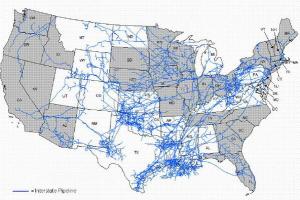 I’m going to remind you today of some events that happened 4 years ago with the BP Oil Gusher and show you that bad things are still going on in the Gulf.The leftover issues from abandoned oil rigs are bigger than Louisiana.Please consider this an open thread while I let you know how I feel.
If corporations are people, then BP and others in the extraction business are serial killers. All over our country and throughout our history, extraction companies have killed their employees, the people that live around their businesses, and the wildlife and the environment and water systems that sustain the life of our country. Look at that map. Those are active and orphaned/abandoned oil wells/pipelines that are disintegrating, leaking, and killing someone.
“I started noticing, towards the end of 2010, other leaks that were unrelated to the BP disaster,” Henderson says. “I would find wellheads that were leaking or platforms that were leaking. Just in the last year, I have filed 50 reports for different leaks and spills unrelated to the BP disaster.”
Under the Clean Water Act, when a company spills any amount of oil in the water, it must file a report with the National Response Center run by the Coast Guard. But when Henderson checked, he found many of those smaller spills were not making that list.
So environmental groups formed the Gulf Monitoring Consortium to get a better count on spills. The partnership is a blend groups of complementary skills.
Gulf Restoration Network, for example, has personnel who can spot spills from the air and file complete reports.
SouthWings, a group of volunteer pilots, helps get those spotters aloft.
Louisiana relies largely on the oil industry to self-report leaks and spills. The Gulf Monitoring Consortium was formed to improve that effort and said it often finds smaller leaks like this one, near Golden Meadow, that go unreported by the companies.A third member, the West Virginia-based tech group SkyTruth, finds the spills on satellite photographs, then applies a formula used by spill experts to translate the size of the oil sheen into gallons of oil in the water.
SkyTruth spokesman David Manthos says its estimates typically are much higher than what’s been reported.
“We found that the spill was usually 10 times larger than had been reported, and that was averaged out across a lot,” he says. “In some, the mismatch was much larger than that.”
The sheer size of the industry here means there’s seldom a quiet day for the consortium. In an average year, the NRC receives 10,000 reports of spills in the Gulf.
It’s a number that surprised even SouthWings Gulf Program Director Meredith Dowling, a veteran of monitoring efforts.
“I can’t think of a single instance where our volunteers have flown offshore and not found spills,” Dowling says. “This was something that was really amazing to me when I first moved here … that is was a continuous, absolute failure of business-as-usual practices.”
There are many active spills around here. Many come from orphaned and abandoned wells. Many come from active wells. They are all spewing toxic waste and it’s not just in Louisiana. Here is a program in Pennsylvania dedicated to plugging orphaned and abandoned wells. There are similar issues in Texas, New York State, and just nearly anywhere there’s been activity. Louisiana alone has about 6000. You can see that they are nearly everywhere if you look at the map at the top of the post. Many of these wells were first put into play in the 1850s and were just left where they were. They are rotting, they are decaying, and they are leaking. They are also dangerous.
Methane is an odorless, colorless gas that exists naturally below the surface. It isn’t poisonous, but it’s dangerous. When enough methane gathers in an enclosed space — a basement or a water well, for instance — it can trigger an explosion.
The gas didn’t come from the Butters well, nor did it originate from the Marcellus Shale formation that a nearby Shell well had recently tapped into. What most likely happened to cause the geyser in June, Shell and state regulators say, was something of a chain reaction. As Shell was drilling and then hydraulically fracturing its nearby well, the activity displaced shallow pockets of natural gas — possibly some of the same pockets the Morris Run Coal company ran into in 1932. The gas disturbed by Shell’s drilling moved underground until it found its way to the Butters well, and then shot up to the surface.
Areas impacted by oil spills are never the same. The BP Oil Gusher has introduced issues into the ecosystem that have left endangered species teetering further towards extinction. In the case of Louisiana, it’s even the state bird.
On a bright spring morning, P.J. Hahn is walking through a graveyard in the middle of Barataria Bay.
It’s a 30-yard patch of mud and sand bristling with bare, dead mangrove brush surrounded by miles of open water. Each mangrove is a tombstone marking the death of a nesting site used for decades by brown pelicans and roseate spoonbills on what was once the string of wetland pearls that made up the Cat Islands chain.
But in 2010 the oil spewing from BP’s Deepwater Horizon would send them all to an early grave.
“Four years ago we had more than five acres of habitat and there were tens of thousands of birds nesting on these islands,” said Hahn, director of coastal zone management for Plaquemines Parish. “Then the oil came in and coated the mangrove roots, and two years later the islands started going.
“I don’t know where those birds are nesting now – but they can’t do it here any more.”
The post-BP story of the brown pelican, Louisiana’s official bird, is the perfect metaphor for the crisis confronting the state’s coast.
Before the Deepwater Horizon blew out on April 20, 2010, brown pelicans were living the good life in southeast Louisiana as one of the great wildlife comeback stories. In 1963 not a single brown pelican could be found in the state due to impacts from the insectiside DDT. The comeback started in 1968 when the state began transplanting birds from Florida, and populations began to soar after DDT was banned in 1972. Thanks to the abundant food in one of the world’s most productive fisheries, by 2010 their numbers were thought to be near historic levels, as high of 85,000.*
 Four years later, the sea floor closest to the spill and even the shores in the Gulf of Mexico are comparable to an Arizona Desert. It is barren, bleak and dead. There was life there. Now, there is the look of a forest fire without the resultant new growth. Nothing will grow back amid the poison of Corexit and Oil.
When a crew of journalists and environmental groups studying the effects of the BP Deepwater Macondo oil spill disembarked on Cat Island in Baratria Bay last week, there was a collective gasp.
“It looks like the Arizona desert,” said Eileen Fleming, who’s reported for WWNO spring after spring since the April 20, 2010 spill.
“It looks like there was a fire here,” said Doug Meffert, vice president of the National Audubon Society and president of the Louisiana chapter, “but there wasn’t a fire.”
The bones of black mangrove stumps are all that remain of what was a thriving bird rookery here in Plaquemines Parish Four years ago, footage of oiled brown pelicans and the thousands of shorebirds nesting here went around the world in the aftermath of the 200 million gallons of thick crude that spilled into the Gulf of Mexico.
Today the only green thing on the beach is a glass bottle. There are no pelicans, no mangroves, and worse, much of Cat Island itself is washing away. It and most of the barrier islands and marsh in Barataria Bay are steadily degrading, losing their battles with coastal erosion and subsidence faster than ever.
Areas around Barataria Bay and Grand Isle, La. were particularly hard hit, but they weren’t the only affected areas. Moreover, thousands of birds, other wildlife and marine life including dolphins perished, were oiled, sickened and overall left in distress. The effects on the area resonate now, which is only a shock to those either unfamiliar with garish oil spills or unwilling to accept the truth.
In the days following the “spill”, BP, apparently colluding with the US Government, doused a horrific amount of a deadly dispersant in the affected areas. Called “Corexit”, the cutesy name belies the sickening effects it brings to all it touches. On background, an environmentalist working in the area explained to me last year that they were, essentially, damned if they did, and damned if they didn’t, but chose the lesser of two ills.
That remains to be seen as the National Institutes of Health continues its 10-year “GuLF” study of BP spill health effects, from those most affected out on the Vessels of Opportunity boat that included BP-hired personnel trying to contain the spill, to residents in the line of fire, such as around Barataria Bay.
There is a way of life dying along the southern parts of the Gulf Coast in Louisana. The coastline disappears daily, the salt water intrudes in to the fresh  water marshes, and the land doesn’t sustain the people or the animals like it once did. There is not better place to study the impacts of the extraction business and human addiction to fossil fuels than many parts of Cajun Louisiana.
Sea level rise is like an ultra-slow-motion hurricane for low-lying areas, but unlike a hurricane, it can be forecast decades in advance. Projections that some town or road will be underwater in 100 years can—and must—be mitigated against today.
Osborn characterizes the choice as “being proactive rather than reactive. Once you get into situations like Louisiana facing some very serious challenges in a very near time frame, all of a sudden you’re in a reactive posture.” Louisiana is a harbinger of things to come for New York, Miami, and other major coastal cities that would do well to look 20 to 75 years ahead and budget accordingly. Local, state, and federal governments will have to make critical decisions about infrastructure, water and sediment diversion, and wetlands restoration in the next 10 to 15 years, he says, and while NOAA scientists can contribute data, they can’t green-light projects or secure funding.
Osborn makes a technical distinction: “Right now it’s what’s called frequently flooded. And the risk is it will be routinely flooded.” Routine flooding will start to happen as early as 10 years from now, he says. They can call it whatever they want, but Gill says soon LA 1 will be “flooded every day during high tide.”
NOAA scientists predict that eventually all the marsh that surrounds LA 1 and Port Fourchon will disappear, connecting two major bodies of water that now are distinct: Barataria Bay and Terrebonne Bay. The only thing out in the water at all, by 2100, may be a raised road and Port Fourchon. “I can imagine Port Fourchon being like the Florida Keys,” says Chiasson, “being on its own, in the middle of open water, maybe a little marsh around it, but nothing between here and there.”
The fact that the entire extraction business is so fraught with so many bad things is why the men that run it must find politicians to protect them from lawsuits and regulations. Making these guys pay for what they’ve done would undoubtedly run their companies deeply into the red. Donation whores like Republican Governor Bobby Jindal will do anything to protect the benefactors that he hopes will fund him to the White House. There is nothing about Louisiana that this man is interested in except as a step on the rung of his personal ascent.
The state Senate targeted the flood protection authorities around New Orleans and the lawsuit one of the levee boards filed against the oil and gas industry for damages to the state’s wetlands.
In one bill, advanced by a Senate panel Wednesday morning, Gov. Bobby Jindal would get sweeping power to remove members of the Southeast Louisiana Flood Protection Authorities. Opponents said the move, which would allow a governor to remove authority members under certain conditions, reintroduces politics into the levee boards, which is precisely what revamp after the 2005 hurricanes was designed to prevent.
Another measure, which was passed by the full Senate late Tuesday night, would derail a lawsuit filed last year by the Southeast Louisiana Flood Protection Authority — East against 97 oil and gas companies. The levee board sought damages for contributing to coastal erosion and led to higher than anticipated storm surges.
Jindal opposes the lawsuit and has called it a windfall for lawyers, who would be paid with a portion of any winnings rather than a flat fee. Critics say the legislation would keep the oil and gas industry from taking responsibility for damage caused by drilling and productions activities over the years.
SB553 is aimed at a lawsuit filed by the Southeast Louisiana Flood Protection Authority-East. It would not impact similar suits filed by Jefferson and Plaquemines Parishes. But other measures currently being considered might.
The legislation passed Tuesday night, Senate Bill 553, would apply to retroactively. That measure was sent Wednesday morning to the Louisiana House.
Even kindergartners know they should clean up their messes. That is ones that aren’t sociopaths.
But, wherever there has been the extraction business, there are the sociopaths. We have the hundred year anniversary of just such an example.
Linda Linville climbed down the steep stone steps into the dugout on the southern Colorado prairie Sunday where one branch of her family was wiped out in one day 100 years ago.
Her great aunt, her unborn baby and two children died in a fire that broke out during a battle between coal miners striking against John D. Rockefeller, Jr. and the Colorado National Guard in what became known as the Ludlow Massacre. Twenty-seven-year-old Cedilena Costa, 4-year-old Lucy and 6-year-old Onofrio suffocated from the smoke as they hid below ground to escape the battle. Linville said Cedilena’s husband, Charlie Costa, was captured and shot in the head that day and never knew his family’s fate.
“Anyone who says they died in vain is wrong,” said Linville, a retired history teacher from Corona, Calif., referring to the fact that the miners eventually ended up going back to work without winning any of their demands.
The massacre and battle left 21 people dead, including the Greek-American union leader Louis Tikas, and set off 10 days of civil war in which the miners killed 30 mine guards, supervisors and strikebreakers. They surrendered only after President Woodrow Wilson sent federal troops to the state.
The deaths drew national attention to the long running strike and forced Rockefeller to take a public role in Colorado Fuel & Iron. He instituted a company union and grievance system, which the miners later rejected when the won a right to unionize on their own during the New Deal. The massacre and the deadly Triangle Shirtwaist fire in 1911 are credited with the helping win the eventual passage of the 1935 National Labor Relations Act.
Linville and over 100 others — including members of the United Mine Workers of America wearing the red bandanas the strikers wore — gathered at the site of the former Ludlow tent colony to mark the massacre’s 100th anniversary with a Greek Orthodox Easter service. It was very similar to the one the miners, who came from a variety of countries, shared in 100 years ago with the Greek strikers the day before the massacre. In a coincidental reminder of Ludlow’s international community, the Easter service will include the traditional reading of the Gospel story in many languages to symbolize the universality of its message.
It is easy to look back at the years of coal and oil and see that not much has really changed in terms of the business. The only thing that’s changing is that people, nature, and animals don’t have a chance at all and the deathtoll and damage are obvious if you actually get to see it. I have a small car. I really don’t drive much at all. I think in a busy week I may put on 15 miles. I have a bike and nearly everything I need is about a mile away. I suppose, for me, that it’s nothing to say that I really don’t benefit from any of this. I’d frankly rather pay for every single person to have some form of solar or wind generator in their home than the tax breaks we give to the oil industry. I think it would save every one in the country a lot less grief in the short and long run. But then, I could care less how much money the likes of the Koch Brothers earn. I’d frankly rather be dancing on their graves.
I just wanted to add that I found some of these wonderful skull art prints from this site.
I know it doesn’t look like it, but this is an open thread.
What’s on your reading and blogging list today?
Monday Reads: What are we doing to our fragile ecosystems?
Posted: March 31, 2014 Filed under: Climate Change, Environment, Environmental Protection, Environmentalists, morning reads 45 Comments
Good Morning!
Is it too late to notice that our consumerist society is a lot like a swarm of parasitic insects clinging to the belly of a rapidly dying host? What are we to do when so many wealthy individuals prey on the superstitions and ignorance and greed of our fellow citizens to ensure their wealth grows while our planet dies? They convince us we need more than we do, underpay us, entice us with loans and plastic, then ship themselves off to pristine virgin island bank havens while we are surrounded by the chemicals, the death, and disasters that hyper-consumerism has wrought.
How can you possibly deny what we are doing to our home? Here are the top five items from a ‘terrifying” report presented over the weekend..
The impacts of climate change are likely to be “severe, pervasive, and irreversible,” the chair of the Intergovernmental Panel on Climate Change said Sunday night in Yokohama, Japan, as the world’s leading climate experts released a new survey of how our planet is likely to change in the near future, and what we can do about it.
Here’s what you need to know:
We’re already feeling the impacts of climate change. Glaciers are already shrinking, changing the courses of rivers and altering water supplies downstream. Species from grizzly bears to flowers have shifted their ranges and behavior. Wheat and maize yields may have dropped. But as climate impacts become more common and tangible, they’re being matched by an increasing global effort to learn how to live with them: The number of scientific studies on climate change impacts, vulnerability, and adaptation more than doubled between 2005, before the previous IPCC report, and 2010. Scientists and policymakers are “learning through doing, and evaluating what you’ve done,” said report contributor Kirstin Dow, a climate policy researcher at the University of South Carolina. “That’s one of the most important lessons to come out of here.”
Heat waves and wildfires are major threats in North America. Europe faces freshwater shortages, and Asia can expect more severe flooding from extreme storms. In North America, major threats include heat waves and wildfires, which can cause death and damage to ecosystems and property. The report names athletes and outdoor workers as particularly at risk from heat-related illnesses. As the graphic below shows, coastal flooding is also a key concern.
Globally, food sources will become unpredictable, even as population booms.Especially in poor countries, diminished crop production will likely lead to increased malnutrition, which already affects nearly 900 million people worldwide. Some of the world’s most important staples—maize, wheat, and rice—are at risk. The ocean will also be a less reliable source of food, with important fish resources in the tropics either moving north or going extinct, while ocean acidification eats away at shelled critters (like oysters) and coral. Shrinking supplies and rising prices will cause food insecurity, which canexacerbate preexisting social tensions and lead to conflict.
Coastal communities will increasingly get hammered by flooding and erosion. Tides are already rising in the US and around the world. As polar ice continues to melt and warm water expands, sea level rise will expose major metropolitan areas, military installations, farming regions, small island nations, and other ocean-side places to increased damage from hurricanes and other extreme storms. Sea level rise brings with it risks of “death, injury, ill-health, or disrupted livelihoods,” the report says.
We’ll see an increase in climate refugees and, possibly, climate-related violence.The report warns that both extreme weather events and longer-term changes in climate can lead to the displacement of vulnerable populations, especially in developing parts of the world. Climate change might also “indirectly increase” the risks of civil wars and international conflicts by exacerbating poverty and competition for resources.

There have been so many disasters just recently that it’s hard to keep track. You can see our handprints on many of them. Has the policy of clear cutting timber created situations like the Washington State mudslide? Many scientists and environmentalists say yes.
As rescue workers, specially trained dogs, and heavy equipment move carefully through the area, longstanding questions are being raised about logging there and how it might have contributed to the slide.
The hillside in and around the slide area, which slopes steeply down toward the river, has seen much clear-cut logging over the years. Much of the forest there is second- and third-growth timber, replanted or regenerating naturally after earlier cuts.
Concern over logging’s impact has involved environmentalists and native American tribes. Large, old-growth trees take up more water than younger stands, which can take decades to mature and may be cut down before they reach full maturity. The demand for lumber, plywood, paper, and other wood products is part of an industry that once dominated Washington State and Oregon.
The Tulalip Tribes were so concerned with landslides hitting the Stillaguamish River and its prime salmon habitat that they blocked a proposed timber sale above an earlier slide in 1988.
“There were some very large clear-cuts planned for that area, which made us very concerned,” Kurt Nelson, a hydrologist with the tribes, told KUOW, the NPR affiliate at the University of Washington in Seattle.
“That reach of the North Fork has multiple, ancient, deep-seated landslides,” Mr. Nelson said. “There’s a lot of unstable terrain in that area.”
Landslides have followed logging in that area at least four times, KUOW reported.
“There was cutting in the 1940s; it failed in the ’50s. There was cutting in 1960, then it failed in the mid-’60s. There was cutting in ’88; it failed in ’91. There was cutting in 2005, and it failed in 2006 and in 2014,” said geomorphologist Paul Kennard, who worked for the Tulalip Tribes in the 1980s and now works for the National Park Service at Mt. Rainier.
“This had been known at least since the ’50s as one of the more problematic areas on the Stillaguamish for perennial landsliding,” Mr. Kennard said.
Although state logging regulations have been tightened in recent years, The Seattle Times reports that a clear-cut nine years ago “appears to have strayed into a restricted area that could feed groundwater into the landslide zone that collapsed Saturday.”
An analysis of government geographical data and maps suggests that a logging company “cut as much as 350 feet past a state boundary that was created because of landslide risks,” the newspaper reported.
This is an area above the most recent slide. Scientists and officials are investigating whether that clear-cut could have contributed to the current disaster.
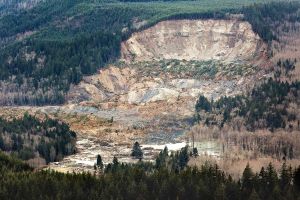 Scientists tell us that mudslides are inevitable when you treat these mountains as we do and we fail to recognize that some places just aren’t meant for human habitation. However, tell that to the developers.
Almost 25 years ago, I went into one of the headwater streams of the Stillaguamish with Pat Stevenson, a biologist with the American Indian tribe that bears the same name as the river and claims an ancient link to that land. The rain was Noah-level that day — just as it’s been for most of this March.
We drove upriver, winding along the drainage of Deer Creek, one of the main tributaries of the Stillaguamish. We couldn’t see Whitehorse Mountain, the dreamy peak that towers over the valley, that day. We could barely see beyond our windshield wipers. At last, we arrived at an open wound near road’s end. I’d never witnessed anything like it: an active slide, sloughing mud and clay down into the formerly pristine creek. We watched huge sections of land peel and puddle — an ugly and terrifying new landscape under creation before our eyes.
Stevenson pointed uphill, to bare, saturated earth that was melting, like candle wax, into the main mudslide. Not long ago, this had been a thick forest of old growth timber. But after it was excessively logged, every standing tree removed, there was nothing to hold the land in place during heavy rains. A federal survey determined that nearly 50 percent of the entire basin above Deer Creek had been logged over a 30-year period. It didn’t take a degree in forestry to see how one event led to the other.
The Stilly, as locals call the river, is well known to those who chase fish with a fly rod, and to native people who have been living off its bounty for centuries. Zane Grey, the Western novelist, called it the finest fishing river in the world for steelhead, the big seagoing trout that can grow to 40 pounds. What Stevenson showed me that day in a November storm was how one human activity, logging, was destroying the source of joy and sustenance for others. When the crack and groan of an entire hillside in collapse happened a week ago Saturday, I thought instantly of Stevenson and that gloomy day at Deer Creek.
And, sure enough, logging above the area of the current landslide appears to have gone beyond the legal limits, into the area that slid, according to a report in The Seattle Times.
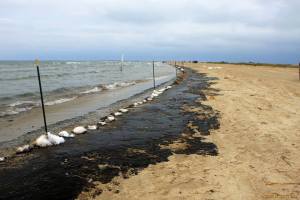 Meanwhile, the latest oil spill disasters take their toll in both the North and South of this Country. There are still long lasting effects in Alaska and in the Gulf of those giant oil spoils. But, even Galveston Bay shows sign of permanent damage from its latest brush with deadly oil that’s no where near the size of those other two. It’s getting to be that no one’s back yard is safe.
Authorities in charge of the cleanup from last week’s Houston Ship Channel oil spill say they’re responding to reports of oil near North Padre Island and Mustang Island, some 200 miles southwest of the original accident.
The command center for the cleanup reports Sunday that oil sightings were made earlier in the day by crews aboard flights being conducted by the Texas General Land Office and the U.S. Coast Guard.
Some tar balls — from dime-size to about 6 inches — have been spotted in seaweed patches along Mustang Island’s J.P. Luby Beach but it’s not certain if they are related to the spill a week ago between Galveston and Texas City.
The spill endangers wildlife nearby. There is a bird refuge that is in a particularly precarious location. That was also the clean side of the Gulf where 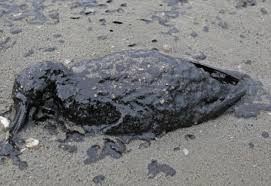 you could still trust the fish and the seafood.
The spill, which dumped what one Texas official referred to as “sticky, gooey, thick, tarry” oil that doesn’t evaporate quickly into Galveston Bay, occurred about eight miles from the Bolivar Flats Shorebird Sanctuary, which attracts 50,000 to 70,000 shorebirds each year. March is right around spring migration for many species of birds, and other birds are still wintering at Bolivar Flats, so tens of thousands of birds are living at the sanctuary, which is designated a Globally Significant Important Bird Area. Cleanup crews are using cannon booms to try to deter birds away from oiled beaches, and so far, oil hasn’t washed up on Bolivar Flats, but birds that have come in contact with oil in the water or on other beaches have been landing there.
Houston Audubon Society volunteers have been tracking the oiled birds they see at Bolivar, and Jessica Jubin, development director at the Houston Audubon Society, told ThinkProgress that the group was “definitely seeing more” oiled birds now than when they first started the day after the spill. She said on Monday, volunteers cataloged 40 to 50 oiled birds at one spot at Bolivar Flats, and on Tuesday, they counted about 100 at the same site. On Wednesday, she said, the number increased to about 140, with most birds ranging from just a few spots of oil on them to half covered in oil.
It’s the shorebirds and seabirds that are most at risk of becoming oiled from the spill, Jubin said.
“Like pelicans, for example — I don’t know if you’ve ever watched them fish, but they will soar in the sky and then spot something down below and then dart right into the water, and that’s how they get so much oil on them,” she said. “They can’t distinguish whether or not the oil is there, and they don’t know how to react to it.”
Mike Cox, spokesperson at the Texas Parks and Wildlife Department, told ThinkProgress the agency has so far collected 45 oiled birds in the Galveston area, with 19 birds in rehabilitation and 26 that were found dead. Jubin said Audubon was reporting birds they saw to Texas Parks and Wildlife and the U.S. Fish and Wildlife Service, but she worries about the movement of the oil. If it drifts too far south or west, it could end up in important habitat for endangered whooping cranes. Already, the oil has reached the ecologically-sensitive Matagorda Island, soiling at least 12 miles of the barrier island’s pristine beaches. So far, however, the Parks and Wildlife Department hasn’t received reports of oiled wildlife from Matagorda Island, Cox said, and crews were working to put up booms to keep the oil from getting into Matagorda Bay.
But birds aren’t the only wildlife at risk from the oil spill. As the Texas Tribune reports, marine scientists are worried that the spill could result in long-term health effects on Texas marine life. The thick fuel oil that spilled Saturday is persistent, so marine species could be even more at risk from oil-related defects like irregular heart rhythm and cardiac arrest than they were from the Deepwater Horizon disaster. Shrimp are a major part of the Galveston Bay fishing industry, and they’re also among the species most vulnerable to the oil spill — if their marshy homes are polluted with oil, they may not survive.
That, of course, doesn’t include the danger to the people and the clean up workers.
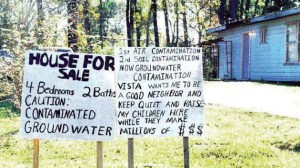
In 1790, a freed slave named Jim Moss found a place to settle down on a bend in the Houston River in the bayous of southwest Louisiana. Although never formally incorporated, the village of Mossville became one of the first settlements of free blacks in the South, predating the formal establishment of Calcasieu Parish by 50 years. But over the last half century, Mossville was surrounded. More than a dozen industrial plants now encircle the community of 500 residents, making it quite possibly the most polluted corner of the most polluted region in one of the most polluted states in the country. Now, a proposal to build the largest chemical plant of its kind in the Western Hemisphere would all but wipe Mossville off the map.
The project, spearheaded by the South African chemical giant SASOL, will cost as much as $21 billion, but stands to benefit from more than $2 billion in incentives (including $115 million in direct funding) from the cash-strapped state budget. It has the backing of Republican Gov. Bobby Jindal, considered a likely 2016 presidential candidate, who traveled to the outskirts of Lake Charles for the official announcement of the plan in 2012. The state thinks it’s an economic slam dunk. One study from Louisiana State University projected that it would have a total economic impact of $46.2 billion. It is the largest industrial project in the history of Louisiana. And after a community meeting on Tuesday, it’s one step closer to realization.
But that massive plant will come with a steep environmental price. It will produce more greenhouse gases than any other facility in the state. And the project will almost certainly spell the end for the 224-year-old settlement of Mossville, a poor enclave that has been forced to play host to industrial facilities no one else wanted in their backyard.
An analysis conducted by the Louisiana Department of Environmental Quality (DEQ) in February determined that the new project “will result in significant net emissions increases” of greenhouse gases, promethium, sulfur oxide, nitric oxide, and carbon monoxide. By its calculations, the plant will spew out more than 10 million cubic tons of greenhouse gases per year. (By contrast, the Exxon-Mobil refinery outside Baton Rouge, a sprawling complex that’s250 times the size of the New Orleans Superdome, emits 6.6 million tons.)
It’s beginning to feel a lot like we’re trapped between a future envisioned in the “Blade Runner” and that envisioned in Margaret Atwood’s “The Handmaid’s Tale”. Either way, the outcome will be sponsored by the likes of the Koch brothers and we will soon discover the fresh hells they’ve created for us. The dominionists and the capitalists join together to force their earth and its people into submission.
What’s on your reading and blogging list today?
Don’t Give Up Your Day Job, Bobby
Posted: March 11, 2013 Filed under: Environment, Environmentalists, U.S. Politics | Tags: Assumption Parish, Bayou Corne sinkhole, Bobby Jindal, Erin Brockovich, Gridiron dinner, Louisiana 5 Comments
I heard Bobby Jindal was a big hit at the Gridiron Club Dinner in Washington DC on Saturday night. Supposedly his speech was hilarious–comedy gold. Lynn Sweet of The Chicago Sun-Times gave it a rave review:
WASHINGTON–Proving once against that there are second acts in politics, Louisiana Gov. Bobby Jindal was a big hit Saturday night at the 128th annual Gridiron Club and Foundation dinner, more than making up for his disastrous 2009 State of the Union speech.
Which of course he used as fodder, since the best political humor is self-deprecating– and Jindal had an abundance of material.
Noting that some people ask him if he intends to run for president, Jindal said, “My answer is I have no plans to run. I have made that clear over and over again. In Iowa. In New Hampshire and in South Carolina,” he said, naming the states with the first caucus and primaries.
After all, he said with faux modesty, “What chance does a skinny guy with a dark complexion and a funny name have to get elected president of the United States.”
The crowd roared.
“The truth is, I am too skinny to run. At least that’s what my friend, Chris Christie, keeps telling me,” Jindal said of the overweight New Jersey Governor, also mentioned as a 2016 prospect.
On a roll, Jindal went on to compare himself with Obama and mock his own party.
He said earnestly that Obama and he had the “exact same campaign slogan years ago but unfortunately UPS sued both of us and made us stop using it. You remember our slogan, ‘What can Brown do for you?”‘
“Speaking of brown, I was hoping to see my good friend, John Boehner, here tonight,” Jindal said of Boehner, the House Speaker who is always tan. “We actually go to the same tanning salon here in Washington.”
Har har har. Are you laughing yet? Me neither. But it apparently went over big with the pols and journalists at “white tie and gown affair.” Chris Cillizza was so impressed with Jindal’s comedy routine that he requested and got a full transcript from the Governor’s staff. Here are a few more choice howlers:
They say this is a place where you can come and tell jokes about the President…poke fun at yourself…set political ambition aside and just generally say anything you want.
Kind of like the Romney campaign.
I spoke to Mitt the other day…told him that I was doing the Gridiron dinner…he said that 47 percent of you can’t take a joke.
Great to see the new Senator from Massachusetts – Elizabeth Warren. My staff tells me we’ve got a lot in common.
Well from one Indian politician to another, I want to wish you all the best in your new job.
I ran into Joe Biden earlier today. I don’t think he recognized me though. He asked me to go get him a Slurpee.You know, sometimes I wonder where we would be without Vice President Biden. And then I realize: Pretty much exactly where we are right now.
I figured Jindal would take the opportunity to joke about the disaster area back in his home state–that giant Bayou Corne sinkhole in Assumption Parish. I searched through the whole transcript, but there was nary a word.

But a funny thing happened while Governor Jindal was in Washington DC. Environmental activist Erin Brockovitch paid a visit to Assumption Parish.
Relief is a word frequently heard around the Assumption Parish sinkhole, but as Bayou Corne residents will tell you, it’s not a word they use to describe their attitudes. But now the now 8-and-a half acre sinkhole has caught the attention of California based environmentalist Erin Brockovich.
On Saturday, hundreds of Bayou Corne residents packed into a community meeting to hear what Brockovich and California based attorney Tom Girardi plan to do to help them out.
….
Girardi has offered his legal services to any resident who decides to take further action against Texas Brine and all parties responsible for their troubles over the past seven months. Brockovich says litigation, if things come to that, could take months or even years to resolve. She says her role, as it has been for nearly two decades in dozens of cases like this one, would be to keep the community united.
“We as states all over America, need to be paying more attention to what the corporations are doing…old records, what we need to do to come in and see that disaster before it happens…and not wait until after it happens and then go and argue on the legislative floor for the, what, next two or three years,” said Brockovich.
….
Brockovich said before Saturday’s meeting, they were representing 50 residents in the Bayou Corne area. After the meeting dozens more stayed behind to decide if they would join the lawsuit.
Suddenly Bobby J. has decided he’ll go visit the sinkhole in his state for the very first time since the hole opened up last August. The announcement was maid in an “e-mail statement,” so it’s not clear if the Governor was actually in Louisiana at the time.
Something tells me when Jindal shows up, the residents of the area won’t be laughing.
Time to do your day job, Governor.

 peej
peej Carissa
 bostonboomer
 dakinikat
 ecocatwoman
 mablue2
 Mama Lopez
 peggysue22
 quixote
 skydancingguestblogger
 Mona (aka Wonk the Vote)



 Sky Dancing

Recent Comments