
I See Dead People
Posted: February 27, 2012 Filed under: 2012 elections, 2012 primaries, corruption, Democratic Politics, Environment, Environmentalists, George W. Bush, Politics as Usual, Republican politics, Tea Party activists 23 CommentsMaybe this should be the new Republican mantra for a suitable candidate in 2012. If Republican politicians aren’t conjuring up the ghost of  Ronald Reagan every fifteen minutes, they can go back further into the annals of GOP glory and dig up another Republican corpse. Say . . . Ike Eisenhower. And lo and behold, that’s exactly what NY Times columnist Ross Douthat attempts in his recent “The Greatness of Ike” piece, which extolls the General’s many virtues, bemoans the fact that Eisenhower is overshadowed by the likes of FDR, ties for twelfth-place in POTUS rankings with Jimmy Carter and is generally under appreciated.
The man may have a point.
I recall Eisenhower’s warnings about the industrial/military complex being aired frequently throughout my living memory. Yet no one has paid much attention beyond nodding and saying: yes, the man was right. I suspect the current state of affairs, the country involved in a decade of senseless war, where defense contractors and mercenaries have been made fat and happy, proves the General’s point. Only problem for the Republicans is that it was likes of George W. Bush, Dick Cheney and Donald Rumsfeld who led the disastrous charge into Iraq on false allegations, hyped-up claims about weapons of mass destruction, and then offered a breath-taking defense of torture for national security purposes. Even more startling, they got away with it, leaving the country bleeding and bankrupt in their wake. All in the name of democracy, freedom and ‘shop ‘till you drop’ exhortations.
It was a moment of infamy, as someone once said.
This is why the glance backwards always skips over those inconvenient years of woeful mismanagement and fiscal insanity. No doubt the current batch of 2012 candidates, the Fearless Four, bring angst to all Republican hopefuls convinced, only a few, short months ago, that a 2012 victory was inevitable, a piece of cake.
A powerful dose of nostalgia makes the medicine go down easier.
Surely, the good ole days seem ever more grand as Rick Santorum raises the flag for a home-grown theocracy and dances with the Devil, Mitt Romney continues to stumble over his own tongue [revealing his wife drives ‘two’ Caddies], Newt Gingrich beats his breast over the secular plot to undermine America and Ron Paul, the cuddly libertarian, begins to look and sound strangely reasonable.
 What’s a true-blue Republican to do?
Dig up some corpses.
Am I, a thoroughly disenchanted Democrat gloating? In a pinch, yes. In the long-term, no, because I’m stuck with a candidate I did not vote for in 2008, a man who has proven himself less a champion of Democratic principles than even I ever expected.
As a Nation, we are stuck in a rut for which there seem few alternatives. The legacy parties offer nothing but more of the same—craziness on one side and the uninspiring ‘we suck less than they do’ on the other. As a voter, I’ve vowed to go 3rd party in November [unless the Republicans were to choose Santorum, then I’ll vote directly against him]. However, in the larger frame all I see are monied interests, directing and maneuvering what is suppose to be a ‘free’ election. It has virtually nothing to do with me or my values. On the contrary, it’s all about the persistence of a political class and their cash-soaked benefactors calling for war and protecting their national interests, the gutting of our social contract; the unwillingness to formulate a sensible energy program sans the giant fossil fuel companies’ interference or address the critical and devastating slippage in education, infrastructure, healthcare and employment opportunities.
We have plenty of money for bombs. But not our people. Bailouts are bad. Unless our representatives are saving the asses of and colluding with the corrupt TBTFs. Water and food is the stuff of life until there’s a pipeline, gushing with sludgy oil and money, to compromise both.
Ed Rollins, former Reagan strategist, made a statement recently about the 2012 Republican field:
“Six months before this thing got going, every Republican I know was saying, ‘We’re gonna win, we’re gonna beat Obama.’ Now even those who’ve endorsed Romney say, ‘My God, what a fucking mess.’
That about sums it up, not simply about the Republican field but the entire country. It is an effing mess. And there’s no savior on the horizon. In fact, there’s no savior anywhere. Unless we, the American public, do the saving. But that means coming together on issues where we can agree. The gridlock in DC gets us absolutely nowhere. It’s enough to put anyone into a funk.
But then this morning I read an article about environmentalists and Tea Party activists coming together to fight Keystone XL, the pipeline extension from Nebraska to Texas. For the Tea Party, it’s all about individual property rights and the way TransCanada, a foreign company, has attempted to strong-arm property owners. For the environmentalists it’s about preserving fertile farm land and a major aquifer from the too real danger of irreversible contamination. The nexus of agreement between these two wildly divergent political groups is this: the Keystone pipeline does not serve the public’s interest.
That’s the winning hand: the public’s interest. Not the oil companies, not the 196 people funding the SuperPacs, not the banks, not the Democratic or Republican parties.
What serves the public’s interest.
We, American citizens, can find ways to work together or continue to be spectators to the endless political theater, the Kabuki dance we call elections. And once more we’ll be digging up corpses, which could very well be our own.

There Will Be Blood
Posted: February 23, 2012 Filed under: alternative energy, energy, Environment, First Nation, health hazard, Keystone XL pipeline, Northern Gateway pipeline, Regulation, tar sand oil, toxic waste, US & Canada, Water 22 CommentsIf you listen to the GOP, you’d be convinced that the WH, Democrats in general and crazed environmentalists specifically had nixed the Keystone Pipeline out of sheer orneriness or a deep-seated hatred of good ‘ole American Capitalism. Rick Santorum and his Prince of Darkness tour would no doubt smell brimstone in the midst of any pipeline dissent.
Well, surprise, surprise. The push back is not limited to protestors in the United States. Our northern neighbors in Canada have as many if not 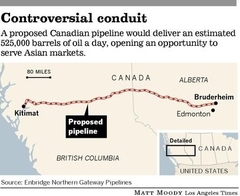 more objections to the Petro State ripping through their country, poisoning watersheds, destroying wildlife and property, causing disease and health problems among citizens, all in the name of King Oil and the desire to wring every last drop out of the planet.
The Hell with Consequences!
First Nation, the indigenous population of Canada, has already predicted:
There will be blood!
Why the outcry? Enbridge, Inc. and the conservative government in Canada is pressing forward with their own pipeline project, Northern Gateway, which would carry 500,000+ barrels a day 731 miles from a town near Edmonton, westward through the Rocky Mountains to a port on the British Columbia [BC] coast. Over 60 indigenous organizations have expressed their opposition, refusing to be moved by the promise of revenue, jobs and an increase in their quality of life because their lives are deeply attached to the natural resources of BC, most importantly the integrity of the salmon trade that depends on the streams and tributaries of the Fraser and Skeena Rivers. In addition, the proposed port on the coast, which would host over 200 oil tankers a year, could expose the Great Bear rainforest to irreparable damage.
Think Valdez!
Interestingly enough, First Nation opposition is the most serious threat to the Harper government’s enthusiastic endorsement of the pipeline. Unlike other indigenous groups, First Nation never signed treaties with the Canadian government and consequently never relinquished their lands to the Federal government. On the other hand, the government and oil companies have nearly unlimited funds to fight this battle in court.
According to the LA Times report Tribal Chief Jackie Thomas has said:
“It’s going to be a war. The only question is, who’s going to draw the first blood.”
And here’s a chilling factoid: Enbridge is the same company responsible for the leak of 800,000+ gallons [the EPA now reports over 1 million gallons] of tar sand oil into the Kalamazoo River, Michigan. Presumably, the oil company has spent $700 million in reclamation procedures. The area is still a gigantic mess.

Kalamazoo River Spill
Added to the environmental risks [the cost of which is usually ignored] the Northern Pipeline is likely to boost the price of oil for Canadian consumers because like the Keystone proposal, the oil would be exported, not available domestically. The video below is instructive in a grim way.
Why are we having these bitter disputes?
Because we desperately need new energy sources. And there’s tons of money on the line. More importantly, we need an Energy Policy/Strategy, where the pros and cons of transitional sources are seriously considered–the trade-offs, the costs, what we as a culture are willing to put up with or risk until renewable, clean sources are developed and brought online. That’s a plan that would look at what we need today, five years down the road, 10, 20, 30 years. You set benchmarks. You invest in, encourage and unleash innovation, while focusing on increased efficiency from power plants–the traditional US coal power plant is only 35% efficient, meaning we’re wasting most of the energy we’re producing–to autos to buildings to everything else.
Where is that policy? Nada.
The Department of Defense’s push towards alternative energy is not a sign of the US military becoming rabid tree huggers. As the world’s largest institutional energy consumer, the DOD knows the score: the days of cheap fossil fuel are over and our dependence on foreign and unfriendly suppliers is a serious security issue. The Department’s commitment to this reality can be seen in proposed budget expenditures: $3 billion by 2015; $10 billion by 2030.
As GreenTech Media reported, this sort of shift has historical parallels:
Military spending in support of energy is not new. Winston Churchill’s decision in 1911 to move the British Navy, then the world’s then most dominant military force, from coal to oil changed the world’s energy marketplace. The emerging trend in DoD spending on renewables is an equally historic marker.
Neither American or Canadian energy needs should come down to an either/or contest: shut off the electricity or rip the environment apart, robbing people, wildlife, the very planet of their health, sustainability and future. We cannot poison our watersheds, jeopardize our aquifers or damage fertile farmlands for the sake of profits or our unwillingness to conserve and efficiently utilize what we have. King Oil has ruled long enough. The damage they’re willing to exact is unacceptable, even obscene.
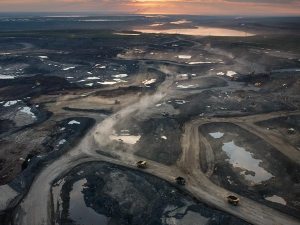
Alberta Tar Oil Sands, Aerial Satellite Shot
First Nation peoples of British Columbia know this and are willing to fight tooth and nail to preserve what’s left of their way of life and cultural traditions. To save the irreplaceable.

Great Bear Rainforest
There may very well be blood. It’s a worthy fight.
The Myth in the Machine
Posted: February 17, 2012 Filed under: Economy, Environment, Environmental Protection | Tags: regulations create jobs 15 Comments Bostonboomer and I were perusing information on the Issa panel and committee on religious freedom and birth control yesterday. Their expert witness panel appeared to be a mix between the Salem Witch Trials and the Spanish Inquisition. Where were the women on this panel? Is this really our government? What’s going on in Torquemada’s–errr Issa’s–realm of influence these days? BB has already regaled us on the crooked career and life of Issa whose business and career seems built on insurance fraud, car theft, and arson, so I won’t go there. We have a whole tag dedicated to him that’s infinitely googleable. However I will express my utter surprise and contempt that a committee of the US House of Representatives and its web page seem to be more of a propaganda tool of right wing tropes than anything remotely informative or helpful. Issa appears to be the Republican Party’s budding little combination of Goebbels and Himmler.
Go there and you’ll see a youtube with a nice white lady saying her “choice” was taken away by the SEIU. You’ll also see the Orwellian job creators DOT com that wants to know what kind of things are holding up your business. I don’t suppose any answer pointing to a lack of customers with well-paying jobs gets much attention. It also has a link to the Fast and Furious Witch Hunt. (No mention that this program had roots in the previous Republican administration, of course.) I had no idea that so much propaganda had crept into tax payer paid websites of congressional committees. I expect propaganda on their Facebook pages. But congressional committee pages with federal government addresses? Please!!
In honor of Issa’s hunt for “experts” that agree with him, I thought I’d point out a Bloomberg Business article that shows how many jobs new government regulations can create in the economy. The subtitle is “Vilified on the campaign trail, government rules often create as many jobs as they kill”. Nothing like a little truth and empirical research to shine the light on the Issa/Gingrich/Romney propaganda machine. It’s true that regulations on businesses can shift resources away from the regulated business. That includes jobs, profits, capital, and executive perks. However, that’s a one-sided notion. Those resources don’t disappear into thin air. They simply shift away from the business that’s regulated–most likely because it’s creating a social cost–to other businesses that can better use the resources or employ folks cleaning up and measuring the messes in the case of regulation of dirty industries like Coal and Oil.
“This rule is the most extensive intervention into the power market and job market that EPA has ever attempted to implement,” says Scott Segal, a lobbyist at Bracewell & Giuliani, which represents the utility Southern Co. (SO) He argues the regulation will “undermine job creation in the United States.”
Tell that to Cal Lockert, the vice-president of Breen Energy Solutions, a Pittsburgh manufacturer of equipment that absorbs acid gases to keep them from spilling out of smokestacks. Lockert spends his days persuading power companies that he can help them bring some of their oldest, dirtiest plants in line with the federal requirements. There’s been “a frenzy of engineering firms and utilities” calling him for demonstrations of his products, he says. He’s hired a dozen people in the past month and says he’s just getting started.
Nol-Tec Systems in Lino Lakes, Minn., also expects a boom in sales of its equipment, which uses baking soda to pull pollutants out of plant exhaust. Meanwhile, Thermo Fisher Scientific (TMO) in Waltham, Mass., is building emission monitors that power plants will need to measure toxins under the new rules. The regulations “could easily add $50 million to $100 million dollars in revenue in a year or two years,” says Chief Executive Officer Marc Casper, “which is significant for a company like ours.” The Institute of Clean Air Companies, a trade association representing businesses that make products to reduce industrial emissions, forecasts the industry will add 300,000 jobs a year through 2017 as a result of the EPA rules.
This is the side of the story that rarely gets mentioned in Washington or on the campaign trail. In an election year that hinges on the economy, government rules have become politically toxic. President Barack Obama’s health-care overhaul, the massive Dodd-Frank financial reform law, and EPA clean air and water mandates come under frequent attack from Republicans who say burdensome regulations are stalling the nation’s recovery. In the GOP debates, the R-word is now habitually preceded by “job-killing,” as in Mitt Romney’s promise to put an end to “job-killing regulations.” Newt Gingrich refers to the EPA as a “job-killing regulatory engine.”
Romney and Gingrich aren’t wrong. Government regulations do kill jobs, often by the thousands. Although it’s too early to tell how many layoffs may result from health-care and Wall Street reforms, there is a body of research going back decades detailing what has happened time and time again when Washington handed down sweeping environmental regulations: Costs increased, prices went up, and workers were fired. Supporters and opponents of the EPA’s new power plant rules agree that they will almost certainly result in dozens of coal plants shutting down and hundreds of workers being laid off.
But that’s not the whole picture. Government employment figures also show that those same regulations usually wind up creating about as many jobs as they kill. “We find there is no net impact,” says Richard Morgenstern, the EPA’s director of policy analysis in the Reagan and Clinton Administrations and now a researcher with Resources for the Future, a nonpartisan energy think tank in Washington. “The job creation and the job destruction roughly cancel each other out.”
Businesses targeted for regulation create huge social costs that taxpayers are forced to pick up. There are public health and safety costs, pollution and clean up costs, and many other costs. Dirty industries do these because they can force their costs onto the back of the public. They over produce their products and gobble up scare capital and productive resources because of they don’t realize the full costs of doing business. Regulation pushes these costs back onto their businesses. It also leads to “creative destruction” which is the Schumpeter idea that old, outdated technology must be replaced with better things to improve the long term performance of the economy. Some times the discipline in key industries has to come from the government because of the monopoly power of the industry. The energy industry is a prime example with its oligopoly over resource and product markets and the price inelastic nature of its demand. This enables the industry to via for political power as well as allows it fight to maintain dominance. In most of these cases, only technological developments break the monopoly/oligopoly. When Carter deregulated the telecommunications industry it wasn’t really all that effective. What really broke the back of the AT&T monopoly was the advances in communications technology. Frequently, regulations allow access to the heart of the monopoly’s business so that more facile, advanced businesses can break apart this destructive market type. It transfers resources away from the inefficient market that pushes high social costs on to taxpayers and neighboring communities.
Here’s a study that you never hear coming from the Issa propaganda/witch hunt arm of the US House of Representatives.
In 2002, Morgenstern and his colleagues published a landmark study detailing the effects of regulations on jobs in four polluting industries: paper, plastics, petroleum, and iron and steel. Drawing on more than 10 years’ worth of U.S. Census data, the study found new regulations led to higher production costs that pushed up prices, resulting in lost sales and layoffs. Yet those job losses were offset by new jobs in pollution abatement. “There’s always someone who is helped and someone who is hurt,” says Roger Noll, director of the Program on Regulatory Policy at Stanford University. “Which is why you have to look at the net effect on the economy.”
The loss in the polluting industry is actually a good thing in terms of market economy’s because it’s usually related to market inefficiency and transferred costs of doing business. BTW, this Stanford University think tank is not a hot bed of raging liberalism. This is one of this policy areas where there are trade-offs. This means changes create winners and losers. The deal is that in most cases the job loss is minimal but overall market efficiency improves. The true cost of the product is passed on to consumers which removes the subsidy to the consumers and producers of the product. Again, the resources just go elsewhere and are employed more efficiently in newer businesses. Oddly enough, this is what Romney frequently says he did in his corporate raider days.
The critique of regulations fits into a broader conservative narrative about government overreach. But it also comes after a string of disasters in recent years that were tied to government regulators falling short, including the financial crisis of 2008, the BP oil spill and the West Virginia mining accident last year.
Data from the Bureau of Labor Statistics show that very few layoffs are caused principally by tougher rules.
Whenever a firm lays off workers, the bureau asks executives the biggest reason for the job cuts.
In 2010, 0.3 percent of the people who lost their jobs in layoffs were let go because of “government regulations/intervention.” By comparison, 25 percent were laid off because of a drop in business demand.
I’m really not sure how we can create responses and discussions to one-sided political narratives that are based more on ideological memes than facts. It certainly doesn’t help when that one-sided narrative comes from our own government sites and servants. Obviously, the inefficient, lop-sided markets create monopoly profits for the stakeholders and we see K street filled with lobbyists aimed at protecting the inefficient markets. The stories from younger, inventive, upstart businesses without lobbyists and pet pundits and politicians have worthwhile narratives. Too bad their lost in a fight for ideological purity instead of empirical truth. Perhaps this is one of the reasons we keep fighting the culture wars. Voodoo economics narratives don’t hold up to inspection.
Zombies and Vultures and Pipelines, Oh My
Posted: February 5, 2012 Filed under: Domestic Policy, Environment, Environmental Protection, ethics, Gulf Oil Spill, health hazard, K street, legislation, lobbyists, Politics as Usual, Regulation, Republican politics, science, toxic waste, Water | Tags: Climate change, environmental problems, oil spills 6 CommentsThe zombies seem to be winning the war against the living. We have zombie banks, zombie politicians [think Rick Perry], zombie policy—free market fundamentalism preached as an untried economic theory.
And now zombie pipelines.
Just when you thought the Keystone XL controversy had been put to rest [at least temporarily], its zombie presence lunges forward, reanimated for all to see. Although I suspect supporters of this very bad idea are hoping the American public is not watching or if they are watching they will buy the swill on the non-existent benefits of a 1700-mile tar sands pipeline.
What am I talking about?
I found a disturbing inquiry [hattip to OEN] by Representative Henry Waxman to a Deborah Hohlt, who received $50,500 from the Great State of Indiana [that would be paid in state taxpayer monies] to lobby in DC on behalf of the TransCanada Keystone XL Pipeline. Indiana’s Governor Mitch Daniels provided the rebuttal to the President’s SOTU address, in which he referred to the Administration’s decision to ‘postpone’ the pipeline’s construction as an ‘extremist’ policy.
As you might remember the Republican chorus on this subject has been jobs, jobs, jobs. House Speaker Boehner has quoted 100,000 jobs at stake. TransCanada has been all over the map with job estimates, the last, most creative quote coming in at 250,000 jobs. Unfortunately, the numbers are at odds with the single independent analysis from Cornell Global Labor Institute, estimating the number at between 4000-6000 temporary jobs. The steel for the pipeline? Would be coming from India. The cry that the pipeline would reduce our reliance on foreign oil? The refined tar sands oil is contracted for export [80%] to South America and Europe.
The upsides are slim to none, considering the toxic, corrosive nature of tar sand oil, the sludge-like quality that requires pressure and heat to make a pipeline flow possible. That also increases the risk of a leak and an environmental disaster. Anyone who may question the heightened risk should check out the total mess in Michigan when over 800,000 gallons of tar sand oil spilled and contaminated 40 miles of the  Kalamazoo River and surrounding properties.
And the reclamation? These corporations should hang their heads in utter shame. If you want to be thoroughly disgusted check out the You Tube clip I provided in an earlier post.
But here’s the really curious thing. The pipeline won’t be running through Indiana. The pipeline will not be running close to Indiana’s borders. No Indiana facilitities will have access to the pipeline. In fact, it appears that Indiana does not stand to be impacted in anyway by the Keystone pipeline and yet Governor Daniels felt compelled to call President Obama an extremist for postponing the pipeline’s construction. He was also willing to pay a $50,000+ [in state taxpayer money] to lobby for the Great State of Indiana in defense of the pipeline.
More curious still? TransCanada has stated that the pipeline will ‘increase’ oil prices for Indiana and other Midwestern residents because the area is ‘oversupplied.’ Keystone’s successful construction [this is stated in TransCanada’s application] will ensure higher prices for Canadian crude. By independent analysis costs will increase $6.55 per barrel in the Midwest and $3 per barrel everywhere else. The Indiana Petroleum Council thinks this is a swell idea.
Which begs the question: Who does Governor Daniels work for? His constituents or the oil companies?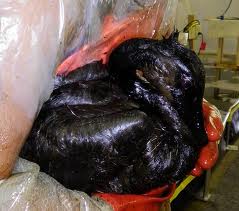
So, it should not be any great surprise that a Senate group–laughably-called bi-partisan because it includes 1 Democrat, Joe Manchin from W. Va.–is reintroducing the Keystone proposal, pushing for immediate construction with or without the Administration’s approval. The Senate committee is invoking the Commerce Clause of the Constitution, which says Congress should have the power:
To regulate Commerce with foreign Nations, and among the several States, and with the Indian Tribes.
I love it when the Republicans start waving the Constitution. It’s a clear signal they’re up to no good. Did I mention that Koch Industries stands to make a killing on this project?
While reading Representative Waxman’s letter, I recalled something I’d read in Greg Palast’s book Vultures’ Picnic and found an accompanying and equally disturbing text online here and here. To quote Palast:
Reserves are the measure of oil recoverable at a certain price. Raise the price, raise the reserve. Cut the price and the amount of oil in the ground drops. In other words, it’s a fool’s errand to measure the “amount of oil we have left.” It depends on the price.
Specifically, oil companies and oil-related financiers are not interested in expanding oil supplies to the world, particularly cheap oil supplies  [because the days of cheap oil are over]. They’re interested in feeding the hunger for oil and controlling the price around the world with an iron fist. The higher, the better. The environment—air, water, soil–is not the concern. Our health or that of our children is not the concern. The bottom line—profit and power—is all that matters. If nations collapse? The Vultures are waiting to feast on the bones.
Sound harsh? It shouldn’t. Zombies and vultures are kissing cousins. They’re coming ‘round for a friendly visit. Again.
DOD Embraces the Green Giant While Keystone XL Looks Increasingly Unattractive
Posted: January 27, 2012 Filed under: Environment, Environmental Protection, Gulf Oil Spill, health hazard, toxic waste, U.S. Military, U.S. Politics | Tags: Department of Defense, going green, Keystone Pipeline, renewable energy, tar sand oil 9 Comments Frankly, I was surprised by President Obama’s comments in his SOTU address about the Department of Defense’s solar program, a project that would not only provide energy to military installations but generate enough additional energy to supply ¾ million American households.
Well, lo and behold, this is not idle chatter.
Turns out ground has been broken on a 13.78-megawatt solar power system at the Naval Air Weapons Station at China Lake, CA. The project is expected to provide over 30% of the facility’s annual energy requirement and save an estimated $13 million in costs over the next 20 years. This is in keeping with a larger strategic plan to reduce the Defense Department’s reliance on foreign oil, shrink its annual $4 billion energy bill and ensure energy security in the event of a natural disaster or other unforeseen events [sounds ominous].
A year-long study indicated that of DOD’s huge landholdings in the Mojave and Colorado deserts, across which seven military bases in California were considered– Fort Irwin, China Lake, Chocolate Mountain, Edwards, Barstow, Twentynine Palms and El Centro—and two in Nevada [Creech and Nellis], 30,000 acres were deemed suitable acreage for solar production. Future facilities could produce 7 gigawatts of electricity. To put this in perspective that’s roughly equal to 7 nuclear power plants, sufficient to supply full electricity to the 5 California bases 30 times over, enough in excess to supply 780,000 California households.
This push for renewable energy use by the military has also been taken to the battlefield, namely Afghanistan. Last year, the 3rd Battalion 5th Marines began operating with Ground Renewable Energy Networks, Solar Portable Alternative Communications Energy Systems, LED lighting systems, Solar Shades, and Solar Light Trailers. In addition to reduced fuel savings, reports indicate that alternate energy use in remote locations decreases resupply convoy runs and subsequently the danger of IED attacks. Lives saved is a definite plus.
But there’s more. Army installations force-wide have implemented a 2020 goal of net-zero energy consumption, which means reducing energy consumption, and then producing power through renewable sources.
Kristine M. Kingery, director of the Army’s sustainability policy, said pilot installations in the program are “striving toward” goals the Army wants met by 2020. “With Net Zero, the idea is not just replace the energy with renewables,” Kingery said. “It’s the reduction, the repurposing, conservation and efficiency. Reduce usage, and replace what you are using with renewables.”
As the largest institutional energy consumer in the world, the Defense Department is providing a major infusion of funding for research and development and application of renewable energy projects, including advanced biofuels, the world’s largest rooftop solar project involving 127 bases, advanced fuel cells and advanced grid technology, just to name a few.
What I find remarkable about all this activity is how DOD’s push puts the Keystone pipeline controversy in an entirely different light.
As you may recall, the Republican objection to President Obama’s recent rejection of Keystone’s proposal was presumably all about jobs. The numbers have been wildly overstated. The State Department, at best, estimated 5000-6000 temporary construction jobs created, not the 100,000 jobs Speaker Boehner recently cited. Or the 250,000 that TransCanada finally arrived at. But more importantly, claims have been made that the pipeline would help break our dependence on foreign oil. This, too, has been proven patently false since the tar sand crude, once refined, had already been contracted for export to Latin America and Europe. Even the material for the pipeline [primarily steel] was being supplied not by American suppliers but by India.
This a classic battle–the old vs. the new. And who is leading the way? The United States Military, an institution of conservative values, has taken the bull by the horns and said: Time to move on, boys. The Era of Conservation and Renewable Energy is at hand.
There’s also the environmental impact of the pipeline, the danger of a leak, something pipeline supporters have openly mocked. What is rarely mentioned is that tar sand oil requires heat and pressure to move the sludge-like material along its 1700-mile journey from the Alberta sand fields to Texan refineries. Tar sand oil is toxic and very corrosive, making leaks far more likely.
What could happen?
Unfortunately, we’ve had a graphic example of exactly what could and did happen. In Michigan, a tar sands leak, estimated at over 800,000 gallons, polluted 30 miles of the Kalamazoo River, July 2010.
And Quelle Surprise! There was a resultant cover up.
Recall the Gulf of Mexico, BP and the environmental disaster of nightmarish proportions.
Then remember that the United States Military has clearly gotten the message and acted upon it: The Age of Fossil Fuel, the rush for Black Gold is coming to an end. The way forward financially and security-wise is colored Green.
Which would you rather see–this?
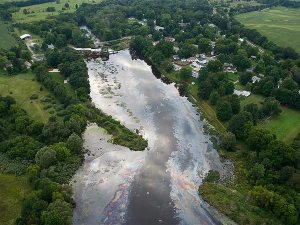
Or this?

Personally? I’ll take door number 2 and follow the generals into the future.

 peej
peej Carissa
 bostonboomer
 dakinikat
 ecocatwoman
 mablue2
 Mama Lopez
 peggysue22
 quixote
 skydancingguestblogger
 Mona (aka Wonk the Vote)



 Sky Dancing
Recent Comments