
We Interrupt your Regularly Scheduled Programming for a Bit of Deprogramming
Posted: April 12, 2011 Filed under: Catfood Commission, Domestic Policy, Economic Develpment, financial institutions, income inequality | Tags: helping the world's poor, Income Inequality, tax havens 9 Comments
Uncle Barrack sez: Time to feed the Corporate Kitty
It’s time for my regular rant on how bad income inequality is for an economy. I know that John Boenher wants to transfer all the resources in the country to so-called job creators and that CEO Hacks are trying to turn the public school system into a drone production unit, but as usual, I’m going to interrupt the messaging with empirical evidence. I’m just one of those people that doesn’t believe any one unless they back it up with honest numbers. This time, I’m going to direct you to a study by the International Monetary Fund (IMF). Just in case you don’t already know, the IMF is not exactly a bastion of comrades-in-arms. They’ve been soundly criticized by developing nations for exporting American-style capitalism wherever they go to provide help to struggling nations. So, with that in mind, here’s a briefing on the study titled “Warning! Inequality May be Hazardous to your Health”.
Their introduction is so meaty that I’m going to leave it nearly wholesale for you before I return to editing more things for a development journal. Finding ways to raise every one’s boat is my thing, just in case you never noticed.
Many of us have been struck by the huge increase in income inequality in the United States in the past thirty years. The rich have gotten much richer, while just about everyone else has had very modest income growth.
Some dismiss inequality and focus instead on overall growth—arguing, in effect, that a rising tide lifts all boats. But assume we have a thousand boats representing all the households in the United States, with boat length proportional to family income. In the late 1970s, the average boat was a 12 foot canoe and the biggest yacht was 250 feet long. Thirty years later, the average boat is a slightly roomier 15 footer, while the biggest yacht, at over 1100 feet, would dwarf the Titanic! When a handful of yachts become ocean liners while the rest remain lowly canoes, something is seriously amiss.
In fact, inequality matters. And it matters in all corners of the globe. You need look no further than the role it might have played in the historic transformation underway in the Middle East.
The increase in U.S. income inequality in recent decades is strikingly similar to the increase in the 1920s. In both cases there was a boom in the financial sector, poor people borrowed a lot, and it all ended in huge financial crises. Did the recent financial crisis result somehow from the increase in inequality?
Some time ago, we became interested in long periods of high growth (“growth spells”) and what keeps them going. The initial thought was that sometimes crises happen when a “growth spell” comes to an end, as perhaps occurred with Japan in the 1990s.
We approached the problem as a medical researcher might think of life expectancy, looking at age, weight, gender, smoking habits, etc. We do something similar, looking for what might bring long “growth spells” to an end by focusing on factors like political institutions, health and education, macroeconomic instability, debt, trade openness, and so on.
Somewhat to our surprise, income inequality stood out in our analysis as a key driver of the duration of “growth spells”.
We found that high “growth spells” were much more likely to end in countries with less equal income distributions. The effect is large. For example, we estimate that closing, say, half the inequality gap between Latin America and emerging Asia would more than double the expected duration of a “growth spell”. Inequality seemed to make a big difference almost no matter what other variables were in the model or exactly how we defined a “growth spell”. Inequality is of course not the only thing that matters but, from our analysis, it clearly belongs in the “pantheon” of well-established growth factors such as the quality of political institutions or trade openness.
While income distribution within a given country is pretty stable most of the time, it sometimes moves a lot. In addition to the United States in recent decades, we’ve also seen changes in China and many other countries. Brazil reduced inequality significantly from the early 1990s through a focused set of transfer programs that have become a model for many around the world. A reduction of the magnitude achieved by Brazil could—albeit with uncertainty about the precise effect—increase the expected length of a typical “growth spell” by about 50 percent.
The upshot? It is a big mistake to separate analyses of growth and income distribution. A rising tide is still critical to lifting all boats. The implication of our analysis is that helping to raise the lowest boats may actually help to keep the tide rising!
That basically says that no one’s boat will really rise as much as it could unless all boats rise. Intuitively, this makes sense because if you think about it, businesses need customers. Poor customers just don’t buy as much unless you provide them with good incomes. Unless you want make government the primary customer in an economy or you’re deluded into thinking business investment will ever be the major agent in GDP, you realize that household consumers are the true center of any market economy. Denying them incomes denies every one of incomes. Just providing monies to the top 1 or 2 percent who are now likely to take their spending and investment any where on the planet is just delusional. Actually, if you want some really good reading on that, I suggest you pick up the book Tax Havens: How Globalization Really Works (Cornell Studies in Money).
In Tax Havens, Ronen Palan, Richard Murphy, and Christian Chavagneux provide an up-to-date evaluation of the role and function of tax havens in the global financial system-their history, inner workings, impact, extent, and enforcement. They make clear that while, individually, tax havens may appear insignificant, together they have a major impact on the global economy. Holding up to $13 trillion of personal wealth—the equivalent of the annual U.S. Gross National Product—and serving as the legal home of two million corporate entities and half of all international lending banks, tax havens also skew the distribution of globalization’s costs and benefits to the detriment of developing economies.
The first comprehensive account of these entities, this book challenges much of the conventional wisdom about tax havens. The authors reveal that, rather than operating at the margins of the world economy, tax havens are integral to it. More than simple conduits for tax avoidance and evasion, tax havens actually belong to the broad world of finance, to the business of managing the monetary resources of individuals, organizations, and countries. They have become among the most powerful instruments of globalization, one of the principal causes of global financial instability, and one of the large political issues of our times.
There’s not really much difference between the Gadhaffi family and the Koch brothers when it comes to where the money goes from exploiting national resources. It’s also really no surprise that when you observe the countries that have the highest per capita incomes in the world that you find the world’s tax havens in the top tiers. (Norway and the US are the only countries in the top ten that aren’t tax havens.) Giving money to the richest folks in your country–the behavior of so-called banana republics–is detrimental to the economic health of that country in many ways. It’s just another way that financial institutions and financial innovation has gutted the productive capability of many a country.
The original IMF study–released on April 8, 2011–is here. I would like to point to the policy implications and suggestions section which makes going to the original study imperative. Think about this when you listen to US banana republic President Obama speak tomorrow on the marvels of the catfood commission’s report. Notice there are other studies cited in the policy suggestions.
There is nonetheless surely policy scope to improve income distribution without undermining incentives—perhaps even improving them—and thereby contribute to lengthening the duration of growth spells.
- Better targeting of subsidies can be a win-win proposition, as with the reallocation of fiscal resources towards subsidies of goods that are consumed mainly by the poor,which can free up capacity to finance public infrastructure investment while better protecting the poor (Coady et al., 2010).
- Active labor market policies to foster job-richer recoveries (ILO, 2011) may help to make recoveries more sustainable, especially as rising unemployment appears to be associated with deteriorations in the income distribution (Heathcote, Perri, and Violante, 2010).
- Equality of opportunity can make for both more equal and more efficient outcomes (World Bank, 2005). For example, effective investments in health and education—human capital—may be able to square the circle of promoting durable growth and equity while avoiding shorter-run disincentive effects (Gupta et al., 1999). Such investments could strengthen the labor force‘s capacity to cope with new technologies (which may have contributed to more inequality in a number of cases), and thereby not only reduce inequality but also help sustain growth. They could also help countries address possible adverse distributional consequences of globalization and reinforce its growth benefits.
- Some countries have managed through pro-poor policies to markedly reduce income inequality. Brazil, for example, after its market-oriented reforms of 1994 implemented active propoor distributional policies, notably, social assistance spending, that were critical to substantial reductions in poverty (Ravallion, 2009).
- Well-designed progressive taxation and adequate bargaining power for labor can also be important in promoting equity, though with due attention to the need to avoid dual labor markets that perpetuate divisions between insiders and outsiders.
Yes, I bolded the sections that are in absolute contradiction with current US political groupthink. I guess Obama just really isn’t that into development policy or research in economics. Read them and weep for what could be. Meanwhile, turn on the TV and go right back to the villagers promoting the idea that trickle up economics makes all of us better off, if you dare.
Karl Marx: The Comeback Kid
Posted: April 10, 2011 Filed under: Economic Develpment, financial institutions, Global Financial Crisis | Tags: Commerce, economics, finance, Financial Development, Financial Institutions, Karl Marx 23 Comments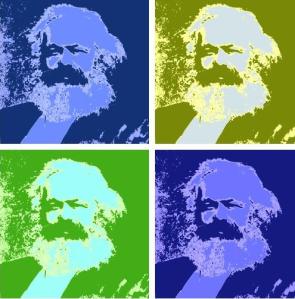 technology, pushing them to take more and more expensive credits, until their debt becomes unbearable. The unpaid debt will lead to bankruptcy of banks, which will have to be nationalised, and the State will have to take the road which will eventually lead to communism”
Karl Marx, Das Kapital, 1867
Okay, I got your attention and that’s my purpose. I’m really not a closet Marxist, but I do feel that some of that old school political economics he brought to the realm of economic thinking way back when is still worth contemplating. The above quote from Marx is a fairly good summation of his intellectual endeavors. He starts out with some really great assumptions then jumps the shark with vague, unmapped conclusions, But, Marx was a philosopher and jumping sharks seems to be an occupational hazard for them. Economics these days relies on mathematical models and empirical study.
Marx is one of those folks–along with equally fringe Frederick Hayek– who is getting a second look in a back-handed way. What’s pretty interesting is that a lot of the criticism of Marx and Lenin forgets that they had more against “financial capitalists” than they had against “industrial capitalists”. Both Rand and Ron Paul sort’ve remind me of them in that way. Marx actually looked at us ideally as a society of producers. He didn’t like how financiers fit into that picture at all. He railed against the UK’s Bank Act of 1844 that was a response to a fairly huge financial crisis. He argued that the “1844 Act had been deliberately designed to keep interest rates artificially high, benefiting the financial section of the capitalist class at the expense of the industrial section”. He also had a lot to say about paper money that wasn’t convertible to things like gold and it’s hard not to hear Marx in Ron Paul’s diatribes.
Marx also introduced the idea of commodity fetishism, which is a fairly compelling description of the modern US economy. He felt we’d all become slaves to it eventually. So, even though he never really fleshed out much worth implementing, he and Lenin had some interesting commentary on what they saw as problems that would arise from a society that became increasing focused on financial services and became addicted to consumer goods.
In an odd way, the financial crisis has brought on renaissance of the Marxist critique as well as a huge number of libertarians that are trying to have a Hayekian renaissance. Academics that study financial economics are asking similar questions but not quite in the way that you would think. The odd thing is that the very line of research that used to soundly tromp the Marxist assumption of the financial capitalist as parasite is sort’ve headed towards a refinement of the idea that too many bankers spoil the economy.
Every one is pretty much in agreement that much of the time, market economies do a fairly good job of sorting out who gets what. You can even speak with economists in Cuba and find out they are all planning for liberalization as long as it doesn’t reintroduce a flurry of exploitation. The problem is that real life markets don’t function very well when there are too many ‘frictions’. Just as in physics, frictions deform things. Frictions are basically things that cause less-than-efficient outcomes in markets where efficiency is strictly defined as the maximum quantity produced at a minimal price. In some cases, these things are caused by governments. Regulations, tariffs, quotas, and taxes can all cause frictions. Some are put in place purposely to warp the market outcome as is the case with sin taxes. Third party payers–like the health insurance industry–create frictions. Advertising creates incredible frictions.
Markets can have naturally occurring frictions like the placement of oil reserves or diamonds or gold in certain locations in the world. They can have frictions due to technology or economies of scale where it’s most efficient to have a single producer or monopoly because it is least expensive or necessary to create the minimal cost plant size. Think how huge car manufacturing or steel plants have to be so they are cost effective. Frictions are everywhere and they warp market outcomes. Free Market fetishists tend to ignore any friction not created by the government. In some cases, government is the source of the friction; in other cases, government–through regulation or policing of markets–can remove the frictions. Financial markets are riddled with two notorious frictions: information asymmetry and moral hazard. You can see how Marx grasped those problems philosophically. Lenin actually did studies using numbers. Hayek had his explanations of financial crises as did J.M. Keynes. Keynes went so far to say that financial markets were driven by “animistic spirits”. We’ve come a long way since all of them were actively writing but yet, some of the themes remain the same in new veins of inquiry.
There are several things out in the blogosphere that have brought me to discuss this topic with you. The first is a NYT editorial called ‘Banks are Off the Hook Again’. Banks are trying to get Federal lawmakers to override state laws on foreclosure in an attempt to avoid prosecution and the results from their foreclosure practices. They are–per usual–succeeding.
As early as this week, federal bank regulators and the nation’s big banks are expected to close a deal that is supposed to address and correct the scandalous abuses. If these agreements are anything like the draft agreement recently published by the American Banker — and we believe they will be — they will be a wrist slap, at best. At worst, they are an attempt to preclude other efforts to hold banks accountable. They are unlikely to ease the foreclosure crisis.
All homeowners will suffer as a result. Some 6.7 million homes have already been lost in the housing bust, and another 3.3 million will be lost through 2012. The plunge in home equity — $5.6 trillion so far — hits everyone because foreclosures are a drag on all house prices.
The deals grew out of last year’s investigation into robo-signing — when banks were found to have filed false documents in foreclosure cases. The report of the investigation has not been released, but we know that robo-signing was not an isolated problem. Many other abuses are well documented: late fees that are so high that borrowers can’t catch up on late payments; conflicts of interest that lead banks to favor foreclosures over loan modifications.
The draft does not call for tough new rules to end those abuses. Or for ramped-up loan modifications. Or for penalties for past violations. Instead, it requires banks to improve the management of their foreclosure processes, including such reforms as “measures to ensure that staff are trained specifically” for their jobs.
This is a really good example of maintenance of mutually destructive frictions in a market. It creates uncertainty. It does not contribute to translucence and information. It ensures a lop-sided process. In short, it guarantees certain market failure and it sets up the winners and the losers. It’s something about which both Marx and Hayek would rant. For that matter, J.M. Keynes wouldn’t be so judicious about it either.
Fighting Back … Ballroom Days are Over
Posted: April 5, 2011 Filed under: Civil Liberties, Civil Rights, collective bargaining, Corporate Crime, Democratic Politics, Domestic Policy, Economic Develpment, Economy, education | Tags: civil disobedience, democratic solutions, demonstrations, protesting 31 Comments
May take a week, and it may take longer.
They got the guns, but we got the numbers.
Gonna win yeah, we’re taking over.
Come on!
Yeah!
Your ballroom days are over, baby.
Night is drawing near.
Shadows of the evening
Crawl across the years.
Jim Morrison, from “Five to One”
I’ve spent the last six months watching this country’s policy makers throw all common sense and empirical evidence on the US economy to the wind. My jaw just drops when I consider what the Republicans have proposed under the flag of austerity and how the Democrats entertain them.
BostonBoomer and I spend a lot of time on the phone with each other. We’ve been each other’s support system having much in common as older, divorced women gone back to school and social justice activists feeling exiled in some kind of shared virtual gulag. We remember the protests and actions that we took at a younger age to demonstrate against war and the treatment of minorities and women. BB was active in antiwar protests. I was an avid women’s rights activist in the 70s and 80s, having found out that just getting good grades and hard work weren’t going to be enough for me to break into white male dominated bastions. It’s maddening when you think of all the time you spend on your education and doing the right thing and find out that what really gets you ahead is your ability to fit certain biological characteristics and social status. All those things I tried to change back then are being undone. All over the country, privileged, wealthy people and corporations are using political donations and power to seek advantage like never before. This is not healthy for our country or our future. We need to end their Ballroom Days.
It’s heartened both of us to see union workers in the US and many citizens in the MENA region stand up to authority and demand their right to participate in policy decisions that impact their lives. All over the world, the immense transfer of wealth and national assets to a small elite–the uberwealthy few representing mostly inheritance dynasties–has occurred with the help of political lap dogs seeking donations and parochial interests. It seems we may have reached a tipping point. Some yearning-to-be-free democracy contagion has created a new call for activism to protect the interests of the many against the pillaging of the few. It’s brought people to the streets all over the world and created scapegoats for rapacious states. From whistle blowing of war crimes by Bradley Manning to shouting for no more political or economic prisoners in Northern African nations, we see ordinary, educated, middle class people taking to the streets and shouting enough! We’ve fed the cheats long enough!
It’s about time.
Allison Kilkenny at The Nation has a new article up called “The Resistance Has Begun” that lists recent political demonstrations and unrest. Her article was inspired by a post by Chris Hedges–This is What Resistance Looks Like–on the increasing number of political protests occurring around the country. Hedges writes on the importance of the protests. Are we looking at renewed activism from the people who’ve been hurt by the power class-enabling policies of the last 30 years?
Chris Hedges has this to say.
The phrase consent of the governed has been turned into a cruel joke. There is no way to vote against the interests of Goldman Sachs. Civil disobedience is the only tool we have left.
We will not halt the laying off of teachers and other public employees, the slashing of unemployment benefits, the closing of public libraries, the reduction of student loans, the foreclosures, the gutting of public education and early childhood programs or the dismantling of basic social services such as heating assistance for the elderly until we start to carry out sustained acts of civil disobedience against the financial institutions responsible for our debacle. The banks and Wall Street, which have erected the corporate state to serve their interests at our expense, caused the financial crisis. The bankers and their lobbyists crafted tax havens that account for up to $1 trillion in tax revenue lost every decade. They rewrote tax laws so the nation’s most profitable corporations, including Bank of America, could avoid paying any federal taxes. They engaged in massive fraud and deception that wiped out an estimated $40 trillion in global wealth. The banks are the ones that should be made to pay for the financial collapse. Not us. And for this reason at 11 a.m. April 15 I will join protesters in Union Square in New York City in front of the Bank of America.
“The political process no longer works,” Kevin Zeese, the director of Prosperity Agenda and one of the organizers of the April 15 event, told me. “The economy is controlled by a handful of economic elites. The necessities of most Americans are no longer being met. The only way to change this is to shift the power to a culture of resistance. This will be the first in a series of events we will organize to help give people control of their economic and political life.”
I’ve written recently about the Social Contract of 20th century America and how that contract has been broken by politicians seeking to empower the monopolies and oligopolies that fill their political accounts with booty. Things have gotten so blatantly amoral that the very same folks that destroyed the Gulf ecosystem and took 11 lives and many livelihoods through careless management decisions rewarded themselves with bonuses and ‘best safety’ records with no concept that people might find that appalling. This was a repeat performance of the situation where executives of investment and commercial banks took huge bonuses right on the back of their bad management decisions that brought near US economic collapse and massive bail outs with federal funds. Also, BP is right back applying for drilling rights having really not made things right on either the human or the environment accounts for their last cost-cutting, profit gouging adventure in ignoring safety for the sake of quick profits.
When the social costs of doing business exceed the benefits of doing that business for every one but a few, the society needs to take a hard look at why it tolerates such behavior. Forcing other people to bear the costs of your business or your consumption is wrong and that’s exactly what most business subsidies and lax regulations do. When businesses can push their costs off on society or consumers of certain goods can push their costs off on society, that market becomes distorted and dysfunctional. The market price does not reflect true costs. It will overproduce harmful goods and drain resources that would be better placed elsewhere. The only way to push these costs back to the producers and consumers of costly activities and end the dysfunction is through legal prosecution or tough regulation. The idea that’s been propagated that regulation serves no purpose in a market system is part and parcel of the problem.
Opaque, vague markets do no one any good. They serve as breeders of Ponzi schemes like that of Bernie Madoff. Markets that don’t force the true cost of doing business back on the producer are no good either. They take precious scarce resources and allocate them to activities that are not worthwhile because prices and costs are understated. There are mounds and mounds of microeconomic studies that show how insidious markets can be when they are distorted by things like information asymmetries or supply-enabling protection. All of these activities set up winners and losers. In most cases, ordinary people are the losers. It takes money and power to access the special treatment offered by politicians and their laws. You only get those huge passes and benefits if your get to call yourself a corporation in this country. You can collect a lot of money for being inefficient for some reason. Businesses in this country are considered to be ‘individuals’ for freedom of speech issues but they go unprosecuted for murder every day. Just talk to grieving families of those 11 workers who died on the Deep Water Horizon in the name of increased production and lower costs. Only a sociopath could murder 11 people with safety shortcuts then provide incentives for good safety records to the instigators of the bad decisions. The only offset that we have to the kind of power and access achieved by lobbyists and corporate interests is civil disobedience and protests. Protest we must!
Kilkenny’s article lists a number of protests that are brewing around the country. These include examples in New York State, New Hampshire, Wisconsin, Ohio, Indiana and other average cities with average US citizens. Is this a Middle Class Awakening going viral? Here’s some more from Chris Hedges on how concentration of power and money in monopoly banks has warped our policy agendas and priorities. Our incomes from hard work are being skimmed by paper shuffling fees paid as bonuses to agents with no productive purpose but market distortion.
The 10 major banks, which control 60 percent of the economy, determine how our legislative bills are written, how our courts rule, how we frame our public debates on the airwaves, who is elected to office and how we are governed. The phrase consent of the governed has been turned by our two major political parties into a cruel joke. There is no way to vote against the interests of Goldman Sachs. And the faster these banks and huge corporations are broken up and regulated, the sooner we will become free.
Bank of America is one of the worst. It did not pay any federal taxes last year or the year before. It is currently one of the most aggressive banks in seizing homes, at times using private security teams that carry out brutal home invasions to toss families into the street. The bank refuses to lend small business people and consumers the billions in government money it was handed. It has returned with a vengeance to the flagrant criminal activity and speculation that created the meltdown, behavior made possible because the government refuses to institute effective sanctions or control from regulators, legislators or the courts. Bank of America, like most of the banks that peddled garbage to small shareholders, routinely hid its massive losses through a creative accounting device it called “repurchase agreements.” It used these “repos” during the financial collapse to temporarily erase losses from the books by transferring toxic debt to dummy firms before public filings had to be made. It is called fraud. And Bank of America is very good at it.
There is nothing free market about government-installed and enabled monopolies. We achieve nothing as a society by buying into the delusion that all government does is destroy the business environment when all evidence points to their enabling of the worst business practices. There is nothing remotely efficient about markets that can use public resources on the cheap to underprice goods and services, hence making them more marketable than they should be. There is no efficiency in letting producers of products and services pass the costs of their bad management decisions on to middle class and working people. You cannot blame government workers for the current economic failings. You can however, blame Bank of America, Republican Governors who hand out tax cuts indiscriminately, and federal subsidies of inefficient businesses. Huge corporations and rich people gobble up tons of public resources via subsidies, tax breaks, and use of infrastructure. Many governors have literally given away their states treasury and resources courting businesses that cost them more than they bring to that state in jobs or revenues. The big lie is that corporations are overtaxed and receive no benefits from state, local or federal government. We can’t afford to enable that big lie. We must protest it.
Ordinary Americans cannot band together to hire lobbyists to help repair our broken Social Contract. The only thing we have are our feet, our voices, and our votes. Paul Ryan’s budget Anthem is just the latest in a line of assaults on reason and common sense. It is the very definition of pennywise and pound foolish and it’s insulting. It hypes unnecessary tax cuts and increases in pentagon spending while removing funding for public health, public education, and public information programs. It continues the effort to redistribute the incomes and the resources of the country to the very few at the cost of the very many. The only way to stop this is to protest. Protest frequently. Protest openly. Protest now. Public Policy should not be based on badly written dystopian fiction novels.
It is not illegal immigrants that have broken the American Dream. It’s not bands of stereotyped Muslim Bedouins hiding out in caves a world apart from Main Street that’s threatening the livelihoods of American workers. It’s not poor Cuba’s last vestiges of Marxism or crazy-like-a-fox Hugo Chavez. It’s time to stop falling for their straw men enemies. What has taken the American Dream away from so many is the greed and power lust of a few people that have completely usurped the nation’s policy makers. It’s time to remind them that they may have the guns, but we have the numbers.
States of Denial
Posted: February 17, 2011 Filed under: Economic Develpment, education, Elections, Federal Budget, poverty, Psychopaths in charge, public education, Republican presidential politics, The Media SUCKS, the villagers, U.S. Economy, U.S. Politics, unemployment, We are so F'd | Tags: education, Florida, Governor Bobby Jindal, Governor Chris Christie, Governor Rick Perry, Governor Scott Walker, Governors of Texas, Lousiana, public financing, public goods, Republican Governors, Rovernor Rick Scott, Wisconsin 25 CommentsGail Collins messed with Texas today. I’m rather glad she did because it shows exactly how much Texas seems to exist  in a vacuum of its own making. The head denier of reality is its wacko Governor who appears to get elected by saying the right things and doing very little. The state that forces its antiquated views through textbooks onto the rest of the nation has a huge problem in the numbers of children having children. This leads to all kinds of social problems that I probably don’t have to discuss here.
But, let’s just see how bad it gets down there with the denier-in-chief who seems to think abstinence education works and the Texas education system works when Texas’ own statistics show that they don’t work at all. Republicans get elected spewing untruths and he’s a prime case in point. The state’s out of money and like my governor Bobby Jindal, the first place Republican governors look is for cuts to education rather than look for new revenue sources. What is worse, they talk about improving children’s future while doing draconian cuts to children’s schools. How do they get away with it?
“In Austin, I’ve got half-a-dozen or more schools on a list to be closed — one of which I presented a federal blue-ribbon award to for excellence,” said Representative Lloyd Doggett. “And several hundred school personnel on the list for possible terminations.”
So the first choice is what to do. You may not be surprised to hear that Governor Perry has rejected new taxes. He’s also currently refusing $830 million in federal aid to education because the Democratic members of Congress from Texas — ticked off because Perry used $3.2 billion in stimulus dollars for schools to plug other holes in his budget — put in special language requiring that this time Texas actually use the money for the kids.
“If I have to cast very tough votes, criticized by every Republican as too much federal spending, at least it ought to go to the purpose we voted for it,” said Doggett.
Nobody wants to see underperforming, overcrowded schools being deprived of more resources anywhere. But when it happens in Texas, it’s a national crisis. The birth rate there is the highest in the country, and if it continues that way, Texas will be educating about a tenth of the future population. It ranks third in teen pregnancies — always the children most likely to be in need of extra help. And it is No. 1 in repeat teen pregnancies.
Which brings us to choice two. Besides reducing services to children, Texas is doing as little as possible to help women — especially young women — avoid unwanted pregnancy.
For one thing, it’s extremely tough for teenagers to get contraceptives in Texas. “If you are a kid, even in college, if it’s state-funded you have to have parental consent,” said Susan Tortolero, director of the Prevention Research Center at the University of Texas in Houston.
Plus, the Perry government is a huge fan of the deeply ineffective abstinence-only sex education. Texas gobbles up more federal funds than any other state for the purpose of teaching kids that the only way to avoid unwanted pregnancies is to avoid sex entirely. (Who knew that the health care reform bill included $250 million for abstinence-only sex ed? Thank you, Senator Orrin Hatch!) But the state refused to accept federal money for more expansive, “evidence-based” programs.
“Abstinence works,” said Governor Perry during a televised interview with Evan Smith of The Texas Tribune.
“But we have the third highest teen pregnancy rate among all states in the country,” Smith responded.
“It works,” insisted Perry.
“Can you give me a statistic suggesting it works?” asked Smith.
“I’m just going to tell you from my own personal life. Abstinence works,” said Perry, doggedly.
There is a high cost to a state to living in this kind of denial. Teen moms and children of teen moms are generally not a productive group of citizens. You pay to prevent this realistically or you pay for their and your mistake to do so throughout their entire lives. But, this seems to be the way of the new brand of Republican governor. These guys start running for president the minute they hit the mansion. They do so by following a litmus test of Republican items–regardless of the consequences to their states–that will make them sound like purity experts when they hit Iowa and New Hampshire. They will undoubtedly leave their state in ruins, but that won’t be the story by the time they’re on the lecture and talking heads circuit for higher offices.
The Governor of New Jersey is doing the same thing. He can read off a litmus list for the republican inquisition while at the same time ensuring the people of the state he governs languish. Again, he screams about the importance of the future of the children while simultaneously downsizing it.
In a clear shot at congressional Republicans over calls for curbing entitlement programs, he said, “Here’s the truth that nobody’s talking about. You’re going to have to raise the retirement age for Social Security. Woo hoo! I just said it, and I’m still standing here. I did not vaporize into the carpet.
“And I said we have to reform Medicare because it costs too much and it is going bankrupt us,” he continued, later comparing those programs to pensions and benefits for state workers that he’s been looking to reel back.
“Once again, lightning did not come through the windows and strike me dead. And we have to fix Medicaid because it’s not only bankrupting the federal government but it’s bankrupting every state government. There you go.”
Clearly looking to blunt criticism of his famously combative style, the former federal prosecutor said there is a method to the battles he picks, insisting, “I am not fighting for the sake of fighting. I fight for the things that matter.”
The speech was titled “It’s Time to do the Big Things,” and Christie suggested the items that Obama called for as “investments” in his State of the Union address were “not the big things” that need Washington’s focus.
“Ladies and gentlemen, that is the candy of American politics,” Christie declared, adding that it appeared to be a “political strategy” – or game of budgetary chicken – that both Republicans and Democrats are playing.
“My children’s future and your children’s future is more important than some political strategy,” he said. “What I was looking for that night was for my president to challenge me … and it was a disappointment that he didn’t.
It’s difficult not to scream when you hear these folks talk about our children’s futures while cutting education, telling children abstinence fairy tales, turning down money for infrastructure improvements —like the nitwit Republican Governor Rick Scott in Florida–that will likely create better environments for business and jobs, and refusing to look at their tainted tax systems that usually punish the poor and flagrantly ignore the assets and the incomes of the rich. It is clear whose children they have in mind. It is not yours or mine or the majority of the people who live in their states.
These guys seem intent on turning their states into third world countries. Many people seem more intent on letting them do it as long it doesn’t cost them anything immediate. Our fellow citizens appear beguiled by fairy tale promises and bribes of low taxes. They should not be surprised then by a future where they and their adult children live in rented shacks together with few available public services. They better just hope they don’t get robbed, the shack doesn’t catch fire, and there are no grandchildren needing public education. They’re voting to downsize these things into extinction.
Tuesday Reads: Tim Geithner in Control of Obama’s Economic Policy, and Other News
Posted: February 15, 2011 Filed under: Bailout Blues, Barack Obama, Economic Develpment, Egypt, financial institutions, Foreign Affairs, Global Financial Crisis, Gulf Oil Spill, Iran, U.S. Economy, U.S. Politics, unemployment, Yemen | Tags: Barack Obama, Financial Markets, Larry Summers, Noam Scheiber, The New Republic, Timothy Geithner, Wall Street 22 Comments
Good Morning!! The snow is slowly melting outside my house, and I’ve come down with Spring fever! No more snowstorms please, Mother Nature. Anyway, at least for this week, we are getting temperatures in the 40s and 50s. It is going to be chilly again tomorrow, but after that–springlike! After the frigid winter we’ve lived through, these temperatures feel amazing. Maybe this will make the bad news from DC a little more bearable. I hope so.
This morning I want to focus on an important article that comes via David Dayen at FDL. It’s a piece at The New Republic about Timothy Geithner, written by Noam Scheiber. First a little aside.
Back in November, I wrote a post about the axing of Obama’s economic team and noted that Geither was the last man standing.
In that post, I quoted Andrew Cockburn of Counterpunch:
If Barack Obama needed any help in guiding the Democratic Party over the cliff he certainly got it from Treasury Secretary Timothy Geithner. Voters have told pollsters that the state of the economy, their own in particular, was their principle concern. Though impelled by the specter of unemployment and homelessness, the image of Geithner, toady to the bankers, can only have encouraged them in their fury. A sensible president would therefore already be running out the plank prior to giving this disastrous financial overseer an encouraging shove between the shoulders. But in this case, we may not be that lucky. CounterPunch can reveal the crucial role played in these matters by a group close to the President but unknown to the outside world.
A knowledgeable insider told Cockburn that despite Larry Summers’ reputation as a corporate tool,
“Larry has some idea that there is more to the economy than just the welfare of large banks,” this official suggests. “He did push for a larger stimulus and more jobs programs, for example. Tim just cares about banks.”
I then went on to indulge in a little conspiracy theorizing based on Cockburn’s information. But that’s beside the point right now. The point is that after writing that post, I came to the conclusion that Geithner was running economic policy in the Obama administration.
Getting back to the article at TNR, Scheiber purports to explain how Geithner survived the massacre of the economists. One interesting tidbit in the lengthy article is about Geithner’s relationship with Larry Summers, who acted as Geithner’s mentor and patron early on.
In 1993, Geithner caught the attention of [a] prominent patron—Larry Summers—whom Bill Clinton had appointed as his treasury undersecretary. Summers took a personal interest in Geithner’s career and promoted him each time he rose through the Treasury ranks.
And then during the Obama administration, Geithner apparently stabbed his patron in the back, becoming President Obama’s primary economic adviser–even though Geithner isn’t an economist. (Neither is anyone else on Obama current “economic team,” as Dakinikat frequently points out.)
Geithner actually sounds a lot like Obama–he’s really good at sucking up and convincing people he’s on their side–until he slides in the knife. Regarding Geithner’s time at the IMF, Scheiber writes:
According to former co-workers, Geithner was deft at bringing skeptical colleagues on board. One technique involved homing in on possible dissidents and absorbing their suggestions into his proposals.
Sound familiar? A bit more:
Perhaps most important, Geithner was scrupulously attuned to the temperament of the boss. Like Obama, he evinced a strong aversion to blather. During meetings with the president, he would say little, and usually not until the end, when his opinion was solicited. “I thought [Geithner] got the president really well,” says a former administration official who interacted with him on nonfinancial matters. “When he was in trouble, I said to someone, ‘He just needs to hold on. He’ll be fine with Obama. Once they get to know each other, they’re like the same person.’”
Scheiber describes an epic struggle between Geithner and Summers over how to deal with the banks that had crashed the U.S. economy. Summers argued for some form of nationalization, while Geithner claimed the banks just needed more capital and they could recover.
If Geithner was right, the capital shortfall was much more manageable than Summers feared. The banks might be able to fill it with minimal government help, simply by selling shares to investors. But, if he was wrong, the banks would stumble along in a kind of vampire state, sucking credit from the economy and exacerbating the recession. In the worst case, fears of insolvency could trigger a modern-day version of Depression-era bank runs.
Hey, wait a minute. That sounds like what is happening to our economy right now. But, never mind, Geithner won the battle that counted–the battle for Obama’s favor.
Part of what Geithner convinced Obama of was “that it was ultimately better politics to risk a backlash with unemployment at 10 percent than to feed the backlash and watch the economy shrink further.” So it’s Geithner we have to thank for the new normal of high unemployment, poverty, and suffering among the middle, working, and lower classes.
Finally, what horrified David Dayen was Geithner’s out-front claim that–in Dayen’s words, “what’s good for Wall Street is good for America.” Geithner:
“I don’t have any enthusiasm for … trying to shrink the relative importance of the financial system in our economy as a test of reform, because we have to think about the fact that we operate in the broader world,” he said. “It’s the same thing for Microsoft or anything else. We want U.S. firms to benefit from that.” He continued: “Now financial firms are different because of the risk, but you can contain that through regulation.” This was the purpose of the recent financial reform, he said. In effect, Geithner was arguing that we should be as comfortable linking the fate of our economy to Wall Street as to automakers or Silicon Valley.
In response, Dayen writes:
I don’t even know what to say about this. We’re just a few years removed from the financial oligarchs destroying the global economy through their own greed and negligence. And the man put in charge of regulating them, who had a front-row seat to all this destruction and who has been given expanded powers under Dodd-Frank to see to it that never happens again, thinks that there’s a great “financial deepening” about to take place where the demand for sophisticated financial innovations will jump. Therefore, the financial sector will need to grow and become the most reliable spur of the US economy. That’s his feeling. And regulation can reduce the risk, even though the new regulations barely put a dent into Wall Street’s core business, and are being systematically defunded besides.
Financialization of the economy has led to practically nothing but pain for the average worker and risk for the taxpayer. It has turned the allocation of capital into the placing of bets at a casino, and the stock market into a particularly sophisticated video poker game. This territory was all covered before in the run-up to the Great Depression as well, and we know the precise causes and remedies involved. Geithner prefers not to address the plutocracy he’s really advancing here – where elites provide “financial deepening” services abroad and amass ridiculous profits that they wall off.
This incredibly amoral conman is partnering with our conman chief executive to sell out our country, our lives, and those of our children and grandchildren. There’s lots more of interest in the article, particularly the information about Geithner’s upbringing.
I’ll wrap this up with a few other stories, and then throw the floor open to your links and opinions. Did you hear that Stephen Baldwin is suing Kevin Costner over Costner’s oil-eating invention?
It seems Baldwin sold his shares in Costner’s company right before BP shelled out $50 million for the machines.
Jane Hamsher offers a flow-chart of the principle players in the scandal over US Chamber of Commerce’s attempts to discredit Wikileaks, Glenn Greenwald, Brad Friedman, David House, and others who have supported wikileaks and Bradley Manning. Joseph Cannon has also been covering this story.
Brad Friedman’s post especially is a must read. Get this, the Chamber paid 2 million dollars a month for dirt on Friedman, and got completely inaccurate information. And that inaccurate information came from corporations who are paid billions by our government “to target terrorists.” But Obama wants to cancel heating assistance for poor people to save money.
Mitt Romney is ahead in the latest NH poll, at 40%, for whatever that’s worth. Romney was always going to win NH. They always vote for New Englanders up there. The real test for Romney will be Iowa.
The Patriot Act extension has been passed by the House on the second try. I think the Egyptians will probably get rid of their emergency law before we get rid of ours.
There are “massive” protests in Iran, inspired by the dramatic events in Egypt. There have also been more protests in Yemen and in Bahrain. When will it happen here?
What are you reading and blogging about today?

 peej
peej Carissa
 bostonboomer
 dakinikat
 ecocatwoman
 mablue2
 Mama Lopez
 peggysue22
 quixote
 skydancingguestblogger
 Mona (aka Wonk the Vote)



 Sky Dancing
Recent Comments