
France’s Christine Legarde Set to head IMF creating another ‘first’ for Women
Posted: June 28, 2011 Filed under: Economic Develpment, financial institutions, Global Financial Crisis, Women's Rights | Tags: Christine Legarde, French Minister of Finance, IMF, President of IMF 7 Comments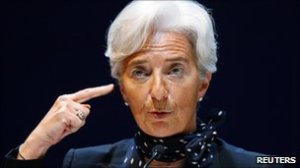 One of the world’s best economists and France’s Minister of Economics, Finance, and Industry–Christine Legarde–will likely be the newly appointed head of the International Monetary Fund (IMF). Thankfully, the U.S. joined with other members of the IMF board to approve Legarde which virtually assures her appointment. Legarde will be the first woman to head the IMF. She is widely regarded as the best Finance minister in the Eurozone. She will inherit an IMF still reeling from the sex scandal surrounding Dominique Strauss-Kahn as well as an IMF dealing with the Greek sovereign debt meltdown. The IMF is an important development vehicle for many of the world’s struggling economies. It has been controversial in the past since it has been seen to implement ideological as well as development strategies.
Lagarde’s presence itself as the first female head of the IMF will go a long way toward reinvigorating any demoralization of the staff. Granted, Lagarde is poised to earn the job because she’s the most qualified and best positioned to help the organization deal with its pressing economic crises. And while putting an extremely successful woman atop the IMF certainly won’t erase the Strauss-Kahn scandal or stop every unwanted advance, it should go a long way toward reminding the IMF’s staffers how much the organization values gender equality and won’t tolerate such behavior at any level. At the very least, having someone in charge who doesn’t have the reputation of being a womanizer is surely a good thing.
It’s unclear how much the internal culture at IMF actually needs fixing. A May New York Times story laid out an image of the IMF as a place “in which romances often flourish—and lines are sometimes crossed,” and where a pressured, “sharp-elbowed” place left complaints of harassment unanswered and where “rules are more like guidelines.” Some 676 women in the organization filed a response to the story, saying they were insulted by the way their workplace was depicted.
Still, Lagarde herself says the organization will need to “take pains to show the outside world” that it is a leader in ethical behavior. And she acknowledges that staff morale will need some mending following the august organization’s embarrassing time in the spotlight.
Legarde has a formidable intellect and is well-known for her straight and tough talk. Finance and economics are areas dominated by men with swagger. She has succeeded in ways that many men have not.
Ms Lagarde was appointed France’s Trade Minister in 2005 and under her watch, French exports reached record levels.
In 2007 she became finance minister, the first woman to hold this post not just in France but in any of the G8 major industrial countries.
Never afraid of speaking her mind, she has blamed the 2008 worldwide financial crisis partly on the male-dominated, testosterone-fuelled culture at global banks.
One of France’s most popular right-wing politicians, in 2009 she came second in a poll carried out by broadcaster RTL and newspaper Le Parisien on the country’s favourite personalities, beaten only by singer and actor Johnny Hallyday.
But her popularity has stretched beyond French shores and she is viewed with high regard in the international arena.
In 2009, the Financial Times voted her the best finance minister in Europe.
She has won international respect for promoting France’s negotiating clout in key forums like the G20, for which France currently holds the presidency.
She has also received plaudits for the key role she played in approving a bail-out mechanism to aid struggling members of the eurozone last May.
Lagarde has played a large role in the many challenges facing the Eurozone since the U.S. financial market meltdown. Unlike the U.S. which has basically coddled the very executives whose risky behavior and bad business practices have gone largely unpunished, Largarde has worked hard to reform the system to avoid a repeat. She not only has to herd French politicians but also create consensus among the other members of the EU community.
Lagarde has won praise for steering France through the financial crisis, notably by dispensing $48 billion in aid to French banks, which are repaying the money with interest after stabilizing themselves. She also fought successfully to provide corporate tax relief, aid to small businesses, and tax credits to stimulate research. “None of those things would have happened without Christine Lagarde,” says Frédéric Gonand, an economics professor at Paris-Dauphine University who recently stepped down after four years as Lagarde’s chief economic adviser. “She placed her own mark on economic policy.” A May poll by Ipsos for the magazine Le Point put her approval rating at 51 percent, far above her boss Sarkozy’s 37 percent.
Still, France has fallen behind Germany in making the kinds of changes that could give the economy a serious boost, such as reducing government bureaucracy and labor market restrictions. The need to carry out policies dictated by Sarkozy has also put her in awkward situations at times. In 2009 she had to defend his plan to invest $51 billion in research and development and other projects at a time when France was under attack by other euro zone countries for running a 7.5 percent budget deficit, far above the 3 percent that member countries had agreed on. And despite her role in negotiating the euro rescue package, the terms of that deal, such as automatic sanctions against aid recipients if they didn’t meet agreed-upon targets, were dictated largely by Germany. “France’s game seemed to be, ‘Let’s stick to the Germans as closely as possible,'” says Philip Whyte, a senior research fellow at the London-based Centre for European Reform. “She’s a great facilitator and chair, but she’s probably not in the absolute center of influence.”
I actually can’t tell you how excited I am about this development. As I’ve said before, she’s been a great success in France. This shows she can once again bust through a major glass ceiling that’s been there for ages for women in my profession.
Elite Conspiracy Theories and the Arrest of Dominique Strauss-Kahn
Posted: May 25, 2011 Filed under: collective bargaining, Economic Develpment, financial institutions, Foreign Affairs, France, Libya, Media, Pakistan, poverty, racism, Regulation, The Bonus Class, The Great Recession, U.S. Economy, U.S. Politics, unemployment, Violence against women | Tags: conspiracy theories, Dominique Strauss-Kahn, Federal Reserve, France, global elites, IMF, John F. Kennedy, Naomi Wolf, Nicholas Sarkozy, rape 29 Comments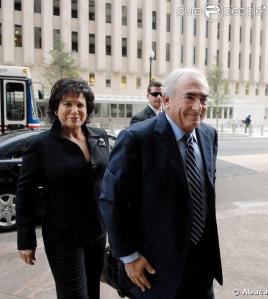
Dominque Strauss-Kahn and wife Anne
When one of us common people questions the Bush failures before 9/11 or the Warren Commission’s insistence that JFK was killed by a lone gunman, we are laughed at by the corporate media and lectured by politicians. But when one of the Global Elite gets in trouble, conspiracy theories are suddenly in vogue. Now that a global banker and possible candidate for the French presidency is accused of a sexual attack on a lowly hotel maid, elite conspiracy theories are running rampant in the U.S. and international media. I’ll give you a few examples.
At the Pakistan Observer, Ali Ashraf Kahn argues that Strauss-Kahn had to brought down, first because he would very likely have beaten the “American poodle Sarakozi” in a race for the presidency of France, and second because he (Strauss-Kahn) had offended the international banksters and corporations by proposing more liberal policies at the IMF which would have been a threat to the dollar. According to Ali Ashraf Kahn, getting rid of Strauss-Kahn would–along with U.S. military actions in Libya and Pakistan–would help to “save American predominance in the world.”
This incident goes to prove the hidden agenda of an international vested interest group trying to build and secure an American Empire for their master, which has not spared even Strauss-Kahn, who has been fixed in a rape attempt with a 32 year old hotel maid in a country where teen aged unwed mothers are a normal accepted feature. The former French Foreign Minister Strauss-Kahn, once if he was elected as president of France would have worked to strengthen the Euro to bring down dollar, which was of serious concern for the Federal Reserve Board in the already ongoing currency war with China. John F. Kennedy, US president was murdered for his only sin of canceling Federal Reserve Act of 1913 in 1963, when for the first time dollar currency was issued with the seal of US government, soon after his assassination President Lyndon B. Johnson revived this Act to continue their financial exploitation.
The author of this article appears to have a problem understanding the distinction between rape and consensual sex that results in pregnancies, but I’ll let that go for the moment. Kahn explains that Strauss-Kahn was trying to make radical changes at the IMF–so much so that Strauss Kahn won high praise from Joseph Stiglitz, which was apparently the final “kiss of death.”
Strauss-Kahn was trying to move the bank in a more positive direction, a direction that didn’t require that countries leave their economies open to the ravages of foreign capital that moves in swiftly-pushing up prices and creating bubbles, and departs just as fast, leaving behind the scourge of high unemployment, plunging demand, hobbled industries, and deep recession. Strauss-Kahn had set out on a “kinder and gentler” path, one that would not force foreign leaders to privatize their state-owned industries or crush their labour unions. Naturally, his actions were not warmly received by the banker’s mafia and multi national corporations who look to the IMF to provide legitimacy to their ongoing plunder of the rest of the world. These are the people who think that the current policies are “just fine” because they produce the desired results they’re looking for, which is bigger profits for themselves and deeper poverty for everyone else.
I have to admit, I’m in sympathy with those goals. There’s a lot more, so read the whole thing if you want more detail.
The next conspiracy theory is from Uganda. The author, Dr. Kihura Nkuba, also argues that Strauss-Kahn’s attack on the U.S. dollar is what led to his downfall. Nkuba says that police in the racist U.S. would never take the word of a poor black woman against that of a powerful white man unless motivated by a political conspiracy.
A woman from West Africa, assaulted by a famous white male, a future president of France, to be listened to by the New York Police, is amazing. But is it? [….]
New York police has [sic] been rummaging through DSK’s diaries, hotel registries, phone records, yearbooks and have made sure that the “great seducer” always appears handcuffed and dressed in a “pervie” raincoat with three-days stubble before they parade him in front of the media. He gets this treatment even though he has no criminal record and nothing, but the sketchy accusations of a room service cleaner.
What is his real crime? Strauss-Kahn was mounting an attack against the dollar and had called for a new world reserve currency that would challenge the dominance of the dollar and protect against future financial instability. He suggested adding emerging market countries’ currencies, such as the Yuan, to a basket of currencies that the IMF will administer to add stability to the global system….Strauss-Kahn saw a greater role for the IMF’s Special Drawing Rights, (SDRs) which is currently composed of the dollar, sterling, euro and yen, over time but said it will take a great deal of international cooperation to make that work.”
I love the way these male authors toss aside the charges against Strauss-Kahn–in Nkuba’s case, while complaining about racial prejudice. I guess he goes by the “bros before hos” rule: racism bad, sexism invisible.
Naomi Wolf also has a conspiracy theory about the Strauss-Kahn arrest that goes along with her defense of Julian Assange against sexual abuse charges in Sweden. She begins by comparing the NYC police response to the Strauss-Kahn case with the case of two of New York’s “finest,” Kenneth Moreno and Franklin Mata, who are on trial for raping a woman in Manhattan.
According to Wolf,
Moreno and Mata have not been asked to strip naked for “evidence” photos, were not initially denied bail, and were not held in solitary confinement, and are not being strip-searched daily. Their entire case has followed the usual timetable of many months, as evidence was gathered, testimony compiled and arguments made.
On the other hand, Wolf writes,
After a chambermaid reportedly told her supervisor at the elegant Sofitel hotel that she had been sexually assaulted, the suspect was immediately tracked down, escorted off a plane just before its departure, and arrested. High-ranking detectives, not lowly officers, were dispatched to the crime scene. The DNA evidence was sequenced within hours, not the normal eight or nine days. By the end of the day’s news cycle, New York City police spokespeople had made uncharacteristic and shockingly premature statements supporting the credibility of the victim’s narrative — before an investigation was complete.
The accused was handcuffed and escorted before television cameras — a New York tradition known as a “perp walk.” The suspect was photographed naked, which is also unusual, initially denied bail and held in solitary confinement. The Police Commissioner has boasted to the press that Strauss-Kahn is strip-searched now multiple times a day — also unheard-of.
I didn’t know that Strauss-Kahn was being subjected to daily strip-searches, but it seems to be true, according to the New York Post.
Prison brass and the NYPD have an airtight plan to safeguard the jet-setting French moneyman by having him isolated, chained, shackled — and repeatedly strip-searched — before and after court appearances, including a bail hearing newly scheduled for today.
“He will be strip-searched when he leaves Rikers Island. He will be strip-searched when he arrives in court. He’s strip-searched when he leaves court, and he’s strip-searched when he gets back to Rikers,” said Norman Seabrook, head of the correction officers union.
“When he arrives to the courthouse, he’s going to be put in an isolated cell away from other inmates,” said Seabrook. “This is for fear that another inmate would try to kill him to make a name for himself.”
Yet, as Wolf points out, hotel maids are routinely subject to sexual attacks during their work. Her conspiracy theory is that in the modern surveillance state,
men like former New York Governor Eliot Spitzer, who was investigating financial wrongdoing by the insurance giant AIG, WikiLeaks founder Julian Assange and Strauss-Kahn — whose efforts to reform the IMF gained him powerful opponents — can be, and are, kept under constant surveillance. Indeed, Strauss-Kahn, who had been the odds-on favorite to defeat Nicolas Sarkozy in next year’s French presidential election, probably interested more than one intelligence service.
This does not mean that Strauss-Kahn is innocent or that he is guilty. It means that policy outcomes can be advanced nowadays, in a surveillance society, by exploiting or manipulating sex-crime charges, whether real or inflated.
She has a pretty good point there. But the maid who reported Strauss-Kahn’s attack was a member of a union, as Dean Baker pointed out. Could that be why her employer made sure she was treated well by the police?
The reason that this is an important part of the story is that it is likely that Strauss-Kahn’s alleged victim might not have felt confident enough to pursue the issue with either her supervisors or law enforcement agencies, if she had not been protected by a union contract. The vast majority of hotel workers in the United States, like most workers in the private sector, do not enjoy this protection.
Dean Baker was also disappointed in Strauss-Kahn’s arrest, because whether or not he is guilty, his resignation spells the end of reform at the IMF.
Reading all these arguments for a conspiracy against Dominque Strauss-Kahn has given me pause. It certainly makes sense that the U.S. government would want to end his tenure at the IMF and prevent him from becoming President of France. But how could they know he would attack a hotel maid? Does the conspiracy require her involvement? That’s the serious hangup I have in buying into these authors’ claims–much as I do always enjoy a good conspiracy theory.
Patrica J. Williams touches all the bases in an article about the case at NPR. On the conspiracy issue, she argues for a skeptical approach to conspiracy theories, while keeping an open mind.
Politics is a complicated, dirty business, as the impeachment hearings of President Clinton ought to have instructed us. (Who guessed back then that Newt Gingrich, while skewering Clinton’s morals, was cheating on his then-wife with his present wife?) For Americans, who by and large have never heard of DSK, the possibility of his arrest being a set-up is inconceivable. But in the immediate aftermath of his detention, a majority of French citizens believe he has been purposely brought down. Why? Dominique Strauss-Kahn was well on track not just to become France’s president but its first Jewish president. As head of the IMF, he led that institution in a distinctly progressive manner. He sharply critiqued corrupt American bankers and banking practices and, early on, predicted the collapse of the mortgage market. As a center-left Socialist party member, he was close to negotiating a European Union bailout for Greece. And his elimination from the election empowers the candidacy of Marine LePen, head of the anti-immigrant, anti-Muslim and anti-Semitic National Front party, whose popularity, alarmingly enough, currently polls higher than that of Nicolas Sarkozy.
I’m certainly going to keep all this in mind as I follow the developments in the Strauss-Kahn case. I’d love to know what you all think about it too, so please chime in!
Head of IMF Arrested for Sexual Assault in NYC
Posted: May 14, 2011 Filed under: Crime, Economic Develpment, Foreign Affairs, France | Tags: Dominique Strauss-Kahn, International Monetary Fund (IMF), politics, sexual assault 13 Comments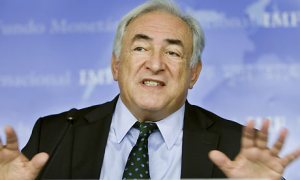
IMF head Dominique Strauss-Kahn
Dominique Strauss-Kahn, head of the International Monetary Fund and a candidate for the French presidency, was pulled off a plane at JFK Airport and arrested late this afternoon. He was accused of sexually assaulting a maid at the hotel he had been staying at in New York City. According to the NYT:
It was about 4:45 p.m. when plainclothes detectives of the Port Authority of New York and New Jersey suddenly boarded the plane, Air France Flight 23, as it idled on the tarmac at the airport 10 minutes before it was scheduled to take off and took Mr. Strauss-Kahn into custody, according to an agency official.
The Port Authority officers were acting on information from the New York Police Department, whose detectives had been investigating a brutal attack of a woman employee at the hotel Sofitel New York, at 45 West 44th Street, in the heart of the city’s theater district.
This isn’t the first time Strauss-Kahn has been accused of sexual misconduct.
In 2008 he was embroiled in a controversy after accusations arose that he had had a sexual relationship with one of his subordinates, Piroska Nagy, a senior official in the I.M.F.’s Africa Department. The I.M.F. hired a law firm to launch an investigation, and Ms. Nagy left the fund and went to work for the European Bank for Reconstruction and Development. With the I.M.F. needed to quell the international economic meltdown, Mr. Strauss-Kahn was kept on the job. He later apologized for an “error in judgment.”
More on Strauss-Kahn from the Guardian UK:
Rumours of dangerous liaisons and sexual conquests have had little effect on Strauss-Kahn’s chances of occupying the highest office in France, but last night’s arrest may alter his future ambitions. Strauss-Kahn was expected to throw his hat into the election ring within weeks. He has been fighting off a very French furore over assertions his tastes are too luxurious to lay claim to the political left.
Strauss-Kahn is married to a wealthy heiress, Anne Sinclair,
the granddaughter of Paul Rosenberg, a celebrated dealer of modern art, and has inherited part of his collection, which is said to include at least one Picasso. In many countries, such wealth would not necessarily be viewed as an impediment to a leftwing politician’s career. In France, however, the flashiness has appalled some observers.
It seems that in France being wealthy is a drawback for a liberal candidate. Now he’ll have to figure out how to deal with being arrested for a sexual attack and having to meet with detectives from New York’s Special Victims Unit.
The LA Times has more detail on the maid’s accusations.
The 32-year-old woman told authorities that she entered Strauss-Kahn’s room at the Sofitel near Manhattan’s Times Square at about 1 p.m. Saturday and he emerged from the bedroom naked, threw her down and tried to sexually assault her, Browne said. She somehow broke free and escaped the room and told hotel staff what had happened, authorities said. They called police.
When New York City police detectives arrived moments later, Strauss-Kahn had already left the hotel, leaving behind his cellphone and other personal items, Browne said. “It looked like he got out of there in a hurry,” Browne said.
This is an open thread.
“Having a Republican Governor is associated with low Economic Growth”
Posted: May 9, 2011 Filed under: academia, Domestic Policy, Economic Develpment, Economy, Republican politics | Tags: austerity measures by states fail, state economic growth, state fiscal policy, voodoo economics 13 Comments
The Miser Brothers as Republican Governors. Honey, we shrunk the state's prosperity but saved us a few pennies in tax dollars.
There’s a new academic study by professors from Tulane University and the Nevada state Department of Planning and Budget that’s sure to become the source of some very hot political debate. I didn’t bury the lead. It’s up there in the banner header, however, I’m sure you want to know the supporting evidence and tests. There’s a brief overview of this study at The Atlantic written by Richard Florida who is the Director of the Martin Prosperity Institute at the University of Toronto
The basic research question for the authors was “What factors influence state economic growth?”. Basically, the authors look at a state’s fiscal policy and regress it against various policy choices and factors. Then, they run some Monte Carlo simulations to see what happens under various scenarios. It’s complex statistics but their findings are somewhat intuitive to me for years as well as true to my experience working with the state of Nebraska as a consultant to its Economic Development Department. However, this is a solid academic study with oodles of data. It’s the kind of study that will be talked about for some time in economic circles.
This is what I learned from my time dealing with people in state governments whose jobs are attracting and retaining companies. Businesses tend to relocate to states with good public services and low cost, employees that come from good educational systems. They look for decent public school systems and state universities that do research in their area. They want good state recreational facilities and even professional sports teams and cultural venues. Omaha used to lose out to all kinds of places over things like lack of recreational facilities and cultural venues all the time. It lost two fortune 100 companies and possible new ones over no recreational facilities or sports venues. They offered hugely attractive tax packages and ready to build land but they always lost out on the same reason that makes me not want to live there. There’s really very few things to do there and you don’t spend your life at work.
If you haven’t figured out that all of those things people and corporations seek basically come from public tax dollars, you must be a Republican. A state’s tax giveaways and tax rates aren’t as high up on the list of things attractive to business as most die-hard Republicans want you to believe. That’s pretty much what this study shows.
A new study by Tulane’s James Alm and Janet Rogers of Nevada’s Department of Budget and Planning (h/t Ryan Avent, whose deadpan tweet noted that it was likely to spark a “lively discussion”) takes a close look at the effects of tax and spending policies at the state level. Entitled “Do State Fiscal Policies Affect State Economic Growth?”, it examines 50 years of data (from 1947 to 1997), tracking the effects of state tax policies, spending policies, and political orientation on economic growth. Looking at the different policy approaches and strategies that have been pursued at the level of states and cities and comparing their results provides a useful lens through which to examine pressing national issues. Alm’s and Rogers’ main findings are certainly interesting; “lively” is quite likely an understatement for the sort of debate their findings should inspire.
There are two major take-aways. First, a “state’s fiscal policies have a measurable relationship with per capita income growth, although not always in the expected direction.” Tax impacts, they report, are “quite variable”; “expenditure impacts are more consistent.”
This particular statement is right up there in the author’s abstract.
Of some interest, there is moderately strong evidence that a states political orientation has consistent and measurable effects on economic growth; perhaps surprisingly, a more \conservative” political orientation is associated with lower rates of economic growth.
Wow. Austerity doesn’t work. Not only does it NOT work, it’s detrimental to the state’s economic well being and future. Again this should be pretty intuitive. If you have a business, you need customers with paychecks. The higher the paycheck, the more they customer spends on nonessentials which many business sell. Also, you need good, happy, creative employees. If you rely on professional people, these folks like good restaurants, entertainment, schools, and sports venues. Every one needs good transportation infrastructure like well maintained roads and airports. Again, a lot of this must be provided by government for a variety of reasons having to do with the nature of public goods.
Their conclusion is pretty damning to current policy prescriptions.
… there is strong evidence that a state’s political orientation, as indicated by whether the governor is Republican or Democrat, whether the state has enacted tax and expenditure limitation legislation, and whether the state frequently elects a governor of the same party as the incumbent, have consistent, measurable, and significant effects on economic growth. Perhaps surprisingly, having a Republican governor is associated with lower rates of growth.
I’m not the least bit surprised. This is good old fashioned, no-nonsense Keynesian results. Also, growth rates compound over time like interest compounds your savings account. If the rates of growth are low during one administration, the state will fall farther and farther behind so one or two administrations of bad fiscal policy means that slow growth compounds over time and makes the results more noticeable as you go along. This seems to be how they capture some of their significant differences.
That trend brings us back to the extremely low growth we had during the Dubya years and the paltry recovery we have now. Traditional fiscal policy always tells us that the multiplying effects of tax cuts are less strong than increases in government spending because the first round of government spending gets spent 100 percent and because it usually is targeted at infrastructure or other types of spending that has long reaching impact. Yes, you can actually see economic benefit from building football stadiums or airports. When you give money to rich people or even business in tax rebates or tax cuts, there’s no way of controlling where it goes or where it’s spent. That degrades the impact of the stimulus as well as leads to lost revenues. And, at the moment, those tax cuts at the state level are being coupled with excuses to raid basic government services like public education. The result is basically a drain on the state’s capacity to grow as well as no stimulation to the economy.
Anyway, I imagine the Cato Institute or the Heritage Institute will try to rush out some distorted studies of their own shortly depending on how much circulation this gets. I would like to add that the state of Nevada is not exactly Massachusetts and even though Tulane is referred to as the Harvard of the South, it’s still Louisiana. Let’s hope this does stir up some debate and that this study attracts attention in all the right places.
Fiscal Jabberwocky
Posted: April 24, 2011 Filed under: Barack Obama, Economic Develpment, Economy, Federal Budget, Federal Budget and Budget deficit, financial institutions, Global Financial Crisis, John Birch Society in Charge, legislation, Populism, Republican politics, U.S. Economy, U.S. Military, U.S. Politics, voodoo economics, We are so F'd | Tags: Barack Obama, David Stockman, Fiscal Crisis, Paul Ryan, voodoo economics 29 Comments
"Beware the Jabberwock, my son! The jaws that bite, the claws that catch!"
It’s not often I get to post pictures of mythical beasts for a few days in a row but here I go again. Plus, I’ve gotten another chance to use one of those wonderful Alice in Wonderland book illustrations. Too bad they’re attached to posts where the perverse wonderland rules. It seems to be a year for fictional monsters in Op-Eds and real ones in congress.
David Stockman, Budget Director for Ronald Reagan, has joined the ranks of Republican advisers calling shenanigans on the Boehner/Tea Party Republicans AND the dithering Obama Dems. He must be very financial and professionally secure. His op-ed in the New York Times draws blood on all sides. He starts out telling President Obama what is what then moves on to hammering that petulant ninny from Wisconsin, Paul Ryan. Go read it if only for the creative use of words like that in the heading above.
On the other side, Representative Ryan fails to recognize that we are not in an era of old-time enterprise capitalism in which the gospel of low tax rates and incentives to create wealth might have had relevance. A quasi-bankrupt nation saddled with rampant casino capitalism on Wall Street and a disemboweled, offshored economy on Main Street requires practical and equitable ways to pay its bills.
Ingratiating himself with the neo-cons, Mr. Ryan has put the $700 billion defense and security budget off limits; and caving to pusillanimous Republican politicians, he also exempts $17 trillion of Social Security and Medicare spending over the next decade. What is left, then, is $7 trillion in baseline spending for Medicaid and the social safety net — to which Mr. Ryan applies a meat cleaver, reducing outlays by $1.5 trillion, or 20 percent.
Trapped between the religion of low taxes and the reality of huge deficits, the Ryan plan appears to be an attack on the poor in order to coddle the rich. To the Democrats’ invitation to class war, the Republicans have seemingly sent an R.S.V.P.
Stockman call the entire situation “fiscal jabberwocky”. Good turn of phrase that. He then moves to skewering the FED and adds Chinese currency pegging into the villain mix. I guess there’s nothing like a good rant when you can get primetime ink. This seems to be an interesting foray into harsh policy critique for economists with a republican bent.
Stockman, like Bruce Barlett and even David Frum are yet more Republicans who are pointing out the current GOP leaders are no more serious about budget reform than the Democrats are. The main difference is the GOP has better slogans and marketing, and slides into full blow demagoguery more easily.
But in terms of actual strategies for intelligently addressing the issue? The most glaring truth is the lack of leadership on both sides of the aisle.
The Barry Ritholtz blog post on Stockman’s op ed does score some points on mentioning the leadership chasm, but, even more telling is the absolute adherence to fairy tales over reality in policy making these days. Is there an economist in the House? Joe Wiesenthal says that Stockman is suffering from “fatalistic populism”. Here’s Stockman’s ending barb to prove that point. It’s also the two sentences that offer up the policy solution.
So the Ryan plan worsens our trillion-dollar structural deficit and the Obama plan amounts to small potatoes, at best. Worse, we are about to descend into class war because the Obama plan picks on the rich when it should be pushing tax increases for all, while the Ryan plan attacks the poor when it should be addressing middle-class entitlements and defense.
I’ve said many times that the Bush tax cuts just need to expire. I’ve also said that since the Reagan years we’ve basically started chumming our economy by jumping into interventions wherever and whenever. Afghanistan and Iraq are two such adventures that need to be de-funded and ended. We also need to reign in the congressional and pentagon weapons fetish which is basically whipped into a frenzy by free spending lobbyists for companies like Halliburton, GE, and Boeing. I can only image what they all want the drone budget to look like. MENA appears to be filled with hives these days.
So many of our fiscal problems would go away if we would just put things back to the where they were 10 years ago. This includes putting Wall Street back in its box instead of letting it go completely gaga with nonstandard, unregulated financial innovations. We can’t afford Obama’s muddling policies that seem like voting present while Republicans go wild with his inability to stand any firm ground. I believe he got elected to undo the Dubya years. Instead, he’s put the Dubya policies on steroids. So, if most of us–that would be voters–are saying let’s take it all back to the Clinton years, what I’d like to know is who are the real conservatives and who are the real radicals?

 peej
peej Carissa
 bostonboomer
 dakinikat
 ecocatwoman
 mablue2
 Mama Lopez
 peggysue22
 quixote
 skydancingguestblogger
 Mona (aka Wonk the Vote)



 Sky Dancing
Recent Comments