





The Senate hearing, which featured five of the nation’s top intelligence officials, including Director of National Intelligence Tulsi Gabbard and CIA Director John Ratcliffe — both of whom were involved in the group chat over the Signal messaging app — was meant be a forum for the nation’s spy chiefs to offer their assessments of the top national security threats facing the nation.
Lazy Caturday Reads
Posted: March 29, 2025 Filed under: cat art, caturday, Donald Trump, education, Elon Musk, just because | Tags: campus activism, Columbia University, Doge, Hamas, higher education, international students, Marco Rubio, Pete Hegseth, Peter Marks, Phil Hegseth, Robert F. Kennedy Jr., Rumeysa Ozturk, Social Security, Tufts University 7 Comments
Stephanie Lambourne, Blissful Teatime
Good Afternoon!!
As usual, so much is happening that I don’t know where to begin, so I’ll begin with the Trump administration’s war on higher education.
The most detailed story I’ve seen so far is at The Times of India, but they don’t allow copying. I hope you’ll go to the link and read the article. The gist is that the Trump administration is emailing international students who were involved in campus activism to self-deport. The administration spies are searching social media for any comments from foreign students that they interpret as anti-American. In addition, Marco Rubio is using AI to find student that appear to support Hamas or other terrorist groups and revoke their visas. There’s more at the link.
This is from Ken Klippenstein.com: Trump Admin Spies on Social Media of Student Visa Holders. Ideological purge of foreign students revealed in new leaked directive.
The Trump administration is requiring that foreign students studying in, or seeking to study in the United States, pass an ideological test in order to obtain a visa, according to a “sensitive” State Department directive issued by Secretary of State Marco Rubio and which I obtained.
The crackdown, instituted on Tuesday, makes it “mandatory” for consular officers and State Department personnel to conduct a “social media review” — including screenshotting posts — of new and returning student visa applicants for any evidence of terrorist connections. Such connections are defined broadly to include “advocating for, sympathizing with, or persuading others to endorse or espouse terrorist activities or support” a terrorist organization. Though the document doesn’t explicitly define what counts as advocacy, it mentions “conduct that bears a hostile attitude toward U.S. citizens or U.S. culture (including government, institutions, or founding principles).
Specific reference is made to students seeking to participate “in pro-Hamas events,” which is how the Trump administration has characterized student protests against the war in Gaza.
“When you apply to enter the United States and you get a visa, you are a guest,” Secretary of State Marco Rubio said on March 16 in remarks quoted in the directive “If you tell us when you apply for a visa, I’m coming to the U.S. to participate in pro-Hamas events, that runs counter to the foreign policy interest of the United States ….. if you had told us you were going to do that, we never would have given you the visa.”
The order to “comprehensively review and screen every visa applicant” appears directed at Palestinian and other foreign students who are “sympathetic” to Hamas, but typical of every government directive, it also opens the door for broader ideological vetting. It also directs the social media of visa applicants to be assessed for “potential security and non-security related ineligibilities [that] pose a threat to U.S. national security.”
The directive, dated March 25, bears the subject line “Enhanced Screening and Social Media Vetting for Visa Applicants.” It begins with a reference to two of Trump’s executive orders, including one on “measures to combat anti-semitism” and another on combating foreign terrorists and other national security threats to public safety.
There’s more detail at the link.
The LA Times: California international students on alert as Trump ramps up arrests of pro-Palestinian activists.
Ali, a UCLA student who joined pro-Palestinian protests last year, avoided arrest when riot police dismantled the school’s encampment last May. An international student who took part in a surge of campus activism around Israel’s war in Gaza, he was wary of having a record that could affect his visa. But he did not otherwise hide his activism.
Now, as federal authorities act on President Trump’s directive to deport international student activists he accuses of being antisemitic “pro-Hamas” terrorism supporters, Ali has taken new precautions. He’s moved out of his apartment — the address listed with the government — and is staying with a friend. He attends classes but avoids social events. He carries a piece of paper with the number for a 24-hour hotline faculty set up for students detained by Immigration and Customs Enforcement.
Arthur’s Morning, by Vicky Mount
As more arrests unfold, fears among California international students are growing — and frustrations mounting — as they accuse campus administrators of not doing enough to protect them in the state with the largest foreign student population in the nation and universities at the forefront of national activism.
“It’s a matter of time before it gets here,” said Ali, who did not want his full name, nationality, area of study or age published because he is worried about being tracked. “This is free speech. Isn’t this what this country is supposed to be known for?” [….]
At UCLA, faculty members recently circulated advice to international students: “Don’t say anything to ICE. Don’t sign anything. Tell them to speak to your attorney,” it said alongside a hotline number. “… Please have a stamped, pre-addressed envelope to someone you trust with you in the event of an ICE arrest, you can send the mail to alert them you have been detained.”
During “know your rights” training events, some international students have been told to “not go out unless you need to and make sure someone knows where you are going if you do go out,” said Randall Kuhn, a UCLA professor of public health who last year joined protesters.
Apparently, Trump is attempting to cancel the First Amendment for international students, and he is working on ending it for all college students, professors, and administrators as well.
The New York Times (gift link): Columbia President Is Replaced as Trump Threatens University’s Funding.
The interim president of Columbia University abruptly left her post Friday evening as the school confronted the loss of hundreds of millions of dollars in federal funding and the Trump administration’s mounting skepticism about its leadership.
The move came one week after Columbia bowed to a series of demands from the federal government, which had canceled approximately $400 million in essential federal funding, and it made way for Columbia’s third leader since August. Claire Shipman, who had been the co-chair of the university’s board of trustees, was named the acting president and replaced Dr. Katrina Armstrong.
The university, which was deeply shaken by a protest encampment last spring and a volley of accusations that it had become a safe haven for antisemitism, announced the leadership change in an email to the campus Friday night. The letter thanked Dr. Armstrong for her efforts during “a time of great uncertainty for the university” and said that Ms. Shipman has “a clear understanding of the serious challenges facing our community.”
Less than a week ago, the Trump administration had signaled that it was satisfied with Dr. Armstrong and the steps she was taking to restore the funding. But in a statement on Friday, its Joint Task Force to Combat Antisemitism said that Dr. Armstrong’s departure from the presidency was “an important step toward advancing negotiations” between the government and the university.
The statement included a cryptic mention of a “concerning revelation” this week, which appeared to refer to comments from Dr. Armstrong at a faculty meeting last weekend. According to a faculty member who attended, Dr. Armstrong and her provost, Angela Olinto, confused some people when they seemed to downplay the effects of the university’s agreement with the government. A transcript of the meeting had been leaked to the news media, as well as to the Trump administration, according to two people familiar with the situation.
Ms. Shipman, a journalist with two degrees from Columbia, is taking charge of one of the nation’s pre-eminent universities at an extraordinarily charged moment in American higher education.
The federal government is threatening to end the flow of billions of dollars to universities across the country, many of which are facing inquiries from agencies that range from the Justice Department to the Department of Health and Human Services.
Reuters has an update on Rumeysa Ozturk, the Tufts University graduate student who was recently kidnapped by ICE in Somerville, Massachusetts: US judge halts deportation of Turkish student at Tufts.
BOSTON, March 29 (Reuters) – A federal judge in Massachusetts on Friday temporarily barred the deportation of a Turkish doctoral student at Tufts University, who voiced support for Palestinians in Israel’s war in Gaza and was detained by U.S. immigration officials this week.
Rumeysa Ozturk, 30, was taken into custody by U.S. immigration authorities near her Massachusetts home on Tuesday, according to a video showing the arrest by masked federal agents. U.S. officials revoked her visa.
Artist unknown
The U.S. Department of Homeland Security has accused Ozturk, without providing evidence, of “engaging in activities in support of Hamas,” a group which the U.S. government categorizes as a “foreign terrorist organization.”
Oncu Keceli, a spokesperson for Turkey’s foreign ministry, said efforts to secure Ozturk’s release continued, adding consular and legal support was being provided by Turkish diplomatic missions in the U.S.
“Our Houston Consul General visited our citizen in the center where she is being held in Louisiana on March 28. Our citizen’s requests and demands have been forwarded to local authorities and her lawyer,” Keceli said in a post on X….
In Friday’s order, opens new tab, U.S. District Judge Denise Casper in Boston said that to provide time to resolve whether her court retained jurisdiction over the case, she was barring Ozturk’s deportation temporarily.
She ordered the Trump administration to respond to Ozturk’s complaint by Tuesday.
Mahsa Khanbabai, a lawyer for Ozturk, called the decision “a first step in getting Rumeysa released and back home to Boston so she can continue her studies.”
Robert F. Kennedy, Jr. has been very busy undermining our health in his position as head of the Department of Health and Human Services. Here’s the latest.
ProPublica: The CDC Buried a Measles Forecast That Stressed the Need for Vaccinations.
Leaders at the Centers for Disease Control and Prevention ordered staff this week not to release their experts’ assessment that found the risk of catching measles is high in areas near outbreaks where vaccination rates are lagging, according to internal records reviewed by ProPublica.
In an aborted plan to roll out the news, the agency would have emphasized the importance of vaccinating people against the highly contagious and potentially deadly disease that has spread to 19 states, the records show.
A CDC spokesperson told ProPublica in a written statement that the agency decided against releasing the assessment “because it does not say anything that the public doesn’t already know.” She added that the CDC continues to recommend vaccines as “the best way to protect against measles.”
But what the nation’s top public health agency said next shows a shift in its long-standing messaging about vaccines, a sign that it may be falling in line under Health and Human Services Secretary Robert F. Kennedy Jr., a longtime critic of vaccines:
“The decision to vaccinate is a personal one,” the statement said, echoing a line from a column Kennedy wrote for the Fox News website. “People should consult with their healthcare provider to understand their options to get a vaccine and should be informed about the potential risks and benefits associated with vaccines.”
ProPublica shared the new CDC statement about personal choice and risk with Jennifer Nuzzo, director of the Pandemic Center at Brown University School of Public Health. To her, the shift in messaging, and the squelching of this routine announcement, is alarming.
“I’m a bit stunned by that language,” Nuzzo said. “No vaccine is without risk, but that makes it sound like it’s a very active coin toss of a decision. We’ve already had more cases of measles in 2025 than we had in 2024, and it’s spread to multiple states. It is not a coin toss at this point.”
CBS News: RFK Jr. to gut vaccine promotion and HIV prevention office, sources say.
The entire staff of the federal government’s Office of Infectious Disease and HIV/AIDS Policy is expected to be laid off, multiple federal health officials told CBS News Friday. The moves are part of a broader restructuring plan ordered by Health and Human Services Secretary Robert F. Kennedy Jr. that involves cutting 20,000 HHS positions.
Much of the government’s efforts to buoy lagging childhood vaccination rates nationwide have been run through OIDP, including a new campaign called “Let’s Get Real” that had launched in the final months of the Biden administration to provide resources and information to health care providers talking to hesitant parents.
“Spreading the truth saves lives, so use our resources to help parents understand how vaccines work, why they’re safe, and how they help protect kids,” the department had said of the campaign after it was launched.
The Office of Minority Health has also been informed that it should expect to be dissolved, sources said.
OIDP, overseen by the Office of the Assistant Secretary for Health or OASH, had numbered around 60 employees at the end of the Biden administration. The cuts come as the Trump administration is trying to merge the other offices in OASH into a new HHS agency called the Administration for a Health America, or AHA….
The National Vaccine Program has also been run by OIDP, which works with an advisory committee to coordinate the department’s agencies to develop vaccines, oversee their safety and increase their availability and use.
The New York Times: Top F.D.A. Vaccine Official Resigns, Citing Kennedy’s ‘Misinformation and Lies.’
The Food and Drug Administration’s top vaccine official, Dr. Peter Marks, resigned under pressure Friday and said that Health Secretary Robert F. Kennedy Jr.’s aggressive stance on vaccines was irresponsible and posed a danger to the public.
“It has become clear that truth and transparency are not desired by the secretary, but rather he wishes subservient confirmation of his misinformation and lies,” Dr. Marks wrote to Sara Brenner, the agency’s acting commissioner. He reiterated the sentiments in an interview, saying: “This man doesn’t care about the truth. He cares about what is making him followers.”
By Karyn Lyons
Dr. Marks resigned after he was summoned to the Department of Health and Human Services Friday afternoon and told that he could either quit or be fired, according to a person familiar with the matter.
Dr. Marks led the agency’s Center for Biologics Evaluation and Research, which authorized and monitored the safety of vaccines and a wide array of other treatments, including cell and gene therapies. He was viewed as a steady hand by many during the Covid pandemic but had come under criticism for being overly generous to companies that sought approvals for therapies with mixed evidence of a benefit.
His continued oversight of the F.D.A.’s vaccine program clearly put him at odds with the new health secretary. Since Mr. Kennedy was sworn in on Feb. 13, he has issued a series of directives on vaccine policy that have signaled his willingness to unravel decades of vaccine safety policies. He has rattled people who fear he will use his powerful government authority to further his decades-long campaign of claiming that vaccines are singularly harmful, despite vast evidence of their role in saving millions of lives worldwide.
“Undermining confidence in well-established vaccines that have met the high standards for quality, safety and effectiveness that have been in place for decades at F.D.A. is irresponsible, detrimental to public health, and a clear danger to our nation’s health, safety and security,” Dr. Marks wrote.
This is insane:
Mr. Kennedy has, for example, promoted the value of vitamin A as a treatment during the major measles outbreak in Texas while downplaying the value of vaccines. He has installed an analyst with deep ties to the anti-vaccine movement to work on a study examining the long-debunked theory that vaccines are linked to autism.
And on Thursday, Mr. Kennedy said on NewsNation that he planned to create a vaccine injury agency within the Centers for Disease Control and Prevention. He said the effort was a priority for him and would help bring “gold-standard science” to the federal government….
In his letter, Dr. Marks mentioned the deadly toll of measles in light of Mr. Kennedy’s tepid advice on the need for immunization during the outbreak among many unvaccinated people in Texas and other states.
Dr. Marks wrote that measles, “which killed more than 100,000 unvaccinated children last year in Africa and Asia,” because of complications, “had been eliminated from our shores” through the widespread availability of vaccines.
Dr. Marks added that he had been willing to address Mr. Kennedy’s concerns about vaccine safety and transparency with public meetings and by working with the National Academies of Sciences, Engineering and Medicine, but was rebuffed.
Next up, the latest Musk news.
The latest DOGE plan for Social Security is terrifying. Wired: DOGE Plans to Rebuild SSA Code Base in Months, Risking Benefits and System Collapse.
The so-called Department of Government Efficiency (DOGE) is starting to put together a team to migrate the Social Security Administration’s (SSA) computer systems entirely off one of its oldest programming languages in a matter of months, potentially putting the integrity of the system—and the benefits on which tens of millions of Americans rely—at risk.
The project is being organized by Elon Musk lieutenant Steve Davis, multiple sources who were not given permission to talk to the media tell WIRED, and aims to migrate all SSA systems off COBOL, one of the first common business-oriented programming languages, and onto a more modern replacement like Java within a scheduled tight timeframe of a few months.
Under any circumstances, a migration of this size and scale would be a massive undertaking, experts tell WIRED, but the expedited deadline runs the risk of obstructing payments to the more than 65 million people in the US currently receiving Social Security benefits.
“Of course, one of the big risks is not underpayment or overpayment per se; [it’s also] not paying someone at all and not knowing about it. The invisible errors and omissions,” an SSA technologist tells WIRED….
SSA has been under increasing scrutiny from president Donald Trump’s administration. In February, Musk took aim at SSA, falsely claiming that the agency was rife with fraud. Specifically, Musk pointed to data he allegedly pulled from the system that showed 150-year-olds in the US were receiving benefits, something that isn’t actually happening. Over the last few weeks, following significant cuts to the agency by DOGE, SSA has suffered frequent website crashes and long wait times over the phone, The Washington Post reported this week.

By Fernando Botero
Why this is problematic:
This proposed migration isn’t the first time SSA has tried to move away from COBOL: In 2017, SSA announced a plan to receive hundreds of millions in funding to replace its core systems. The agency predicted that it would take around five years to modernize these systems. Because of the coronavirus pandemic in 2020, the agency pivoted away from this work to focus on more public-facing projects.
Like many legacy government IT systems, SSA systems contain code written in COBOL, a programming language created in part in the 1950s by computing pioneer Grace Hopper. The Defense Department essentially pressured private industry to use COBOL soon after its creation, spurring widespread adoption and making it one of the most widely used languages for mainframes, or computer systems that process and store large amounts of data quickly….
As recently as 2016, SSA’s infrastructure contained more than 60 million lines of code written in COBOL, with millions more written in other legacy coding languages….
SSA’s core “logic” is also written largely in COBOL. This is the code that issues social security numbers, manages payments, and even calculates the total amount beneficiaries should receive for different services, a former senior SSA technologist who worked in the office of the chief information officer says. Even minor changes could result in cascading failures across programs.
“If you weren’t worried about a whole bunch of people not getting benefits or getting the wrong benefits, or getting the wrong entitlements, or having to wait ages, then sure go ahead,” says Dan Hon, principal of Very Little Gravitas, a technology strategy consultancy that helps government modernize services, about completing such a migration in a short timeframe.
The New York Times: Elon Musk Says He Has Sold X to His A.I. Start-Up xAI.
Elon Musk said on Friday that he had sold X, his social media company, to xAI, his artificial intelligence start-up, in an unusual arrangement that shows the financial maneuvering inside the business empire of the world’s richest man.
The all-stock deal valued xAI at $80 billion and X at $33 billion, Mr. Musk said on X. X’s price was down from the $44 billion that Mr. Musk paid for the social media company in 2022, but higher than the $12 billion valuation that some of X’s investors have recently assigned it. The last valuation of xAI, at a December fund-raising round, was about $40 billion.
Both companies are privately held and already share significant resources, such as engineers. A chatbot called Grok, made by xAI, is trained on data posted by X users and is available on X. Last month, bankers for X told investors that some of the social media company’s revenue came from xAI.
Mr. Musk wrote in his post that “xAI and X’s futures are intertwined.”
“Today,” he said, “we officially take the step to combine the data, models, compute, distribution and talent.” He added, “The combined company will deliver smarter, more meaningful experiences to billions of people while staying true to our core mission of seeking truth and advancing knowledge.”
The deal shows how Mr. Musk can play with different parts of his business empire. In this case, he folded a company that has been losing value, X, into one that has been gaining value, xAI. Mr. Musk made a similar maneuver in 2016 when he used stock of his electric car company, Tesla, to buy SolarCity, a clean energy company where he was the largest shareholder and his cousin Lyndon Rive was chief executive.
While Tesla is a publicly traded company that must disclose its finances and other information to shareholders, most of Mr. Musk’s companies are privately held and more opaque. Those include the rocket manufacturer SpaceX; the Boring Company, a tunneling start-up; and Neuralink, a brain interface company. Mr. Musk often moves resources and employees among his companies, defying traditional business norms and operating his various companies as one big Musk enterprise.
The latest on Pete Hegseth.
The Wall Street Journal: Hegseth Brought His Wife to Sensitive Meetings With Foreign Military Officials.
Defense Secretary Pete Hegseth, who is facing scrutiny over his handling of details of a military strike, brought his wife, a former Fox News producer, to two meetings with foreign military counterparts where sensitive information was discussed, according to multiple people who were present or had knowledge of the discussions.
Artist unknown
One of the meetings, a high-level discussion at the Pentagon on March 6 between Hegseth and U.K. Secretary of Defense John Healey, took place at a sensitive moment for the trans-Atlantic alliance, one day after the U.S. said it had cut off military intelligence sharing with Ukraine. The group that met at the Pentagon, which included Adm. Tony Radakin, the head of the U.K.’s armed forces, discussed the U.S. rationale behind that decision, as well as future military collaboration between the two allies, according to people familiar with the meeting.
A secretary can invite anyone to meetings with visiting counterparts, but attendee lists are usually carefully limited to those who need to be there and attendees are typically expected to possess security clearances given the delicate nature of the discussions, according to defense officials and people familiar with the meeting. There is often security near the meeting space to keep away uninvited attendees.
Hegseth’s wife, Jennifer Hegseth, isn’t a Defense Department employee, defense officials said. It isn’t uncommon for spouses of senior officials to possess low-level security clearances, but a Pentagon spokesperson declined to say whether Jennifer has one. Jennifer didn’t respond to requests for comment.
Jennifer Hegseth also attended a meeting last month at North Atlantic Treaty Organization headquarters in Brussels where allied defense officials discussed their support for Ukraine, according to two people who attended the meeting. Hegseth’s brother Philip Hegseth has also been traveling with him on official visits, the Pentagon said.
The Brussels meeting, which took place on the sidelines of a February conference of NATO defense ministers, was a gathering of the Ukraine Defense Contact Group, a U.S.-led forum of some 50 nations that periodically meets to coordinate on production and delivery of weapons and other support for Ukraine. At the closed-door discussions, national representatives routinely present confidential information, such as donations to Ukraine that they don’t want to be made public, according to officials.
You can get past the paywall and read the rest if you click the link at http://www.memeorandum.com.
Defense News: Hegseth’s younger brother is serving in a key role inside the Pentagon.
Defense Secretary Pete Hegseth’s younger brother is serving in a key position inside the Pentagon as a Department of Homeland Security liaison and senior adviser, Hegseth’s office confirmed.
The high-profile job has meant meetings with a UFC fighting champion, a trip to Guantanamo Bay and, right now, traveling on the Pentagon’s 747 aircraft as Hegseth makes his first trip as defense secretary to the Indo-Pacific.
Phil Hegseth’s official title is senior adviser to the secretary for the Department of Homeland Security and liaison officer to the Defense Department, spokeswoman Kingsley Wilson said in a statement Thursday.
“Phil Hegseth, one of a number of talented DHS liaisons to DOD, is conducting touch points with U.S. Coast Guard officials on the Secretary’s Indo-Pacific trip,” which includes stops in Hawaii, Guam, the Philippines and Japan, Wilson said in response to a query by The Associated Press….
It’s common for the Defense Department and other federal agencies to have liaisons. Each military branch sends liaisons to Capitol Hill. The Pentagon, State Department and others all use interagency liaisons to more closely coordinate and keep tabs on policy.
But it is not common for those senior-level positions to be filled by family members of the Cabinet heads, said Michael Fallings, a managing partner at Tully Rinckey PLLC, which specializes in federal employment law.
Based on Phil Hegseth’s publicly available resume, his past experience includes founding his own podcast production company, Embassy and Third, and working on social media and podcasts at The Hudson Institute.
He sounds about as qualified as his older brother Pete.
That’s all I have for you today. What’s on your mind?
Wednesday Reads: Signalgate and Social Security News
Posted: March 26, 2025 Filed under: Donald Trump, Social Security | Tags: Frank Bisignano, Houthis, Jeffrey Goldberg, John Ratcliffe, Karoline Leavitt, Kash Patel, Mike Waltz, Pete Hegseth, Senator Mark Warner, Signal Ap, Signalgate, The Atlantic, Tulsi Gabbard, Yemen 6 CommentsGood Afternoon!!

Jeffrey Goldberg
This morning The Atlantic’s Editor in Chief Jeffrey Goldberg released the full Signal text exchange that was the top news story all day yesterday. I’m sure you’re familiar with the story, but in case you missed it (unlikely), Goldberg was sent an invitation to a Signal group that included top administration officials. He accepted out of curiosity. Here is the original story published two days ago in The Atlantic (gift article): The Trump Administration Accidentally Texted Me Its War Plans.
And here is today’s article (gift): Here Are the Attack Plans That Trump’s Advisers Shared on Signal.
On Monday, shortly after we published a story about a massive Trump-administration security breach, a reporter asked the secretary of defense, Pete Hegseth, why he had shared plans about a forthcoming attack on Yemen on the Signal messaging app. He answered, “Nobody was texting war plans. And that’s all I have to say about that.”
At a Senate hearing yesterday, the director of national intelligence, Tulsi Gabbard, and the director of the Central Intelligence Agency, John Ratcliffe, were both asked about the Signal chat, to which Jeffrey Goldberg, the editor in chief of The Atlantic, was inadvertently invited by National Security Adviser Michael Waltz. “There was no classified material that was shared in that Signal group,” Gabbard told members of the Senate Intelligence Committee.
Ratcliffe said much the same: “My communications, to be clear, in the Signal message group were entirely permissible and lawful and did not include classified information.”
President Donald Trump, asked yesterday afternoon about the same matter, said, “It wasn’t classified information.”
These statements presented us with a dilemma. In The Atlantic’s initial story about the Signal chat—the “Houthi PC small group,” as it was named by Waltz—we withheld specific information related to weapons and to the timing of attacks that we found in certain texts. As a general rule, we do not publish information about military operations if that information could possibly jeopardize the lives of U.S. personnel. That is why we chose to characterize the nature of the information being shared, not specific details about the attacks.
Pete Hegseth
The statements by Hegseth, Gabbard, Ratcliffe, and Trump—combined with the assertions made by numerous administration officials that we are lying about the content of the Signal texts—have led us to believe that people should see the texts in order to reach their own conclusions. There is a clear public interest in disclosing the sort of information that Trump advisers included in nonsecure communications channels, especially because senior administration figures are attempting to downplay the significance of the messages that were shared.
Experts have repeatedly told us that use of a Signal chat for such sensitive discussions poses a threat to national security. As a case in point, Goldberg received information on the attacks two hours before the scheduled start of the bombing of Houthi positions. If this information—particularly the exact times American aircraft were taking off for Yemen—had fallen into the wrong hands in that crucial two-hour period, American pilots and other American personnel could have been exposed to even greater danger than they ordinarily would face. The Trump administration is arguing that the military information contained in these texts was not classified—as it typically would be—although the president has not explained how he reached this conclusion.
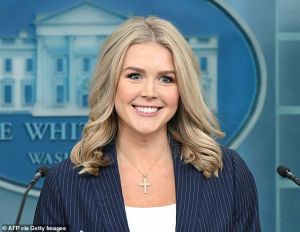
Karoline Leavitt
The Atlantic approached multiple people in the Trump administration, asking if they had objections to the publication of the entire Signal chant. Only press secretary Karoline Leavitt responded:
“As we have repeatedly stated, there was no classified information transmitted in the group chat. However, as the CIA Director and National Security Advisor have both expressed today, that does not mean we encourage the release of the conversation. This was intended to be a an [sic] internal and private deliberation amongst high-level senior staff and sensitive information was discussed. So for those reason [sic] — yes, we object to the release.” (The Leavitt statement did not address which elements of the texts the White House considered sensitive, or how, more than a week after the initial air strikes, their publication could have bearing on national security.)
Here is the relevant part of the text chain:
At 11:44 a.m. eastern time, Hegseth posted in the chat, in all caps, “TEAM UPDATE:”
The text beneath this began, “TIME NOW (1144et): Weather is FAVORABLE. Just CONFIRMED w/CENTCOM we are a GO for mission launch.” Centcom, or Central Command, is the military’s combatant command for the Middle East. The Hegseth text continues:
- “1215et: F-18s LAUNCH (1st strike package)”
- “1345: ‘Trigger Based’ F-18 1st Strike Window Starts (Target Terrorist is @ his Known Location so SHOULD BE ON TIME – also, Strike Drones Launch (MQ-9s)”
- “1410: More F-18s LAUNCH (2nd strike package)”
- “1415: Strike Drones on Target (THIS IS WHEN THE FIRST BOMBS WILL DEFINITELY DROP, pending earlier ‘Trigger Based’ targets)”
- “1536 F-18 2nd Strike Starts – also, first sea-based Tomahawks launched.”
- “MORE TO FOLLOW (per timeline)”
- “We are currently clean on OPSEC”—that is, operational security.
- “Godspeed to our Warriors.”
Read the whole article at The Atlantic. It isn’t very long. Those certainly look like war plans to me. This is a great opportunity for Democrats to fight back against Trump’s rapidly advancing coup. They did an excellent job in the Senate hearing yesterday.
The Washington Post (Gift article): Democrats slam spy chiefs over Trump team’s Signal leak of war plans.
Senate Democrats on Tuesday hammered the Trump administration’s top intelligence officials on how and why the vice president, defense secretary, national security adviser and other top Cabinet members made the “reckless” decision to use a commercial messaging app to discuss secret war plans for Yemen — while also inadvertently including a journalist in the group chat.
Instead, the routine annual hearing before the Senate Select Committee on Intelligence became a staging ground to interrogate the kind of “mind-boggling” behavior that the committee’s top Democrat, Sen. Mark R. Warner (Virginia), said would easily have gotten a lower-ranking military or intelligence officer fired.
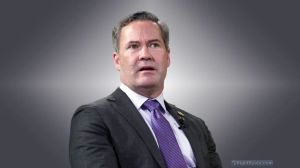
Mike Waltz
In the Signal group chat, convened by national security adviser Michael Waltz, Defense Secretary Pete Hegseth and others reportedly detailed the targets, the attack sequencing and the weapons they would use in a U.S. air attack on Yemen’s Houthis, before the Pentagon launched the strikes on March 15, according to a bombshell report published Monday by the Atlantic.
“If this was the case of a military officer or an intelligence officer, and they had this kind of behavior, they would be fired,” Warner said in his opening remarks at Tuesday’s hearing, noting that in addition to the targeting information, the text chain included the identity of an active CIA officer. “This is one more example of the kind of sloppy, careless, incompetent behavior, particularly toward classified information,” exhibited by the Trump administration, Warner said. “This is not a one-off.”
How is it that “nobody bothered to even check? … Who are all the names?” Warner added.
Gabbard, Ratcliffe and the other government witnesses provided few answers.After Gabbard at first declined to say whether she was involved in the group chat at all, she and Ratcliffe then told senators that the information shared over Signal was not classified. At other times, they denied the details contained in the Atlantic’s reporting or said they could not recall the exact contents of the messages. They repeatedly deferred to Trump’s defense secretary and national security adviser to answer for them.
The deflections triggered an incredulous and angry backlash from the committee’s liberals.
Warner, who accused Gabbard of “bobbing and weaving and trying to filibuster,” demanded repeatedly that she reconcile her conflicting assertions that the information in the text chain was not classified, but also that she was not at liberty to talk about it. “If there are no classified materials, share it with the committee. You can’t have it both ways,” he said.
Well, now it has been shared with everyone, and the Trump officials look exactly as incompetent as we assumed they were. On top of everything else, one of the participants in the Signal chat, special envoy Steve Witkoff, was actually in Moscow waiting to speak to Vladimir Putin, while using his personal cell phone.
More from CBS News: Democrats call Trump intelligence officials’ use of group chat “reckless, sloppy and stunning.”
Director of National Intelligence Tulsi Gabbard and CIA director John Ratcliffe appeared before the Senate Intelligence Committee to testify about global threats facing the U.S. However the annual hearing, which typically focuses on threats posed by China, Russia, Iran, largely concentrated on the lapse.
FBI Director Kash Patel, National Security Agency Director Gen. Timothy Haugh and Defense Intelligence Agency Director Lt. Gen. Jeffrey Kruse also appeared, but received few questions.
Senator Mark Warner
Sen. Mark Warner of Virginia, the top Democrat on the committee, addressed the controversy at the top of the hearing, calling it “mind-boggling” that none of the intelligence officials in the chat on the encrypted messaging app Signal thought to check who else was included.
“Are these government devices? Were they personal devices? Have the devices been collected to make sure there’s no malware?” Warner said in his opening remarks. “There’s plenty of declassified information that shows that our adversaries, China and Russia, are trying to break into encryption systems like Signal.”
Gabbard and Ratcliffe both denied that classified information was shared in the group chat in a feisty exchange with Warner. Confronted by Warner, Gabbard initially declined to say whether she was part of the chat….
Ratcliffe confirmed to Warner that he was a participant in the message thread, but pushed back on whether the decision to use Signal to communicate was a security lapse. Ratcliffe said Signal was on his CIA computer when he was confirmed as director earlier this year….
Ratcliffe confirmed to Warner that he was a participant in the message thread, but pushed back on whether the decision to use Signal to communicate was a security lapse. Ratcliffe said Signal was on his CIA computer when he was confirmed as director earlier this year. “As it is for most CIA officers,” he said, adding that the agency considers the commercial app “permissible” for work use.
The spy chiefs also denied that the conversation included information on weapons packages, targets or timing of the strikes, as Goldberg reported.
“Not that I’m aware of,” Ratcliffe said, with Gabbard adding “same answer.”

I guess they weren’t paying attention. There’s more at the CBS link.
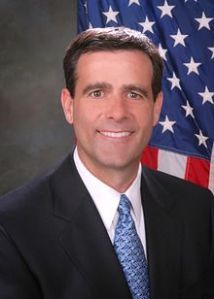
John Ratcliff
Tulsi Gabbard, Kash Patel, and John Ratcliff are appearing before the House Intelligence Committee today. That should be interesting. CBS News: Intel chiefs testify before House committee as new Signal texts emerge.
Director of National Intelligence Tulsi Gabbard and CIA Director John Ratcliffe are back on Capitol Hill to testify before the House Intelligence Committee on Wednesday after new text messages came to light from a group chat in which top Trump officials discussed sensitive plans to strike targets in Yemen.
Shortly before the hearing began, The Atlantic published additional messages showing Defense Secretary Pete Hegseth provided detailed information to the group of senior Trump officials about the strikes, including a timeline of when fighter jets would take off and what kind of weapons would be used. The group inadvertently included Jeffrey Goldberg, the editor in chief of The Atlantic who revealed the first batch of texts earlier this week….
Gabbard and Ratcliffe are appearing Wednesday alongside FBI Director Kash Patel, National Security Agency Director Gen. Timothy Haugh and Defense Intelligence Agency Director Lt. Gen. Jeffrey Kruse at a hearing ostensibly focused on the global security threats facing the U.S. But the Signal leak and its fallout dominated the early portions of questioning.
Rep. Jim Himes of Connecticut, the top Democrat on the committee, chastised the intelligence leaders at the start of the hearing, saying they put the lives of troops at risk.
“Everyone here knows that the Russians or the Chinese could have gotten all of that information, and they could have passed it on to the Houthis, who easily could have repositioned weapons and altered their plans to knock down planes or sink ships,” Himes said.
Gabbard acknowledged that the conversation was “sensitive” but again denied that classified information was shared in the chat.”There were no sources, methods, locations or war plans that were shared,” she told lawmakers, echoing the defense from the White House that “war plans” were not discussed, despite the detailed guidance for an impending attack.
Defense Secretary Pete Hegseth’s texts to a Signal group chat about military operations against the Houthis almost certainly contained classified information, according to current and former Pentagon officials.
The Atlantic on Wednesday released excerpts of a conversation among top national security leaders to which a journalist had accidentally been invited. Hegseth and the White House have denied sharing classified information or war plans.
“This information was clearly taken from the real time order of battle sequence of an ongoing operation,” said Mick Mulroy, a former deputy assistant Defense secretary under the first Trump administration. “It is highly classified and protected.
Hegseth identified the aircraft used and the precise timing of the attacks, according to texts from the group chat, which was started by national security adviser Mike Waltz. That information, if obtained by adversaries, could put U.S. troops in danger.
Kash Patel
A current defense official and former Air Force official both said that any forecasting of future operations and planned weapons are almost always classified information. The former and current officials were granted anonymity to speak about a sensitive issue.
Details about future airstrikes and the timing of launches is tightly controlled and usually provided only through classified documents, conversations and in secure email traffic. Few outside of top leadership and those involved usually know about the plans.
“The information that you have fighter aircraft launching off of an aircraft carrier, flying over enemy territory and impending combat operation is the most sensitive information we have at the federal government,” said Sen. Mark Kelly (D-Ariz.), a former Navy pilot, who added it was likely classified.
“Mike Waltz did a boneheaded thing. It was careless. I think what Pete Hegseth did was reckless and dangerous.”

Hegseth should be fired, but Waltz is more likely to be the scapegoat.
President Donald Trump was upset when he found out that National Security Adviser Mike Waltz accidentally included a journalist in a group chat discussing plans for a military strike. But it wasn’t just because Waltz had potentially exposed national security secrets.
Trump was mad — and suspicious — that Waltz had Atlantic editor-in-chief Jeffrey Goldberg’s number saved in his phone in the first place, according to three people familiar with the situation, who were granted anonymity to discuss private conversations. A fourth person said the president was also particularly perturbed by the embarrassing nature of the episode.
“The president was pissed that Waltz could be so stupid,” the person said. (A “Mike Waltz” invited Goldberg to the chat, according to The Atlantic).
But by Tuesday afternoon, the two men had made a show of smoothing things over and the White House was closing ranks around Waltz. Trump conducted brief interviews with both NBC News and Fox News pledging to stand behind his national security adviser. Two top Trump spokespeople suggested in posts on X that national security hawks were colluding with the media to make the issue bigger than it actually was. And Waltz attended a meeting of Trump’s ambassadors Tuesday afternoon.
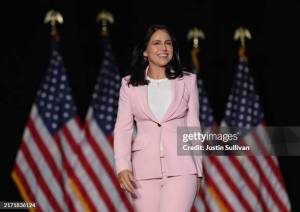
Tulsi Gabbard
“There’s a lot of journalists in this city who have made big names for themselves making up lies … This one in particular I’ve never met, don’t know, never communicated with, and we are looking into and reviewing how the heck he got into this room,” Waltz said during the meeting.
Trump followed up by calling Waltz “a very good man” and suggested he had been unfairly attacked. Yet the president also said he would look into government officials’ use of Signal, the app used in the chat with Goldberg that could have resulted in a security breach as top U.S. officials discussed plans to launch strikes in Yemen.
Still, several Trump allies cautioned this may not be the end of Waltz’s troubles. One of them, who like others was granted anonymity to discuss the sensitive matter, said the incident has strained Waltz’s relationship with Trump’s inner circle.
Brandi Buchman at HuffPost: Pete Hegseth Sued Over Signal Text Debacle.
A public watchdog group sued Defense Secretary Pete Hegseth and a slew of other Trump administration officials Tuesday after a journalist revealed he was inadvertently added to a text chain discussing U.S. war plans.
The lawsuit, brought by the watchdog group American Oversight and first reported by HuffPost, requests that a federal judge formally declare that Hegseth and other officials on the chat violated their duty to uphold laws around the preservation of official communications. Those laws are outlined in the Federal Records Act and, according to lawyers for American Oversight, if agency heads refuse to recover or protect their communications, the national archivist should ask the attorney general to step in.
On Monday, The Atlantic’s editor-in-chief Jeffrey Goldberg reported that national security adviser Michael Waltz inadvertently added him to a Signal group chat with more than a dozen Trump administration officials and aides including Vice President JD Vance, Defense Secretary Pete Hegseth, Secretary of State Marco Rubio, homeland security adviser Stephen Miller and Treasury Secretary Scott Bessent. CIA Director John Ratcliffe told members of the Senate Intelligence Committee on Tuesday that he was also in the Signal chat. Director of National Intelligence Tulsi Gabbard would not admit whether she was a participant, though Goldberg reported she was; instead, she said the matter was “still under review.”
As American Oversight lawyers pointed out in their lawsuit Tuesday, Rubio is also the acting archivist of the United States and, as such, “is aware of the violations” that allegedly occurred.
He is also “responsible for initiating an investigation through the Attorney General for the recovery of records or other redress,” the lawsuit said.
Axios reports that Trump nemesis Judge James Boasberg will preside of the Signalgate lawsuit: Judge who ruled against Trump deportation flights will oversee Signal lawsuit.
Social Security News:
Teresa Ghilarducci at Forbes: Social Security Is Breaking Down— Millions Will Feel It First.
U.S. Commerce Secretary Howard Lutnick recently offered a chilling glimpse into the Trump administration’s indifference to Social Security’s importance. “Let’s say Social Security didn’t send out their checks this month,” Lutnick said, according to Axios. “My mother-in-law, who’s 94, she wouldn’t call and complain.”
Perhaps the commerce secretary’s mother-in-law wouldn’t call. But millions of other Americans would—and not just to complain. They would call because they couldn’t pay rent, buy food, or refill essential medications. Lutnick’s casual comment downplayed the gravity of a missed Social Security check.
The comment also exposed the distance between elites and others. Elites may not care if they miss a Social Security check, but for a typical Americans a missing check is a gut punch. Calls to the Social Security office would be pouring in. But no one may answer.
Howard Lutnick
Lutnick’s remarks come during a time when the Social Security system faces record demand and historic strain. And the remarks come during a month of extreme alarm and confusion about the system. Elon Musk demeaned the system publicly, calling it “the biggest Ponzi scheme of all time,” the New York Post reported. Field offices are overrun, wait times are spiking, and staffing levels have been slashed by 12% since 2020, notes The Washington Post. The very system that ensures timely payments to 73 million Americans is being stomped on, and senior citizens and families are feeling anxious and worse.
To be clear, Trump and DOGE have not cut or delayed Social Security checks—yet. The Social Security Administration does not miss checks. In 80 years, it never missed payment….
While Lutnick and others suggest that delays wouldn’t matter, the data tell another story. Social Security is the foundation of retirement security for most American seniors.
According to the Social Security Administration, nearly 90% of Americans over age 65 receive benefits, and those benefits make up an average of 31% of their income. But for many, the reliance is much deeper: 39% of older men and 44% of older women count on Social Security for more than half their income. Even more sobering, 12% of older men and 15% of older women rely on it for at least 90% of their income.
Older women, in particular, are at risk. They tend to earn less over their lifetimes, outlive their spouses, and have less saved for retirement. For them, Social Security is often not just the main source of income—it’s the only source.
The Washington Post (Gift link): Long waits, waves of calls, website crashes: Social Security is breaking down.

Lazy Caturday Reads: The Attack on Social Security and Other Outrages
Posted: March 22, 2025 Filed under: cat art, caturday, Donald Trump, Elon Musk, just because, Social Security | Tags: "leakers are patriots", authoritarianism, Doge, Howard Lutnick, Judge Ellen Hollarder, Leland Dudek, Social Security Administration, Tesla 11 Comments Good Afternoon!!
Yesterday the realization that Elon Musk and his DOGE bandits are dead set on stealing our Social Security hit home for millions of Americans. Perhaps some of the MAGA cultists are still lying to themselves, but plenty of Trump voters now know they made a huge mistake.
Two days ago, Maryland District Judge Ellen Hollander ordered the acting head of the Social Security Administration Leland Dudek to stop DOGE bandits from accessing recipients’ personal information. Dudek responded by threatening to shut down the agency entirely.
Reuters: Judge stops Musk’s team from ‘unbridled access’ to Social Security private data.
March 20 (Reuters) – A federal judge said on Thursday the Social Security Administration likely violated privacy laws by giving tech billionaire Elon Musk‘s aides “unbridled access” to the data of millions of Americans, and ordered a halt to further record sharing.
U.S. District Judge Ellen Lipton Hollander of Maryland said Musk’s Department of Government Efficiency was intruding into “the personal affairs of millions of Americans” as part of its hunt for fraud and waste under President Donald Trump.
“Really, I want to turn it off and let the courts figure out how they want to run a federal agency,” he said….
Earlier on Thursday, Judge Hollander, in her ruling, said: “To be sure, rooting out possible fraud, waste, and mismanagement in the SSA is in the public interest. But, that does not mean that the government can flout the law to do so.”
The case has shed light for the first time on the amount of personal information DOGE staffers have been given access to in the databases, which hold vast amounts of sensitive data on most Americans.
The SSA administers benefits for tens of millions of older Americans and people with disabilities, and is just one of at least 20 agencies DOGE has accessed since January.
Hollander said at the heart of the case was a decision by new leadership at the SSA to give 10 DOGE staffers unfettered access to the records of millions of Americans. She said lawyers for SSA had acknowledged that agency leaders had given DOGE access to a “massive amount” of records.
“The DOGE Team is essentially engaged in a fishing expedition at SSA, in search of a fraud epidemic, based on little more than suspicion. It has launched a search for the proverbial needle in the haystack, without any concrete knowledge that the needle is actually in the haystack,” Hollander said….
One of the systems DOGE accessed is called Numident, or Numerical Identification, known inside the agency as the “crown jewels,” three former and current SSA staffers told Reuters. Numident contains personal information of everyone who has applied for or been given a social security number.
After a new order from Judge Hollander, Dudek has backed down on his threat to shut down the Social Security Administration.
The Washington Post: Federal judge pushes back on acting Social Security head over threat to close agency.

Liam Archacki at The Daily Beast: Billionaire Trump Aide Uses Mom-in-Law, 94, to Defend DOGE Social Security Cuts.
Commerce Secretary Howard Lutnick said his 94-year-old mother-in-law wouldn’t be worried if she didn’t receive her Social Security check one month.
Lutnick argued that the only people upset about DOGE head Elon Musk targeting Social Security are fraudsters abusing the system.
“Let’s say Social Security didn’t send out their checks this month. My mother-in-law, who’s 94, wouldn’t call and complain,” he said during a Thursday appearance on the All-In podcast. “She just wouldn’t. She’d think something got messed up and she’ll get it next month.”
Public records suggest that his mother-in-law, Geri Lambert, lives with Lutnick and his wife Allison, at his Upper East Side townhouse in Manhattan. If that is the case, she is unlikely to be relying on Social Security for rent or mortgage payments.
Lutnick, who was nominated to the role by President Donald Trump, amassed a fortune worth around $1.5 billion over more than 30 years as the CEO of the investment bank Cantor Fitzgerald. He stepped down from the position in February when he was confirmed as commerce secretary.
“A fraudster always makes the loudest noise screaming, yelling, and complaining,” the commerce secretary continued. “Elon knows this by heart… The easiest way to find the fraudster is to stop payments and listen, because whoever screams is the one stealing.”
It isn’t the first eyebrow-raising statement Lutnick has made in support of Musk—even this week.
On Wednesday, Lutnick appeared on Fox News and urged viewers to “buy Tesla” stock, which has been plummeting amid protests against Musk’s efforts to reshape the federal government. Musk is the CEO of the electric vehicle manufacturer.
He called Musk “probably the best person to bet on I’ve ever met,” saying: “It’s unbelievable that this guy’s stock is this cheap.”
This guy is completely out of touch with reality.
More on Trump/Musk’s plans for Social Security from Ashley Lopez at NPR: The Social Security Administration’s many proposed changes are worrying advocates.
In the past month, the Trump administration has announced a flurry of changes at the agency that administers Social Security.
Among these changes are plans to cut thousands of jobs, close offices and enact new policy — including more stringent identity checks that could require in-person office visits.
By Natsuo Ikegami
Advocates warn these sweeping moves could lead to seniors and people with disabilities having a harder time getting help with their crucial benefits.
Already, getting assistance can be burdensome.
“My first phone call that I made to Social Security, I was on hold for 3 hours and 15 minutes before I spoke to somebody,” Aaron Woods, who’s been trying for months to help his mother sort out her Social Security and Medicare benefits, told NPR.

Read more about Woods’ case at the link. These problems existed before DOGE got involved.
For years, advocates say the Social Security Administration has struggled to keep up with its growing workload. Besides retirement services, the agency runs programs that provide survivor benefits and disability benefits and supplemental income for the very poor.
“There simply have not been enough workers to administer the benefits timely,” said Kristen Dama, a managing attorney at Community Legal Services of Philadelphia, which helps people navigate the benefits process. “To make sure that mistakes aren’t made. And then when people get disconnected, whether it’s for financial reasons or for mistakes, there’s just not enough people … to allow recipients to get reconnected easily.”
And problem-solving could get harder as the agency plans to cut 7,000 jobs — though its current staffing of about 57,000 is already at a 50-year low….
The agency also announced it would undergo a massive restructuring by eliminating six out of its 10 regional offices, which Dama said would significantly affect her organization’s ability to sort out problems for her clients.
“For legal aid advocates, both at my organization and across the country, the regional offices are really the fixers, are the quality control, and they play that role also for constituent service staff, social services organizations,” she said. “They are really the place where problems that can’t be solved get escalated.”
There’s much more information at the link. This is a great article.
Leah Willingham at AP: New Social Security requirements pose barriers to rural communities without internet, transportation.
Veronica Taylor doesn’t know how to turn on a computer, let alone use the internet.
The 73-year-old can’t drive and is mostly housebound in her mountainous and remote West Virginia community, where a simple trip to the grocery store can take an hour by car.
New requirements that Social Security recipients access key benefits online or in person at a field office, rather than on the phone, would be nearly impossible to meet without help.
“If that’s the only way I had to do it, how would I do it?” Taylor said, talking about the changes while eating a plate of green beans, mac and cheese and fried fish with a group of retirees at the McDowell County Senior Center. “I would never get nothing done.”
The requirements, set to go into effect March 31, are intended to streamline processes and combat widespread fraud within the system, according to President Donald Trump and officials in his administration.

Time to Oneself, Marcella Cooper
Bullshit.
They say that’s why it’s vital for people to verify their identity online or in person when signing up for benefits, or making a change like where the money is deposited.
But advocates say the changes will disproportionately impact the most vulnerable Americans. It will be harder to visit field offices in rural areas with high poverty rates. Often these are the same areas that lack widespread internet service.
Many Social Security field offices are also being shut down, part of the federal government’s cost-cutting efforts. That could mean seniors have to travel even farther to visit, including in parts of rural West Virginia.
At least now the efforts to kill Social Security are out in the open. I guarantee you if there is a missed payment the public reaction will shock self-satisfied billionaires like Howard Lutnick, Elon Musk, and Donald Trump.
Meanwhile, Musk is throwing a tantrum about judges who are simply interpreting U.S. laws.
Nick Robbins-Early at The Guardian: Elon Musk lashes out at US judges as they rule against Doge.
In the days after a federal judge ruled Elon Musk’s dismantling of USAID likely violated the constitution, the world’s richest person issued a series of online attacks against the American judiciary, offered money to voters to sign a petition opposing “activist judges”, and called on Congress to remove his newfound legal opponents from office.
“This is a judicial coup,” Musk wrote on Wednesday, asking lawmakers to “impeach the judges”.
Musk, who serves as a senior adviser to Donald Trump, posted about judges who ruled in opposition to the administration more than 20 times within 48 hours this week on X, the social network he owns, repeatedly framing them as radical leftist activists and seeking to undermine their authority. His denunciations came as his so-called “department of government efficiency” (Doge) faces sweeping and numerous legal challenges to its gutting overhaul of the government, which has involved firing thousands of workers and gaining access to sensitive government data.
Doge is the subject of nearly two dozen lawsuits, which in some cases have already resulted in judges imposing more transparency on Musk’s initiative or reversing parts of its rapid-fire cuts at federal agencies. The legal pushback poses one of the most significant challenges to Musk’s plans, which for weeks after inauguration day involved operating with expansive powers and little evident oversight.
While Musk posts online, he is also directing some of his immense wealth towards those who support his cause. Musk donated funds to seven Republican members of Congress who called for impeaching judges, the New York Times reported, giving the maximum allowable donation of $6,600 to their campaigns.
Musk also launched a petition on Thursday against “activist judges” via his political action group America Pac, which offered registered voters in Wisconsin $100 if they signed. Musk’s Pac has funneled millions of dollars into the state’s 1 April supreme court race, in which he is backing a former Republican attorney general in another attempt to reshape the country’s courts.
How is that legal? But he got away with it in Pennsylvania during the 2024 election when he offered 1 million prizes for people who signed a petition.

By Laura El
Musk is also furious about “leakers” who have talked to the press about his DOGE meddling.
Politico: Leakers to Musk: We’re ‘not Elon’s servants.’
The pervasive fear and anger that have been rippling through federal agencies over Elon Musk’s slashing approach to shrinking government deepened even further on Friday over the billionaire tech mogul’s threat to root out and punish anyone who is leaking to the media.
They’ve already taken every precaution they can for fear of retaliation: setting Signal messages to automatically disappear, taking photos of documents they share instead of screenshotting, using non-government devices to communicate. But disclosing the chaos caused by Musk’s Department of Government Efficiency, for many, outweighs the risks that come with leaking.
Following Thursday’s New York Times report that Musk was set to receive a Pentagon briefing about a confidential contingency plan for a war with China, the Tesla and SpaceX CEO posted on his social media platform X that leakers “will be found” and, he intimated, punished.
“I look forward to the prosecutions of those at the Pentagon who are leaking maliciously false information to NYT,” Musk wrote in his post.
Oooooh! How scary!
But Musk’s post is not having the chilling effect on leakers he’d intended, according to conversations with more than half a dozen government employees who had previously spoken to POLITICO. If anything, it might be the other way around.
“We are public servants, not Elon’s servants,” said one Food and Drug Administration employee who, like all people interviewed for this story, was granted anonymity to speak candidly about internal dynamics. “The public deserves to know how dysfunctional, destructive, and deceptive all of this has been and continues to be.”
“Leakers are patriots,” said one Agriculture Department employee. Helping the media report on problems or concerns inside agencies, the USDA employee added, is motivated by a desire for greater transparency — the same goal Musk has said undergirds his own work through DOGE….
Musk’s comments may not have caused a major shift in how federal workers view sharing information with reporters, one federal employee at a health agency said, citing group chats with other employees.
But even before Musk’s comments this week, the prevailing atmosphere inside many federal agencies — from constant threats of firing and being labeled enemies of the public to ousting them for following orders from previous administrations — have left employees feeling vulnerable, increasingly incensed and concerned about their physical safety.
There’s quite a bit more at the Politico link.

By Rakhmeet Redzhepov
Musk is also paying a price in attitudes toward his EV company Tesla. He and his rich buddies think attacks on Tesla locations and individual cars is a conspiracy, but it is really organic. Let me say up front that I don’t condone violence or vandalism.
NBC News: No evidence of coordinated vandalism of Teslas despite Musk and Trump claims.
Law enforcement officials and domestic extremism experts say they have found no evidence that a series of attacks on Tesla vehicles and dealerships are coordinated despite such claims from Tesla CEO Elon Musk and President Donald Trump.
At least 10 Tesla dealerships, charging stations and facilities have been hit by vandals, many of whom have lit cars on fire, while a growing collection of videos posted to social media have shown people defacing and damaging Tesla vehicles. One website appeared to encourage people to target Tesla vehicles, publishing a map with the information of dozens of Tesla owners and Tesla facilities. It’s unknown who started the site.
The attacks have come as Musk has emerged as one of the brightest flashpoints of an already tumultuous second Trump administration, leading a sweeping effort to cut large swaths of the federal government. Musk has decried the attacks on Teslas, and on Thursday claimed on his social media platform X that the attacks were “coordinated.” He did not provide evidence….
Trump has also claimed the attacks have been coordinated. In an interview Wednesday on Fox News, he said without evidence that “people that are very highly political on the left” are paying the vandals.
Trump has called the destruction of Tesla property domestic terrorism, and Attorney General Pam Bondi announced charges on Thursday against three people accused of vandalizing Tesla properties in Oregon, South Carolina and Washington state.
Publicly available court documents for the three people make no mention of coordination, an NBC News review found.
Experts and law enforcement officials nationwide from the FBI and the Bureau of Alcohol, Tobacco, Firearms and Explosives, the two federal agencies investigating the attacks, all told NBC News they have found no evidence of any coordination around the attacks.
More details at NBC News.
I’m just heartened by the rising public anger over Trump and Musk working to destroy our democratic form of government and turn our country into a dictatorship.
I’ll end with this piece by David Smith in The Guardian: The Trump Administration is descending into authoritarianism.
Entering the magnificent great hall of the US Department of Justice, Donald Trump stopped for a moment to admire his portrait then took to a specially constructed stage where two art deco statues, depicting the “Spirit of Justice” and “Majesty of Justice”, had been carefully concealed behind a blue velvet curtain.
The president, who since last year is also a convicted criminal, proceeded to air grievances, utter a profanity and accuse the news media of doing “totally illegal” things, without offering evidence. “I just hope you can all watch for it,” he told justice department employees, “but it’s totally illegal.”
Cat Lady on a Couch, by Sharon Bursic
Trump’s breach of the justice department’s traditional independence last week was neither shocking nor surprising. His speech quickly faded from the fast and furious news cycle. But future historians may regard it as a milestone on a road leading the world’s oldest continuousdemocracy to a once unthinkable destination.
Eviscerating the federal government and subjugating Congress; defying court orders and delegitimising judges; deporting immigrants and arresting protesters without due process; chilling free speech at universities and cultural institutions; cowing news outlets with divide-and-rule. Add a rightwing media ecosystem manufacturing consent and obeyance in advance, along with a weak and divided opposition offering feeble resistance. Join all the dots, critics say, and America is sleepwalking into authoritarianism.
“These are flashing red lights here,” Tara Setmayer, a former Republican communications director turned Trump critic. “We are approaching Defcon 1 for our democracy and a lot of people in the media and the opposition leadership don’t seem to be communicating that to the American people. That is the biggest danger of the moment we’re in now: the normalisation of it.”
Much was said and written by journalists and Democrats during last year’s election campaign arguing that Trump, who instigated a coup against the US government on January 6, 2021, could endanger America’s 240-year experiment with democracy if he returned to power. In a TV interview he had promised to be “dictator” but only on “day one”. Sixty days in, the only question is whether the warnings went far enough.
The 45th and 47th president has wasted no time in launching a concerted effort to consolidate executive power, undermine checks and balances and challenge established legal and institutional norms. And he is making no secret of his strongman ambitions.
Trump, 78, has declared “We are the federal law” and posted a social media image of himself wearing a crown with the words “Long live the king”. He also channeled Napoleon with the words: “He who saves his country does not violate any law.” And JD Vance has stated that “judges aren’t allowed to control the executive’s legitimate power”.
Trump quickly pardoned those who attacked the US Capitol on January 6, placed loyalists in key positions within the FBI and military and purged the justice department, which also suffered resignations in response to the dismissal of corruption charges against New York mayor Eric Adams after his cooperation on hardline immigration measures.
The president now has the courts in his sights. Last weekend the White House defied a judge’s verbal order blocking it from invoking the Alien Enemies Act, a 1798 law meant only to be used in wartime, to justify the deportation of 250 Venezuelan alleged gang members to El Salvador, where they will be held in a 40,000-person megaprison.

Read the rest at The Guardian.
That’s it for me today. What’s on your mind?
Wednesday Reads: Judges Push Back
Posted: March 19, 2025 Filed under: Corrupt and Political SCOTUS, Donald Trump, Elon Musk, SCOTUS | Tags: Alien Enemies Act, Chief Justice John Roberts, Judge Ana Reyes, Judge James Boasberg, Judge Jesse Furman, Judge Julie Rubin, Judge Maryanne Trump Berry, Judge Tanya Chutkan, Judge Theodore Chuang, Mahmoud Khlil 5 CommentsGood Afternoon!!
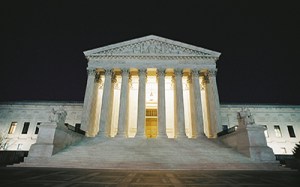
The Supreme Court at night
Yesterday, the courts pushed back on Trump and Musk. I’m not convinced that it will stop them, but we’ll find out soon enough. Here’s a brief summary of what happened from David Kurtz at Talking Points Memo: The Day The Federal Courts Stood Tall.
The showdown between President Trump and the federal judiciary came to a head Tuesday in a more dramatic and direct way that Morning Memo had anticipated.
With Trump dangerously but also absurdly calling for the impeachment of the federal judge who ruled against him in the Alien Enemies Act case, Supreme Court Chief Justice John Roberts stirred from his torpor long enough to issue a rare rebuke of the president, though not by name (as Trump himself pointed out). Roberts’ decision to come to the defense of district judges who have been on the front lines of this constitutional battle keeps them from being marooned on an island while their decisions wind their way up through the lengthy appeals process.
“The Chief Justice’s statement now renders the Trump confrontation one with the entire federal judiciary, and not just the lower federal courts,” Harvard Law professor Jack Goldsmith observed.
What followed over the course of the day was a series of significant court rulings against the Trump administration. While the compressed timing of the rulings was mostly coincidental, the thrust of the decisions all pointed in the same direction: Two months into his second term, President Trump has wildly exceeded his constitutional authority on numerous fronts.
I wish I could say that the combination of the chief justice’s rebuke and the multiple legal setbacks suggests that the federal judiciary is girding for a fight over the rule of law and its own constitutional powers. I hope that’s the case. I want that to be the case. But we need to see appeals courts and the high court itself weighing in on the substance of these cases in the weeks and months to come before we can assess whether the judicial branch will hold the line. There’s no doubt that Trump is itching to coopt the judiciary.
It bears repeating that the courts alone can’t save us from autocracy. But losing the courts entirely would be a devastating blow that would make additional areas of American public and private life vulnerable to Trump’s rampage and would add immeasurably to the future workload of rebuilding what Trump has broken.
For one day, though, the judicial branch stood tall.
Some specifics:
The New York Times: Musk’s Role in Dismantling Aid Agency Likely Violated Constitution, Judge Finds.
Efforts by Elon Musk and his team to permanently shutter the U.S. Agency for International Development likely violated the Constitution “in multiple ways” and robbed Congress of its authority to oversee the dissolution of an agency it created, a federal judge found on Tuesday.
The ruling, by Judge Theodore D. Chuang of U.S. District Court for the District of Maryland, appeared to be the first time a judge has moved to rein in Mr. Musk and his Department of Government Efficiency directly. It was based on the finding that Mr. Musk has acted as a U.S. officer without having been properly appointed to that role by President Trump.
Judge Theodore Chuang
Judge Chuang wrote that a group of unnamed aid workers who had sued to stop the demolition of U.S.A.I.D. and its programs was likely to succeed in the lawsuit. He agreed with the workers’ contention that Mr. Musk’s rapid assertion of power over executive agencies was likely in violation of the Constitution’s appointments clause.
The judge also ordered that agency operations be partially restored, though that reprieve is likely to be temporary. He ordered Mr. Musk’s team to reinstate email access to all U.S.A.I.D. employees, including those on paid leave. He also ordered the team to submit a plan for employees to reoccupy a federal office from which they were evicted last month, and he barred Mr. Musk’s team from engaging in any further work “related to the shutdown of U.S.A.I.D.”
Given that most of the agency’s work force and contracts were already terminated, it was not immediately clear what effect the judge’s ruling would have. Only a skeleton crew of workers is still employed by the agency.
And while the order barred Mr. Musk from dealing with the agency personally, it suggested that he or others could continue to do so after receiving “the express authorization of a U.S.A.I.D. official with legal authority to take or approve the action.”
A federal judge has indefinitely blocked President Donald Trump’s ban on transgender service members, dealing a major defeat to a controversial policy the president resurrected from his first term.
In a scathing ruling, US District Judge Ana Reyes said the administration cannot enforce the ban — which was set to take effect later this month.
Reyes, an appointee of former President Joe Biden, wrote that the ban “is soaked in animus and dripping with pretext. Its language is unabashedly demeaning, its policy stigmatizes transgender persons as inherently unfit, and its conclusions bear no relation to fact.”
Judge Ana Reyes
“Indeed, the cruel irony is that thousands of transgender servicemembers have sacrificed – some risking their lives – to ensure for others the very equal protection rights the Military Ban seeks to deny them,” she wrote.
The judge said she was pausing her preliminary injunction until Friday morning to give the administration time to appeal it to the DC Circuit Court of Appeals.
The ruling came in a case brought by transgender active-duty service members and others hoping to enlist in the military who would be barred from service under the ban. Reyes said they had shown that they would likely succeed on their claim that the ban violated rights afforded to them by the Constitution.
Days after taking office, Trump signed an executive order directing the Pentagon to implement its own policies that say transgender service members are incompatible with military service. The government had argued that continuing to permit trans individuals to serve in the US would negatively affect, among other things, the military’s lethality, readiness and cohesion.
The Washington Post: Judge halts Trump EPA bid to kill $14 billion Biden climate grant fund.
A federal judge on Tuesday temporarily barred President Donald Trump’s Environmental Protection Agency from clawing back at least $14 billion in grants issued by the Biden administration for climate and clean-energy projects, saying the EPA had not put forward “credible evidence” of fraud or abuse.
U.S. District Judge Tanya S. Chutkan of Washington, D.C., ruled that the EPA’s sudden mid-February asset freeze and March 11 termination of legally awarded grants came without a legally required explanation to three coalitions of grant recipients. The groups said the sudden cutoff of funds approved by Congress appeared to be arbitrary, capricious or in violation of federal law and regulations.
Judge Tanya Chutkan
Climate United Fund, Coalition for Green Capital and Power Forward Communities, which received $7 billion, $5 billion and $2 billion, respectively, sued over the funding freeze. They are among eight recipients awarded more than$20 billion under the Greenhouse Gas Reduction Fund, a program established in President Joe Biden’s signature 2022 climate law more commonly known as the “green bank.”
In a 23-page opinion, Chutkan said the EPA’s actions raised “serious due process concerns” and issued a temporary restraining order barring the grant cutoffs for now. Chutkan did not release funds to the groups but ordered that the money be held as it was in their accounts at Citibank and not clawed back or reused for any other purpose by the EPA while the case moves ahead.
While the agency voiced concerns regarding “program integrity,” “programmatic fraud, waste, and abuse” and “the absence of adequate oversight,” Chutkan wrote, “vague and unsubstantiated assertions of fraud are insufficient.”
Chutkan said she was neither forcing the EPA to “undo” its termination nor making the funds unrecoverable, but ensuring that the government abides by grant laws and regulations, “which serves the public interest.”

The New York Times: Judge Orders Education Dept. to Restore Some Grants to Schools.
A federal judge on Tuesday ordered the Education Department to restore some federal grants that were terminated as part of the Trump administration’s purge of diversity, equity and inclusion programs.
Judge Julie R. Rubin of the Federal District Court for the District of Maryland said in an opinion that the department had acted arbitrarily and illegally when it slashed $600 million in grants that helped place teachers in underserved schools. The judge also ordered the administration to cease future cuts to those grants.
Judge Julie R. Rubin
The grants fund programs that train and certify teachers to work in struggling districts that otherwise have trouble attracting talent. The programs cited goals that included training a diverse educational work force, and provided training in special education, among other areas.
The department, led by Education Secretary Linda McMahon, argued that the grants trained teachers in “social justice activism” and other “divisive ideologies” and should be eliminated.
A coalition of educator organizations sued to stop the Education Department from terminating the grants. The coalition included groups, such as the American Association of Colleges for Teacher Education and the National Center for Teacher Residencies, whose members depend on the grants at issue.
The judge found that the loss of the federal dollars would harm students and schools with the fewest resources.
“The harms plaintiffs identify also implicate grave effect on the public: fewer teachers for students in high-need neighborhoods, early childhood education and special education programs,” she wrote. “Moreover, even to the extent defendants assert such an interest in ending D.E.I.-based programs, they have sought to effect change by means the court finds likely violate the law.”

One more from The Guardian today: Judge denies government’s attempt to dismiss Mahmoud Khalil’s challenge to his deportation.
A federal judge has turned down a request from the Trump administration to dismiss Palestinian activist Mahmoud Khalil’s challenge to his deportation, and ruled his case should be heard in New Jersey rather than Louisiana, where he is now detained.
Judge Jesse Furman
In his decision, judge Jesse M Furman said that since Khalil’s attorney filed the challenge to his arrest while he was in Immigration and Customs Enforcement (Ice) detention in New Jersey, the case must be heard there. Government lawyers had asked that his petition be considered in Louisiana, where Khalil had been flown to after being arrested by Ice in New York City and then briefly held in New Jersey.
“Given that the District of New Jersey is the one and only district in which Khalil could have filed his Petition when he did, the statutes that govern transfer of civil cases from one federal district court to another dictate that the case be sent there, not to the Western District of Louisiana,” Furman wrote.
He added that “the Court’s March 10, 2025 Order barring the Government from removing him (to which the Government has never raised an objection and which the Government has not asked the Court to lift in the event of transfer) shall similarly remain in effect unless and until the transferee court orders otherwise.”

On the “Alien Enemies” case before Judge James Boesberg, NBC News reports: Trump administration pushes back on judge’s request for answers about deportation flights.
The Justice Department is pushing back against a federal judge’s request for more information about the deportation flights that took off over the weekend after President Donald Trump invoked the rarely used Alien Enemies Act.
U.S. District Judge James Boasberg had ordered the Trump administration to submit answers to his questions about the timing of the deportation flights and custody handover of deportees, giving the government until noon Wednesday to respond.
Judge James Boasberg
The government submitted a filing Wednesday morning asking for a pause of Boasberg’s order to answer his questions.
“Continuing to beat a dead horse solely for the sake of prying from the Government legally immaterial facts and wholly within a sphere of core functions of the Executive Branch is both purposeless and frustrating to the consideration of the actual legal issues at stake in this case,” the DOJ wrote in the filing.
The judge had initially ordered the government to answer his questions surrounding the flights by noon Tuesday. The Justice Department declined to answer some of his questions, saying, “If, however, the Court nevertheless orders the Government to provide additional details, the Court should do so through an in camera and ex parte declaration, in order to protect sensitive information bearing on foreign relations.”
Boasberg agreed and directed DOJ attorneys to submit under seal the answers to his questions about the deportations that were carried out under the terms of a rarely used wartime act by noon Wednesday.
In its response Wednesday, the government blasted the judge for accepting its proposal and suggested he not take any action until an appeals court rules on its request for a stay.
“The Court has now spent more time trying to ferret out information about the Government’s flight schedules and relations with foreign countries than it did in investigating the facts before certifying the class action in this case. That observation reflects how upside-down this case has become, as digressive micromanagement has outweighed consideration of the case’s legal issues,” the DOJ filing said. “The distraction of the specific facts surrounding the movements of an airplane has derailed this case long enough and should end until the Circuit Court has had a chance to weigh in,” it added.

These Trump people are truly evil.
An interesting sidebar to the “Alien Enemies” law dispute from Forbes: Trump’s Sister Declared The Immigration Law He Used Unconstitutional.
In a historical twist, Donald Trump’s sister was the federal judge who ruled unconstitutional the immigration law the Trump administration is using to deport a pro-Palestinian protester. In 1996, U.S. District Judge Maryanne Trump Barry wrote an opinion that declared unconstitutional the part of U.S. immigration law that Donald Trump has promised to continue employing to deport protesters. The current case has captured headlines and will test the Trump administration’s immigration authority….
On March 8, 2025, Immigration and Customs Enforcement arrested Mahmoud Khalil, a lawful permanent resident and pro-Palestinian protester who graduated in December from Columbia University. Controversy over the arrest surrounded the Trump administration using a provision in immigration law that allows for deportation if the Secretary of State believes an alien’s presence or activities “would have potentially serious adverse foreign policy consequences for the United States.”
In 1995, Secretary of State Warren Christopher used the same authority when attempting to deport Ruiz Massieu to Mexico. As presented by the court documents, the circumstances in that case were quite different from the arrest of Mahmoud Khalil.
In September 1994, Ruiz Massieu’s brother, a prominent member of PRI, Mexico’s ruling party, was assassinated. As Deputy Attorney General, Ruiz Massieu investigated and identified a PRI official, Manuel Munoz Rocha, as the lead conspirator in his brother’s killing. Rocha was protected, first by official immunity and later by disappearing before an interview could be conducted. In late November 1994, Massieu resigned in a public speech and later published a book criticizing the PRI.
After Mexican officials sought his arrest, he entered the United States legally as a visitor (he owned property in Texas) and flew to Spain with a stopover at Newark Airport. In Newark, he was arrested for declaring only $18,000 of the $44,322 in cash with him. While the declaration infraction was later dropped, the Mexican government charged him with crimes “against the administration of justice” and sought his extradition.
“It was then, however, that this case took a turn toward the truly Kafkaesque,” writes U.S. District Judge Maryanne Trump Barry, Donald Trump’s sister. She notes that the Immigration and Naturalization Service took Massieu into custody. “He was ordered to show cause as to why he should not be deported because, the Secretary of State has made a determination that . . . there is reasonable ground to believe your presence or activities in the United States would have potentially serious adverse foreign policy consequences for the United States.” (Emphasis added.) In 1996, the provision was Section 241(a)(4)(C)(i) of the Immigration and Nationality Act but it was later redesignated Section 237(a)(4)(C)(i) due to other changes in the INA. The language in both designations is identical.
More at the Forbes link.
More News links
CNN: Trump says he had ‘very good’ call with Zelensky after speaking to Putin yesterday.
AP: Zelenskyy says Putin’s vow not to hit Ukraine’s energy infrastructure is ‘at odds with reality.’
Steven Rosenberg at BBC News: Rosenberg: Trump-Putin call seen as victory in Russia.
Jonathan Lemire at The Atlantic: Trump Gets a Taste of Putin’s Tactics. (Gift link)
Jamelle Bouie at The New York Times: Trump Has Gone From Unconstitutional to Anti-Constitutional.
Politico: Hill Republicans already hated the ‘idiotic’ call to impeach judges. Then Trump jumped in.
Jennifer Rubin at The Contrarian: The Constitutional Crisis May be Upon Us.
The New York Times: DOGE Cuts Reach Key Nuclear Scientists, Bomb Engineers and Safety Experts.
The Washington Post: Trump aides prep new tariffs on imports worth trillions for ‘Liberation Day.
The New York Times: Kennedy’s Alarming Prescription for Bird Flu on Poultry Farms.
The Atlantic: The Cost of the Government’s Attack on Columbia.
Philip Bump at The Washington Post: They’re coming for immigrants first. And the Trump administration is signaling that no one else might be safe, either.
Timothy Snyder at “Thinking about…”: The evil at your door. The deportation action as regime change.
Sorry this post isn’t longer. I’m still dealing with a bad cold. I just can’t seem to shake it.
Wednesday Reads: Social Security, Measles, and Government Shutdown
Posted: March 12, 2025 Filed under: Donald Trump, Elon Musk, just because, Social Security | Tags: government shutdown 2025m, Leland Dudek, measles outbreak, Robert F. Kennedy Jr. 6 CommentsGood Afternoon!!

Fool on the Hill, by Dave LeBow
I have a nasty cold, so I don’t know how much I can do today. As always, everything is endlessly crazy. Trump is causing chaos with his on-again, off-again tariffs, but I’m not going to deal with that today. I want to begin with the latest on Social Security. There is quite a bit of news on it today. Next, news on the spreading Measles outbreak and then the possible government shutdown.
Social Security News
ProPublica got ahold of a recording of the acting director of the Social Security Administration: “The President Wanted It and I Did It”: Recording Reveals Head of Social Security’s Thoughts on DOGE and Trump.
Since the arrival of a team from Elon Musk’s Department of Government Efficiency, Social Security is in a far more precarious place than has been widely understood, according to Leland Dudek, the acting commissioner of the Social Security Administration. “I don’t want the system to collapse,” Dudek said in a closed-door meeting last week, according to a recording obtained by ProPublica. He also said that it “would be catastrophic for the people in our country” if DOGE were to make changes at his agency that were as sweeping as those at USAID, the Treasury Department and elsewhere.
Dudek’s comments, delivered to a group of senior staff and Social Security advocates attending both in person and virtually, offer an extraordinary window into the thinking of a top agency official in the volatile early days of the second Trump administration. The Washington Post first reported Dudek’s acknowledgement that DOGE is calling the shots at Social Security and quoted several of his statements. But the full recording reveals that he went much further, citing not only the actions being taken at the agency by the people he repeatedly called “the DOGE kids,” but also extensive input he has received from the White House itself. When a participant in the meeting asked him why he wouldn’t more forcefully call out President Donald Trump’s continued false claims about widespread Social Security fraud as “BS,” Dudek answered, “So we published, for the record, what was actually the numbers there on our website. This is dealing with — have you ever worked with someone who’s manic-depressive?”
Throughout the meeting, Dudek made alarming statements about the perils facing the Social Security system, but he did so in an oddly informal, discursive manner. It left several participants baffled as to the ultimate fate of the nation’s largest and most popular social program, one that serves 73 million Americans. “Are we going to break something?” Dudek asked at one point, referring to what DOGE has been doing with Social Security data. “I don’t know.”
But then he said, in a more reassuring tone: “They’re learning. Let people learn. They’re going to make mistakes.”
Dudek embodies the dramatic whipsawing of life as a public servant under DOGE. For 25 years, he was the ultimate faceless bureaucrat: a midlevel analyst who had bounced between federal agencies, ultimately landing at the Social Security Administration and focusing on information technology, cybersecurity and fraud prevention. He was largely unknown even within the agency. But in February, he suddenly vaulted into the public eye when he was put on leave for surreptitiously sharing information with DOGE. It appeared that he might lose his job, but then he was unexpectedly promoted by the Trump administration to the position of acting commissioner. At the time, he seemed unreservedly committed to the DOGE agenda, writing — then deleting — a bellicose LinkedIn post in which he expressed pride in having “bullied agency executives, shared executive contact information, and circumvented the chain of command to connect DOGE with the people who get stuff done.”
Now, only weeks into his tenure, he was taking a far more ambivalent posture toward not just DOGE but Trump. On multiple occasions during last week’s meeting, according to the recording, Dudek framed the choices that he has been making in recent weeks as “the president’s” agenda. These choices have included planned cuts of at least 7,000 Social Security employees; buyouts and early retirement offered to the entire staff of 57,000, including those who work in field offices and teleservice centers helping elderly and disabled people navigate the program; cuts to disability determination services; the dissolution of a team that had been working to improve the user experience of the ssa.gov website and application process; a reduction of the agency’s footprint across the country from 10 regional offices to four; the terminations of 64 leases, including those for some field office and hearing office space; proposals to outsource Social Security customer service; and more.
“I work for the president. I need to do what the president tells me to do,” Dudek said, according to the recording. “I’ve had to make some tough choices, choices I didn’t agree with, but the president wanted it and I did it,” he added later. (He didn’t name specific actions that Trump did or did not direct.)
Center for American Progress: Cuts to the Social Security Administration Threaten Millions of Americans’ Retirement and Disability Benefits.
In January 2025, 73 million people—more than 1 in 5 Americans—received benefits from the Social Security Administration (SSA). But the agency that gets those benefits into bank accounts to buy groceries and pay bills is now under attack, putting beneficiaries at risk of dangerous disruptions and delays. Recently, the SSA announced that it would cut approximately 7,000 jobs—a 12 percent reduction in the agency’s staffing. At the same time, the SSA is shutting down six of its 10 regional offices, while posts to the Department of Government Efficiency (DOGE) website spark fears of upcoming field office closures around the country.
These assaults on the SSA threaten Americans’ ability to access the benefits they rely on to get by.
The Social Security Administration has been doing more with less for years, providing benefits to a rapidly growing number of beneficiaries despite its shrinking staff. Under congressional restrictions on administrative spending, agency capacity has stretched to the breaking point, with staff levels approaching a 25-year low in fiscal year 2024. Under these conditions, former Social Security Commissioner Martin O’Malley warned that DOGE-led cuts to an already skeletal agency may lead to “system collapse and an interruption of benefits.”
Any delay or interruption in payments would be catastrophic. More than 7 million Americans 65 and older receive at least 90 percent of their income from Social Security.* For many of these seniors, even a few days’ delay in receiving Social Security benefits would pose an immediate threat to their ability to pay rent and buy food. Payments made even later, or missed, would irreparably harm many more: In a January 2025 survey, 42 percent of Americans 65 and older reported “I would not be able to afford the basics, such as food, clothing, or housing [without Social Security retirement benefits].”
Disabled people and their families, likewise, would face dire straits. More than 11 million disabled Americans under the age of 65 rely on benefits administered by the SSA through either Social Security Disability Insurance (SSDI), Supplemental Security Income (SSI), or both. Most SSDI recipients can’t work due to their disability, while others work limited hours and can only earn very limited amounts without forfeiting their benefits. For SSI claimants, even when they are able to work, they can only hold a few thousand dollars in gross assets without losing their benefits, subject to limited exceptions, making it essentially impossible to save. As a result, too many SSDI and SSI recipients are one missed or late payment away from not making rent or putting food on the table.
There is much more information at the CAP link.
 Nathaniel Weixel at The Hill: Trump, Musk fuel fears of Social Security cuts with ‘fraud’ talk.
President Trump and his billionaire adviser Elon Musk are ratcheting up false rhetoric about Social Security, repeatedly claiming the program wastes hundreds of billions of dollars in fraudulent payouts that need to be eliminated.
Their position is confounding experts and worrying advocates, who fear the claims are a pretext for massive cuts to the program down the road.
Trump, Musk and the administration’s allies insist they are targeting waste, fraud and abuse and are not going after benefits as a whole.
In an interview Monday with Larry Kudlow, who served as Trump’s chief economic adviser in his first term, Musk suggested Social Security and other entitlement programs are rife with fraud and a prime target for cuts.
“Most of the federal spending is entitlements. So that’s the big one to eliminate,” Musk said on Kudlow’s Fox Business show, adding there’s possibly $500 billion to $700 billion in potential cuts there.
Musk also said they’re trying to put a stop to “stolen” and “fake” Social Security numbers.
What’s their evidence for this fraud and waste?
Economists say the levels of fraud talked about by Trump and Musk just don’t exist.
A report by the Social Security Administration’s inspector general last year found the agency made nearly $72 billion in improper payments from fiscal 2015 through fiscal 2022 — less than 1 percent of benefits paid out during that period.
“I’m a firm believer in the perpetual inefficiency of government. But if I had to pick one place in the federal government that is more efficient than most, Social Security would be one of them,” said Chuck Blahous, a senior research strategist at the Mercatus Center at George Mason University and a former top economic adviser in the George W. Bush administration.
Representatives from DOGE have reportedly gained access to sensitive taxpayer data collected by the Social Security Administration (SSA).
According to a declaration in a federal lawsuit from Tiffany Flick, the SSA’s former acting chief of staff, DOGE staffers seemed to want the data to search for evidence of alleged benefits fraud.
Flick wrote that she thought the DOGE team’s concerns were “invalid and based on an inaccurate understanding of SSA’s data and programs.”
Musk also claims that “illegal” immigrants are getting Social Security benefits. Of course, that’s impossible, since these people can’t get Social Security numbers.
One more on Social Security from CNBC: Senators to Trump Social Security nominee: ‘You will be responsible’ if benefits are interrupted.
Democratic Senators Elizabeth Warren of Massachusetts and Ron Wyden of Oregon are warning Frank Bisignano, the nominee to lead the Social Security Administration, that he will be responsible if staff cuts interfere with the agency’s ability to process and disburse benefit checks.
President Donald Trump has nominated Bisignano, chief executive of payments and financial technology company Fiserv, to serve as commissioner of the agency, which is responsible for sending monthly benefit payments to more than 72 million Americans.
“As President Trump’s nominee for SSA Commissioner, you will be responsible if the Trump Administration’s attacks on the program result in failures or delays in getting Americans their Social Security checks — in other words, a backdoor cut to benefits,” Warren and Wyden wrote in a March 11 letter to Bisignano, shared exclusively with CNBC.
Bisignano’s Senate confirmation hearing is expected to take place later this month, according to a source familiar with the situation.
In the interim, the agency is under the leadership of acting commissioner Lee Dudek, who according to reports publicly stated before his appointment that he had been put on administrative leave after helping representatives of Elon Musk’s so-called Department of Government Efficiency. Dudek replaced former acting commissioner Michelle King, who stepped down following reported disagreements with DOGE over access to sensitive data.
The Measles Outbreak
Measles is spreading around the country, and RFK Jr. isn’t dealing with what’s happening.
 The Washington Post: Texas measles outbreak grows, while New York and California report new cases.
So what is the head of Health and Human Services doing?
 The Daily Beast: RFK Jr.: It Would Be Better if ‘Everybody Got Measles.’
Health and Human Services Secretary Robert F. Kennedy Jr. appeared to suggest getting measles is the best defense against the disease, as a Texas outbreak spreads across the U.S.
More than 220 people in the state have been diagnosed with the infectious virus, and California, New York, and Maryland have also reported cases of late. The Centers for Disease Control and Prevention is sweating over the outbreak, warning health-care workers and travelers to “be vigilant.”
While RFK Jr. recently shifted his stance to concede that vaccinations are actually pretty useful, he has still stopped short of urging skeptics to go and get it. And in an interview with Fox News’ Sean Hannity that aired Tuesday night, he appeared to still favor natural immunity through exposure to the virus.
“It used to be, when I were a kid, that everybody got measles. And the measles gave you lifetime protection against measles infection,” he said, then taking a swipe at the vaccine. “The vaccine doesn’t do that. The vaccine is effective for some people for life, but for many people it wanes.”
In Texas, uptake of the vaccine is lower than in other states, partly fueled by COVID skepticism. The measles, mumps, and rubella (MMR) vaccine offers 93 percent protection against measles if the recipient has one dose, and 97 percent after two doses, according to the CDC.
HuffPost via Yahoo News: RFK Jr. Makes More Alarming Comments About Measles Amid U.S. Outbreaks.
In an interview with Fox News’ Sean Hannity broadcast Tuesday, Kennedy said “natural immunity” after getting a measles infection is more effective at providing lasting protection against the disease. However, Kennedy left out that the dangers of catching the disease outweigh the advantage of immunity, according to doctors….
Despite Kennedy’s claims, the Centers for Disease Control and Prevention says the majority of people who have had the measles, mumps, and rubella (MMR) and the measles, mumps, rubella, and varicella (MMRV) vaccines will be protected for life. The CDC also has guidance for people it recommends should be revaccinated.
Prior to the introduction of the vaccine in 1963, about 500,000 cases and 500 measles deaths were reported annually, while the real number of cases was suspected to be much higher, the agency said. Since then, incidence of the disease has fallen by over 95%, it said.
Kennedy added that he would make sure that “anybody who wants a vaccine can get one,” noting that he is against forcing people to take it.
“I’m a freedom of choice person,” Kennedy said. “We should have transparency. We should have informed choice. And — but if people don’t want it, the government shouldn’t force them to do it. There are adverse events from the vaccine. It does cause deaths every year. It causes all the illnesses that measles itself cause.”
The CDC has stressed the measles vaccine is safe and effective. Its website lists extensive information about the vaccine, including potential side effects and warnings for people who shouldn’t get vaccinated.
Government Shutdown
Yesterday, the House passed their continuing resolution with devastating cuts to Medicaid. Now, Democrats in the Senate have to decide whether to filibuster and possibly shut down the government.
David Dayen at The American Prospect: Senate Democrats’ Choice: Block the Republican Spending Bill or Dissolve Congress.
Democrats were actually quite pleased with the clown show that was Congress in the last two years. Speaker Mike Johnson (R-LA) had no ability to pass anything without Democratic votes, as he was simply not in control of the far-right elements of his caucus. Democrats welcomed the perception that they were government’s rescuers, the adults in the room, who would save Johnson’s bacon and functionally control the House.
This is no longer true. Donald Trump’s looming presence has whipped Republicans in line, and Johnson has recognized an important truth: So-called “moderate” Republicans will swallow anything, so he only has to negotiate with the far right, and if he can satisfy them, he’ll win any vote. Such was the case with a partisan seven-month “continuing resolution” that passed the House on Tuesday 217-213, with only one defection by libertarian Rep. Thomas Massie (R-KY), who doesn’t really believe in government funding at all. (One Democrat voted for it, Maine Blue Dog Jared Golden.)
It is somewhat remarkable that dozens of House Republicans who have vowed never to pass stopgap bills to fund the government in their political careers caved on this one. But that’s why I put “continuing resolution” in quotes. In reality, this is a hastily arranged partisan Republican budget that achieves much of their anti-government, anti-immigrant, pro-military agenda while paving the way for Trump to nullify whatever spending he deems unworthy. It doesn’t just tilt spending in a far-right direction, it actually abdicates congressional responsibility as the branch of government that makes federal spending decisions.
Yet several Senate Democrats are thinking about passing it anyway.
Without the luxury of Republicans falling apart, Democrats in the Senate need to decide whether to prevent a dangerous and harmful budget that shrinks the power of Congress in the government. Since operating on principle goes against their “adults in the room” mindset, they are wavering on what to do. But it should be an open-and-shut case.
A normal continuing resolution funds the government at the same level as the previous budget. This bill does not. It cuts non-defense discretionary spending by $13 billion below last year’s level, while increasing military spending by $6 billion. It zeroes out funding for programs that fund homeless shelters and prevent child abuse. It cuts health care funding for clinics and hospitals, emergency preparedness for communities, clean water projects, and tribal assistance. Meanwhile, it adds money for mass deportations, just as Immigration and Customs Enforcement has illegally detained a green card holder for his political beliefs.
Read the rest at the link above.
Josh Marshall at Talking Points Memo: Here Are the Arguments for Why Senate Ds Should Vote Yes and Why They’re Wrong.
Over the last week a few TPM Readers have written in with contrary arguments about how to deal with the “continuing resolution” that just passed the House and will soon be voted on in the Senate. These weren’t critical or acrimonious letters but frank constructive counters, which I appreciate. I wanted to discuss them because they line up pretty closely with the arguments that seem to have strong advocates in the Senate Democratic caucus.
Let me summarize them briefly.
- Democrats are in a tough messaging environment and they’ll get blamed for the shutdown. Trump might even get to blame a recession on them.
- The White House will get to control the pace of the shutdown. In other words, the executive gets flexibility in just how things get shut down, things that will get more or less helpful press attention. Thus he’ll be able to engineer lots of bad press cycles for the Democrats.
- Quite simply, Trump’s presidency and the economy are imploding. Why rush in to make ourselves the story when every day is a bad day for Trump?
- It’s too soon. The public isn’t engaged enough yet. By the fall the economy will likely be in recession and it will be a debate on Medicare, Medicaid, etc. — that’s the time to have the fight.
- Trump and Musk probably want a shutdown. After a shutdown goes on for 30 days, the law opens up new legal avenues for layoffs. A shutdown is actually what they want and they will use it to accelerate the process, get people used to it. In other words, risking a shutdown is a trap because nothing would make them happier.
I’ve thought a lot about each of these arguments. On their own a number of them are compelling and point to very real risks. Indeed, last week I briefly started questioning my own position because Democrats had done nothing to lay any groundwork for why they were choosing this confrontation. And that makes a fight much, much harder.
But I think each of these arguments is mistaken. Indeed, as a whole it’s a bit like sitting in the mess hall in Treblinka planning an escape when someone says, “But if we try to escape they’ll kill us all!”
First, I think Republicans are going to get wrecked in the midterms. I think that’s highly likely whatever happens. As a narrowly electoral calculus I think there’s a decent argument Democrats should just let everything happen, let Trump and Musk go wild. In this sense, James Carville’s argument that Democrats should just do nothing is right, by a narrowly electoral calculus. But there’s more than just an electoral calculus. Trump and Musk are methodically dismantling the republic day by day. Absent some major change in the trajectory of events the government Democrats might half-inherit in a midterm sweep would be all but unrecognizable, a smoldering heap of faits accompli. Democrats need to take some real risks to at least slow the process of destruction and reshape the trajectory.
Read the rest at TPM.
Michael Cohen at Truth and Consequences: Shut It Down! Senate Democrats are in a difficult spot with a government shutdown looming, but their course of action is clear.
On Tuesday afternoon, the Republican-controlled House of Representatives passed a continuing resolution to keep the government funded through September 30 and avert a government shutdown on Friday. Now, the bill moves to the Senate, where, if Democrats want to stop Donald Trump’s assault on the federal government, they must filibuster it.
I get that the politics of this are complicated, but this isn’t even a close call.
First, Republicans didn’t even bother negotiating with Democrats on this bill. As a result, there are no provisions requiring Trump to actually spend the money Congress is appropriating. This is important because Trump and Elon Musk have run roughshod over congressional prerogatives for the past two months, slashing government spending that Congress has already appropriated.
Republicans are, in effect, daring Democrats to block it and risk taking the blame for a government shutdown (that’s how Speaker Mike Johnson got all but one of his fractured caucus to vote for the bill). On the merits, the bill is bad but not egregiously awful. It keeps spending levels essentially flat while increasing defense spending by $6 billion. However, it would force the District of Columbia to cut its budget by more than $1 billion, which would be devastating. In addition, it includes a provision that strips the House of the ability to stop Trump’s recent declarations of national emergencies on immigration and the border, which has allowed him to place sweeping tariffs on Canada and Mexico.
But the real problem with the House-passed CR is that if Democrats allow it to become law, they will be handing Trump and Musk a blank check and the congressional authority to wreak further havoc on the federal government.
Handing Trump more money — with no provision for how he spends it — is an explicit surrender to his and Musk’s lawlessness. Unlike regular spending bills, continuing resolutions do not explicitly tell the executive branch how it should allocate the money appropriated. So, if Senate Democrats allow this bill to pass, they would give Trump even greater discretion in how he spends money authorized by Congress — and more congressional leeway for taking a wrecking ball to the federal government.
In an interview with the New Republic’s Greg Sargent, former New Jersey congressman Tom Malinowski captures the dynamic at play here.
This is a bizarre situation in which the president of the United States and this billionaire are already shutting down the government. So if I’m a Democrat in Congress, why do I vote for a continuing resolution to fund programs that are not continuing? It really is just a blank check. It’s like giving Trump and Musk a trillion dollars and saying, Spend it as you like.
Democrats cannot be complicit in Trump and Musk’s evisceration of the federal government. Even if Senate Republicans try to eliminate the filibuster to thwart Democrats’ shutdown tactics, even if Trump ignores Congress and (unconstitutionally) keeps the government open, and even if an extended shutdown boomerangs politically against Democrats, Democrats still need to hold the line.
Click the link to read the rest.
That’s it for me today. What’s on your mind?

 peej
peej Carissa
 bostonboomer
 dakinikat
 ecocatwoman
 mablue2
 Mama Lopez
 peggysue22
 quixote
 skydancingguestblogger
 Mona (aka Wonk the Vote)



 Sky Dancing
Recent Comments