Posted: April 23, 2025 | Author: bostonboomer | Filed under: Donald Trump, ICE Immigration and Customs Enforcement, immigration, just because | Tags: Abrego Garcia, Autocracy, Chris Van Hollen, Cory Booker, dictatorship, Gary Kasparov, Mahmoud Khalil, Maria Ressa, Philippines, Rodrigo Duterte, Rumeysa Ozturk, Steven Levitsky |
Good Morning!!
We are in deep trouble as a country. Trump hasn’t even been in the White House for 100 days, and he has made rapid progress toward turning us into a dictatorship. I think Congressional Democrats are beginning to wake up, but not nearly quickly enough. Too many of these elected Democrats still aren’t taking the danger seriously enough. In my opinion, they should calling press conferences at least every few days to explain how Trump is destroying our government.
There’s an excellent piece in The Atlantic by executive editor Adrienne LaFrance (gift link): A Ticking Clock on American Freedom. It’s later than you think, but it’s not too late.
Look around, take stock of where you are, and know this: Today, right now—and I mean right this second—you have the most power you’ll ever have in the current fight against authoritarianism in America. If this sounds dramatic to you, it should. Over the past five months, in many hours of many conversations with multiple people who have lived under dictators and autocrats, one message came through loud and clear: America, you are running out of time.

Maria Ressa
People sometimes call the descent into authoritarianism a “slide,” but that makes it sound gradual and gentle. Maria Ressa, the journalist who earned the Nobel Peace Prize for her attempts to save freedom of expression in the Philippines, told me that what she experienced during the presidency of Rodrigo Duterte is now, with startling speed and remarkable similarity, playing out in the United States under Donald Trump. Her country’s democratic struggles are highly instructive. And her message to me was this: Authoritarian leaders topple democracy faster than you can imagine. If you wait to speak out against them, you have already lost.
Shortly after Trump was reelected last fall, I called Ressa to ask her how she thought Americans should prepare for his return. She told me then that she worried about a failure of imagination. She knew that the speed of the destruction of institutions—one of the first steps an authoritarian takes to solidify and centralize power—would surprise people here, even those paying the closest attention. Ressa splits her time between Manila and New York, and she repeatedly warned me to be ready for everything to happen quickly. When we spoke again weeks after his inauguration, Ressa was shaken. President Trump was moving faster than even she had anticipated.
I heard something similar recently from Garry Kasparov, the Russian dissident and chess grand master. To him, the situation was obvious. America is running out of time, he told me. As Kasparov wrote recently in this magazine, “If this sounds alarmist, forgive me for not caring. Exactly 20 years ago, I retired from professional chess to help Russia resist Putin’s budding dictatorship. People were slow to grasp what was happening there too.”
The chorus of people who have lived through democratic ruin will all tell you the same thing: Do not make the mistake of assuming you still have time. Put another way: You think you can wait and see, and keep democracy intact? Wanna bet? Those who have seen democracy wrecked in their home country are sometimes derided as overly pessimistic—and it’s understandable that they’d have a sense of inevitability about the dangers of autocracy. But that gloomy worldview does not make their warnings any less credible: Unless Trump’s power is checked, and soon, things will get much worse very quickly. When people lose their freedoms, it can take a generation or more to claw them back—and that’s if you’re lucky.
Trump’s methods clearly mirror those of authoritarian leaders in other countries.
The Trump administration’s breakneck pace is obviously no accident. While citizens are busy processing their shock over any one shattered norm or disregarded law, Trump is already on to the next one. This is the playbook authoritarians have used all over the world: First the leader removes those with expertise and independent thinking from the government and replaces them with leaders who are arrogant, ignorant, and extremely loyal. Next he takes steps to centralize his power and claim unprecedented authority. Along the way, he conducts an all-out assault on the truth so that the truth tellers are distrusted, corruption becomes the norm, and questioning him becomes impossible. The Constitution bends and then finally breaks. This is what tyrants do. Trump is doing it now in the United States.
Philippines, it took about six months under Duterte for democratic institutions to crumble. In the

Rodrigo Duterte
United States, the overreach in executive power and the destruction of federal agencies that Ressa told me she figured would have kept Trump busy through, say, the end of the summer were carried out in the first 30 days of his presidency. Even so, what people don’t always realize is that a dictator doesn’t seize control all at once. “The death of democracy happens by a thousand cuts,” Ressa told me recently. “And you don’t realize how badly you’re bleeding until it’s too late.” Another thing the people who have lived under authoritarian rule will tell you: It’s not just that it can get worse. It will.
Americans who are waiting for Trump to cross some imaginary red line neglect the fact that they have more leverage to defend American democracy today than they will tomorrow, or next week, or next month. While people are still debating whether to call it authoritarianism or fascism, Trump is seizing control of one independent agency after another. (And for what it’s worth, the smartest scholars I know have told me that what Trump is trying to do in America is now textbook fascism—beyond the authoritarian impulses of his first term. Take, for example, his administration’s rigid ideological purity tests, or the extreme overreach of government into freedom of scientific and academic inquiry.)
Between the time I write this sentence and the moment when this story will be published, the federal government will lose hundreds more qualified, ethical civil servants. Soon, even higher numbers of principled people in positions of power will be fired or will resign. More positions will be left vacant or filled by people without standards or scruples. The government’s attacks against other checks on power—the press, the judiciary—will worsen. Enormous pressure will be exerted on people to stay silent. And silence is a form of consent.
This article is essential reading. I hope you’ll use the gift link to read the rest at The Atlantic.
Dave Davies of NPR’s Fresh Air interviewed political science Professor Steven Levitsky, co-author of How Democracies Die: Harvard professor offers a grim assessment of American democracy under Trump.
In the 2024 presidential campaign, Democrats’ warnings that American democracy was in jeopardy if Donald Trump was elected failed to persuade a majority of voters. Our guest, Steven Levitsky, says there’s plenty of reason to worry about our democracy now….
In a new article for the journal Foreign Affairs, Levitsky and co-author Lucan A. Way write, quote, “U.S. democracy will likely break down during the Second Trump administration in the sense that it will cease to meet standard criteria for a liberal democracy – full adult suffrage, free and fair elections, and broad protection of civil liberties,” unquote. We’ve invited Levitsky here to explain the threats he sees to democracy and to talk about dramatic developments in the Trump administration’s confrontation with Harvard University.
DAVIES: You note in this article that Freedom House, which is a nonprofit that’s been around for a long time, which produces an annual global freedom index, has reduced the United States’ rating. It has slipped from 2014 to 2021. How much? Where are we now, and where did we used to be?
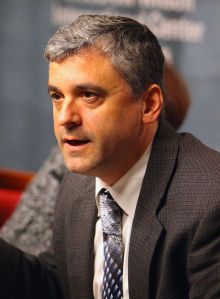
Steven Levitsky
LEVITSKY: Freedom House’s scores range from zero, which is the most authoritarian to a hundred, which is the most democratic. I think a couple of Scandinavian countries get scores of 99 or 100. The U.S. for many years was in the low 90s, which put it broadly on par with other Western democracies like the U.K. and Italy and Canada and Japan. But it slipped in the last decade, from Trump’s first victory to Trump’s second victory, from the low 90s to 83, which placed us below Argentina. And in a tie with Romania and Panama. So we’re still above what scholars would consider a democracy, but now in the very low-quality democracy range, comparable, again, to Panama, Romania and Argentina.
DAVIES: And does Freedom House explain its demotion? Why? Why did this happen?
LEVITSKY: Oh, yeah. Freedom House has annual reports for every country – the rise in political violence, political threats, threats against politicians, refusal to accept the results of a democratic election in 2020, an effort to use violence to block a peaceful transfer of power are all listed among the reasons for why the United States has fallen. I should say that even in the first four months of the Trump administration, it’s quite certain that what’s happening on the ground in the United States is likely to bring the U.S. score down quite a bit.
DAVIES: You say that the danger here is not that the United States will become a classic dictatorship with sham elections, you know, opposition leaders arrested, exiled or killed. What kind of autocracy might we become?
LEVITSKY: I think the most likely outcome is a slide into what Lucan Way and I call competitive authoritarianism. These are regimes that constitutionally continue to be democracies. There is a Constitution. There are regular elections, a legislature and importantly, the opposition is legal, above ground and competes for power. So from a distance, if you squint, it looks like a democracy, but the problem is that systematic coming (ph) abuse of power tilts the playing field against the opposition. This is the kind of regime that we saw in Venezuela under Hugo Chavez. It’s subsequently become a full-on dictatorship. It’s what we see in Turkey under Erdogan. It’s what we see in El Salvador. It’s what we see in Hungary today. Most new autocracies that have emerged in the 21st century have been led by elected leaders and fall into this category of competitive authoritarianism. It’s kind of a hybrid regime.
DAVIES: So free and fair elections lead us to a leader which takes us in a different direction?
LEVITSKY: Right. And because the leader is usually freely and fairly elected, he has a certain legitimacy that allows him to say, hey, how can you say I’m an authoritarian if I was freely and fairly elected? So citizens are often slow to realize that their country is descending into authoritarianism.
You can read the rest of the interview or listen to it at the NPR link.
Jamelle Bouie writes at The New York Times (gift link): Trump Wants You to Think Resistance Is Futile. It Is Not.
The American constitutional system is built on the theory that the self-interest of lawmakers can be as much of a defense against tyranny as any given law or institution.
As James Madison wrote in Federalist 51, “The provision for defense must in this, as in all other cases, be made commensurate to the danger of attack. Ambition must be made to counteract ambition. The interest of the man must be connected with the constitutional rights of the place.” Our Constitution is nothing more than a “parchment barrier” if not backed by the self-interest and ambition of those tasked with leading the nation.
One of the most striking dynamics in these first months of the second Trump administration was the extent to which so many politicians seemed to lack the ambition to directly challenge the president. There was a sense that the smart path was to embrace the apparent “vibe shift” of the 2024 presidential election and accommodate oneself to the new order.
But events have moved the vibe in the other direction. Ambition is making a comeback.
Last week, Senator Chris Van Hollen of Maryland traveled to El Salvador, where he met with Kilmar Armando Abrego Garcia, a victim of the Trump administration’s removal program under the 1798 Alien Enemies Act….
Abrego Garcia is one of the men trapped in this black zone. Despite his protected legal status, he was arrested, detained, accused of gang activity and removed from the United States. At no point did the government prove its case against Abrego Garcia, who has been moved to a lower-security prison, nor did he have a chance to defend himself in a court of law or before an immigration judge. As one of Abrego Garcia’s representatives in the United States Senate, Van Hollen met with him to both confirm his safety and highlight the injustice of his removal.
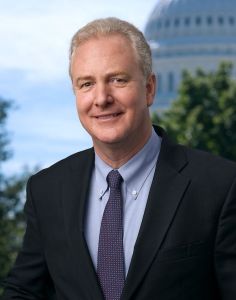
Sen. Chris Van Hollen
“This case is not just about one man,” Van Hollen said at a news conference following his visit. “It’s about protecting the constitutional rights of everybody who resides in the United States of America. If you deny the constitutional rights of one man, you threaten the constitutional rights and due process for everyone else in America.” [….]
The goal of Van Hollen’s journey to El Salvador — during which he was stopped by Salvadoran soldiers and turned away from the prison itself — was to bring attention to Abrego Garcia and invite greater scrutiny of the administration’s removal program and its disregard for due process. It was a success. And that success has inspired other Democrats to make the same trip, in hopes of turning more attention to the administration’s removal program and putting more pressure on the White House to obey the law.
Senator Cory Booker of New Jersey is reportedly organizing a trip to El Salvador, and a group of House Democrats led by Representative Robert Garcia of California arrived on Monday. “While Donald Trump continues to defy the Supreme Court, Kilmar Abrego Garcia is being held illegally in El Salvador after being wrongfully deported,” Representative Garcia said in a statement. “That is why we’re here, to remind the American people that kidnapping immigrants and deporting them without due process is not how we do things in America.”
“We are demanding the Trump administration abide by the Supreme Court decision and give Kilmar and the other migrants mistakenly sent to El Salvador due process in the United States,” Garcia added.
All of this negative attention has had an effect. It’s not just that the president’s overall approval rating has dipped into the low 40s — although it has — but that he’s losing his strong advantage on immigration as well. Fifty percent of Americans disapprove of Trump’s handling of immigration, according to a recent poll from Quinnipiac University, and a new Reuters poll shows Trump slightly underwater on the issue with a 45 percent approval to 46 percent disapproval.
These lawmakers are getting positive attention for standing up to Trump, and their actions are waking up Americans who may not have been paying enough attention to Trump’s illegal and cruel deportations.
A group of Congress people traveled to Louisiana yesterday to meet with university students who have been kidnapped and held without charges. CNN: Congressional delegation visits Mahmoud Khalil and Rumeysa Ozturk in Louisiana detention centers.
A delegation of congressional members traveled to Louisiana Tuesday to demand the release of Mahmoud Khalil and Rümeysa Öztürk and inspect conditions at the two Immigration and Customs Enforcement detention facilities where the two remain in custody.
It’s the first time a congressional delegation has met with Khalil or Ozturk.
Khalil, a Columbia University graduate, and Ozturk, a Tufts University PhD student, have been in ICE custody for more than a month after being arrested near their homes by federal agents.
The Democrat delegation, led by Rep. Troy Carter of Louisiana traveled to Jena, where Khalil is being held, and then two hours south to Basile, where Ozturk is detained. The group included Reps. Bennie Thompson of Mississippi, Ayanna Pressley and Jim McGovern of Massachusetts and Sen. Ed Markey.

Mahmoud Khalil
The facilities were clean but “chilly” according to Carter, who said detainees complained of cold temperatures at night, making it difficult to sleep. Carter said the facilities appeared to have been cleaned prior to their visit and that conditions appeared to be “fine” while they visited.
Following the visit, lawmakers said the detainees they met with also complained about a lack of medical care, food and religious accommodations.
“I really worry that this administration is ushering in a new era of McCarthyism. And unless Congress and unless the American people stand up and push back, they will succeed,” McGovern said during a press conference after the visits.
Markey accused the Trump administration of wanting to “make an example” out of Khalil and Ozturk in an effort to chill free speech. Markey also said ICE had intentionally transferred them to Louisiana for political reasons.
Through the Trump administration, ICE feels “they have a right to take people from across our country, and to put them into facilities like this here in Louisiana,” Markey said. “And why did they do that? They have done that in order to go to the single most conservative Circuit Court of Appeals in the United States of America.”
Again, these Congress people received positive media coverage. As Jamelle Bouie wrote (see above article), perhaps their ambition has led them to publicly oppose Trump’s dictatorial actions.
David Atkins at Washington Monthly: Democrats Need to Make Republicans Fear the Consequences of Attempting a Dictatorship.
Imagine that you were a high-ranking official in Donald Trump’s administration. Imagine that you believed in the Dark Enlightenment dream of dismantling liberal democracy itself—of “killing the woke mind virus,” ending birthright citizenship, and using federal power to suppress dissent. Now imagine you’re openly defying the Supreme Court, declaring that protest aids and abets terrorism, directing the FBI and IRS to target political enemies, and seriously considering invoking the Insurrection Act on flimsy pretexts. What would stop you?
Certainly not impeachment. Not with a compliant Republican Congress. Not with a conservative media ecosystem ready to justify any abuse of power as a patriotic necessity. The only thing that might give you pause is the possibility that Democrats would regain control and then do to you what you’ve done to them.
That fear of reciprocal power and legal accountability was once enough to preserve American political norms. It was the logic of mutually assured destruction: if you break democracy now, they’ll break you later. That’s how informal guardrails were enforced, even through dark chapters like Watergate or Iran-Contra. But those norms no longer hold because no one believes Democrats will retaliate.
This is the context for the quiet battle raging within the Democratic Party leadership. A few anonymous but influential centrists are urging party leaders to soft-pedal Trump’s detention of legal residents in foreign internment camps and pivot to kitchen-table economics instead. Even as constituents demand action and donors grow restless, Senate Majority Leader Chuck Schumer and House Minority Leader Hakeem Jeffries still signal caution, urging patience and restraint…..

Rumeysa Ozturk
There have been some bright spots. Senator Cory Booker broke Strom Thurmond’s filibuster record in a marathon floor speech denouncing Trump’s abuses. Senator Chris Van Hollen forced a meeting with abducted U.S. resident Abrego Garcia in El Salvador, delivering proof of life and drawing global attention. Senator Chris Murphy’s rhetoric has been sharp and effective. House Democrats like Alexandria Ocasio-Cortez (along with her “anti-oligarchy tour” partner Senator Bernie Sanders), Jasmine Crockett, and Robert Garcia have been doing excellent work. Their energy and determination carry the tacit message that those who broke the law and tried to impose an authoritarian regime on the U.S. will face appropriate justice at the end of the day. Representative Jamie Raskin was explicit about warning El Salvador’s leader: “Look, President Bukele—who’s declared himself a dictator—and the other tyrants, dictators, autocrats of the world have to understand that the Trump administration is not going to last forever,” Raskin said. “We’re going to restore strong democracy to America, and we will remember who stood up for democracy in America and who tried to drive us down towards dictatorship and autocracy.”
But these have been exceptions rather than the rule. Most Democrats in leadership and positions of power have stayed quiet—avoiding press conferences, shunning symbolic actions, and allowing business to continue as if the country weren’t barreling toward authoritarianism.
When pressed, party leaders often respond that they can do little substantively. That protests are performative. That voters are tired of drama. But that’s not the point. The point isn’t what Democrats can do today. It’s what they’re signaling they’re willing to do when they return to power.
If Trump and his allies face no meaningful consequences, they have no reason to stop. If Republicans don’t believe that Democrats will act with equal force to protect democracy—legally, aggressively, unapologetically—then there’s no deterrent to further escalation.
Click the link to read the rest.
One more from Toby Buckle at Liberal Currents: Trump ‘Alarmists’ Were Right. We Should Say So.
Throughout the Trump era I’ve been firmly in the camp unaffectionately dismissed as ‘alarmist’ by most commentators. Put simply: It is that bad. Liberal democracy is in danger. Fascism is a reasonable term for what we’re fighting.
For veteran ‘alarmists’ this is a strange moment. People are at a loss. It seems wrong, given all that is at stake, to say “I told you so”. I’ve felt that discomfort. For the longest time I avoided saying that. It felt . . . petty, childish, gauche, it just wasn’t the done thing. One of the big political awakenings I’ve had over the last year, and particularly since Trump’s 2024 victory, is realizing that it’s OK to say “called it”. More than OK. Even if it feels awkward, it’s actually important, perhaps necessary, that we do.
My view has not been, to put it mildly, the mainstream position. You’re allowed, with a certain amount of resentment, to say it today. But that wasn’t always the case. I recall first voicing it as the antecedents of Trump, the tea party and growing white supremacy, started to arise. Obama’s “the fever will break” seemed hopelessly naive to me. The press treated them either as legitimate libertarians or an eccentric curiosity, not a threat. To the activist left, what would become the Bernie movement, they were a joke—the punchline to a Jon Stewart monologue. Nothing more. When Trump first rode the elevator down to announce his candidacy, it was entertainment, not omen.
If you saw in any of this a threat to liberal democracy writ large, much less one that could actually succeed, you were looked at with the kind of caution usually reserved for the guy screaming about aliens on the subway. Trump’s election in 2016 was a shock to people who insisted it could never happen. But those most complacent before quickly found their way back to complacency after. For a certain type—specifically, the type who has a column in legacy media despite never having written an interesting or original paragraph in their lives—smug condescension became the order of the day: yes, Trump is bad, but dear me those liberals are being hysterical. As late as the last election they were writing pieces with titles like “A Trump Dictatorship Won’t Happen” or “No, Trump won’t destroy our democracy.” Even after the election, as the scale of the incoming lawlessness became clear, we were dismissed: “Trump Is Testing Our Constitutional System. It’s Working Fine” respected legal commentator Noah Feldman told us—the legal rationale for his actions was very flimsy. Courts would strike it all down. And certainly the administration would not ignore a court order.
One thing I’ve always wondered about the anti-alarmists during this decade was, to put it bluntly, weren’t they worried about looking stupid? The path we were on seemed clear enough to me, but I didn’t know the future. I always stressed that my predictions were one of any number of possible outcomes. They didn’t. What I was saying was dismissed, not just as unlikely, but impossible. Did they not want to hedge their bets even a bit? And it’s not as if the liberal democratic collapse happened all at once. The last decade has been a steady drum beat of them being wrong, again and again. Yet it never shook them.
Read more at Liberal Currents.
I have been fearful of Trump’s authoritarian tendencies since the 2016 campaign and so have most Sky Dancers. It does feel sometimes that people who didn’t see it are stupid, but I’m willing to welcome people who are beginning to change their minds to the resistance. We need as many resisters as possible. Trump’s polls are dropping now, as more people begin to see what he’s really up to–and it isn’t about bringing down grocery prices. I want to believe there is still hope for our democracy. Lately, it looks like some Democratic leaders are ready to fight back. Some of that fight must have come from seeing the protests all over the country. Now we need a few Republicans to grow spines and stand up to Trump.
That’s all I have for today. What do you think? What’s on your mind?
Did you like this post? Please share it with your friends:
Posted: April 19, 2025 | Author: bostonboomer | Filed under: cat art, caturday, Donald Trump, just because | Tags: Alien Enemies Act, American Revoution, Defense Department, Doge, Elon Musk, government censorship, Harvard University, immigration, medical journals, Pentagon, Pete Hegseth, Steve Vladek, Supreme Court |
Good Afternoon!!
Before I get to the news, I want to call attention to the fact that today April 19, 2025 is the 250th anniversary of the first shots fired in the American revolutionary war–commemorated in the Concord Hymn, by Ralph Waldo Emerson:
 Concord Hymn
Their flag to April’s breeze unfurled,
Here once the embattled farmers stood
And fired the shot heard round the world.
The foe long since in silence slept;
Alike the conqueror silent sleeps;
And Time the ruined bridge has swept
Down the dark stream which seaward creeps.
On this green bank, by this soft stream,
We set today a votive stone;
That memory may their deed redeem,
When, like our sires, our sons are gone.
Spirit, that made those heroes dare
To die, and leave their children free,
Bid Time and Nature gently spare
The shaft we raise to them and thee.
It’s a big deal here in the Boston area, although I haven’t seen much about it in the news. If you watch Rachel Maddow’s show, she has been talking about this anniversary for the past few days. Towns around where I live have lots of celebrations going on. I think this anniversary is really significant right now, because of Trump’s and Musk’s efforts to destroy our government an install a Russian-style dictatorship.
Now on to today’s momentous news:
The Trump administration’s war on immigrants is running into some serious pushback. Early this morning, the Supreme Court ordered the Trump gang to halt their planned deportment of Venezualan men from a Texas detention camp. Trump must be enraged.
The Washington Post (gift article): Supreme Court blocks Alien Enemies Act deportation of Venezuelan men.
The U.S. Supreme Court ordered the Trump administration early Saturday to temporarily halt the deportations of dozens of alleged Venezuelan gang members who immigration advocates say were at imminent risk of being removed from the country.
“The Government is directed not to remove any member of the putative class of detainees from the United States until further order of this Court,” the order reads.
 The court did not explain its reasoning in its brief unsigned emergency order. Justices Clarence Thomas and Samuel A. Alito Jr. dissented, with Alito saying he would file a more fulsome statement on his disagreement with the ruling later.
The Trump administration was preparing to deport the Venezuelan men under the Alien Enemies Act, the American Civil Liberties Union said Friday as it scrambled to find a court it could persuade to step in and block the removals before it was too late.
In a statement early Saturday, the ACLU’s lead counsel in the case, Lee Gelernt, said the organization was “relieved that the Supreme Court has not permitted the administration to whisk them away the way others were just last month.”
But the fate of the detainees targeted for this latest round of removals remains unresolved. Attorneys for the migrants had also pressed federal judges in Texas and Washington as well as the New Orleans-based U.S. Court of Appeals for the 5th Circuit to intervene, arguing that the government had not provided those targeted a meaningful opportunity to challenge the reasons for their removals.
In its order early Saturday, the Supreme Court said it would take further action after the 5th Circuit had weighed in. Around that same time, a three-judge panel from that appellate court denied the ACLU’s emergency request to block the deportations and chided its lawyers for coming to them before a lower court had ruled on the issue.
Read the rest at the WaPo.
JJ sent this piece by Steve Vladek at One First: The Supreme Court’s Late-Night Alien Enemy Act Intervention.
Just before 1:00 a.m. (ET) last night/very early this morning, the Supreme Court handed down a truly remarkable order in the latest litigation challenging the Trump administration’s attempts to use the Alien Enemy Act (AEA) to summarily remove large numbers of non-citizens to third countries, including El Salvador:
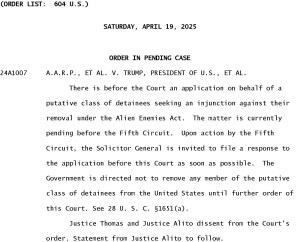
I wanted to write a short post to try to put the order into at least a little bit of context—and to sketch out just how big a deal I think this (aggressive but tentative) intervention really is.
As I wrote at the time, although I disagreed with the majority’s “habeas-only” analysis, the broader ruling made would’ve made at least a modicum of sense if the Court was dealing with any other administration, but it raised at least the possibility that the Trump administration, specifically, would try to play games to make habeas review effectively inadequate. And all of those games would unfold while no court has ruled, one way or the other, on either the facial legal question (does the AEA apply at all to Tren de Aragua); or case-specific factual/legal questions about whether individual detainees really are “members” of TdA. Lo and behold, that’s what happened.
In the immediate aftermath of the Court’s April 7 ruling in J.G.G., litigants successfully obtained TROs against AEA removals in three different district courts—the Southern District of New York; the District of Colorado; and, as most relevant here, the Southern District of Texas. In the S.D. Tex. case (J.A.V. v. Trump), Judge Fernando Rodriguez (not that it should matter, but a Trump appointee) barred the government from removing the named plaintiffs or anyone else “that Respondents claim are subject to removal under the [AEA] Proclamation, from the El Valle Detention Center.” (The other rulings were also geographically specific.)
The ACLU had already filed a habeas petition on Wednesday in the Northern District of Texas on behalf of two specific (anonymous) plaintiffs and a putative class of all Bluebonnet detainees—captioned A.A.R.P. v. Trump. Judge Hendrix had already denied the ACLU’s initial motion for a TRO—based on government representations that the named plaintiffs were not in imminent threat of removal (he reserved ruling on the request for class-wide relief).
Thus, once the news of the potentially imminent AEA removals started leaking out, the ACLU did two things at once: It sought renewed emergency relief from Judge Hendrix in the A.A.R.P. case, and it went back to Chief Judge Boasberg in the J.G.G. case—which has not yet been dismissed—since that case at least for the moment includes a nationwide class of individuals subject to possible removal under the AEA. And while it waited for both district judges to rule, the ACLU sought emergency relief in A.A.R.P. from both the Fifth Circuit and the Supreme Court.
You’ll need to head over to One First to read the details, but here some of Vladek’s conclusions. He argues that this is “massively important,” because the court acted very quickly, without waiting for the 5th Circuit to rule, they “didn’t hide behind any technicalities” as they have previously, and “perhaps most significantly, the Court seemed to not be content with relying upon representations by the government’s lawyers.”
Maybe the Court is finally beginning to understand that Trump really wants to make the U.S. a dictatorship.
Yesterday Dakinikat wrote Senator Chris Van Hollen’s meeting in El Salvador with wrongly deported Kilmar Abrego Garcia. Last night, Van Hollen returned to the U.S. and held a remarkable press conference to report on his experience.
ABC News: Van Hollen describes dramatic meeting with Abrego Garcia in El Salvador upon return to US.
Sen. Chris Van Hollen took aim at President Donald Trump and the El Salvador government over their treatment of Kilmar Abrego Garcia, the migrant who the government said in court was erroneously deported to El Salvador, and for trying to deflect from the notion that the U.S. government is flouting court orders to “facilitate” his return to the U.S.
The Maryland Democrat joined Abrego Garcia’s wife and mother and other supporters at Washington Dulles International Airport on Friday and spoke about his three-day visit, providing more details about the one-hour conversation he had with Abrego Garcia.
 Van Hollen said the Trump administration is lying about the case in attempt to distract from questions about whether Abrego Garcia’s rights were violated by bringing up gang violence.
“This case is not about just one man. It’s about protecting the constitutional rights of everyone who resides in the United States of America,” he said….
Van Hollen revealed during the press conference that Abrego Garcia told him during their meeting that he has been moved out of CECOT to another facility that was further away.
“We all thought he was at CECOT, which I didn’t know until I met him,” he said.
Abrego Garcia described being handcuffed, shackled and put on planes with other migrants, noting that they could not see where they were going, according to the senator. Van Hollen added that Abrego Garcia was held in a cell with 25 other people and fearful of other prisoners who taunted him.
The senator said Abrego Garcia told him he was transported to his current facility nine days ago.
“He said the conditions are better, but he said despite the better conditions, he still has no access to news from the outside world and no ability to communicate with the outside world,” Van Hollen said.
I wonder if they moved him to make sure nothing happened to him. Could Trump and Bukele be getting anxious about all the attention? Read more details at the link.
HuffPost: Trump White House Lashes Out At Senator Who Visited Wrongly Deported Man In El Salvador.
President Donald Trump accused Sen. Chris Van Hollen of political grandstanding after the Maryland Democrat managed to meet this week with an immigrant who had made a life in his state before being wrongfully deported to El Salvador last month.
The case sparked fresh fears that the Trump administration is not particularly interested in respecting the rule of law in the United States.
The president wrote on his social media platform that the senator “looked like a fool yesterday standing in El Salvador begging for attention from the Fake News Media, or anyone.”
He threw in an insult: “GRANDSTANDER!!!”
Trump also lashed out at the immigrant, Kilmar Abrego Garcia, saying he was “not a very innocent guy” on Friday while speaking to reporters….
The White House also mocked Van Hollen’s trip on X, formerly Twitter, marking up a New York Times headline to label Abrego Garcia an “MS-13 illegal alien” who is “never coming back.”
Trump is such a whiny baby.
More on the Administration’s war on immigrants from Makena Kelly and Vittoria Elliot at Wired: DOGE Is Building a Master Database to Surveil and Track Immigrants.
Operatives from Elon Musk’s so-called Department of Government Efficiency (DOGE) are building a master database at the Department of Homeland Security (DHS) that could track and surveil undocumented immigrants, two sources with direct knowledge tell WIRED.
DOGE is knitting together immigration databases from across DHS and uploading data from outside agencies including the Social Security Administration (SSA), as well as voting records, sources say. This, experts tell WIRED, could create a system that could later be searched to identify and surveil immigrants.
The scale at which DOGE is seeking to interconnect data, including sensitive biometric data, has never been done before, raising alarms with experts who fear it may lead to disastrous privacy violations for citizens, certified foreign workers, and undocumented immigrants.
 A United States Customs and Immigration Services (USCIS) data lake, or centralized repository, existed at DHS prior to DOGE that included data related to immigration cases, like requests for benefits, supporting evidence in immigration cases, and whether an application has been received and is pending, approved, or denied. Since at least mid-March, however, DOGE has been uploading mass amounts of data to this preexisting USCIS data lake, including data from the Internal Revenue Service (IRS), SSA, and voting data from Pennsylvania and Florida, two DHS sources with direct knowledge tell WIRED.
“They are trying to amass a huge amount of data,” a senior DHS official tells WIRED. “It has nothing to do with finding fraud or wasteful spending … They are already cross-referencing immigration with SSA and IRS as well as voter data.”
Since president Donald Trump’s return to the White House earlier this year, WIRED and other outlets have reported extensively on DOGE’s attempts to gain unprecedented access to government data, but until recently little has been publicly known about the purpose of such requests or how they would be processed. Reporting from The New York Times and The Washington Post has made clear that one aim is to cross-reference datasets and leverage access to sensitive SSA systems to effectively cut immigrants off from participating in the economy, which the administration hopes would force them to leave the county. The scope of DOGE’s efforts to support the Trump administration’s immigration crackdown appear to be far broader than this, though. Among other things, it seems to involve centralizing immigrant-related data from across the government to surveil, geolocate, and track targeted immigrants in near real time.
That is seriously frightening.
On a lighter note, this is hilarious. The Trump folks claim their attack on Harvard was all a silly mistake.
The New York Times: Trump Officials Blame Mistake for Setting Off Confrontation With Harvard.
Harvard University received an emailed letter from the Trump administration last Friday that included a series of demands about hiring, admissions and curriculum so onerous that school officials decided they had no choice but to take on the White House.
The university announced its intentions on Monday, setting off a tectonic battle between one of the country’s most prestigious universities and a U.S. president. Then, almost immediately, came a frantic call from a Trump official.
 The April 11 letter from the White House’s task force on antisemitism, this official told Harvard, should not have been sent and was “unauthorized,” two people familiar with the matter said.
The letter was sent by the acting general counsel of the Department of Health and Human Services, Sean Keveney, according to three other people, who were briefed on the matter. Mr. Keveney is a member of the antisemitism task force.
It is unclear what prompted the letter to be sent last Friday. Its content was authentic, the three people said, but there were differing accounts inside the administration of how it had been mishandled. Some people at the White House believed it had been sent prematurely, according to the three people, who requested anonymity because they were not authorized to speak publicly about internal discussions. Others in the administration thought it had been meant to be circulated among the task force members rather than sent to Harvard.
But its timing was consequential. The letter arrived when Harvard officials believed they could still avert a confrontation with President Trump. Over the previous two weeks, Harvard and the task force had engaged in a dialogue. But the letter’s demands were so extreme that Harvard concluded that a deal would ultimately be impossible.
Why didn’t the Trump people speak up sooner then? Why did they wait until all the back and forth we’ve been watching?
After Harvard publicly repudiated the demands, the Trump administration raised the pressure, freezing billions in federal funding to the school and warning that its tax-exempt status was in jeopardy.
A senior White House official said the administration stood by the letter, calling the university’s decision to publicly rebuff the administration overblown and blaming Harvard for not continuing discussions.
“It was malpractice on the side of Harvard’s lawyers not to pick up the phone and call the members of the antisemitism task force who they had been talking to for weeks,” said May Mailman, the White House senior policy strategist. “Instead, Harvard went on a victimhood campaign.”
So the “misunderstanding” is Harvard’s fault? Anyway the remaining Trump demands are still outrageous.
Still, Ms. Mailman said, there is a potential pathway to resume discussions if the university, among other measures, follows through on what Mr. Trump wants and apologizes to its students for fostering a campus where there was antisemitism.
Mr. Keveney could not be reached for comment. In a statement, a spokesman for the antisemitism task force said, “The task force, and the entire Trump administration, is in lock step on ensuring that entities who receive taxpayer dollars are following all civil rights laws.”
Harvard pushed back on the White House’s claim that it should have checked with the administration lawyers after receiving the letter.
The letter “was signed by three federal officials, placed on official letterhead, was sent from the email inbox of a senior federal official and was sent on April 11 as promised,” Harvard said in a statement on Friday. “Recipients of such correspondence from the U.S. government — even when it contains sweeping demands that are astonishing in their overreach — do not question its authenticity or seriousness.”
The statement added: “It remains unclear to us exactly what, among the government’s recent words and deeds, were mistakes or what the government actually meant to do and say. But even if the letter was a mistake, the actions the government took this week have real-life consequences” on students and employees and “the standing of American higher education in the world.
Just more evidence that the Trump administration is full of stupid, incompetent assholes.
The recent goings on at the Department of Defense are more evidence of that.
Politico: Pentagon turmoil deepens: Top Hegseth aide leaves post.
Joe Kasper, Defense Secretary Pete Hegseth’s chief of staff will leave his role in the coming days for a new position at the agency, according to a senior administration official, amid a week of turmoil for the Pentagon.
Senior adviser Dan Caldwell, Hegseth deputy chief of staff Darin Selnick and Colin Carroll, the chief of staff to Deputy Defense Secretary Stephen Feinberg, were placed on leave this week in an ongoing leak probe. All three were terminated on Friday, according to three people familiar with the matter, who, like others, were granted anonymity to discuss a sensitive issue.
 The latest incidents add to the Pentagon’s broader upheaval in recent months, including fallout from Hegseth’s release of sensitive information in a Signal chat with other national security leaders and a controversial department visit by Elon Musk.
Caldwell, Carroll, Selnick and Kasper declined to comment. Two of the people said Carroll and Selnick plan to sue for wrongful termination. The Pentagon did not respond to a request of comment.
Kasper had requested an investigation into Pentagon leaks in March, which included military operational plans for the Panama Canal, a second carrier headed to the Red Sea, Musk’s visit and a pause in the collection of intelligence for Ukraine.
But some at the Pentagon also started to notice a rivalry between Kasper and the fired advisers.
“Joe didn’t like those guys,” said one defense official. “They all have different styles. They just didn’t get along. It was a personality clash.”
The changes will leave Hegseth without a chief of staff, deputy chief of staff, or senior adviser in his front office.
“There is a complete meltdown in the building, and this is really reflecting on the secretary’s leadership,” said a senior defense official. “Pete Hegseth has surrounded himself with some people who don’t have his interests at heart.”
And of course Hegseth has no fucking clue what he’s doing.
And get this: Trump appointees are trying to censor professional journals.
The New York Times: Trump-Allied Prosecutor Sends Letters to Medical Journals Alleging Bias.
A federal prosecutor has sent letters to at least three medical journals accusing them of political bias and asking a series of probing questions suggesting that the journals mislead readers, suppress opposing viewpoints and are inappropriately swayed by their funders.
The letters were signed by Edward Martin Jr., a Republican activist serving as interim U.S. attorney in Washington, D.C. He has been criticized for using his office to target opponents of President Trump.
Some scientists and doctors said they viewed the letters as a threat from the Trump administration that could have a chilling effect on what journals publish. The health secretary, Robert F. Kennedy Jr., has said he wants to prosecute medical journals, accusing them of lying to the public and colluding with pharmaceutical companies.
One of the letters was sent to the journal Chest, published by the American College of Chest Physicians. The New York Times obtained a copy of the letter.
The Times confirmed that at least two other publishers had received nearly identically worded letters, but those publishers would not speak publicly because they feared retribution from the Trump administration.
In the letter to Chest, dated Monday, Mr. Martin wrote, “It has been brought to my attention that more and more journals and publications like CHEST Journal are conceding that they are partisans in various scientific debates.”
He demanded that the journal’s publishers answer a series of questions by May 2. Do they accept submissions from “competing viewpoints?” What do they do if the authors they published “may have misled their readers?” Are they transparent about influence from “supporters, funders, advertisers and others?”
And he specifically singled out the National Institutes of Health, which funds some of the research the journals publish, asking about the agency’s role “in the development of submitted articles.”
The prosecutor’s inquiry amounts to “blatant political intimidation of our medical journals,” Dr. Adam Gaffney, a pulmonologist and researcher in Massachusetts whose articles have been published in Chest, wrote on X.
Unreal.
That’s all I have for you today. I wish you all a nice weekend, and Happy Easter, if you celebrate it.
Did you like this post? Please share it with your friends:
Posted: April 17, 2025 | Author: bostonboomer | Filed under: Donald Trump, education, immigration | Tags: CECOT, constitutional crisis, El Salvador prison, Harvard University, Kilmar Abrego Garcia, Mohsen Mahdawi, Senator Chris Van Hollen |
Good Afternoon!!
The news is mostly bad as it has been since Trump moved into the White House, and I have to admit I’m feeling frightened and depressed about what is happening to our country.
Trump is waging all-out war on Harvard University, and Harvard is fighting back. That’s one bright spot.
Harvard University is taking hits from Trump on multiple fronts. Here’s the latest:
 CNN: IRS making plans to rescind Harvard’s tax-exempt status.
The Internal Revenue Service is making plans to rescind the tax-exempt status of Harvard University, according to two sources familiar with the matter, which would be an extraordinary step of retaliation as the Trump administration seeks to turn up pressure on the university that has defied its demands to change its hiring and other practices.
A final decision on rescinding the university’s tax exemption is expected soon, the sources said.
The administration already has blocked more than $2 billion in funding from the nation’s oldest university, which is fighting the White House’s policy demands, citing the constitutional right of private universities to determine their own teaching practices.
President Donald Trump in recent days raised the idea of punishing the Ivy League university for not complying with what the administration has sought to portray as a campaign to fight antisemitism.
“Perhaps Harvard should lose its Tax Exempt Status and be Taxed as a Political Entity if it keeps pushing political, ideological, and terrorist inspired/supporting ‘Sickness?’ Remember, Tax Exempt Status is totally contingent on acting in the PUBLIC INTEREST!” Trump posted on Truth Social on Tuesday….
Asked about CNN’s reporting on “The Arena,” Education Secretary Linda McMahon said that she doesn’t know whether Harvard will lose its tax exempt status but argued “it was certainly worth looking into.”
“We’ll see what IRS comes back with relative to Harvard,” McMahon told CNN’s Kasie Hunt. “I certainly think, you know, in elitist schools, especially that have these incredibly large endowments, you know, we should probably have a look into that.”
McMahon added that it is her “guess” that the IRS is also looking at tax exempt statuses of other universities.
Gary Shapley, whom Trump this week picked as acting IRS commissioner, has the authority to rescind the tax exemption under federal law. Doing so typically comes after the agency has made a determination that an organization has violated the rules that govern tax exemptions for not-for-profit entities.
There’s no evidence that Harvard has violated any of the conditions for tax exempt status, according to experts consulted by The Washington Post. From the Post article:
Harvard spokesman Jason Newton said in a statement that there was “no legal basis” to rescind the university’s tax-exempt status. Newton said the status “means that more of every dollar can go toward scholarships for students, lifesaving and life-enhancing medical research, and technological advancements that drive economic growth.”
Some Trump allies predicted that Harvard would only be the first of numerous colleges and universities that the administration would target over their tax-exempt status.
“I think they’re going to go after a whole bunch of them,” said Newt Gingrich, the former House GOP leader. “I’m not sure why we need to be funding people who aggressively refuse to give up a variety of values and structures that most Americans don’t agree with.”
Earlier this month, the Trump administration demanded broad control over Harvard’s operations over complaints about “diversity, equity and inclusion” policies in hiring, admissions and curriculums and student activism surrounding Israel’s war against Hamas.
Harvard rejected those demands on Monday, marking the first time a university formally countered the administration’s campaign for sweeping changes in higher education. Hours later, the administration responded by saying it would freeze more than $2 billion in federal funding.
If Harvard loses its tax-exempt status as President Trump has threatened, it would be extremely rare, but not unprecedented.
Moreover, the only instance in higher education that experts are aware of shows how far a university had to go to lose that coveted status.

View of Harvard Yard
In 1976, the Internal Revenue Service stripped the tax exemption from Bob Jones University, a private fundamentalist Christian institution in Greenville, S.C., because the school forbid interracial dating by its students. The university objected, saying it wasn’t practicing racial discrimination because the policy applied to all students.
The case went all the way to the Supreme Court, which upheld the IRS action in 1983. The 8-1 ruling likely would be the legal precedent for the Trump administration if it revokes Harvard’s tax-exempt status over allegations it practiced discrimination through diversity equity and inclusion initiatives and a failure to protect Jewish students from antisemitic harassment by Gaza war protesters.
“In 1983, the Supreme Court established the precedent that universities which practice racial discrimination can be stripped of their nonprofit status,” conservative activist Christopher Rufo wrote on X Tuesday. “Harvard’s DEI programs are openly discriminatory and, therefore, the president has every right to proceed with this remedy.”
In Trump’s twisted notion of discrimination (it only counts if it’s against white men), I guess lots of tax-exempts institutions could be targeted.
That’s not all the administration is threating to do to Harvard. They want to stop the university from admitting foreign students.
The Harvard Crimson: DHS Threatens To Revoke Harvard’s Eligibility To Host International Students Unless It Turns Over Disciplinary Records.
The Department of Homeland Security sent Harvard a letter on Wednesday threatening to revoke its eligibility to enroll international students unless it submits information on international students’ disciplinary records and protest participation.
In a Wednesday press release, the DHS wrote that it had also canceled two grants worth $2.7 million to Harvard.
The letter threatening Harvard’s authorization to host international students, which was signed by Secretary of Homeland Security Kristi Noem, accused Harvard of creating a “hostile learning environment” for Jewish students.
“It is a privilege to have foreign students attend Harvard University, not a guarantee,” the letter read.
American universities may host international students on student visas only if they have certification under the Student and Exchange Visitor Program.
The Wednesday letter calls on Harvard to provide information regarding visa holders’ “known threats to other students or university personnel,” “obstruction of the school’s learning environment,” and any disciplinary actions “taken as a result of making threats to other students or populations or participating in protests.”
It comes less than a week after three federal agencies threatened to pull Harvard’s federal funding unless the University agreed to report international students for violation of its conduct policies. Harvard rebuffed the government’s demands on Monday and now faces cuts to more than $2.2 billion in federal funding.
The University also announced last week that a total of 12 current Harvard students and recent graduates have had their visas revoked.

Another view of Harvard
CNN: Harvard weighs its next moves amid the federal funding standoff.
About 24 hours after the Trump administration said it would freeze more than $2 billion in federal grants and contracts, Harvard University’s research arm began to assess the fallout.
The impact is already acute at Harvard’s School of Public Health, where professors are scrambling to salvage their research into tuberculous and cancer treatments.
Harvard – the nation’s oldest and richest university – has emerged as a new symbol of the Trump resistance after refusing to capitulate to a series of policy changes the administration had demanded. Now, having put itself in an uncertain position, Harvard must weigh its next moves.
John Shaw, vice provost for research at Harvard, emailed colleagues Tuesday evening asking them to notify the Office for Sponsored Programs of any funding disruptions they become aware of – and what steps they ought to take.
“While there will inevitably be important research that will suffer as a result of the funding freeze, we are asking for your help in assessing how best to preserve vital work and support our researchers, while using institutional resources responsibly through this disruption,” he wrote, according to an email reviewed by CNN. “This is meant to stabilize the research environment while we gather information, coordinate decision-making, and strive to protect what matters most.”
Professors at the Faculty of Arts and Sciences, home to Harvard’s undergraduate and PhD programs, were notified in a separate email that a town hall would be arranged in the coming days to answer questions, according to the email.
The funding freeze threatens as much as $9 billion in federal money for Harvard. Beyond the practical implications of losing those funds, it’s not clear how far a standoff could go.
As we have seen, Trump is also attacking foreign students and immigrants individually, grabbing them off the streets or when they report to update their immigration status and disappearing them.
At The Boston Globe, Paul Heintz profiled a Columbia University student who was kidnapped when he arrived to take a citizenship test: ‘The town loved him’: Palestinian student detained in Vermont forged deep connections in the Upper Valley.
When federal officials led a handcuffed Mohsen Mahdawi out of an office building in northern Vermont on Monday, he became the latest international student whom the Trump administration had apparently targeted for speaking out against Israel’s war in Gaza.
But those who know Mahdawi say it’s absurd to suggest he “engaged in pro-terrorist, anti-Semitic, anti-American activity,” as the president has said of protesters at Columbia University where he was a student. Rather, they describe him as a peaceful 34-year-old Palestinian who had a remarkable journey from a refugee camp in the West Bank to a cabin in rural Vermont to an Ivy League institution in New York City.

Mohsen Mahdawi
He is widely known in the upper Connecticut River Valley of Vermont and New Hampshire, where he has been based since moving to the United States more than a decade ago, as a spiritual man who grew up Muslim, is a practicing Buddhist, and whose closest friends are Jewish.
“He is such an advocate for peace. He is such an opponent of any kind of violence,” said Rabbi Dov Taylor, who leads Chavurat Ki-tov, a Jewish cultural and educational organization in Woodstock, Vt. “His love just comes out in what he says.”
Simon Dennis, a carpenter and a former selectboard member in nearby Hartford, described Mahdawi as “a person of great gracefulness and dignity and gravitas” who is “destined to go forward and do great things in the world.”
Mahdawi, who was set to graduate this spring, was being held Tuesday in Vermont’s Northwest State Correctional Facility in St. Albans.
On Wednesday evening, some 200 supporters gathered in a windswept field several hundred yards from the prison. They hoisted Palestinian flags and signs calling for his release. An organizer, Jesse Lubin of Burlington, encouraged the crowd “to be loud enough so that he might be able to hear us” from inside the prison.
Just a bit more, because this is behind a paywall:
Crystal Cole of St. Albans told fellow protesters that she was there to demonstrate that even residents of this rural county on the Canadian border were outraged about Mahdawi’s detention.
“People up here in Franklin County know just as well as everyone else across the state, across the country, and across the world that free speech is a right, kidnapping is a wrong, and we refuse to stand for it,” she said.
By all accounts, Mahdawi has assiduously accumulated friends in the Upper Valley since moving from the West Bank in 2014. He’s done so while working as a bank teller, joining faith events, speaking at lectures and protests on the Middle East, and serving as a jack-of-all-trades at Dan & Whit’s, a popular general store in Norwich.
“Everyone loved him,” said Dan Fraser, a former owner and manager. “The town loved him. The town knows him.”
Mahdawi has lived for years in Fraser’s home in Hartford. He attended Lehigh University in Pennsylvania before transferring to Columbia in 2021. He was expecting to enter graduate school there in the fall for international affairs.
Mahdawi has been a permanent resident, or green card holder, since 2015, according to his attorneys, and appeared on track to attain citizenship. He had been in hiding after a friend and fellow Columbia student organizer, Mahmoud Khalil, was detained on March 8, according to friends.
He sounds really dangerous, right?
We are all familiar with the case of Kilmar Abrego Garcia, who was sent to the torture prison in El Salvador. The Trump administration admits this was a mistake, but they are determined not to return Garcia to his family in Maryland. Yesterday Maryland Senator Chris Van Hollen traveled to El Salvador in an attempt to meet with Garcia.
Politico: Van Hollen denied from meeting with wrongfully deported man in El Salvador.
Sen. Chris Van Hollen (D-Md.) flew to El Salvador on Wednesday seeking to secure the release of a man wrongly deported by the Trump administration, as officials ramp up their defense of the administration’s actions in an escalating battle over President Donald Trump’s mass deportation policy.
The Trump administration has made the fight around Kilmar Abrego Garcia the centerpiece of its broader deportation efforts, resisting efforts to bring him back to the United States, despite a Supreme Court ruling that the administration must “facilitate” Abrego Garcia’s return after his illegal deportation.
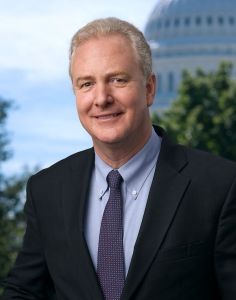
Chris Van Hollen
But after a meeting with Salvadoran Vice President Félix Ulloa, Van Hollen was denied the opportunity to see Abrego Garcia or visit the maximum security prison where he’s being held.
In a press conference on Wednesday, Van Hollen said that he asked Ulloa for a meeting with Abrego Garcia. Ulloa said he would have needed to “make earlier provisions” to visit, according to the senator, and also added he would be unable to arrange a phone call.
“I asked the vice president — if Abrego Garcia has not committed a crime, and if courts found that he was illegally taken, and the government of El Salvador has found no evidence he was part of MS-13 — then why is El Salvador continuing to hold him?” Van Hollen said.
Statement from Van Hollen:
“The goal of this mission is to let the Trump administration, let the government of El Salvador know that we are going to keep fighting to bring Abrego Garcia home until he returns to his family,” Van Hollen said in a video from the airport on his way to San Salvador, adding that he hopes to “meet with representatives of the government” and “see Kilmar.” Van Hollen, in second a video posted to X, said he arrived in San Salvador a little before noon and that he was on his way to the U.S. embassy.
Trump border czar Tom Homan slammed the Democratic senator for his visit, calling the trip “disgusting” on Fox News on Wednesday morning and echoing a line from the administration that the senator is more concerned with an “MS-13 terrorist” than Rachel Morin, a Maryland woman whose killer — who was convicted this week — was an undocumented immigrant.
“He wasn’t abducted. He is an MS-13 gang member, classified as a terrorist, that was removed from this country. So we got rid of a dangerous person — an El Salvadoran national was returned to the country of El Salvador, to his home,” Homan said, going on to call Abrego Garcia a “public safety threat.”
There’s no evidence Garcia is a gang member or terrorist.
We are in a true Constitutional crisis right now, since the Trump administration is ignoring court orders about these actions from two judges. So far, the judiciary is holding the line. It remains to be seen whether the Supreme Court will come down on the side of democracy or let Trump become a dictator. Here’s what’s happening on the immigration front this morning.
Reuters: Trump challenges judges’ probes of compliance with deportation orders.
The Trump administration is appealing efforts by two judges to investigate whether government officials defied their rulings over the deportation of migrants to El Salvador, escalating a confrontation between the executive and judicial branches.
On Wednesday night, the Justice Department said it would appeal Washington-based U.S. District Judge James Boasberg’s finding that there was probable cause to believe the government had violated his order to return alleged members of a Venezuelan gang who were deported to El Salvador on March 15 under an 18th-century wartime law. Boasberg said administration officials could face criminal contempt charges.
Also late on Wednesday, government lawyers asked the Fourth U.S. Circuit Court of Appeals to stop U.S. District Judge Paula Xinis in Greenbelt, Maryland from ordering U.S. officials to provide documents and answer questions under oath about what they had done to secure the return of Kilmar Abrego Garcia, a migrant who was wrongly deported to El Salvador.
In both cases, the Trump administration has denied it violated court orders and accused judges of overstepping their authority.
“A single district court has inserted itself into the foreign policy of the United States and has tried to dictate it from the bench,” the Justice Department lawyers wrote in its filing with the Fourth Circuit.
“Emergency relief is needed.”
Below are commentary pieces on the El Salvador prison and what Trump is doing to immigrants.
Hunter Walker at Talking Points Memo: Trump is Sending People to the Camps.
Extraordinary times call for extraordinary and strong language. President Trump’s plan to have migrants — and potentially U.S. citizens — rounded up, flown to El Salvador, and confined there in a maximum security facility that specializes in indefinite detention meets that bar. However, even when news coverage and criticism has acknowledged Trump’s vision is almost certainly illegal and unquestionably dangerous, it has often used fairly normal terminology and referred to the flights as deportations to a “prison.” That is not what is happening. President Trump is sending people to the camps.
The distinction comes from some of the unique features of the Terrorism Confinement Center, or CECOT, the infamous El Salvadoran facility that is holding people on behalf of the Trump administration. A “prison” is most typically defined as an institution holding inmates who have been sentenced for a crime. And, of course, most sentences have an end date. However, El Salvadoran President Nayib Bukele and his government have boasted that people placed in CECOT, “have no chance of getting out.”
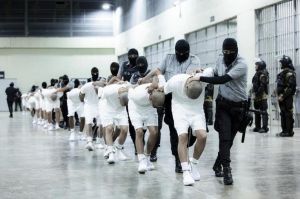
U.S. prisoners arriving at El Salvador prison
Because of the prospect of indefinite detention and the lack of due process the Trump administration has afforded the people it has sent to CECOT, experts who spoke to TPM said the facility could be more accurately described as a “concentration camp,” “penal colony,” or “permanent prison camp.”
Dr. Sandra Susan Smith, who is the Daniel & Florence Guggenheim Professor of Criminal Justice at Harvard’s Kennedy School, was very clear on this point in an email.
“More than a prison, El Salvador’s CECOT has many if not all the hallmarks of a concentration camp,” Smith wrote. “The Trump administration has unlawfully deported a group it finds highly undesirable — migrants largely from Venezuela — to CECOT, a facility known for its utter brutality and unyielding inhumanity that is located in a foreign country where US courts have no jurisdiction. Further, they have done so with no evidentiary basis for claims of migrants’ criminality and with no due process.”
Smith’s point might sound extreme since the term “concentration camp” is most closely associated with the German Nazi regime that left millions dead. However, mass executions are actually not part of the official definition. According to the Holocaust Encyclopedia published by the U.S. Holocaust Memorial Museum, “the term concentration camp refers to a camp in which people are detained or confined, usually under harsh conditions and without regard to legal norms of arrest and imprisonment that are acceptable in a constitutional democracy.”
Mike Wessler, the communications director of the Prison Policy Initiative, said he and his team were “discussing” whether CECOT should be called a “prison” this morning or whether another term should be applied. He pointed to the Holocaust Encyclopedia definition of “concentration camp.”
“I think there is a strong case to be made that the term prison does not fit for these sorts of facilities. Prisons are generally considered part of a larger legal system that is subject to judicial oversight and has somewhat defined processes, including around sentences, conditions, and releases,” Wessler said.
Read the rest at TPM.
Marcos Alemn, Regina Garcia Cano, and Alex Brandon at The Independent: Inside the brutal mega-prison where Trump administration has wrongly sent Maryland father.
Kilmar Abrego Garcia was deported to El Salvador by the Trump administration in March, despite a court order preventing his removal from the US….
He is among more than 200 immigrants sent to the Terrorism Confinement Center (CECOT), El Salvador’s maximum-security gang prison, in the past month….
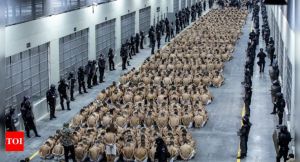
El Salvador mega prison
What is the CECOT?
Bukele ordered the mega-prison built as he began his campaign against El Salvador’s gangs in March 2022.
It opened a year later in the town of Tecoluca, about 45 miles (72 kilometers) east of the capital.
The facility has eight sprawling pavilions and can hold up to 40,000 inmates.
Each cell can fit 65 to 70 prisoners.
CECOT prisoners do not receive visits and are never allowed outdoors. The prison does not offer workshops or educational programs to prepare them to return to society after their sentences.
Occasionally, prisoners who have gained a level of trust from prison officials give motivational talks.
Prisoners sit in rows in the corridor outside their cells for the talks or are led through exercise regimens under the supervision of guards.
Bukele’s justice minister has said that those held at CECOT would never return to their communities.
The prison’s dining halls, break rooms, gym and board games are for guards.
Read the rest at The Independent.
The Handbasket: GOP photos at El Salvador prison evoke Abu Ghraib—and worse.
A row of Latino men with shaved heads and stoic expressions wearing identical white boxer shorts stand behind thick metal bars. In the back fellow prisoners sit cross-legged on large shelves that look like they’re meant for boxed furniture at IKEA, but are instead being used for humans. Outside the bars, free, is a white man in a blazer and collared shirt, his arm stretched out to hold the camera being used to take the photo of him and the men. The image is grotesque. And now it is history.
If you’re not familiar with the names Riley Moore and Jason Smith, don’t worry; I wasn’t either until yesterday. They’re Republican Congressmen from West Virginia and Missouri, respectively, who took a trip to El Salvador on Tuesday where they were given a tour of Centro de Confinamiento del Terrorismo (CECOT), a two-year old maximum security prison. Each posted photos to their social media pages after the visit, gloating about their access….
Go to the linked article to see photos these Congressmen posted on social media….
Photos like this are only possible when you’ve become so divorced from the humanity of others that they become nothing more than props in your political ploy.
But they weren’t alone in their casual disregard: A photo posted to X by the US Embassy in El Salvador confirmed an additional five House Republicans went along for the trip, including Claudia Tenney (NY), Mike Kennedy (UT), Carol Miller (WV), Ron Estes (KS) and Kevin Hern (OK). I’ve reached out to the offices of these members and will update if I hear back.
These members at least had the sense not to brag about it on social media, but it also makes me wonder why? If visiting CECOT has become a Trump loyalty pilgrimage, why haven’t they blasted out thumbs up pics of their own? Is it enough for Trump just to know they went, or do Smith and Moore understand that you only truly get credit for your depravity if you broadcast it?
Senator Chris Van Hollen, a Democrat from Maryland, had a very different experience when he arrived in El Salvador. Wednesday morning to check in on one of his constituents who was wrongfully and illegally imprisoned there beginning in March. He met with the country’s Vice President and asked if he could visit CECOT to meet with Kilmar Abrego Garcia: In a press conference later that day, he revealed he was told no. He also said the embassy told him they hadn’t received any direction from the administration to facilitate Garcia’s return, despite a court order.The visit by Republican members of Congress and Van Hollen’s subsequent rejection the very next day show that CECOT isn’t a prison holding Americans, but a place for Trump to hold his political prisoners—and where only his allies can wander and gawk. Some have compared the prison’s conditions to Nazi concentration camps.
Nick Miroff at The Atlantic (gift link): We’re About to Find Out What Mass Deportation Really Looks Like.
The Trump administration is working hard to convince the public that its mass-deportation campaign is fully under way. Over the past several weeks, federal agents have seized foreign students off the streets, raided worksites, and shipped detainees to a supermax prison in El Salvador using wartime powers adopted under the John Adams administration.
The tactics have spread fear and created a showreel of social-media-ready highlights for the White House. But they have not brought U.S. Immigration and Customs Enforcement much closer to delivering the “millions” of deportations President Donald Trump has set as a goal.
“We need more money,” Tom Homan, Trump’s “border czar,” told me in an interview. “We won’t fail if we get the resources we need.”
Using the budget-reconciliation process, Republican lawmakers are now preparing to lavish ICE with a colossal funding increase—enough to pay for the kind of social and demographic transformation of the United States that immigration hard-liners have long fantasized about achieving.
Although GOP factions in the House and Senate have squabbled over the contours of the bill, spending heavily on immigration enforcement has bicameral support. The reconciliation bill in the Senate would provide $175 billion over the next decade. A House version proposes $90 billion.
To put those sums in perspective, the entire annual budget of ICE is about $9 billion.
The funding surge—which Republicans could approve without a single Democratic vote—would allow ICE to add thousands of officers and enlist police and sheriff’s deputies across the country to help arrest and jail more immigrants. It would funnel billions to private contractors to identify and locate targets, jail them in for-profit detention centers, and fast-track their deportations.
Paul Hunker, who was formerly ICE’s lead attorney in Dallas, likened Trump’s deportation campaign to a gathering wave. “It seems intense now, but wait until five months from now when the reconciliation bill has passed and ICE gets a huge infusion of cash,’’ he told me. “If that money goes out, the amount of people they can arrest and remove will be extraordinary.’’
ICE officials envision a private-sector contracting bonanza that would rely on old workhorses such as CoreCivic and Geo Group-–the for-profit firms best known for running immigration jails—while enlisting large data companies to make the deportation system run more like an e-commerce platform.
Read the rest at the link. It sounds a lot like the Nazi railroad cars, only with planes.
That’s for me. This is way too long already. Take care everyone.
Did you like this post? Please share it with your friends:
Posted: April 12, 2025 | Author: bostonboomer | Filed under: Donald Trump, Elon Musk, U.S. Economy, U.S. Military, U.S. Politics | Tags: China, Doge, El Salvador prison, FDA, federal grants, immigration, RFK Jr, Social Security, tariffs |
Good Afternoon!!

By Karen Lyons
Looking at the headlines today makes me want to just throw up my hands and give up. Events are moving so quickly that no one could possibly keep track of everything. Things that happened just days ago recede into the past as new horrors arise.
The global economic crisis that Trump has triggered with his insane tariffs is still going on, but the realization that he is going to keep sending innocent people to a torture prison in El Salvador has pushed that into the background for now.
Even though he has “paused” the worst of the tariffs, many still remain in effect and will continue to affect the global economy, as Dakinikat discussed in her post yesterday. Meanwhile, the trade war with China continues, and it’s clear that China won’t back down.
On the immigration front, Trump is involving the military in border enforcement, even though that is illegal, and he is trying to find a way to send American citizens to the El Salvador gulag.
And of course Social Security is being ravaged by DOGE, while RFK, Jr. lays waste to the FDA and the U.S. health care system, and DOGE plans to take over control of all government grants.
Before I get started with the latest news, I need to call attention to a surprising Wall Street Journal editorial. It’s behind the paywall, but Tom Boggioni has a summary at Raw Story: ‘It’s already in the cards’: Trump impeachment urged by WSJ editorial board member.
In a column published late Friday, a member of the Wall Street Journal editorial board claimed it would be “desirable” to subject Donald Trump to a third impeachment to make up for the damage he has done to the U.S. economy with his “ill-founded” trade war.
According to longtime columnist Holman W. Jenkins Jr., Trump’s on-again, off-again tariff threats almost makes it appear he wants to be impeached, with Jenkins writing, “A future Trump impeachment seemed all but guaranteed by last Wednesday morning. It seems only slightly less likely now. It may even be desirable to restore America’s standing with creditors and trade partners.”
As he sees it, the president’s last great achievement was being re-elected in 2024, and the damage he has been creating since then belies his promise of a “golden age,” so an impeachment is “already in the cards.”
“No consensus or even significant coalition exists for trying to force into existence a new American ‘golden age’ with tariffs, which anyway is like asking a chicken to give birth to a lioness. He invented this mission out of his own confused intuition,” he accused.
Noting that conservative historian Niall Ferguson labeled Trump’s trade policy going “full retard,” he contributed, “I go with ‘neurotic’ for the word’s wider applicability to any leader who, lacking a clear bead on his times, fabricates a gratuitously ambitious mission to meet his misguided sense of importance.”
“Nobody in Mr. Trump’s orbit actually shares his belief in the magical efficacy of tariffs because it makes sense only in a world that doesn’t exist, where other countries don’t retaliate,” he pointed out before concluding, “The founders never anticipated today’s instantly responsive trillion-dollar financial markets. And yet these markets neatly adumbrate the founders’ scheme of checks and balances, also known as feedback. Mr. Trump, still sane enough to appreciate what’s good for Mr. Trump, listened this week to their feedback.”
Trump isn’t going to like that.
Trade war news:
The administration has come up with exceptions to some tariffs. CNBC: Trump exempts phones, computers, chips from new tariffs.
Smartphones and computers are among many tech devices and components that will be exempted from reciprocal tariffs imposed by President Donald Trump, according to new guidance from U.S. Customs and Border Protection.
The guidance, issued late Friday evening, comes after Trump earlier this month imposed 145% tariffs on products from China, a move that threatened to take a toll on tech giants like Apple, which makes iPhones and most of its other products in China.
The guidance also includes exclusions for other electronic devices and components, including semiconductors, solar cells, flat panel TV displays, flash drives, and memory cards.
These products could eventually be subject to additional duties, but they are likely to be far lower than the 145% rate that Trump had imposed on goods from China.
The exemptions are a win for tech companies like Apple, which makes the majority of its products in China. The country manufactures 80% of iPads and more than half of Mac computers produced, according to Evercore ISI.
“This is the dream scenario for tech investors,” Dan Ives, global head of technology research at Wedbush Securities, told CNBC. “Smartphones, chips being excluded is a game changer scenario when it comes to China tariffs.”
I wonder what Trump got from the tech companies in return for these exemptions?
 Still, the big problem is the trade war with China. Trump has been begging for a phone call from Xi Jinping, but it’s not going to happen. Michael Schuman at The Atlantic (gift link): Why China Won’t Give In to Trump. Xi Jinping, like his American counterpart, needs to be the top dog.
On Tuesday, President Donald Trump bragged that many foreign leaders were “kissing his ass” to avoid the steep tariffs he’d imposed on their countries. But China’s leader, Xi Jinping, was not one of them. “We are waiting for their call,” Trump said of China’s leadership in a social-media post.
He might be waiting for a while. Xi became China’s most powerful political figure in half a century by promoting a new Chinese nationalism—not by kowtowing to anyone, least of all the president of the United States.
“Seeking to negotiate on U.S. terms would be deeply embarrassing for Xi and could potentially weaken his standing and even control over the Communist Party and the country,” Steve Tsang, the director of the SOAS China Institute at the University of London, told me. That’s because the party justifies Xi’s dictatorship by portraying him as the ultimate defender of the Chinese people—the man who will restore China’s past glory and attain the “Chinese dream” of national rejuvenation. He must be seen standing up to foreign oppressors who seek to humiliate China and thwart its rightful rise.
“The Chinese people will never allow foreign forces to bully, oppress, or enslave us,” Xi said in a speech commemorating the centennial of the Communist Party in 2021. “Whoever nurses delusions of doing that will crack their heads and spill blood on the Great Wall of steel.
Little wonder, then, that Xi has been quick to retaliate against Trump while other leaders have held back. Trump slapped an additional 34 percent duty on Chinese imports on April 2, and Xi responded two days later with a 34 percent tariff on U.S. imports. Trump then retaliated by imposing another 50 percent duty, which Xi matched the next day. On Wednesday, Trump tried isolating Xi by pausing most tariffs on all countries for 90 days—except for China, on which he increased his duties yet again. On Friday, Beijing raised its duties on American imports once more….
The Chinese Communist Party is characterizing Trump’s trade war as an American effort to contain and suppress China’s economic success—one the government is fully prepared to thwart, according to one commentary in the People’s Daily. This framing commits Beijing to holding out, because the alternative is for a party that predicates its power on the projection of strength to appear to be capitulating to a hostile onslaught.
Trump and his team do not seem to understand Xi’s political realities. They seem to believe that if they keep turning up the pressure, Xi will eventually come to heel. U.S. Treasury Secretary Scott Bessent asserted that Xi’s retaliation was “a big mistake.” Because China exports so much more to the U.S. than it imports, “they’re playing with a pair of twos,” he said.
This is going to really hurt small businesses who buy parts and inventory from China and farmers who sell soybeans to China.

Drawing in the afternoon light, by Thomas Little
As Dakinikat has written this week, the consequences of Trump’s tariffs are being reflected in the bond market. AP: Freak sell-off of ‘safe haven’ US bonds raises fear that confidence in America is fading.
The upheaval in stocks has been grabbing all the headlines, but there is a bigger problem looming in another corner of the financial markets that rarely gets headlines: Investors are dumping U.S. government bonds.
Normally, investors rush into Treasurys at a whiff of economic chaos but now they are selling them as not even the lure of higher interest payments on the bonds is getting them to buy. The freak development has experts worried that big banks, funds and traders are losing faith in America as a stable, predictable, good place to store their money.
“The fear is the U.S. is losing its standing as the safe haven,” said George Cipolloni, a fund manager at Penn Mutual Asset Management. “Our bond market is the biggest and most stable in the world, but when you add instability, bad things can happen.”
That could be bad news for taxpayers paying interest on the ballooning U.S. debt, consumers taking out mortgages or car loans — and for President Donald Trump, who had hoped his tariff pause earlier this week would restore confidence in the markets.
Read more at the AP link.
Immigration news:
Myah Ward at Politico: Trump grants military control over strip of federal land along US southern border.
A 60-foot wide strip of land along three southwestern border states will be placed under the jurisdiction of the U.S. military to help deter illegal immigration, the White House said Friday.
President Donald Trump issued a memorandum directing the military to take temporary control over the Roosevelt Reservation, a corridor that runs along the border line in California, Arizona and New Mexico.
The order would empower troops to detain people attempting to illegally enter the U.S. within the stretch of land, which was established by President Theodore Roosevelt for border security in 1907. Trump authorized the military to operate in the same area during his first administration to aid construction of a wall to deter migrant crossings.
The memorandum marks an escalation in the president’s use of the military to facilitate his sweeping crackdown on immigration. And while unclear how far the administration will go, it could be an additional step to militarizing the nation’s southwestern border….
Immigration, military and legal experts have said that Trump’s move to militarize the border could raise legal questions about potential violations to the Posse Comitatus Act, a federal law that generally prohibits active-duty troops from being used in domestic law enforcement.
Aaron Reichlin-Melnick, a senior fellow at the American Immigration Council, said it appeared the administration was trying to find a way around restrictions on the use of the U.S. military for civilian border enforcement.
Nikki McCann Ramirez, Asawin Suebsaeng, and Andrew Perez at Rolling Stone: Team Trump Is Gaming Out How to Ship U.S. Citizens to El Salvador.
Donald Trump and his White House have moved to deport green-card holders for espousing pro-Palestinian views, shipped hundreds of migrants to a notorious Salvadoran mega-prison without due process (in defiance of a judge’s order), and are now publicly musing about sending United States citizens to prison in El Salvador.
Trump said last weekend he would “love” to send American criminals there — and would even be “honored” to, depending on “what the law says.” White House Press Secretary Karoline Leavitt confirmed this week that the president has discussed this idea privately, too, adding he would only do this “if it’s legal.” El Salvador’s president, Nayib Bukele, has for months been offering to hold U.S. citizens in his country’s prison system, which he has turned into “a judicial black hole” rife with “systematic torture,” as one human rights advocate recently told Rolling Stone.

Consuelo by Olga Sacharoff, 1924
Legal experts agree that sending American citizens to prison in El Salvador would be flagrantly illegal under both U.S. and international law — and that the idea itself is shockingly authoritarian, with few parallels in our nation’s history.
The Trump administration is indeed discussing this idea behind the scenes, two sources familiar with the matter confirmed to Rolling Stone. In their most serious form, these conversations have revolved around attempting to denaturalize American citizens and deport them to other countries, including El Salvador.
“You can’t deport U.S. citizens. There’s no emergency exception, there’s no special wartime authority, there’s no secret clause. You just can’t deport citizens,” says Steve Vladeck, a legal commentator and law professor at Georgetown. “Whatever grounds they try to come up with for denaturalization or expatriation, the one thing that is absolutely undeniable is that people are entitled to individualized processes, before that process can be effectuated.”
In the United States, the grounds to strip a naturalized individual of their citizenship encompass serious material offenses. They include: committing treason or terrorism, enlisting in a foreign military engaged in opposition to the United States, or lying in applications for citizenship or as part of the naturalization process.
They obviously don’t care whether it’s legal or not, based on how they are treating Kilmar Garcia, an innocent man who is currently languishing in prison in El Salvador. Alan Feuer and Aishvarya Kavi at The New York Times: White House Continues Defiant Stance on Seeking Return of Deported Man.
The Trump administration on Friday continued to pursue its stubborn fight against securing the freedom of a Maryland man it inadvertently deported to a Salvadoran prison last month despite a court order that expressly said he could remain in the United States.
Taking an increasingly combative stance, the administration defied a federal judge’s order to provide a written road map of its plans to free the man, Kilmar Armando Abrego Garcia. Trump officials then repeatedly stonewalled her efforts to get the most basic information about him at a court hearing.
During the hearing, in Federal District Court in Maryland, the judge, Paula Xinis, called the administration’s evasions “extremely troubling” and demanded that the Justice Department provide her with daily updates on the White House’s progress in getting Mr. Abrego Garcia back on U.S. soil.
“The court finds that the defendants have failed to comply with this court’s order,” Judge Xinis wrote in a ruling Friday afternoon.
The conflict between the judge and the White House arose just one day after the Supreme Court unanimously ordered the administration to “facilitate” Mr. Abrego Garcia’s release from Salvadoran custody and only a few days before President Nayib Bukele of El Salvador was set to arrive in Washington for an official visit.
Asked about the case on Friday, President Trump appeared in no hurry to take steps to ensure Mr. Abrego Garcia’s return, despite repeated court orders and a Supreme Court intervention.
“If the Supreme Court said, ‘Bring somebody back,’ I would do that,” he said, seeming to ignore the court’s order. “I respect the Supreme Court.”

By Hedda Oppenheim
Of course the Supreme Court has already said that.
The public recalcitrance on the part of Mr. Trump and his officials highlighted questions about why they have been so reluctant to follow the orders or leverage the president’s relationship with Mr. Bukele to simply ask for Mr. Abrego Garcia to be freed.
Judge Xinis, by ordering the government to detail its progress in getting Mr. Abrego Garcia out of El Salvador, managed to avoid an immediate showdown with the White House. But the fiery clashes left open the possibility of a future standoff.
The administration has already had friction with judges in other cases — particularly those involving Mr. Trump’s deportation policies — but the conflict with Judge Xinis was one of the most contentious yet. Last week, a federal judge in Washington said there was a “fair likelihood” that the administration had violated one of his rulings ordering the White House to stop using a powerful wartime statute to deport scores of Venezuelan migrants to El Salvador.
The dispute involving Judge Xinis emerged after the Supreme Court late Thursday told Trump officials to take steps to free Mr. Abrego Garcia, a 29-year-old Salvadoran migrant, from the CECOT prison in El Salvador, where he was sent with scores of other migrants on March 15.
Now DOGE is getting involved in immigration battles. Sophia Cai at Politico: Inside the DOGE immigration task force.
DOGE’s bread and butter has been slashing headcounts but it is now wielding its influence deep inside the nation’s immigration system — an initiative led by one of Elon Musk’s closest friends, three Trump administration officials granted anonymity to discuss internal dynamics told POLITICO.
Antonio Gracias, a Musk confidante whose history with the billionaire goes back more than 20 years, is quietly heading up a specialized DOGE immigration task force that’s embedded engineers and staffers across nearly every nook of the Department of Homeland Security, two of the people said. The task force is also working with DOGE operatives stationed at other agencies like the Social Security Administration and the Department of Health and Human Services, which house sensitive data on undocumented immigrants.
With Musk’s trusted friend and fixer at the helm, the task force marks a significant expansion of DOGE’s portfolio — from primarily working on agency-wide layoffs to executing the president’s most hardline immigration policies. It’s also a test for how far DOGE’s reach can extend.
Key DOGE engineers now embedded at DHS include Kyle Schutt, Edward Coristine, (aka “Big Balls”) and Mark Elez, according to their government email addresses. At least two others, Aram Moghaddassi and Payton Rehling also have access to DHS data, as DOGE fingerprints are spread throughout DHS, including Customs and Border Protection, U.S. Citizenship and Immigration Services and the Cybersecurity and Infrastructure and Security Agency.
They are providing the technical infrastructure for a sweeping set of actions aimed at revoking parole, terminating visas, and later on, reengineering the asylum adjudication process, according to the officials.
Their first mission: implement parole terminations for 6,300 undocumented immigrants who either have criminal records or are on the FBI’s terrorist watchlist. That effort required coordinating with the Social Security Administration to have their Social Security numbers effectively canceled by adding them to a database that tracks dead people, the New York Times and the Washington Post first reported. Their theory is that without effective Social Security numbers – needed for bank accounts and loans, among other things – these people would “self deport.”
There’s more at the Politico link.
Social Security news:
Zoe Schiffer at Wired: The Social Security Administration Is Gutting Regional Staff and Shifting All Public Communications to X.
The Social Security Administration will no longer be communicating with the media and the public through press releases and “dear colleague” letters, as it shifts its public communication exclusively to X, sources tell WIRED. The news comes amid major staffing cuts at the agency.
“We are no longer planning to issue press releases or those dear colleague letters to inform the media and public about programmatic and service changes,” said SSA regional commissioner Linda Kerr-Davis in a meeting with managers earlier this week. “Instead, the agency will be using X to communicate to the press and the public … so this will become our communication mechanism.”

Woman holding cat, by Liang Yi Er
Previously, the agency used dear colleague letters to engage with advocacy groups and third-party organizations that help people access social security benefits. Recent letters covered everything from the agency’s new identity verification procedures to updates on the accuracy of SSA death records (“less than one-third of 1 percent are erroneously reported deaths that need to be corrected,” the agency wrote, in contrast to what Elon Musk claims).
The letters and press releases were also a crucial communications tool for SSA employees, who used them to stay up on agency news. Since SSA staff cannot sign up for social media on government computers without submitting a special security request, the change could have negative consequences on the ability for employees to do their jobs.
It could also impact people receiving social security benefits who rely on the letters for information about access benefits. “Do they really expect senior citizens will join this platform?” asked one current employee. “Most managers aren’t even on it. How isn’t this a conflict of interest?” Another staffer added: “This will ensure that the public does not get the information they need to stay up-to-date.”
The White House response to the Wired story:
“This reporting is misleading. The Social Security Administration is actively communicating with beneficiaries and stakeholders,” says Liz Huston, a White House spokesperson. “There has not been a reduction in workforce. Rather, to improve the delivery of services, staff are being reassigned from regional offices to front-line help – allocating finite resources where they are most needed. President Trump will continue to always protect Social Security.”
I guess we’ll find out eventually. Social security advocates are warning that the system is going to collapse and the 73 million recipients could go months with out payments.
Hannah Natanson, Lisa Rein, and Meryl Kornfield at The Washington Post (gift article): Trump administration overrode Social Security staff to list immigrants as dead.
Two days after the Social Security Administration purposely and falsely labeled 6,100 living immigrants as dead, security guards arrived at the office of a well-regarded senior executive in the agency’s Woodlawn, Maryland, headquarters.
Greg Pearre, who oversaw a staff of hundreds of technology experts, had pushed back on the Trump administration’s plan to move the migrants’ names into a Social Security death database, eliminating their ability to legally earn wages and, officials hoped, spurring them to leave the country. In particular, Pearre had clashed with Scott Coulter, the new chief information officer installed by Elon Musk. Pearre told Coulter that the plan was illegal, cruel and risked declaring the wrong people dead, according to three people familiar with the events.
But his objections did not go over well with Trump political appointees. And so on Thursday, the security guards in Pearre’s office told him it was time to leave.
They walked Pearre out of the building, capping a momentous internal battle over the novel strategy — pushed by Musk’s U.S. DOGE Service and the Department of Homeland Security — to add thousands of immigrants ranging in age from teenagers to octogenarians to the agency’s Death Master File. The dataset is used by government agencies, employers, banks and landlords to check the status of employees, residents, clients and others.
The episode also followed earlier warnings from senior Social Security officials that the database was insecure and could be easily edited without proof of death — a vulnerability, staffers say, that the Trump administration has now exploited….
Experts in government, consumer rights and immigration law said the administration’s action is illegal. Labeling people dead strips them of the privacy protections granted to living individuals — and knowingly classifying living people as dead counts as falsifying government records, they said. This is in addition to the harm inflicted on those suddenly declared dead, who become unable to legally earn a living wage or draw benefits they may be eligible for. Social Security itself has acknowledged that an incorrect death declaration is a “devastating” blow….
“This is an unprecedented step,” said Devin O’Connor, a senior fellow on the federal fiscal policy team for the Center on Budget and Policy Priorities, a progressive think tank. “The administration seems to basically be saying they have the right to essentially declare people equivalent to dead who have not died. That’s a hard concept to believe, but it brings enormous risks and consequences.”
There’s much more at the above gift link.
Crazy RFK Jr. news:
Adam Cancryn, Lauren Gardner and David Lim at Politico: RFK Jr. says Deep State ‘is real,’ called FDA employees ‘sock puppet’ of industry.
HHS Secretary Robert F. Kennedy Jr.’s visit to the FDA Friday was supposed to introduce him as a trusted leader to agency employees. It did anything but.
Over the course of 40 minutes, Kennedy, in largely off-the-cuff remarks, asserted that the “Deep State” is real, referenced past CIA experiments on human mind control and accused the employees he was speaking to of becoming a “sock puppet” of the industries they regulate.

Little Girl with Cat, by Pierre Bonnard
“Because of my family’s commitment to these issues, I spent 200 hours at Wassaic Home for the Retarded when I was in high school,” Kennedy said, in a reference to the Wassaic State School for the Mentally Retarded in Wassaic, New York. “So I was seeing people with intellectual disabilities all the time. I never saw anybody with autism.”
The remark jolted several FDA employees in the audience, who misheard the reference and thought he was making a derogatory remark about people with intellectual disabilities, according to two employees granted anonymity for fear of retaliation.
By the end of the event, billed as a welcome from the new commissioner, Marty Makary, several FDA staffers had walked out of the rooms where the speech was being broadcast at the agency’s headquarters in White Oak, Maryland, according to two employees granted anonymity for fear of retaliation.
“President Trump always talks about the Deep State, and the media, you know, disparages him and says that he’s paranoid,” Kennedy said, according to a transcript and audio of his remarks obtained by POLITICO. “But the Deep State is real. And it’s not, you know, just George Soros and Bill Gates and a bunch of nefarious individuals sitting together in a room and plotting the, you know, the destruction of humanity.”
He said “every institution that’s created by human beings” is inevitably captured by powerful interests, and urged FDA employees to take advantage of a four-year period under his leadership where he vowed that the Department of Health and Human Services would not be subjected to undue influence and would listen to “dissidents.”
Dan Diamond, Hannah Natanson and Carolyn Y. Johnson at The Washington Post: DOGE takes over federal grants website, wresting control of billions.
U.S. DOGE Service employees have inserted themselves into the government’s long-established process to alert the public about potential federal grants and allow organizations to apply for funds, according to four people who spoke on the condition of anonymity to describe a sensitive situation.
The changes to the process — which will allow DOGE to review and approve proposed grant opportunities across the federal government — threaten to further delay or even halt billions of dollars that agencies usually make in federal awards, the people said. The moves come amid the Trump administration’s broader push to cut federal spending and crack down on grants that DOGE and other officials say conflict with White House priorities.
DOGE employees have made changes to grants.gov, a federal website that has traditionally served as a clearinghouse for more than $500 billion in annual awards and is used by thousands of outside organizations, the people said. Federal agencies including the Defense, State and Interior departments have historically posted their grant opportunities directly to the site. Nonprofits, universities and local governments respond to these grant opportunities with applications to receive federal funding for activities that include cancer research, cybersecurity, highway construction and wastewater management.
But a DOGE engineer recently deleted many federal officials’ permissions to post grant opportunities, without informing them that their permissions had been removed, the people said. Now the responsibility of posting these grant opportunities is poised to rest with DOGE — and if its employees delay those postings or stop them altogether, “it could effectively shut down federal-grant making,” said one federal official who spoke on the condition of anonymity to describe internal operations.
Agency officials have been told that the grants.gov site has been under systems maintenance. They have been instructed to email their planned grant notices to grantreview@hhs.gov, an inbox at the Department of Health and Human Services that is being monitored by DOGE, the people said.
About 5,000 notices of funding opportunities are typically posted on grants.gov each year, with more than 10 million visitors to the site, according to people with knowledge of its operations. Some federal agencies have been able to post grant opportunities, known as Notice of Funding Opportunities or NOFOs, but the vast majority rely on grants.gov, the people said.
Unbelievable.
I’ll end there. I know this is way too long. Take care, everyone!
Did you like this post? Please share it with your friends:
Posted: April 9, 2025 | Author: bostonboomer | Filed under: Donald Trump, U.S. Economy, U.S. Politics | Tags: bond market crash, China, Elon Musk, EU, Financial Crisis, global safe haven, Stock Market, UK |

By Eric Fischl
Hello Sky Dancers!!
Dakinikat should be writing this post, but you’re stuck with me. I stayed up till about 2:30 last night doom scrolling and trying to understand what Trump’s tariff madness has done to us. The latest disaster last night was that the bond market is collapsing.
I’ll do my best to post relevant stories, and perhaps Dakinikat will chime in later. Thanks to Trump’s insanity, we could end up in another financial crisis comparable to the one in 2008.
What’s happening with tariffs:
There’s even more insane news this morning: China responded to Trump’s 104 percent tariff threat with another 84% tariff on the U.S.
CNBC: China slaps 84% retaliatory tariffs on U.S. goods in response to Trump.
China has pushed back again on U.S. President Donald Trump’s tariff policies by hiking its levies on U.S. imports to more than 80%.
Tariffs on U.S. goods entering China will rise to 84% from 34% starting April 10, according to a translation of a Office of the Tariff Commission of the State Council announcement. The hike comes in response to the latest U.S. tariff increase on Chinese goods to more than 100% that began at midnight.
The tit-for-tat escalation of tariffs threatens to crush trade between the world’s two largest economies. According to the Office of the U.S. Trade Representative, the U.S. exported $143.5 billion of goods to China in 2024, while importing products worth $438.9 billion.
The Trump administration announced a sweeping new tariff policy last week, warning other countries not to retaliate. Some nations, including Japan, have seemed willing to negotiate on tariffs, but China appears to be taking a more hard-line stance and quickly announced a countertariff.
After China’s initial response to the April 2 tariff rollout, Trump announced an additional 50% hike, putting the total level for import taxes on Chinese goods at 104%….
The trade war has spooked investors around the world by increasing the odds of slower economic growth, higher inflation and lower corporate profits, sparking a sharp sell-off in April.
The S&P 500 finished Tuesday down nearly 20% from its peak, putting the U.S. large-cap stock index in a bear market. South Korea’s Kospi Index fell into a bear market of its own on Wednesday. Stocks in Shanghai and Hong Kong are also down sharply since the U.S. tariff announcement on April 2.
David Pierson and Barry Wang at The New York Times: For U.S. and China, a Risky Game of Chicken With No Off-Ramp in Sight.
A whopping increase in tariffs, followed by a whopping retaliation. Nationalist Chinese bloggers comparing President Trump’s levies to a declaration of war. China’s Foreign Ministry vowing that Beijing will “fight to the end.”
For years, the world’s two biggest powers have flirted with the idea of an economic decoupling as tensions between them have risen. The acceleration this week of their trade relationship’s deterioration has made the prospect of such a divorce seem closer than ever.
That was underscored on Wednesday when China announced an additional 50 percent tariff on U.S. goods, matching new American levies that had taken effect hours earlier. China also struck at American companies, imposing export controls on a dozen of them and adding six others to a list of “unreliable entities,” preventing them from doing business in China.
China’s new tariffs, which will take effect on Thursday, mean all American goods shipped to China will face an additional 85 percent import tax. The minimum U.S. tax on Chinese imports is now 104 percent. Both figures would have been unimaginable a few weeks ago.
With China’s top leader, Xi Jinping, and Mr. Trump locked in a game of chicken — each unwilling to risk looking weak by making a concession — the trade fight could spiral even further out of control, inflaming tensions over other areas of competition like technology and the fate of Taiwan, the self-governing island claimed by Beijing.
Mr. Trump’s bare-knuckle tactics make him a singular force in U.S. politics. But in Mr. Xi, he faces a hardened opponent who survived the turmoil of China’s late-20th-century political purges, and who views the United States’ competitive tactics as ultimately aimed at subverting the ruling Communist Party’s legitimacy.
“Trump has never gone into a back-alley brawl where the other side is willing to brawl and use the same kind of tactics as him,” said Scott Kennedy, a senior adviser at the Center for Strategic and International Studies, a Washington think tank. “For China, this is about their sovereignty. This is about the Communist Party’s hold on power. For Trump, it might just be a political campaign.”
 From what I’m hearing and reading, this is going to hit U.S. small businesses hard, drive many of them into bankruptcy, and send their employees to the unemployment lines.
China isn’t the only country that’s retaliating.
Politico: EU takes revenge on Trump’s tariffs as countries approve €20B+ retaliation.
BRUSSELS — The EU can apply retaliatory tariffs on nearly €21 billion of U.S. products like soybeans, motorcycles and orange juice after the bloc’s 27 countries assented to the measures on Wednesday, the European Commission announced.
“The EU considers U.S. tariffs unjustified and damaging, causing economic harm to both sides, as well as the global economy. The EU has stated its clear preference to find negotiated outcomes with the U.S., which would be balanced and mutually beneficial,” the EU executive said in a statement.
Hitting back against U.S. President Donald Trump’s steel and aluminum tariffs, the European Union’s countermeasures will apply in three rounds. Measures covering €3.9 billion in trade will go into force next week, with a further €13.5 billion from mid-May and a final round of €3.5 billion following in December.
Only Hungary opposed the package, according to four EU diplomats with direct knowledge of the vote, while all other 26 countries voted in favor….
The retaliation does not yet respond to Trump’s imposition of 20 percent “reciprocal” tariffs on all EU exports, which came into force on Wednesday, and his latest 25 percent tariff on cars. Trump has also said tariffs on pharmaceuticals are coming soon.
The European Commission is considering putting forward its countermeasures on those tariffs as early as next week. “It will for sure be soon. I expect it could be as early as next week,” trade spokesperson Olof Gill said Tuesday.
What’s happening with the bond markets:
Felix Salmon at Axios: The bond market plunges as crisis brews.
The price of U.S. Treasury bonds is plunging, in what Treasury Secretary Scott Bessent on Wednesday called “deleveraging convulsions.” The effect is to raise borrowing costs just as recession fears spike.
Why it matters: The last thing America needed in the midst of a global trade war and a stock-market meltdown was a debt crisis too. But that now seems to be a real possibility.
What they’re saying: “This is the script for a truly existential financial crisis,” writes Columbia economic historian Adam Tooze, who wrote a whole book on the very similar dynamics that overtook the Treasury market in March 2020.
Driving the news: Bond yields — which move in the opposite direction to prices — are soaring in the wake of protectionist U.S. tariffs.
- The amount that the U.S. government needs to pay to borrow money for a decade rose briefly to more than 4.5% Wednesday morning. For a 30-year bond, the yield rose to more than 5%.
- Those moves are truly enormous by bond market standards. As recently as Friday, the 10-year yield was less than 4%, and the 30-year was below 4.4%.
The intrigue: In normal times, the most consistent buyer of Treasury bonds is a group of hedge funds that participate in something called the “basis trade.”
- They buy the bonds in order to hedge their derivatives exposure to institutional investors, who can lock in slightly higher yields in the futures market.
- The profit on any given trade is minuscule, but it’s also very close to risk-free, so the hedge funds can apply as much as 50x or even 100x leverage.
- By many accounts, the basis trade is now unwinding, which means the hedge funds are selling their bonds — or, at the very least, not buying new ones.
The big picture: In a move reminiscent of the bond-market tantrum that swept U.K. Prime Minister Liz Truss from office in 2022, the technical factors in the bond market were precipitated by — and also exacerbated — fundamental issues with the country’s finances.
 More from Philip Inman and Jasper Jolly at The Guardian: Dramatic sell-off of US government bonds as tariff war panic deepens.
US government bonds, traditionally seen as one of the world’s safest financial assets, are undergoing a dramatic sell-off as Donald Trump’s escalation of his tariff war with China sends panic through all sectors of the financial markets.
The falls suggest that as Trump’s fresh wave of tariffs on dozens of economies came into force, including 104% levies against Chinese goods, investors are beginning to lose confidence in the US as a cornerstone of the global economy.
The yield – or interest rate – on the benchmark 10-year US Treasury bond rose by 0.16 percentage points on Wednesday to 4.42%, its highest since late February – and this week has undergone the three biggest intraday moves since Trump was elected in November. Yields move inversely to prices, so surging yields mean falling prices as demand drops.
The move in the 30-year bond was more dramatic. The 30-year yield briefly jumped above 5% to its highest since late 2023 and was last trading at 4.9157%, or 0.2 percentage points higher than Tuesday.
“This is a fire sale of Treasuries,” said Calvin Yeoh, portfolio manager at the hedge fund Blue Edge Advisors. “I haven’t seen moves or volatility of this size since the chaos of the pandemic in 2020,” he told Bloomberg.
Analysts believe the US Federal Reserve may need to step in. Jim Reid, at Deutsche Bank, said: “Markets are pricing a growing probability of an emergency [interest rate] cut, just as we saw during the Covid turmoil and the height of the GFC [global financial crisis] in 2008.” [….]
UK bonds were also under severe pressure after the US moves. The yield on a 30-year UK gilt hit 5.518% on Wednesday morning, up 16 basis points and surpassing a previous 27-year high of 5.472% set in January.
Shorter-dated 10-year gilt yields were slightly higher at 4.69% while two-year yields ticked down at 3.92%.
Higher yields on gilts – UK government bonds – will make things even more difficult for Downing Street, as it will raise the cost of borrowing to fund investment.
Colby Smith at The New York Times (gift link): U.S. Bond Sell-Off Raises Questions About ‘Safe Haven’ Status.
A sharp sell-off in U.S. government bond markets has sparked fears about the growing fallout from President Trump’s sweeping tariffs and retaliation by China, the European Union and others, raising questions about what is typically seen as the safest corner for investors to take cover during times of turmoil.
Yields on 10-year Treasuries — the benchmark for a wide variety of debt — shot 0.2 percentage points higher on Wednesday, to 4.45 percent, a big move in that market. Just a few days ago, it had traded below 4 percent. Yields on the 30-year bond rose significantly as well, at one point on Wednesday topping 5 percent. Borrowing costs globally have also shot higher.
The sell-off comes as investors have fled riskier assets globally in what some fear has parallels to what became known as the “dash for cash” episode during the pandemic, when the Treasury market broke down. The recent moves have upended a longstanding relationship in which the U.S. government bond market serves as a safe harbor during times of stress.
Volatility has surged as stock markets have plummeted amid fears that the U.S. economy is hurtling toward stagflation, in which economic growth contracts while inflation surges. The S&P 500 is now on the verge of entering a bear market, meaning it has dropped 20 percent from its recent high.
 The global safe-haven:
“The global safe-haven status is in question,” said Priya Misra, a portfolio manager at JPMorgan Asset Management. “Disorderly moves have happened this week because there is no safe place to hide.”
Scott Bessent, the U.S. Treasury secretary, sought to tamp down concerns on Wednesday, brushing off the sell-off as nothing more than investors who bought assets with borrowed money having to cover their losses.
“I believe that there is nothing systemic about this — I think that it is an uncomfortable but normal deleveraging that’s going on in the bond market,” he said in an interview with Fox Business.
But the moves have been significant enough to raise broader concerns about how foreign investors now perceive the United States, after Mr. Trump decided to slap onerous tariffs on nearly all of its trading partners. Some countries have sought to strike deals with the administration to lower their tariff rates. But China retaliated on Wednesday, announcing an 84 percent levy on U.S. goods after Mr. Trump raised the tariff rate on Chinese goods to 104 percent.
In a social media post on Wednesday, the former U.S. Treasury secretary Lawrence H. Summers said the broader sell-off suggested a “generalized aversion to US assets in global financial markets” and warned about the possibility of a “serious financial crisis wholly induced by US government tariff policy.”
Some analysis and commentary on what’s happening:
Heather Cox Richardson at Letters from an American: April 8, 2025.
Stocks were up early today as traders put their hopes in Treasury Secretary Scott Bessent’s suggestion that the Trump administration was open to negotiations for lowering Trump’s proposed tariffs. But then U.S. Trade Representative Jamieson Greer said there would not be exemptions from the tariffs for individual products or companies, and President Donald J. Trump said he was going forward with 104% tariffs on China, effective at 12:01 am on Wednesday.
Markets fell again. By the end of the day, the Dow Jones Industrial Average had fallen by another 320 points, or 0.8%, a 52-week low. The S&P 500 fell 1.6% and the Nasdaq Composite fell 2.2%.
Rob Copeland, Maureen Farrell, and Lauren Hirsch of the New York Times reported today that over the weekend, Wall Street billionaires tried desperately and unsuccessfully to change Trump’s mind on tariffs. This week they have begun to go public, calling out what they call the “stupidity” of the new measures. These industry leaders, the reporters write, did not expect Trump to place such high tariffs on so many products and are shocked to find themselves outside the corridors of power where the tariff decisions have been made.
Elon Musk is one of the people Trump is ignoring to side with Peter Navarro, his senior counselor for trade and manufacturing. Navarro went to prison for refusing to answer a congressional subpoena for information regarding Trump’s attempt to overturn the 2020 presidential election. Since Musk poured $290 million into getting Trump elected in 2024 and then burst into the news with his “Department of Government Efficiency,” he has seemed to be in control of the administration. But he has stolen the limelight from Trump, and it appears Trump’s patience with him might be wearing thin.
Elizabeth Dwoskin, Faiz Siddiqui, Pranshu Verma, and Trisha Thadani of the Washington Post reported today that Musk was among those who worked over the weekend to get Trump to end his new tariffs. When Musk failed to change the president’s mind, he took to social media to attack Navarro personally, saying the trade advisor is “truly a moron,” and “dumber than a sack of bricks.”
Read the rest at the Substack link above.
David E. Sanger at The New York Times (gift link): An Experiment in Recklessness: Trump as Global Disrupter.
As the breadth of the Trump revolution has spread across Washington in recent weeks, its most defining feature is a burn-it-down-first, figure-out-the-consequences-later recklessness. The costs of that approach are now becoming clear.
Administration officials knew the markets would dive and other nations would retaliate when President Trump announced his long-promised “reciprocal” tariffs. But when pressed, several senior officials conceded that they had spent only a few days considering how the economic earthquake might have second-order effects.

Trump clown mask
And officials have yet to describe the strategy for managing a global system of astounding complexity after the initial shock wears off, other than endless threats and negotiations between the leader of the world’s largest economy and everyone else.
Take the seemingly unmanaged escalation with China, the world’s second largest economy, and the only superpower capable of challenging the United States economically, technologically and militarily. By American and Chinese accounts, there was no substantive conversation between Mr. Trump and China’s top leader, Xi Jinping, or engagement among their senior aides, before the countries plunged toward a trade war.
Last Wednesday, Mr. Trump’s hastily devised formula for figuring out country-by-country tariffs came up with a 34 percent tax on all Chinese goods, everything from car parts to iPhones to much of what is on the shelves at Walmart and on Amazon’s app.
When Mr. Xi, predictably, matched that figure, Mr. Trump issued an ultimatum for him to reverse the decision in 24 hours — waving a red flag in front of a leader who would never want to appear to be backing down to Washington. On Wednesday, the tariff went to 104 percent, with no visible strategy for de-escalation.
If Mr. Trump does get into a trade war with China, he shouldn’t look for much help from America’s traditional allies — Japan, South Korea or the European Union — who together with the United States account for nearly half of the world economy. All of them were equally shocked, and while each is negotiating with Mr. Trump, they seem in no mood to help him manage China.
“Donald Trump has launched a global economic war without any allies,” the economist Josh Lipsky of the Atlantic Council wrote on Tuesday. “That is why — unlike previous economic crises in this century — there is no one coming to save the global economy if the situation starts to unravel.”
The global trading system is only one example of the Trump administration tearing something apart, only to reveal it has no plan for how to replace it.
Read the rest at the NYT.
Andrew Egger at The Bulwark: A Microwaved Mind.
There’s a paradox to covering Donald Trump these days. On the one hand, he’s never out of the news—a wannabe dictator busy remaking the government and the economy so that more and more decisions about our futures answer only to his whim. On the other hand, there’s so much news about what he’s doing that it’s easy to reduce our thinking about Trump to the sum of his actions. There’s Trump the bundle of bad policy ideas, Trump the destroyer of institutions, Trump the fountain of post-truth grievance. It’s hard to take the time to dwell on the man himself—to focus our attention on Donald Trump the clown.
Yesterday afternoon, as markets continued crashing and with the further implementation of backbreaking tariffs just hours away, the clown was on full display. Trump participated in the ceremonial signing of an executive order on “unleashing American energy.” In the East Room event, he was in his element: coal miners in hard hats behind him, an audience crammed with his political flunkies in front. He ended up riffing for about 45 minutes. Let’s listen in, shall we? [….]
The topic du jour, of course, was energy, specifically the “beautiful clean coal” that Trump loves so much. Trump riffed at length on the supposed stupidity of proposals to retrain miners for skilled labor in other industries, reminiscing his 2016 campaign against Hillary Clinton:
“One thing I learned about the coal miners . . . You could give them a penthouse on Fifth Avenue and a different kind of a job and they’d be unhappy. Coal mining is what they love to do,” Trump said. “And she was gonna put them in a high-tech industry, to make little cell phones, I don’t know. Do you think you’d be good at that? I don’t know.”
Anyway, no need for any of that now, the president exulted: “We’re gonna be crushing Biden-era environmental restrictions. . . . And we have clean air and clean water and now we have clean coal. And at the same time we’re gonna do other things and forms of technology and also energy, like our country has never seen before.”
On his tariffs:
Trump didn’t totally avoid talk of the market crash he kicked off last week—a “whole situation,” he noted, that “was somewhat explosive.”
But, Trump added, you should see the response we’re getting! “We have had talks with many, many countries. . . . And our problem is, we can’t see that many that fast. But we don’t have to because, you know, the tariffs are on, and money is pouring in at a level that we’ve never seen before.”
How much money are we talking? “We’re taking in almost $2 billion a day in tariffs,” Trump said. “America is gonna be very rich again very soon.”
Got all that? Yes, markets are tanking because of the tariffs. But not to worry: We’re going to strike great deals to replace them soon. But not too soon, because we don’t have time to deal with all these countries at once. But that’s okay, because look at how much money these tariffs are making us!
That’s it for me. I’ve learned a lot and I plan to continue studying this stuff. I expect Daknikat with have a lot to say on Friday. For now, hang in there everyone and take care of yourselves.
Did you like this post? Please share it with your friends:


 peej
peej Carissa
 bostonboomer
 dakinikat
 ecocatwoman
 mablue2
 Mama Lopez
 peggysue22
 quixote
 skydancingguestblogger
 Mona (aka Wonk the Vote)



 Sky Dancing
Recent Comments