As we inch close to January 20 and another Trump administration, my feeling of dread only grows stronger. Already, Trump is dominating the news and acting as if he is in charge.
Last time, Trump had the “adults in the room” to occasionally hold back his efforts to destroy the country; this time, he only has Elon Musk, and Trump still doesn’t seem to comprehend that Musk is manipulating him. It’s going to be every bit as chaotic and exhausting as last time. And, of course, there will be the ugly Trump social media posts. Here’s his Christmas greeting from Truth Social:
Pieter Bruegel the Elder – Hunters in the Snow
Isn’t that sweet? I will never understand how anyone could stand to be in the same room with this monster, let alone vote for him for POTUS.
There’s not much exciting news today, but I’ve found some interesting reads.
The bald eagle has landed in the U.S. code after President Joe Biden signed a bill Tuesday making the predator the official national bird.
Congress passed the measure with unanimous support.
Although the bird of prey is at the center of the Great Seal of the United States, it was never formally recognized as the country’s official bird. Some of the Founding Fathers — Benjamin Franklin, John Adams and Thomas Jefferson — were tasked with creating a national seal but simply couldn’t come to an agreement.
In 1782, a version of the seal with a bald eagle was submitted by Secretary of the Continental Congress Charles Thomson and approved. Most Americans are familiar with the seal’s eagle carrying a flag-emblazoned shield holding an olive branch in one talon and arrows in the other.
Franklin was historically against the decision, arguing in a letter to his daughter that the bald eagle was “a bird of bad moral character.”
Either way, the U.S. has not had an official bird in the almost 250 years since its founding.
Nearly eight years ago, reports began circulating in Washington that the Trump administration was going to be chaotic. One obvious sign was the rapid turnover of aides close to the president. Within months, Trump had replaced his chief of staff, national security advisor, press secretary and counselor to the president. Ultimately, in a four-year period, Trump would go through four chiefs of staff, four national security advisors, four press secretaries and five counselors to the president.
Beyond the rapid turnover, those who worked with Trump in his first term recounted his anarchic governing style. He refused to read briefing books before meeting with government leaders and simply “winged” important negotiations. He read only one-page summaries, and even then, only if they were filled with maps, photos and graphs. He ignored advice from his counselors in favor of information (or misinformation) from Fox News and extreme social media posts. He made policy on his own via tweets rather than through consultations with others.
Aides, who sought anonymity for obvious reasons, recounted that Trump was spending several hours every day watching television, typically Fox News, and impulsively walking out of meetings he was bored with. As a result, his governing style whipsawed between a lack of interest and sudden intense activity. Simply put, he did not pay attention until, suddenly, he understood a policy he did not like was being made without him. For example, in 2018, he intervened at the last minute as a government shutdown loomed to insist that the continuing resolution include money for a Mexican border wall. One aide reported that Trump was an “instinctive and reactive” leader.
His aides revealed that his attention span was extraordinarily short. They confessed that when he made some outrageous demand, they would distract him with something else, expecting he would forget about the order he just gave. One journalist found that Trump was live-tweeting Fox News, setting his agenda based on what Fox News was reporting.
Political scientist David Drezner analyzed statements by Trump aides and supporters comparing him to a toddler who throws temper tantrums when he does not get his way, has a short attention span, and has no interest in learning if it is not presented in an extremely simple manner. Drezner says his aides would treat Trump like a toddler by using reverse psychology on him (telling him he cannot do something that they actually wanted him to do), keeping him busy so he would not have time to tweet, and feeding him simple information.
Van Gogh-Snowy Landscape with Arles in Background
This time, it will be much, much worse. Trump has already threatened to take over Panama, Greenland, and Canada. And, of course, he has threatened repeatedly to attack Mexico.
The Danish government has announced a huge boost in defence spending for Greenland, hours after US President-elect Donald Trump repeated his desire to purchase the Arctic territory.
Danish Defence Minister Troels Lund Poulsen said the package was a “double digit billion amount” in krone, or at least $1.5bn (£1.2bn).
He described the timing of the announcement as an “irony of fate”. On Monday Trump said ownership and control of the huge island was an “absolute necessity” for the US.
Greenland, an autonomous Danish territory, is home to a large US space facility and is strategically important for the US, lying on the shortest route from North America to Europe. It has major mineral reserves.
Poulsen said the package would allow for the purchase of two new inspection ships, two new long-range drones and two extra dog sled teams.
It would also include funding for increased staffing at Arctic Command in the capital Nuuk and an upgrade for one of Greenland’s three main civilian airports to handle F-35 supersonic fighter aircraft.
“We have not invested enough in the Arctic for many years, now we are planning a stronger presence,” he said.
The defence minister did not give an exact figure for the package, but Danish media estimated it would be around 12-15bn krone.
The announcement came a day after Trump said on his social media platform Truth Social: “For purposes of National Security and Freedom throughout the World, the United States of America feels that the ownership and control of Greenland is an absolute necessity.”
A major international crisis is “much more likely” in Donald Trump’s second term given the president-elect’s “inability to focus” on foreign policy, a former US ambassador to the United Nations has warned.
John Bolton, who at 17 months was Trump’s longest-serving national security adviser, delivered a scathing critique of his lack of knowledge, interest in facts or coherent strategy. He described Trump’s decision-making as driven by personal relationships and “neuron flashes” rather than a deep understanding of national interests.
Bolton also dismissed Trump’s claims during this year’s election campaign that only he could prevent a third world war while bringing a swift end to the conflicts in Gaza and Ukraine.
“It’s typical Trump: it’s all braggadocio,” Bolton told the Guardian. “The world is more dangerous than when he was president before. The only real crisis we had was Covid, which is a long-term crisis and not against a particular foreign power but against a pandemic.
“But the risk of an international crisis of the 19th-century variety is much more likely in a second Trump term. Given Trump’s inability to focus on coherent decision making, I’m very worried about how that might look.” [….]
Bolton was Trump’s national security adviser from April 2018 to September 2019.
Bolton recalled: “What I believed was that, like every American president before him, the weight of the responsibilities, certainly in national security, the gravity of the issues that he was confronting, the consequences of his decisions, would discipline his thinking in a way that would produce serious outcomes.
“It turned out I was wrong. By the time I got there a lot of patterns of behaviour had already been set that were never changed and it could well be, even if I had been there earlier, I couldn’t have affected it. But it was clear pretty soon after I got there that intellectual discipline wasn’t in the Trump vocabulary.”
“When you hear the acts of each, you won’t believe that he did this. Makes no sense. Relatives and friends are further devastated. They can’t believe this is happening!”
Trump vowed to take action as soon as he takes office.
“As soon as I am inaugurated, I will direct the Justice Department to vigorously pursue the death penalty to protect American families and children from violent rapists, murderers, and monsters,” he said in a follow up post. “We will be a Nation of Law and Order again!”
The Trump Store has a gift for every patriot on your Christmas list.
It’s a little late for this year’s celebrations, but you can get a very early jump on next year and count down with the $38 Trump Advent calendar. Or trim the tree with a $95 Mar-a-Lago bauble or a $16 MAGA hat ornament, sold in nine colors. (A glass version of the hat ornament is $92.) Stuff stockings with an $86 “GIANT Trump Chocolate Gold Bar” and a $22 pair of candy cane socks printed with “Trump.” Prepare a holiday feast with a $14 Trump Christmas tree pot holder and $28 Trump apron featuring Santa waving an American flag.
The profits from these holiday trinkets do not benefit a political committee or a charitable cause, but the Trump Organization, the Trump family’s privately owned conglomerate of real estate, hotel and lifestyle businesses. As the company encouraged customers to celebrate the holidays with Trump gifts for all ages, President-elect Donald Trump personally profited off of his upcoming term in a manner that is unprecedented in modern history — even during his unconventional first stint in the White House.
The Trump Organization thought of everyone celebrating Trump’s nonconsecutive terms this yuletide season, rolling out a line of merchandise printed with “45-47,” including $195 quarter-zip sweatshirts, $85 cigar ashtrays and $38 baseball caps. Fido can’t go without his gear, of course: The store also sells gifts for dogs, including orange leashes and camo collars emblazoned with Trump’s name. And don’t forget the kids! How about a $38 teddy bear wearing a red, white or blue Trump sweater, $8 MAGA hat stickers or an array of Trump sweets, including $16 gummy bears?
All of these gifts can be wrapped in $28 golden Trump wrapping paper or stuck into Trump ornament gift bags ($14 a pair), and accompanied by a note on $35 stationery featuring bottles of Trump wine.
“Make the holidays that much greater this year with essentials from the Trump Home and Holiday collection,” the website says, over a photo of an Elf on the Shelf toy and a lime-green MAGA hat.
Trump has long delighted in finding new ways to market his name, creating a merchandise empire that includes digital trading cards, pricey sneakers, expensive watches and signed Bibles. But his expansion of offerings in the run-up to the inauguration has further concerned ethics experts and watchdogs, who say his behavior is the opposite of what they expect from a president-in-waiting during the transition.
“How much is he going to use the presidency just to sell Trump products?” said Jordan Libowitz, vice president for communications for the nonprofit Citizens for Responsibility and Ethics in
Claude Monet, The Magpie
Washington.
That’s what I want to know. Are he and Melania going to continue hawking their tasteless junk from the White House?
The hard lesson of 2024 is that liberals spent too much time fretting that Donald Trump would subvert democracy if he lost and not enough that Trump would win a free and fair election. We can argue about the reason why voters elected Trump—inflation, transgender hysteria, Joe Biden staying too long in the race—but we can’t pretend that those who cast their vote for Trump didn’t know they were choosing oligarchy.
Thanks to the 14-year run of The Apprentice, even the politically ignorant were well aware that Donald Trump (net worth $6.2 billion, per Forbes) was a wealthy real estate tycoon. If anything, the voting public judged Trump wealthier than he really is; as John D. Miller, a marketer for the NBC series, pointed out in October, “We created the narrative that Trump was a super-successful businessman who lived like royalty.” Given that narrative’s predominance, nobody can be surprised that the president-elect’s sidekick ended up being the richest person in the world, or that he’s appointed a dozen billionaires to top posts.
How could this happen? None of liberals’ usual explanations is available. We can’t blame Trump’s victory on the distortions of the Electoral College (as we could in 2016) because Trump won the popular vote. And we can’t blame Trump’s victory on the distortions of money, because even when you figure in outside money, including more than a quarter-billion to Trump from Elon Musk, it was the loser, Kamala Harris, who raised the most cash. Yes, Trump indicated before the election that if he lost he wouldn’t accept the result, just as he still refuses to concede the 2020 election. But in the end, democracy didn’t come under threat. Democracy turned out to be the problem.
This has happened before. The worst presidential choice prior to 2024 was James Buchanan in 1856. Like Trump, Buchanan won both the popular vote and the Electoral College. These two presidents are the lowest-ranked in an annual poll of American political scientists, and Buchanan ranks last in a 2021 survey of American political historians (though for some mysterious reason that one ranks Trump only fourth-worst). Buchanan is reviled for fumbling Confederates’ threats to secede, which of course led to the Civil War. I would argue that the public also chose very badly in reelecting Richard Nixon in 1972 and George W. Bush in 2004—and that in choosing Ronald Reagan in 1980, the party cleared a path that eventually led to Trump.
But 2024 may be the first election in American history in which a majority of United States voters specifically chose oligarchy. This is terra incognita, but it turns out to be a problem to which our second president, John Adams, gave considerable thought.
Democrats spent much of the presidential campaign warning that a second Donald Trump presidency would move methodically and remorselessly toward sinister goals: persecuting immigrants, enriching billionaires, ending democracy, imposing theocracy. This time, they said, he and his people would already know how to use the powers of his office. His party would put up less, maybe no, resistance. He now has the backing of the world’s richest man. The fact that Trump won a plurality of the popular vote and enjoys his best polling ever has deepened progressive despair.
Last week’s fight over the continuing resolution to keep the federal government funded should calm some of these fears. It won’t change progressive minds about Republicans’ ambitions. But it should suggest that many of the limits on Republican effectiveness that were in place during Trump’s first term remain — and new ones have arisen….
Trump’s decision to insist that the legislation include a lifting of the debt ceiling also suggests that he still has little interest in figuring out how to build a legislative coalition. He was effectively demanding that Republicans lift the debt ceiling on a party-line vote. He should have known that they would never accede. Now, seeing his demand so widely ignored has moved him a little closer to lame-duck status. Congressional Republicans may be learning that if enough of them balk at a Trump order — 38 of them voted down the funding bill he endorsed — he cannot credibly threaten all of them.
The president-elect also kneecapped Johnson by telegraphing his disappointment with the way the speaker handled the continuing resolution. This was unfair, since Trump hadn’t articulated his key priorities, such as raising the debt limit, or done anything else to make them achievable. It was also counterproductive. By blaming Johnson for the embarrassing zigzags of the spending bill, Trump avoids taking any responsibility himself. But he has increased the chances that House Republicans will be consumed by a fight over their leadership rather than enacting his administration’s agenda.
By now, though, Republicans are used to the drawbacks of working withTrump. Their new difficulty is Musk. During Trump’s first term, Republicans in Congress and the executive branch had to anticipate what would draw the president’s wrath. Now they will have to wonder, as well, what will bring them negative attention from Musk. They can’t count on either man to telegraph his views well ahead of time or privately; they will just have to keep a social media tab open. The two men also have varying views and priorities, with Musk more concerned about controlling federal spending than Trump has ever shown himself to be. (Even Musk, though, did not stir himself against the bipartisan bill to spend nearly $200 billion more on Social Security — which passed Congress at the same time as the government-funding deal.)
Republicans can’t be sure, either, how long Trump and Musk will stay allied. Musk isn’t like Steve Bannon, whom Trump could put into political exile and then summon back. He has fame, a fan base, a means of communication and resources of his own. This would be Trump’s messiest divorce yet.
I expect Trump to tire of Musk stealing the spotlight, but Ponnuru is probably right that Musk will be difficult for Trump to eliminate.
I hope you all have a nice, relaxing day whether you celebrate the holidays or not.
Did you like this post? Please share it with your friends:
Recently, Dakinikat has been writing about the notion of kakistocracy, government of the worst people. That is obviously where we are headed with Trump and his appointments of completely inappropriate and incompetent people to his cabinet, White House staff, and ambassadorships. The latest example is his nomination of Herschel Walker as Ambassador to the Bahamas.
The term “kakistocracy” (rule by the worst) emerged from obscurity during the first Trump administration. The word, which was previously used to describe troubled foreign governments, gained mainstream usage as critics pointed to controversial appointments such as Tom Price at the Department of Health and Human Services and Scott Pruitt at the Environmental Protection Agency—officials whose qualifications and conduct drew widespread criticism.
With President-elect Donald Trump’s imminent return to power, “kakistocracy” is back in public conversation. As the Economist noted by making it “word of the year,” Google searches for the term spiked in November: first after Trump’s victory, then after he nominated controversial officials for cabinet positions, including Matt Gaetz for attorney general and Robert F. Kennedy Jr. for secretary of health and human services, and again when Gaetz withdrew his nomination amid criticism. And Trump’s recent nomination of Kash Patel to lead the FBI has only intensified concerns about an impending kakistocracy.
More than just a problem of policy or politics, kakistocracy undermines a core constitutional principle: Functioning democracies need qualified individuals to hold public trust. Trump’s nominees threaten key constitutional norms in unprecedented ways: through their flaws, their number, and Trump’s willingness to skirt the procedural safeguards that ensure the Senate’s role in the appointments process. And like with so many of Trump’snorm-bustingactions in his first term, constraints will mostly have to come from the political process rather than the legal one….
The Constitution’s framers were obsessed with the quality of American public officials. Thomas Jefferson extolled “a natural aristocracy among men[,] the grounds of [which] are virtue [and] talents. … [T]he natural aristocracy I consider as the most precious gift of nature, for the instruction, the trusts, and government of society.” He argued, “[M]ay we not even say that that form of government is the best which provides the most effectually for a pure selection of these natural aristo[crats] into the offices of government?” Similarly, in the Federalist Papers, Alexander Hamilton recognized that personnel is policy, predicting that “judicious choice of men for filling the offices of the Union” would determine the “character of its administration,” while John Jay predicted that “when once an efficient national government is established, the best men in the country will not only consent to serve, but also will generally be appointed to manage it.”
The founders expected presidents to appoint competent and distinguished candidates for roles in their administrations.
Unsurprisingly, the Constitution carefully addresses the appointment of government officials. First, it makes the president primarily responsible for appointments. This decision—to have a single person, rather than a collective body, nominate officials—both strengthens the executive and, as Hamilton explained, increases the quality of the appointments, since having a single individual in charge increases their political accountability in case of bad appointees. In contrast, with a committee of appointments, “while an unbounded field for cabal and intrigue lies open, all idea of responsibility is lost.”
By Leonora Carrington
Second, the Constitution requires Senate consent to the appointment of high-level officers, subject to the limited exception of temporary appointments when the Senate is in recess. Hamilton argued that this limitation on the president’s appointment power would be an “excellent check upon a spirit of favoritism in the President, and would tend greatly to prevent the appointment of unfit characters from State prejudice, from family connection, from personal attachment, or from a view to popularity.”
Beyond the constitutional procedures of presidential nomination and Senate confirmation, the appointments process functions, as do so many parts of the Constitution, less as a matter of law than of norms. The expectation is that the president will nominate competent officials to run the executive branch and the Senate will exercise its confirmation power responsibly and block bad presidential nominees….
Trump’s nominations represent an unprecedented triple assault on constitutional appointment norms: First, many are unqualified or hostile to their agencies’ missions. Second, rather than making a few controversial picks, Trump has flooded the zone, nominating an entire slate of problematic candidates that burdens the Senate’s capacity for proper vetting. And third, Trump has signaled willingness to circumvent the confirmation process through legally dubious tactics such as forced Senate adjournment. Together, these moves threaten to transform the appointments process from a constitutional safeguard into a vehicle for installing loyalists regardless of competence.
There’s much more to read at Lawfare.
One of Trump’s goals in appointing his loyalist cabinet is to carry out his revenge against anyone who criticized him in the past or present. Kash Patel, whom Trump nominated as FBI director, already has an enemies list. Here’s the list, as posted at The New Republic:
Michael Atkinson (former inspector general of the intelligence community) Lloyd Austin (defense secretary under President Joe Biden) Brian Auten (supervisory intelligence analyst, FBI) James Baker (not the former secretary of state; this James Baker is former general counsel for the FBI and former deputy general counsel at Twitter) Bill Barr (former attorney general under Trump) John Bolton (former national security adviser under Trump) Stephen Boyd (former chief of legislative affairs, FBI) Joe Biden (president of the United States) John Brennan (former CIA director under President Barack Obama) John Carlin (acting deputy attorney general, previously ran DOJ’s national security division under Trump) Eric Ciaramella (former National Security Council staffer, Obama and Trump administrations) Pat Cippolone (former White House counsel under Trump) James Clapper (Obama’s director of national intelligence) Hillary Clinton (former secretary of state and presidential candidate) James Comey (former FBI director) Elizabeth Dibble (former deputy chief of mission, U.S. Embassy, London) Mark Esper (former secretary of defense under Trump) Alyssa Farah (former director of strategic communications under Trump) Evelyn Farkas (former deputy assistant secretary of defense for Russia, Ukraine, Eurasia under Obama) Sarah Isgur Flores (former DOJ head of communications under Trump) Merrick Garland (attorney general under Biden) Stephanie Grisham (former press secretary under Trump) Kamala Harris (vice president under Biden; former presidential candidate) Gina Haspel (CIA director under Trump) Fiona Hill (former staffer on the National Security Council) Curtis Heide (FBI agent) Eric Holder (former FBI director under Obama) Robert Hur (special counsel who investigated Biden over mishandling of classified documents) Cassidy Hutchinson (aide to Trump chief of staff Mark Meadows) Nina Jankowicz (former executive director, Disinformation Governance Board, under Biden) Lois Lerner (former IRS director under Obama) Loretta Lynch (former attorney general under Obama) Charles Kupperman (former deputy national security adviser under Trump) Gen. Kenneth Mackenzie, retired (former commander of United States Central Command) Andrew McCabe (former FBI deputy director under Trump) Ryan McCarthy (former secretary of the Army under Trump) Mary McCord (former acting assistant attorney general for national security under Obama) Denis McDonough (former chief of staff for Obama, secretary of veterans affairs under Biden) Gen. Mark Milley, retired (former chairman, Joint Chiefs of Staff) Lisa Monaco (deputy attorney general under Biden) Sally Myer (former supervisory attorney, FBI) Robert Mueller (former FBI director, special counsel for Russiagate) Bruce Ohr (former associate deputy attorney general under Obama and Trump) Nellie Ohr (wife of Bruce Ohr and former CIA employee) Lisa Page (former legal counsel for Deputy Director Andrew McCabe at FBI under Obama and Trump; exchanged texts about Trump with Peter Strzok) Pat Philbin (former deputy White House counsel under Trump) John Podesta (former counselor to Obama; senior adviser to Biden on climate policy) Samatha Power (former ambassador to the United Nations under Obama, administrator of AID under Biden) Bill Priestap (former assistant director for counterintelligence, FBI, under Obama) Susan Rice (former national security adviser under Obama, director of the Domestic Policy Council under Biden) Rod Rosenstein (former deputy attorney general under Trump) Peter Strzok (former deputy assistant director for counterintelligence, FBI, under Obama and Trump; exchanged texts about Trump with Lisa Page) Jake Sullivan (national security adviser under President Joe Biden) Michael Sussman (former legal representative, Democratic National Committee) Miles Taylor (former DHS official under Trump; penned New York Times op-ed critical of Trump under the byline, “Anonymous”) Timothy Thibault (former assistant special agent, FBI) Andrew Weissman (Mueller’s deputy in Russiagate probe) Alexander Vindman (former National Security Council director for European affairs) Christopher Wray (FBI director under Trump and Biden; Trump nominated Patel to replace him even though Wray’s term doesn’t expire until August 2027) Sally Yates (former deputy attorney general under Obama and, briefly, acting attorney general under Trump)
Last week, I noted with alarm that House Republicans were shrugging off—or even approving of—Donald Trump wanting to jail some of their past and current colleagues who served on the January 6th Committee. As it turns out, I underestimated their bloodthirstiness.
Yesterday, a key House Republican released a report directly calling for a criminal investigation into former Rep. Liz Cheney for her committee work.
The report came from Rep. Barry Loudermilk (R-Ga.), whom House Republicans tapped two years ago to spearhead the House Administration Committee’s probe into the actions of the January 6th Committee itself. It was clear from the start that Loudermilk’s primary goal was to shift blame for the attempted insurrection away from Trump. His report works plenty hard at that.
False Profits by Mear One
What wasn’t expected was what Loudermilk would bring forward as his number-one “top finding”: “Former Representative Liz Cheney colluded with ‘star witness’ Cassidy Hutchinson without Hutchinson’s attorney’s knowledge. Former Representative Liz Cheney should be investigated for potential criminal witness tampering based on the new information about her communication.”
Testimony from Hutchinson, a former aide to Trump’s one-time chief of staff Mark Meadows, featured prominently in the January 6th Committee’s work. Loudermilk focuses in on the fact that Hutchinson, who by her own account originally intended to keep her head down and clam up—even asking Team Trump for a lawyer to represent her through her interactions with the committee—had a change of heart midway through. Bracing to break with Trumpworld, Hutchinson reached out to Cheney for advice, and they had several conversations without Hutchinson’s Trump-issued lawyer present.
“Representative Cheney’s influence on Hutchinson is apparent from that point forward by her dramatic change in testimony and eventual claims against President Trump using second- and thirdhand accounts,” the report reads.
This is incredibly weak milktea on any level. Hutchinson clearly intended to open up to Cheney’s committee before Cheney ever spoke with her. That’s obvious from the fact that it was Hutchinson who initiated the contact, not Cheney. The idea that this amounted to witness-tampering on Cheney’s behalf would be too stupid to entertain if not for the fact that the country’s most powerful people are trying to pass it off with a straight face.
In a statement, Cheney denounced Loudermilk’s report as “a malicious and cowardly assault on the truth.” “No reputable lawyer, legislator or judge,” she added, “would take this seriously.”
President-elect Donald Trump reignited his longstanding feud with former Rep. Liz Cheney, saying she “could be in a lot of trouble” following a House subcommittee report accusing her of wrongdoing while serving on the panel that investigated the Jan. 6, 2021, attack on the Capitol.
Trump’s post cites a 128-page report released Tuesday by the House Administration Oversight Subcommittee chaired by GOP Rep. Barry Loudermilk that accuses Cheney of colluding with top witnesses and calls for her to be investigated for witness tampering. “Liz Cheney could be in a lot of trouble based on the evidence obtained by the subcommittee,” Trump wrote. “Which states that ‘numerous federal laws were likely broken by Liz Cheney, and these violations should be investigated by the FBI.’”
The report also accuses members of the Jan. 6 committee of withholding evidence and failing to preserve records from its investigation. It places blame for the attack on a “series of intelligence, security, and leadership failures at several levels and numerous entities” rather than Trump, who urged his supporters to march on the Capitol that day during an earlier rally near the White House.
Cheney responded:
In a statement, Cheney defended her work while taking a shot at Trump.
“January 6th showed Donald Trump for who he really is — a cruel and vindictive man who allowed violent attacks to continue against our Capitol and law enforcement officers while he watched television and refused for hours to instruct his supporters to stand down and leave,” Cheney said in a statement.
“Now, Chairman Loudermilk’s ‘Interim Report’ intentionally disregards the truth and the Select Committee’s tremendous weight of evidence, and instead fabricates lies and defamatory allegations in an attempt to cover up what Donald Trump did.”
This is frightening. Trump isn’t even waiting until he takes office to try to prosecute anyone who opposes him.
Donald Trump and his Republican allies are planning to target progressive groups they perceive as political enemies in a sign of deepening “authoritarianism”, a US watchdog has warned.
The president-elect could potentially use the justice department and Internal Revenue Service (IRS) to target non-profits and researchers, launch politically motivated investigations and pass legislation to restrict their activities.
Playing God, Troy Jacobson
“Trump has made it clear that he plans to use his second term to attack the progressive ecosystem and his perceived enemies,” Adrienne Watson of the Congressional Integrity Project (CIP) told the Guardian. “This is a worrying progression of Trump’s authoritarianism that would undermine our democracy.”
The CIP announced on Wednesday that it will aim to counter such abuses of power with a new initiative to defend progressive groups and individuals. The Civic Defense Project will be led by Watson, a former White House and Democratic National Committee spokesperson.
Fears have been raised by the Trump second term agenda’s considerable overlap with Project 2025, a policy blueprint from the Heritage Foundation think tank that includes plans to attack non-profits, researchers and civil society groups that have challenged election denial narratives.
Activists say the threat extends beyond political investigations and includes leveraging government agencies such as the justice department and IRS to investigate, prosecute and shut down organisations that oppose the administration’s policies.
Democrats may be in the minority, but they are not yet an opposition.
What’s the difference?
An opposition would use every opportunity it had to demonstrate its resolute stance against the incoming administration. It would do everything in its power to try to seize the public’s attention and make hay of the president-elect’s efforts to put lawlessness at the center of American government. An opposition would highlight the extent to which Donald Trump has no intention of fulfilling his pledge of lower prices and greater economic prosperity for ordinary people and is openly scheming with the billionaire oligarchs who paid for and ran his campaign to gut the social safety net and bring something like Hooverism back from the ash heap of history.
An opposition would treat the proposed nomination of figures like Robert F. Kennedy Jr., Kash Patel and Pete Hegseth as an early chance to define a second Trump administration as dangerous to the lives and livelihoods of ordinary Americans. It would prioritize nimble, aggressive leadership over an unbending commitment to seniority and the elevation of whoever is next in line. Above all, an opposition would see that politics is about conflict — or, as Henry Adams famously put it, “the systematic organization of hatreds” — and reject the risk-averse strategies of the past in favor of new blood and new ideas.
By Jhonata Aguiar
The Democratic Party lacks the energy of a determined opposition — it is adrift, listless in the wake of defeat. Too many elected Democrats seem ready to concede that Trump is some kind of avatar for the national spirit — a living embodiment of the American people. They’ve accepted his proposed nominees as legitimate and entertained surrender under the guise of political reconciliation. Senator Richard Blumenthal of Connecticut, for example, praised Elon Musk, a key Trump lieutenant, as “the champion among big tech executives of First Amendment values and principles.” Senator Chris Coons of Delaware similarly praised Musk and Vivek Ramaswamy’s so-called Department of Government Efficiency, a glorified blue-ribbon commission, as a potentially worthwhile enterprise — “a constructive undertaking that ought to be embraced.” And a fair number of Democrats have had friendly words for the prospect of Kennedy going to the Department of Health and Human Services, with credulous praise for his interest in “healthy food.”
“I’ve heard him say a lot of things that are absolutely right,” Senator Cory Booker of New Jersey said last week. “I have concerns, obviously, about people leading in our country who aren’t based in science and fact.” But, he continued, “when he speaks about the issues I was just speaking about, we’re talking out of the same playbook.”
And at least two Democrats want President Biden to consider a pardon for incoming President Trump. “The Trump hush money and Hunter Biden cases were both bullshit, and pardons are appropriate,” Senator John Fetterman of Pennsylvania wrote in his first post on Trump’s social networking website.
Representative Jim Clyburn of South Carolina also said that Biden should consider a pardon for Trump as a way of “cleaning the slate” for the country.
Reading that makes me feel like throwing up. We are going to have to fight the Democrats and the media if we want to save what’s left of our democracy.
In the wake of Donald Trump’s election victory and promised revenge tour, a number of individuals have proposed the creation of an organization or fund which would take on the job of defending the various lawsuits, prosecutions and generalized legal harassment Trump will bring to the table in the next four years. It’s a very good idea. It’s a necessary one. Over the last six weeks I’ve had a number of people reach out to me and ask who is doing this. Where should they send money to fund this effort? This includes people who are in the small-donor category and also very wealthy people who could give in larger sums. So a few days ago I started reaching out to some people in the legal world and anti-Trump world to find out what’s going on, whether any efforts are afoot and who is doing what.
What I found out is that there are at least a couple groups working toward doing something like this. But the efforts seem embryonic. Or at least I wasn’t able to find out too much. And to be clear, I wasn’t reaching out as a journalist per se. I was explicitly clear about this. I was doing so as a concerned citizen, not to report anything as a news story but as someone who wants such an entity to come into existence. The overnight news that Trump is now suing Ann Selzer and the Des Moines Register over her final election poll for “election interference” makes me think that these efforts aren’t coming together soon enough or can’t come together soon enough. (If you’re not familiar with the details, Selzer is a pollster of almost legendary status and in what turned out to be her final public poll, dramatically missed not only the result of the election but the whole direction of it.) So what I’m going to write here is simply my take on why such an effort is important and what shape it should take….
Waldemar von Kosak, We are the Robots
Trump’s retribution may focus on individuals, but it’s a collective harm. So it makes sense to spread the cost of dealing with it. If person X is targeted for defending the rule of law or democracy or related equities, those are things we all have an interest in defending. So it makes sense to spread the burden.
When a powerful person (and in this case a president) targets individuals, he is trying to overwhelm them, force them to knuckle under because they lack the resources to fight. That does more damage to the civic equities we’re trying to defend. The point of such retribution is to make an example of someone and cast a penumbra of fear that keeps other people from getting out of line. If people are confident their costs — literal and figurative — will be covered they will be more likely to speak their minds, do the right thing, run risks.
These two points are straightforward. But they’re worth articulating. First, fairness: targeted individuals shouldn’t alone bear the costs of protecting collective goods. Second, self-protection: people who believe in democracy and the rule of law have a clear interest in guaranteeing these defenses and preventing the spread of civic fear.
A bit more:
But there’s another need that may not be as clear and its a role some group like this should fill.
Let’s take the Selzer/Des Moines Register suit as our example. Trump is claiming that he was damaged and should be made whole because of a poll that showed him behind and turned out to be wrong. His lawyers are trying to shoe-horn this claim into an Iowa consumer fraud statute. But we shouldn’t be distracted by that. The idea that a political candidate has a cause of action over a poll is absurd on its face. And really that is precisely the point. I’ve written a number of times recently about the ways Trump casts penumbras of power and fear with talk, how he holds public space, how he keeps opponents off balance and guessing. This is another example.
As I noted above, a lot of the power and point of such an exercise is precisely the absurdity of it. It is meant to spur a chorus of “You can’t do that” and “How can he do that?” But he does do it. We have that same mixture of outrage, incomprehension, uncanny laughter, the upshot of which is an overwhelming and over-powering belief that the rules somehow don’t apply to this guy. That’s the power and that is the point. It is a performance art of power enabled by a shameless abuse of the legal system.
There’s not a lot of exciting politics news today; and that is probably a good thing, considering how bad things are looking for the country in the long run. We only have a little more than a month until Trump moves into the White House and tries to become president for life.
Have you heard the latest gossip? Donald Trump, Jr., who is still engaged to Kimberly Guilfoyle, has a new girlfriend.
Is there trouble in paradise for one of America’s most unsettling couples? Sure seems like it. Donald Trump Jr. and Kimberly Guilfoyle may be on the rocks, if the Daily Mail is to be believed. While the fiancés were spotted together about a week after the election, the tabloid has been all over what looks like Don Jr.’s new relationship with Bettina Anderson, a Republican socialite who lives in Florida. So what’s going on here?
Let’s back up a few months. In September, the Daily Mail reported that Don Jr. and Anderson had been “spotted canoodling” during a brunch date the month prior. According to their sources, this new fling was “the talk of Palm Beach.” One source said that Anderson reached over “to plant a sexy kiss” on Don Jr. three times during their meal at the Honor Bar.
“She seemed totally smitten with Don — and he with her,” the source told the Daily Mail.
Bettina Anderson
Guilfoyle was probably shocked to learn this information, right? Well, not so fast. The day after the first Daily Mail reports, friends of the former Fox News host told the tabloid that she might have had an idea of what was going on.
“Kimberly either didn’t know about Bettina — or didn’t want to know. Did she hear whispers that Don Jr. was fooling around with someone else? Probably,” one of Guilfoyle’s so-called friends said. “She’s no fool but it’s easy to deceive yourself when you’re so committed to someone and believe he’s committed to you.”
Guilfoyle and Trump have been together since 2018, and got engaged on New Year’s Eve 2020 (his birthday). During their time together, she became a mainstay in the MAGA world, often seen at Trump events, delivering speeches at Republican National Conventions, and sharing almost nothing but pro-Trump content on Instagram. By Election Night this year, it seemed like she and Trump Jr. had worked things out, as she stood by his side at his father’s victory speech.
But all was reportedly not well. The Daily Mail is back on the Trumpfoyle beat, and on Tuesday, they reported that the purportedly engaged couple has not been spotted together since November 12. Meanwhile, on Monday, Don Jr. and Bettina were photographed holding hands while out to dinner to celebrate her 38th birthday. The tabloid also reported that he has been living with his new girlfriend at her West Palm Beach townhouse instead of in the $15.5 million mansion he and Guilfoyle bought in 2021.
Gross. Who would want to hang around with Don Jr., much less live with him? I guess it takes all kinds.
According to US Magazine, via Yahoo News, Anderson is “a model and an influencer” with “more than 38,000 followers on” Instagram.
Anyway, Trump Sr. is giving Guilfoyle a consolation prize–He plans to appoint her Ambassador to Greece.
“For many years, Kimberly has been a close friend and ally,” the president-elect said in his announcement, which he posted to Truth Social.
Kimberly Guilfoyle and Don Jr
“Her extensive experience and leadership in law, media, and politics along with her sharp intellect make her supremely qualified to represent the United States, and safeguard its interests abroad. Kimberly is perfectly suited to foster strong bilateral relations with Greece, advancing our interests on issues ranging from defense cooperation to trade and economic innovation.”
Guilfoyle’s nomination requires Senate confirmation and would see her handling foreign affairs.
The announcement hit conspicuously soon after Trump Jr., 46, was pictured cozying up with Palm Beach socialite Bettina Anderson, 38.
Trump Jr. made no comment on the rumors on social media when he congratulated Guilfoyle in a brief statement to X Tuesday night: “I am so proud of Kimberly. She loves America and she always has wanted to serve the country as an Ambassador. She will be an amazing leader for America First.”
There’s more information coming out on Luigi Mangione, the man who has been arrested and charged with murdering of United Health Care CEO Brian Thompson in NYC. Here’s the latest:
The mainstream media has refused to publish Mangione’s “manifesto,” but Ken Klippenstein has posted it on his website:
I’ve obtained a copy of suspected killer Luigi Mangione’s manifesto — the real one, not the forgery circulating online. Major media outlets are also in possession of the document but have refused to publish it and not even articulated a reason why. My queries to The New York Times, The Washington Post, CNN and NBC to explain their rationale for withholding the manifesto, while gladly quoting from it selectively, have not been answered.
I’ll have more to say on this later — on how unhealthy the media’s drift away from public disclosure is — but for now, here’s the manifesto:
“To the Feds, I’ll keep this short, because I do respect what you do for our country. To save you a lengthy investigation, I state plainly that I wasn’t working with anyone. This was fairly trivial: some elementary social engineering, basic CAD, a lot of patience. The spiral notebook, if present, has some straggling notes and To Do lists that illuminate the gist of it. My tech is pretty locked down because I work in engineering so probably not much info there. I do apologize for any strife of traumas but it had to be done. Frankly, these parasites simply had it coming. A reminder: the US has the #1 most expensive healthcare system in the world, yet we rank roughly #42 in life expectancy. United is the [indecipherable] largest company in the US by market cap, behind only Apple, Google, Walmart. It has grown and grown, but as our life expectancy? No the reality is, these [indecipherable] have simply gotten too powerful, and they continue to abuse our country for immense profit because the American public has allwed them to get away with it. Obviously the problem is more complex, but I do not have space, and frankly I do not pretend to be the most qualified person to lay out the full argument. But many have illuminated the corruption and greed (e.g.: Rosenthal, Moore), decades ago and the problems simply remain. It is not an issue of awareness at this point, but clearly power games at play. Evidently I am the first to face it with such brutal honesty.”
When the identity of Luigi Mangione, the alleged UnitedHealthcare CEO shooter, was revealed on Monday, the online search — a reporting process that’s become a collective online ritual — began. It turns out he left a lot of information online: an active account on X, an Instagram, a Facebook, a Goodreads, a Reddit account, and maybe even a Tinder profile. The dossier came together fast.
Luigi Mangione
Reporters and social-media users noted possible red flags, strange and eerie fragments of information, and small ironies. On Goodreads, he had posted a contrarian riff on Ted Kaczynski’s manifesto. Was it evidence of violent tendencies? He also reviewed a couple of books about back pain. On X, he posted about AI superintelligence and followed some anti-woke pundits. Had he tumbled down a slippery slope? Was he blackpilled? Some sort of accelerationist? On Reddit, he posted about backpacks and spinal injuries. Had he been hiding in plain sight all along?
In isolation, with the hindsight that they were posted by someone who went on to allegedly assassinate a health-care CEO, these accounts, and some of these posts, assumed new meaning, which is reasonable and understandable: It’s a crazy story that people want to understand, and the way social media has been processing it more broadly is unprecedented in about six different ways. But what’s most striking about Mangione’s extensive online dossier is that, had it been studied before the shooting took place, it wouldn’t have raised much alarm. You can spend hours reading these posts, sifting through his follows, and looking for clues about what Type of Guy he is, but the supportable theories are pretty thin: Mangione had an online profile consonant with his identity and context. He shared and posted and followed like a 20-something striver with a foot in the tech industry, listened to Rogan, and considered himself a rationalist or at least unusually rational….
His media consumption — wellness podcasts, a dash of “heterodox” punditry, tech personalities on X — might have placed him near some worrying ideological tendencies, but no more so than millions of other young men in his social milieu; on digital paper, he’s a bit like one of those young male swing voters that dominated post-election recriminations, albeit with an Ivy on his LinkedIn. If a dating profile led you to these accounts, you might wonder if he was going to talk at you about AI or if he might be sort of socially awkward. You might wonder if he’s a bit of a pod bro, or an RFK guy, but you’d also see a lot of stuff that looks — again, without future context — if not normal, then demographically typical. You wouldn’t have wondered if he was planning an assassination. You’d probably have assumed he was friendly! Now, everyone’s looking for the online trail that leads directly the sidewalk in front of the Midtown Hilton, but they haven’t quite found it. Nor, in 2024, should they expect to.
Herrmann argues that a criminal’s “on-line footprint” doesn’t really reveal who a person is anymore, if it ever did.
Faith in the existence of meaning in the “online trail” started waning when social media achieved full ubiquity. By the mid-2010s, the sorts of evidence you’d find in the aftermath of a shocking news event tended to be either hidden in places like 4chan — intentionally inscrutable communities within a fully mainstream internet — or left behind intentionally to be found and shared in the form of a manifesto, an archived Discord channel, or a recording of the act itself. These revelations could still be illuminating or at least shocking — the Pittsburgh synagogue shooter left a trail of posts on the right-wing social-media site Gab, for example — but in recent years, the post-news deep-dive, which has become a messy and fraught spectacle unto itself, wasn’t producing much in the way of understanding. Mostly, if you were planning a dramatic crime, you knew better than to post about it. If you wanted nobody to see you, or suspect you of anything, you simply didn’t post about it.
Mangione’s stubbornly normal online footprint, and the way the media and public have feasted upon it, marks the closing of this circle. Online, he was a guy with unremarkable niche interests and a serious appetite for boring productivity books. The reflexive assumption that his digital trail must contain essential, decodable truths about his motives has produced less in the way of insight than of fandom, which is constructed online through a similar process of breathless driven data aggregation.
Luigi Mangione, who has been charged with killing the chief executive of UnitedHealthcare at a company investors’ day, was arrested with a notebook that detailed plans for the shooting, according to two law enforcement officials.
The notebook described going to a conference and killing an executive, the officials said.
Luigi Mangione
“What do you do? You wack the C.E.O. at the annual parasitic bean-counter convention. It’s targeted, precise, and doesn’t risk innocents,” was one passage written in the notebook, the officials said….
When Mr. Mangione was arrested, the authorities also found a 262-word handwritten note with him, which begins by appearing to take responsibility for the murder. The note, which officials described as a manifesto, also mentioned the existence of a notebook. The recovery of the notebook was first reported by CNN.
The suspect saw the killing as a “symbolic takedown,” according to a New York Police Department internal report that detailed parts of a three-page manifesto found with him at the time of his arrest. The report added that the suspect “likely views himself as a hero of sorts who has finally decided to act upon such injustices” and expressed concern that others might see him as a “martyr and an example to follow.” [….]
On his way into court on Tuesday afternoon, Mr. Mangione shouted about “an insult to the intelligence of the American people and their lived experience.”
It was not exactly clear what he was referring to as deputies worked to push him into the courthouse. On Wednesday, the sheriff of Blair County, James E. Ott, said that otherwise Mr. Mangione had not given deputies any problems.
Even when Luigi Mangione was surrounded with people who cared about him, he was isolated by a spinal defect that dealt the athletic young man crippling pain and contributed to a jaundiced view of the American health-care system.
Authorities charged Mangione, 26, with murder in the shooting of UnitedHealthcare CEO Brian Thompson in New York, but have said little about a motive for the killing. They found a three-page, handwritten document on Mangione that expressed disdain for the American health-care system, they’ve said.
On Reddit in April, Mangione foreshadowed that skepticism about the health-care industry as he offered advice for getting a doctor to perform spinal surgery.
“Tell them you are ‘unable to work’ / do your job,” he wrote. “We live in a capitalist society. I’ve found that the medical industry responds to these key words far more urgently than you describing unbearable pain and how it’s impacting your quality of life.”
Nothing in his Reddit posts reviewed by The Postindicate violent intentions. Authorities have not laid out their case for what drove Mangione to escalate his frustration with the health system, which is common in the United States, into an allegedly premeditated murder of a prominent health-care executive….
Mangione’s arrest has stunned his friends and family, most of whom appear to have lost touch with him in the last six months.
“We all condemn violence of any kind,” said Josiah Ryan, a spokesman for Surfbreak HNL, a co-living community in Honolulu where Mangione lived for six months in 2022. He added, “There’s sadness, because he was a person who was well-loved and no one saw this coming.”
Mangione’s back X-ray
Ryan said that Mangione’s back pain was well known within the Surfbreak community. “It was a real problem for him, and he had to think about that in a way that most 24-year-old young men living in Hawaii would not have to worry about their health,” he said.
Mangione’s struggles with his back pain offer a glimpse into the interior life of a young man who outwardly lived a charmed existence — the scion of a wealthy family in Maryland who was valedictorian of his prestigious private school in Baltimore and earned degrees in computer science from the University of Pennsylvania….
In archived Reddit comments, Mangione doesn’t express anger toward UnitedHealthcare or other health insurers. But the posts chronicle his struggle over years to deal with back pain that became increasingly debilitating.
“From childhood until age 23, my back would always ache if I stood too long, but it wasn’t too bad,” he wrote in February. But as he entered his mid-20s, the pain began to disrupt his life, and he also struggled with cognitive issues.
In a Reddit group focused on brain fog, he wrote, “The people around you probably won’t understand your symptoms — they certainly don’t for me.”
Lots of people live with chronic pain (including me), but we don’t kill people over it.
In an 82-page court filing made public Tuesday, Manhattan prosecutors say Donald Trump’s “history of malicious conduct” is too serious for his hush-money case to be dismissed.
The filing, signed by DA Alvin Bragg, also fights Trump’s claim that he enjoys something called presidential-elect immunity — above and beyond the presidential immunity bestowed on him by the US Supreme Court in June.
“There are no grounds for such relief now, prior to inauguration,” Bragg wrote in opposing Trump’s 11th-hour motion to dismiss, “because President-elect immunity does not exist.”
With just six weeks left before his January 20 inauguration — and six months after a Manhattan jury convicted him — Trump is again demanding that New York Supreme Court Justice Juan Merchan immediately dismiss his hush-money case.
It’s his third time trying to void his indictment or his conviction. If successful, Trump would escape altogether his already thrice-delayed sentencing.
Manhattan District Attorney Alvin Bragg
The president elect faces as little as no jail time and a potential maximum of four years prison for falsifying 34 business records throughout his first year of office to retroactively hide a hush-money payment to adult actress Stormy Daniels. (Legal experts have said that it’s unlikely Trump would be sentenced to jail time as a 78-year-old first-time offender convicted of low-level felonies, and any jail sentence would be stayed as he appeals.)
Trump paid for Daniels’ silence just eleven days before 2016 election, and jurors unanimously found that he thereby conspired to promote his own election by unlawful means, Bragg wrote.
The evidence presented against Trump was “overwhelming,” reads the filing, which is also signed by a lead prosecutor on the case, Christopher Conroy.
“The crimes that the jury convicted defendant of committing are serious offenses that caused extensive harm to the sanctity of the electoral process and to the integrity of New York’s financial marketplace,” which relies on honest record-keeping, Bragg wrote.
One of the strangest aspects in living in a declining democracy is that everyone is forced to learn about arcane areas of the law … if only to see them trampled by the despot.
The first Trump administration taught us about the Logan Act, the Federal Vacancies Reform Act, and the Presidential Records Act. Those were all about the limits of the president’s authority. Could Trump dispatch Mike Flynn to secretly negotiate with the Russian ambassador before taking office? Could he simply stack federal agencies with his cronies serving in an acting capacity and avoid Senate confirmation? Could he steal or destroy government records?
The answer was an enthusiastic “yes,” thanks to the Supreme Court, with an assist from Judge Aileen Cannon. In the name of ensuring that he can act “boldly” and “without hesitation,” six conservative justices gave the president unlimited authority to commit crimes without fear of prosecution. The imperial presidency is upon us.
But even that blank check isn’t enough for Trump and his enablers. To reshape society, they need the legislative and judicial branches to be more than supine. They need to steal Congress’s power, too. And so, while we’re learning about Trump’s plans to use recess appointments to sidestep the senate’s constitutionally mandated “advice and consent” role, we now have to learn about the Impoundment Control Act of 1974.
I can’t do this important post justice with excerpts, but there’s no paywall, so please go read it at Public Notice. Here’s a bit more.
It all goes back to Nixon
The Constitution vests “the power of the purse” in Congress.
Article I, Section 8, Clause 1, AKA the Spending Clause, specifies that “Congress shall have Power To lay and collect Taxes, Duties, Imposts and Excises, to pay the Debts and provide for the common Defence and general Welfare of the United States.” And Section 9 says that “No Money shall be drawn from the Treasury, but in Consequence of Appropriations made by Law.”
Congress passes the budget and allocates government revenues as it sees fit — that’s just black-letter law. And so in 1972, Congress passed the Federal Water Pollution Control Act, allocating $5 billion for 1973, $6 billion for 1974, and $7 billion for 1975 for municipal sewer updates. President Richard Nixon tried and failed to veto the law, and, after it was passed, he instructed EPA Administrator William Ruckelshaus to allot “[n]o more than $2 billion of the amount authorized for the fiscal year 1973, and no more than $3 billion of the amount authorized for the fiscal year 1974.”
The City of New York sued, and in a 1975 case called Train v. City of New York, the Supreme Court held that Nixon had no discretion to refuse to spend money allocated by Congress. Ruckelshaus was obligated to dispense the $18 billion over three years, despite Nixon’s strong belief that cities should simply live with rotting pipes.
And while that case was percolating through, Congress went one further and passed the Impoundment Control Act, to make it clear to Nixon that he should quit encroaching on their turf and monkeying with the budget….
Under the ICA, the president must either spend the funds obligated by the legislature, or come to Congress with a “special message” and explain why not. Congress then has 45 days to vote for rescission, rescinding the original allocation. If Congress doesn’t agree, or simply ignores the message, the funds must be spent as originally ordained. (Here’s a handy ICA fact sheet from the Dems on the House Budget Committee.)
Elon Musk and Vivek Ramaswamy, who clearly don’t know or care about the separation of powers, are currently promising to slash $2 trillion from the federal budget and delete entire federal agencies through their fake DOGE committee. But even in his first administration, Trump violated the ICA by withholding the defense allocation for Ukraine in 2019.
Read the rest at the link.
That’s all I have for today. We’re having a stormy day here, so I’m going to try to distract myself with a good book. Have a nice day, everyone.
Did you like this post? Please share it with your friends:
Nothing says Thanksgiving to me more than the WKRP Turkey Drop! Thank you, John Buss, @repeat1968
Good Day, Sky Dancers!
My first short story remains in my scrapbook in its purply blue mimeograph ink. It has my drawing of Cassandra and my interpretation of my favorite Greek Character, who was dedicated to the Greek God Apollo but was fated to make true prophecies no one ever believed. I was drawn to her in my 5th-grade mythology class. I remember my mother listening to me once and starting to question me before she interrupted herself by telling me this. “I don’t know why I question you; you’re almost always right.” I usually don’t believe everything I read, but I remember it. Prognostication is less godly and more mathematical these days, but when you know what’s likely to happen when you do that S-VAR model based on solid theory and a new hypothesis, you don’t always want to welcome the results.
I’ve been running around with my hair on fire since the Orange Demon started obsessing about tariffs again. He tried them during his last Reign of Terror and nearly drove our farmers out of business. Congress had to rescue them with huge subsidies that paid them for not selling their crops or livestock. Trump started a Trade War with China. He needed a visit from Herbert Hoover’s Ghost and to listen to the huge chorus of economists who warned him, but he persisted. Luckily, it didn’t take out the U.S. economy, but it ran up the deficit and jeopardized the Agriculture sector.
Donald Trump loved to use tariffs on foreign goods during his first presidency. But their impact was barely noticeable in the overall economy, even if their aftershocks were clear in specific industries.
The data show they never fully delivered on his promised factory jobs. Nor did they provoke the avalanche of inflation that critics feared.
The president-elect is talking about going much bigger — on a potential scale that creates more uncertainty about whether he’ll do what he says and what the consequences could be.
“There’s going to be a lot more tariffs, I mean, he’s pretty clear,” said Michael Stumo, the CEO of Coalition for a Prosperous America, a group that has supported import taxes to help domestic manufacturing.
The president-elect posted on social media Monday that on his first day in office he would impose 25% tariffs on all goods imported from Mexico and Canada until those countries satisfactorily stop illegal immigration and the flow of illegal drugs such as fentanyl into the United States.
Those tariffs could essentially blow up the North American trade pact that Trump’s team negotiated during his initial term. But on Wednesday, Trump posted on social media that he had spoken with Mexican President Claudia Sheinbaum and she had agreed to stop unauthorized migration across the border into the United States.
Trump also posted on Monday that Chinese imports would face additional tariffs of 10% until Beijing cracks down on the production of materials used in making fentanyl.
President Sheinbaum immediately denied Trump’s characterization of their conversation. This headline from HuffPo says it all. “Trump Mocked After Mexico’s President Blows Up His Brag About Their Call.” Josephine Harvey reports on the response.
Donald Trump seemed to offer alternative facts on Wednesday about his recent call with Mexican President Claudia Sheinbaum and was swiftly rebutted by the leader herself, prompting mockery on social media.
In a post on his Truth Social platform, the U.S. president-elect declared that Sheinbaum had “agreed to stop Migration through Mexico, and into the United States, effectively closing our Southern Border.”
Shortly afterward, Sheinbaum shared a Spanish-language message about the conversation, writing, “We reiterate that Mexico’s position is not to close borders, but to build bridges between governments and communities.”
Both leaders characterized the call as positive. The two spoke after Trump on Monday threatened to impose a 25% tax on all products entering the country from Canada and Mexico as soon as he takes office. Trump said, “This Tariff will remain in effect until such time as Drugs, in particular Fentanyl, and all Illegal Aliens stop this Invasion of our Country!” He also threatened to put an “additional 10%” tariff on goods from China.
This week’s news was somewhat reminiscent of Trump’s claim ahead of the 2016 election that he would make Mexico pay for “100%” of a proposed wall at the U.S. border. Enrique Peña Nieto, Mexico’s president at the time, disagreed. Mexico did not pay.
Social media users sarcastically celebrated Trump’s fictional victory this week.
“All it took was one call. Donny deals,” journalist Sam Stein posted online.
Mike Nellis, a former aide to Vice President Kamala Harris, said, “Trump thinks he convinced the President of Mexico to stop all migration across the border LOL.”
Olivia Troye, who was a White House official in Trump’s first term, offered a “Translation” of the president-elect’s comments about Mexico.
Just had a conversation with the President of Mexico who didn’t allow me to bully her, which left me confused about my charm…she pointed out that this is very bad…very bad for me if I do these tariffs…” Troye wrote.
China and Canada were also blunt about DonOld’s mischaracterizations of his conversations with their leaders. USA Today‘s Kim Hjelmgaard reported it this way. “‘Counter to facts and reality’: China, Mexico, Canada respond to Trump tariff threats.”
Officials in China, Mexico and Canada criticized Tuesday a pledge made by President-elect Donald Trump on social media to impose new tariffs on all three of the United States’ largest trading partners on the first day of his presidency.
Trump said the move, which appears to violate the terms of a free-trade deal Trump signed into law in 2020, is aimed at clamping down on drugs − fentanyl especially − and migrants crossing into the U.S. illegally.
The president-elect said he would sign an executive order immediately after his inauguration introducing a 25% tariff on all goods coming from Mexico and Canada and a 10% tariff on goods from China.
Trump takes office on Jan. 20.
“Both Mexico and Canada have the absolute right and power to easily solve this long simmering problem,” Trump said in a post on Truth Social, a platform he owns. “It is time for them to pay a very big price!” He accused China in a separate post of failing to block smuggling of U.S.-bound fentanyl, a synthetic opioid.
There was quick pushback to Trump’s comments from all three countries.
Liu Pengyu, a spokesperson for the Chinese embassy in Washington, said: “No one will win a trade war or a tariff war” and “the idea of China knowingly allowing fentanyl precursors to flow into the United States runs completely counter to facts and reality.”
Mexico’s finance ministry said in a statement the U.S.-Mexico-Canada Agreement, a trade pact Trump sponsored during his first term, provided “certainty” for investors. “The response to one tariff will be another, until we put at risk companies that we share,” Mexico’s President Claudia Sheinbaum said, naming General Motors and Ford, among others. Sheinbaum said her comments, read aloud in a press conference, were sent in a letter to Trump.
Doug Ford, the premier of Ontario, Canada’s most populous province, said the tariffs would be “devastating to workers and jobs” in both the U.S. and Canada.
A tariff is effectively a tax imposed by one country on the goods and services imported from another country. Oil is the top U.S. import from Canada, according to the U.S. Energy Information Administration. The largest category of goods imported to the U.S. from Mexico is cars and components for cars. The U.S. imports a significant amount of electronics from China. Some goods are exempt from tariffs because of the U.S.-Mexico-Canada Agreement.
An estimate from The Budget Lab at Yale shared Wednesdaywith NBC News found that the cost to consumers from Trump’s proposed tariffs could reach as much as $1,200 in lost purchasing power on average based on 2023 incomes, assuming retaliatory duties on U.S. exports are put into place.
Mexican President Claudia Sheinbaum has already warned that any new tariffs imposed by the U.S. would be met with retaliatory ones by her country. Canada is similarly considering its own options, including possible tariffs on U.S. goods, according to The Associated Press.
America’s biggest import from Canada is oil — and any increase in energy prices would likely be felt throughout the economy.
“Another way to think about this is it’s 4 to 5 months of a normal year’s inflation in one fell swoop,” Ernie Tedeschi, The Budget Lab’s director and the former chief economist under the Biden administration, said in an email.
While Trump has insisted other countries end up paying the cost of tariffs, most economists agree those costs wind up getting passed on to shoppers. And at a time when rising prices remain a top concern, the types of goods that could see higher costs are the ones consumers interact with every day.
Some companies are warning that particularly import-heavy parts of the economy could be hit hard. Best Buy CEO Corie Barry warned Tuesday that any added costs on U.S. imports “will be shared by our customers.” Electronic goods account for the largest share of U.S. imports from China as of 2023.
“There’s very little in [the] consumer electronics space that is not imported. … These are goods that people need, and higher prices are not helpful,” Barry said.
Donald Trump has selected Tulsi Gabbard, former congresswoman and notorious Putin stooge, as his nominee for director of the office of national intelligence.
It’s difficult to imagine a candidate less suited to carry out the DNI’s mission, and that’s very likely just the reason that Trump chose her. Gabbard has virtually none of the experience or expertise required to competently assume DNI’s weighty responsibility of marshaling the information and analyses gathered by the nation’s intelligence agencies and coordinating their work.
Gabbard’s longstanding association with a shadowy rightwing cult, her history of suspicious uses of campaign funds, her habitual conspiracism and advocacy for the interests of bloodthirsty dictators (including Syria’s Bashar al-Assad as well as Putin) all raise a multiplicity of red flags.
But, as Donald Trump made clear during his first term in office, national security is hardly at the top of his list of priorities. In fact, hobbling the nation’s intelligence agencies is one of his principal goals.
Donald Trump has selected Tulsi Gabbard, former congresswoman and notorious Putin stooge, as his nominee for director of the office of national intelligence.
It’s difficult to imagine a candidate less suited to carry out the DNI’s mission, and that’s very likely just the reason that Trump chose her. Gabbard has virtually none of the experience or expertise required to competently assume DNI’s weighty responsibility of marshaling the information and analyses gathered by the nation’s intelligence agencies and coordinating their work.
Gabbard’s longstanding association with a shadowy rightwing cult, her history of suspicious uses of campaign funds, her habitual conspiracism and advocacy for the interests of bloodthirsty dictators (including Syria’s Bashar al-Assad as well as Putin) all raise a multiplicity of red flags.
But, as Donald Trump made clear during his first term in office, national security is hardly at the top of his list of priorities. In fact, hobbling the nation’s intelligence agencies is one of his principal goals.
Meta boss Mark Zuckerberg has visited Donald Trump at his resort in Mar-a-Lago, further evidence of the apparent thawing in their once frosty relations.
The president-elect already has a close, high-profile relationship with another of the leading figures in tech, X owner Elon Musk.
Historically, though, there has been no such closeness between Trump and Mr Zuckerberg – with Trump barred from Facebook and Instagram after the Capitol riots, and Trump threatening the Meta boss with jail if he interfered in the 2024 presidential election.
However, there has recently been evidence those strained relations are improving, culminating in Mr Zuckerberg dining with the president-elect at his Florida mansion.
“Mark was grateful for the invitation to join President Trump for dinner and the opportunity to meet with members of his team about the incoming administration,” a Meta spokesperson told the BBC.
“It’s an important time for the future of American Innovation,” the statement added.
The Detroit Free Pressfeatured an Op-Ed by the AG of Michigan, Dana Nessel. It is difficult not to notice the incredibly large number of Sexual Predators Trump has been appointing to his Cabinet and other leadership positions. It seems like a feature and not a bug, “Michigan AG Nessel: Trump cabinet picks show disdain for victims of sex assault.” We continue to see a parade of the stupid and the lawless.
Only a third of the estimated 440,000 victims over the age of 12 each year will ever report, often due to negative emotions such as guilt, shame, and self-blame.
Survivors feel they won’t be believed, so why bother reporting, opening themselves up to ridicule, judgment and shame?
So what is it we are telling victims of these brutal, life-altering crimes, when our President-elect seeks to elevate alleged fellow perpetrators to cabinet positions and other high levels of power in our government?
With these nominations, we are telling survivors of sexual assault that they don’t matter, that their trauma is meaningless and that they should stay silent.
The presumptive Secretary of Education is married to a man whose former employee alleges he forced her to perform sex acts with his friend for an hour and a half after he defecated on her head. The presumptive Commerce Secretary preemptively sued his former assistant in 2018, after her lawyer threatened to publicize “not pretty” 2 a.m. text messages she’d received from him and his wife. The presumptive Health and Human Services director’s explanation for forcibly groping a former nanny’s breasts while holding her hostage in a kitchen pantry was that he “had a very, very rambunctious youth”; he was 46 at the time. The White House efficiency czar, currently a defendant in a putative class-action lawsuit filed by eight former employees who accuse him of perpetrating an “Animal House” work environment of “rampant sexual harassment,” and paid a quarter of a million dollars to a flight attendant who says he got naked and asked her to touch his erect penis in exchange for the gift of a horse.
And of course the presumptive Defense Secretary was accused of raping a woman who was tasked with monitoring what she described to police as his “creeper vibes” after a Republican women’s conference at which he was a keynote speaker, just a month and change after the birth of his fourth child with a woman who was not his wife at the time. (Reader, she married him.)
The aggressive rapeyness of the second Donald Trump administration is so tyrannical it’s almost enough to make a girl wistful for Matt Gaetz, the Florida congressman who withdrew his name from attorney general contention yesterday (to make way for the despicable Pam Bondi) amid an orgy of leaks from two investigations into his sexploits with a 17-year-old procured by a convicted sex trafficker friend. Multiple witnesses testified that Gaetz did not actually know the 17-year-old was underage, you see, and that he ceased having sex with her when he found out.
We definitely have a kakistocracy coming our way. We can see the incompetence, the total lack of knowledge of policy, and the complete inappropriateness of every candidate for Cabinet. It comes from the ultimate dotard. The only thing we have going for us now is our resolve and the fact that the Republican Majority in both Houses is narrow. Both houses have also had lots of experience in gumming up the works for Trump. Trump’s so-called mandate is a bald-faced lie. The LA Times asks, “As Trump’s lead in popular vote shrinks, does he really have a ‘mandate’?” Of course, Trump will be oblivious to all that, so he’s relying heavily on executive mandates that may or may not be legal.” Jenny Jarvis has the details.
Though Trump overwhelmingly won the electoral college vote, his tally in the popular vote is hardly a landslide.
In the last 75 years, only three other presidents had popular-vote margins that were smaller than Trump’s.
When Trump exaggerates his presidential mandate, he is not an outlier but drawing from bipartisan history.
It’s a message his transition team has echoed in the last three weeks, referring to his “MAGA Mandate” and a “historic mandate for his agenda.”
But given that Trump’s lead in the popular vote has dwindled as more votes have been counted in California and other states that lean blue, there is fierce disagreement over whether most Americans really endorse his plans to overhaul government and implement sweeping change.
The latest tally from the Cook Political Report shows Trump winning 49.83% of the popular vote, with a margin of 1.55% over Vice President Kamala Harris.
The president-elect’s share of the popular vote now falls in the bottom half for American presidents — far below that of Democrat Lyndon B. Johnson, who won 61.1% of the popular vote in 1964, defeating Republican Sen. Barry Goldwater by nearly 23 percentage points.
In the last 75 years, only three presidents — John F. Kennedy in 1960, Richard Nixon in 1968 and George W. Bush in 2000 — had popular-vote margins smaller than Trump’s current lead.
“If there ever was a mandate, this isn’t it,” said Hans Noel, associate professor of government at Georgetown University.
There is a slim majority margin in the US House of Representatives. There is no mandate radical change there. This is from Politico, “Where the slim House margin might matter most.” The analysis is by Anthony Adragna.
Republicans are vowing an all-out war in the opening days of the next Congress against Biden administration regulations in areas as varied as energy, financial, housing and education policy.
They’re hoping for a redux of 2017 and 2018, when Republicans used their unified control of government and the powers of the Congressional Review Act to ax 16 regulations. With a coming 53-47 majority, GOP senators say they’re again primed to use the CRA, one of their most potent tools to undo Democratic policies — and one that tends to unite the often fractious Republican conference.
But — and it’s a major but — an extremely narrow House margin could make things hard to pull off, at least for the first couple of months of the Trump administration. While the GOP could lose as many as three votes in the Senate with Vice President-elect JD Vance (R-Ohio) casting tie-breakers, the House very well be at a one-vote margin until early April (more on that math below).
Still, that hasn’t dampened Republicans’ enthusiasm around the CRA.
“We’re going to want to go and evaluate everything that fits into the jurisdiction” of the 1996 review law, incoming Senate Whip John Barrasso (R-Wyo.) told Inside Congress. Invoking it involves passing simple-majority votes in both chambers plus a presidential signature, no filibusters allowed.
President Joe Biden’s administration recognized this looming threat and prioritized early completion of rulemakings to shield them from congressional challenge. Still, dozens of regulations were finalized after Aug. 1, 2024, leaving them vulnerable to the CRA, according to Public Citizen, which closely tracks the potential use of the law. (That corresponds to the date identified by the Congressional Research Service after which rules might be vulnerable to revocation.)
Barrasso’s hardly alone with vows of aggressive use of the tool, which had only been successfully used once before Trump’s first term.
“We’ll do every possible regulation we can get to,” Sen. Rand Paul (R-Ky.) said. “It’s a wonderful tool for undoing the bureaucratic excess of the Biden administration.”
“On some of these crazy policies we ought to just get rid of them as fast as we can,” said Sen. Kevin Cramer (R-N.D.), who said he’d instructed his staff to find regulations that may be good targets for challenges.
“This is the only time the Congressional Review Act actually has teeth, otherwise it’s a messaging vehicle,” Sen. Ron Johnson (R-Wis.) said, referring to the first months of a new trifecta, since using the CRA effectively requires one party to control the presidency and both chambers of Congress, a relatively infrequent occurrence in modern politics.
Hopefully, this turns into a Can’t Do Anything Congress.
Have a good weekend! Hope you had a great day for feasting! I’m off to eat a turkey sandwich!
What’s on your reading and blogging list today?
Did you like this post? Please share it with your friends:
I’m still struggling to recover from the shock of the election results. At first I kept paying close attention to the news, but now I find that I just want to avoid the horror of current events. I wish there was some way I could regress to childhood and be blissfully free of the pain and anxiety that comes with greater knowledge of the outside world. Right now, I’m really having a great deal of resistance to reading the news, and watching it on TV is out of the question.
I forced myself to check current events today so I could write this post. Here are some stories that caught my attention. Trump is talking to foreign leaders on insecure phones. He is still naming stunningly inappropriate people to important government posts. He’s threatening neighboring countries with ridiculous tariffs. He’s threatening to end civil service protection for government employees. He has given Elon Musk free rein to create chaos. And he appears to have gotten away with all the crimes he was indicted for. Is it any wonder that I want to go back in time and escape real life?
Donald Trump had been the president-elect for just two days when he reportedly spoke by phone with Russian President Vladimir Putin on Nov. 7.
On the call, Trump advised the Russian president not to escalate the war with Ukraine and reminded him of the U.S.’s military presence in Europe, according to an account first published by The Washington Post, which cited multiple sources familiar with the conversation.
The Kremlin, however, denied that meeting had ever taken place. “Pure fiction,” Kremlin spokesperson Dmitry Peskov insisted.
Normally, the U.S. would be able to document that the call had happened. But not this time.
That’s because the State Department, which traditionally helps coordinate phone calls between incoming presidents and world leaders, has been shut out of Trump’s calls with foreign dignitaries.
That means the conversations were not held over secure phone lines, no State Department staff were available to offer guidance on the nuances on foreign policy and no official interpreters were on hand to overcome language barriers that can sometimes lead to confusion or misunderstandings about exactly what was said.
For U.S. foreign policy analysts, Trump’s calls with Putin and other world leaders after his victory over Vice President Kamala Harris in the Nov. 5 election are cause for alarm.
“We’re entering a dangerous territory of telephone games, where Trump is going to have private chats with foreign leaders, and they’re going to tell their teams one thing, and Trump is going to tell our national security team another,” said Brett Bruen, a former diplomat who worked in the White House under President Barack Obama
Different interpretations of private conversations stemming from translation difficulties or misunderstandings could not only sow confusion, Bruen said, but also could trigger an international crisis.
Trump’s transition team did not respond to questions about why he has not involved the State Department in his calls with foreign leaders….
Historically, the State Department has helped coordinate phone calls between incoming presidents and foreign leaders because it’s important to ensure during the transition that the government is always speaking with one voice, particularly on matters of national security and foreign policy, according to the nonpartisan Center for Presidential Transition.
But since his first term as president, Trump has openly expressed suspicion and resentment of what he derisively calls “the Deep State,” the government bureaucrats who he argues worked secretly behind the scenes to sabotage his agenda.
By Kajsa Hallström
Read more details at the USA Today link. Trump is behaving like an enemy of the U.S., so why does he have the right to be president? This is so fucked up.
The Trump transition team said Tuesday it had reached an agreement with the Biden White House to start coordinating the handoff of federal agencies to the new administration.
But the Trump team is still refusing to accept several typical trappings of the presidential transition process,including federal funding, equipment and office space — as well as official government background and security checks for his transition staff. The agreement does not include an ethics pledge for the president-elect, required by the Presidential Transition Act, stating that Trump will avoid conflicts of interest while in office.
An ethics plan covering the transition staff was signed by the Trump team and posted on the website of the General Services Administration, which coordinates the handover of hundreds of agencies.
The agreement clears the way for Trump-appointed “landing teams” to start entering government offices to receive briefings from career staff about the operations of hundreds of federal agencies, a ritual of presidential transitions. By turning down about $7 million in federal funding for the transition, Trump will be able to raise unlimited privatedonations for his transition.
The long delay in signing the transition deal — which was signed by Vice President Kamala Harris before the election in September — does not mean that Trump’s transition will now conform to those of his predecessors. The president-elect refused to abide by key requirements aimed at transparency and security.
The limited agreement also reflects a deep distrust the president-elect holds toward the federal governmentfor stymieing his first-term agenda or in some cases bolstering legal cases against him. Trump and his political alliespledged during the campaign to radically downsize and restructure the federal workforce of 2.2 million.
Trump’s transition team has not signed a memorandum of understanding with the Justice Department, for instance, that would allow the agency to conduct background checks and intensive reviews for the security clearances that many of Trump’s landing teams need for the Biden administration to legally share classified intelligence and national defense briefings. The briefings will only be given to Trump transition officials who have a proper security clearance and have signed a nondisclosure agreement, according to the White House.
Some ethics guardrails were put in place with the White House. Transition officials are prohibited, for instance, from using information they learn in their new roles for their personal benefit.
But the plan does not include language about the president-elect’s own ethical conduct during the transition, a new provision of the Presidential Transition Act added by Congress after ethical issues dogged the first Trump administration.
Again, why was this evil man even allowed to run for office? Read more excuses at the WaPo link.
President-elect Donald J. Trump said on Tuesday evening that he had selected Dr. Jay Bhattacharya, a Stanford physician and economist whose authorship of an anti-lockdown treatise during the coronavirus pandemic made him a central figure in a bitter public health debate, to be the director of the National Institutes of Health.
“Together, Jay and RFK Jr. will restore the NIH to a Gold Standard of Medical Research as they examine the underlying causes of, and solutions to, America’s biggest health challenges, including our Crisis of Chronic Illness and Disease,” Mr. Trump wrote on social media, referring to Robert F. Kennedy Jr., his choice to lead the N.I.H.’s parent agency, the Department of Health and Human Services.
If confirmed by the Senate, Dr. Bhattacharya would lead the world’s premier medical research agency, with a $48 billion budget and 27 separate institutes and centers, each with its own research agenda, focusing on different diseases like cancer and diabetes. Dr. Bhattacharya, who is not a practicing physician, has called for overhauling the N.I.H. and limiting the power of civil servants who, he believes, played too prominent a role in shaping federal policy during the pandemic.
He is the latest in a series of Trump health picks who came to prominence during the coronavirus pandemic and who hold views on medicine and public health that are at times outside the mainstream. The president-elect’s health choices, experts agree, suggest a shake-up is coming to the nation’s public health and biomedical establishment.
Dr. Bhattacharya is one of three lead authors of the Great Barrington Declaration, a manifesto issued in 2020 that contended that the virus should be allowed to spread among young healthy people who were “at minimal risk of death” and could thus develop natural immunity, while prevention efforts were targeted to older people and the vulnerable.
Through a connection with a Stanford colleague, Dr. Scott Atlas, who was advising Mr. Trump during his first term, Dr. Bhattacharya presented his views to Alex M. Azar II, Mr. Trump’s health secretary. The condemnation from the public health establishment was swift. Dr. Bhattacharya and his fellow authors were promptly dismissed as cranks whose “fringe” policy prescriptions would lead to millions of unnecessary deaths.
Read more about this awful person at the NYT link.
President-elect Donald Trump has selected businessman John Phelan as his nominee to lead the Navy, according to a statement released on Tuesday night.
“It is my great honor to announce John Phelan as our next United States Secretary of the Navy! John will be a tremendous force for our Naval Servicemembers, and a steadfast leader in advancing my America First vision,” Trump wrote. “He will put the business of the U.S. Navy above all else.”
Trump’s pick of Phelan, after choosing Army National Guard Veteran and former Fox News host Pete Hegseth to lead the Defense Department, is a sign that the incoming administration could prioritize disruptors coming into the agency instead of long-tenured bureaucrats. Trump is also eyeing businessman Steve Feinberg and defense investor Trae Stephens as the Pentagon’s No. 2, The Wall Street Journal reported.
Phelan, who leads the private investment firm Rugger Management and once handled Michael Dell’s investments, was a major donor to the Trump campaign and reportedly hosted the president-elect at his Aspen, Colorado, home this summer where Trump went on a profanity-laced tirade about immigration and warned that the election could be the last the United States ever had if Vice President Kamala Harris had won.
And get this: Phelan has no military experience. Trump also consider Ronny Jackson for the job!
Two Trump transition insiders, Cliff Sims and Kash Patel, are angling to be deputy director of the CIA — and angering others who feel they’re using their roles on the transition to undermine any would-be contenders, according to three people familiar with the matter.
The No. 2 position at the powerful spy agency is one of the most sought-after national security posts that remains unfilled. It does not require Senate confirmation — a concern for other roles, like FBI director, Patel is said to be interested in — but wields enormous influence inside the U.S. intelligence community.
The frustration toward Sims, the former White House and ODNI communications strategist, and Patel, the firebrand former House Intelligence Committee staffer and Pentagon official, stems from the fact that both are helping the transition interview candidates for the CIA role, said the three people, all of whom were granted anonymity to share details on the transition.
“The issue that a lot of us have is that these people are involved in staffing national security jobs, and at the same time they’re also promoting themselves for the same roles,” said one of the people.
There is also a concern that Patel in particular is fighting dirty. A second person said there was suspicion Patel was leaking damaging stories on Sims, citing a recent story on a blow-up Trump had after being reminded Sims wrote a tell-all memoir in 2019 after leaving the White House.
Trump has also put Elon Musk in a prominent position in his transition, and now we are hearing from Musk’s mother, who seems even stupider than her son.
Now they have a new fear: becoming the personal targets of the world’s richest man – and his legions of followers.
By Anna Matveeva
Last week, in the midst of the flurry of his daily missives, Musk reposted two X posts that revealed the names and titles of people holding four relatively obscure climate-related government positions. Each post has been viewed tens of millions of times, and the individuals named have been subjected to a barrage of negative attention. At least one of the four women named has deleted her social media accounts.
Although the information he posted on those government positions is available through public online databases, these posts target otherwise unknown government employees in roles that do not deal directly with the public.
Several current federal employees told CNN they’re afraid their lives will be forever changed – including physically threatened – as Musk makes behind-the-scenes bureaucrats into personal targets. Others told CNN that the threat of being in Musk’s crosshairs might even drive them from their jobs entirely – achieving Musk’s smaller government goals without so much as a proper review.
“These tactics are aimed at sowing terror and fear at federal employees,” said Everett Kelley, president of the American Federation of Government Employees, which represents more than 800,000 of the 2.3 million civilian federal employees. “It’s intended to make them fearful that they will become afraid to speak up.”
This isn’t new behavior for Musk, who has often singled out individuals who he claims have made mistakes or stand in his way. One former federal employee, previously targeted by Musk, said she experienced something very similar.
“It’s his way of intimidating people to either quit or also send a signal to all the other agencies that ‘you’re next’,” said Mary “Missy” Cummings, an engineering and computer science professor at George Mason University, who drew Musk’s ire because of her criticisms of Tesla when she was at the National Highway Traffic Safety Administration.
The mother of Elon Musk, the world’s richest man, stopped by Fox Business on Monday to scold those who call her son “wealthy,” claiming it was “degrading” and that she would prefer he be referred to as the “genius of the world.”
With her son now president-elect Donald Trump’s “First Buddy” and in charge of the so-called Department of Government Efficiency (DOGE), Maye Musk sat down with Fox Business anchor Stuart Varney to gush over her 53-year-old child’s accomplishments.
Besides talking about the younger Musk’s companies SpaceX, Tesla and X (formerly Twitter), she also dished on how well her son and Trump get along, especially since the election.
“I’ve seen them together, but very shortly. I live in New York, and they’re in Mar-a-Lago or at a SpaceX launch, and they just seem to be having fun. A lot of fun,” she declared, adding: “And it’s nice for both of them to have fun, and [Elon] really respects him a lot and is really happy that there’s a future for America now.”
She also claimed that it would be “very easy” for her son and DOGE co-chair Vivek Ramaswamy to slash the federal workforce and cut spending, citing Elon Musk’s severe and immediate layoffs when he purchased Twitter in 2022.
Seemingly parroting her son’s talking points, she absolutely trashed the press. “What they call mainstream media, but I call them dishonest Democrat media, they will be trying to break up the relationship. They will be hating everything,” she said. “And I told that to Elon, he said he expects that because they were dishonest before the election.”
Special counsel Jack Smith filed a motion with the trial court in the District of Columbia to dismiss the Jan. 6 election interference case against President-elect Donald Trump on Monday, kicking up a flurry of questions — namely, why would the special counsel pull the plug? Smith later filed a motion with the 11th Circuit Court of Appeals to dismiss the appeal of the government documents case against Trump. While Trump has vowed to fire Smith, why would the special counsel do something to make it easy for Trump, by dismissing the cases himself before Trump is sworn in to office in January? Is this simply an example of what historian Timothy Snyder calls “obeying” an authoritarian in advance?
Not at all. In fact, this move could be an effort to keep the cases alive in the long term. An interesting tell in each motion is Smith’s request to dismiss the cases “without prejudice.” That means that the cases can be filed again. By dismissing the cases now on his own terms, Smith blocks Trump’s attorney general from dismissing the cases for all time.
In addition, by filing his motions pre-emptively, Smith was able to explain his reasons for dismissing the case, rather than allowing Trump’s future AG to mischaracterize them. According to Smith, he was dismissing the case not because of the merits or strength of the cases, but because he had to. As Smith explains, the DOJ’s Office of Legal Counsel, whose opinions are “binding” on the special counsel, has concluded that a sitting president may not be indicted or criminally prosecuted under the Constitution. OLC reasoned that criminal charges would make it impossible for a president to carry out his constitutional duties in light of the distraction of preparing a criminal defense, the public stigma that would hamper his leadership role and the obstacles prison would impose on his ability to perform his duties.
But Smith was careful to note that this relief from criminal prosecution is “temporary,” and ends when the president leaves office. Smith cites OLC as concluding that this form of immunity for a sitting president “would generally result in the delay, but not the forbearance, of any criminal trial” That is, Trump gets a reprieve, but only during his term in office.
Of course, as in most criminal cases, the statute of limitations here is five years from the date of the last act alleged in the indictments. In the Jan. 6 case, the last alleged conduct occurred in January 2021, so the deadline for filing new charges would typically be January 2026. In the documents case, in which the last act occurred in August 2022, the statute will expire in August 2027. Both dates will arrive well before Trump’s term ends. But Smith’s brief contains another tell when he writes that OLC has “noted the possibility that a court might equitably toll the statute of limitations to permit proceeding against the President once out of office.” That is, a court could call a timeout, pausing it on Trump’s inauguration day on Jan. 21, 2025, and then restarting the clock when Trump leaves office in 2029. That would give prosecutors plenty of time to refile charges. Certainly, the tolling issue would be litigated, but by dismissing the case now, Smith preserves this issue for future prosecutors to argue.
Read the rest at MSNBC.
That’s it for me today. I don’t know how I even got through those articles. I’m going back into hibernation now.
Did you like this post? Please share it with your friends:
The Sky Dancing banner headline uses a snippet from a work by artist Tashi Mannox called 'Rainbow Study'. The work is described as a" study of typical Tibetan rainbow clouds, that feature in Thanka painting, temple decoration and silk brocades". dakinikat was immediately drawn to the image when trying to find stylized Tibetan Clouds to represent Sky Dancing. It is probably because Tashi's practice is similar to her own. His updated take on the clouds that fill the collection of traditional thankas is quite special.
You can find his work at his website by clicking on his logo below. He is also a calligraphy artist that uses important vajrayana syllables. We encourage you to visit his on line studio.








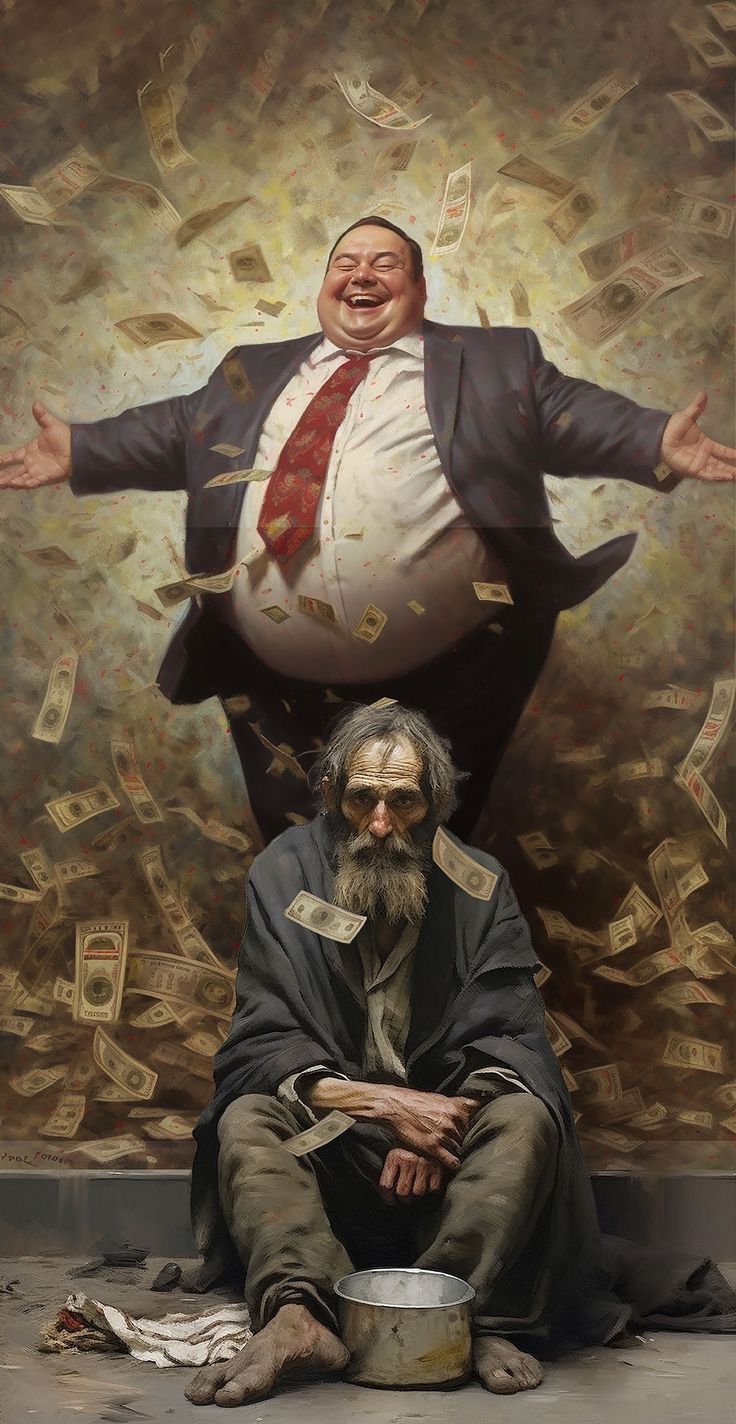


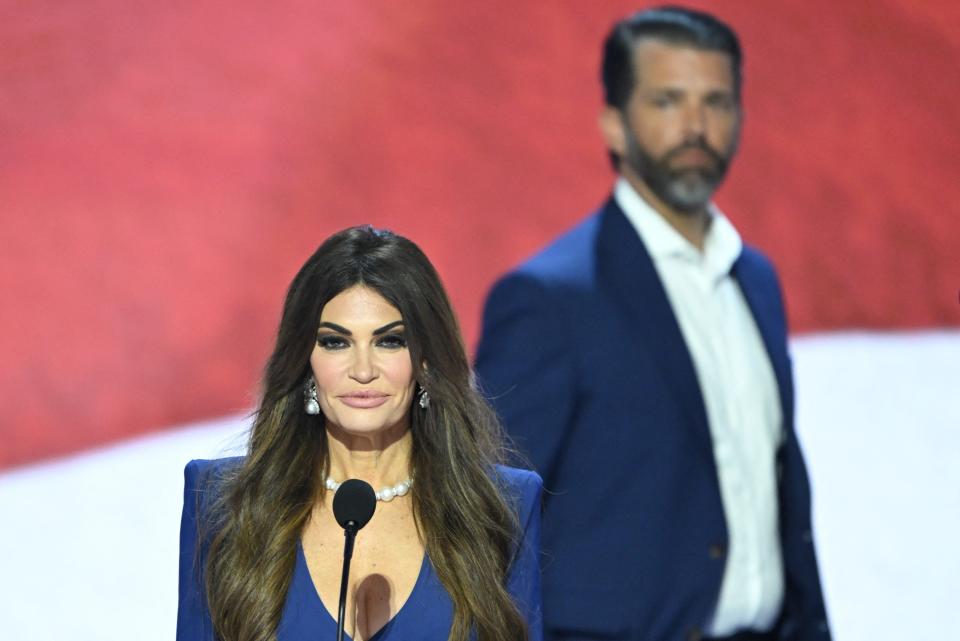

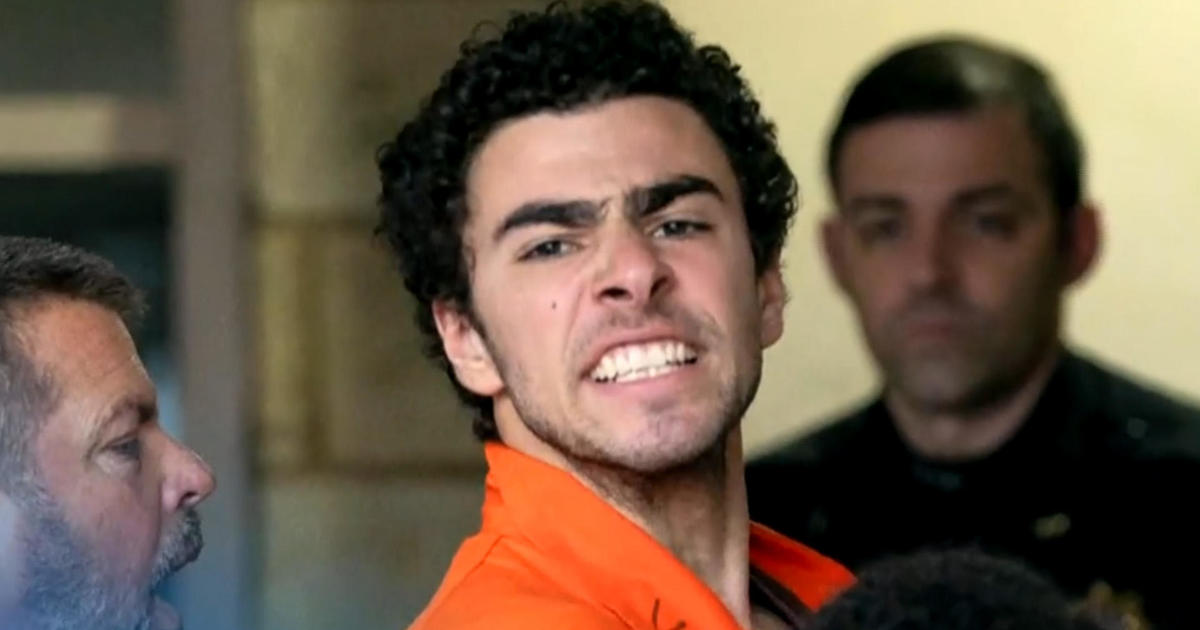

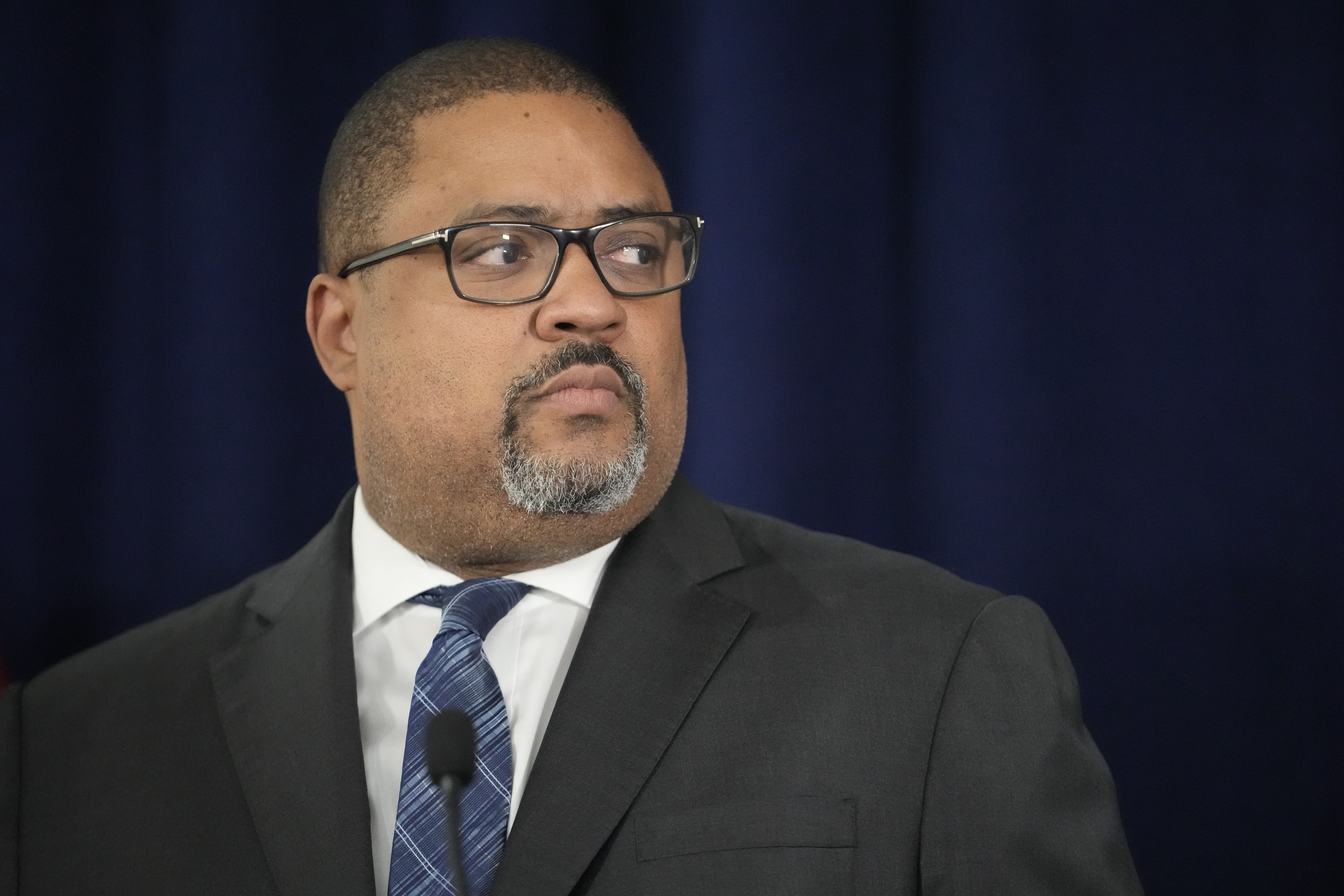
 President Sheinbaum immediately denied Trump’s characterization of their conversation. This headline from
 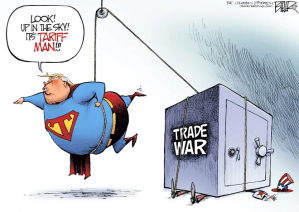 China and Canada were also blunt about DonOld’s mischaracterizations of his conversations with their leaders.
 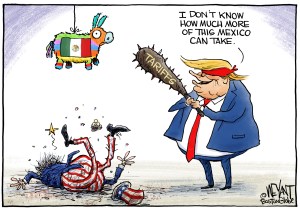 Businesses are already responding to the tariff threats. This will not be good for American Consumers.
  This is what happens when morons vote for a moron.
 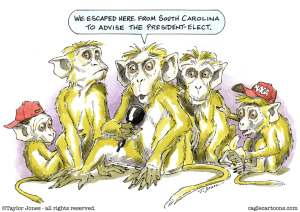 Marc Zuckerberg perfects his role as Surrender Monkey by dining with the Dotard at Mara Lardo.
 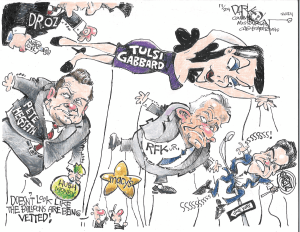 The Detroit Free Press
 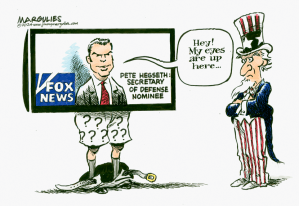 The American Prospect calls them “The Rape Gang.”
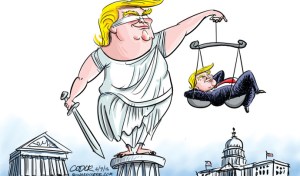 We definitely have a kakistocracy coming our way. We can see the incompetence, the total lack of knowledge of policy, and the complete inappropriateness of every candidate for Cabinet. It comes from the ultimate dotard. The only thing we have going for us now is our resolve and the fact that the Republican Majority in both Houses is narrow. Both houses have also had lots of experience in gumming up the works for Trump.
  There is a slim majority margin in the US House of Representatives. There is no mandate radical change there. This is from





 peej
peej Carissa
 bostonboomer
 dakinikat
 ecocatwoman
 mablue2
 Mama Lopez
 peggysue22
 quixote
 skydancingguestblogger
 Mona (aka Wonk the Vote)



 Sky Dancing
Recent Comments