
Saturday Reads
Posted: July 30, 2011 Filed under: A My Pet Goat Moment, Democratic Politics, Federal Budget and Budget deficit, George W. Bush, Medicaid, Medicare, morning reads, Republican politics, Social Security, Team Obama, U.S. Economy, U.S. Politics, Violence against women | Tags: 9/11, Ann Arbor, balanced budget amendement, Barack Obama, default, FBI, Federal debt ceiling, Fourth Turning, generations, George W. Bush, House of Representatives, John Boehner, Neil Howe, rape, revolution, Richard Nixon, Senate, sexual assault, University of Michigan, Watergate 30 Comments
Good Morning news junkies! I’m filling in for WonktheVote today. She is taking a little break from blogging, so Dakinikat, Minkoff Minx, and I are going to take turns doing the Saturday Reads for a little while. So what’s in the news today? Let’s see…
After his blow-up-the-economy plan passed the House yesterday, John Boehner gave a very defensive-sounding speech to justify his treasonous behavior.
A defiant House Speaker John Boehner (R-Ohio) late Friday defended his debt-ceiling plan by saying it is the only viable plan on paper so far….
“I’ve offered ideas, I’ve negotiated,” Boehner said in closing debate on his bill. “Not one time, not one time did the administration ever put any plan on the table. All they would do is criticize what I put out there.
“I stuck my neck out a mile to try to get an agreement with the president of the United States,” Boehner continued to grumbling among Democrats. “Hey, I put revenues on the table in order to try to come to an agreement in order to avert us being where we are. But a lot of people in this town can never say yes.”
He also defended including the ridiculous balanced budget amendment to the Constitution in his bill.
“It’s time for this to happen,” he said. “It enjoys support from both houses of this Congress, and it enjoys bipartisan and widespread support across our country.”
No. It doesn’t, Mr. Speaker.
A short time later the Senate put Boehner’s bill out of its misery.
Now what?
Despite a day of frenzied legislative maneuvering and another attempt by President Obama to rally public opinion behind some kind of compromise, the two parties made no visible progress in finding common ground, leaving Washington, Wall Street and much of the nation watching the clock toward a deadline of midnight Tuesday.
Reid has made some changes in his plan, hoping to appeal to Senate Republicans. The NYT didn’t elaborate on what these changes are. At Huffpo, Michael McAuliff and Sam Stein say Reid’s plan is now a lot like Mitch McConnell’s. But whatever its contents, Republicans in the House plan to hold a “symbolic vote” on it today in order to “send a message” that whatever the Senate agrees on will not pass the House.
These people are playing with fire. It’s looking like they’re not going to meet the August 2 deadline either.
The seemingly unbridgeable impasse between the two parties as the deadline for raising the nation’s debt limit approaches has Tom Daschle losing sleep, as he never did when he was a Senate Democratic leader in the mid-1990s and Congressional Republicans forced government shutdowns rather than compromise on spending cuts.
“That was nothing compared to this. That was a shutdown of the government; this could be, really, a shutdown of the entire economy,” Mr. Daschle said. “You can’t be too hyperbolic about the ramifications of all this.”
Democrats and Republicans with legislative experience agree that even if both sides decided Saturday to raise the $14.3 trillion borrowing ceiling and to reduce future annual deficits, it would be extremely difficult for the compromise measure to wend its way through Congress before Tuesday’s deadline, given Congressional legislative procedures.
But all signs point to August 2 passing with no budget bill. As we all know, President Obama could end the struggle at any time with an executive order, but then he’d have to put off gutting Social Security, Medicare, and Medicaid for a little bit longer. He can’t allow that, now can he?
Stay tuned…
There has been a disturbing string of sexual assaults on women in Ann Arbor, Michigan over the past two weeks. the assaults have taken place near the University of Michigan campus. There have been six attacks, two of which were rapes. In the others, women were grabbed and fondled, but managed to escape.
Two different composite sketches of the suspect have been developed. Police aren’t sure if there is just one perpetrator two. The FBI is now involved in the investigation.
The agency will be assisting Ann Arbor police at the city’s request, said FBI spokeswoman Sandra Berchtold. She did not provide any details about the agency’s role.
The six attacks occurred between July 15 and 26, and between the hours of 10 p.m. and 2 a.m. The victims were traumatized, said police spokeswoman Lt. Renee Bush.
Ann Arbor Police Chief Barnett Jones said he did not know if the attacks were linked. He warned in a letter to university staff, faculty and students that there was a “predator or predators operating in our community.”
Emily Zinn and her boyfriend were sleeping when one of the rapes took place right outside their apartment.
…an 18-year-old woman was pulled behind a wall outside Zinn’s bedroom window and raped on July 18.
She first noticed something was wrong when she and her boyfriend, Matt McAnelly, 24, a University of Michigan graduate student, heard the girl sobbing outside about 12:45 a.m.
“We heard a girl crying and ‘Help me, help me,’ ” Zinn said. “She was saying, ‘He left, I’m alone,’ so we didn’t really know what was happening.”
The couple heard nothing while the girl was being attacked.
This monster (or monsters) must be stopped ASAP.
Is the U.S. on the verge of a revolution?
On last night’s The Big Picture with progressive talk show host Thom Hartmann, author Neil Howe discussed how he and William Strauss came to accurately predict today’s political crisis in their 1997 book “The Fourth Turning,” and offered speculation as to what might happen next….
Speaking of the generational differences between today’s new guard and the retiring baby boomers, Howe said that cultural forces have essentially forced this crisis, with “culture warriors” and “values voters” in direct contention with “gen x” for control of the national budget.
“Are we on the verge of another ‘fourth turning’ — another major crash leading to a world war and a world-wide depression?” Hartmann asked.
“No,” Howe said. “I hope it won’t be bad. I hope the destructive will be avoided to the furthest extent possible and the constructive, which always comes out of a fourth turning… will be maximized.”
Watch it:
———————————————–
A judge has ordered the release of Richard Nixon’s grand jury testimony about the Watergate scandal.
U.S. District Judge Royce Lamberth granted a request by historian Stanley Kutler, who has written several books about Nixon and Watergate, and others to unseal the testimony given on June 23 and 24 in 1975.
Nixon was questioned about the political scandal during the 1970s that resulted from the break-in of the Democratic National Committee headquarters at the Watergate office complex in Washington….
Lamberth ruled in the 15-page opinion that the special circumstances, especially the undisputed historical interest in Nixon’s testimony, far outweighed the need to keep the records secret. Grand jury proceedings typically remain secret.
The Obama administration opposed the release of Nixon’s testimony. It figures, doesn’t it?
Finally, here’s a fascinating bit of historical revisionism from George W. Bush.
In a rare interview with the National Geographic Channel, Bush reflects on what was going through his mind at the most dramatic moment of his presidency when he was informed that a second passenger jet had hit New York’s World Trade Center.
Bush was visiting a Florida classroom and the incident, which was caught on TV film, and has often been used by critics to ridicule his apparently blank face.
But Bush claims he deliberately decided to stay in his seat so as not to alarm the children and to “project a sense of calm.”
“I had been in enough crises to know that the first thing a leader has to do is to project calm,” he added.
I wonder what “crises” he’s talking about? Just about the only thing he did as Governor of Texas was execute people. Let’s watch Bush’s demeanor on 9/11/2001 and see how well he projected “a sense of calm.”
——————————————
Here’s what one of the children who was in the classroom that day had to say about it:
“The president he just sat there, and his face — he just went dead,” says Jaimie, who was among the second graders in the classroom where President Bush learned of the terrorist attacks on Sept. 11, 2001.
Jamie’s one of the kids featured in Nickelodeon’s Linda Ellerbee news special, “What Happened?: The story of September 11, 2001,” which debuts Sept. 1.
That’s all the news I’ve got for today. What are you reading and blogging about?
Late Night: We Told You So — Hillary in 2012!
Posted: July 26, 2011 Filed under: 2012 presidential campaign, Barack Obama, Democratic Politics, Hillary Clinton, Medicaid, Medicare, Social Security, U.S. Economy, U.S. Politics, unemployment, voodoo economics, WE TOLD THEM SO | Tags: African American voters, Barack Obama, Bernie Sanders, Hillary Clinton, Michael Hudson, U.S. economy 2012 presidential election, U.S. Politics 24 Comments
Hillary in 2012! Yes, it’s still a pipe dream, but who else is there? Bernie Sanders came out and said it recently–it’s time to primary Obama or run a third party candidate. Again, I know it’s probably a fantasy, but what other choice do we really have?
For myself, I know I can never vote for Obama. At this point it’s really a moral issue for me. I couldn’t vote for him in 2008, and that was before I realize how truly horrible his presidency would be.
I knew he’d be bad, and I knew he was going to go after Social Security and Medicare. I didn’t know that he would completely ignore unemployment and refuse to use the power of government to create jobs.
I suspected he would carry on Bush’s wars. But I never suspected that he would defend torture and rendition or that he would claim the right to imprison or assassinate American citizens without probable cause or trial.
I don’t know how I can bring myself to vote for Romney either. He’s pretty much indistinguishable from Obama anyway. They are both cynical sellouts; neither has a real ideology or moral core.
Bernie Sanders said it straight out not too long ago:
…while appearing on Thom Hartmann’s radio show, Sen. Bernie Sanders (I-VT) — who, while being an independent, caucuses with the Democrats — said that one way progressives can make sure Obama does not enact huge cuts to major social programs is to run a primary challenger against him. Sanders told a listener who called in to protest a debt ceiling deal that cuts Social Security that such a challenge would be a “good idea”:
SANDERS: Brian, believe me, I wish I had the answer to your question. Let me just suggest this. I think there are millions of Americans who are deeply disappointed in the president; who believe that, with regard to Social Security and a number of other issues, he said one thing as a candidate and is doing something very much else as a president; who cannot believe how weak he has been, for whatever reason, in negotiating with Republicans and there’s deep disappointment. So my suggestion is, I think one of the reasons the president has been able to move so far to the right is that there is no primary opposition to him and I think it would do this country a good deal of service if people started thinking about candidates out there to begin contrasting what is a progressive agenda as opposed to what Obama is doing. […] So I would say to Ryan [sic] discouragement is not an option. I think it would be a good idea if President Obama faced some primary opposition.
Am I crazy? Look at what has been going on in Washington for the past few weeks. This debt ceiling fight is utter nonsense, and this President has shown no leadership whatsoever. For a long time, he completely cut Democrats out of the process and “negotiated” with John Boehner, Eric Cantor, and Mitch McConnell! He has put every treasured Democratic program on the table to be cut. Again and again, he has lied about the strength and solvency of Social Security and Medicare. Over at Naked Capitalism, liberal economist Michael Hudson documents Obama’s ugly lies:
You know that the debt kerfuffle is as staged as melodramatically as a World Wrestling Federation exhibition when Mr. Obama makes the blatantly empty threat that if Congress does not “tackle the tough challenges of entitlement and tax reform,” there won’t be money to pay Social Security checks next month. In his debt speech last night (July 25), he threatened that if “we default, we would not have enough money to pay all of our bills – bills that include monthly Social Security checks, veterans’ benefits, and the government contracts we’ve signed with thousands of businesses.”
This is not remotely true. But it has become the scare theme for over a week now, ever since the President used almost the same words in his interview with CBS Evening News anchor Scott Pelley.
Of course the government will have enough money to pay the monthly Social Security checks. The Social Security administration has its own savings – in Treasury bills. I realize that lawyers (such as Mr. Obama and indeed most American presidents) rarely understand economics. But this is a legal issue. Mr. Obama certainly must know that Social Security is solvent, with liquid securities to pay for many decades to come. Yet Mr. Obama has put Social Security at the very top of his hit list!
The most reasonable explanation for his empty threat is that he is trying to panic the elderly into hoping that somehow the budget deal he seems to have up his sleeve can save them. The reality, of course, is that they are being led to economic slaughter. (And not a word of correction reminding the President of financial reality from Rubinomics Treasury Secretary Geithner, neoliberal Fed Chairman Bernanke or anyone else in the Wall Street Democrat administration, formerly known as the Democratic Leadership Council.)
It is a con. Mr. Obama has come to bury Social Security, Medicare and Medicaid, not to save them.
Obama has destroyed the Democratic Party and he is in the process of destroying the U.S. economy and sending us into a prolonged depression. He has to go. Frankly, if we can’t replace him with a liberal Democrat, a Mitt Romney might actually be preferable for the same reason many of us reluctantly preferred McCain in 2008: it’s possible Democrats in Congress would put up a fight against a Republican who did the things Obama has done.
Recent polls show that Obama’s blatantly conservative policies are finally having and effect–his liberal base is falling apart. The latest Washington Post-ABC poll found that the President’s approval numbers on the economy are dropping fast.
More than a third of Americans now believe that President Obama’s policies are hurting the economy, and confidence in his ability to create jobs is sharply eroding among his base, according to a new Washington Post-ABC News poll.
The dissatisfaction is fueled by the fact that many Americans continue to see little relief from the pain of a recession that technically ended two years ago. Ninety percent of those surveyed said the economy is not doing well, and four out of five report that jobs are difficult to find. In interviews, several people said that they feel abandoned by both parties, particularly as debates over the debt ceiling gridlock Washington.
To me the most striking finding in this poll is that African American voters are losing faith in Obama’s handling of the economy and jobs.
the number of liberal Democrats who strongly support Obama’s record on jobs plunged 22 points from 53 percent last year to 31 percent. The number of African Americans who believe the president’s actions have helped the economy has dropped from 77 percent in October to just over half of those surveyed.
If African Americans are starting to see through Obama, he’s in trouble. How can he possibly win enough Independents to make up for the loss of African American votes? Sure, plenty of AA’s will still vote for him, but how many will end up staying home?
At the Top of the Ticket blog, Andrew Malcolm argues that Obama is trying to reach out to the “center,” and that his ridiculous speech last night was filled with code words to appeal to “independents.”
Using political forensics, notice any clues, perhaps telltale code words that reveal to whom he was really addressing his Monday message? Clearly, it wasn’t congressional Republicans — or Democrats, for that matter.
The nation’s top talker uttered 2,264* words in those remarks. He said “balanced approach” seven times, three times in a single paragraph.
That’s the giveaway. Obviously, David Plouffe and the incumbent’s strategists have been polling phrases for use in this ongoing debt duel, which is more about 2012 now than 2011. “Balanced approach” is no sweet talk for old Bernie or tea sippers on the other side.
Obama is running for the center already, aiming for the independents who played such a crucial role in his victorious coalition in 2008. They were the first to start abandoning the good ship Obama back in 2009 when all the ex-state senator could do was talk about healthcare, when jobs and the economy were the peoples’ priority.
Maybe, except Obama isn’t running to the center, he’s running to the right. In the debt limit “negotiations,” he is the one who put Social Security, Medicare, and Medicaid on the table. He has consistently pushed for even bigger cuts than the Republicans have. And Obama has done exactly nothing about jobs. He seems to have no interest in the issue at all. So how is he going to win “centrist” votes? Surely these centrists still care about Social Security and Medicare and surely they care about jobs. I just don’t buy that running further to the right is going to help Obama be reelected.
I’m probably going on too long in this post, so I’ll wrap it up. I’ll end with a bit of Glenn Greenwald’s piece in reaction to the recent polls:
approval ratings is only one of many barometers of a President’s standing with his base — and, at least in Obama’s case, almost certainly not the most important one. It’s completely unsurprising that the vast majority of Democrats and even “liberals” — when presented with the dichotomous approve/disapprove choice by a pollster regarding their own party’s President — will choose “approve”; that, in essence, is little more than a proxy for declaring one’s tribal identity (which of the two sides are you on?). But what propelled the Obama campaign in 2008 was not merely the number of people willing to vote for him but, rather, the intensity of his support.
It’s one thing to be willing to go vote for a candidate on Election Day (or, more accurately, against the other candidate); it’s another entirely to be willing to donate scarce money, canvass and evangelize, and infuse the campaign with passion and energy. That many liberals will still be willing to do the former notwithstanding their dissatisfaction does not mean they will do the latter. That level of progressive commitment to Obama’s candidacy was vital to his victory in 2008, and its absence could be crippling in 2012 (a dependency on Wall Street cash even greater than 2008 can only take one so far). Wasn’t that one obvious lesson of 2010: the central role base enthusiasm plays in election outcomes?
So what is to be done? I don’t know, but I do know that there isn’t another potential candidate with the stature of Hillary Clinton. Is it just a pipe dream? What do you think? Is there any chance at all that Hillary might step in as Ted Kennedy did (admittedly unsuccessfully) against Carter in 1980? Are there any other possible candidates that could pull it off?
Try Boehner and Cantor for Treason? What about Obama?
Posted: July 25, 2011 Filed under: Barack Obama, Democratic Politics, Medicaid, Medicare, Republican politics, Social Security, U.S. Economy, U.S. Politics, voodoo economics | Tags: 14th amendment, Barack Obama Abe Lincoln, Eric Cantor, Federal debt limit, full faith and credit, John Boehner, Sky Dancers, Tea Party, U.S. Treasury 40 Comments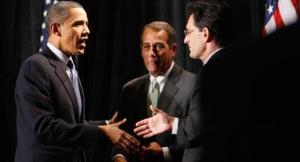
Are Sky Dancers cutting edge or what? Nearly two weeks ago, Dakinikat asked whether our government leaders could be charged with treason over the debt ceiling debacle.
Now David Seaman, a blogger at Business Insider argues that Boehner and Cantor are committing treason by catering to a small number of Tea Partiers’ demands while making the U.S. look weak and unreliable to the rest of the world.
I don’t know of a single American business owner or executive who thinks default — economic armageddon — should be on the table, and yet Republicans are acting as if Americans consider this a viable option.
Sadly, it’s already too late: although we still have time to get a deal before the August 2nd hard deadline, this is the equivalent of shoving a check under your landlord’s door at 11:59 p.m. You’ve lost his trust, even if you are technically not in default.
Enough disgusting dramatics to please your small Tea Party base — we are a nation of more than 300 million; the Tea Party is a handful of folks with racist signs, radical agenda, and the favor of a few influential bookers at Fox News.
On Boehner and Cantor:
John Boehner — a full-grown man who cries in public for rhetorical affect (or maybe he’s that imbalanced, I don’t know)… Eric Cantor — a disgusting attention-seeker who doesn’t realize he is one of the country’s actual leaders, and not merely a commentator on a political morning show.
At this point, Americans should be calling for both of their heads. We need to keep an eye on such “leaders” and ensure that they and their kind are not re-elected to Congress. They don’t represent any of us. And their childish Tea Party views — which have no basis in sound economic theory — are making us look like fools to our international partners.
Seaman also points to this column by John Avlon at CNN, “Our stupid self-inflicted debt crisis.”
…if America defaults on its debt, not only will we find ourselves in a far deeper fiscal hole, but the full faith and credit of the United States will be compromised. In our globalized era, that means America will be considered an unpredictable partner and a second-class power.
Worst of all, this will be a self-inflicted wound. It is a direct result of the hyper-partisanship that has been hijacking America’s political debates. Now it is compromising our ability to govern ourselves effectively.
The markets are viewing Washington’s debt dysfunction as badly as Standard & Poor’s and Moody’s, which have raised the possibility of downgrading their ratings of U.S. bonds.
The British government’s business secretary, Vince Cable, summed up the situation as he saw it on the BBC this weekend: “The irony of the situation at the moment, with markets opening tomorrow morning, is that the biggest threat to the world financial system comes from a few right-wing nutters in the American Congress.”
Avlon blames the mess on “hyper-partisanship,” but the problem as I see it is that the Democratic side–especially our Reagan-adoring President–is showing no partisanship at all, just rushing to cave in to every Republican demand. After all, Obama could quickly resolve this situation, as Daknikat pointed out yesterday, by “invoking the 14th Amendment.”
At FDL, David Dayen points out, rather sarcastically, that Obama “has options to raise the debt limit.” He could tell Congress to vote on the debt limit and hold the arguments about cuts and taxes till later, as Elizabeth Drew suggested at Politico. Alternatively, Dayen says he could turn to the 14th amendment. Obama has so far dismissed this possibility.
Finally, Dayen points to an article in Friday’s NYT by two conservatives.
PRESIDENT OBAMA should announce that he will raise the debt ceiling unilaterally if he cannot reach a deal with Congress. Constitutionally, he would be on solid ground. Politically, he can’t lose. The public wants a deal. The threat to act unilaterally will only strengthen his bargaining power if Republicans don’t want to be frozen out; if they defy him, the public will throw their support to the president. Either way, Republicans look like the obstructionists and will pay a price….
Our argument is not based on some obscure provision of the 14th amendment, but on the necessities of state, and on the president’s role as the ultimate guardian of the constitutional order, charged with taking care that the laws be faithfully executed.
When Abraham Lincoln suspended habeas corpus during the Civil War, he said that it was necessary to violate one law, lest all the laws but one fall into ruin. So too here: the president may need to violate the debt ceiling to prevent a catastrophe — whether a default on the debt or an enormous reduction in federal spending, which would throw the country back into recession.
A deadlocked Congress has become incapable of acting consistently; it commits to entitlements it will not reduce, appropriates funds it does not have, borrows money it cannot repay and then imposes a debt ceiling it will not raise. One of those things must give; in reality, that means that the conflicting laws will have to be reconciled by the only actor who combines the power to act with a willingness to shoulder responsibility — the president.
Abe Lincoln did it, but Obama claims he can’t? Seaman, Avlon, and Vince Cable so far are holding their fire on Obama’s role in this embarrassing mess. But he is the one who is ultimately responsible for maintaining the full faith and credit of the U.S. Treasury. That credit has already been harmed by Obama’s failure to act decisively.
I’d say it’s high time to begin impeachment proceedings against this President, or failing that, Democrats should find someone to run against him in the 2012 primaries. This nonsense has gone on long enough. Yes, I understand that Obama wants to gut Social Security, Medicare, and Medicaid, but the Republicans aren’t going to accept a deal when it’s blatantly obvious that they still can get more from this President–he’ll cave on anything. Either Obama needs to get a grip and do the right thing for once, or he needs to find a job he can handle and let someone else lead the United States of America.
Today’s Deadline Passes With No Progress: Now What?
Posted: July 24, 2011 Filed under: Democratic Politics, Economy, legislation, Medicare, Republican politics, Social Security, Surreality, the villagers, U.S. Economy, U.S. Politics, voodoo economics, We are so F'd | Tags: Asian markets, Barack Obama, Catfood Commission II, Federal debt ceiling, Grover Norquist, Harry Reid, John Boehner, kabuki, markets, Mitch McConnell, Nancy Pelosi, Super Congress, the dollar, Wall Street 19 Comments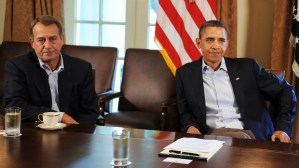
Late last night I wrote a post summarizing what happened yesterday in seemingly endless debt ceiling kabuki dance that is being staged for our benefit by people who are supposed to be serving us but instead answer to Wall Street, Big Oil, Big Pharma, and the rest of the filthy rich.
Last night John Boehner told House Republicans that they needed to show some progress today in order to calm the Asian markets. After weeks of assuming the politicians in Washington would work something out in order to keep the US from defaulting on its debts, the banksters were suddenly realizing there is a good chance the feckless “leaders” will just go ahead and let it happen.
Apparently both Democrats and Republicans see this debt ceiling debacle as a golden opportunity to strip Americans of what is left of their social safety net. The only disagreement seems to be that Democrats want to include a pretense of raising some revenue along with all the cuts to social programs and Republicans want no new revenue sources, apparently because they see an opportunity to bring Grover Norquist’s dream to fruition:
Norquist favors dramatically reducing the size of the government. He has been noted for his widely quoted quip: “I don’t want to abolish government. I simply want to reduce it to the size where I can drag it into the bathroom and drown it in the bathtub.”
He has also stated, “Cutting the government in half in one generation is both an ambitious and reasonable goal. If we work hard we will accomplish this and more by 2025. Then the conservative movement can set a new goal. I have a recommendation: To cut government in half again by 2050”. The Americans for Tax Reform mission statement is “The government’s power to control one’s life derives from its power to tax. We believe that power should be minimized.”
So what was accomplished in today’s kabuki performance? Did the Republicans meet Boehner’s goal of sending a calming signal to Asian markets before their Monday opening. No, of course not.
From The New York Times: Deadline Passes as Debt Ceiling Talks Languish
House Speaker John A. Boehner and the Senate majority leader, Harry Reid, were preparing separate backup plans to raise the nation’s debt ceiling on Sunday, after the leaders were unable to end an increasingly grim standoff over the federal budget.
The dueling plans emerged as lawmakers appeared to miss a self-imposed deadline of 4 p.m. Eastern time to cut a deal before markets open in Asia. And at about 6 p.m., President Obama began meeting with Mr. Reid and the House Democratic leader, Nancy Pelosi, in the Oval Office to discuss the Reid proposal.
Not surprisingly, nothing new seems to have emerged from the talks at the White House. But here’s Harry Reid’s supposed “plan.”
Mr. Reid, the Senate’s top Democrat, was trying Sunday to cobble together a plan to raise the government’s debt limit by $2.4 trillion through the 2012 election, with spending cuts of about $2.5 trillion. He would seek to avoid cuts to entitlement programs, but it was unclear how those savings would be achieved.
Notably, the plan does not currently contain any new or increased taxes, an approach that many in his caucus would probably balk at.
For his part, John Boehner is still blabbing on about the Republicans ridiculous “cut, cap, and balance” plan.
Speaker John Boehner (R-Ohio) told his colleagues in a Sunday afternoon conference call that a debt deal with Obama is not the way forward. He said on the call that a plan that “reflects the principles” of the conservative “Cut, Cap and Balance” proposal that the Senate rejected will serve as the model for any legislation coming out of the House. The speaker, though, did acknowledge that the plan itself is a non-starter.
“So the question becomes – if it’s not the Cut, Cap and Balance Act itself – what can we pass that will protect our country from what the president is trying to orchestrate,” Boehner said, according to a source familiar with the call.
Boehner and Majority Leader Eric Cantor (R-Va.), according to several sources on the call, implored his colleagues to “stick together” to enact a budget deal that they can support. Boehner said an agreement “will require some of you to make sacrifices.” He told his colleagues that they shouldn’t worry about winning the battles, but rather the war, according to a source on the call.
I found this piece at Huffpo helpful, although I’ve never heard of the author, Mohamed el-Erian. CEO and co-CIO, Pacific Investment Management Company. Perhaps Daknikat has? Here’s what he had to say after the supposed deadline passed without any progress.
Friday’s stunning and very public quarrel between the president and the Speaker of the House of Representatives was the catalyst for a weekend of frantic negotiations on how to increase America’s debt ceiling, maintain the country’s sacred AAA rating, and avoid a near-term default. Meanwhile, administration officials and members of Congress took to the airwaves on Sunday trying, but largely failing, to strike the balance between statesmanship and another round of the Washington blame game.
It was hoped that all this would serve as a prelude to a political compromise announced just before the opening of Asian markets. This did not materialize. But while another self-imposed deadline has been missed, it is likely that the nation’s leadership will stumble into a short-term compromise over the next few days — one that raises the debt ceiling and avoids a debt default but, importantly, leaves the AAA rating extremely vulnerable and does little to lift the damaging clouds hanging over the US economy.
It will come down to the wire; and when the stopgap compromise is reached, many in Washington will declare victory and, in the process, claim credit for averting a national disaster. Yet the resolution will likely be temporary, and the damage will be real and long-lasting — both of which render an already worrisome situation even more difficult going forward. Indeed, by illustrating so vividly to the whole world what is ailing America, the weekend’s political theatrics should make us all worry even more about the world’s largest economy.
It’s an interesting article. Obviously our “leaders” have already done immense damage to our struggling economy, not just with their wrongheaded policies, but also with their childish game-playing.
Boehner’s plan right now seems to be to insist on a short-term temporary increase in the debt limit of about $1 trillion
accompanied by spending cuts of at least as much, tying the remainder of the debt-ceiling increase Obama has requested to further cuts in the future. The White House says Obama would veto such a measure.
The markets responded quickly:
U.S. stock futures fell, indicating the Standard & Poor’s 500 Index will slump after rallying within 1.4 percent of a three-year high, as failure to raise the federal debt limit intensified concern of a default.
The contract on the S&P 500 Index expiring in September declined 1.2 percent to 1,325.50 at 7:01 a.m. in Tokyo. The U.S. dollar fell against the euro, yen and Swiss franc.
[….]
The dollar weakened to $1.4390 per euro as of 6:01 a.m. in Tokyo from $1.4360 in New York at the end of last week. The greenback fell to 78.35 yen, and touched a four-month low of 78.12 yen, from 78.54 on July 22. It fetched 81.17 Swiss centimes from 81.92 last week after reaching a record low 80.33 on July 18. The yen traded at 112.75 per euro from 112.77.
I don’t pretend to understand all that gibberish, but I know it isn’t good.
The Wall Street Journal says the markets are “bracing for volatility as debt ceiling debate drags on.”
What really scares me is what is going on behind all the “partisan” kabuki. Let’s face it, Democrats are no more our friends than Republicans at this point. We simply can’t trust any of them. I wrote a few days ago about the Catfood Commission II clause that is included in the so-called McConnell plan–the fallback plan that Harry Reid is on board with. Apparently Boehner has also latched onto this idea, and the sequel to the Catfood Commission will also be included in whatever legislation the Republicans come up with.
Ryan Grim has a piece in Huffpo today about Catfood Commission II, which he characterizes as a “Super Congress.”
Debt ceiling negotiators think they’ve hit on a solution to address the debt ceiling impasse and the public’s unwillingness to let go of benefits such as Medicare and Social Security that have been earned over a lifetime of work: Create a new Congress.
This “Super Congress,” composed of members of both chambers and both parties, isn’t mentioned anywhere in the Constitution, but would be granted extraordinary new powers. Under a plan put forth by Senate Minority Leader Mitch McConnell (R-Ky.) and his counterpart Majority Leader Harry Reid (D-Nev.), legislation to lift the debt ceiling would be accompanied by the creation of a 12-member panel made up of 12 lawmakers — six from each chamber and six from each party.
Legislation approved by the Super Congress — which some on Capitol Hill are calling the “super committee” — would then be fast-tracked through both chambers, where it couldn’t be amended by simple, regular lawmakers, who’d have the ability only to cast an up or down vote. With the weight of both leaderships behind it, a product originated by the Super Congress would have a strong chance of moving through the little Congress and quickly becoming law. A Super Congress would be less accountable than the system that exists today, and would find it easier to strip the public of popular benefits. Negotiators are currently considering cutting the mortgage deduction and tax credits for retirement savings, for instance, extremely popular policies that would be difficult to slice up using the traditional legislative process.
So basically, no matter what legislation Congress ends up passing to raise the debt ceiling, this “Super Congress” will be included. We certainly can’t expect any disagreement on this from Obama who, as Grim describes it “has shown himself to be a fan of the commission approach to cutting social programs and entitlements.”
We are so utterly f&cked.
What is John Boehner Up To Now?
Posted: July 23, 2011 Filed under: 2012 presidential campaign, Democratic Politics, Republican politics, U.S. Economy, U.S. Politics, voodoo economics, We are so F'd | Tags: Barack Obama, Federal debt ceiling, Harry Reid, John Boehner, Mitch McConnell, Nancy Pelosi, Standard and Poor's, U.S. Credit rating 20 Comments
Bloomberg reports that John Boehner
told Republican lawmakers they need to provide a positive signal on a plan to avert a U.S. default before Asian financial markets open tomorrow, Republican congressional aides said.
Boehner wants at least $3 trillion in spending cuts in a two-step plan to accompany an increase in the U.S. debt limit, one of the aides said. Treasury Secretary Tim Geithner warned President Barack Obama and congressional leaders during a White House meeting today of a possible reaction by Asian markets, said an official familiar with the meeting.
Did what Geithner said light a fire under Boehner or is he getting pressure from other sources–like Wall Street donors?
The markets could be tumultuous if a plan isn’t negotiated over the weekend, said Christian Cooper, head of U.S. dollar derivatives trading in New York at Jefferies & Co.
“The markets will be under very real pressure at the open because the assumption will be there is really no resolution to this,” Cooper said. “The breakdown in negotiations has crossed the line from the political posturing of the last few weeks to potentially a very real crisis.
“The Tea Party is effectively playing Russian roulette with the bond market and they will, with certainty, lose,” Cooper said. Jefferies is one of 20 primary dealers that trade with the U.S. Federal Reserve.
So suddenly the drop dead day is no longer August 2, but tomorrow?
Derek Thompson of the Atantic wrote today that “Dave Beers, director of the sovereign debt division at S&P” told him that S&P is losing faith in the ability of Washington politicians to agree on anything.
“The debt ceiling is not the central preoccupation that we have,” Beers told me this afternoon. “We put the United States on credit watch because we’re growing less certain that this political debate can be resolved. This was not merely about the debt ceiling.”
What about other AAA-rated sovereigns, like France and Canada, who also have high debt burdens? “They all have a strategy that went through the political process, and we think those strategies are credible,” he said. “The problem with the U.S. is that there is no strategy. There is a debate about what the strategy would be. But there’s nothing close to a consensus. If consensus isn’t possible now, when will that be?”
Basically the kabuki nonsense that has been going on for weeks now between President Obama and House and Senate Republicans has already done serious damage to the U.S. credit rating. These guys look like fools to the rest of the world, and we all know the reason for the continuing game playing is that Obama actually wants massive cuts–especially in social programs. Anyone who is paying attention knows that now, even though Obama is still trying to put the blame on the Republicans, he owns this mess.
There is every sign at this point that Congressional leaders on both sides have decided the President just isn’t going to lead on this, and they have decided to work something out without him.
And, to emphasize responsibility now lies with Congress, Boehner and the congressional held their own meeting at the Capitol Saturday evening.
Pelosi and Reid left the meeting with Boehner and McConnell after less than an hour, retreating to Pelosi’s office across statuary hall in the Capitol. The two Democratic leaders refused to answer repeated questions from reporters. McConnell returned to the Senate side of the Capitol minutes later.
On Friday evening the Speaker announced that he was ending on-again-off-again talks with the White House with only days remaining before the Aug. 2 deadline when the U.S. will exceed its borrowing authority.
After a meeting in the White House with Obama, Harry Reid, and Nancy Pelosi, Boehner
told his colleagues that any deal will be a product of congressional leadership – not a compromise struck with the White House, the Republican source said, noting that “strategically not working with the president, but with the Senate could be better for him.”
Boehner was backed up by Democratic leaders Reid and Pelosi, when he said to Obama, “Mr. President, I need to deal with the House and the Senate because we [the White House and Congress] aren’t getting anywhere,” the source said.
Very interesting. It’s also interesting to note that Eric Cantor was not at that meeting this morning. Has Boehner decided to clip Cantor’s wings? We haven’t seen or hear much from him for the past few days.
Sam Stein at Huffpo is reporting that
House Speaker John Boehner (R-Ohio) is set to call the Democratic Party’s bluff on the debt ceiling. The Ohio Republican, in a briefing with his conference on Saturday, announced that he would press for a short-term deal, with major spending cuts paired with longer-term deficit-reduction strategies, as a way around the current impasse.
That strategy puts the speaker directly at odds with the White House and allied Democrats, who have insisted for weeks that they would not support a short-term extension of the debt ceiling.
Actually, Obama already waffled on that, but other Democratic leaders seem determined that whatever deal they reach will carry through the 2012 election. So how serious can Boehner be if he still plans to play chicken on the short-term/longer-term-deal issue?
There are lots more stories out there tonight speculating about what will happen tomorrow. What kind of “positive sign” does Boehner plan to send to Asian markets? Will it convince the ratings agencies not to downgrade U.S. Credit. Will there be a massive sell-off of U.S. Treasury bonds (Our resident expert, Dakinikat, already dumped hers).
I know it’s late, but I thought I’d put all this out there, since tomorrow could be a big day for news on the debt ceiling kabuki fight. Dakinikat told me that Tim Geithner will be making the rounds of the Sunday shows tomorrow. Maybe we’ll learn something from those shows for a change. Stay tuned….

 peej
peej Carissa
 bostonboomer
 dakinikat
 ecocatwoman
 mablue2
 Mama Lopez
 peggysue22
 quixote
 skydancingguestblogger
 Mona (aka Wonk the Vote)



 Sky Dancing
Recent Comments