
Mostly Monday Reads: He cannot Tell the Truth
Posted: August 31, 2026 Filed under: "presidential immunity", #FARTUS, #We are so Fucked, Climate Change, Data Centers, Disappearing Constitutional Rights, Environmental Protection, Follow the Money, Governor Lousyana Whore Landry, Israel/US and Iran War, SpaceX, Tech Bro's favorite Lousyana Whore/Governor, Tech Bros and Environmental Murder, Tech Bros are killing us, Trump AI War propaganda | Tags: Data Centers, SpaceX, Trump's AI generated war, Trumps Cherry Tree Slaughter 3 Comments
“George Washington, he ain’t. “John Buss, @repeat1968
Good Day, Sky Dancers!
How can you spend a springtime in the District without marveling over Cherry Blossom season? How do you repeatedly ignore the history and laws of the most historically significant places in the country? Orange Caligula, narcissist supreme, has done it again. This happened a few days ago. No one stopped him. He has a long history of destroying things only to replace them with something disgusting. The Jackie Kennedy Rose Garden and the Oval Office were only the beginning. He ignores we, the people and the law.
This was the CNN headline. “Par for the course: Trump forging ahead with DC golf course makeover without input from oversight agencies.” Sunlen Serfaty has the lede. The man is an international menace. No living thing is safe with him alive.
Whenever President Donald Trump gets an idea for a major project or renovation in Washington, DC, a pattern has emerged: move forward and ask questions later.
Public sagas over Trump’s proposed “triumphal arch,” the East Wing ballroom construction and the Lincoln Memorial Reflecting Pool renovation have followed this playbook – provoking outcry and numerous legal challenges.
Now, the greenways of a manmade peninsula just south of the National Mall is next on Trump’s quest to remake the nation’s capital in his style, and they’re poised to be made over in a way that’s par for the course for this president.
The administration is on track to push ahead with turning the 300-acre East Potomac Park and its public golf course into a championship course without first getting approvals from two key agencies that have oversight of DC public spaces.
Neither the National Capital Planning Commission nor the Commission on Fine Arts have received any golf course plans from the Trump administration to review, officials from both told CNN. Neither agency meets in August, and ground is supposed to be broken by the start of the following month.
And based on what has been publicly reported, a project of this complexity and ambition would typically require months of regulatory reviews to examine environmental impact, questions over historical preservation, planning and design, the officials at each agency said.
On Friday, the administration provided a federal judge overseeing a legal challenge to the project with new information about the venture. It included a disclosure that the government did not finish testing soil from the demolition of the East Wing that was deposited onto the golf course before deeming it was safe.
The revelation opens the door to allowing plaintiffs to question administration officials under oath.
The DC Preservation League and two local golfers are pressing US District Judge Ana Reyes to issue an order that would bar the Trump administration from moving ahead.
Critics worry that proper approvals and legal battles have hardly handicapped the president before.
“There is really this ability to ignore regulatory guardrails, rules and protocols that have existed in the past. And we just see it again and again, and the golf course, sadly, is yet another example of that,” said Charles Birnbaum of the Cultural Landscape Foundation, which has filed lawsuits against several other Trump projects.
Those historic trees plus others could be removed to make way for Trump’s plan to turn the public East Potomac Golf Links into a “championship” venue capable of hosting major tournaments such as the PGA Championship and Ryder Cup.

No one ever stops this pathetic, destructive, personality disorder-ridden man. The warnings were clear back on July 13th. He just won’t ever do the right thing, work through the process, or listen to anyone. This article is from back on July 13. It’s from a local Ohio paper, the Ohio Capital Journal, and somehow, none of this reached the establishment national media covering our sicko president. Now, it’s too late. Acres of beautiful, mature cherry trees gifted by Japan are gone.”President Taft descendant, former Ohio Gov. Bob Taft, slams Trump plan to devastate D.C. cherry trees.” Alan Johnson reports the story.
A plan that threatens some historic Washington, D.C., cherry trees to make way for President Donald Trump’s planned golf course is “very unfortunate,” said the great-grandson of William Howard Taft who received the Japanese trees more than a century ago.
“I don’t understand the idea of a championship golf course near the nation’s capital. There are already world-class golf courses there,” said former Ohio Gov. Bob Taft, who served from 1999 to 2007. He is the great-grandson of William Howard Taft, the 27th president.
“Now is not the time to devastate cherry trees that have an important role as part of the cultural alliance between the United States and Japan … It’s very concerning.”
Taft, a Republican as is Trump, is an avid outdoorsman and golfer. He said chopping down cherry trees is an afront to his family heritage and a threat to the beauty of Washington as an international tourist attraction.
“They are a United States institution,” Taft said. “People from all over the world come to the Cherry Blossom Festival.”
Cherry trees were given by the Japanese to former President Taft and his wife, Nellie, who had ambitions to beautify the nation’s capital. She admired the flowering trees when her husband was the presidentially appointed Governor General of the Philippines.
The plan would also eliminate a riverside bike trail and other public recreation areas. Trump toured the course June 28 with government officials and golf course planners. The project could begin as early as Sept. 1.
The Ohio connection to the threatened Japanese cherry trees goes back to 1912-1913 when 3,020 saplings from the banks of the Arakawa River in a Tokyo suburb were planted along the Tidal basin.
 He’s willing to destroy everything and everyone to make it all about him. At the top of his list is making sure a lot of us can’t vote. This is from today’s New York Times. I’m no longer surprised but will be forever appalled. More Mail Ballots Are Arriving Late This Cycle, and They’re Getting Tossed. State officials say they worry about the Postal Service’s ability to deliver votes this fall. They are urging voters to mail their ballots early or use drop boxes so their votes count.” We’re a Banana Republic.
The rate at which mail votes have been rejected for arriving late has ticked up in primaries this year and general elections last year in roughly a dozen states, prompting election officials to worry that the U.S. Postal Service is ill-equipped to deliver ballots in the fall midterms.
The states studied by The New York Times include some of the most critical battleground House and Senate seats where control of Congress will be determined, as well as key races for governor and secretary of state. The Times obtained data from California, Colorado, Maine, Maryland, Michigan, Nebraska, New Jersey, Pennsylvania, Utah, Virginia, Wisconsin and Washington.
In Wisconsin, which hosts an open race for governor, a competitive House election plus contests for both chambers of the state legislature, lateness accounted for about 5,000 rejected mail ballots in the spring primary this year, or 78 percent of all tossed ballots. During the last spring election, in 2023, the figure was roughly 2,300, or 47 percent of all tossed votes.
The increase is particularly striking when comparing primaries in 2024 and this year. In Michigan’s primary earlier this month, more than 10,000 mail ballots were rejected for arriving after the state’s deadline of 8 p.m. on Election Day. That is nearly double the number of ballots rejected in 2024. In Washington, the number of late-arriving mail ballots increased from about 16,000 to more than 20,000 in the same period.
The rise in rejected ballots comes at a time of immense upheaval at the Postal Service, where a budget crisis has prompted widespread complaints about delivery delays. The increase also comes as President Trump and his allies are trying to transform the 251-year-old agency into a central player in their quest to restrict mail voting and otherwise overhaul the nation’s elections.
 I can feel this in my backyard, as there’s been a huge push to actually shut down my local post office. There are next to no Republicans in my ward and precinct. It’s basically a neighborhood with many black, GLBT, and single women like me. I can understand why they’d like my massive blue dot in a blue city to get as little ability to vote as possible.
Meanwhile, back in pathological liar land, The Independent had this headline that could only happen under Orange Caligula. “Trump’s fake AI video of Kharg Island ‘attack’ leaves US military scrambling to explain President’s very realistic AI slop video, posted to his official Truth Social account, forces Pentagon to step in with a denial.” Andrew Feinberg has the story.
The Defense Department was forced on Monday to deny the U.S. had struck Iran’s main petroleum export facility after President Donald Trump posted a fake but very realistic AI-generated video showing a purported attack by American forces.The video, posted to the president’s Truth Social account, appears to show oil storage tanks and refineries erupting in flames from the perspective of someone filming from inside a helicopter above the carnage, with an accompanying message describing the scene as “Kharg Island being blown to smithereens” and signed as “President DJT.”
But a U.S. official said no such attack had taken place, with Kharg Island not being among the locations targeted overnight in what has been the first exchange of fire between American and Iranian forces in weeks.
Additionally, the head of National Iranian Oil Co, Hamid Bovard, said on Monday that the president’s post was “laughable” and described conditions on Kharg Island as “calm and appropriate.”
Trump — whose White House has repeatedly stated that his Truth Social posts count as official statements from the commander in chief — also hit out at Iran again in a separate Truth Social post on Monday, writing that it was “officially a Failed Nation” and “DEAD.”
“They have no Navy, they have no Air Force, they have no currency, they are not paying their soldiers or police, Inflation is at 300%, and their leadership is in total disarray and incapable of properly representing the country. The only thing they have is FAKE NEWS from the USA, a willingness to kill their protesters (now over 100,000 people dead,” he said.
Iranian media outlets did report explosions near Larak Island in the Strait of Hormuz, where an American official said Tehran had been preparing to launch mine-laying rockets as part of the country’s bid to choke off the key waterway and hamstring the American economy in response to Trump’s war, which has now passed the half-year mark without end in sight.
Here’s an FYI.

President Donald Trump on Monday again championed the spread of data centers despite growing bipartisan backlash ahead of the midterms in November.
In a post to Truth Social, the president insisted data centers will lead to richer, more successful Americans and criticized those who object to them.
“The only reason that communities throughout the U.S.A. should not want Data Centers is if they want to end up being backwards and poor,” Trump said. “If we kill the Golden Goose, you will only have yourselves to blame.”
Texas GOP Gov. Greg Abbott this month instituted new regulations on data centers despite expressing broad support for them over the last year on the campaign trail. Michigan Republican Senate nominee Mike Rogers and Pennsylvania GOP nominee for governor Stacy Garrity have both urged for a temporary halt to some projects.
But Trump, who has met with some of the world’s leading tech giants on numerous occasions, is adamant that data centers are critical to staying ahead of China in the artificial intelligence race — a point he made in a recent interview with his former fixer Michael Cohen and which he reiterated on Monday.
“China could not be happier with this anti Data Center movement. Actually, they can’t believe it is happening!”
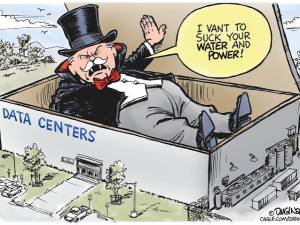 If only we were following China’s example. This is from Wired. “China Opens World’s First Wind-Powered Underwater Data Center. With an initial capacity of 24 megawatts, the innovative data center uses seawater as a natural cooling system.”
China has become the first country in the world to operate an underwater data center, or UDC, powered by wind. Located off the coast of Shanghai, the complex represents a significant advance in the country’s strategy to secure energy supplies in the face of the accelerated growth of artificial intelligence, reduce dependence on fossil fuels, and reduce the environmental impact of its technology infrastructure.
The initiative is the result of a collaboration between private company HiCloud Technology and state-owned China Communications Construction, which involved an investment of 1.6 billion yuan, equivalent to about $236 million.
With an initial capacity of 24 megawatts, the facility is submerged at a depth of 10 meters in the Lin-gang Special Zone, within the China Pilot Free Trade Zone in Shanghai. This location allows seawater to be used as a natural cooling system, reducing the proportion of energy used to cool the infrastructure to less than 10 percent.
This feature solves one of the main energy consumption challenges of conventional data centers, where air conditioning systems typically account for 40 to 50 percent of the total electricity required to operate.
The thermal efficiency of the UDC is directly reflected in its power-usage effectiveness, or PUE. This metric is used by the industry to evaluate the energy performance of a data center; 1.0 represents the maximum theoretical efficiency. In its first phase, the Lin-gang facility is designed to achieve a PUE of no more than 1.15, a figure considered state-of-the-art within the industry.
Under this same cooling principle, HiCloud opened the world’s first commercial underwater data center in 2023 in Hainan, an island located in southern China. However, the Shanghai complex marks a milestone as the first to operate using offshore wind power.
Construction of the UDC was completed in mid-October last year. According to the Chinese government, “compared to traditional onshore data centers, the project is designed to use more than 95 percent green electricity, reducing energy consumption by 22.8 percent, and water and land use by 100 percent and more than 90 percent, respectively.”
 The difference is that China isn’t trying to kill off its people and natural resources and it’s not relying on fossil fuels which are dirty, nasty, require fracking, and kill off living things. Trump also doesn’t want any regulation on the damn things. Here’s some information on that from The New Republic. “This Data Center Is Everything That Everyone Hates About AI. Utah’s Stratos Project is showing how everyone loses in the unregulated rush to build these Big Tech behemoths—even investors.” Luke Barnes has the analysis.
Big Tech firms are now keenly aware of the need for their data centers to have at least some environmental protections and community considerations built into development plans. Microsoft, for instance, announced its “Community-First” AI infrastructure plan in January 2026, shortly after it was forced to cancel a proposed data center in rural Wisconsin. The plan calls for covering the grid and electricity costs its data centers create, minimizing and replenishing local water use, and paying its full share of local property taxes rather than seeking the tax breaks data centers typically negotiate. OpenAI has called for significant investment in renewables to help modernize the U.S. electrical grid and make data center build-out more sustainable, while Anthropic has pledged to cover the grid infrastructure improvements and electricity cost increases that are generated from the data centers it uses.
These actions from both big business at one end and state actors at the other are a recognition of the problem. But they are the inverse of the kind of investment that the Stratos Project represents: rushed ad hoc investment on one side of the coin, and reactive ad hoc regulation on the flip side.
What’s more, both actors have fundamental limitations. Data centers are a footloose industry, meaning if one state is deemed to be overregulating, investors can easily shop for a friendlier jurisdiction. And while Big Tech firms might talk a good game, they are also subject to severe market pressures that could make them put their plans for equitable, environmentally friendly data centers on the back burner.
What’s needed is a concrete set of enforceable federal standards that can slow down the ad hoc gold rush in favor of equitable (and ultimately faster) long-term build-out. But here, the Trump administration is doing the exact opposite. In its July 2025 executive order, the White House moved to ease regulatory burdens on data centers costing at least $500 million, while compressing review windows and streamlining environmental evaluations meant to identify those burdens, and saying nothing about the water consumption or community frustration driving the backlash.
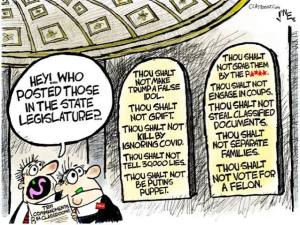 Lousyana is the perfect example of how not to let your crazy Republican Governor go wild on these things. We now not only have an AI center in process. We have a SpaceX project that will likely ruin the ecosystem and lives of people living on and near the Gulf of Mexico. We are so fucked it’s not even funny. One month ago, this showed up in the New York Times. (I’ve gifted the links, btw.) “How Meta Got Everything It Wanted in a Secret Louisiana Data Center Deal. A Times examination details how the Silicon Valley giant used private talks with local officials to start a project big enough to cover nearly six square miles.”
Mr. Turner had helped land the largest development in Louisiana’s history: a $50 billion data center for the Silicon Valley giant Meta that planners say could cover about six square miles and use seven times as much energy as New Orleans.
Meta wanted the rebate to build its data center in Richland Parish, an impoverished farming community in Louisiana’s northeast corner. The tech company also needed a secret deal done quickly, and state officials were eager to oblige.
Rewriting the bill was a critical part of a nine-month process that Meta used to cut deals behind the scenes, avoid local opposition and offload financial risk, according to interviews with more than 40 people and a review of corporate filings, tax records, property records and meeting transcripts.
The secrecy was agreed to by nearly everyone involved, from utility executives to the governor’s office to a local elected official who knew about the talks with Meta and sold 300 acres of his own property for the project.
The upshot was a deal that was nearly ironclad for Meta because everyone else took on most of the potential downside. Mark Zuckerberg, Meta’s chief executive, also gave his company an escape hatch to get out of it years before its partners.
Those partners include Entergy Louisiana, the state’s largest power company, and Blue Owl, a Wall Street investment firm, according to public statements from the companies and investor documents. If Meta should pull out of the project because of a natural disaster, Blue Owl and its investors could be stuck with tens of billions of dollars in debt. Should Meta exit its lease early for other reasons and pay high penalties for doing so, Entergy and its customers could wind up saddled with higher costs.
Adding to their risk, insurance companies would not fully insure Meta’s facility because of its size and location in the Louisiana Delta flood plains.
The New York Times’s examination shows for the first time how Meta used secrecy and speed to pave the way for its giant project, which it calls Hyperion. At a pivotal moment for the A.I. boom, Hyperion could be a blueprint for other companies intent on avoiding local opposition in order to get massive data centers built fast.
Google, Amazon, Microsoft and others are expected to spend more than $1 trillion on data centers in coming years, but some communities are pushing back because they are worried about water use, higher electricity rates, disruption by construction and the endless hum of giant computing centers running throughout the night.
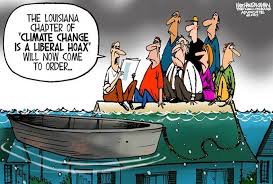 We’ll not be the Sportsman’s Paradise between that and the Musk project. All living thing are likely to perish in the parish at this rate. Landry is a mini Trump and very much a part of the brotherhood of sociopaths. This is from The Hill. “Louisiana governor ‘not concerned’ about environmental impact of Gulf Coast SpaceX facility.”
Louisiana Gov. Jeff Landry (R) brushed aside fears Wednesday morning about possible negative environmental impacts from SpaceX’s planned $100 billion launch facility in the state.
He told CBS News on Wednesday that he was “not concerned about the environmental impact” of the new spaceport, which will be constructed along the Gulf Coast on a former Exxon property in Vermilion Parish, La.
“What I am concerned about is the lack of economic opportunity on the coast that continues to basically rob us of opportunities to rebuild our coast,” the governor said.
The spaceport will be the company’s fourth and largest launch site, and it will serve as the main facility for Starship, SpaceX’s in-development reusable rocket launch system.
SpaceX got into hot water over its operations at its first launch site in Boca Chica, Texas.
In 2024, the Texas Commission on Environmental Quality found that the company violated environmental regulations by repeatedly releasing pollutants into nearby bodies of water.
This followed an earlier warning by the Environmental Protection Agency Region 6 office, which oversees Texas, that SpaceX violated the Clean Water Act with these actions.
Elon Musk’s company said in a statement that it was committed to working with federal and state agencies and conservation groups “to protect shoreline, restore wetlands, and support the wildlife and recreation that depend on them” in Louisiana.
And if any one believes Musk will do that I have several bridges over the Mississippi River I’d like to sell you.
So, I end with this thought. WE ARE SO FUCKED.
What’s on your Reading, Action, and Blogging list today?

 peej
peej Carissa
 bostonboomer
 dakinikat
 ecocatwoman
 jjlo
jjlo mablue2
 Mama Lopez
 peggysue22
 quixote
 skydancingguestblogger
 Mona (aka Wonk the Vote)



 Sky Dancing
Recent Comments